
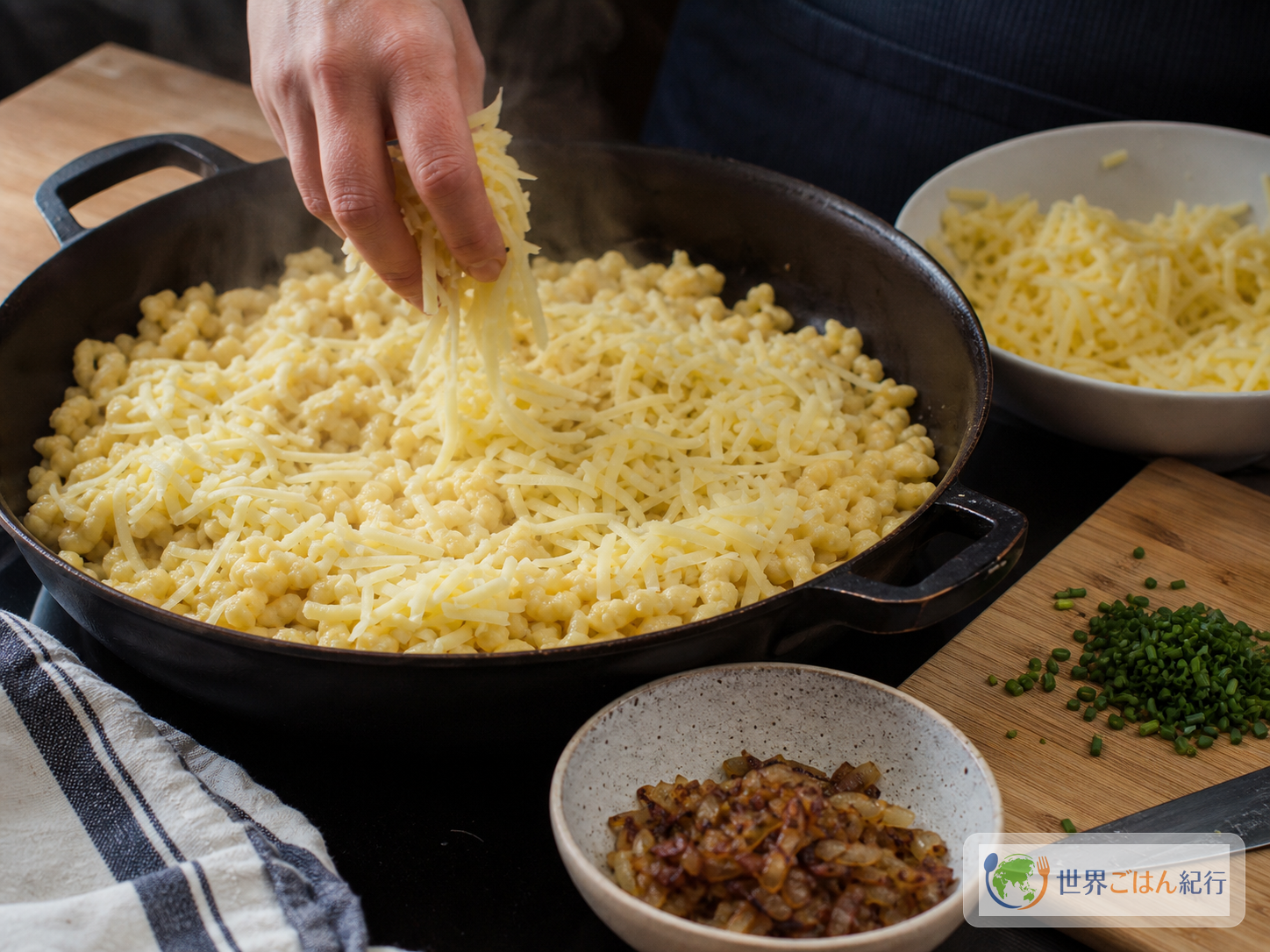
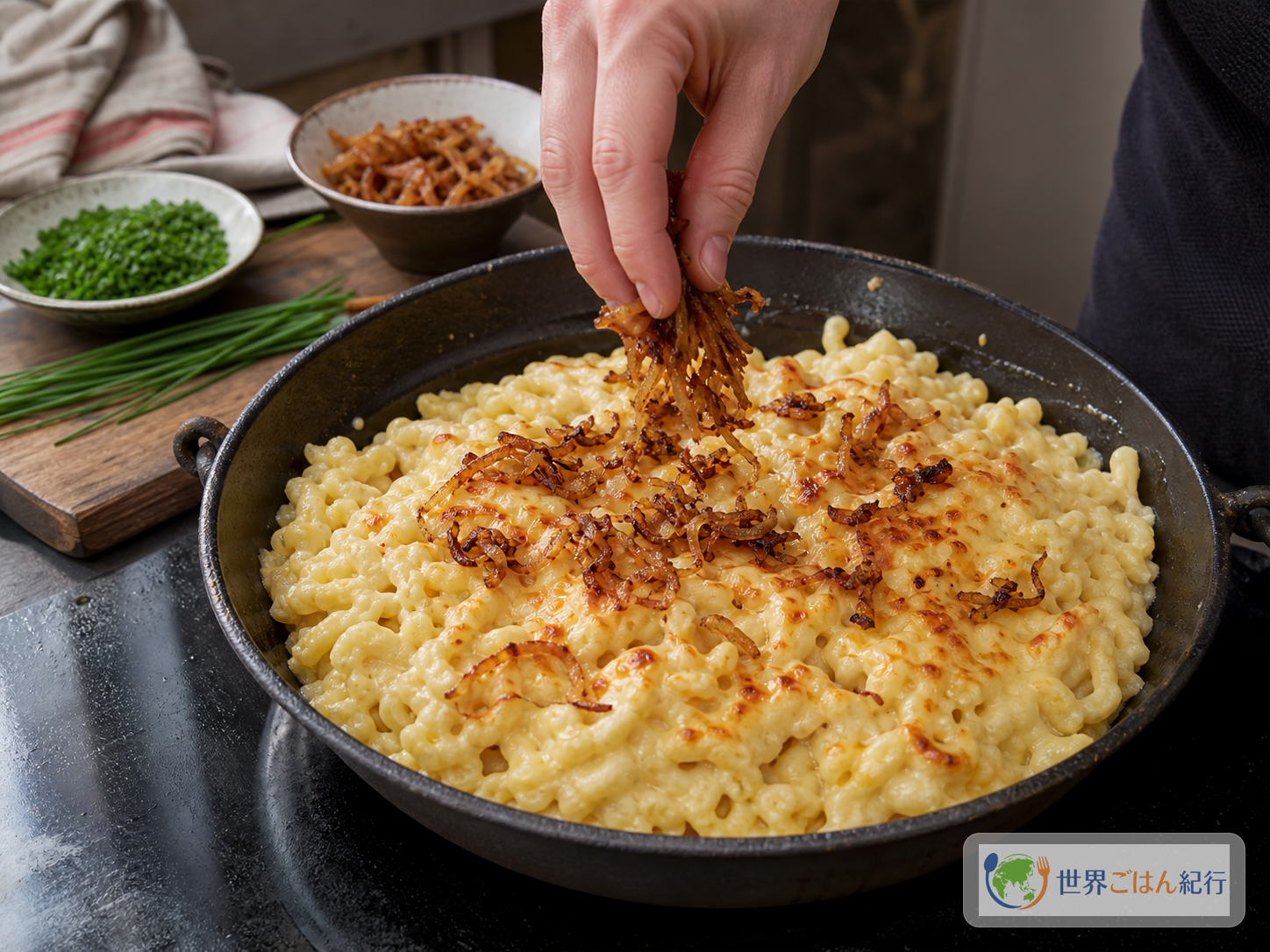
In the sweet steam of onions, short noodles take center stage
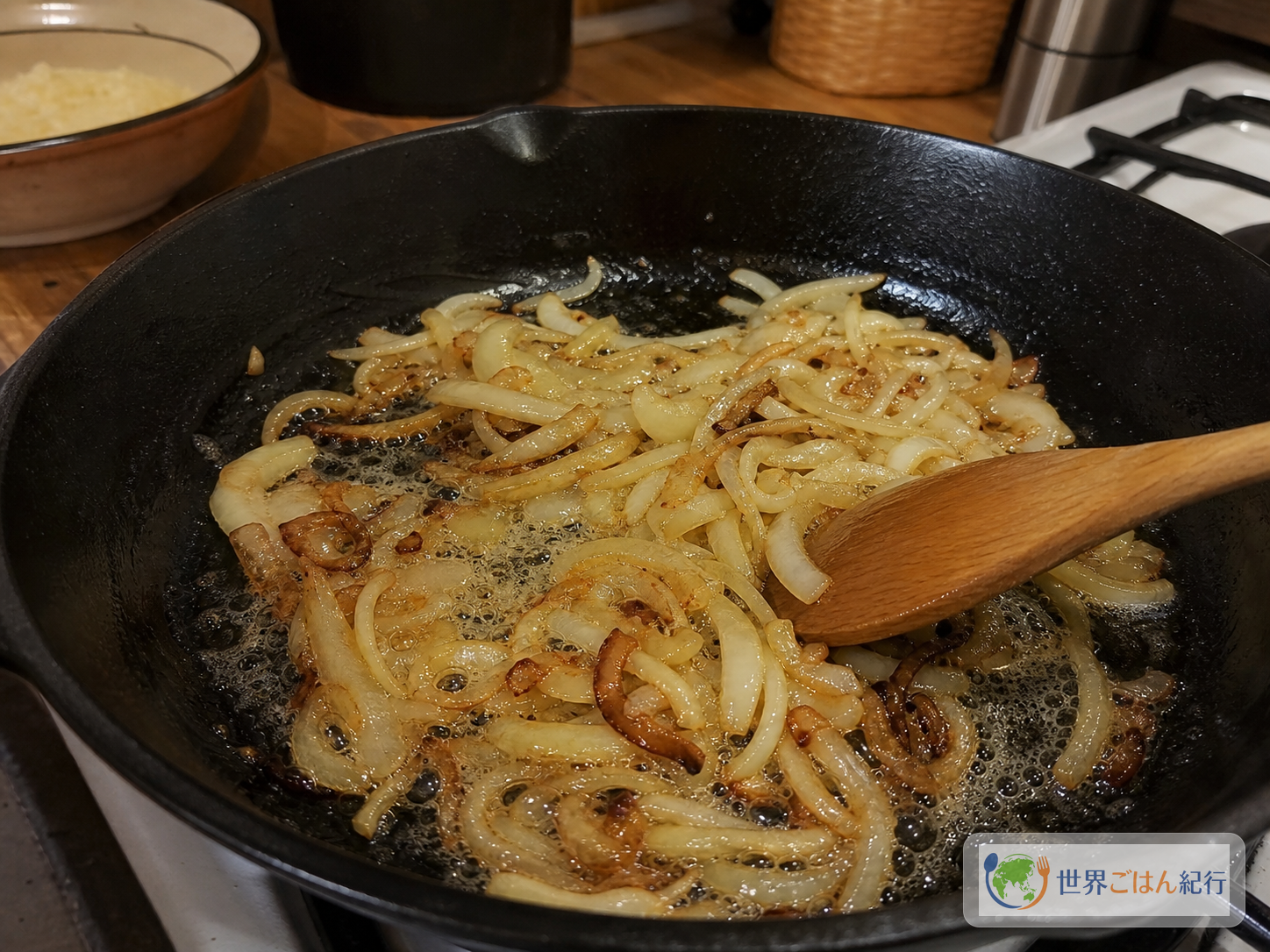
When onions hit butter in the pan, the bubbles are quiet at first, and a few minutes later the smell turns sweet. Then come freshly boiled spätzle, grated cheese and a splash of cooking water. Each turn of the wooden spoon pushes cheese between the short noodles, and the aroma of browned dairy rises from the bottom of the pan.
Käsespätzle (also Kässpätzle) is a dish of short egg noodles and cheese loved in Swabia and the Allgäu in southern Germany, as well as in western Austria and German-speaking Switzerland. In the Allgäu it is sometimes called Kässpatzen, and it's commonly described as a combination of mountain cheese, browned onions and a green salad eaten alongside.
Outside the region, the hard part isn't the name but the ingredient choices. Do you need a spätzle maker? Which cheese should you use? If you can't find the local Bergkäse, how far can you substitute? This article centers on a short homemade spätzle shaped with a colander or slotted spoon, mixes cheeses that melt differently, and lightens the richness with browned onions and a salad.
The same spätzle, paired with beef broth, becomes a hearty noodle soup like Gaisburger Marsch (in Japanese). Käsespätzle doesn't go into a soup; it's a dish where the heat of the cheese binds the noodles together. Compared with Slovakia's bryndzové halušky (in Japanese), it puts the sweet aroma of browned onions and mountain cheese up front rather than tangy sheep's cheese.
Käsespätzle means "cheese spätzle." Calling it Allgäuer Kässpatzen signals the mountain cheeses typical of the Allgäu. Schwäbische Spätzle / Schwäbische Knöpfle are registered as a protected geographical indication in the EU; this home recipe does not claim to be a product made in that region, but treats the structure of the dish as something to re-create in a home kitchen.
Ingredients (serves 4)
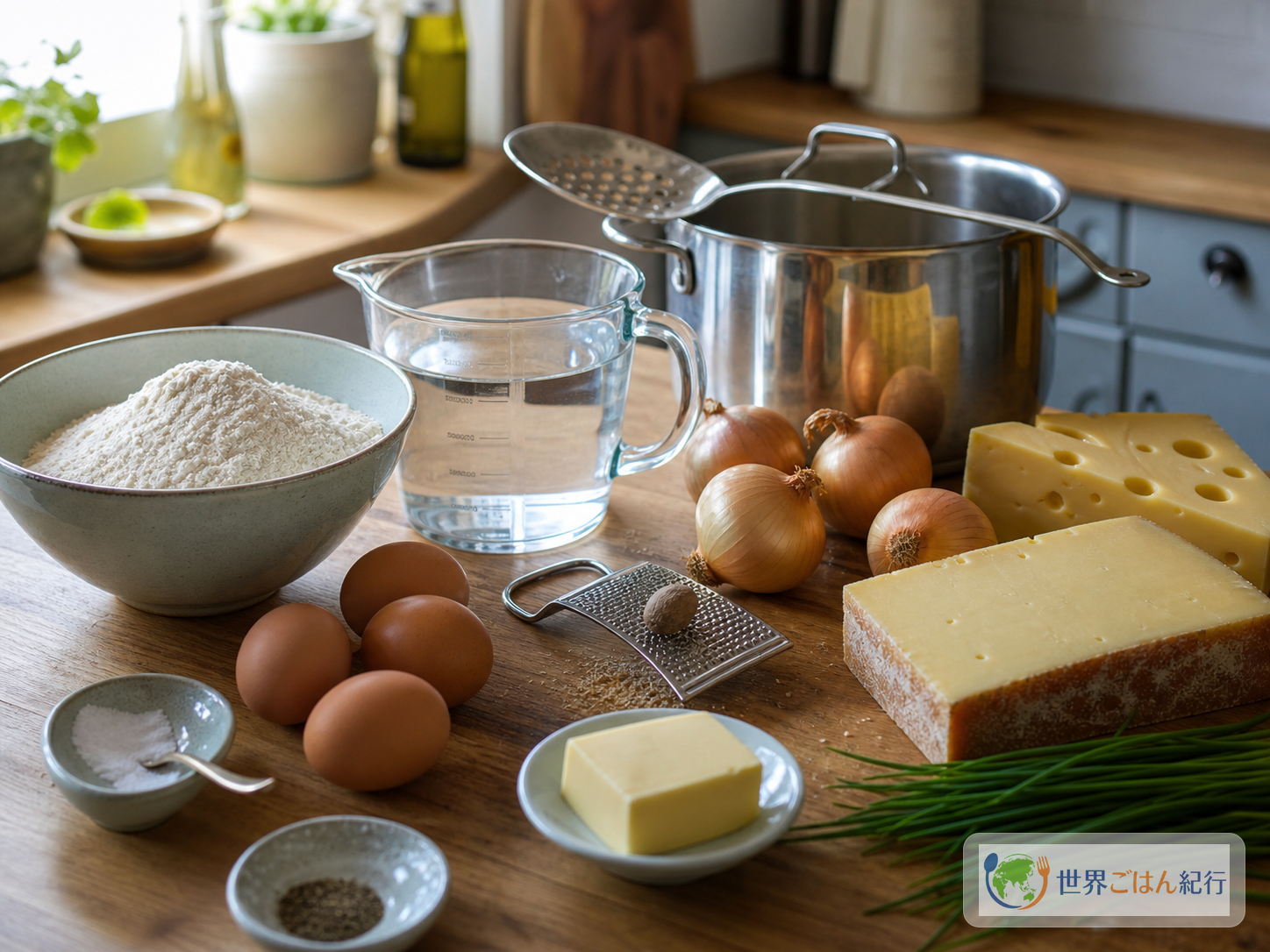
This serves 4. It's portioned as a main starch, so for a lighter dinner, serve more salad. Rather than relying on one cheese, mixing a strongly flavored cheese with one that melts easily makes it easier to bring together in a home skillet.
This dish contains wheat, egg and dairy. Heating cheese does not remove its allergens. Cook the egg batter thoroughly in the boiling water and lift it out about 1 minute after it floats. Don't leave the finished dish at room temperature for long; move leftovers to a shallow container and refrigerate within 2 hours.
What's worth thinking about when shopping
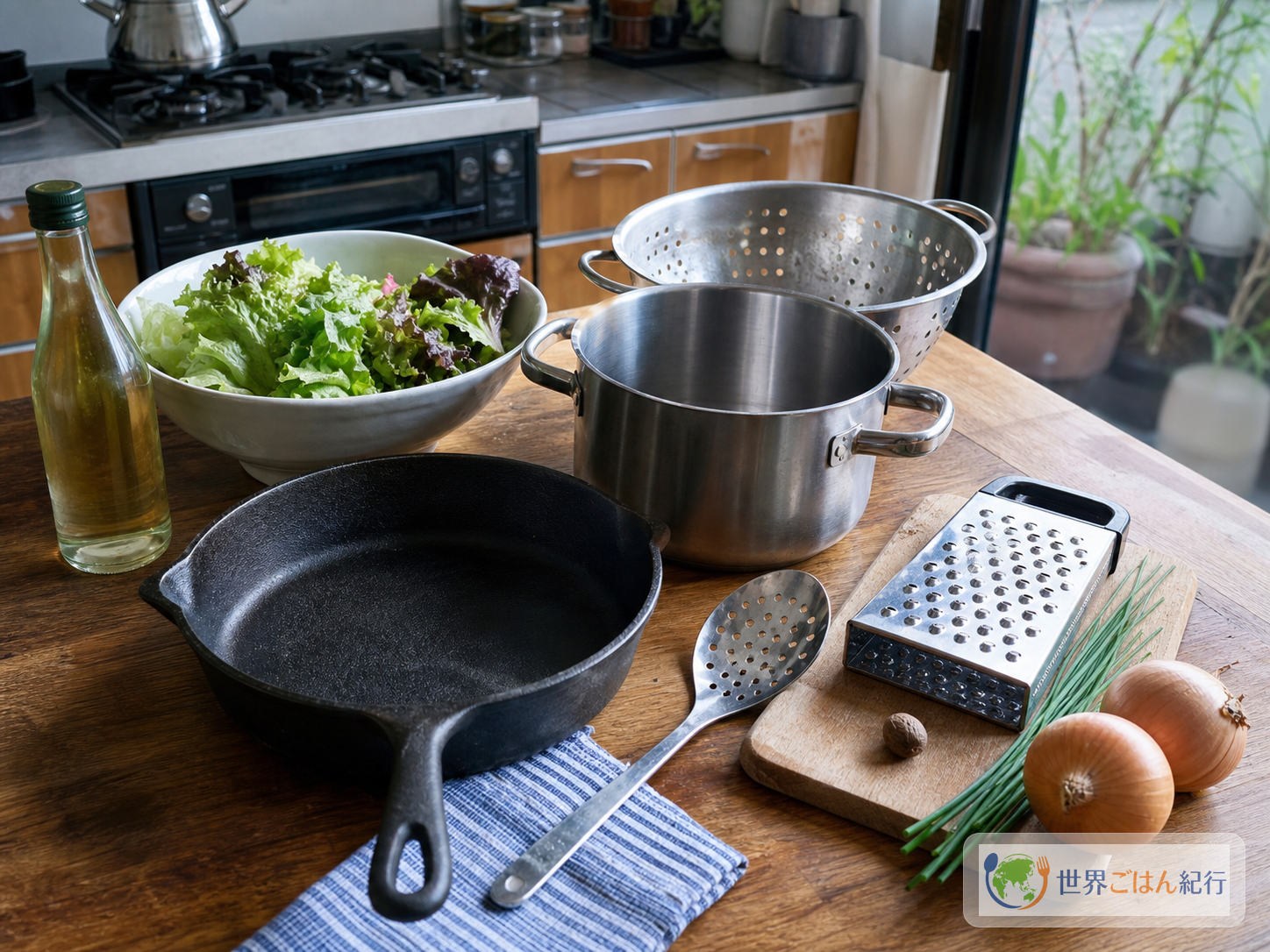
Flour, eggs, onions, cheese and greens are everyday shopping. Beyond those, what helps is a heavy pot that holds plenty of water, a skillet that can brown the finished dish, and white wine vinegar to make the rich cheese noodles easier to eat.
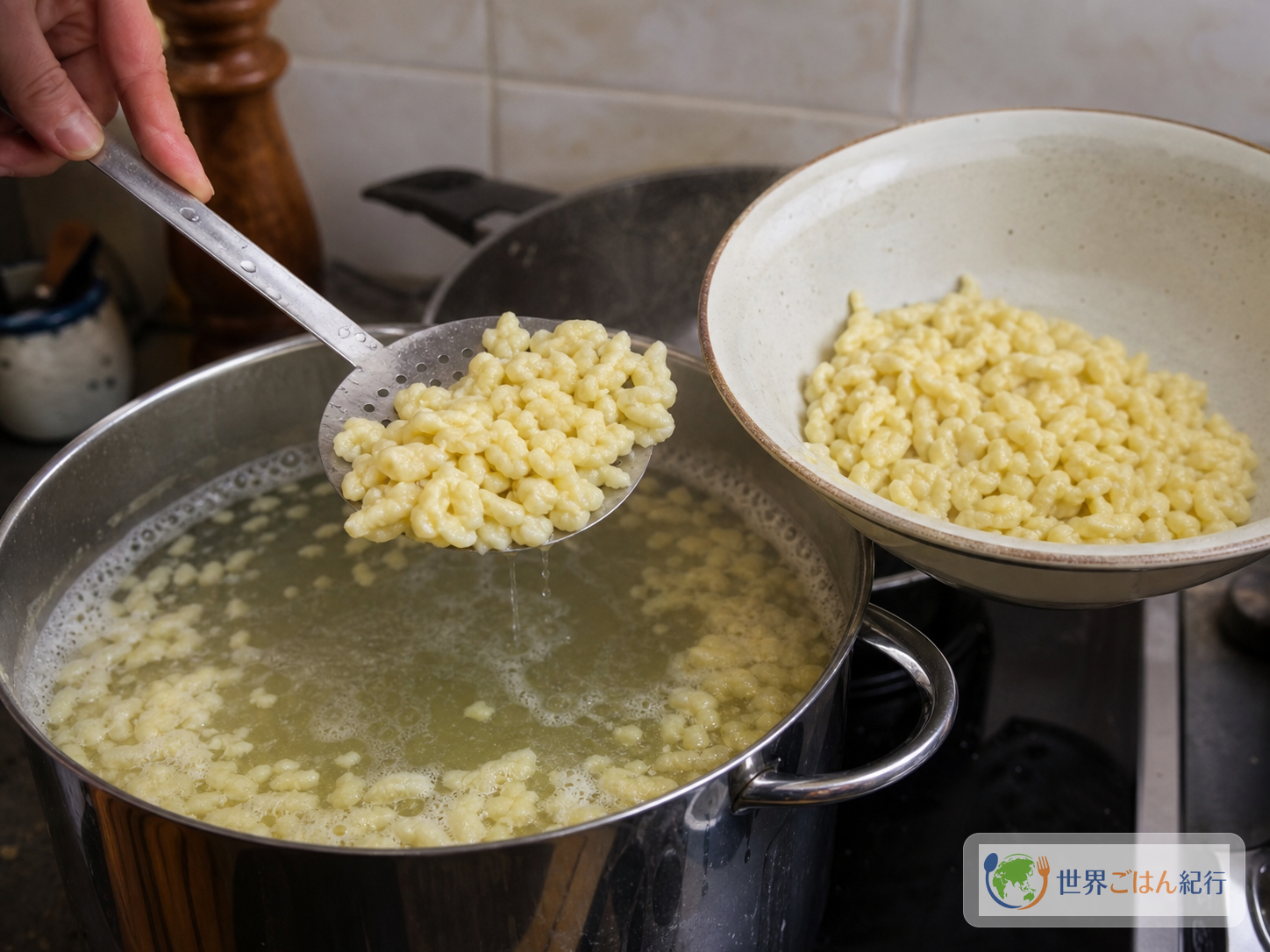
Boiling spätzle in 2 L of water keeps the temperature from dropping too far the moment you add the batter. In a thin or small pot, the first batch may be fine, but from the second batch on the water turns cloudy and the noodles stick together more easily. For 4 servings, a heavy pot around 22 cm (9 inches) across is easy to handle.
A pan with a stable base makes finishing the browned onions and cheese easier. You can make it in a nonstick pan, but when you want a thin crust on the sides at the end, iron or cast iron builds more aroma. A skillet also goes straight to the table, which suits this dish well.
To eat it the way it's eaten locally, don't let the sweet cheese noodles stand alone; put tangy greens alongside. A white wine vinegar salad earns its place here. The vinegar also works for the cabbage dish Bayrisch Kraut (in Japanese), so if you plan to keep cooking German food, a bottle is easy to use up.
How to make it
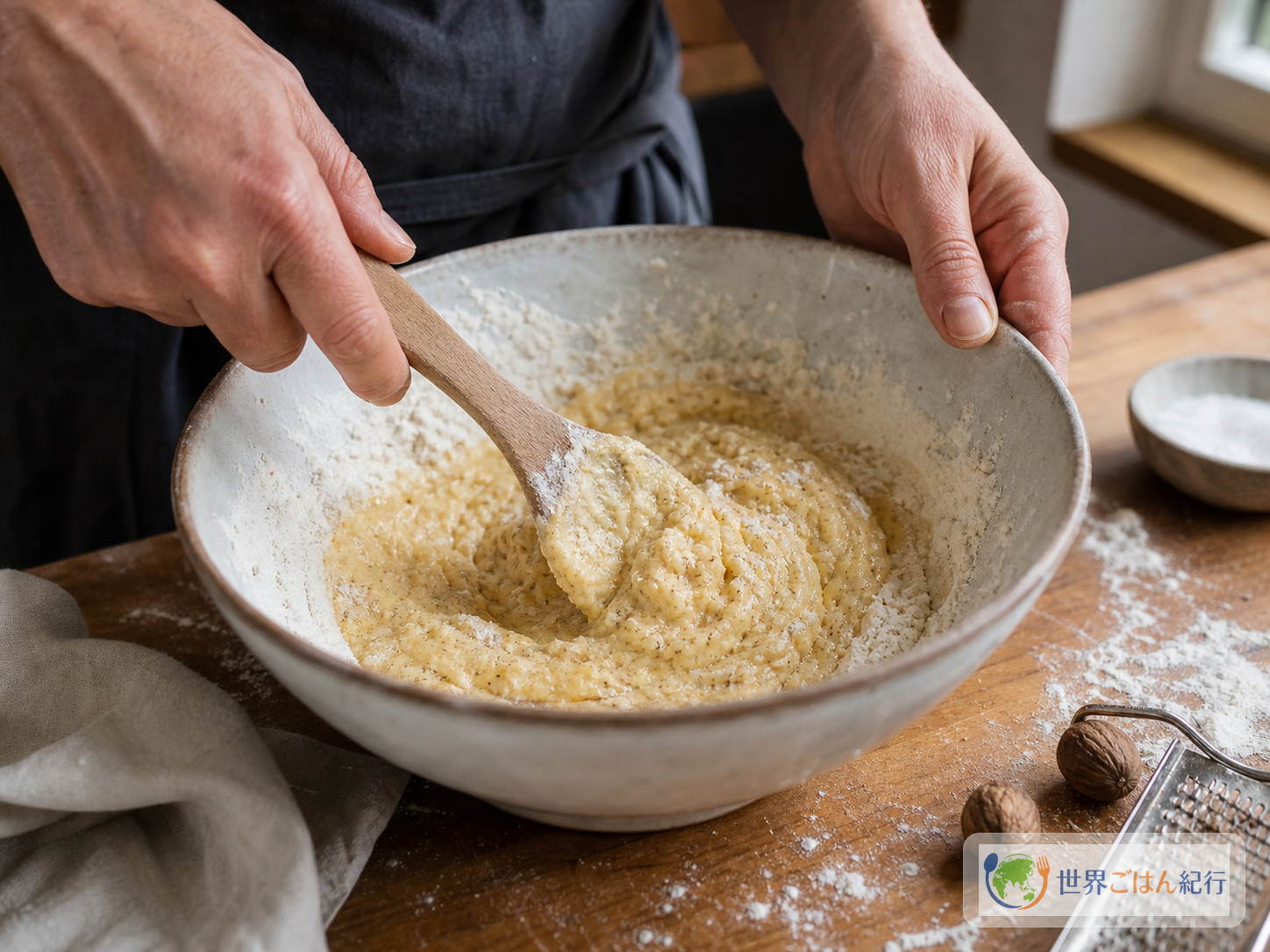
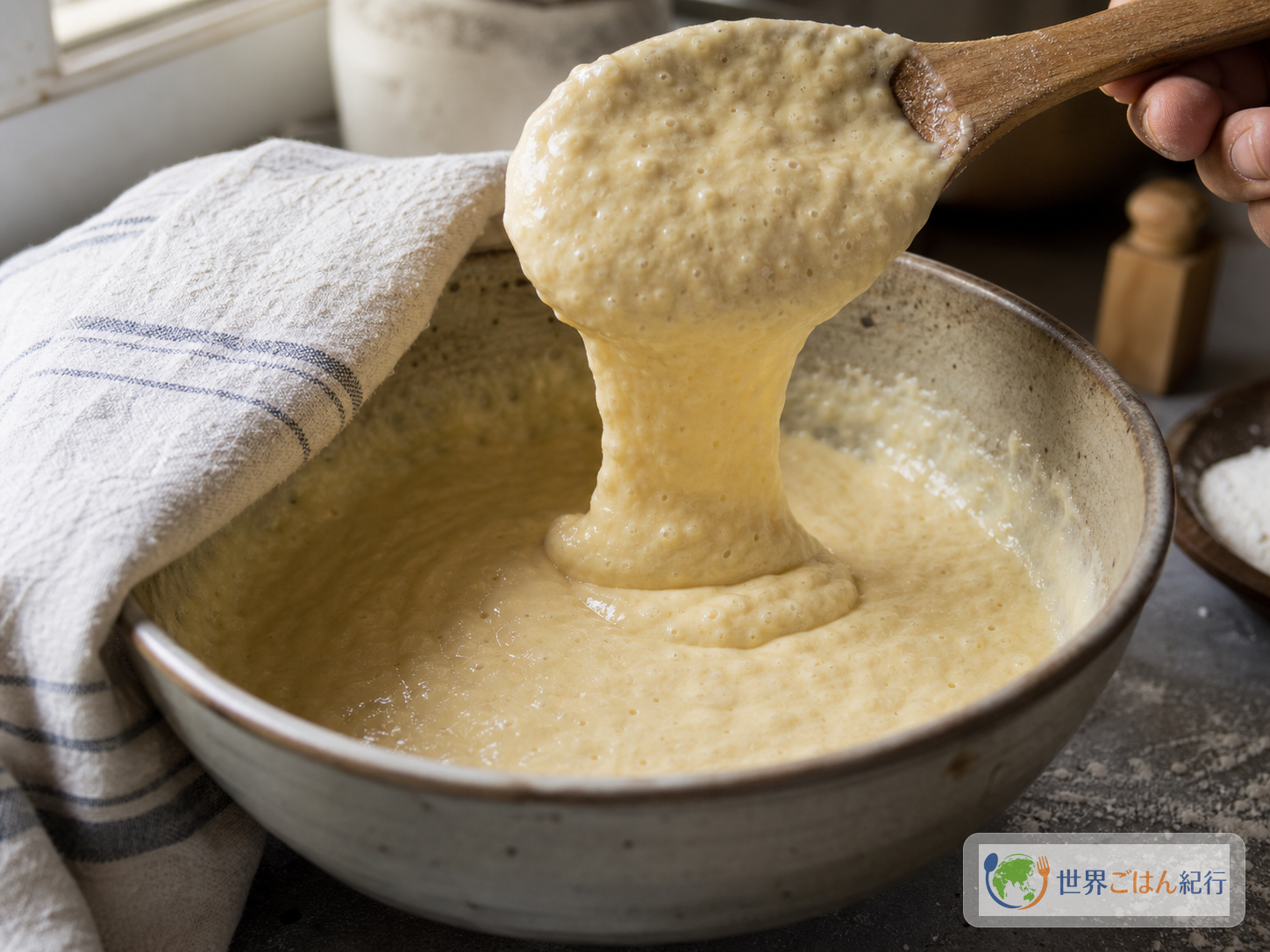
This dish settles down when you separate making the noodles from finishing them with cheese. The batter drops through the holes more easily if you let it rest briefly instead of boiling it right after mixing. Rather than tossing the cheese over high heat, binding it slowly with hot noodles, cooking water and gentle heat keeps it from separating.
Käsespätzle's background: the tables of the Allgäu and Swabia
Spätzle are short egg noodles long loved in Swabia in southwestern Germany and in the Allgäu, which spreads to its south. The names show regional differences: in the Allgäu they're "Spatzen," in Swabia "Spätzle" or the small, round "Knöpfle," and in Tyrol "Spatzln." Whether they come out long or round depends on how firm the batter is and how it's dropped.
Looking at the history, spätzle were already mentioned in Göppingen in the 17th century, and Bavaria's food heritage database notes that the Swabian tradition of making them can be traced back to the 18th century. They are also said to have originally been eaten as a Lenten meal, when meat was avoided. Folklore records from the early 20th century document Käsespätzle as a popular home dish, a filling everyday meal that sustained lives full of farm work.
"Swabian spätzle" (Schwäbische Spätzle / Schwäbische Knöpfle) became a protected geographical indication (g.g.A.) in the EU in 2012. The old method of scraping the batter off a board into boiling water with a knife is still regarded as a sign of high quality.
Allgäu Käsespätzle typically layers several local cheeses, such as mountain cheese (Bergkäse) and Emmental. Whether the browned onions should be crisp or soft and sweet is a matter of debate between homes and restaurants, and a salad of greens dressed with vinegar and oil is considered an "inseparable pairing." Today it's a signature regional taste you can eat in mountain huts and at market stalls.
What to keep in a home kitchen
What matters in Käsespätzle is not so much the shape of the noodles as the egg noodles, melted cheese, browned onions and a tangy escape route. Even without the local tools, dropping the batter through a colander or slotted spoon to make short Knöpfle-style noodles is enough to make a proper home dish.
| Question | Recommendation for a first try | Why |
|---|---|---|
| Shaping tool | Large-holed colander or slotted spoon | Makes short noodles without special equipment |
| Cheese | 140 g Gruyère-type + 120 g Emmental | Easy to balance aroma and meltability |
| Onions | Thin slices over medium-low heat, just short of deep amber | Adds a sweet aroma without bitterness |
| Liquid | Save 80 ml cooking water | Loosens the cheese and unites it with the noodles |
| Side | Greens with a vinegar dressing | Cuts the richness of the dairy |
Using only processed cheese or pre-shredded melting cheese makes it cohesive, but the aroma tends to go flat. For a first try, mix in Emmental, Gruyère, Comté or raclette cheese, whichever is easiest to find. If you use pizza cheese, keep it to half at most and make the rest a more strongly flavored cheese, so it doesn't drift toward plain macaroni and cheese.
Nutmeg is not the star. Just 1/8 tsp rounds out the smell of egg and cheese. More makes it smell like a sweet dessert, so if you want more aroma, adjust with black pepper or chives.
Where things tend to go wrong

The batter won't go through the holes
There's too little liquid, or the batter got too sticky after resting. Add 2 tsp water, mix with a wooden spoon for 30 seconds and try again. If you thin it until it runs freely, it won't form short noodles in the water but small dumpling-like bits.
The noodles sink and stick to the bottom
The water is too cool, or you're touching the batter too much right after it drops in. Keep the water at a gentle boil, 95 to 100°C, and wait 10 seconds after adding the batter. Don't force noodles off the bottom; move them gently with a wooden spoon once the surface has set.
The cheese clumps
The heat is too high, there's too little cooking water, or too much cheese went in at once. Lower the heat, add 1 tbsp cooking water and turn it over from the bottom with a wooden spoon. If it has fully separated, don't keep frying it; it's easier to rescue by plating it and eating it with the browned onions and salad.
It's too heavy to finish
The cause is more often a lack of acidity than the amount of cheese. Put the salad on a separate plate and mix white wine vinegar and oil at about 1 to 1.3. Tucking acidity between the sweet onions and the cheese makes it easy to eat to the last bite.
How it's eaten locally, and bringing it to the table
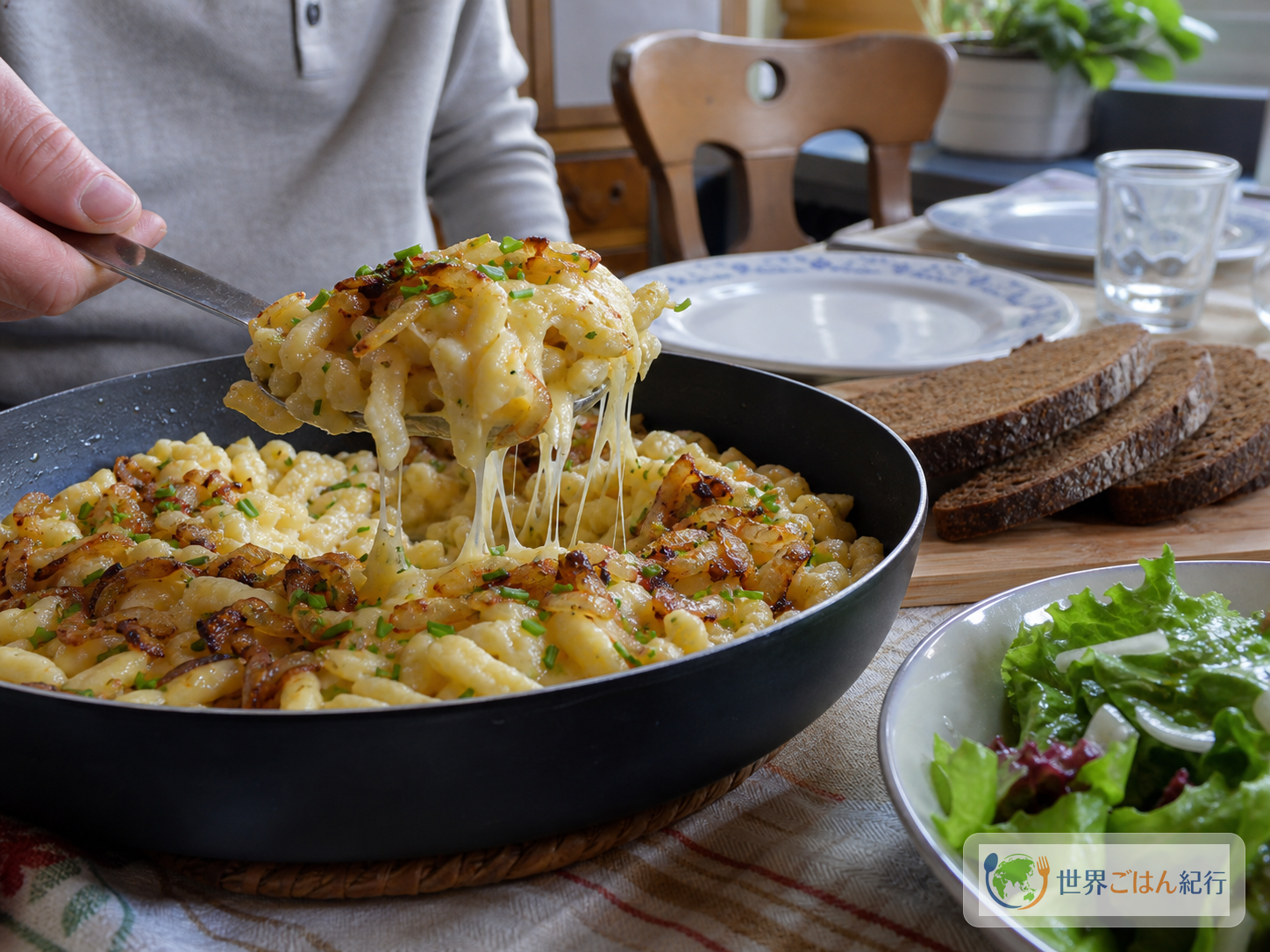
To serve it the local way, set the hot skillet in the middle of the table, pile the browned onions on top and let everyone help themselves. Don't put the salad on the same plate; serve it separately so its acidity stays clear. Bread isn't essential, but a little dark or rye bread soaks up the oil from the cheese.
Seen as a dish of the Allgäu and Swabia, Käsespätzle is not "noodles made rich with cheese" but a staple that kept people full in a cold region. Light sides such as cabbage, pickled cucumbers or a green salad suit it better than a meat dish. To build out a German menu, make Bayrisch Kraut (in Japanese) on another day and get to know its tang and the sweetness of cabbage; it will make choosing a side for this dish easier.
Storage and reheating
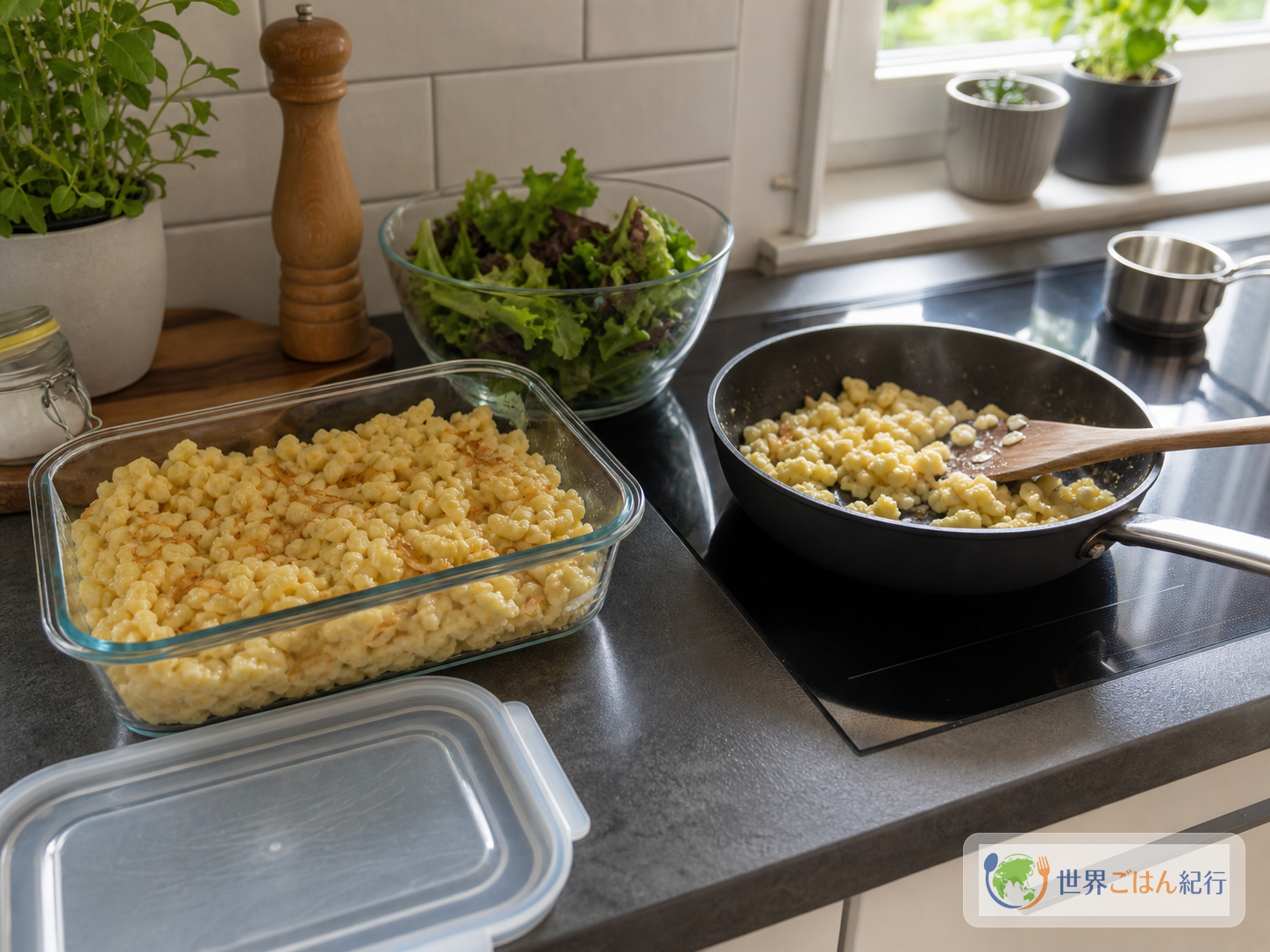
Käsespätzle is best freshly made. If you have leftovers, don't pack them hot into a deep container; spread them in a shallow container to let the steam escape, and refrigerate within 2 hours. Plan on 2 days in the refrigerator. You can freeze it, but after thawing the surface of the noodles tends to turn dry and crumbly, so for a first batch, finishing it from the fridge works better.
Reheating in the microwave alone tends to make the cheese clump. Put the leftovers in a frying pan, sprinkle with 1 to 2 tbsp water, cover and warm over low heat for 3 to 4 minutes. Once everything has loosened, raise the heat to medium for just 30 seconds to toast the bottom and bring back the aroma. Don't reheat the salad; make a fresh one.
FAQ
Can I make it without a spätzle maker?
Yes. A large-holed colander, a slotted spoon, or a flat cutting board and the back of a knife all work. Pushing the batter through a colander gives short Knöpfle-style noodles; scraping it off a board gives irregular, long ones. For a first try, a colander drops the batter into the water more easily.
What if I use dried spätzle?
Boil them 1 minute less than the package says, save 80 ml cooking water and then combine with the cheese. Dried spätzle have less flavor of their own, so brown the onions carefully and add aroma with black pepper and chives. Saltiness varies with the cheese, so adjust at the end.
Can I use only pre-shredded cheese?
You can, but the aroma will be much milder. If you use pre-shredded cheese, keep it to 120 g and make the rest Gruyère, Comté, Emmental, raclette cheese or similar; that brings it closer to the mountain-cheese cooking of southern Germany.
Can I use fried onions instead?
On a busy day, a small amount works. But store-bought fried onions taste strongly of oil and salt, which is different from the sweetness of onions cooked in butter. For a first try, cook the onions yourself, and try fried onions as a shortcut on days without time, starting with 2 tsp.
Is the salad essential?
Not for the dish itself, but it makes a big difference in how easy it is to eat. With cheese, butter and onions piled together, a tangy salad on a separate plate keeps you from tiring of it. A light dressing of white wine vinegar, oil, salt and a little sugar suits it better than a sweet dressing.
Related recipes
- Gaisburger Marsch (in Japanese) - A Stuttgart dish that pairs spätzle with beef broth and potatoes.
- Bayrisch Kraut (in Japanese) - A sweet-and-sour cabbage side from southern Germany that sits well next to cheese noodles.
- Bryndzové halušky (in Japanese) - A Central European comparison that also pairs short noodles with dairy.
- How to enjoy raclette (in Japanese) - Broadens the idea of putting melted cheese at the center of the table.
Sources
- Allgäu: Allgäuer Kässpatzen - On Allgäu Kässpatzen and the food culture of pairing cheese, onions and salad.
- Germanfoods.org: Käsespätzle - On the basic structure of home-style cheese spätzle and the handling of cheese and onions.
- EUR-Lex: Commission Implementing Regulation (EU) No 186/2012 - On the registration of Schwäbische Spätzle / Schwäbische Knöpfle as a protected geographical indication.
- Bayerisches GenussErbe: Schwäbische Spätzle - On the regional character of Swabian spätzle, the tradition dating to the 18th century, their origin as a Lenten meal and the protected designation (checked October 22, 2026).