Kačamak: A Heavy Pot of Potatoes and Corn, Finished with Cheese and Kajmak
Let the corn flour steam on top of the potatoes before you stir it, then pound the two together until they become one dense mass. The melted cheese and kajmak go in last, and the dish goes to the table hot.
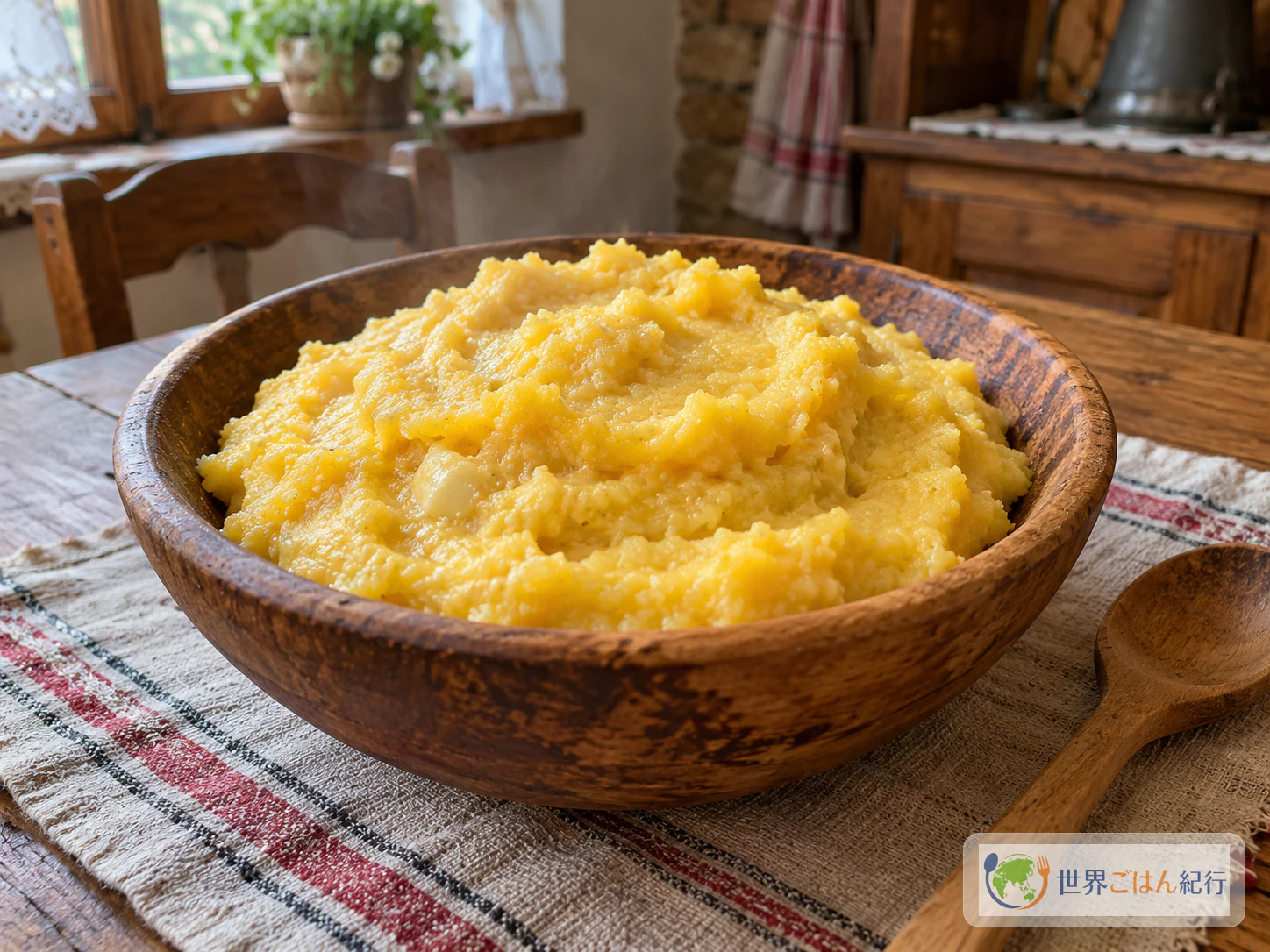
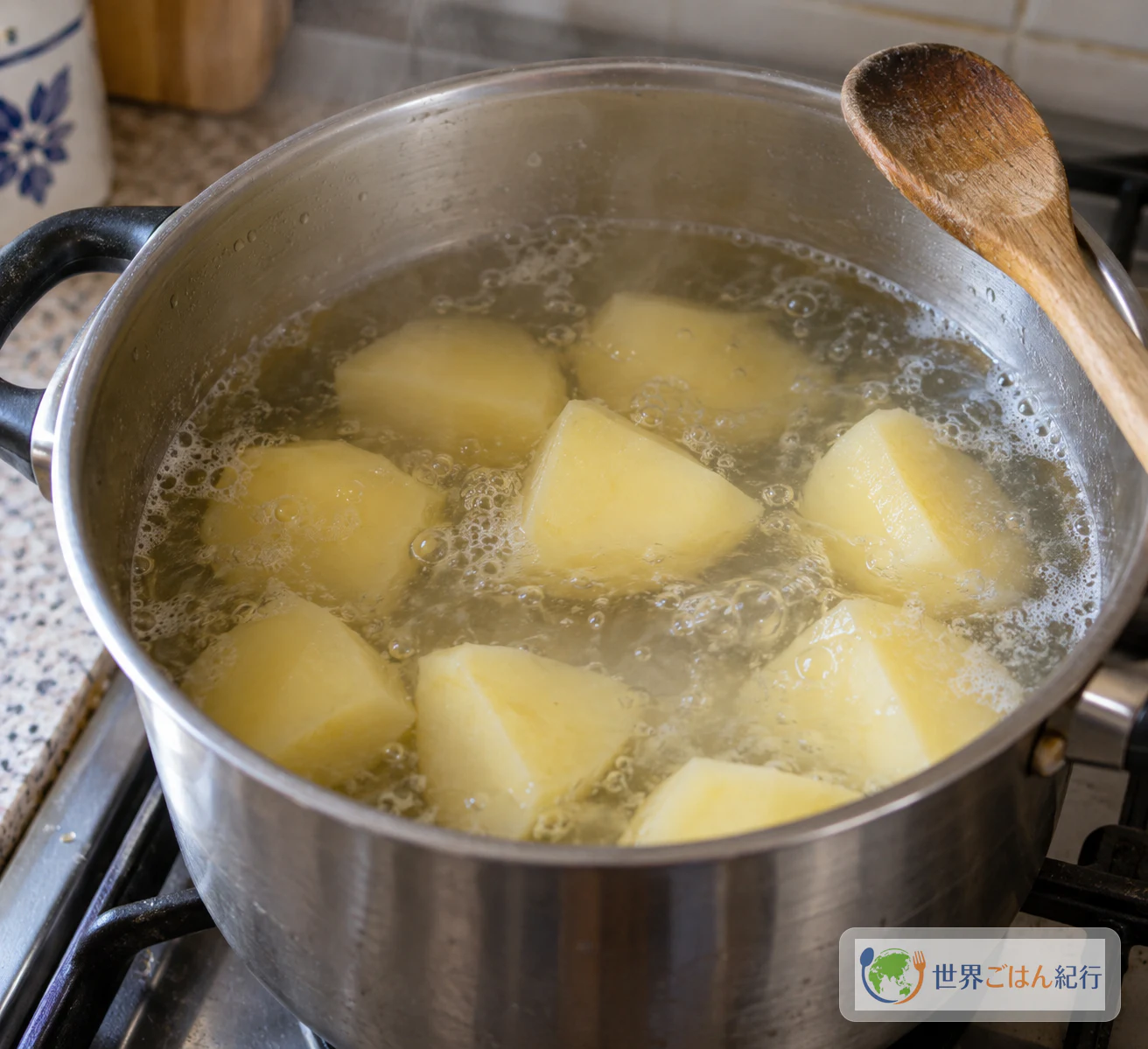
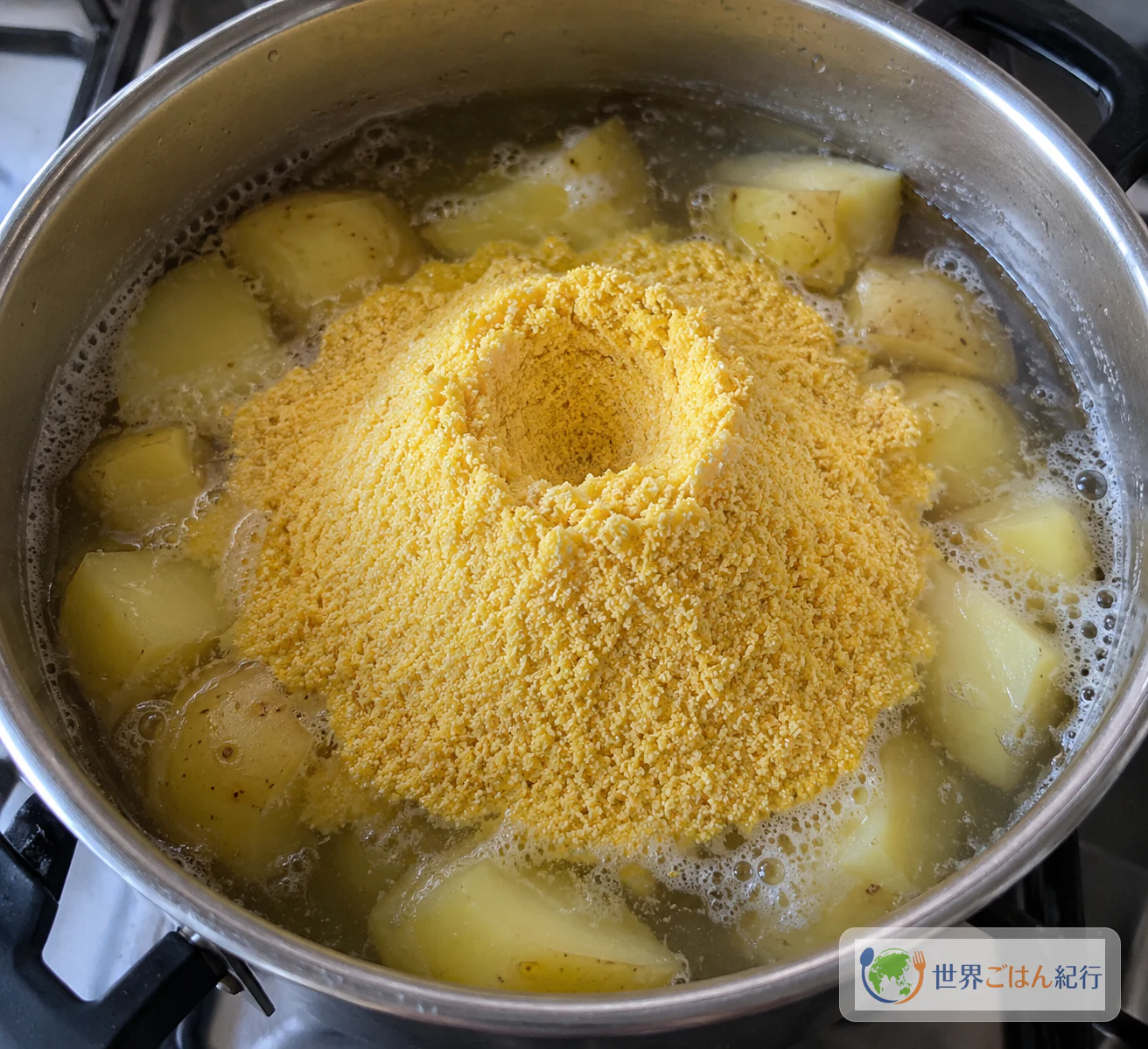
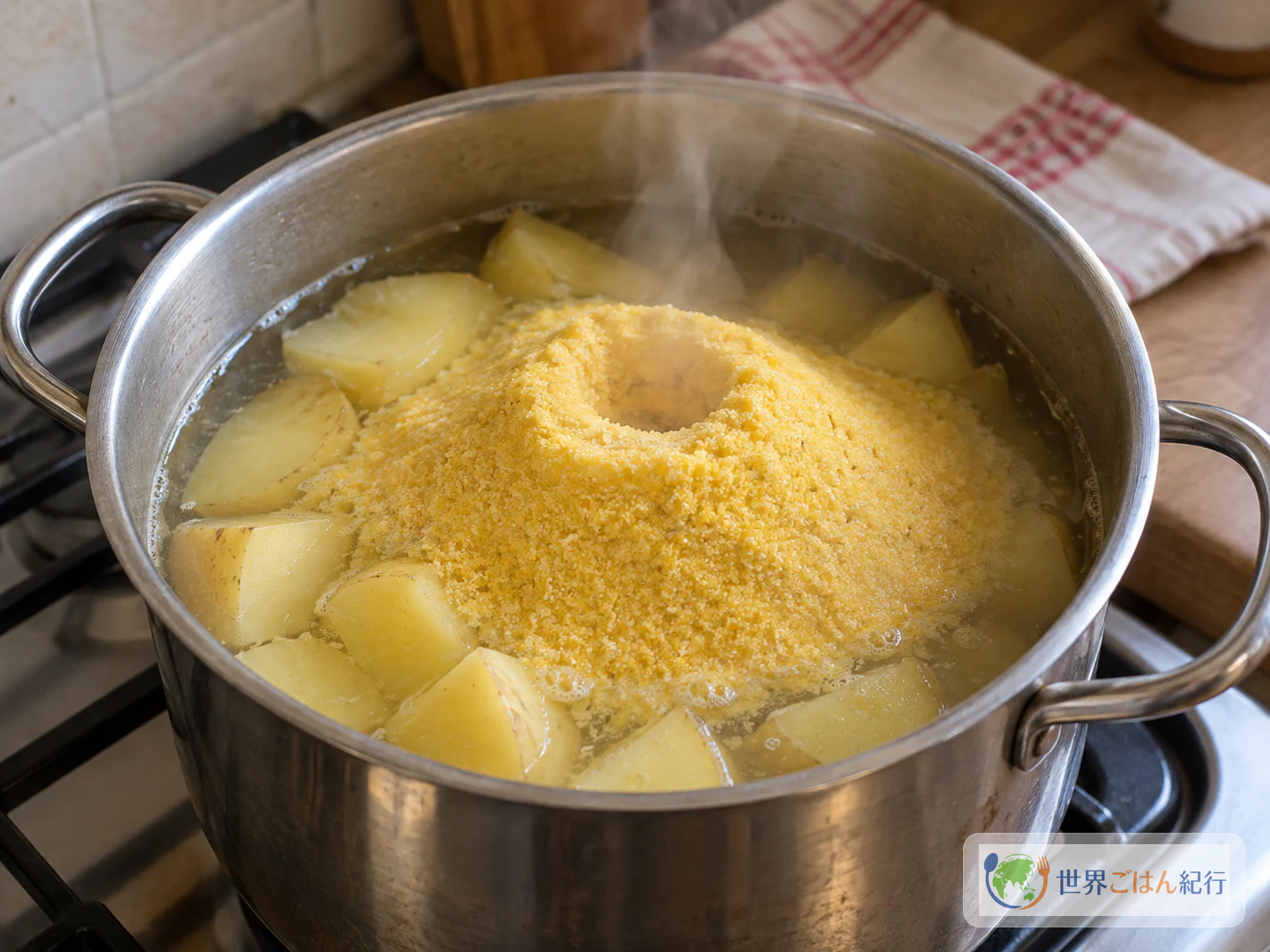
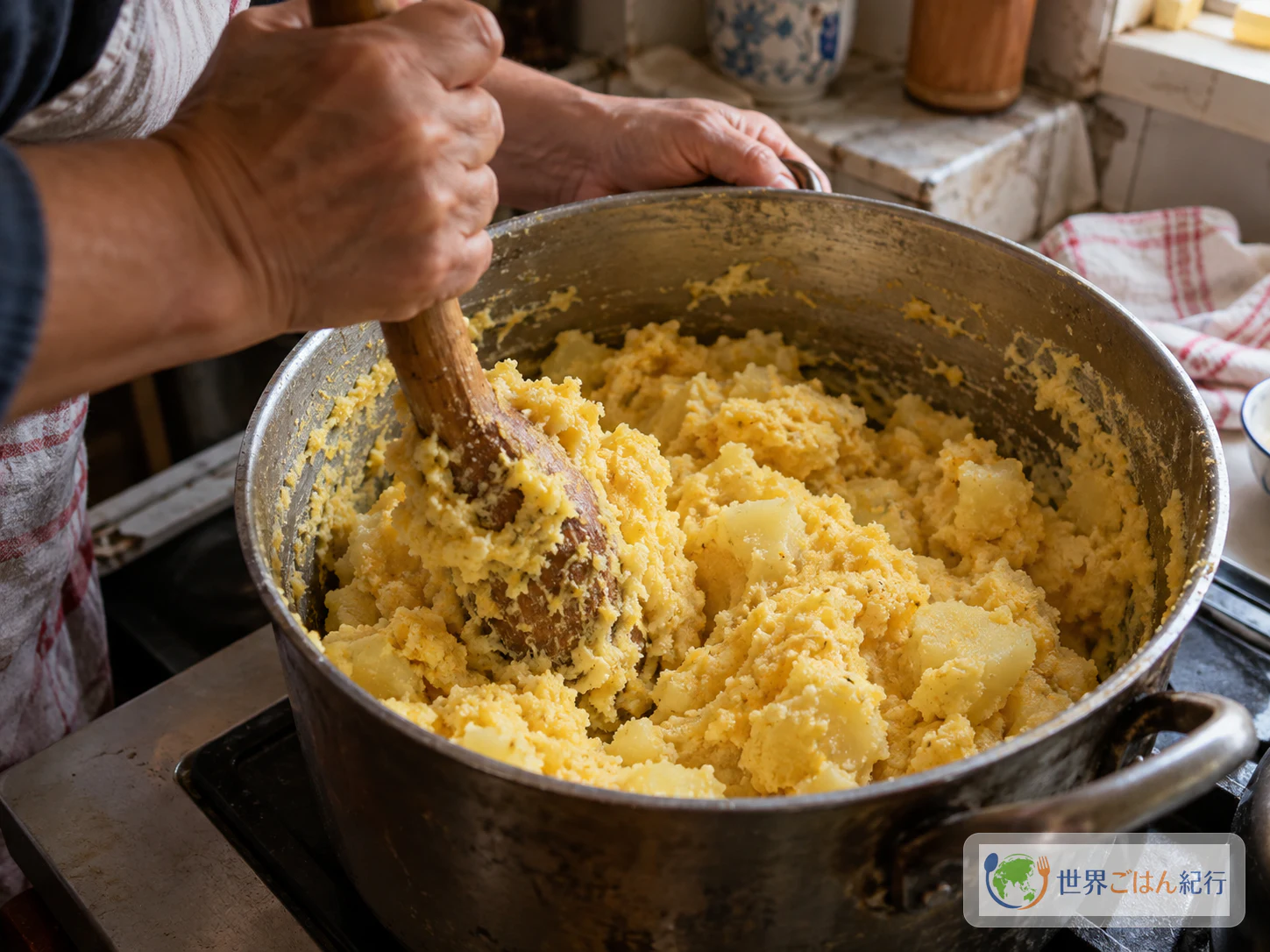
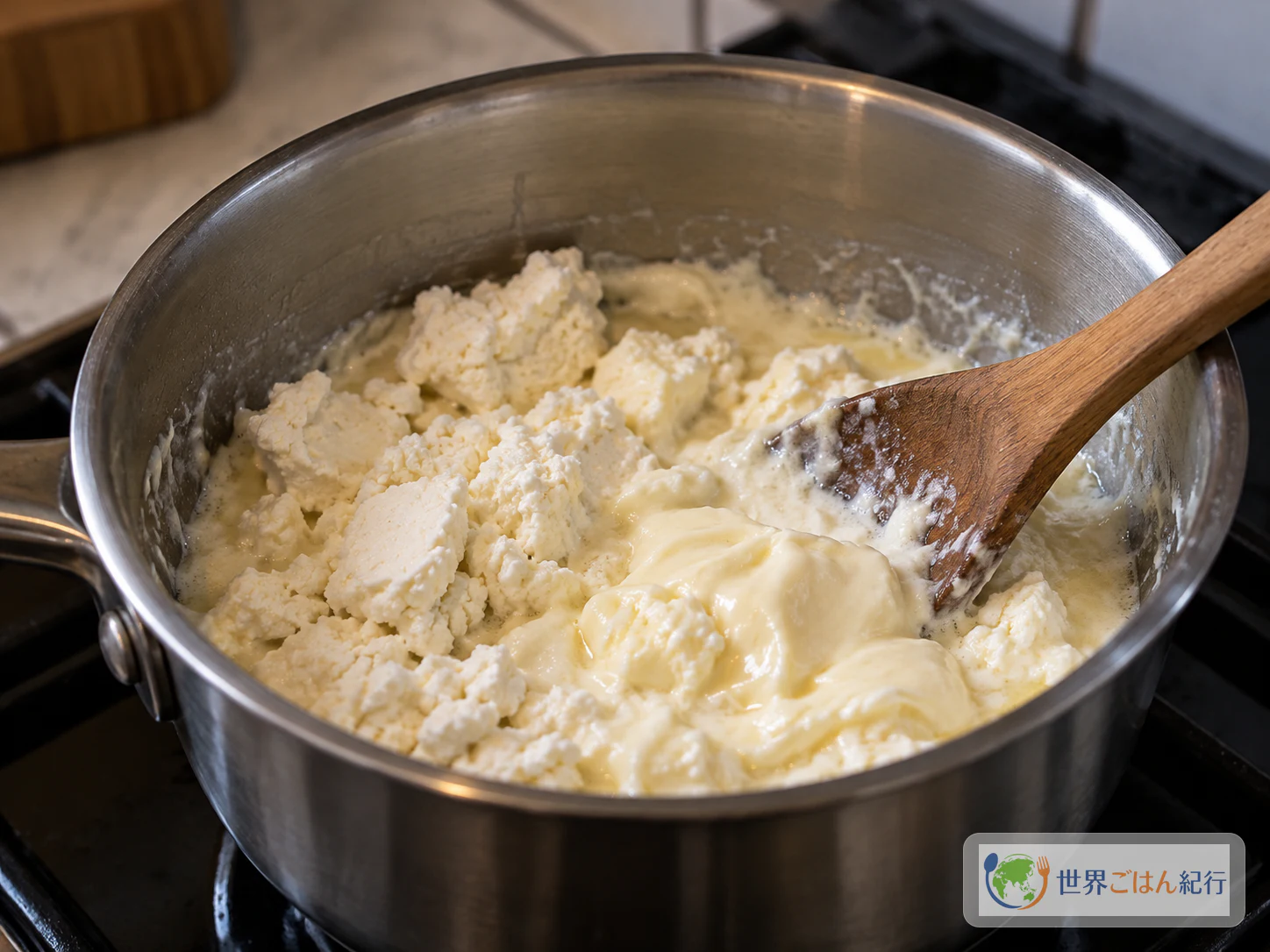
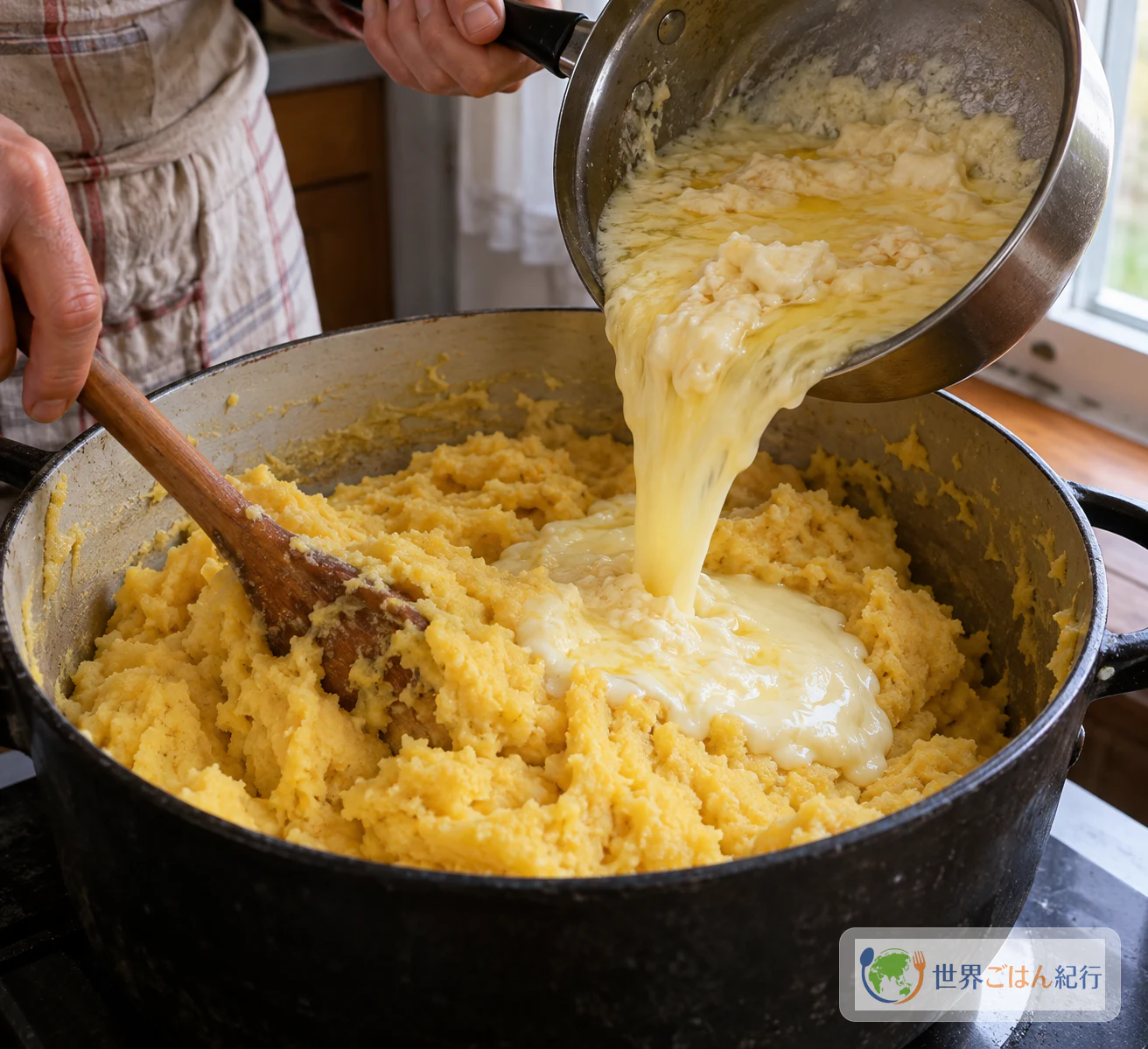
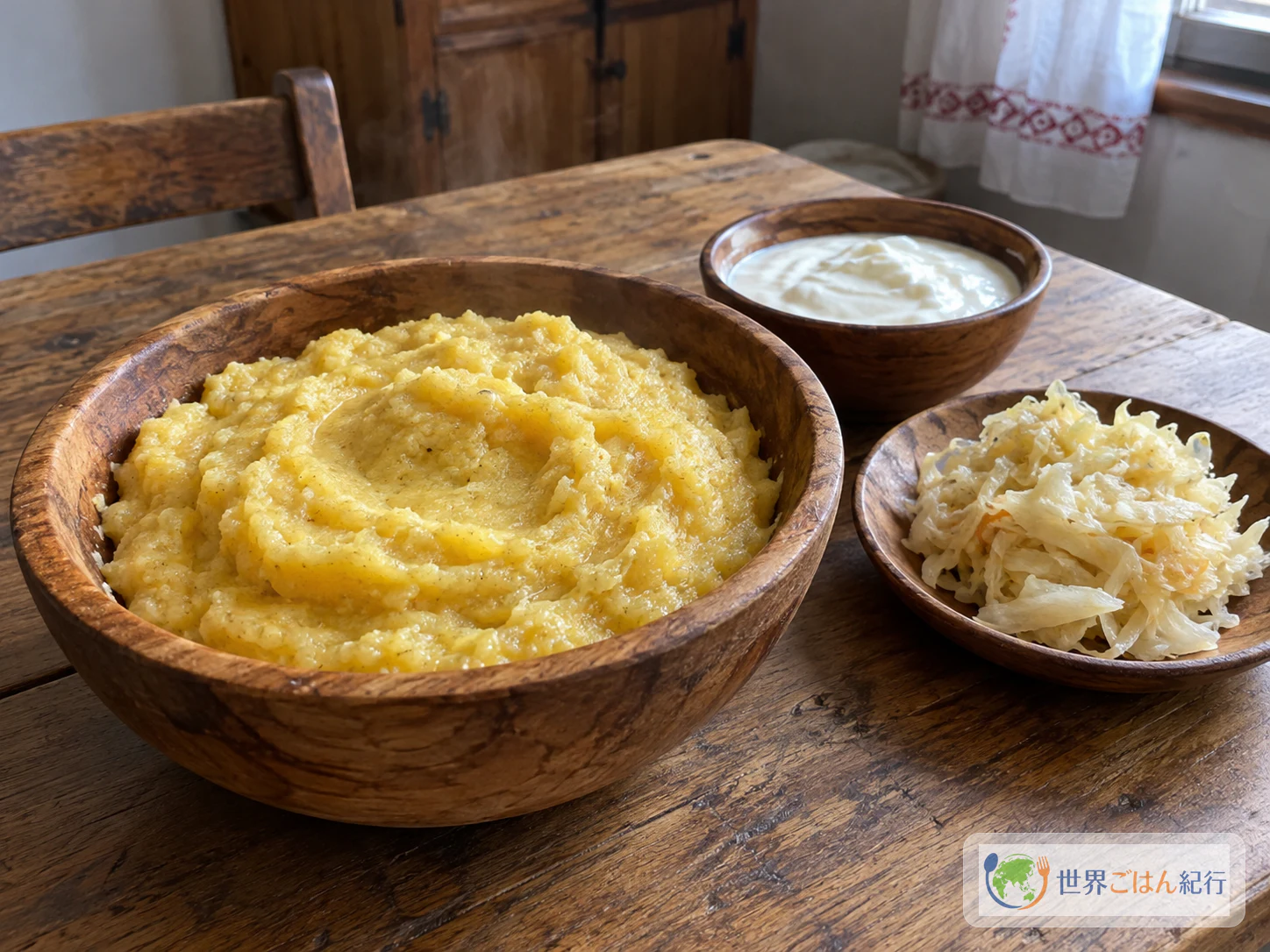
A pot of peeled potatoes boils in salted water. Yellow corn flour is piled on the surface in a cone and left alone to steam, and only then does the work begin: a wooden pounder or a sturdy wooden spoon drives the potatoes and flour together until they turn into one heavy, even mass. Fresh cheese and aged kajmak, melted in a separate pan, are poured over and worked through, and the kačamak is served hot, with soured milk or sauerkraut alongside.
In the Montenegrin recipe this article follows, published in the Balkan Traditional Cookbook by GIZ and Seerural, kačamak is described as a dish made at the weekend, when the whole family is together. A recipe from Radio Televizija Budva describes the same core moves: leave the corn flour unstirred at first so it can steam, then mash it with a wooden spoon or pounder until it is smooth, and add cheese and kajmak. The result is not a loose porridge but something closer to a thick dough, rich with dairy fat.
Where This Kačamak Comes From: Hard Mountain Corn and a Weekend Pot
This article covers one specific form: the Montenegrin kačamak made with potatoes, corn flour, fresh cheese and aged kajmak. The name kačamak is used across the Balkans for several corn-based and flour-based dishes, so it helps to pin down which one is on the table. The quantities and method here come from the GIZ/Seerural cookbook's "Kačamak with Yellow Jarik Corn," which the book also titles "Polenta with Yellow Jarik Corn."
That cookbook frames the dish through a local grain. Yellow Jarik (Žuti Jarik) is presented as a hard, local Montenegrin maize, and the book describes how important corn was to life in the past. The hardness of the kernel and its fit with growing conditions in the mountains hint at why a corn-and-potato dish became part of everyday eating there. This is the cookbook's account of a regional crop; it does not mean every household cooks with this one variety, and you do not need it to make the dish elsewhere.
The dairy carries the other half of the flavor. The National Tourism Organisation of Montenegro describes skorup, or kajmak, as a dairy product of northern Montenegro, made by collecting the fat that forms on milk after boiling and then aging it. The same brochure describes smočani kačamak topped with kajmak and crumbled cheese and served with sour milk (kiselo mlijeko). A regional tourism resource for the Accursed Mountains likewise pictures kačamak served in the mountains on wooden plates with soured milk.
Other dishes called kačamak
The same name covers dishes with different ingredients and methods, so they are kept separate here rather than blended into one formula.
| Version | What goes in | How it relates to this recipe |
|---|---|---|
| Montenegrin potato kačamak (this recipe) | Potatoes, corn flour, fresh cheese, aged kajmak | The recipe in the steps below |
| Smočani kačamak | Cooked potatoes with wheat flour or corn flour, topped with kajmak and cheese | Described by the Montenegrin tourism organisation; no quantities are given |
| Cornmeal-only kačamak | A mound of corn flour cooked in boiling salted water, beaten with a wooden kačamar, with cheese and kajmak melted separately and mixed in | Described by the Accursed Mountains resource as a distinct version without potatoes |
Ingredients (Serves 4)
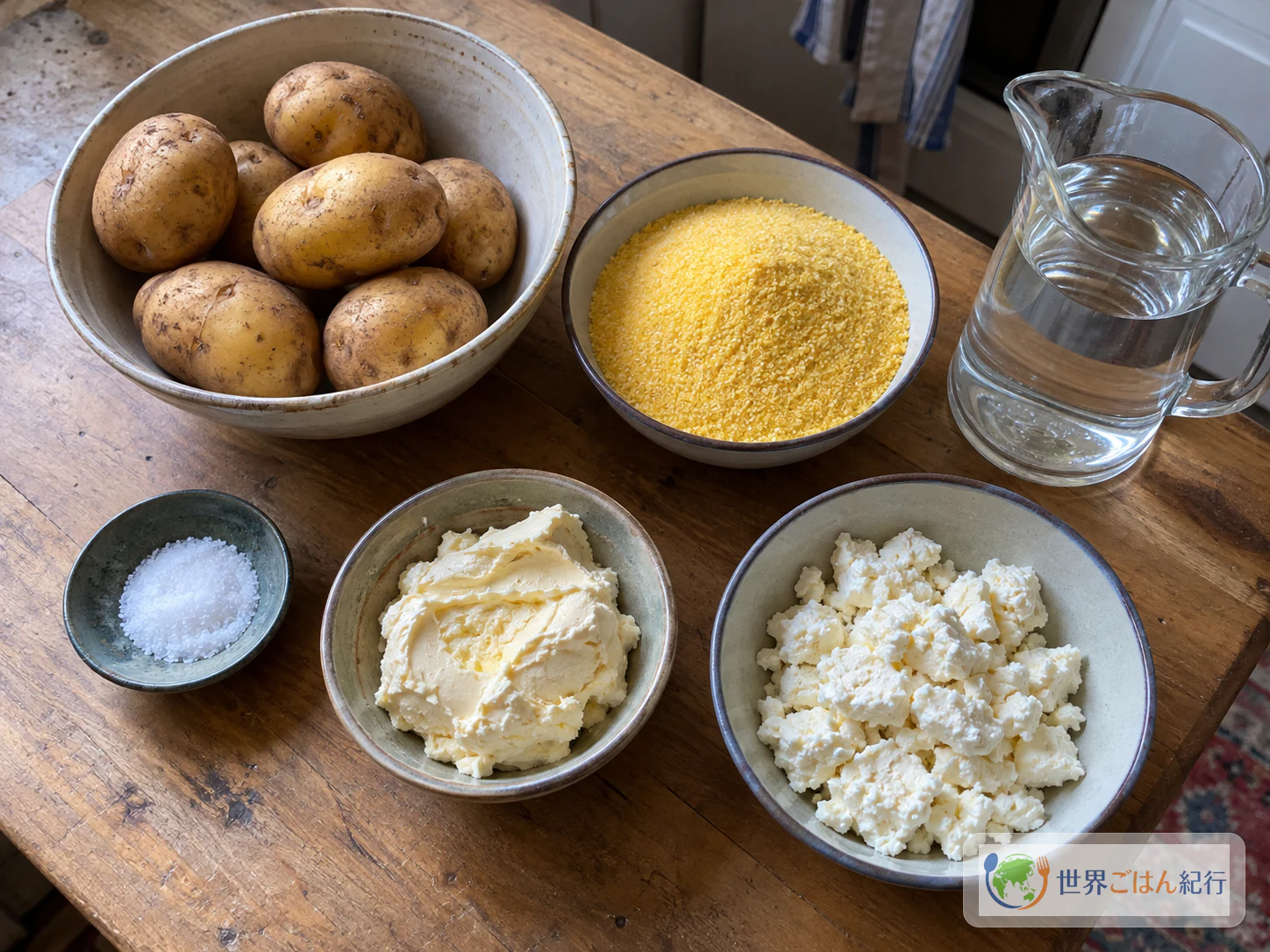
This is a full four-serving batch with a large amount of corn flour, so the finished mass is very heavy. Have a deep, sturdy pot and a strong wooden spoon ready before you start.
This dish contains dairy (cheese and kajmak). Corn flour products differ by brand, so check the package for allergen labeling and any shared-facility statements before you buy.
Equipment
- A large, deep, sturdy pot for the potatoes, corn flour and the final mixing
- A small separate saucepan for melting the cheese and kajmak
- A wooden kačamalj (a wooden pounder) or a large, strong wooden spoon
- A ladle for taking out some of the potato cooking water
Choosing Corn Flour, Cheese and Kajmak Away from Montenegro
Corn flour. Yellow Jarik is a hard local Montenegrin maize. Supermarket cornmeal varies a great deal in grind. As an editorial suggestion only, a coarse-ground cornmeal may come closer to flour milled from hard local corn than a very fine one, but we cannot say it is equivalent. Check the grind and ingredient list on the package.
Potatoes. Because the potatoes are broken down completely and merged with the flour, a floury potato is a reasonable choice as an editorial suggestion.
Fresh cheese. Use grated fresh cheese. Fresh cheeses sold elsewhere differ in saltiness, moisture and how they melt, so treat whatever you buy as an approximation. Look for one that is not strongly salted and that holds together when heated. Substitutes have not been kitchen-tested.
Kajmak. Kajmak is made by collecting the fat from boiled milk, and the aged kind used here also carries a salty, matured flavor. It is not the same as fresh cream, clotted cream or sour cream. If you cannot find aged kajmak, a younger kajmak or clotted cream can be considered as a stand-in to try, but neither reproduces the salt, the fermented notes or the aged aroma. This is an editorial suggestion that has not been kitchen-tested.
Salt. Salt the potato water with 1 tbsp salt. The final saltiness depends heavily on your cheese and kajmak. As an optional editorial adjustment, taste after the dairy goes in and add a little salt only if needed.
Method: Boil, Steam, Pound, Then Fold in the Dairy
Do not stir the corn flour when it first goes into the pot. Steaming first, then pounding, is the whole point of the method.
Allow 10 minutes of preparation and 1 hour to 1 hour 15 minutes of cooking for four servings. Sekai Gohan has not kitchen-tested this recipe. These times are guides and will shift with your pot and burner. Go by the state of the potatoes, flour and dairy at each step as well as by the clock.
Keeping It on Track: Steaming, Weight and Variable Dairy
Resist the urge to stir the corn flour the moment it hits the water. The cone and its central hollow are what let it steam, and stirring early changes that step entirely.
Steam first, stir later. Both the GIZ/Seerural recipe and the Radio Televizija Budva recipe leave the corn flour unstirred at first. The Budva recipe steams it only briefly; the recipe here gives about 20 minutes. We follow the 20-minute version and do not mix the two timings.
Prepare for the weight. Six hundred grams of corn flour with a kilo of potatoes makes a much heavier mass than most home pots of mash. A thin pot or a flimsy spoon will struggle during the 10–15 minutes of pounding. A whisk or an electric mixer is not a substitute for the wooden spoon here.
Expect variation from your ingredients. The grind of your corn flour and the salt and moisture of your cheese and kajmak all affect the result. We are not giving adjusted numbers for them, because none have been tested.
| What you notice | Likely cause | What to do |
|---|---|---|
| Floury pockets or a raw-flour taste | The flour was stirred before it steamed, or the pounding stopped early | Keep pounding over low heat until the mass is even throughout |
| The potatoes stay in lumps | They were not boiled until soft at the center | Next time, boil until a quarter breaks apart with no resistance before adding the flour |
| The spoon or pot is hard to work | The batch is large and very heavy | Use a deeper, heavier pot and a thick wooden spoon; work in short, firm strokes |
| The finished dish tastes too salty | Salty cheese or kajmak on top of salted potato water | Next time choose a milder cheese; the soured milk on the side also helps balance it |
Eating It Hot, with Something Sour
The recipe gives two companions: soured milk or sauerkraut. The Montenegrin tourism brochure pairs kačamak with sour milk (kiselo mlijeko), and the Budva recipe suggests extra kajmak or homemade yogurt. Our reading, as an editorial note, is that something cool and sour on the side cuts through the weight of potatoes, corn and dairy fat.
If you cannot find soured milk, plain unsweetened yogurt is a home stand-in. It is thicker and its sourness is different, so treat it as a substitute rather than the same thing. No amount is set for the side; serve as much as people want.
Variations to Try (Outside the Base Recipe)
These are editorial ideas, kept separate from the recipe above. None of them has been kitchen-tested.
- Floury potatoes: Choose a floury variety from your local shop, as they tend to break down easily into the flour.
- A different cornmeal grind: A coarse grind may leave more texture; a fine grind may give a smoother result. Follow the package directions for the product you choose.
- Clotted cream in place of kajmak: A candidate to try if kajmak is unavailable. It will not bring kajmak's salt, fermented notes or aged aroma.
- A different fresh cheese: Try a mildly salted cheese that holds together when heated, and judge the result for yourself.
- Yogurt or sauerkraut on the side: Both are ways to add a sour note at the table; sauerkraut is already one of the two pairings in the recipe.
Frequently Asked Questions
Before thinking about substitutes, make sure the base is right: potatoes soft through, flour steamed before stirring, and the whole thing pounded into an even mass.
How many people does this serve?
Four. The recipe uses 1 kg potatoes, 600 g corn flour, 250 g aged kajmak, 300 g fresh cheese, about 2 L water and 1 tbsp salt. It is a heavy dish, and the amounts are given as published rather than scaled down.
Do I need Yellow Jarik corn flour?
No. The Montenegrin recipe describes Yellow Jarik as the local hard corn behind its flour, but it is not a requirement for cooking the dish elsewhere. Use the corn flour or cornmeal you can find, and check its grind on the package.
What is kajmak, and can I replace it?
Kajmak (also called skorup) is a dairy product described as coming from northern Montenegro, made by collecting the fat from boiled milk and aging it. It is not the same as cream, clotted cream or sour cream. Clotted cream or a younger kajmak can be tried as a stand-in, but the flavor will differ.
What is the 200–300 ml of cooking water for?
The recipe says to take it out but does not say what it is used for. A separate, cornmeal-only version described by the Accursed Mountains resource uses strained cooking water to loosen the mixture, but that is a different recipe, and we have not added the step to this one.
Do I need a special wooden pounder?
The recipe names a wooden kačamalj but also allows a wooden spoon. A large, strong wooden spoon works; choose one sturdy enough for a very heavy mass.
Is kačamak the same as polenta?
The GIZ/Seerural cookbook uses "polenta" in its title as a loose comparison, but this potato, cheese and kajmak version is not the same recipe as Italian polenta in general.
Is there kačamak without potatoes?
Yes. The Montenegrin tourism brochure describes smočani kačamak made with wheat flour or corn flour, and the Accursed Mountains resource describes a cornmeal-only version. They use different ingredients and methods, so they are not mixed into this recipe.
How do I store leftovers?
The recipe gives no storage or reheating instructions, so we do not give any storage times here. It is meant to be served hot, straight from the pot.
Sources
- GIZ / Seerural, Balkan Traditional Cookbook, "Polenta with Yellow Jarik Corn (Kačamak with Yellow Jarik Corn)." The Montenegrin recipe followed in this article: four servings, preparation and cooking times, ingredient amounts, the order of the method, serving warm with soured milk or sauerkraut, the weekend family context and the background on Yellow Jarik hard corn. The grind of the corn flour and the salt level of the cheese are not specified, and the published calorie figure is not reproduced here. https://seerural.org/wp-content/uploads/2020/06/GiZ-cookbook-interactive.pdf
- National Tourism Organisation of Montenegro, Arome i ukusi Crne Gore. Smočani kačamak made with cooked potatoes and wheat or corn flour, pounded until smooth, topped with kajmak and crumbled cheese and served with sour milk; and skorup/kajmak as a northern Montenegrin dairy product made from the fat of boiled milk and aged. No quantities are given. https://www.montenegro.travel/uploads/content/2_explore/arome-i-ukusi-crne-gore.pdf
- Radio Televizija Budva, "Kačamak sa sirom i kajmakom." Cross-check of the method: keeping the potato cooking water, not stirring the corn flour at first so it can steam briefly, mashing with a wooden spoon or pounder until homogeneous, adding cheese and kajmak, and serving warm with extra kajmak or homemade yogurt. Not used for quantities. https://www.rtvbudva.me/zabava/kacamak-sa-sirom-i-kajmakom/ChvdwF8guo
- Accursed Mountains regional tourism resource, "Gastronomy." A distinct cornmeal-only kačamak beaten with a wooden kačamar, with cheese and kajmak melted separately; strained cooking water used to loosen that version; and a mountain serving scene with wooden plates and soured milk. Treated as a separate version and not combined with the recipe above. https://accursed-mountains.me/gastronomy/