You can't see inside until the leaves come off: Fijian lovo
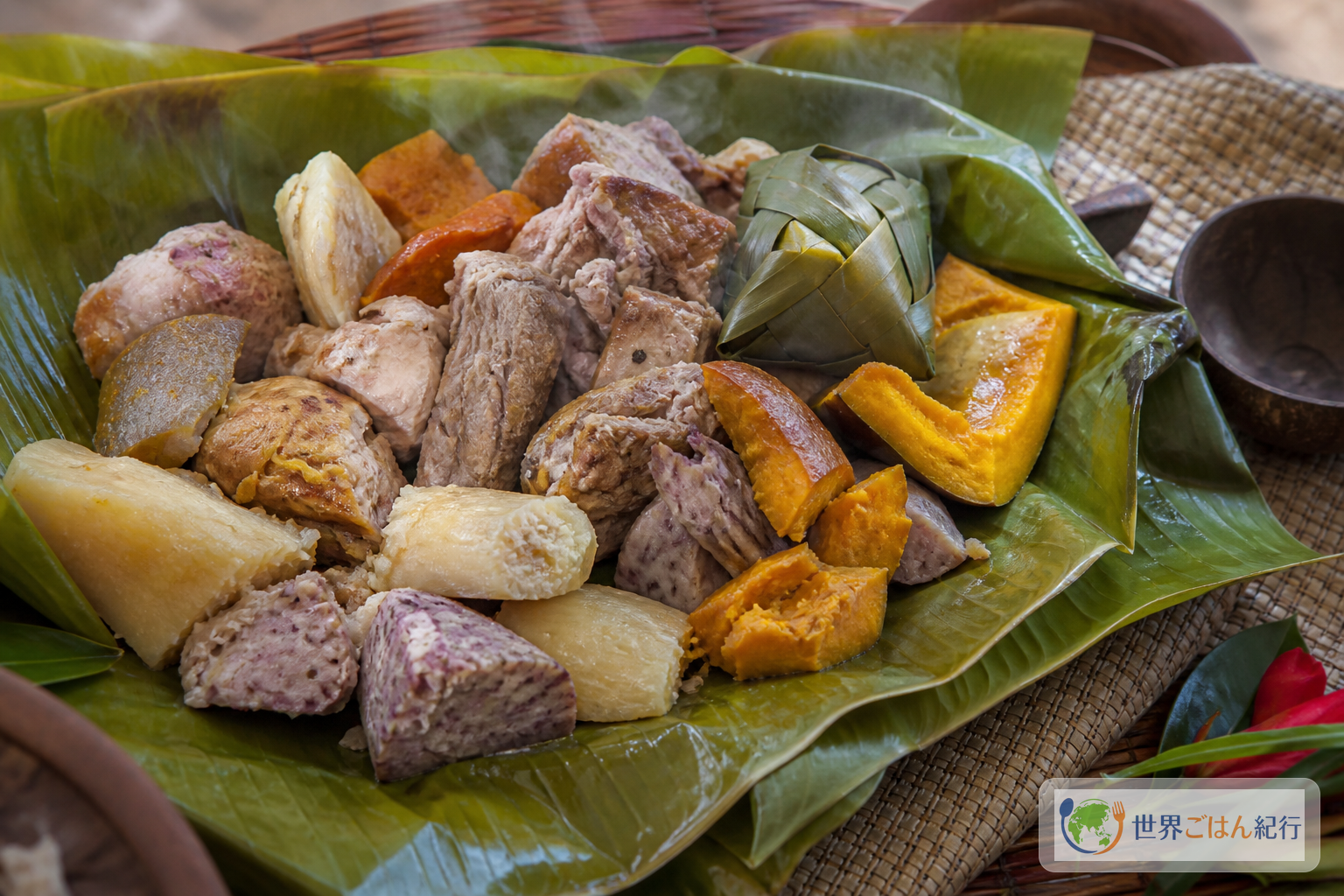
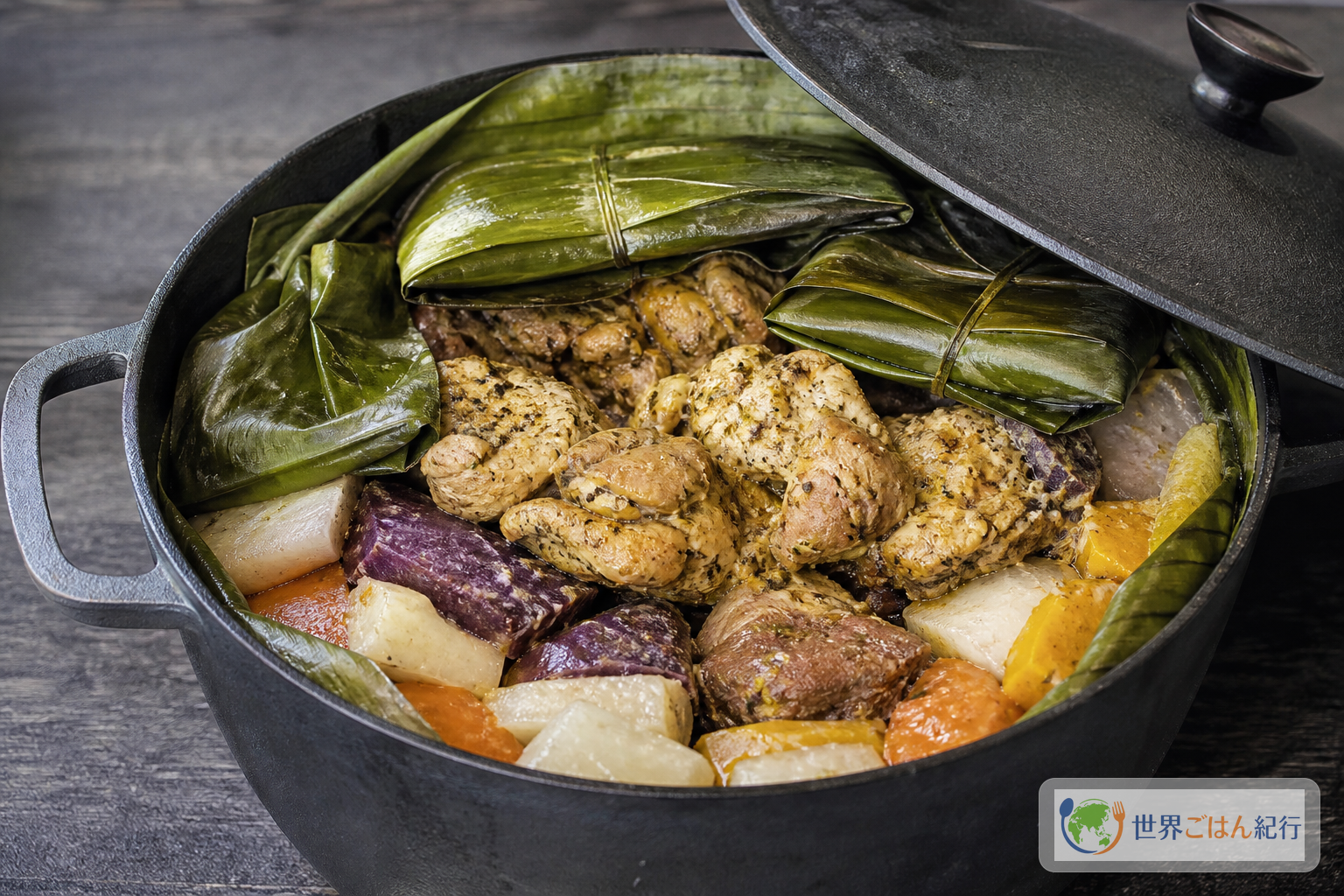
Banana leaves go down first, root vegetables on top, then meat wrapped in more leaves, and finally another layer of leaves over everything.
Lovo is Fiji's traditional way of steam-roasting food in an earth oven.
Heated stones are laid in a pit, the food is covered with leaves, and soil or sand seals in the heat.
Unlike cooking beside a fire, where you can watch the browning, nothing is visible until the bundles are opened.
There are still signs to read, though.
If a skewer slides easily into the root vegetables, the center of the meat is thoroughly hot, and the leaves have turned a deep olive color, the steam in the oven has done its work.
Most home kitchens have no pit to dig, so this recipe swaps the structure for a heavy lidded pot and an oven.
What we are reproducing is not the smoke but the mechanism: wrapping in leaves and trapping the aromas of roots, meat and coconut.
In Fijian homes and at celebrations, lovo is not a single-serving dish but a big shared table where family and friends divide up the preparation.
Even scaled down to four servings, stacking root vegetables and leaf bundles in the same pot, rather than just roasting meat, keeps the spirit of a lovo.
The Fijian table and where lovo comes from
The Coconet, which introduces Fijian food culture, describes lovo as a Fijian earth-oven dish in which meat, chicken, pork, vegetables, palusami and root crops are all prepared at once.
Rather than looking for the origin of lovo as a single named dish, it helps to see it as a method of cooking many foods together with heated stones and leaves, which explains why it endures on Fijian tables.
For a large meal, the cooks first decide what to make and for how many people, then work in parallel: marinating meat, peeling roots, heating the stones.
The order in which food goes into the pit also matters.
An SBS Food recipe layers dalo (taro), tavioka (cassava) and kumala (sweet potato) on the bottom, then leaf-wrapped chicken, pork or fish, with vegetables and palusami on top.
The heavy roots sit closest to the hot stones, the meat stays moist in leaves and steam, and the leafy greens and pumpkin on top cook in something close to a braise.
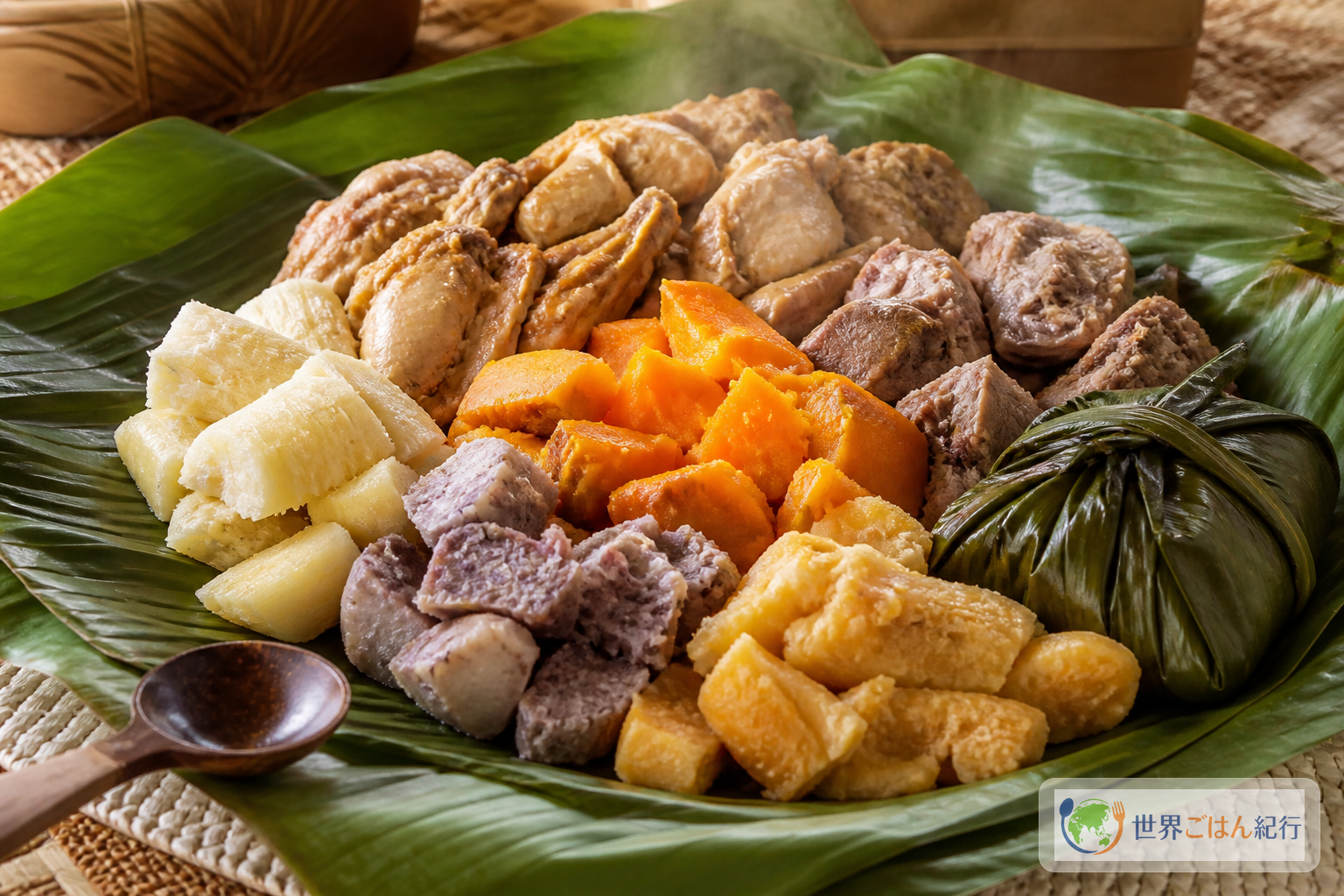
One person tends the fire, another prepares the roots, another makes the seasonings and sides, and at the end the food is lifted out of the pit and spread on big leaves to be shared.
If you think of lovo only as "something you put in an oven and wait for," you lose much of what makes it interesting.
Bringing everything together in one pot is itself an expression of the scale of the celebration and the sharing of the table.
Regional differences: roots and leaf bundles in the earth oven
Earth ovens are not unique to Fiji.
The Coconet explains that Fijian lovo is similar to the hāngī of New Zealand and the umu of Samoa.
But a different name does not make it the same dish.
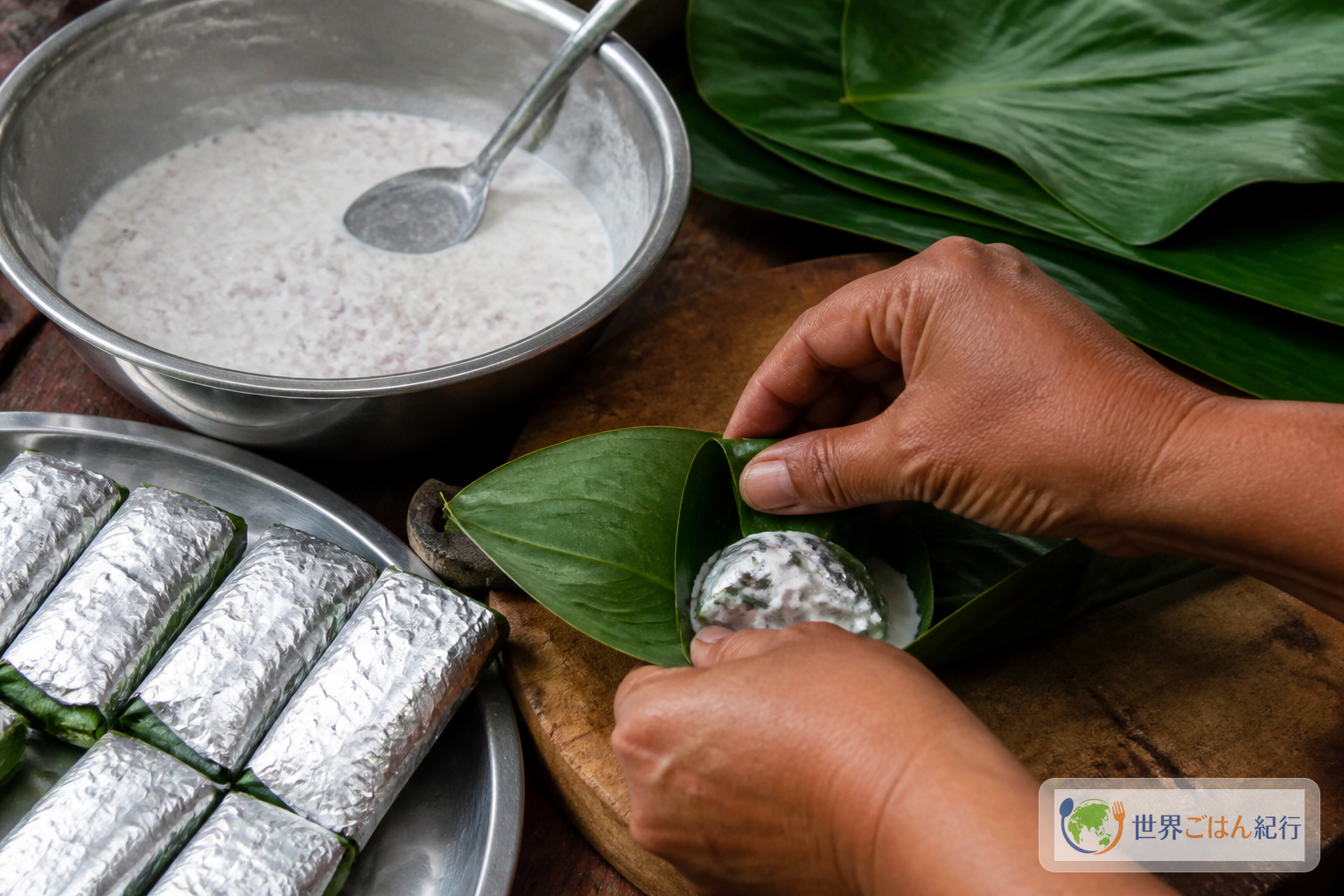
Pacific Community materials list Fijian rourou as taro leaves simmered in coconut cream, and Samoan palusami as taro leaves and coconut cream wrapped and baked.
Even within the Pacific, the form on the table changes with which leaves are used and whether the coconut is served as a liquid or wrapped inside.
Inside Fiji, too, there is no single fixed lovo.
Regional differences show up less in set proportions than in what the island, the season and the number of guests make available: roots, fish, pork, chicken and leafy greens.
This does not mean a particular island has a fixed recipe; it is simply what the range of ingredients in these sources tells us about how a lovo is assembled.
Outside the Pacific, taro can stand in for dalo's sticky texture, cassava for tavioka's floury crumb, and sweet potato for kumala's sweetness.
Breadfruit is welcome if you can find it, but there is no need to hunt for it.
This recipe uses Fijian ingredient names and layering as a guide and adjusts them to roots that are easy to buy, making it a home version.
A sealed pot in place of the earth oven
A traditional lovo cooks with heated stones, a pit in the ground and layers of leaves and soil.
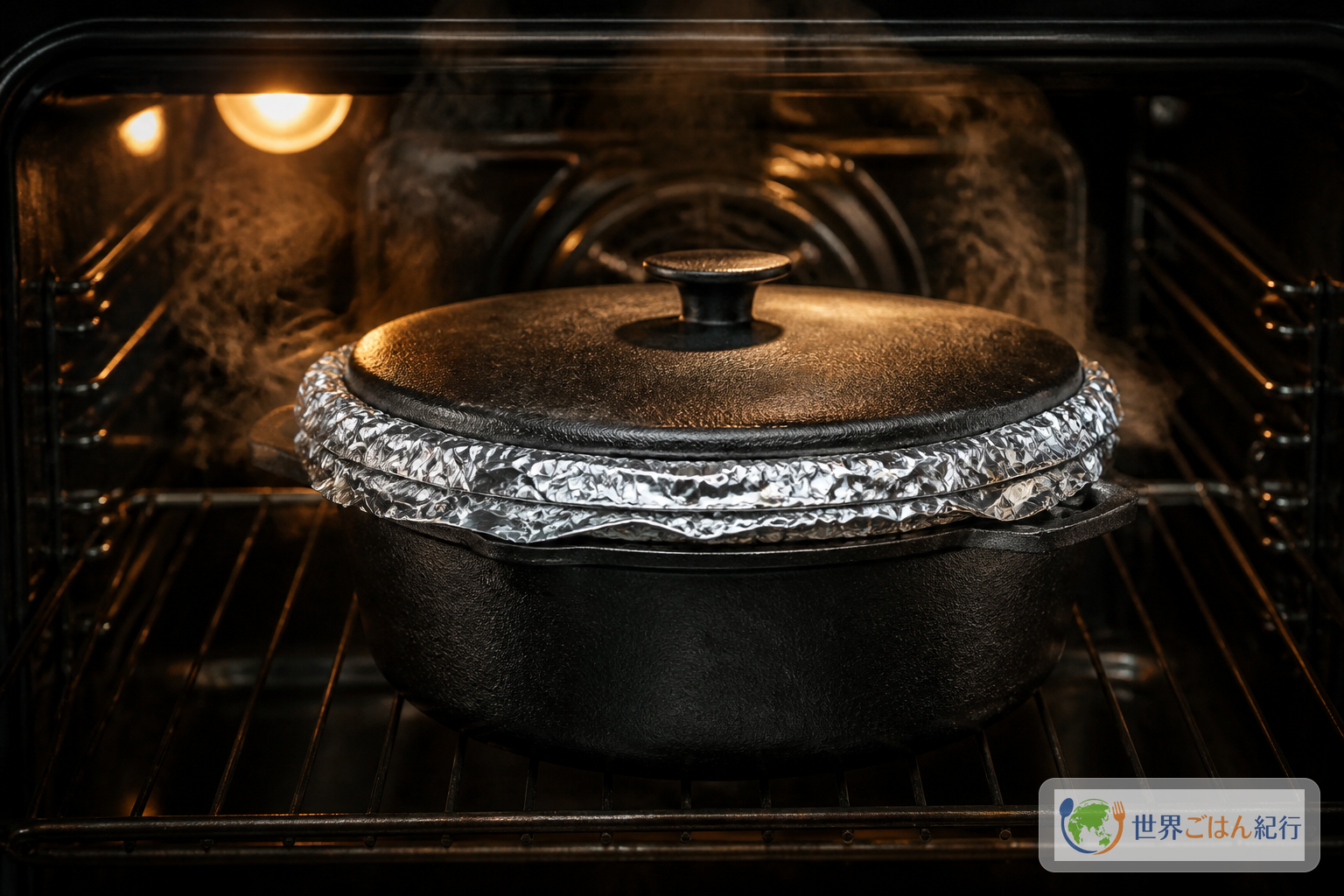
In the home version, a heavy pot supplies the stones' stored heat, and the lid and aluminum foil take the place of leaves and soil.
If you add too much water, the roots taste boiled and the leaf aroma washes into the liquid.
Use only 100 ml of water to supply steam, and let the moisture from the meat and roots stay in the pot.
If your pot has a light lid, press a double layer of aluminum foil under it.
Conversely, if you have a deep ovenproof dish with a lid, you can make this without buying a Dutch oven.
Extra equipment is worth it only if you want to crush ginger and garlic for the marinade; a grater can do the job, so a stone mortar is not essential. If you already use a grater, use it instead of buying anything new.
Ingredients (serves 4)
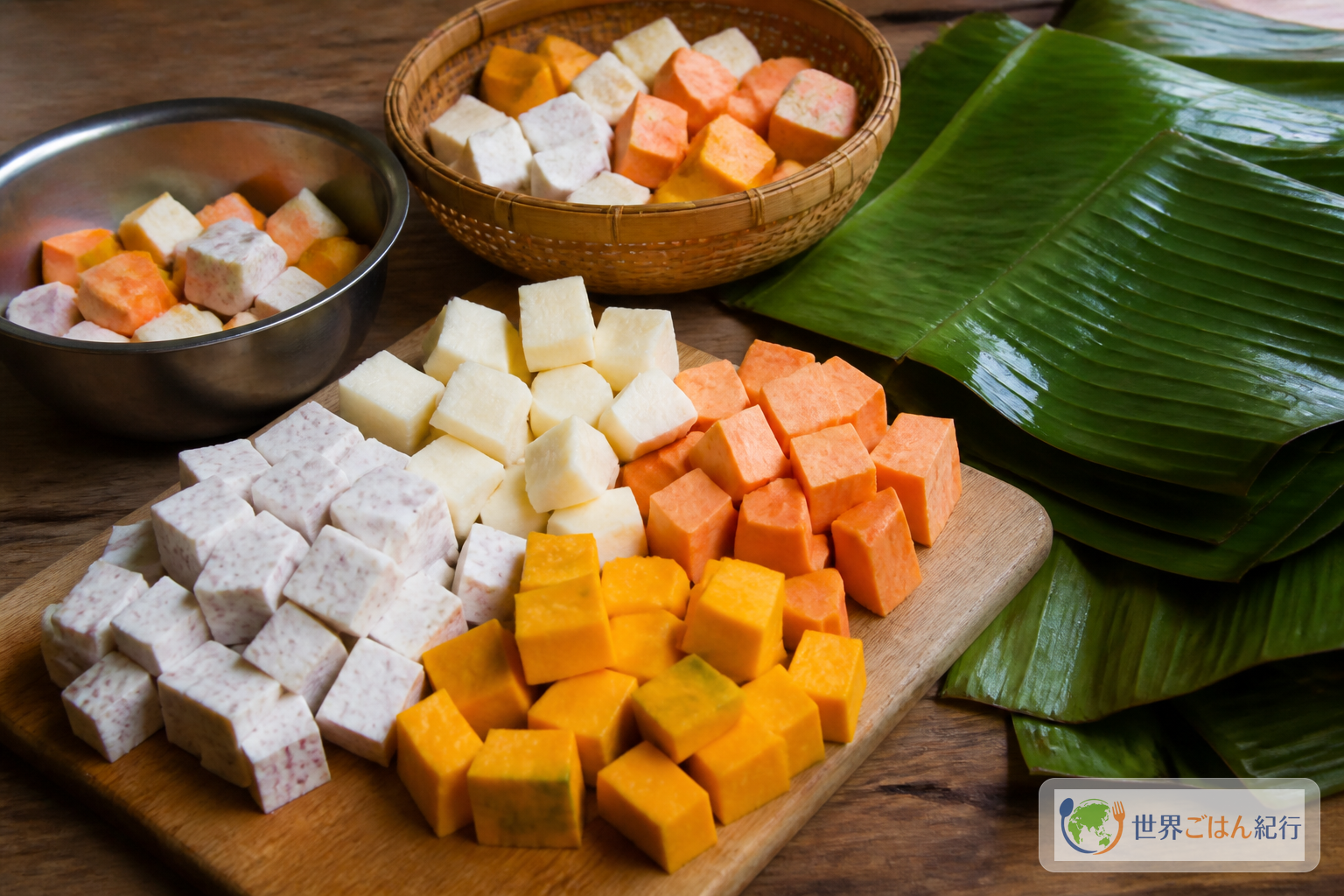
Cut the roots to the same size so they are ready to eat when the meat is done.
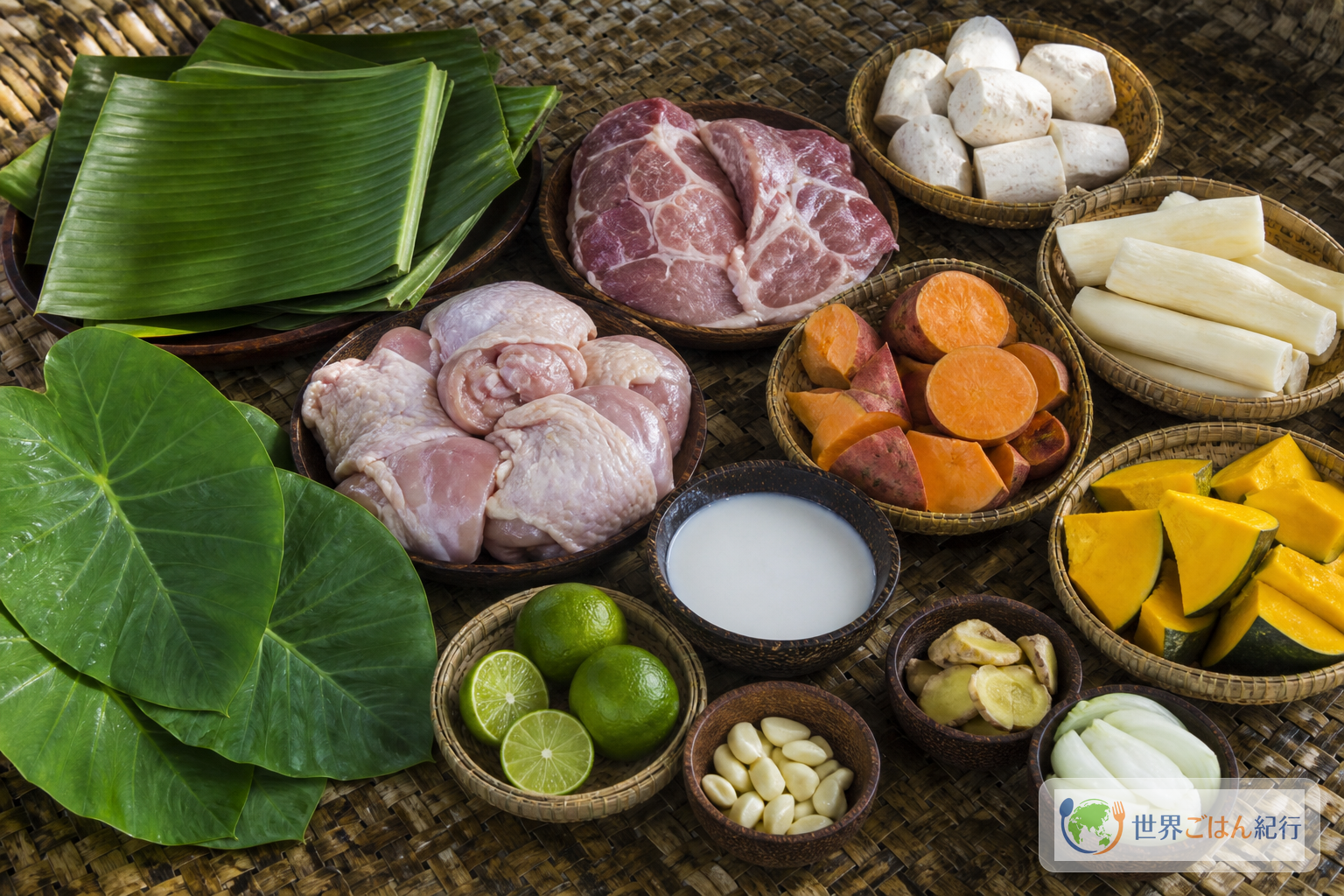
Choose taro leaves sold for eating, not ornamental or foraged leaves.
Taro cannot be eaten raw, and the Pacific Community advises cooking leaves and corms thoroughly to reduce the irritating crystals they contain.
For coconut milk, choose a cooking product rather than a drink or sweetened type, with an ingredient list of mainly coconut and water. Look for a can of about 400 ml, unsweetened, regular or full-fat.
If you already have a suitable can, there is no need to buy another.
Method
Opening the pot as little as possible, and keeping the root sizes and the seal consistent, gives the most reliable result.
Marinating and preparing the leaf bundles (about 45 minutes)
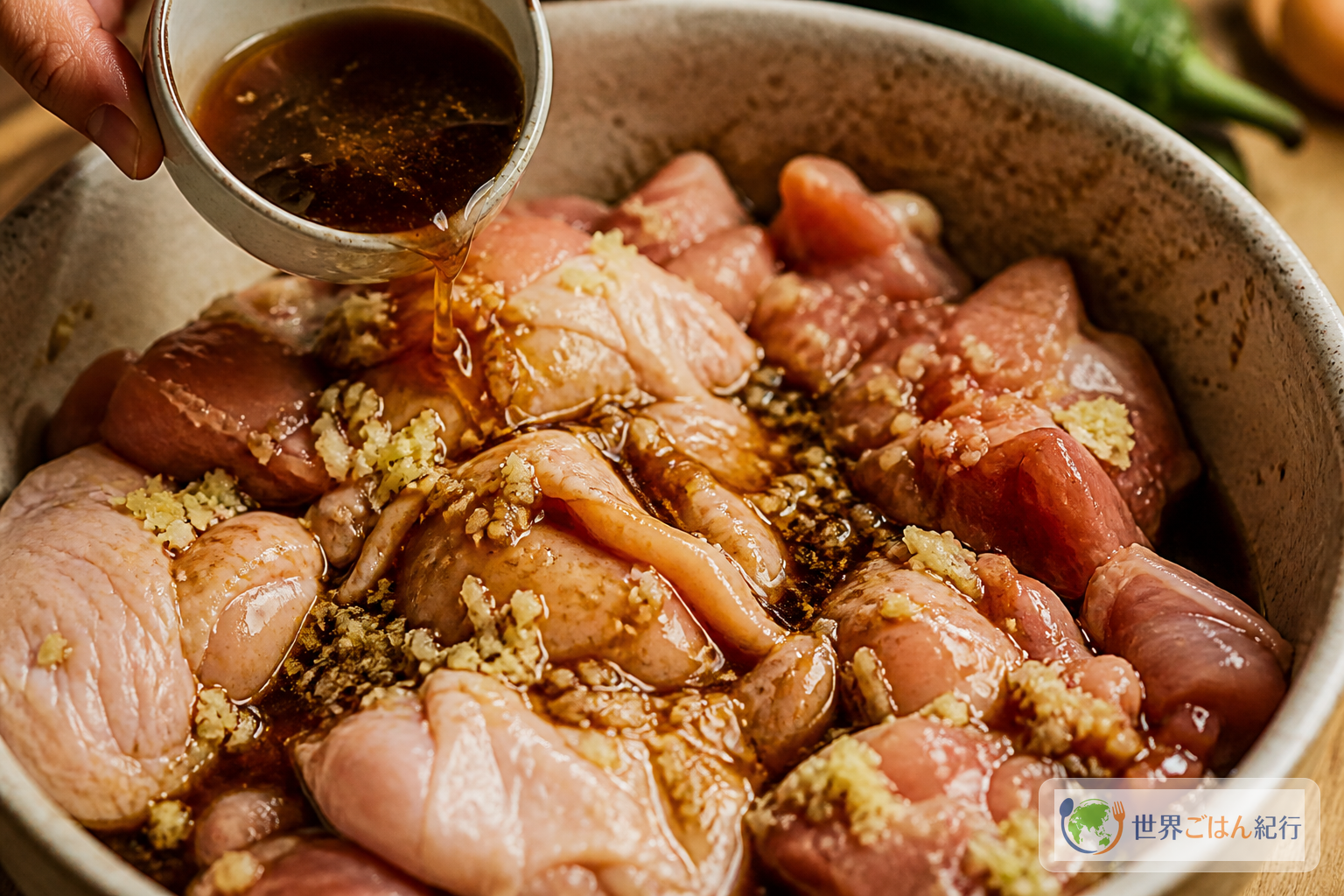
Layering in the pot and steam-roasting (about 120 minutes)
Japan's Ministry of Agriculture, Forestry and Fisheries advises heating chicken to at least 75°C at the center for at least 1 minute.
Because the leaves and lid hide the food, don't judge by appearance alone; cut into the center of a thick piece to check.
Don't reuse the cutting board or knife from raw meat for the roots or the leaves you serve on; wash them before using them for anything else.
When it won't cook through, dries out, or you have no leaves
Because you can't see inside the pot, work backward from the condition of the food to find the cause.
Only the roots are hard
If taro or cassava is hard even though the seal held, the pieces were too large or the pot too shallow for the steam to circulate.
Close the foil again, add just 50 ml of hot water along the edge of the pot, and bake another 15 minutes at 170°C.
If they are still hard, cut the roots into 3 cm cubes next time and halve the thick parts of the cassava.
The meat is done but the bottom of the pot is watery
Adding water without measuring, or putting in frozen meat, releases too much liquid from the meat and vegetables.
Next time reduce the water from 100 ml to 50 ml, and thaw the meat completely in the refrigerator first.
After baking, take out the meat and roots, simmer the cooking liquid uncovered for 10 minutes, check the seasoning and spoon a little back over the food.
The banana leaves tore and the aroma is weak
Folding leaves without warming them makes them split easily, and the steam inside the bundle escapes.
If you can't find cooking leaves, wrap the food in parchment and then double-seal it in aluminum foil.
This keeps the steam-roasting structure, but you lose the green fragrance of banana leaf.
Choose frozen cooking leaves if the aroma is the point; if you just want softening steam, parchment and foil are enough.
You can't find taro leaves
Without edible taro leaves, use 200 g of Swiss chard or spinach for the coconut bundles.
The texture will be softer, but if you double the leaves and cook thoroughly, they still hold the coconut in.
Switching to a known edible vegetable is safer than substituting an unidentified leaf.
Lovo is easiest to understand at a size you can gather around
The smoke and hot stones of an earth oven can't be moved fully into a home oven.
Still, the structure of roots at the bottom, meat in the middle and leaf bundles on top, sealed in, can be reproduced in a heavy pot.
When you eat, don't treat the meat as the main dish alone; take some of each and compare the textures of taro, cassava and sweet potato.
Taro is sticky, cassava floury and crumbly, and sweet potato and pumpkin add sweetness.
The coconut bundles act as a soft side dish that catches the fat from the meat.
For a comparison with Samoa's leaf-wrapped dish, which uses similar ingredients with a different name and wrapping, see Palusami.
Storage and leftovers
Serve only what will be eaten onto the platter, move the rest to a shallow container and let it cool.
Eat refrigerated lovo by the next day, and reheat until the centers of the meat and roots are steaming.
The oil in the coconut bundles sets when cold, so warm them in their wrappers before opening.
Avoid cooling and reheating a second time; portion for the number of people eating before you store it.
Sources
- The Coconet.tv, “How to Lovo 101” (accessed and checked 19 August 2026)
- SBS Food, “Fijian feast cooked in the earth (lovo)” (accessed and checked 19 August 2026)
- Pacific Community, “Taro in Pacific cooking” (accessed and checked 19 August 2026)
- Ministry of Agriculture, Forestry and Fisheries (Japan), “Enjoying chicken dishes: beware of food poisoning by Campylobacter” (in Japanese) (accessed and checked 19 August 2026)