


After the meat comes off the grill, a green sauce changes the table
The moment a grilled steak lands on the cutting board, the kitchen fills with the smell of meat juices and browned fat. Salt and pepper alone are good. But take a small jar from the refrigerator, spoon on a green sauce that smells of chopped parsley and garlic, and the same meat suddenly belongs on a South American table.
Chimichurri is a raw herb sauce that is indispensable to the grilling culture of Argentina and Uruguay, asado. The base is parsley, oregano, garlic, chili, red wine vinegar and oil. It isn't cooked: you chop everything fine, mix, let it rest a little, and spoon it over meat.

The ingredients are quite familiar. If you don't have flat-leaf parsley, curly parsley will do; if you don't have red wine vinegar, rice vinegar and lemon work; and if you don't have ají molido, coarse chili flakes will do. Three things matter: don't turn it into a paste in a blender, don't be afraid of the vinegar, and don't eat it right away but let it rest.
This article makes a basic home chimichurri that goes with churrasco (in Japanese), empanadas (in Japanese) and revuelto gramajo (in Japanese), which combines egg and shoestring potatoes. It digs into the role of chimichurri touched on in the overview of South American cuisine (in Japanese) so that one article covers everything from shopping to storage.
In the Spanish-speaking world it is "chimichurri", and this article uses that name throughout.
What is chimichurri? The sourness beside the asado

Chimichurri is a raw sauce said to have originated in Argentina. Britannica describes the usual makeup as parsley, oregano, garlic and red wine vinegar, and summarizes that in Argentina parsley, garlic, oregano and chili form the foundation.
What is interesting is that while Argentine beef culture values "only salt and pepper on the meat," chimichurri is the one exception that is loved. Asado meat isn't flavored by marinating; it is grilled over embers with salt, and at the table you add aroma and sourness with sauce. It is a sauce that brightens the fat of grilled meat rather than one that hides the meat.
South America has several sauces with similar roles. Brazil's vinagrete (in Japanese) is a salsa of diced tomato and onion, and farofa (in Japanese) is a toasty meal that soaks up meat juices. Among them, chimichurri is the one that leans most toward "herbs and vinegar."
| Sauce | Main ingredients | Texture | Goes with |
|---|---|---|---|
| Chimichurri | Parsley, oregano, garlic, vinegar, oil | A liquid sauce with chopped herbs | Beef, chicken, fish, grilled vegetables |
| Vinagrete | Tomato, onion, bell pepper, vinegar, oil | Diced-vegetable salsa | Churrasco, bean dishes |
| Salsa criolla | Onion, tomato, chili, vinegar | Coarse relish | Locro, grilled meat, fried foods |
Even the Nutrition.gov recipe says "finely chop but don't purée." If you use a home food processor, stop where you can still see grains of parsley instead of making a complete paste. Make it like a green juice and the oil and bitterness come to the front.
Ingredients (easy-to-make amount, about 6 servings)

This quantity covers 4 to 6 steaks, 2 to 3 chicken thighs, or one large platter of grilled vegetables. As a sauce, plan on 1 to 2 tbsp per person.
Chimichurri itself uses no wheat, egg or dairy. However, because it is a sauce of raw garlic and herbs in oil, avoid leaving it at room temperature. Once made, put it in a clean jar, keep it refrigerated, and eat it within 4 days if possible. For longer storage, freezing is safer.
Ingredients worth thinking about when shopping
For parsley, choose flat-leaf if you can. Curly parsley has a stronger aroma, and finely chopped it can have a slightly green bitterness. But curly parsley is more easily available in many stores, so in that case remove the stems well and use only the leaves for easier eating.
Red wine vinegar gives chimichurri its outline. Made with grain vinegar alone it comes out a bit sharp, so combining rice vinegar and lemon juice suits home cooking. There is no need to buy an expensive olive oil, but it remains as an aroma at the end, so choose one that isn't too bitter.
Method
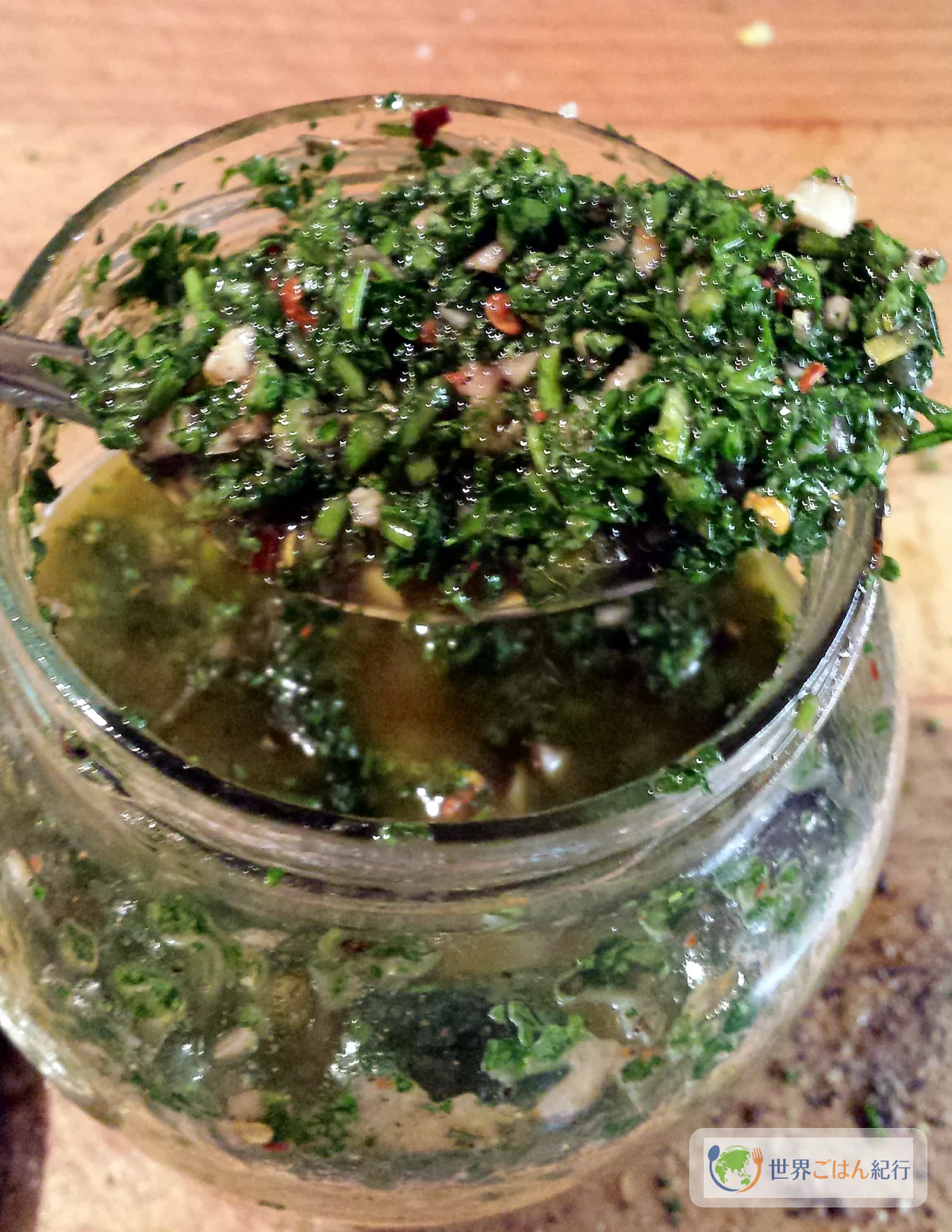
Tasting straight from a spoon makes the vinegar and garlic seem strong. Check it on what you'll actually serve it with: grilled meat, toast or potatoes. A sauce that is slightly strong on its own is just right on meat.
A formula that doesn't fail: how to think about vinegar, oil and salt
The most common reason chimichurri turns out dull is too much oil. If you're used to avoiding "sour sauces," you may want to hold back on vinegar, but to go with asado you need a decent amount. It is there to reset the fat of the meat, the toasty smoke of the embers and the saltiness with vinegar and herbs.
The basic ratio is 90 ml oil to 60 ml vinegar: about 1.5 parts oil to 1 part vinegar. With less than half that vinegar it becomes closer to herb oil and feels heavy on meat. With vinegar equal to the oil it becomes quite sharp. That could suit grilled fish or chicken breast, but starting at 1.5 to 1 the first time makes it hard to go wrong.
| Result | Oil | Vinegar | Good with |
|---|---|---|---|
| Basic | 90 ml | 60 ml | Beef steak, chicken thighs, sausages |
| Fresher | 80 ml | 70 ml | Fish, pork, grilled vegetables |
| Mellower | 110 ml | 50 ml | Meat for children, mild chicken |
| For marinating | 70 ml | 80 ml | Chicken before grilling, mushrooms, onions |
Use 1 tsp salt as the baseline. If you salt the meat well, drop the sauce to 2/3 tsp. Conversely, for grilled vegetables or boiled potatoes a bit over 1 tsp is fine. Chimichurri is a sauce you spoon on at the table, so adjust the salt by what it goes on.
In Argentine homes a jar may sit on the table, but a raw-garlic oil sauce made at home should not be left out at room temperature for long. The U.S. National Center for Home Food Preservation explains that garlic in oil stored at room temperature carries a risk of botulism. After making it, refrigerate it, and freeze it for the long term.
What to put it on: more than just meat

Beef is the classic: steak, skirt steak, rump, roast beef, short ribs for grilling. Grill the meat, then spoon chimichurri onto the cut surface, and meat juices and vinegar mix into a small sauce on the plate. Serving it alongside vinagrete with churrasco (in Japanese) meat lets you taste Brazilian and Argentine grilling culture at once.
It also goes well with chicken. Grill chicken thighs with just salt and spoon on chimichurri right before eating for a green aroma unlike lemon chicken. For mild meats like chicken breast or tenderloin, the mellower version with a little more oil suits better.
For fish, pair it with salmon, mackerel, marlin or sautéed white fish. For fish, cut the garlic to 1 clove and use slightly more vinegar to make it easier to eat. For grilled vegetables, eggplant, zucchini, bell pepper, potato and corn go superbly.
| Use | How to apply | A small touch |
|---|---|---|
| Beef steak | 1 to 2 tbsp after grilling | Rest the meat 5 minutes before spooning |
| Chicken thighs | Finish after browning the skin | A little lemon makes it lighter |
| Grilled fish | Over the top, with less garlic | More vinegar cuts fishiness |
| Grilled vegetables | Toss while still hot | Especially good with potatoes |
| Sandwiches | Mix with a little mayonnaise | Good for roast beef sandwiches |
If you make it on the weekend and have leftovers, the next day spread it thin on toast and top with an egg. Served with grilled sausage, it comes close to the taste of choripán, the South American street food. Chimichurri's convenience is that it lends leftovers a "properly cooked" feel.
Empanadas (in Japanese) already have flavor inside, so rather than drenching them in chimichurri, serve it in a small dish and just dip the edge. With a fried type or a meat-heavy filling, a sharply acidic chimichurri works well.
Storage and make-ahead: about 4 days refrigerated, 1 month frozen

Chimichurri can be made ahead, but it is not a shelf-stable preserve. Because it uses raw garlic, raw herbs and oil, put food safety first.
At home, use the following as a guide.
| Storage method | Guideline | Good for |
|---|---|---|
| Refrigerated | Within 4 days | Best flavor, use as is on meat and vegetables |
| Frozen | 1 month | Portion in an ice-cube tray and use a little at a time on grilled food |
| Room temperature | Not allowed | On the table only during the meal. Discard leftovers rather than returning them |
Refrigerated, the olive oil may turn white and solid. That's a property of the fat; take it out of the refrigerator 10 minutes before eating and stir lightly and it returns. But if there is an odd sour smell, mold, sliminess or foaming, do not eat it.
To freeze, put 1 tbsp into each cube of an ice-cube tray, and when frozen move the cubes to a storage bag. When using, put it frozen on grilled vegetables or meat, or thaw naturally in the refrigerator. Freezing darkens the parsley's green a little, but the aroma remains well.
Don't keep adding fresh parsley or oil to a jar that has been served at the table. Meat tongs and spoons touching it increase the contamination risk. Put only what you'll use into a clean small dish, and don't return what's left in the dish to the storage container.
Variations

Chimichurri is not a sauce with one right answer. Britannica also explains that the formula changes by region and by cook. Once you have the basic green down, change it little by little to suit the dish.
Red chimichurri
Add 1 tsp paprika, 1/4 tsp cumin and a little more chili to make red chimichurri. It suits beef and sausage, and using smoked paprika moves it toward the aroma of charcoal. Too much heat hides the flavor of the meat, so at first just enough for color is plenty.
Leaning toward Japanese ingredients
Swapping red wine vinegar for rice vinegar and part of the olive oil for rice bran oil makes it easier to put on a Japanese table. A small amount of shiso leaf is refreshing, but too much turns it into a Japanese condiment rather than Argentine cooking. To enjoy it as a dish from around the world, keep the parsley as the star and limit shiso to about 10 leaves.
Milder, for children
Leave out the chili and cut the garlic to 1 clove. Use 50 ml vinegar and 100 ml oil for a mellower sauce. Rather than spooning it directly on the meat, serve it in a small dish and let adults add more, which makes it easier for a family to use.
For marinating
Nutrition.gov presents chimichurri as usable for marinating as well as for spooning over meat, fish and vegetables. However, marinating for a long time can make the surface of the meat too firm from the vinegar. For chicken allow 30 minutes to 2 hours, and for fish 15 to 30 minutes. Don't reuse the marinade after marinating as a table sauce without heating it.
Keep the sauce you marinate meat in separate from the sauce you spoon on at the table. Setting aside half from the start is safe for both hygiene and flavor.
Background: gauchos, immigrants and the mystery of the name

Behind chimichurri is the gaucho culture of herding cattle on the Argentine pampas. Grill meat on the wide grassland and eat it with salt. Layered onto that was the sense of herbs, vinegar and oil brought by European immigrants, and the result is thought to be today's sauce.
The origin of the name, however, is unclear. Britannica says it may derive from the Basque tximitxurri but that this is not certain. In the English-speaking world a theory of an Irishman, "Jimmy McCurry," is also told, but it is closer to folk etymology and the grounds are thin. It's safer not to assert that "this particular person certainly made it."
What matters more is that chimichurri is a sauce that belongs to each household. More parsley, more oregano, stronger chili, stronger vinegar. At an Argentine asado, the asador watches the meat while each family's chimichurri is on the table. The flavor isn't fixed to one version; it changes to suit the meat and the gathering of people.
At an asado table, chimichurri isn't something that "overrides the grill cook's seasoning" but a small freedom for diners to adjust on their own plates. More vinegar for well-grilled, fatty cuts; a little more oil for lean meat; chili added for sausage. The interest of this sauce lies in passing one jar around so each person finds their own landing point on the plate.
| Asado cut | Chimichurri adjustment | Reason |
|---|---|---|
| Fatty ribs | Add 1 tsp vinegar | Cuts the fat and lightens the next bite |
| Lean rump or skirt | Add 1 tsp oil | Offsets the dryness of lean meat and carries aroma |
| Sausage | Add a little chili | Heat suits the saltiness of processed meat |
| Grilled vegetables | Add a pinch of salt | Because vegetables have little salt of their own |
It's the same in a Japanese home. Make it the first time with the basic formula, then adjust: "a bit more vinegar," "less garlic," "lighter for fish." That turns a world dish from a one-time event into a tool that stays in the refrigerator.
FAQ

Q1. Can I make chimichurri in a blender?
You can, but don't make it a complete paste. Pulse only a few short times and stop while grains of parsley remain. Chopping with a knife keeps the aroma from getting muddy, and the oil and herbs separate more naturally.
Q2. Are there different spellings of chimichurri?
Variant transliterations of the same name exist in other languages, but the dish is the same: the herb sauce served with grilled meat in Argentina and Uruguay.
Q3. Is it still authentic with cilantro?
In other parts of Latin America there are formulas with coriander, but to stay close to the basic Argentine style, keep parsley as the star. If you add cilantro, don't replace all of it; limiting it to about 10 g of the 40 g of parsley is easier to eat.
Q4. How long does it keep?
Plan on within 4 days refrigerated. Because raw garlic and herbs are in oil, avoid room-temperature storage. If there is leftover, freeze it in an ice-cube tray and use it up within 1 month.
Q5. What does it go with best?
Beef steak is the recommended first choice. Spoon 1 tbsp of chimichurri over meat grilled with salt only and the roles of sourness, oil and herbs are easy to understand. Then branching out to chicken thighs, grilled vegetables and sautéed fish makes it easier to use up.
Summary: having it in the refrigerator makes meat days easier

Chimichurri isn't a difficult dish. Chop parsley, let garlic and oregano meld in vinegar, add oil and rest. Yet that small effort lightens the fat of meat, makes grilled vegetables a proper dish and even helps with the next day's sandwich.
Make it the first time with the basic formula: 90 ml oil, 60 ml vinegar, 40 g parsley, 2 cloves of garlic. Even if the sourness seems strong, it will be just right on meat. From the next time, less garlic for fish, more lemon for chicken, a little more salt for grilled vegetables, and it becomes the chimichurri of your own kitchen.
Set beside churrasco (in Japanese), empanadas (in Japanese) and locro (in Japanese), the tables of Argentina and its neighbors come into clearer view. South American cooking is completed not only by large platters of meat but by small sauces and accompaniments like this.


