

The story of acarajé: a Bahian street stall that starts with the sound of crushed beans
Say it is evening, and you spread soaked black-eyed peas across the kitchen counter. Rub them with your fingers and the thin skins float to the surface of the water. Each time you turn the ground beans with a wooden spatula, the heavy batter gets a little lighter. The dendê oil in the pot shimmers red, and a spoonful of batter dropped in answers with a "sizzle."
Acarajé is a dish that takes a little while to reach that sound. The hard part is not the frying oil. It is deciding how far to remove the skins of the black-eyed peas, how much air to work into the batter, and whether the aroma of dendê oil will be the star or a supporting note. Settle those three and what to buy and in what order to work become clear.

Acarajé is not only a fried bean fritter
Acarajé from Bahia in northeastern Brazil is a batter of black-eyed peas and onion fried in dendê oil and eaten with vatapá, caruru, shrimp and vegetables. IPAC, the cultural heritage agency of the state of Bahia, describes the work of the street-stall "baianas" selling from a stand called a tabuleiro, together with the ingredients and combinations of the dish, as one culture. IPAC's explanation
What matters here is not to hunt too hard for "the one right recipe." What IPHAN registered is not a fixed recipe for one plate but the "Ofício das Baianas de Acarajé," the craft of making acarajé and selling it from the tabuleiro. Acarajé served in religious settings also differs from the acarajé filled and sold in the street. IPHAN's registration
This article keeps that range in view and reworks the dish into a version for 4 that is easy to reproduce at home. First get the fried bean batter right, then make the vatapá-style filling. You can leave out the dried shrimp for a seafood-free version, but keep the aroma of dendê oil. By the end you should be able to decide whether to make the full version over a whole day or try a simplified filling on a weekend.
Ingredients: what to keep, and what the kitchen can give up

Vegetables to finish
Cut 1 tomato into 1 cm dice and slice 1/4 red onion thinly. With 1 tbsp lemon juice, 8 okra pods and a little cilantro, you add acidity and a green aroma to the rich filling. You do not have to make a separate leafy-green filling like caruru. Tomato and lemon alone are enough the first time.
Conditions for buying dendê oil
What defines the outline of acarajé is the red-orange dendê oil. Frying everything in dendê oil gives a strong aroma, and the first time it is easier to serve if you mix it half and half with rice bran oil. When you buy, check the label or product page for "edible," "azeite de dendê," or that it is edible red palm oil. Red palm oil sold for cosmetics, or other products meant only for flavoring, cannot stand in.
It is worth buying if you will cook Bahian food several times, or if you will use several pieces at once and freeze them. If the aroma of dendê oil does not appeal to you, it wastes less to practice the frying with rice bran oil alone and buy a small bottle next time. Check the contents as well as whether it is edible.
Conditions for buying black-eyed peas
Choose dried peas whose only ingredient is the beans. Canned boiled beans seem to save the peeling, but the water content is different and the batter will not come together at the amounts in this recipe. If you use canned, it needs to be a separate recipe: drain off the moisture and adjust with a little flour. This time, buy dried, or look at an import grocery store for packs labeled "black-eyed peas" or "feijão fradinho."
It is for those who can soak the beans from the day before. If you want to make it on the day, or if peeling is a burden, it is more realistic to look for cooked beans at a store and switch to another bean dish rather than force this one. Check that the pack is dried and look at the contents.
Method: remove the skins, work in air and fry in red oil
You may do the first half, soaking and peeling, the night before. The Senac Bahia recipe too washes soaked black-eyed peas, makes a batter with onion and salt, beats it with a wooden spatula to lighten it and fries it in dendê oil. Here that flow is divided to suit a home pot. Senac Bahia's recipe
Step 1: Soak the black-eyed peas and remove the skins
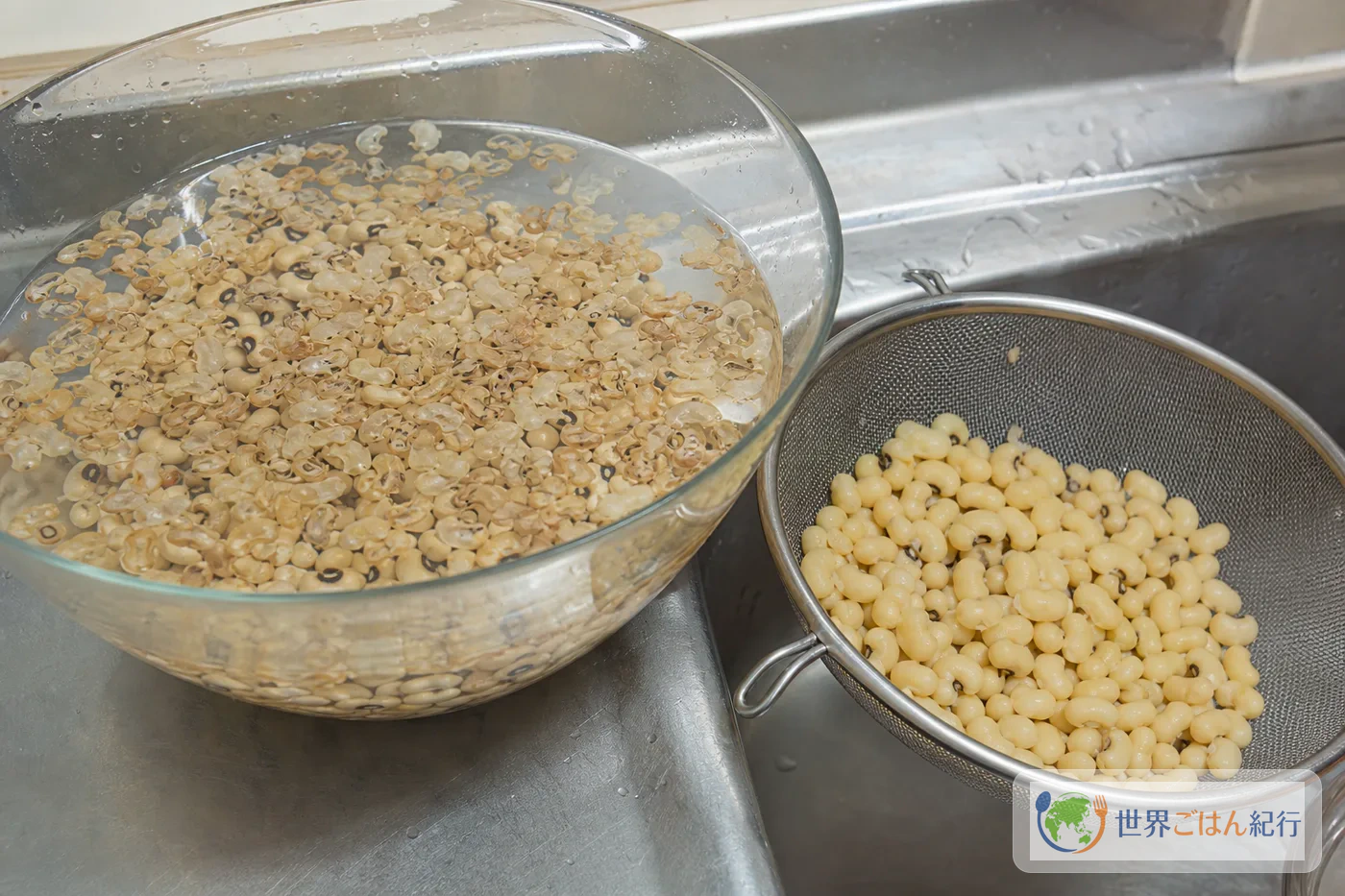
Put 400 g dried black-eyed peas in plenty of water and soak at room temperature for 5 hours to overnight. They are ready when plumped up, not so soft that you can split them with a finger, and dent slightly when pressed. Change the water, rub the beans with both hands to loosen the floating skins, and drain in a colander. Spend about 10 minutes removing as many skins as you can, but a few left behind is not a failure. The more skins remain, the coarser the mouthfeel of the finished fritter.
Step 2: Grind the beans and work air into the batter

Process the drained beans, 100 g onion, 8 g salt and 15 ml dendê oil in a food processor for 3 to 5 minutes, until no grains are visible. Do not add water; add 1 tsp at a time only if it will not turn. Move the batter to a bowl and beat it hard with a wooden spatula for about 3 minutes, until it turns whitish and has the viscosity of a loose peak whose spoon trail slowly closes. If it falls heavily and holds no peak, beat for 1 more minute before shaping.
Step 3: Bring the vatapá-style filling together over low heat

Tear 50 g bread and soak it in 200 ml coconut milk for 5 minutes. Finely crush 20 g dried shrimp, 25 g peanuts, the garlic and ginger, and cut 80 g onion into 5 mm dice. Put 15 ml dendê oil in a pot and cook the onion over low heat for 6 minutes. When translucent, add the bread soaked in milk and the crushed ingredients. Keep working it over low heat for 8 to 10 minutes and stop when it has a smooth thickness and the line from the spatula remains for about 2 seconds. If it cooks down too firm, return coconut milk 1 tbsp at a time.
Step 4: Shape small and fry at 170 to 175°C

Pour frying oil 3 cm deep into a pot and bring it to 170 to 175°C (340 to 350°F) over medium heat. Take the batter 2 tbsp at a time and shape it with two spoons into ovals about 7 cm long and 2 cm thick, then lower up to 3 gently at a time. Fry one side for 3 to 4 minutes, turn and fry another 3 to 4 minutes. They are done when the surface is a deep golden brown and the bubbles of oil turn fine when you lift one. If the oil temperature drops and the bubbles grow large, return to medium heat before adding the next batter. Without a thermometer, drop in a little batter and look for fine bubbles that start at once and keep coming.
Step 5: Split and fill with the filling and acidity

Move the fried fritters to a rack and rest them for 3 minutes to settle the residual heat. Cut a slit from the side about two thirds of the length, about 2 cm wide, and open the mouth without splitting it fully. While the crisp surface still holds, fill with 1 to 1 1/2 tbsp of the vatapá-style filling and about 2 tsp each of tomato and red onion, and add okra and lemon juice. Overfilling hides the aroma of the beans, so use less on the first one. If you add more dried shrimp, check the saltiness and start with a pinch.
Signs of success: lightness comes from the batter, ease of eating from the filling

If the cross section has small holes and the outside is thin and crisp, the batter went well. If the inside is dense and heavy, beat the batter for 1 to 2 minutes longer for the next piece only. Adding water does not always make it lighter. More water leads to spattering and more oil absorbed.
If the outside is dark and the inside too soft, the oil is too hot. Lower the heat and return to about 170°C before adding the next piece. If it is oily, the oil may be too low in temperature or too much went in at once. The easiest fix is never to fry so many at once that you cannot see the bottom of the pot.
If you find the aroma of dendê oil strong, mix half rice bran oil into the next pot only. Rather than erasing the aroma, catch it with the coconut milk and acidity of the filling and it is easier to eat at the table.
Buying dried shrimp: make it the core of the aroma, or take another path
Dried shrimp add the scent of the sea to the vatapá-style filling, but they are not required. If you buy them, choose dried goods whose ingredients are mostly shrimp, with little seasoning added. Check the ingredients, contents and sodium on the label. If the saltiness of dried shrimp is strong, do not use the soaking liquid, and holding the salt of the filling until the very end is the safe approach.
Do not use them if you have a crustacean allergy. You can leave out the dried shrimp and finely chop and sauté mushrooms instead, or make the filling just tomato and onion rather than vatapá style. The flavor is not the same, but the bean batter and dendê oil remain the stars. If someone in the family has an allergy, also watch for shared utensils and oil.
How to eat: set acidity after a rich bite

Bite into one fresh from the fryer and the crunch of the outside, the faint sweetness of the beans and the earthy aroma of dendê oil hit at once. Squeeze a little lemon on the next bite and the rich vatapá loosens. It is easier to compare the fillings if you do not make the chili strong from the start.
For a weekday dinner, make one acarajé per person and set the rest of the filling on a separate plate. On a weekend, add 2 pieces, vegetables and farofa and you get the feeling of a street-stall plate moved to the table. If your interest widens to charcoal cooking in southern Brazil, churrasco also suits, a direction away from bean and oil dishes.
What you can substitute, and what you should not
Black-eyed peas are the batter of this dish itself. Switching to chickpeas or white kidney beans still gives a fried food, but a different dish from acarajé in texture. If you try, enjoy it as a "bean fritter" rather than as acarajé, and do not reuse the same amounts as they are.
Diluting the aroma of dendê oil is possible. Frying in rice bran oil alone gives you the shape, but not the red-orange color or the distinctive aroma. Using a small amount of dendê oil in the batter and filling and frying in rice bran oil is a choice that balances the amount you buy against the aroma.
For the bread, a moist bread gives the filling more body than bread crumbs. If you avoid dairy, check the ingredients of the sandwich bread and choose unsweetened coconut milk. If you leave out nuts, remember that ground sesame can also be an allergen, so check labels first.
Storage and safety: separate before filling

The appeal of acarajé is the texture just after frying, so eat it the same day if you can. If you keep any, separate the fritters, the vatapá-style filling and the chopped vegetables, and once the heat has gone off put them in shallow containers in the refrigerator. Keep the refrigerator at 4°C (40°F) or below, and do not keep anything left at room temperature for 2 hours or more. Even where general leftover storage is given as 3 to 4 days, the fried texture and the quality of the filling drop quickly in this dish, so use until the next day as the safe side. FoodSafety.gov's storage chart
| What you store | Guide at home | How to bring it back |
|---|---|---|
| Fried fritters | Refrigerated, until the next day | 6 to 8 minutes in a 180°C oven or toaster oven |
| Batter | Refrigerated, within the same day | If it separates, turn it lightly; do not carry it over to the next day |
| Vatapá-style filling | Refrigerated, until the next day | Warm over low heat, and if firm add 1 tbsp coconut milk |
| Chopped vegetables | Refrigerated, within the same day | Eat before they release water |
| Fried fritters, frozen | About 2 weeks | Warm from frozen at 180°C for about 10 minutes |
Reading Bahia's street-stall culture from the kitchen

If you cut out the dish alone when you make acarajé, it looks like "fried black-eyed peas." But what you see in Bahia is a scene where the frying technique, choosing the fillings, setting out the plates and the dress, and handing it over in the street are all joined. IPAC presents the baiana's tabuleiro, the white dress, and cooking and selling with dendê oil as elements that carry the memory of a place.
The object of IPHAN's registration is not ownership of a recipe either. What was registered are the people who hold the knowledge and the work. So in a home version, rather than blaming yourself for leaving out one filling as "straying from the real thing," thinking about which aromas and steps you want to keep gets closer to the background of this dish.
West Africa also has dishes that soak and fry black-eyed peas, but acarajé cannot be treated simply as a stand-in for another dish. Similar techniques overlapped over movements of people and history, and this dish grew up in the context of Bahia's religion, street stalls and the work of women. Here, not fixing the roots in one phrase is what lets you see the dish better.
FAQ

Do I have to remove all the skins from the black-eyed peas?
You can make it without removing all of them. As a guide, the skins float in the rubbing water and more than half the surface of the beans looks smooth. More skins add roughness, so on a day when you put lightness first, take your time.
Can I make it if I do not like dendê oil?
Yes. Use rice bran oil for frying and start by using 1 tsp each in the batter and the filling. Leaving it out completely changes the axis of color and aroma. There is no need to force yourself to buy it if it does not suit you.
Can I skip the vatapá-style filling?
Yes. Tomato, onion and lemon alone let you taste the fried bean batter. A realistic approach is to get the fritter right first and add dried shrimp and coconut milk next time.
Can I make it for children?
Leave out the chili, use a small amount of dried shrimp, and have an adult squeeze the lemon afterward. Because it is fried, an adult should handle the hot oil and check the labels for shrimp and nuts in the filling.
What should I buy to get closer to the authentic version?
Start with dried black-eyed peas and edible dendê oil. Dried shrimp are only for when you like the aroma of seafood. Setting aside time the day before to soak the beans, rather than switching to canned boiled beans, gets you closer to the batter of true acarajé.
Summary: buy or pass
Acarajé is not a dish that becomes more authentic the more ingredients you add. Remove the skins of the black-eyed peas, lighten the batter and set the aroma of dendê oil in place. If you can do those three, the filling can be vatapá style or tomato, to suit the situation at your table.
For building a Brazilian meal, feijoada, which stews beans, is the direction that takes time, and baião de dois, which puts rice and beans on one plate, leans toward a weekday staple. For adding a floury texture next to the fried food, farofa, which toasts cassava flour, is also an easy side to reuse.
If you can soak from the day before and want to enjoy the aroma of edible dendê oil, it is worth buying black-eyed peas and dendê oil to make this. If the time for frying and peeling is a burden, passing this time and waiting for a chance to eat it at a restaurant is also a fine choice. If you do buy, check last whether the pack is dried, whether the oil is edible, and the ingredients and contents.
Sources
- IPAC, "Ofício das Baianas do Acarajé": the work of the baianas, the tabuleiro, black-eyed peas, onion, dendê oil and combinations of fillings
- IPHAN, "Ofício das Baianas de Acarajé": the 2005 registration, the idea of distinguishing the craft from the recipe, and the difference between religious settings and street sales
- IPHAN, "Registro do Bem": that what is registered is knowledge and practice, not the dish itself
- Senac Bahia Museu da Gastronomia Baiana, "Acarajé": black-eyed peas, onion, dendê oil, soaking, removing the skins and beating the batter
- Saveur, "Acarajé": ingredients as presented in English and background on the baianas of Bahia
- FoodSafety.gov, "Cold Food Storage Charts": refrigerator temperature and general leftover storage guidance


