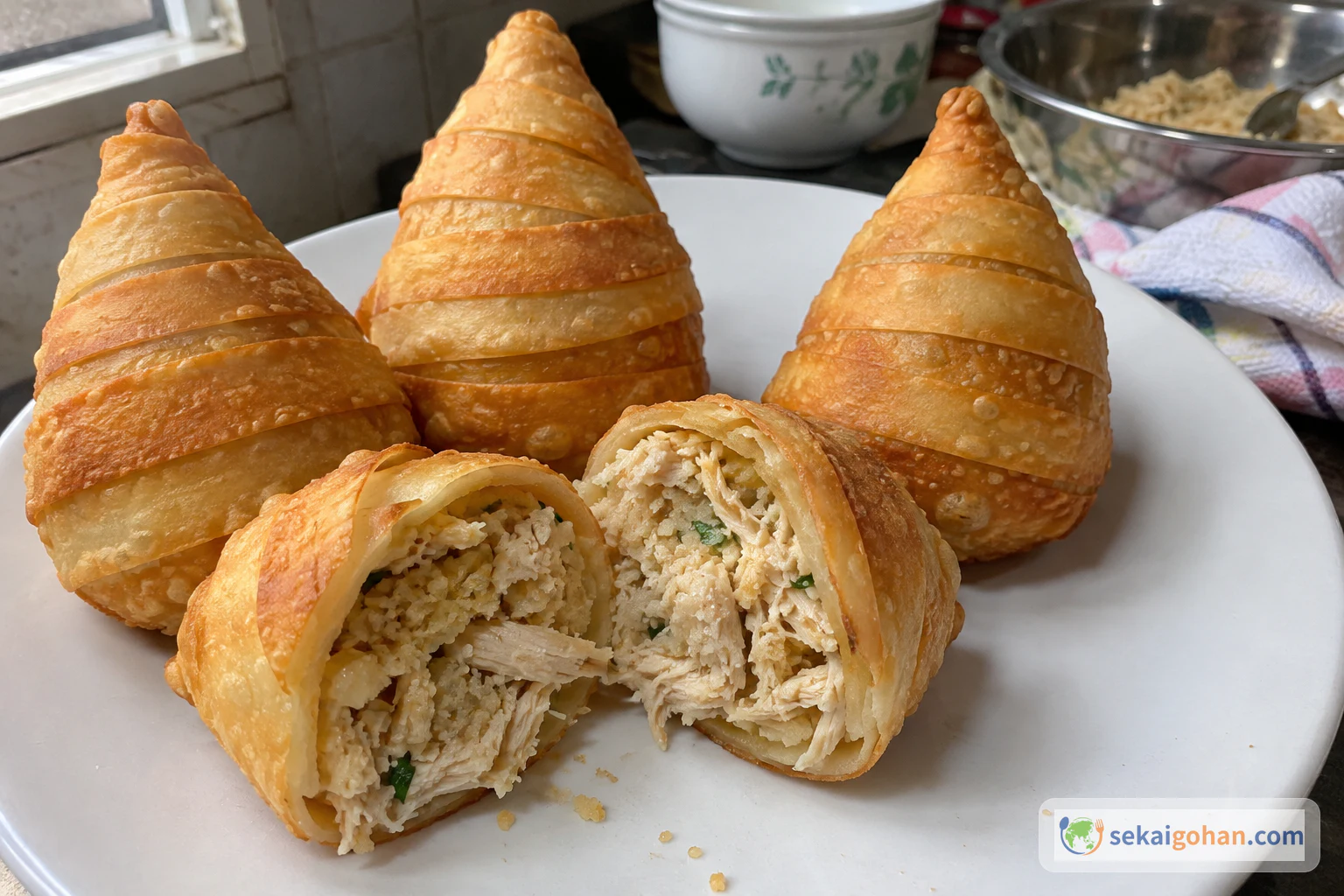
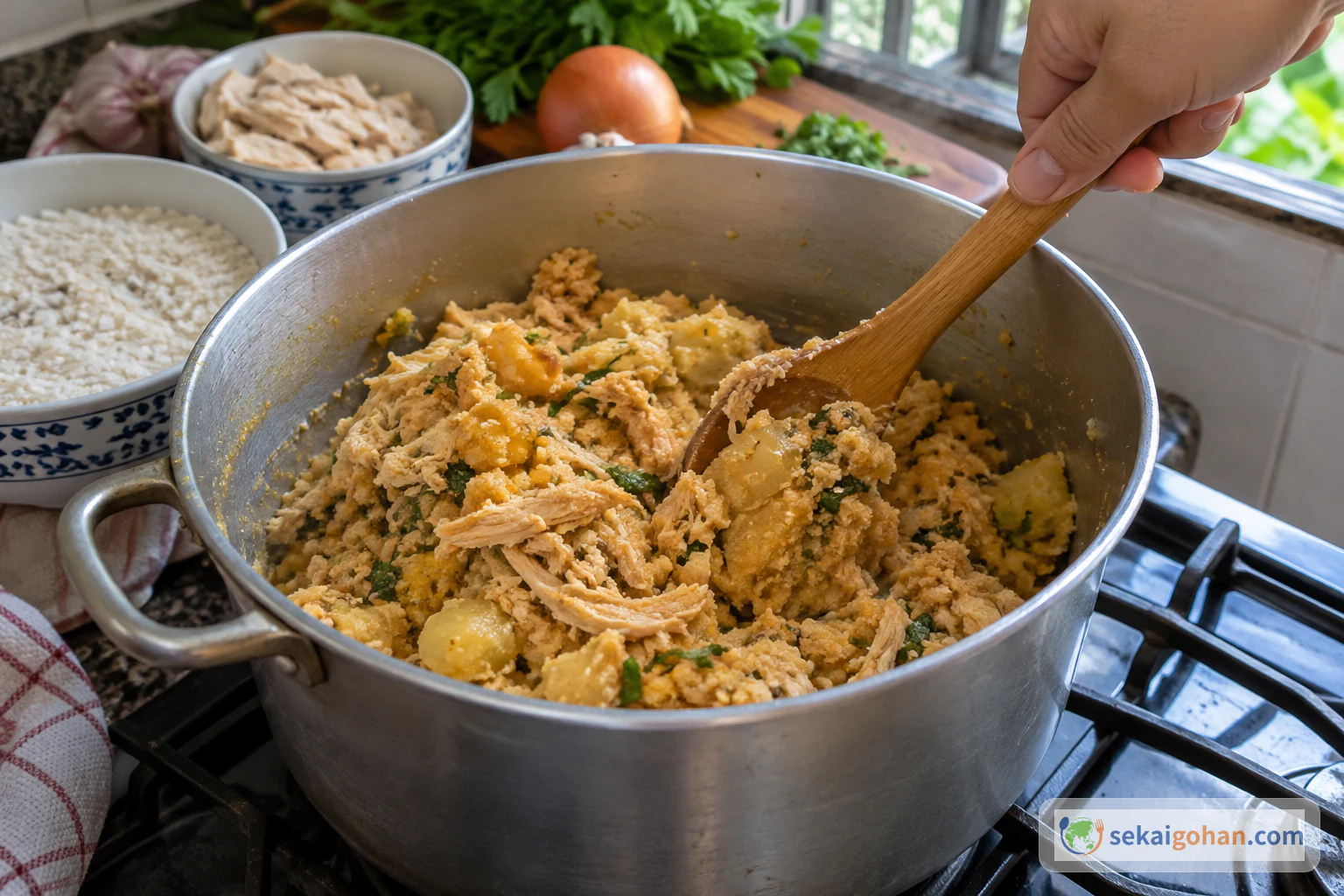
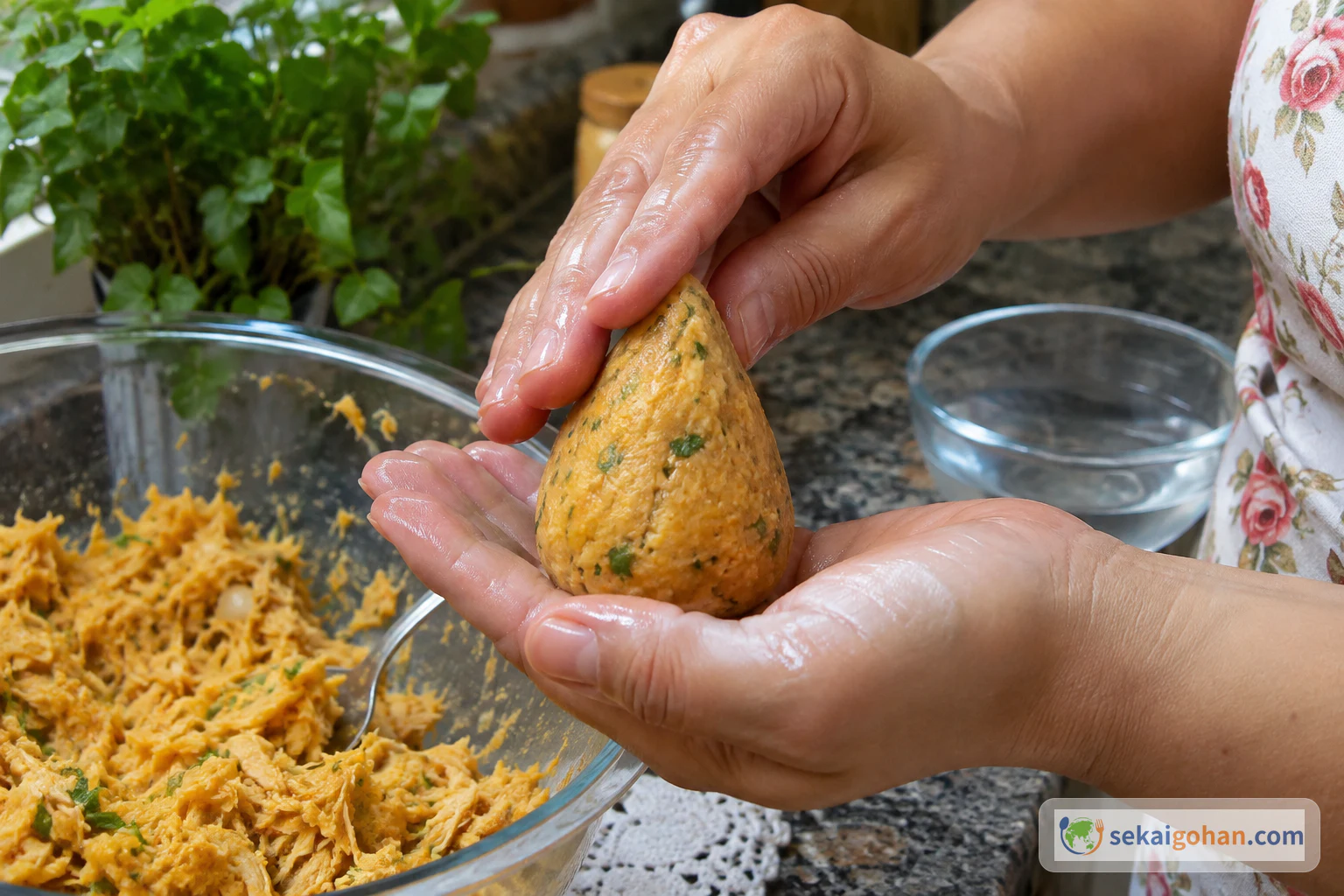
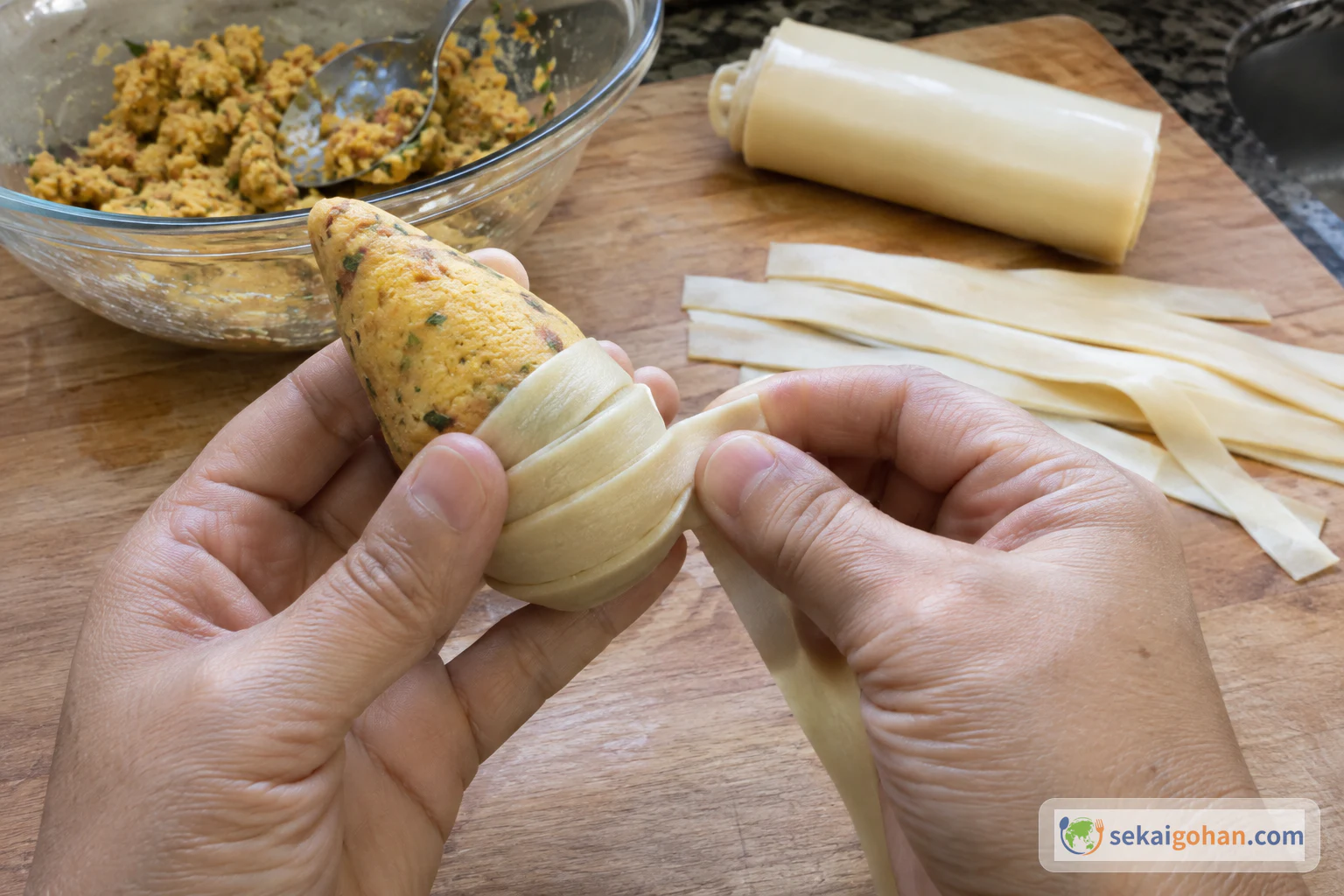
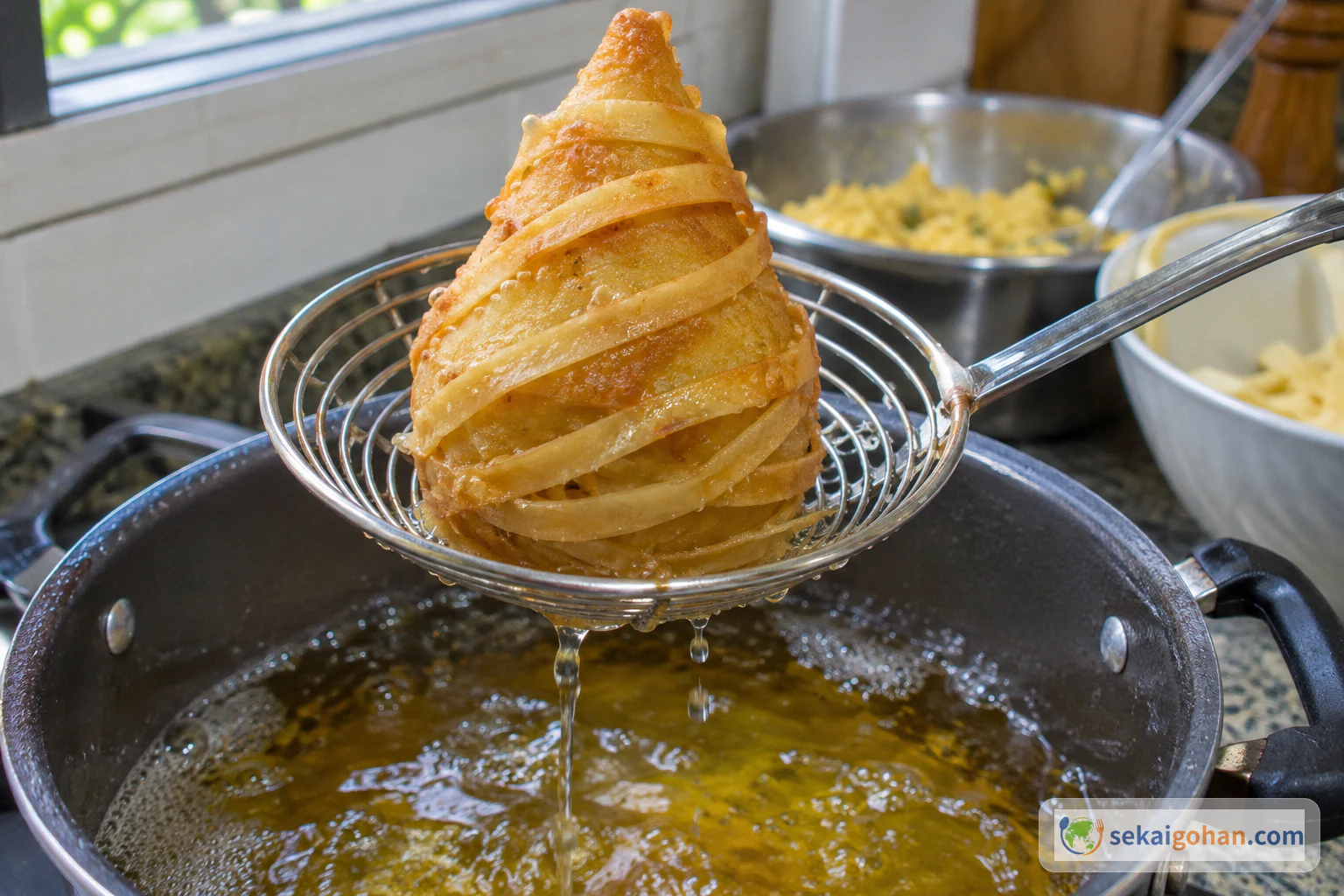
The farofa is still warm when it goes into your wet palms. It is white cornmeal flakes soaked through with chicken broth and threaded with shredded chicken, and you press it into a teardrop that holds its shape. Then a strip of thin pastel dough, about as wide as a fingertip, goes round it from the fat end to the point. After a spell in hot oil the ribbon turns golden and crisp, and the inside stays soft, savoury and full of chicken. This is coxinha de farofa, the street snack of Lapa in the Brazilian state of Paraná. It has the familiar coxinha teardrop shape, but there is no smooth dough shell and no breadcrumb coat, just a crisp spiral and a tender cornmeal filling.
A Coxinha From Lapa With a Different Inside
Most Brazilians know the coxinha as shredded chicken sealed in a smooth wheat-dough teardrop, breaded and fried. In Lapa the name means something else. Here the chicken goes into a farofa of white cornmeal flakes, the teardrop is made from the filling itself, and the only dough is a narrow ribbon wound round the outside. People also call it coxinha da Lapa. It belongs to a town whose traditional cooking is the food of the tropeiros, the mule drivers who once moved herds and goods through the region. A dish made from chicken, cornmeal and a scrap of dough fits that kind of table.
How it began
Where the idea came from is not settled, and the stories disagree on people and dates. The most common telling places it at the São Benedito festival around the early 1940s. The meat filling ran out, dough and farofa were left over, and someone put the two together. That someone is usually named as Maria da Glória Ribas Kuss. One account credits a second woman, Benedita Berghauser, with cutting the dough into thin strips and winding them round. Another story connects the snack to train journeys instead of the festival. Accounts also differ on who Maria da Glória was, which is one more reason to hold every version loosely.
What is clear is how it spread. Bakeries in Lapa, Panificadora Zeni among them, made it an everyday item, and it is still sold that way. In March 2015 the town held its first Festa da Coxinha. A TV programme, Aventuras do Richard no Paraná, featured it as a Lapa specialty and presented the recipe. In 2011 there was a petition to have it recognised as intangible cultural heritage, and that is as far as the record goes. It is a petition, not a registration.
Coxinha means "little thigh", from the drumstick-like teardrop shape. In Lapa the shape stayed but the build changed, and the ribbon-wrapped farofa version is also known as coxinha da Lapa.
Within Lapa the filling moves around. Festival stalls have sold versions with salt cod, apple and even brigadeiro, the chocolate fudge sweet. More recently carne seca and linguiça sausage have joined chicken. Some home cooks build the farofa on a tomato sauce. The recipe below keeps to the plain chicken, lard and herb farofa that most people think of as the standard. If you want more of Brazil's everyday cooking after this, start from our Brazil page.
Ingredients
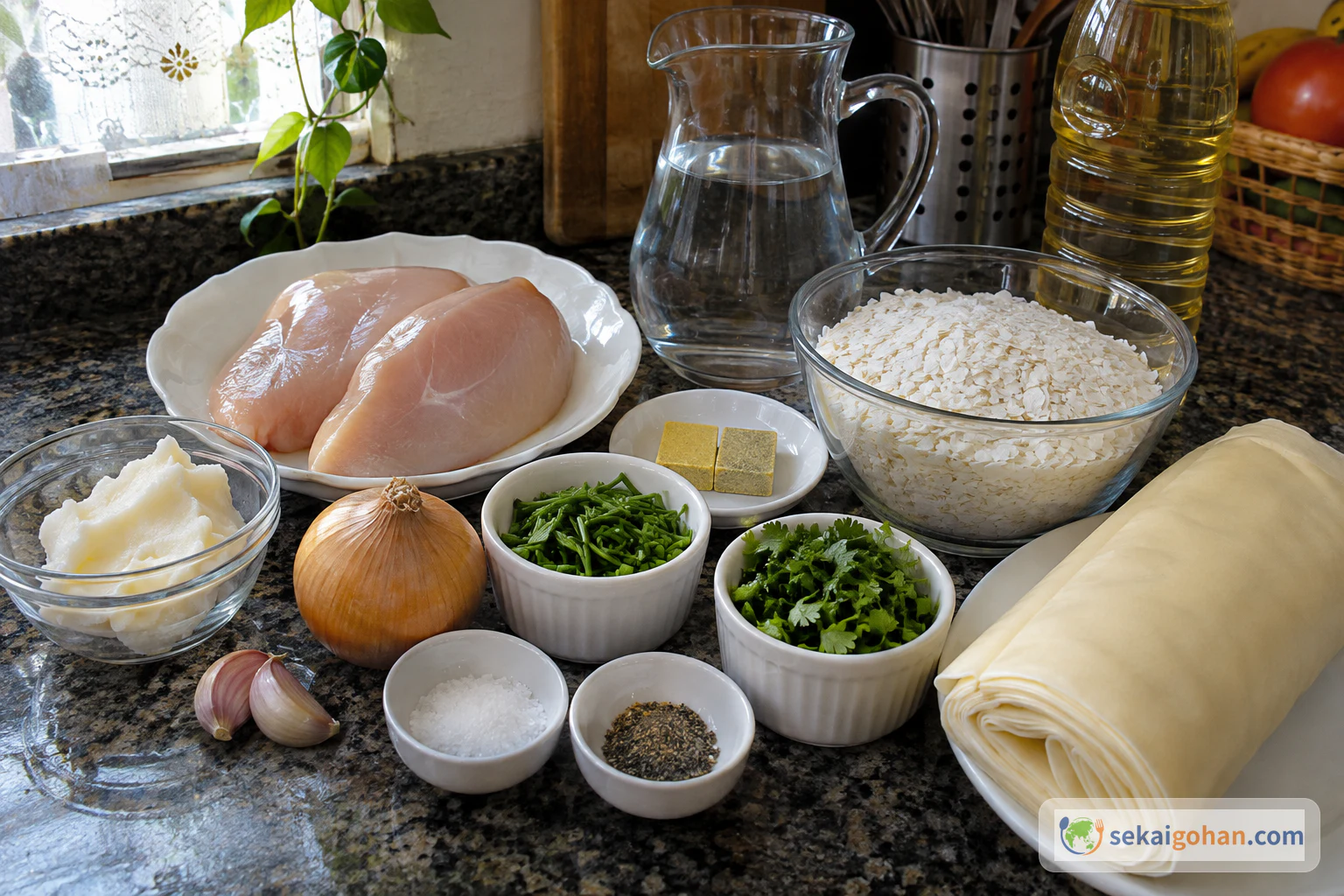
Pastel dough contains wheat. Bouillon cubes often contain milk, soy or other allergens, so read the label on the brand you buy. Lard is pork fat.
Equipment
- Pressure cooker
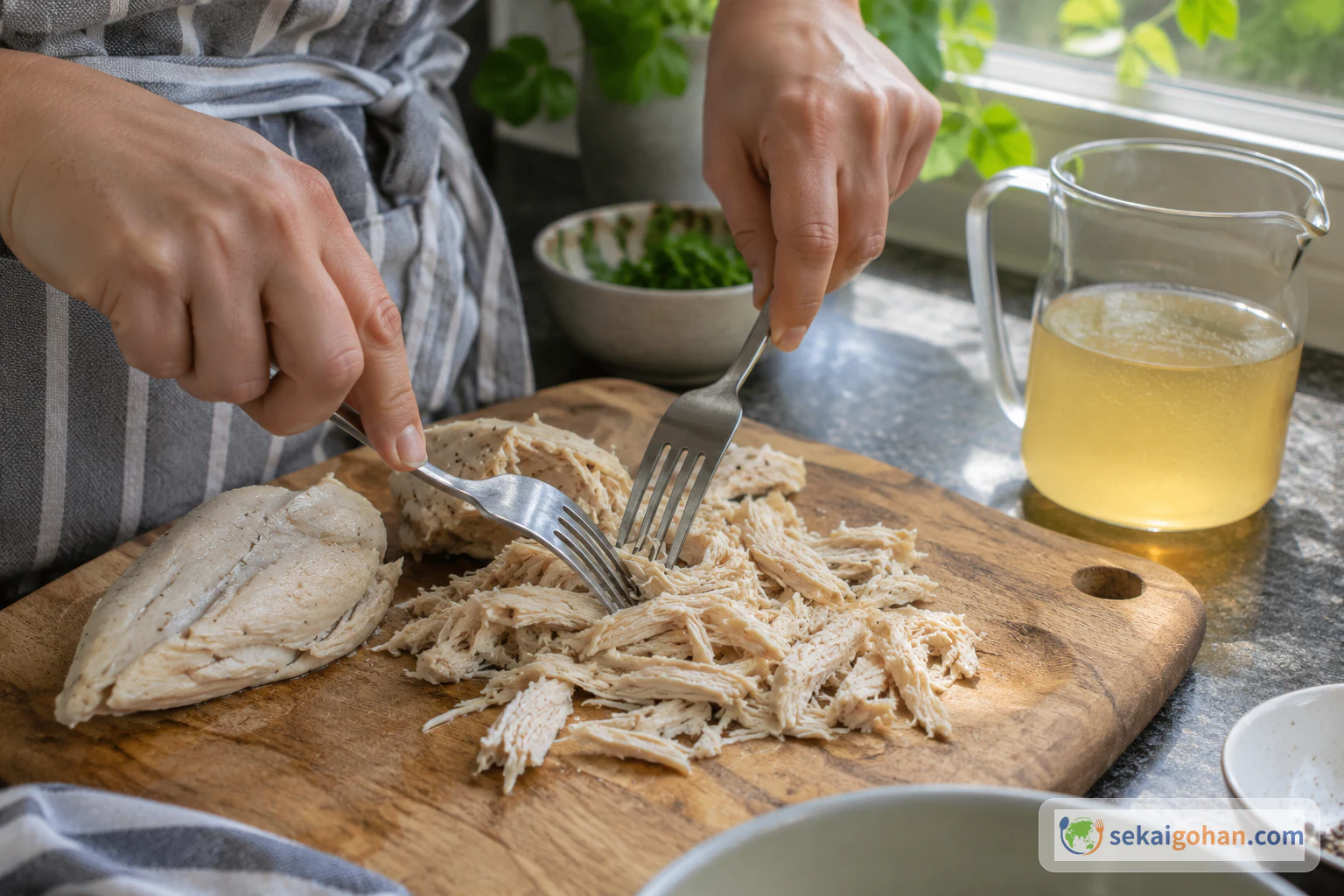
- Cutting board and two forks for shredding
- Measuring jug for the reserved broth
- A second pot for the farofa, and a wooden spoon
- Small bowl of cold water for your hands
- Sharp knife or pastry wheel
- Deep, heavy pot for frying
- Wire skimmer (spider)
- Paper towels
Choosing and Substituting
The one ingredient worth hunting down is farinha de milho branca flocada. These are coarse, flat, precooked white corn flakes that drink up hot broth and stay grainy. Look for them at Brazilian grocers or online. In Lapa some cooks use a type called biju. Yellow polenta, fine cornmeal, semolina, cassava flour and potato starch all behave differently, and the result moves toward a different dish. If you can't get the white flakes, it is better to wait than to swap.
Ready-made massa de pastel is sold in long rolls at Brazilian shops. It is thin, stretchy and blisters when fried. Everything else on the list is ordinary supermarket shopping.
| Swap | What changes |
|---|---|
| Homemade pastel dough for the bought roll | Close to the real thing. Mix 2 cups (2 xícaras) wheat flour, ½ tsp (½ colher de chá) salt, 2 tbsp (2 colher de sopa) oil, 1 tbsp (1 colher de sopa) cachaça, 1 tbsp (1 colher de sopa) apple cider vinegar and ½ cup (½ xícara) lukewarm water, knead, rest 15 minutes, roll thin |
| Dumpling or spring roll wrappers for pastel dough | Different thickness and stretch, so the ribbons wrap differently and the crust bites differently |
| Vegetable oil for lard | Works for browning, but the filling loses some of its richness |
| Scallions and parsley for cheiro-verde | A close match for the fresh green note |
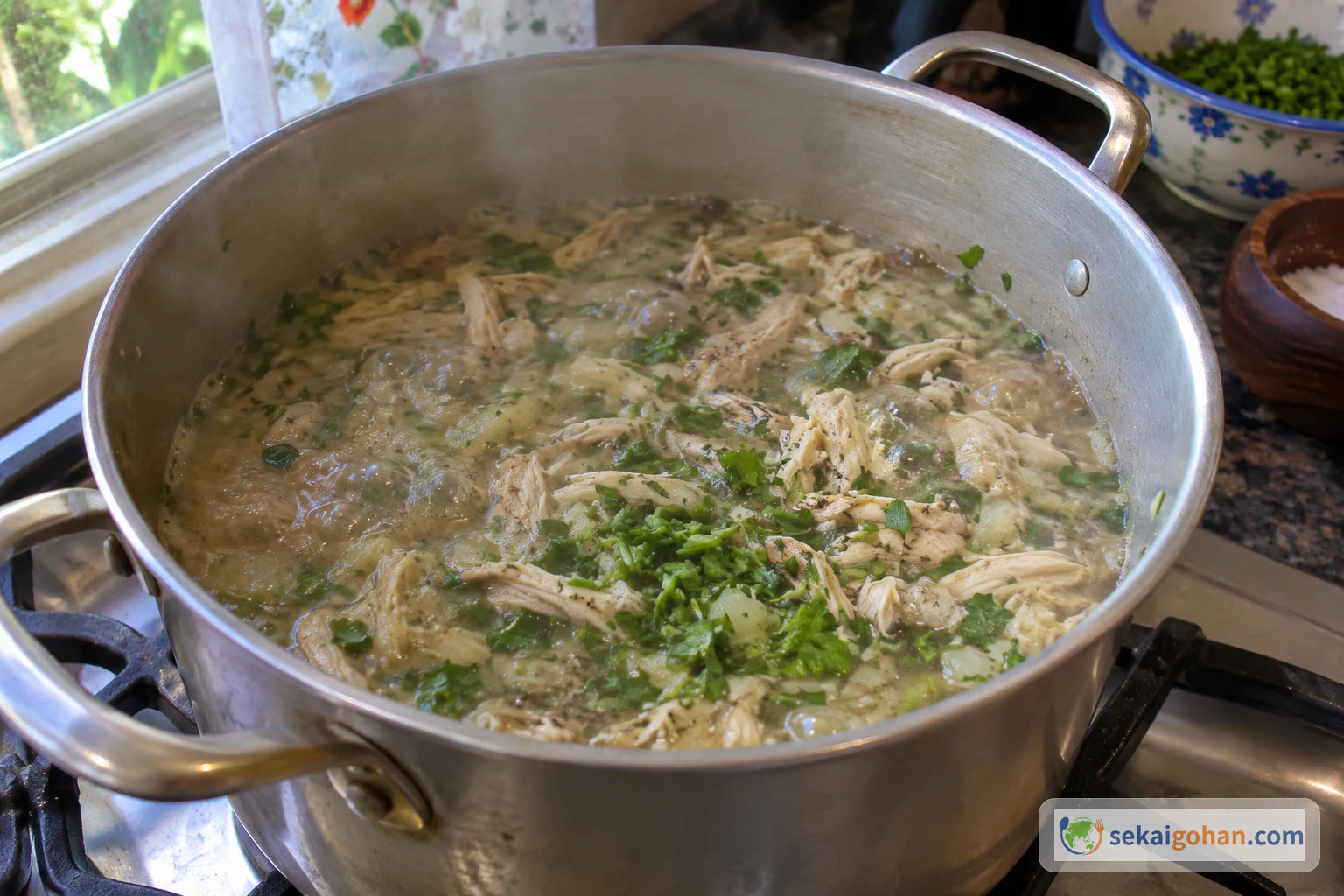
Bouillon cubes vary a lot in salt. Leave the salt until the chicken, herbs and broth are together in the pot, then taste the broth before the cornmeal goes in. Once the flakes have soaked it up, you can't correct it easily.
Method
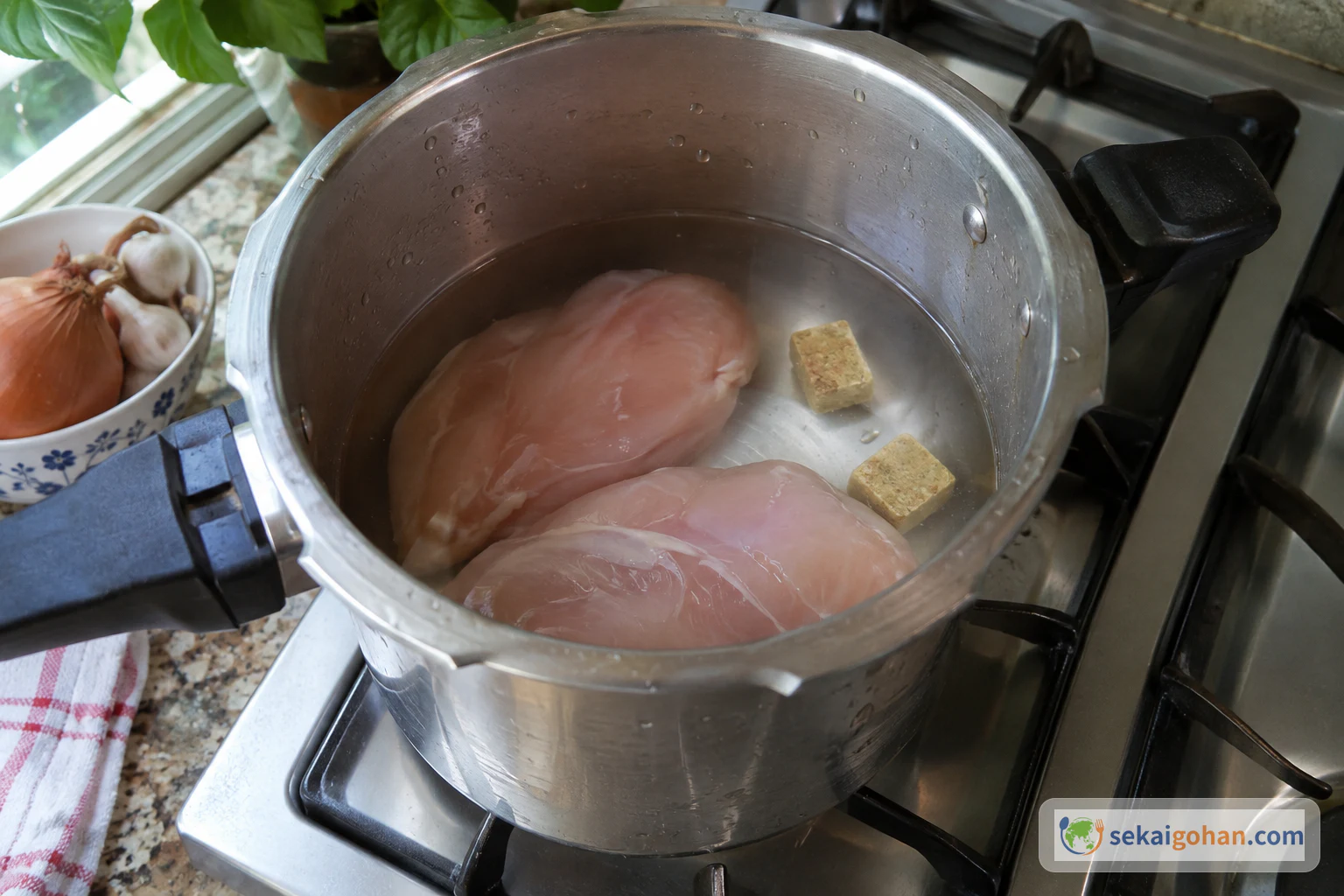
The chicken cooks hands-off in the pressure cooker while you chop the onion, garlic and herbs. After that the work moves quickly. The farofa has to be shaped while it is still warm, so cut your dough ribbons and set up the water bowl before you mix in the cornmeal. Fry soon after wrapping.
Keep the pot no more than half full and dry any wet coxinhas before frying, since water makes oil spit. Lower them in with the skimmer, never by hand, and keep children and pets away from the stove.
When It Goes Wrong
| What you see | Why | What to do |
|---|---|---|
| The ribbon unwinds or opens in the oil | Wrapped too loosely, or the seams weren't pressed | Press each spiral firmly before frying and seal the tip well |
| The farofa is dry and won't hold together | Not enough liquid for the flakes | Work in hot broth from the cooker a little at a time until it clumps |
| The teardrops crack as you shape them | The farofa has cooled | Keep the pot covered and shape while it is warm |
| The mixture sticks to your hands | Hands too dry | Dip your hands in cold water before every piece |
| The filling is pasty, like porridge | A different cornmeal (fine or yellow) instead of the white flakes may be the cause | Use farinha de milho branca flocada |
| Filling leaks between the turns | Gaps left in the spiral | Overlap each turn slightly so no farofa shows |
Serving and Variations
Coxinha de farofa is eaten hot, straight from the paper towels. In Lapa it is a bakery snack and a festival food. At home, put out a tray of them for friends and have the next batch going in the oil while the first is eaten. Shape the teardrops close to frying time. Don't leave shaped pieces sitting at room temperature for long.
Variations
- Carne seca or linguiça. Swap the chicken for dried beef or sausage. The filling gets saltier and smokier, so go easy with the salt.
- Tomato-based farofa. Some cooks build the farofa on a tomato sauce with more chicken. It turns redder and tangier, and it takes its own proportions rather than a splash of tomato added to this one.
- Festival fillings. Salt cod, apple and brigadeiro have all shown up at Lapa's festival stalls. The sweet ones turn the snack into a dessert, keeping only the ribbon wrap.
Frequently Asked Questions
Can I make a smaller batch?
Yes. Halve everything: 1.1 lb (500 g) chicken, 2 cups (500 ml) water, 1⅔ cups (400 ml) reserved broth, 9 oz (250 g) cornmeal flakes and ¾ tbsp (¾ colher de sopa) lard. Halve the aromatics and herbs too. The cues in the method stay the same.
Can I bake them instead of frying?
Baked and oversized coxinhas de farofa do appear as home experiments. The Lapa snack is fried, though, and the blistered, golden ribbon comes from the oil. If you bake, expect a paler, drier wrap.
Do I need a pressure cooker?
The pressure cooker gives tender, easily shredded chicken and the broth you need for the farofa in one pot. Whatever you cook the chicken in, cook it through to the centre and keep the broth, because the farofa depends on it.
Is coxinha de farofa a protected heritage food?
Nothing in the record says so. In 2011 there was a petition to have it recognised as intangible cultural heritage, and no registration is reported. In Lapa it is sold in bakeries every day, and the town held its first Festa da Coxinha in March 2015.