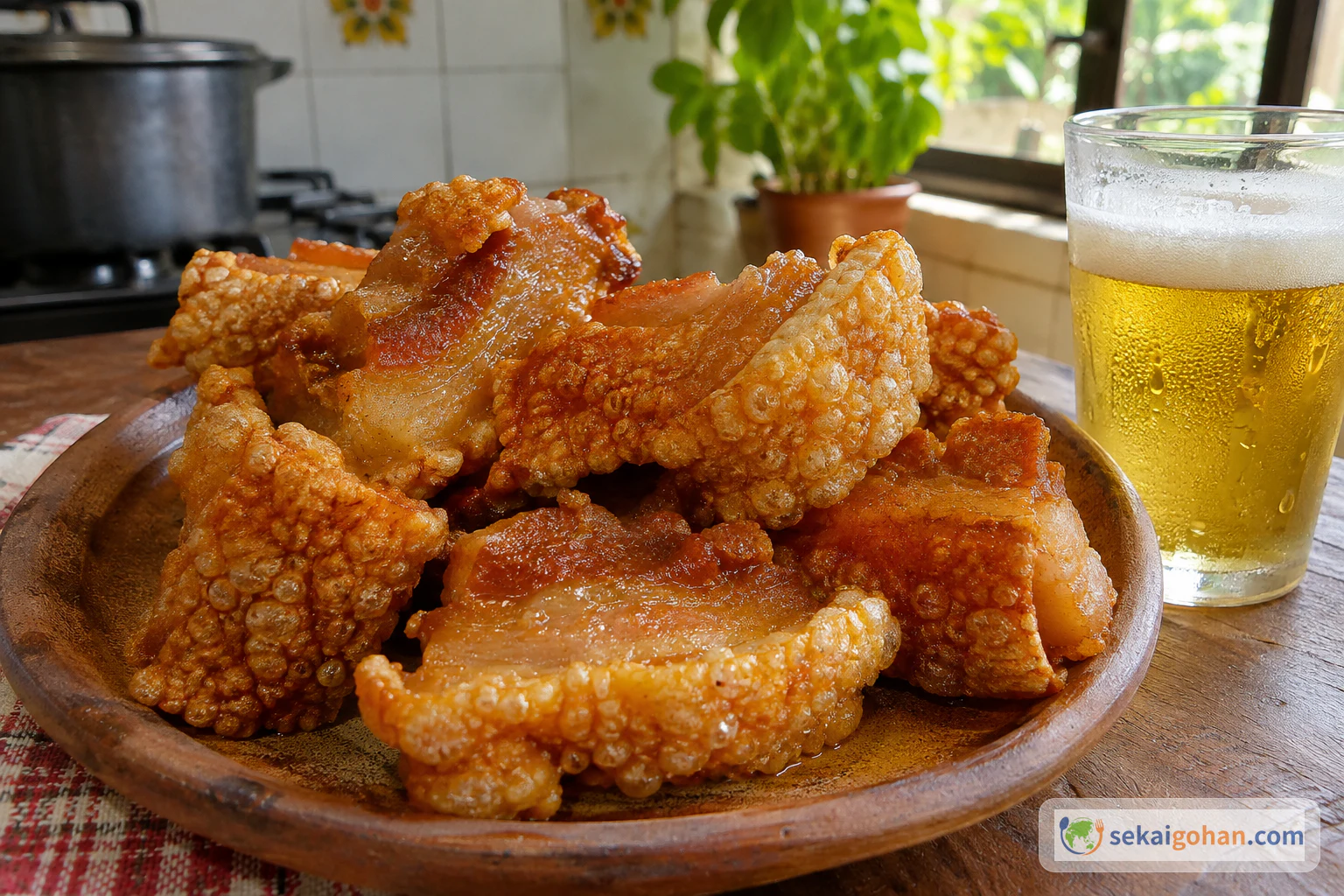
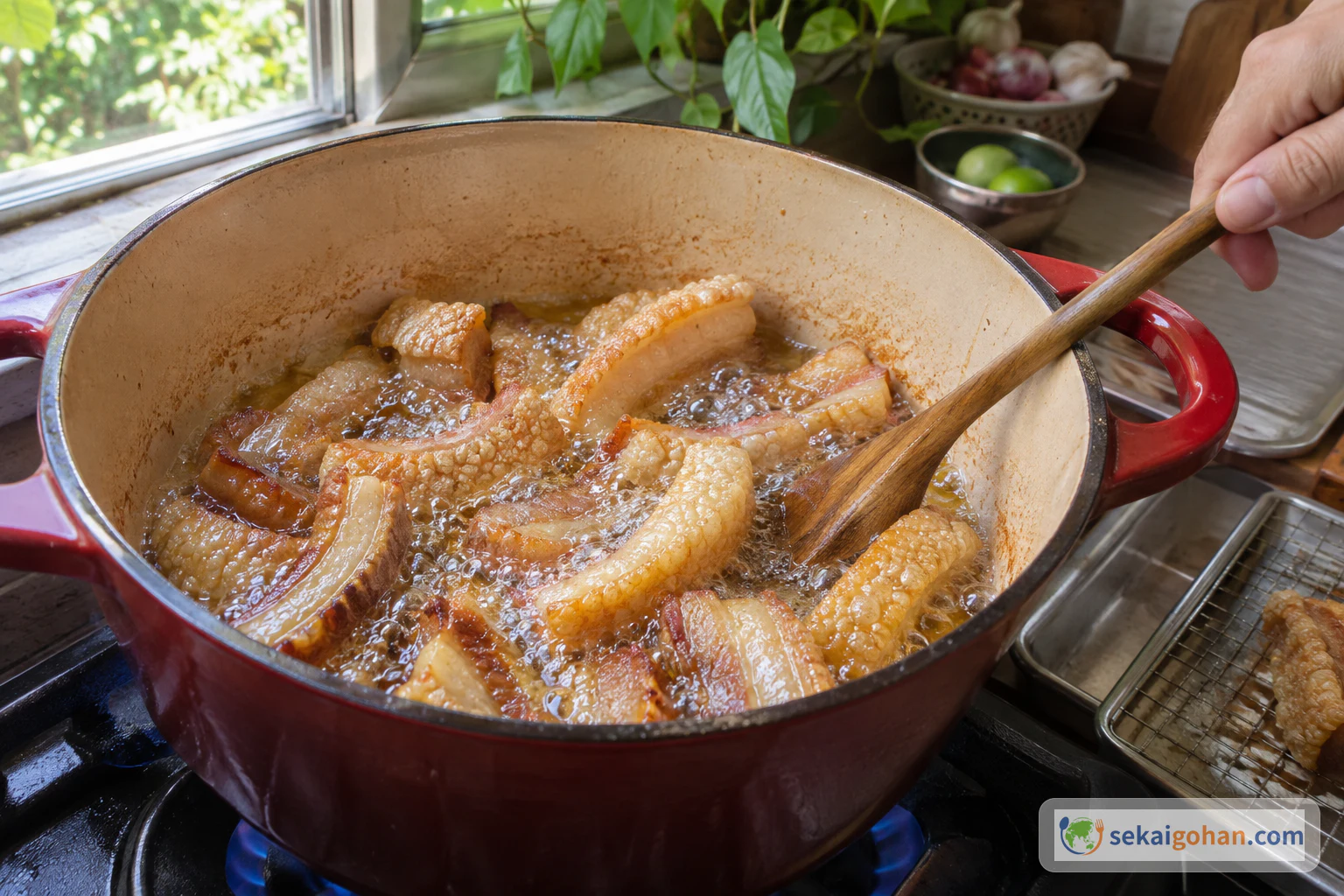
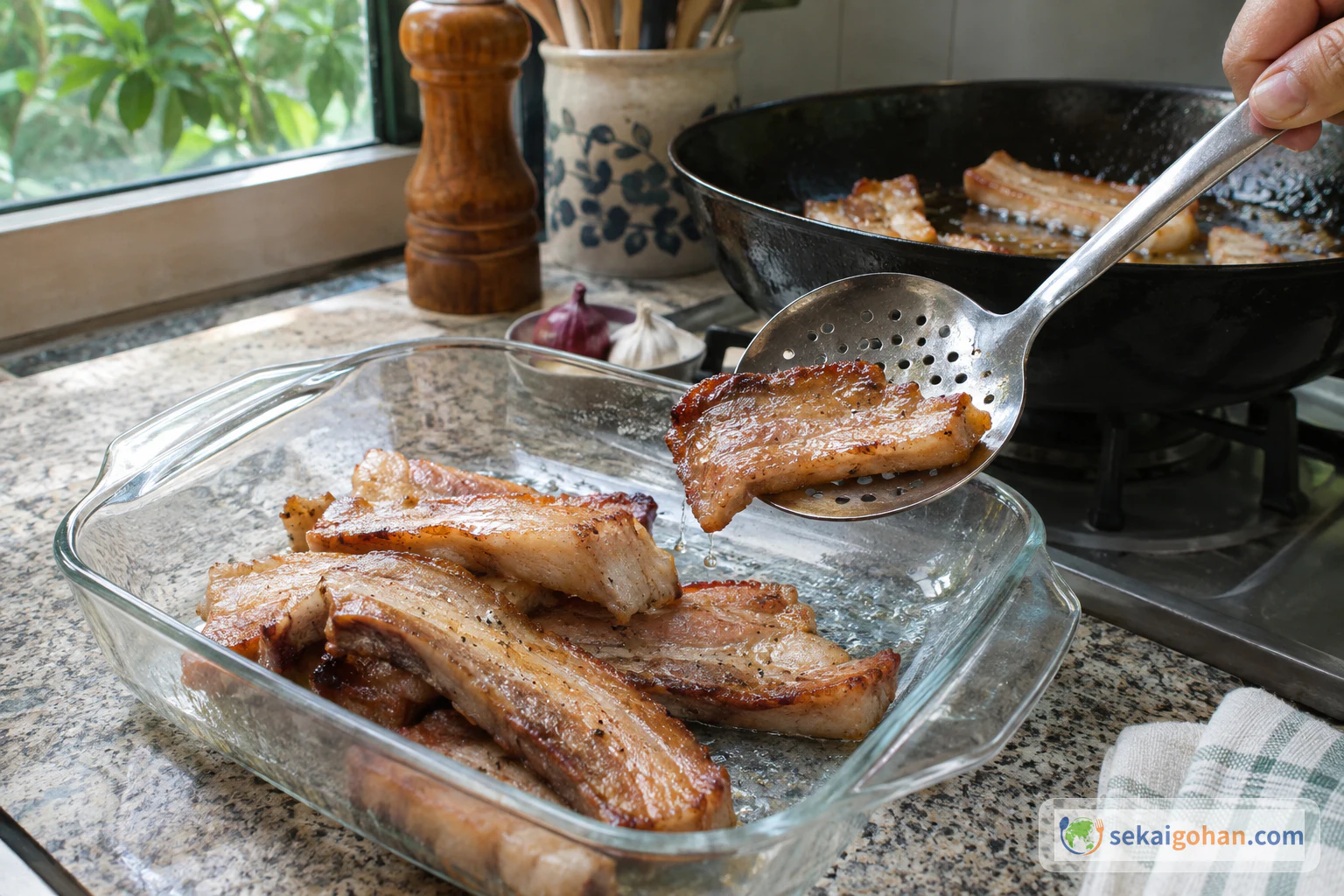
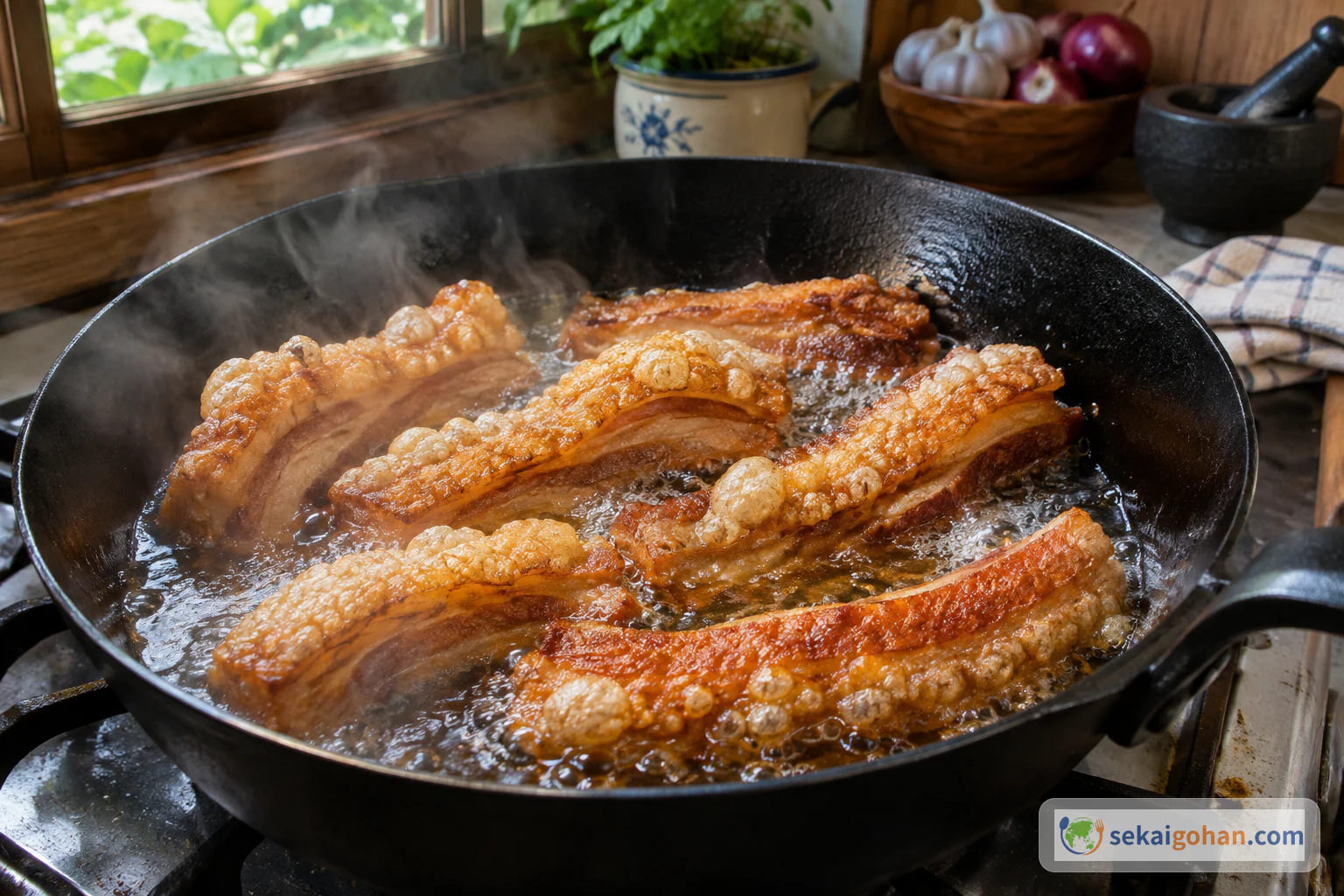
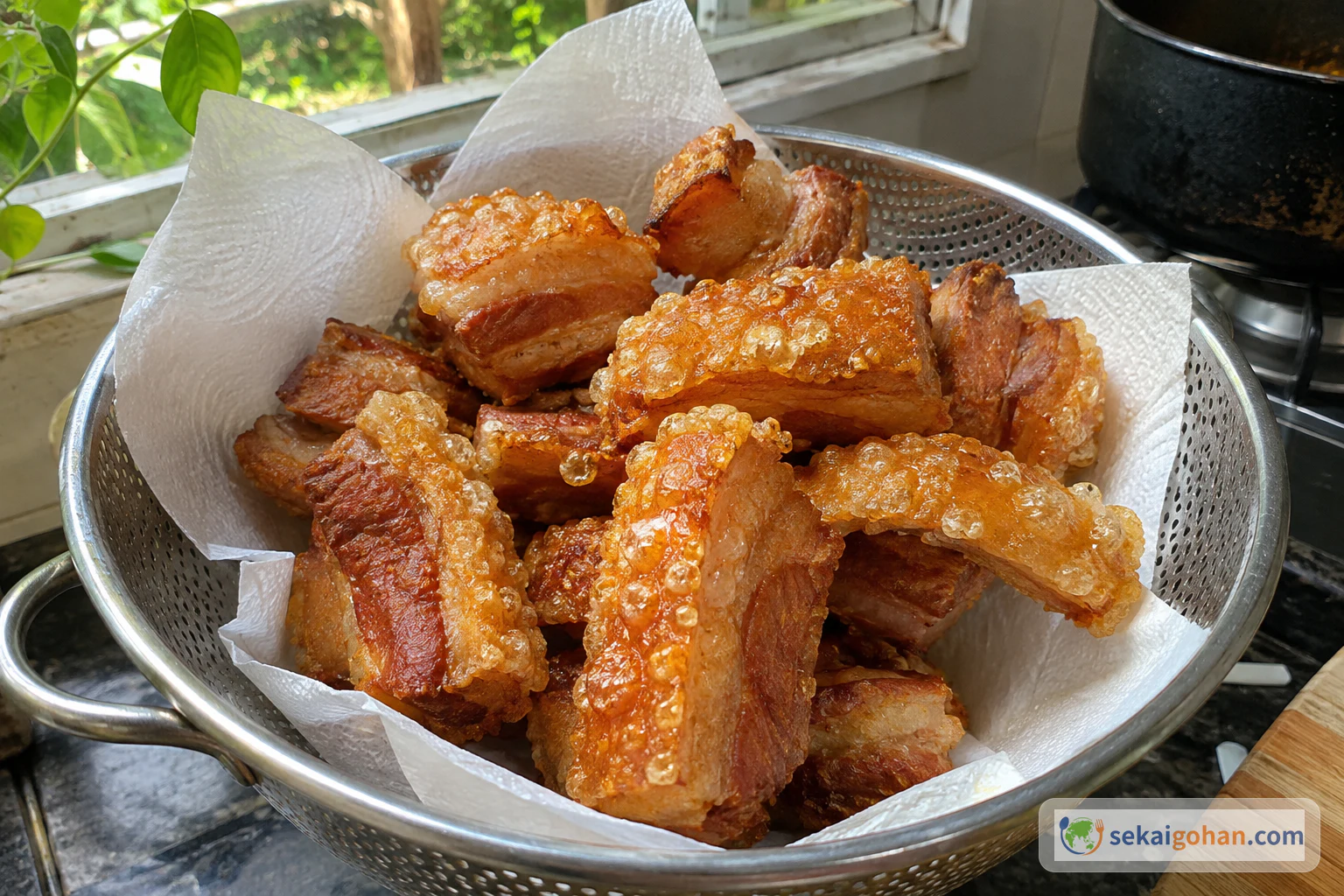
The moment that matters comes in the second fry. Cold strips of pork belly drop into very hot lard and, within minutes, the flat brown skin starts to swell and blister. It crackles in the pot and steam lifts off the surface. Torresmo is skin-on pork belly cut into strips and fried in two stages until the rind turns into a light, bubbled crackling over a band of rich, salty meat. In Brazil it is a bar snack next to a cold beer and a crunchy edge on a plate of rice and beans.
Torresmo in Minas Gerais and at the Brazilian table
Torresmo has its roots in Portugal, and in Brazil it spread as a snack of Minas Gerais cooking, the inland state whose kitchens lean hard on pork, beans and lard. There it belongs to the petisco and tira-gosto world, the small bites that arrive with drinks and keep a table talking. A bowl of golden pieces goes in the middle and hands reach for it between sips of beer.
It also comes to the main meal. Torresmo goes beside feijoada, the black bean and pork stew, and beside feijão-tropeiro, beans tossed with toasted manioc flour. It also sits at the edge of a prato feito, the everyday set plate of rice, beans and greens. In each case it brings crunch and salt to soft beans and plain rice. More of the country's dishes are on the Brazil page.
The style made here is torresmo pururuca, where the rind puffs and blisters into a light, airy crackling instead of staying flat and hard. The two-stage fry with a chill in between is what drives that puff.
Fried pork skin turns up wherever pigs are raised. Spanish-speaking countries have chicharrón, and Jewish kitchens make gribenes from chicken skin fried in its own fat. Portugal keeps its own torresmo. They share an idea and a sound when you bite, yet the Brazilian version here is defined by skin-on belly strips and that puffed finish.
Ingredients (serves 12)
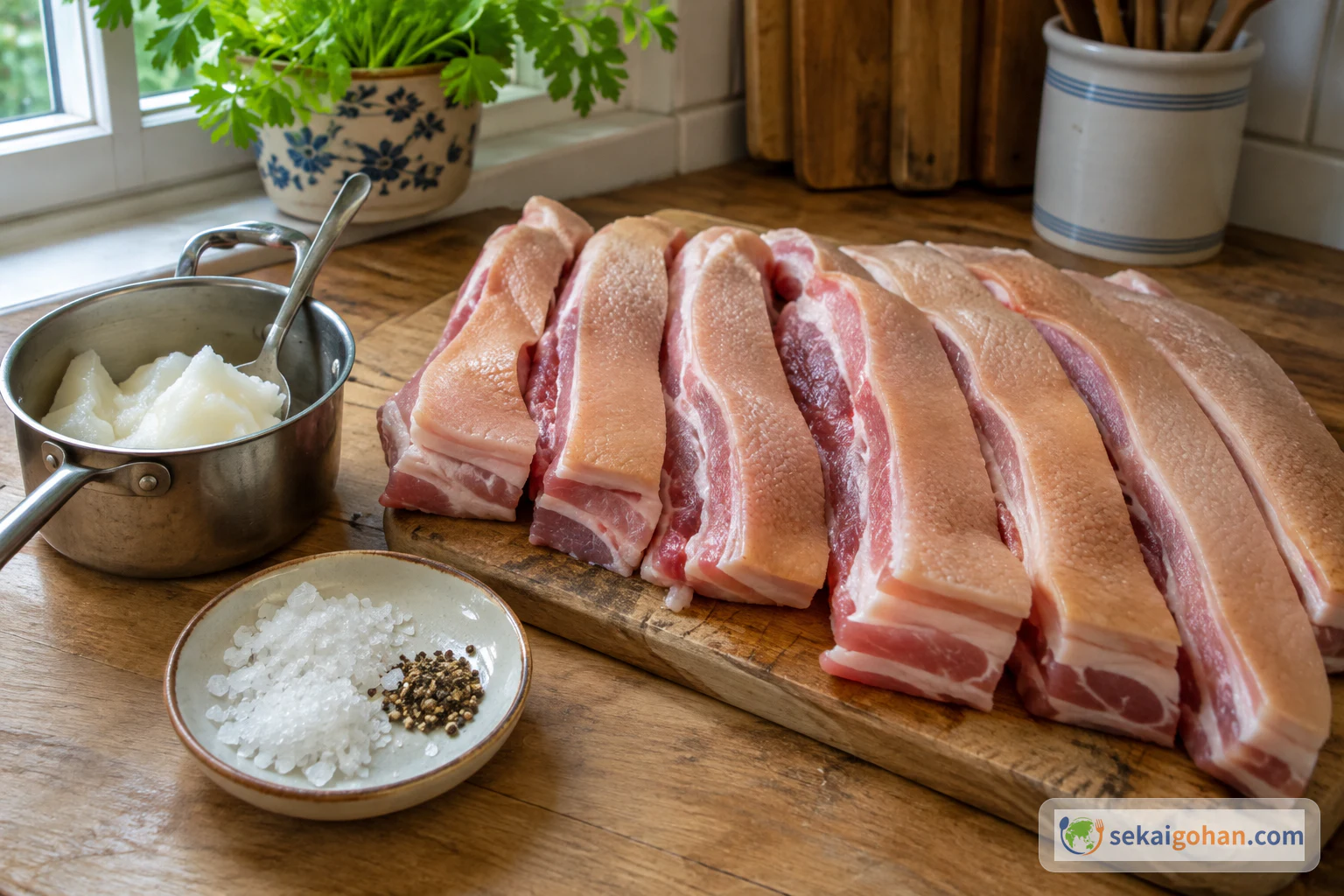
Buy the belly with its rind attached. The rind is what puffs into crackling; without it you get fried pork belly, not torresmo.
This dish contains pork and is fried in lard (pork fat). If you swap in vegetable oil, check the label of the oil you use.
Equipment
- Sharp knife and a cutting board
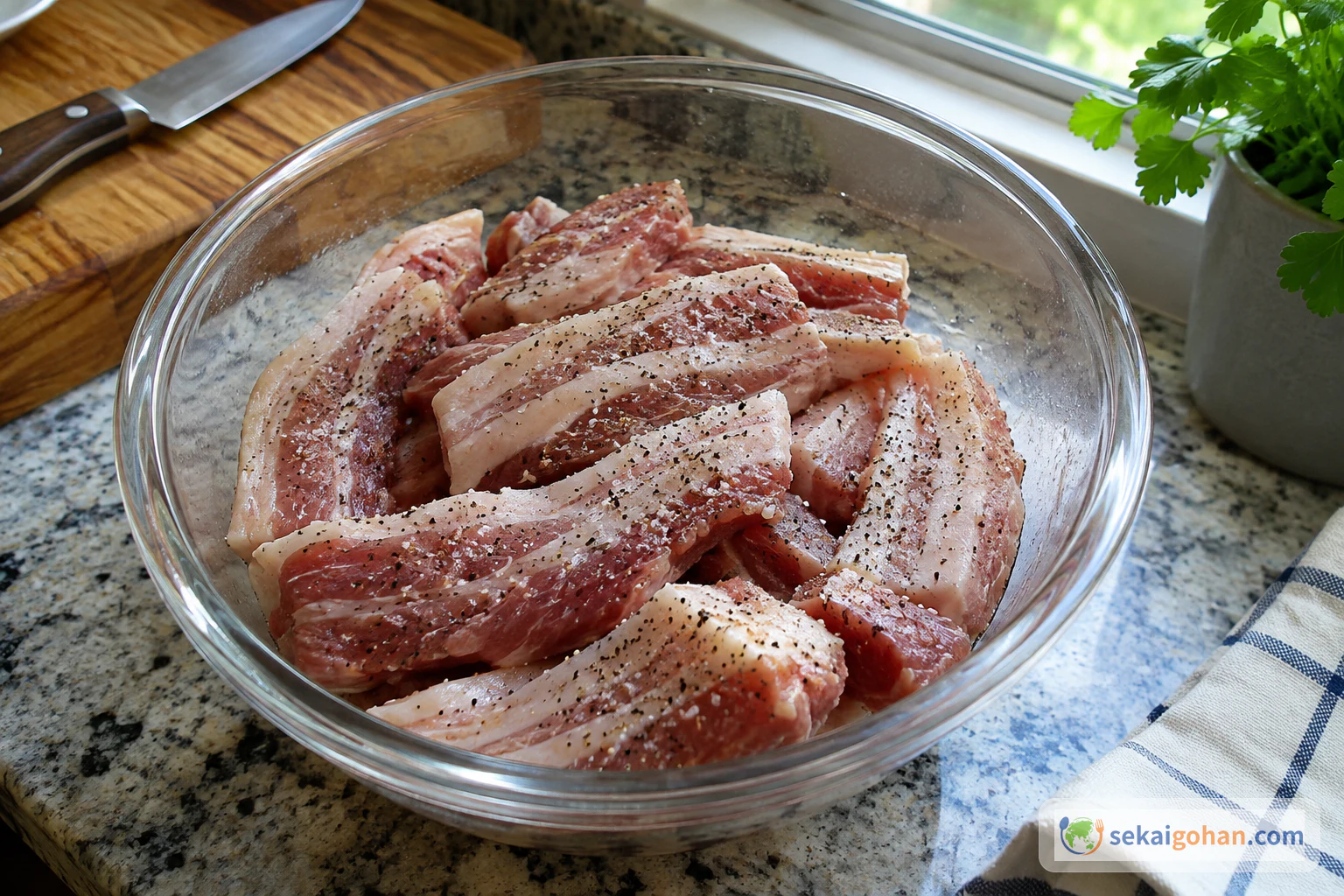
- Large bowl for seasoning
- Deep, heavy-bottomed pot with a lid
- Long-handled spoon
- Slotted spoon or spider
- Heatproof dish that fits in the refrigerator
- Wire rack or a colander lined with paper towels
- Splatter guard
Choosing the pork and the fat
Two cuts work. Pork belly (barriga) fries up drier and crisper, the classic bar-snack texture. Belly sold as panceta, with its layer of back fat (toucinho) still on, gives a meatier bite under the crackling. Pick by how you want the pieces to eat: belly for a snack that shatters, panceta for something closer to a small meal.
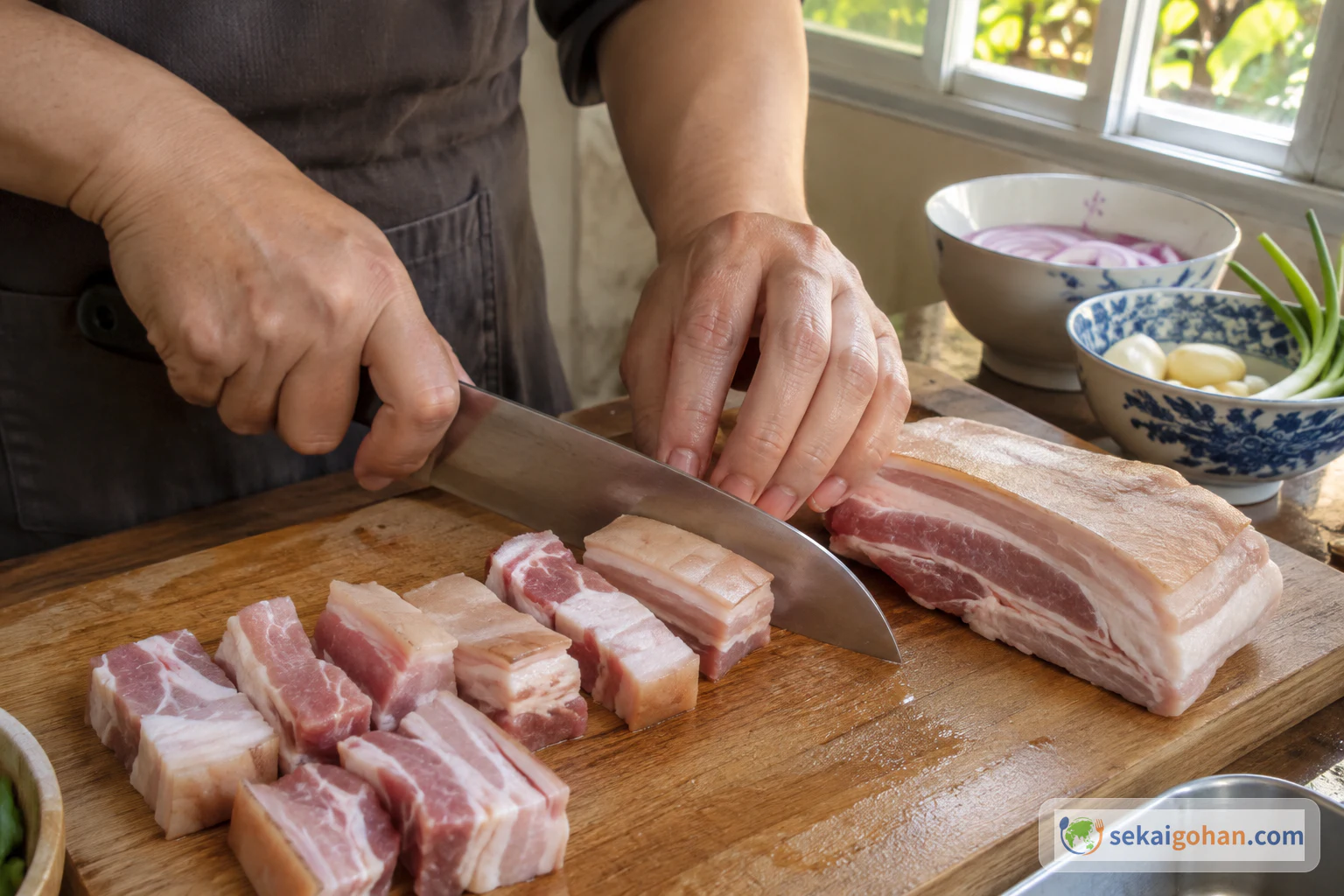
Skin-on belly is hard to find in ordinary supermarket cases, so ask a butcher to order a slab with the rind left on. Ask for one piece you can cut yourself, because the strips in step 1 are cut to a specific size.
Lard is sold ready-made and keeps the flavor all pork. A neutral vegetable oil also fries torresmo; the pieces taste a little cleaner and less rich. To make a smaller batch, choose one ratio and apply it to every ingredient. Half the batch is 2¼ lb (1 kg) belly, ½ cup lard, ½ tsp salt and a pinch of pepper.
Method
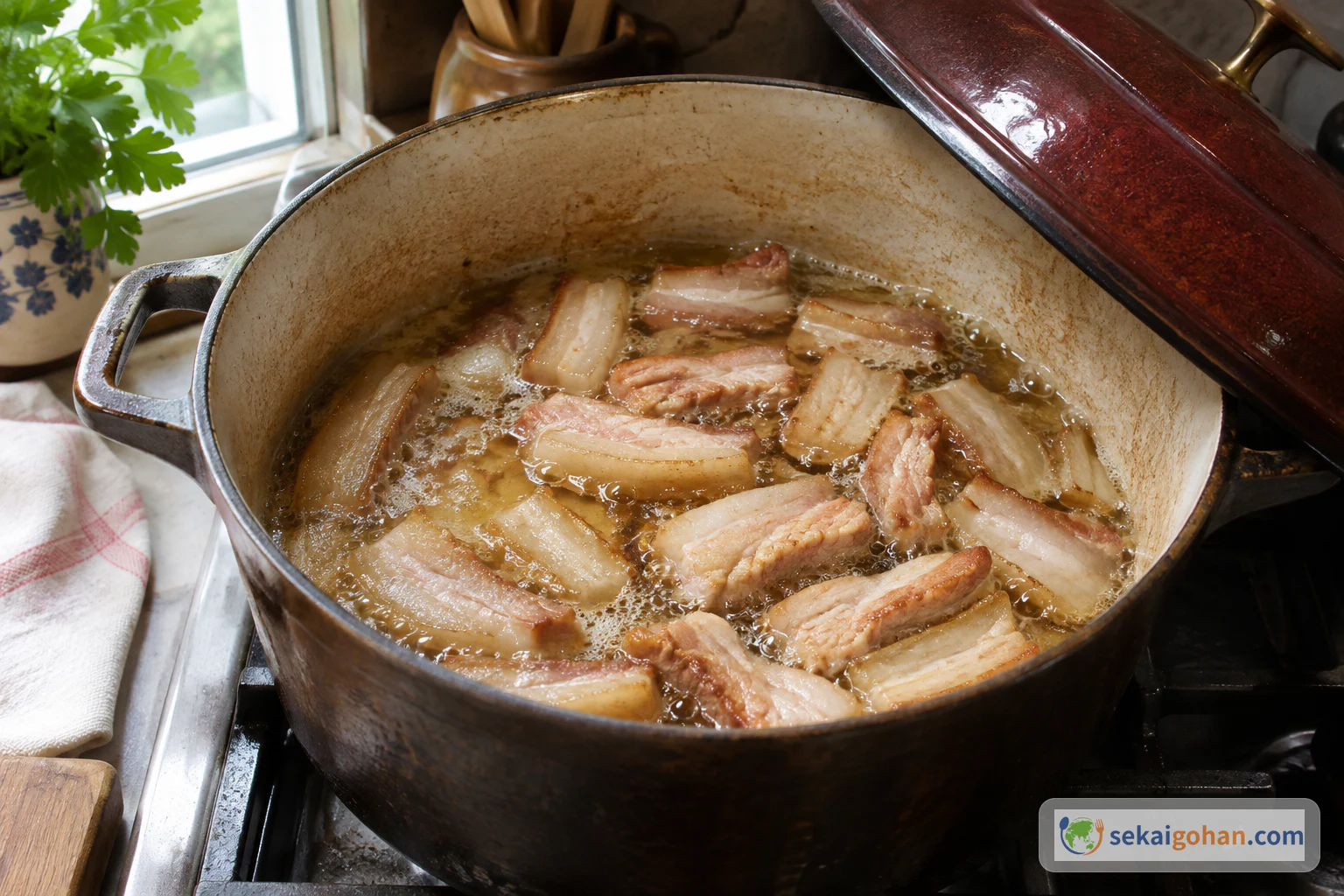
The work runs in two halves. First comes a long, quiet fry in barely bubbling lard with the lid on, then a short burst of high heat. The pieces then come out and spend an hour in the refrigerator, which is your hands-off time. The second fry in very hot fat is short and loud, and it is where the rind puffs. Have the heatproof dish, slotted spoon and draining rack ready before the pot goes on.
Torresmo spits fat hard, especially once the heat goes up. Take the pot off the burner every time you stir, use a long spoon, and keep a splatter guard and the lid within reach. During the long covered fry, keep the heat low and stay near the stove. Keep children and pets out of the kitchen while the fat is hot.
When it goes wrong
| What you see | Why | What to do |
|---|---|---|
| Pieces darken fast in the first fry but the rind stays flat | The heat is too high for the slow stage | Turn it down to a gentle bubble and keep the lid on until the rind starts to swell |
| Fat spits violently whenever you stir | Stirring over a live burner at high heat | Lift the pot off the heat before every stir and use the splatter guard |
| Some pieces stay hard and unblistered after the second fry | The fat was not hot enough, or the fry ended early | Let the fat heat fully before adding the pork and keep frying until every piece is puffed |
| The pieces puff unevenly | Strips cut to very different sizes | Cut to an even size in step 1 next time and pull finished pieces out first |
| Torresmo tastes greasy | Not drained long enough | Drain on a rack or paper towels until the surface looks dry |
Serving and other ways to make it
On the table
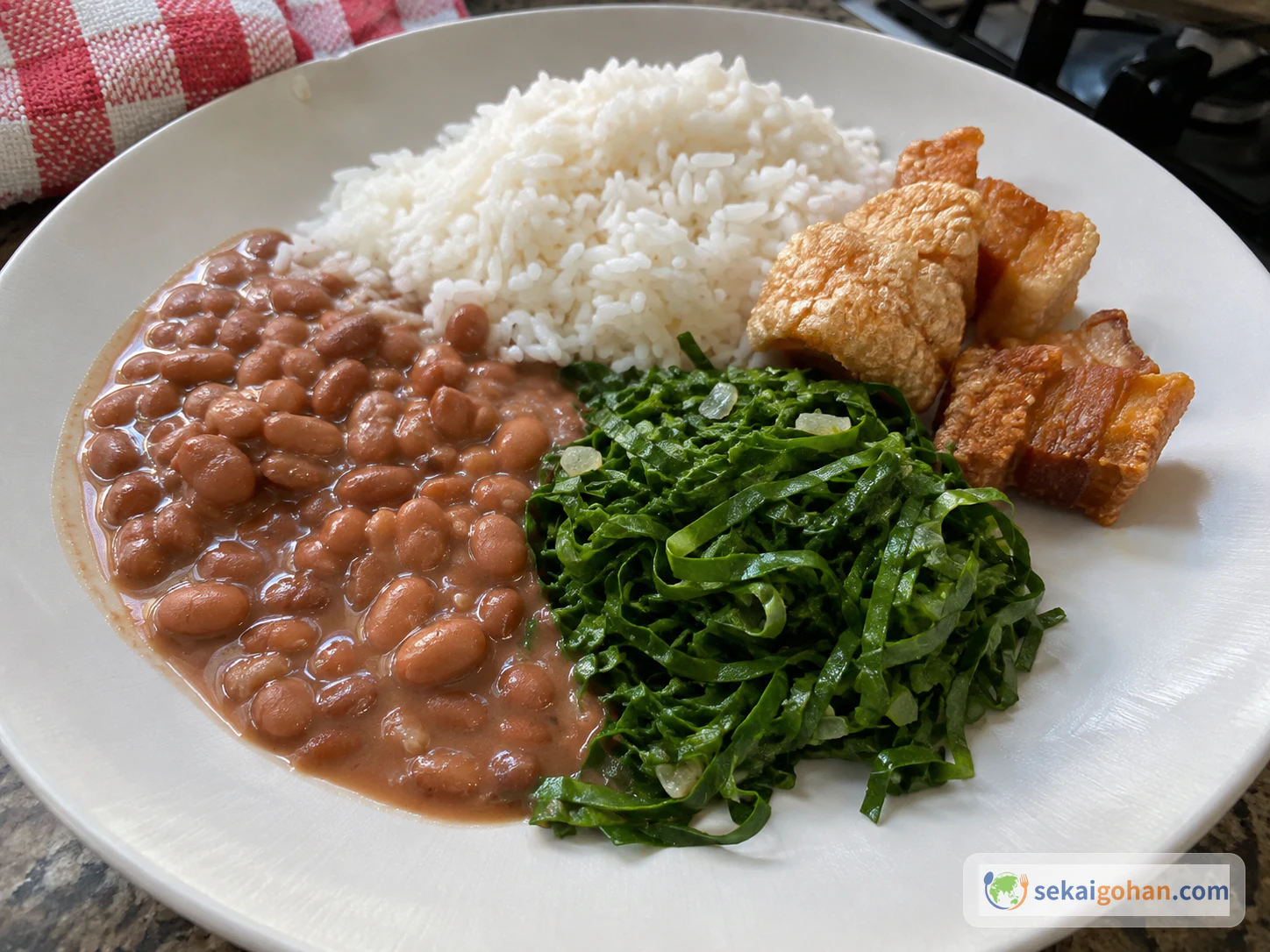
Serve torresmo hot, straight from draining. As a snack it goes in a bowl beside ice-cold beer. As part of a meal, add a few pieces to a prato feito of rice, beans and sautéed greens, or set it beside feijoada. Eat it the day you fry it.
Variations
Rind only. Fry pieces of pork skin alone in oil until they turn yellow and pull them out as they begin to puff. Cool them, then fry again until fully puffed. The result is crackling from the skin alone, with no meat.
Brine and oven first. Soak the belly briefly in lemon water and then brine it for at least 15 minutes in about 1 quart (1 L) of water with 3½ oz (100 g) of salt. Next, cook it in a low oven for two hours. Cut it into small pieces and fry them. This is a different method from the main recipe, so do not mix the two.
Frequently asked questions
Do I need a thermometer for the fat?
No. Follow what the pork shows you: a gentle bubble and golden color in the first fry, then a hard, loud fry in the second until the rind blisters.
Can I prepare part of it ahead?
The chill between the two fries is the natural break. Do the first fry, chill the pieces, and finish the second fry close to serving time. The crackling is best minutes after draining.
Can I cut the pieces smaller for a party?
Stay within the strip sizes in step 1; the timings in this recipe are for strips of that size.
Is torresmo the same as chicharrón?
They are close relatives, both fried pork with crackling skin. Brazilian torresmo pururuca is made from skin-on belly strips taken through a slow fry, a chill and a hot fry, and it is known for its puffed, blistered rind.