Turning the scent of guava into a sweet you can slice
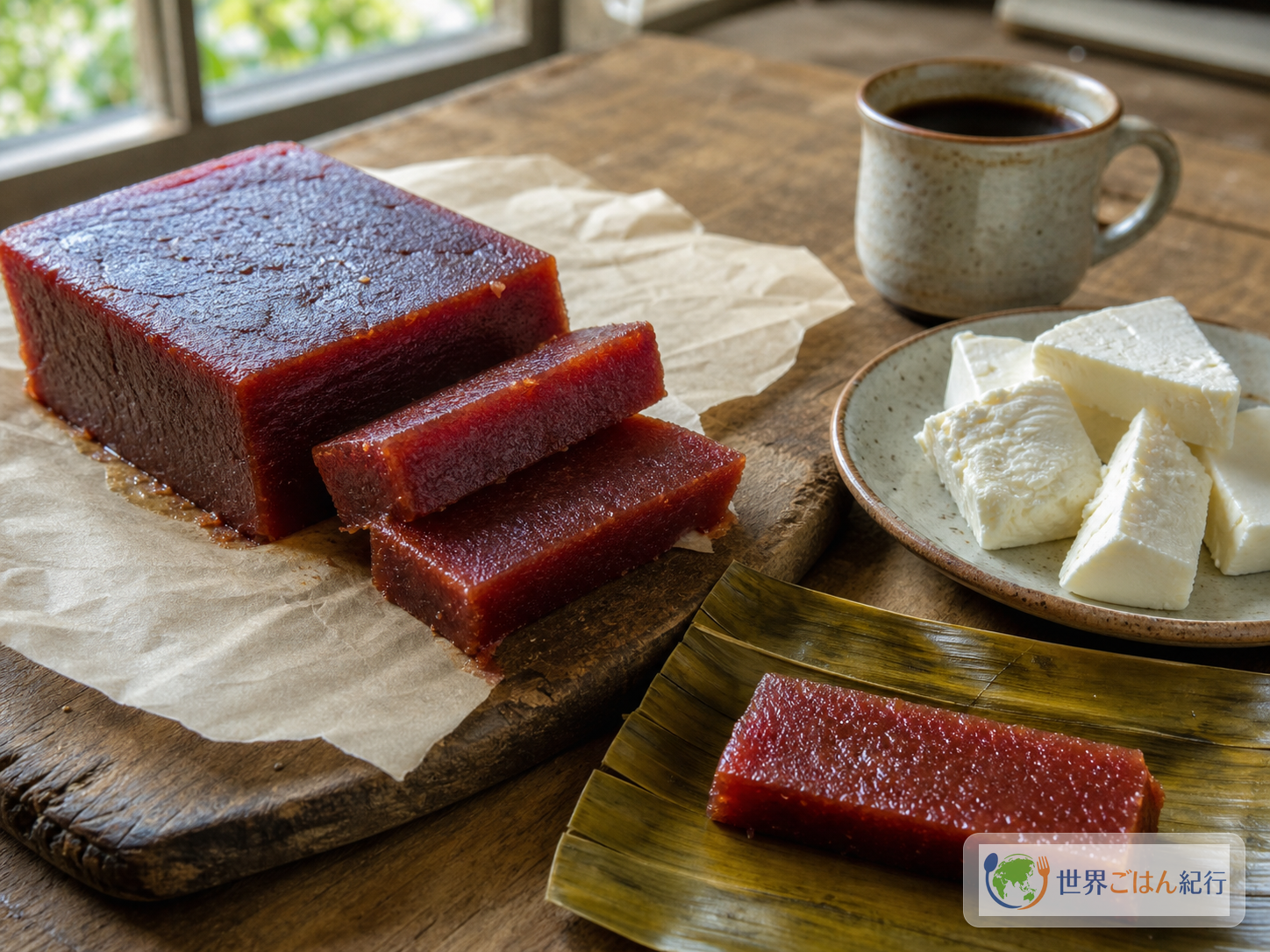
Cut a guava and a faintly floral scent, different from peach or strawberry, lingers on the board. Capture that scent in sugar and cook it down until it can be cut with a knife, and you have bocadillo de guayaba, a sweet loved across Colombia. It is sometimes called "guava paste," but once you know how it is eaten locally, it is not simply a stiff jam.
In Spain the word bocadillo can mean a sandwich. Here it means a sweet made by cooking guava pulp with sugar until it sets. The best-known version is Bocadillo Veleño from the area around Vélez in Santander, where ripe guava and sugar are cooked into a paste and wrapped in bijao leaves. In Colombia it is treated as a protected designation of origin.
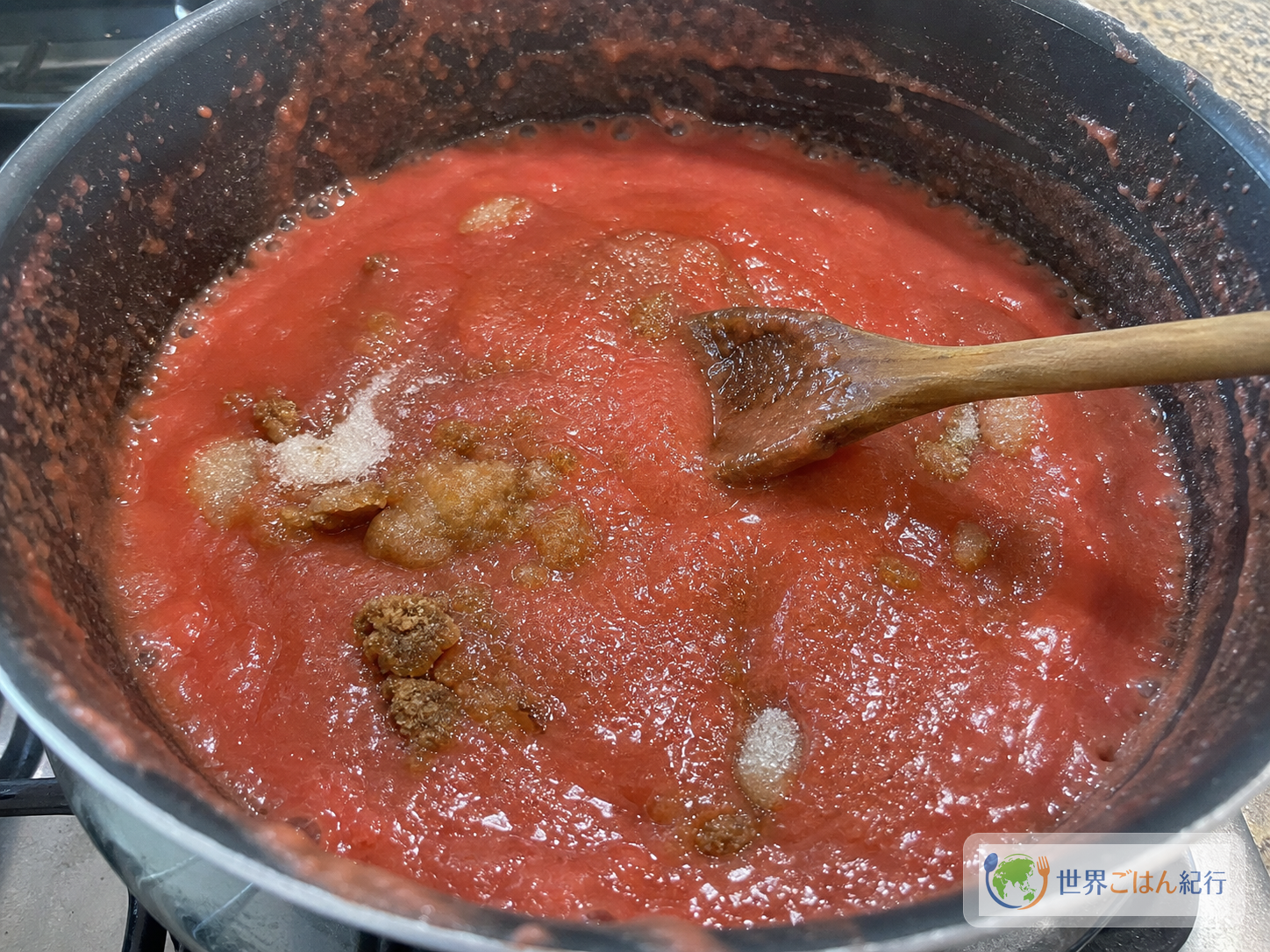
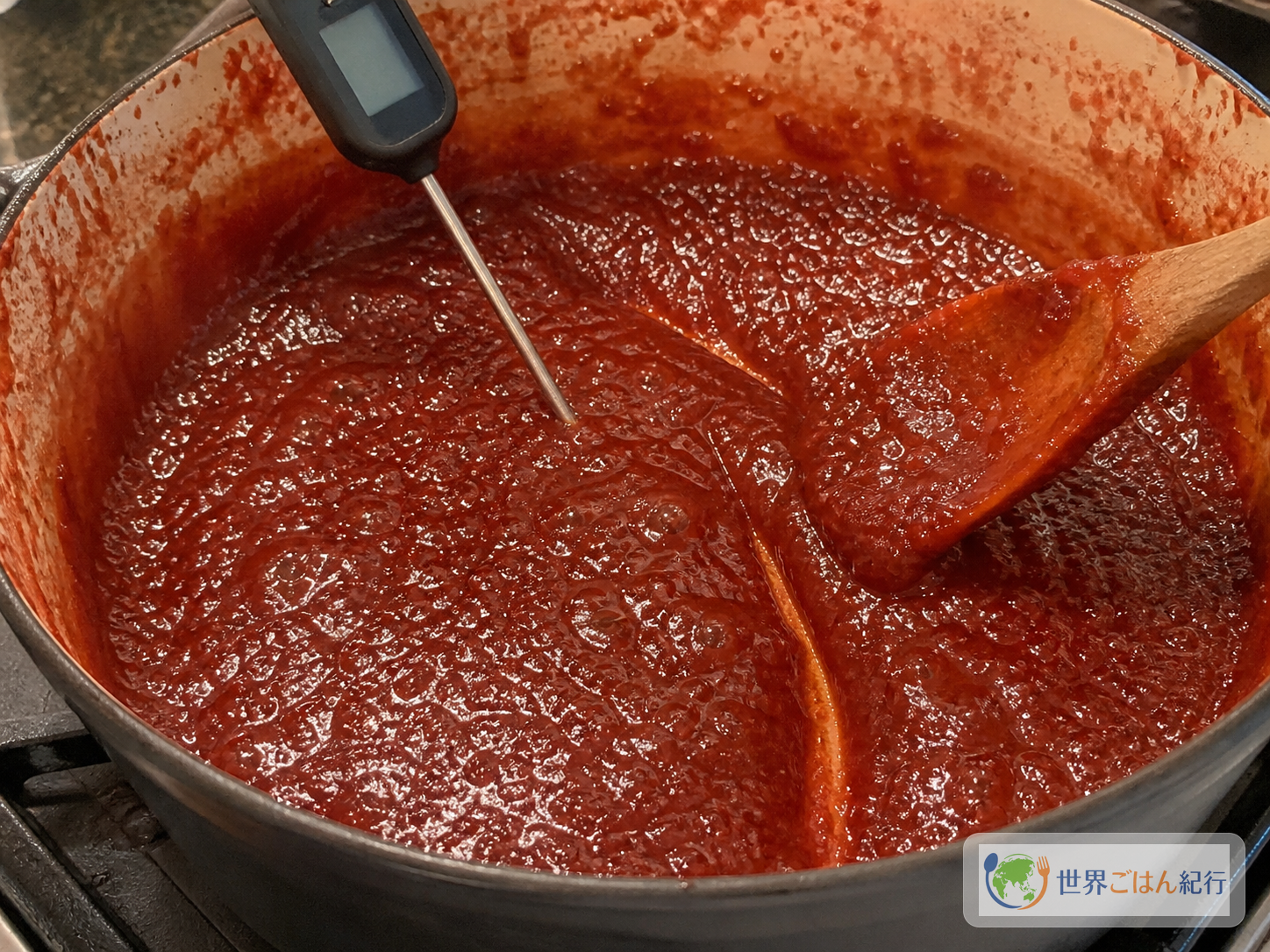
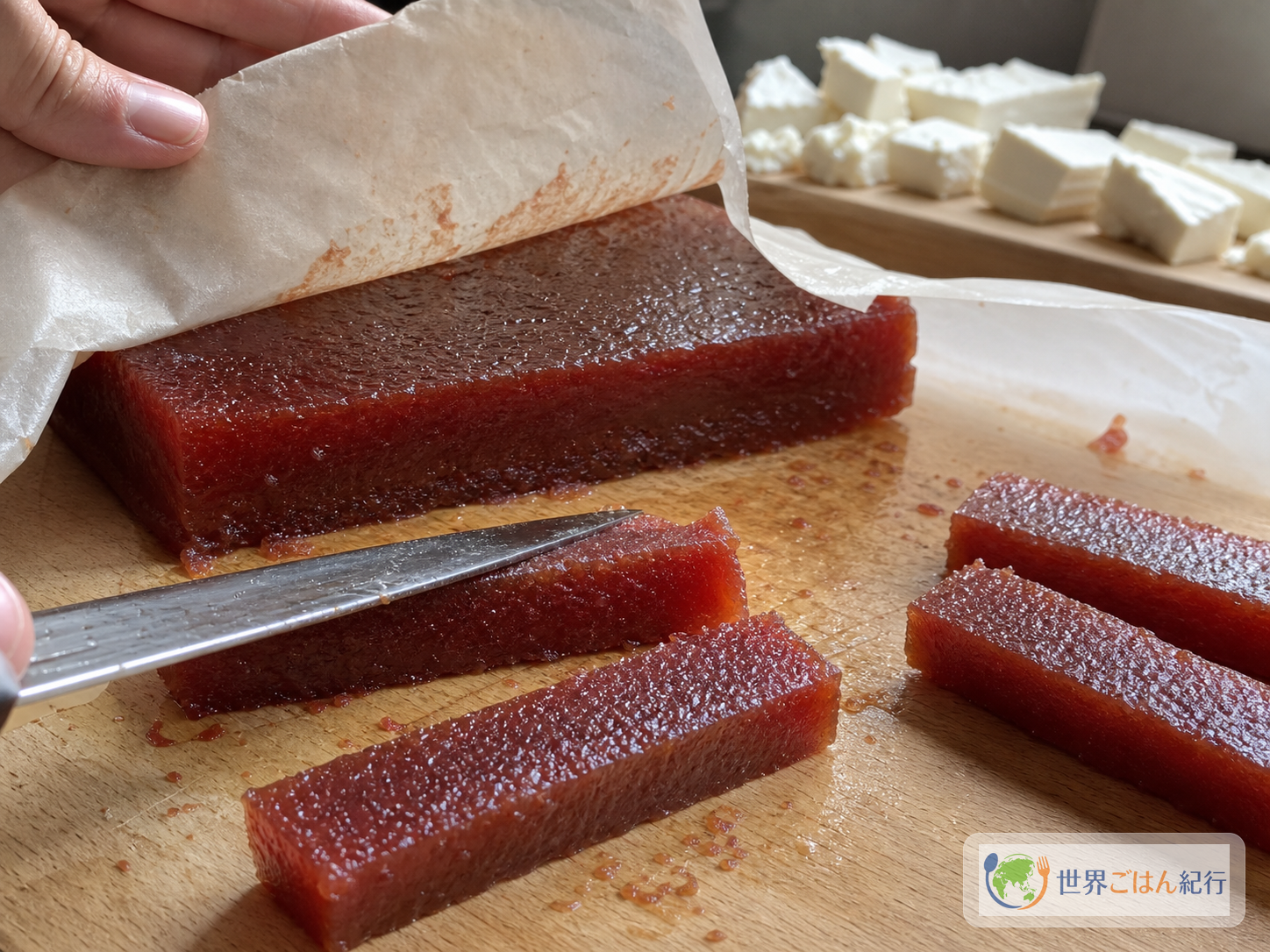
The hard part at home is less the guava than knowing when to stop cooking. Stop too early and you have a jam you can spoon; too late and the bottom scorches. Watch a thermometer for 104–106°C, and cook until a wooden spoon leaves a trail that stays for a few seconds. Get that right and, once cooled, you have a red slab you can cut like yokan.
Among Colombian dishes, this is a very different face from the cold-weather ajiaco of Bogotá or the Antioquian platter bandeja paisa (in Japanese). Both are sturdy meals; bocadillo slips into the gaps in the day as a snack, a travel food, or a small sweet to eat with cheese.
In Spanish it is written bocadillo de guayaba, or Bocadillo Veleño when the region is included. In English it is often called "guava paste." This article uses "bocadillo" throughout, in the sense of the Colombian sweet.
Bocadillo as a leaf-wrapped sweet from Vélez
The outline of Bocadillo Veleño can be seen on the designation-of-origin page of the SIC (Colombia's Superintendence of Industry and Commerce). It describes an agricultural product in which a paste of ripe guava pulp and white sugar is wrapped in bijao leaves. Colombia's Ministry of Commerce, Industry and Tourism also reports that the EU recognized Bocadillo Veleño as a geographical indication.
The leaf wrapping is the interesting part. In a home version bijao leaves are not essential; banana leaf, parchment paper or wax paper will do. But if you think of bocadillo not as "set guava jam" but as a sweet that combines fruit aroma, the keeping power of sugar and the portability of a leaf wrap, it becomes clearer why it is cut into blocks and why it goes so well with cheese.
| What to look at | The Colombian outline | Closest at home |
|---|---|---|
| Fruit | Ripe guava pulp | Fresh guava, or unsweetened frozen guava puree |
| Sweetener | White sugar; panela in some areas | Granulated sugar plus a little panela or unrefined cane sugar |
| Texture | A paste firm enough to slice | Cook to 104–106°C, until a spoon leaves a trail |
| Wrapping | Bijao leaf | Banana leaf, parchment paper or wax paper |
| How to eat | On its own, or with white cheese | Queso fresco, cottage cheese, or a salty white cheese |
Eating it with white cheese is a way to round off the sweetness. Guava alone leads with deep sweetness, but a salty fresh cheese beside it brings the fruit's acidity back. Coffee makes the idea even clearer: black bitterness, red sweetness and white saltiness, all in one bite.
Ingredients (makes about 12 pieces)
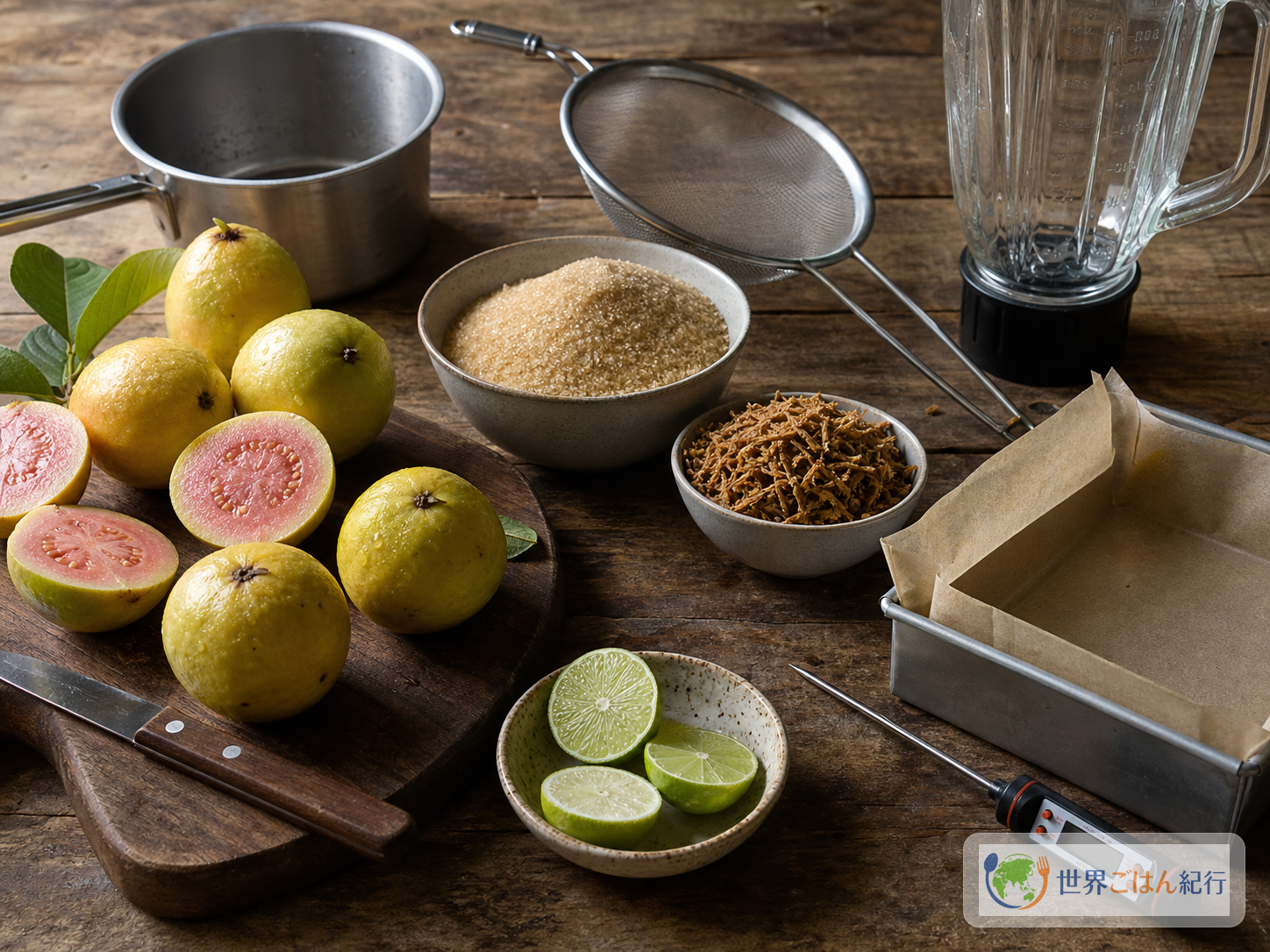
This makes one 18 cm square pan, cut into about 12 sticks. A thickness of 1.5–2 cm is easiest to eat with cheese. In a larger pan the slab will be thinner; it sets faster but dries out more easily.
The sugar here creates both the firmness and the keeping quality. If you halve it to make the sweet less sweet, the paste is less likely to set firm when cool, and it keeps less well. This home version is meant to be stored in the refrigerator, but start with these proportions.
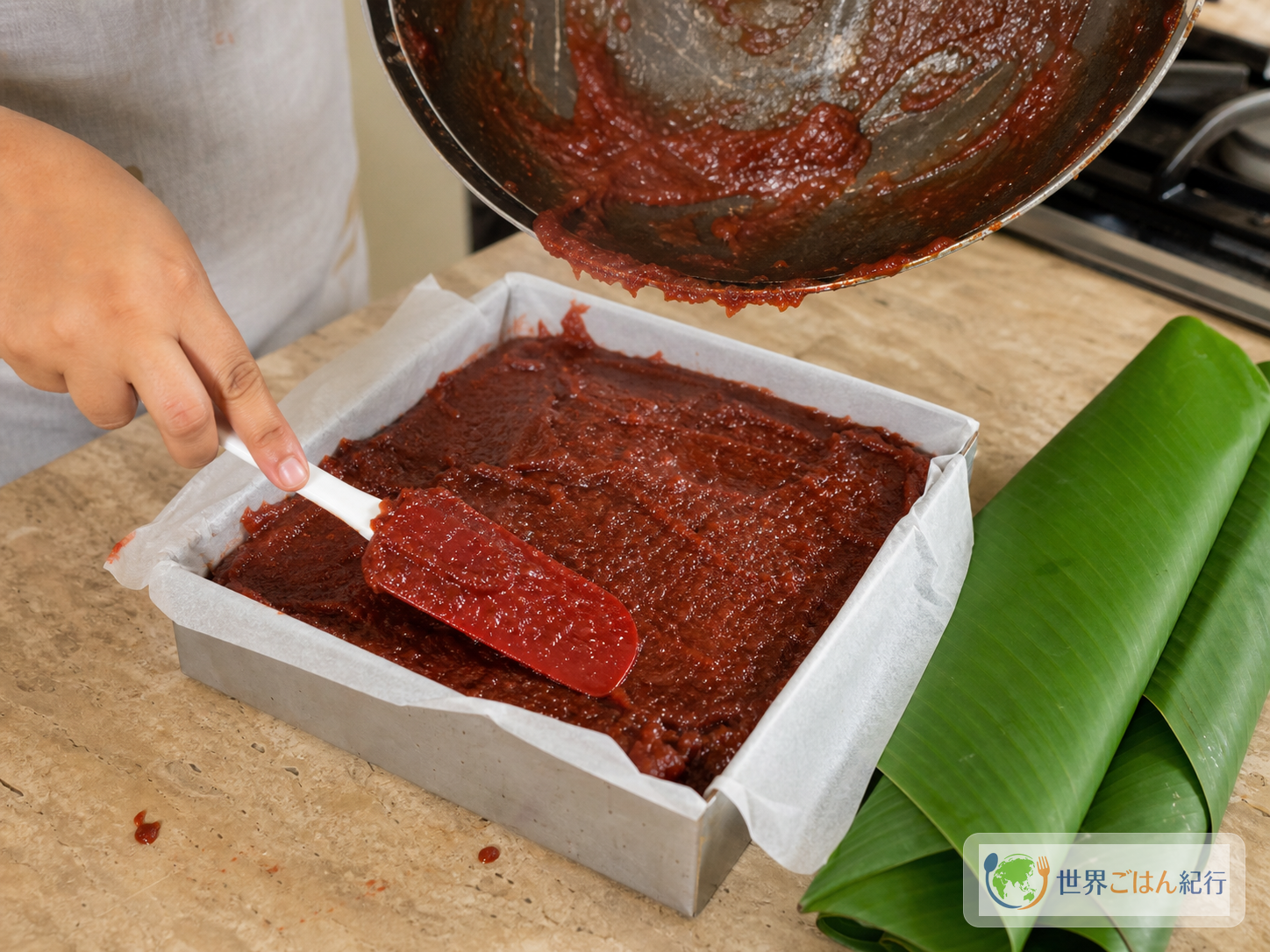
Cooked guava paste goes above 100°C and will burn skin. Use a long-handled wooden spoon, and keep children away from the pot. Pour into the mold only when you can hold the pot firmly with both hands.
A small blender is plenty for smoothing seeded guava; you do not need a powerful large one. Bocadillo is a dish of temperature more than appearance. Stop by jam instinct and it will be soft; judge by color and it is easy to scorch. For a first batch, a thermometer is worth using.
White cheese is not required, but it is what meets the sweetness in the local way. If all you have is cottage cheese, that is fine; if you can find queso fresco, try it once.
Method: strain the guava and cook it down
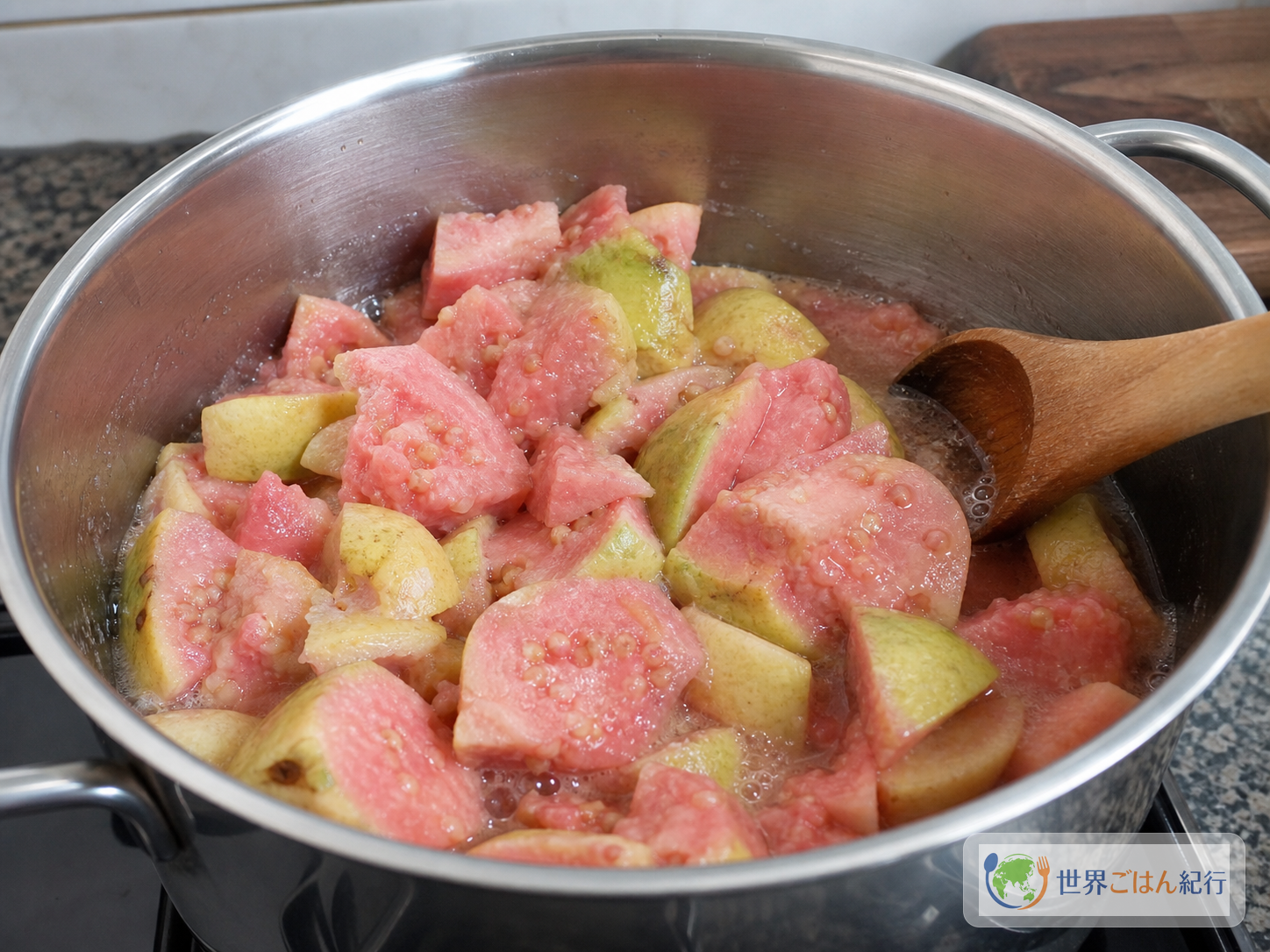
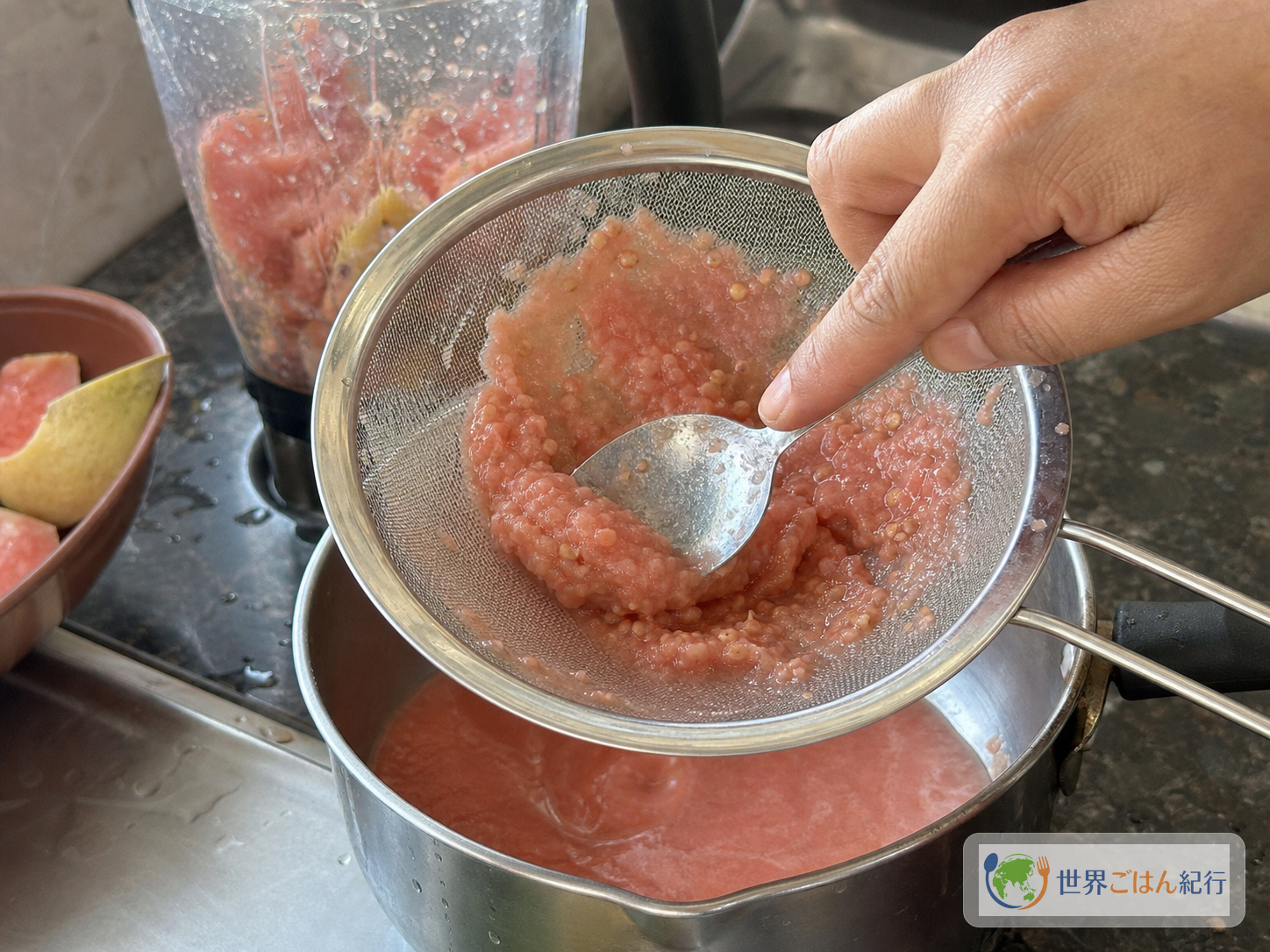
Bocadillo is not a sweet you stir and leave alone. The first half is the work of removing seeds; the second is driving off water without scorching. You will be holding a wooden spoon against the bottom of the pot for a while, so use a deep, heavy pot, and prepare the mold and paper before you start the heat.
Choices at home
Fresh guava varies greatly in availability by region. A practical route is to look for unsweetened guava puree in Latin or Brazilian grocery stores, or frozen-fruit suppliers online.
| Ingredient in question | What you can use | Watch out for |
|---|---|---|
| Fresh guava | Fully ripe, strongly scented fruit | Use with skin. Hard, underripe fruit has little aroma |
| Frozen guava puree | Unsweetened type | Start with 50 ml water. If sweetened, recalculate the sugar |
| Guava juice | Generally not recommended | Too much water; flavorings and sugar throw off the taste |
| Panela | Unrefined cane sugar, a little brown sugar | Too much dark sugar smothers the guava aroma |
| Bijao leaf | Banana leaf, parchment paper | The aroma changes, but fine for molding and storage |
| Queso fresco | Cottage cheese, mozzarella, a little feta | Sweet cheesecake-style cream is too heavy |
What to protect is the acidity and aroma of the guava. Lots of dark sugar adds depth but loses the bright tropical feel. For a home version, keep white sugar as the main sweetener and hold panela or cane sugar to 20–30 percent of the total.
If using frozen puree, shorten the first simmer. Put 850 g puree, 50 ml water, the sugars, lime juice and salt in the pot and start from the step of dissolving the sugar. The seeds are already out, so no straining is needed. Brands differ in water content, so cooking time will shift by about 5–15 minutes. Always judge by temperature and the trail of the spoon in the end.
When you find fresh guava, judge by aroma as well as color. Choose fruit that smells sweet when you bring it to your nose and gives a little under your finger, somewhat firmer than a peach. Green, hard fruit gives little aroma even when cooked, and only sugar comes forward. When choosing frozen puree, pick one where guava pulp is the main ingredient rather than one that lists sugar, flavoring or coloring first; it is easier to adjust.
What goes wrong: it won't set, it scorches, it is gritty
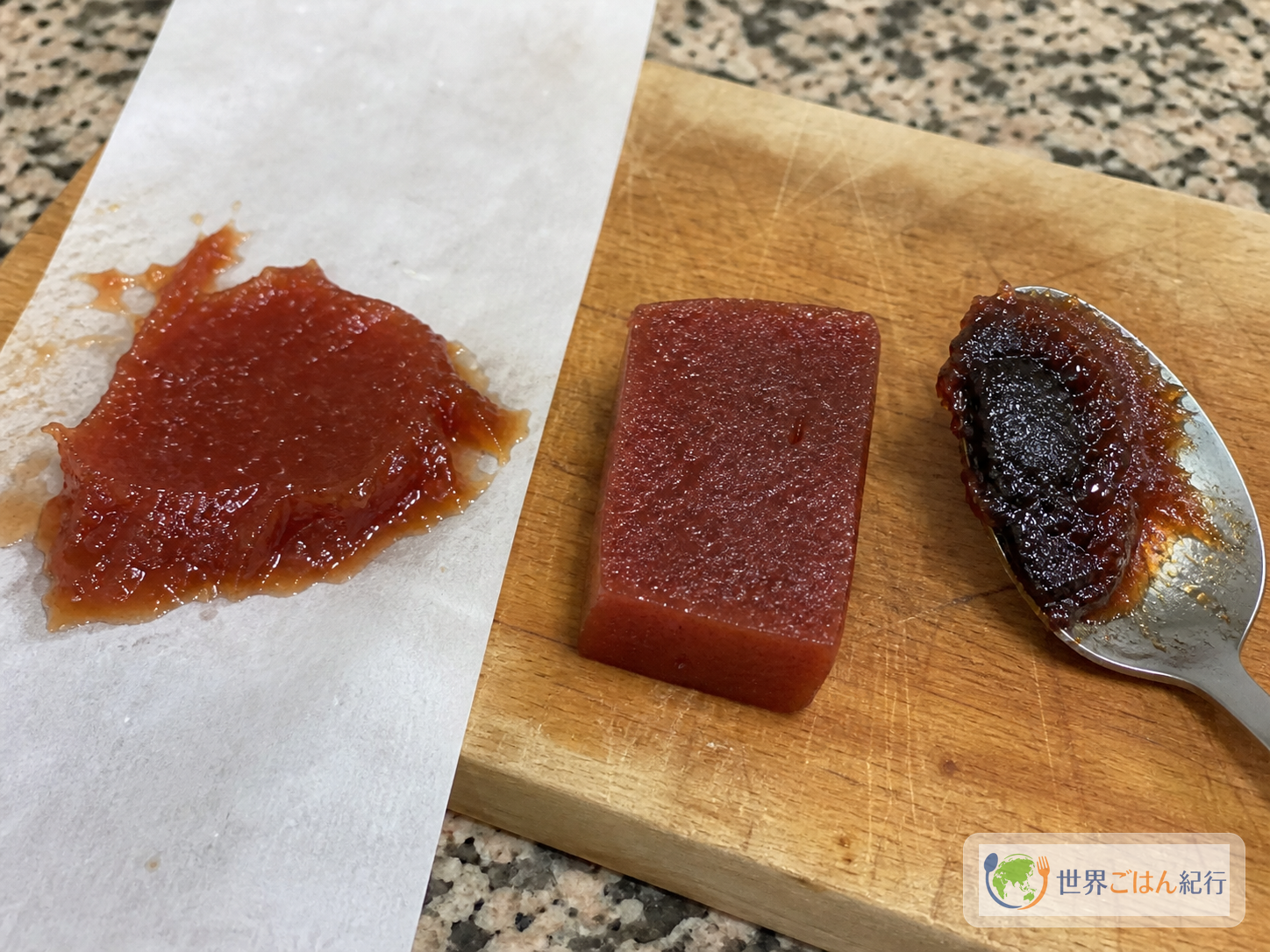
Bocadillo problems are hard to see until it has cooled. It can look thick in the pot yet flow softly in the mold. Or, wanting it firmer, you raise the heat and only the bottom turns bitter and scorched. Sort out where to fix it next time.
| Problem | Common cause | What to fix next |
|---|---|---|
| Does not set when cool | Stopped below 103°C; too much water | Return to the pot and cook again over low heat to 104–106°C |
| Firm on top, runny in the middle | Mold too thick; not enough chilling | Keep it within 2 cm and chill 1 more hour |
| Smells burnt | Heat too high; the bottom not scraped | Low heat after 15 minutes; keep the spoon on the bottom |
| Gritty | Seeds forced through; sugar not fully dissolved | Do not force seeds; cook down only after the grittiness is gone |
| Too sweet and heavy | Too much dark sugar or panela; weak acidity | Use mainly white sugar; add 20 ml lime juice |
A batch that stays soft is not a failure; it works as a sauce. It is good on yogurt, pancakes or cheese toast. If you want to cut and serve it as bocadillo, it is quicker to return it to the pot and cook again. Only if it has scorched is there no recovery, because the bitterness spreads through everything.
How to eat it, menu ideas and storage
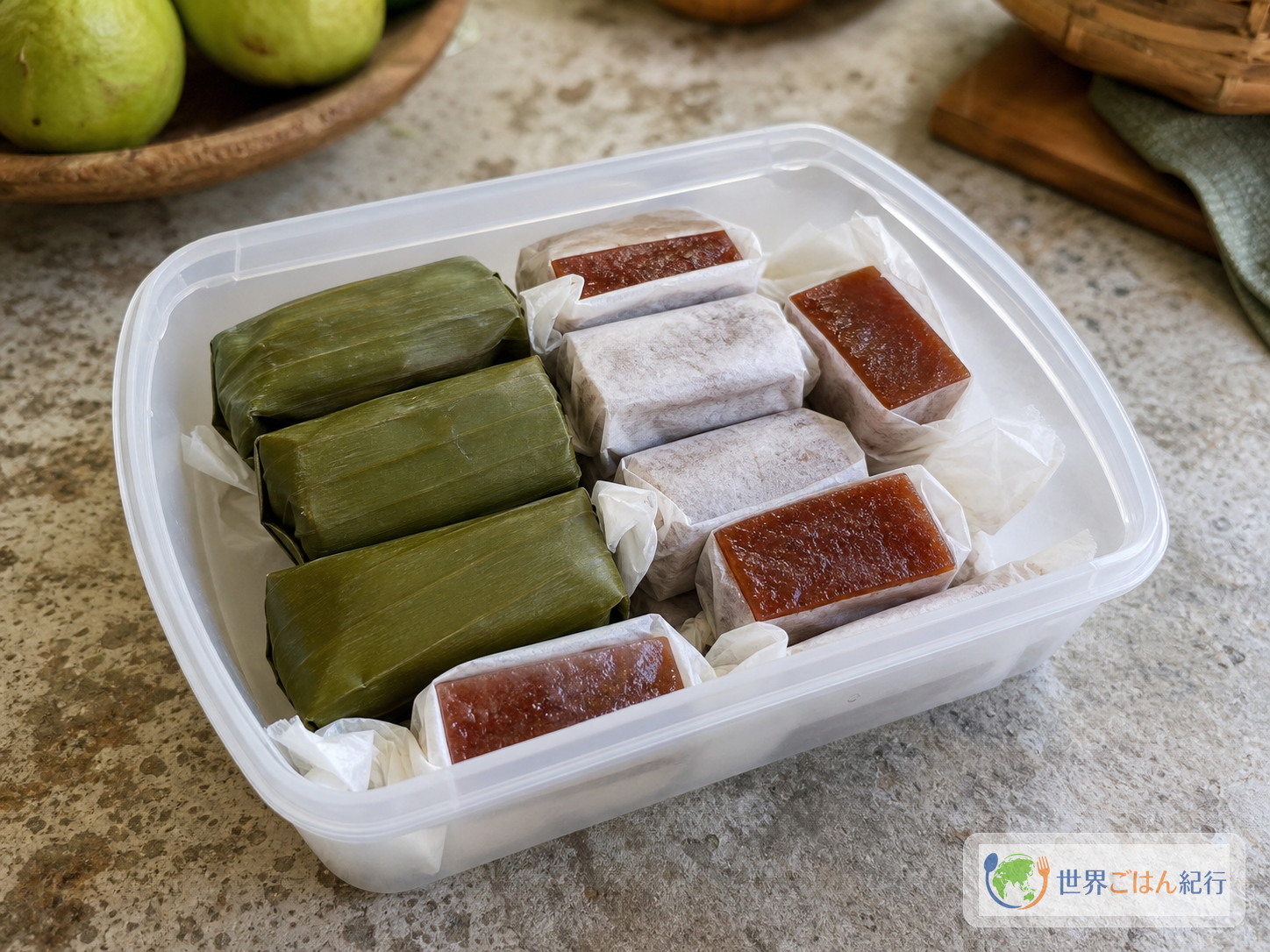
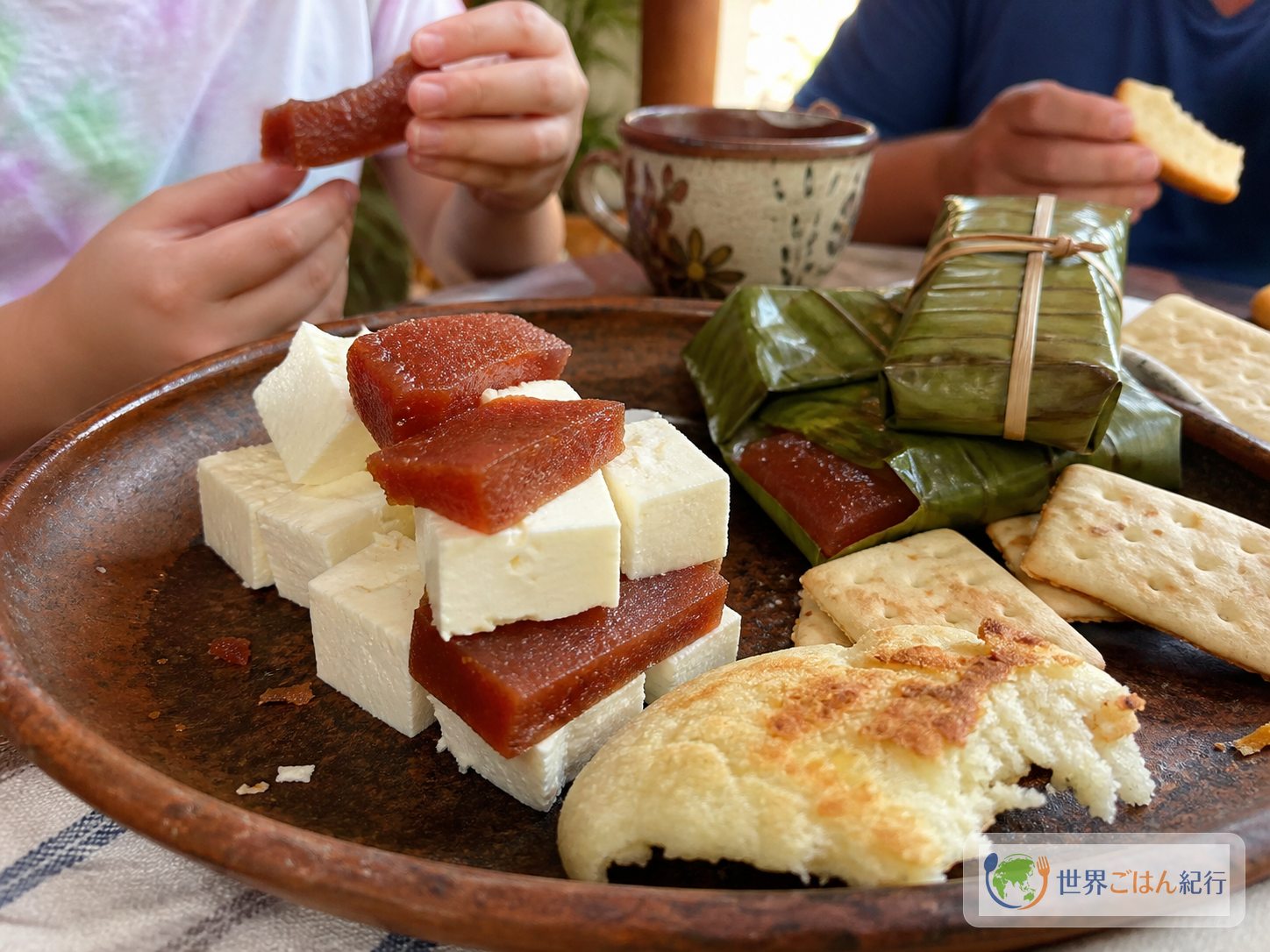
The basic way to eat it is to cut bocadillo and white cheese to about the same size: a bite of the sweet red slab, then a bite of salty white cheese. Or stack them and eat together. My Colombian Recipes also presents it as a simple dessert of guava paste with white cheese.
For a light breakfast or snack, coffee alone is enough. To move toward lunch, put it next to arepas or cachapa (both in Japanese), which connects it naturally to the corn dishes of northern South America. If you like sweet fruit with cheese, the white cheese idea in Peru's potato dish papa a la huancaína is a useful reference.
Do not assume that homemade bocadillo will keep long at room temperature like the commercial kind. Wrap each piece in parchment, put them in a clean container, and eat within 7–10 days in the refrigerator. Droplets make the surface sticky, so do not seal it while hot; cool it completely before wrapping.
To freeze, wrap each stick, put them in a storage bag, and keep up to about 1 month. Thaw in the refrigerator for half a day. Microwaving makes it too soft, so natural thawing suits cut pieces. Do not freeze the cheese; cut it just before eating.
Frequently asked questions
Q1. I have no fresh guava. Can I use frozen puree?
Yes. Use 850 g unsweetened guava puree and start with 50 ml water. Sweetened puree makes the sweetness and firmness hard to predict, so avoid it for a first batch. Puree usually has the seeds removed already, so you can skip the straining.
Q2. Can I use guava juice?
I do not recommend it. Juice has a lot of water and may contain flavoring or added sugar. Cooking it down can work, but it takes longer and the aroma fades. If you must, reduce the sugar and test a small batch.
Q3. Can I make it without a thermometer?
You can, but the first time is harder. Without one, check that a line drawn across the bottom with the spoon stays visible for about 3 seconds, and that a drop on a cold small plate slowly springs back after 1 minute. Cook it down to something much heavier than jam.
Q4. Will it set if I reduce the sugar?
A little, yes, but cut it much and it will not set. Sugar makes not only sweetness but the firmness and keeping quality of the paste. To make it feel lighter, cut smaller pieces and eat them with cheese or coffee instead.
Q5. Which cheese is closest?
A white, salty fresh cheese like queso fresco or queso blanco. At home, cottage cheese, mozzarella or a little feta gets you close. Blue cheese and strongly aged cheeses overpower it with their aroma.
Q6. Is it not authentic without bijao leaves?
The aroma and look of the leaf are part of the charm of the Vélez style, but they are not required in a home version. Use banana leaf if you can find it, otherwise wrap in parchment. What matters is a sliceable firmness, the aroma of guava, and eating it with cheese.
Summary: bocadillo is a sweet decided by temperature
Bocadillo is very simple in ingredients: guava, sugar, acidity and a little salt. Still, the work of removing seeds and judging the end of the cooking changes the result greatly. Do not stop at jam; cook until the spoon leaves a trail, pour into a mold, chill, and cut with a knife. Only then is it the small red sweet of Colombia.
Made at home, it does not need to be identical to Vélez in everything. Frozen puree is fine. Parchment is fine in place of bijao leaves. But keep the guava aroma, do not cut the sugar too far, and try the way of eating it with cheese. Hold to that and bocadillo is not just a sweet paste but a Colombian bite you will want beside your coffee.
To go on with Colombian food, move to ajiaco for a warm meal, bandeja paisa (in Japanese) for a big platter, and arepas for the corn staple, and the table of the same region becomes three-dimensional.
Sources
The regional character of bocadillo, its designation of origin, the leaf wrapping and the pairing with cheese were checked against Colombian public bodies, geographical-indication documents and a cooking site by a Colombian author.
- Superintendencia de Industria y Comercio: Bocadillo Veleño
- Ministerio de Comercio, Industria y Turismo: La Unión Europea reconoció indicación geográfica para el bocadillo veleño
- UK Government: Bocadillo Veleño Product Specification PDF
- FedeVeleños: Denominación de Origen Bocadillo Veleño
- My Colombian Recipes: Bocadillo con Queso
- Vecina Vegetariana: Guava Paste Recipe Colombian Bocadillo
- Wikipedia: Bocadillo (dessert)