


The Scent of Sweet Corn Rises from the Skillet
In the evening, when you find a stray bag of corn at the back of the freezer, most of the time it goes into butter-fried corn or soup. But if you have a little time, put it in the blender and pour it into a skillet. There's a small sizzle, the edge of the yellow batter sets, and the sweet scent of roasted corn and butter fills the kitchen. Lay white cheese over it and fold it in half, and you are close to the cachapa you'd eat at a Venezuelan street stall.
Cachapa is a Venezuelan pancake made from coarsely crushed sweet corn. It looks like a hotcake, but eats like something else entirely. The star is not the scent of flour but the sweetness of corn that still has some kernel in it. The outside is thin and toasty, the inside a little chewy, and the saltiness of melted cheese turns it into a meal in an instant.

When you talk about corn dishes on the Venezuelan table, arepas are famous too. Arepas are a near-staple bread made from masarepa, precooked corn flour. Cachapa uses fresh corn, or frozen or canned kernels, and is a "roasted-corn pancake" that is sweeter and holds more water. Once you grasp that difference, you are less likely to buy the wrong flour.
This article assumes frozen and canned corn, which are easy to find in a grocery store, and sorts out how to bake cachapa so it doesn't tear. Locally the standard filling is queso de mano, a soft white cheese, but it is hard to get elsewhere, so I go as far as how to combine mozzarella, string cheese, fresh cheese, and salty white cheese.
An arepa is a round corn bread made with masarepa, and you eat it stuffed. A cachapa is a batter of crushed corn kernels baked on a skillet or budare, then folded around cheese. Both are national corn dishes of Venezuela, but the ingredients and texture are quite different.
The Story of Cachapa: A Sweet-Corn Meal Baked on a Budare

At the heart of cachapa is corn. In the farming villages of north-central Venezuela, corn is an everyday grain and has been tied to festivals and religious events. Curious Cuisiniere places cachapa's origin in the indigenous corn culture of central Venezuela, especially around Miranda, and says corn was also linked to seed-planting customs on the day of San Isidro. Translate the local dish simply as "pancake" and the farm-village fragrance falls out.
A traditional cachapa is made by crushing tender young corn, adding a little sugar and salt, and baking it on a budare, a flat griddle of clay or iron. It's not a thin crepe but a thicker batter that keeps some kernel texture. Once it's browned, you spread it with butter, pile on queso de mano, and fold it into a half-moon. At roadside shops and markets, pork, ham, cream, or shredded stewed meat are added to make a plate that works for breakfast or lunch.
The hard part elsewhere is the moisture of the corn. Fresh corn there is sweet, with a good balance of water and starch in the kernels, so crushing alone easily makes a batter. Canned corn is soft in brine, and frozen corn releases water when thawed. Copy the local recipe as is and the batter tears the moment you flip it in the skillet. So this article adds a small amount of masarepa or rice flour to the kernel corn, in a formula that holds its shape even in a home skillet.
Cachapa is not a showy dish. But the moment you fold it fresh off the heat and the cheese stretches has the strength of South American street food. Like chivito and empanadas (in Japanese), it has the satisfaction of something you can eat by hand, and it is sweeter than an arepa, suited to weekend breakfasts and light dinners.
Make the corn batter completely sweet and it becomes dessert. Leave out the sugar and the round sweetness of cachapa weakens. Use a little sugar and pair it with a salty cheese. This sweet-and-salty character is the core of cachapa that ketchup or maple syrup can't replace.
Ingredients: Choosing Among Frozen, Canned, and Fresh Corn

There are not many ingredients. The question is which corn to choose. For the first time, frozen corn is easiest to handle. Canned corn has a lot of water and its sweetness varies by product, so drain it well. If fresh corn is available in summer, cutting the kernels off with a knife lifts the aroma another notch.
Choosing your corn
| Type | Who it suits | Moisture adjustment | Result |
|---|---|---|---|
| Frozen corn | First-time cooks | Blot dry after thawing. Start at 80 ml milk | Stable sweetness, less likely to tear |
| Canned corn | People cooking from the pantry | Drain in a sieve 5 minutes, start at 60 ml milk | Soft, the batter a bit loose |
| Fresh corn | People who want aroma in summer | Varies with the water in the kernels. Start at 70 ml milk | The strongest kernel texture and aroma |
Cheese substitute guide
| Local ingredient | Substitute elsewhere | How to use |
|---|---|---|
| Queso de mano | Fresh mozzarella plus a little salt | Blot dry, slice thick, and fold in |
| Queso blanco | String cheese plus cream cheese | Supplies stretch and saltiness |
| Telita-type white cheese | Halloumi, a little feta, cottage cheese | Salty, so mix in a small amount |
This recipe uses egg and dairy. Some masarepa and P.A.N. yellow corn flour products carry gluten-free labeling, but always check the labeling for production lines and imported products. Substituting wheat flour makes it no longer gluten-free.
Cachapa's flavor is decided by the corn and cheese more than by the flour. Masarepa or yellow corn flour can also be used for arepas once you buy it, so it is worth securing first if you plan to keep cooking South American food. You can make it with white masarepa, but yellow brings it closer to cachapa's color.
Buy frozen corn, eggs, milk, mozzarella, and cream cheese at the supermarket, and get only the masarepa from a specialty grocer or online. On a day when you have no masarepa, you can make it with rice flour, but the corn aroma gets a little lighter.
Method: A Home Cachapa That Flips Without Tearing
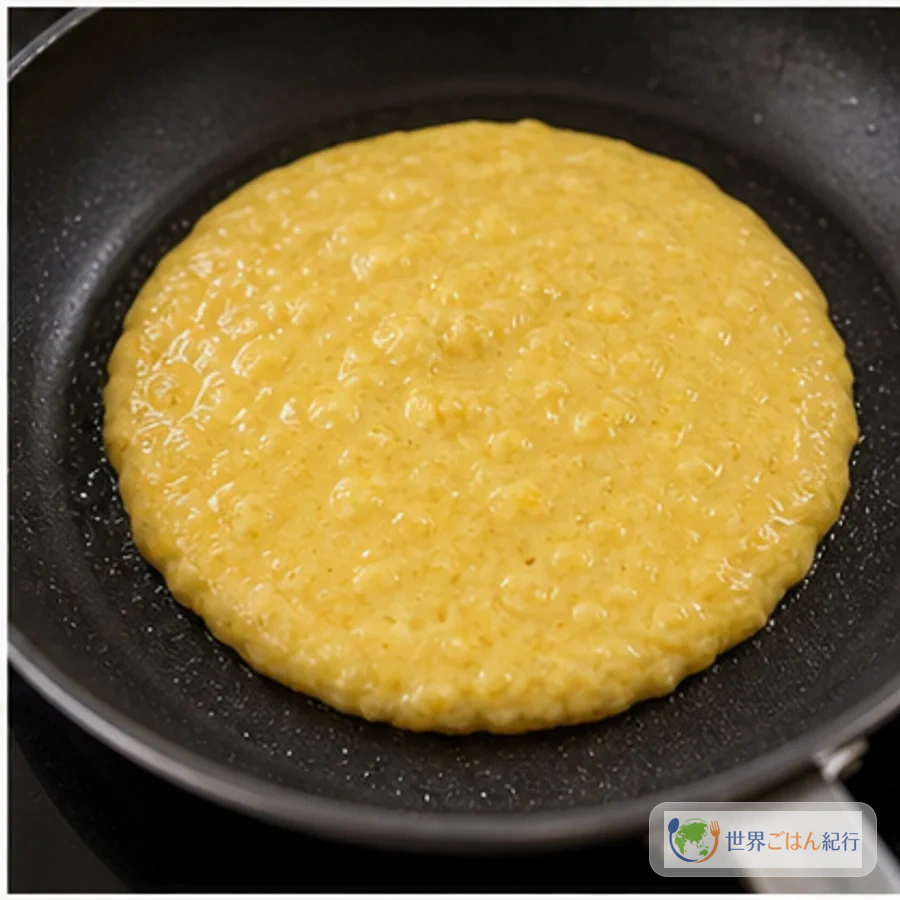
Cachapa is harder to flip than a hotcake. It isn't held together by wheat gluten, and there is a lot of corn kernel and water. Don't cook it too large, and don't touch it until the surface dries. Just these two things greatly reduce failures.
Because it is a dish eaten fresh, don't try to cook all 4 at once. Cook them one at a time and eat each as it's done, or hold them in an 80 degree C oven. If you have a hot plate, cooking in front of the family lets everyone enjoy the moment the cheese melts.
If batter scooped with a ladle spreads like water, the corn has too much moisture. Add masarepa or rice flour 1 tbsp at a time and wait 5 minutes before cooking. Too much makes the batter stiff, like an arepa, so draining the water comes before firming it with flour.
Cooking Tips: Don't Scorch the Sweet Batter, and Keep the Cheese In

Make the batter completely smooth and it becomes uniform like a hotcake. Cachapa is a dish where the sweetness of kernels remains, so don't run the blender too long. Stopping when about a third of the kernels remain lets the corn aroma rise when you bite.
Even if the edge is cooked, a wet center will break the moment you flip. Wait until the whole surface is slightly dry and the bubble holes remain. Longer than a hotcake, 4–5 minutes per side is the guide.
Japanese-style mozzarella stretches well but isn't as salty or milky as queso de mano. Pairing mozzarella with cream cheese, a little feta, or string cheese gives a flavor that holds up to the sweet batter.
In English-language recipes, some formulas include wheat flour. Bon Appétit and North American recipes often use flour and egg to hold the shape even with canned corn. But a lot of wheat flour moves it from "corn pancake" to "hotcake with corn." In this recipe, we support it with masarepa or rice flour and keep the corn as the star.
The other important point is the amount of sugar. Young corn locally is sweet, so some recipes add no sugar. Because the sweetness of frozen corn varies by product, take 1 tbsp as the basis and reduce to 2 tsp for a sweet variety. The more sugar, the sooner it browns and the easier it scorches.
Variations: From Street-Stall Style to a Light Dinner

The basic queso de mano-style combines mozzarella and cream cheese. If you want the saltiness of local white cheese, crumble in about 1 tsp feta. Too much feta brings strong acidity and salt, so use it only as a supplement.
Cachapa with pork is a hearty street-stall favorite. Cut grilled pork belly small and fold it in with the cheese. Sweet corn, salty cheese, and fatty pork overlap, so a side of salad or lime makes it easier to eat. If you like South American meat dishes, thin slices of leftover churrasco (in Japanese) also go well in it.
Reina pepiada-style cachapa tucks a small amount of the chicken and avocado filling used for arepas into a cachapa. Since the batter is sweet, go light on mayonnaise and stronger on lime juice. It isn't completely authentic, but it's a fun way to see the connections between Venezuelan dishes.
For a breakfast cachapa, add a soft fried egg to the cheese. The yolk mingles with the sweet corn batter, giving it more of a meal feel than a pancake. It goes with coffee, but for a weekend brunch, cilantro and tomato keep it from feeling heavy.
For a vegetable-heavy light dinner, halve the cheese and add avocado, tomato, and black beans. The day after making a black bean dish like feijoada, warming the beans and setting them beside the cachapa gives you a very South American plate.
Besides the pancake baked on a budare, there is also cachapa de hoja, wrapped in corn husks and boiled. It looks closer to a tamal and the cooking method differs from the home skillet version. This article covers the budare-style cachapa, which is easy to reproduce in a home kitchen.
Storage and Make-Ahead: Batter Early, Cooked Ones Short

Cachapa is best fresh. With time, the moisture from the corn batter makes the toasty outside hard to bring back. If you still want to make ahead, store it before adding the cheese.
For the batter, take half a day refrigerated as the limit. It has the sweetness of corn plus egg and milk, so it isn't something to keep long. If you can't cook it right away, put it in an airtight container in the refrigerator and stir everything before cooking. If water has separated and the batter is loose, add 2 tsp–1 tbsp masarepa and wait 5 minutes.
Cooked cachapa without cheese keeps until the next day refrigerated. Cool it completely and wrap each in plastic wrap. To reheat, not just the microwave but a skillet for 2 minutes per side, to bring back the toastiness of the surface. If you store it with cheese folded in, moisture moves into the batter easily, so avoid that if possible.
If you want to prepare the night before, rather than making the batter, it is safer to drain the corn and refrigerate it. In the morning, just mix the corn, egg, milk, and flour and cook. Splitting it up this way avoids the worry of leaving an egg batter out long and avoids the failure of flour absorbing too much water and getting heavy. For guests, first make one small test cake to check the firmness that can be flipped, and then cook the full size.
Freezing isn't impossible, but we don't strongly recommend it. Unlike flour-based batters such as arepas, cachapa has a lot of water from the kernels and cracks easily after thawing. If you freeze, do it without cheese and within a week. Thaw naturally before eating, re-cook in a skillet, and then fold in the cheese.
Leftover cachapa is easy to eat the next morning cut small and re-cooked with egg and cheese. It's away from the local way of eating, but the sweet corn aroma remains. Rather than throwing it out, turn it into a breakfast plate.
Background: Why They Eat It by the Roadside in Venezuela

The reason cachapa is beloved in Venezuela is not only the simplicity of its ingredients. The sweetness of corn, the saltiness of white cheese, and the toasty flavor from a griddle suit stalls and roadside shops. Amigo Foods presents cachapa as a dish that can be eaten at breakfast or as a street food folded around cheese or meat. It's easy to take away and can be served as it's cooked, which fits food-stall culture.
In Venezuelan cooking, corn changes shape again and again. Arepas are the daily staple. Hallacas are the wrapped dish of festivals and Christmas. Cachapa is a griddled dish that lets you enjoy sweet kernel corn. Even P.A.N.'s official product description of its yellow corn flour introduces it as a flour you can use for typical Venezuelan dishes such as arepas, cachapas, and hallacas. In other words, cachapa isn't a one-off trend but part of a food culture centered on corn.
When you reproduce it elsewhere, don't think "I can't because I don't have the same cheese." What matters more is separating what you can swap from what you should keep. Queso de mano can be approximated with mozzarella or fresh cheese. A budare can be replaced with a heavy skillet or a hot plate. But keep the kernel texture of the corn and the structure of salty cheese against a sweet batter. If you keep those, cachapa becomes a proper dish even with frozen corn.
South American cooking may bring meat to mind. Meat plates like ropa vieja (in Japanese), lomo saltado, and bandeja paisa (in Japanese) are certainly strong. But cooking a corn dish like cachapa shows you that the South American table is not just meat. Flour, beans, cheese, corn. The more a food supports everyday meals, the more of a place's way of life shows in it.
FAQ

Can I make cachapa with just cornmeal?
It won't have the same texture. Cachapa is made by crushing kernel corn, and with cornmeal alone it becomes a flour-based pancake. A small amount of masarepa or rice flour as support is effective, but make frozen or fresh corn the star.
Can I use canned corn?
Yes. But canned corn has a lot of water, and its sweetness varies by product. Drain it in a sieve for 5 minutes, blot the water with paper towels, and adjust starting with 60 ml milk. If the batter is loose, add masarepa 1 tbsp at a time.
I can't get queso de mano. What can I substitute?
Fresh mozzarella is the easiest to handle. But it's low in salt, so combining it with cream cheese or a little feta balances it with the sweet batter. String cheese stretches well and is a very handy substitute for the home version.
The batter cracks when I flip it.
The main causes are three: too much moisture, undercooking, and spreading it too large. Cook it small, about 16 cm across, 4–5 minutes per side, and don't touch it until the center of the surface is dry. Use a wide spatula, not a small one.
Is cachapa gluten-free?
If you make it without wheat flour, with corn, egg, milk, and masarepa or rice flour, it contains no wheat. But check the production lines and allergen labeling of the flour and cheese you use for each product. At restaurants and in store-bought versions, wheat flour is sometimes used as a binder.
What menu does it go with?
For a light meal, cachapa with salad; for a hearty one, add pork or black beans. To widen into a South American table, ceviche (in Japanese) as an appetizer, churrasco (in Japanese) as a meat dish, and arepas for comparing staples show you the breadth of corn culture.
Wrapping Up: Cachapa Is a Dish for Enjoying Griddled Corn

Cachapa looks simple from its ingredients alone: corn, egg, milk, a little flour, and cheese. But making it well takes several decisions. With canned corn, reduce the water. With frozen corn, drain it. With fresh corn, check the sweetness and cut back the sugar. For cheese, combine one that stretches with one that is salty. Small adjustments like these are the points that keep the Venezuelan character in a home kitchen.
The first time, frozen corn and mozzarella are enough. Don't make the batter too large, wait until the center is dry, and fold it while hot. Just this turns the usual canned or frozen corn into the star of the table.
To compare other Venezuelan corn dishes, move on next to how to make arepas. To go with meat dishes, widening from the South American cuisine overview (in Japanese) to churrasco, ropa vieja, and ceviche shows where cachapa sits within South America.
Sources
- P.A.N. USA, "Cachapas / Sweet Corn Pancakes" https://us.allofpan.com/recipes/cachapas/ (accessed 2026-05-07)
- P.A.N. USA, "Pre-cooked Yellow Corn Meal" https://us.allofpan.com/product/pre-cooked-yellow-corn-meal/ (accessed 2026-05-07)
- Bon Appetit, "Cachapas" https://www.bonappetit.com/recipe/cachapas-recipe (accessed 2026-05-07)
- Curious Cuisiniere, "Cachapas (Venezuelan Corn Pancakes)" https://www.curiouscuisiniere.com/cachapas-corn-pancakes/ (accessed 2026-05-07)
- Amigo Foods, "Cachapas Recipe" https://www.amigofoods.com/blogs/venezuelan-recipes-recetas-venezolanas/cachapas-recipe (accessed 2026-05-07)
- Wikimedia Commons, Category "Cachapa" https://commons.wikimedia.org/wiki/Category:Cachapa (accessed 2026-05-07)
- Wikimedia Commons, "Cachapa 1.jpg" by Caldobasico, CC BY-SA 4.0 https://commons.wikimedia.org/wiki/File:Cachapa_1.jpg
- Wikimedia Commons, "Cooking a cachapa.jpg" by Wilfredor, CC BY-SA 3.0 https://commons.wikimedia.org/wiki/File:Cooking_a_cachapa.jpg
- Wikimedia Commons, "Cachapa Con Queso e Mano.JPG" by Wilfredor, CC BY-SA 3.0 https://commons.wikimedia.org/wiki/File:Cachapa_Con_Queso_e_Mano.JPG
- Wikimedia Commons, "La cachapa oriental.JPG" and other files in Category:Cachapa; individual licenses are listed on each file page.


