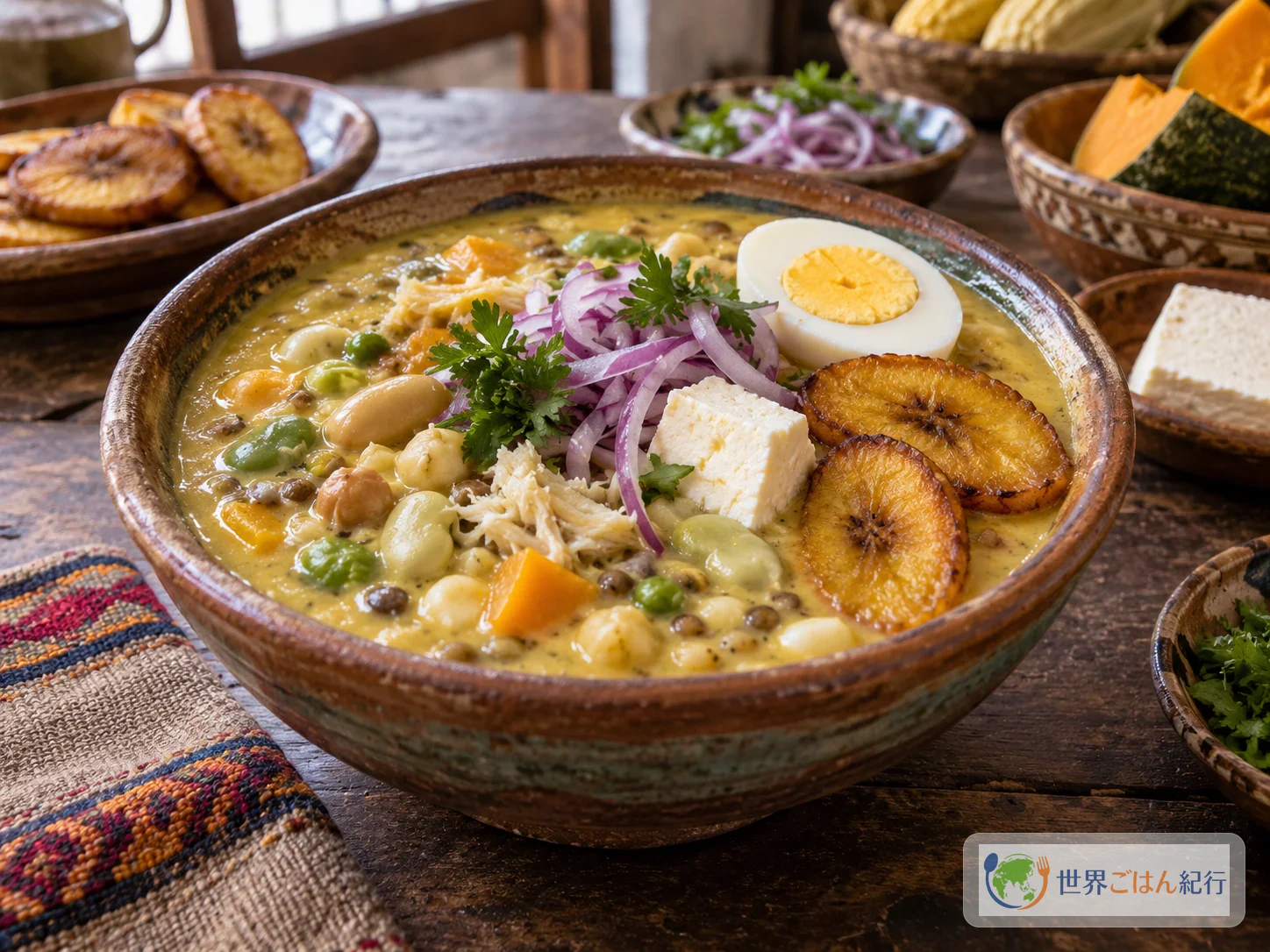
In Ecuadorian homes during Holy Week, bags and bowls of beans line the kitchen table. A grandmother cracks open fava bean pods, a child counts white beans, someone shucks kernels of corn. Beside them salt cod soaks in water and squash simmers until tender. Fanesca (also written fanesca ecuatoriana) is a thick soup eaten in Holy Week, leading up to Easter. Into the great pot of Holy Week go beans, young grains, squash, and milk, and every spoonful has a different texture. For the cook, the time spent shelling beans as a family is part of the dish itself. What makes this plate interesting is that salt cod and young grains, ingredients of the sea and the field, meet in one pot.
The fillings vary by household and region, and some recipes use eight to twelve kinds of beans and grains. The number twelve is linked to a religious reading in which the ingredients or grains stand for the apostles, but this is not a dish that requires twelve kinds of grain. Still, the reason so many things go in is not to compete on numbers but because the family brings its hands and ingredients to the festive table. The recipe in this article is arranged as eight ingredients, a form that is easy to make while sharing the work: corn, green peas, fava beans, white beans, chickpeas, lentils, chochos, and rice. In exchange for not being tied to twelve, we make it a rule that thickness is set by milk and squash.
The Spanish spelling is fanesca, or fanesca ecuatoriana. Quito Turismo says the twelve ingredients are said to represent the apostles, but it does not limit the dish to twelve grains. Ingredients, garnishes, and the treatment of the fish all differ by region and household, so this dish has no single fixed recipe.
How to Make It
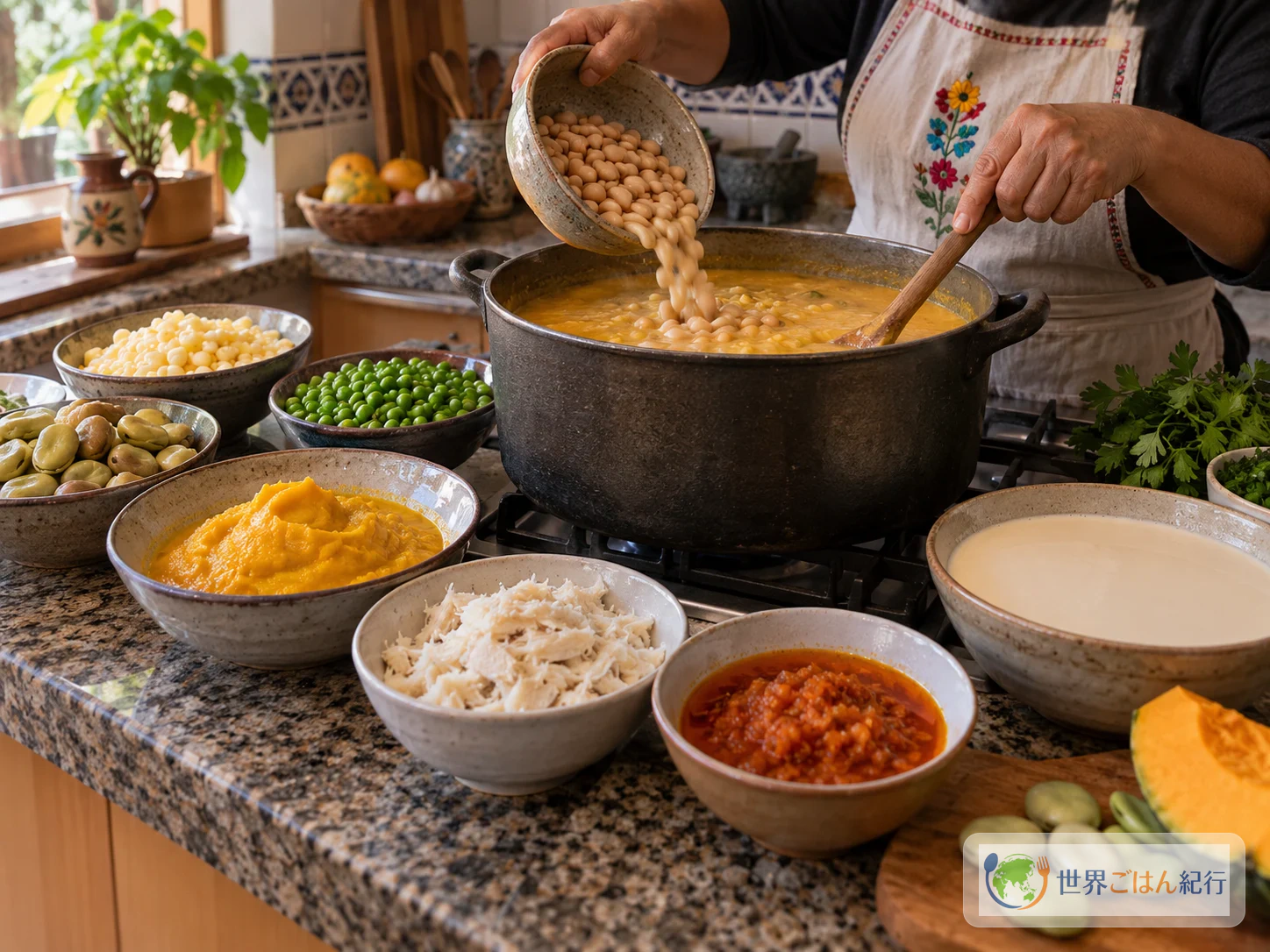
The total time includes 24 hours to desalt the salt cod. The cooking day itself takes about 70 minutes. Because the beans and grains differ in hardness, the premise of this dish is to cook them separately rather than in the same pot. Then you build the soup base, finish the annatto sofrito, the peanut and milk, and the salt cod in turn, and combine them at the end. Seasoning is judged after the saltiness of the salt cod and cheese goes in, so salt comes last of all.
1. Desalt the salt cod and pre-boil the beans the day before
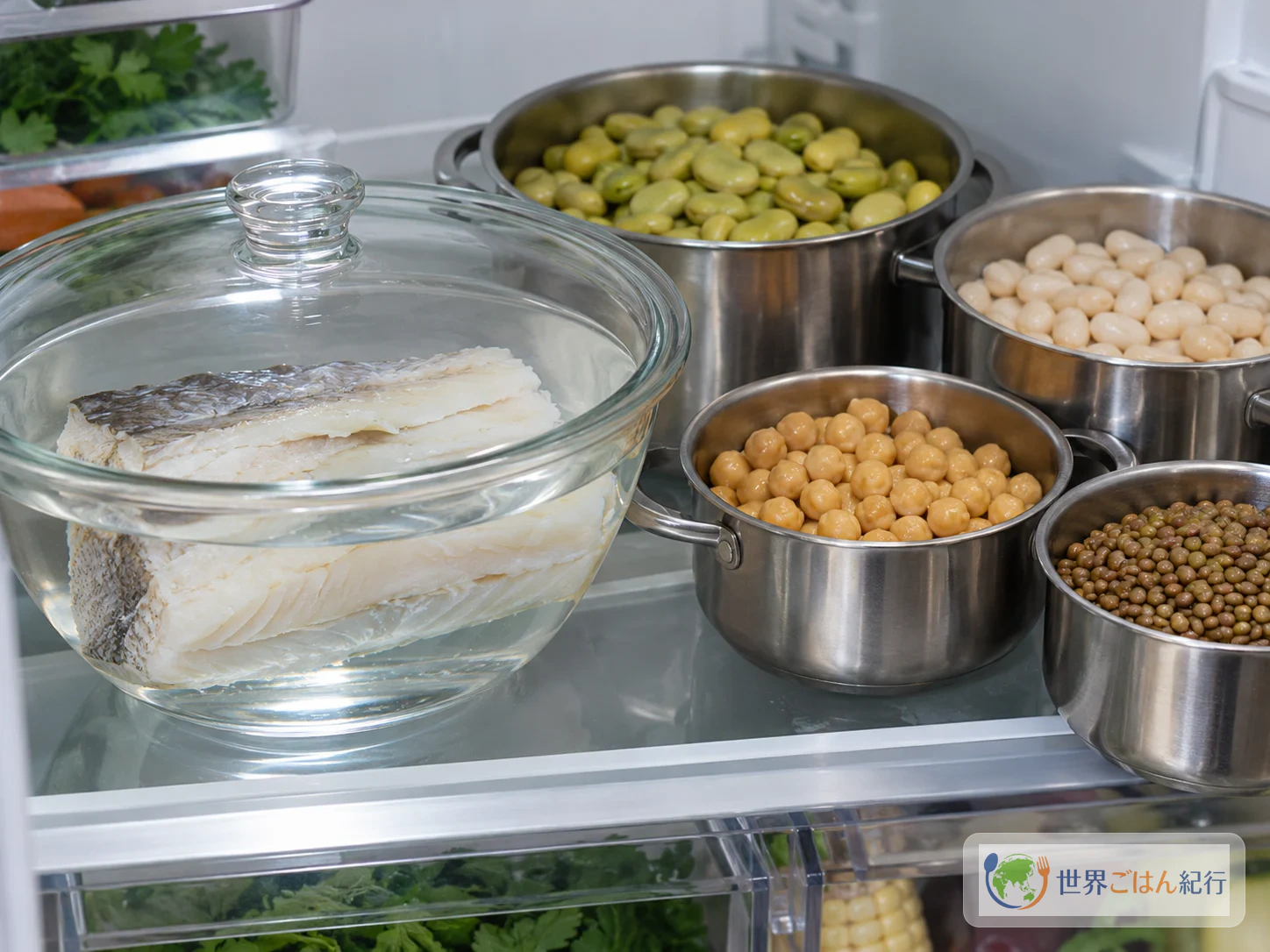
Start with the desalting, which takes the longest. Put 200 g salt cod in plenty of water in the refrigerator, change the water every 6–8 hours for 24 hours. Then check the saltiness with one piece. Cook a piece and taste it, and if it is still too salty, keep changing the water for a few more hours. The sources include a procedure of 12 hours in milk and one of 24–48 hours in water, and the time varies with the thickness of the fish.
Boil the beans in separate pots. Soak dried fava beans, white beans, and chickpeas each and boil them until tender, and stop the lentils at the stage where they do not fall apart. If you use canned beans, just rinse and drain them. Do not overcook the green peas and corn.
If you stop the beans when they can be crushed with a finger but still have a slight firmness at the center, they will be just tender in the final big pot. If you simmer lentils or green peas from the start, they dissolve into the soup, so save them for later. Keep the cooking liquid separate for each bean, and if it is not too cloudy, you can use a little of it as soup liquid.
2. Make the core of the soup with squash and rice
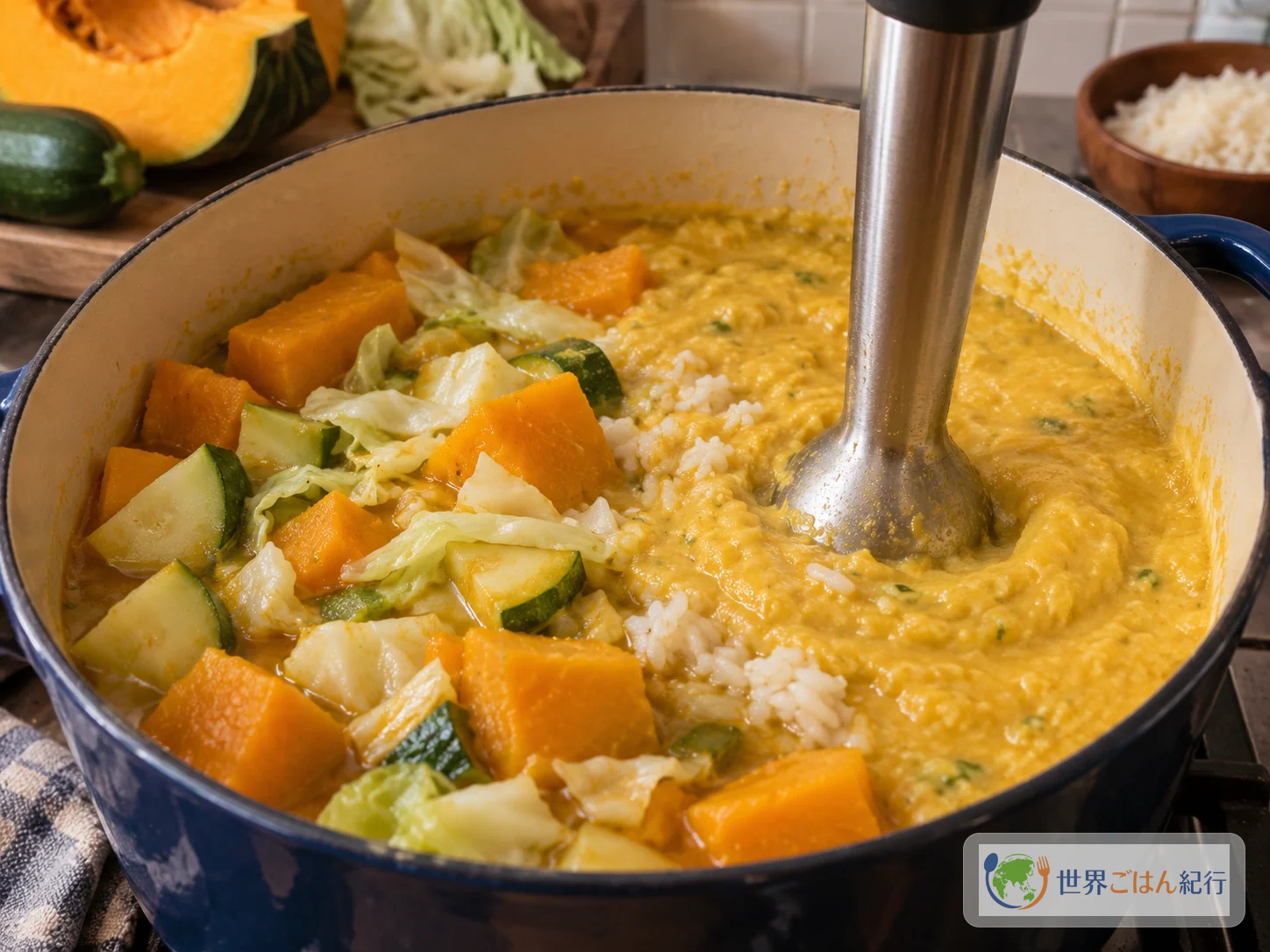
Put 250 g squash, 150 g zucchini, 80 g cabbage, and 250 ml water in a pot, cover, and simmer over medium-low heat for 15–20 minutes. Turn off the heat, leaving the cooking liquid, when a skewer goes through to the center, that is, when it goes into the middle of the squash without resistance.
Blend 2/3 of the squash and zucchini, the cabbage, 80 g cooked rice, and 100 ml cooking liquid smooth with an immersion blender. The rice binds the soup and gives it a pleasant body. Set the remaining 1/3 aside without mashing it completely, so that small pieces of squash remain in the finished soup. Not turning everything into paste is what makes it fun to eat.
For thickness, aim for a soup that falls from a spoon in a thick ribbon. If it is stiff, add cooking liquid 1 tbsp at a time. If it is watery, add the reserved squash and then blend; do not add water just to thin it. The cabbage's moisture tends to dilute the flavor, so leave the salt undecided at this stage.
3. Make the annatto sofrito
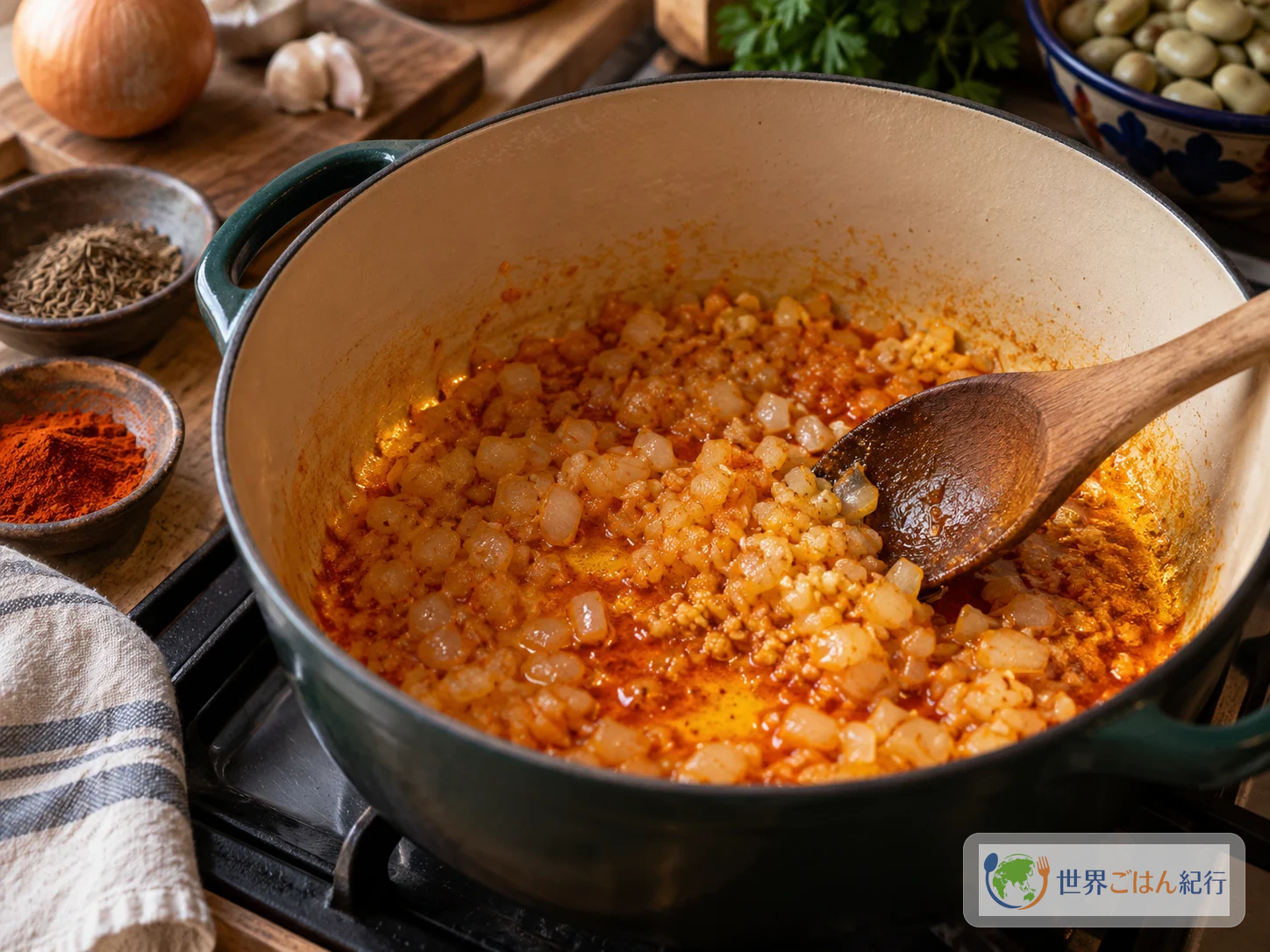
Melt 25 g unsalted butter in a heavy pot and cook 150 g onion and 2 cloves garlic over medium-low heat for 5–7 minutes. When the onion is translucent and there is still some moisture left in the bottom of the pot, add 1 tsp annatto, 1 tsp cumin, and 1/2 tsp oregano.
Annatto is not a spice that adds heat. What it contributes is red color and a mild earthy aroma. Think of moving the red color into the fat and cook for only 30–60 seconds. Stop before the powder turns black at the bottom of the pot, and move on to the next step.
If the pot is drying out, add 1 tbsp cooking liquid or water to lower the temperature. Never turn up the heat after the annatto goes in. If black specks or smoke appear, it is better to start over so you do not carry bitterness forward. Paprika can stand in for the color, but it is not the same as annatto's aroma.
4. Cook the salt cod in milk and make the peanut milk (cooking step)
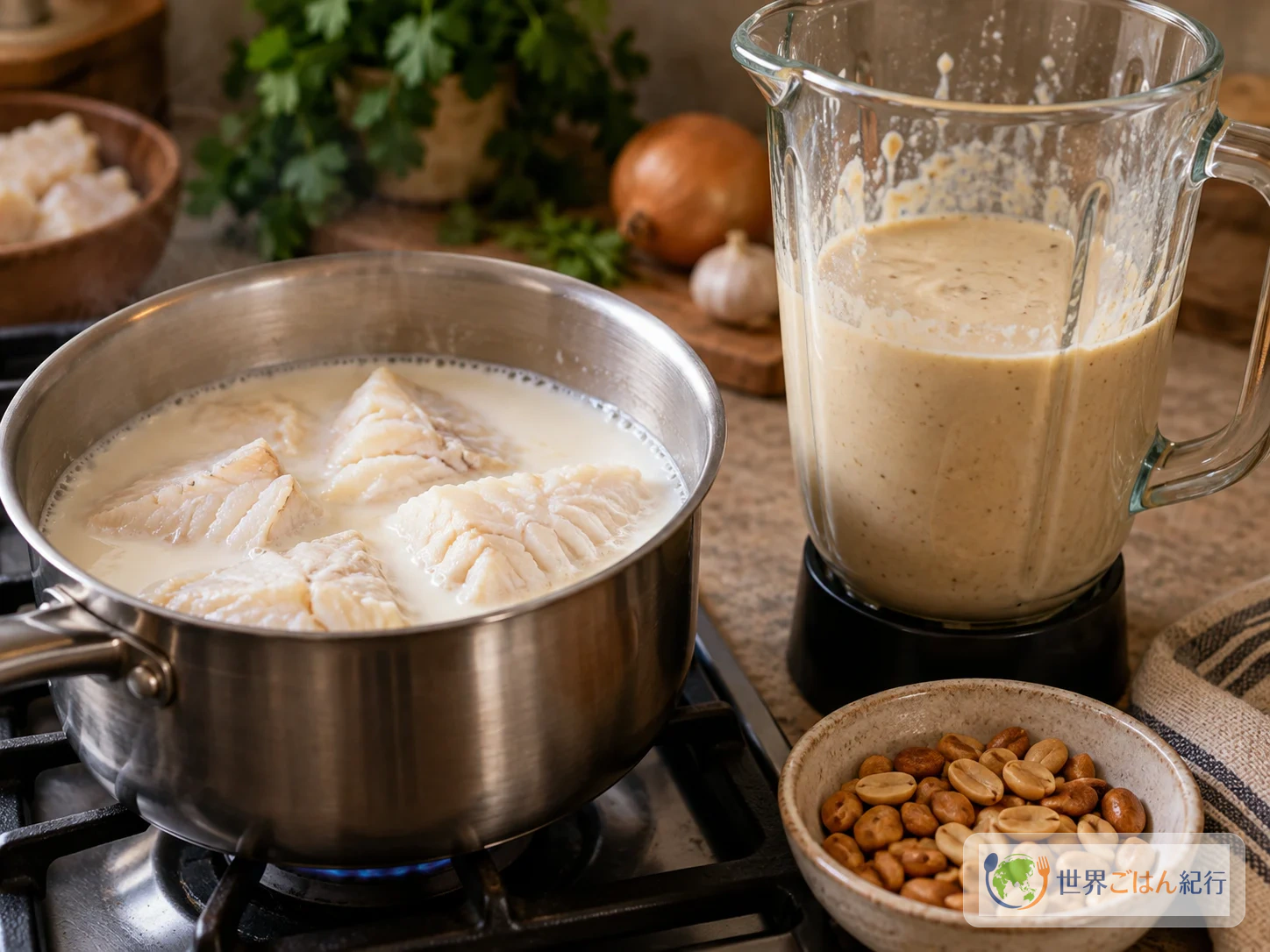
Pat the desalted salt cod dry and gently simmer it in a small pot with 250 ml milk over low heat for 8–10 minutes, until it is white through to the center. Take it out and flake it coarsely, and strain the fish milk and keep it. A hard boil makes the fish tough and the milk likely to separate.
Blend 50 g unsalted roasted peanuts with 200 ml milk in a blender until the peanuts are smooth. Make sure no large bits remain. Set aside 50 ml cream and the remaining 100 ml milk for finishing, and adjust how much you use while tasting the saltiness of the salt cod and cheese.
5. Combine in the big pot, return the ingredients, and set the thickness
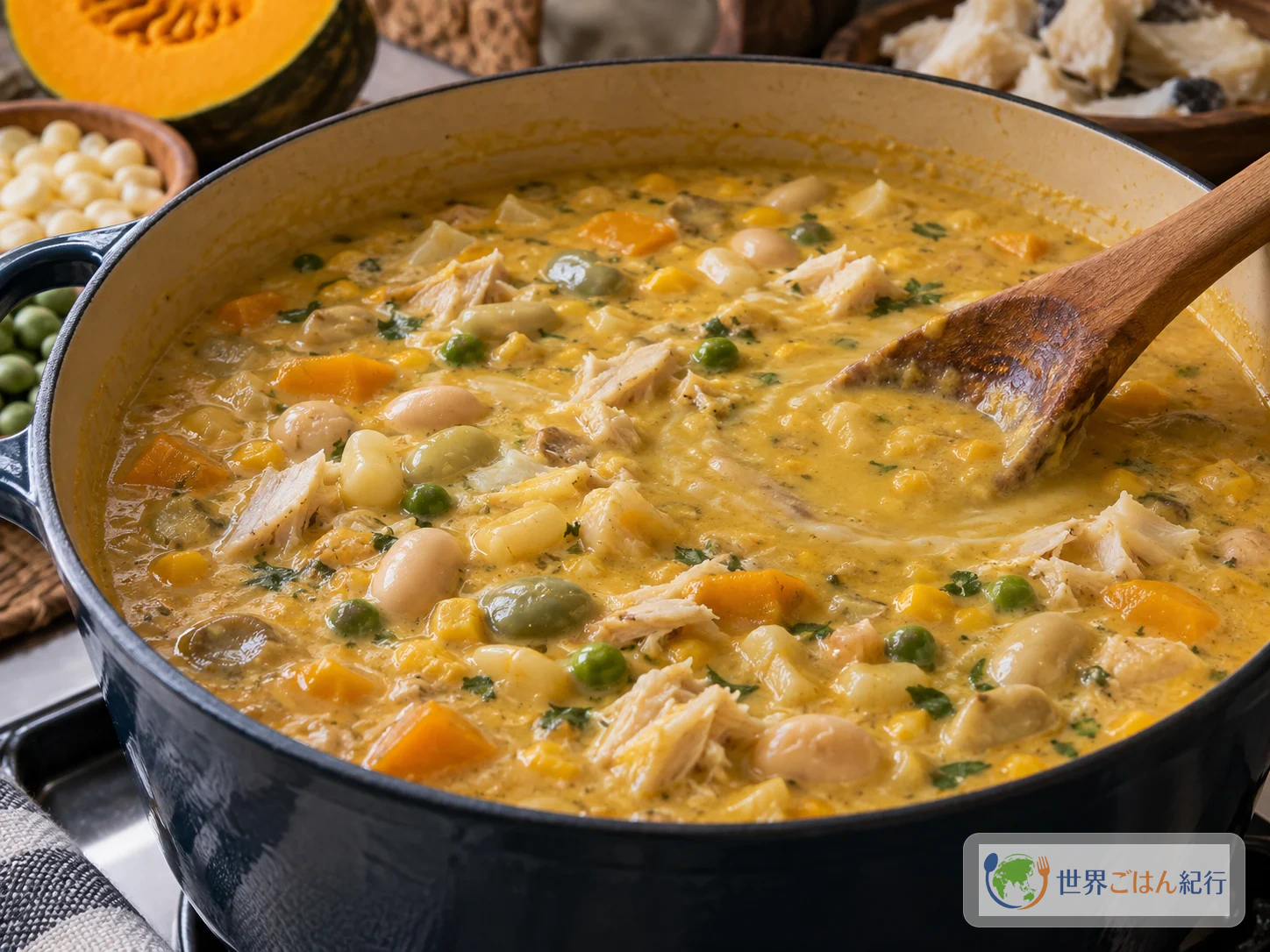
To the sofrito add the squash puree and the reserved squash, 300 ml bean cooking liquid or water, and the milk the fish was cooked in, and combine over low heat for 10 minutes. Then add the corn, fava beans, white beans, chickpeas, and chochos, and simmer another 10 minutes over low heat.
Finally add the green peas, lentils, salt cod, the peanut and milk sauce, and the cream, and cook for 5–8 minutes without letting it boil. Just before turning off the heat, melt in the cheese and adjust with salt and black pepper. Because of the salt cod and cheese, decide the salt last.
The sign it is done: the squash and milk base blends smoothly with the ingredients, and when you drag a wooden spoon along the bottom of the pot, the trail of the spoon lasts 2–3 seconds and the soup thinly coats the back of the spoon.
If it is too thick, add 50 ml milk or unsalted cooking liquid at a time, warming over low heat each time. If it is too thin, remove the lid and simmer over low heat for 5–10 minutes, or mash a little of the reserved squash and add it. Boiling hard to reduce it breaks the beans, separates the milk and peanuts, and leaves only the saltiness.
6. Finish with egg and plantain
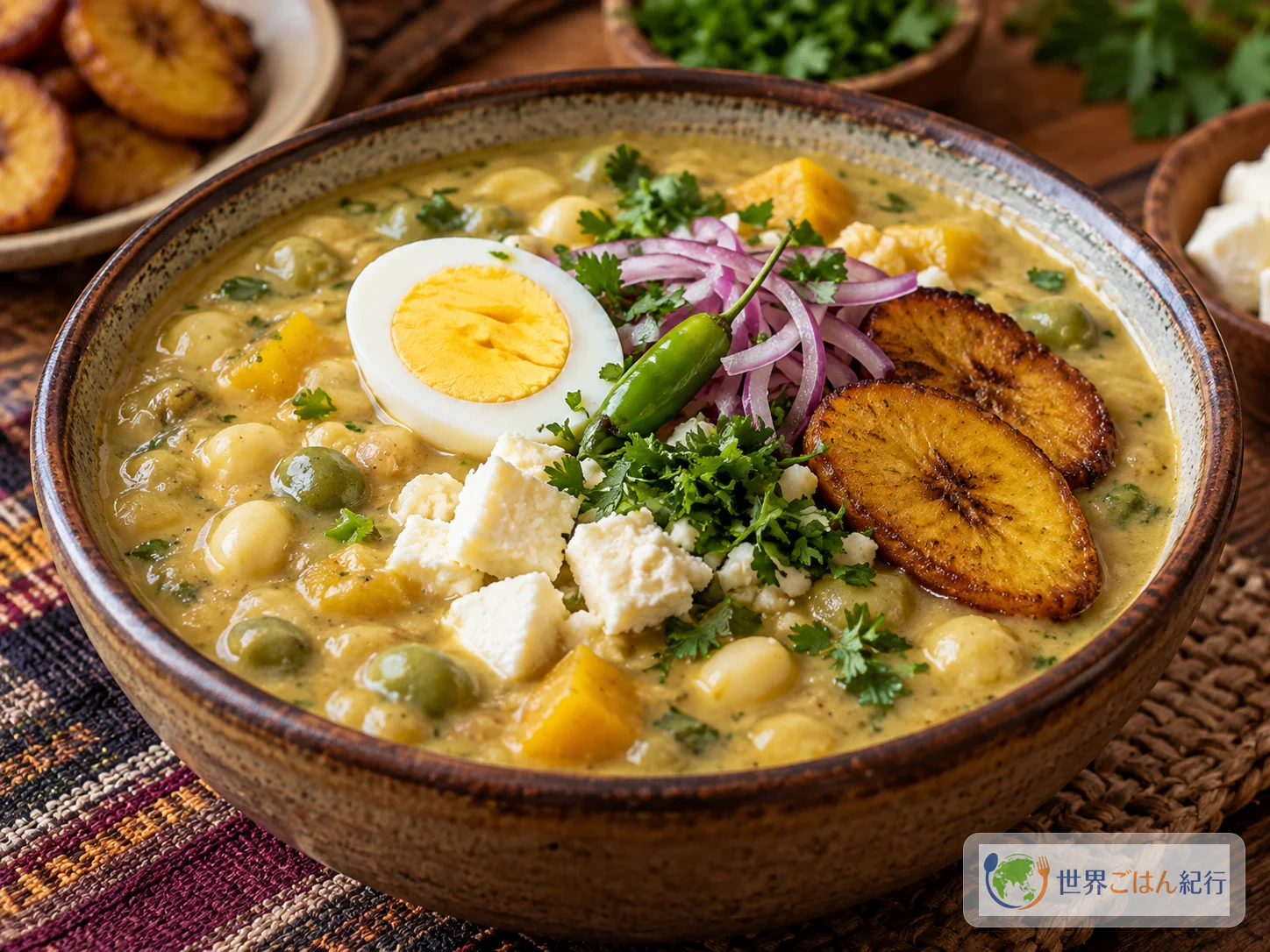
Hard-boil 2 eggs in boiling water and halve them. Slice ripe plantain on the diagonal and, in a skillet over medium-low heat with a little oil, cook both sides until browned to toast the surface. Toss red onion with a little lime juice and salt, and have parsley or cilantro, cheese, and green chile ready too.
Pour the fanesca into deep bowls and top with the egg and plantain, onion, cheese, and herbs. Keep the acidity separate by serving it on a different plate if you like. If everyone adds to taste, they can change each bite with the garnishes, and the rich soup stays enjoyable to the end.
At Easter in Ecuador, the Family Shells the Beans
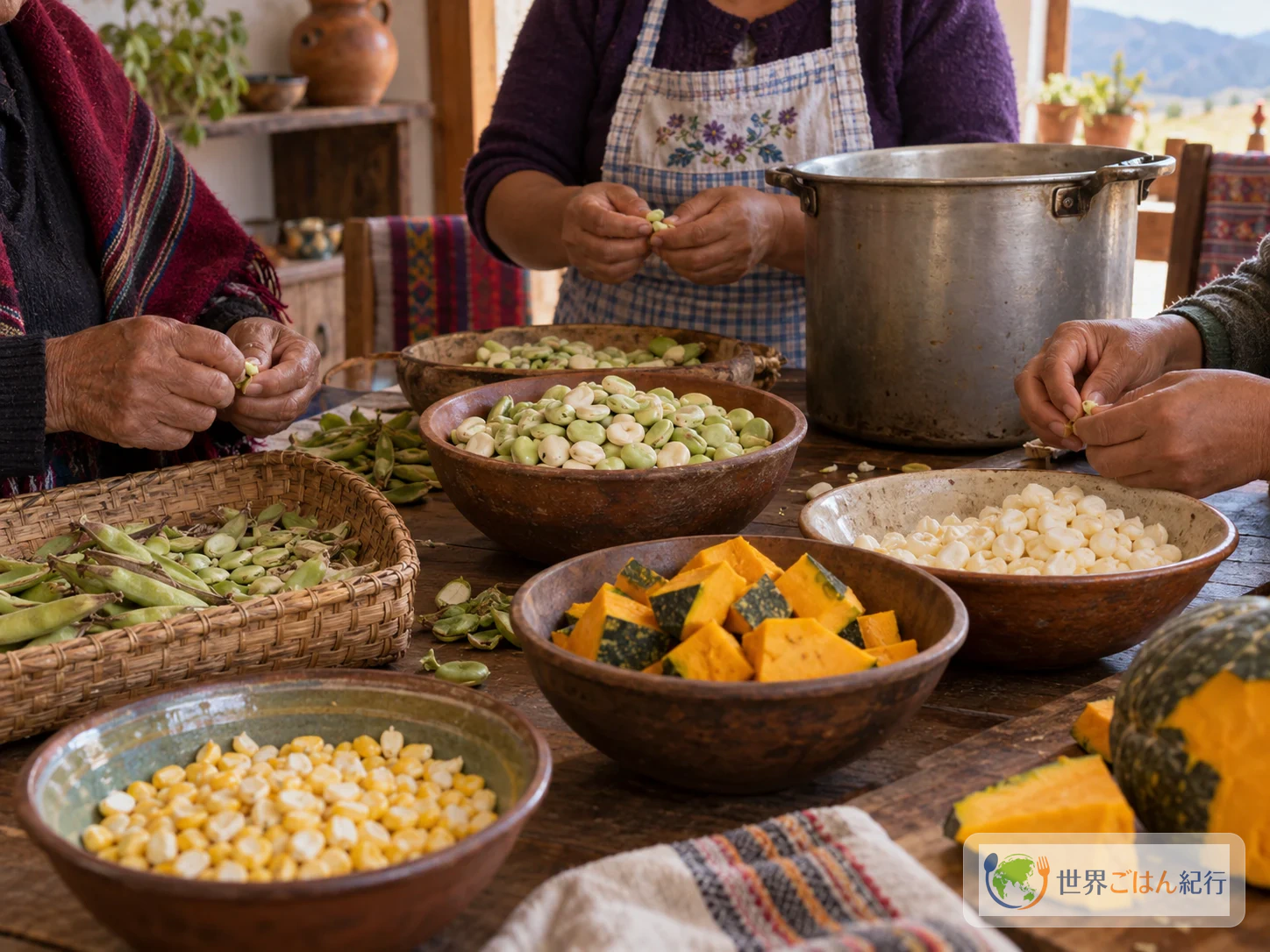
Following the sources, again and again you find the scene of families gathering in the kitchen during Holy Week and sharing the work of shelling and cooking beans and grains. In the past, even peeling the grains was a communal household job, and the sheer amount of labor was tied to the social meaning of the dish. What we want to picture here is not a pot one person makes in a short time. It is a big pot with preparation that starts the day before, where the shelling time is part of the cooking, and the family's hands gather in one pot.
So where did the dish come from? The Asociación de Chefs del Ecuador and UDLA explain it as the Andean uchucuta (a harvest food) using young grains and chiles, overlaid with dairy, fish, and sofrito elements that arrived in the colonial period. Links to Mushuk Nina and the equinox farming calendar are also described, but not every household today performs the same ritual. Catholic Holy Week was then added, and the dish changed into today's form, using salt cod and milk in a period of abstaining from meat. There are multiple theories about its origin and the source of its name, and neither its birthplace, its inventor, nor a single date can be stated with certainty.
The contents of the pot also differ by region. The Andean ingredients listed are corn, fava beans, chochos, mellocos, and squashes. Coastal variants are also explained as adding vegetables different from the Andean side, such as achogcha and green beans. So it is natural that ingredients change by region, and it is closer to reality to think there is a fanesca for each household than to settle on one authentic home. It is the same abroad. From the perspective of academic sources, the dish is not lost but transplanted to home tables as it swaps in the beans and fish available. Even when substituted, the structure of the celebration remains.
The origin is not told as a choice between "an Indigenous dish" and "a colonial dish." Each source explains that Andean grains, squash, and chiles were overlaid with colonial-era milk, cheese, salt cod, and the Catholic calendar. UDLA also notes that details of the origin and the name are not settled.
Ingredients (serves 4)
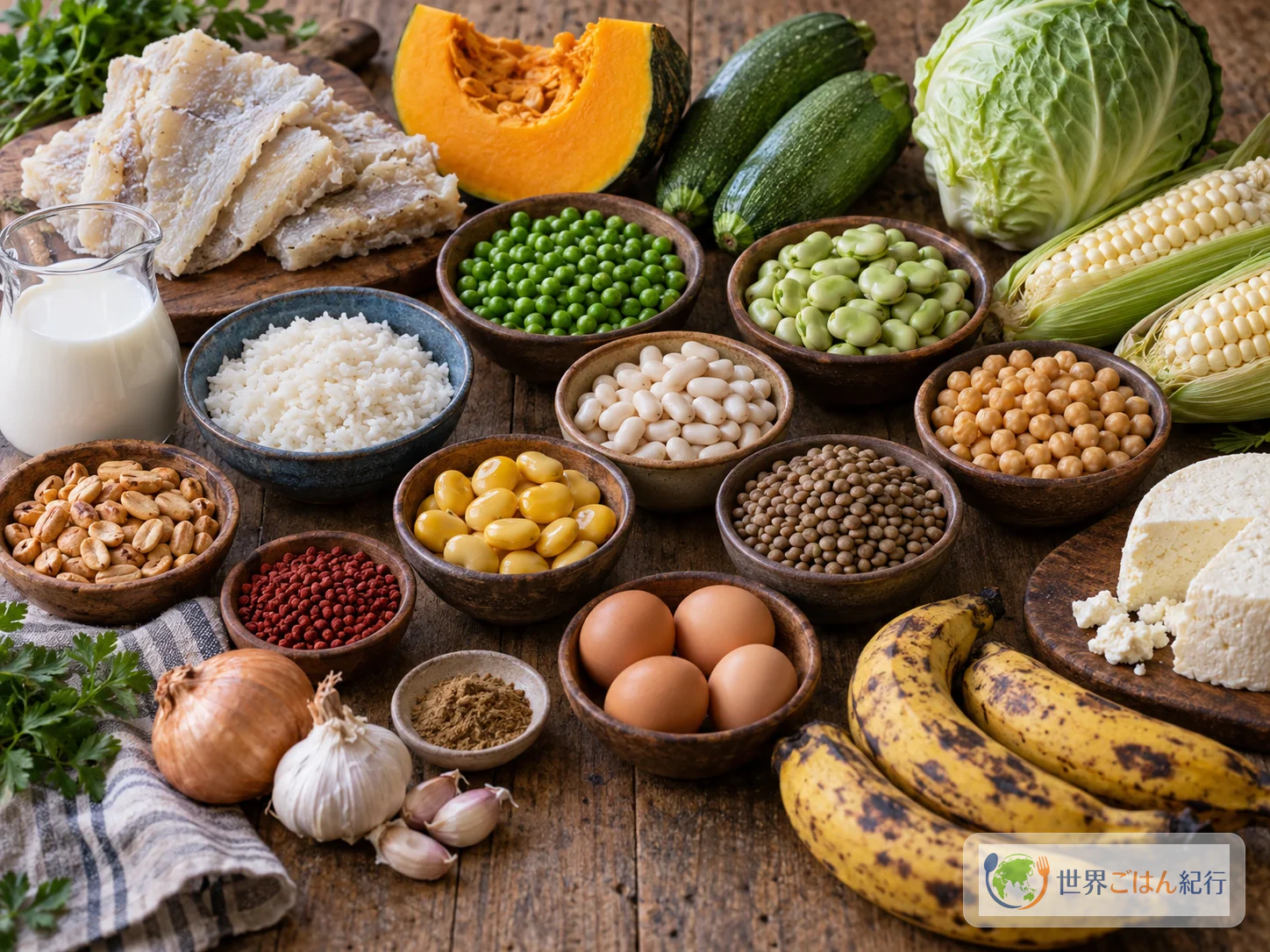
Before you shop, get the overall picture. The eight ingredients are corn, green peas, fava beans, white beans, chickpeas, lentils, chochos, and rice. Chochos are lupini beans; if you can find them already soaked, rinse and use them. If you cannot find them, use the same amount of white beans, though the texture will be a little different.
The other foundation is the squash and zucchini that build the thickness from squash. The sweetness and body of squash make the core of the soup. Using zucchini to make up for the lack of zambo is a workaround for recreating the dish in this article. Chochos can be substituted, so there is no need to hunt for them.
If you prep the salt cod, dried beans, and lentils separately the day before, on the day you only need to line up the eight boiled beans and grains in boxes or bowls. The ones worth looking for first are fava beans, lentils, annatto, and plantain, by their common names. Do not hunt for chochos and zambo; replace their roles of texture and sweetness with white beans and zucchini.
Desalt the salt cod in the refrigerator, changing the water, and do not leave it long at room temperature. Check each diner for allergies to fish, milk and cheese, peanuts, and legumes. Do not reuse the water or milk used for desalting, and cook everything thoroughly to the center after heating.
Assembling Regionally Variable Ingredients in Your Kitchen
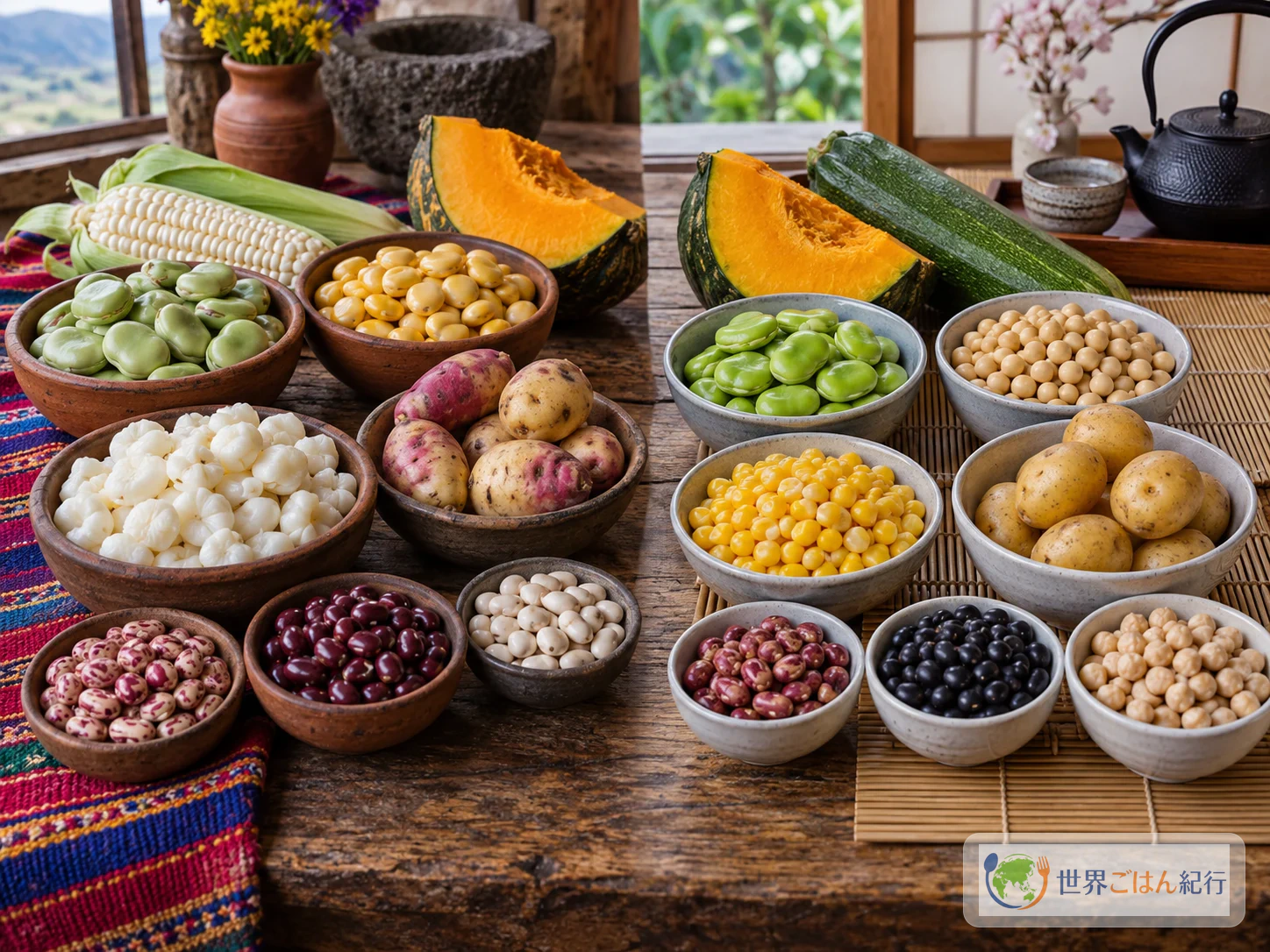
On the Andean side, fava beans, chochos, mellocos, corn, and squashes make the dish's outline. Coastal areas are also described as adding achogcha and green beans, so even under the same name fanesca, the ingredients do not match. Regional differences are differences in ingredients, not a ranking. Whether to use dried beans or fresh young beans, what fish goes in, and what accompanies it also change by household. The family recipe is the standard; you could say there are as many fanescas as there are home kitchens. Abroad, it is a dish that continues in the new place, changing into the beans available there.
When you build it in a home kitchen, picture first what to keep: the savoriness of salt cod, the sweetness of squash, the body of milk and peanuts, a sofrito with annatto, and several beans and grains. Keep these as the top priority. Beyond that, replace chochos with white beans, zambo with zucchini and extra squash, and mellocos with a little potato.
If you use white fish because you have no salt cod, the saltiness and savoriness will be weaker. Do not cook the fish first; add it at the end and adjust the salt separately. Paprika in place of annatto only helps with color and does not replace the flavor. Forcing turmeric in as a substitute turns it into a different dish, so avoid it.
If you search online, search by common names in this order: annatto (achiote), fava beans, lentils, plantain (cooking banana). For chochos and mellocos, do not swap in another product just to match the count; make up their roles with the substitutes in the ingredient table. Ordinary pots, knives, an immersion blender, and fresh vegetables are not things you need to buy specially.
The Holy Week dish has continued in new places with changing ingredients, method, and meaning. That change can be seen not as "departing from the original" but as an effort to fit available ingredients and family memory into one pot.
Serving: Add Acidity and Sweetness at the End
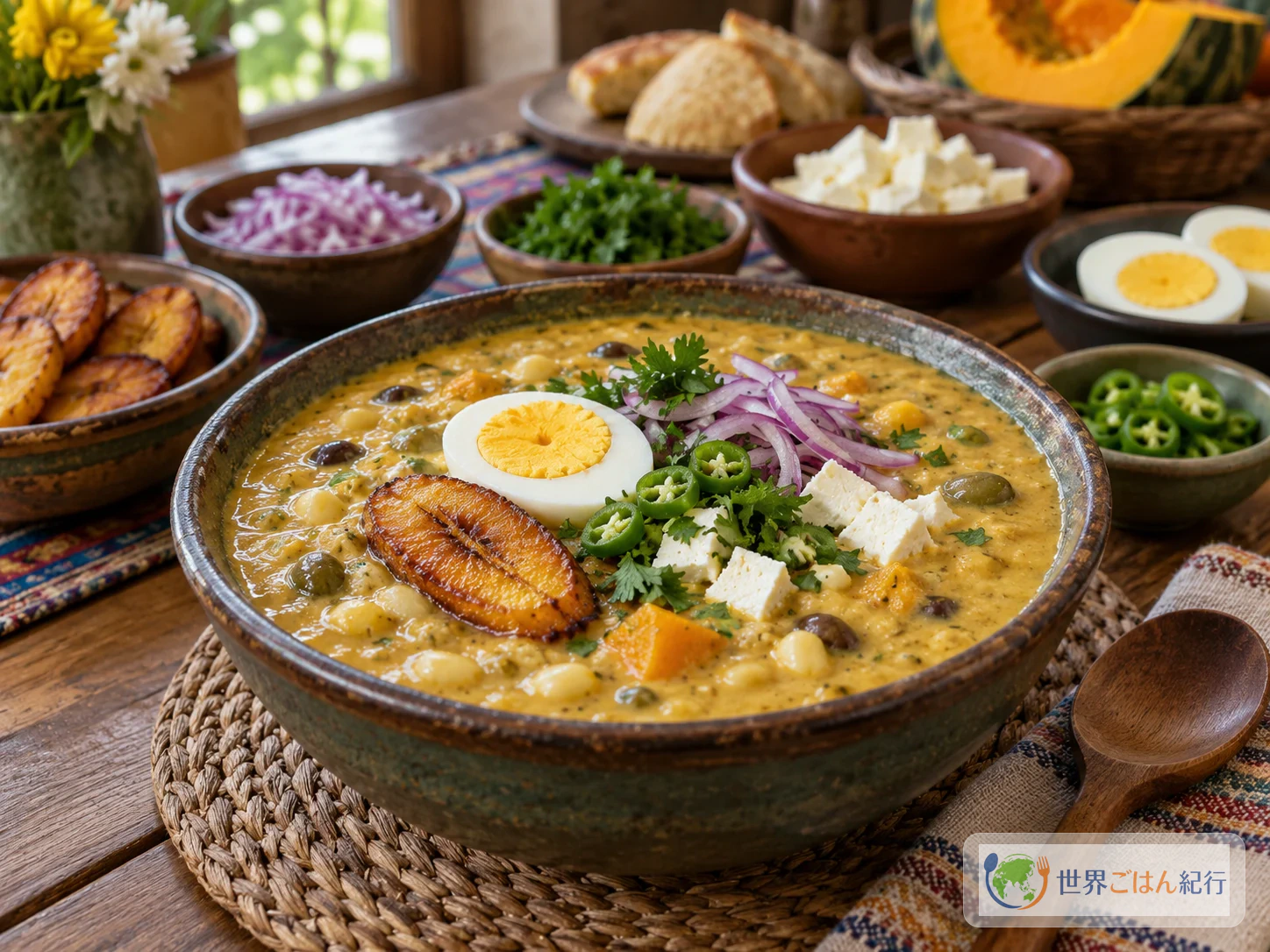
Garnish with hard-boiled egg, fried ripe plantain, cheese, parsley or cilantro, chile, and lime-cured onion. There is also a way to serve it with small fried wheat pastries or empanaditas, but in this 4-serving recipe they are an optional separate plate. Browned sweetness from the plantain, acidity on a separate plate from the red onion, cheese a little at a time. Keeping each separate makes even a rich soup easier to finish a whole bowl.
To serve, pour it into bowls while hot and put the egg and plantain on first. Then add the onion, chile, cheese, and herbs. If you let everyone add heat and saltiness themselves, you do not have to impose the pot's flavor on children or those who want less salt. For the first bowl, check the thickness without thinning it; for the second, you can add a little milk or unsalted cooking liquid to bring it to your taste.
Storage and Fixing Problems
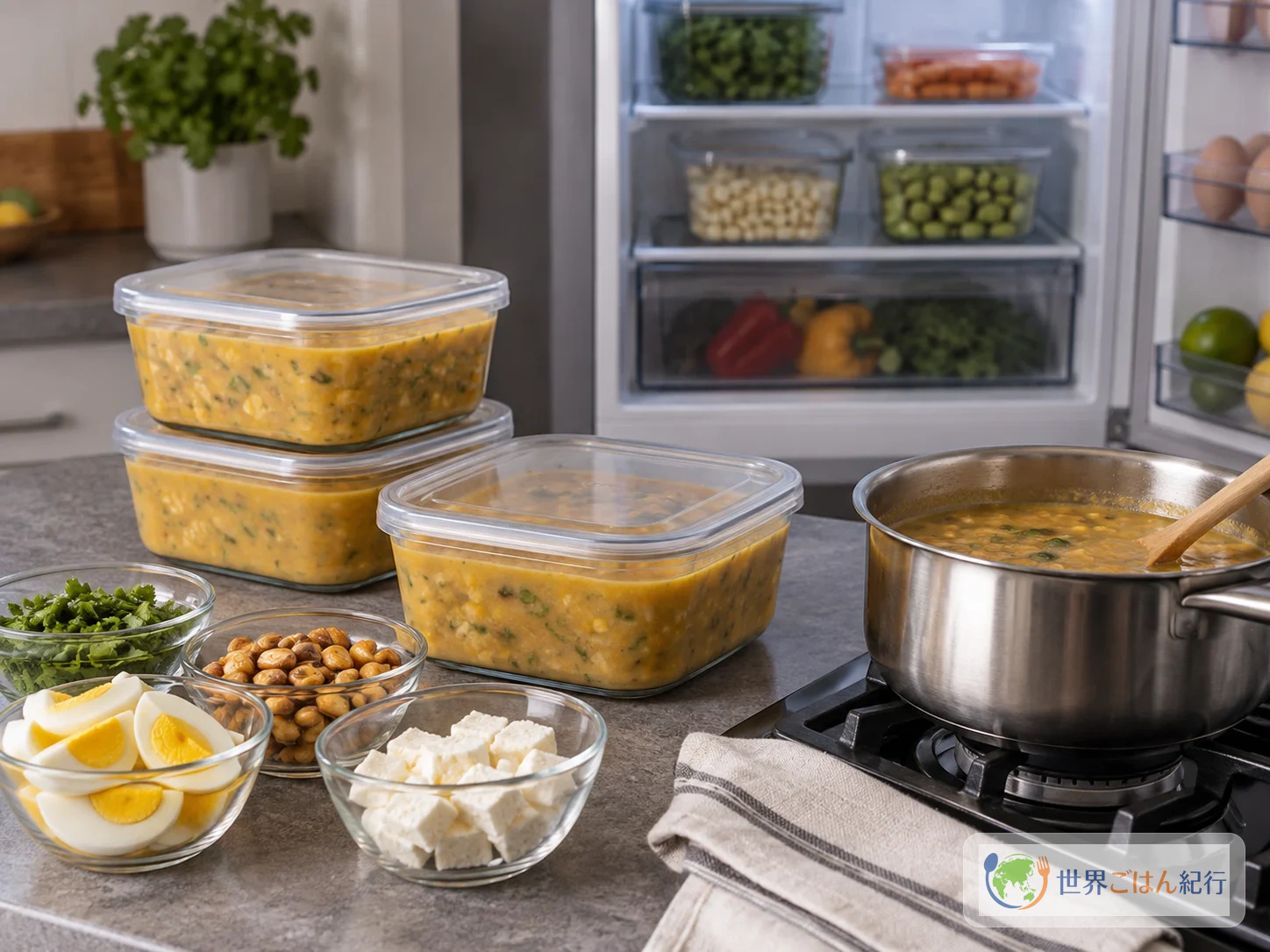
It is a rich soup made with fish and dairy, so take care when making it ahead. Cool it quickly, divide it into shallow portions, and refrigerate in airtight containers. Do not leave it long at room temperature. Finish it within about 2 days in the refrigerator, and reheat only what you will eat, heating it in a pot until hot at the center.
If you freeze it, store the garnishes separately. Knowing that the texture of the beans changes and the dairy tends to separate, the quality guide is about 2 weeks. If it separates on reheating, do not boil it hard; add a little milk and bring it back slowly with a whisk.
Do not leave the pot out at room temperature. Shorten the cooling time and use containers in the refrigerator that will not let liquid touch other foods. Do not eat it if it smells sour, is stringy, or the container is bulging. Storage days vary with the refrigerator temperature, the desalting, and the state of the ingredients. Do not treat the number of days as a guarantee of safety.
If it becomes too salty
If the saltiness of the salt cod and cheese stack up and it is too salty, thin it with small amounts of unsalted squash puree, milk, and bean cooking liquid. Thinning with water alone all at once breaks the squash and milk thickness. Hold off on extra cheese, salt, and salt-cured onion garnish, and taste again.
If it is watery or separated
If it is watery, remove the lid and simmer over low heat for 5–10 minutes, or add a little squash and rice puree. If the dairy and peanuts separate, stop the boiling, add a little milk, blend one serving until smooth, and return it to the pot. If the beans have fallen apart, do not add more beans; accept it as part of the soup and make up for texture with the other garnishes.
FAQ
Q1. Is fanesca made with twelve kinds of grain?
The number twelve is explained as a symbol of the apostles. Quito Turismo gives twelve ingredients, and Primicias gives a range of eight to twelve grains. The types vary by household and region, so this article chose eight ingredients. It prioritizes texture and roles over meeting the count.
Q2. Is 12 hours enough to desalt the salt cod?
Primicias has a procedure of 12 hours in milk and Laylita one of 24–48 hours in water, and it varies with the thickness and saltiness of the fish. This article takes as its base 24 hours, changing the water every 6–8 hours. Do not decide by time alone; cook a piece after desalting and taste it to see whether to desalt further.
Q3. I cannot get chochos or mellocos.
Chochos can be replaced by white beans, and mellocos by small-cut potatoes. Even with substitutes, keep the overall structure of salt cod, squash, milk and peanuts, and several beans and grains. It will not have the same taste or texture as the local ingredients, so it cannot be called a complete reproduction.
Q4. Can I make it without peanuts or milk?
Peanuts and milk are the center of the thickness and richness. To leave them out, increase the white beans and squash puree and extend with an unsalted fish stock. Replacing dairy with soy milk changes the aroma and the way it separates. People with peanut allergies should also avoid substitutes containing peanut butter. When there are dietary restrictions, put safety before closeness of flavor and check allergen labels.
Q5. The next day it was too thick.
That is because the rice, beans, and squash absorb liquid while refrigerated. Add 50 ml milk or unsalted cooking liquid at a time and warm over low heat. After reheating, check the salt and add cheese or salt-cured onion. Do not boil it hard; turn off the heat before the dairy separates.
Related Reading
- Locro de papas: Ecuador's potato and cheese soup (in Japanese): Learn the Andean soup of potatoes and dairy and compare it with fanesca's base of squash and milk
- Encebollado: Ecuador's fish soup (in Japanese): Move on to a coastal combination of fish and acidity, different from salt cod
- Llapingachos: Ecuador's cheese-stuffed potato cakes (in Japanese): Widen the Ecuadorian table starting from potato and cheese side dishes
Nutrition (per serving, one of four)
The values in this table are an estimate designed by the editorial team from the quantities for four servings including salt cod, beans and grains, milk, peanuts, cheese, and garnishes. They vary with the salt remaining after desalting, the moisture of the beans, the type of cheese, and the oil used to fry the plantain. Do not use them as evidence of health benefits or disease prevention; give priority to how much you eat and the ingredient labels.
| Nutrient | Amount |
|---|---|
| Energy | 540 kcal |
| Protein | 29 g |
| Fat | 22 g |
| Carbohydrates | 54 g |
| Fiber | 11 g |
| Salt equivalent | 3.7 g |
Wrap-Up
At the center of fanesca are the Holy Week table, the preparation shared among the family, and the beans and grains that change by region. What decides the result when you make it outside Ecuador is starting with the desalting, boiling the beans separately to keep their shape, building thickness with squash and rice, and not boiling the milk too hard. Making it with eight ingredients does not deny the tradition of twelve. The structure of the dish, bringing together whatever ingredients are available into one pot, can be kept. Including the egg, plantain, onion, and cheese, the garnishes are part of the one plate. Enjoy it as a dish that runs from the kitchen the day before to the top of the bowl.
Sources
- Quito Turismo, "La fanesca: tradición gastronómica en Ecuador": Andean harvest and Catholic calendar, the Holy Week table, symbolism of twelve ingredients, published 14 March 2025. Accessed and checked 2 October 2026. https://turismo.quito.gob.ec/la-fanesca-tradicion-gastronomica-en-ecuador/
- Primicias, "Fanesca ecuatoriana: receta para preparar en Viernes Santo": consulted for the range of ingredients, salt cod, separate boiling of beans, and a procedure for 10 servings. Updated 15 March 2024. Accessed and checked 2 October 2026. https://www.primicias.ec/noticias/entretenimiento/gastronomia/receta-fanesca-ecuador-viernes-santo-comida/
- Laylita's Recipes, "Fanesca ecuatoriana: Ecuadorian Easter soup": consulted for household differences, chochos, building the soup from squash, rice, peanuts, and milk, and salt cod desalting and cooking. Updated 5 March 2021. Accessed and checked 2 October 2026. https://www.laylita.com/recipes/fanesca/
- Universidad de Las Américas Ecuador, "UDLA narra la historia de la fanesca": consulted for uchucuta, harvest and equinox, colonial-era elements, and the multiple theories of origin. Published 16 March 2016. Accessed and checked 2 October 2026. https://sitios.udla.edu.ec/2016/03/udla-narra-la-historia-de-la-fanesca/
- Asociación de Chefs del Ecuador, "La fanesca, potaje nutritivo prehispánico": consulted for the link between uchucuta and fanesca, Andean and coastal regional differences, and garnishes. Published 13 April 2022. Accessed and checked 2 October 2026. https://chefs.ec/la-fanesca-potaje-nutritivo-prehispanico/
- Paula Orellana Uribe, "La fanesca aquí y allá. Etnografía migratoria de un plato ecuatoriano": consulted for Holy Week among Ecuadorian migrants in Guayaquil and Spain, regional differences, and transplantation of the dish. Accessed and checked 2 October 2026. https://revistaselectronicas.ujaen.es/index.php/rae/article/download/2622/2114/8535