




A Green Fragrance Hidden Under the White Yogurt
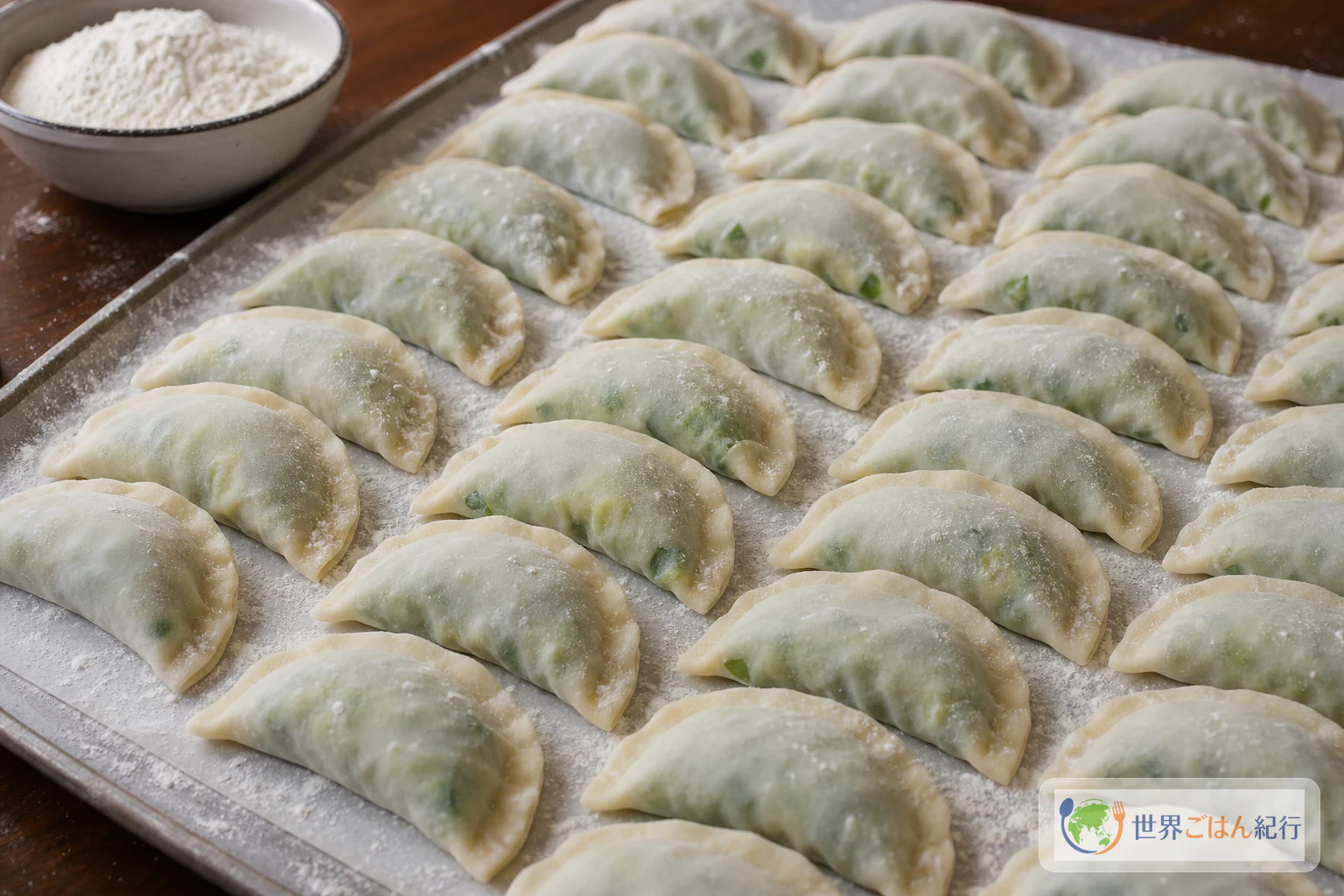
Ashak (also spelled Aushak) is a dish whose contents you can't guess from the plate. White garlic yogurt, red tomato-meat sauce, dried mint. Underneath are thin dumplings wrapped around leeks and an herb called gandana. Cut one open and what comes out is not meat but a green fragrance. That surprise is the best part of the dish.
When you think of Afghan dumplings, you probably think first of mantu, steamed and filled with meat. Ashak steps a little sideways from that: the filling is herbs, and the meat sauce goes on top. With no meat inside, the sourness of the yogurt, the savoriness of the tomato, and the sweetness of the leeks stack up in layers. Set beside a celebration rice like Kabuli palaw, it adds lightness to the table.
The hard part at home is not the gandana itself but the moisture. Leeks and scallions release water when chopped. If you don't wilt them with salt and drain them, liquid collects inside the wrapper and it bursts the moment it hits the water. This recipe uses the leeks, scallions, and garlic chives that are easiest to find, and the wrappers are scaled so that you can start with store-bought dumpling wrappers.
In English it appears as Ashak, Aushak, and Afghan leek dumplings. Transliterating from Dari and Pashto gives variants like "ashak," "oshak," and "aushak." This article mostly uses "ashak" because it is easy to search.
This recipe uses wheat, dairy, and beef. Store-bought dumpling wrappers contain wheat, and yogurt is dairy. If you make the meat sauce, cook the ground meat all the way through, until no red juices remain on the pan.
The Story of the Dish: A Feast Wrapped Together

Ashak takes effort. You chop the herbs, wrap them, make two sauces, and finally layer it all on the plate. It is not a quick dish. That is why at home it is described as a dish people wrap together when guests come or on days off. SBS Food's write-up on ashak also presents it as a beloved Afghan dumpling that family and friends make together.
Afghan Cooks introduces ashak as an Afghan dumpling wrapped around leeks. The same holds in any home kitchen. Gandana is a strongly scented vegetable close to a leafy scallion, used in Central Asia and around Afghanistan, and it is hard to find outside the region. Leeks are sometimes found in specialty grocers, but combining leeks or other onions, scallions, and garlic chives is more realistic.
What makes ashak interesting is its family relationship with dumplings across borders. Nepali momo wrap meat or vegetables and are steamed. Uzbek manti wrap meat fat and onion. Afghan mantu are also filled with meat. Ashak, by contrast, puts herbs inside and meat on top. They taste as if they were related, but the center of gravity is completely different.
| Dish | Main filling | Cooking | Topping |
|---|---|---|---|
| Ashak | Leeks, scallions, garlic chives | Usually boiled | Garlic yogurt, tomato-meat sauce, dried mint |
| Afghan mantu | Ground meat, onion | Steamed | Yogurt, tomato sauce, beans |
| Nepali momo | Meat or vegetables | Steamed | Tomato and sesame achar |
| Uzbek manti | Lamb, onion | Steamed | Sour cream, herbs |
To succeed with ashak at home, it is a shorter path to keep three things in mind than to copy the original form exactly: make the green filling light, don't let the yogurt turn watery, and make the red sauce a little thicker. When the wrapper is thin, the herbs are light, and the sauce on top has force, it looks like the ashak you see on restaurant menus.
Ingredients: Ashak from a Regular Grocery Store

For your first time, I recommend using store-bought dumpling wrappers. Hand-rolled wrappers smell good and stretch well, but with ashak, managing the moisture in the filling and sauces comes first. Learn the feel of wrapping, then move on to making your own wrappers, and you'll fail less.
Replacing gandana with long green onion alone leans toward a sweet, heavy aroma. Adding scallions lightens it, and mixing in a little garlic chives brings a wild note. For the first time, mix "leek or long green onion, scallions, and garlic chives" and don't overdo the chives.
What is worth buying
Ashak isn't a dish that requires a pile of imported ingredients. It helps to choose things you can also use in other dishes, such as a steamer, cumin, and yogurt. They lead to momo and raita next.
Method: Light Herb Filling, Rich Sauce
Because ashak requires the dumplings, white sauce, and red sauce at the same time, it helps to decide the order first. Draw the water from the herb filling first, wrap while the meat sauce simmers, and finally boil and plate.
Getting Close to the Real Thing in a Home Kitchen
Ashak changes with the herbs you can get. Rather than forcing one right answer, it works better to decide the direction of the aroma and then choose ingredients.
| Direction | Herb combination | Character |
|---|---|---|
| For a first try | 1 long green onion, 1 bunch scallions, 1/2 bunch garlic chives | Easy to find in a supermarket, not too strong in aroma |
| Closer to the original | 1 leek, 1 bunch scallions, a little garlic chives | Good balance of sweetness and green fragrance |
| Light finish | 2 bunches scallions, a little garlic chives | Light inside the wrapper, good with yogurt |
| Stronger aroma | 1 bunch garlic chives, 1 bunch scallions | Closer to gandana, but too much makes it taste like a gyoza-style dumpling |
Large dumpling wrappers are easiest to handle. Wonton wrappers are thin and pleasant to bite, but because they are square, the corners are left over when making half-moons. Cut them round or fold them into triangles. For handmade wrappers, knead 200 g all-purpose flour, 100 g bread flour, 1/2 tsp salt, and 150 ml water, rest for 30 minutes, and roll thin. Handmade wrappers stretch, but if they're thick they get heavy, so aim for thin enough to be slightly translucent on the far side.
The meat sauce can be made with ground beef alone. Adding lentils brings the savoriness of beans common in Afghan cooking and leaves it satisfying even with a little less meat. For a vegetarian version, leave out the meat and simmer with 120 g lentils and 350 ml water for 20–25 minutes. On meatless days, increase the cumin to 1 tsp and the tomato paste to 3 tbsp so the flavor doesn't turn thin.
Choose an unsweetened yogurt that isn't too sour. At Afghan tables a thick, tart dairy product close to qurut or chaka is sometimes used. At home, lightly draining plain yogurt is enough. Draining too much makes a heavy dip, so for ashak stop at "thick enough to spread thinly on the plate."
Troubleshooting: Torn Wrappers, Watery Plates, Muddy Flavor
When wrappers tear, the cause is the filling's moisture or the way you boil. Mix the leeks and scallions with salt, leave them for 10 minutes, and drain them until no drops fall when you squeeze. Don't boil the water hard; keep a gentle bubble over medium-low heat. If it boils so hard the dumplings dance in the pot, the edges open.
When the plate turns watery, the yogurt and the meat sauce are too loose. Drain the yogurt for just 10 minutes, and cook the meat sauce down until a line drawn along the bottom with a wooden spatula holds for a moment. Ashak is a saucy dish, but not to the point that the dumplings swim. Think of the white sauce as the base and the red as dots on top, and it comes together neatly.
When the flavor is muddy, re-check where the salt and the acidity are. If you only salt the filling to draw out water, the flavor washes out while boiling. Salt the boiling water and the yogurt too. You can squeeze lemon on top at the end, but getting the saltiness of the yogurt right first is what gives it the ashak flavor.
If wrapping takes a long time, don't move the filling and wrappers in and out of the refrigerator. Wrappers that dry out while cold crack easily. Take out 15 at a time on the counter and put the rest back in the bag. Just this small habit lets you wrap cleanly through the last few.
Storage and Reheating
The best way is to freeze them wrapped. Line a tray with parchment, arrange the ashak so they don't touch, and freeze. Once hard, move them to a storage bag and use them within 2–3 weeks. To cook, put them in the water still frozen and allow 2 minutes longer than usual, 7–8 minutes in all.
Boiled ashak keeps until the next day in the refrigerator. If you leave them dressed with yogurt and sauce the wrappers absorb moisture, so store the dumplings, yogurt, and meat sauce separately. To reheat, arrange the dumplings on a heatproof plate, sprinkle with 2 tsp water, cover loosely with plastic wrap, and microwave at 600 W for 1 minute 30 seconds. Warm the meat sauce in a small pot over low heat for 3–4 minutes until it bubbles.
Leftover meat sauce goes well with rice or bread the next day. A small amount beside Kabuli palaw pairs nicely: the sweet carrots of the rice dish and the acidity of the tomato. Stir cucumber into the yogurt sauce and it becomes a small side close to Indian raita (in Japanese).
More to Cook Alongside
- Sindhi biryani - uses ingredients and aromas from the same region.
FAQ
Q1. Can I make ashak with dumpling wrappers?
Yes. Large dumpling wrappers work fine. Thick wrappers need longer boiling and lose the lightness of the herbs, so choose thin ones if you can. If you use wonton wrappers, they tear easily, so reduce the filling to a scant teaspoon.
Q2. What should I use if I can't find leeks?
Combine long green onion, scallions, and garlic chives. Long green onion alone gives a sweet, heavy aroma, and garlic chives alone lean toward Japanese gyoza. 1 long green onion, 1 bunch scallions, and 1/2 bunch garlic chives is the starting guide.
Q3. Can I make it without meat?
Yes. If you leave out the meat, simmer 120 g brown lentils, 3 tbsp tomato paste, and 350 ml water for 20–25 minutes. Make the cumin and coriander a bit stronger and adjust the salt at the end, and it is less likely to feel lacking.
Q4. Which is more authentic, steaming or boiling?
Most ashak recipes boil, while mantu, filled with meat, is usually described as steamed. There is variation by household and region, though. With thin store-bought wrappers, boiling gives a lighter texture.
Q5. What goes well with it?
Salad, bread, and a light soup suit it better than heavy rice dishes. If you want a big platter as the center, Afghan Kabuli palaw makes it feel like a celebration table. On a day when you'd like to compare dumplings, Nepali momo and Uzbek manti are fun pairings too.


