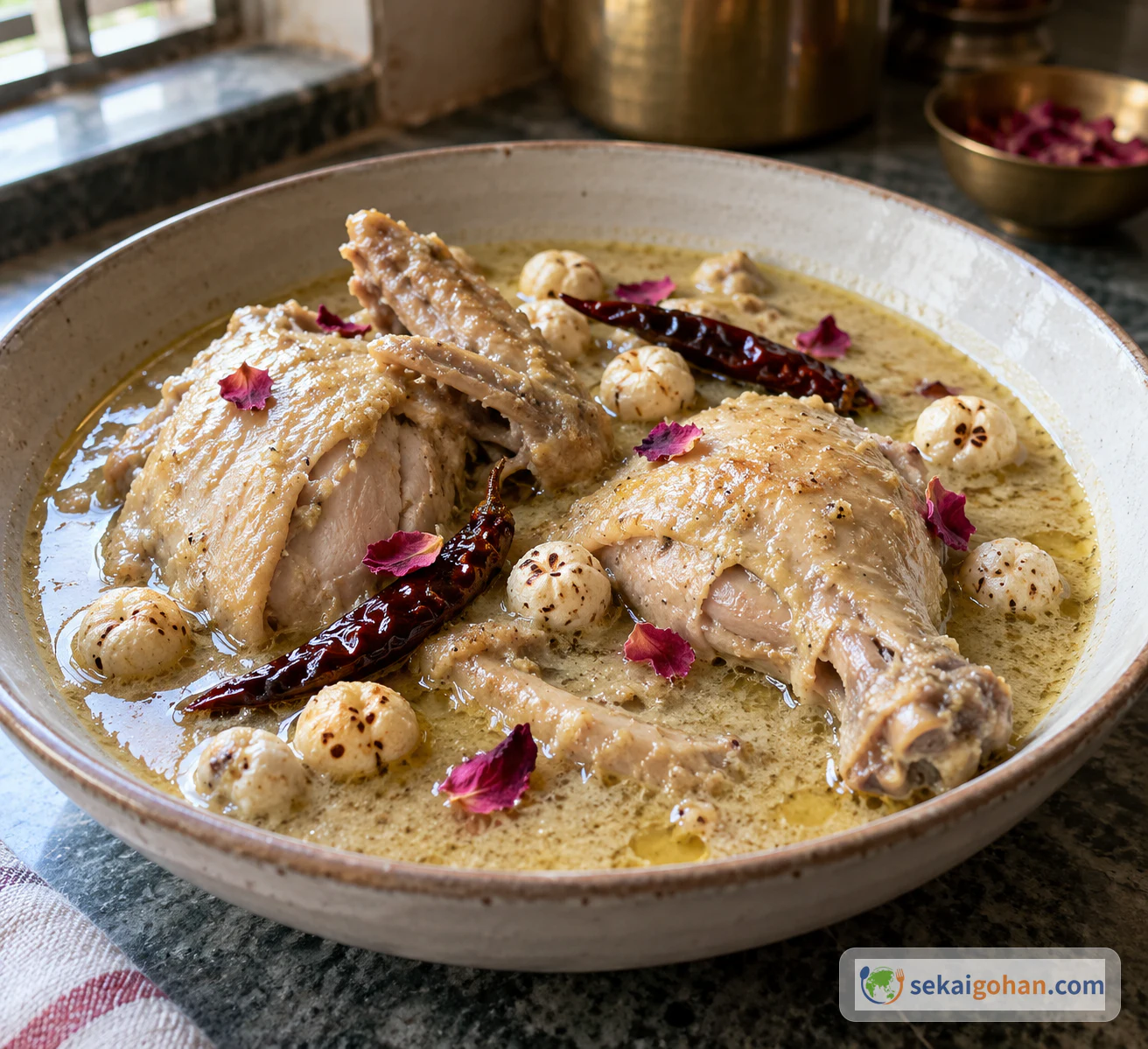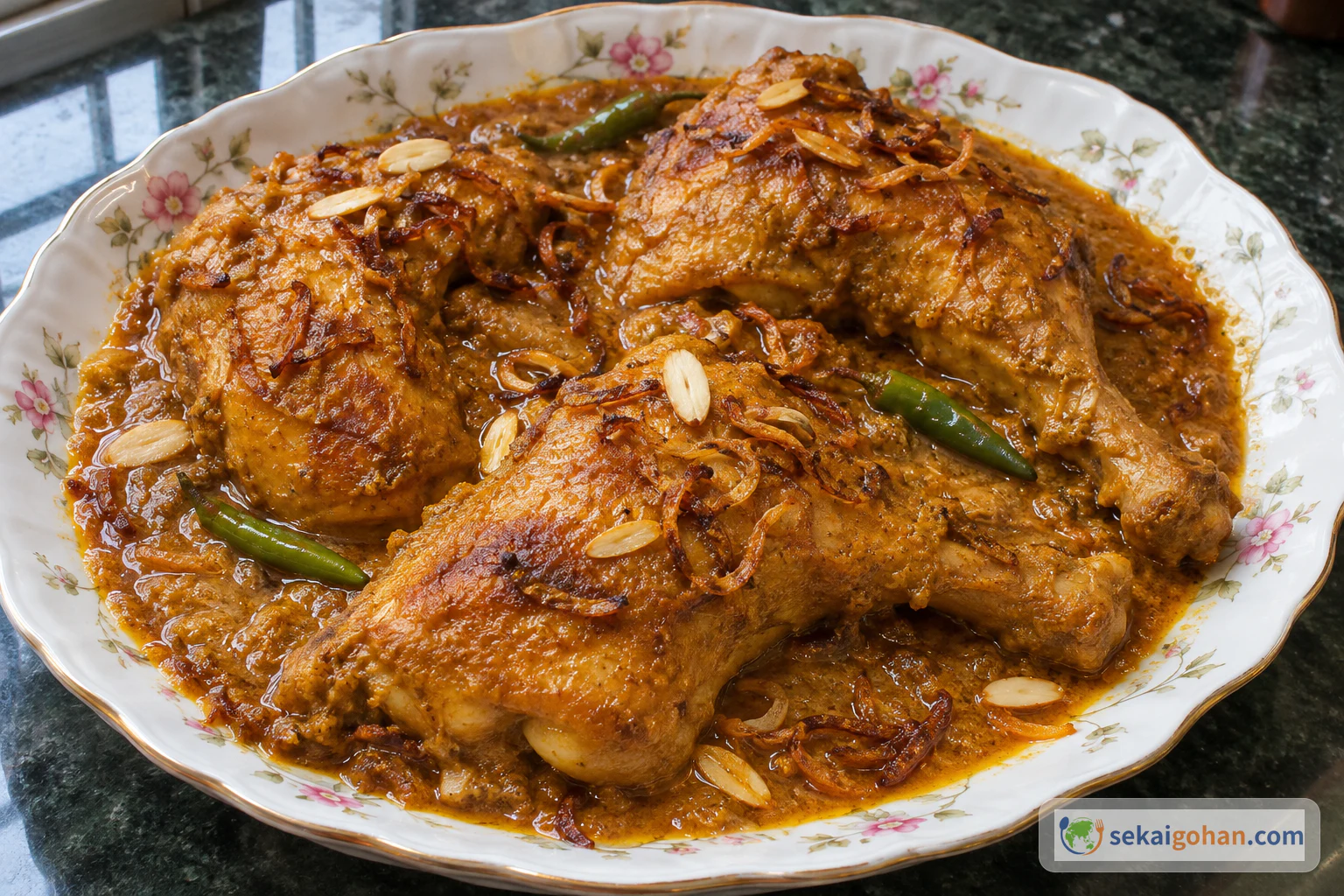
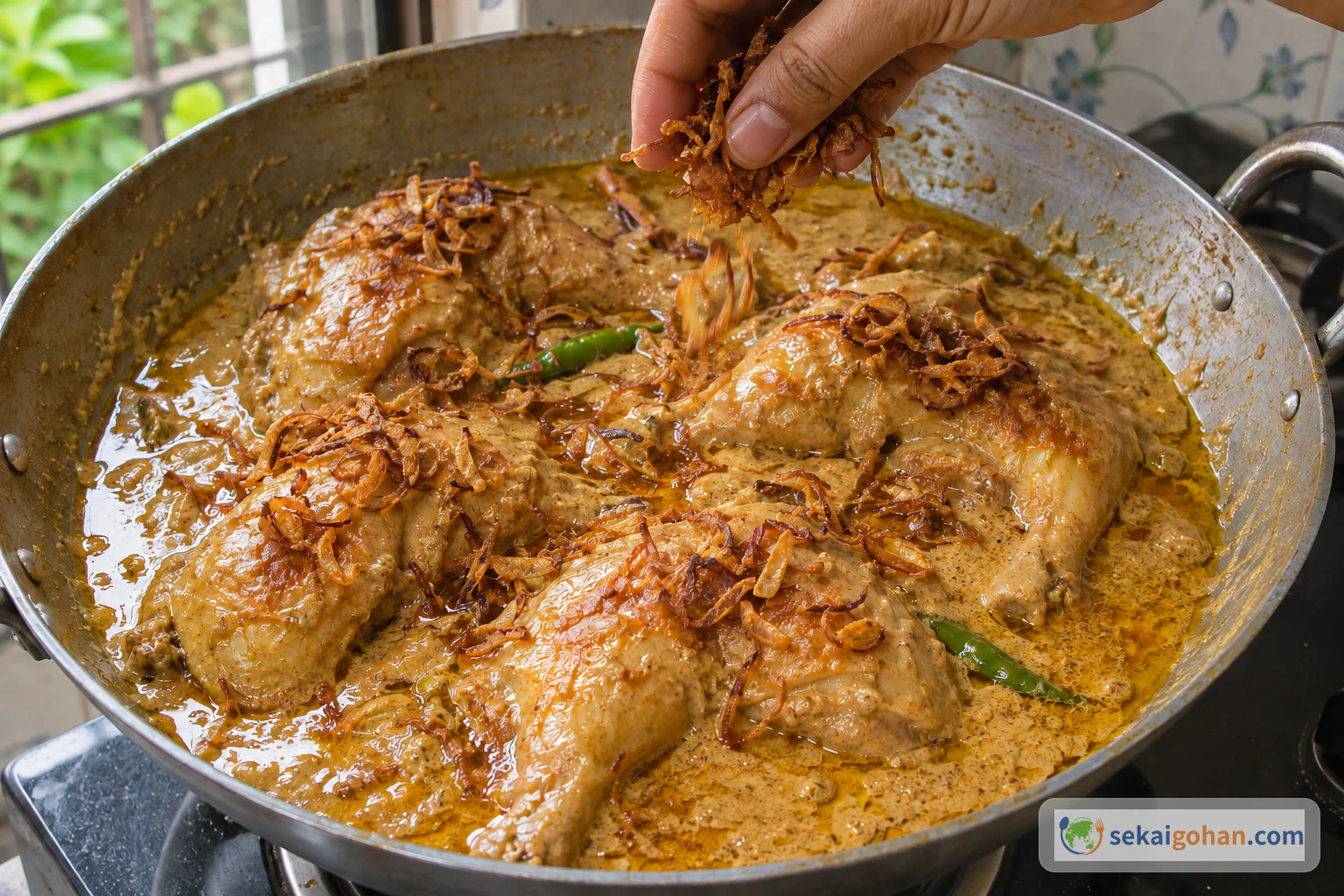
Near the end, the pale gravy starts to slide apart from its ghee, a golden ring of fat loosens at the edge of the pan, and a second handful of crisp fried onions goes in on top of the chicken. Just before that, rose water or kewra has gone in with green chilies, sugar and lemon, and the steam smells of cardamom, mace and flowers all at once. This is roust, the chicken roast of Bangladeshi weddings: bone-in leg quarters browned in ghee, then cooked in a gravy of yogurt, ground spices and fried onions. It tastes rich and mellow, gently sweet and sour, warm with spice rather than hot, and it is served with fragrant polao when a family is feeding a crowd.
A Roast That Never Goes Near the Oven
The name is the first surprise. Roust is written রোস্ট in Bengali and sounds like the English word "roast," yet the whole dish cooks on the stovetop. The chicken is browned and then cooked down in its sauce in the bhuna style, the same patient frying-and-reducing method that gives Bangladesh dishes like kala bhuna and ilish bhuna their depth. At home it is made in a wide pan; for wedding crowds, cooks work in huge batches over built clay-and-brick fires.
Its full name, biye barir murgir roast, means "wedding-house chicken roast," and that is where it belongs. Roust appears at nearly every Bangladeshi wedding. One tradition gives the bride and groom a whole bird to share, while guests get portions on their plates. The same dish returns for Eid, for birthdays, and for Milad Mehfil gatherings, wherever a household wants the table to say "celebration."
Mughal roots and a disputed birthplace
The dish is thought to descend from murgh musallam, the whole stuffed chicken of the Mughal kitchens, though that link is a possibility rather than a certainty. Roust echoes it in its ghee, its yogurt and its sweet, floral spice. One story places its birth in the Nawab kitchens of Old Dhaka; where it began is not settled. What is clear is that it blends Mughal court cooking with Bengali taste.
It is made in two shapes: a whole bird, closest to its musallam ancestor, or in pieces. The spice blends differ too. This version uses a vinegar marinade and a yogurt gravy thickened with ground white poppy seed; richer Eid versions build the sauce on cashew and poppy paste with mawa, cream and prunes.
Roust, Murgir Roast and Biye Barir Roast all point to the same dish. "Murgi" is chicken and "biye bari" is the wedding house. Search under all three when shopping for recipes or spices, and you can find more dishes from the country on our Bangladesh page.
Ingredients (serves 6)
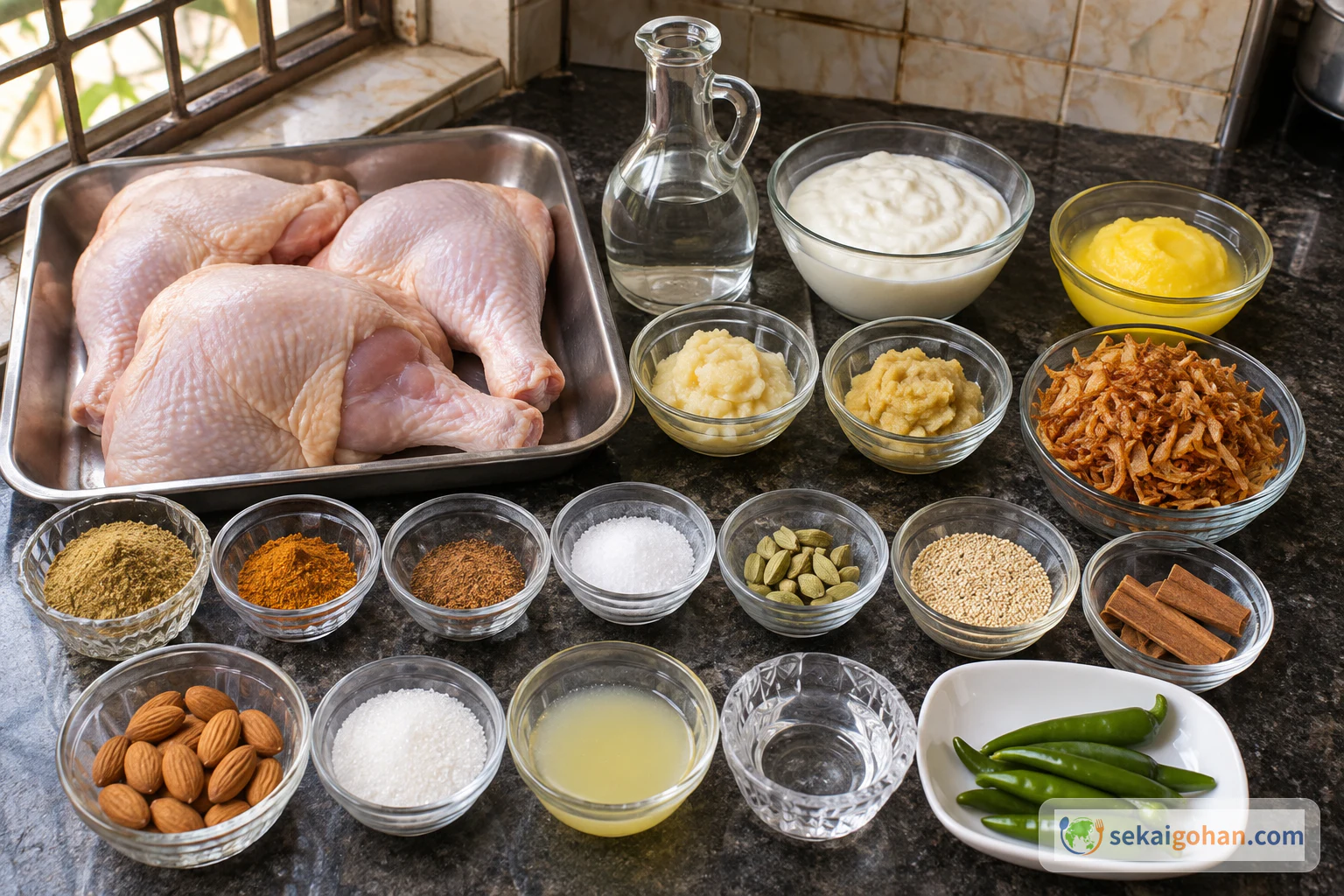
Measure the paste into four small bowls before you start. The teaspoon portions season the meat in the marinade and are thrown away with it; the tablespoon portions go into the yogurt and carry the gravy. Mixing them up leaves the sauce thin on garlic and ginger.
Roust contains milk (ghee, butter and yogurt) and tree nuts (almond garnish). Using oil instead of ghee or butter removes milk only from the fat; the yogurt still contains it. Leave the almonds off for anyone with a nut allergy.
Equipment
- Large bowl for marinating, with a cover
- Wide, heavy pan with a lid
- Spice grinder
- Small bowl for the yogurt mixture
- Plate for the browned chicken
- Instant-read thermometer
- Separate cutting board and utensils for raw chicken
Choosing and Substituting
The flavor of roust rests on ghee, fried onions, yogurt, and the sweet warmth of cardamom, mace and nutmeg finished with a floral water. Keep those, and the dish tastes the way it does at a Bangladeshi wedding.
| Ingredient | Where to look | What a swap changes |
|---|---|---|
| Beresta | South Asian grocers sell it fresh-fried; supermarkets carry packaged crispy fried onions | Packaged onions work, but their oil and sweetness differ from onions fried at home |
| Kewra water | South Asian grocers | Rose water is easier to find and works well; the perfume is different, more rose and less of kewra's green, pandan-like scent |
| White poppy seeds | South Asian grocers or spice shops | They are hard to find in some countries; leaving them out changes the flavor and body of the gravy |
| Ghee | Supermarkets and South Asian grocers | Butter or neutral oil both work; ghee gives the deepest, nuttiest aroma |
| Vinegar | Any supermarket | Rice vinegar or grain vinegar both suit the marinade |
Buy cardamom pods and cinnamon whole and grind them yourself. Coriander, mace and nutmeg go in already ground, so a jar of each is fine. Choose leg quarters with the thigh and drumstick still attached; their size is what makes the portion one piece per guest.
Method
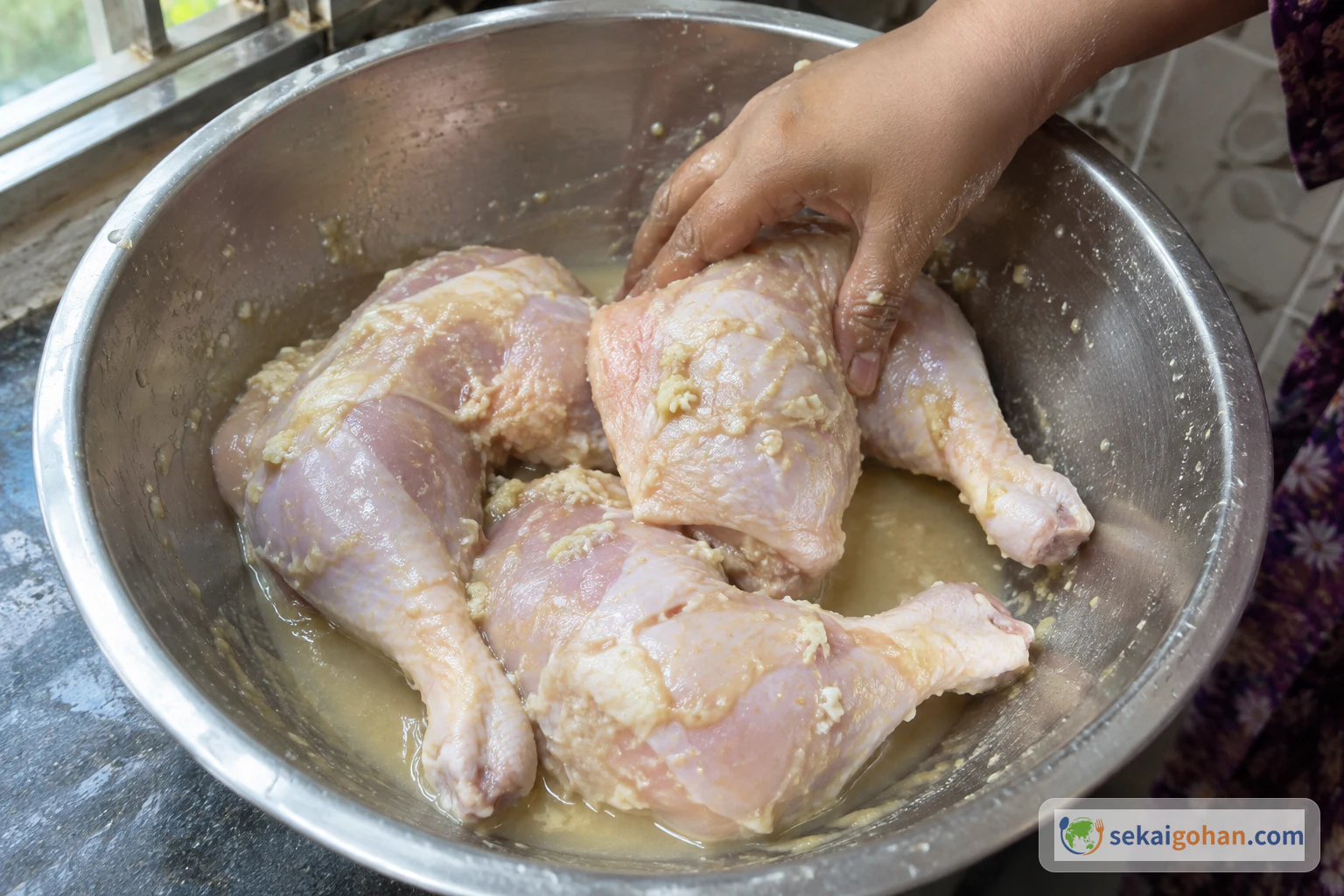
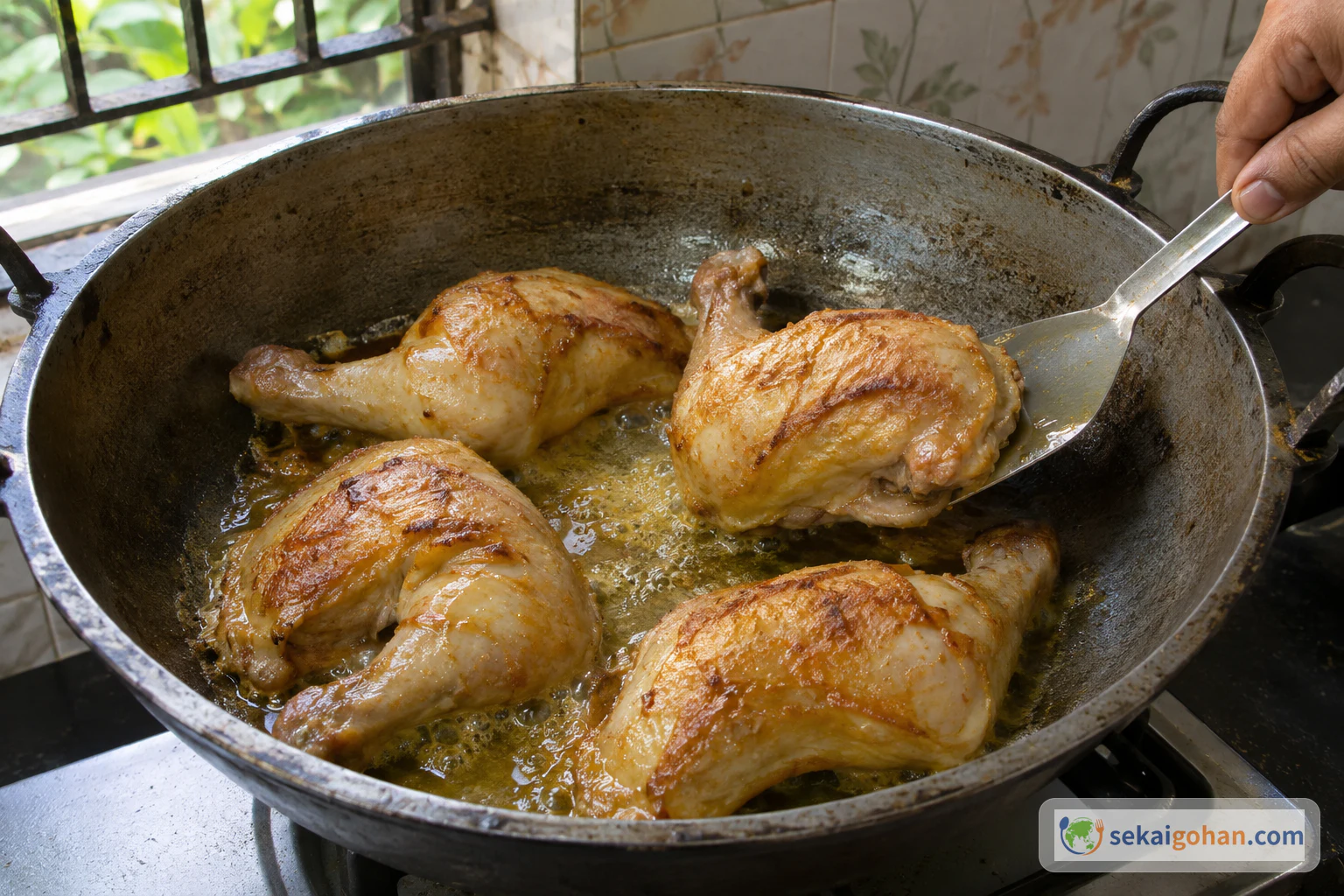
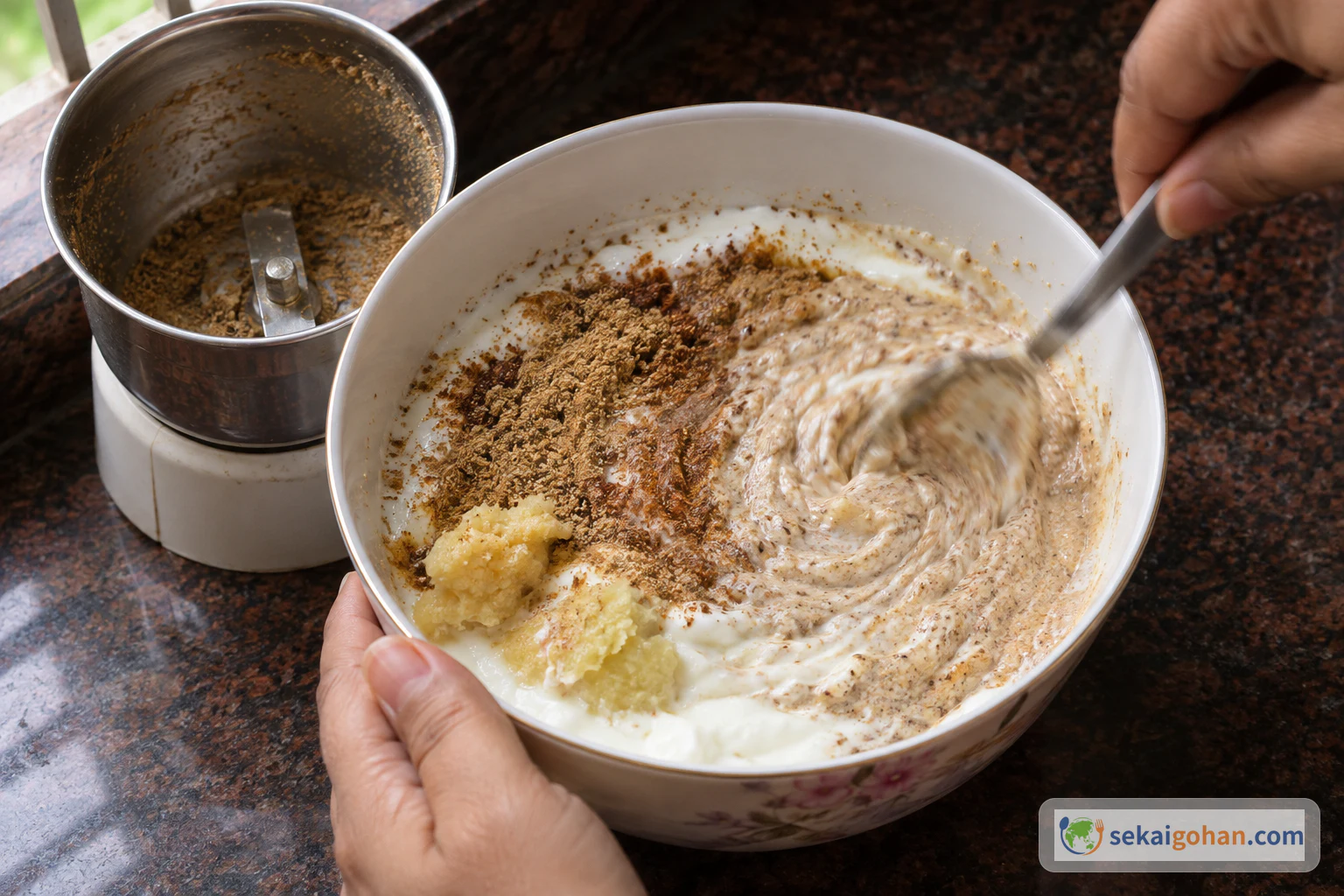
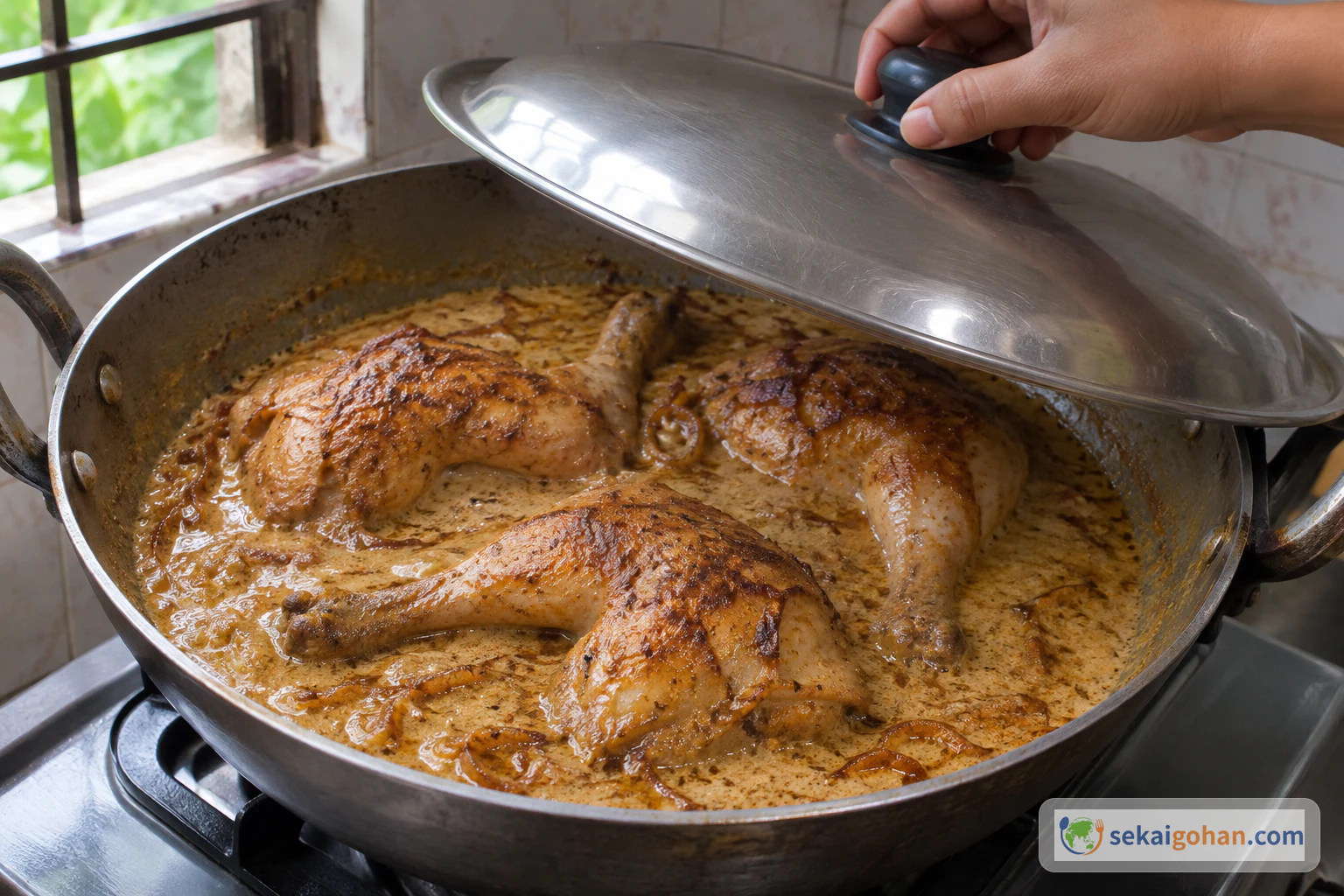
Start the marinade first; it needs at least 30 minutes in the refrigerator, and that is the time to grind the spices and mix the yogurt. The cooking itself runs in one pan: brown the chicken, build the gravy in the same pan, then let the chicken cook covered until tender. The only hands-off stretch is that covered simmer and the final rest over very low heat.
Bring the chicken to 167°F (75°C) for at least 1 minute at the thickest part next to the bone; 158°F (70°C) for 3 minutes, 154.4°F (68°C) for 5 minutes or 149°F (65°C) for 15 minutes reach the same result. Discard the vinegar marinade, because it has touched raw meat. Keep raw-chicken boards, bowls and hands away from finishing spoons and serving dishes. A cup of hot ghee spits when wet chicken meets it: pat the pieces dry and lower them in away from you.
When It Goes Wrong
| What you see | Why | What to do |
|---|---|---|
| Chicken is pale and sitting in liquid during browning | The pan was crowded, so the meat steamed | Take half the pieces out, let the ghee bubble again, and brown in two batches |
| Thigh feels firm at the bone, or the thermometer reads below 167°F (75°C) | The covered simmer has not finished | Cover and keep cooking gently, then test again next to the bone |
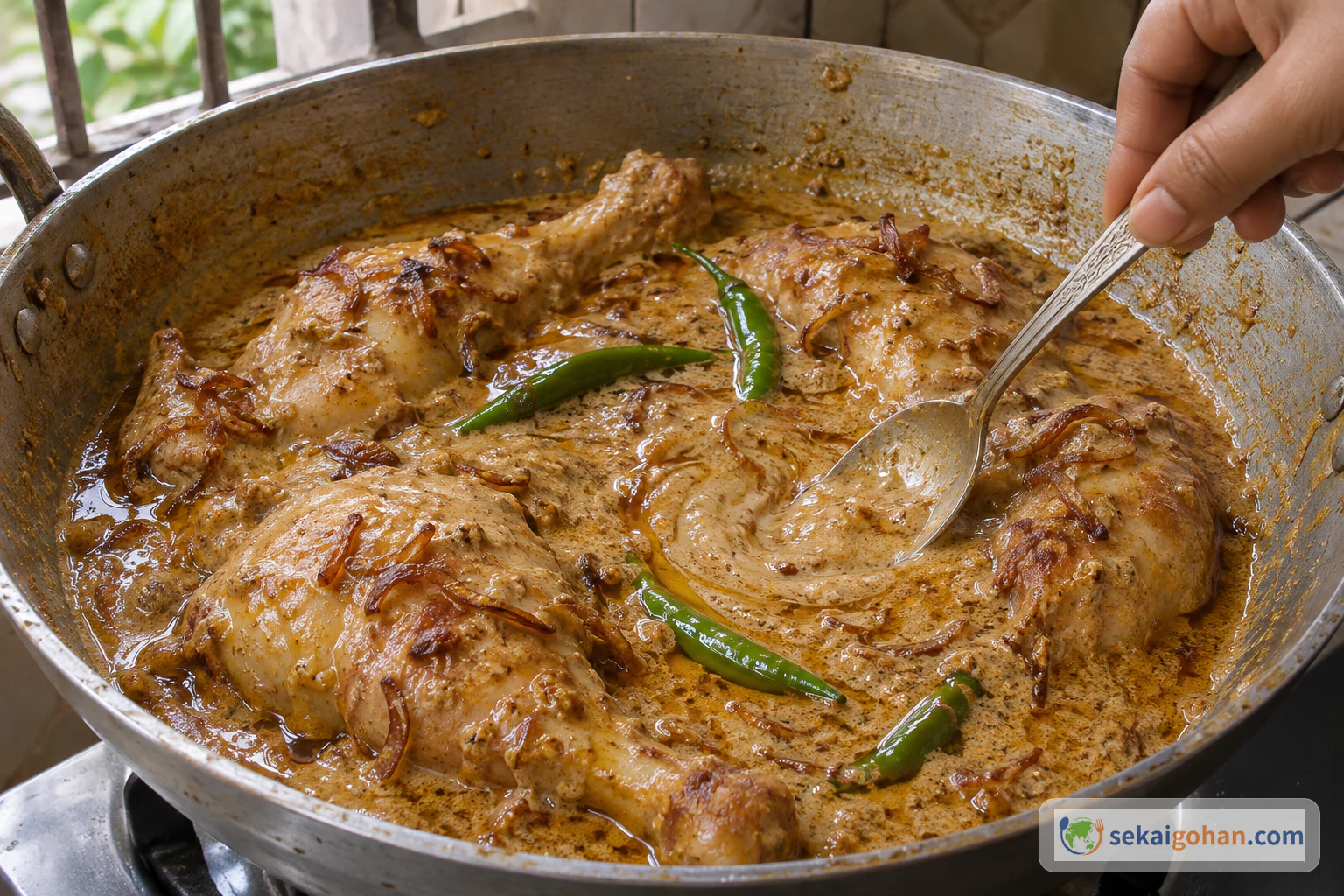
| Gravy never separates from the ghee | It has not cooked down long enough | Keep cooking gently, covered, until a golden line of fat appears at the edges |
| Flavor tastes flat after the finishing step | Not enough salt to lift the sugar and lemon | Add salt a pinch at a time, stirring gently between tastes |
| Fried onions turn soggy before serving | Both halves went in early | Keep the second half for the very end, after the ghee separates |
Serving and Variations
At the table
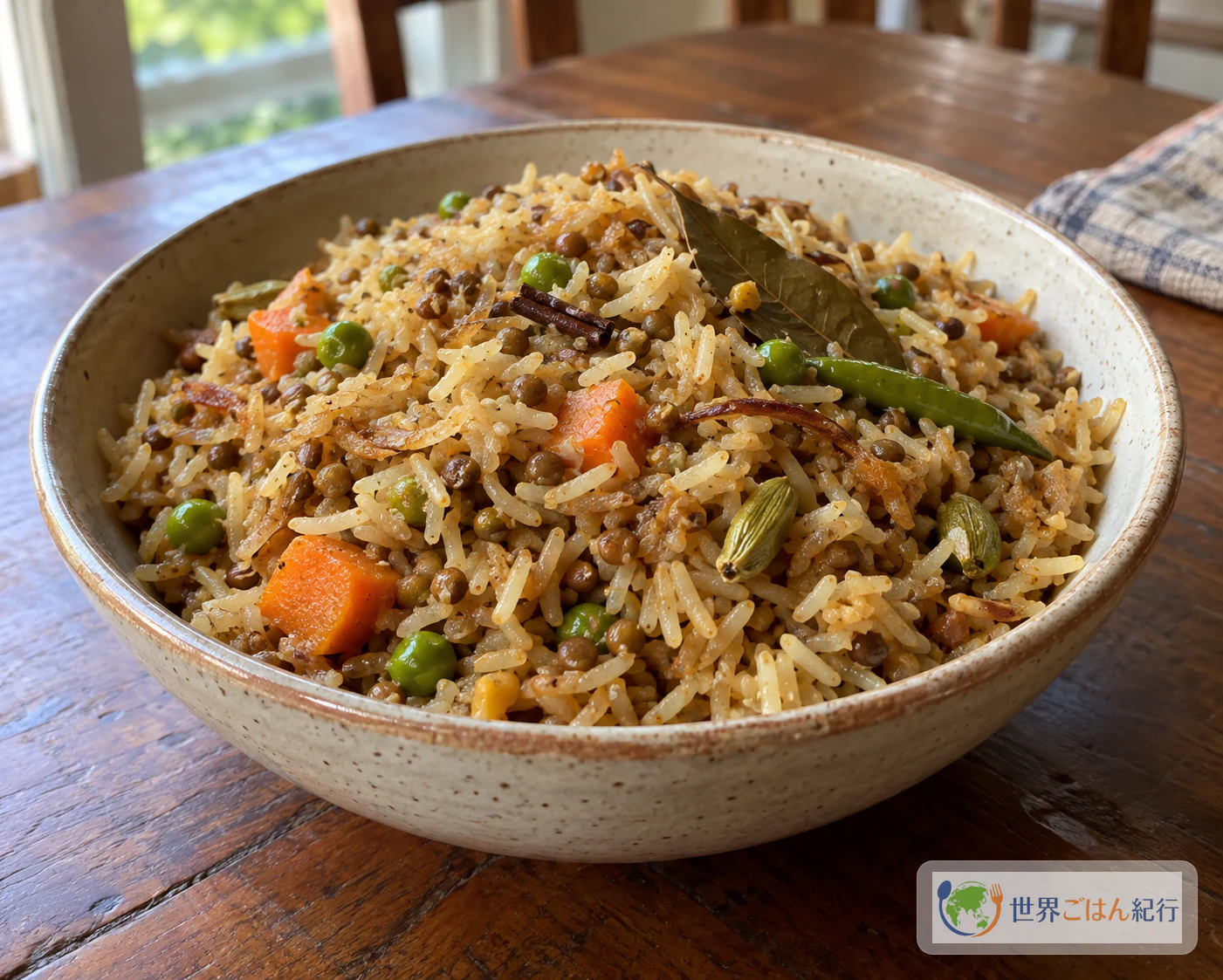
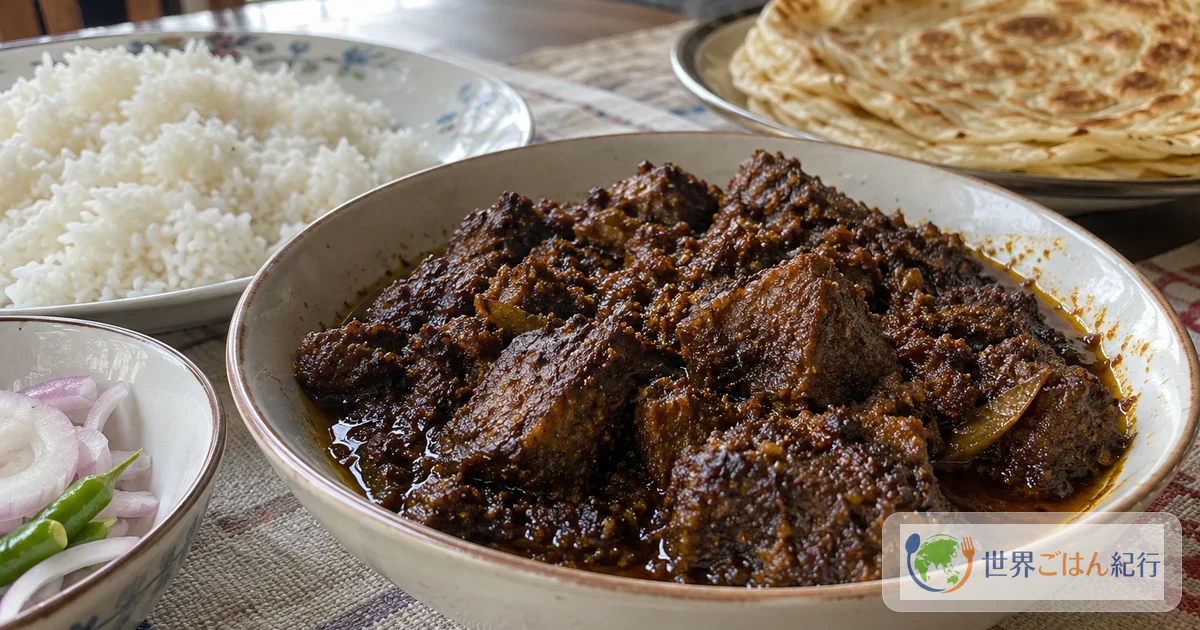
Roust is a dish for a full table. Fragrant polao is its classic partner, and morog polao in particular is the classic dawat, or feast, dish to set beside it. On smaller days it goes just as well with paratha or naan for scooping up gravy. Serve one leg quarter per person, with the almonds and the crisp final onions on top and the loosened ghee spooned over.
Variations
- Whole bird: Cooking a whole chicken instead of pieces brings the dish back toward murgh musallam and gives the wedding tradition of a shared bird. The amounts and cooking steps in this recipe are written for leg quarters, so check the thickest part of the thigh with the thermometer before serving.
- Richer festival gravy: Some Eid versions build the sauce on cashew and poppy paste with mawa, cream and prunes. The result is heavier and sweeter; cook it as its own recipe rather than adding those ingredients here.
- Milder heat: Slit the green chilies and remove the seeds before they go in. The gravy keeps the chili aroma with less bite.
- Store-bought beresta: Using packaged fried onions for both additions saves frying onions at home. The gravy tastes a little less sweet and more of frying oil.
Frequently asked questions
Two cups of ghee seems like a lot. Why so much?
The first cup browns the chicken, and the rest becomes the body of the gravy and the cue that tells you the dish is done. That separating fat is part of how roust is served, spooned over each piece. It also gives you something valuable to keep for the rice.
What can I do with the ghee left in the pan?
One Bangladeshi festival recipe uses the fat from the roast to cook the polao served with it. Spoon it off the top before serving and use it in place of plain ghee when you start the rice. The rice picks up the cardamom, fried-onion and rose aroma of the chicken.
Can I make roust with butter or oil instead of ghee?
Yes, butter or oil both work for browning and for the gravy. Ghee gives the deepest flavor and is what makes the dish taste festive. Oil makes the fat lighter in taste, and the yogurt still carries the richness.
Does the nutmeg go into the grinder with the whole spices?
Use it already ground and add it to the powder with the coriander and mace. Only the cardamom pods, poppy seeds and cinnamon sticks need grinding.