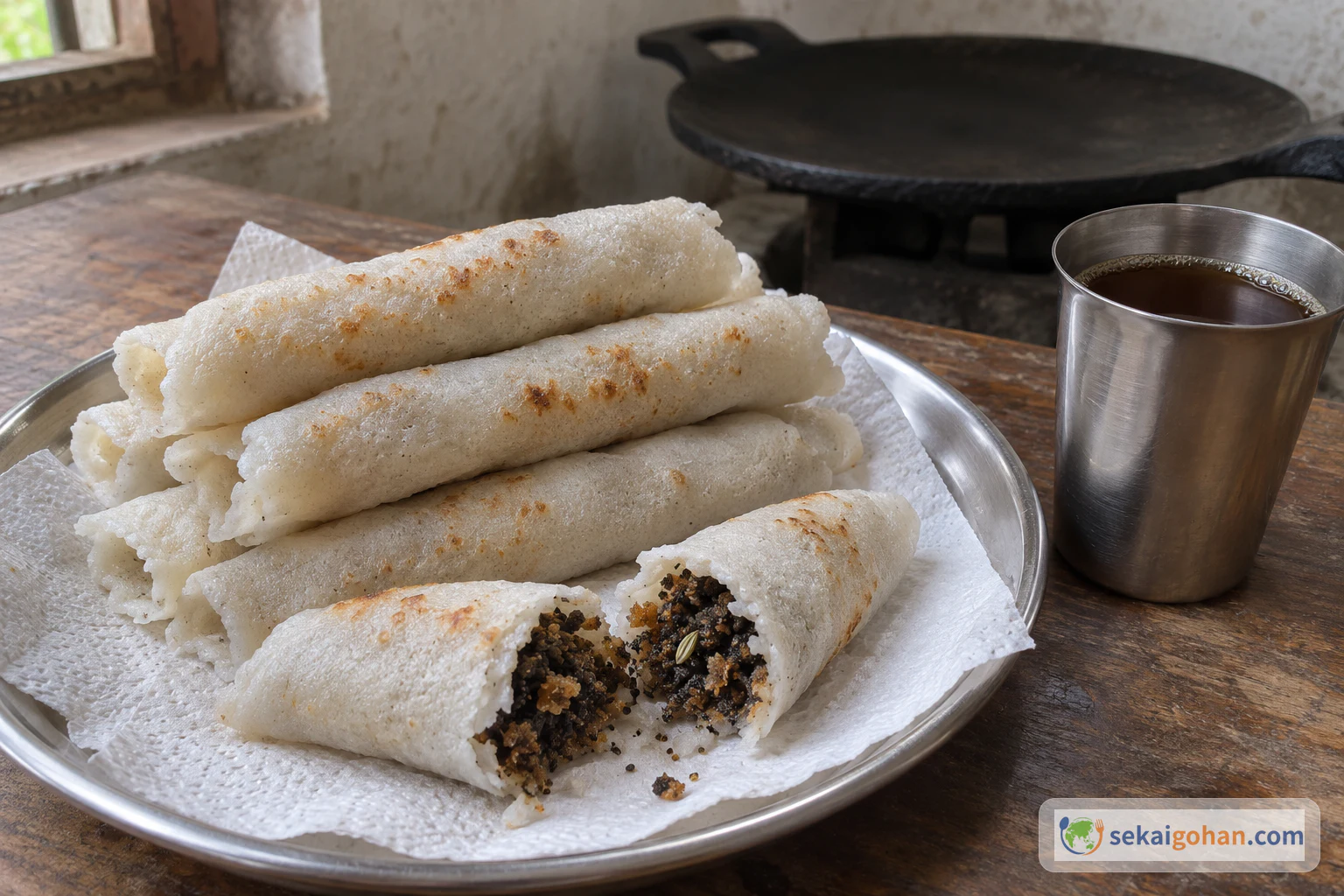
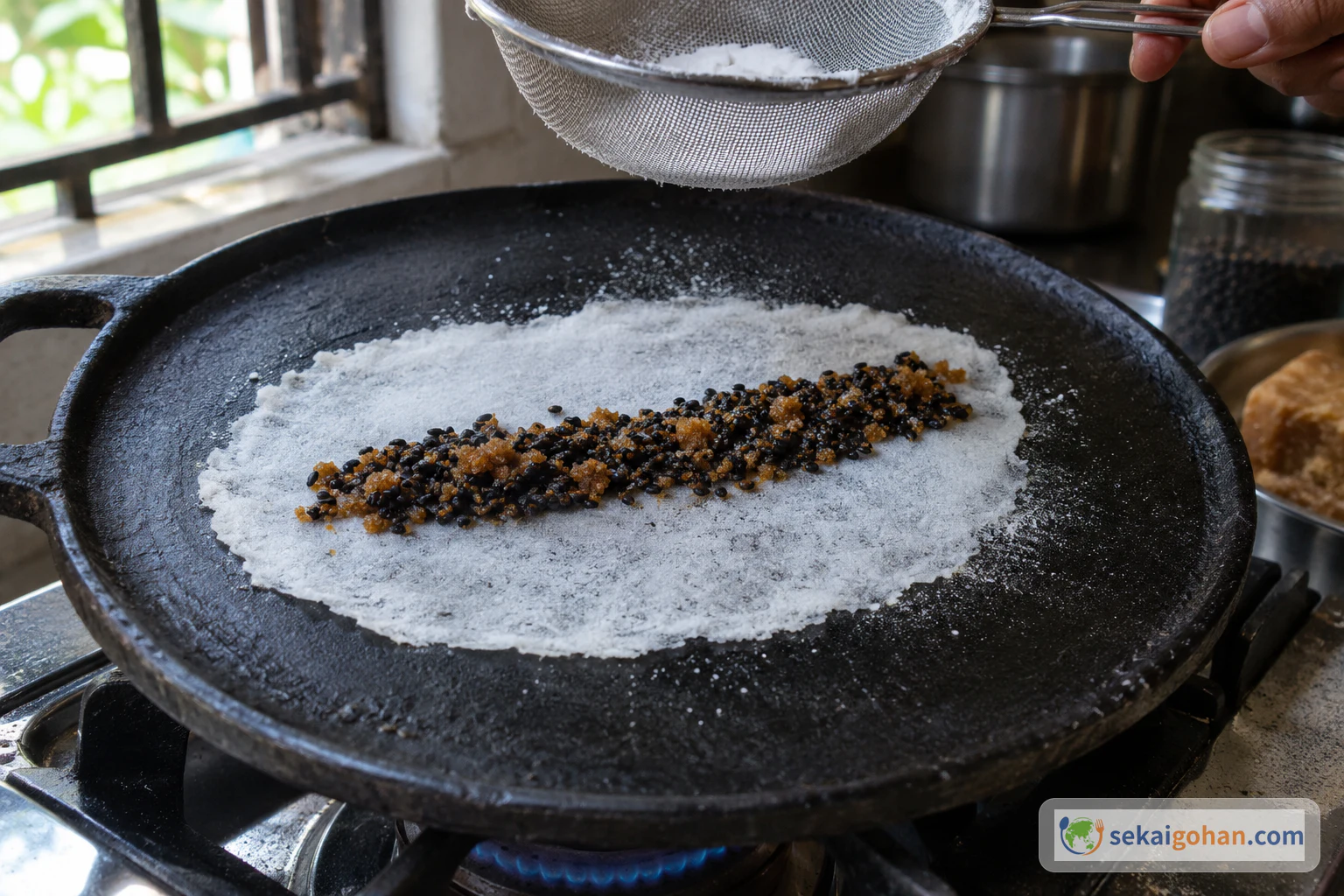
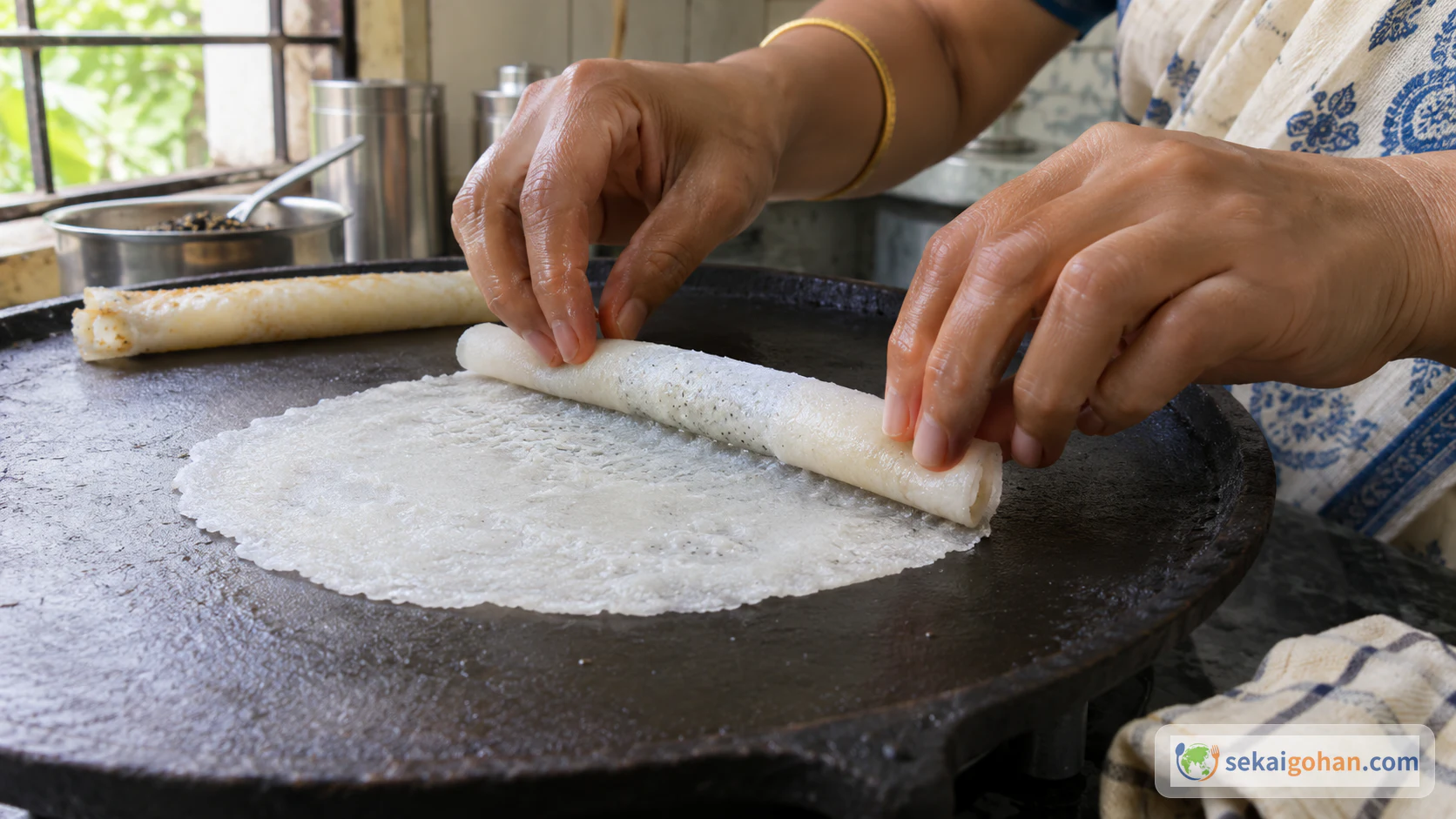
The oval of damp rice flour on the iron griddle is so thin that the black metal shows through it in places. A line of crushed black sesame and jaggery runs down the middle. Within moments the edge of the sheet begins to lift off the pan, and that is your signal to roll it, quickly, from the long side, into a pale tube. Til pitha is the rice roll of Assam, in India's northeast. It is made for Bihu, the harvest festival, and eaten with strong black tea. The shell is nothing but ground sticky rice, dry and crisp at the edges, and it breaks open onto a coarse, sweet filling of roasted sesame and jaggery with a little fennel.
A Sweet for Bihu Mornings and the Meji Fire
The Assamese year has three Bihus. Kati, or Kongali, comes in October, when people pray for a good crop. Magh, or Bhogali, comes in January and marks the end of the harvest. Bohag, or Rongali, comes in April, at the start of ploughing and the Assamese new year. Pitha, the sweets made from rice flour, belong to Bihu and to weddings, and making them takes precision. Magh Bihu falls on January 14. Its morning food is made from newly harvested rice, new jaggery and roasted black sesame, and til pitha is exactly that: the white pitha made with sesame and jaggery.
Til means sesame and pitha means a sweet or snack made from rice, wheat or pulses. In Assamese script it is written তিল পিঠা, and you will also see it as Tilor Pitha, "the pitha of sesame." The sticky rice it is made from is called bora saul in Assam. Jaggery is gur.
Uruka night and the morning fire
The day before Magh Bihu is Uruka. Villages hold a feast out in the harvested fields. People build a meji, a tall stack meant for burning, and a bhela ghar, a hut thatched with straw. In the evening families eat together, and the singing and dancing go late into the night. The next morning people get up around five, burn the meji, and throw black sesame and pitha into the fire as they pray to the fire god. The festival goes on for seven days, so the same sweet you eat with your tea is also an offering made to the flames.
Jolpaan with black tea
Breakfast during those days is jolpaan. Each house puts out handoh gakhir gur (rice flour with milk and jaggery), laru made from sesame and coconut, and pithas such as til pitha and ghila pitha, along with strong black tea. Sweet potatoes are eaten in the morning too. Jolpaan also appears at festivals, weddings and funerals. The rice comes in many forms, among them bora saul, chira, komal saul, pithaguri, sandoh and muri, served with cream, yogurt and jaggery. Grain used to be pounded in a dheki, a foot-operated wooden pounder, and mills do that work now. Assamese food uses less spice and oil than most cooking in India, and til pitha goes further: no oil touches it at all.
Same flour, other pithas
From the same rice, Assam makes ghila pitha (fried), narikol pitha (with coconut), sunga pitha (cooked in bamboo tubes) and tekeli pitha (steamed over the mouth of a clay pot). Bhapa pitha from Bangladesh is a different thing again: damp rice flour is packed into a mould with coconut and jaggery and then steamed, and nothing is rolled. Homes differ on til pitha as well. Some add fennel and many leave it out. Some melt the jaggery before mixing it with the sesame, while here it is shaved and rubbed in raw. Some fill the rolls with sweet coconut in place of sesame. Where and when til pitha was first made is not settled. It is presented here as an Assamese sweet.
Ingredients
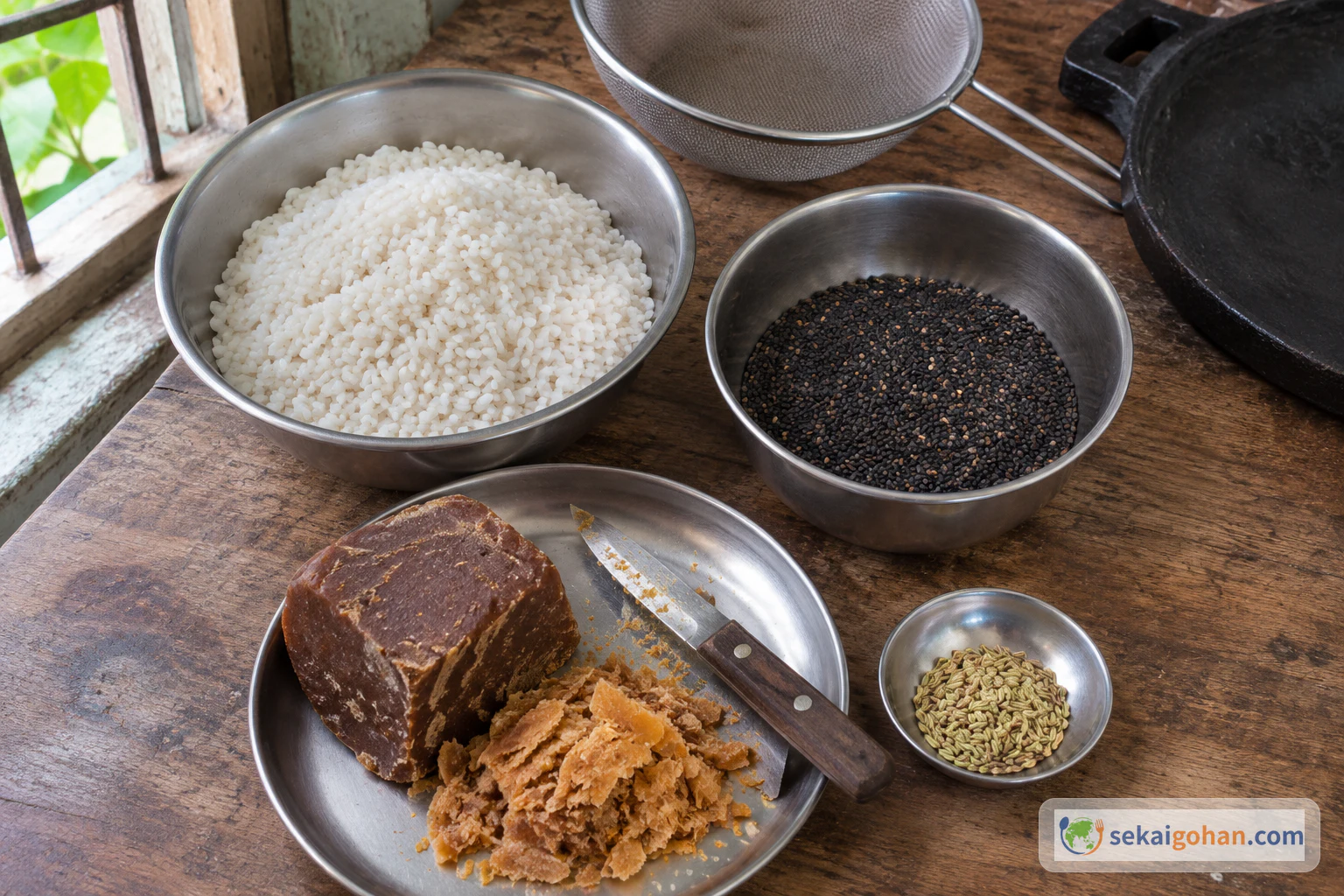
The rice has to be glutinous (sticky) rice. Ordinary short-grain or long-grain rice does not have the stickiness to hold a sheet that is rolled with no batter and no oil.
Sesame is a main ingredient, so anyone with a sesame allergy should not eat til pitha. There is no milk, egg, wheat or peanut in it. Before you call it gluten-free, check the labels on the rice, sesame and jaggery you bought.
Equipment
- Heavy, thick-bottomed iron griddle (tawa) or cast-iron skillet
- Sieve with a fairly coarse mesh
- Food processor or spice grinder
- Colander or wide sieve for draining
- Two or three bowls
- Cling film
- Dry cotton cloth for wiping the pan
- Small spoon (its handle helps lift the first edge)
- Plate lined with paper towel
- Airtight container
Buying and Substituting
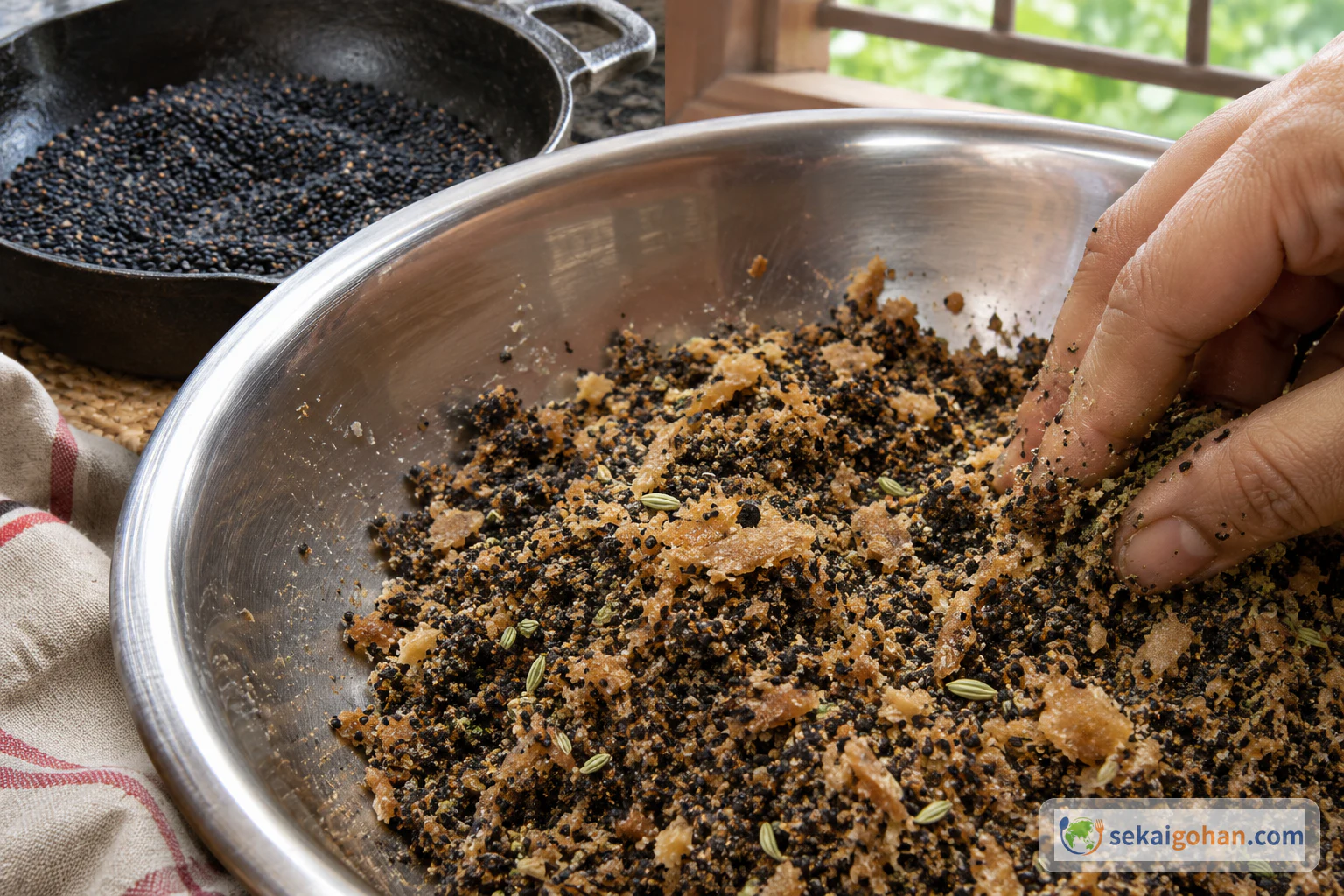
Glutinous rice is sold as sweet rice or Japanese mochigome in Asian grocers and many supermarkets. Japanese sweet rice works as well as bora saul, and the taste barely changes. Jaggery is in Indian shops, sold in blocks. If you cannot find it, shave a block of Japanese kokutō (dark unrefined cane sugar) instead. Kokutō tastes deeper than jaggery and leaves a faint bitterness. Light unrefined cane sugar used on its own makes the filling crumble apart, so if that is all you have, mix in some kokutō. Buy black sesame raw, because toasting it yourself gives the fullest smell. White sesame works, but the filling turns pale like the shell and smells lighter. Fennel seeds are in the spice aisle. If you leave them out, the sesame comes forward.
| Keep this for the Assamese taste | This can change abroad |
|---|---|
| Glutinous rice, soaked and ground at home | Bora saul to Japanese sweet rice |
| A dry iron pan over low heat | Jaggery to shaved kokutō |
| Raw, shaved jaggery rubbed into the sesame | Fennel kept or left out |
A baking sieve with a coarse mesh spreads the flour well, and a tea strainer works in a pinch. Home grinders heat up fast when they run for long, so plan on short pulses.
Method
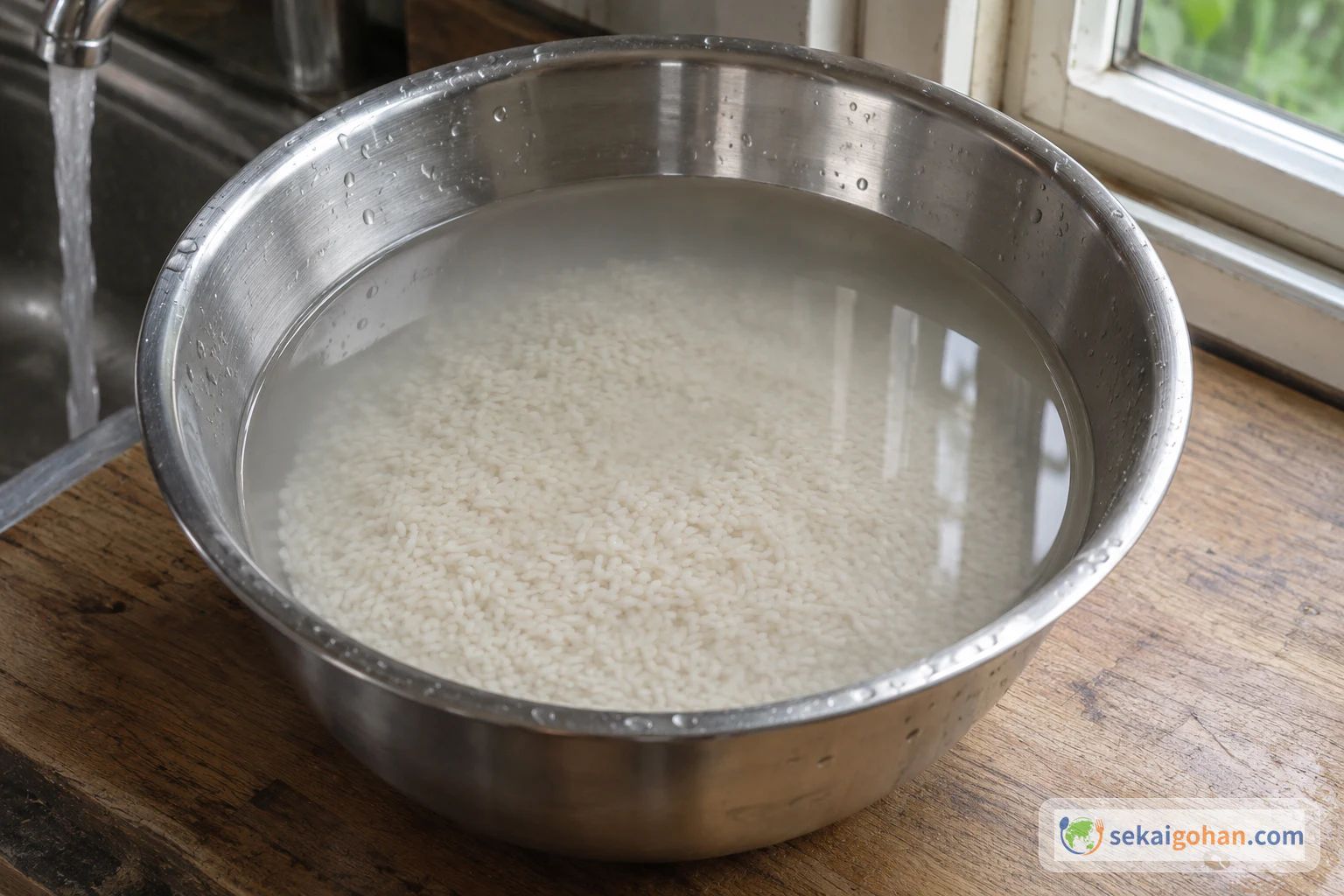
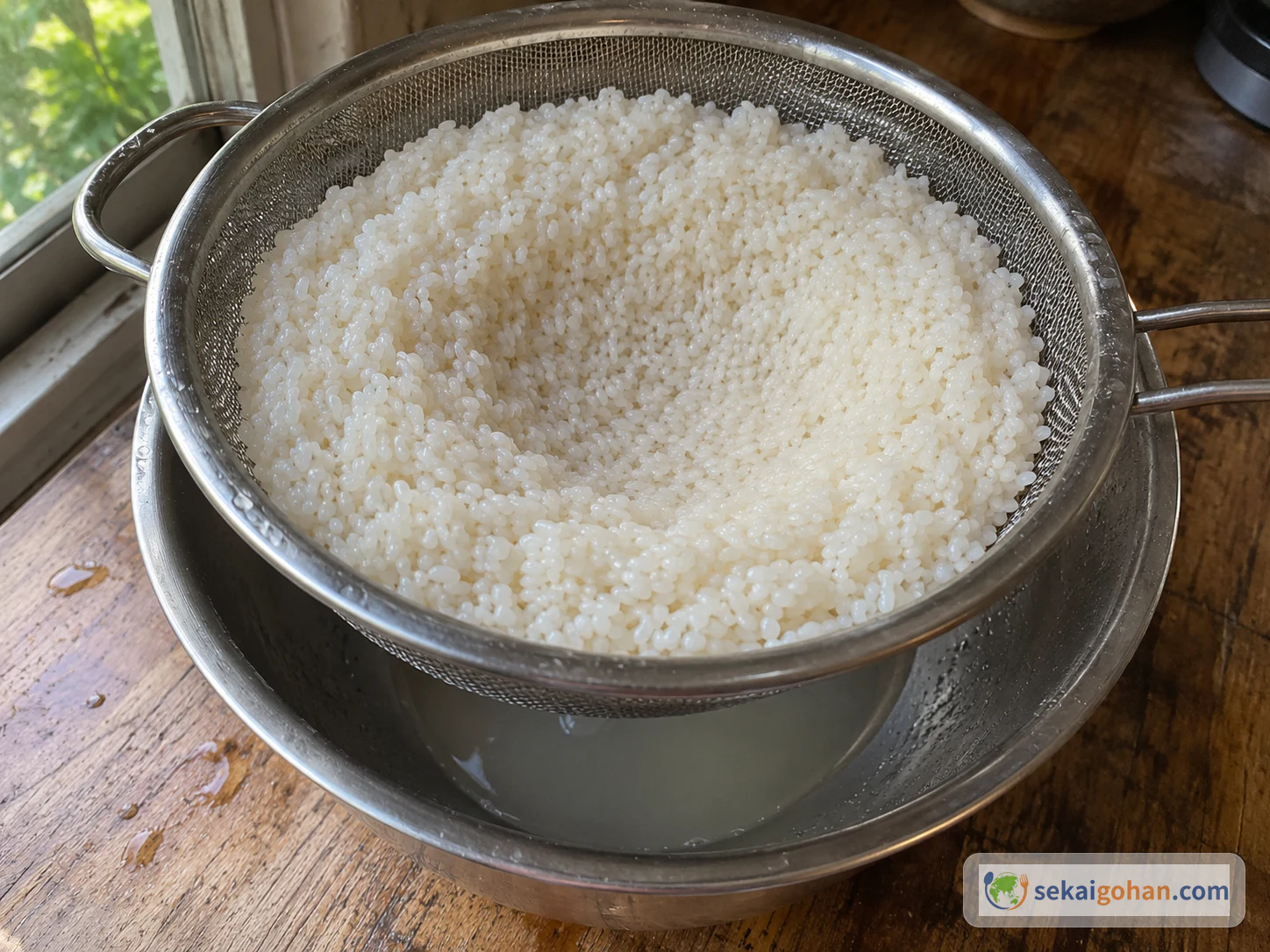
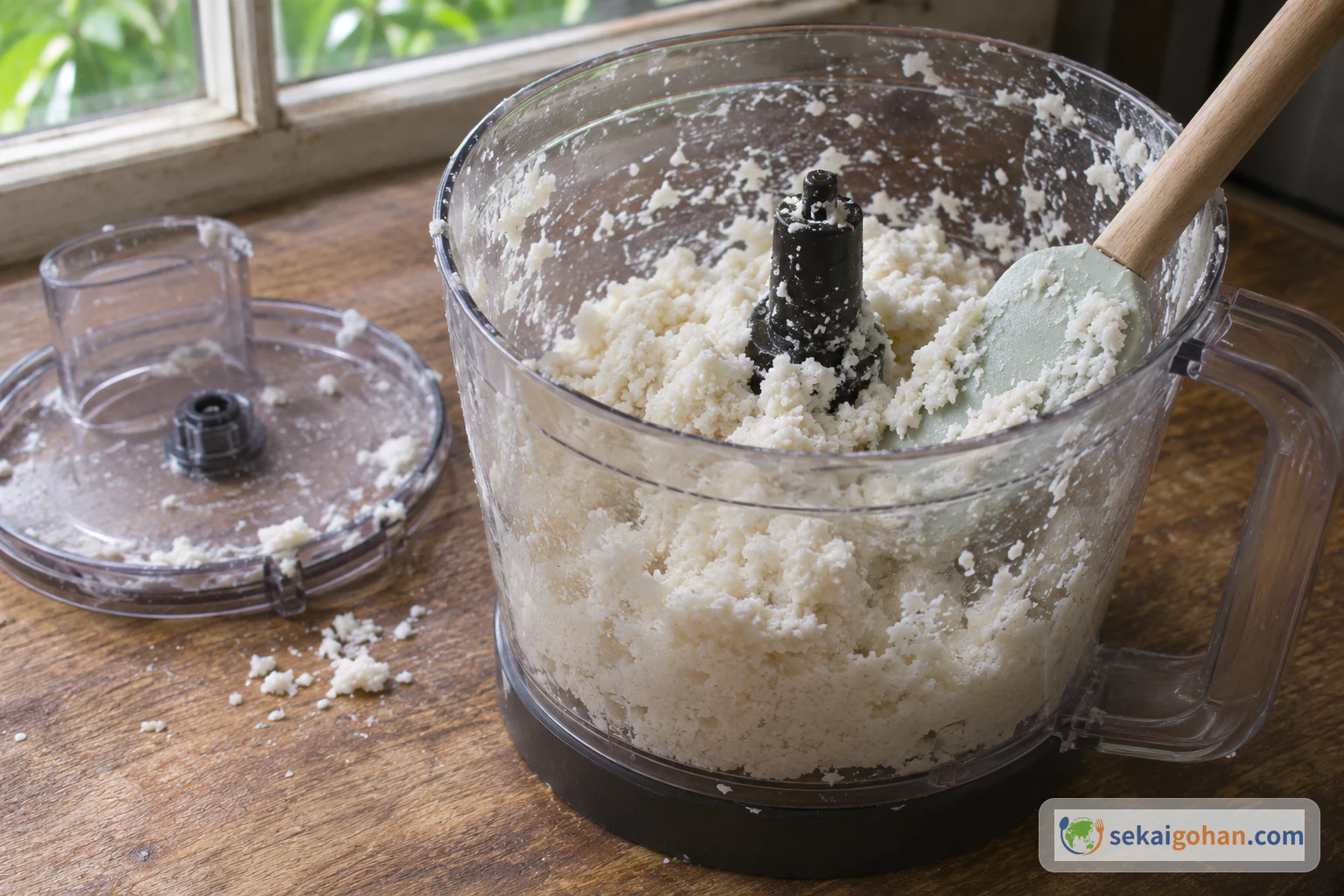
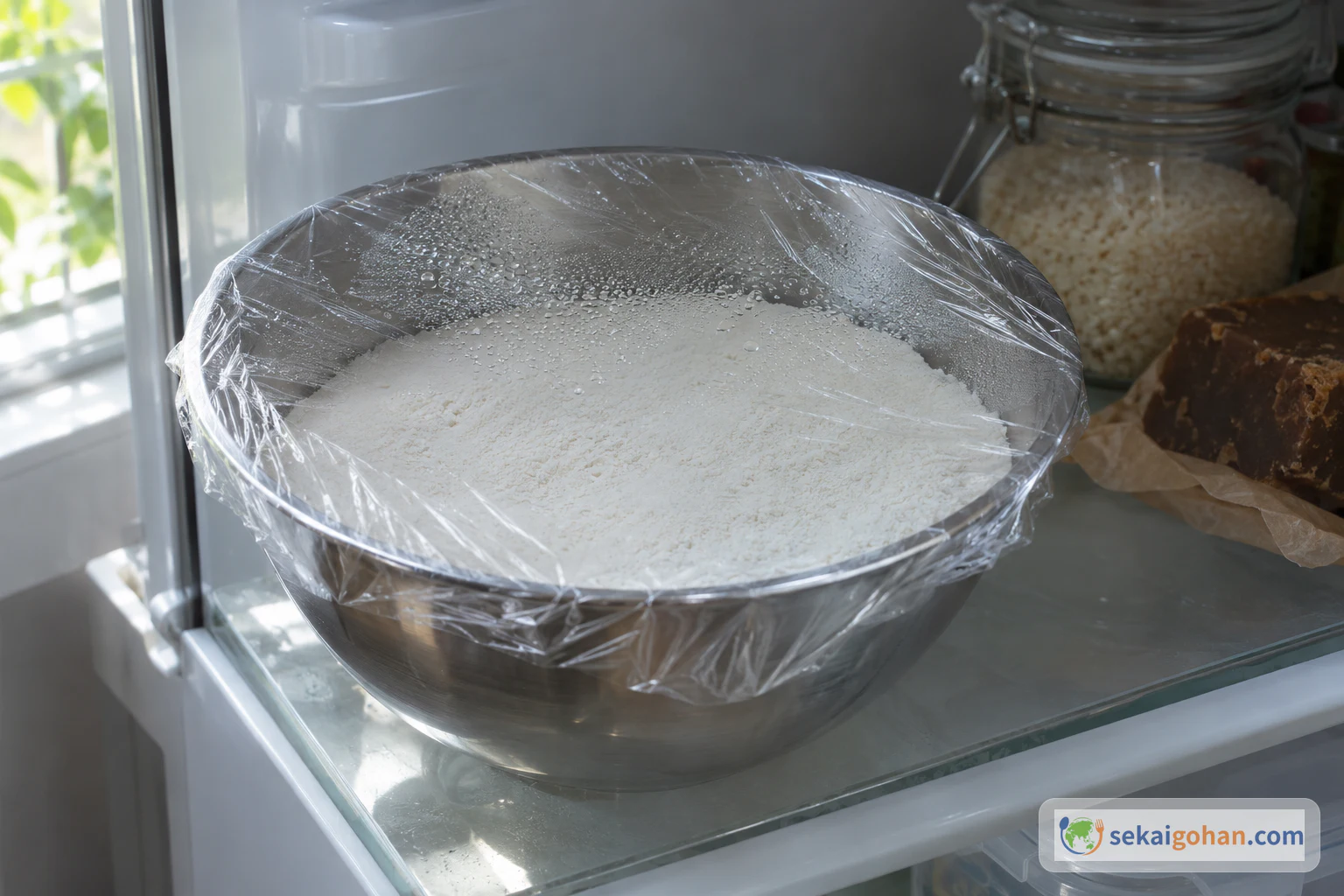
The rice needs most of a day before it reaches the pan: 4 hours of soaking, 4 hours of draining, then grinding and a rest in the fridge. The rest can run overnight. Make the filling while the flour chills. The griddle work at the end goes fast, so set the flour, the sieve, the filling, the cloth and the lined plate within reach of the stove before you start.
How much water is left in the drained rice decides whether the sheets roll or crack. When you touch the grains they should feel damp but not drip. If you dry them too far, the sheets split. If you leave them too wet, the flour balls up.
If the motor or jar gets warm while grinding, the flour loses its stickiness and will not roll. Grind a little at a time and stop whenever the jar feels warm.
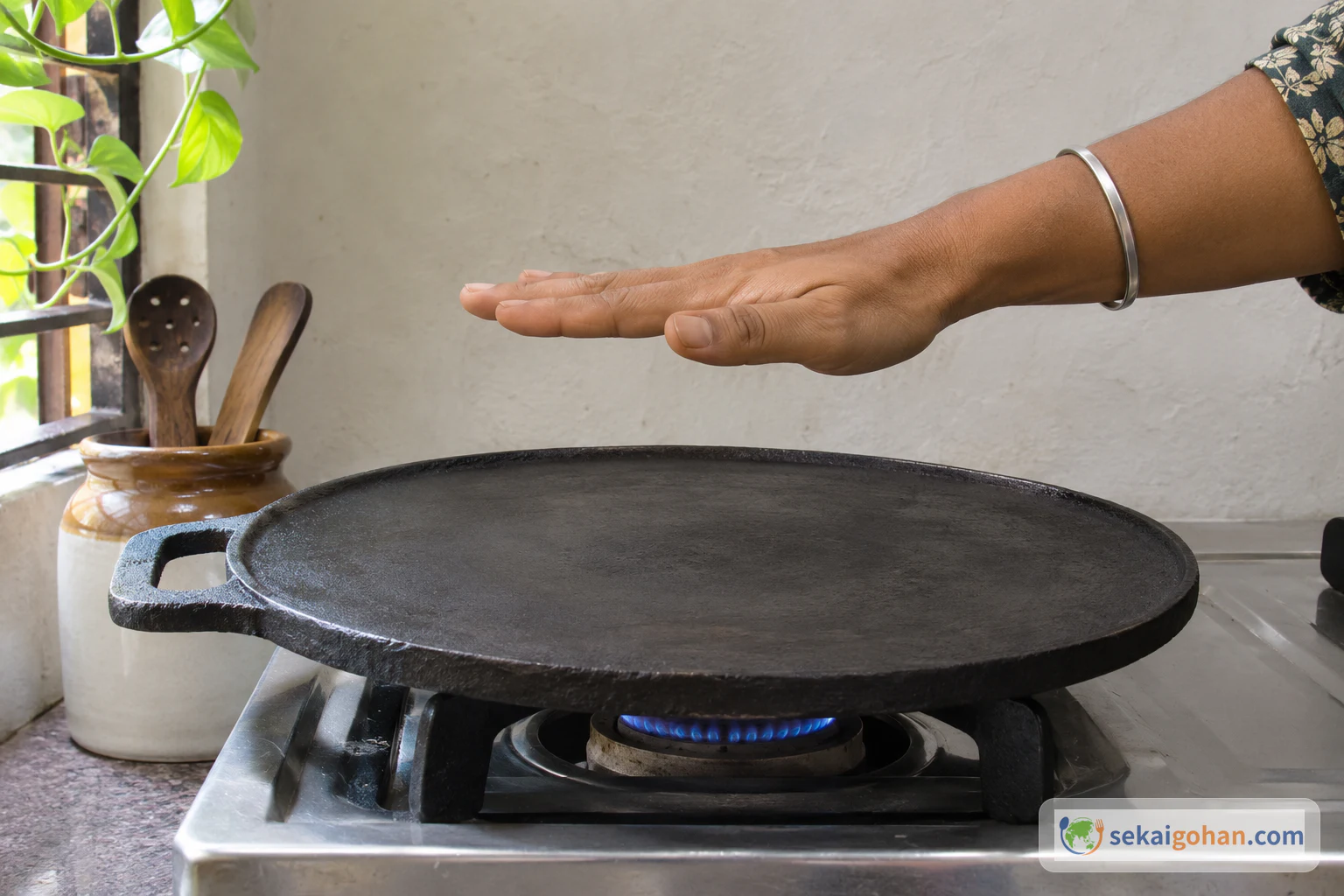
The sheets are rolled with your fingertips right on the hot pan. Keep the heat low the whole time. Lift the first edge with a spoon handle, and keep your fingers on the sheet, off the bare iron.
Flour left on the pan burns under the next sheet. A quick pass with the dry cloth after each roll keeps every sheet pale.
When It Goes Wrong
| What you see | Why | What to do |
|---|---|---|
| The sheet cracks or tears as you roll | The flour is too dry, the grinder got hot, or the flour went in straight from the fridge | Mist the flour with a little water, cover it and rest it for 30 minutes. Spread thinner, and wait until the edges lift |
| The sheet sticks and the edges never lift | The heat is too low, a thick pan has not heated through, or the flour is too wet | Heat the pan fully, then set it back to low. Spread wet flour thinly on a dry cloth for a few minutes |
| It browns and turns brittle before you can roll it | The heat is too high or the spreading is too slow | Turn the heat down and use less flour for the next sheet. Crumble the overdone ones over yogurt or ice cream |
| The middle is floury | The sheet is too thick or came off the heat too soon | Spread thinner. Put the rolled pitha back on the pan over low heat and warm both sides briefly |
| Filling leaks from the ends | The filling went too close to the edges, or you pressed while rolling | Keep the filling to a band in the middle, and lift the sheet as you roll |
| Later sheets burn | Flour has built up on the pan | Wipe the pan with a dry cloth after every roll |
Serving, Variations and Storing
At the table
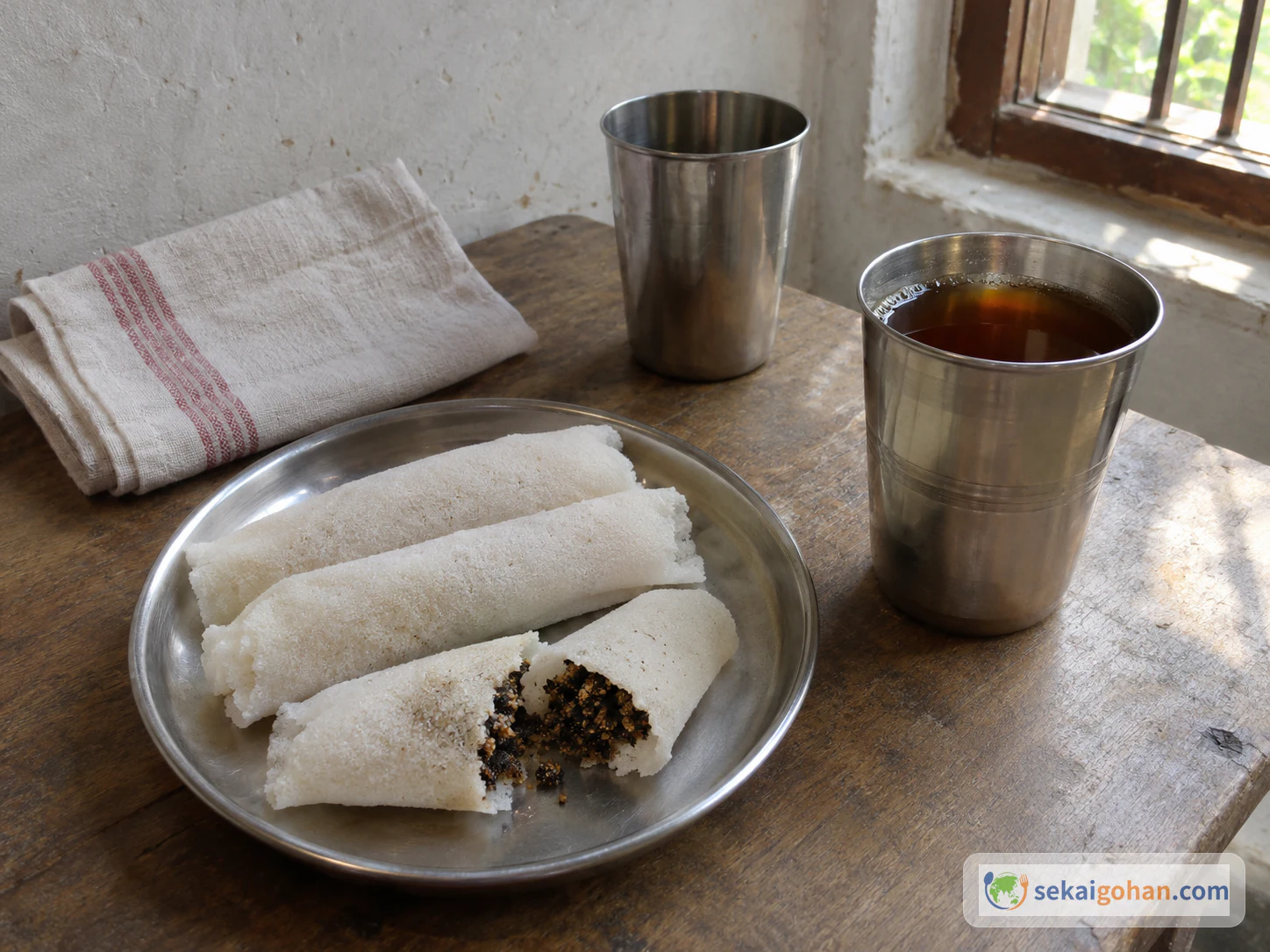
Put til pitha out the way it comes at Bihu: a few rolls on a plate in the morning, with strong black tea and no milk. Hot milk tea goes with it too. The rolls are dry and crumbly, so the tea goes down alongside each bite. Lay out a few other jolpaan things, such as flattened rice with yogurt and jaggery, and you have a festival breakfast.
Variations
- Coconut filling. Replace half the sesame with toasted coconut. This is a traditional alternative. You lose some toasted sesame flavour, and the sweetness turns rounder.
- No fennel. Leave out the 1½ tbsp of fennel. The aroma becomes simpler and the sesame comes forward, as it does in the many homes that make it with three ingredients.
- White sesame. The filling turns pale like the shell and smells lighter.
- Kokutō and cane sugar. Use 1 cup of shaved kokutō and ½ cup of light unrefined cane sugar in place of the jaggery. This softens the bitterness kokutō brings on its own.
- Short rolls for reheating. Roll each sheet into a shorter tube, let the rolls cool, and warm them later on a dry pan. Short rolls survive handling better.
Storing and reheating
Let the rolls cool completely, then put them in an airtight container. They break easily, so lay them in loosely, don't pile them high, and lift them out gently. To warm them up, put them on a dry pan over low heat and turn them briefly on each side.
Frequently asked questions
Can I use glutinous rice flour or shiratamako?
Start from whole rice. Every step here depends on damp flour ground from soaked rice, and dry bought flour holds a different amount of water. Use dry flour as written and the sheets will not roll. Making it from dry flour is a different recipe with its own water adjustments.
Can I use sesame that is already toasted?
Yes. Skip the toasting, because toasting it again burns it. Crush it coarsely and rub it into the jaggery and fennel as in step 6. Raw seeds toasted at home give a stronger smell.
I don't have a cast-iron pan. What else works?
A heavy, thick-bottomed skillet works. A nonstick pan lets the flour slide and is easy to handle, but it browns the sheets faster, so set the heat one notch lower than you would for iron. An electric hot plate holds its heat unevenly, and the sheet can dry out before the edges lift, so make one test sheet first.
Why is there no oil at all?
The sticky rice starch holds each sheet together, and the iron is used dry and wiped clean between sheets. That keeps the shell pale and crisp, never fried. It suits a cuisine that uses little oil to begin with.