Cherupayar Puzhukku: Soft Whole Green Gram, Cooked Until Dry
Keep the beans whole and soft, the chillies and small onions chunky rather than pasted, the coconut for last, and the finish dry.
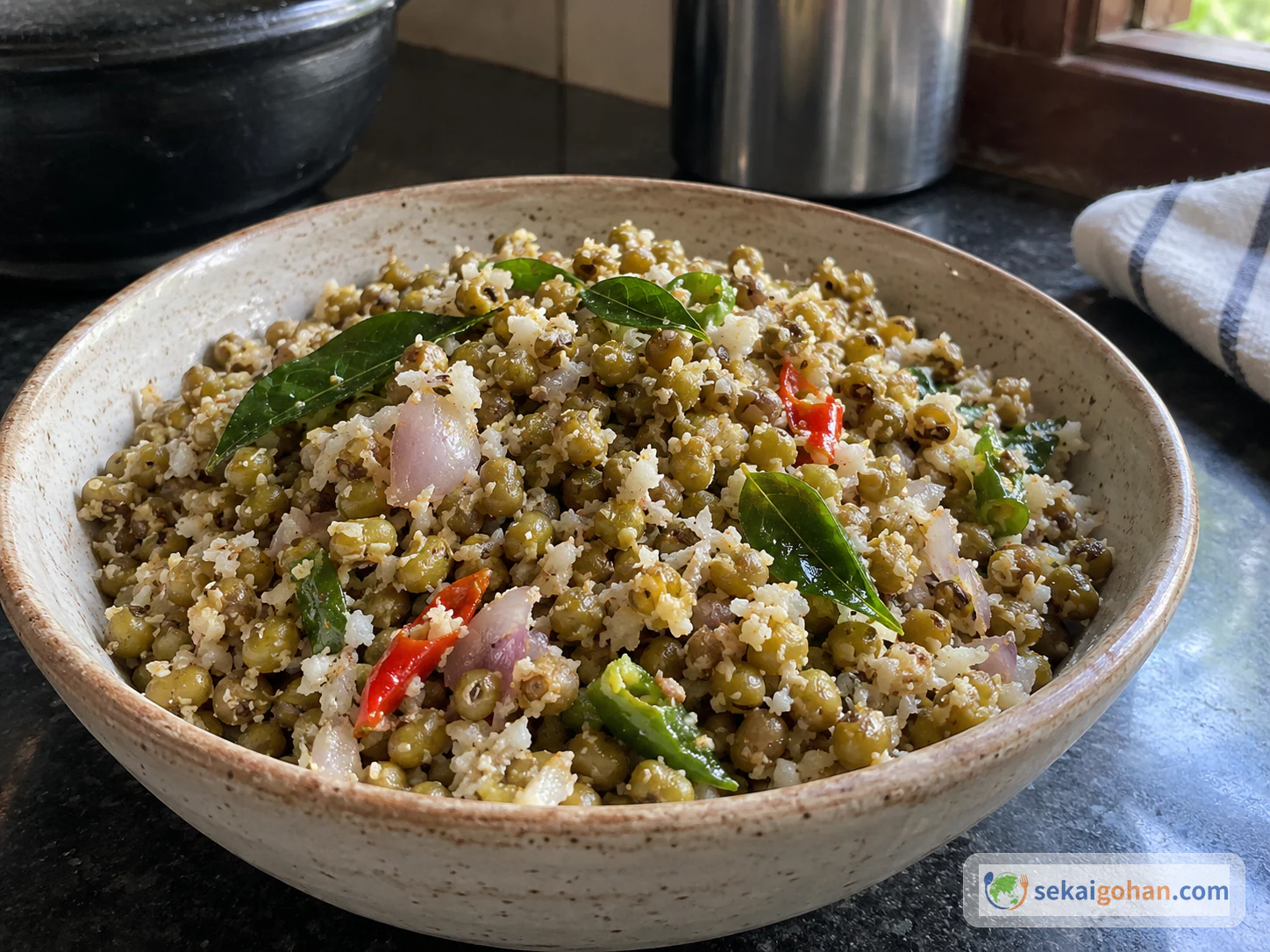
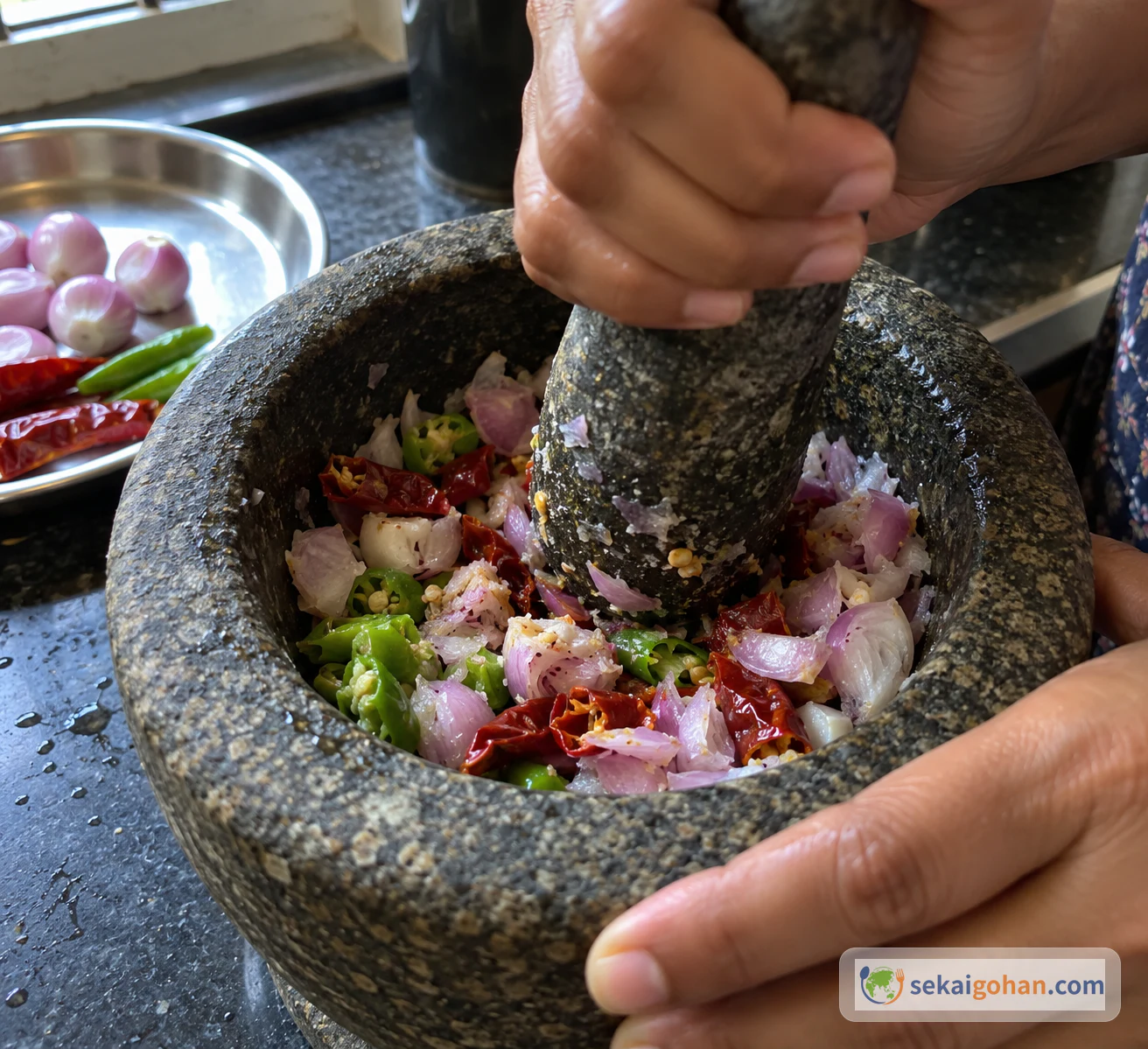
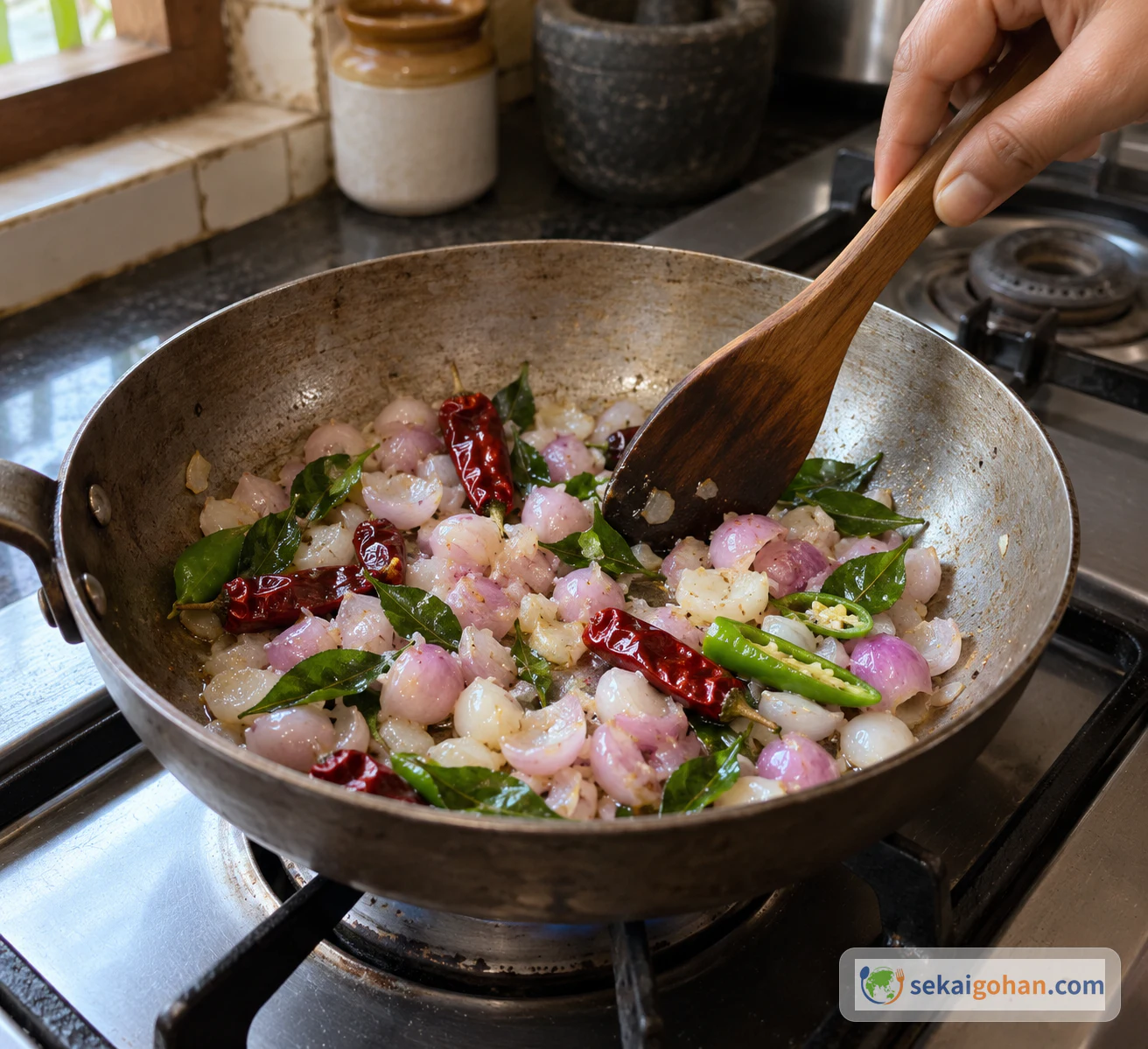
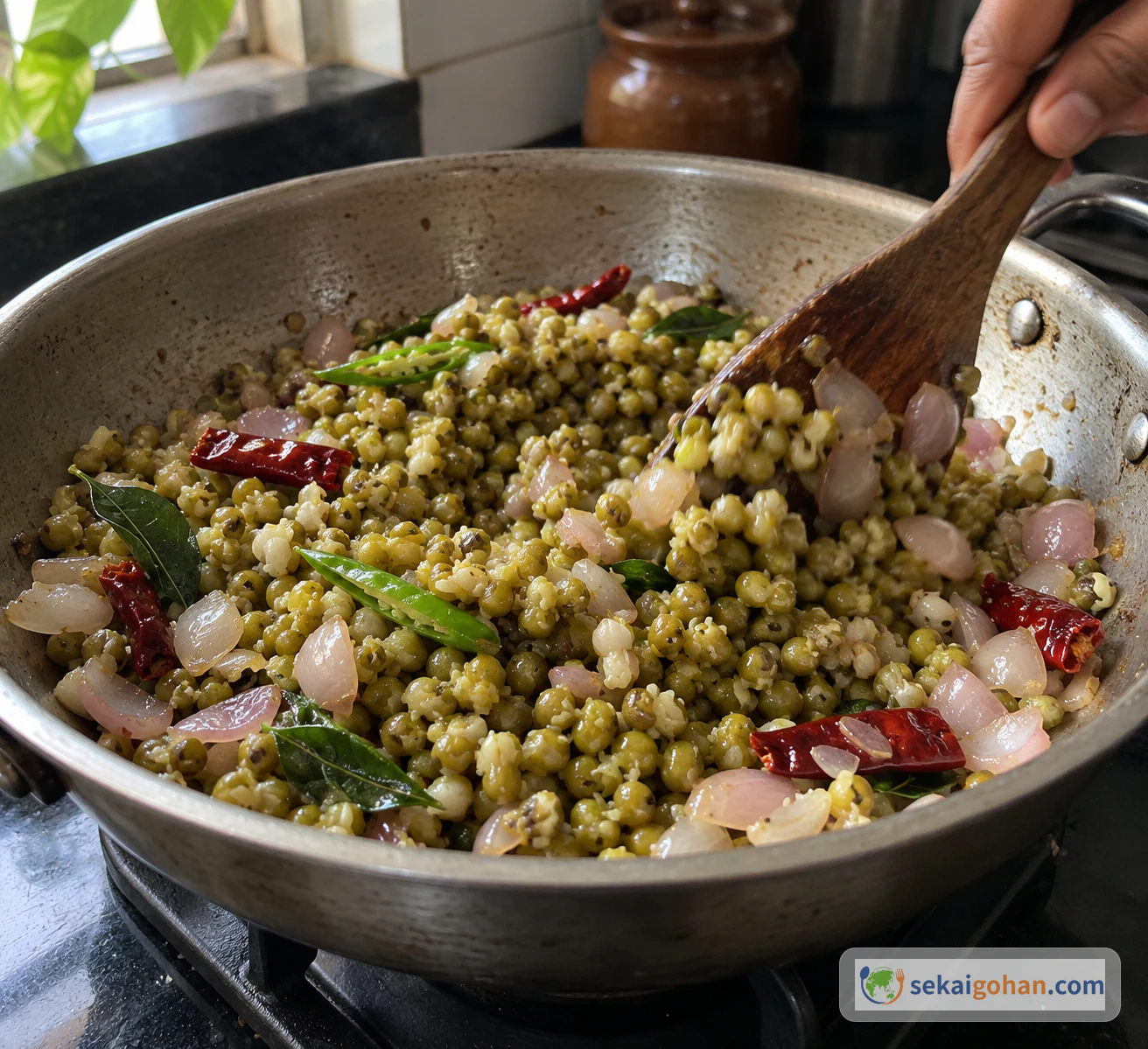
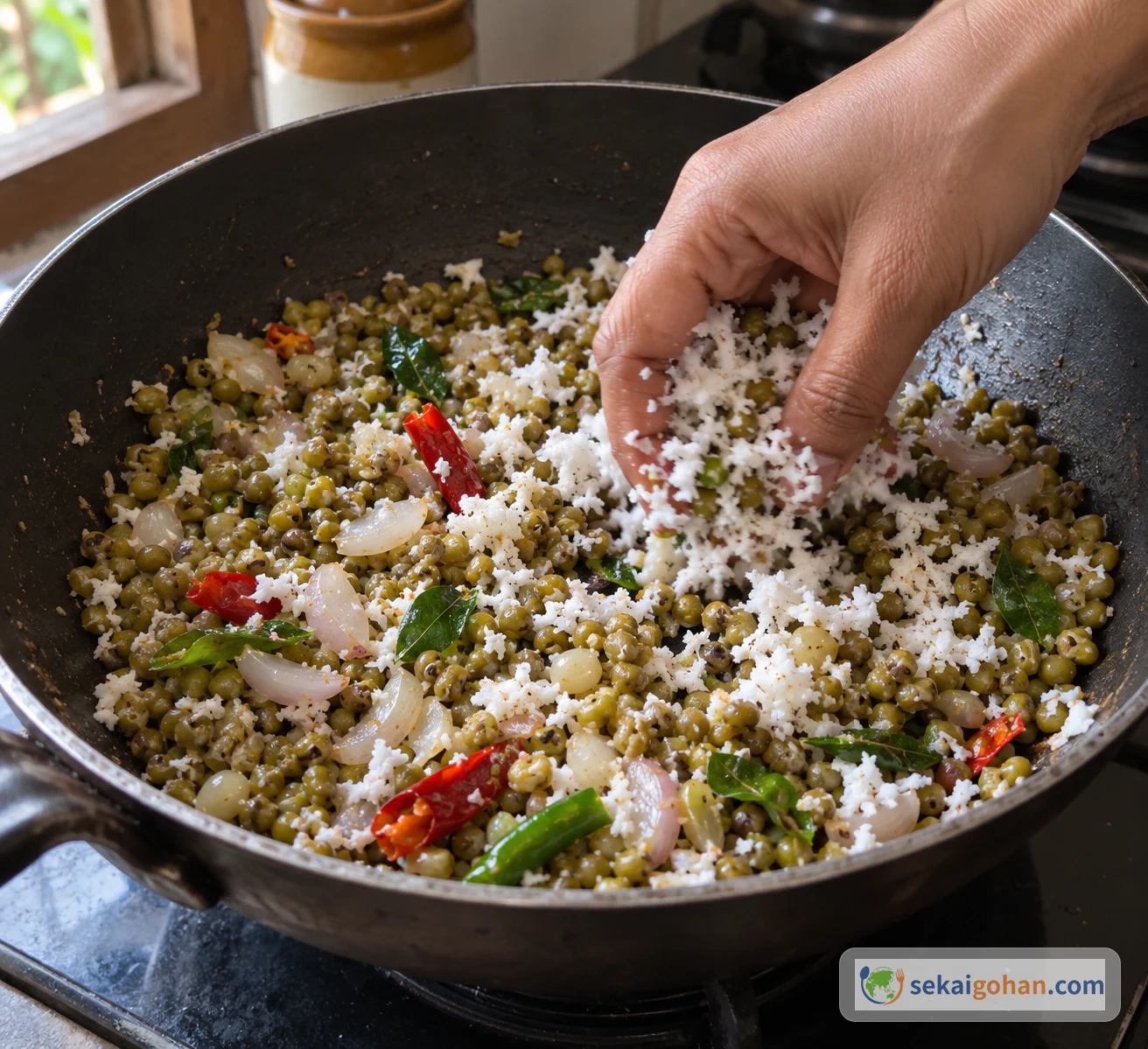
Whole green gram cooks until soft. In a separate pan, coarsely crushed small onions and chillies hit hot coconut oil with curry leaves until their raw smell is gone. The beans go in, then a handful of grated coconut, and the pan stays on low heat until the water left with the beans has disappeared. That sequence is cherupayar puzhukku as Veena Jan wrote it on the Curry World site: a dry dish of whole beans, not a pot of gravy.
Cherupayar (ചെറുപയർ) is the Malayalam name for green gram, Vigna radiata, also known as whole mung. Kerala government references list it separately from masoor dal, so this dish is not made with red lentils, even when loose English labels such as "green moong dal" or "green lentils" make the two sound alike. It also differs from other Indian dishes built on pulses, such as dal tadka, a stew of split pulses finished with a hot tarka, or chana masala, a chickpea curry.
A YouTube video by Kitchen World Of Nami carries the same dish name in its title. Only the title and channel name could be confirmed, so nothing in this recipe comes from that video.
Where This Version Comes From, and What It Changes
The ingredients and their order follow Veena Jan's written recipe, with one deliberate change: the water, and draining it after cooking.
The recipe disagrees with itself on water. Its ingredient list says 1/4 cup, while its method pressure-cooks the beans in 1/2 cup. These two figures should not be added together, and the recipe does not say what the listed 1/4 cup is for.
Neither amount meets the minimum published by the cooker maker Hawkins:
| Hawkins cooker size | Minimum water, first 10 minutes of pressure cooking |
|---|---|
| 1.5–3 L | 240 ml |
| 3.5–6 L | 360 ml |
| 6.5–12 L | 480 ml |
To stay above those minimums, this version uses at least 360 ml of water, or more if your cooker's manual requires it. That figure draws on a recipe in Manorama Online's readers' section, a different Kerala green gram dish that uses 1.5 cups of water for 1 cup of gram. Because the puzhukku must still finish dry, the excess water is drained once the beans are soft, a step borrowed from two cherupayar thoran recipes.
The added water and draining step have not been tried together in a kitchen, so the beans may not cook or taste the same as in the 1/2 cup method. Adding water and returning hard beans to pressure is also an editorial addition, not part of Veena Jan's recipe. Nothing here shows that this method is safe in every pressure cooker. Your own cooker's manual takes priority, and if the recipe is incompatible with it, do not make the recipe in that cooker.
Veena Jan's recipe also lists 1 pod of garlic as optional without saying whether a pod means a clove or a whole bulb, so this version leaves it out. It gives 1 string of curry leaves for both frying and garnish without dividing the amount. It also does not define its cup or state servings or total time, so none are given here.
Ingredients: Whole Green Gram, Chillies, Small Onions and Coconut
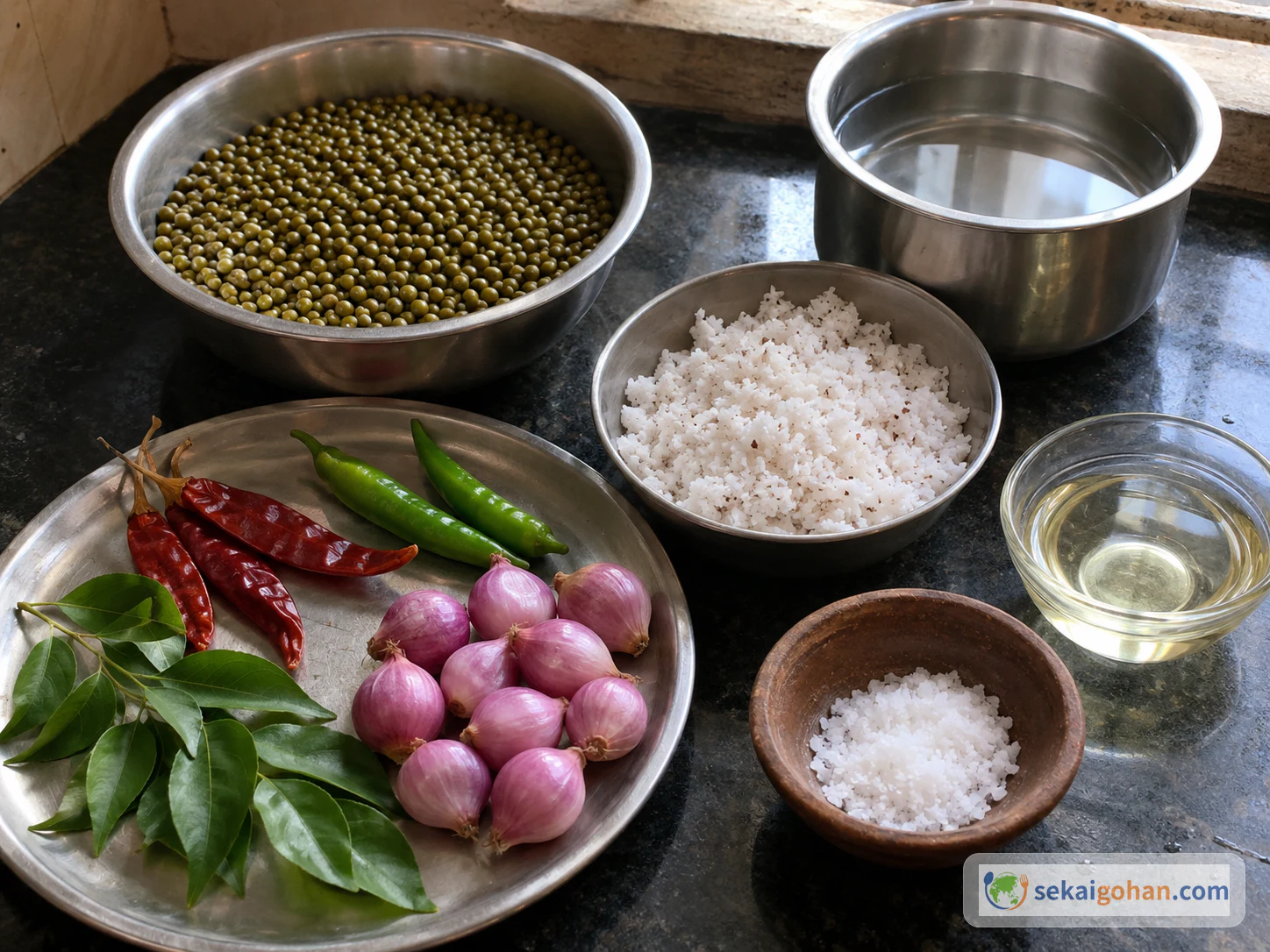
This dish contains green gram and coconut.
Choosing What to Buy
- Beans: Look for whole green gram, whole moong or cherupayar. Red masoor and split mung are different ingredients, so they are not recommended as swaps here.
- Coconut: Choose unsweetened grated coconut, not the sweetened kind used for confectionery.
- Curry leaves and coconut oil: Use both as listed; no replacement is suggested for either.
- Chillies: Heat varies with the variety and size you buy.
Equipment
- Bowl for soaking
- Pressure cooker, with its manual
- Measuring jug marked in ml
- Strainer or colander
- Mortar and pestle, or another tool that can crush coarsely
- Pan
- Serving plate
Method: Soft Beans First, Then a Dry Finish
Never force the lid open, and do not open the cooker until the pressure has fully released. A set waiting time alone does not prove that it has. Do not lift the vent weight to release pressure.
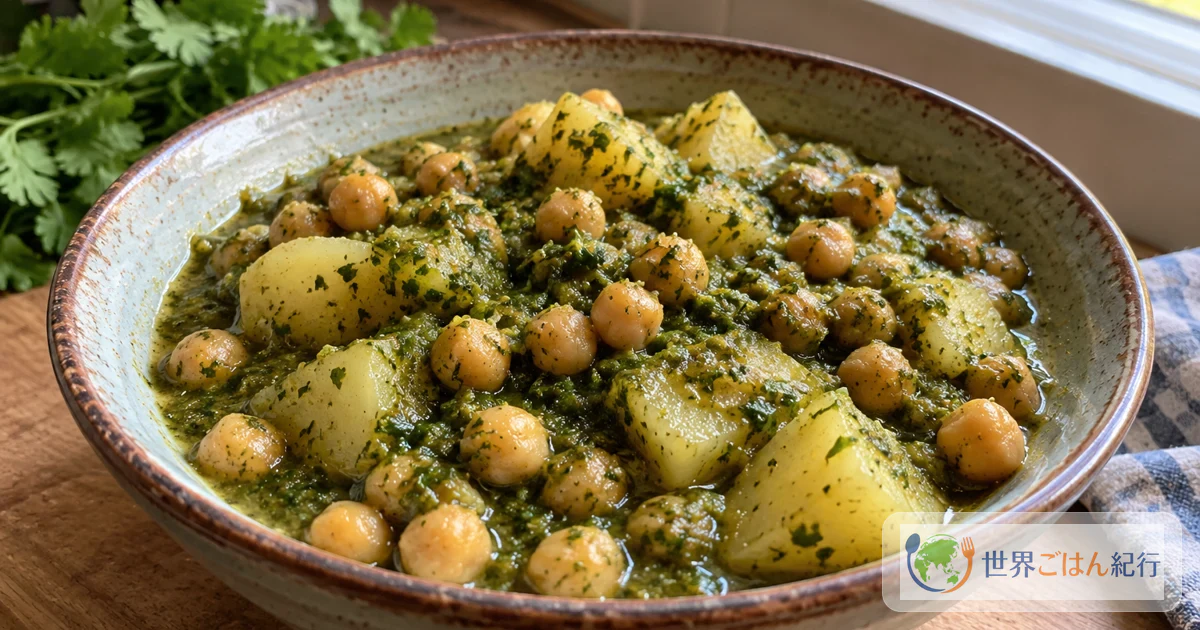
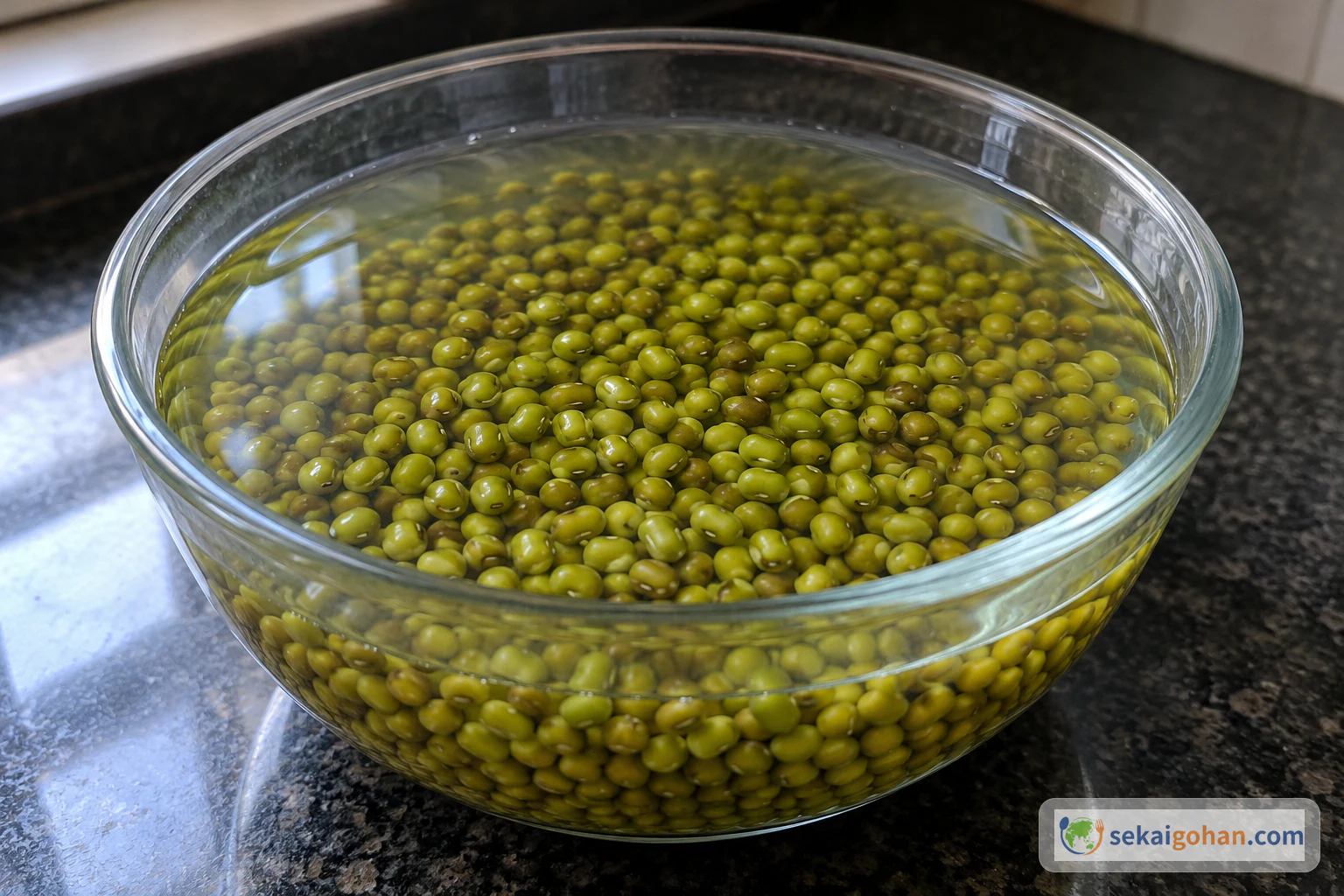
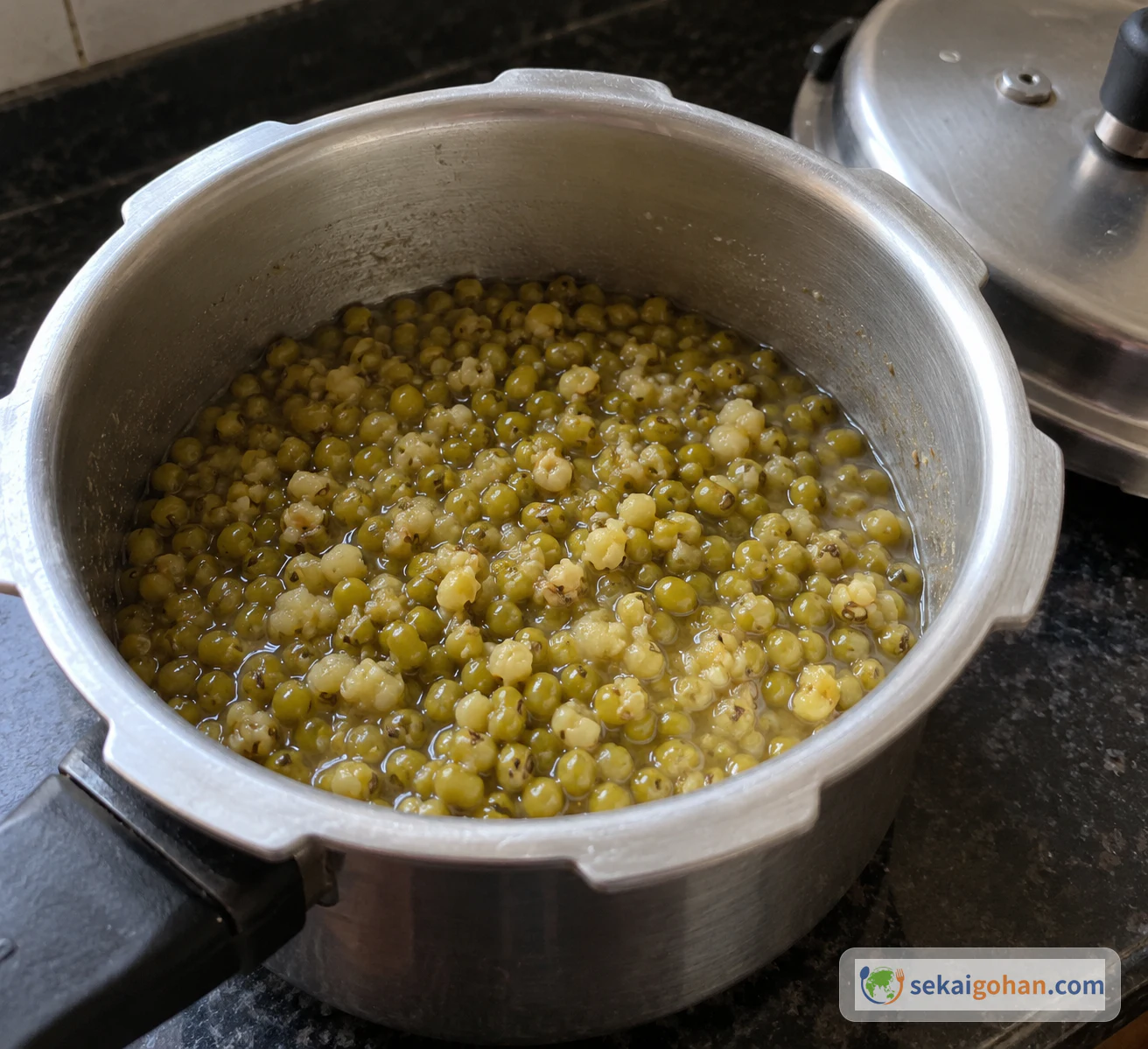
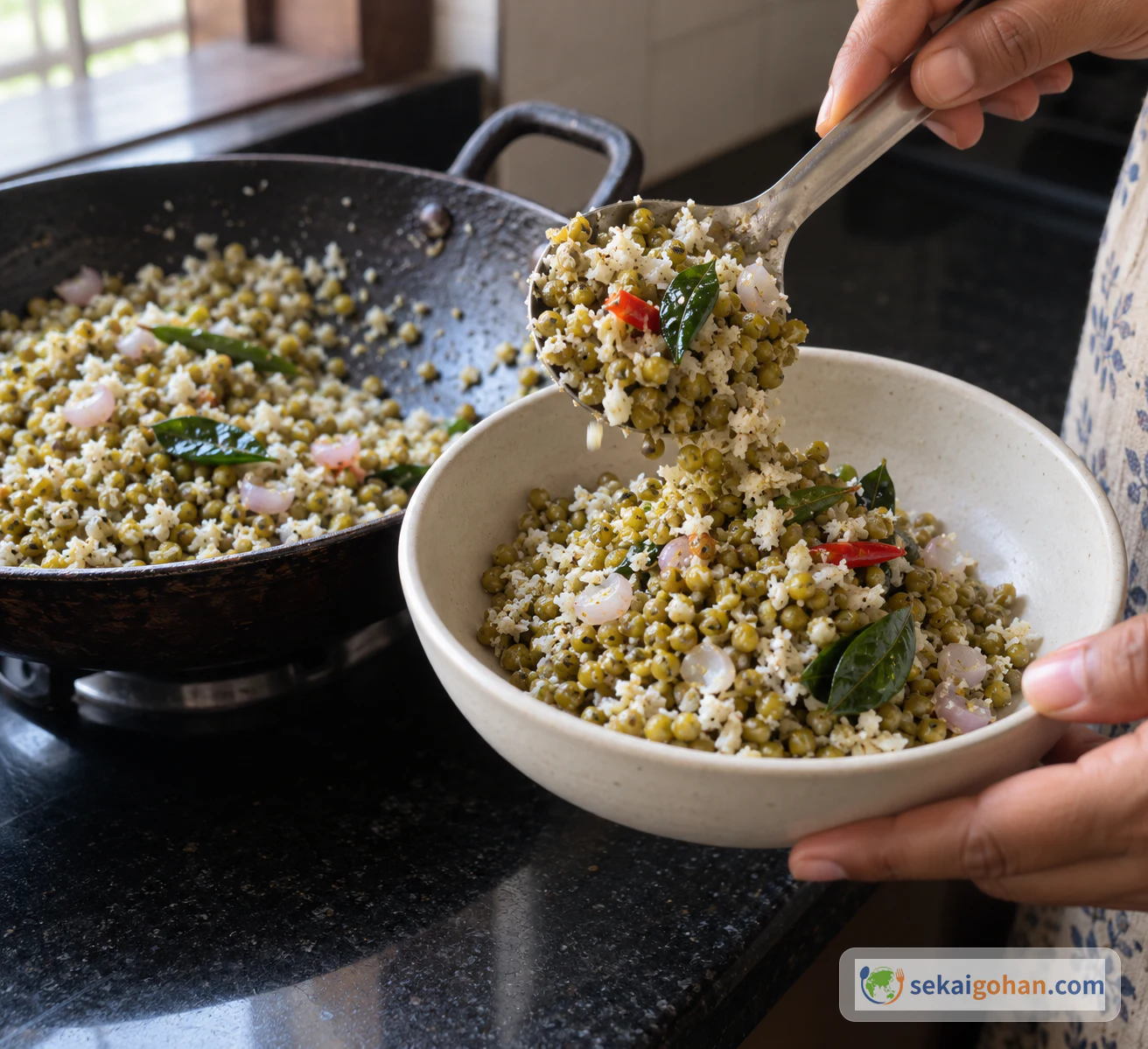
The photographs show stages and textures only. They do not show a measured water level, pressure, cooking time or whether a cooker is suitable.
Hard Beans, Wet Pan, Pasty Aromatics: Fixing Problems
The finished dish should have soft whole beans, visible pieces of onion and chilli, flecks of coconut and no gravy.
| Problem | What to check | What to do |
|---|---|---|
| The beans are still hard | One whistle may not be enough after a 30-minute soak | Do not drain them. Add your cooker's minimum amount of water, check the 1/3 limit, and return to pressure for a few more minutes |
| The lid will not open | Pressure may still be inside | Wait and follow your manual. Do not force the lid or lift the vent weight |
| The aromatics turned to paste | They were crushed too long | Stop earlier next time, while the pieces are still chunky |
| The pan is wet | The beans may not have been drained fully, or the final cooking stopped too soon | Keep cooking on low until dry, and do not add water in the pan |
| The dish is too hot | Chilli varieties differ | Choose milder chillies or use fewer next time, knowing this changes the listed amounts |
Serving: Kanji, and Other Tables It Reaches
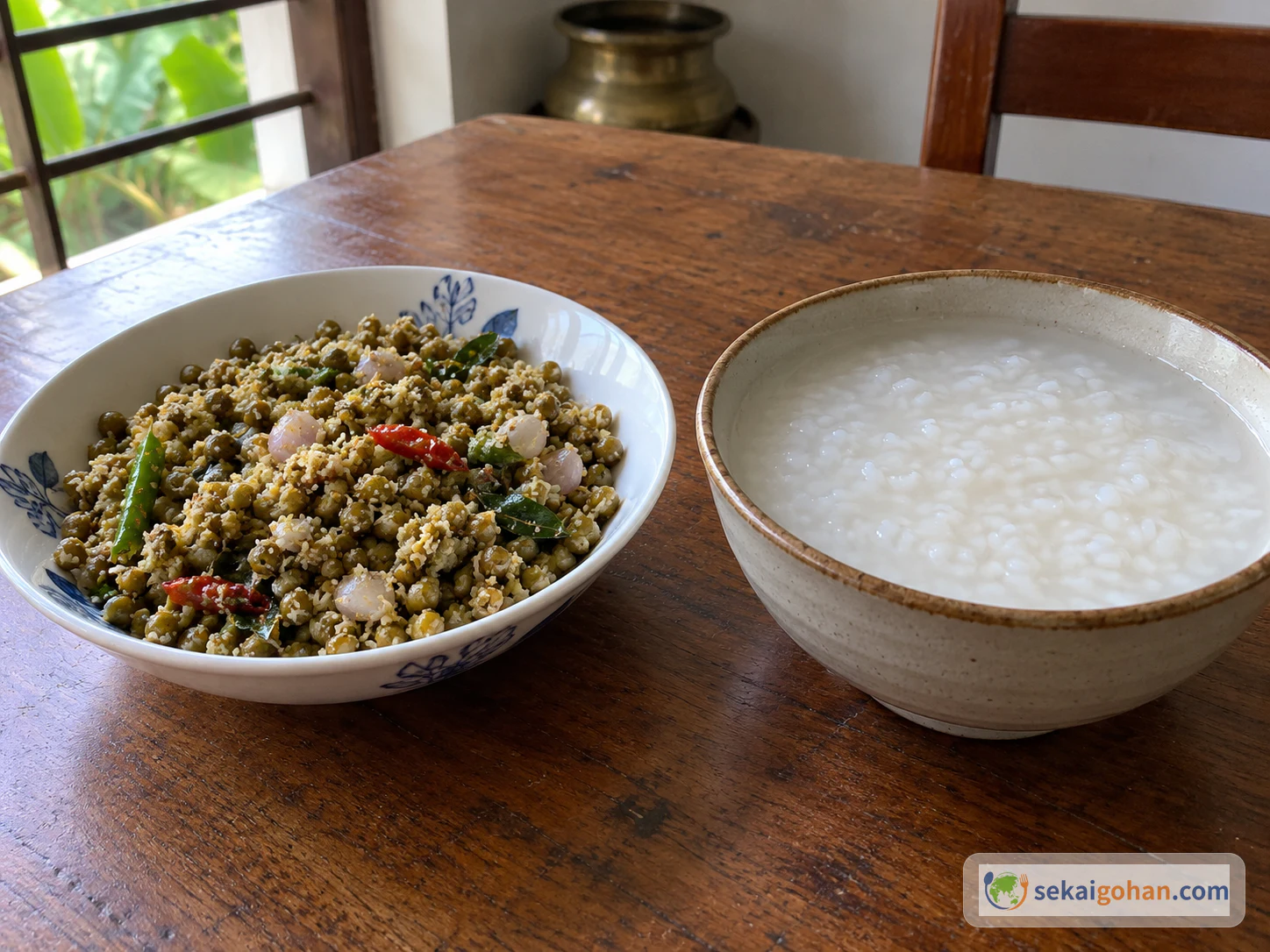
Veena Jan recommends serving this puzhukku with kanji, a rice porridge, and calls the two a good combination. The kanji is a separate dish, made and served on its own.
Other pairings appear elsewhere. Kerala Tourism describes chiratta puttu and cherupayar as a popular combination in Kerala, using its own recipe for the beans. A 2013 New Indian Express report quotes a homemaker from Palakkad who describes cherupayar puzhukk alongside Vishu Kanji. That report is one local account and does not describe every home in Kerala.
Other Green Gram Recipes to Keep Separate
These recipes share the bean but are different formulas, so their ingredients should not be mixed into the version above.
| Version | What differs |
|---|---|
| Kerala Tourism's Cheru Payar | Soaks the beans for one hour, boils them with a little salt, tempers mustard, red chilli, curry leaves and small onion in coconut oil, then mixes in the beans and grated coconut. It is served with chiratta puttu |
| Veena Jan's cherupayar curry in Manorama Online | Adds a blended paste of coconut, cumin, green chilli and curry leaf to pressure-cooked beans, simmers them with water as needed, and finishes with a tempering. It is a curry rather than a dry dish |
| With garlic | Veena Jan's puzhukku lists garlic as optional. If you add it, crush it with the aromatics in step 3 and choose the amount yourself, since "1 pod" is unclear |
The Name and Its Place in Kerala Food
Gundert's Malayalam dictionary glosses puzhunguka as boiling or parboiling, and describes puzhukku in a food sense as a dish of boiled fruits or vegetables. The word does not fix one texture or method, and this dish's dry finish comes from Veena Jan's recipe rather than from the name.
The materials behind this article show how the dish is paired in particular recipes and one Palakkad household account. They do not establish its origin, its history or how often it is eaten across Kerala, so this article makes no such claims.
Frequently Asked Questions
Is this a red lentil curry?
No. It uses whole green gram (Vigna radiata), which Kerala government references list separately from masoor dal. It also finishes dry instead of as a curry with gravy.
How many minutes does the pressure cooker need?
No minute count is given. Veena Jan's recipe says one whistle, opening after 10 minutes, and cooking a few minutes more if the beans are not done. A whistle does not convert reliably to minutes, so judge by the softness of the beans and follow your manual. It is also unconfirmed whether one whistle is always enough after a 30-minute soak.
Is 10 minutes enough before opening the cooker?
Not by itself. The 10 minutes is the recipe's wording, not proof that the pressure has gone. One of the thoran recipes mentions 10–15 minutes for pressure to drop, but this can vary by cooker. Hawkins says not to force a cooker open or open it until it has cooled and the internal pressure has reduced. Check your own manual.
Should the water be 1/4 cup or 1/2 cup?
Veena Jan's ingredient list says 1/4 cup and the method says 1/2 cup. This version uses neither, because both fall below the Hawkins minimums. Use at least 360 ml and measure in ml, since 1.5 cups of a 200 ml cup gives only 300 ml. If your cooker's manual sets a higher minimum, follow that. A 6.5–12 L Hawkins cooker needs at least 480 ml.
Does the safety guidance apply to every cooker?
No. The minimum water, the 1/3 fill limit for pulses and the opening rules come from Hawkins and apply to Hawkins cookers. For any other brand, its own manual takes priority. The Hawkins page does not cover pouring off water after opening, and it does not certify this recipe.
Can I make it without a pressure cooker?
No ordinary-pot version has been confirmed, so no water amount or cooking time is offered for one.
Should it have any sauce?
No. Veena Jan's recipe says the dish should be dry, with the water left in the beans gone after the coconut stage. For a dish with liquid, look to a curry recipe such as the separate cherupayar curry above.
What can I serve it with?
Veena Jan suggests kanji. Kerala Tourism pairs its own version with chiratta puttu, and the Palakkad report mentions Vishu Kanji.
How long does it keep?
Veena Jan's recipe gives no guidance on storage or reheating, so no storage time or method is offered here.
Sources
- Veena Jan, "Cherupayar(Green Gram) Puzhukku," Curry World, posted 2009-06-09 (Internet Archive copy of 2023-06-08). The base recipe, including ingredients, order, whistle wording, dry finish and kanji pairing. The original page can no longer be read, so this links to the archived copy. https://web.archive.org/web/20230608162105/https://curryworld.me/2009/06/09/cherupayar-puzhukkugreen-gram/
- Hawkins Cookers Limited, "Important Safeguards." Minimum water, the 1/3 fill limit for pulses, and opening and pressure-release cautions for Hawkins cookers. https://www.hawkinscookers.com/1.3.pc_safeguards.html
- Ganga Sreekanth, cherupayar ularthiyathu, Malayala Manorama Online readers' recipe section, 2021-12-04. Basis for the water amount only (1 cup green gram to 1.5 cups water) and the note that one whistle is enough for soaked gram. https://www.manoramaonline.com/cooking/readers-recipe/2021/12/04/cherupayar-ularthiyathu.html
- Maria Jose Martin, "Cherupayar Thoran," Maria's Menu. Keeping the cooker closed until the pressure drops, then draining excess water. A different dish on a personal recipe site. https://mariasmenu.com/vegetarian/cherupayar-thoran
- Recipes are Simple, "Cherupayar Thoran (Mung Bean / Green Gram with Coconut)." Draining cooked whole green gram. A different dish on a personal recipe site. https://www.recipesaresimple.com/recipe/cherupayar-thoran/
- Farm Information Bureau, Government of Kerala, "Farm Guide 2022." Cherupayar as green gram, Vigna radiata. https://www.fibkerala.gov.in/sites/default/files/inline-files/Farm%20Guide%202022%20F_0.pdf
- Department of Economics and Statistics, Government of Kerala, commodity names table. Green gram and masoor dal as separately named items. https://ecostat.kerala.gov.in/storage/publications/1898.pdf
- Kerala Tourism, "Recipe of Chiratta Puttu or Steamed Cake, Cheru Payar, Breakfast Recipe, Kerala Food." The puttu pairing and a separate Cheru Payar recipe. https://www.keralatourism.org/kerala-food/chiratta-puttu-steam-cake/59/
- Aswathy K, "A taste of Palakkad," The New Indian Express, 2013. One reported Palakkad account of cherupayar puzhukk with Vishu Kanji. https://www.newindianexpress.com/cities/kochi/2013/Apr/13/a-taste-of-palakkad-467632.html
- Gundert's Malayalam lexicographical work, digital edition, entry for പ. Senses of puzhunguka and puzhukku. https://pressbooks.psgaesthetics.uk/gundert/chapter/%E0%B4%AA/
- Veena Jan, cherupayar curry, Malayala Manorama Online, 2021. A separate curry used only for comparison. https://www.manoramaonline.com/cooking/chefs/2021/05/18/green-gram-curry-by-veenas-curryworld.html
- Kitchen World Of Nami, "ചെറുപയർ പുഴുങ്ങിയത് | cherupayar puzhukku kerala style | green moong dal recipe," YouTube. Title and channel name only; the video itself is not a basis for this recipe. https://www.youtube.com/watch?v=UFr9HfYmh40