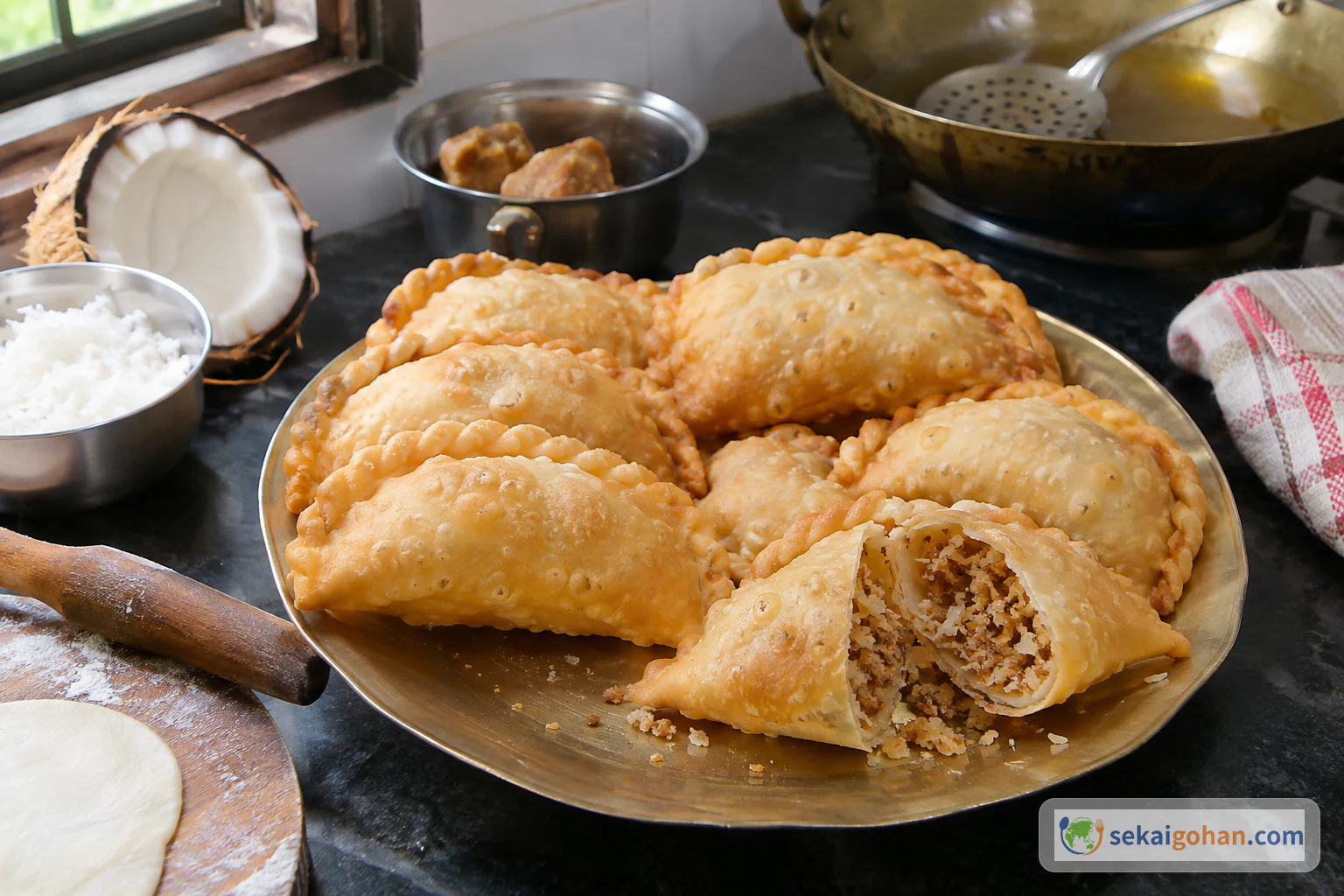
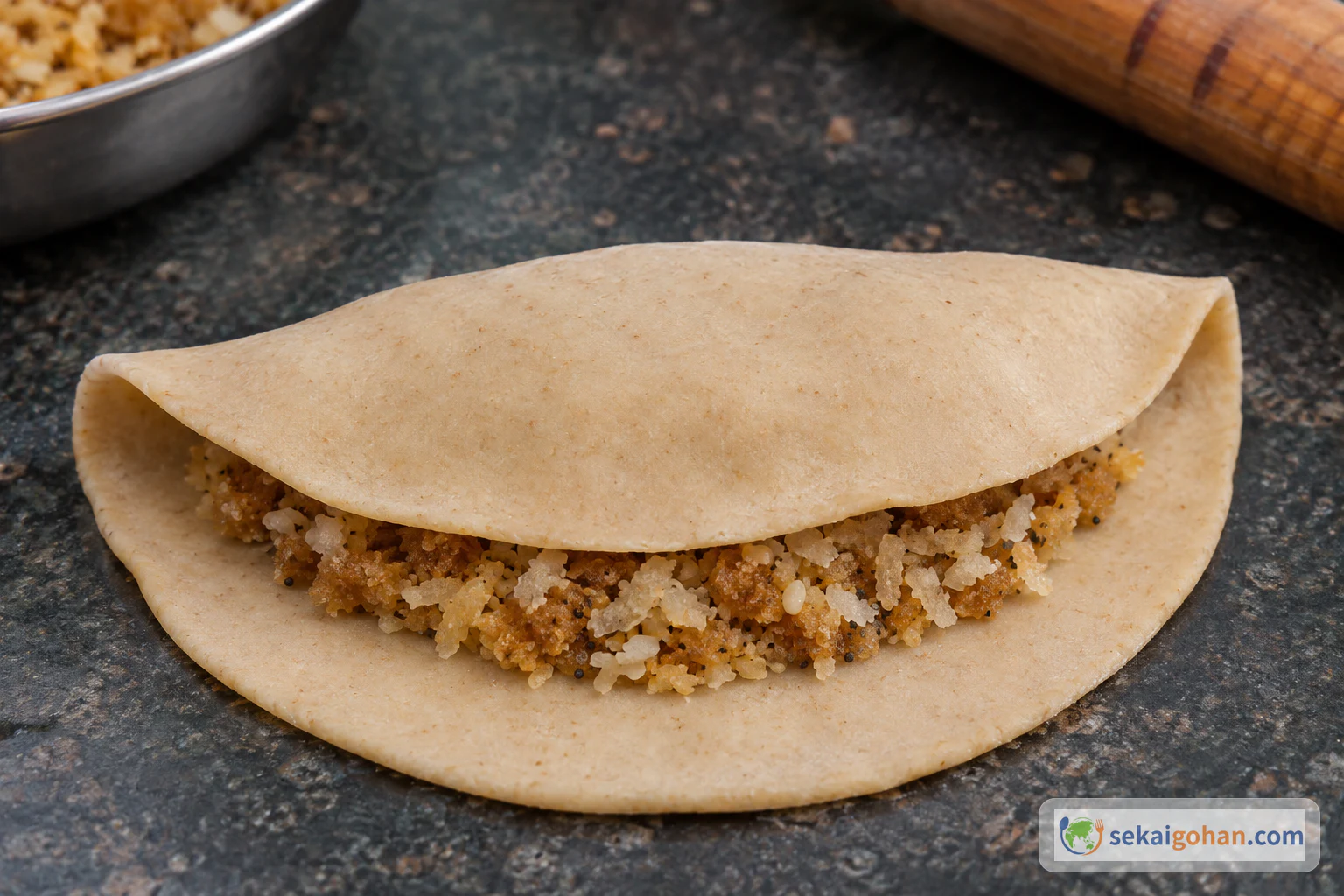
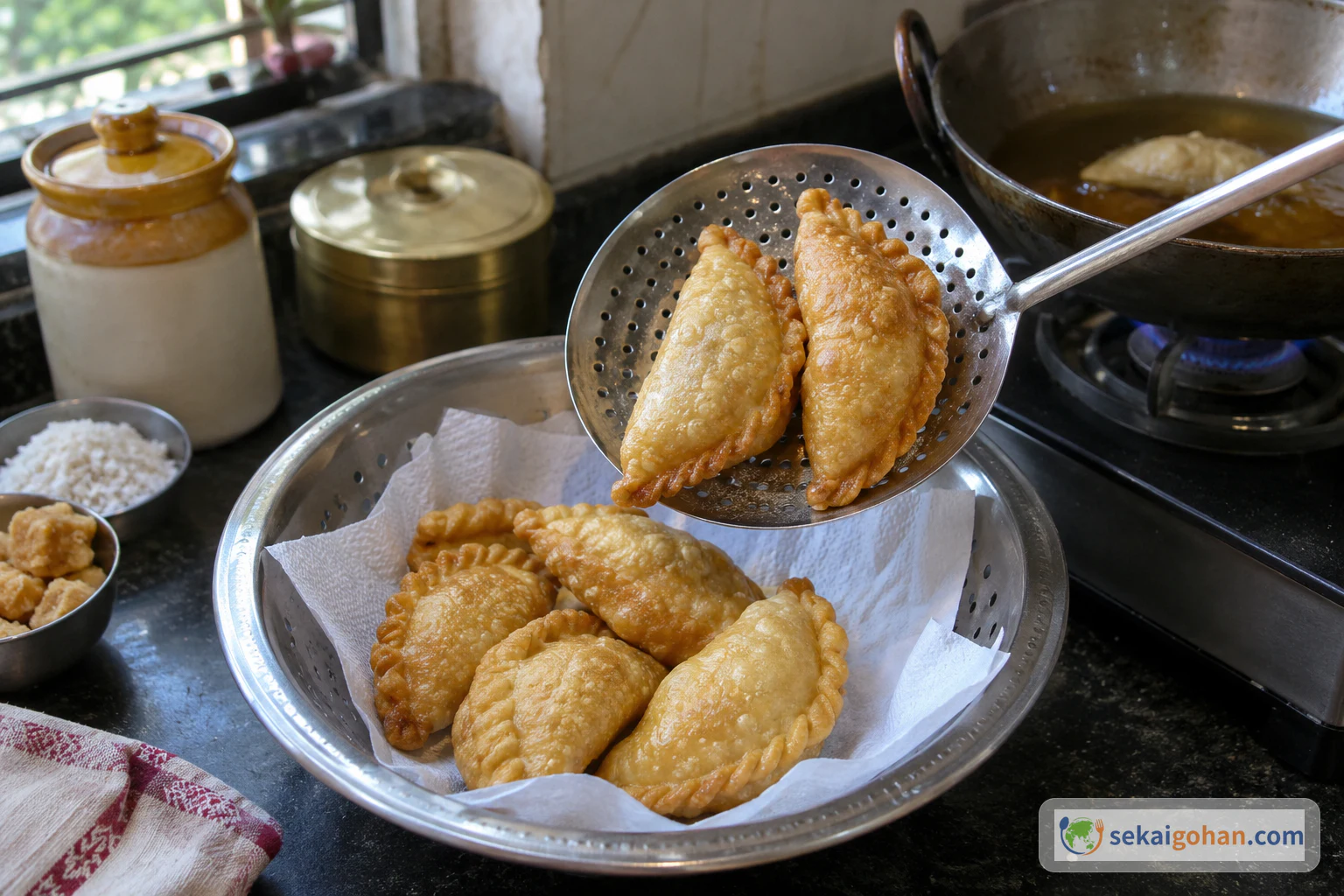
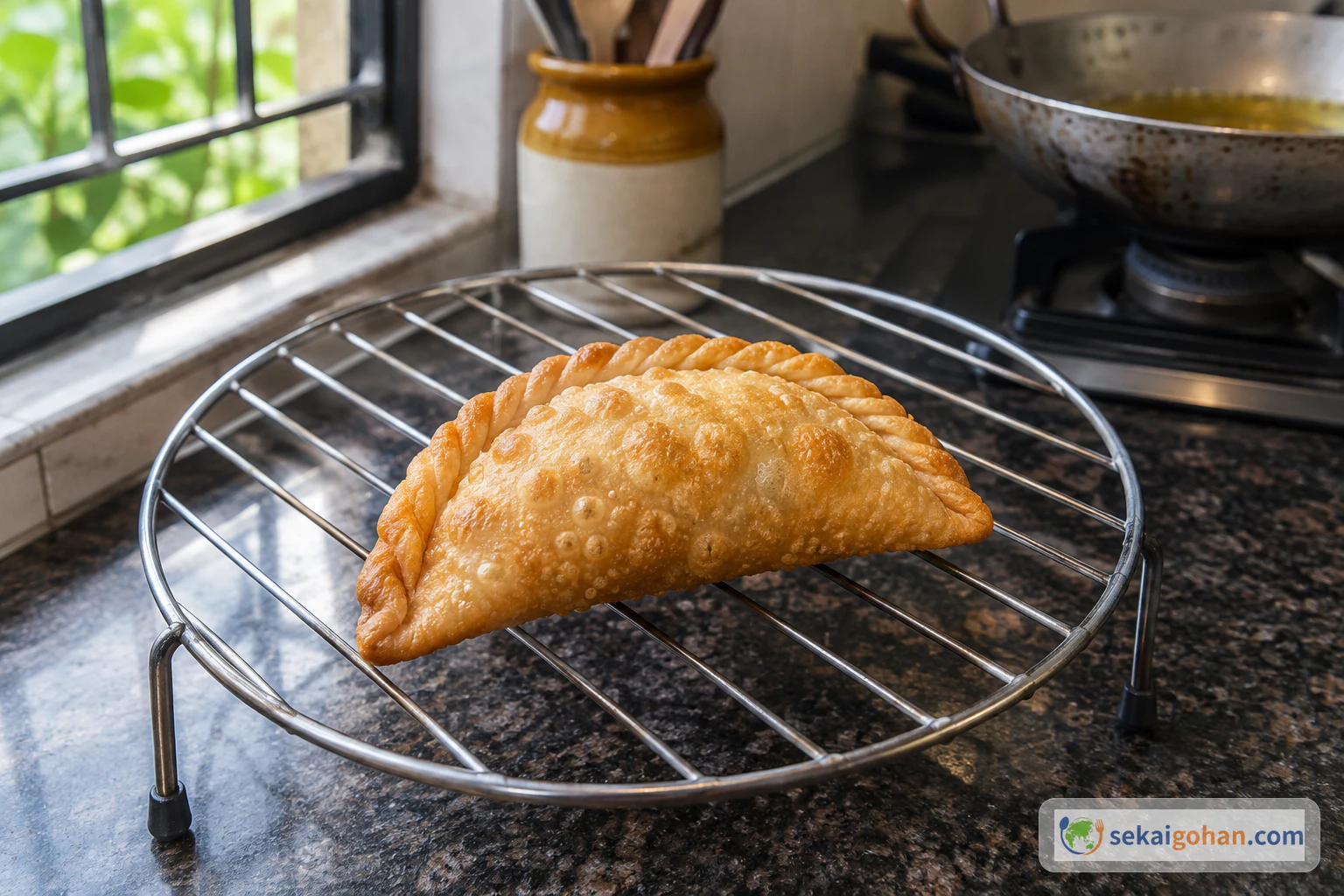

Karanji: A Layered Half-Moon with a Dry, Sweet Filling
This recipe has not been kitchen-tested. It follows one Maharashtrian household's recipe, with one deliberate safety change: the milk dough rests in the refrigerator. The texture may differ from dough rested out in the kitchen. Plan to fry everything the same day and serve it fresh.
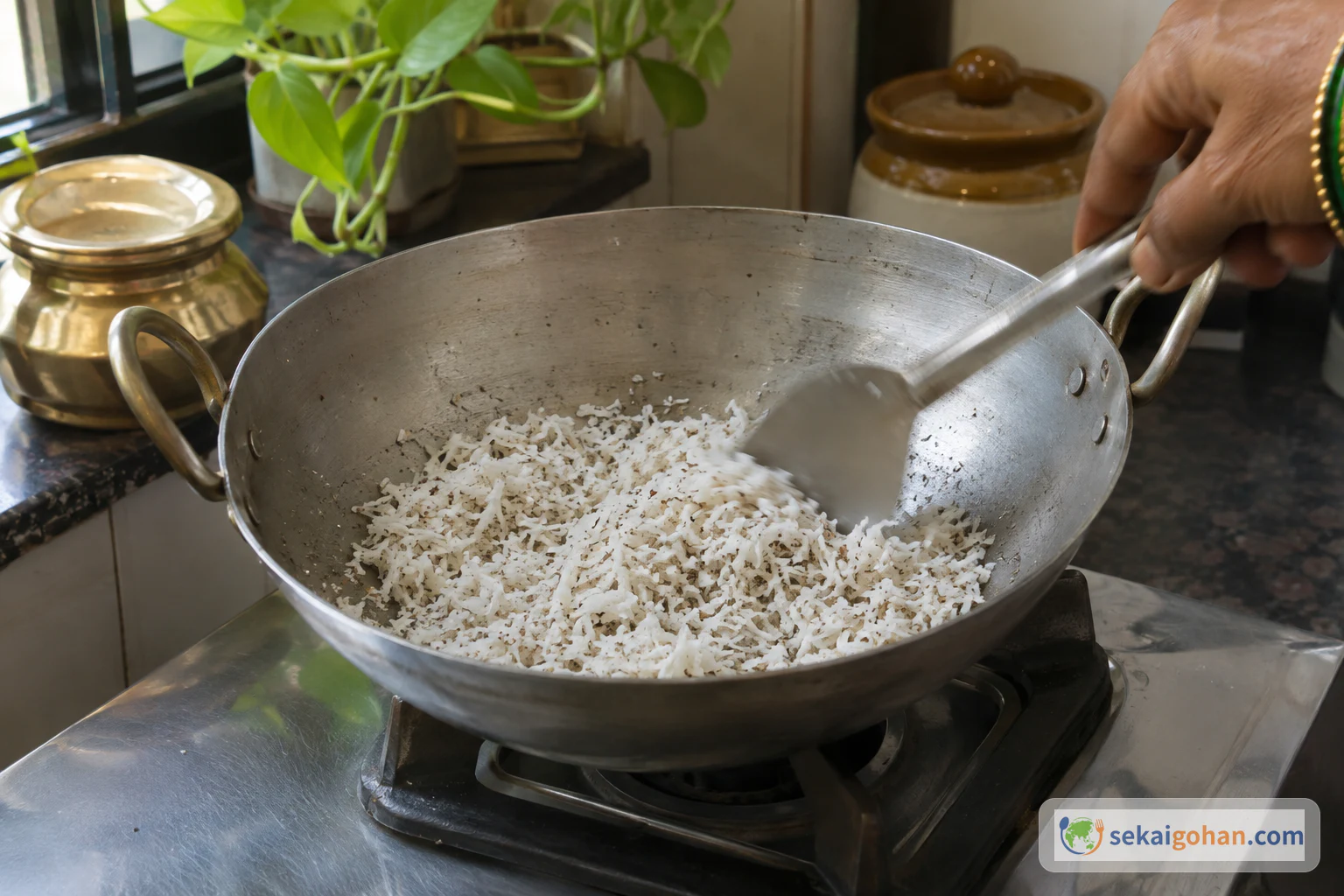
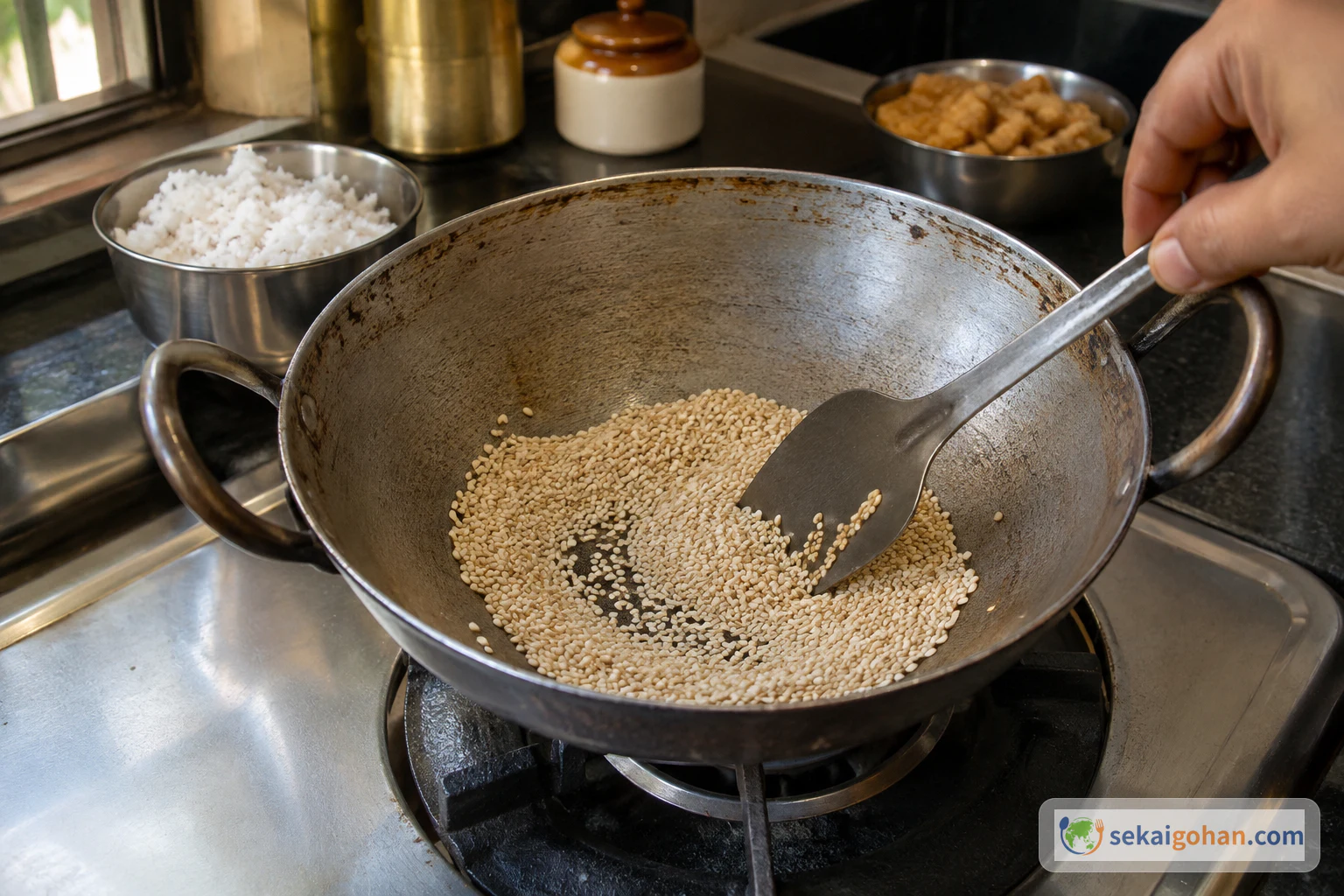
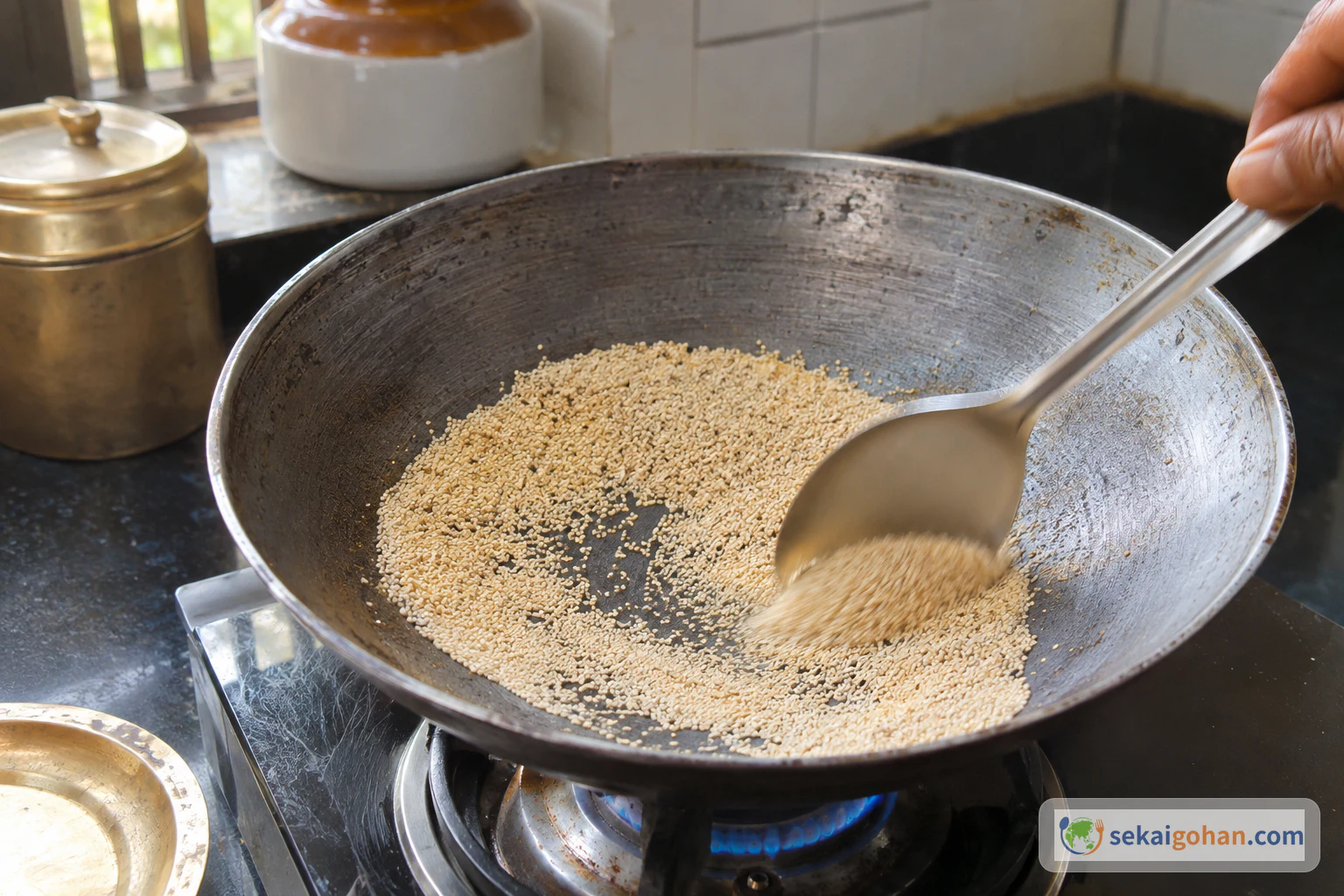
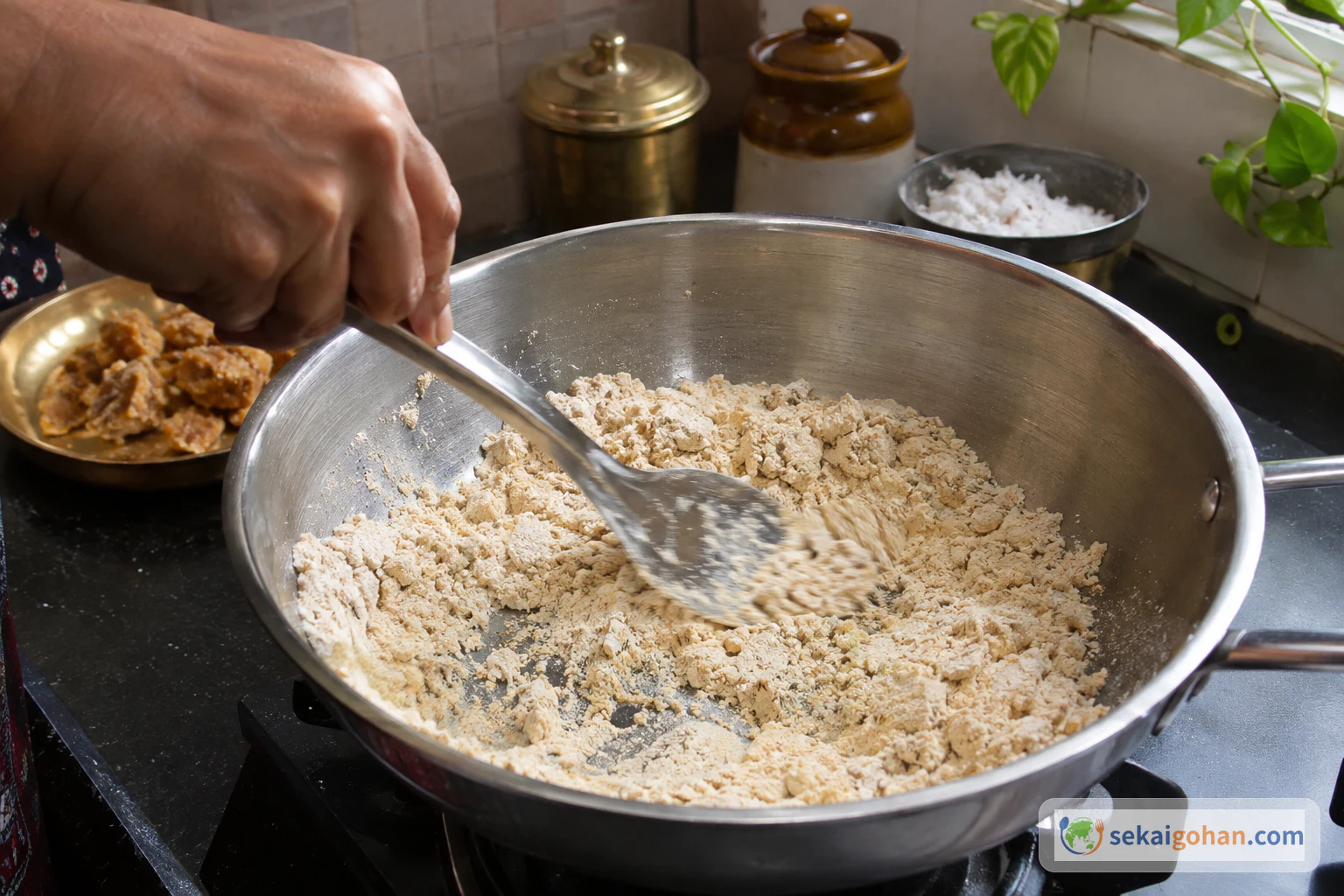
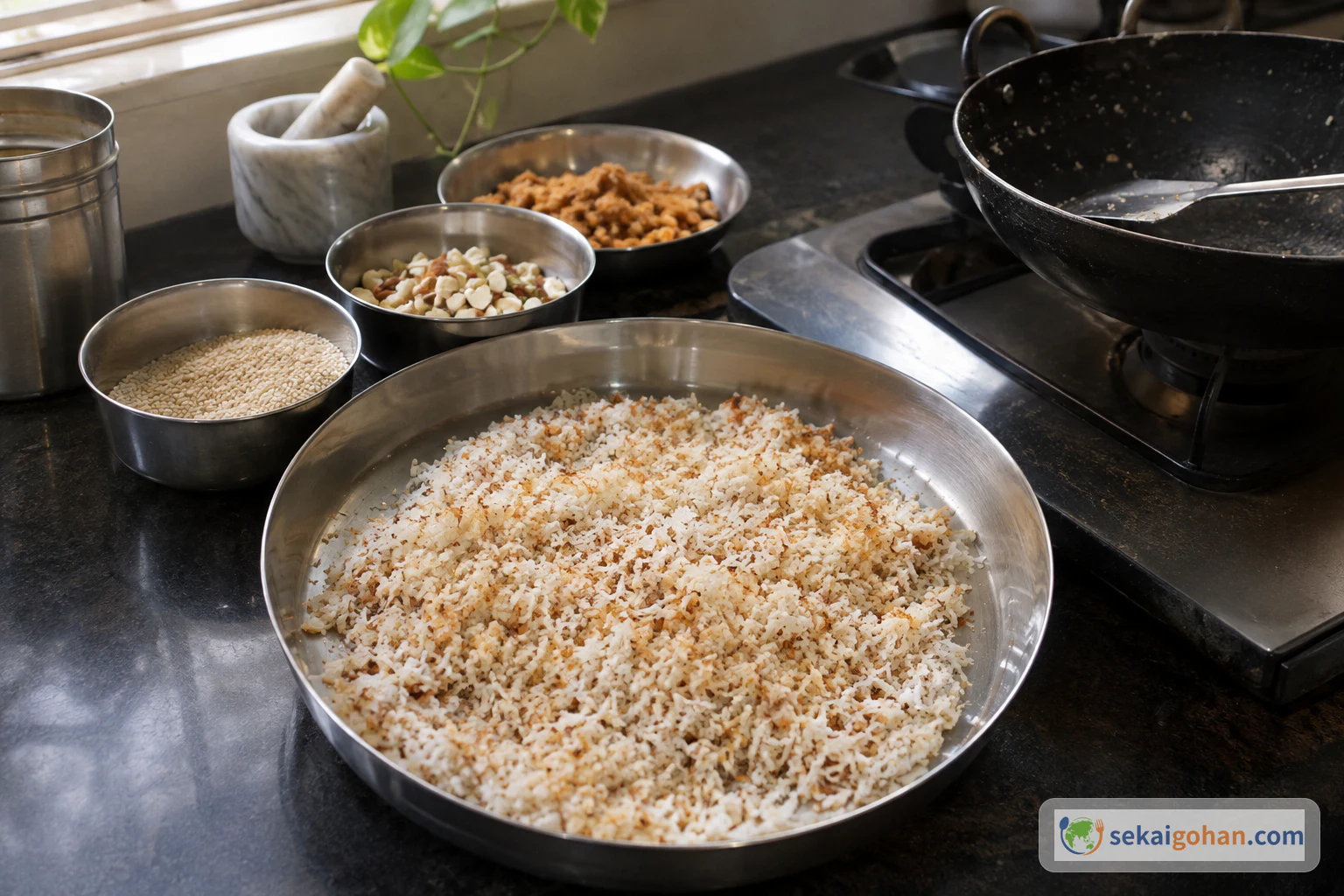
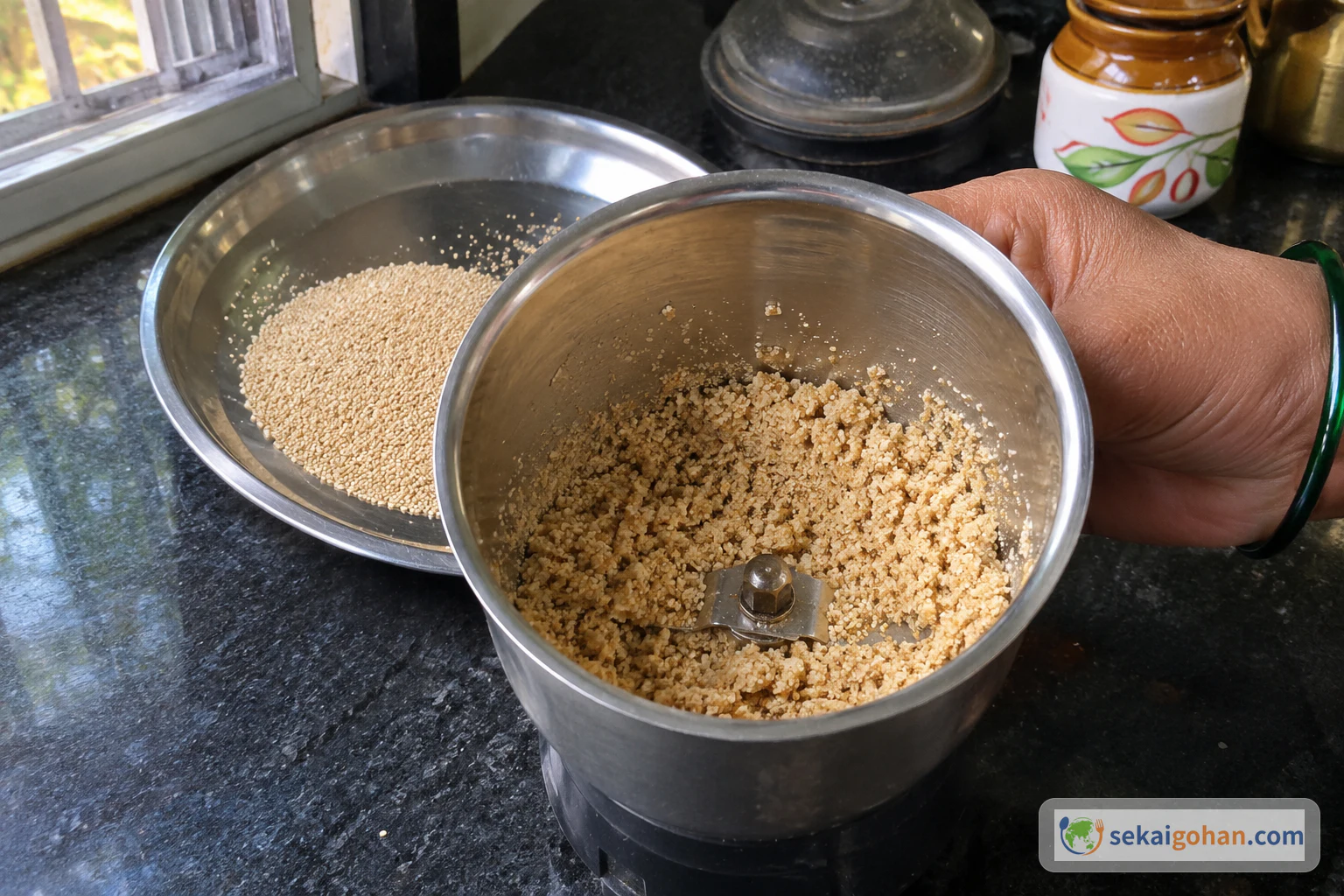
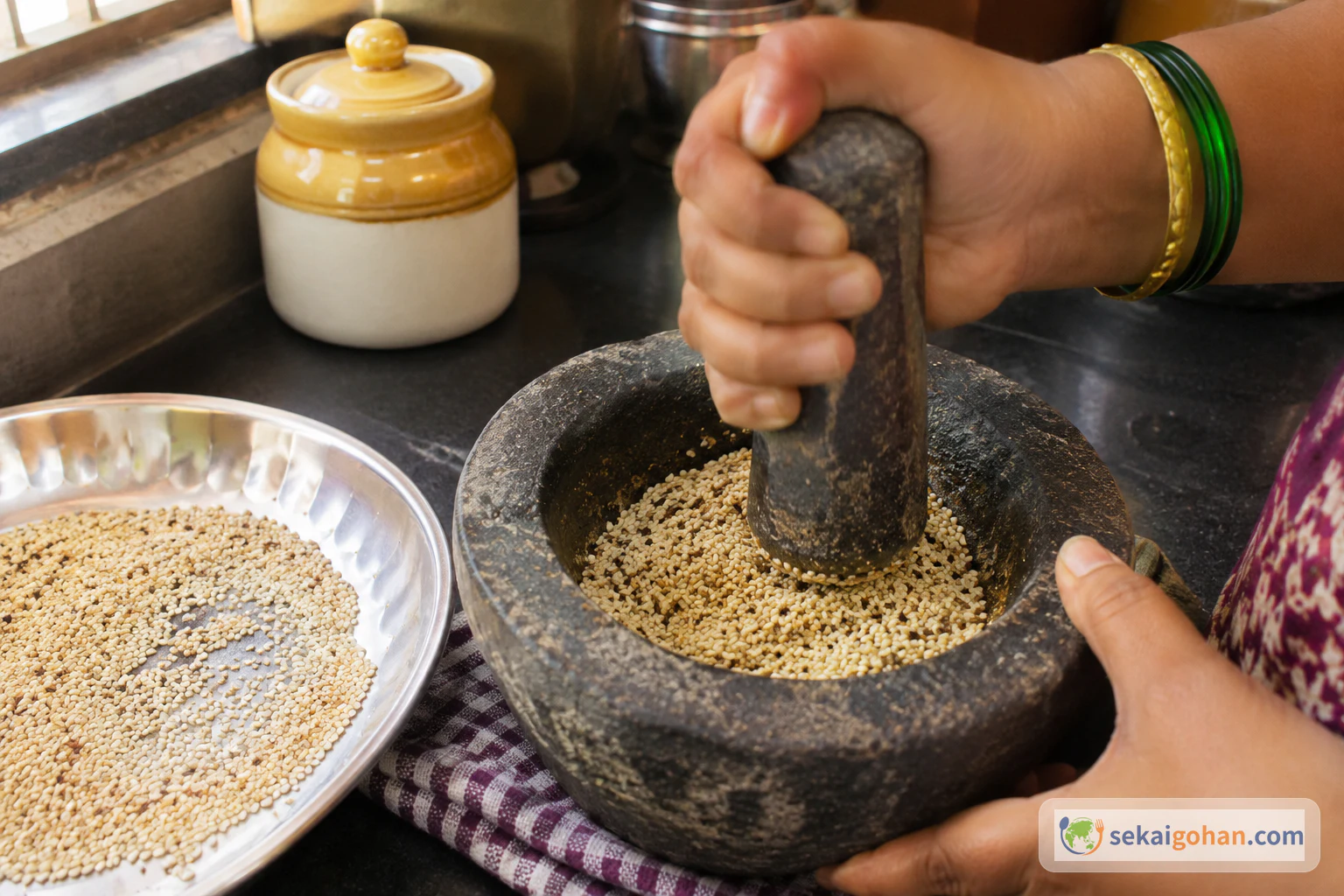
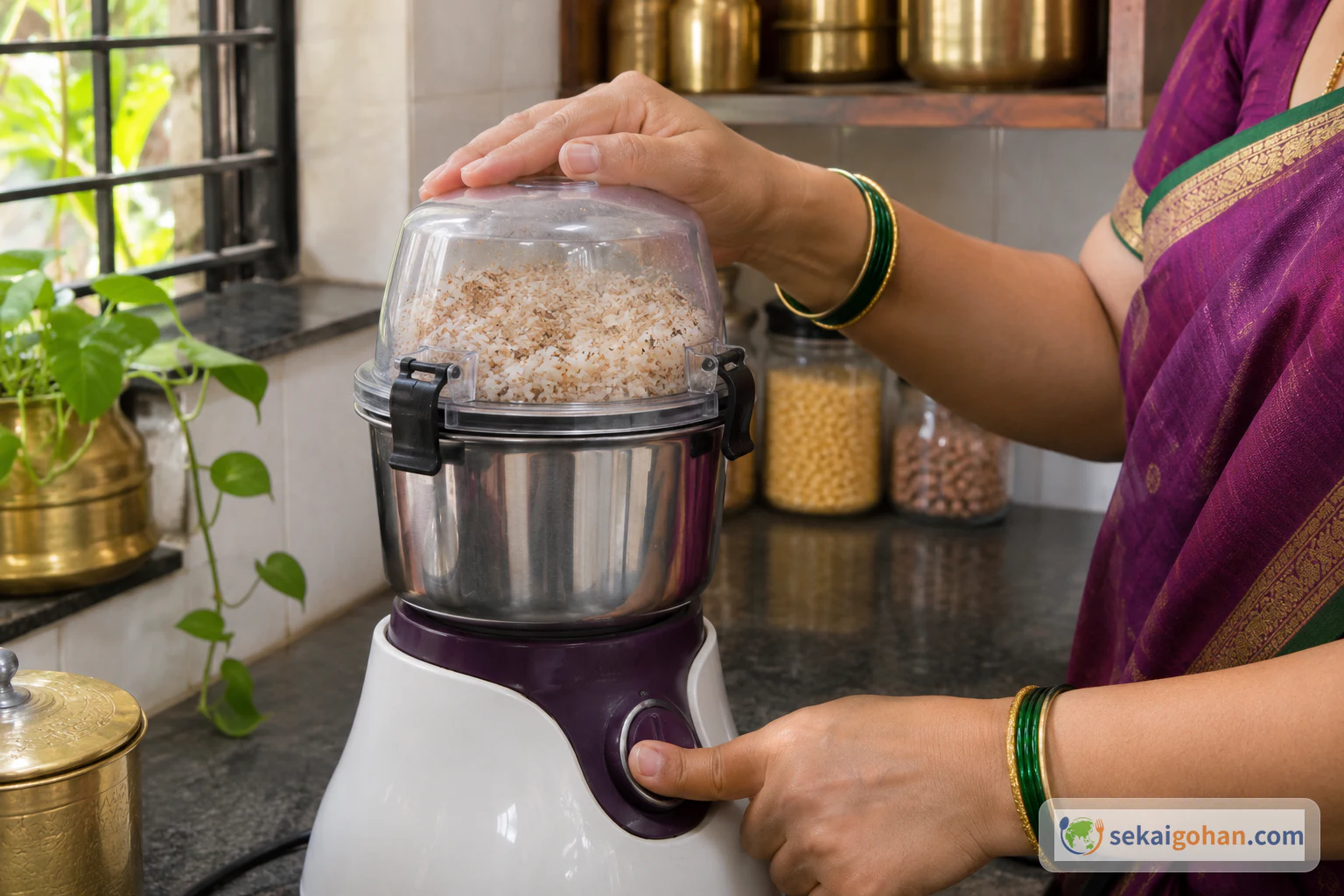
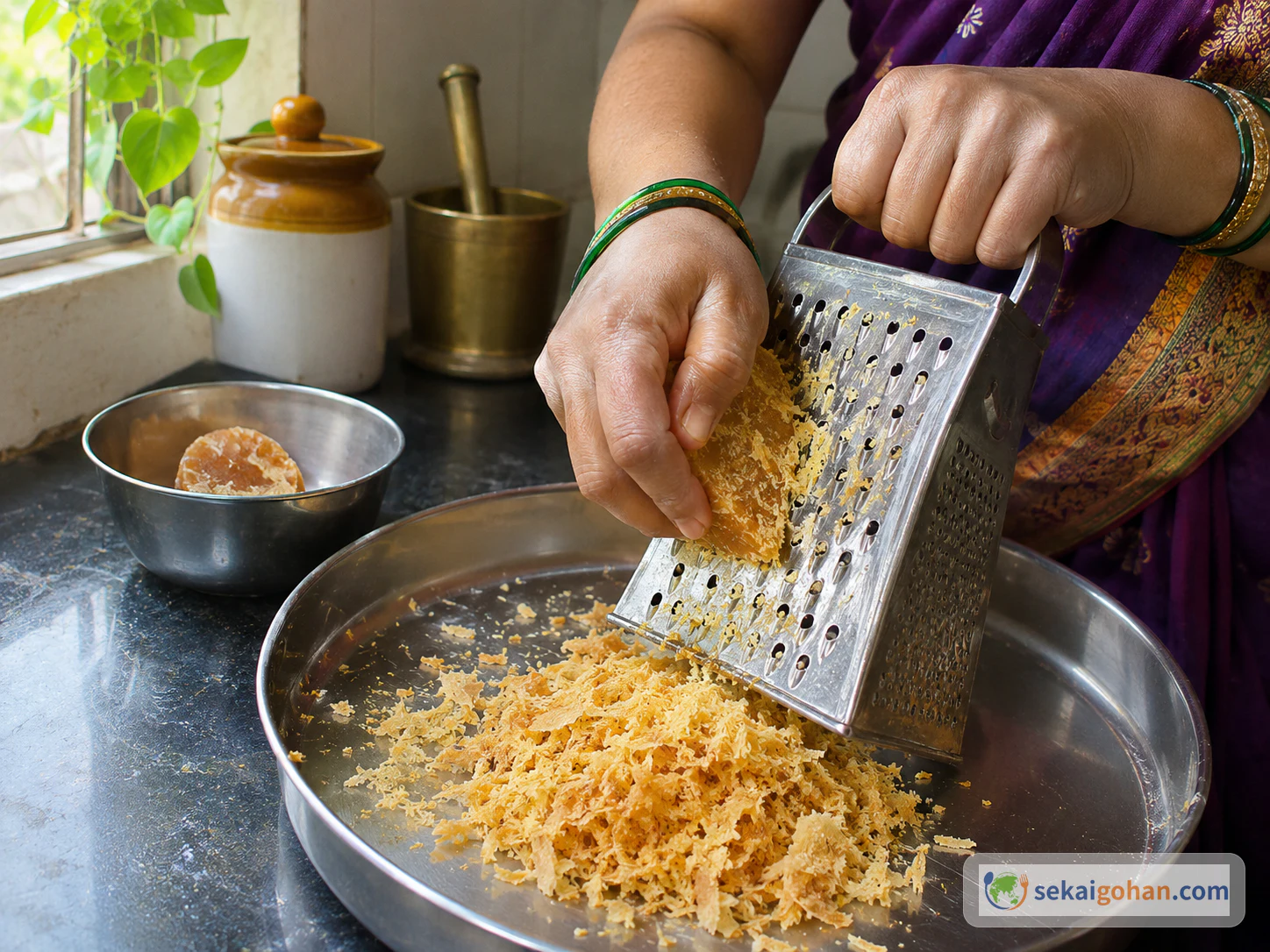
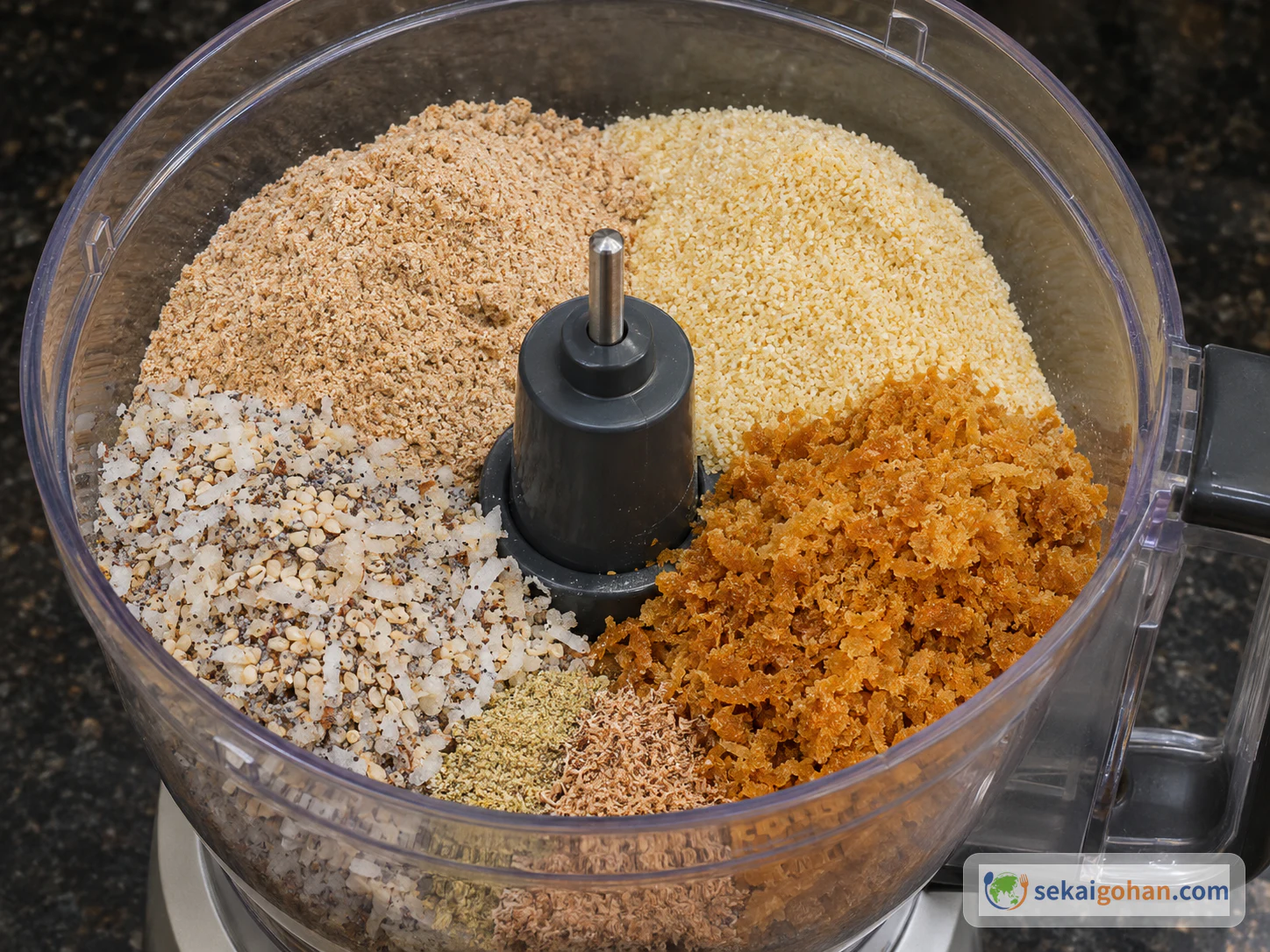
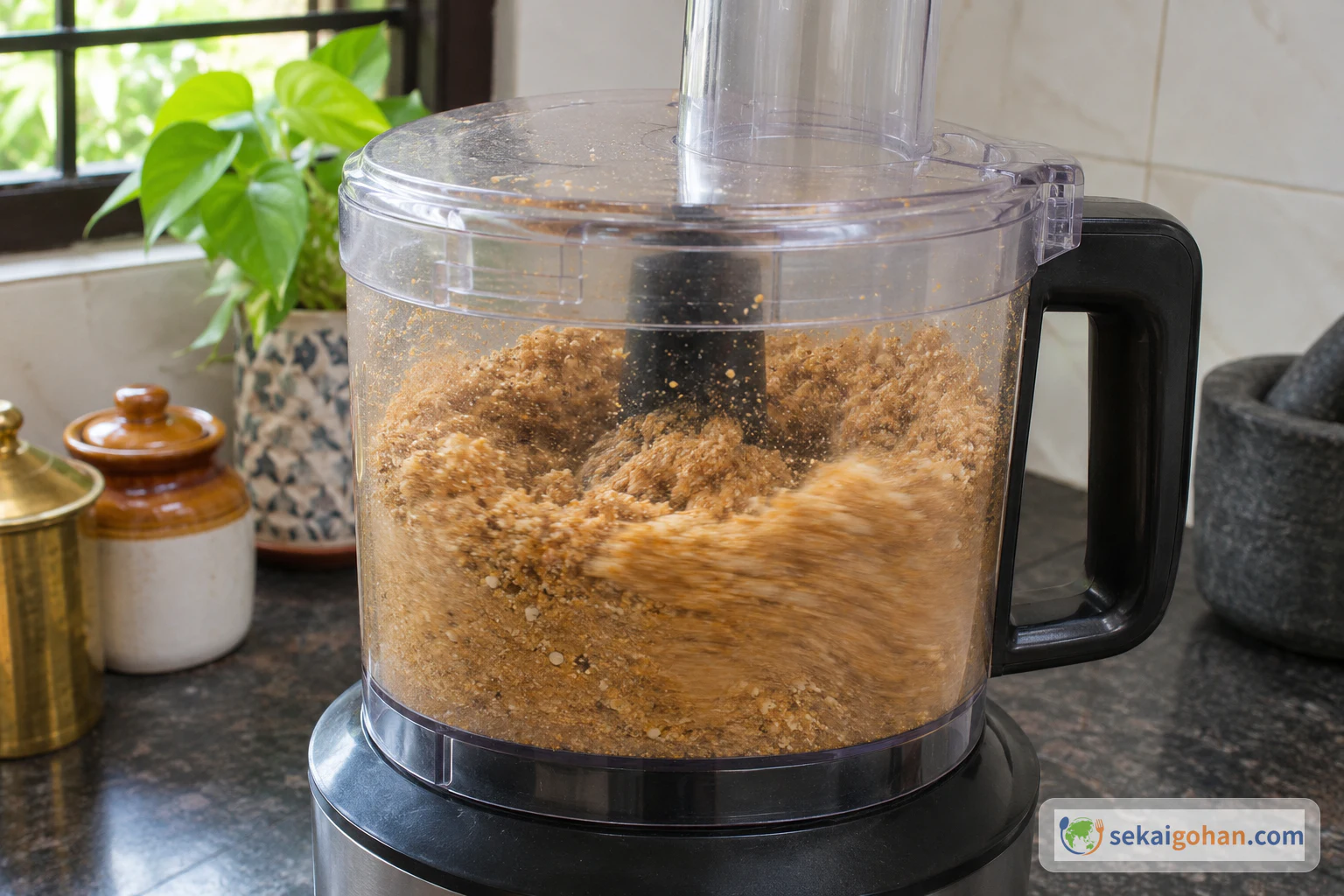
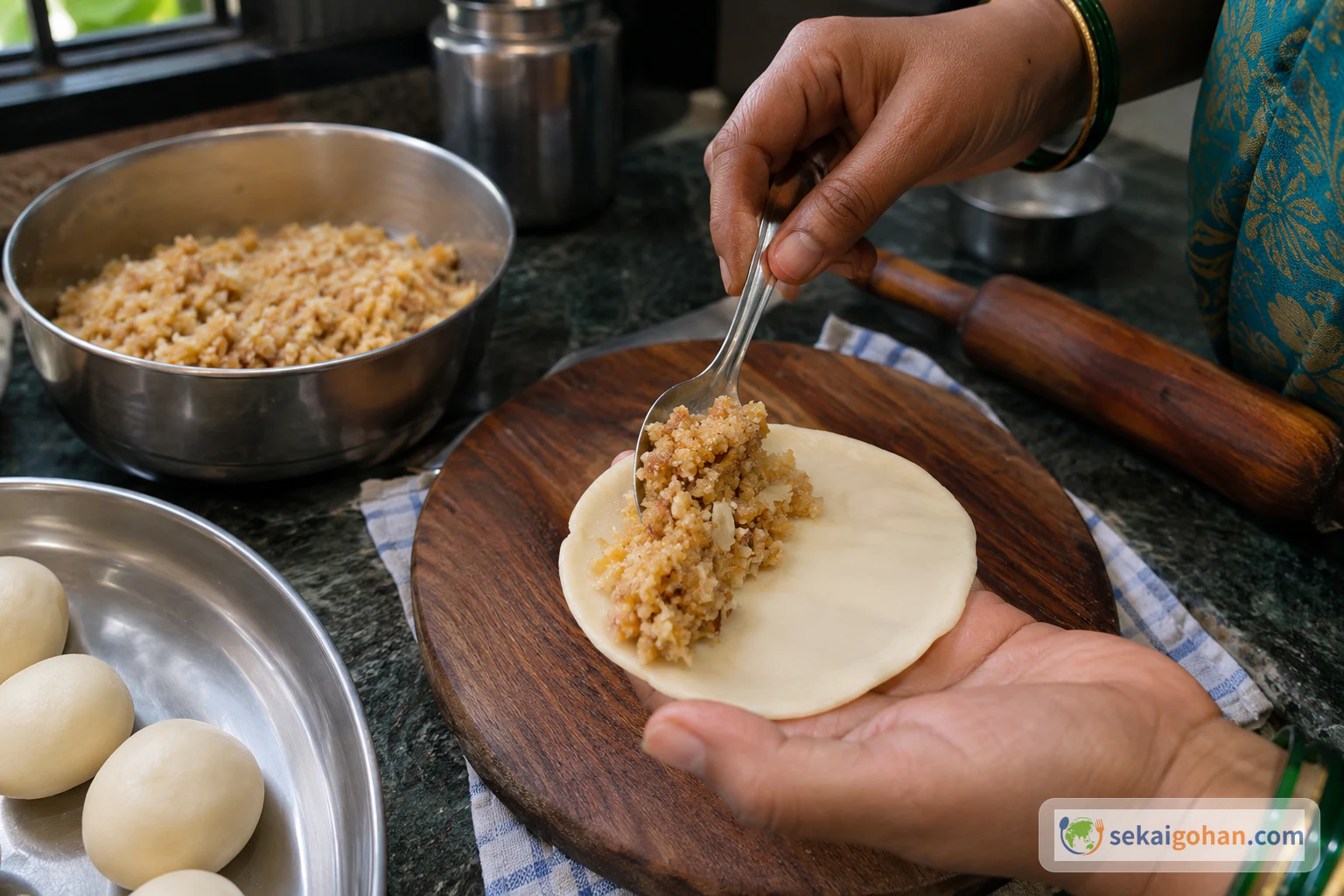
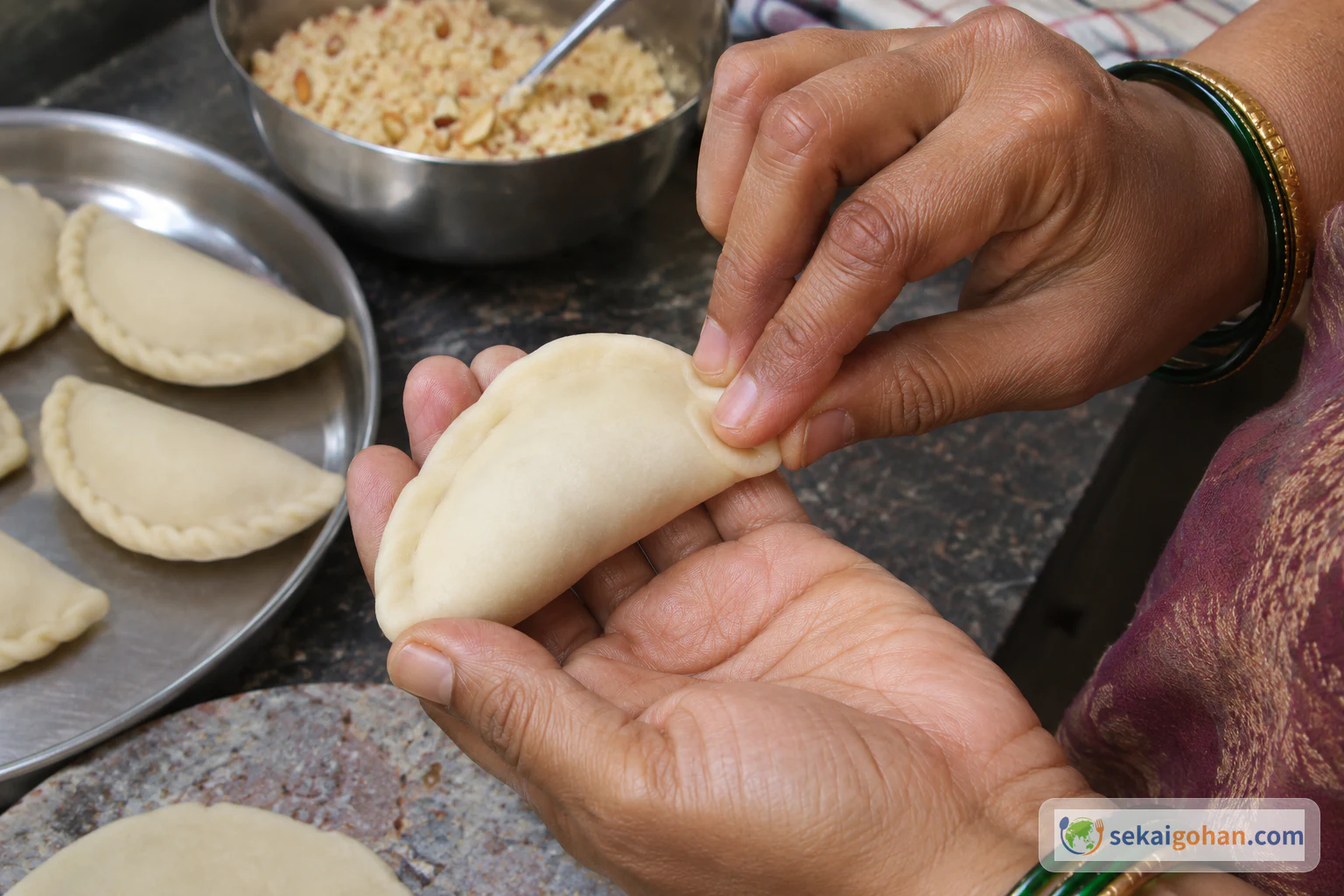
In the days before Diwali, a home kitchen in Maharashtra may be busy with faral, the sweets and snacks made for the festival. For this version of karanji (करंजी), dry coconut, sesame and poppy seeds are roasted one at a time. Each is cooled and ground on its own, then joined by roasted rava, roasted whole wheat flour, grated jaggery, cardamom and nutmeg.
The recipe here comes from Vadani Kaval Gheta, a home-cooking site that records a Maharashtrian household's Diwali faral. Its post separates five fillings, and we use only the traditional fried version with the dry filling. It is one family's record from India, not the single correct karanji.
Ingredients: Filling, Wrapper and Four Separate Uses of Oil
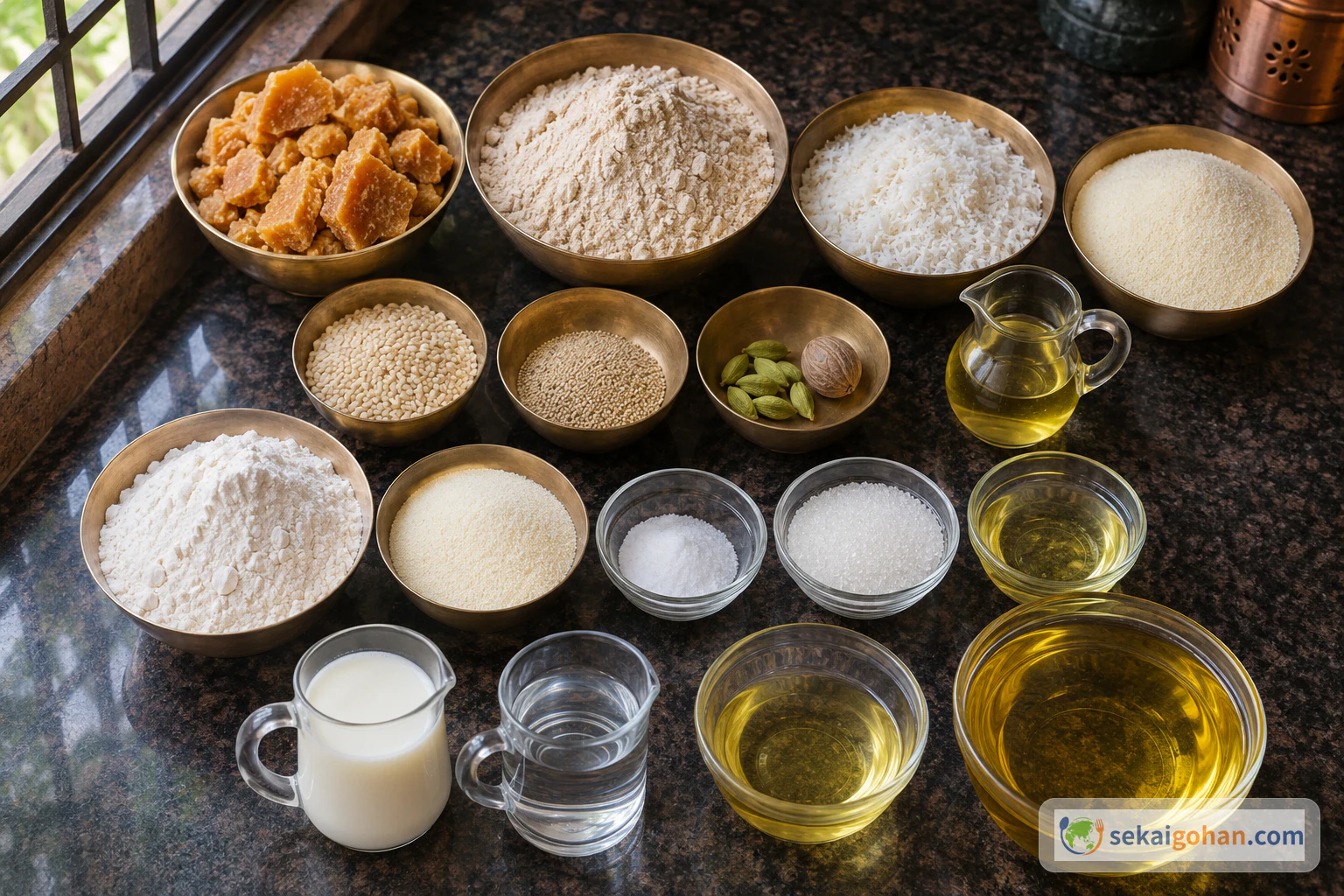
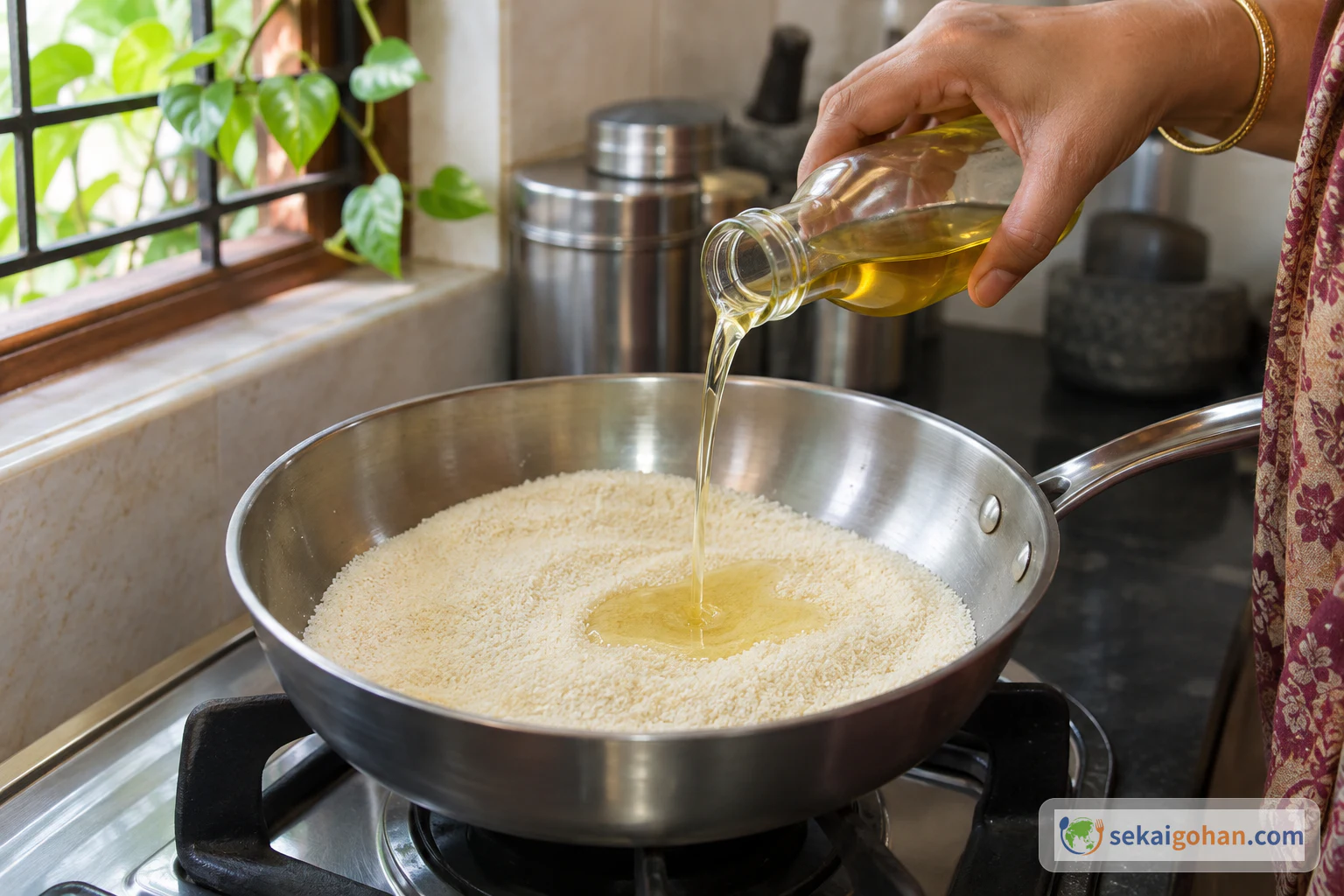
Keep the oils apart as you work. The filling oil, the wrapper oil, the layering oil and the frying oil are all separate amounts.
This recipe contains wheat, milk, sesame and almond. Read the ingredient and product labels for everything you use, including the almond oil.
Equipment
- Pans for dry-roasting and roasting the filling ingredients
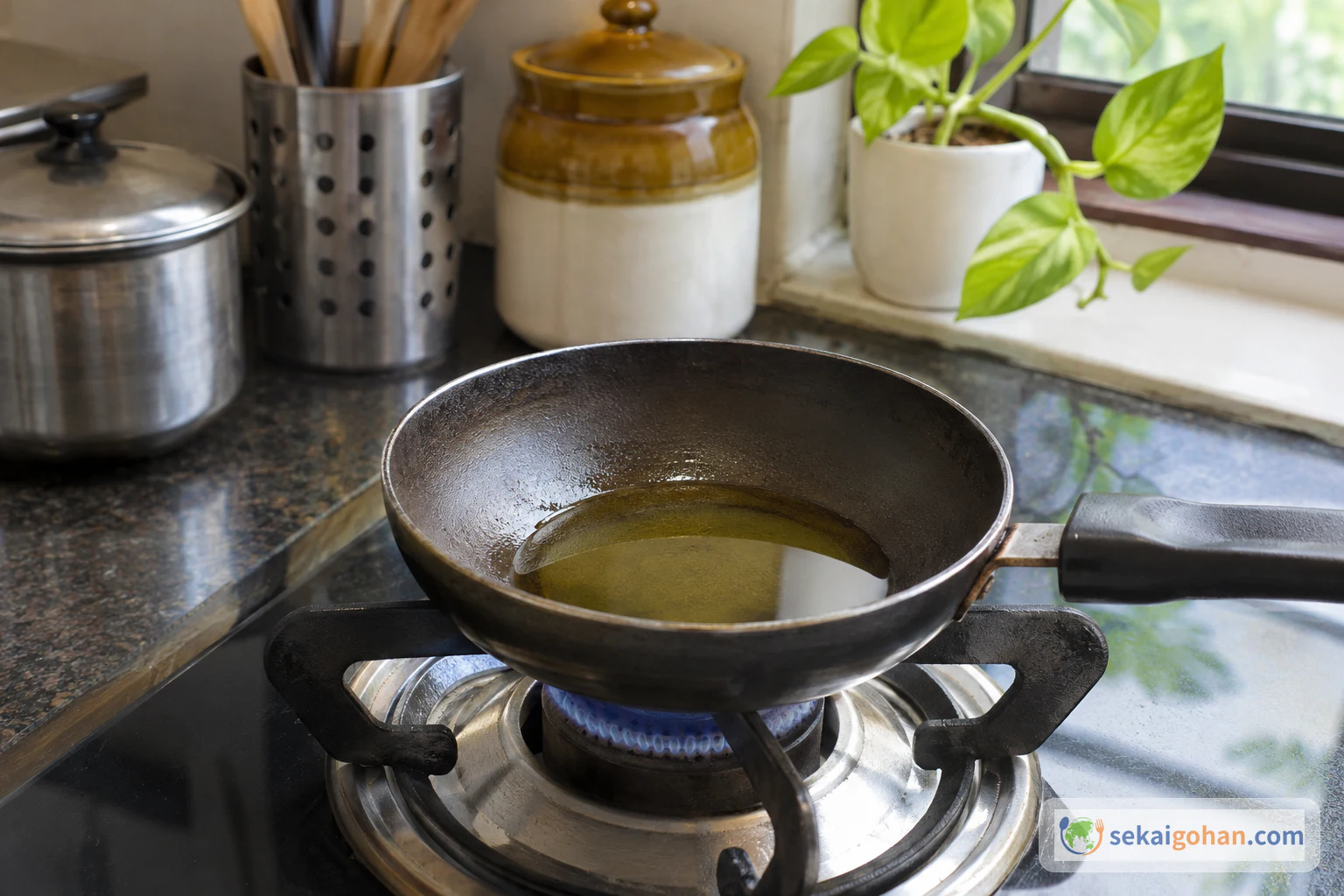
- Small separate pan for heating the wrapper oil
- Spice grinder, small food processor, or mortar and pestle
- Grater for the jaggery
- Food processor for the filling
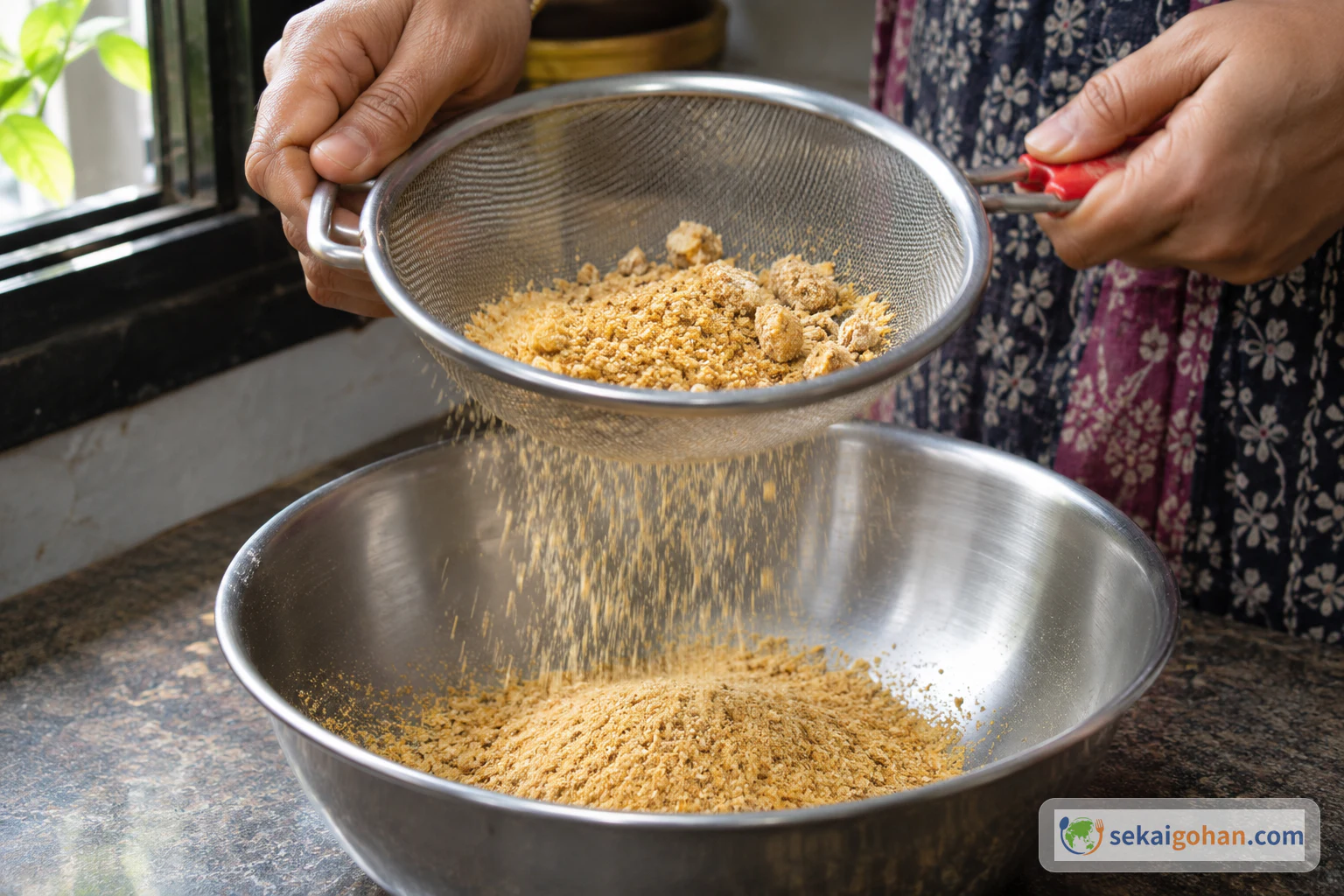
- Fine-mesh sieve, if lumps remain in the filling
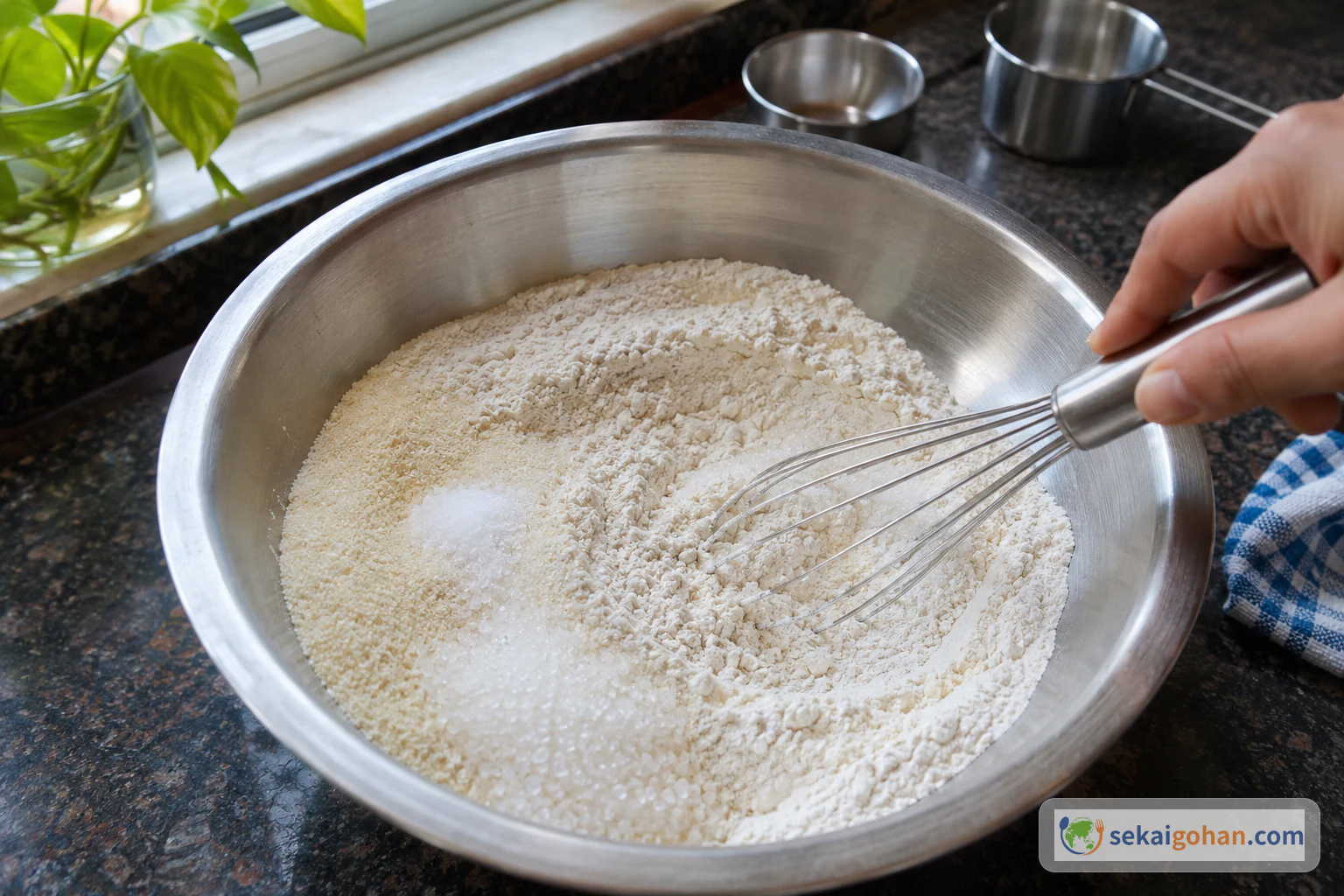
- Mixing bowl and spoon
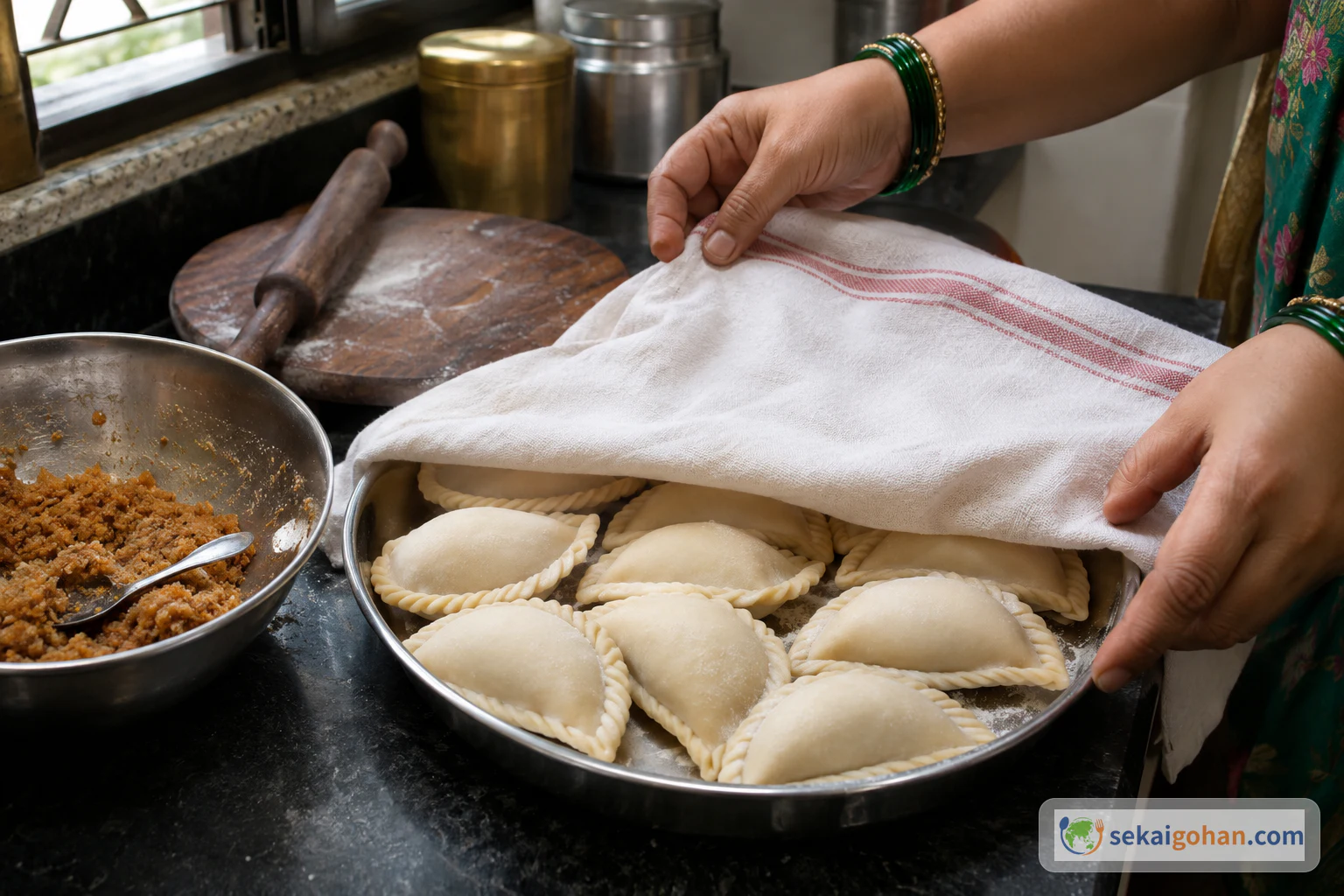
- Clean damp cloth
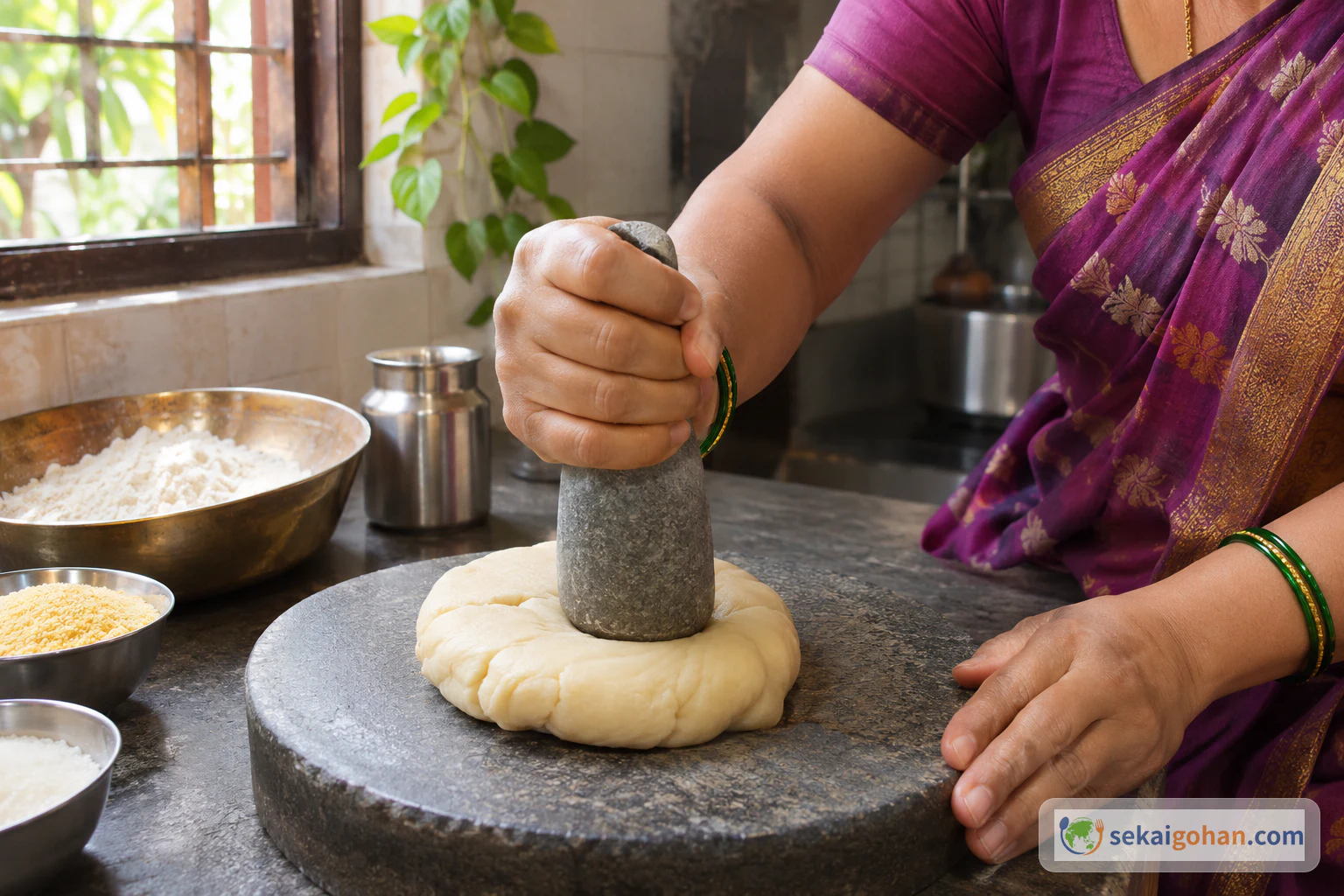
- Clean stone pestle for food use and a sturdy food-use surface
- Rolling pin
- Knife and board
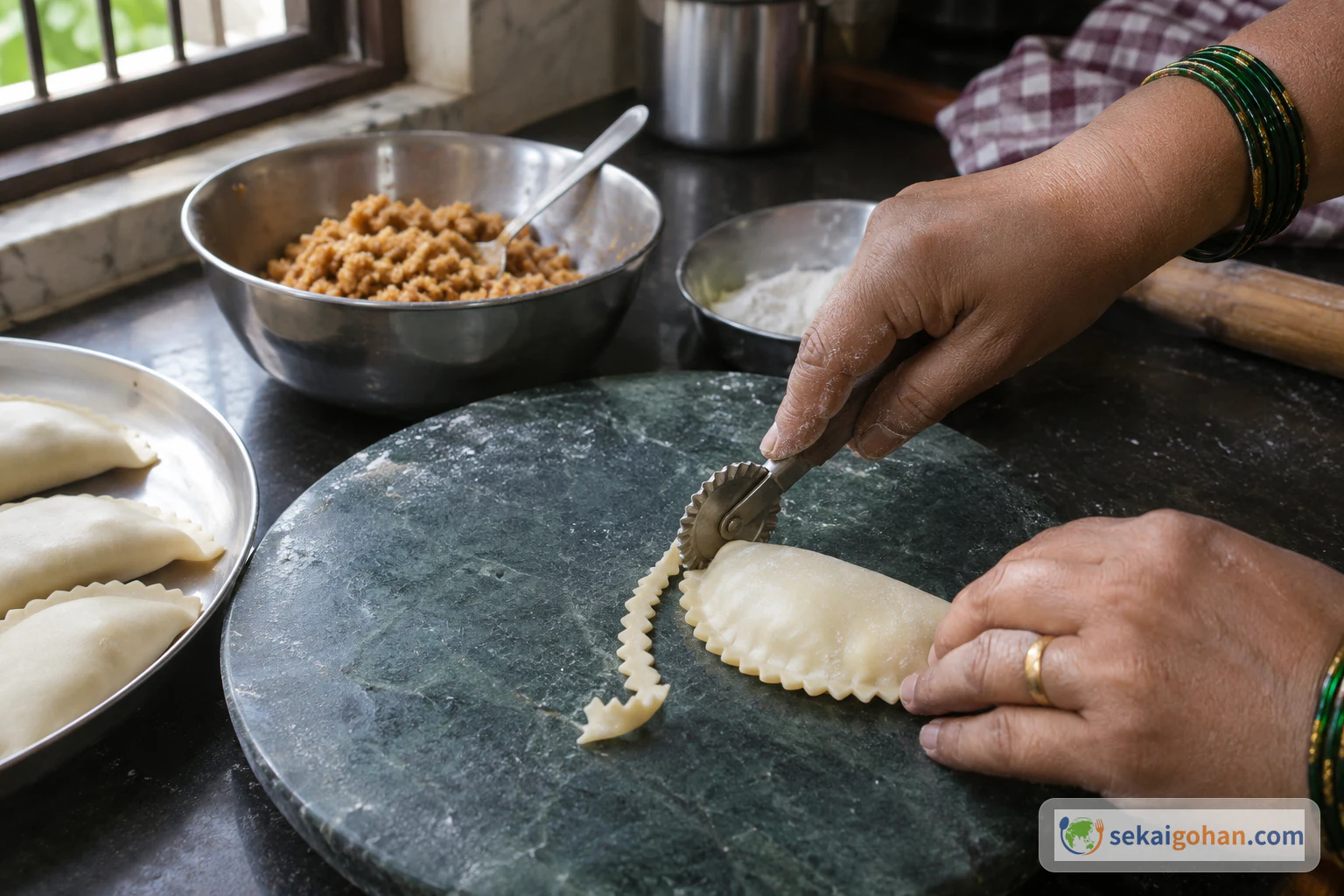
- Pastry cutter
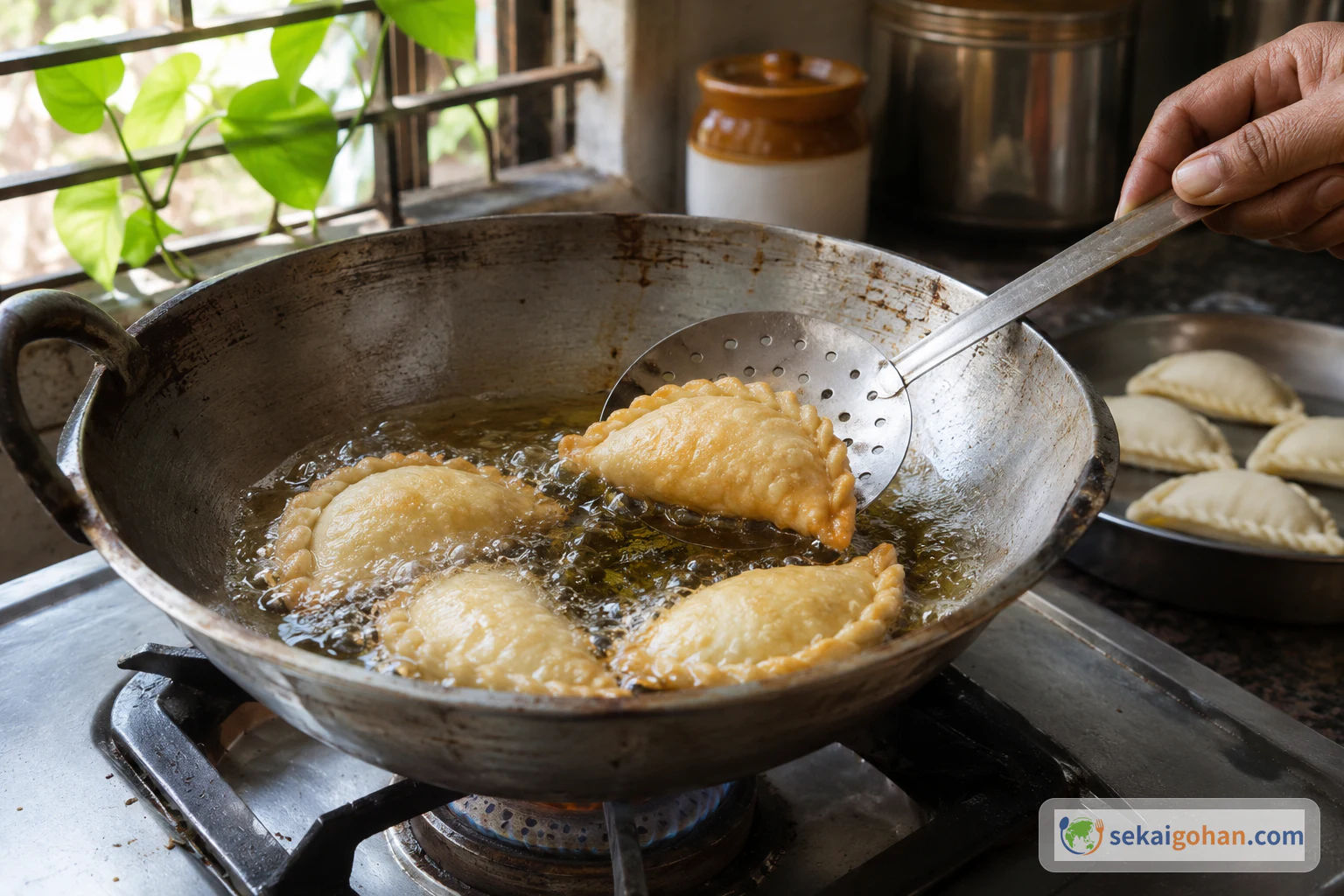
- Deep pan for frying and a slotted spoon or skimmer
- Paper-lined vessel for draining and a rack for cooling
Choosing and Substituting
Jaggery. If you cannot find jaggery, Japanese kokuto (black sugar) is our own suggestion. We have not tried the swap.
Rava. Look for fine semolina. A coarser grain is a different ingredient.
Almond oil. Choose an almond oil sold for eating.
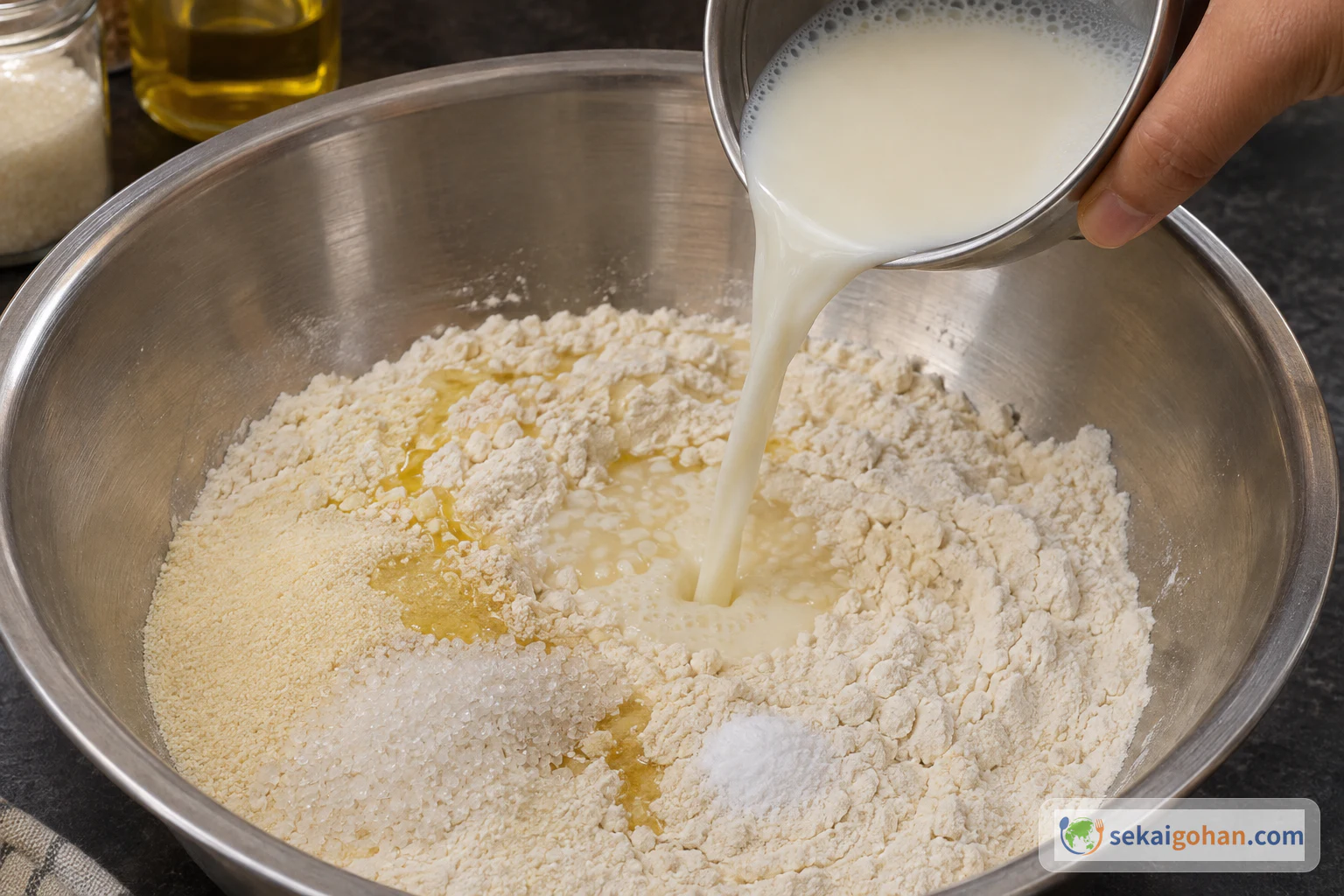
Liquid. This version uses a milk and water mixture, so it is not milk-free. See the FAQ for how we arrived at it.
Why This Dough Rests in the Refrigerator
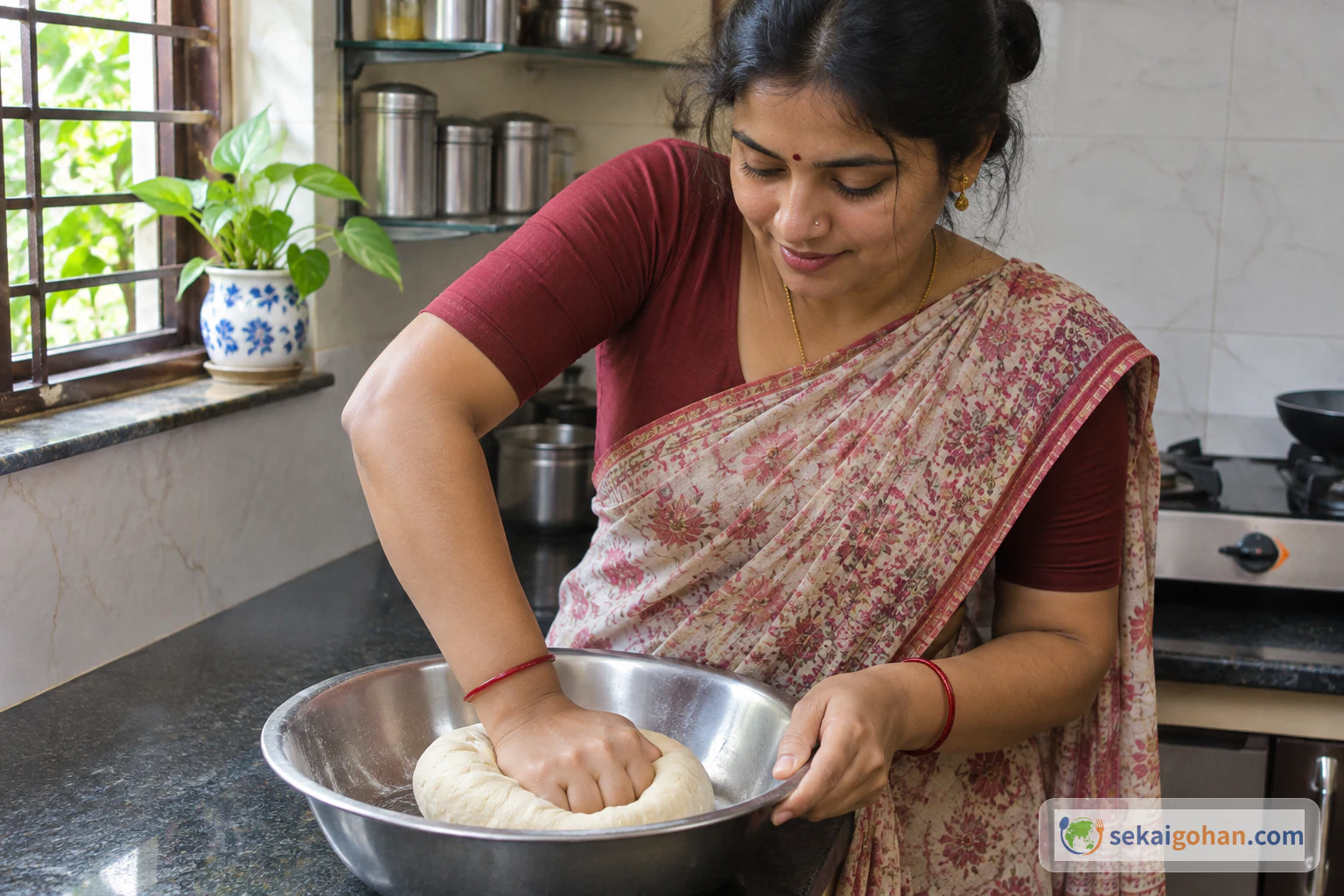
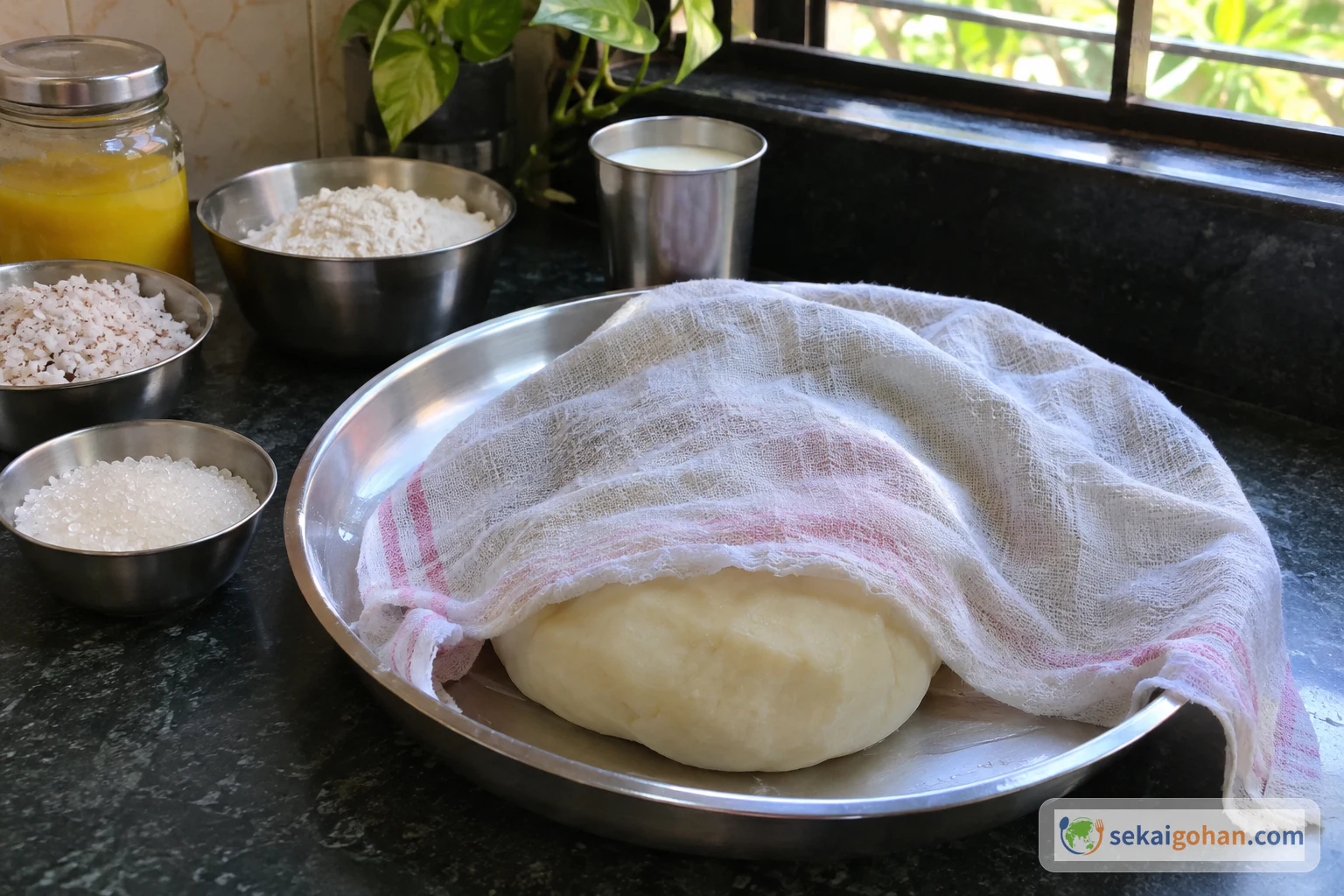
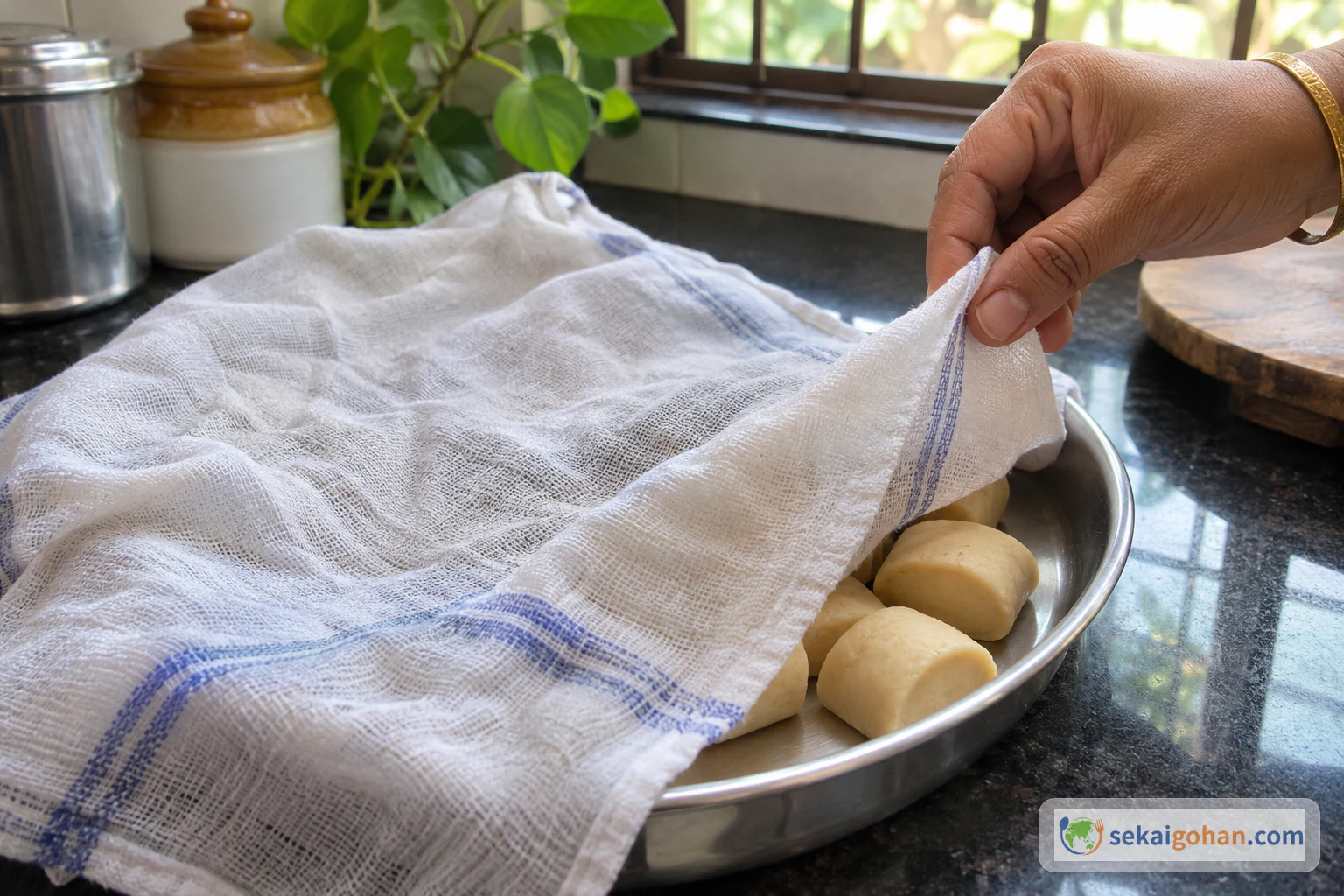
Vadani Kaval Gheta says to cover the dough with a damp towel and set it aside for at least 2 hours. It does not say whether that means room temperature or the refrigerator. Karanji dough with milk in it is a perishable food, and this is not a fermented recipe, so we changed the rest to 2 hours in the refrigerator. This is our editorial safety change, not a faithful reproduction of the recipe.
The limits below come from general food-safety guidance, not from any rule written for this dough:
- Refrigerator temperature. The US CDC and FDA say 40°F (4°C) or below. Japan's Ministry of Health, Labour and Welfare gives 10°C or below as its guide.
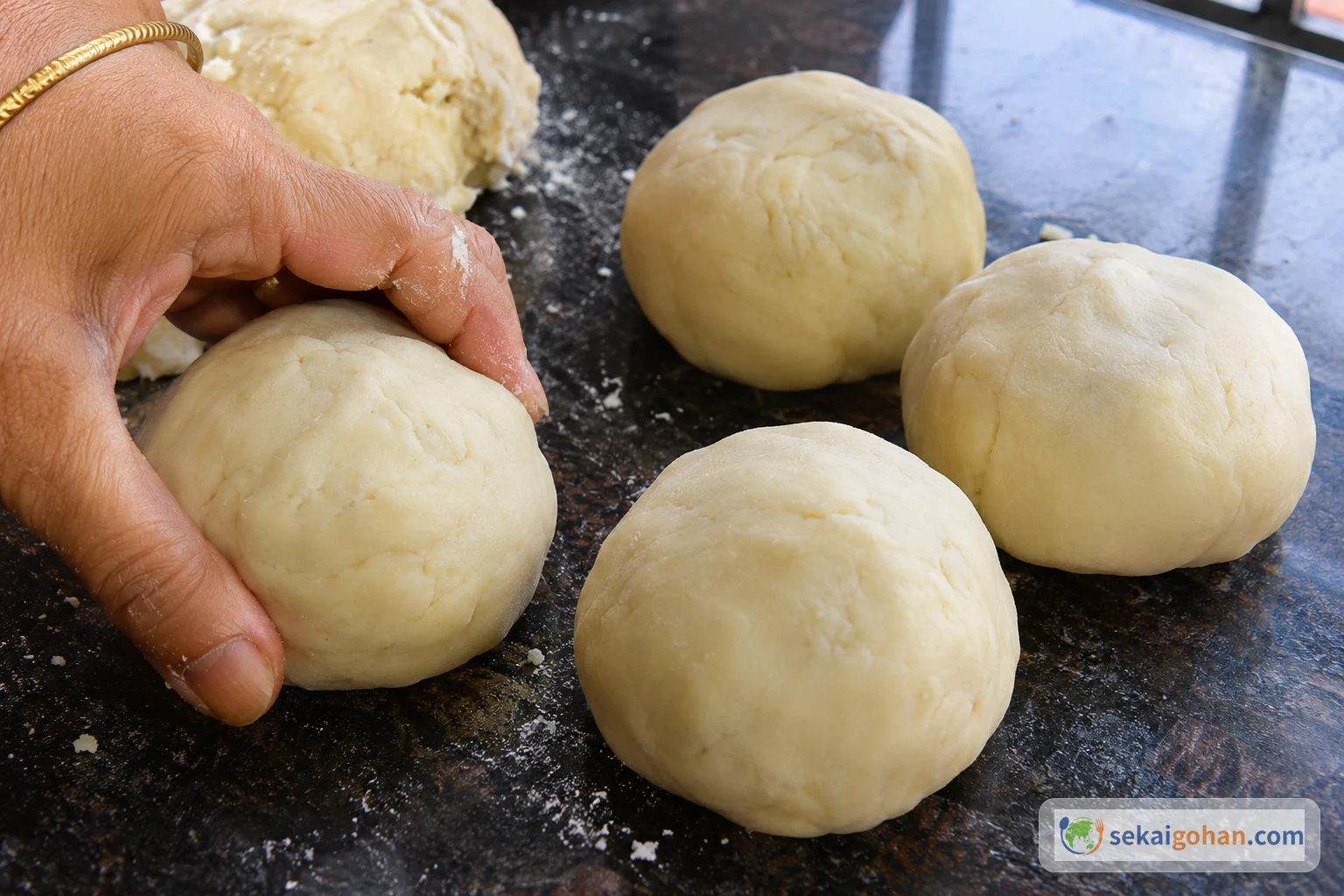
- Time out of the refrigerator. The CDC and FDA say perishable food should not sit out for more than 2 hours, or 1 hour above 90°F (32°C). We apply that limit to the combined time for kneading, 15–20 minutes of pounding, dividing, shaping and waiting to fry. Adding the periods together is our cautious reading of the general rule.
- Stopping midway. The Ministry advises putting food in the refrigerator if you stop cooking partway through. Return any dough you are not working on, covered.
- When to discard. Do not use dough that has been out longer than the limit. Throw it away, in line with the Ministry's advice to discard food left out too long.
- No carrying over. We found no guidance on how long chilled dough keeps, so fry everything the same day you finish resting it.
There is some precedent for chilling related doughs. The baked karanji in the same Vadani Kaval Gheta post is refrigerated for at least an hour, and Chef Kunal Kapur's baked gujiya rests under a damp cloth in the refrigerator for 15 minutes. Both are water doughs, and we found no recipe that chills a milk dough this way for 2 hours. We have not made this version, so we cannot say how firm or easy to handle the dough will be.
Start only when you can work straight through to frying and serving on the same day. Keep your time out of the refrigerator within 2 hours, or 1 hour above 90°F (32°C).
Turning the pastries, watching for a golden color, draining and the fresh-serving limit are editorial additions. A test that drops flour into the hot oil to watch it sizzle is left out to avoid spatter.
Troubleshooting
| What happens | What to do |
|---|---|
| Large lumps remain in the filling | Shake it through a sieve (step 12) |
| The food processor is straining during the long run | Stop and follow the manual, using short pulses and rests |
| You have to stop partway through | Cover the dough or formed pastries and put them in the refrigerator |
| Dough has been out longer than the limit | Throw it away. Do not fry it |
| You may not finish frying today | We have no safe holding time to offer for the next day, so start the dough only when you can finish in one day |
| The chilled dough handles differently than you expected | We have not made this version, so we cannot predict its firmness or say how to correct it |
| Fried karanji are still uneaten after the time limit | Plan the amount you fry so that everything is eaten within 2 hours of frying, or 1 hour above 90°F (32°C) |
Variations
The Vadani Kaval Gheta post separates five fillings, and also gives a baked karanji made from a water dough. This article does not borrow from those versions, and we do not recommend mixing their steps or amounts with this one.
Other recipes follow similar lines with different details. Archana's Kitchen describes a similar filling of dry coconut, sesame, poppy seeds, semolina and wheat flour, with its own quantities and method. Loksatta gives a separate dry-coconut and rava version. Khoya fillings and fillings with a different sugar mix are also separate recipes, and we have not folded them in here.
Karanji in Maharashtra's Diwali Faral
Both the Marathi newspaper Loksatta and Vadani Kaval Gheta place karanji in the setting of Diwali faral. Loksatta also notes that karanji recipes vary across India. A course text from Uttarakhand Open University lists karanji among Maharashtra's regional names for related fried sweet pastries, and describes it with coconut, nuts, cardamom and nutmeg.
Those sources show a family of related pastries, but they do not settle where karanji began or when, so we make no claim about its origin. Gujiya and Goan nevri are related in form but are separate regional dishes, and we do not treat them as this recipe.
Frequently Asked Questions
Why are there so many separate amounts of oil?
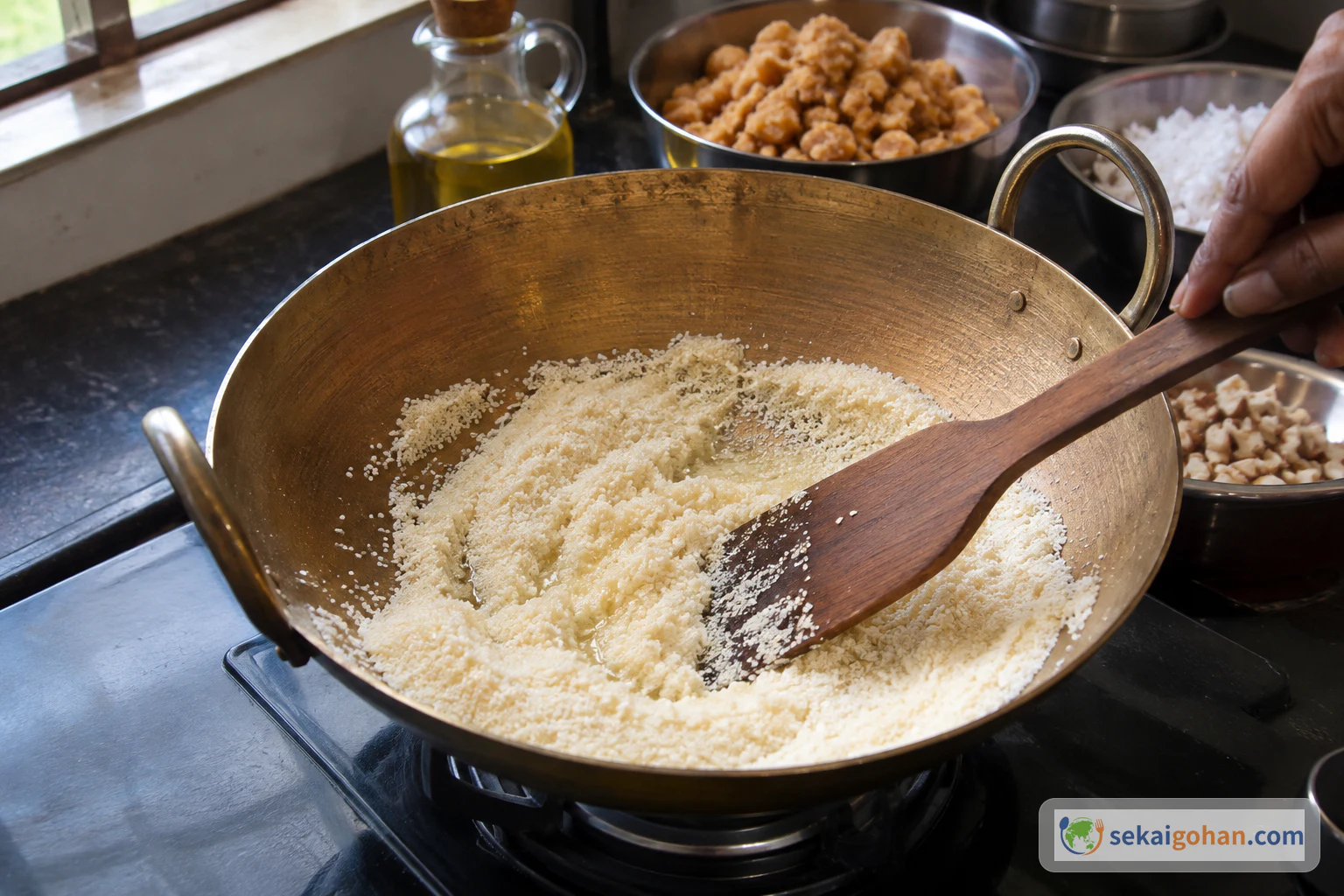
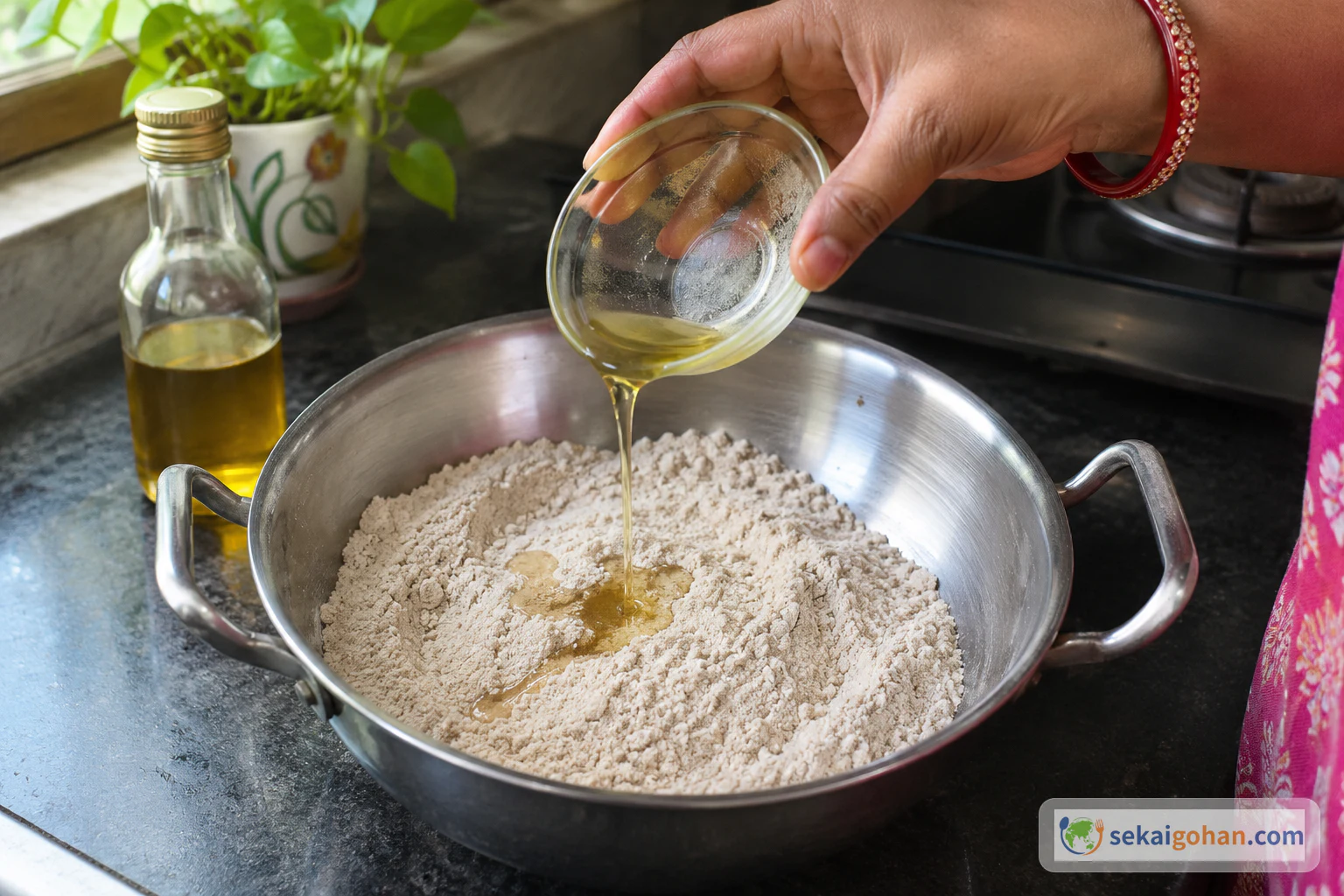
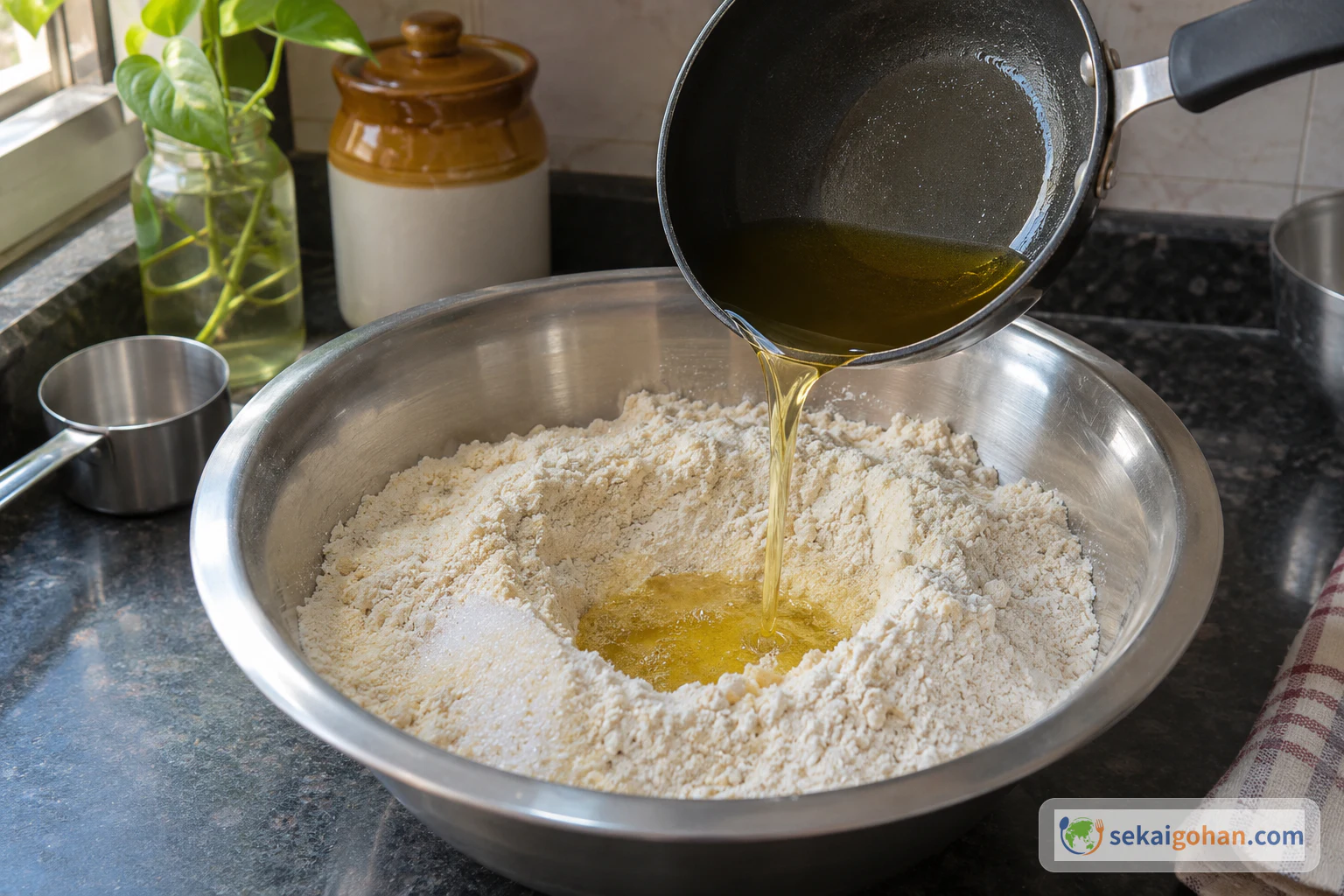
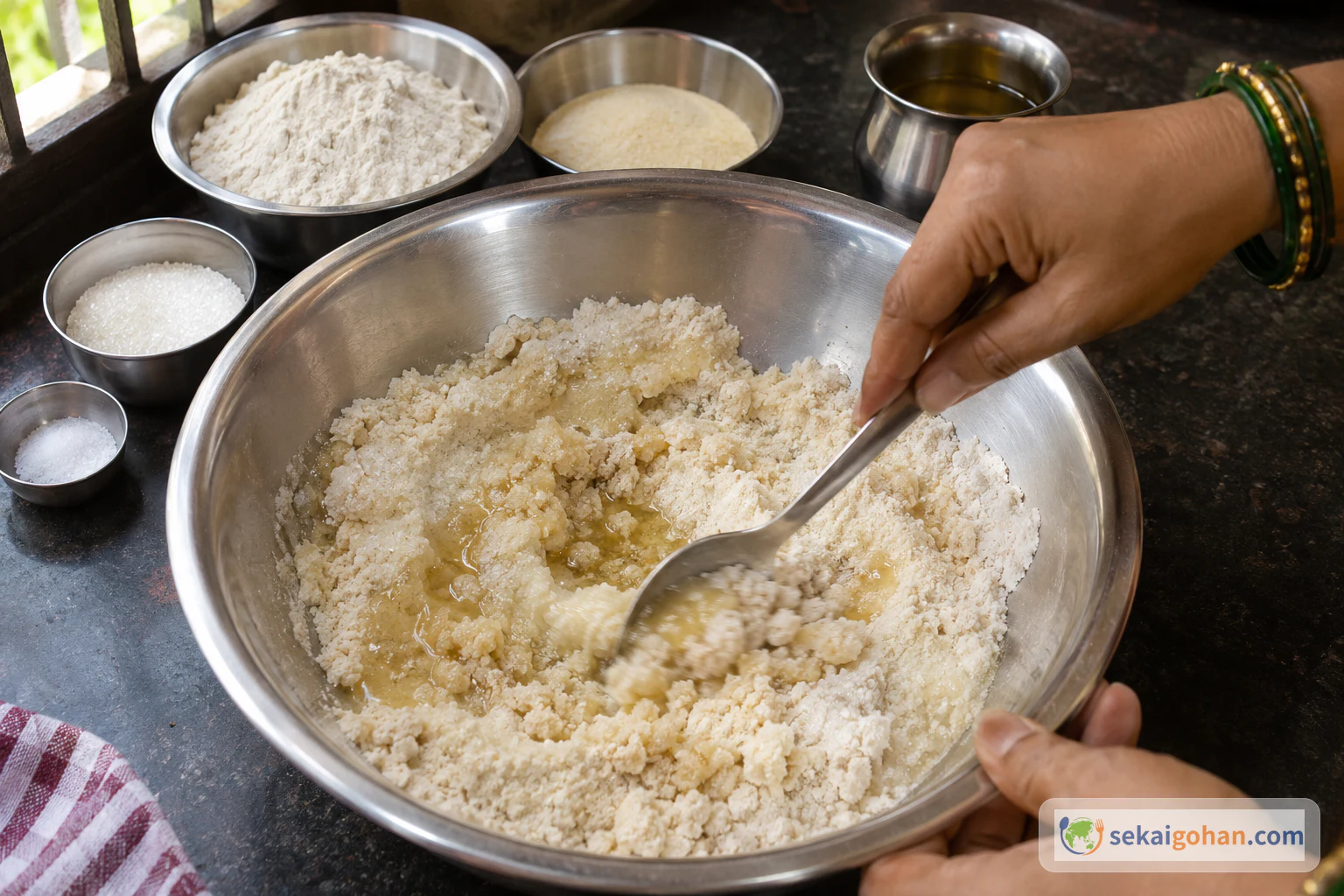
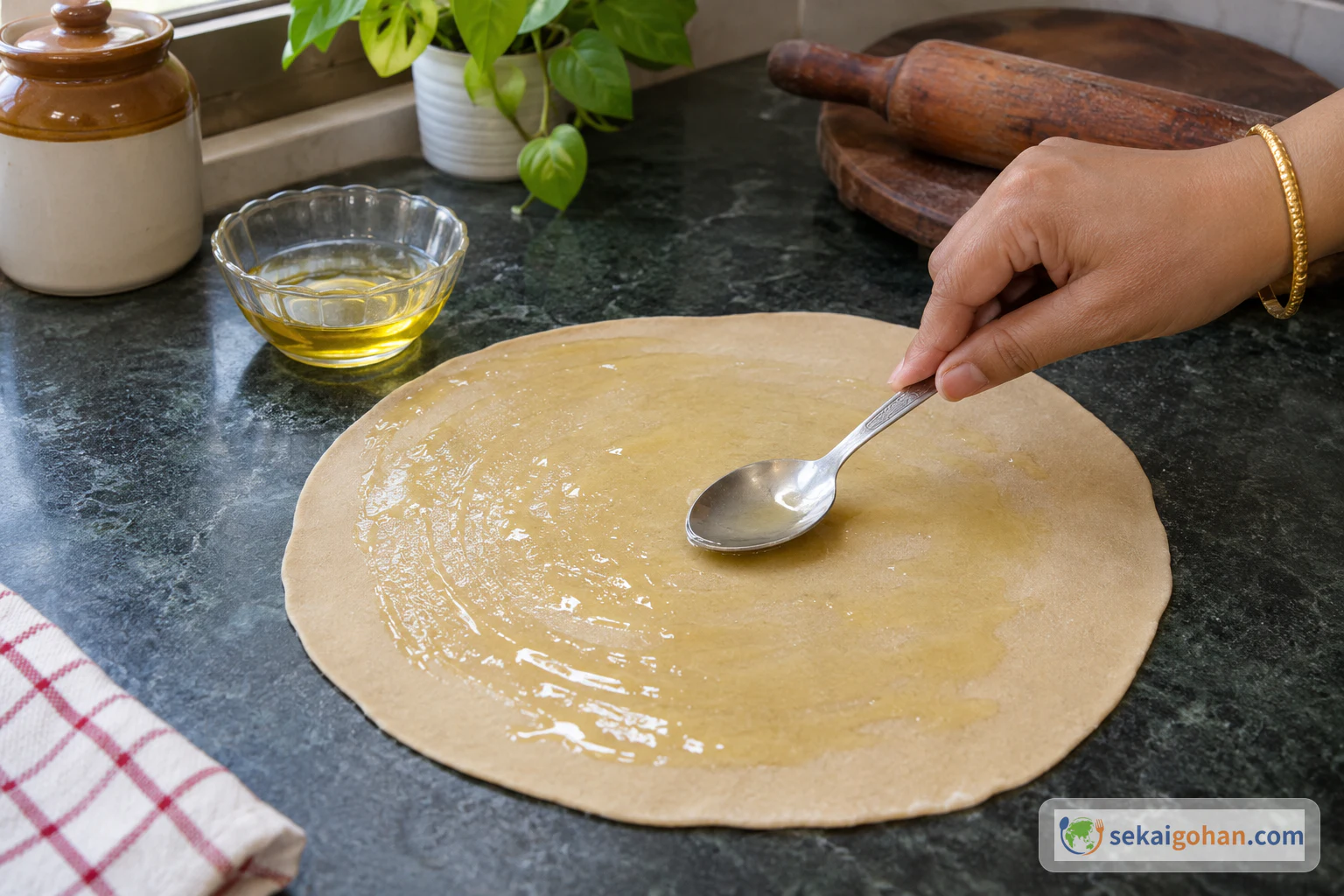
The oil does different jobs. The filling uses 3 tbsp of almond oil. The wrapper uses 2–3 tbsp of heated oil in the first mix, 1 tbsp on each of the four chapatis, and then frying oil. The method in Vadani Kaval Gheta says 1 tbsp for the rava and the remaining oil for the whole wheat flour. Reading that remainder as 2 tbsp is our interpretation of the 3 tbsp listed. The 4 tbsp for layering is our own arithmetic from 1 tbsp per chapati.
Is the liquid milk, water or both?
The ingredient list in Vadani Kaval Gheta gives milk and water mixed, as needed, while its method mentions only water. We follow the ingredient list, which is our interpretation and not the author's explicit statement. No ratio or quantity is recorded, so we do not give one.
Do I really need to pound the dough?
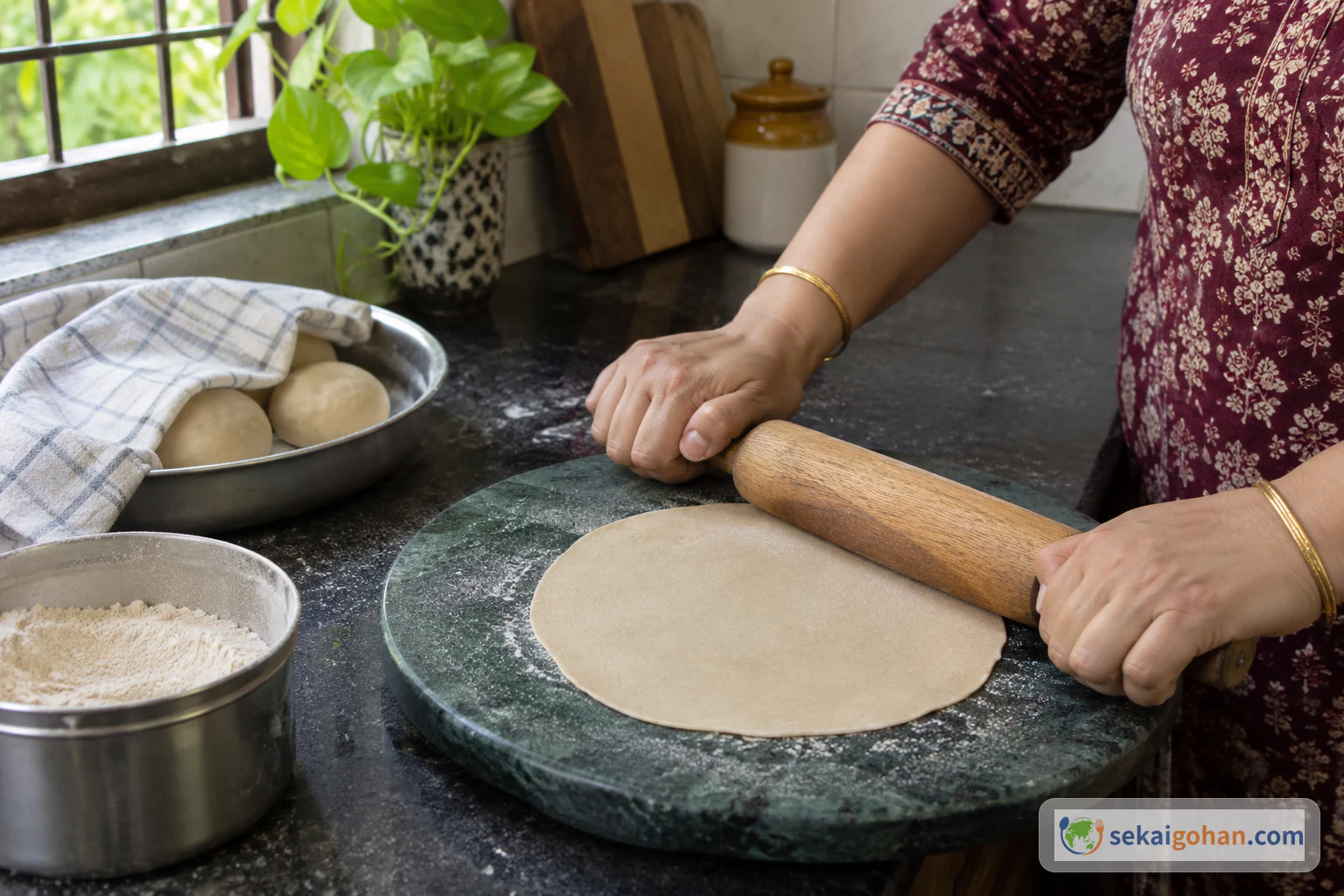
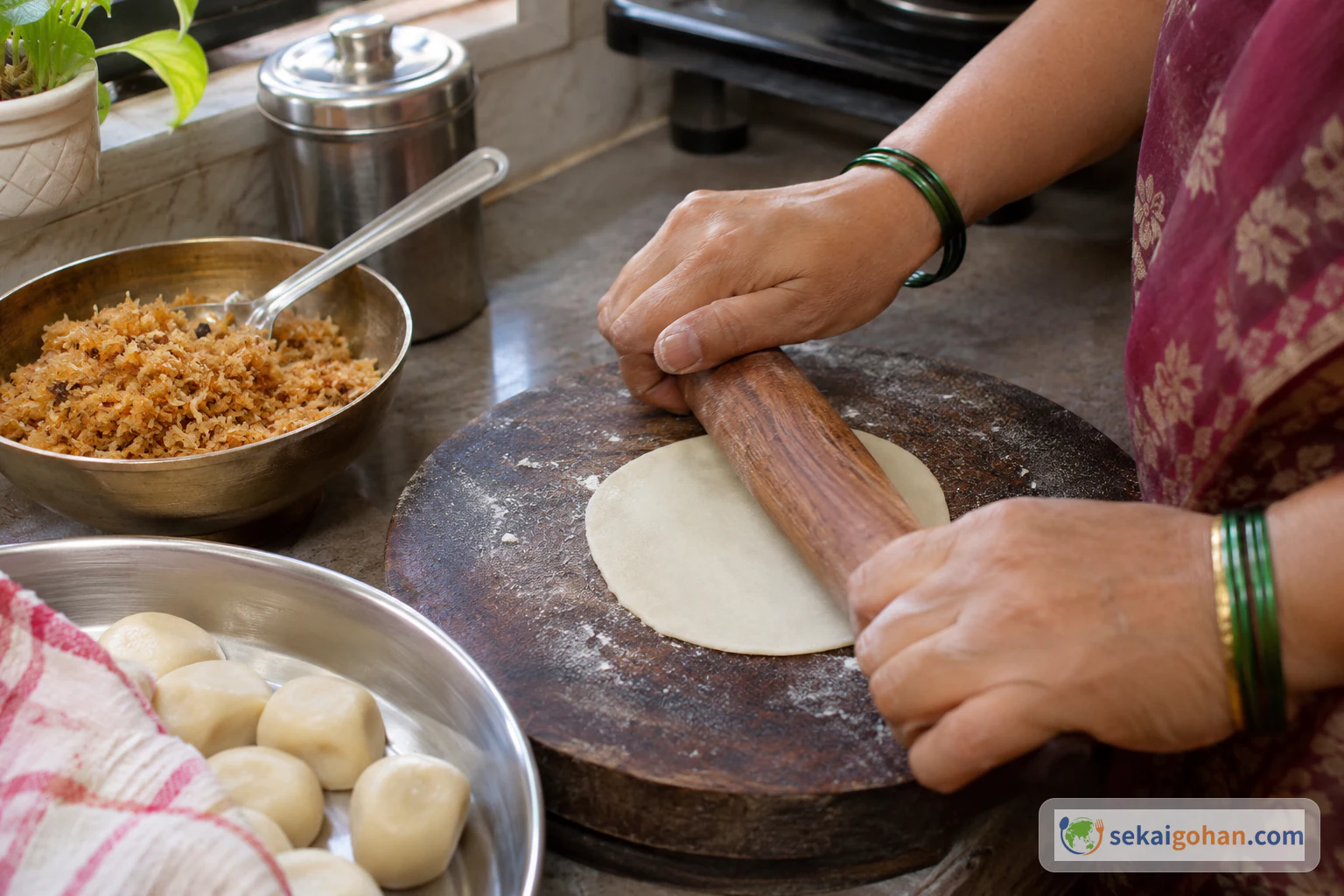
Yes, in this recipe. Vadani Kaval Gheta includes 15–20 minutes of stone pounding after the rest and before dividing the dough, so we kept it. We have no tested alternative to suggest.
Why rest the dough in the refrigerator?
The dough contains milk, and resting it out in the kitchen for 2 hours would go past general guidance for perishable food before any pounding or shaping began. See "Why This Dough Rests in the Refrigerator" above. We have not made this version, and the texture may differ from a dough rested out in the kitchen.
Can I store karanji or make them ahead?
We give no storage guidance. This article covers serving them fresh only, eaten within 2 hours of frying, or 1 hour above 90°F (32°C). Vadani Kaval Gheta mentions preparing ahead and the Uttarakhand Open University text mentions airtight storage, but neither is evidence of a safe storage period.
What cup size should I use, and how many will this make?
Vadani Kaval Gheta does not state a cup size, ingredient weights or a yield, so we do not give conversions or a number of pastries.
What oil temperature and frying time should I use?
The recipe says only medium-hot oil and gives no number or frying time, so we have not added any.
Which allergens does it contain?
Wheat, milk, sesame and almond. Read the labels on the ingredients and products you use.
Sources
- Vadani Kaval Gheta, "Diwali Special: Karanji" (2012). The adopted recipe: Maharashtrian household Diwali faral context, five fillings, the dry-filling ingredients and method, and the baked version's chilled water dough. https://www.vadanikavalgheta.com/2012/11/diwali-special-karanji.html
- Archana's Kitchen, "Maharashtrian Karanji Recipe (Gujiya) - A Delicious Diwali Sweet." Comparison for a similar filling and sequence. No amounts or steps taken. https://www.archanaskitchen.com/recipe/maharashtrian-karanji-gujiya-a-delicious-diwali-sweet
- Uttarakhand Open University, "Regional Cuisines of India – II (BHM-602AT)." Karanji among Maharashtra's regional names for related fried sweet pastries, and its general description. https://www.uou.ac.in/sites/default/files/slm/BHM-602AT.pdf
- Loksatta, "एकदम पातळ आवरणाची आणि भरपूर पदर सुटलेली खुसखुशीत करंजी." Diwali faral framing, variation across India, and a separate dry-coconut and rava version. No amounts taken. https://www.loksatta.com/recipes/karanji-recipe-in-marathi-homemade-karanji-karanji-diwali-faral-recipe-in-marathi-srk-21-4675769/
- US Centers for Disease Control and Prevention, "Four Steps to Food Safety." General time limits for perishable food, including dairy, and refrigerator temperature. https://www.cdc.gov/food-safety/prevention/index.html
- US Food and Drug Administration, "Are You Storing Food Safely?" General room-temperature limits and refrigerator temperature. https://www.fda.gov/consumers/consumer-updates/are-you-storing-food-safely
- Japan Ministry of Health, Labour and Welfare, "家庭でできる食中毒予防の6つのポイント." Refrigerator guide of 10°C or below, refrigerating food when you stop cooking partway, and discarding food left out too long. https://www.mhlw.go.jp/www1/houdou/0903/h0331-1.html
- Chef Kunal Kapur, "Thandai Gujiya | Baked Gujia." Precedent for resting a related water dough under a damp cloth in the refrigerator. No amounts or times taken. https://www.chefkunalkapur.com/?p=4711