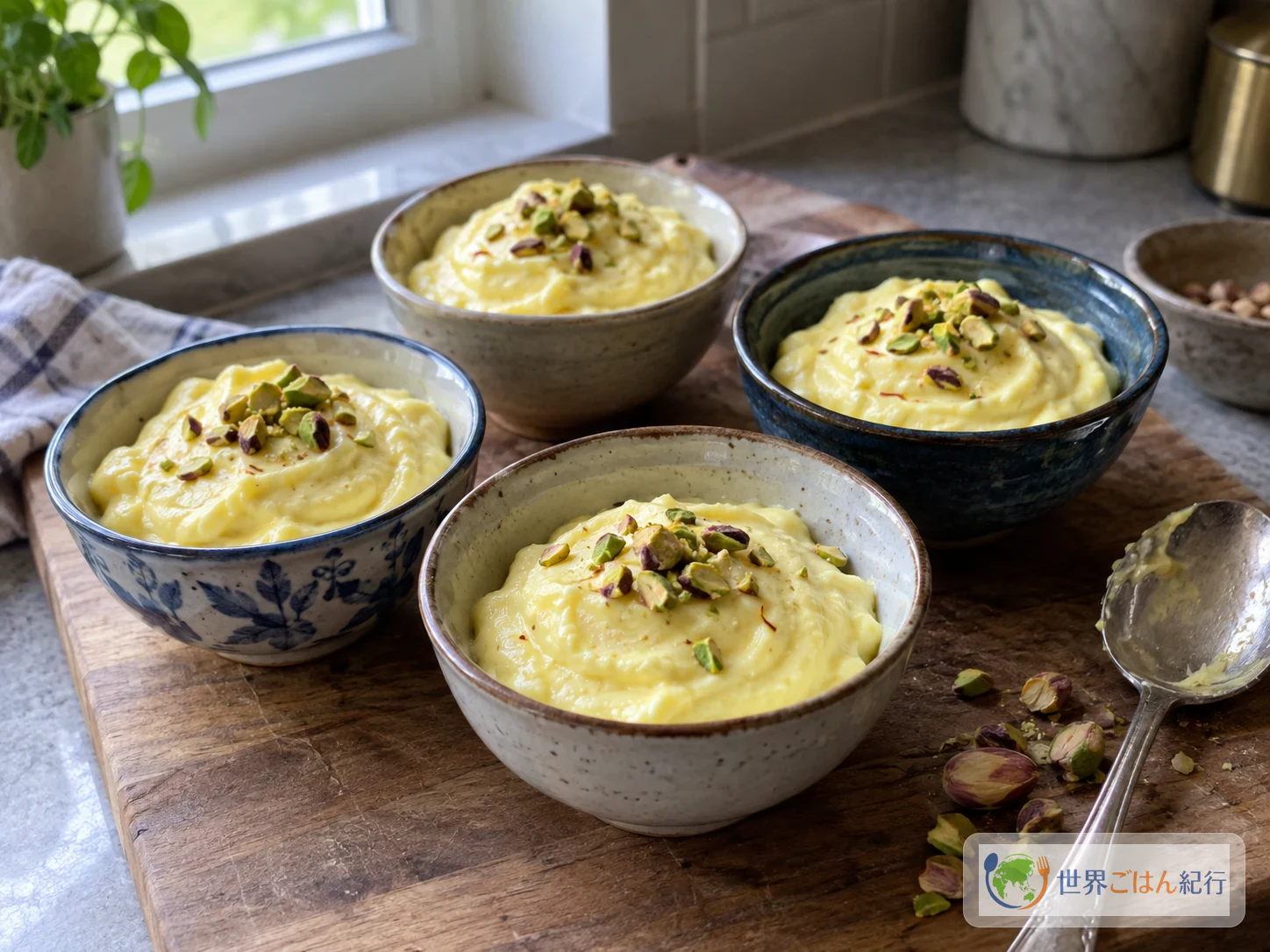
The story of the dish: sweet yogurt beside fried bread
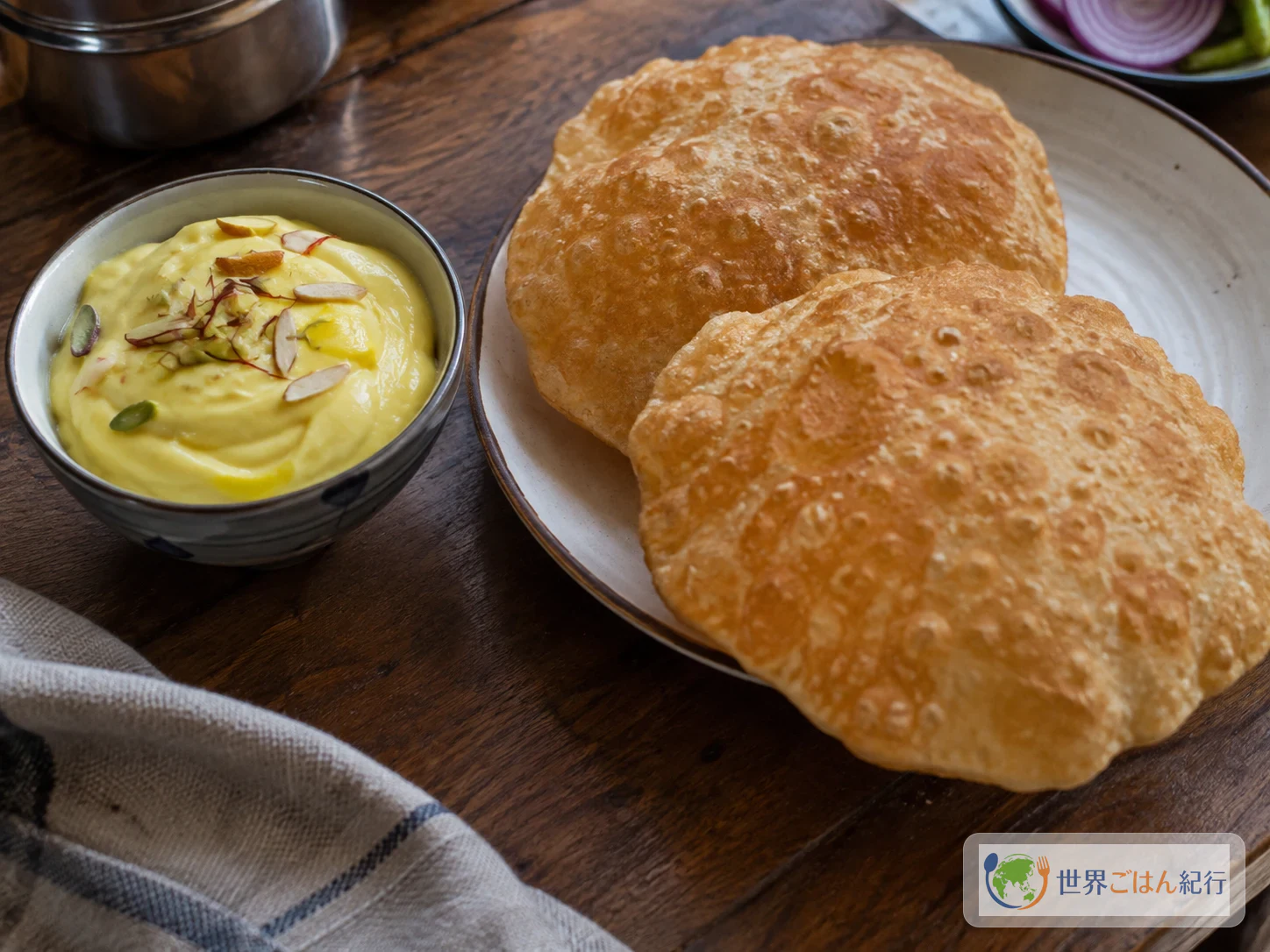
Picture the Gudi Padwa table in Maharashtra. In the kitchen, puffed puris are lifted from the oil, and beside them, in small bowls, sits chilled shrikhand. Hot fried bread and a cold yogurt sweet. Shrikhand is a dessert made from strained yogurt, and setting the two on the same table is a classic pairing for celebration days.
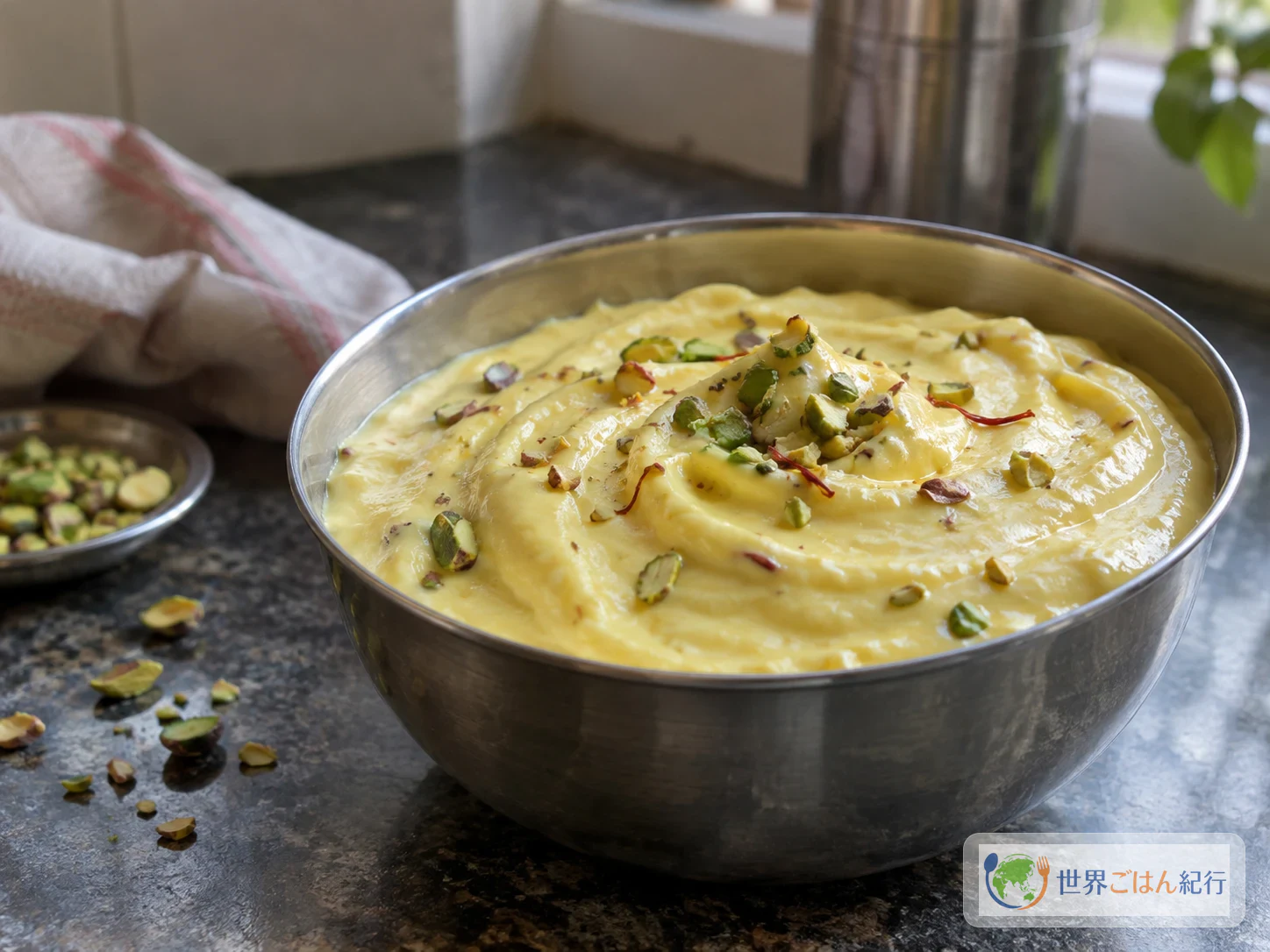
Shrikhand is a sweet from Maharashtra and Gujarat. The basic ingredients are strained yogurt, sugar, cardamom, and saffron, with nuts to finish. It is not baked or set with a coagulant. Its thickness comes from removing the whey from the yogurt, so the richness that comes from straining is the center of this sweet. In the mouth, the sweetness of sugar sits on the tang of yogurt, and the aroma of cardamom rises afterward.
This sweet appears at festivals, special days, and wedding meals. But not every household makes it with the same formula. It may be served with puri, or enjoyed alone as a cold dessert. With unsweetened yogurt and a few spices you can make it anywhere. Since it involves almost no cooking, what decides the flavor is how you handle the water. The core of the aroma is saffron and cardamom, and these two turn everyday yogurt into a sweet worthy of a celebration bowl.
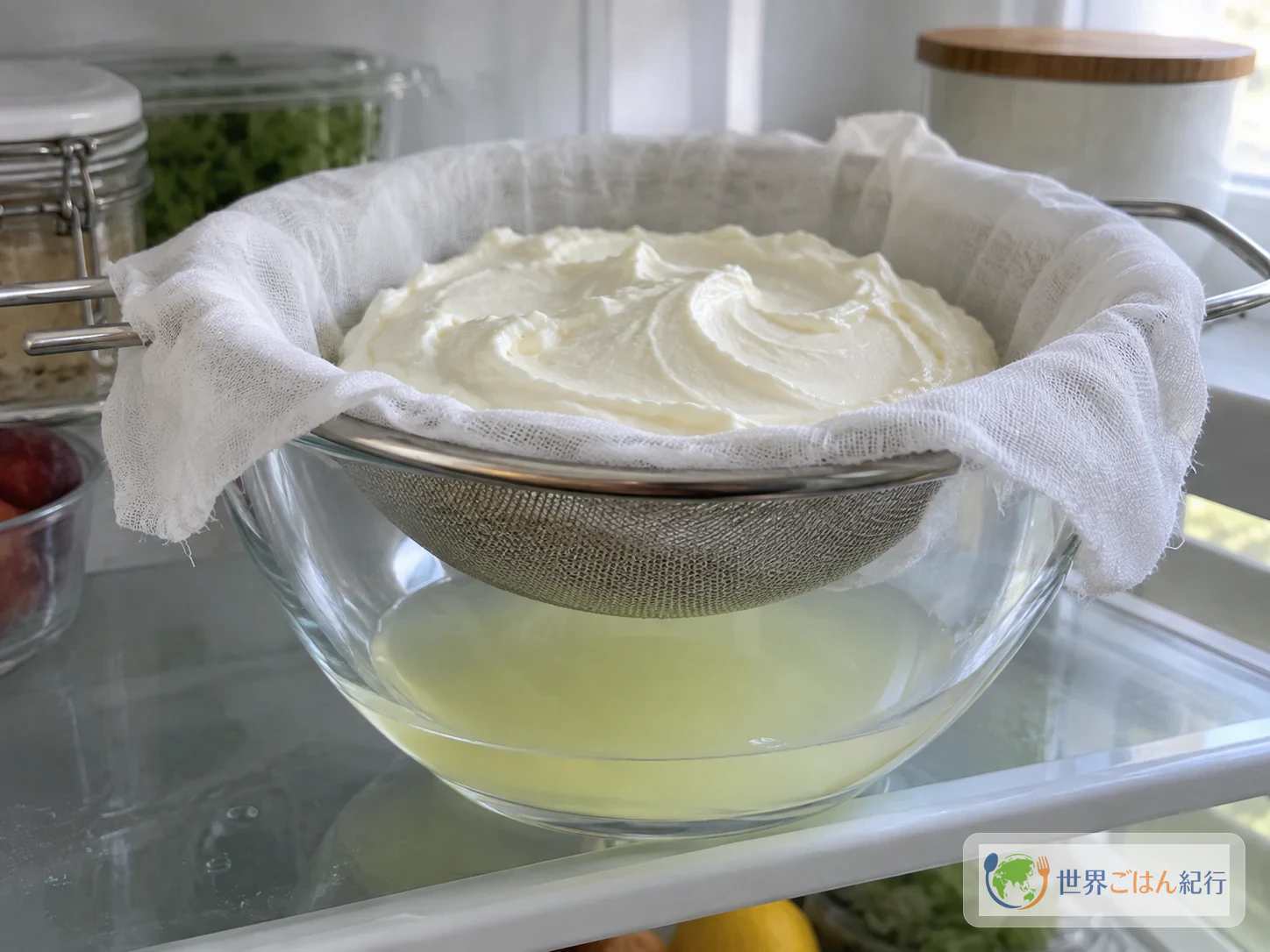
Strained yogurt is called chakka in Marathi. As a guide to thickness, it is closer to cream cheese than to regular yogurt. It is not made by letting fermentation go further; the water is removed to thicken it.
Ingredients (serves 4)
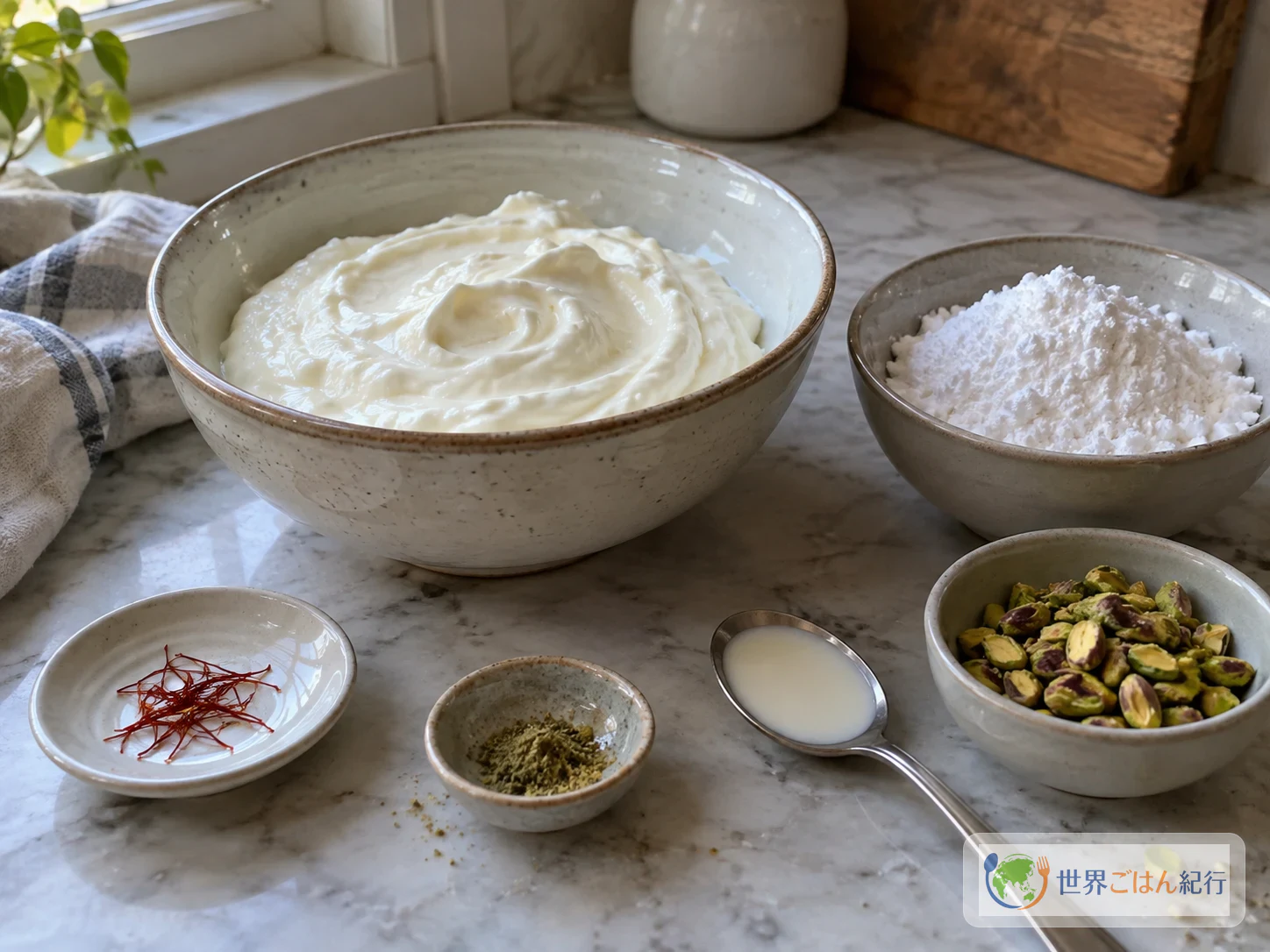
This is a home-adjusted formula that uses 400 g of yogurt after straining. With ordinary unsweetened whole-milk yogurt, strain 1000 g in the refrigerator and weigh out 400 g. The yield varies with the product and the straining time, so if you cannot get 400 g, reduce the other ingredients in the same ratio. With thick unsweetened Greek yogurt you can use 400 g as it is and skip straining. If the product is soft, strain it further.
The 60 g of sugar is a starting amount for home cooks. Taste after mixing, and add only 5 g at a time. If you keep adding sugar endlessly to cover the tang, the yogurt character disappears. Choose unsweetened whole-milk yogurt to get closer to the intended flavor. The nuts are a texture accent, so the yogurt sweet works without them.
Look for saffron and green cardamom by those common names at the spice aisle, specialty grocers, or online. Choose green cardamom, not black cardamom. Curry powder cannot substitute. Saffron is there for aroma. Adding another spice for color will not give the same aroma.
Hands-on time is about 15 minutes. Add at least 4 hours for straining and 2 hours for chilling and the total is about 6 hours 15 minutes. Straining overnight makes it longer. With Greek yogurt and no straining, it is about 2 hours 15 minutes. Strain in the refrigerator, and keep the dairy cold until the final 2 hours of chilling.
Tips for a smooth texture
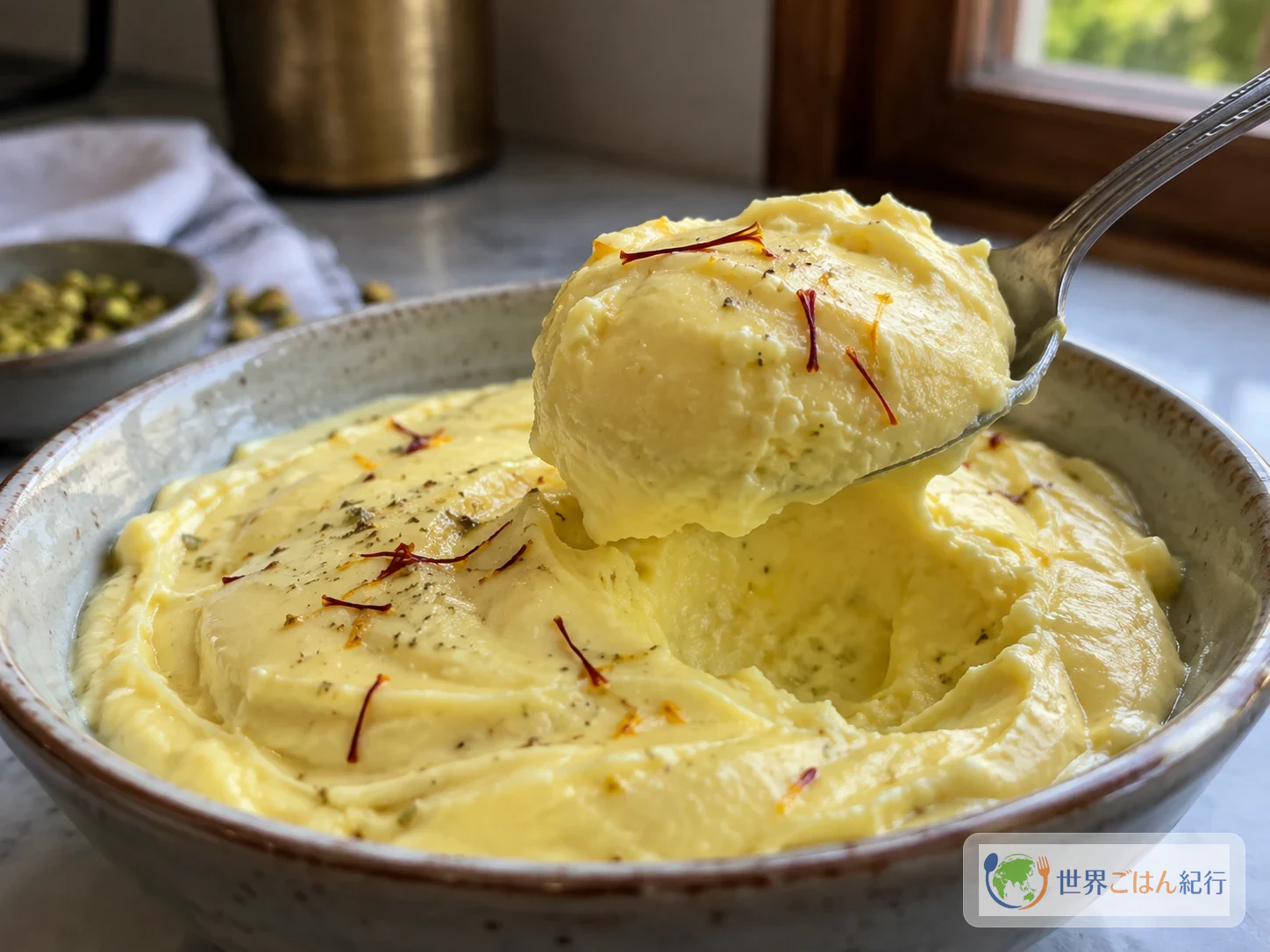
The 4 hours of straining is only a starting guide. The weave of the cloth, the thickness of the product, and the shape of the container change the result, so rather than the clock, look for a thickness that keeps the mark of a spoon. If the yogurt sits in whey, straining slows. Use a deep catch bowl and remove the collected whey often. For yogurt that has become more sour, do not cover it with sweetness; choose a fresher one.
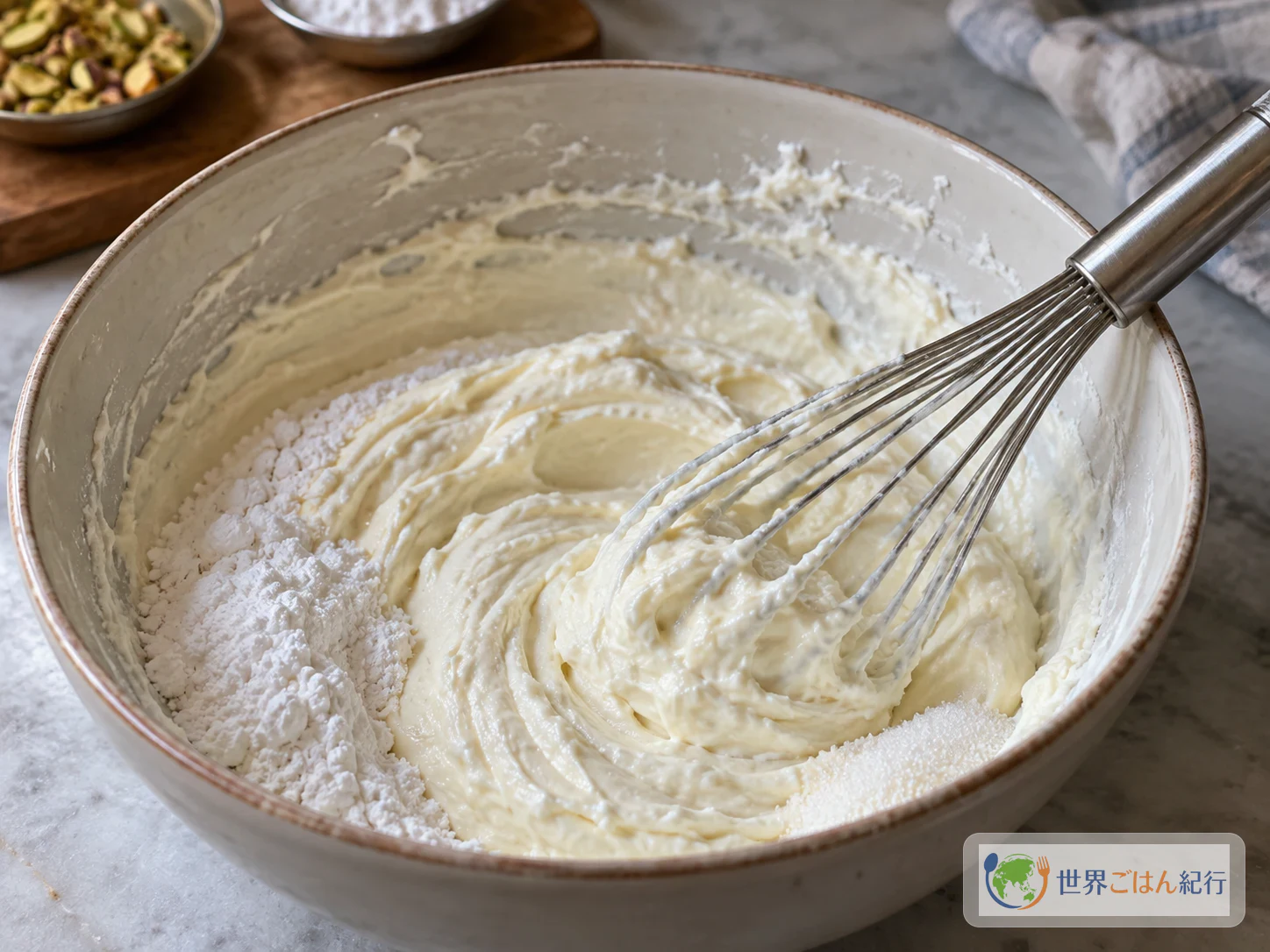
Choose powdered sugar without added starch. When using fine-grain sugar, check with your tongue or the spoon that the grains have disappeared. If it is slightly soft before chilling, it firms up as it cools. Do not add flour or a setting agent right away.
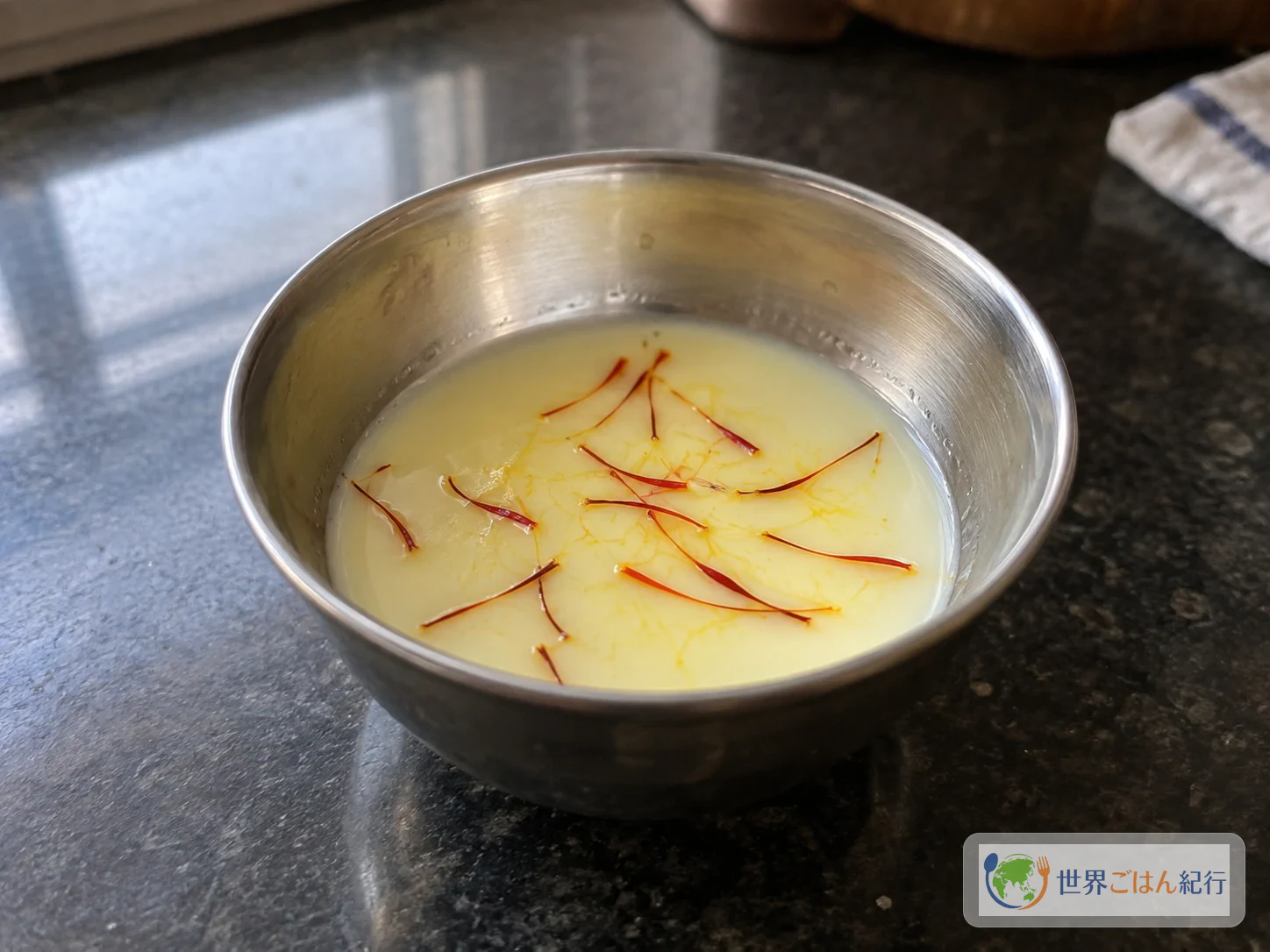
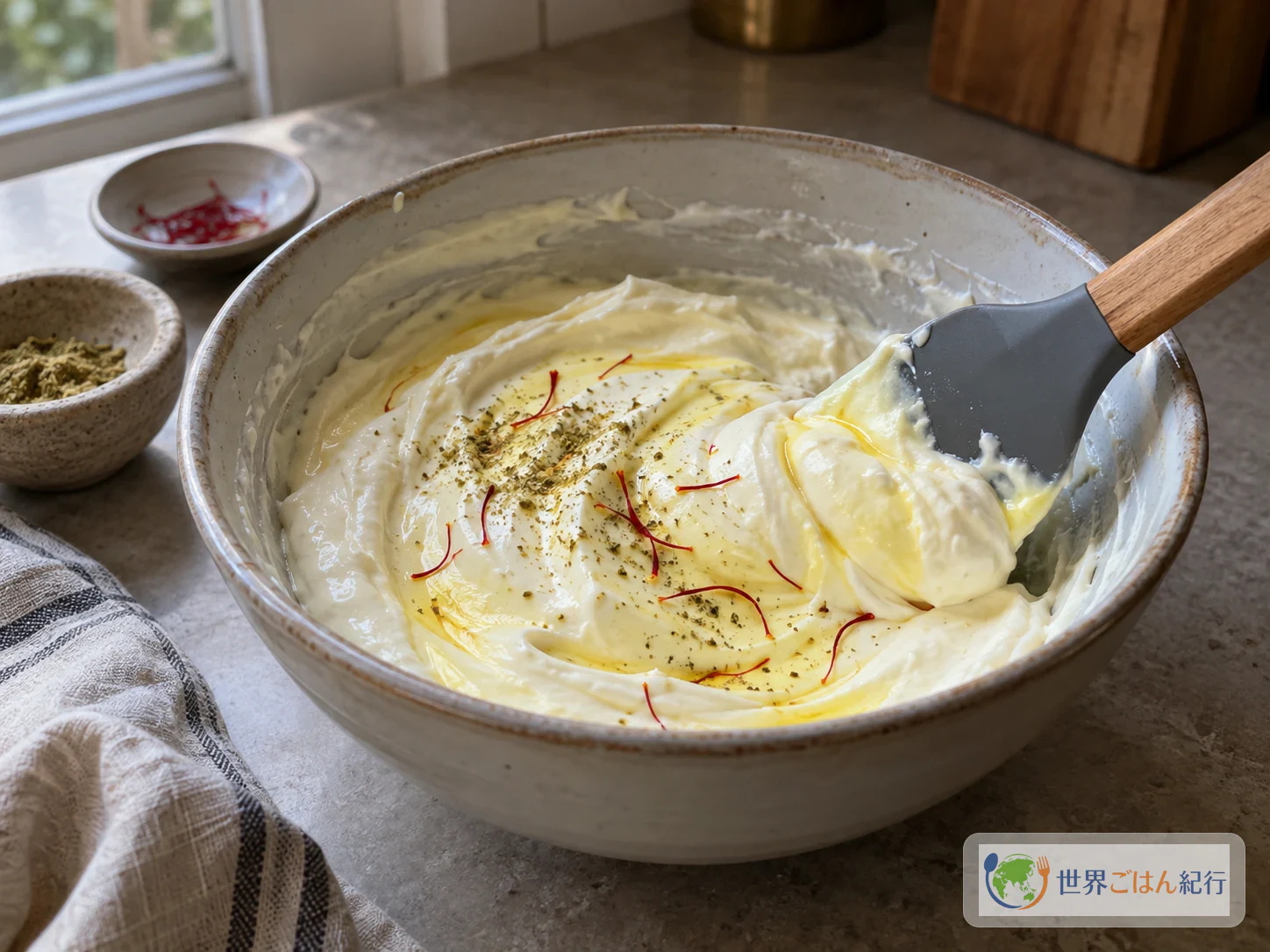
If the result is loose, there are two possible causes: not enough straining, or too much milk. Keep the milk for the saffron to 10 ml and do not increase it to deepen the color. The liquid that appears after mixing in sugar is not only whey. Straining again at that point would pull out sugar and aroma with it and change the formula. If you will eat it right away, chill it as a soft yogurt dessert in bowls, and next time remove the water before flavoring.
If it is too stiff after chilling, loosen it by adding milk 1 tsp at a time. Do not add it all at once; stop when you see how it falls from the spoon after mixing.
A day for mixing in mango, a day for just the spices
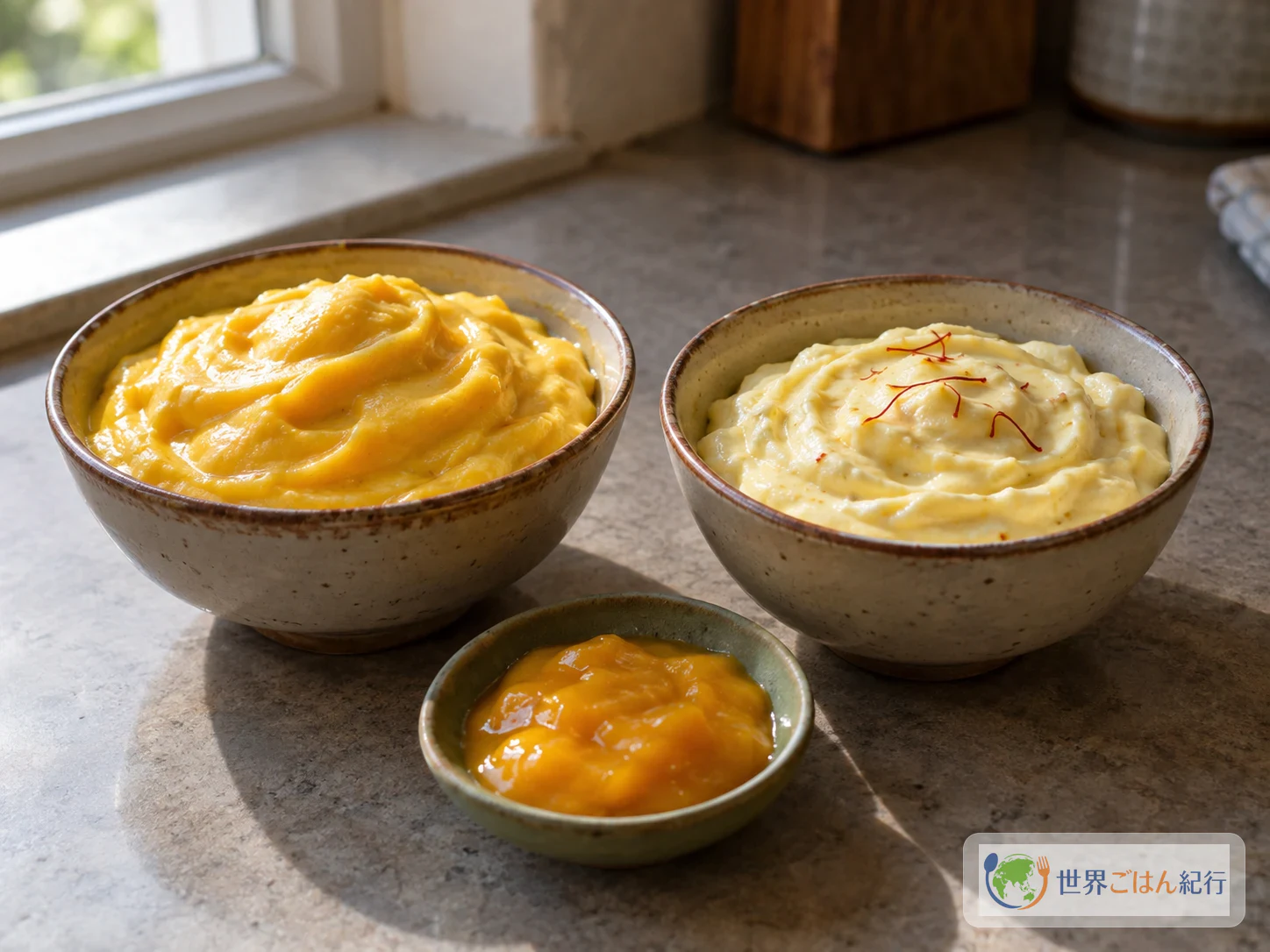
Shrikhand is loved in both Maharashtra and Gujarat, but there is no basis for assigning a fixed amount of sugar or kind of nut to each state. Think of a range by household and shop: the basic form with saffron and cardamom, versions with mango mixed in, versions with different nuts. A fragrance that changes from home to home is part of this sweet's charm.
The version with mango mixed in is also called amrakhand. What follows is a variation proposed by our editorial team. To the full amount of the finished basic formula, first add 80 g unsweetened, thick mango puree. If it gets too soft, do not add more. Fruit changes both sweetness and moisture, so start with 40 g of the basic formula's sugar and adjust after mixing. The trick is to match the moisture of the puree. This is not the single correct traditional formula; it is a suggestion to add a little for ease of making.
Without saffron, it can still be made as a cardamom-flavored sweet. Color and aroma change, but the 10 ml milk can also be omitted. For a dairy-free version, use 400 g thick unsweetened Greek-style yogurt and 10 ml plant milk. It will not have the same taste or nutrition as the dairy version. Check labels for soy and nuts. Some products do not thicken with straining, and in that case do not force the same finished state.
Background: a sweet for the western Indian new year

Gudi Padwa is the Marathi new year, celebrated in Maharashtra. It falls on the first day of the waxing moon of the month of Chaitra, in spring. A gudi is raised outside the house, and families gather for a festive meal. It is a culture that belongs to the table of the spring new year. The date changes every year, so this year's date is not given here.
The pairing of shrikhand and puri is presented as a Gudi Padwa dish. A cold, rich sweet and fried bread are enjoyed within the same meal. It need not be fixed as an after-meal-only sweet. Of course, not every region or household follows the same order or way of eating, and this is only one pairing. Serving it together with puri gives it the look of a celebration table.
The inventor of this dish, the era in which it was established, and the origin of its name could not be confirmed this time, so they are not covered here. A traditional way to get smoothness is to pass strained yogurt through a sieve called a puran yantra. In a home kitchen a whisk will do. It is not a dish that requires buying special equipment.
Some readers may want to move beyond a celebration sweet and explore vegetable dishes too. Our existing article on undhiyu covers Gujarat's winter vegetables and spices. Do not confuse this winter dish with a required dish of Gudi Padwa.
- If you want to cook a Gujarati vegetable dish, ingredients and method for undhiyu is also a useful reference.
Frequently asked questions
Yogurt and milk contain dairy. If you are allergic to pistachios or almonds, do not use them. When substituting plant-based products, check the ingredient list on the package. If you need to avoid soy or nut-derived ingredients, choose a suitable product.
The nutrition figures are an estimate for the case where 400 g of Greek yogurt is used. If regular yogurt is strained instead, the components that move into the whey differ, so the values will not be the same. In the worked example, the yogurt was calculated from the label of a Japanese unsweetened plain Greek yogurt (per 100 g: 99 kcal, protein 10.2 g, fat 4.3 g, carbohydrate 4.9 g). This does not recommend buying any specific product. The 60 g sugar uses granulated sugar, the 10 ml milk is about 10 g, and the 10 g pistachios uses the "roasted, seasoned" entry of Japan's food composition table to approximate energy and the three macronutrients. It is not a measurement of unsalted nuts. Trace spices are not included. The total is about 700 kcal, protein 42.9 g, fat 23.2 g, and carbohydrate 82.2 g, or about 175 kcal per serving. It changes if you add sugar, add fruit, or switch to plant-based products.
Can I make it with regular yogurt?
You can make it with unsweetened whole-milk plain yogurt. In the basic formula, you secure 400 g after straining from 1000 g. With 400 g Greek yogurt you can save time, but some products need additional straining. Low-fat yogurt can also be strained, but it will not necessarily reach the same richness as whole milk. Choose by the thickness of the finished product rather than by name or type.
Can I make it without saffron or special equipment?
Saffron can be omitted. Keeping the cardamom makes it easier to build the basic aroma. A colander, bowl, clean food-safe cloth, and whisk are enough. Use a food-safe cloth, and avoid ones that may transfer fibers or the smell of detergent. If you use unsweetened Greek yogurt, you need no straining equipment either.
How long does it keep?
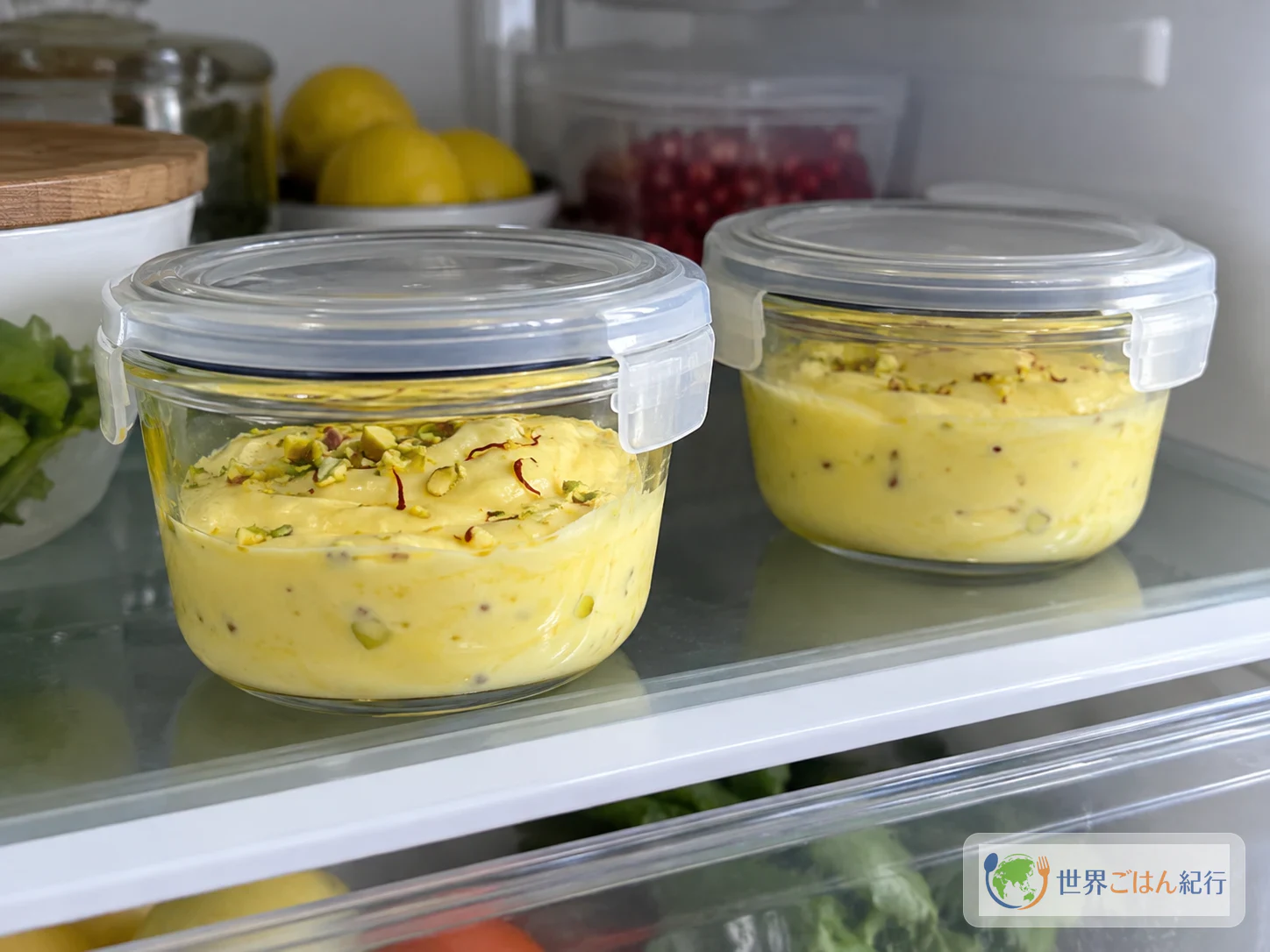
Put it in a clean lidded container and refrigerate at 4 °C or below. At home, aim to finish it from the same day to the next day. This is our editorial team's conservative suggestion, not a measured safety limit. For the original yogurt and milk, follow the after-opening instructions first. A long storage life cannot be guaranteed. Take out only what you will eat, and do not regard anything that has not been properly refrigerated as safe, even if there is no odd smell or mold.
Both straining and storage are done inside the refrigerator. As a general FDA principle, refrigerated foods should not sit at room temperature for more than 2 hours, or for more than 1 hour if the temperature is above about 32 °C. This does not indicate how long you may strain at room temperature. When the work is finished, return it to the refrigerator promptly. If you have allergies to any ingredient, check suitable substitutes.
Sources
- Dassana's Veg Recipes — Shrikhand Recipe (Traditional & Instant) — straining, Greek yogurt, spices, how to eat, variations. Updated 3 July 2025. Accessed and checked 5 October 2026 (JST).
- Department of Tourism Maharashtra — Gudi Padwa — new year celebration and the shrikhand and puri table. Accessed and checked 5 October 2026 (JST).
- FDA — Are You Storing Food Safely? — refrigeration temperature and the general principle on leaving refrigerated food at room temperature. Accessed and checked 5 October 2026 (JST).
- Morinaga Milk Industry — Partheno Plain, no added sugar — worked nutrition example for Greek yogurt (in Japanese). Accessed and checked 5 October 2026 (JST).
- MEXT Standard Tables of Food Composition in Japan — Granulated sugar — values used for sugar (in Japanese). Accessed and checked 5 October 2026 (JST).
- MEXT Standard Tables of Food Composition in Japan — Whole milk — values used for milk (in Japanese). Accessed and checked 5 October 2026 (JST).
- MEXT Standard Tables of Food Composition in Japan — Pistachios (roasted, seasoned) — approximate energy and macronutrient values for nuts (in Japanese). Not a measurement of unsalted nuts. Accessed and checked 5 October 2026 (JST).