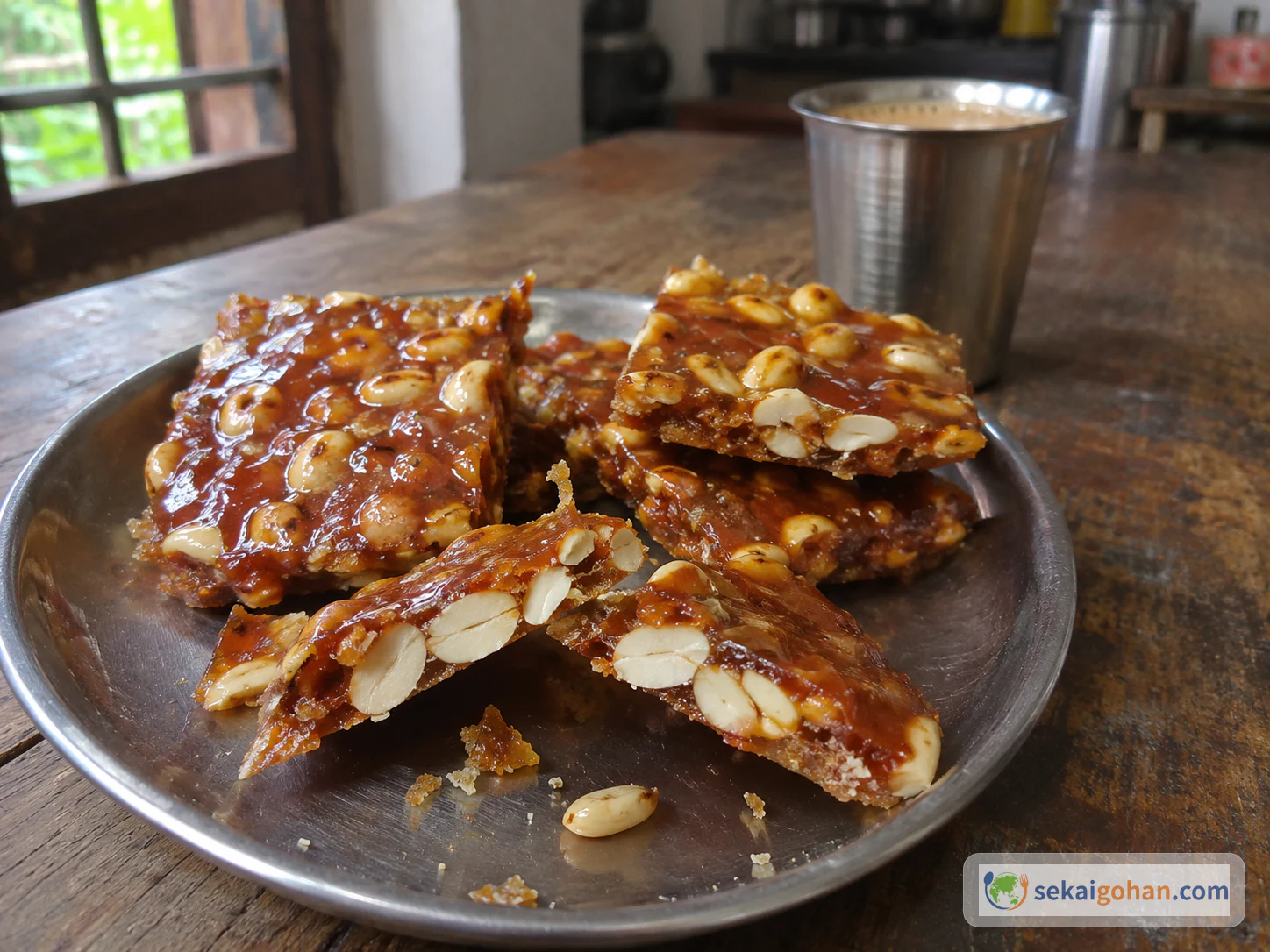
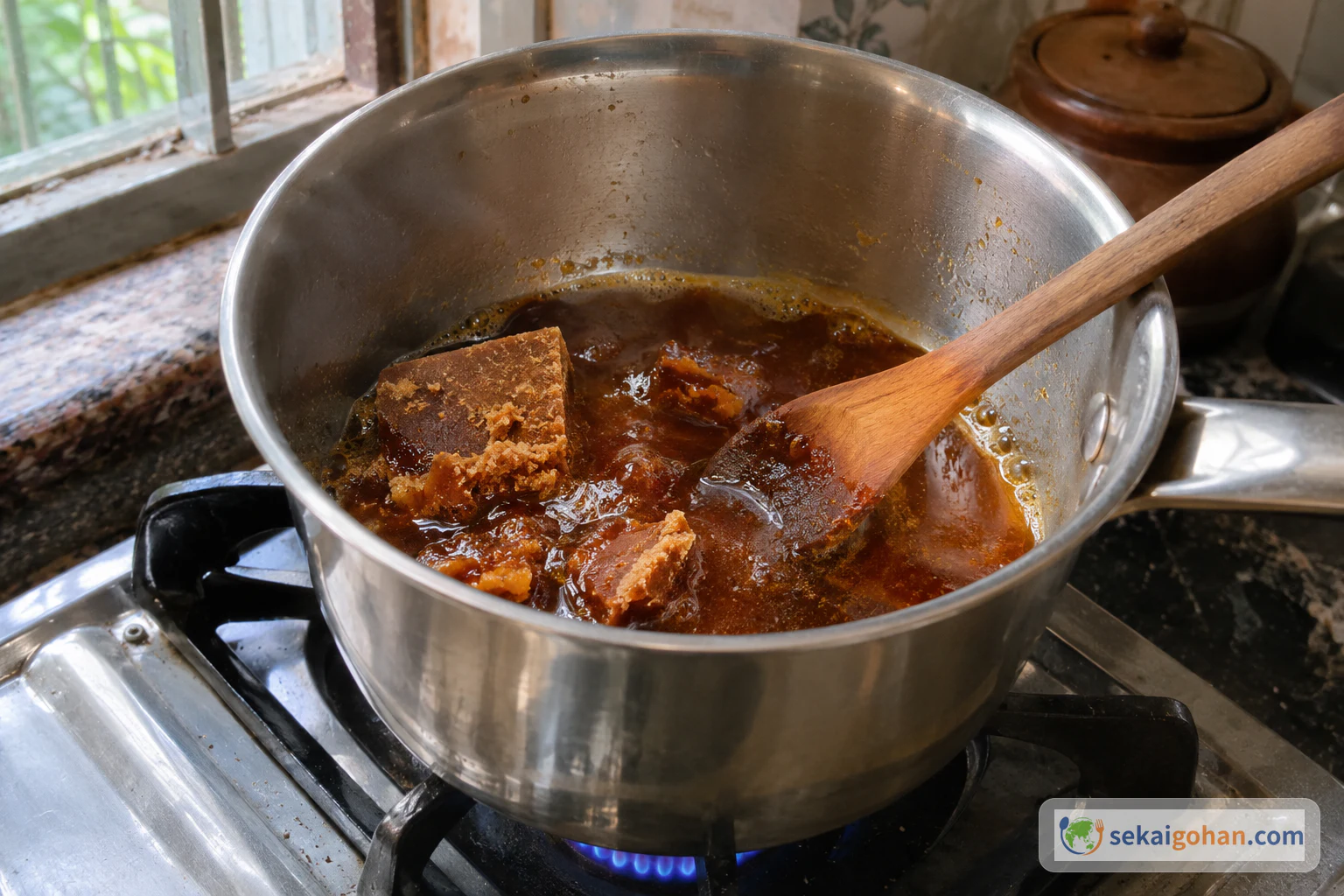
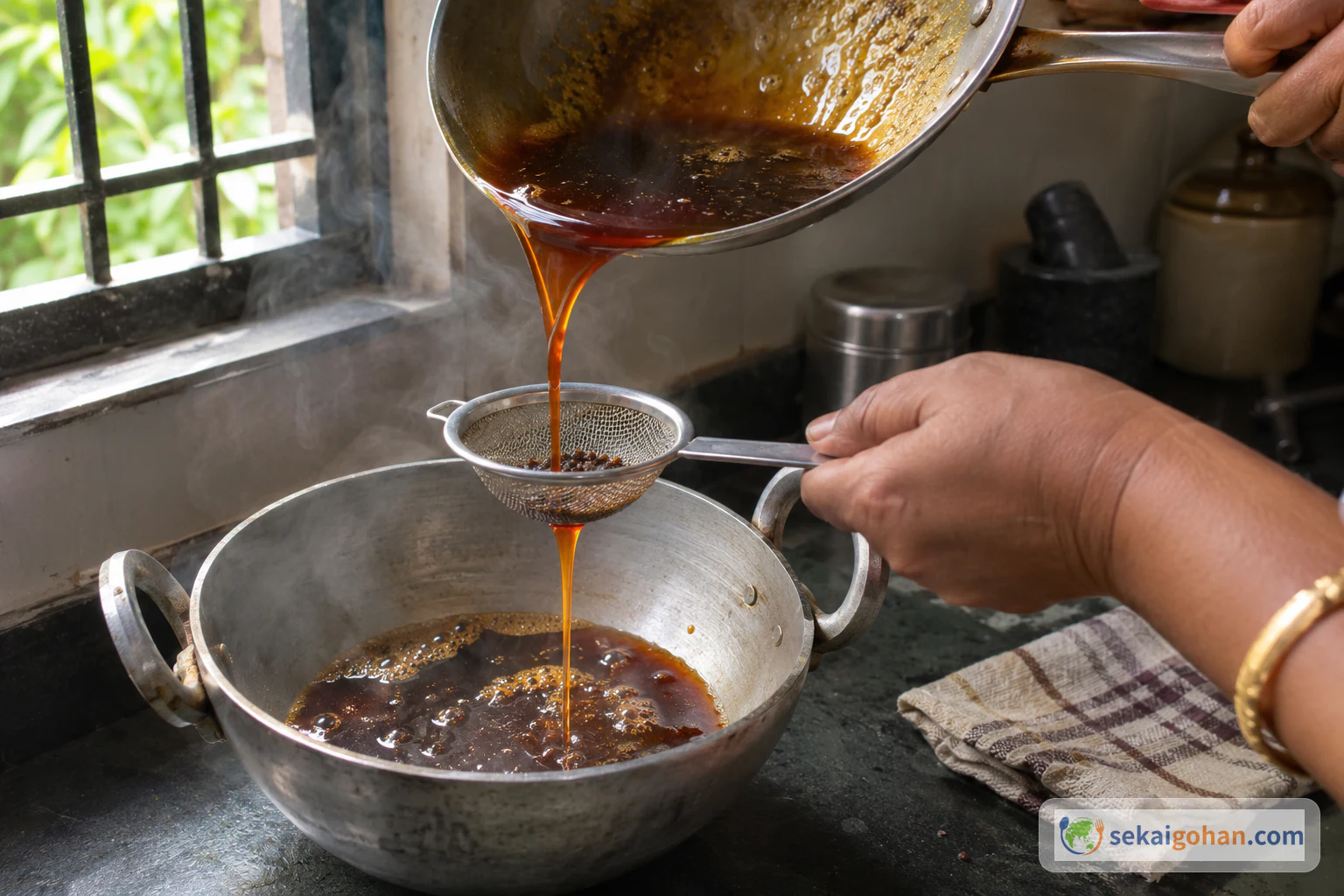
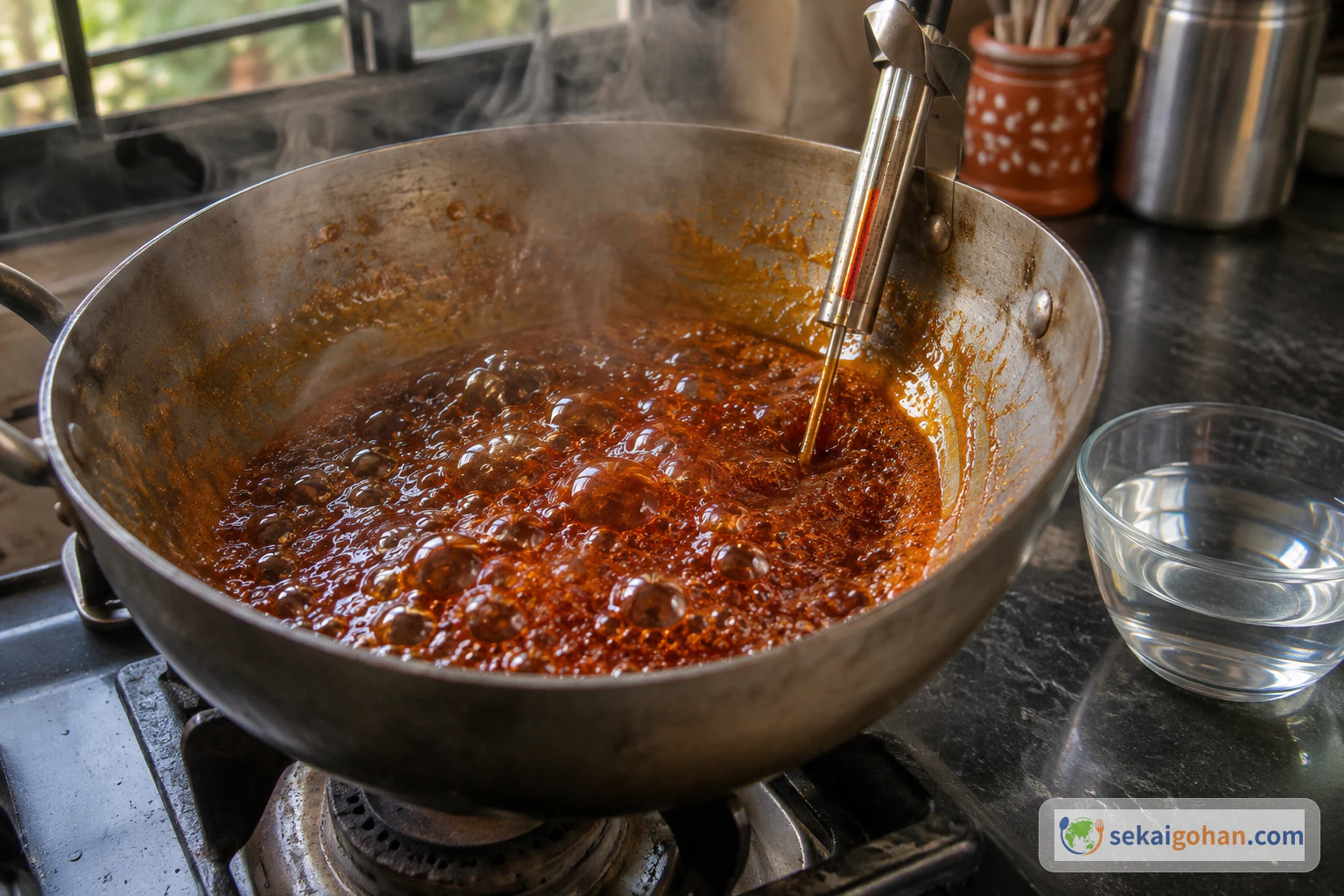
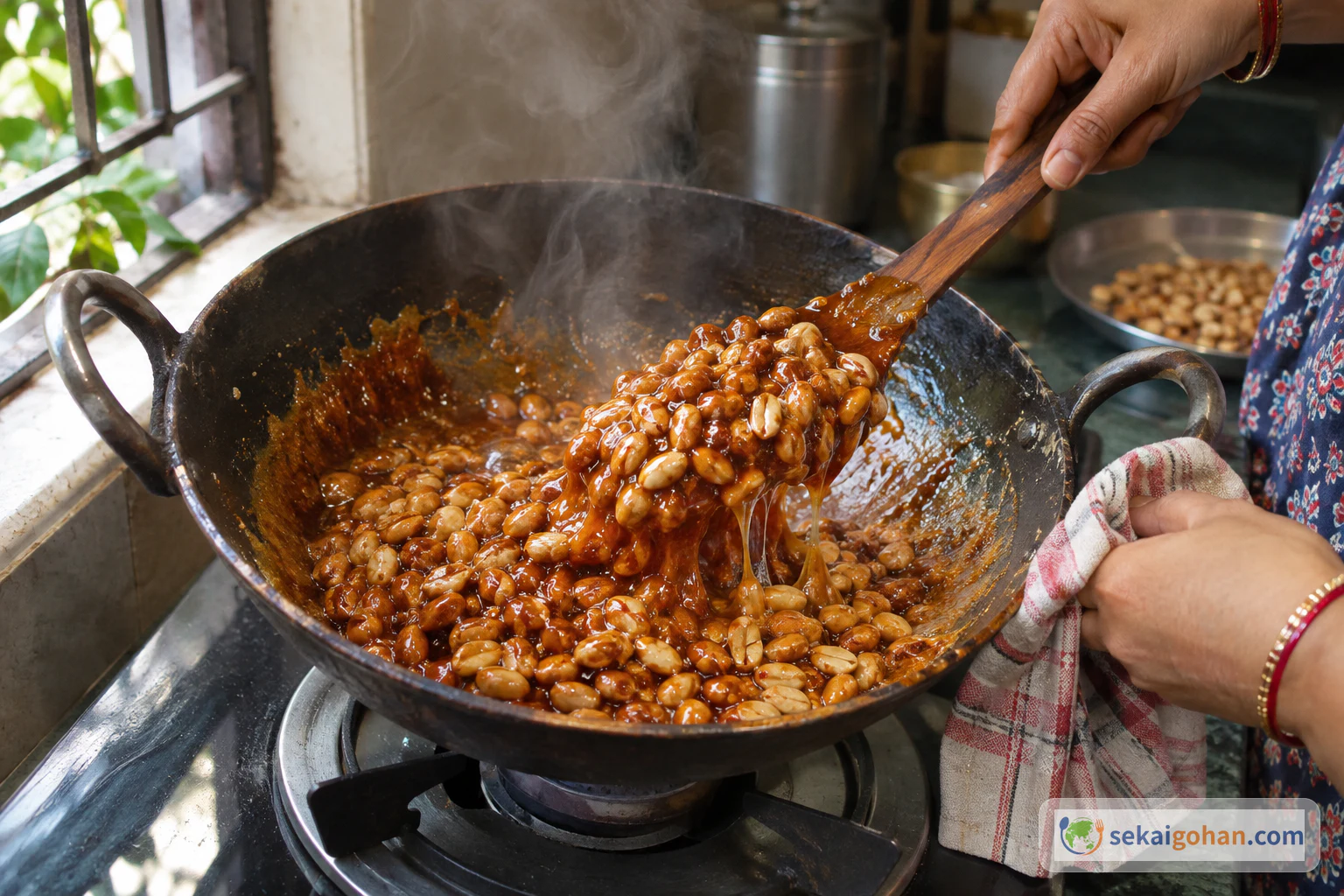
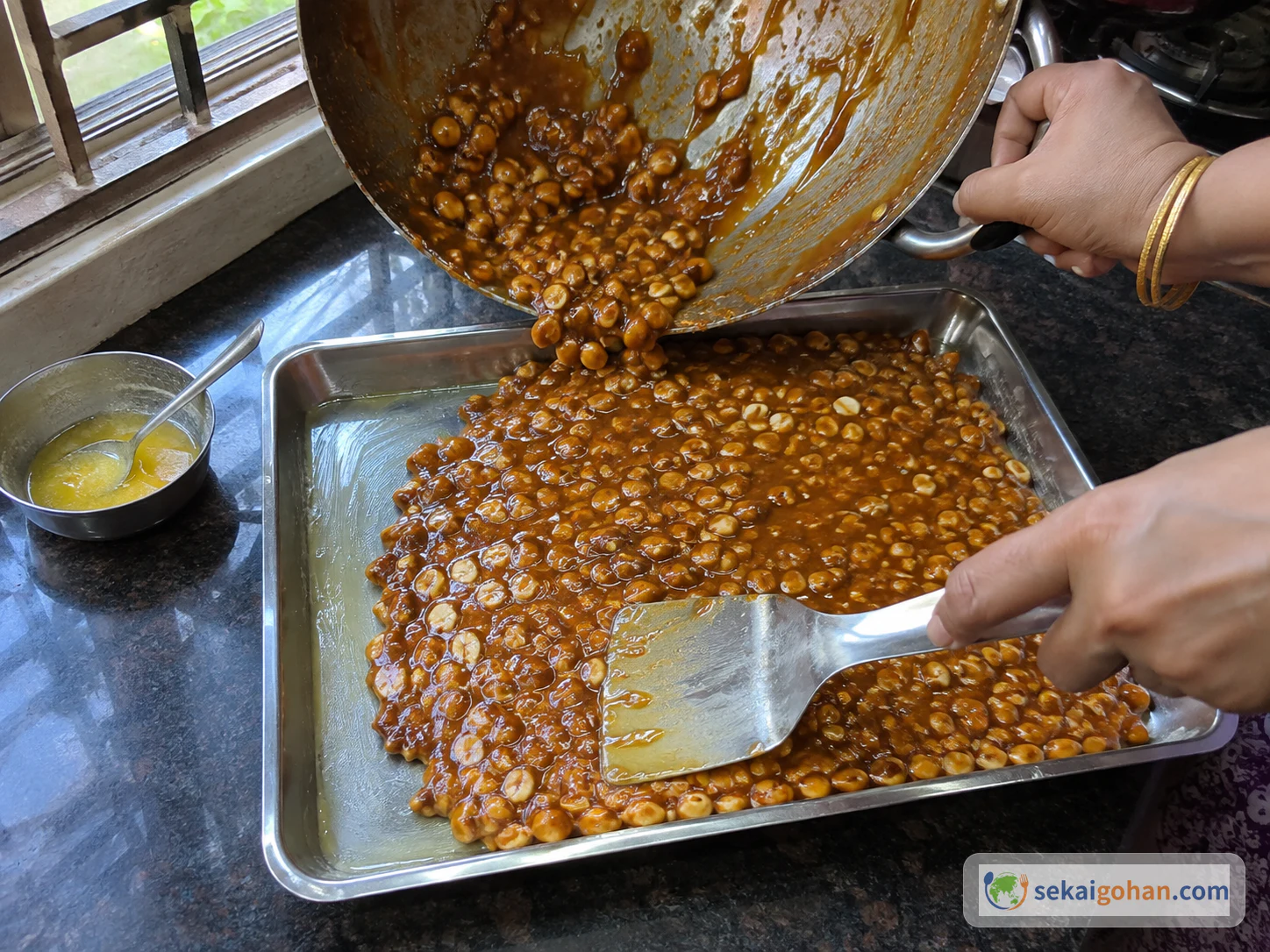
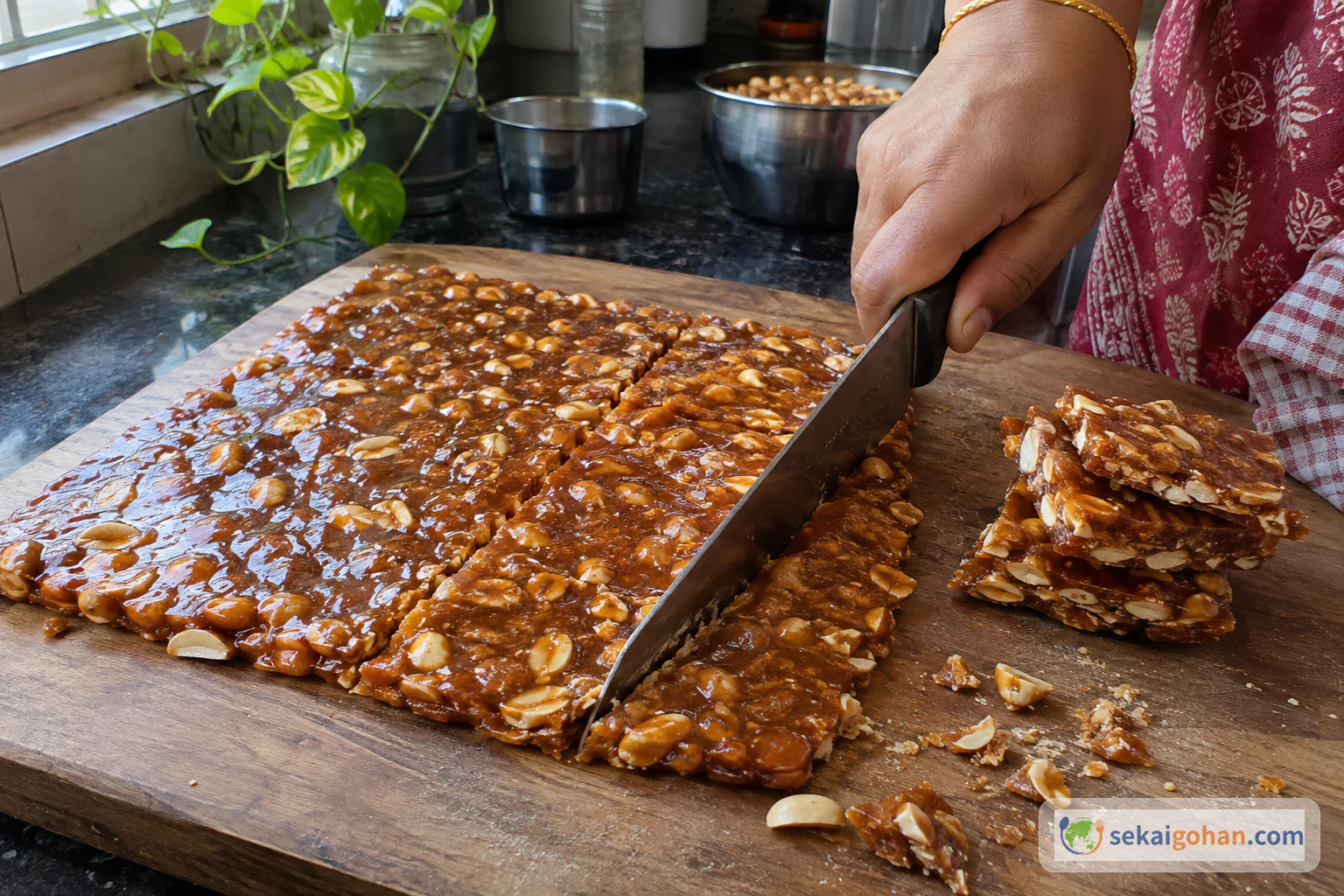
A drop of dark syrup falls from the spoon into a bowl of cold water and sets on the spot, hard enough to snap between your fingers. That snap is the signal. The peanuts go in, the pan is scraped into a greased tray, and from there the candy only has to cool. Kadala mittai is roasted peanuts bound in cooked-down jaggery, poured flat, cooled and cut into pieces. It belongs to Kerala and Tamil Nadu, and it tastes of deep, toasty cane sugar and roasted nut, with a clean crack at the first bite.
Three Names for One Peanut Sweet
In Tamil, kadalai is the peanut and mittai is a sweet. The same mixture goes by two names depending on its shape. Pressed into bars or slabs, it is kadalai mittai. Rolled into balls, it is kadalai urundai, from the word for ball. Across the border in Kerala, it is kadala mittai or kappalandi mittai, a familiar shop-bought sweet. In Tamil Nadu it is also a festival sweet, made at home for Karthigai Deepam, the festival of lamps. It is one of the many sweets of India built from nothing more than a sugar and a nut.
In Malayalam, kadala means the chickpea, and the peanut is kappalandi. The name kadala mittai came over from Tamil, where kadalai is the peanut, so the sweet is always made with peanuts. Kerala has a separate chickpea and jaggery sweet, kadalaparippu mittai, made with split chickpeas, which is a different dish altogether.
Kovilpatti, the town that made it famous
Kovilpatti, a town in Thoothukudi district in southern Tamil Nadu, is the name everyone attaches to this sweet. Long before it was sold in shops, it was made for village festivals from palm jaggery and peanuts grown nearby. In the 1940s, before independence, makers switched to cane jaggery. In the same decade, a sweet-shop owner in Kovilpatti began selling the sweet that households made from hand-pounded jaggery and peanuts. It kept only a day or two, so he changed the method: boil the jaggery with water to a set thickness first, then mix in peanuts and cardamom, press the mixture into moulds, cool it and cut it. Pieces sold for one paisa, and the trimmed offcuts became a favourite in front of the schools.
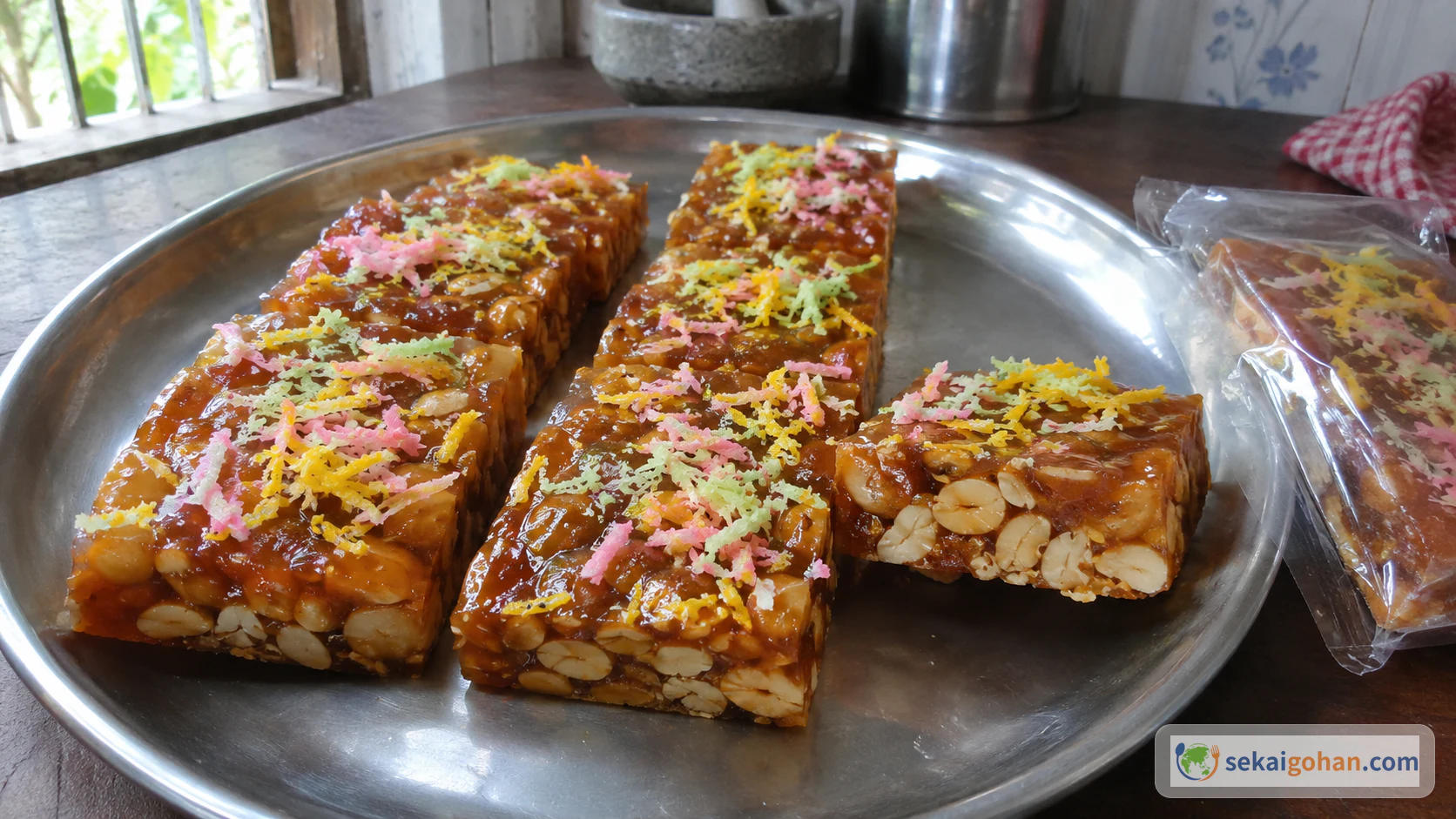
In April 2020, Kovilpatti kadalai mittai received a geographical indication, on an application from the Kovilpatti Regional Kadalaimittai Manufacturers. It is made in Kovilpatti and the surrounding towns and villages of Thoothukudi district, and you know it on sight: rectangular blocks topped with shreds of coconut dyed pink, green and yellow, each one individually wrapped. The water of the Tamirabarani river is held to give it its taste, and peanuts grown around the town are known locally for tasting more sweet than oily. In 2022 the town was sending out about 66,000 lb (30,000 kg) of it a day, roughly 44,000 lb (20,000 kg) of that as cut pieces.
Chikki and the wider family
In Maharashtra and much of western India, peanuts set in jaggery or sugar are called chikki, from the Marathi chikkat, sticky. Lonavala's chikki traces its own line back to a jaggery, ghee and peanut sweet made for railway workers in the 19th century. The ingredients overlap, but chikki is a separate name with a separate history, and kadala mittai is not simply its southern alias. Further afield the same idea turns up as Italian pastelli, Mexican alegría, Georgian gozinaki and Vietnamese kẹo lạc.
Ingredients
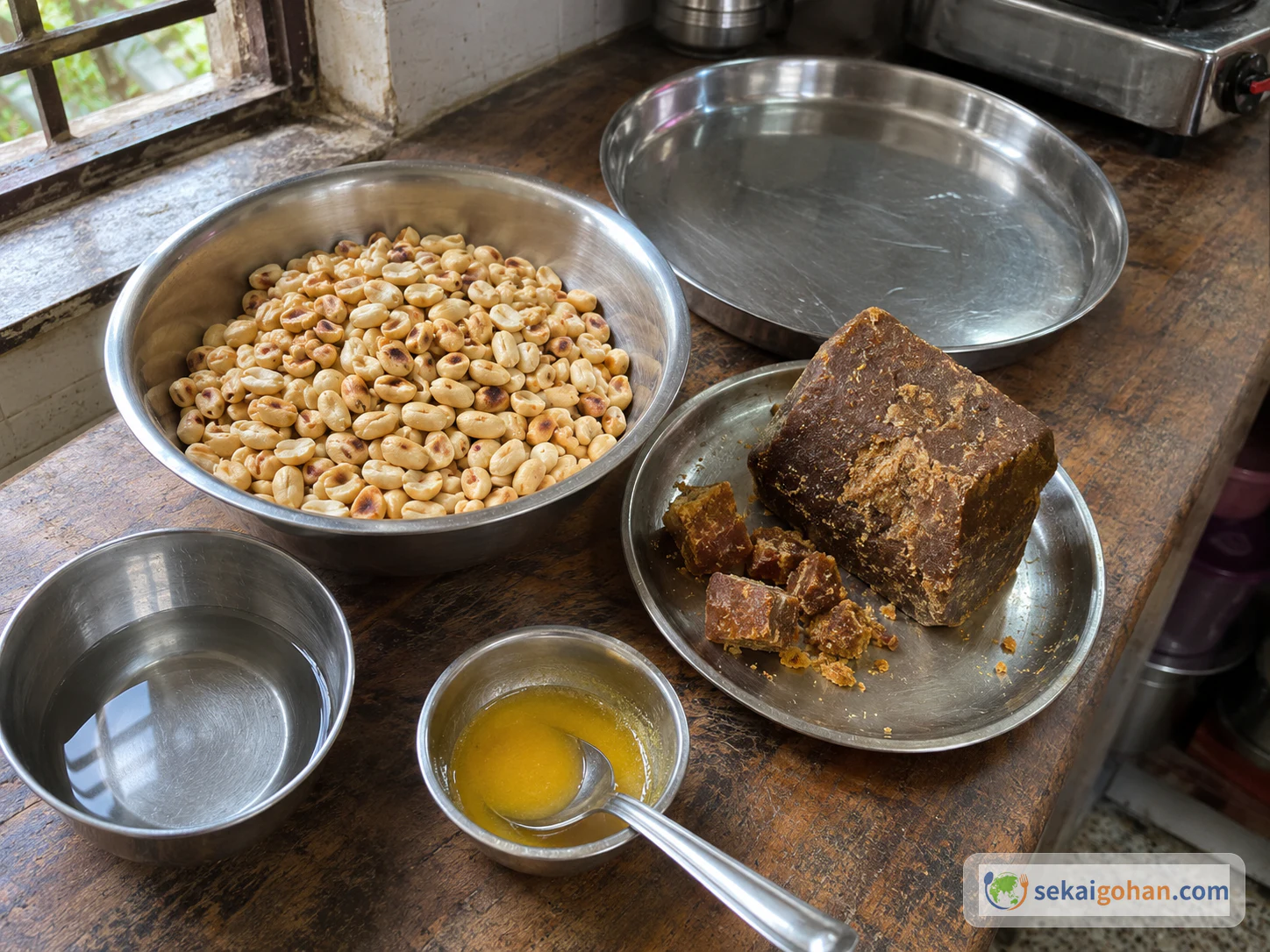
Every bit of the flavour and colour comes from the jaggery, and it is also what sets the peanuts hard. Buy real cane jaggery before anything else; everything else on the list is easy to find.
Peanuts are the main ingredient, and there is no swap: anyone with a peanut allergy should leave this sweet out. Ghee is a milk product. Vanilla essence is made on an alcohol base. If you add cardamom or coloured coconut, tell anyone you are serving.
Equipment
- A saucepan for melting the jaggery
- A heavy-bottomed pan, about 7–8 inches (18–20 cm) across, for boiling the syrup
- A fine strainer
- A candy thermometer that reads to 275°F (135°C), or a small bowl of cold water for testing
- A wooden spatula and a flat spatula
- A shallow tray or mould, about 8 inches (20 cm) square
- A heavy knife and a cutting board
- A dry cloth for holding hot pan handles
Buying Jaggery and Peanuts
Jaggery is unrefined cane sugar that keeps its molasses, sold in blocks or as a coarse powder at Indian grocers and online. Choose a dark block for the deep amber of the finished sweet. Palm jaggery, if you find it, takes the sweet back toward the older festival style, with a stronger aroma than cane jaggery.
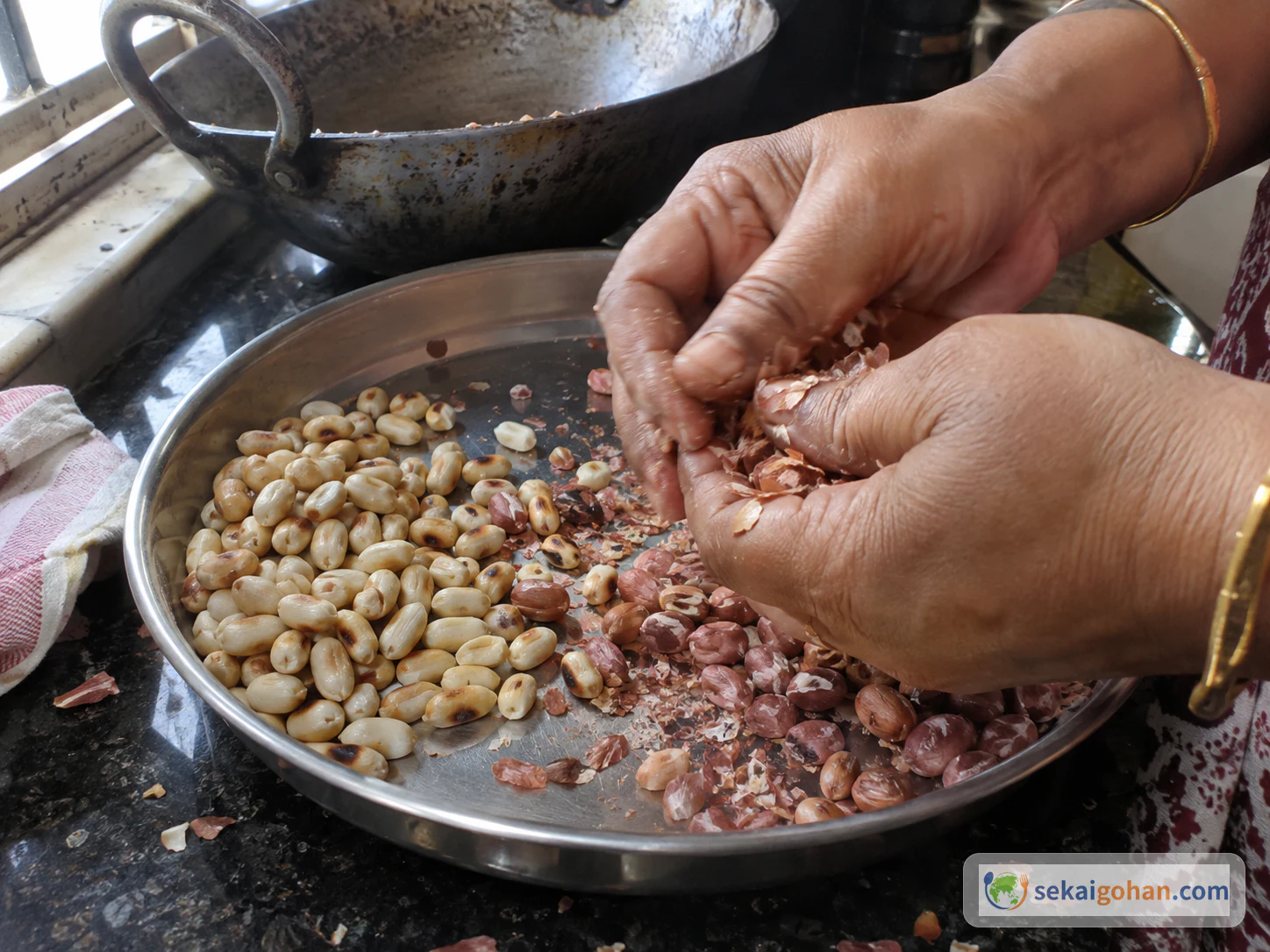
For the peanuts, buy plain, unsalted, roasted and skinless. Salted, flavoured or batter-coated peanuts carry salt and oil that change both the taste and how well the syrup binds, so leave them on the shelf. Raw shelled peanuts work once you roast them and rub off the skins, which the first step covers.
Ghee can be replaced with unsalted butter melted and cleared of its milk solids; it greases the tray just as well and smells close to ghee without being the same. Vanilla is optional. Cardamom belongs to other versions of this sweet, and adding it is a change of style, covered under the variations below.
Method
The whole cook turns on one moment, when the syrup reaches the brittle stage, and from then on there is no pause. So roast and skin the peanuts, grease the tray and set out the cold water before the jaggery goes on the stove. The heat work is short and active; the only waiting is the cooling at the end.
When It Goes Wrong
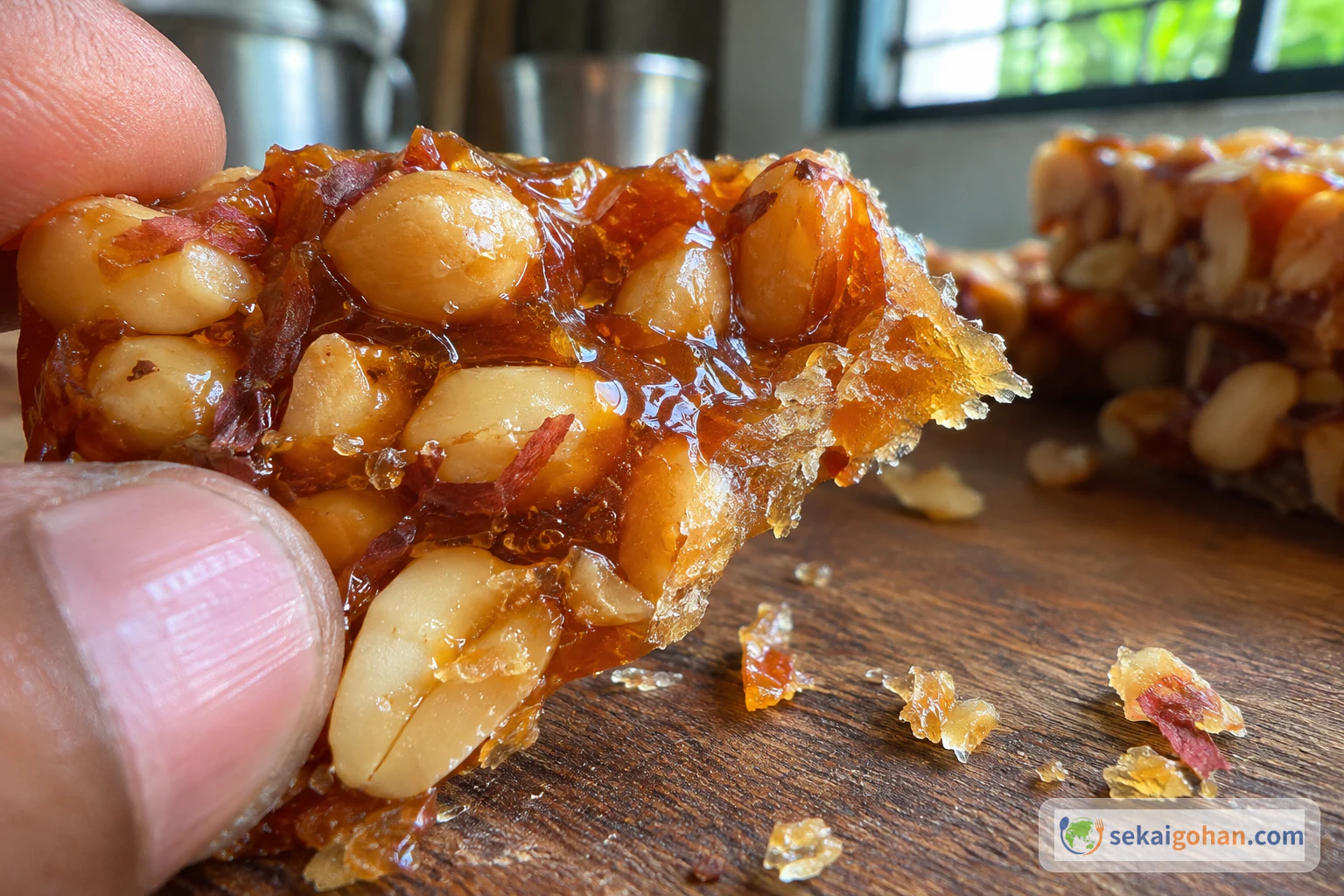
A good piece breaks like glass and shows translucent amber candy around whole peanuts. Most problems trace back to the syrup or to impatience at the end.
| What you see | Why | What to do |
|---|---|---|
| Sticky, chewy pieces that bend instead of snapping | The syrup stopped short of the brittle stage | Next time boil until the thermometer reads 275°F (135°C) or the cold-water drop snaps |
| Bitter taste and a burnt smell | The jaggery scorched while melting or boiling | Burnt jaggery cannot be rescued. Start again, melt over low heat, and start over if the colour runs very dark |
| The slab crumbles when you cut it | It was cut before it was completely cold | Wait until it is cold through, then press straight down with a heavy knife |
| The slab sticks to the tray | Patches of the tray were missed when greasing | Coat every surface, corners and sides included, with a thin layer of ghee |
Serving, Variations and Storage
At the table
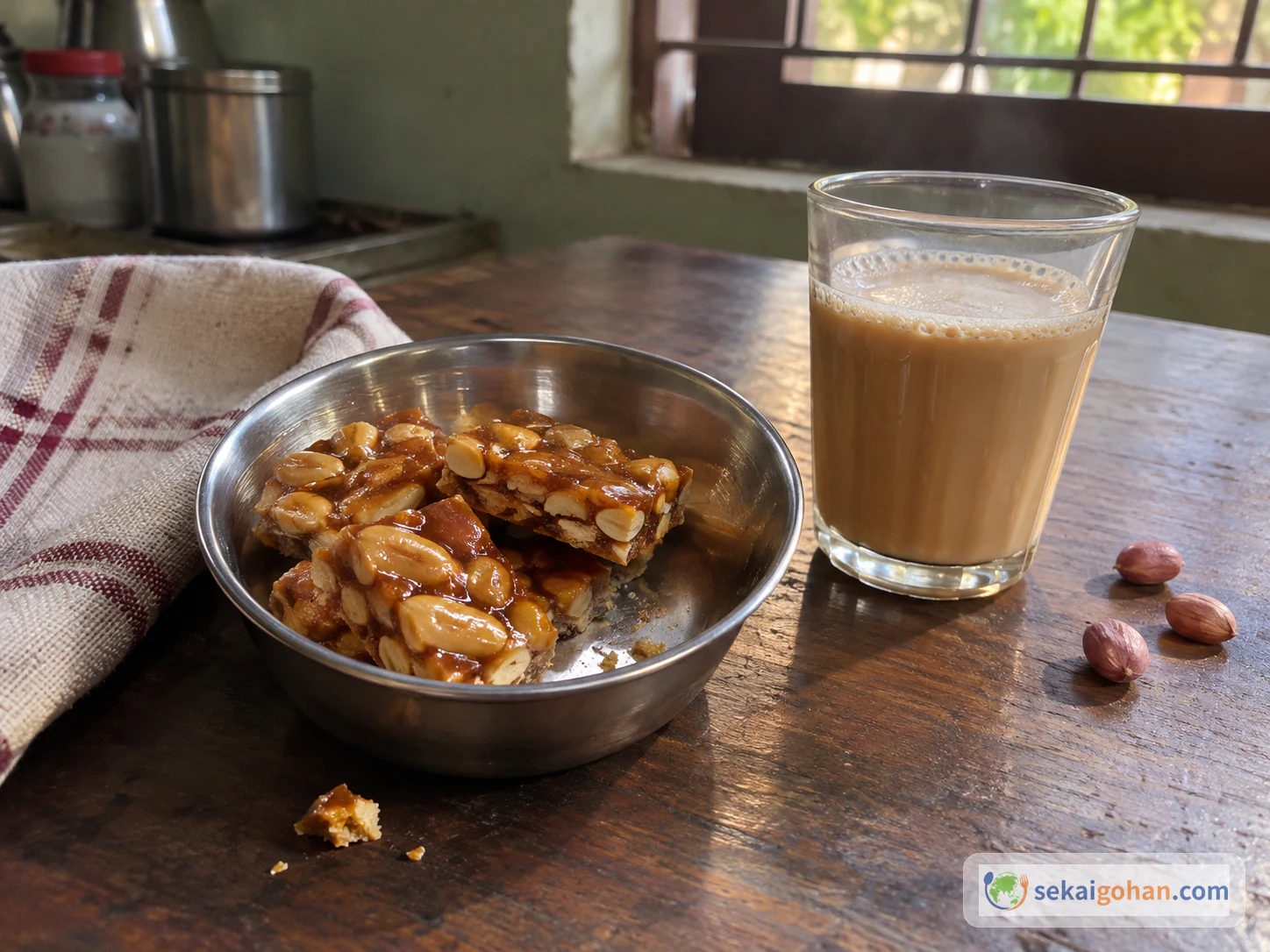
Pile the pieces into a small steel bowl and set them out in the afternoon with hot, milky tea. In Tamil Nadu, it is a sweet made for Karthigai Deepam, the festival of lamps.
Variations
- Tamil-style balls (kadalai urundai). Use 1 cup peanuts, ½ cup jaggery, ¼ cup (60 ml) water, ¼ tsp cardamom powder and a pinch of salt, and stop the syrup at the hard-ball stage, when a drop sets in cold water and rings sharply when dropped on a steel plate. Roll the hot mixture into balls with ghee-coated hands, or press it into bars. The result is softer, rounder and spiced, and the salt sharpens the peanut.
- Kovilpatti-style finish. Scatter shredded coconut dyed pink, green and yellow over the surface while it is soft, then cut the cooled slab into neat rectangular blocks. If you colour the coconut yourself, follow the instructions on the food colouring label.
- Cardamom. Add a little cardamom powder while the jaggery melts. It pulls the sweet toward the Kovilpatti and Tamil versions, with a floral note over the jaggery.
- Kerala shop style. Some Kerala cooks chase the shop flavour with ¼ cup (60 ml) sugar and ½ tsp baking soda for 2¼ cups peanuts, with 2 tbsp water, 1 tsp oil, ¼ tsp cardamom and ¼ tsp salt, spread in a tray, cut into squares and cooled for an hour. This sets by a different mechanism from jaggery syrup, so treat it as a separate recipe and keep its amounts apart from the jaggery version.
Balls are shaped while the candy is still very hot, which carries a high risk of burns. Coat your hands with ghee, and when cooking with family, start with the tray method.
Storage
Once the pieces are completely cold, pack them into an airtight container and keep them dry, away from humid air. Stored this way, they keep for about a week. Moisture is what turns the snap soft, so close the container after each opening.
Frequently asked questions
Can I use another dark sugar instead of jaggery?
Other unrefined dark sugars are made differently and hold different amounts of moisture, so the colour, flavour and set of the candy all move away from kadala mittai. Look for jaggery first, from an Indian grocer or online.
Will mine taste like Kovilpatti kadalai mittai?
The skeleton is the same: roasted peanuts and jaggery cooked with water until it sets. The Kovilpatti makers' own standards, the river water and the local peanuts belong to the town itself, so a home batch is a close relative of the famous one. Add the coloured coconut and cut it into blocks for the look.
Can children help make it?
Keep the melting, boiling, stirring and pouring for adults, because the syrup reaches 275°F (135°C). Children can rub the skins off roasted peanuts at the start. Once the slab is completely cold, they can help break it and pack the pieces.