
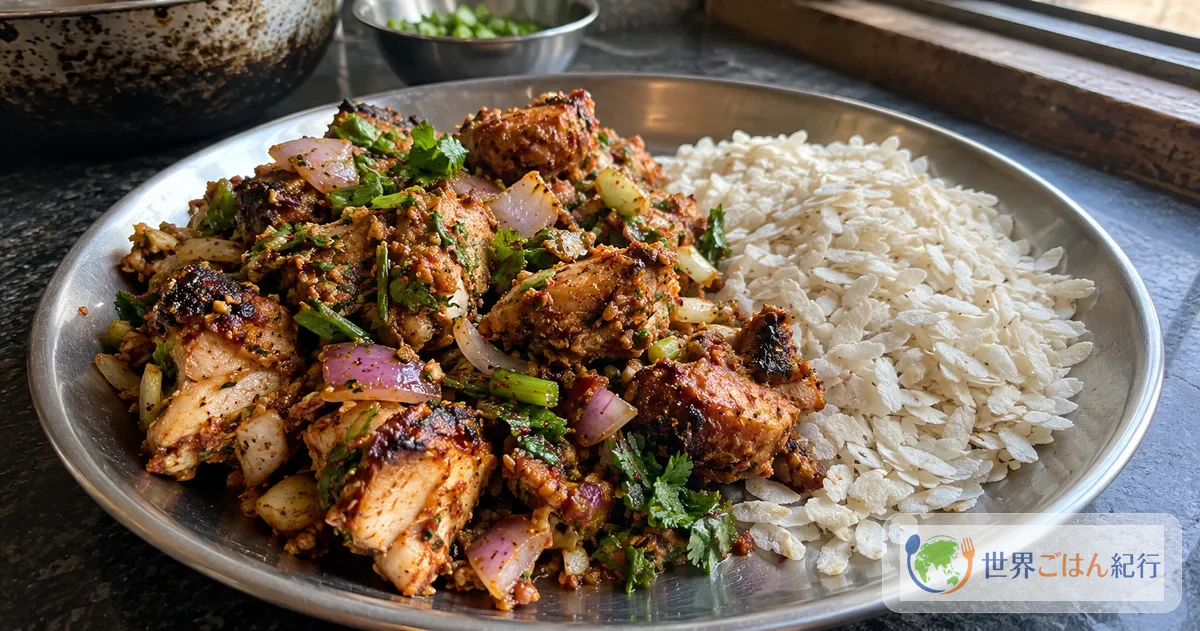
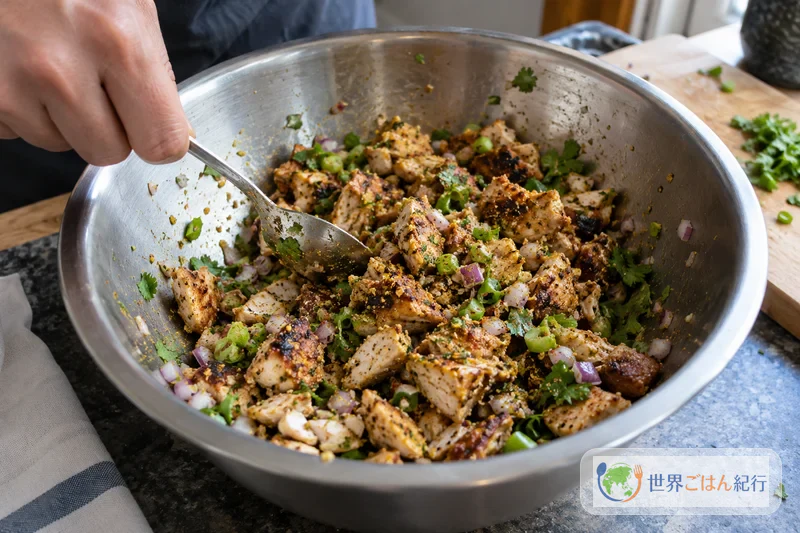
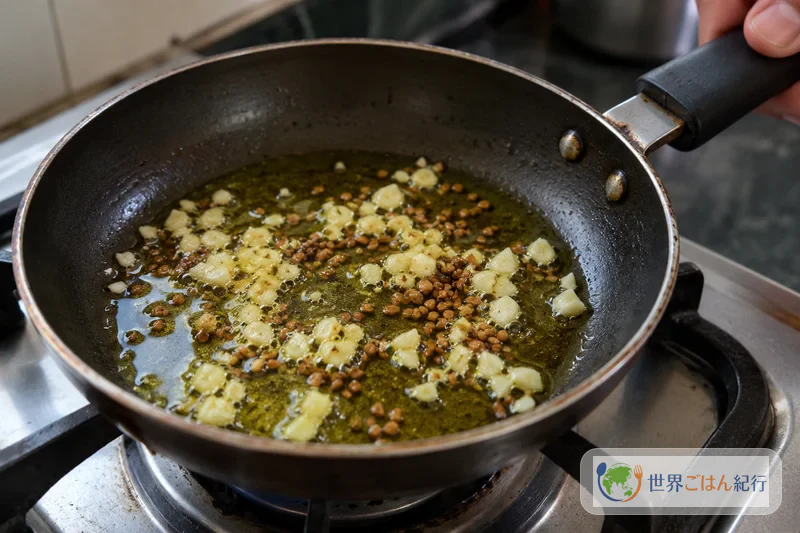
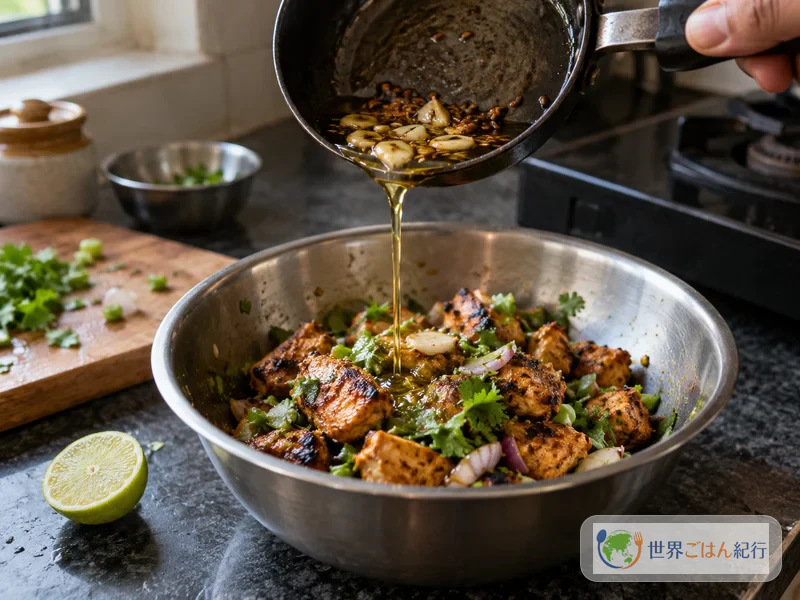
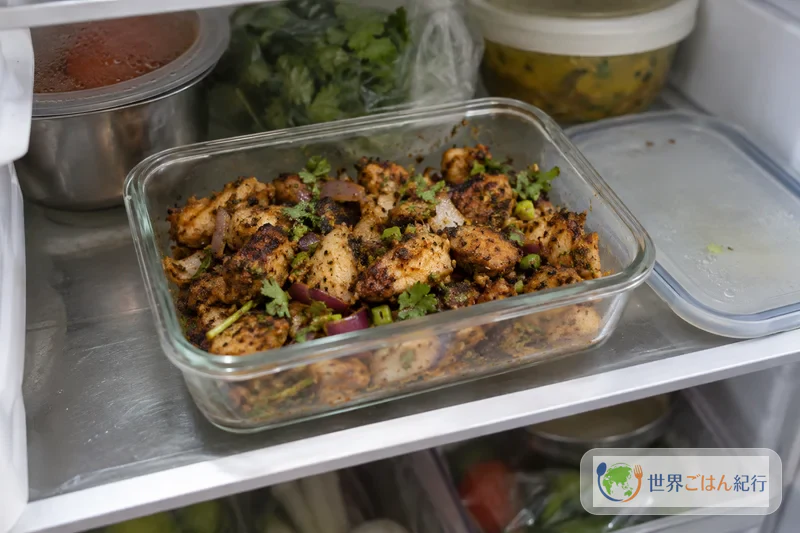
Drop fenugreek seeds into mustard oil warmed in a small pan. They crackle and turn dark brown, and when a bitter-sweet aroma rises, add a pinch of chopped garlic. Then pour that hot oil in one sweep over the grilled meat and aromatics waiting in a bowl, and with a sizzle the smell of chili and pepper spreads all at once. This is choila, the grilled-meat salad that the Newar people of the Kathmandu Valley never leave out, on festival days or on nights drinking with friends.
The plate of fire: grilled meat at the heart of Newar festivals
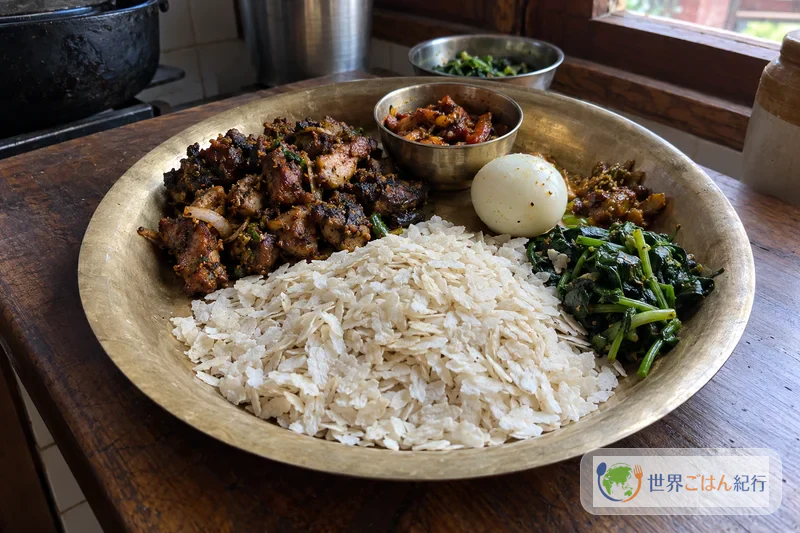
The Newars are the people who have lived in the Kathmandu Valley from the start, in Kathmandu, Patan (Lalitpur), Bhaktapur, Kirtipur, and elsewhere. In the Newar language choila is written छ्वय्ला. Traditionally it was made with water buffalo meat, seared over a fire of rice straw. The smoky char from the straw fire is the foundation of the dish's flavor. Two kinds were made at home: "haku choila" (haku means black in Newar), made by grilling, and "mana choila," made by boiling seasoned meat.
Choila is the dish placed at the center of the Newar festival assortment called "samay baji." The plate holds beaten rice (baji), the local spirit aila, greens, boiled egg, and more, and each is said to stand for one of five elements. Choila stands for fire, and it is treated as connected to Agni, which means life force and vitality.
Before the festival of Dashain, at the full moon of the month of Ashwin (mid-September to mid-October), there is a custom of making water buffalo choila, preparing samay baji, and setting five pieces outside the house as an offering to the gods. In some families, the feast on the eighth day of Dashain puts 12 vegetable dishes and 12 pieces of choila on a banana leaf, and the number of dishes varies by family and region.
Cooking over gas flame is now normal, and chicken or mushrooms are often used in place of buffalo. What has not changed is the oil. Newar cooks say that "choila is made only with mustard oil." Grilled meat is tossed with aromatics and spices, and at the end hot oil is poured over to bring out the fragrance. In Nepali this finishing step is called jhannu.
Ingredient notes for the home cook
The proportions in this article are based on a recipe contributed to the official website of the UK's Chevening Scholarships by Sushmit Sharma Bhattarai, a Chevening scholar from Nepal. He could not find water buffalo meat in the UK and made it with gammon, a cured pork product. Here it is replaced with chicken thigh, which is easy to find and also widely used in Nepal.
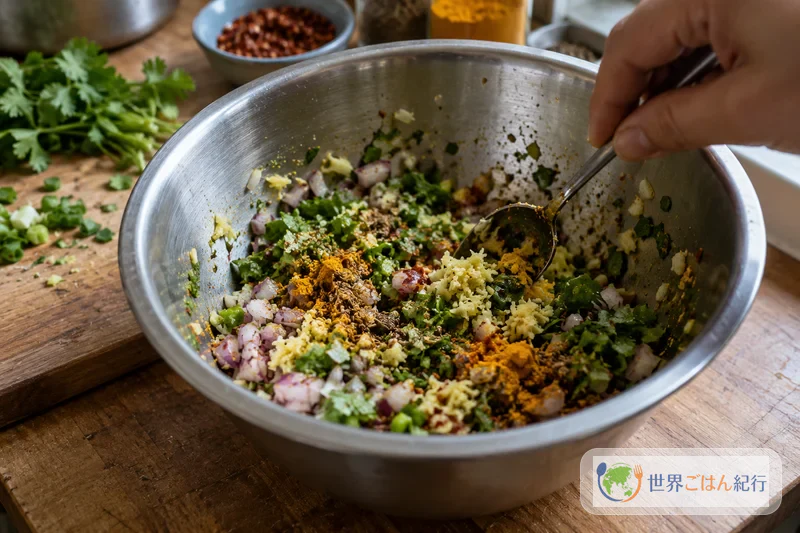
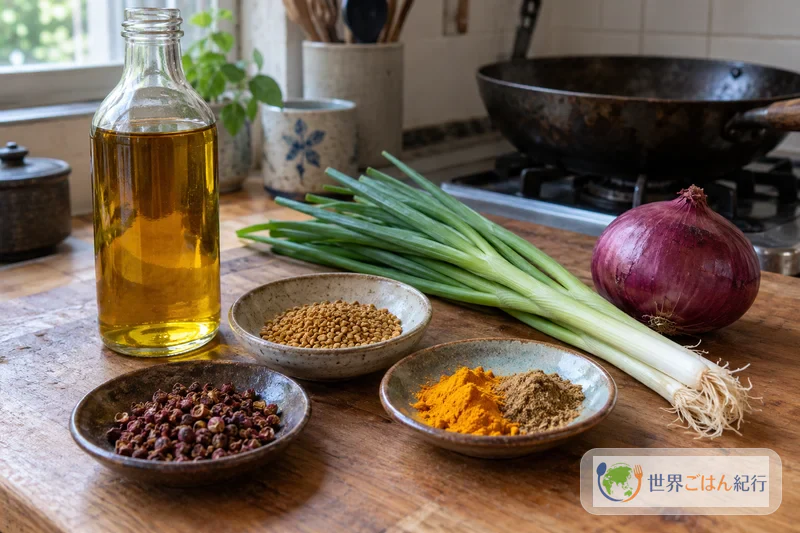
One key to the flavor is timur, Nepal's pepper. It has a citrusy, tongue-numbing aroma and can be found at Nepali grocery stores. If you cannot find it, Chinese Sichuan pepper can stand in. The aroma is a little different, but the numbing sensation is very similar. For mustard oil, look for a bottle labeled as edible at Indian or Nepali grocery stores or online.
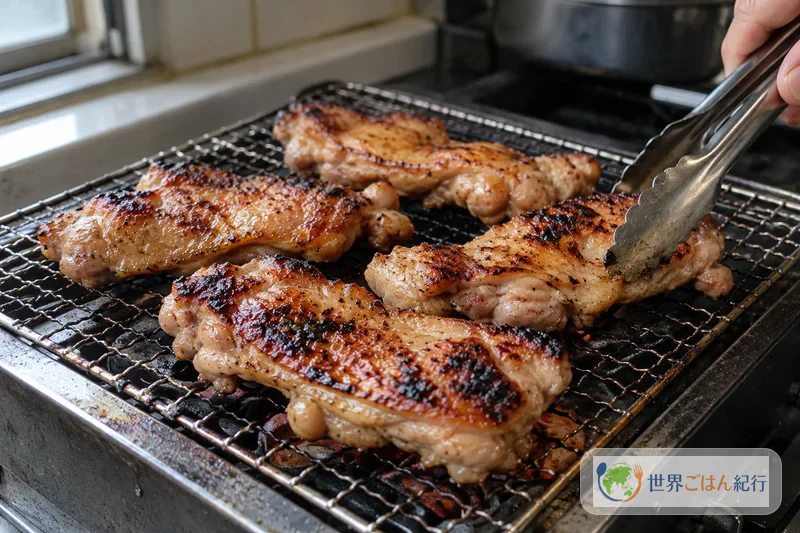
Holding the chicken directly over a gas flame on a grill rack gets you closer to the traditional smokiness of straw-fire grilling. If you do not have a rack, use a grill pan or broiler and cook until the surface is well browned. If the char is pale, the dish will lack smokiness when tossed.
The beaten rice served with choila (chiura, called baji in Newar) is rice that has been steamed, flattened, and dried, and is available at Nepali grocery stores. Its crisp bite is just right for alternating with the spicy meat. If you cannot find it, it is also good with plain white rice or bread.
Ingredients (serves 4)
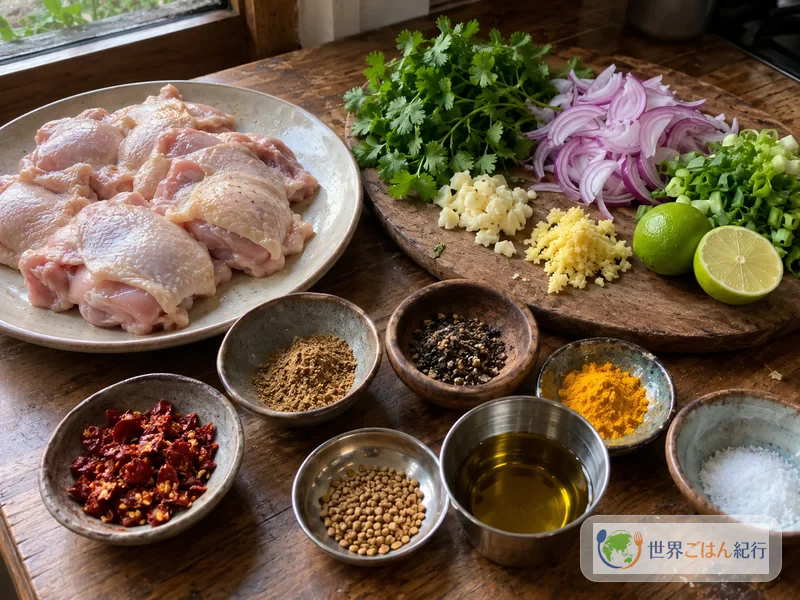
Mustard oil is pressed from mustard seeds, a plant of the same Brassicaceae family as mustard. When pouring hot oil over the ingredients it can splatter, so use a heatproof bowl and keep your face back. The amount of chili flakes and timur greatly changes the heat, so if children will eat it, use half or less.
How to make choila
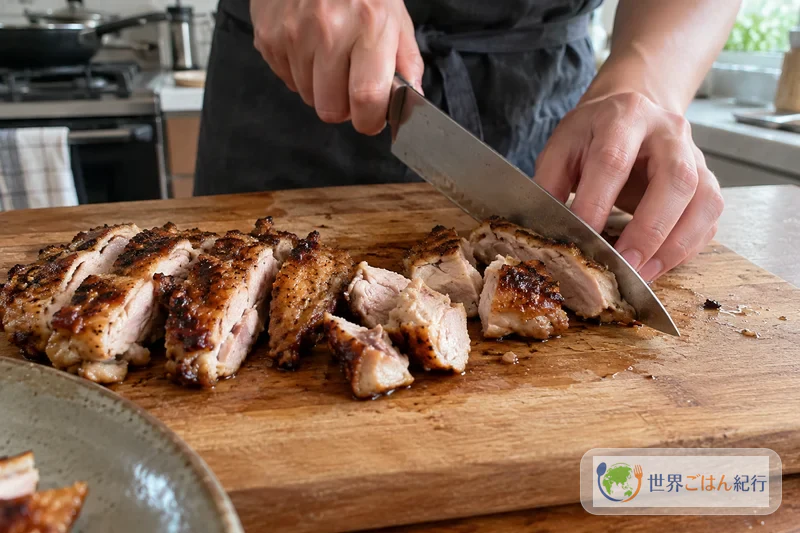
Including the time to grill and cool the chicken, allow about 50 minutes in all. Chop the aromatics while the grilled meat cools and it comes together quickly.
Cook the chicken all the way through. To prevent Campylobacter food poisoning, Japan's Ministry of Health, Labour and Welfare urges cooking chicken to 75°C at the center for at least 1 minute. Do not judge by the surface char alone; check the thickest part.
If the hot oil does not sizzle on the ingredients, it is not hot enough. Put it back on the heat just before pouring, and pour when the fenugreek and garlic are making fine bubbles, for a strong aroma.
With chiura, as a snack or a meal
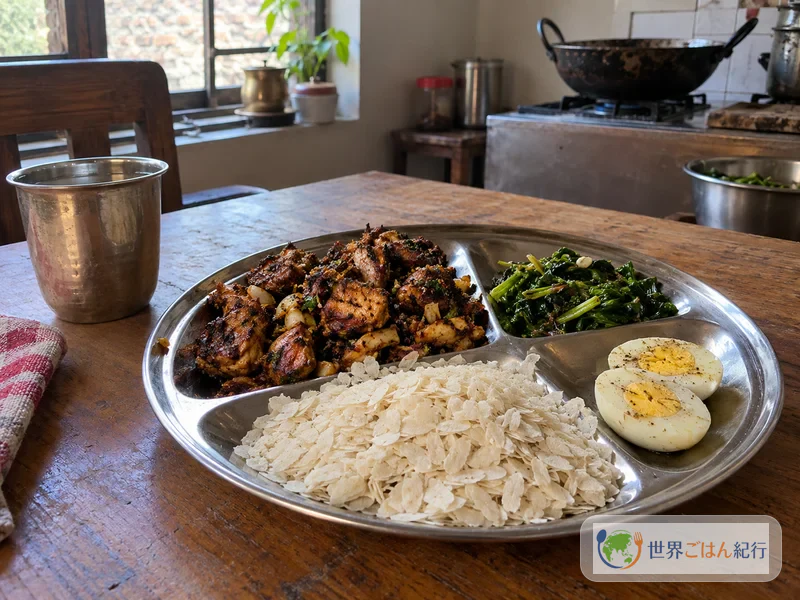
Choila is good piping hot, but it has a different appeal after it settles to room temperature. As the meat cools, the hot oil and spices soak into the surface and the flavors marry. Take a pinch of chiura, then a piece of choila. The crisp bite and mild sweetness of the beaten rice soften the heat of the chili and timur.
At a Newar feast, choila is set out with local spirits, boiled egg, greens, and bean dishes, and everyone picks at them together. At home, put it beside the Newar spiced meat pukala (in Japanese) and the Nepali steamed dumplings momo, and the table looks like a set of small plates at a Nepali eatery. For an everyday meal, it also makes one of the side dishes of dal bhat.
Choila is also an offering to Newar deities, including the household guardian deity, ancestral gods, and gods such as Bhairav and Durga. When it is made as an offering, the custom is to make it without tomato. At Indrayani Jatra, the festival in Kirtipur, choila is also considered an essential dish.
Ways to vary it
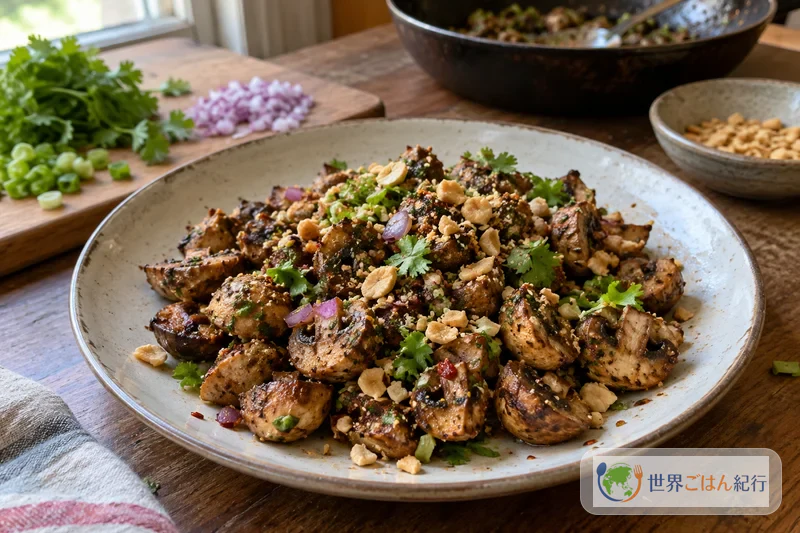
For a meatless version there is mushroom choila. Halve about 20 mushrooms, heat 2 tablespoons of mustard oil in a skillet, and cook slowly over low heat. When browned, toss them with the aromatics and spices as you would the chicken. Scattering dry-toasted, crushed peanuts on top adds a crunchy texture.
For even more smokiness without a grill rack, you can also quickly sear the surface of the grilled chicken with a kitchen torch. Made with sliced pork shoulder or beef instead of chicken, it gets a chew closer to water buffalo meat. You can adjust the heat with timur and chili, so find the amount you like from the second time on.
Frequently asked questions
What if I do not have mustard oil?
You can make it with vegetable oil, but you will not get the sharp aroma of mustard oil that Newar cooks insist on. The impression of the aroma changes a great deal, so prepare mustard oil if you can.
Can I make it ahead?
Once tossed, let the choila cool a little, put it in a storage container, refrigerate, and finish it by the next day. Moisture comes out of the onion and cilantro, so the aroma is weaker than freshly made. Bringing it back to room temperature before eating helps the aroma return.
Are timur and Sichuan pepper the same?
Both are the fruit of plants in the genus Zanthoxylum of the citrus family, and both have a tongue-numbing aroma. Timur is the one used in Nepal, with a stronger, fresh citrusy fragrance. Substituting Sichuan pepper gives a similar numbness but a slightly heavier aroma.
I do not have a grill rack. Can I make it in a skillet?
Yes. Heat a skillet well over medium heat, and without oil start skin side down, blotting up the fat that comes out with paper towels, and cook until both sides are browned. It chars less easily than a rack, so be sure to pat the surface of the chicken dry before cooking.
Sources
- Goya, Ridhi Agrawal, "Chhoila: A Fire-Grilled Delicacy from the Newar Community," published April 2, 2026. Accessed and checked: October 22, 2026. https://www.goya.in/blog/chhoila-a-spicy-meat-dish-indigenous-to-nepals-newars
- Chevening Scholarships, "Chevening Meals: Gammon Choilla." Accessed and checked: October 22, 2026. https://www.chevening.org/news/chevening-meals-gammon-choilla/
- Ministry of Health, Labour and Welfare of Japan, "Let's prevent food poisoning from Campylobacter" (leaflet; in Japanese). Accessed and checked: October 22, 2026. https://www.mhlw.go.jp/file/06-Seisakujouhou-11130500-Shokuhinanzenbu/0000128335.pdf


