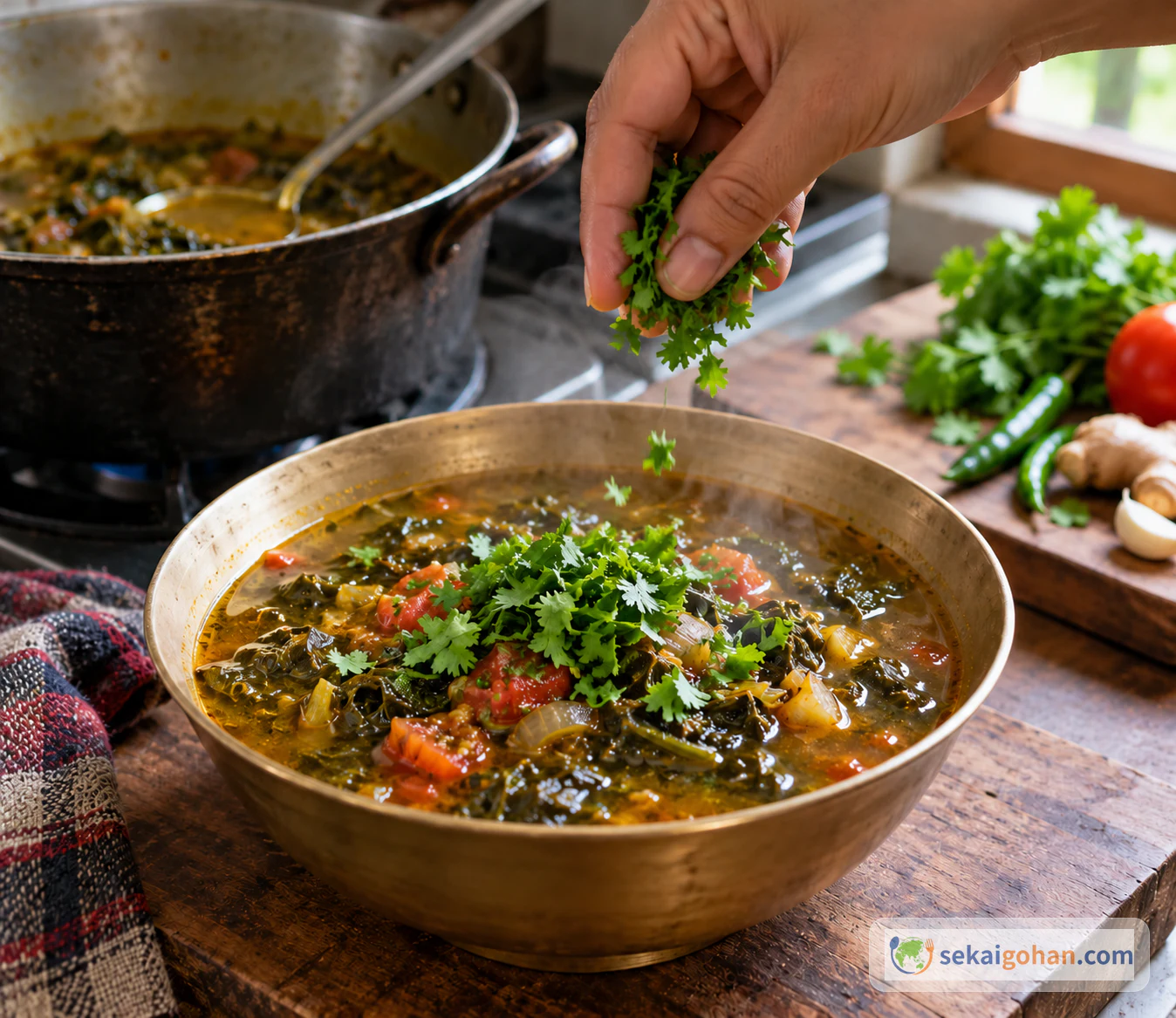
Gundruk ko Jhol: Preserved Leaves Brought Back into Broth
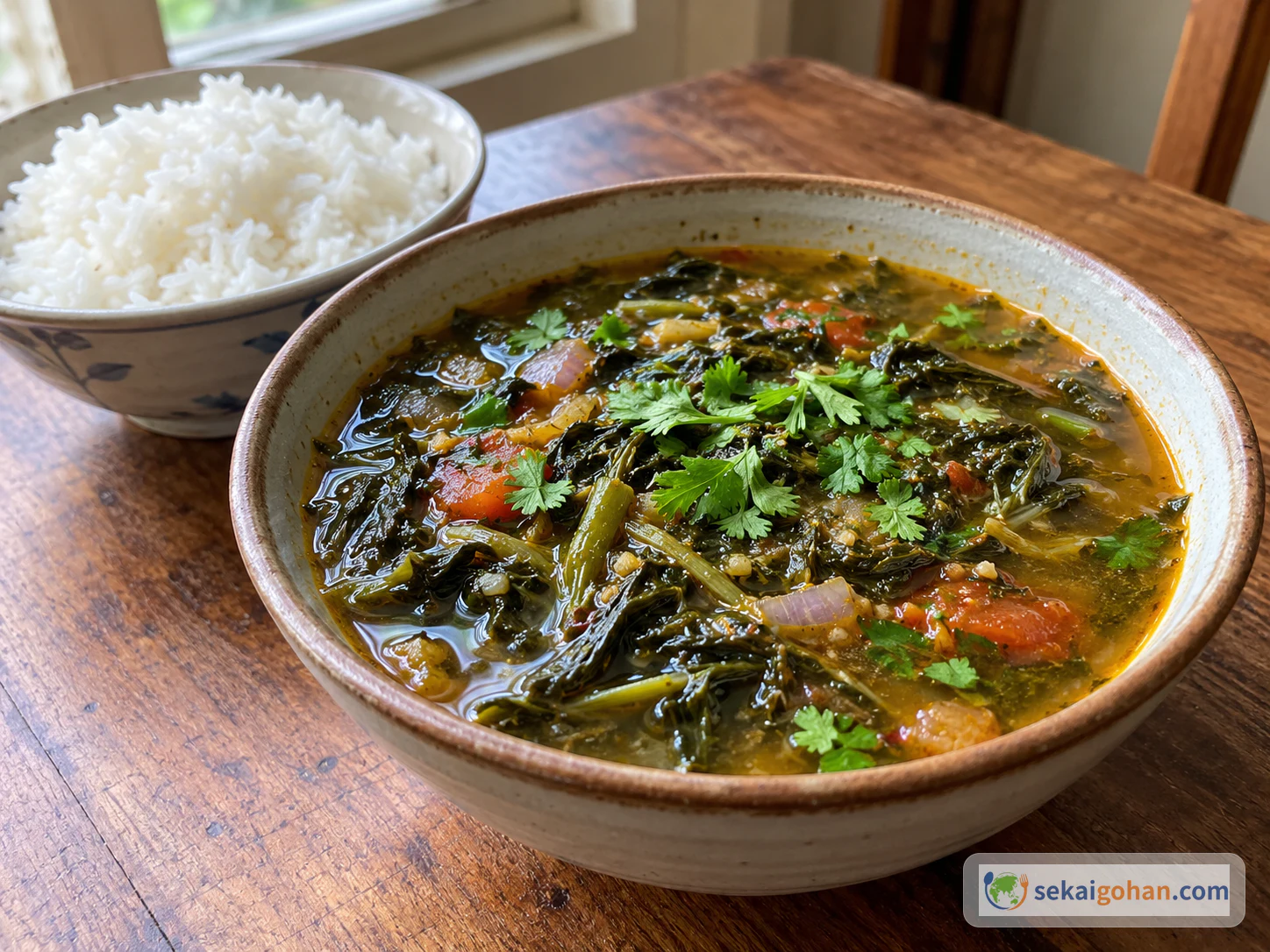
Dark gundruk leaves softened in a thin broth with a sour, pungent edge, carried by mustard oil, aromatics and a little chilli. This version is a clear broth with no potato and no beans.
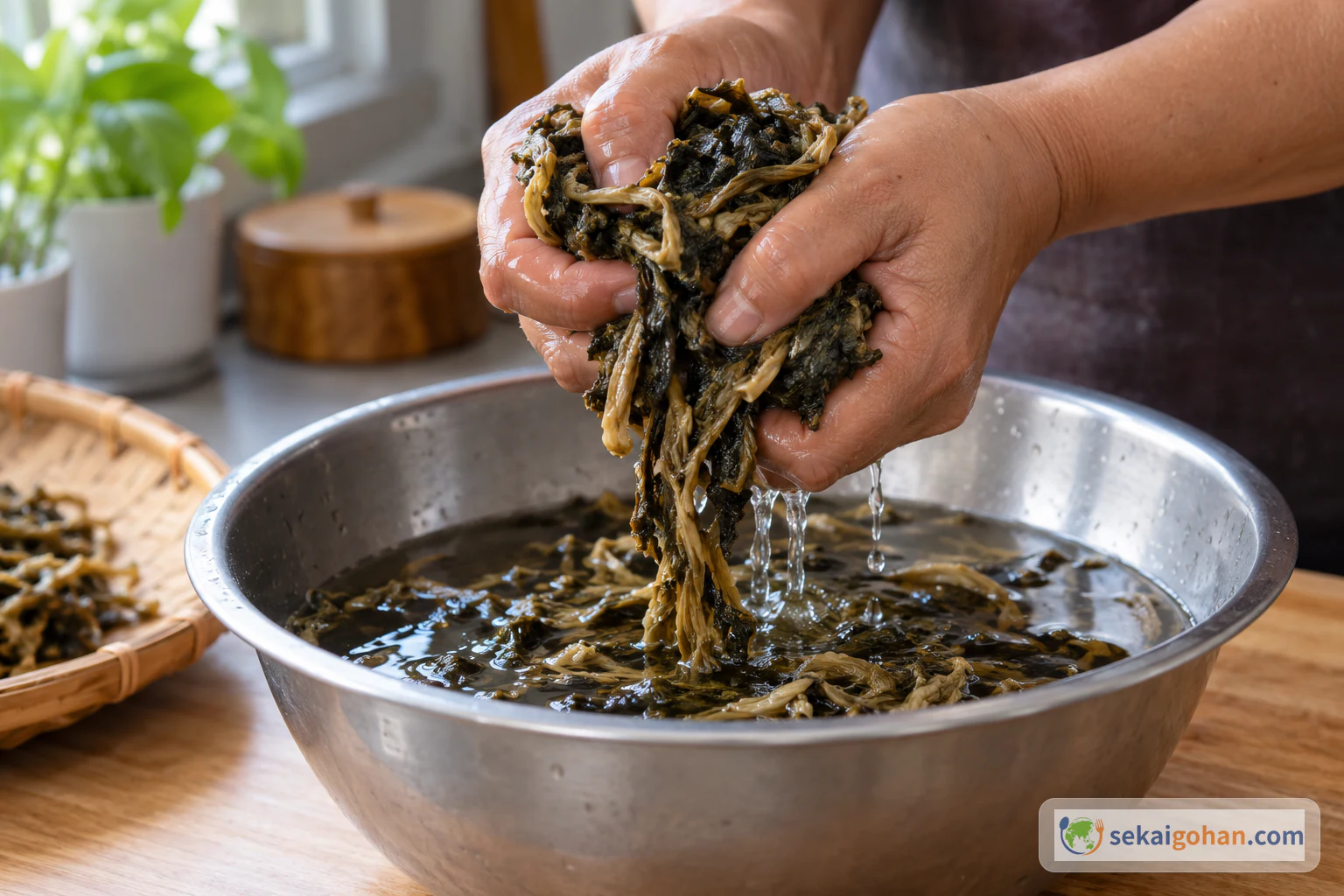
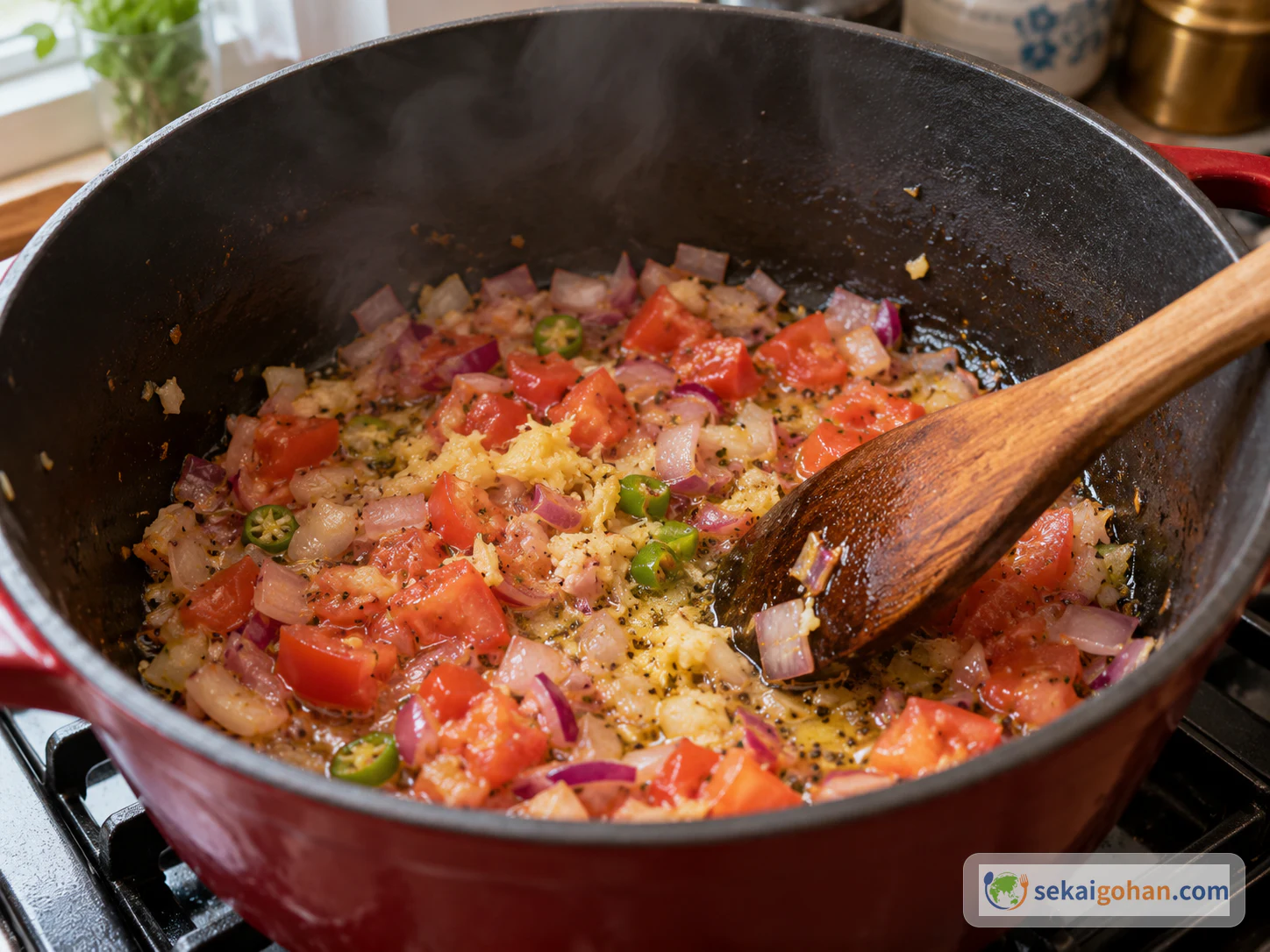
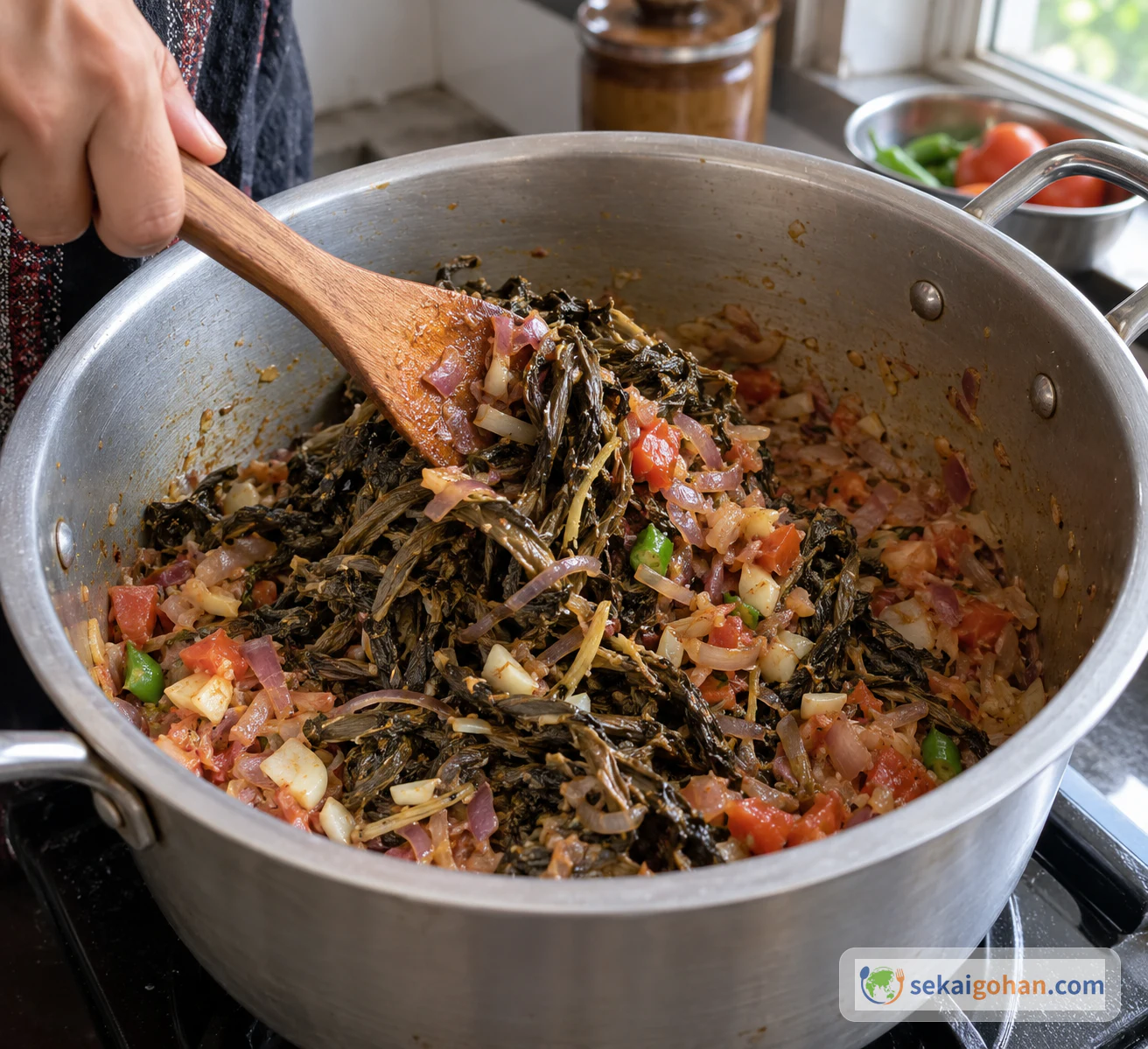
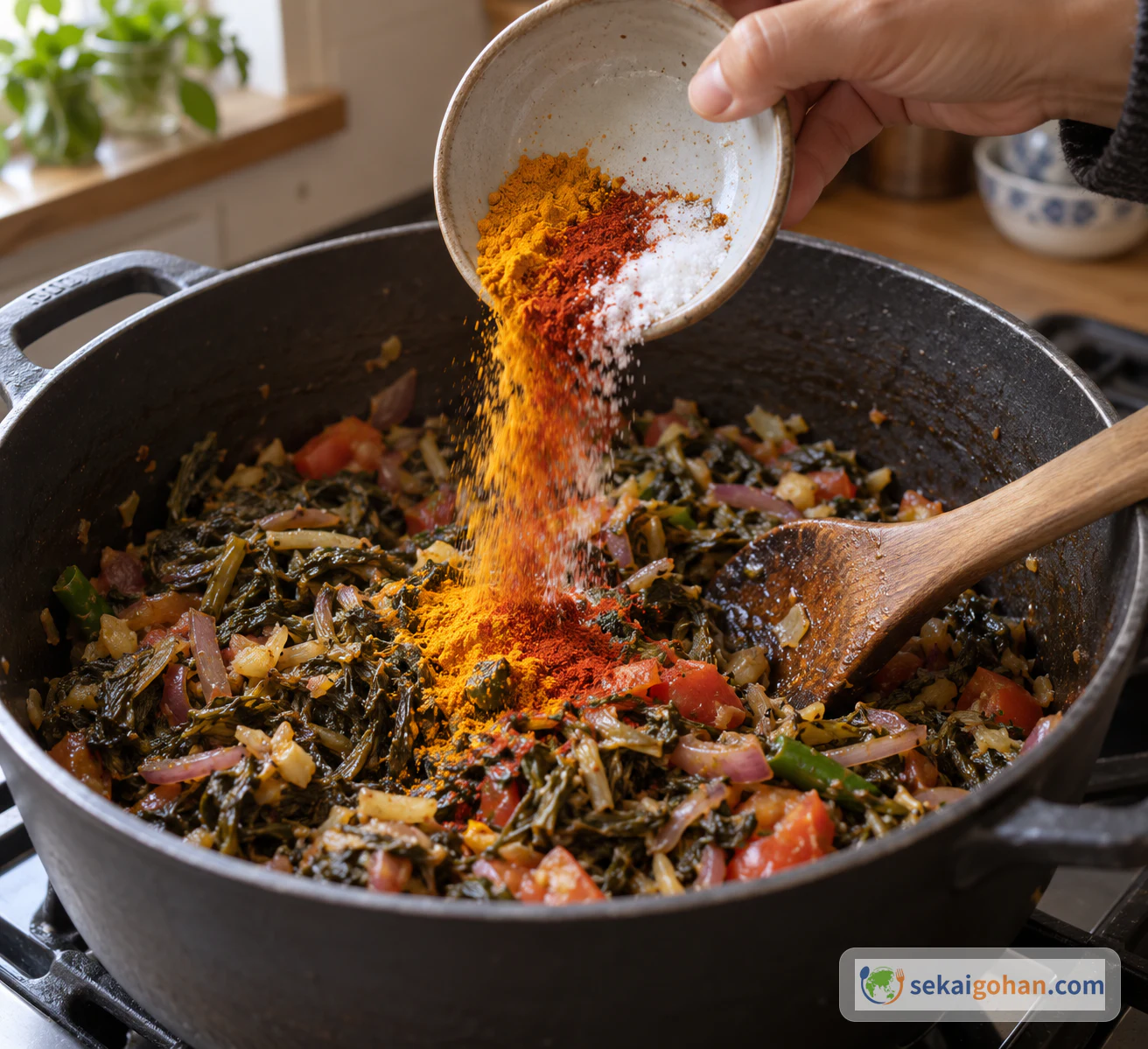
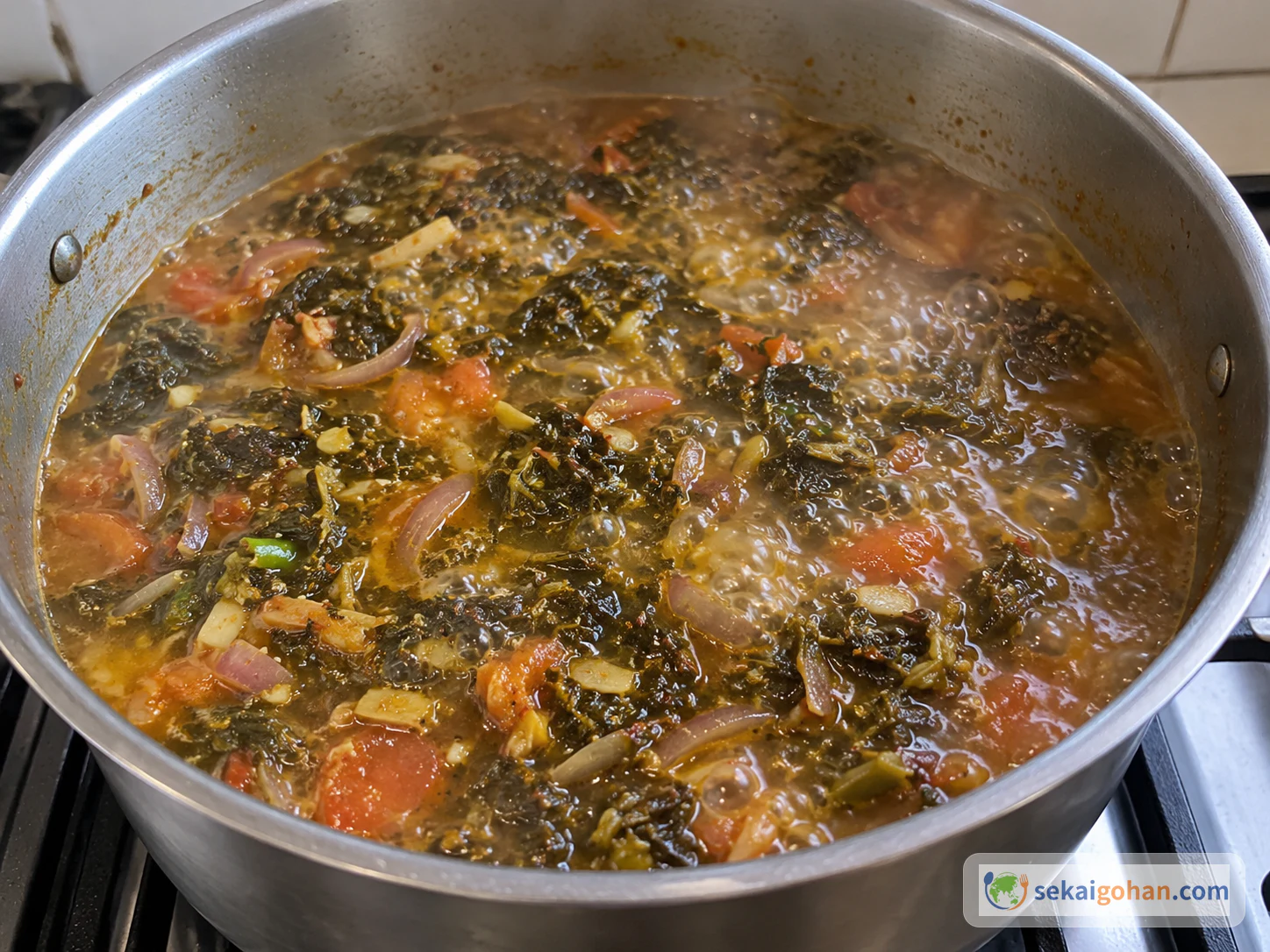
Mustard oil heats in a deep pot until it is smoking hot. Garlic, red onion, ginger, green chilli and tomato go in, followed by a handful of soaked and squeezed dark leaves. Then come turmeric, red chilli powder and salt, water at one cup for each person eating, and a rolling boil. A sprig of chopped coriander finishes the bowl.
This is Gundruk ko Jhol, a sour, pungent broth made with gundruk, a dried fermented leafy food. The recipe here follows a written family version published by journalist Diwash Gahatraj in The Goya Journal, framed within the Nepali-speaking diaspora in India and Bhutan. In that account, the author's grandmother prepared greens each winter to make the next year's gundruk, and the family ate it as this jhol. It is one family's recipe, shared as such, not a single national standard for all of Nepal.
Gundruk is the fermented, dried leafy ingredient. Gundruk ko Jhol is the soup made with it. Jhol refers to the brothy dish; gundruk is also used in other preparations, such as pickles and curries, that are different dishes.
Gundruk Is a Fermented Leafy Food, Not the Finished Dish
It is easy to mix up the ingredient and the dish. A food survey from the Nepal Academy of Science and Technology, Traditional Foods of Nepal, describes gundruk as a fermented leafy food made from the leaves or seedlings of Brassica plants, including mustard, cauliflower and radish leaves. It notes that gundruk is produced in households and that methods vary by locality. The same book treats gundruk and sinki, a separate fermented food made from radish, as different products, and it describes soup, curry and pickle as distinct ways of using gundruk.
This article covers only the soup, made from gundruk that has already been fermented and dried. Making gundruk itself from fresh leaves is not part of this recipe. The descriptions available here are not a tested home-fermentation method, so no fermentation steps, times or safety checks are given.
One Family's Pot from the Nepali Diaspora
In the Goya Journal piece, Diwash Gahatraj presents Gundruk ko Jhol through family memory: a grandmother who prepared winter greens to make the coming year's gundruk, and a broth eaten at home with rice. Those memories belong to the author and the family. They are not offered here as a description of every household, nor as a history of the dish.
The written recipe has two features worth knowing before you cook. First, only the gundruk and the cooking water are given per person: 1 tbsp of gundruk and 1 cup of water for each person. Every other ingredient is a single fixed amount for the pot. Second, the recipe states no total number of servings, no cooking times, no standard for the cup, and no measured amount of soaking water. Those gaps are left as they are in this article rather than filled with guesses. The recipe also mentions an optional boiled potato, which the author's grandmother added; this article follows the version without potato, for a clear broth.
Sekai Gohan has not kitchen-tested this recipe as a whole.
Ingredients for Gundruk ko Jhol
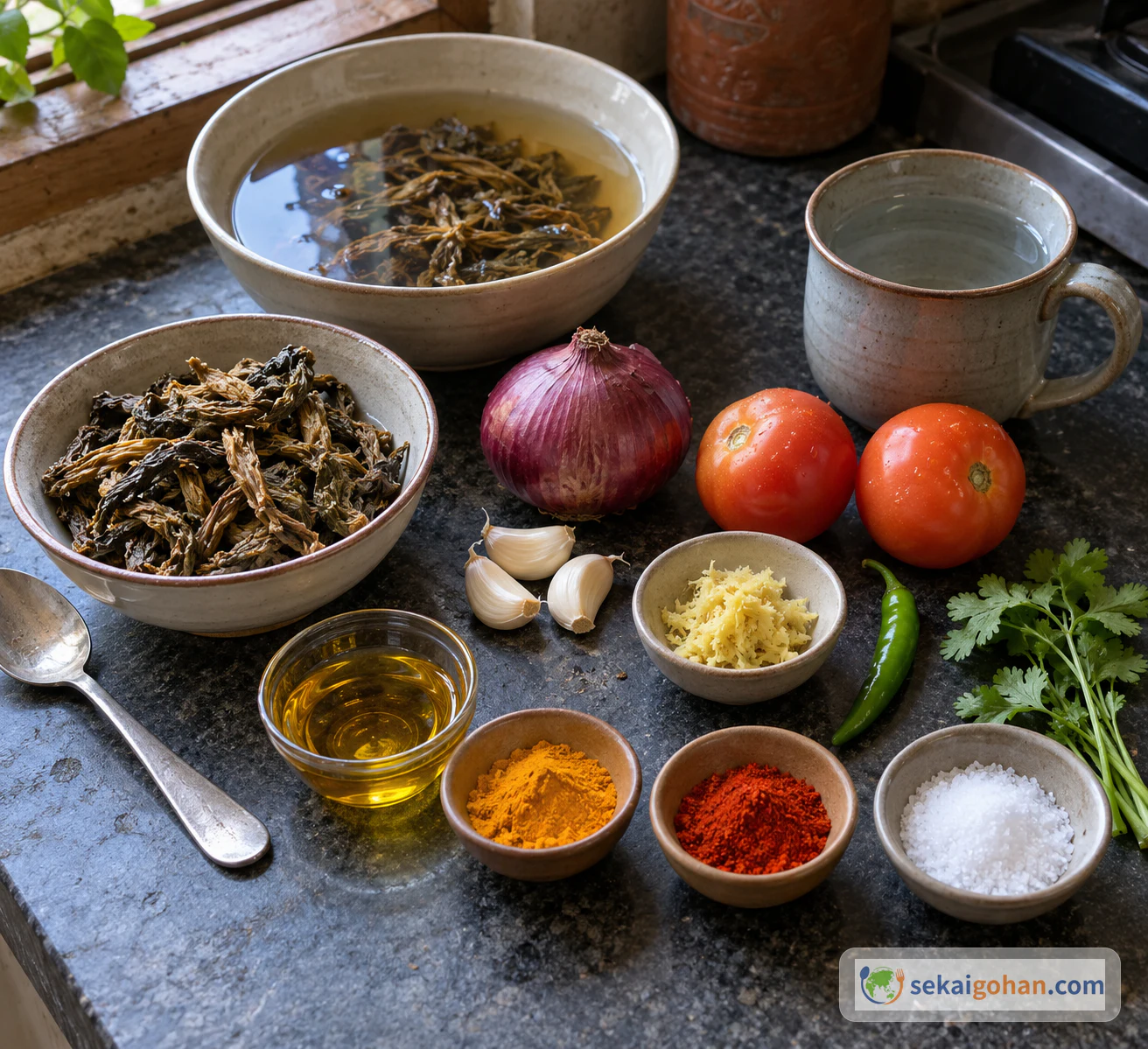
Gundruk and the simmering water are measured per person. Everything else is one fixed amount for the pot.
Steamed white rice is served on the side as an optional accompaniment. It is not part of the soup.
Equipment
- A deep cooking pan or pot
- A bowl for soaking the gundruk
- A spoon for stirring
Choosing Gundruk and Mustard Oil
The soup depends on two things you may need to look for: dried gundruk and mustard oil. Search for "dried gundruk" at South Asian or Nepali grocers. There is no substitute that keeps this dish what it is; kimchi, sauerkraut or other pickles make a different soup, so they are not suggested here.
Use mustard oil that is labelled as edible or for cooking, and follow the product's instructions. Use commercially prepared dried gundruk and follow its package labelling for handling and storage. This recipe does not cover fermenting gundruk at home.
Brands, prices and availability vary and are not covered here.
How to Make Gundruk ko Jhol
Cook by the state of the pot: oil smoking hot before the aromatics go in, spices mixed through before the water, and a rolling boil at the end.
Serving with Steamed Rice
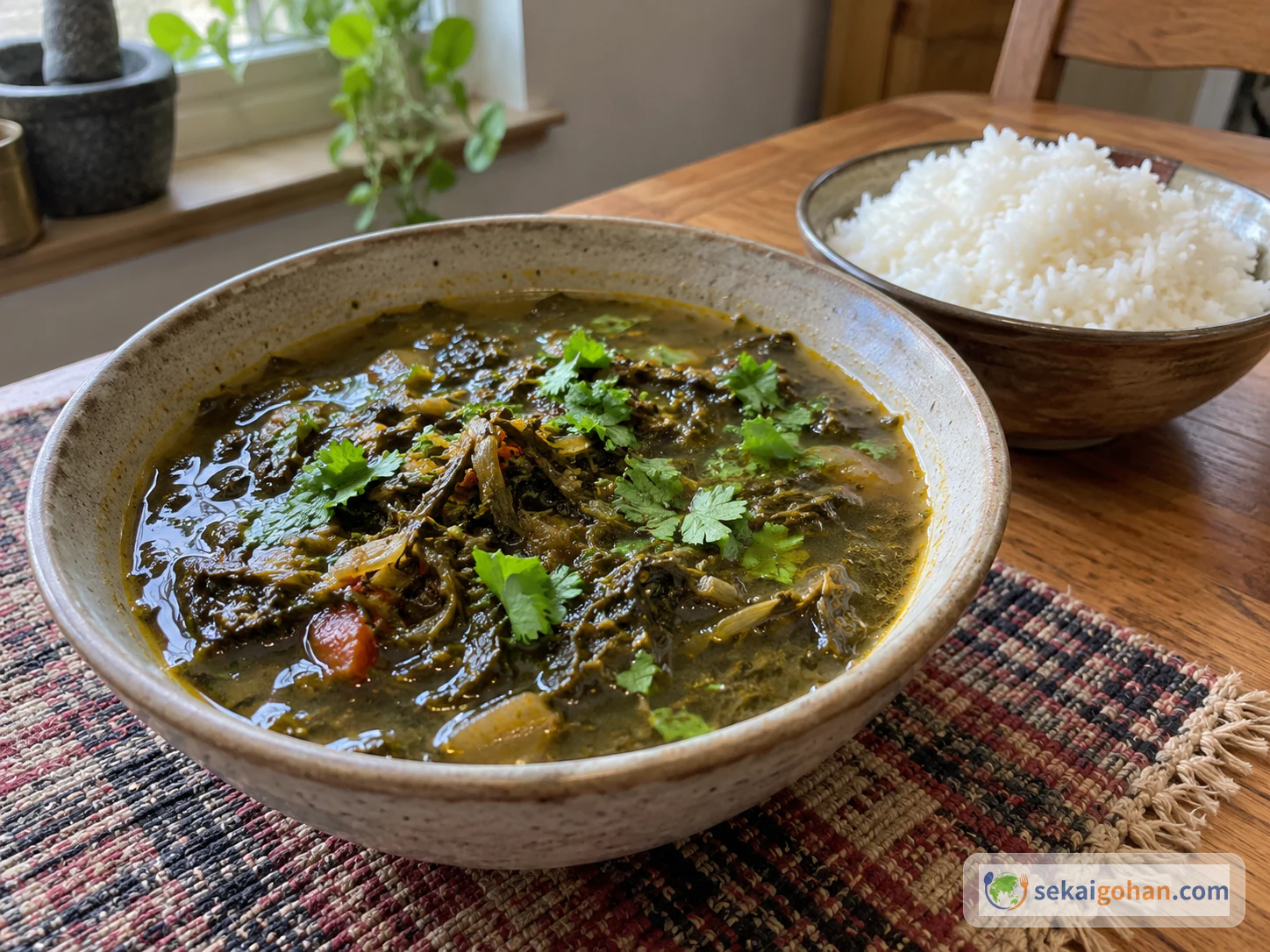
In the family account behind this recipe, Gundruk ko Jhol is eaten with rice. Serve plain steamed white rice in a separate bowl so the broth stays thin and sour on its own. The rice is an accompaniment, not an ingredient, and it is not counted in the per-person amounts.
Troubleshooting
| Situation | What is happening | What to do |
|---|---|---|
| The broth looks thin | That is this version | It is a clear-broth jhol with no potato. For a thicker family variation, see the potato note below |
| The oil starts to smoke heavily | It has gone past the point you need | Add the aromatics as soon as the oil is smoking hot; there is no need to keep heating it for more smoke |
| The pot is dry when you add the spices | The spices go in before any water | Stir them through the gundruk and aromatics, then add the water in step 5 |
| You are cooking for a different number of people | Only two amounts are per person | Adjust the gundruk and water per person; the other amounts are fixed for one pot, so taste and adjust the salt |
| You cannot find gundruk | It is the defining ingredient | Look for dried gundruk at South Asian or Nepali grocers rather than substituting another pickle |
Variations: Other Pots and Other Gundruk Dishes
These are separate versions or separate dishes. They are described for context and are not mixed into the recipe above.
| Version | What changes | How it relates to this recipe |
|---|---|---|
| With potato | One large potato, boiled, chopped and mashed in the pot with a ladle | The author's grandmother's optional addition in the same family recipe. Left out here for a clear broth |
| With soybeans and cumin | Gundruk with soybean (bhatmas), salt, garlic, cumin powder, oil, water, turmeric and chilli powder | Listed in Nepal's occupational skill standard for Nepali cuisine cooks. No amounts or order are given, so it is not turned into a recipe here |
| Gundruk curry | Gundruk cooked with ingredients such as potato, tomato, soybean and onion | A different dish, described in Traditional Foods of Nepal |
| Gundruk pickle (achaar) | Rehydrated gundruk mixed with onion, salt, mustard oil and green chilli | A different way of eating gundruk, not a soup |
Frequently Asked Questions
What is gundruk?
Gundruk is a fermented leafy food made from Brassica leaves or seedlings such as mustard, cauliflower and radish leaves, then dried. Gundruk ko Jhol is a soup made with it.
Is Gundruk ko Jhol the same as gundruk achaar?
No. Jhol is a brothy soup. Achaar, or pickle, is a separate preparation of gundruk with onion, salt, mustard oil and green chilli.
Should I add soybeans?
Not to this version. Nepal's occupational skill standard lists a Gundruk ko jhol with soybeans and cumin, but that is a different recipe with no published amounts or method. The family version here has neither.
Can I add potato?
The family recipe mentions one large boiled, chopped potato, mashed with a ladle, as the author's grandmother's optional addition. This article follows the version without potato, so the broth stays clear.
How many servings does this make, and how long does it take?
The recipe gives no total number of servings and no cooking times. Only the gundruk (1 tbsp per person) and the simmering water (1 cup per person) are given per person; the other ingredients are fixed amounts for one pot. No servings or times are added beyond that.
Can I make gundruk at home?
Gundruk is made in households, and methods vary by locality, but this article does not give a home fermentation method, timings or safety checks. Use commercially prepared dried gundruk and follow its package labelling.
Is gundruk a probiotic or health food?
This article makes no health, nutrition or probiotic claims about gundruk or the soup. The family account mentions health in personal terms, and that is shared only as the author's story.
How should I store leftovers?
The recipe gives no storage guidance for the finished soup, so none is offered here. For dried gundruk, follow the package labelling.
Sources
- Diwash Gahatraj, "A Beloved Recipe for Fermented Gundruk ko Jhol from the Nepali Diaspora," The Goya Journal, 2021-09-17. The recipe followed in this article: ingredients, amounts where given, order of cooking, the rolling-boil finish, the optional potato, serving with rice, and the author's family account within the Nepali-speaking diaspora in India and Bhutan. https://www.goya.in/blog/a-beloved-recipe-for-fermented-gunrdruk-ko-jhol-from-the-nepali-diaspora
- Council for Technical Education and Vocational Training, National Skill Testing Board, Nepal, "National Occupational Skill Standard (NOSS): Nepali Cuisine Cook, Level 1," 2020-03-02. Classifies Gundruk ko jhol among soup items and lists a separate ingredient set including soybean (bhatmas) and cumin powder, without quantities or method. https://www.nstb.org.np/wp-content/uploads/2020/10/Nepali-Cuisine-Cook-NOSS-L-1-1.pdf
- Ganga P. Kharel, Dilip Subba, Pushpa P. Acharya and Basanta K. Rai, "Traditional Foods of Nepal," Nepal Academy of Science and Technology, Library and Documentation Centre. Describes gundruk as a fermented leafy food from Brassica leaves, its household production and local variation, its distinction from sinki, and its uses in soup, curry and pickle. https://nastlibrary.nast.org.np/elibrary/filestore/1/9/0_d5666a15fdb5bfd/190_f8d6b5e1ad6022d.pdf