
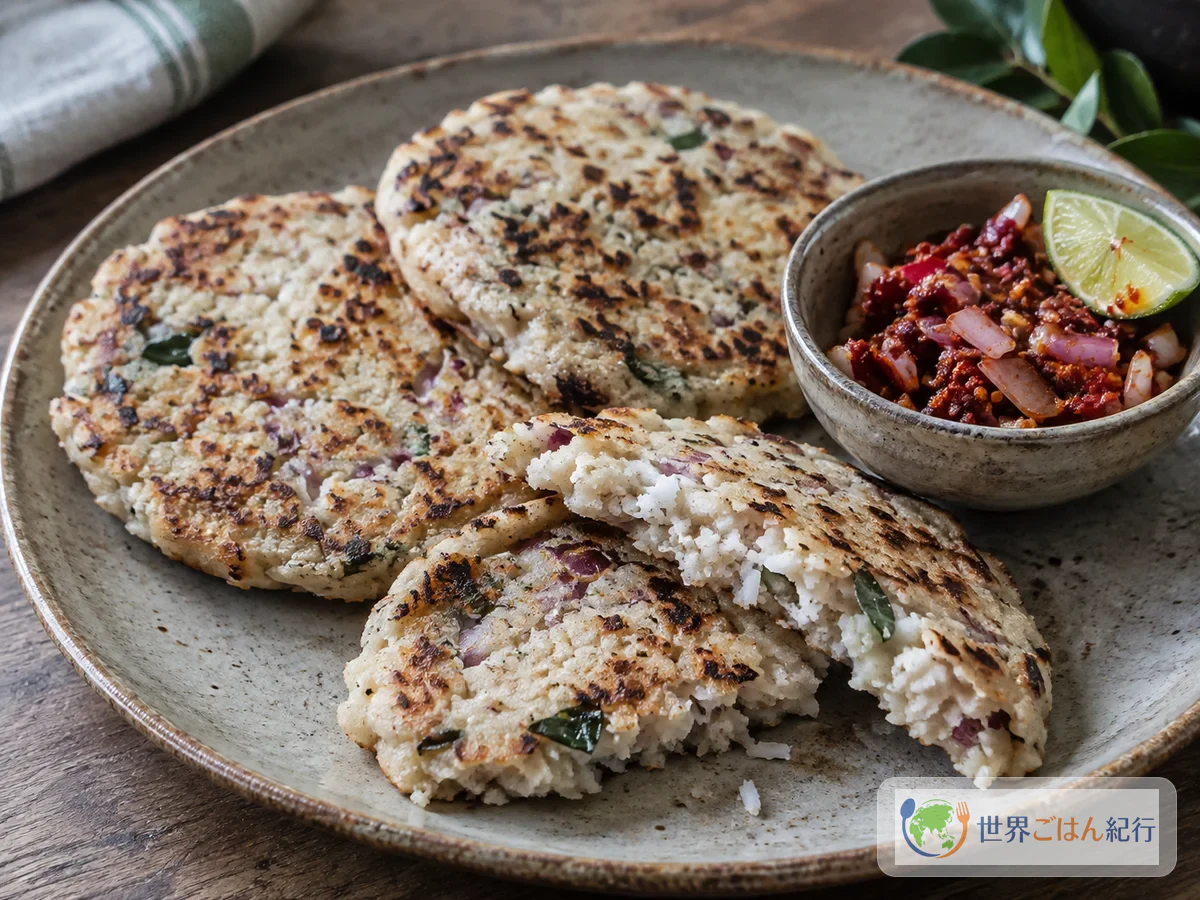
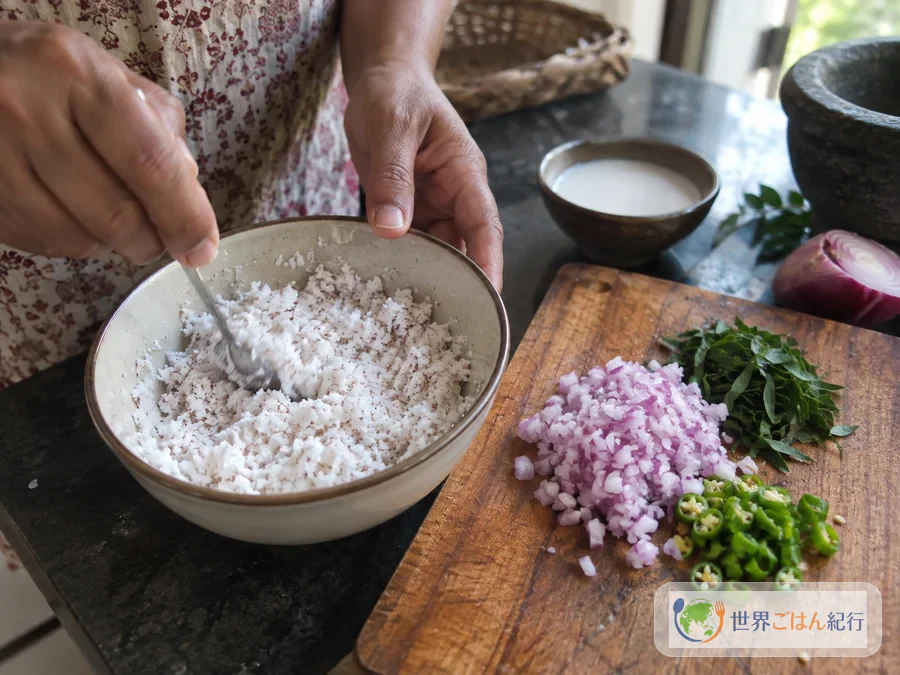
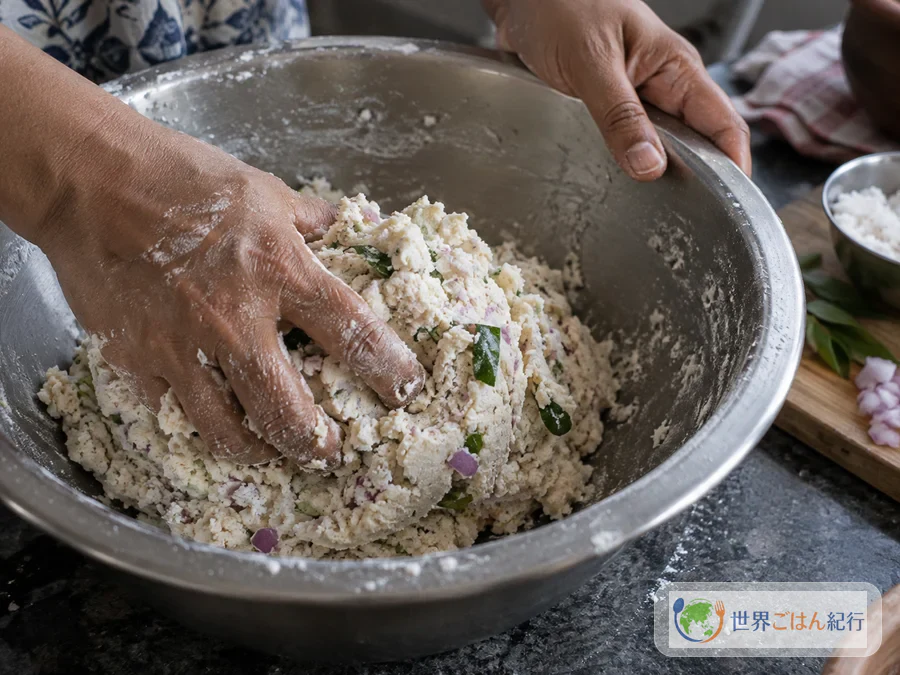
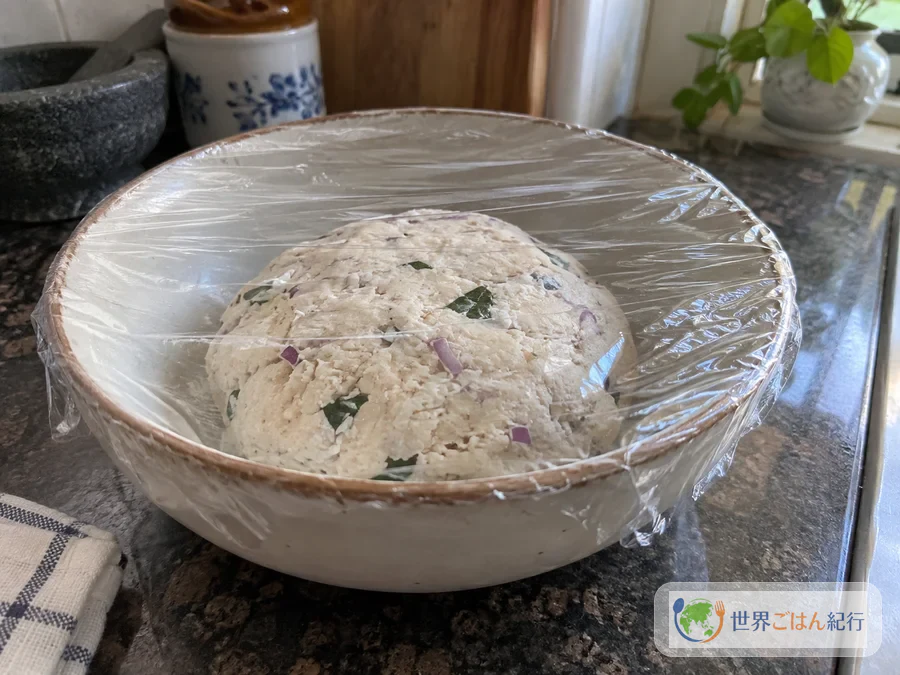
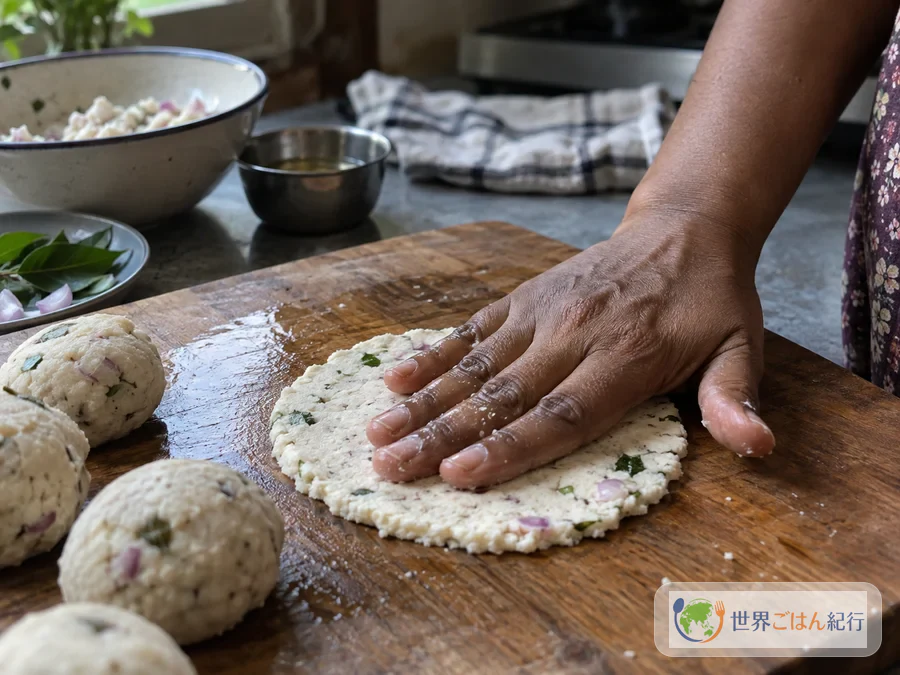
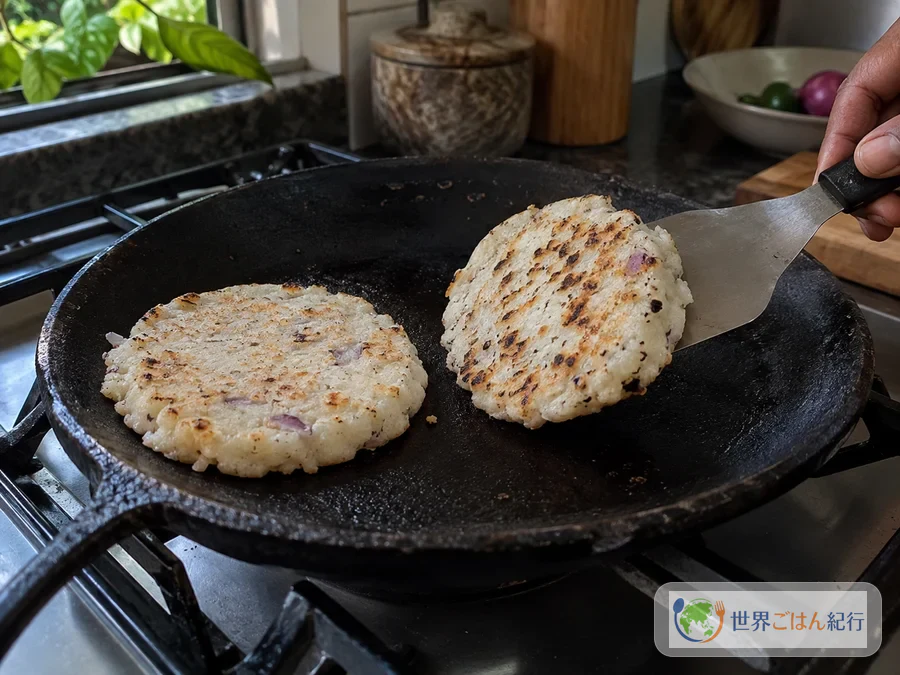
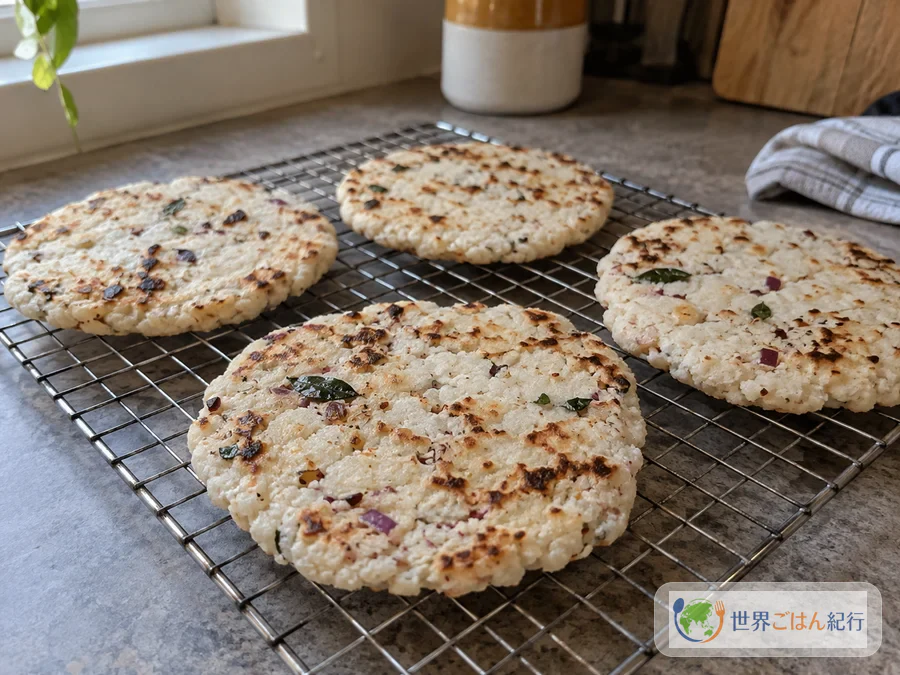
You tear a small round bread with browned spots by hand, dab on a little red lunu miris, and bring it to your mouth. It is a gesture you often see at Sri Lankan breakfast tables. This bread is pol roti, an unleavened flatbread cooked from wheat flour mixed with grated coconut. When you break it, white flecks of coconut show inside, and the outside has toasty browned spots. If I say a bread with coconut kneaded in, you probably get the picture.
I have also prepared a formula for reproducing it fresh in your own kitchen. It uses no yeast and no oven. Dried coconut is not added to the flour as is but moistened with unsweetened coconut milk first, a formula designed for a home kitchen. It makes 8 rounds for 4 servings, each about 12 cm across and 5 mm thick. You cook two at a time in a frying pan, and the whole takes about 80 minutes, but that time is not waiting for fermentation; it is the coconut absorbing liquid and the dough resting 30 minutes. No fermentation and no oven, so with flour and a frying pan you can start.
A Bread on the Island's Tables, for Sweet Mornings and Spicy Nights
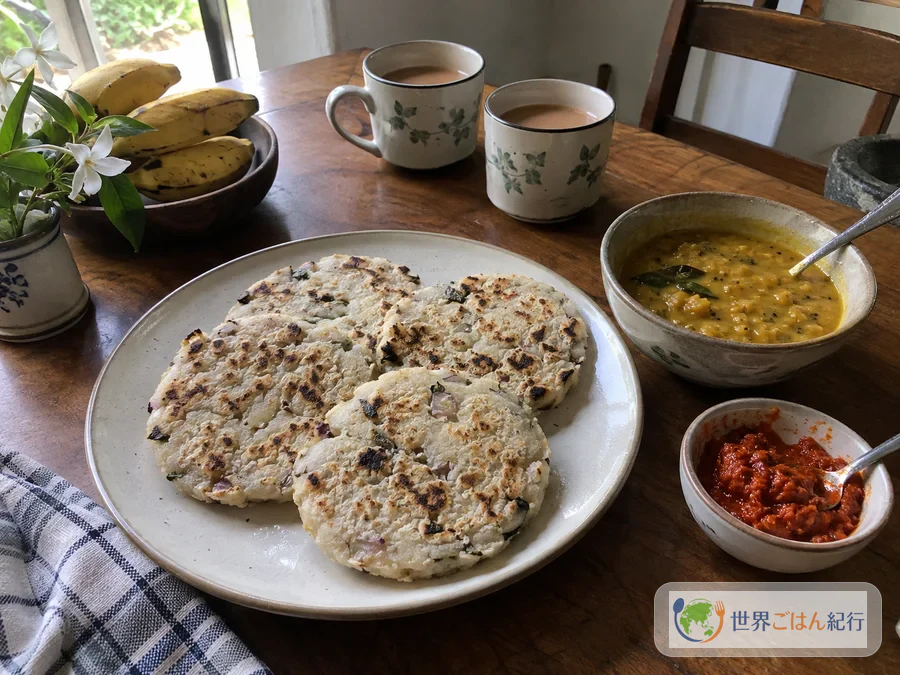
In Sri Lanka, pol roti is eaten at breakfast, at dinner and at tea time. It is also introduced as street food, and it is not a dish only for particular festivals. Putting the coconut flesh itself into the dough is its character, and its use of coconut and grain differs from kiribath, rice cooked in coconut milk, and from hoppers, which are fermented rice-flour batter cooked in a pan. Among the family of large flatbreads called roti, the flecks of coconut and the thickness are what make pol roti. It appears at both breakfast and dinner probably because it is made from familiar ingredients, wheat flour and coconut.
What goes alongside swings both spicy and sweet. On the spicy side are lunu miris (a seasoning of onion, chili and lime), sambol and curry. On the sweet side are jam, jaggery and banana. Even with both spicy and sweet accompaniments, no sugar goes into the bread itself. On days when you want it sweet, the sweetness comes from what you serve with it, so there is no need to sweeten the basic dough. You tear the firm-textured bread bit by bit and dip it in curry. Eating it blazing hot is not the only way.
The Sri Lankan food blog ISLAND SMILE describes it as food to carry. You sandwich lunu miris between two rotis and eat it. But this is not the set form at every stall across the country. At home tables there are examples of serving it with bean curry, fish curry and the like. Whether the aroma is baked into the dough or carried by what you serve beside it changes the table combination even for the same bread.
Flour and Aromatics That Change by Household
Home recipes are not one. Some households put in onion and green chili, some put in curry leaves, some put in no aromatics, and some add oil while others do not. Among examples from local cooks, some have a coconut-to-flour ratio of about 1 to 1 by volume, and another example uses 2 cups of flour to 1 cup of coconut. Numbers given by volume and weight are different things, so here they are only a guide to household differences. Do not mix them with the weights in this article's ingredient table.
The 250 g all-purpose flour, 60 g dried coconut and 100 ml coconut milk here are a formula adjusted for a home kitchen. It is not a single standard formula locally, and the numbers were not confirmed by measurement.
Even under the name roti, the flour can differ. Kurakkan is finger millet, and Sri Lankan tourism material also lists a kurakkan roti made from finger millet flour, brown rice flour and coconut. Not every coconut bread is a wheat-flour pol roti; its form changes with grain and household.
Ingredients (serves 4, makes 8 rounds)
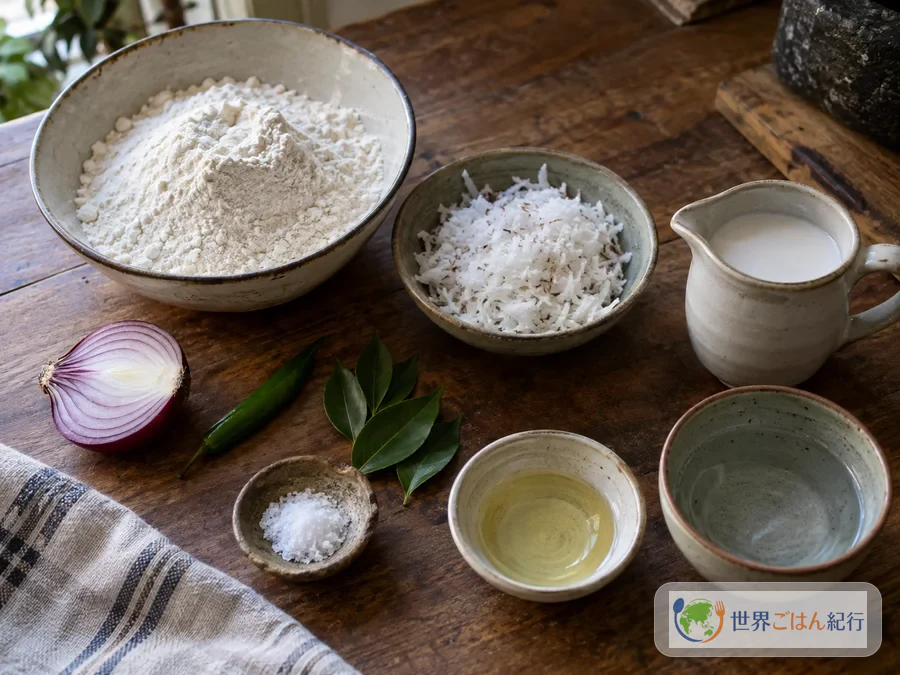
The basic version is 8 rounds with onion and curry leaves, for a meal. At 2 per person it is a staple amount, and you prepare the accompaniments separately. What you use is unsweetened, fine desiccated coconut. Measure out 100 ml water and add starting from 80 ml. It is separate from the 100 ml coconut milk that rehydrates the dried coconut, and you adjust the rest while watching the state of the flour and coconut.
All-purpose flour, onion, salt and oil can be found in an ordinary grocery store. Unsweetened desiccated coconut can come from baking-supply shops or online, and curry leaves from South Asian grocery stores or online. What to watch: desiccated coconut is finely shredded flesh, whereas coconut flour is a different, powdered product. Do not mistake coconut flour for it. A formula replacing it with coconut flour at the same weight was not tested. If you can only find long coconut flakes, cut them fine with kitchen scissors or similar. Do not use sweetened or toasted products as a basic substitute.
Curry leaves are not a name for curry powder but a leaf ingredient. If you can use them, choose fresh or frozen. Dried leaves differ in strength of aroma, so they will not give the same flavor. On a day you cannot get them, leave them out and it still bakes as a coconut bread. Adding curry powder gives a different flavor, so it is not a direct replacement for the leaves. This dough actually uses coconut milk and curry leaves, and you cook it in an ordinary frying pan. You do not need to buy special equipment.
This uses wheat and coconut. If you serve it with accompaniments containing dairy, check for dairy too. Read the ingredient labels, and people who cannot eat wheat or coconut should avoid it. Also, do not taste raw flour or raw dough. After touching the dough, wash your hands, the bowl and the counter, and do not put cooked bread back on a plate that touched the dough.
Method
Look first at how the work is spread out. Prep takes 55 minutes. That breaks down as 10 minutes for the coconut to absorb liquid and for chopping, 5 minutes to mix the dough, 30 minutes to rest it and 10 minutes to shape 8 rounds. Cooking and plating take about 25 minutes, varying with the number of rounds and the size of the pan. With making them an even 5 mm thick as the goal, check the heat with the first round before cooking the rest. Do not call it done with only a scorched surface.
Strongly aromatic flecks and onion color first on the surface. Do not keep strong heat on trying to add more scorched spots. A round that has a thick center should be pressed again before cooking. If it is undercooked, cook it further over low heat; do not aim for blackened parts as a sign of good flavor.
Leave the cooked bread briefly on a rack without stacking. You may lay a cloth lightly over it to favor softness, but that is not the same as sealing it to steam. Cover the dough being worked on to prevent drying, and let the cooked bread release steam. Use measures against dryness and measures against moisture separately for each stage of the work.
Choosing Coconut and Flour in a Home Kitchen
Fresh and dried coconut differ in moisture. Fresh or frozen grated coconut contains water, so 60 g dried coconut and 100 g fresh coconut are not a swap by weight alone. Treat them as two formulas for a home kitchen.
When making it with fresh coconut, do not use the 60 g desiccated coconut and 100 ml coconut milk from the ingredient table; replace them with 100 g grated coconut. The rest is the same, and adjust the water from 80 ml. The water needed differs by coconut. In either case choose fine, unsweetened flesh. If you only increase the coconut milk and make a bread without coconut flesh, the flecked texture will not come out. Keeping the flecks of coconut flesh is this bread's character.
A word about flour as well. The plain flour or all-purpose flour of the local recipes does not correspond perfectly to the cake flour and bread flour categories used in Japan. A formula for Japan is all-purpose flour, or a mix of 125 g cake flour and 125 g bread flour. Bread flour alone tends toward more springiness, and cake flour alone tends to crumble, but since this was not tested, the same texture is not guaranteed. You also do not need to knead long by machine. Flavor and texture depend not just on flour but on the amount of water, the thickness and the cooking heat. When you change the flour, match by the state of the dough, not just the time. Remember then to add water a little at a time.
For equipment, an ordinary frying pan, a bowl, a spatula and a scale are enough. A flat chapati pan is an option, but a dedicated one is not essential. The round shape can be made by pressing by hand, so you need not buy a rolling pin either. A nonstick pan is easy to handle, but avoid heating it empty at high temperature and follow its instructions first. If you use an iron pan, choose one well seasoned, and treat it as dry cooking, not shallow frying in oil. The 2 g of oil for shaping is an amount to reduce sticking. Do not confuse it with a step that adds oil for shallow frying.
When the Dough Cracks or Cooks Hard
For small cracks only at the edge, closing them with a wet finger is enough. A dough that falls apart whenever you press may not have absorbed enough water. Mix in 5 ml water at a time and reshape. Conversely, if it is sticky and will not lift, too much water or the moisture of the onion may be affecting it. Add flour 5 g at a time and check whether it comes together. Adding a lot changes the ratio of coconut, so a little at a time is the rule. Add water 5 ml at a time, add flour 5 g at a time. This small adjustment restores both cracking and stickiness.
| Problem | Likely cause | How to fix |
|---|---|---|
| Crumbles when pressed | Not enough water, coconut too coarse | Add water 5 ml at a time and bring flour and coconut together again |
| Sticks to hands and counter | Added too much water at once | Add flour 5 g at a time and use oil thinly |
| Dark outside but raw center | Heat too high, center too thick | Lower the heat and flip each minute to cook further |
| Hard and dry throughout | Too thin, overcooked, too little water | Make the next dough an even 5 mm and review cooking time and water |
| Stacked bread is damp | Stacked hot and sealed | Spread on a rack and reheat in a frying pan just before eating |
There is little you can do to repair it after cooking. The basics are 5 mm thickness and medium to medium-low heat. Do not treat the number of black spots as a sign it is done. Think of matching the heat with the first round, and break that round open to check the center. Bread that cooked hard cannot be restored, but dipped in curry it softens the dry mouthfeel. Use the rest of the dough to correct the water and thickness.
Changing the Accompaniments for Five Kinds of Table
Even the same bread makes a quite different table depending on what you pair it with: curry, a chili seasoning or a sweet accompaniment. The following table is a serving suggestion and does not present each combination as the tradition of a particular region.
I do not recommend turning the savory aromatic version into a sweet breakfast. For a sweet breakfast, omit the onion, green chili and curry leaves at the mixing stage. For water, do not mechanically add up to the same limit; adjust to the state of the dough. On days you eat it sweet, leave out the aromatics. That alone makes the same dough suit jam or banana.
| How to eat | Dough and accompaniment | Change in flavor |
|---|---|---|
| A meal with bean curry | Basic dough with hot bean curry | Mellowness of beans and toasty browned spots |
| Staple with chicken curry | Tear the basic dough and dip in chicken curry | Coconut-flecked bread takes up a rich sauce |
| A little spice at a time | Basic dough with a small amount of lunu miris | Adjust the kick of chili and lime by quantity |
| Jam breakfast | Aromatics-free dough with jam | Fruit's sweet-sour with coconut |
| Banana and a sweet snack | Aromatics-free dough with banana and a little brown sugar | Brown sugar is a suggestion for elsewhere, not jaggery itself |
If you are choosing what to cook next, you can go on to a chicken curry that suits the aromatic bread, a rice staple using coconut, or a fermented rice-flour bread. You do not need to make everything in the same menu in quantity. Starting from tearing it and dipping it in curry, try the dishes that interest you one at a time.
- To make a companion for the meal, kukul mas curry
- For a rice staple using coconut milk, kiribath
- To learn a fermented rice-flour bread too, hoppers
Storage and Reheating
What is stored is the cooked bread. After setting it briefly on a rack to let steam go, wrap each cooked bread individually and put them in an airtight container. Avoid leaving it for long at room temperature until it is fully cold. Use 4°C or below as the refrigerator guide. Refrigeration until the next day is the editorial desk's conservative operating guide. This limit does not guarantee safety and varies with the refrigerator's temperature, the freshness of ingredients and the packaging.
To keep longer, wrap cooked bread individually and freeze. About one week is the guide for flavor, and freezing does not kill all bacteria. Thaw in the refrigerator or with the microwave's defrost function, and heat at once after microwave thawing. Do not thaw at room temperature for long. To reheat, warm both sides in a frying pan over low to medium-low heat. For reheating leftovers, 74°C at the center is the guide. If it threatens to scorch, lower the heat, and do not judge safety by texture alone.
Refrigerating or freezing within 2 hours of cooking is the food-safety guide. If the outside temperature is above about 32°C, make it 1 hour. Do not exceed this time on the grounds of brief steam release. Do not eat anything with an off smell or mold, or whose storage history is unknown. Lack of smell does not mean it is safe. Store the curry you served in a separate container and handle it as suits its ingredients.
Frequently Asked Questions
Can I make it with coconut milk alone?
What characterizes pol roti is the coconut flesh in the dough. Replacing it with milk alone loses the flecked texture and changes the amount of liquid, so it is no longer the same recipe. In this article the milk is used to rehydrate the dried coconut. Prepare 60 g unsweetened coconut and use 100 ml. Milk alone cannot reproduce the flecks, so do not omit the coconut.
What if I do not have curry leaves?
You can make it without them if that is all that is missing. A bread based on wheat flour, coconut flesh, salt and water is found in home recipes locally too. I do not use curry powder as a direct stand-in at the same amount. If you also leave out the green chili, it becomes a mild dough. Adjust the heat of the accompaniments separately.
Do I need yeast or baking powder?
Neither is needed. The 30 minutes is a rest for the flour to take up moisture and not a wait for rising. Do not keep strong heat on trying to make it puff like a thin flatbread. What matters is keeping a thickness and heat that cook through the center.
Can I make the dough the day before?
Local cooks also have a method of covering and refrigerating. But this dried-coconut formula is designed to be made on the day. If you prepare it the day before, the conservative suggestion is to keep it at 4°C or below from right after mixing and cook it the next day. Do not leave it overnight at room temperature. Nor do I recommend putting leftover dough from the day before back in the refrigerator to stretch the days. If cold dough cracks, bring it to a softness you can handle by hand before shaping.
Can I replace the wheat flour with rice flour?
A formula replacing it with rice flour alone at the same amount has not been tested. It binds differently from wheat flour, and shape and texture change. I do not recommend this formula for people with a wheat allergy. A full replacement with coconut flour also needs a different formula. Think of a full swap to rice flour as a separate formula.
Do the nutrition numbers include the accompaniments?
They do not. The nutrition is an estimate for 2 rounds per person, the basic formula in the ingredient table divided into 4, and excludes accompaniments. It varies with the fat of the coconut milk, any extra flour or water, and how much oil remains. The numbers are about 380 kcal, 7 g protein, 18 g fat, 52 g carbohydrate and 500 mg sodium. They are an estimate calculated from the composition values of each ingredient, counting 100 ml of milk as 100 g and excluding trace amounts of leaves and chili. They are not measured values and cannot be used for therapeutic-diet calculations.
Sources
- Sri Lanka Tourism — So Rich In Flavours: Food Range — breakfast, dinner and street food, sweet and spicy accompaniments, kurakkan roti. Accessed and checked: October 4, 2026.
- Karan Gokani, Hoppers — Pol roti (Jamie Oliver) — formula of flour, coconut and curry leaves, and cooking in a dry frying pan. Accessed and checked: October 4, 2026.
- Roshani Wickramasinghe — The Best Sri Lankan Coconut Roti (Hungry Lankan) — household formula, shaping and moisture, and how to moisten dried coconut in the author's reply of March 18, 2025. Accessed and checked: October 4, 2026.
- ISLAND SMILE — Sri Lankan pol roti — the roadside sandwiching way of eating, cooking 2–3 minutes each side and handling texture. Accessed and checked: October 4, 2026.
- ABC — Sri Lankan Coconut (pol) Roti — Manoj Ranasoma's home recipe, an example of cooking dried coconut, thickness and low to medium heat. Accessed and checked: October 4, 2026.
- FDA — Handling Flour Safely: What You Need to Know — not tasting raw flour or dough, and washing. Accessed and checked: October 4, 2026.
- FDA — Safe Food Handling — refrigerator temperature and safety guides for cooling, thawing and reheating. Accessed and checked: October 4, 2026.
- MEXT Standard Tables of Food Composition in Japan — all-purpose flour, grade 1 — reference values for the nutrition estimate. Accessed and checked: October 4, 2026.
- MEXT Standard Tables of Food Composition in Japan — coconut milk — reference values for the nutrition estimate. Accessed and checked: October 4, 2026.
- MEXT Standard Tables of Food Composition in Japan — rapeseed oil — reference values for the nutrition estimate. Accessed and checked: October 4, 2026.
- MEXT Standard Tables of Food Composition in Japan — red onion — reference values for the nutrition estimate. Accessed and checked: October 4, 2026.
- Tomizawa Shoten — nutrition label of desiccated coconut — reference values for the nutrition estimate. Accessed and checked: October 4, 2026.


