Bebek Betutu: Opening the Foil on a Spiced Balinese Duck
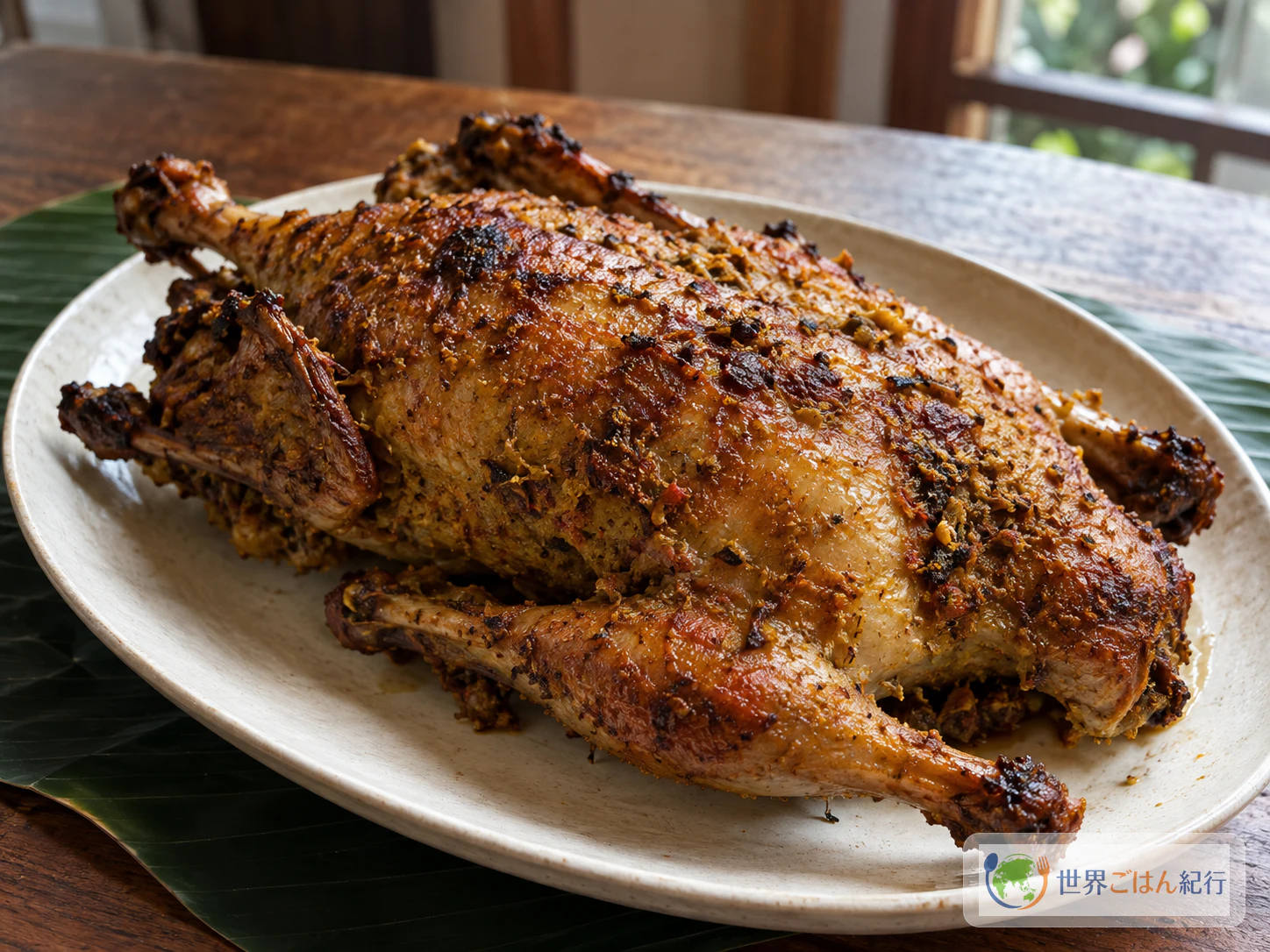
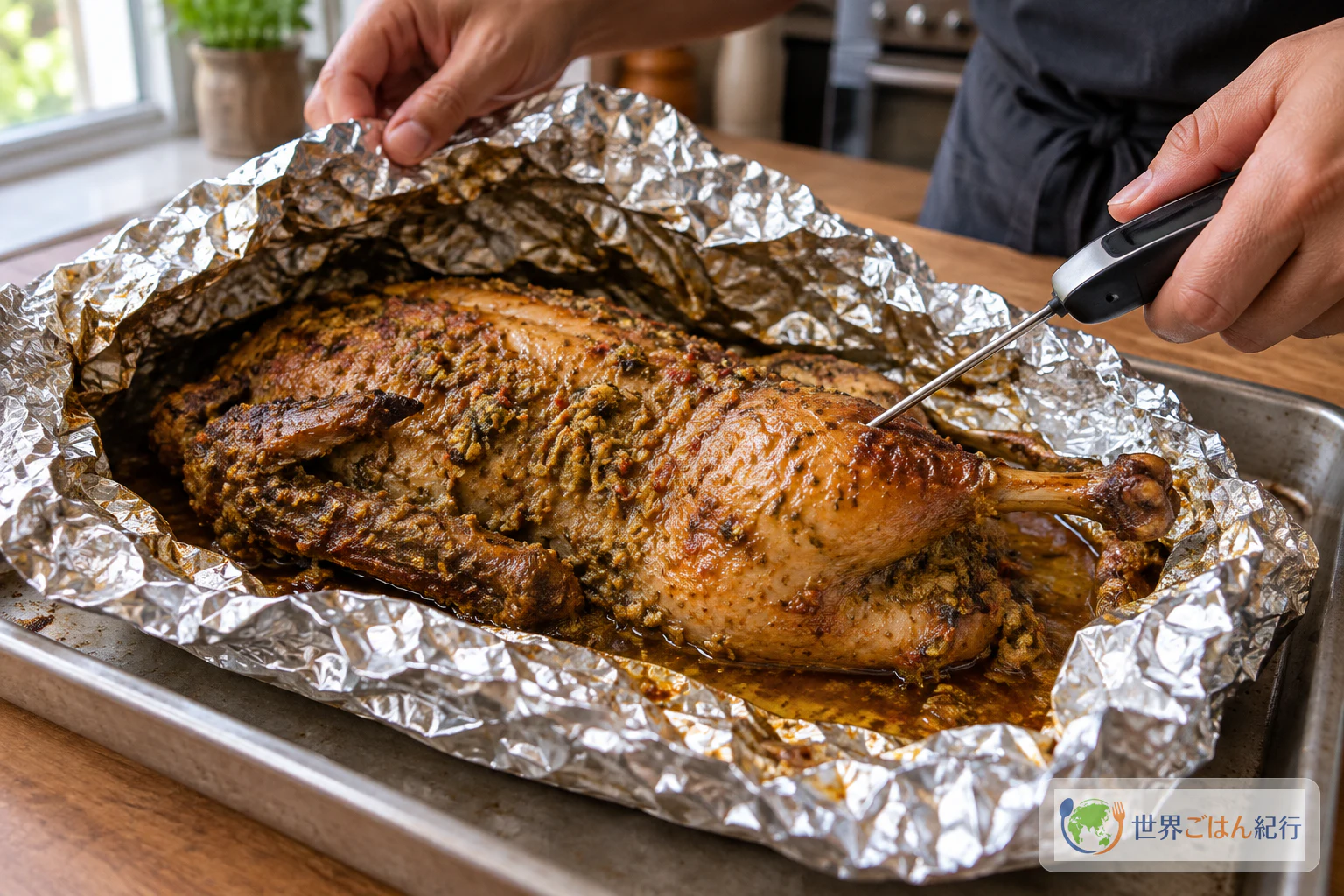
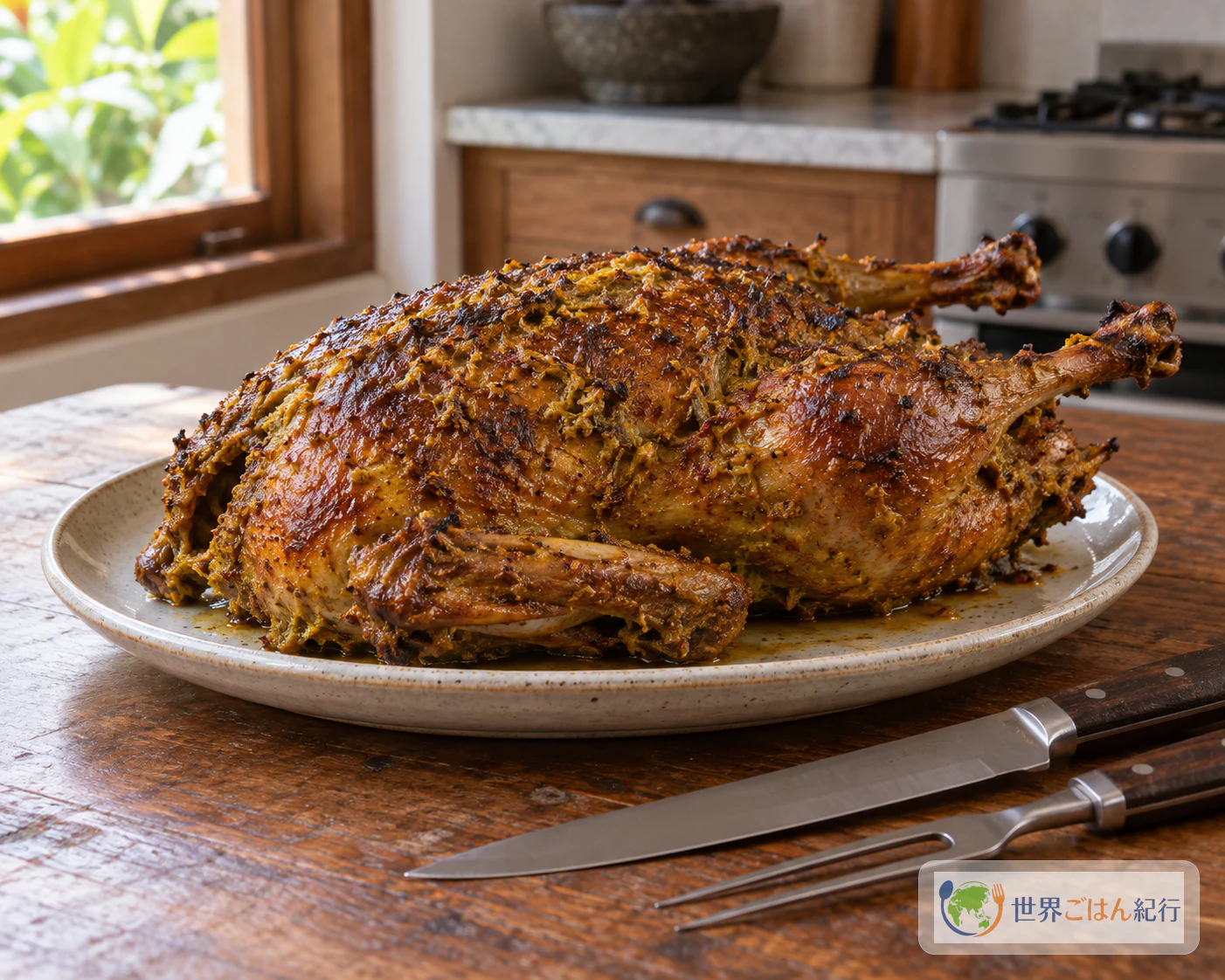
Moist meat from the sealed foil, and a browned, slightly crisp skin from the final blast of heat. The thermometer, not the clock, decides when the first stage is done.
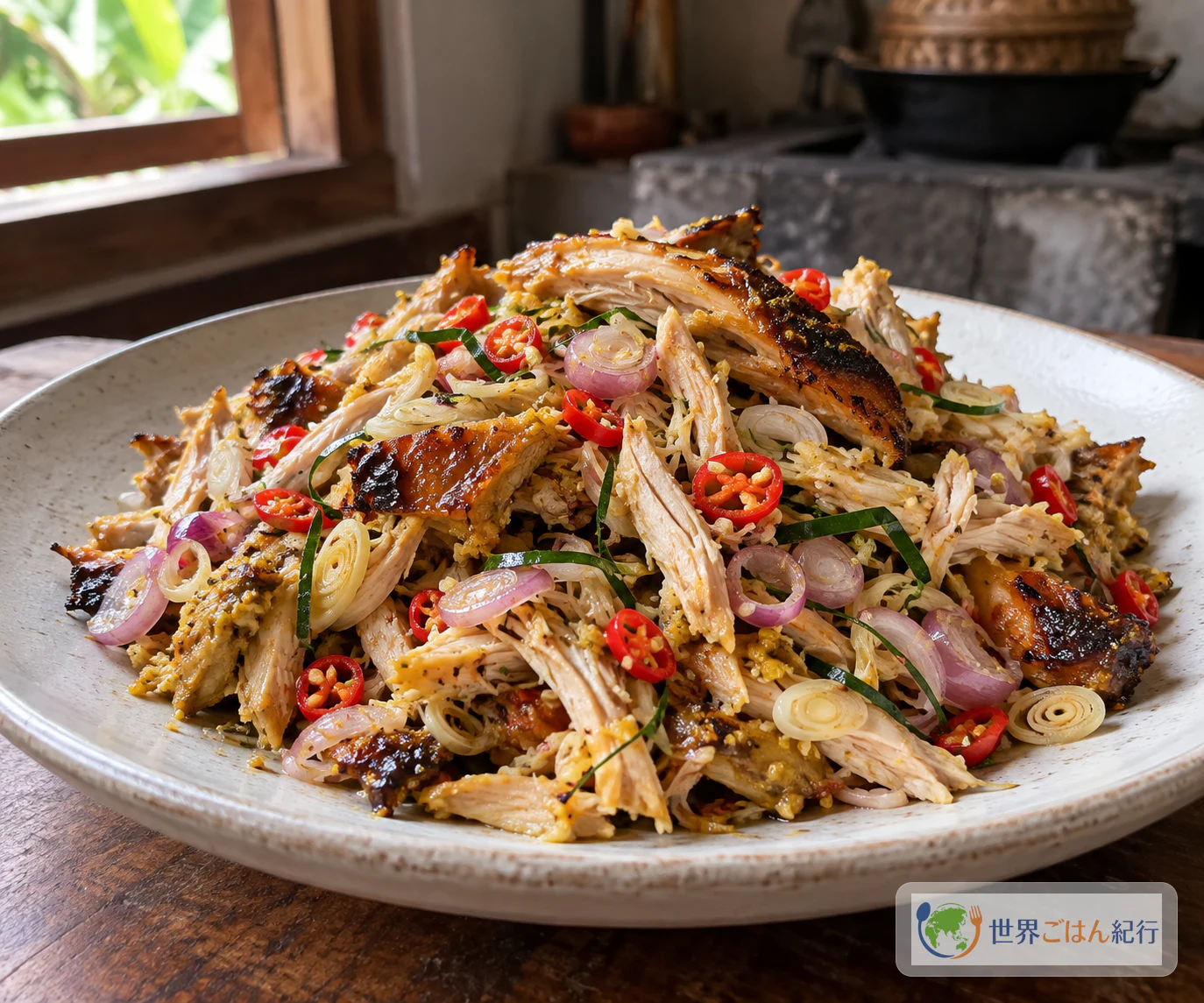
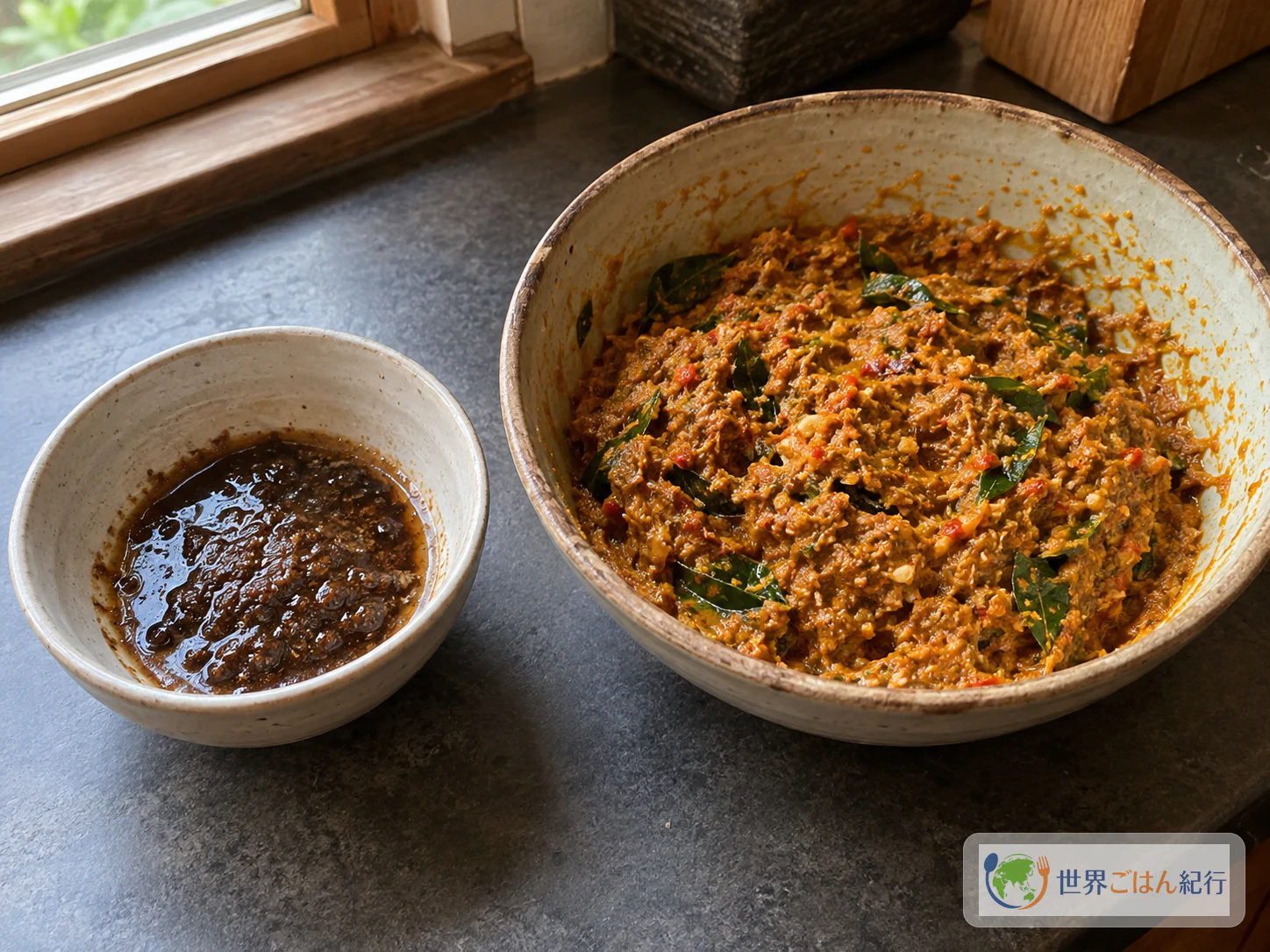
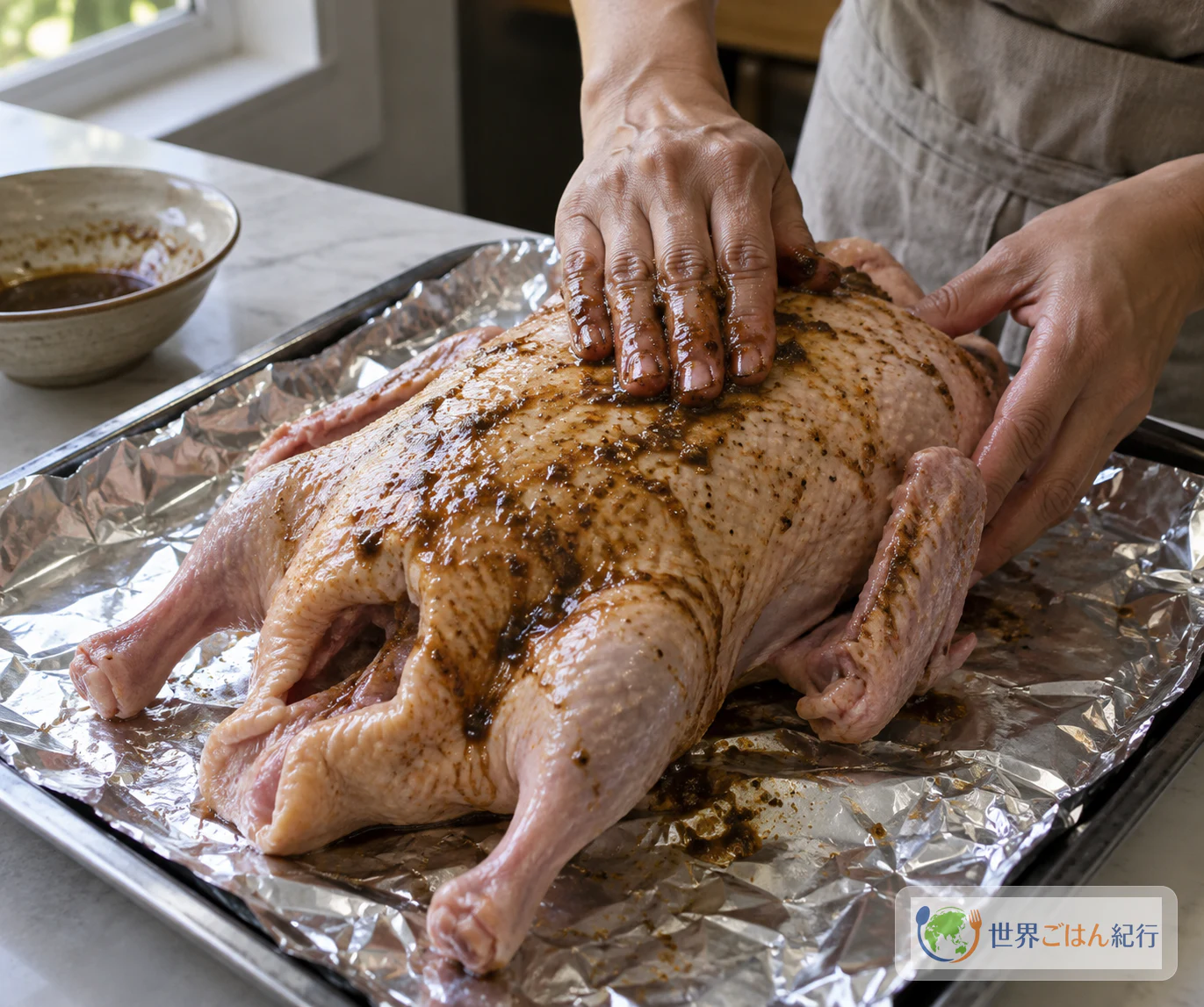
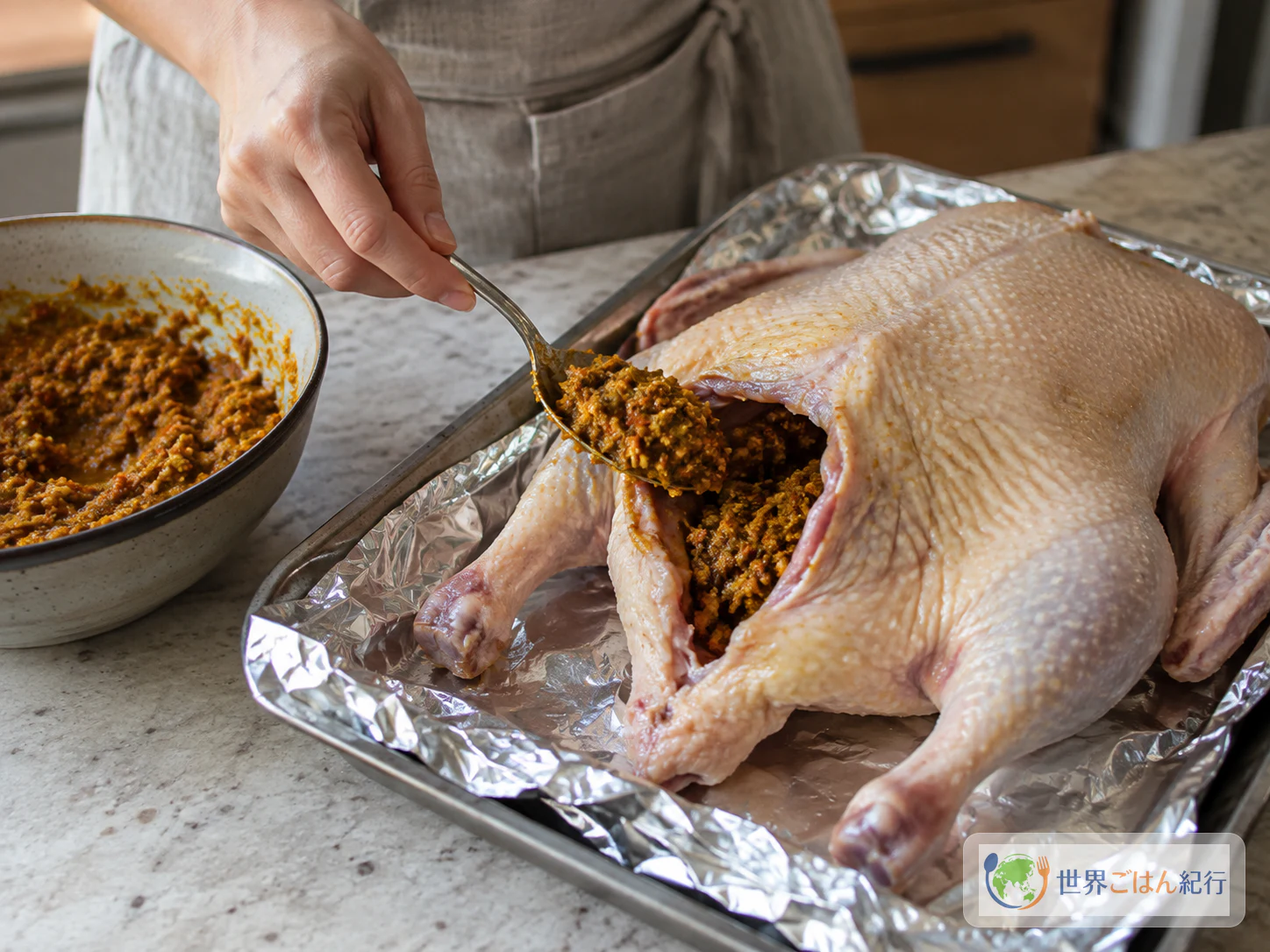
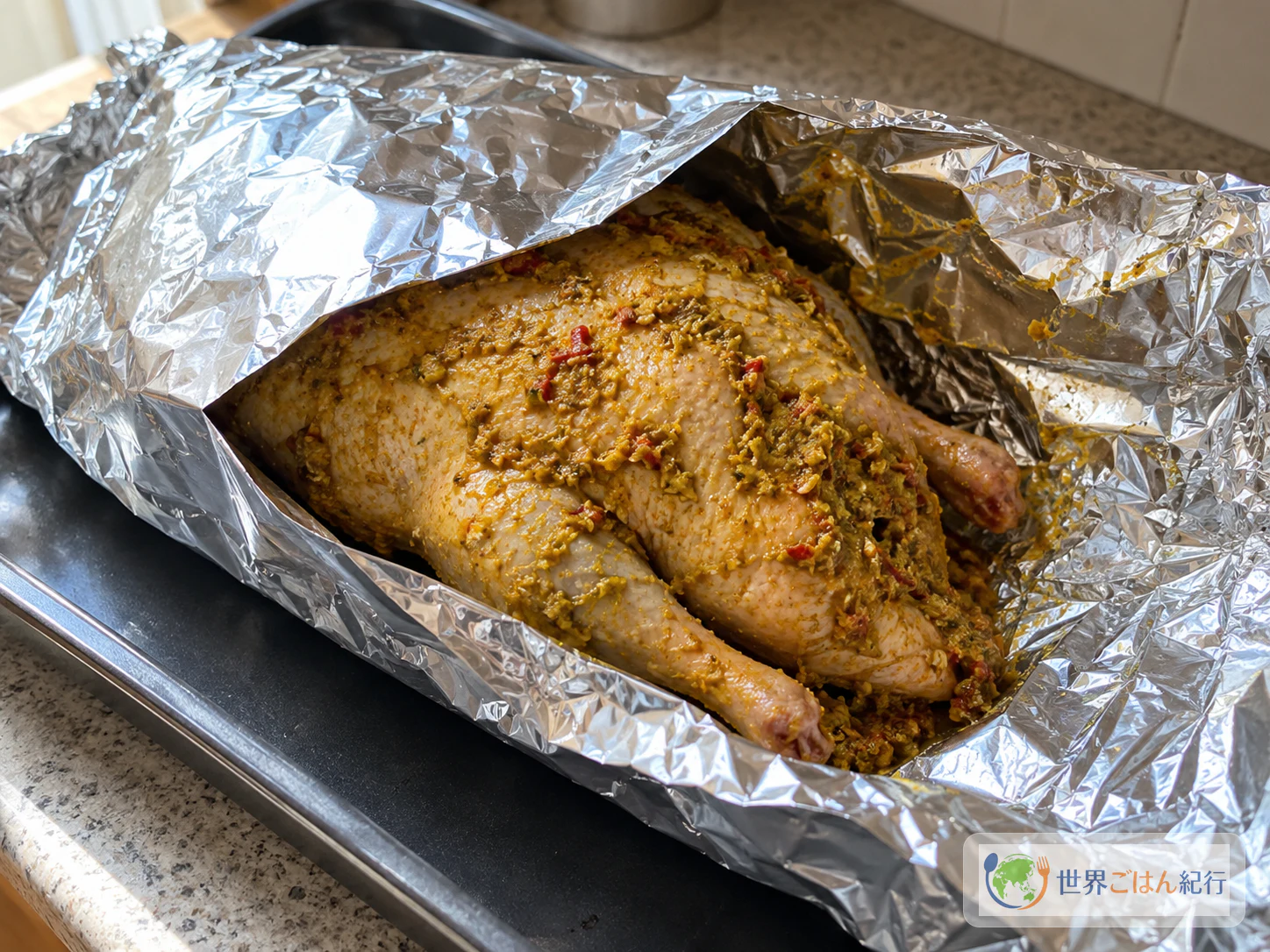
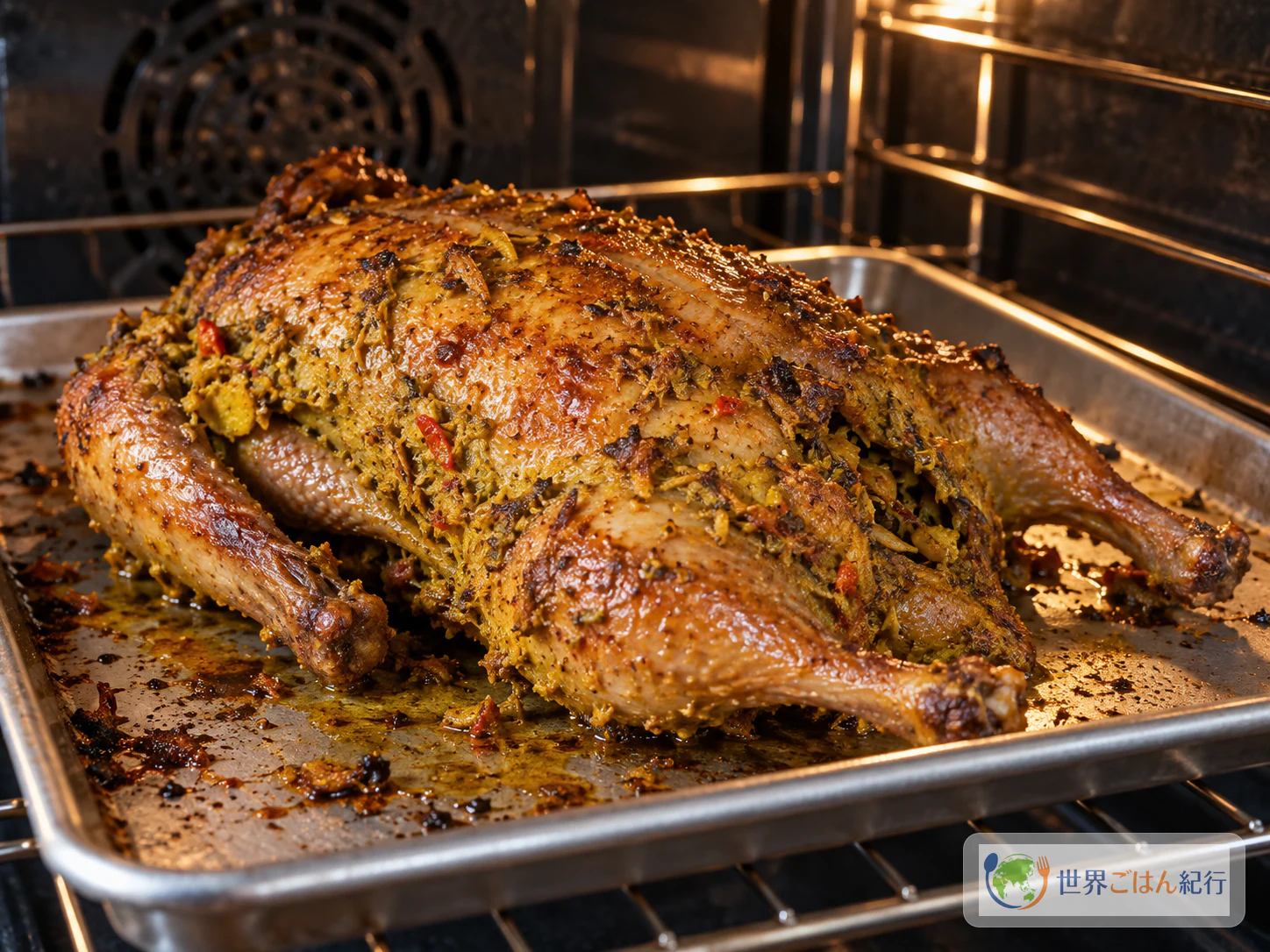
The foil folds back and steam rises, carrying the smell of shallot, garlic, galangal, turmeric and shrimp paste. The duck underneath is still pale and moist under its paste. It goes back into a much hotter oven, uncovered, and comes out with browned skin and a crust of spices.
Bebek betutu is a Balinese whole duck dish. Indonesia's Ministry of Tourism describes a bird seasoned with shallot, garlic, turmeric, ginger and candlenut, wrapped in banana or areca-palm leaf, and cooked slowly by roasting or steaming. It is served at customary events or as a special dish.
This article follows one home-oven version, the foil-wrapped Bebek Betutu published by Saveur and credited to Penny de Los Santos. It uses foil rather than leaves and makes no attempt to reproduce pit cooking, smoke or coconut-shell aromas. If you want the chicken version, ayam betutu, or other dishes from the country, start at our Indonesian recipes. The two betutu share a family resemblance, but this one is about duck.
This recipe has not been kitchen-tested. Please treat its times as guides and rely on a food thermometer.
The duck weight is our editorial decision. Saveur's recipe gives no weight, so our editors set a guide of about 2 kg (about 4.5 lb), gutted. The spice amounts are not scaled to it. The background section below explains the reasoning.
Two safety steps are our additions. Saveur's recipe does not include toasting the candlenuts before blending or measuring the center of the paste inside the bird. We added both. For the same reason, the salt in the paste is handled differently here: see the FAQ.
Ingredients for One Whole Duck
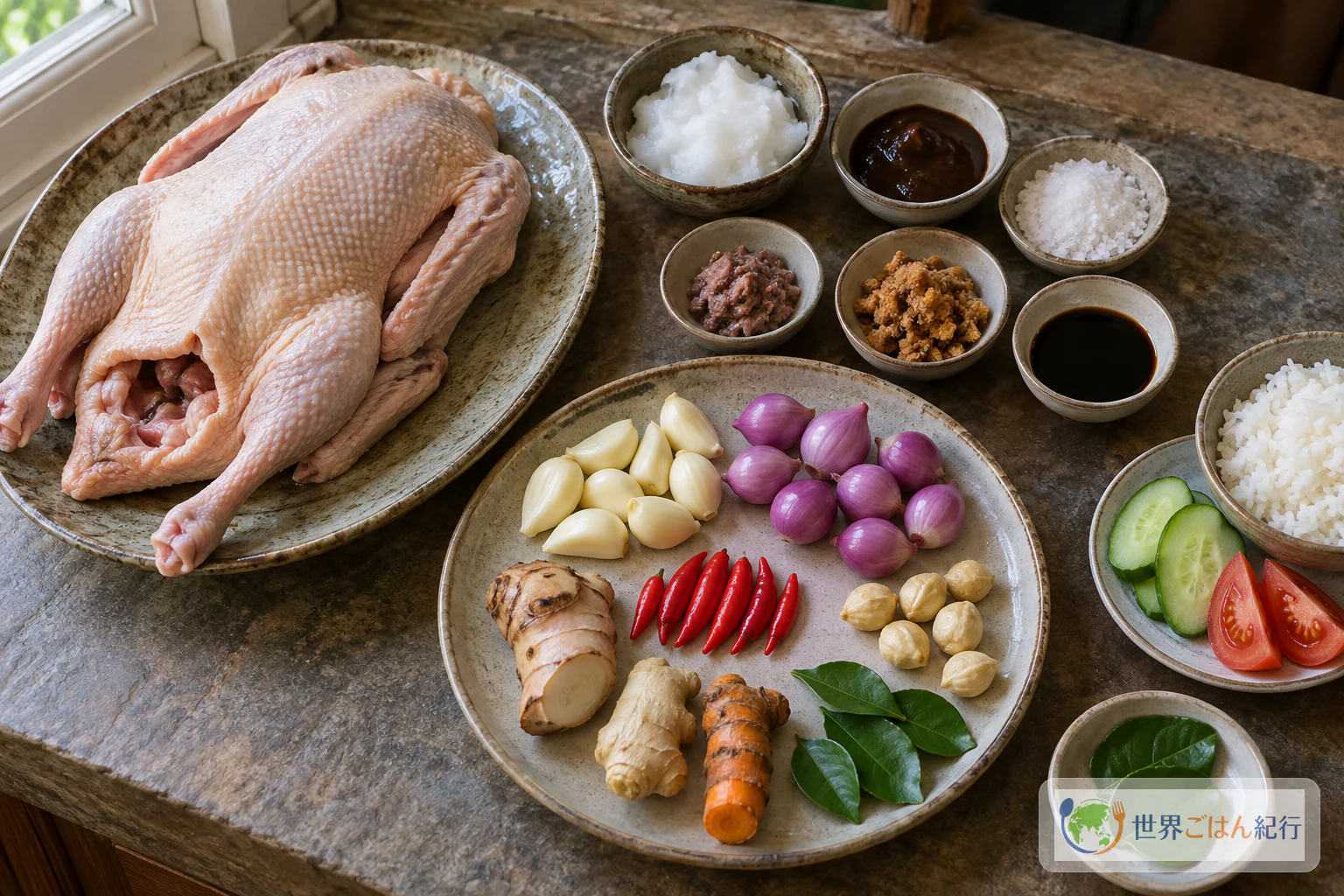
Serves 4–6. The coconut oil and tamarind are each divided between the rub and the paste.
This dish contains duck, shrimp paste (crustacean) and tree nuts. Thaw a frozen duck in the refrigerator or microwave. Keep the knife, cutting board and containers used for raw duck separate from other foods, wash and sanitize them after use, and wash your hands after touching the bird. Use a different knife and board for the cucumber, tomatoes and lime leaves.
Choosing and Substituting: Our Editorial Suggestions
The swaps below are our editorial suggestions, and each one changes the dish. Ground turmeric is the exception, since it is a listed option above.
- Duck: In Japan, gutted whole aigamo duck is sold at about 2.1–2.4 kg and can be used here. If your duck differs from about 2 kg, keep the spice amounts as they are and judge doneness by temperature.
- Salt: One tablespoon of salt varies widely by weight: 8 g for Diamond Crystal kosher, 16 g for Morton's kosher, 18 g for table salt. A spoonful of fine salt can easily be too much, which is why fine salt is measured by weight.
- Candlenuts: Unsalted macadamia nuts are the most common substitute. They are still tree nuts.
- Galangal: Ginger can stand in, but the sharp citrus and pine-like note fades and the warm ginger aroma takes over.
- Palm sugar: Unrefined cane sugar works, with a different flavor.
- Kecap manis: This is a sweet soy sauce, so do not treat ordinary soy sauce as the same thing.
- Shrimp paste: Products sold as shrimp paste or terasi vary by brand, so do not assume they are identical.
- Curry leaves and lime leaves: These are two different leaves. Curry leaves go into the paste, while kaffir lime leaves are only an optional garnish.
Equipment
- Aluminum foil, enough for a double layer that wraps the whole duck
- Baking sheet or roasting tray
- Food processor or mortar and pestle
- Instant-read food thermometer
- Pan for toasting the candlenuts
- Separate knife and cutting board for raw duck
- Small bowl for the rub and a bowl for the paste
- Platter, carving knife and fork
- Shallow containers for leftovers
Method: From Sealed Foil to Browned Skin
This recipe has not been kitchen-tested. The times are guides for a duck of about 2 kg and will shift with the bird and your oven, so measure the temperature at both points in step 5 before moving on.
Doneness: Two Temperatures, Two Purposes
The temperatures in step 5 do different jobs. Saveur's 175°F (about 79°C) at the leg is a finishing guide for the texture of the meat in that recipe, not a safety rule.
The safety figures come from public food-safety agencies. The USDA Food Safety and Inspection Service (FSIS) gives 165°F (about 74°C) as the minimum for whole poultry and for the center of any stuffing. Japan's Ministry of Health, Labour and Welfare gives 75°C at the center for at least 1 minute. That document was written for chicken, and applying it to duck is our editorial judgment, as is treating the paste as a stuffing.
We use the 75°C line at both measuring points, because a dense paste inside the bird is exactly the part the outside of the duck tells you nothing about. Color and elapsed time cannot confirm either point.
Serving: Toward a Balinese Table
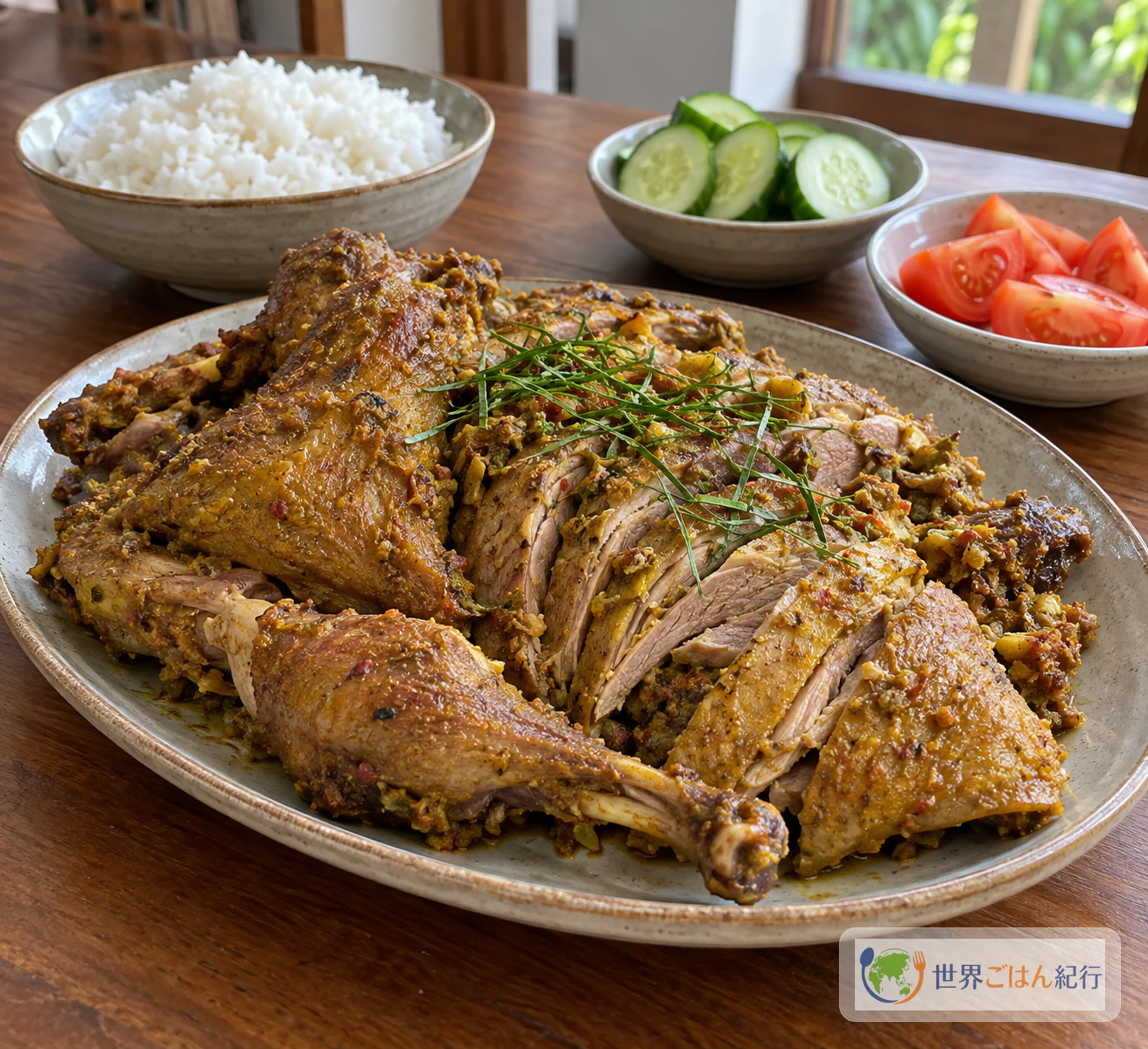
Saveur offers white rice, cucumber and tomatoes as optional accompaniments. The Ministry of Tourism describes bebek betutu as commonly paired with rice, lawar and sambal matah. Neither is a fixed rule, so you can keep the table simple or build it out with sides from those Balinese pairings.
Troubleshooting
| Problem | Likely cause | What to do |
|---|---|---|
| The leg or paste center is under temperature | The duck is larger or the oven runs differently | Wrap it again, keep roasting, and measure both points again |
| The meat has tightened and dried | The foil was not fully sealed, so moisture escaped | Check for gaps before it goes in the oven next time |
| The aroma is uneven | The paste was too coarse | Blend or pound until smooth before filling |
| The skin is browning too fast | The final roast runs hot | Go by color rather than the full 25–30 minutes, and do not let it burn |
| The rub tastes too salty | Fine salt was measured by the spoon | Next time, weigh fine salt and start at 8 g |
| The meat tastes underseasoned | The paste was lightly salted, as intended | Add salt at the table after carving, never by tasting the paste |
Variations: Our Editorial Suggestions
- Less heat: Use fewer chiles. The heat drops, and the balance of the aromatics shifts with it.
- Fresh or ground turmeric: Use either the fresh piece or 2 tsp ground, but never both.
- Simple or fuller table: Rice, cucumber and tomatoes can be added or left out. Lawar and sambal matah lead toward the Balinese pairings instead.
- Leaf-wrapped or steamed betutu: These are separate methods with their own proportions and timings. We do not recommend grafting them onto this recipe, because the times here apply only to the foil method.
Background: One Dish, Several Methods
The ministry's description sets the broad outline: a whole duck, spices, a leaf wrapping, slow heat, and a place at customary events or special meals. Bali.com also presents a ceremonial and celebratory context and a banana leaf wrapping, and Saveur's background mentions coconut bark and steam-roasting. We take these as present-day descriptions. They do not establish a single origin or a rule about when the dish must appear.
Published recipes differ widely, and the foil version is not the only authentic one:
| Published version | Wrapping | Heat | Duck |
|---|---|---|---|
| Indonesian Ministry of Tourism (overview) | Banana or areca-palm leaf | Slow roasting or steaming | Whole; no amounts given |
| Saveur (used here) | Double layer of foil | 350°F about 1.5 hours, then 450°F 25–30 minutes unwrapped | No weight given |
| Bali.com | Banana leaf | Steam 50 minutes, then bake at 180°C 30 minutes | Roughly 2 kg |
| Unilever Food Solutions Indonesia (professional) | Cassava leaves and banana leaves | 180°C 2–3 hours, or steam 45–60 minutes and roast about 1 hour | 1 kg |
We kept Saveur's proportions and method intact and mixed in nothing from the others.
Why about 2 kg
Saveur specifies only "Long Island or Pekin duck," so we looked for what size that usually means. FSIS explains that most domestic ducks in the US are White Pekin and that Long Island is a trade name. Maple Leaf Farms lists a retail whole duck at 4.5 lb (2,041 g). Two other recipes for this dish use the same size: the Bumbu Bali cooking school's at about 2 kg (4 1/2 lb), and Wayan Murda's on Food Network at 4 1/2 lb.
There is also a rough time cross-check. The FSIS guide of 20 minutes per pound at 375°F comes to 90 minutes for 4.5 lb, about the same scale as Saveur's 1.5 hours. That guide is for an unstuffed, unwrapped bird at a different temperature, so it supports the choice without proving it. We borrowed only the size of the duck from these references, and about 2 kg is our figure, not one given by the recipe's author.
Leftovers
Treat the cooked paste the same way as the duck. Divide leftovers into shallow containers and refrigerate them within 2 hours, or within 1 hour if the room is above 32°C (90°F). Keep the refrigerator at 10°C or below, eat within 3 to 4 days, and reheat to 165°F (about 74°C).
Frequently Asked Questions
What is the difference between bebek betutu and ayam betutu?
Bebek betutu is made with duck, and ayam betutu with chicken. This article covers the duck version only, using its own recipe.
Can I make it without banana leaves?
Yes. This version uses a double layer of foil throughout. It is a home-oven method and does not recreate a traditional leaf wrapping or pit.
Does it need a steaming stage?
Not in this version. Some other published methods steam the duck before baking, but those belong to different recipes.
Why can't I taste the paste?
Raw candlenuts are slightly toxic and can cause digestive distress, according to Robert Danhi's Southeast Asian Flavors, and Nyonya Cooking also advises against eating them raw. Both are cooking references, not public authorities. Toasting first follows their advice, but we found no reliable public figure for the temperature or time that makes candlenuts safe, so we make no such claim. The safe course is not to taste the paste before it is fully cooked.
How did you decide on the salt?
Saveur's ingredient list says "1 tbsp kosher salt, plus more to taste." Its rub uses 1 tbsp, and its paste lists salt with no amount. Reading the paste's salt as the "more to taste" portion makes the numbers fit, but this is our interpretation, not something the recipe states. Since the paste cannot be tasted, we suggest only a very small amount, if any, and adjusting at the table. Saveur also names no salt brand, which is why we give a weight range for fine salt.
Can I reduce the chiles?
Yes, as an editorial adjustment. The heat drops, and the balance of aromas changes.
Should I prick the duck's skin?
FSIS recommends pricking or scoring duck skin to render the fat. Saveur's recipe does not include this step, so we have not added it to the method.
When should I carve it?
After a 20-minute rest. FSIS also advises letting a stuffed bird stand for 20 minutes before removing the stuffing, so the paste stays inside until then.
Sources
- Ministry of Tourism, Republic of Indonesia, "Bebek Betutu." Dish identity, leaf wrapping, slow roasting or steaming, customary and special occasions, and pairing with rice, lawar and sambal matah. https://www.indonesia.travel/gb/en/travel-ideas/gastronomy/bebek-betutu
- Saveur, "Bebek Betutu (Balinese Roast Duck)," recipe credited to Penny de Los Santos. The ingredients, amounts, method, yield and foil approach used here. The Saveur page itself could not be opened when this article was prepared, so the wording was read from the two copies listed next. https://www.saveur.com/article/Recipes/Bebek-Batutu-Balinese-Roast-Duck/
- cooked.wiki, copy of the recipe credited to Saveur. Ingredient and step wording; no duck weight stated. https://cooked.wiki/saved/000441a2-67df-4e32-80a3-1e8233f4f7a5
- Food.com, "Bebek Betutu (Roast Duck Bali Style)." Near-identical posting of the recipe, with a yield of 4–6; no duck weight stated. https://www.food.com/recipe/bebek-betutu-roast-duck-bali-style-511700
- Bali.com, "Bebek Betutu – Roast Duck In Banana Leaf." Comparison only: a roughly 2 kg duck, steamed 50 minutes and baked at 180°C for 30 minutes. Not used in the recipe. https://bali.com/bali-travel-guide/food-dishes-venues/recipes-bali-food/meat-dishes/bebek-betutu-roast-duck-in-banana-leaf/
- Unilever Food Solutions Indonesia, "Resep Bebek Betutu Khas Bali yang Empuk." Comparison only: a professional formulation with a 1 kg duck, cassava and banana leaves. Not used in the recipe. https://www.unileverfoodsolutions.co.id/id/recipe/bebek-betutu-R0072898.html
- USDA Food Safety and Inspection Service, "Roasting Those 'Other' Holiday Meats" (archived copy). White Pekin and Long Island ducks, pricking the skin, and the time guide used as a cross-check. https://webarchive.library.unt.edu/web/20120915090009/http:/www.fsis.usda.gov/PDF/Roasting_Those_Other_Holiday_Meats.pdf
- Maple Leaf Farms, "All Natural Whole Duck with Orange Sauce." Retail duck weight of 4.5 lb (2,041 g), with giblets and neck inside. Not a product recommendation. https://www.mapleleaffarms.com/products/all-natural-whole-duck-with-orange-sauce
- Pilot Guides, "Bebek Betutu (Roast Duck in Banana Leaf)," recipe from Bumbu Bali Restaurant & Cooking School. Used only for duck size. https://www.pilotguides.com/recipes/bebek-betutu-roast-duck-in-banana-leaf/
- Food Network, "Bebek Betutu: Roast Duck in Banana Leaf," recipe courtesy of Wayan Murda. Used only for duck size. https://www.foodnetwork.com/recipes/bebek-betutu-roast-duck-in-banana-leaf-recipe-1911344
- Toritake, "合鴨 丸どり 1羽約2.1~2.4kg." Availability of gutted whole aigamo duck in Japan. Not a product recommendation. https://www.toritake.co.jp/SHOP/10000042-aigamomarudori.html
- Nyonya Cooking, "Candlenuts." Not eating candlenuts raw, toasting them chopped until browned, and macadamia as an alternative. A cooking site, not a public authority. https://www.nyonyacooking.com/ingredients/candlenuts~rJmBIvsDfq-Q
- Robert Danhi, Southeast Asian Flavors (2008), candlenut entry, via ckbk. Raw candlenuts and macadamia as the common substitute. A cookbook reference, not a public authority. https://app.ckbk.com/reference/sout39909c02s011e002
- King Arthur Baking, "Ingredient Weight Chart." Weight of one tablespoon of different salts. https://www.kingarthurbaking.com/learn/ingredient-weight-chart
- USDA Food Safety and Inspection Service, "Stuffing and Food Safety" (archived copy, revised 2011). Filling just before roasting, 165°F at the center, standing 20 minutes, and refrigerating within 2 hours. https://webarchive.library.unt.edu/web/20120926182339/http:/www.fsis.usda.gov/PDF/Stuffing_and_Food_Safety.pdf
- USDA Food Safety and Inspection Service, "Safe Minimum Internal Temperature Chart" (archived copy). 165°F for all poultry. The current FSIS page could not be opened. https://webarchive.library.unt.edu/web/20120915114427/http:/www.fsis.usda.gov/PDF/Safe_Miminum_Internal_Temperature_Chart.pdf
- Ministry of Health, Labour and Welfare, Japan, "カンピロバクターによる食中毒を予防しましょう." 75°C at the center for at least 1 minute, and separating utensils and containers for raw meat. Written for chicken at food businesses. https://www.mhlw.go.jp/file/06-Seisakujouhou-11130500-Shokuhinanzenbu/0000128335.pdf
- Ministry of Health, Labour and Welfare, Japan, "家庭でできる食中毒予防の6つのポイント." Refrigerator at 10°C or below, thawing, separating raw meat, and shallow containers. A 1997 document. https://www.mhlw.go.jp/www1/houdou/0903/h0331-1.html
- USDA Food Safety and Inspection Service, "Leftovers and Food Safety" (archived copy). Refrigeration within 2 hours or 1 hour above 90°F, 3 to 4 days, and reheating to 165°F. https://webarchive.library.unt.edu/web/20120915114427/http:/www.fsis.usda.gov/PDF/Leftovers_and_Food_Safety.pdf