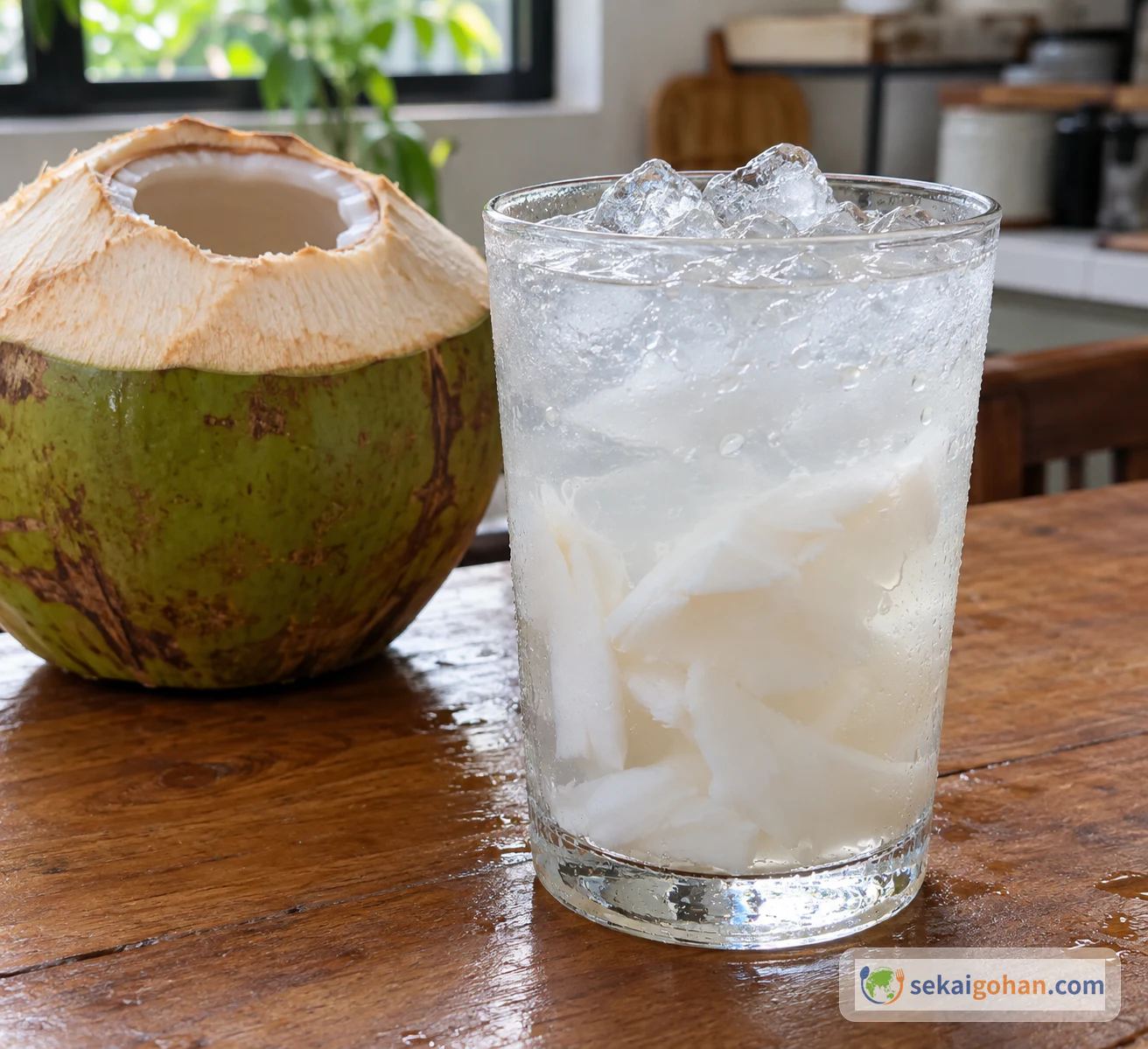
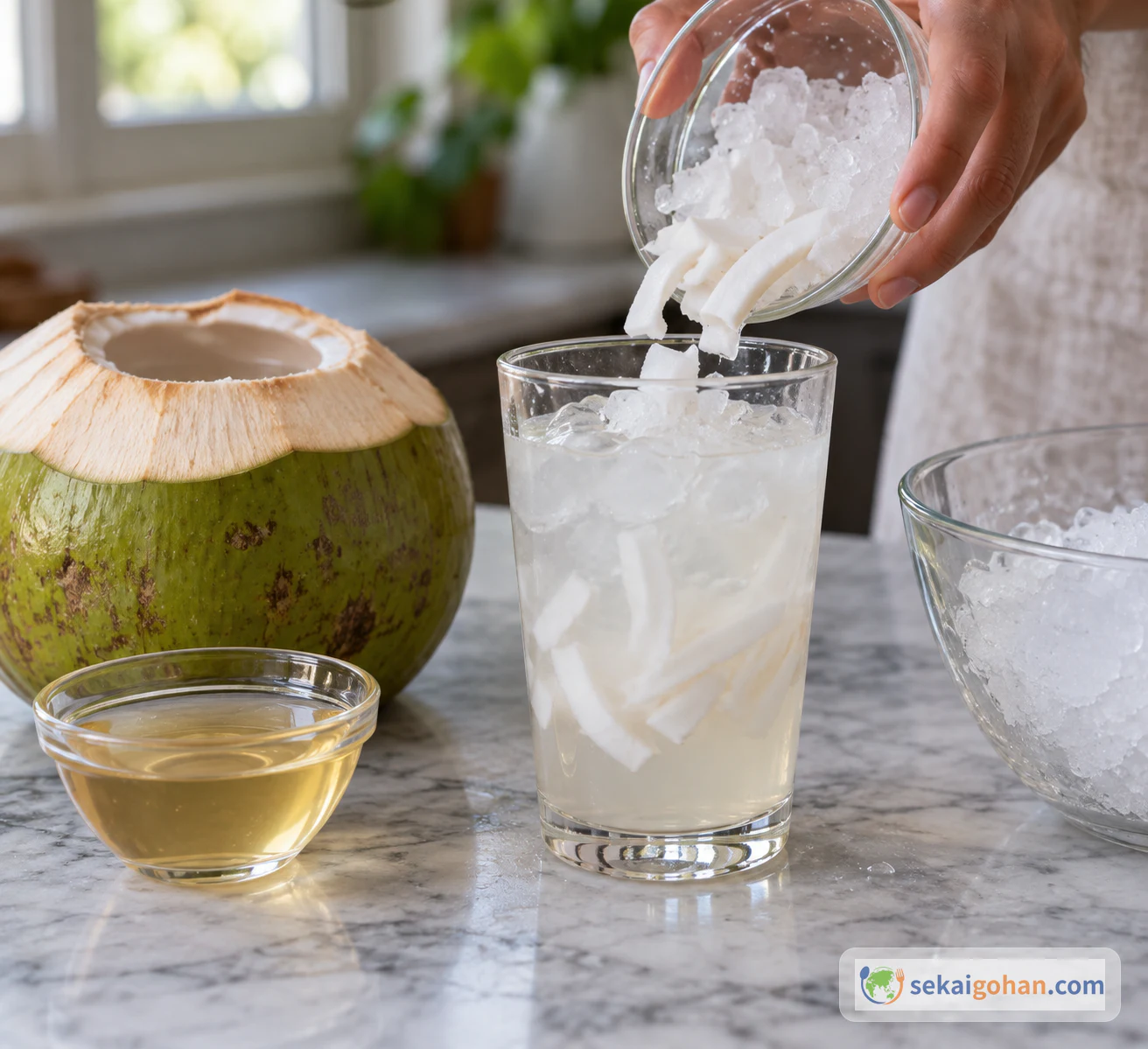
Es Kelapa Muda: Young Coconut Water and Soft Flesh Over Ice
Three things only: the water and tender flesh of one young drinking coconut, a spoonful of simple syrup, and shaved or crushed ice. Nothing is added to hide the coconut.
At a stall in Semarang, Central Java, a seller pours young coconut water over ice and sweetens it with syrup, palm sugar or granulated sugar. That scene comes from a report by the Central Java provincial government's public-relations office about one long-running vendor, Pak Ambon, who calls the drink Es Degan. Es kelapa muda, literally "young coconut ice", is built from the same simple idea: the clear water and soft white flesh of a young coconut, served very cold.
The recipe here follows one written version, "Es Degan (Es Kelapa Muda)" by food writer and cookbook author Roberta Muir, published on the Australian food and travel site Be Inspired. It uses one young drinking coconut, 1 tablespoon of simple sugar syrup and shaved or crushed ice, and it serves 1 or 2. It is one author's version, not the single traditional recipe or a national standard for Indonesia. This recipe has not been kitchen-tested by Sekai Gohan.
The written recipe does not state how big the coconut is, how much water or flesh it holds, how much ice to use, how long to chill, or how much the finished drink makes. Those things are left open here too, because they depend on the coconut in your hands.
Muir describes Es Degan as the Javanese name and es kelapa muda as the name used elsewhere in Indonesia. A seller listing from Sidoarjo, East Java, also calls Es Degan and es kelapa muda the same drink and explains that "degan" means young coconut in Javanese. Both are local, attributed accounts rather than a survey of how the names are used across the country.
Why So Few Ingredients: A Drink That Is Mostly Coconut
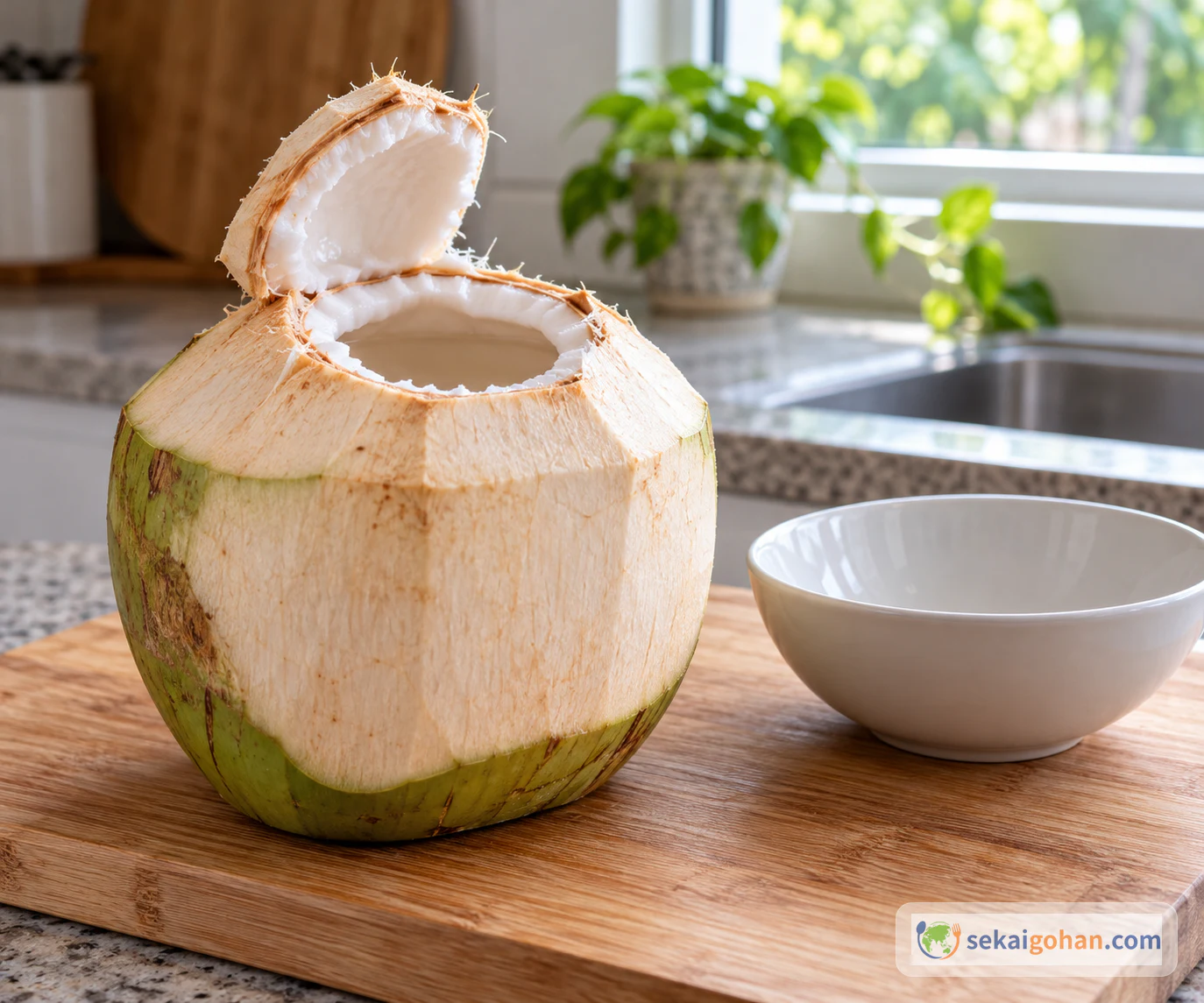
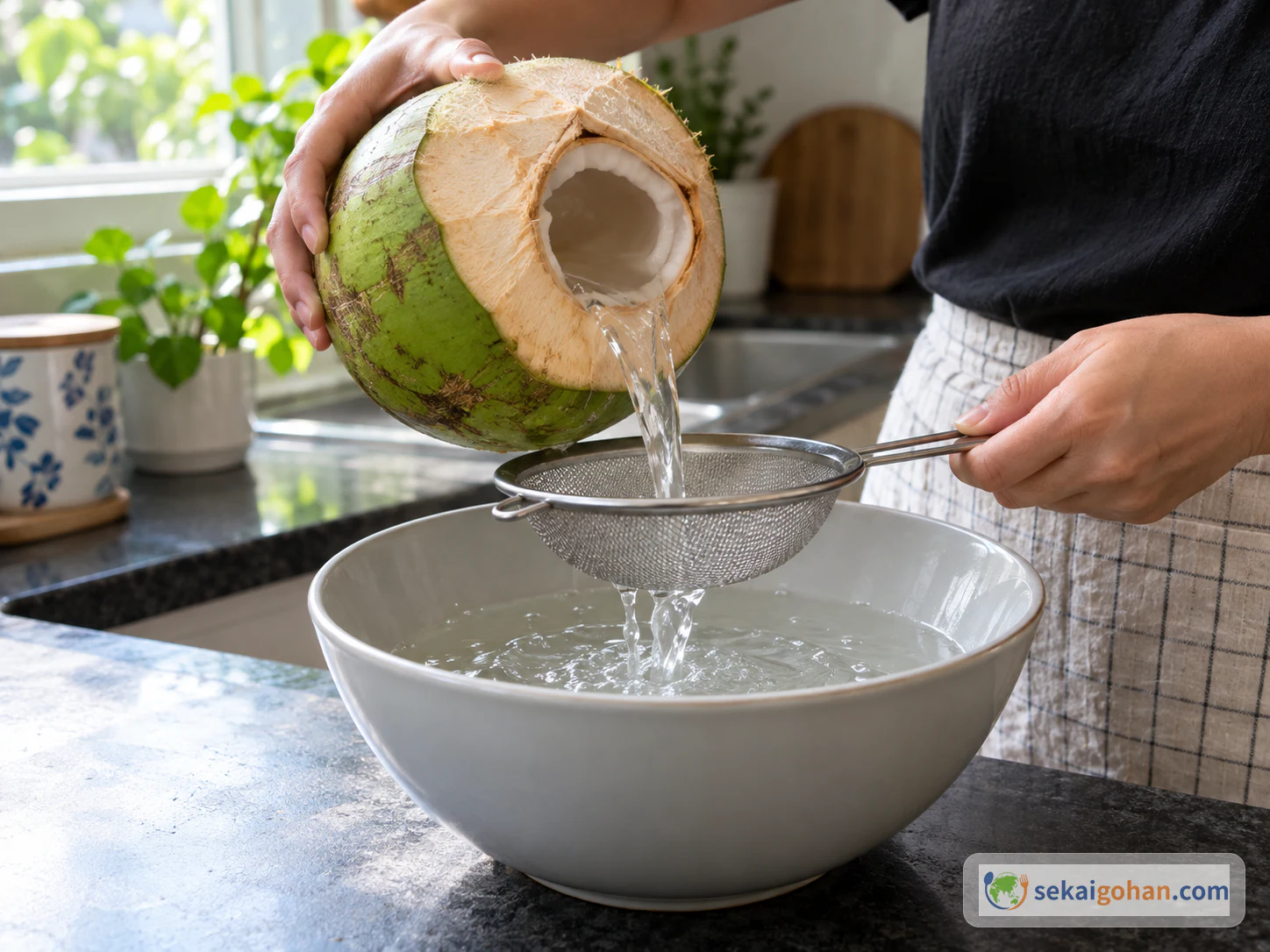
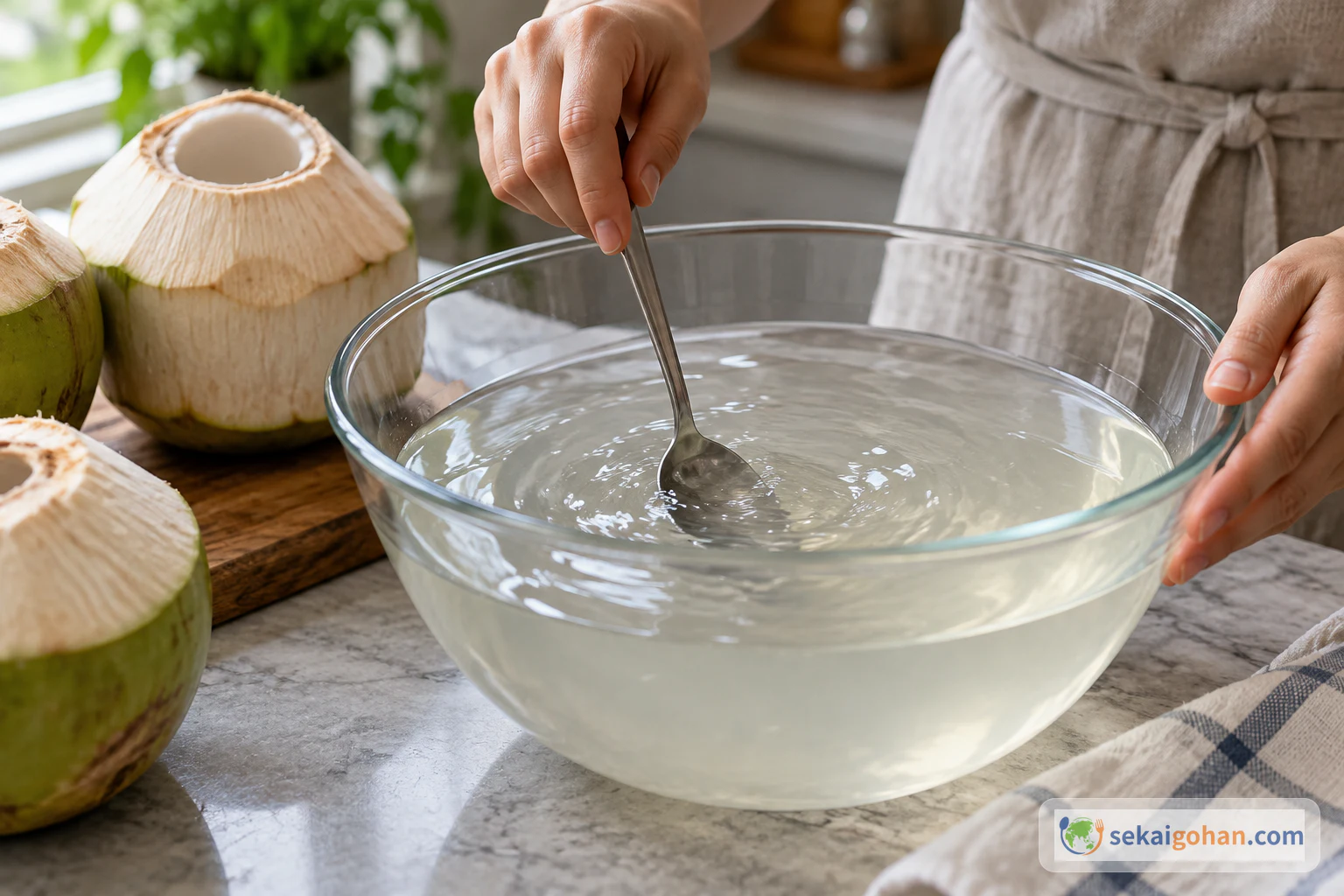
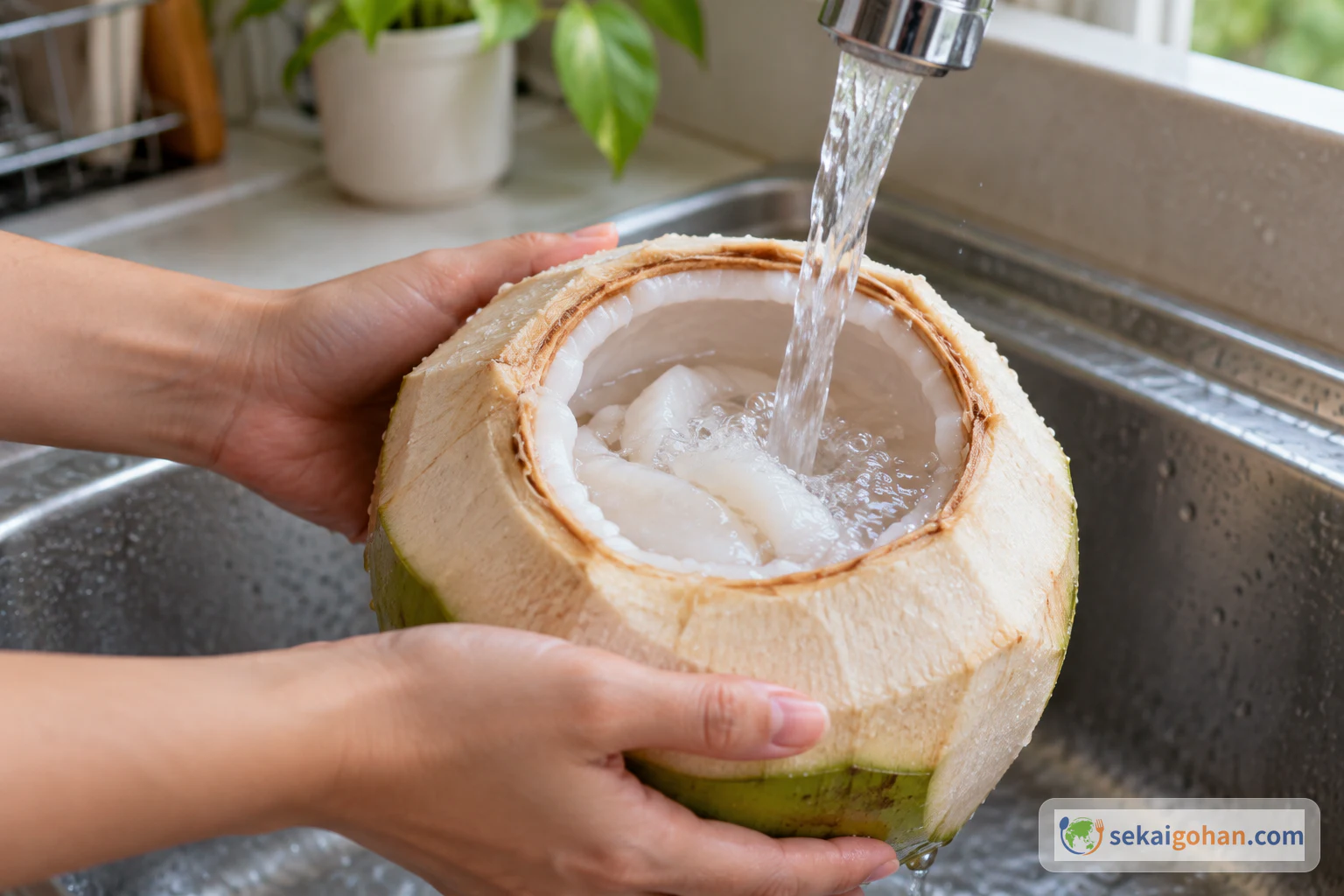
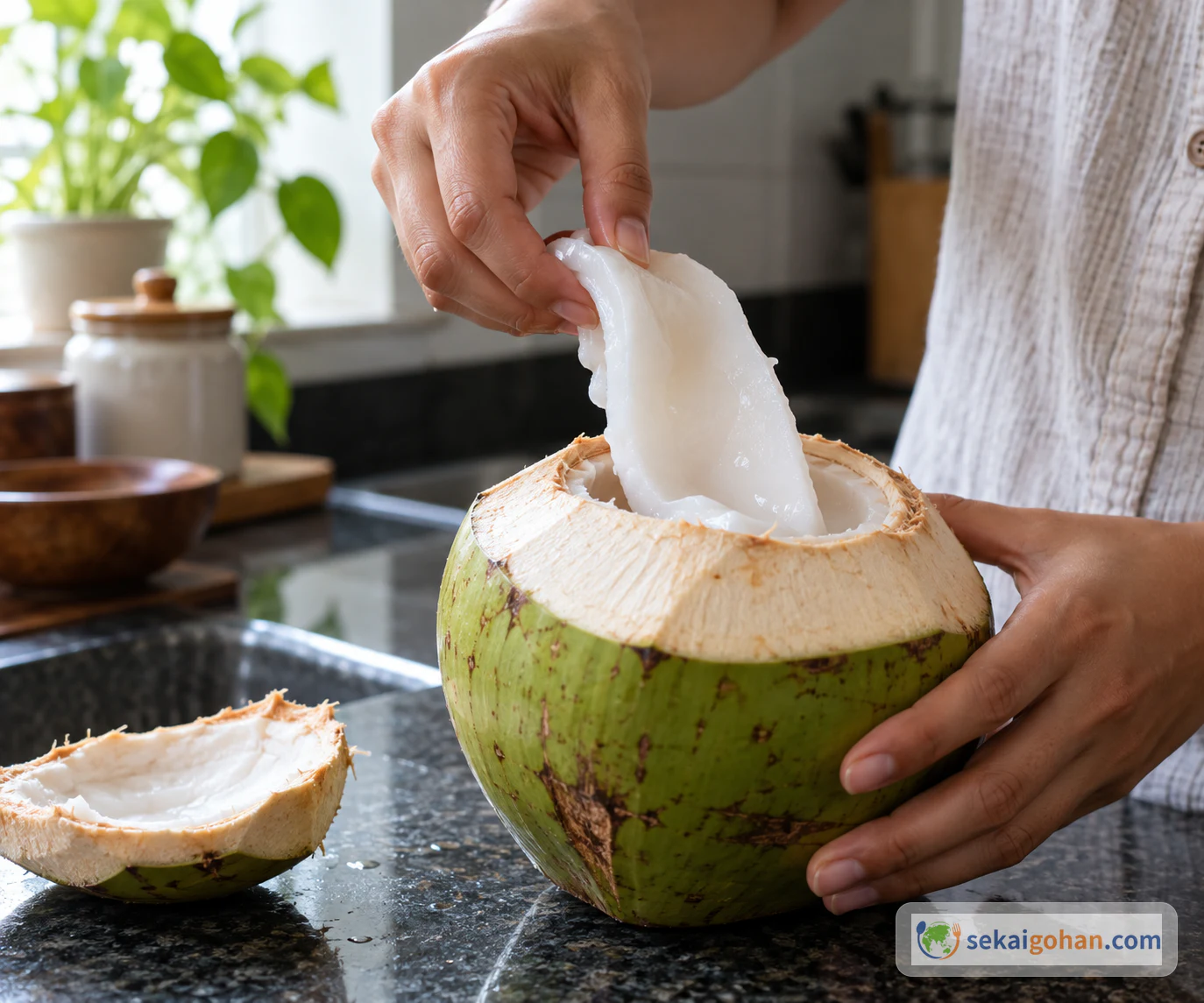
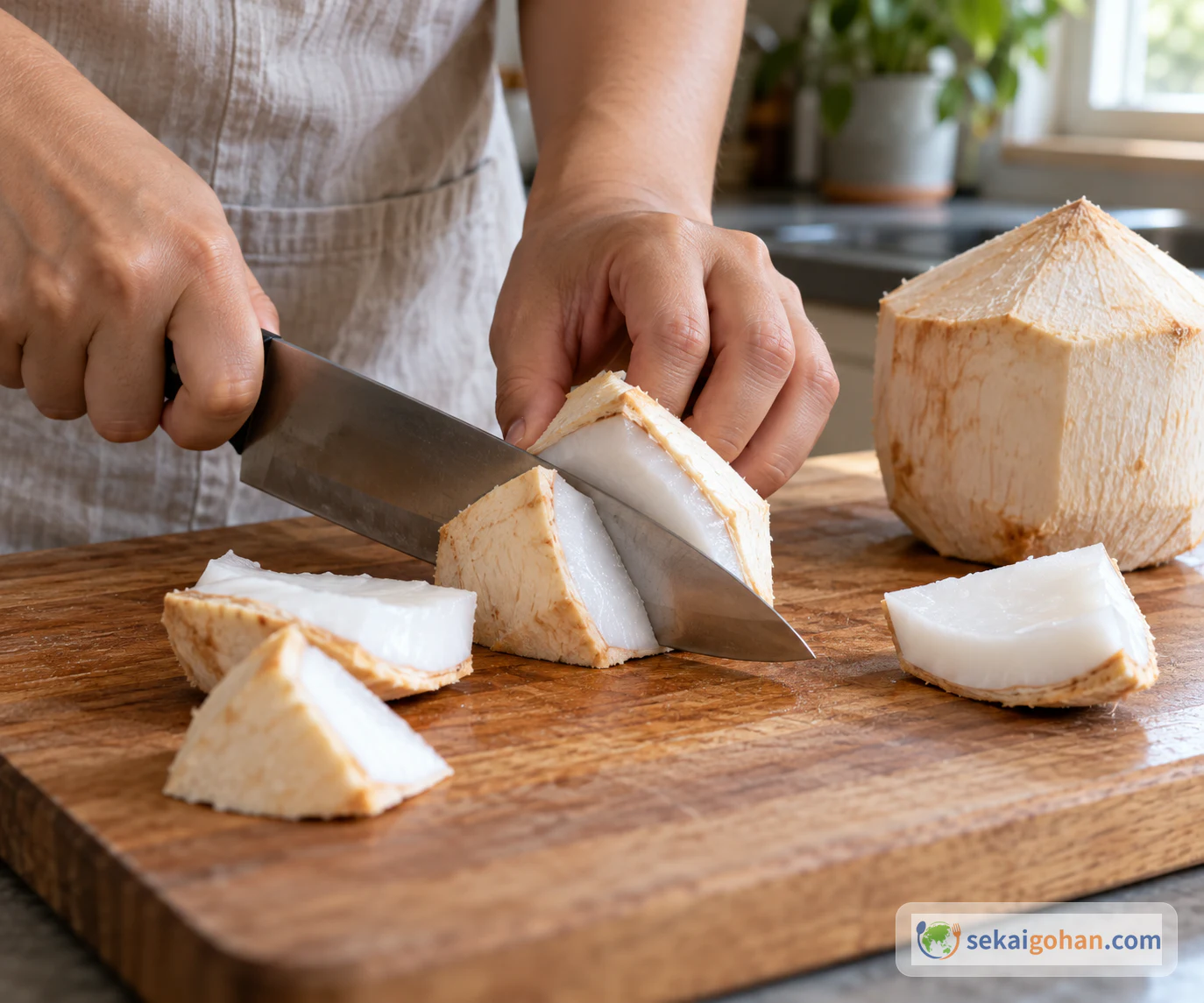
Es kelapa muda is less a mixed drink than a way of serving a young coconut cold. The water is strained, sweetened lightly and chilled; the soft flesh is rinsed, cut out and trimmed; then everything meets the ice. Muir also describes serving it from the young coconut shell itself, and notes that a coconut whose top is already cut open works well.
That last point matters for home cooks. Muir's recipe links to a separate guide for opening a young coconut, which uses sharp, heavy tools such as a cook's knife or cleaver and a screwdriver. Sekai Gohan has not assessed that method as safe for home kitchens, so this article does not describe opening a whole shell. Every step below starts from a coconut a seller has already opened for drinking, or from young coconut water and flesh that have already been taken out.
For more dishes and drinks from the same country, see Indonesia.
Ingredients: One Coconut, One Spoonful of Syrup, Ice
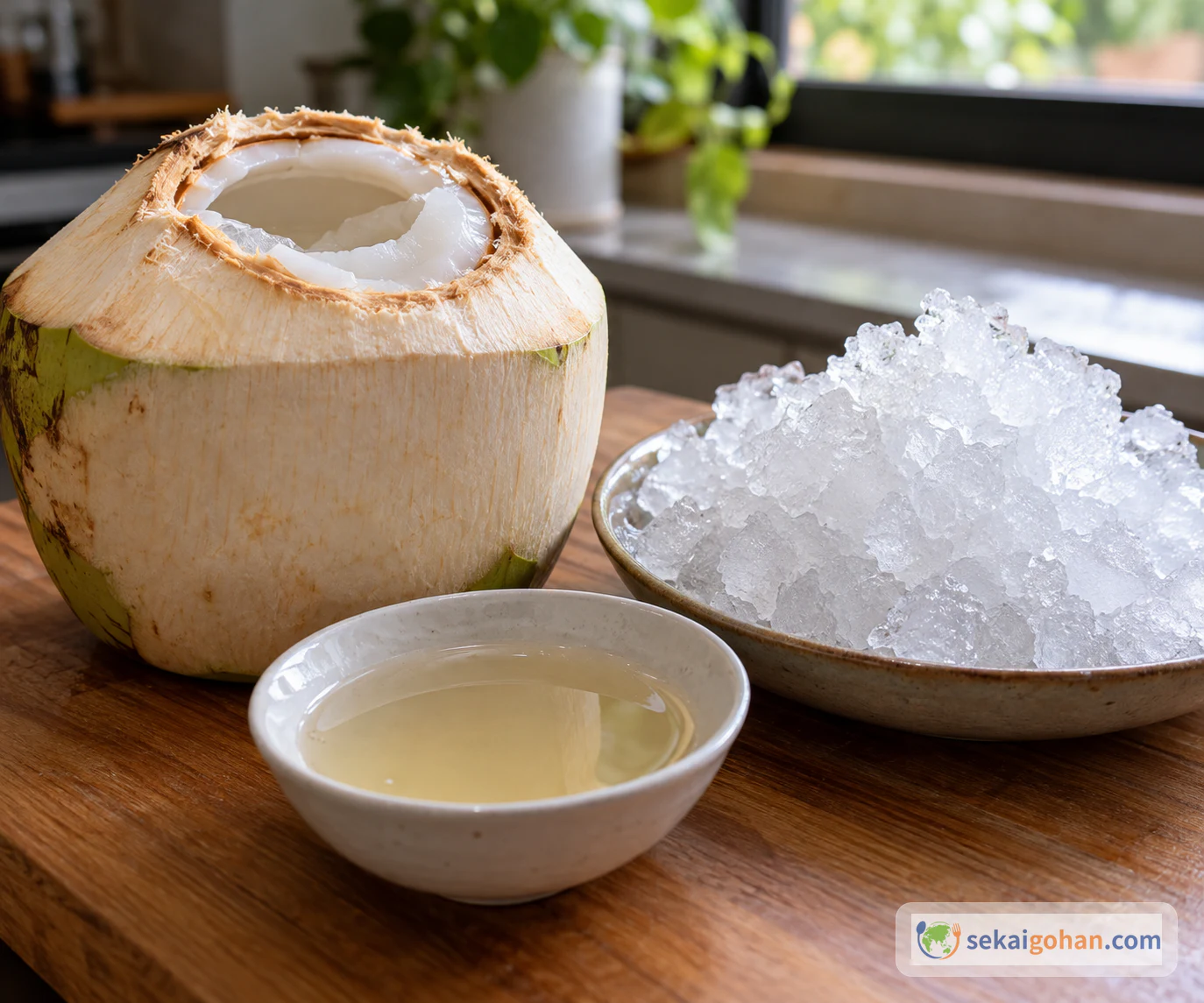
Serves 1 or 2.
Choosing the Syrup and the Coconut
Any kind of sugar syrup works, including one made with coconut sugar. To make a simple syrup, heat equal quantities of white sugar and water until the sugar dissolves, then let it cool. Use 1 tablespoon of the cooled syrup in the drink.
When you buy the coconut, look for one sold as a young or drinking coconut and check that both the water and the soft flesh are usable, since this drink needs the two. Check whether the coconut is sold chilled, and ask the seller to open it for drinking, or choose a product where the water and flesh have already been taken out.
Do not try to crack a hard coconut shell with a knife or other tools at home for this recipe; start from a coconut that is already open. Work with clean hands, a clean board and clean utensils. The cut edge of an opened shell can be sharp, so hold the coconut by its outer shell, away from the rim.
Equipment
- Sieve or strainer
- Large bowl
- Spoon
- Cutting board
- Paring knife
- Glasses, or the coconut shell, for serving
Method: Chill the Water, Trim the Flesh, Then Meet the Ice
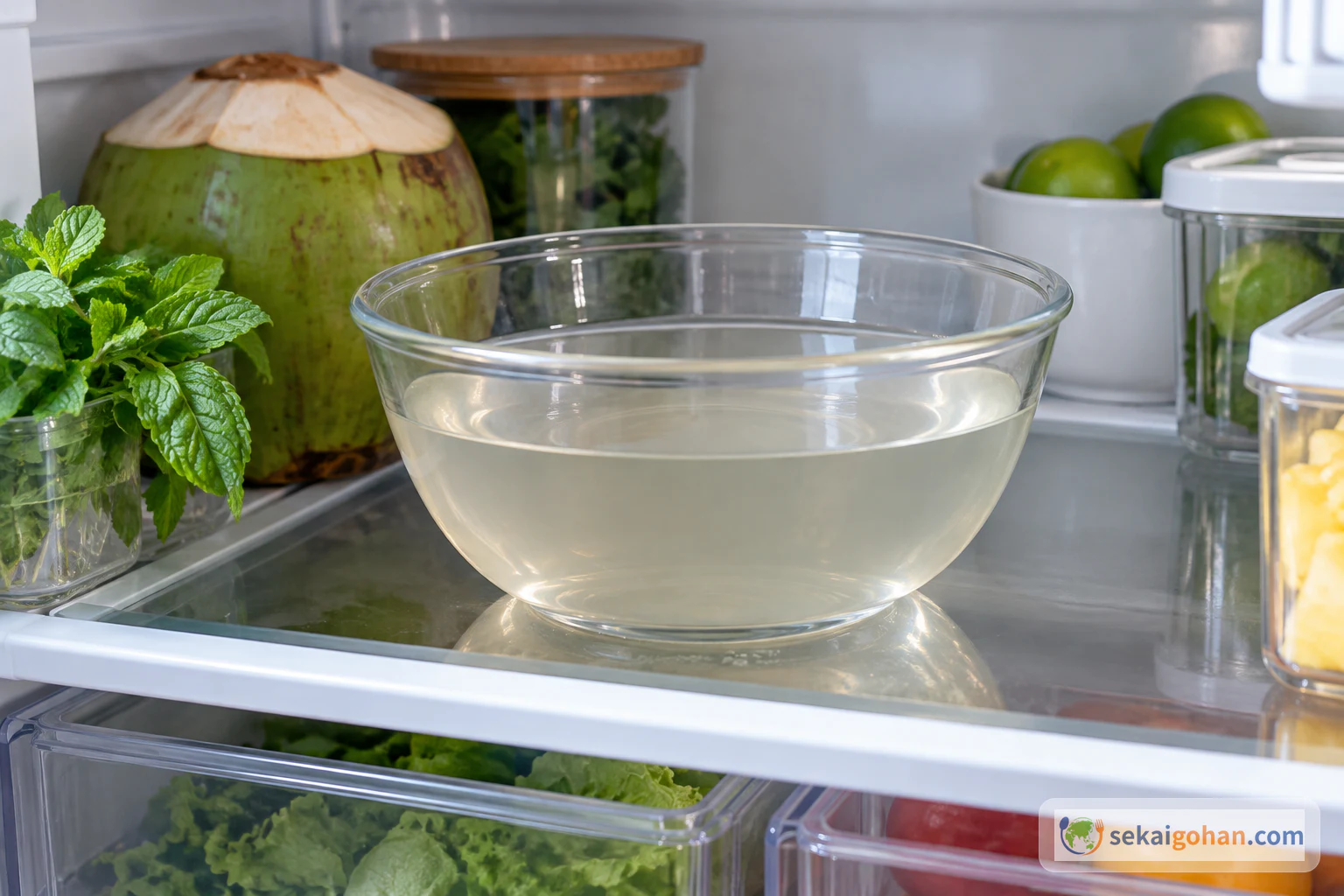
The coconut water goes into the refrigerator first. Prepare the flesh while it chills, and only bring everything together with the ice when you are ready to serve.
When Things Don't Go to Plan
| Situation | What to check | What to do |
|---|---|---|
| The coconut you bought is still closed | Whether the seller can open it for drinking | Ask the seller to open it, or choose a product with the water and flesh already taken out. Don't force a hard shell open at home |
| There is little or no soft flesh inside | The product description | Next time, choose a coconut labeled as having both coconut water and soft flesh |
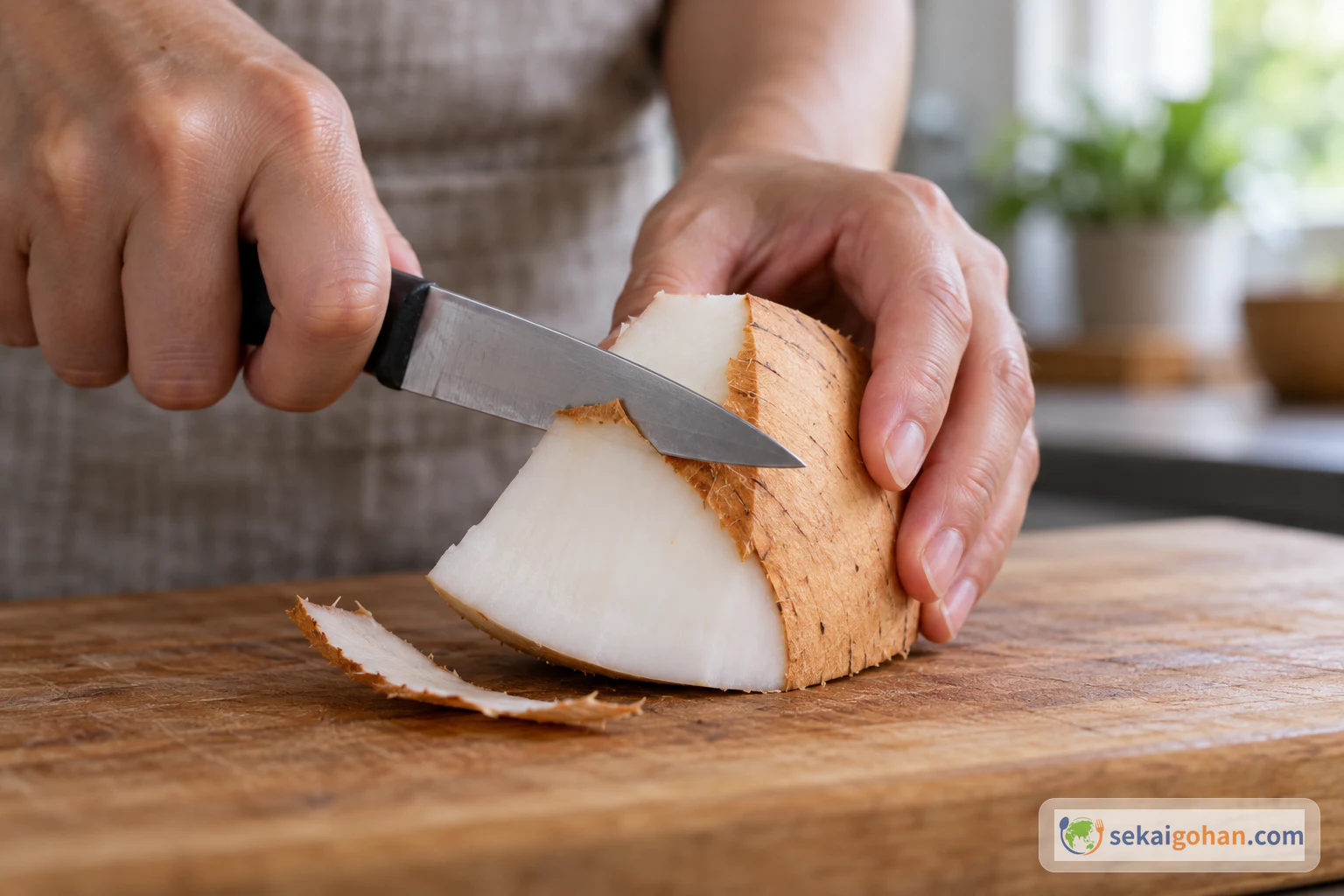
| Brown skin is still visible on the flesh | Step 4 | Pare it away with a paring knife before the flesh goes into the drink |
| The drink isn't cold enough | Whether the water chilled before serving | Keep the sweetened coconut water in the refrigerator until you serve, and add the ice only at the end |
Same Name, Different Glasses: Other Published Versions
The versions below are described so you can see the range. None of their ingredients have been added to the recipe above.
Muir's version was chosen because one author's recipe gives both the amounts and the order clearly. That does not make other versions wrong.
| Version | What goes in | Notes |
|---|---|---|
| Roberta Muir, Be Inspired (this recipe) | Young drinking coconut, simple sugar syrup, shaved or crushed ice | Serves 1 or 2 |
| Kuliner Indonesia yang Mendunia by Siti Maryam (Badan Bahasa, 2017) | One young coconut, a can of sweetened condensed milk, 1–2 lemons, sugar syrup, shaved ice | Some amounts are given only as spoonfuls without a fixed quantity, and the ingredient list says susu kental manis (sweetened condensed milk) while the text later says susu cair (liquid milk) |
| Es Sawo Kelapa Muda, Primarasa | Young coconut, 600 ml coconut water, ripe sawo, selasih, ice, and a syrup of palm sugar, granulated sugar, water and pandan | A separately named fruit version; the page gives six glasses and 30 minutes, which apply only to that recipe |
The Semarang stall from the opening adds another shape: coconut water and ice sweetened with syrup, palm sugar or granulated sugar. The seller there said demand at that stall rises in the hot dry season and during Ramadan. That is one vendor's experience at one stall, not a statement about how the whole country drinks it.
Shopping for a Young Coconut
What matters most is a coconut that gives you both the water and the soft flesh. Some young coconuts are sold mainly for drinking, so read the description before you buy.
As examples from Japanese retailers, Green Beans by AEON listed a chilled 700 g young coconut from Vietnam, with coconut water and soft flesh described as usable parts, and Oisix listed a Thai young coconut for its juice and soft white flesh, marked as limited quantity. Stock, price and delivery areas change, so treat these only as examples of what to look for: young coconut, water and soft flesh both usable, and whether it needs refrigeration. The 700 g product weight is not a measure of the coconut this recipe calls for.
Leftovers and Handling
The recipe gives no storage period for es kelapa muda, and none of the sources gives a coconut-specific shelf life. What can be said comes from general U.S. household food-safety advice. FoodSafety.gov advises refrigerating perishable food within two hours, or within one hour when the surrounding temperature is above 90°F (about 32°C), and keeping the refrigerator at 40°F (4°C) or below. The U.S. FDA advises keeping cut produce refrigerated at 40°F (4°C) or below, and handling produce with clean hands and clean utensils. If you have leftover coconut water or flesh, refrigerate it promptly, following that general advice.
Frequently Asked Questions
This drink rests on one opened young coconut, 1 tablespoon of syrup and ice. Most questions come back to the coconut itself, which varies from one to the next.
How many people does it serve?
Muir's recipe says it serves 1 or 2. It does not give the size of the coconut, the amount of water or flesh, or the finished volume, so the number of glasses depends on your coconut.
How large should the coconut pieces be?
The recipe says only to cut the flesh into pieces; it gives no size or thickness. Cut it however suits your glass or the shell you serve it in.
Is the 1 tablespoon of syrup the same as the homemade syrup note?
Not necessarily. Muir lists 1 tablespoon of simple sugar syrup and separately offers an optional note on making it from equal quantities of white sugar and water, heated until dissolved and cooled. The note does not say whether "equal quantities" means weight or volume, or how much syrup it makes, so it is not turned into a measured syrup recipe here. Muir also says any type of sugar syrup, including coconut sugar syrup, can be used.
Should I add condensed milk or lemon?
Not to this recipe. Condensed milk and lemon appear in the version printed in Kuliner Indonesia yang Mendunia, which is a different recipe. If you want to try that style, treat it as a separate drink.
Can I open a whole coconut myself?
This article does not cover it. Muir links to an opening guide that uses sharp, heavy tools, and its safety for home kitchens has not been assessed here. Buy a coconut the seller has opened for drinking, or young coconut water and flesh that have already been taken out.
Is Es Degan the same drink?
Muir calls Es Degan the Javanese name and es kelapa muda the name used elsewhere in Indonesia, and a Sidoarjo seller listing calls them the same drink. These are local, attributed accounts; whether the two names mean exactly the same thing everywhere is not established.
Sources
- Roberta Muir, "Es Degan (Es Kelapa Muda)," Be Inspired – Food Wine Travel. The recipe followed here: one young drinking coconut, 1 tablespoon simple sugar syrup, shaved or crushed ice, serves 1 or 2; the method order; the optional syrup note; the description of Es Degan as the Javanese name; serving from the shell. https://beinspired.au/recipes/es-degan-recipe/
- Be Inspired – Food Wine Travel, "Roberta Muir: Food Travel Writer, Cookbook Author, Events & Tours." The author's own profile of her food-writing and cookbook work. https://beinspired.au/profile-roberta-muir/
- Be Inspired – Food Wine Travel, "How To Open A Young Coconut: How To Open Drinking Coconuts." The companion opening guide linked from the recipe, which uses sharp tools; referenced only to explain why this article does not describe opening a shell. https://beinspired.au/recipes/how-to-open-a-young-coconut/
- Siti Maryam, Kuliner Indonesia yang Mendunia, Badan Pengembangan dan Pembinaan Bahasa, Kementerian Pendidikan dan Kebudayaan, 2017. A separate Es Kelapa Muda version with sweetened condensed milk, lemon, sugar syrup and shaved ice, and its inconsistent milk wording. https://badanbahasa.kemendikdasmen.go.id/resource/doc/files/71._Isi_dan_Sampul_Kuliner_Indonesia_yang_Mendunia.pdf
- Primarasa, "Resep Es Sawo Kelapa Muda." A separately named version with sawo, selasih and a palm-sugar syrup with pandan, with its own yield and time. https://www.primarasa.co.id/minuman/es-sawo-kelapa-muda
- Central Java Provincial Government Public Relations (Humas Jateng), "Meneguk Es Degan Pak Ambon yang Melegenda, Segarnya Tiada Dua." One Semarang stall serving young coconut water with ice and syrup, palm sugar or granulated sugar, and the seller's account of higher demand in the dry season and Ramadan. https://humas.jatengprov.go.id/detail_berita_gubernur?id=2897
- TukuoYuk, Sidoarjo Regency, "Es Degan Pak Sokheh." A local seller listing describing Es Degan and es kelapa muda as the same drink and "degan" as Javanese for young coconut. https://tukuoyuk.sidoarjokab.go.id/p/es-degan-pak-sokheh
- U.S. Food and Drug Administration, "Selecting and Serving Produce Safely." General advice on washing produce, clean hands and utensils, and keeping cut produce refrigerated at 40°F (4°C) or below; not coconut-specific. https://www.fda.gov/food/buy-store-serve-safe-food/selecting-and-serving-produce-safely?debugMode=false
- FoodSafety.gov, "4 Steps to Food Safety." General advice to refrigerate perishable food within two hours (one hour above 90°F / about 32°C) and keep the refrigerator at 40°F (4°C) or below; not a coconut-specific storage period. https://www.foodsafety.gov/keep-food-safe/4-steps-to-food-safety
- Green Beans by AEON, "冷蔵 ベトナム産 ヤングココナッツ 700g." A Japanese retail listing of a chilled young coconut with usable water and soft flesh; availability and price change. https://greenbeans.com/products/18938535840022/details
- Oisix, "ヤングココナッツ(タイ産)." A Japanese retail listing of a Thai young coconut for juice and soft white flesh, marked limited quantity; availability changes. https://www.oisix.com/ShouhinShousai.ss1-1318.htm