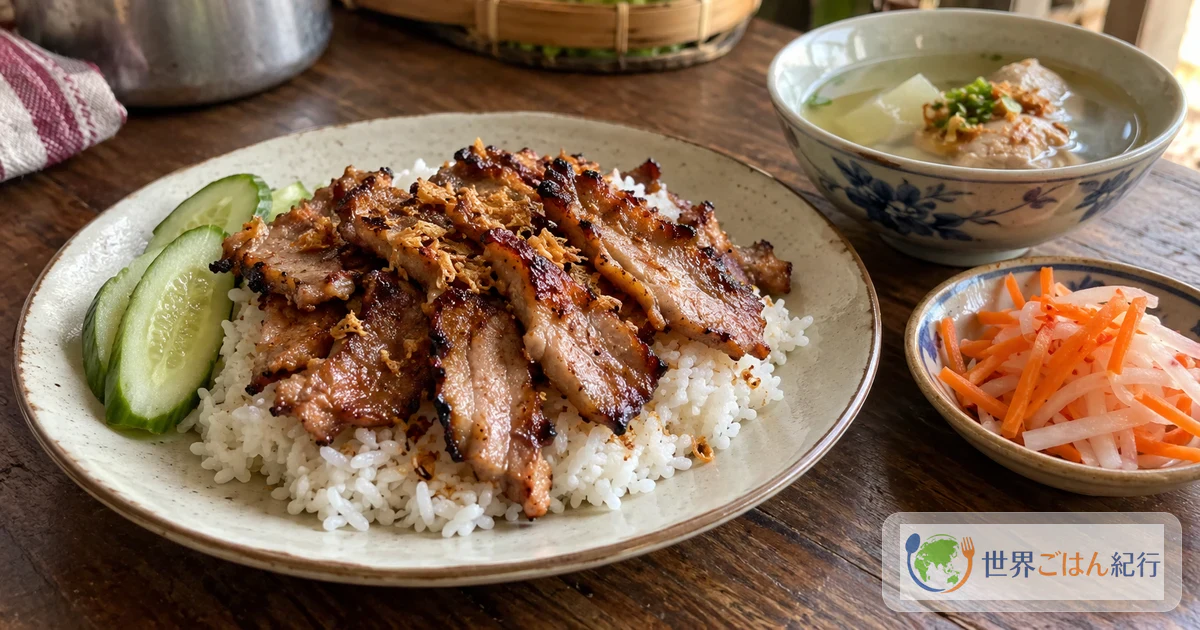
Lemongrass and chicken oil rising out of the smoke
When you catch the smell of yakitori, it's hard not to stop in your tracks: the aroma of sweet-savory glaze, charcoal smoke, the crackle of skin. Chicken inasal from the Western Visayas region of the Philippines tempts in the same way, but with lemongrass, a sour citrus tang and the orange glow of annatto oil layered on top.
Chicken inasal (also inasal na manok) is Filipino charcoal-grilled chicken, marinated in coconut vinegar, calamansi, garlic, ginger and lemongrass and brushed with annatto oil as it grills. In Bacolod it's the star of Manokan Country, the district of chicken-grilling stalls, where a plate comes with white rice, chicken oil, spiced vinegar and calamansi-soy sauce.
The hard part of making it elsewhere isn't collecting every authentic ingredient. What matters is the framework: a sour marinade, the green fragrance of lemongrass, annatto oil layered on while grilling, and cooking the chicken safely through to an internal temperature of 74°C (165°F). Sudachi or lime can stand in for calamansi, and a mix of rice vinegar and apple cider vinegar for coconut vinegar, which gets you quite close to the Bacolod style.
It's the opposite of another Filipino staple, adobo (in Japanese), which is braised in soy sauce and vinegar. If adobo deepens its flavor in the pot, inasal builds aroma with smoke and fat. Serve it with a big platter of pancit canton for a lively Filipino table.
"Inasal" is used in the Visayan languages for grilling, roasting over fire or skewering. Locally it covers not only chicken but also pork and offal skewers. "Chicken inasal" is the most common English spelling.
The story of chicken inasal: Bacolod and the charcoal-grilling culture of Western Visayas

You can't talk about chicken inasal without mentioning Bacolod. On November 16, 2022, the Bacolod City government passed an ordinance treating chicken inasal as a cultural property of the city. According to the city's announcement, the background is the street-stall culture known as Manokan Country and Chicken Alley, which has grown into the face of Bacolod's food scene.
But the dish didn't suddenly appear in Bacolod alone. It grew out of the charcoal-grilling culture of the Ilonggo region of Western Visayas, which includes the islands of Negros and Panay. Iloilo has its own tradition of grilled chicken, and UNESCO's Creative Cities Network lists Iloilo City as a Creative City of Gastronomy as of 2023. A simple way to see it: Bacolod has a strong brand as the "city of chicken inasal," while Iloilo holds grilled chicken and local dishes within a broader culinary culture.
The regional difference most often mentioned in local accounts is where the flavor's center of gravity sits. The Bacolod style tends to put the sourness of coconut vinegar and calamansi up front, while descriptions of Iloilo-style versions sometimes talk about sweetness and a rounder aroma. Of course, every stall blends its own. At home, go easy on the sugar and keep the sharp outline of vinegar and citrus, and you'll get the cleaner, Bacolod-leaning taste.
Another hallmark is that soy sauce is not the star of the marinade. Reach for a lot of soy sauce out of yakitori or adobo habit and you end up with a different dish. The color of chicken inasal is not soy-sauce brown but the orange of annatto (atsuete). The aroma comes not from a sweet-savory glaze but from lemongrass, garlic, ginger, vinegar and charcoal smoke. Keep to that difference and even a home broiler gets you close to Filipino grilled chicken.
The order of flavors matters more than a perfect ingredient list. Build the seasoning with sourness, add the green note of lemongrass, brush on annatto oil as you grill, and finish by spooning a little chicken oil over the rice. With that sequence, even ordinary supermarket chicken thighs taste like inasal.
Ingredients (serves 4): sourness, aroma and annatto oil, sourced where you live

Bone-in chicken thighs are the most authentic, but bone-in thighs aren't always on the shelf at a regular supermarket. For a first try, use bone-in chopped pieces, bone-in thighs, or large boneless thighs. Boneless meat grills faster, though the satisfaction of charcoal-grilled chicken is a little lighter.
This dish contains chicken, dairy (if you use the butter) and soy (the soy sauce in the dipping sauce). Don't use marinade that raw chicken has soaked in as a finishing sauce as is. If you do use it, boil it in a small pot for at least 1 minute, then mix it with annatto oil you set aside separately.
Annatto seeds and coconut vinegar can be hard to find in an ordinary supermarket. Once you have them, though, you can use them in other Filipino and Latin American cooking. If you plan to make chicken inasal again and again, they're worth hunting for first, at Asian or Latin American grocery stores or online.
Coconut vinegar has a softer acidity and a more tropical, fermented note than rice vinegar. You can substitute, but if you want to get closer in aroma, try to find it.
Long bamboo skewers are handy for outdoor grilling. Even if you cook under a broiler, skewering the meat makes it easier to turn.
Method: sour marinade, oil for aroma, and the final call made by internal temperature
You don't cut chicken inasal small like yakitori. Large bone-in pieces cooked slowly are what give it its strong aroma and satisfying bite. That makes marinating time and checking doneness important. Don't judge it done by a charred skin alone; aim for an internal temperature of 74°C (165°F).
If you brush on a lot at once, the oil drips onto the charcoal, flames flare up and only the skin burns. Layering thin coats of annatto oil gives cleaner color and aroma. This is not a dish to be coated thickly like teriyaki glaze.
Days without charcoal: broiler, oven or skillet

Charcoal is ideal, but few households can grill in the yard every time. The smoke and direct-flame aroma will be weaker, but a broiler, oven or skillet can still take you in the direction of chicken inasal. What matters is not stopping at steam-roasting but drying the skin at the end so it turns fragrant.
| Method | How to cook | Best for | Watch out for |
|---|---|---|---|
| Fish broiler / grill | Medium heat, 8 minutes skin side, turn for 7 minutes, brush on oil and cook 5–8 minutes more | The most realistic option for a home kitchen | Burns quickly. Protect the edges with aluminum foil |
| Oven | 220°C (425°F) for 20 minutes, brush with oil and 230°C (445°F) for 10–15 minutes | Cooking a lot at once | Finish with the top heat or broil function to dry the skin |
| Skillet | Medium heat, 7 minutes skin side, turn and cover for 10 minutes, uncover for the end | Making a small amount | No smoke from direct flame. Don't use too much oil |
| Hot plate | 200°C (390°F) on both sides, then 230°C (445°F) at the end for browning | Grilling and eating together as a family | Blot with paper towels if liquid collects |
If you use a broiler, wipe off the marinade thoroughly. If aromatics are left on, they burn first. Start skin side up over medium heat to build fragrance. Brushing oil partway makes smoke, so brush on only 1 tsp at a time. If it browns too strongly, cover just the edges of the skin with aluminum foil.
In the oven, place a rack on the baking sheet so liquid drips below and the skin doesn't turn sticky. Bake at 220°C (425°F) for 20 minutes, turn, brush with annatto oil and bake 10–15 minutes more. Raising the top heat for only the last 3 minutes gets you closer to charcoal-style browning. With any method, the internal temperature of 74°C (165°F) doesn't change.
Annatto oil makes chicken look orange early. Even when the outside looks cooked, the area near the bone can still be at a low temperature. FoodSafety.gov gives a standard of cooking chicken to 165°F, or 74°C. At home, a thermometer is the surest way.
Causes of failure and tips: preventing burning, toughness and flat flavor
Failures in chicken inasal cluster around four things: heat that is too high, marinating too long, too much oil, and drifting too far toward a soy sauce flavor. If you brush on a thick glaze with a yakitori mindset, the skin turns black and the lightness of lemongrass and vinegar disappears.
| Problem | Cause | Fix |
|---|---|---|
| Only the skin burns | Charcoal too close, oil brushed on thickly, grilled with aromatics still on | Move away from the heat and brush the oil on thin. Wipe off the aromatics before grilling |
| Raw in the middle | Bone-in meat grilled briefly over high heat only | Take time over a gentle heat and cook to an internal temperature of 74°C (165°F) |
| Dry, crumbly meat | Breast meat only, overcooked, not rested | Use thigh meat and rest for 5 minutes after grilling |
| Too sour | Too much vinegar and citrus, long marinating | Add 1 tsp sugar and keep marinating to within 8 hours |
| Bland | Not enough salt, large meat with no cuts | Cut along the skin and bones and add 1/2 tsp more salt |
| Tastes like yakitori glaze | Too much soy sauce in the marinade | Move soy sauce to the dipping sauce and make vinegar and citrus the stars of the seasoning |
Putting the tough green leaves in whole will still give some aroma, but what clings to the chicken is the tender white base. Bruise it with the back of a knife, then chop it fine so the green fragrance transfers more easily into the marinade.
At local eateries, spooning red-orange chicken oil over rice is part of the fun. But it's oil, so 1 tsp is plenty at first. Mixing a little into garlic rice gives satisfaction without adding more meat.
With a broiler or oven, turn the skin side up in the second half and let the moisture cook off. Finishing only in a covered skillet gets you closer to steamed chicken. Take the lid off for just the last 3–5 minutes, brush on a thin coat of oil and dry the skin.
The background: why sourness, smoke and chicken oil become the taste of a place

If you imitate only how the chicken is grilled, chicken inasal feels a little lacking. What's strong locally is the way of eating it. You bite the chicken, let a little chicken oil drip over the rice, dip in spiced vinegar and finish with calamansi-soy sauce. Where it might turn greasy, sourness and raw vegetables bring you back. It's this back-and-forth that lets you eat a whole chicken thigh to the end without tiring of it.
Bacolod's Manokan Country is spoken of not just for the food itself but as an experience: choosing a stall, waiting for chicken to grill in the smoke, ordering more rice as you eat. The Philippine News Agency reports that Manokan Country is well known in the context of Bacolod tourism as well. This is not just "local cuisine" but food tied to a city's memory.
You can't reproduce all of that atmosphere in a home kitchen. You can still move the plate closer. Instead of plain white rice, make garlic rice with garlic fried in a little oil. Put chopped onion, garlic and chiles in the vinegar bowl. Set out tomato and cucumber, or sweet-vinegar pickled daikon and carrot. With all of that, the flavor of the chicken suddenly gains dimension.
When planning a menu, go small on a sour soup like sinigang, since it overlaps a bit. On days when you want something gentler, a small bowl of sopas (in Japanese), the chicken-and-macaroni soup enriched with milk, gives a rest from the vinegar and smoke. For a platter meal, serve lumpiang shanghai (in Japanese) as an appetizer, pancit canton as the starch and sapin-sapin as a sweet finish, and it feels like a Filipino celebration table. On days you pair it with the rich peanut stew kare-kare, make the inasal vinegar stronger to let the heaviness escape.
Annatto is not an ingredient with a strong spice aroma. Its main role is to transfer an orange color to the oil and give the browning a warm tone. If you add a lot hoping to make it the main flavor, it turns gritty and earthy. A small amount is enough.
Storage and make-ahead: separate raw marinating from cooked leftovers

The thing to watch most in make-ahead cooking is marinating time. Because it contains vinegar and citrus, leaving the chicken in the marinade for a full day or more makes the surface of the meat too soft, and it tends to turn crumbly when grilled. If you prep the day before, marinate in the evening and grill the next day at midday or in the evening.
If you refrigerate raw chicken in its marinade, put it in a zip-top bag or covered container and always keep it in the refrigerator. Don't marinate at room temperature. Take it out 30 minutes before grilling, just enough to take the chill off the center. If you want to reuse the marinade, always heat it first.
Let grilled chicken inasal cool slightly, put it in a shallow container and plan to eat it within 3 days in the refrigerator. If freezing, use within 1 month. When reheating, the microwave alone leaves the skin soft, so warm the inside in the microwave first and then give it 2–3 minutes in a toaster oven or broiler to bring back the aroma. Shredding the leftovers thin and mixing them into garlic rice or fried noodles also works well.
Divide the chicken oil into a clean container and plan to use it within 3–4 days in the refrigerator. If a brush that touched raw meat goes back into the oil, it can no longer be stored, so spoon some into a small dish before grilling. Leftover chicken oil can also scent the next day's rice, stir-fried vegetables, or spicy Filipino dishes such as Bicol express (in Japanese).
FAQ

Can I make it without calamansi?
Yes. Combining sudachi, lime and lemon gets you close. Lemon alone gives a sharp aroma, so mixing in a little sudachi or lime rounds it out. What matters is not leaving citrus out entirely. With vinegar alone, the aroma is monotone and the bright sourness of chicken inasal weakens.
What can I use instead of annatto seeds?
For color alone, a little paprika powder works, but it isn't a full substitute. Turmeric turns it strongly yellow and brings a different aroma. For a first try you can grill without annatto, but the look of the dish and the feel of the chicken-oil rice change a lot. If you'll make it repeatedly, I recommend getting annatto seeds or achiote powder.
Can I make it the same way with boneless chicken thighs?
Yes. For boneless, cut 1 kg into large pieces and marinate for 2–4 hours. Over charcoal or in a broiler, grill about 6–7 minutes per side, until the internal temperature reaches 74°C (165°F). Cutting the pieces too small makes it closer to yakitori, so grilling whole thighs and then slicing is closer to inasal.
Is it better to add soy sauce to the marinade?
A little is fine, but keep it to about 1 tbsp. A lot of soy sauce makes it more like teriyaki or adobo than chicken inasal. It's closer to the local way to add soy flavor at the table with the small bowl of calamansi-soy sauce.
Can I make a mild version for kids?
Yes. Leave chiles out of the marinade and put chiles only in the adults' bowl of vinegar. The chicken inasal itself is not a spicy dish. For kids, dilute the calamansi-soy sauce and go light on the garlic in the garlic rice, and it's easier to eat.
What's a good way to use leftovers?
Shred them thin and use them in garlic rice, fried noodles, sandwiches or salads. A particularly good option is pancit-style stir-fried noodles. Cut leftover chicken inasal into thin strips and stir-fry with cabbage, carrot and a little oyster sauce, and the charcoal aroma transfers to the noodles.
Sources
- Bacolod City Government. "CHICKEN INASAL: BACOLOD'S CULTURAL PROPERTY." https://bacolodcity.gov.ph/chicken-inasal-bacolods-cultural-property/ (accessed 2026)
- Philippine News Agency. "Bacolod to register chicken inasal as cultural property with NCCA." https://www.pna.gov.ph/articles/1189145 (accessed 2026)
- UNESCO Creative Cities Network. "Iloilo City." https://www.unesco.org/en/creative-cities/iloilo-city (accessed 2026)
- Kawaling Pinoy. "Chicken Inasal (Filipino-style Grilled Chicken)." https://www.kawalingpinoy.com/chicken-inasal/ (accessed 2026)
- Filipino Food Movement Australia. "Filipino Chicken Inasal." https://www.filipinofoodmovementaustralia.org/recipes/filipino-chicken-inasal (accessed 2026)
- FoodSafety.gov. "Cook to a Safe Minimum Internal Temperature." https://www.foodsafety.gov/food-safety-charts/safe-minimum-internal-temperatures (accessed 2026)