La Tiang: A Filling You Can See Through a Net of Egg
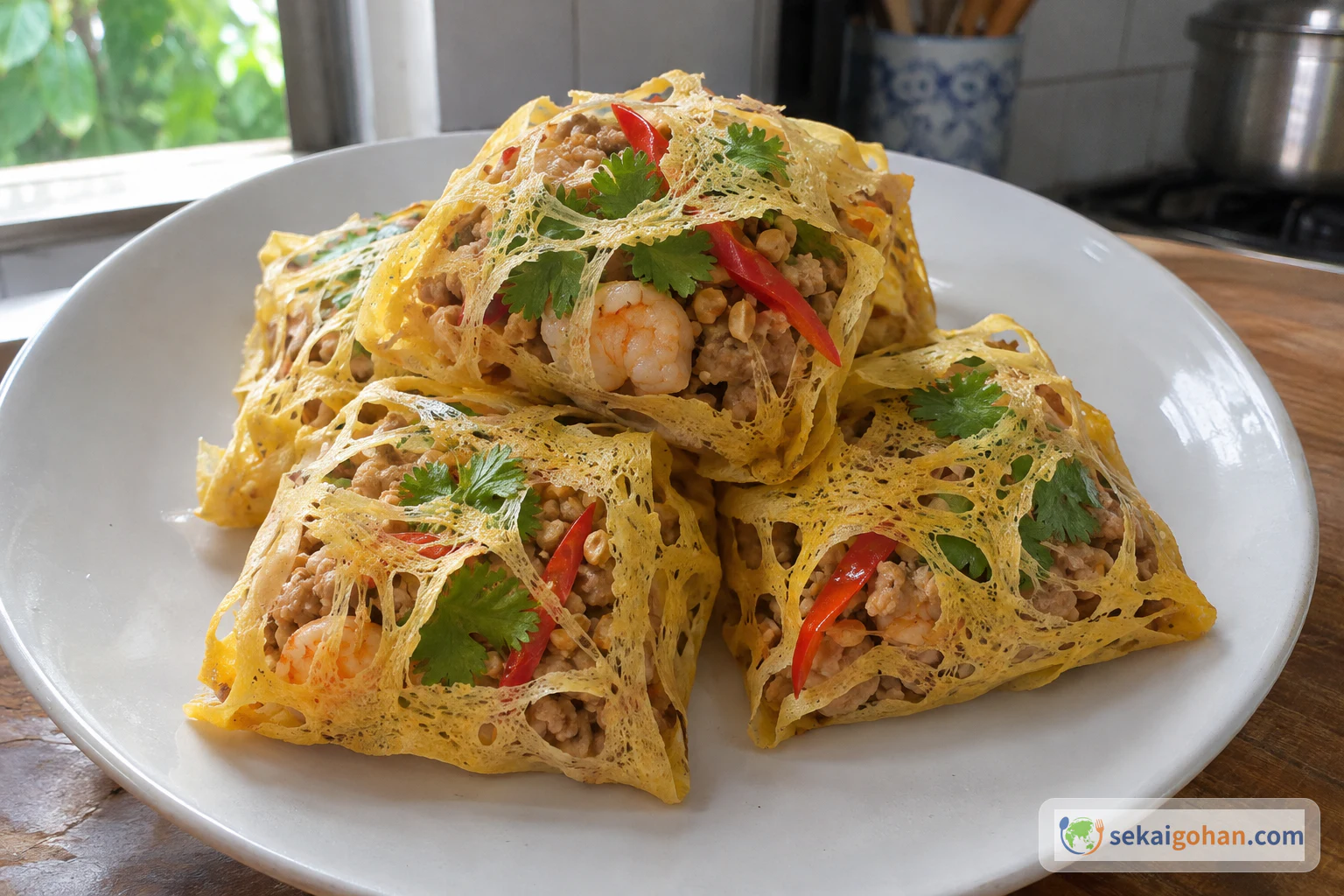
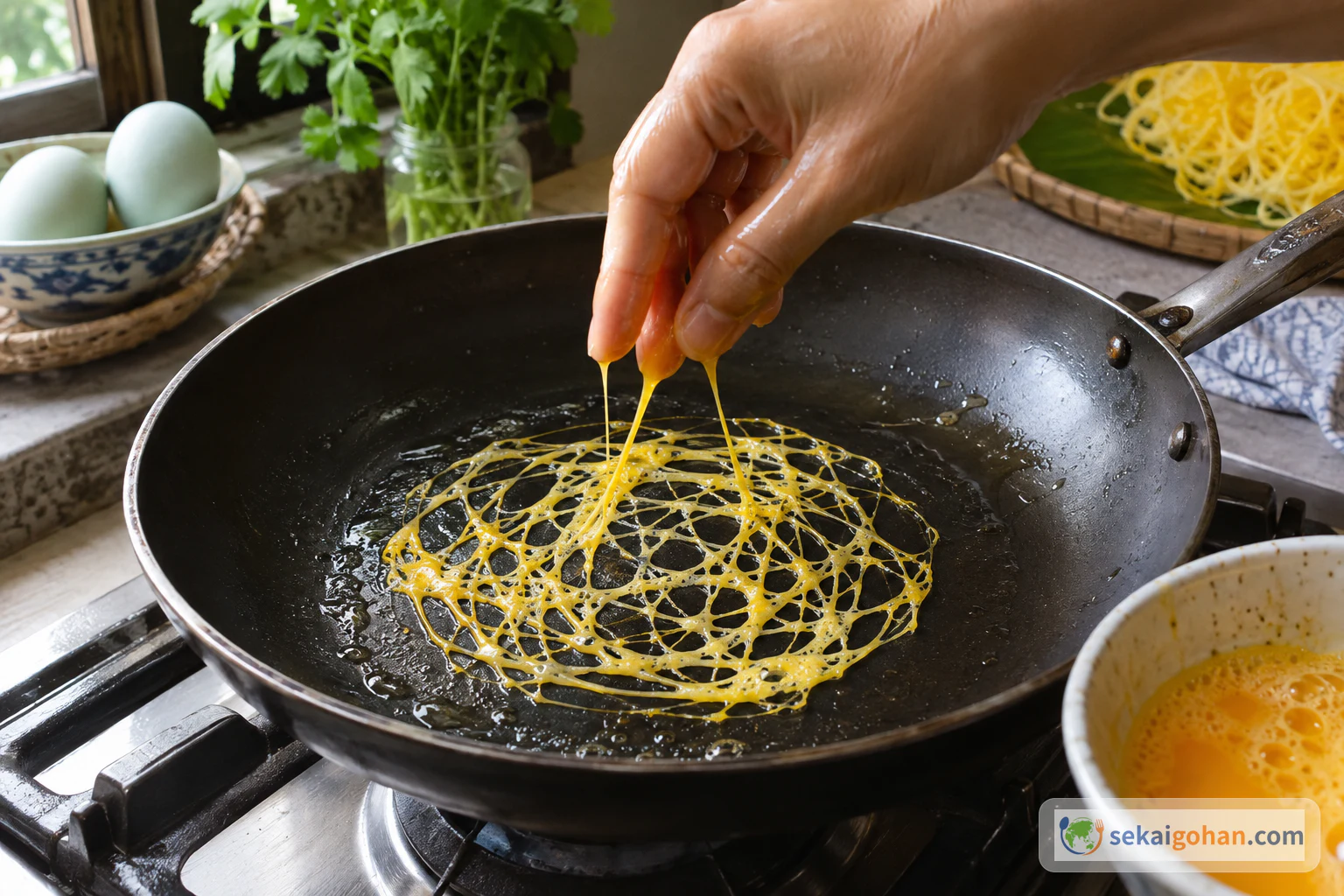
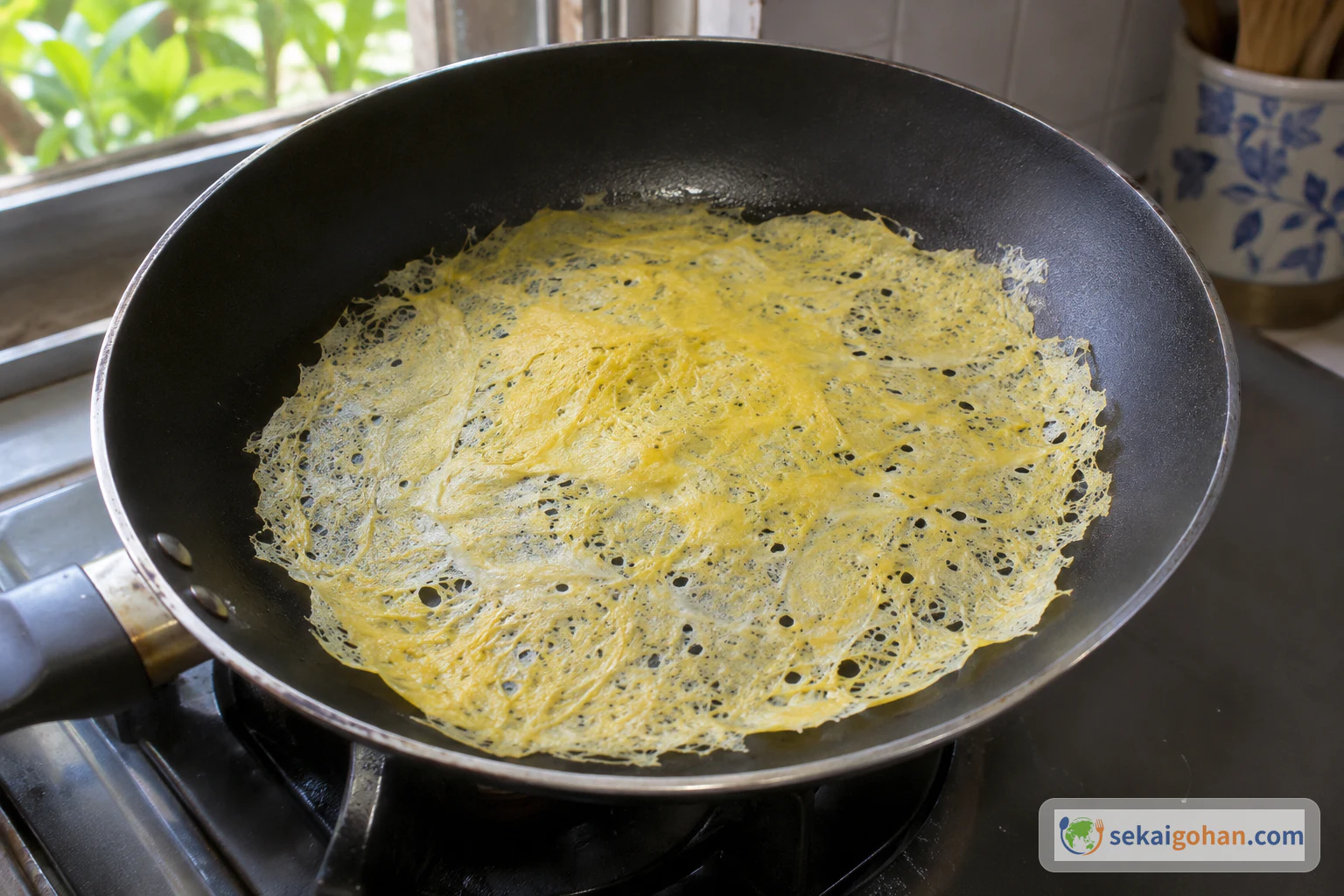
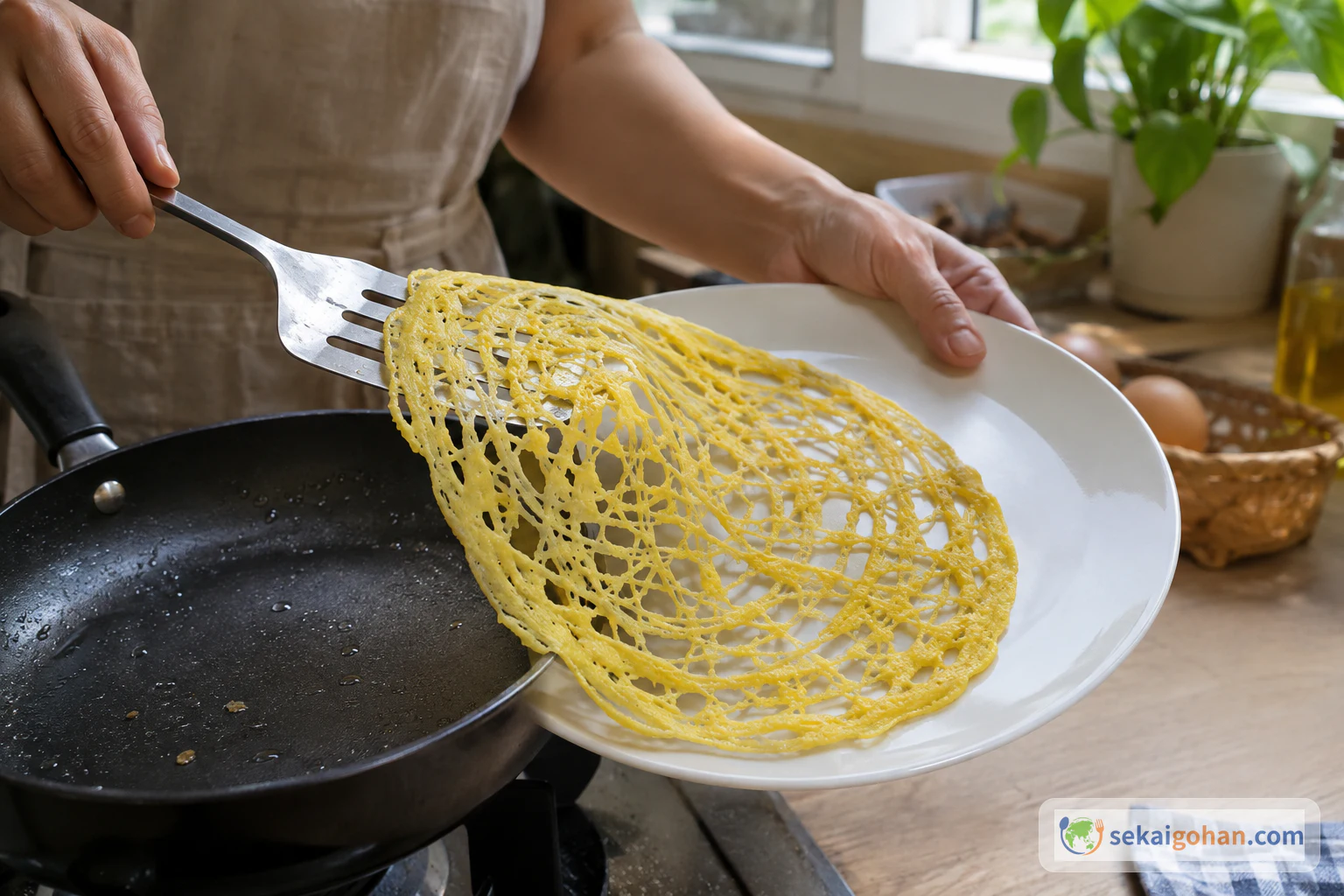
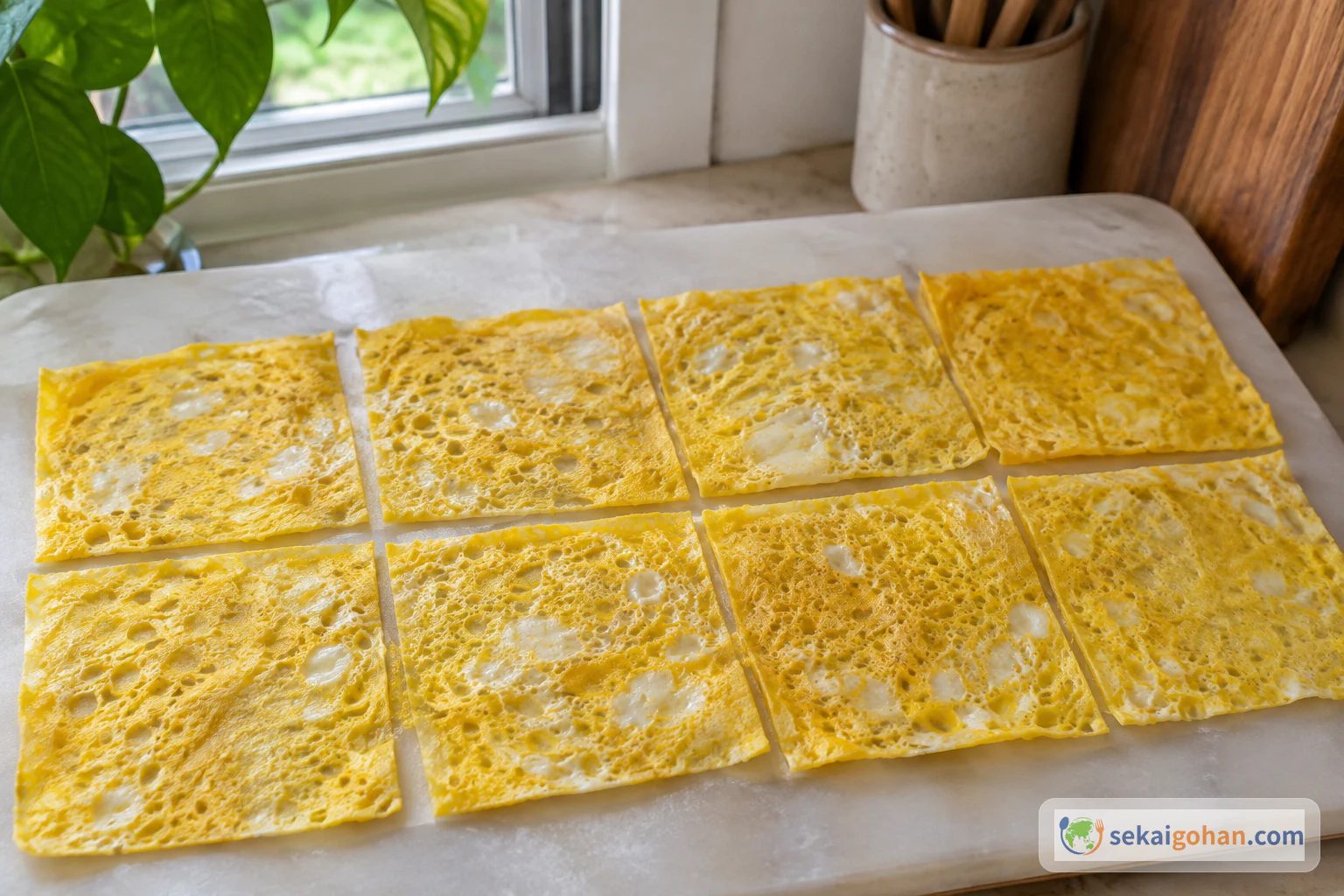
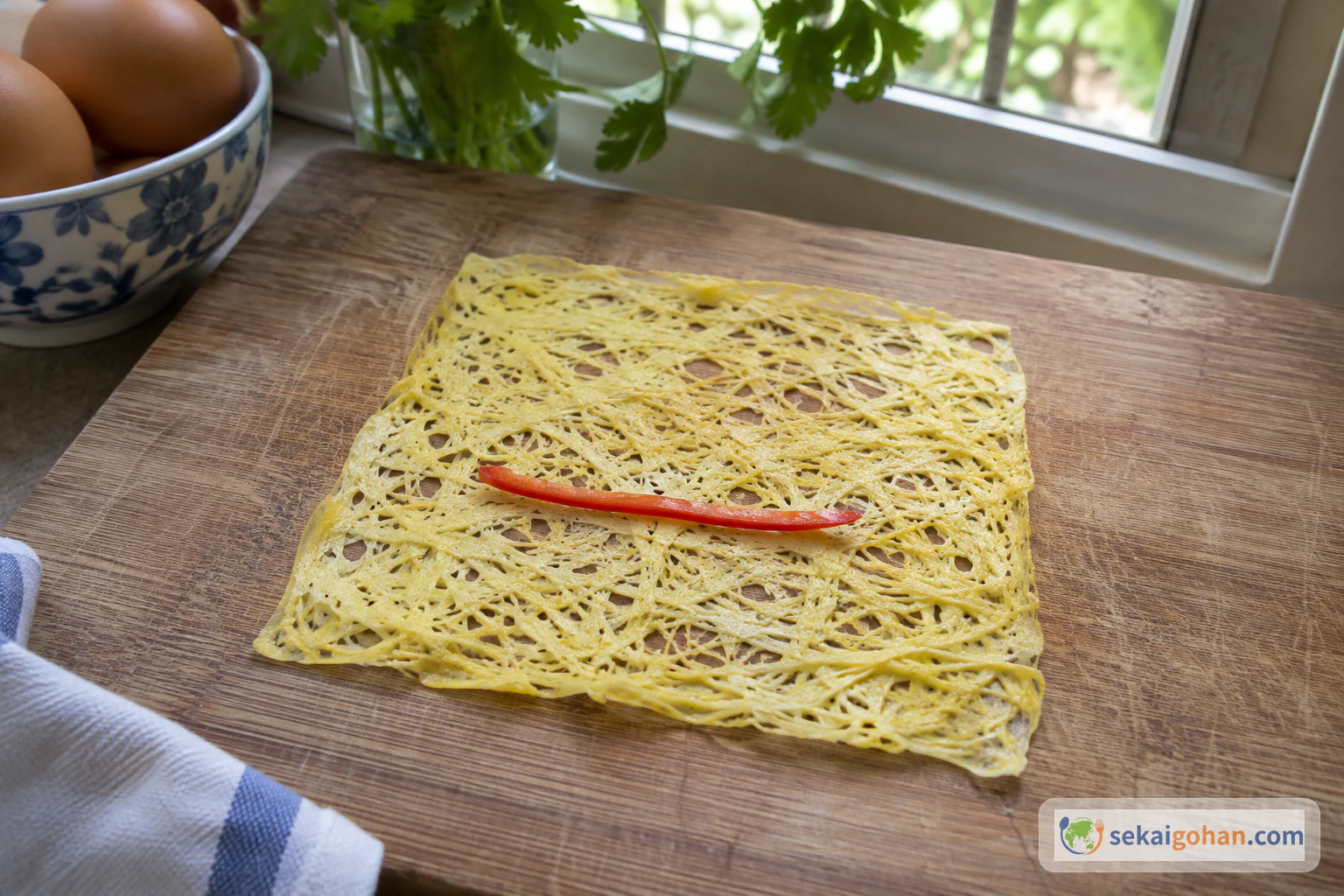
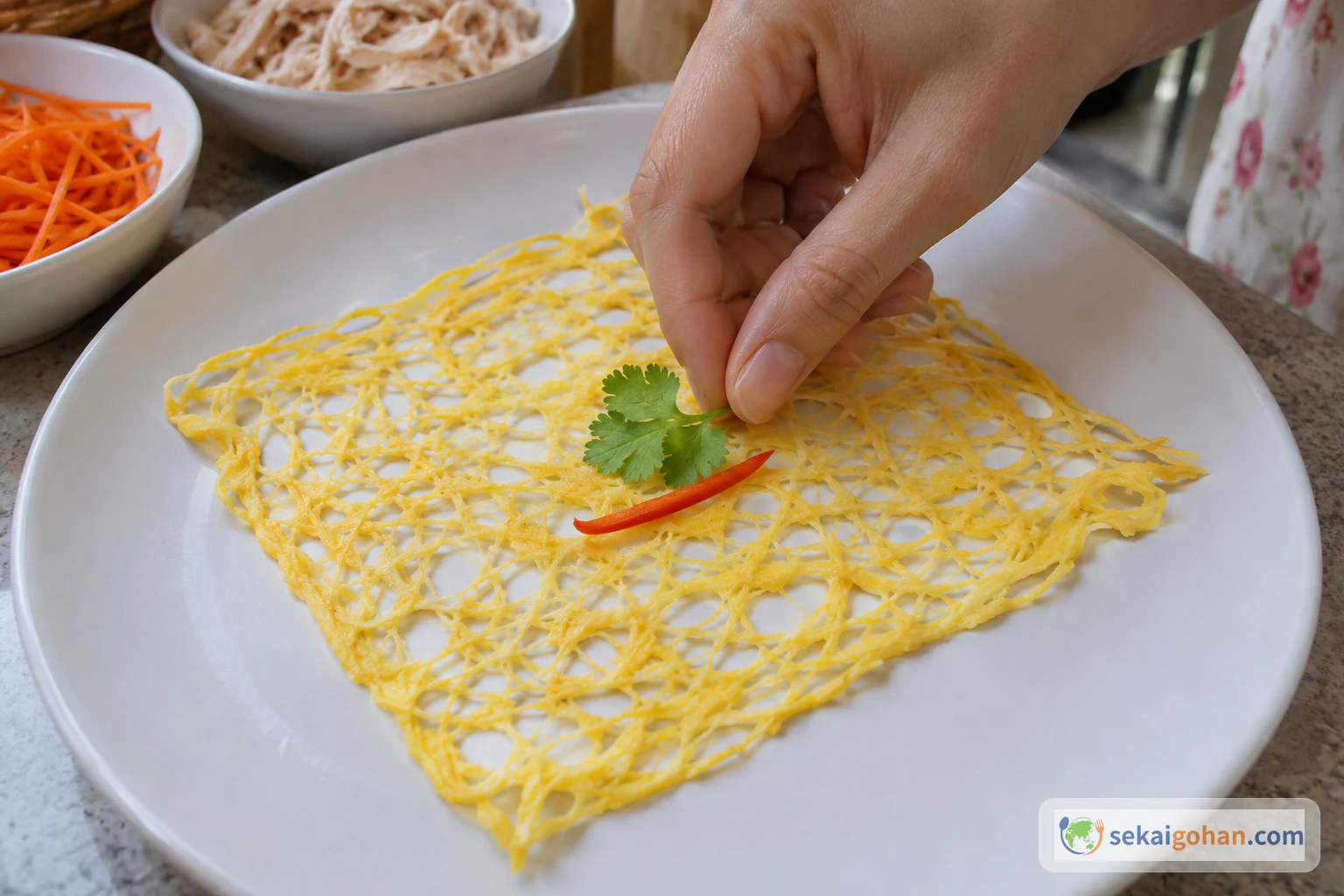
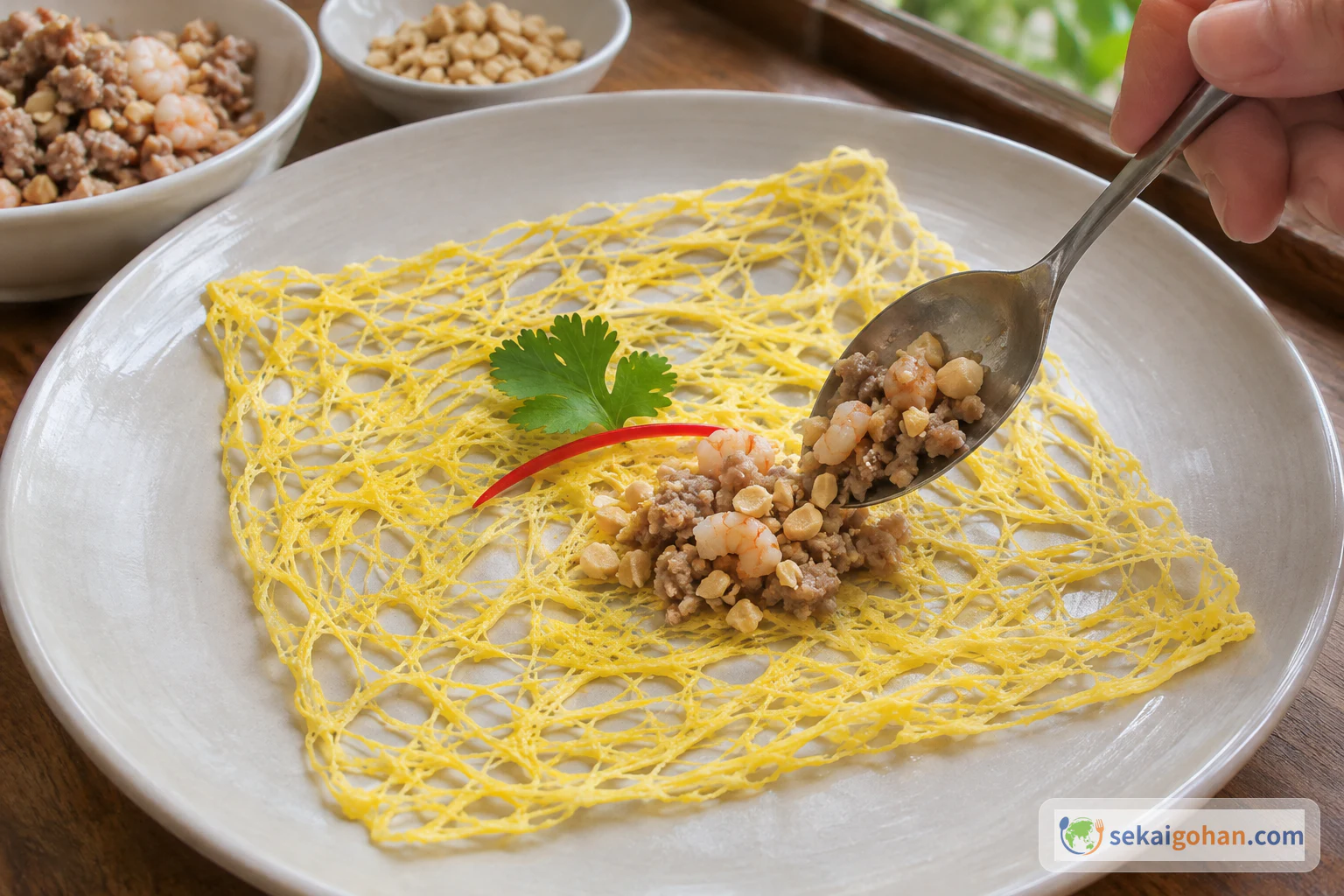
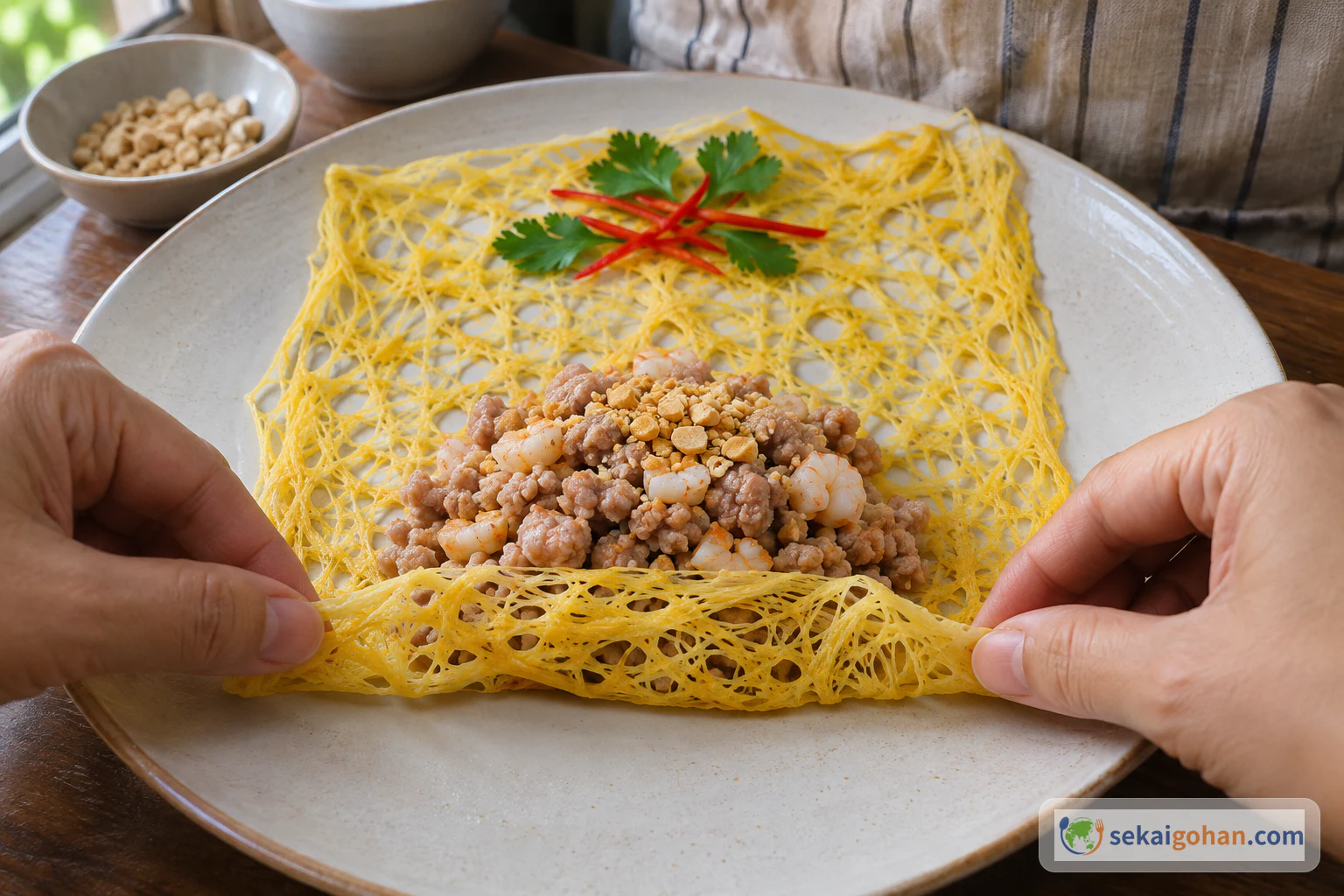
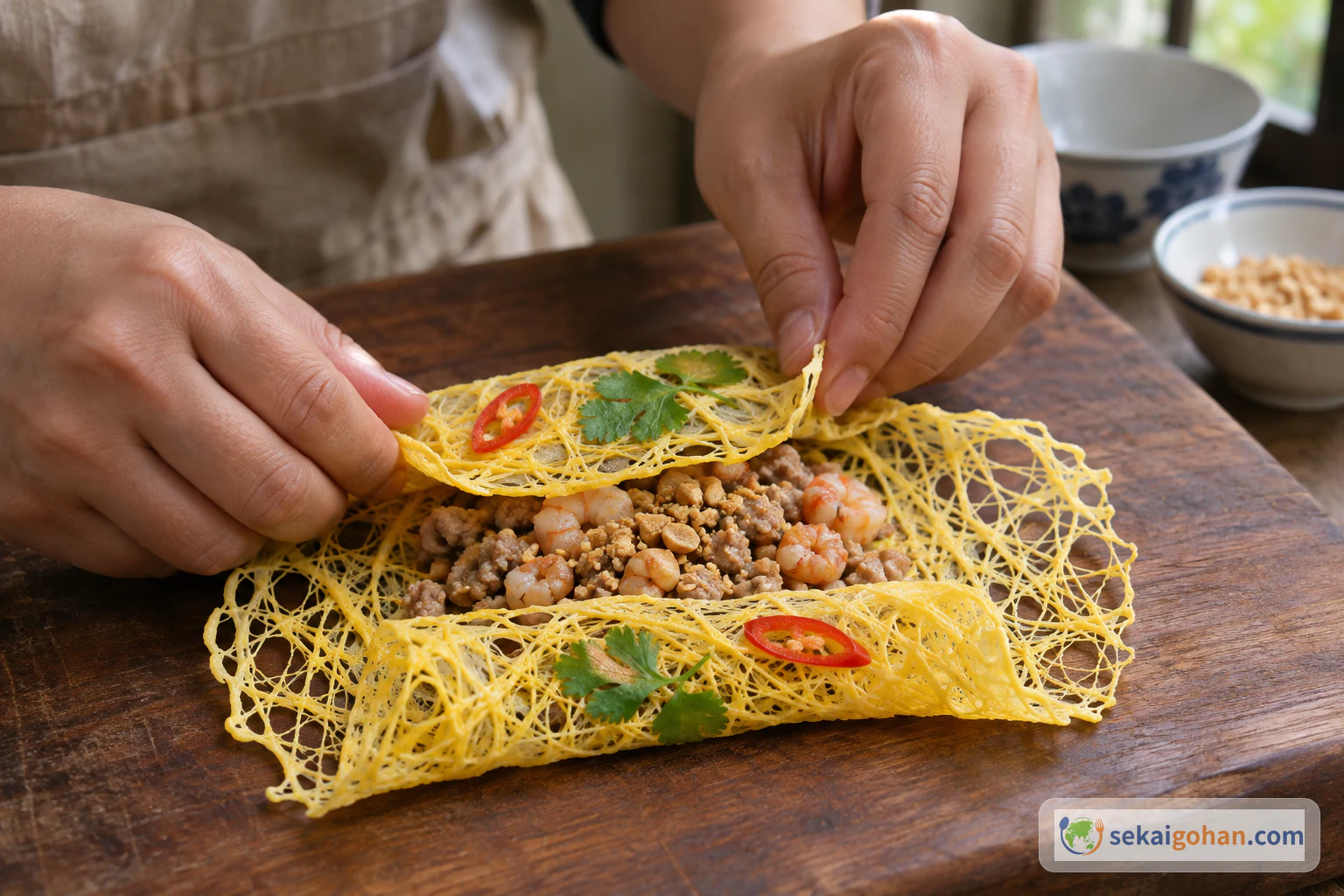
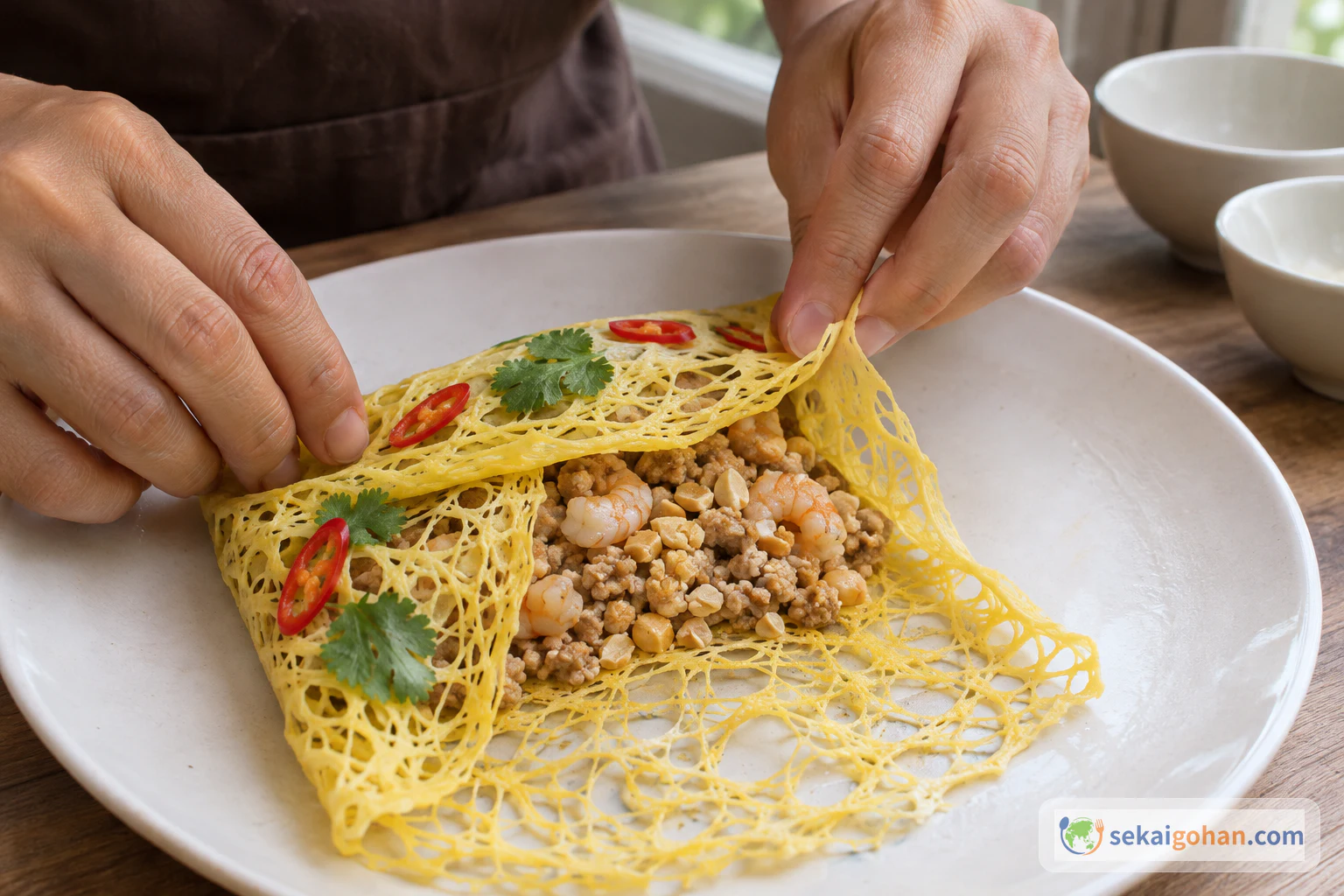
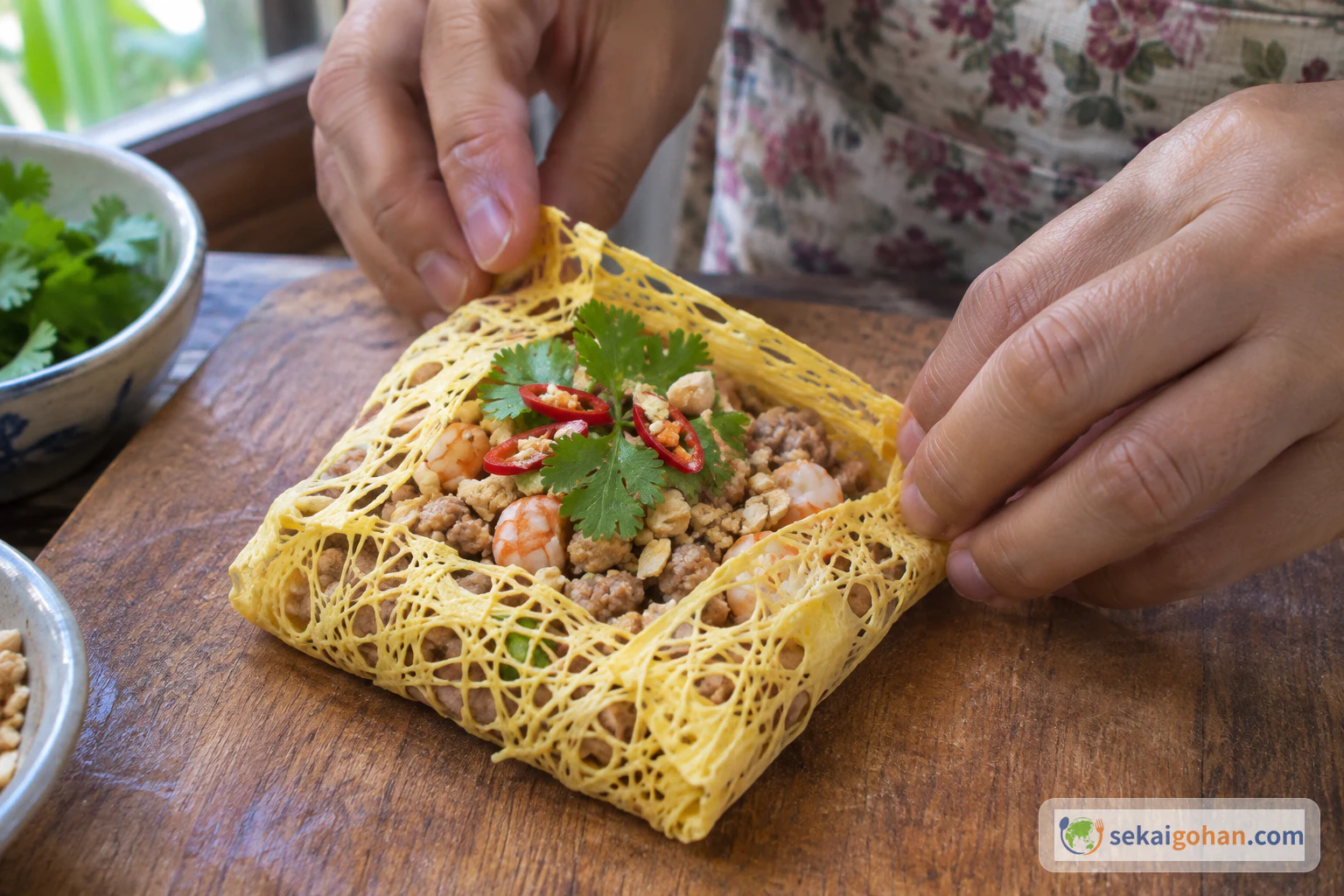
Thin strands of duck egg form a lattice, not a solid omelette. Red chili and coriander go on the net first, then the filling, and the edges fold over into a rough square.
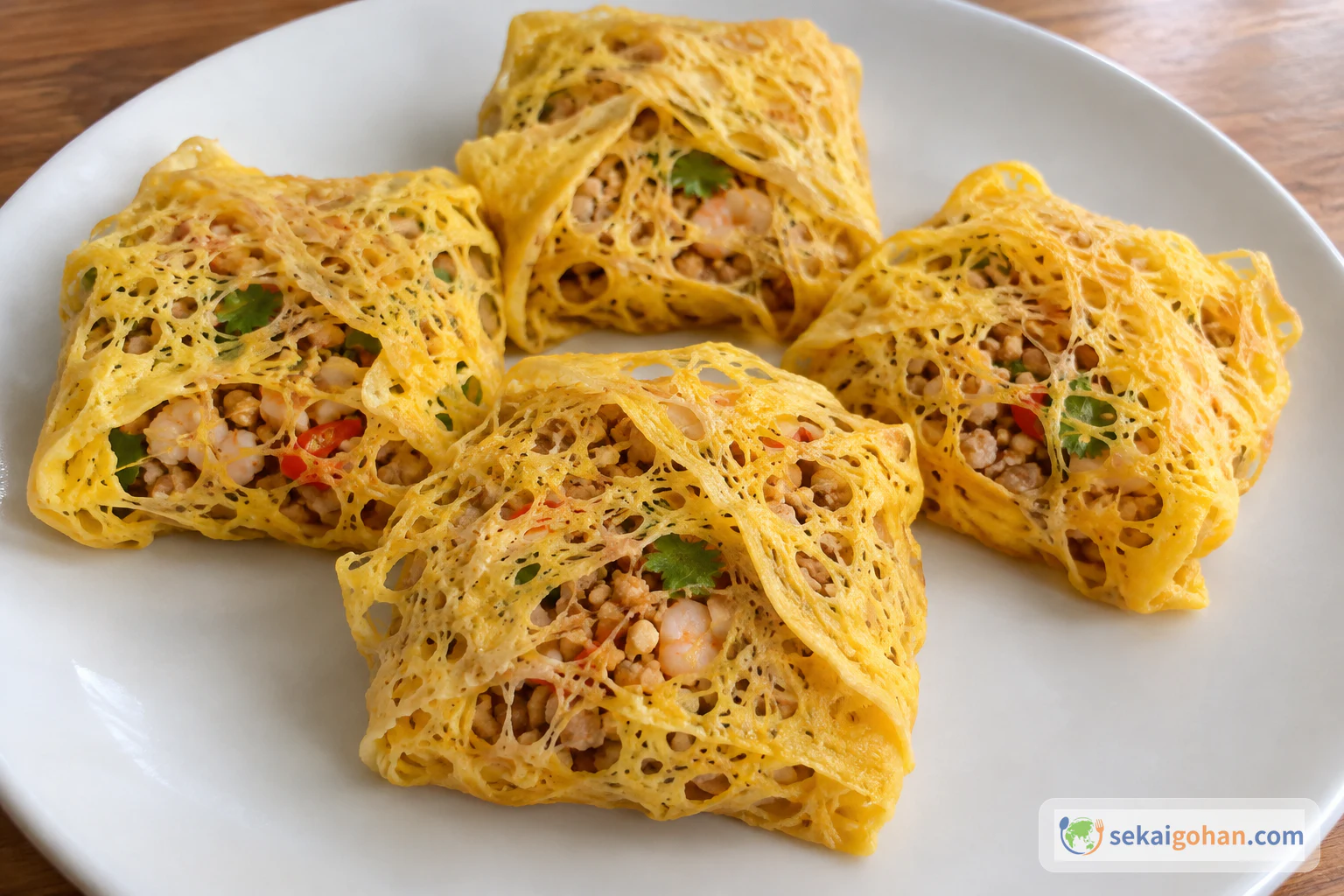
In the finished photo from the Wongnai contributor Nickktwf, la tiang (ล่าเตียง) is a small square parcel with the filling and garnish showing through the gaps in its egg net. A fine lattice of duck egg holds cooked pork, chopped shrimp and crushed roasted peanuts, with raw red chili and coriander tucked against the filling.
This article follows one recipe: the version Nickktwf posted on the Thai food site Wongnai in 2019. The post lists ten ingredients, four instructions, a yield of 30 pieces, 10 minutes of preparation and 50 minutes of cooking. Those yield and time figures are the post's own. They have not been measured here, so treat them as a rough idea rather than a promise.
This recipe has not been kitchen-tested by Sekai Gohan. It is written from the post and from public food-safety advice. For more dishes from the same country, see Thai cooking on Sekai Gohan.
What comes from the post, and what has been added
| Part of the recipe | Where it comes from |
|---|---|
| The ten ingredients and their amounts | Nickktwf's post, unchanged |
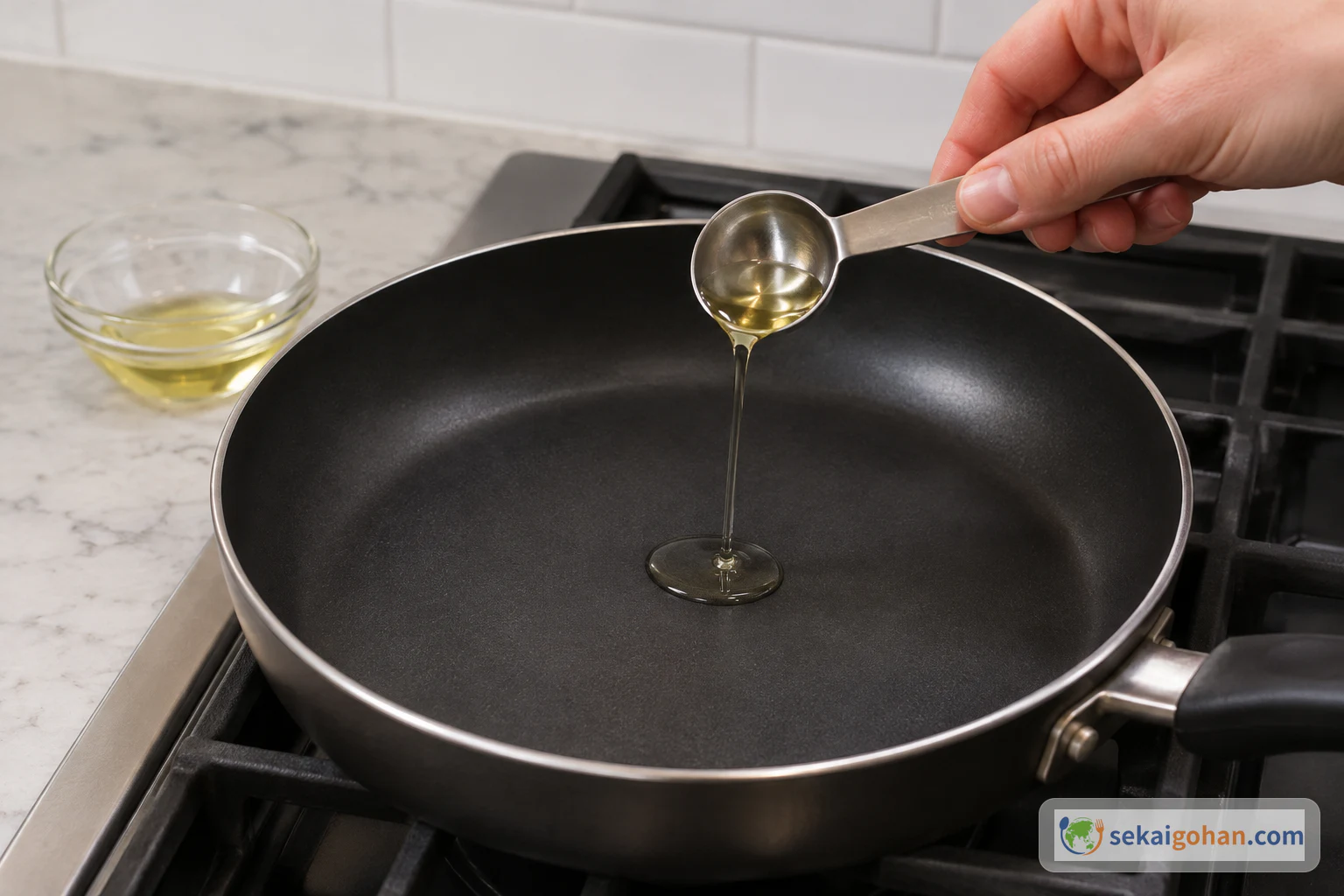
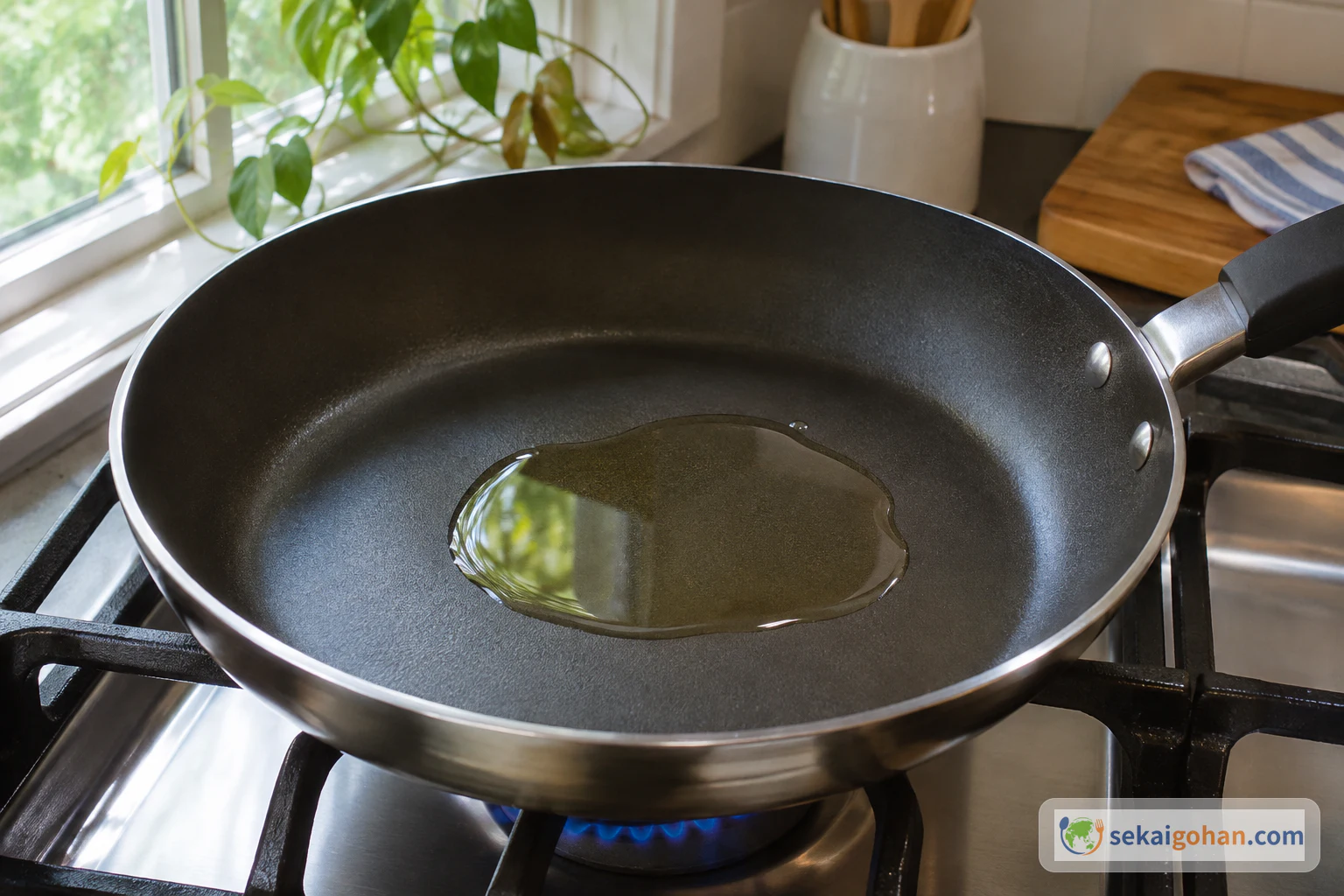
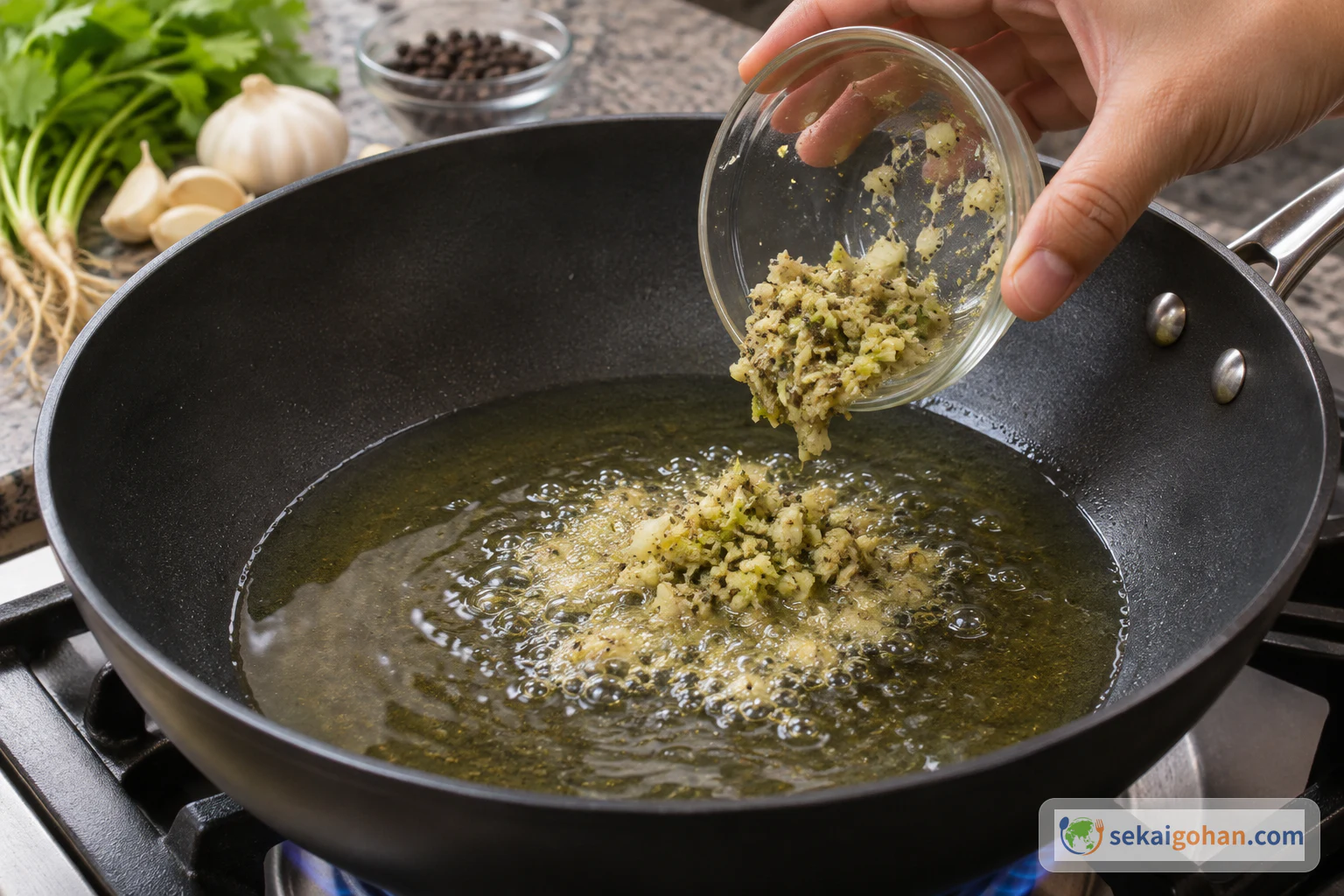
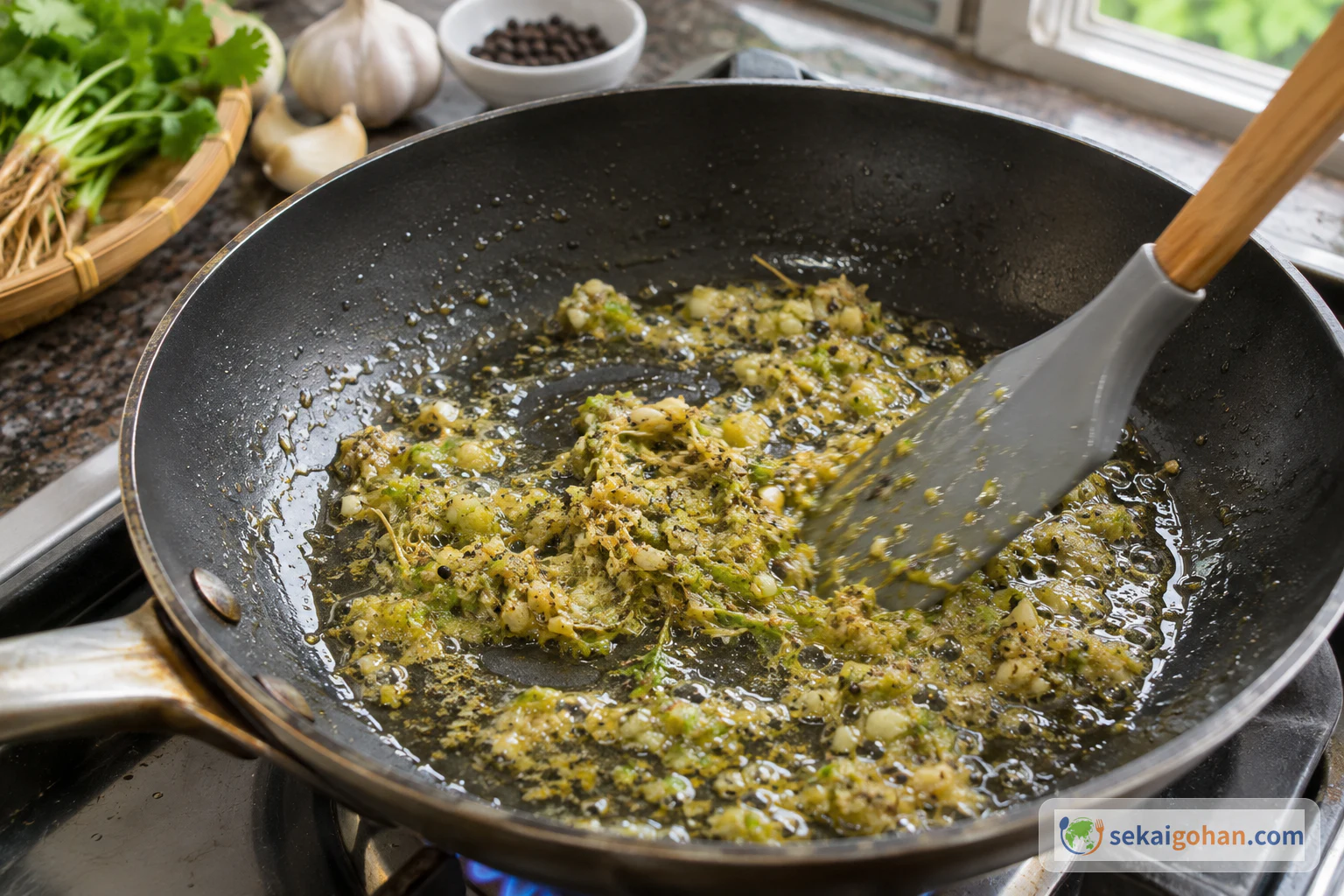
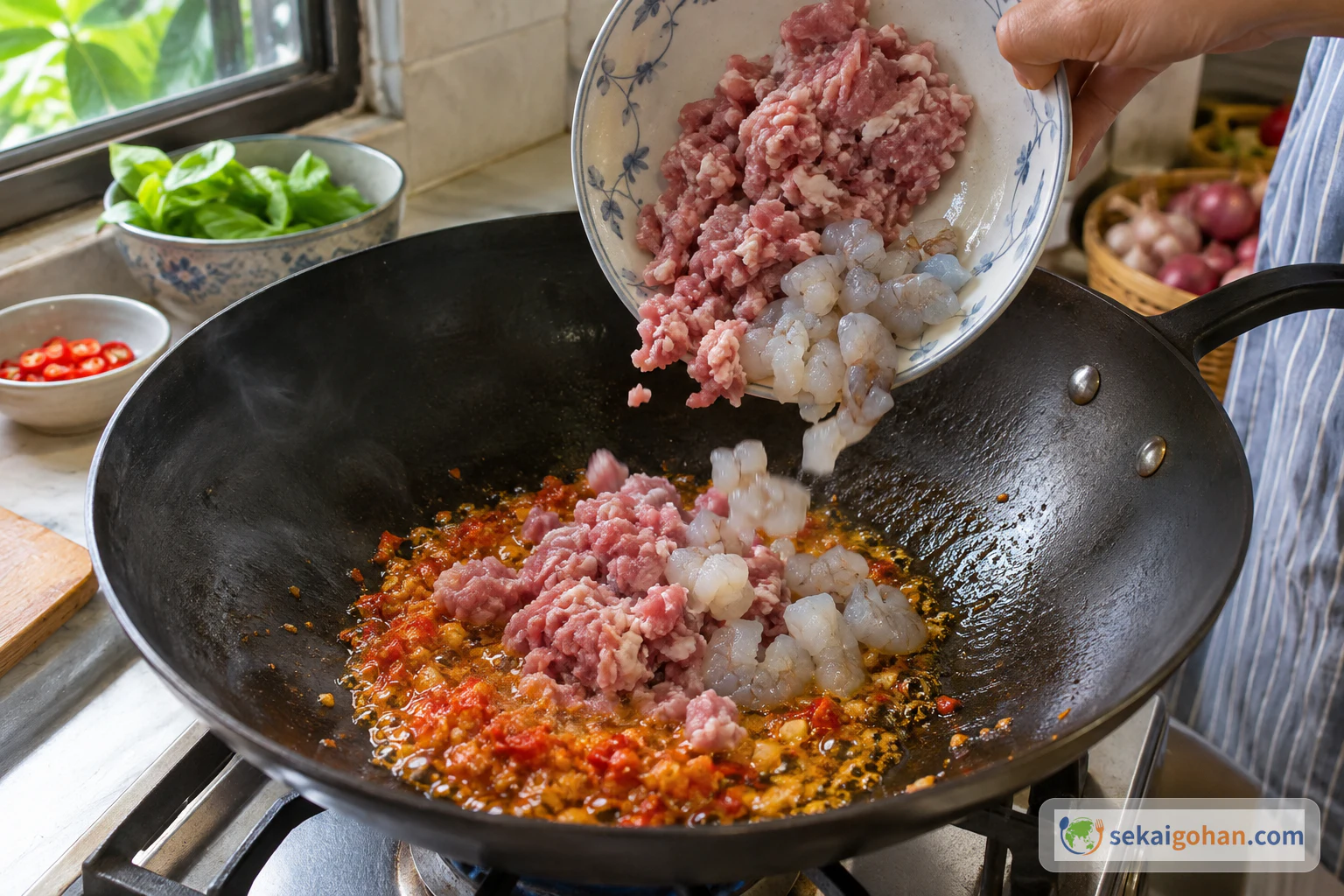
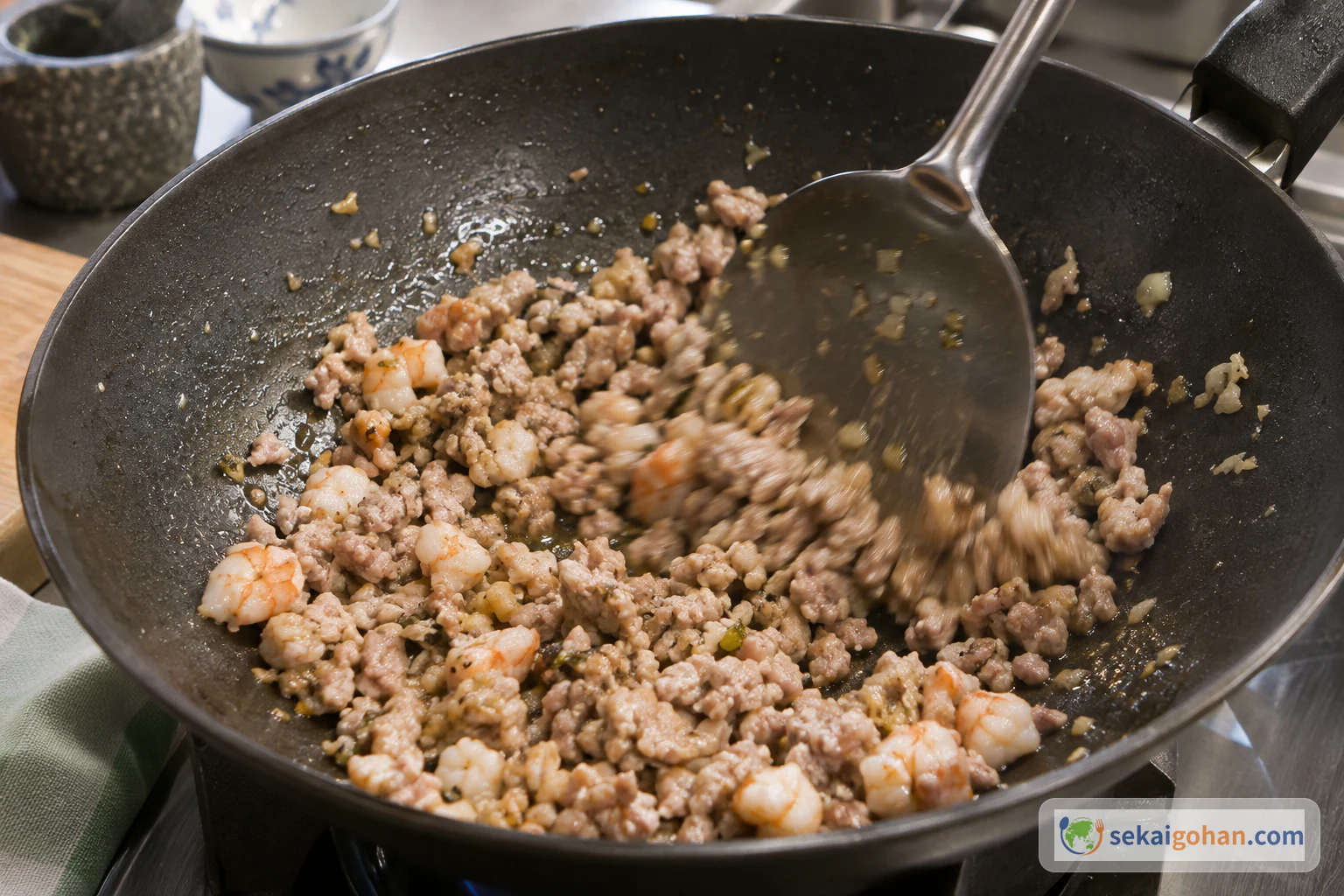
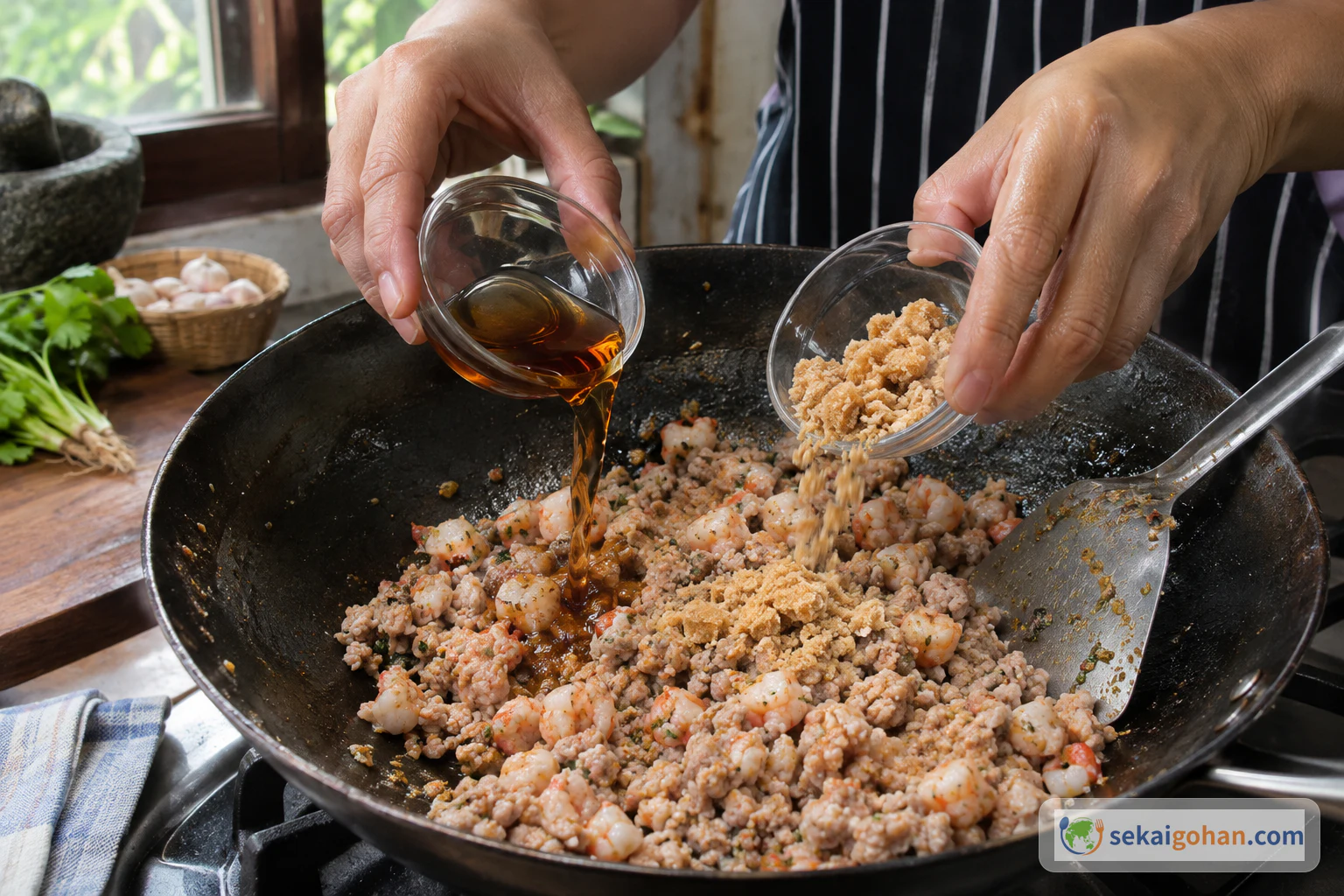
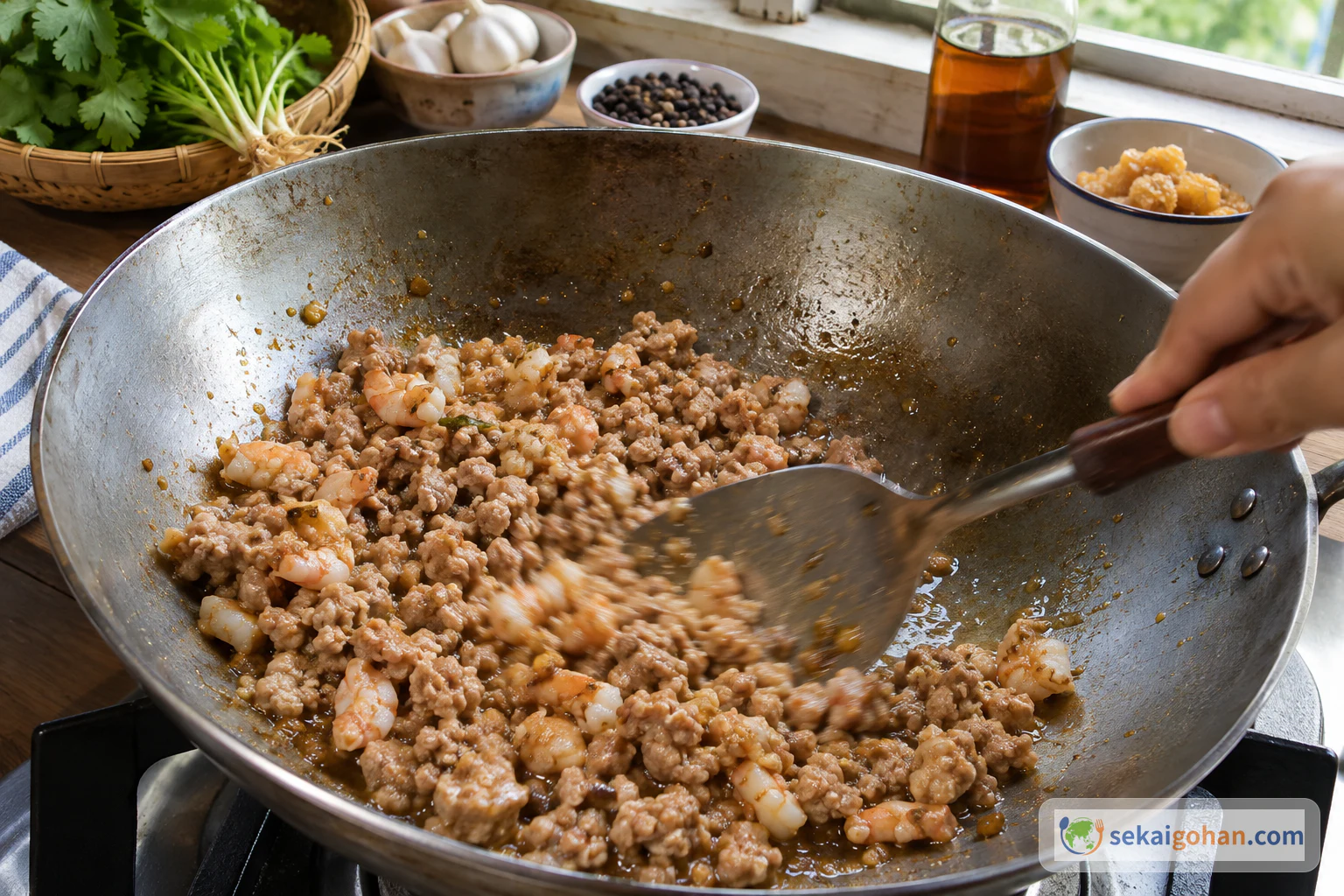
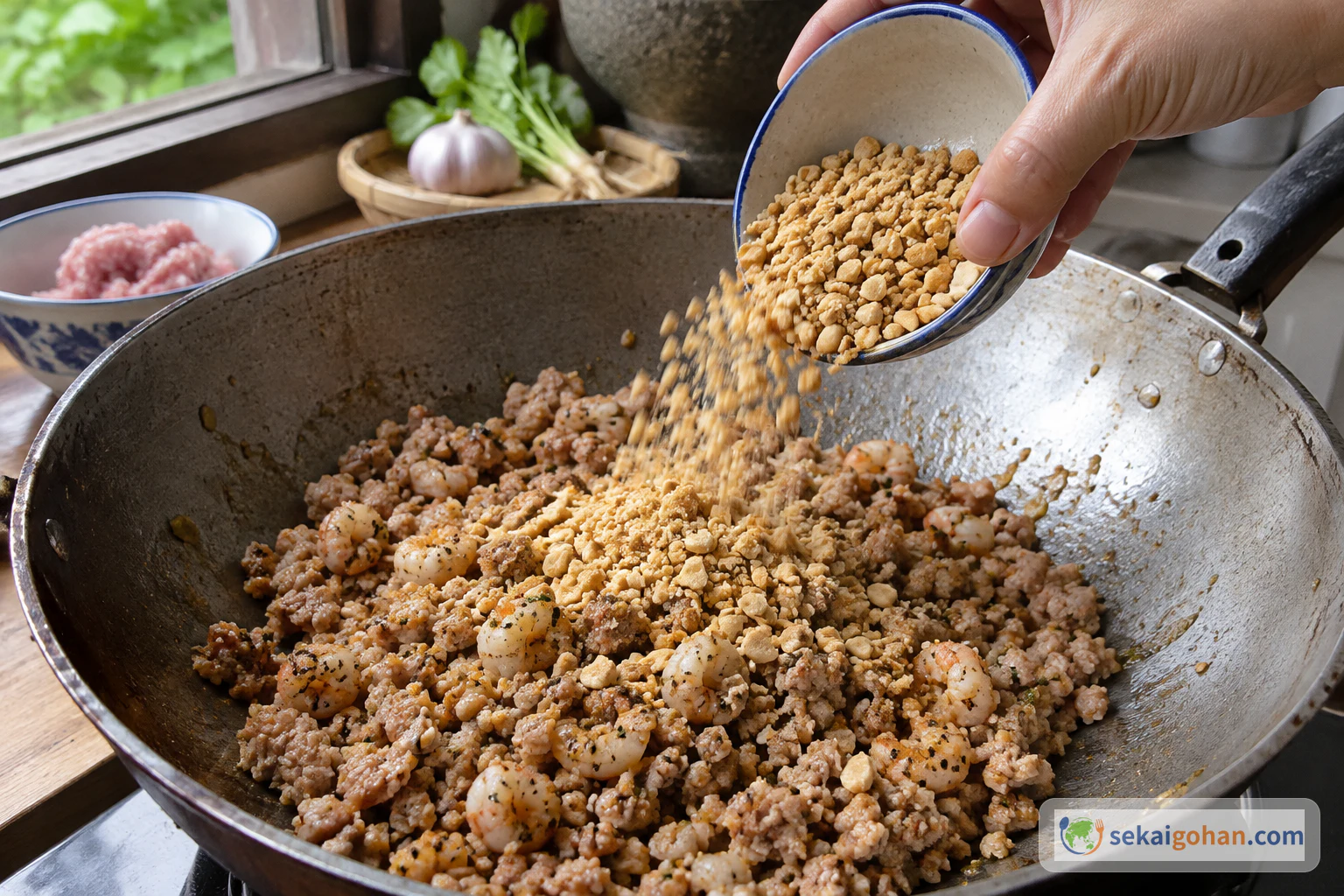
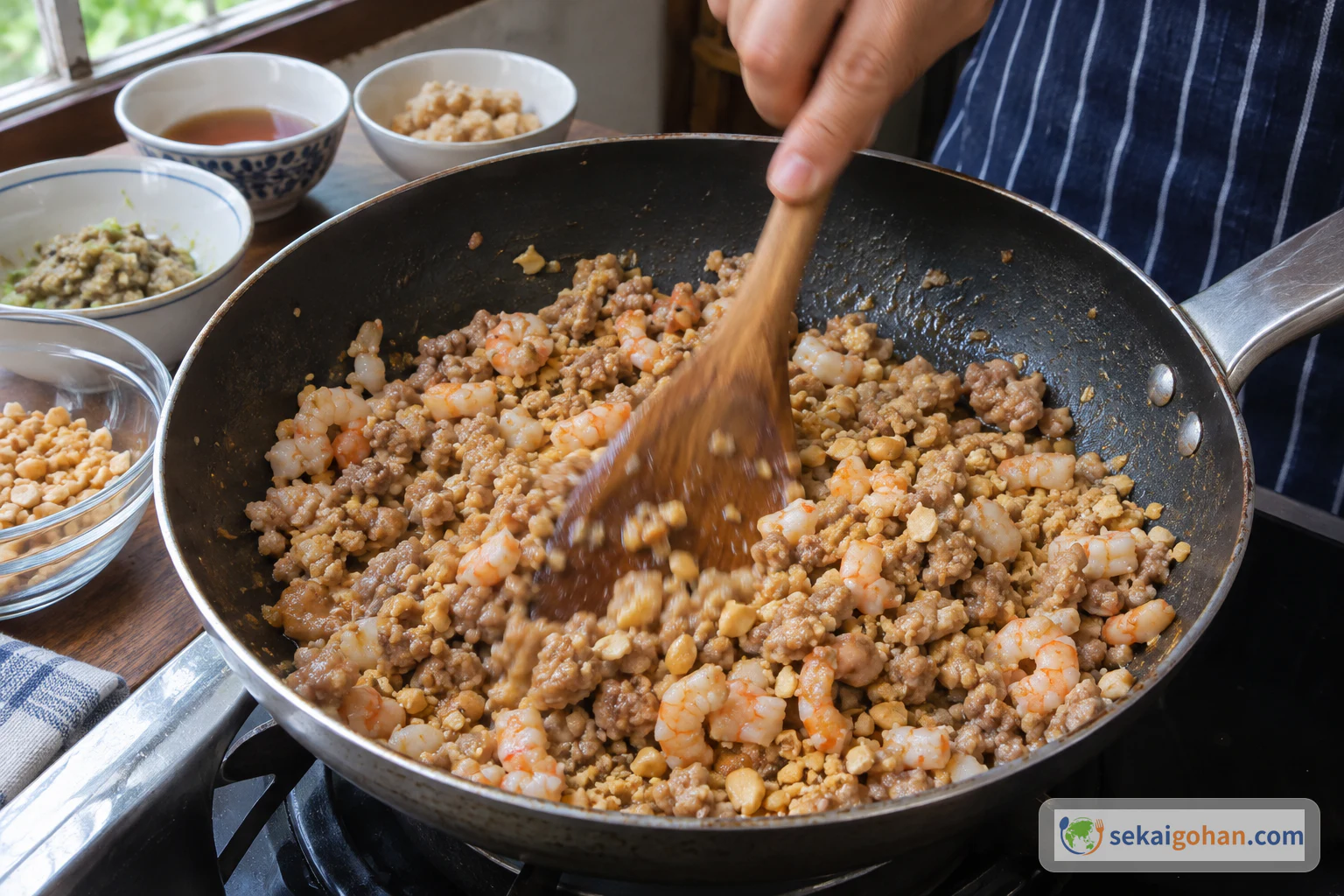
| Frying oil and paste, then pork and shrimp, seasoning and peanuts | Nickktwf's post |
| Low heat, a lightly oiled pan and 4–5 inch egg nets | Nickktwf's post |
| Adding chili and coriander, then wrapping in squares | Nickktwf's post |
| Placing the filling in the center of the net | Added here. The post's wording moves from garnish to wrapping without this action |
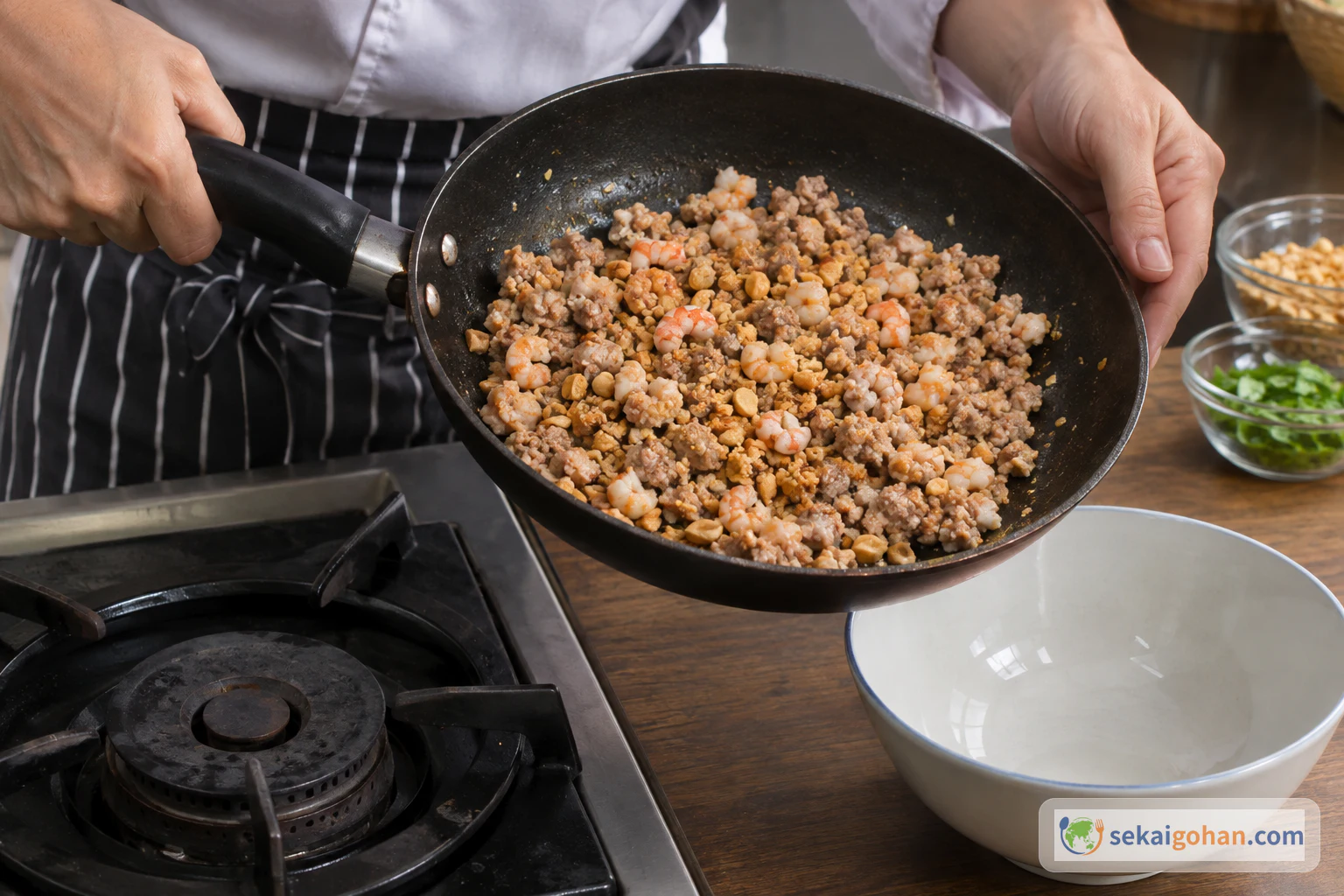
| Cooling the filling while the nets cook | Added here to separate the work. The post gives no cooling instruction |
| Washing, separate boards, hand hygiene and refrigeration | Added from public food-safety advice |
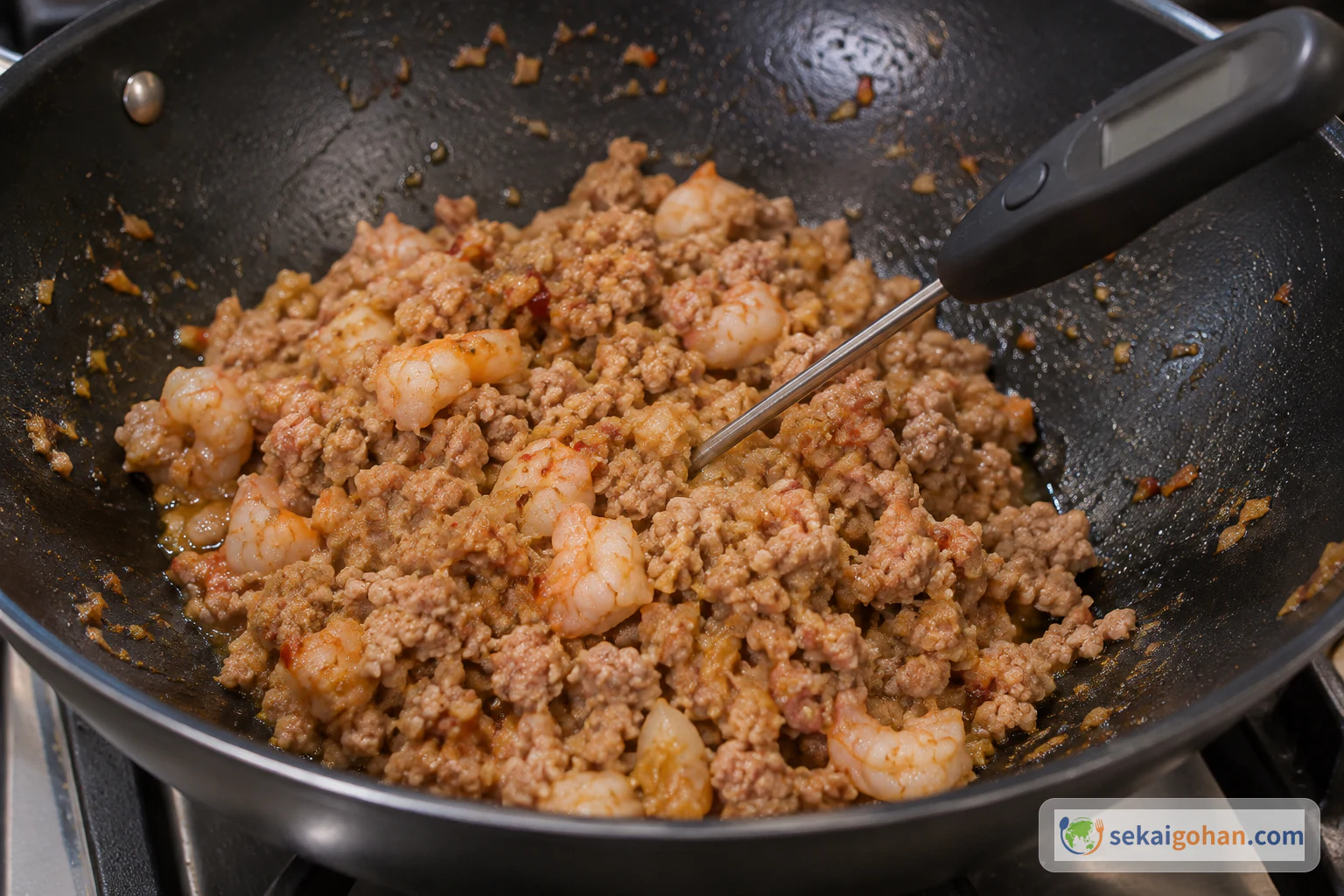
| Cooking the filling to 75°C at the center for 1 minute or more | Added from Japan's Ministry of Health, Labour and Welfare. The post gives no temperature |
| Cooking the egg until white and yolk are both firm | Added from the Food Safety Authority of Ireland's duck-egg advice, which the US FDA and CDC match for eggs in general |
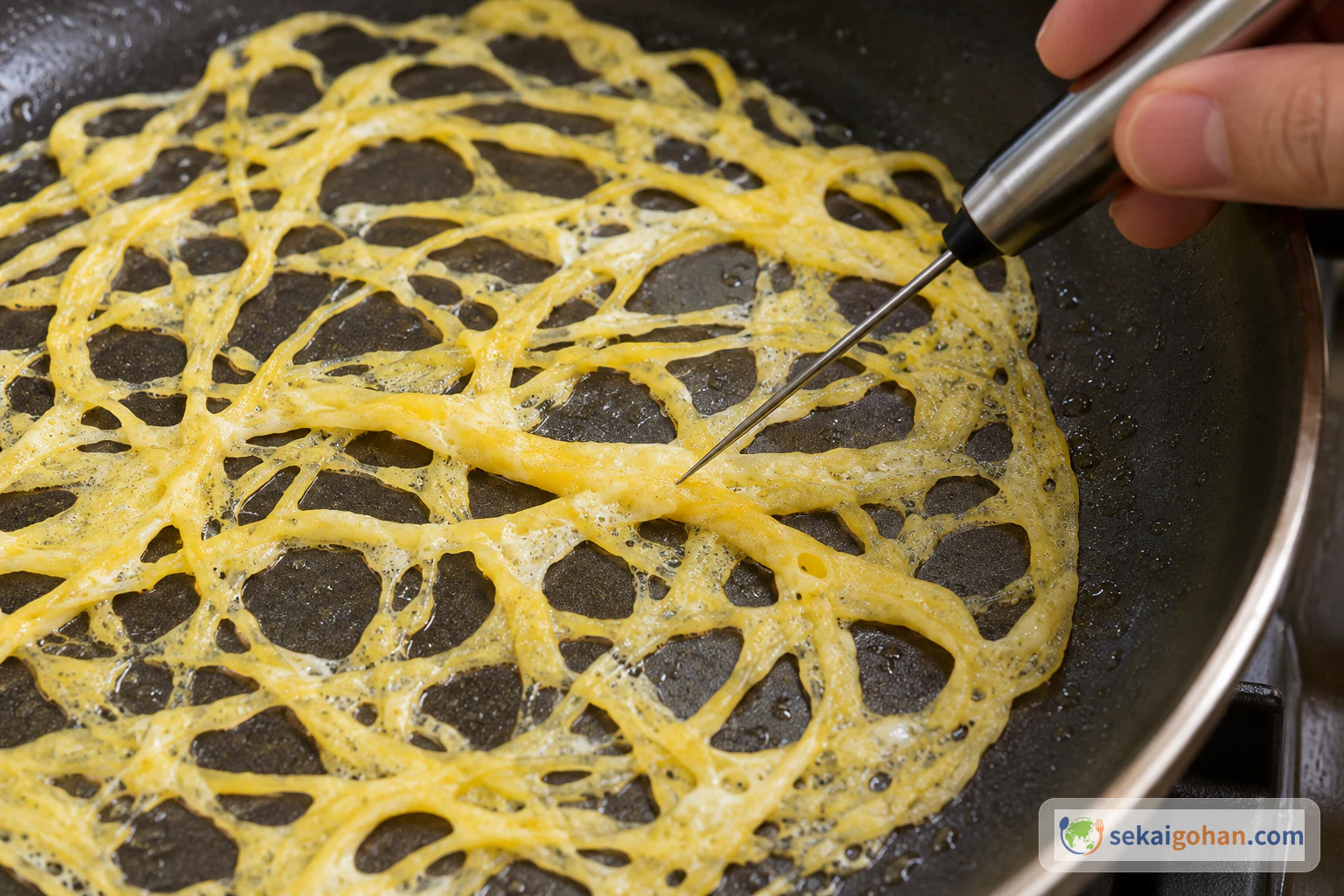
| Touching a fine needle tip to the egg net | Added here as an editorial step. No public guidance describes this check |
Ingredients: Ten Items for the Filling, Nets and Garnish
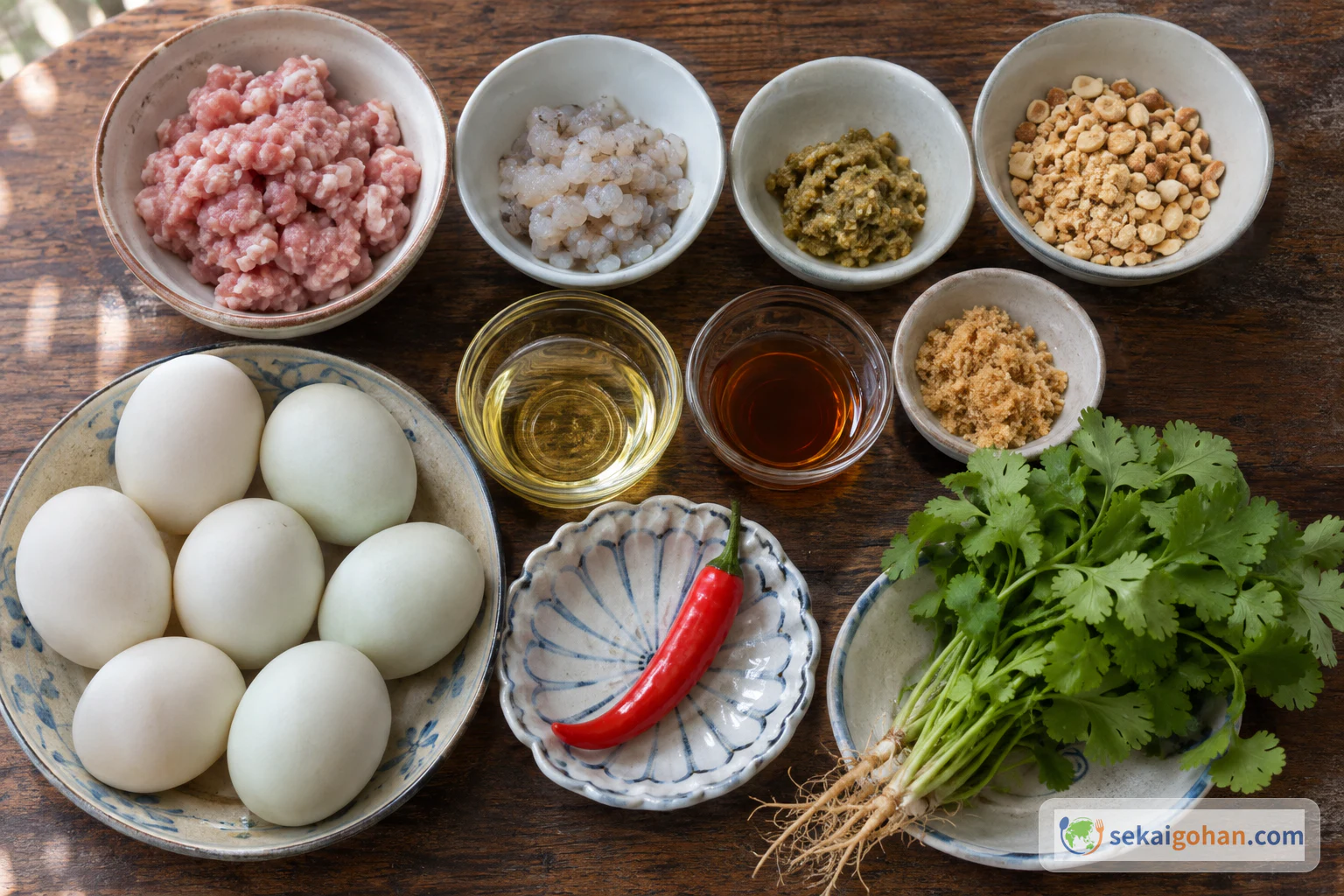
The 1 tbsp of oil covers both pans, so divide it as you go and do not add more. No water, salt, extra sauces or other aromatics go in.
This dish contains peanuts, shrimp, egg and fish (in the fish sauce).
Choosing and Preparing: What Can Be Ready-Made and What Stays
- Aromatic paste: Store-bought is fine. If you make your own from coriander root, garlic and pepper, use 1 tbsp in total. No fixed ratio is given here, so balance it to your taste.
- Peanuts: Ready-roasted peanuts are fine. Crush them coarsely if they are still whole.
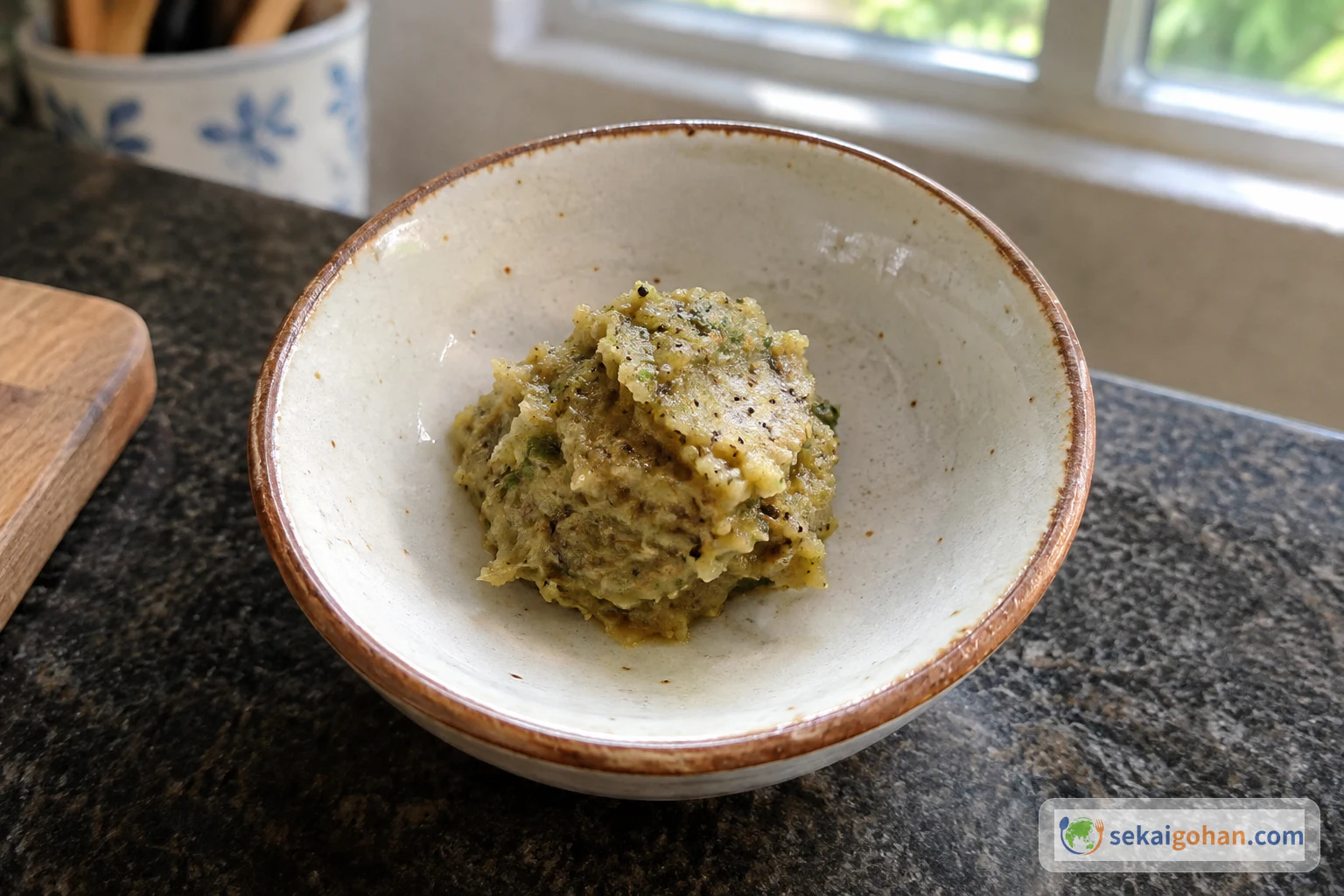
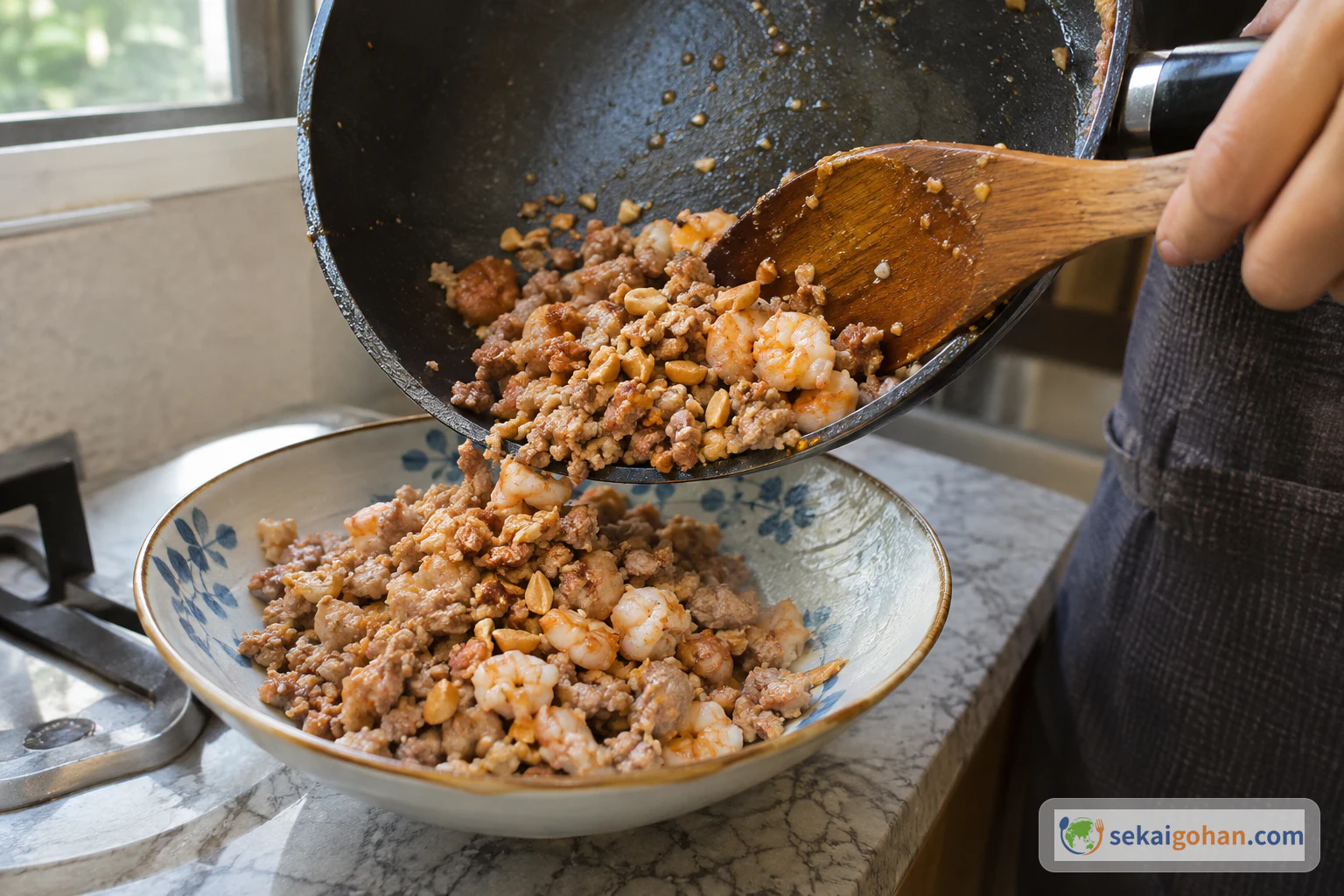
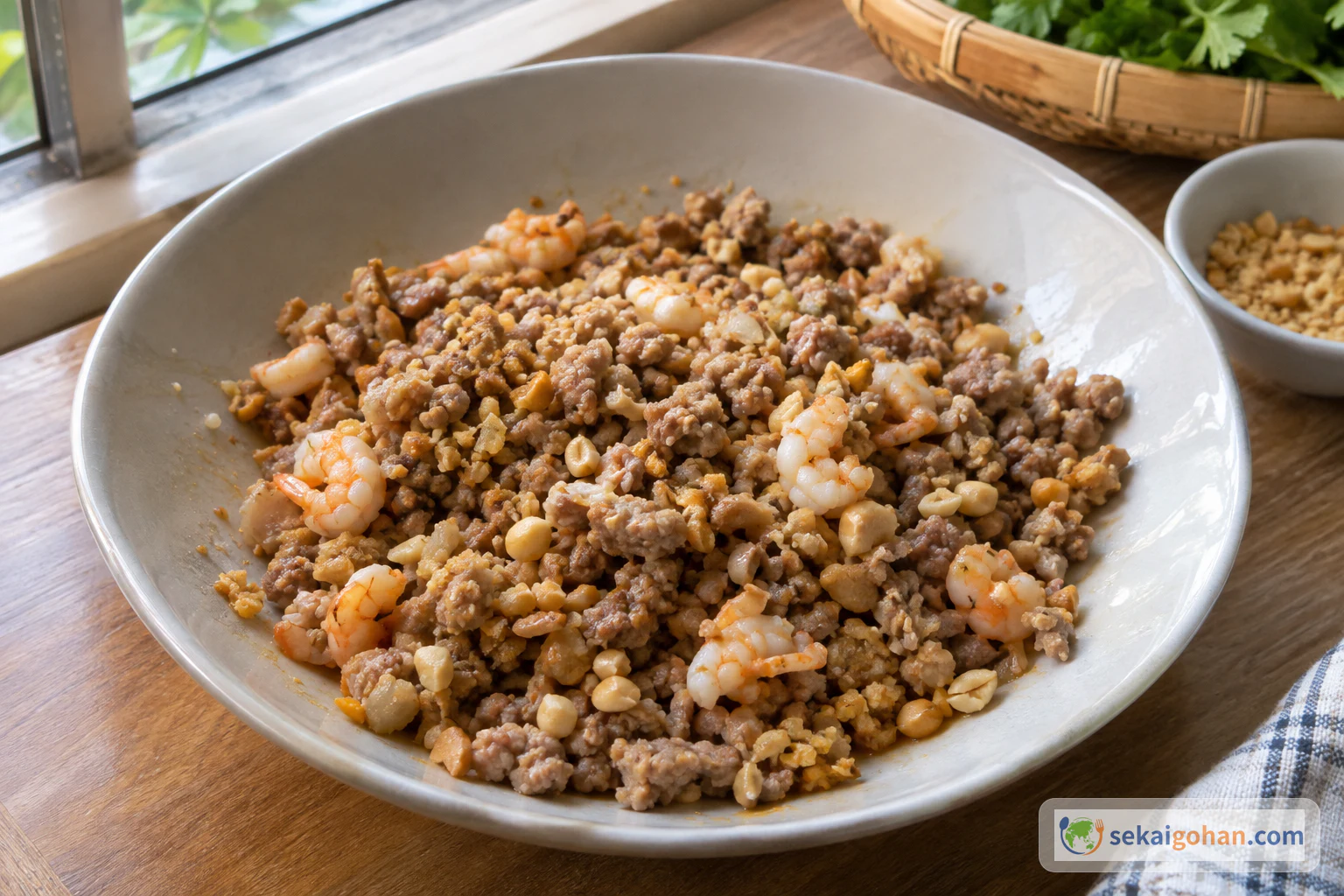
- Pork and shrimp: Start with minced pork and shrimp you have chopped into small pieces. Whole shrimp and strips of pork would change the filling.
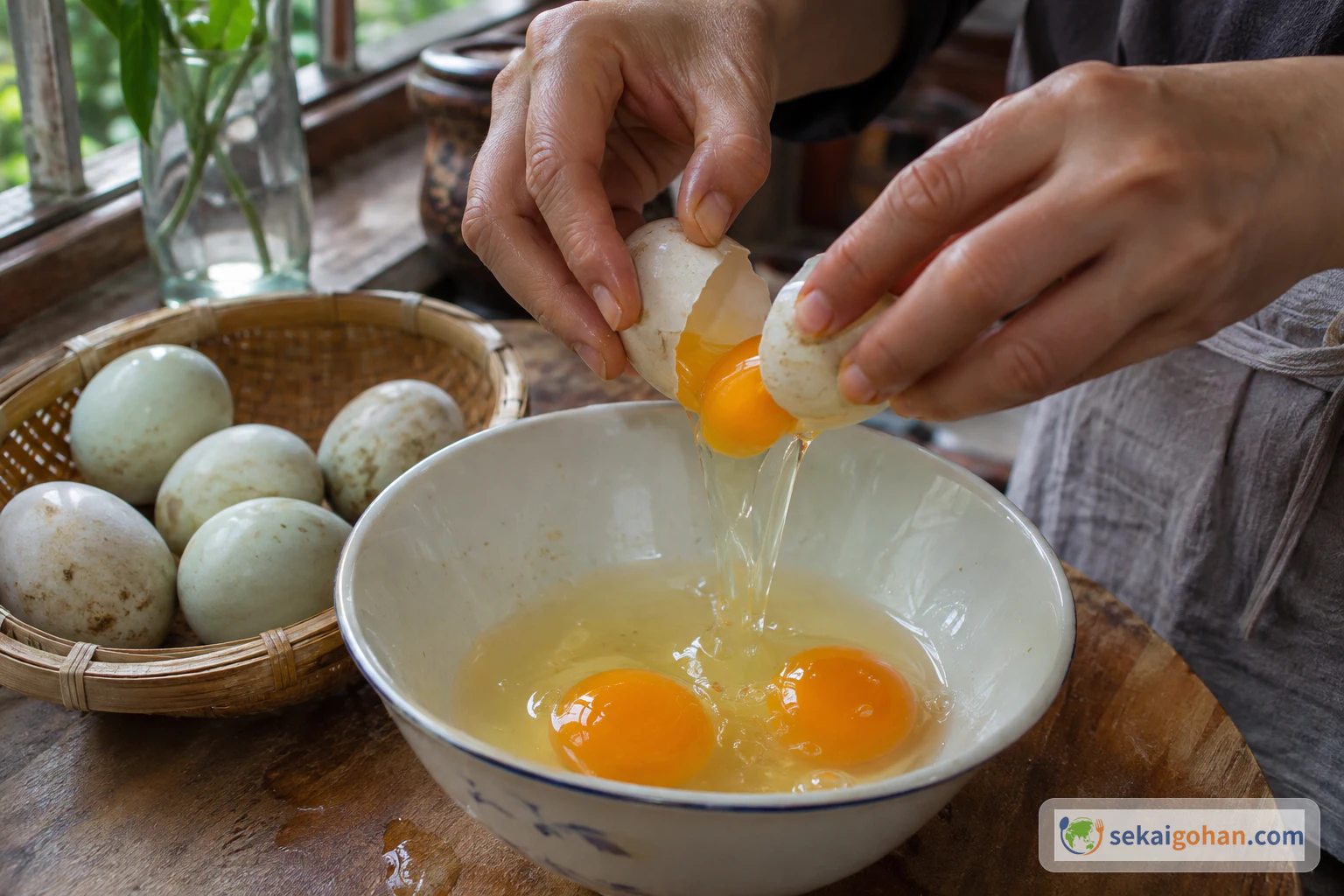
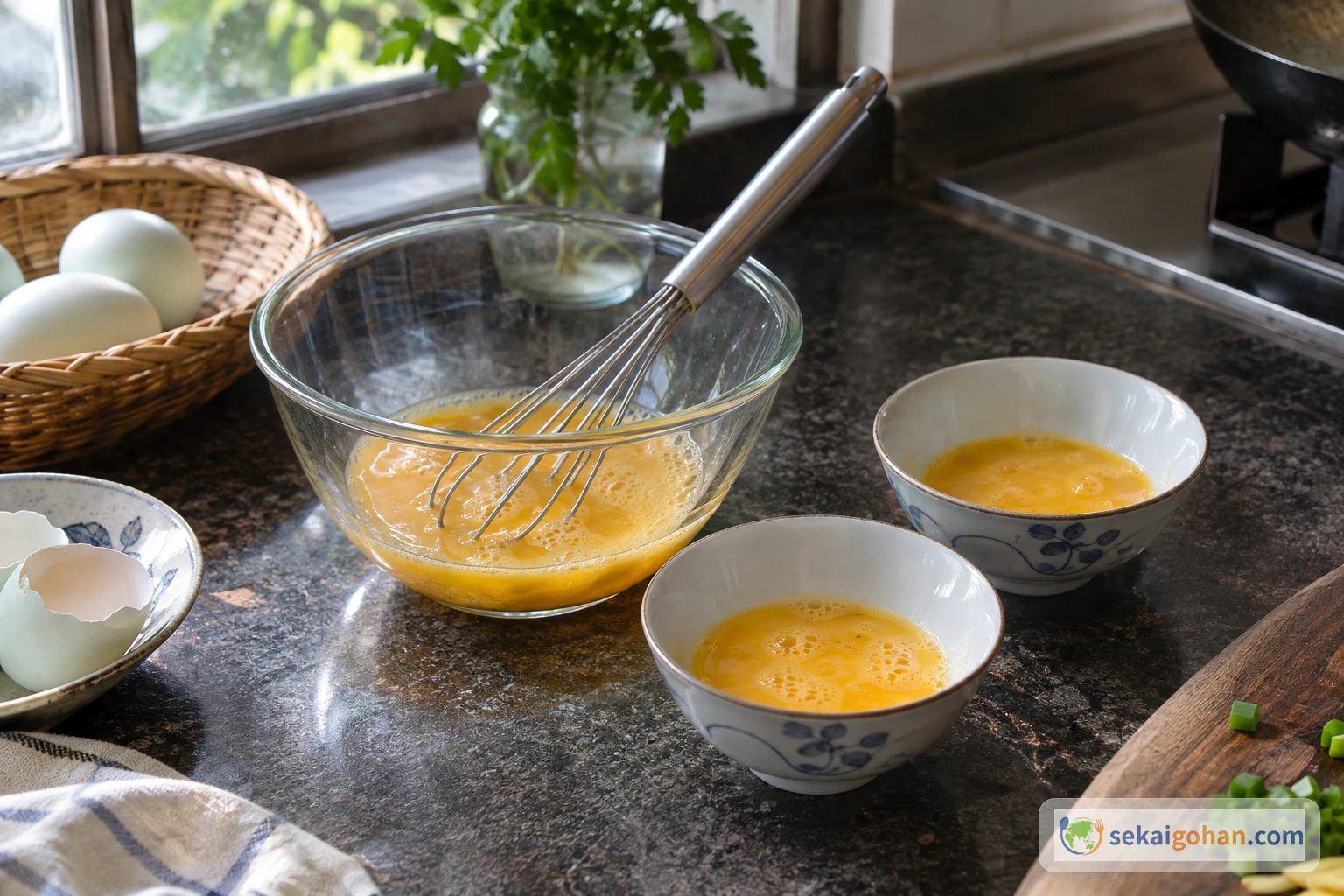
- Eggs: Use duck eggs. No chicken-egg version is given here.
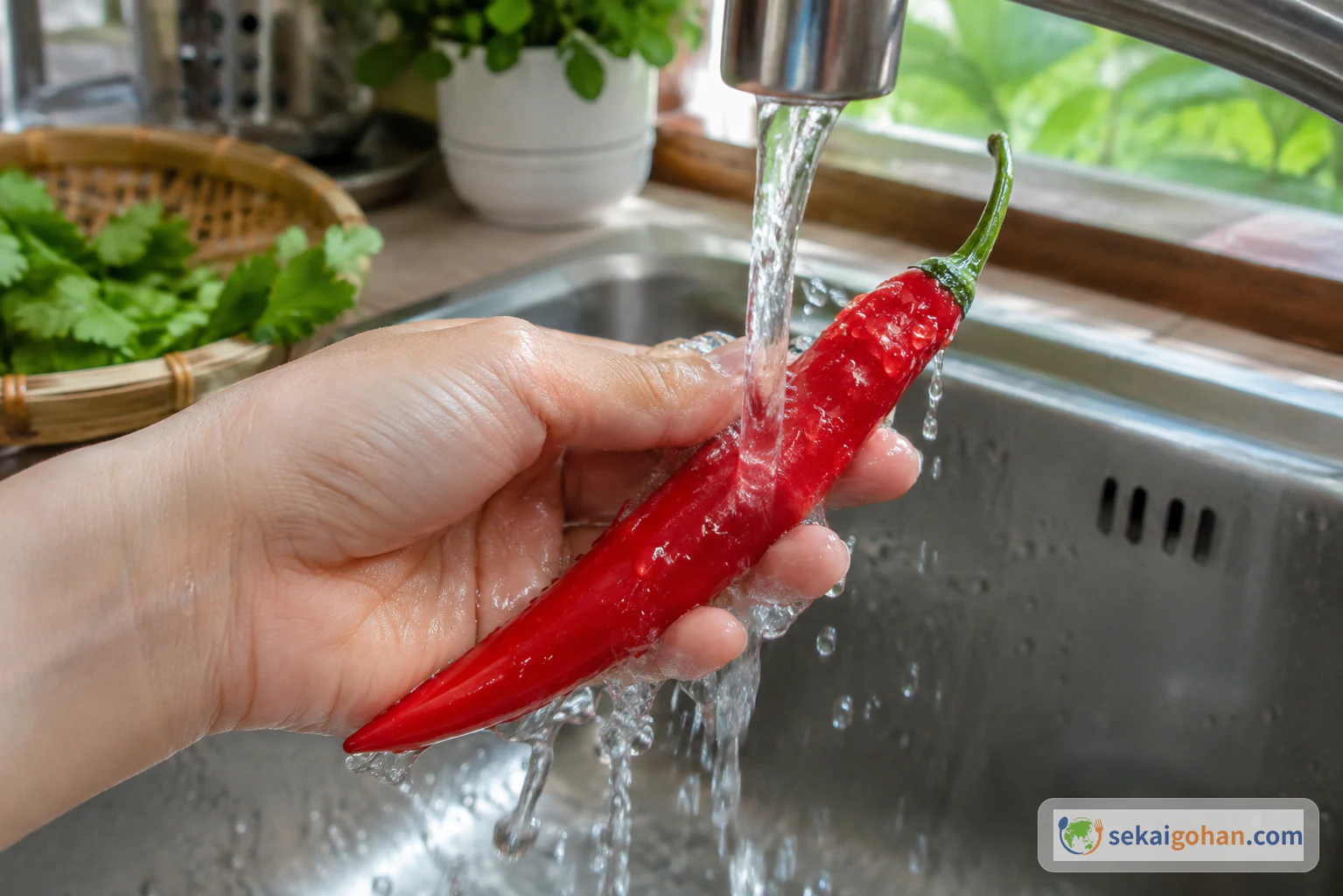
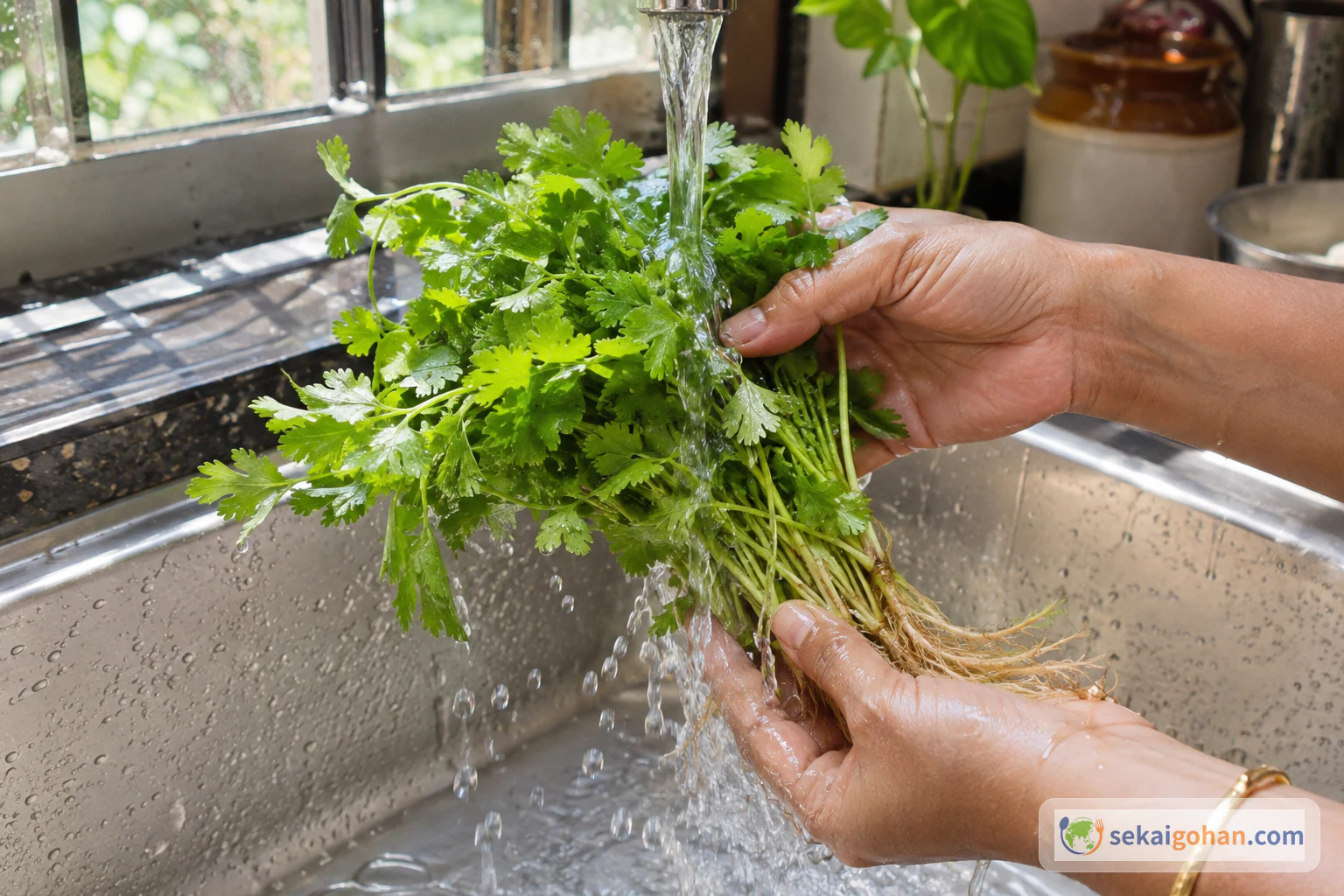
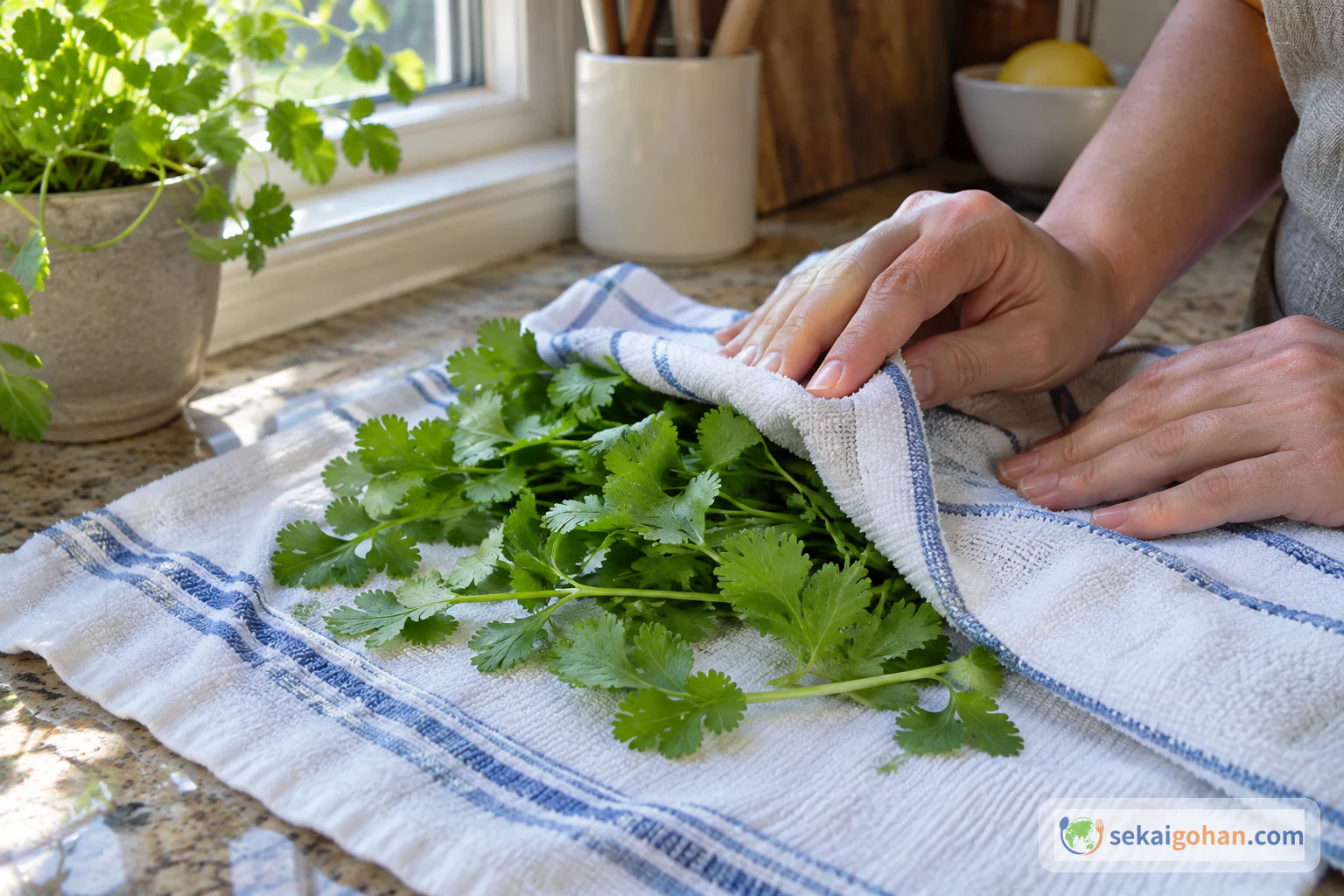
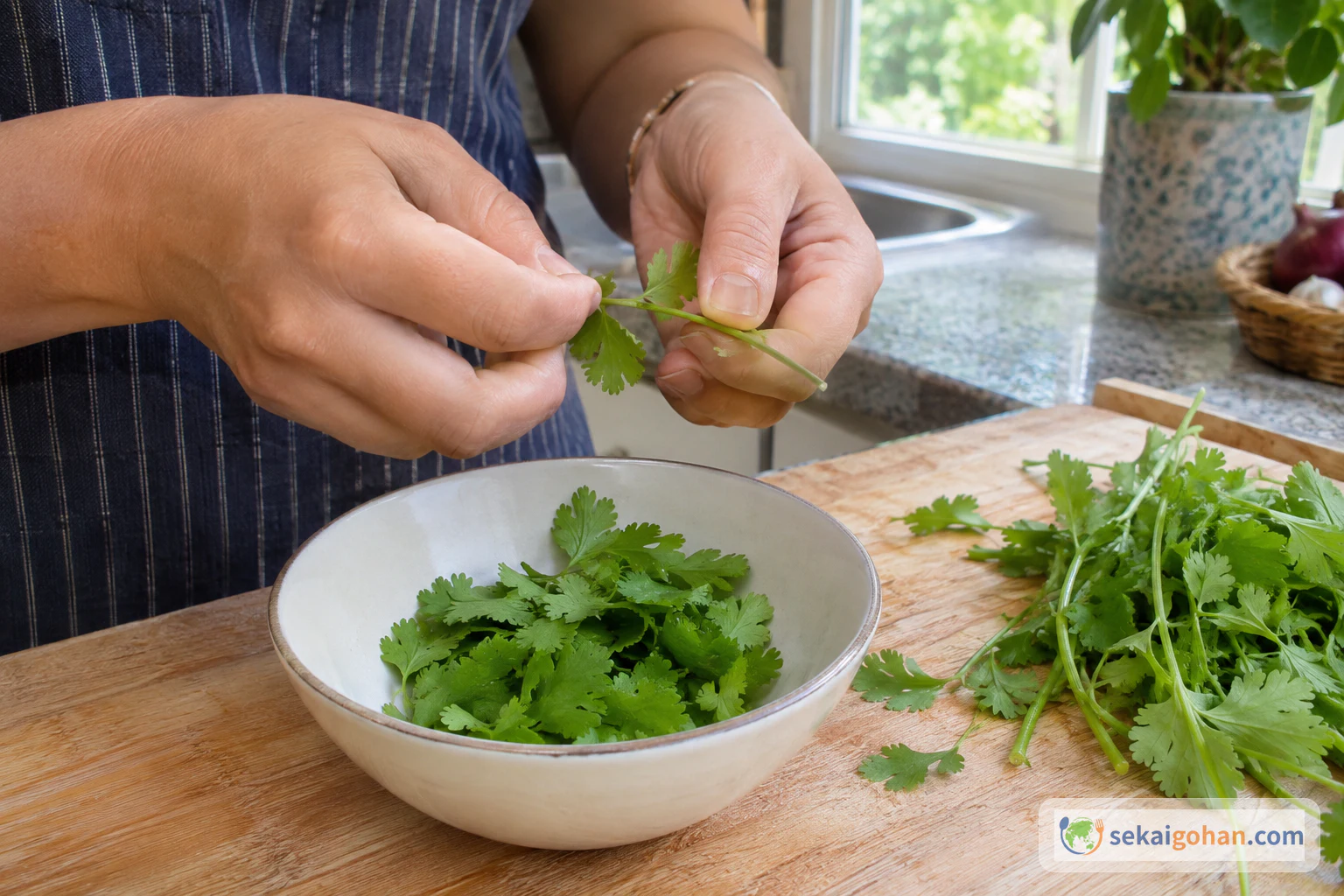
- Chili and coriander: These stay raw and go inside the parcel, so wash them well under running water before use.
Equipment
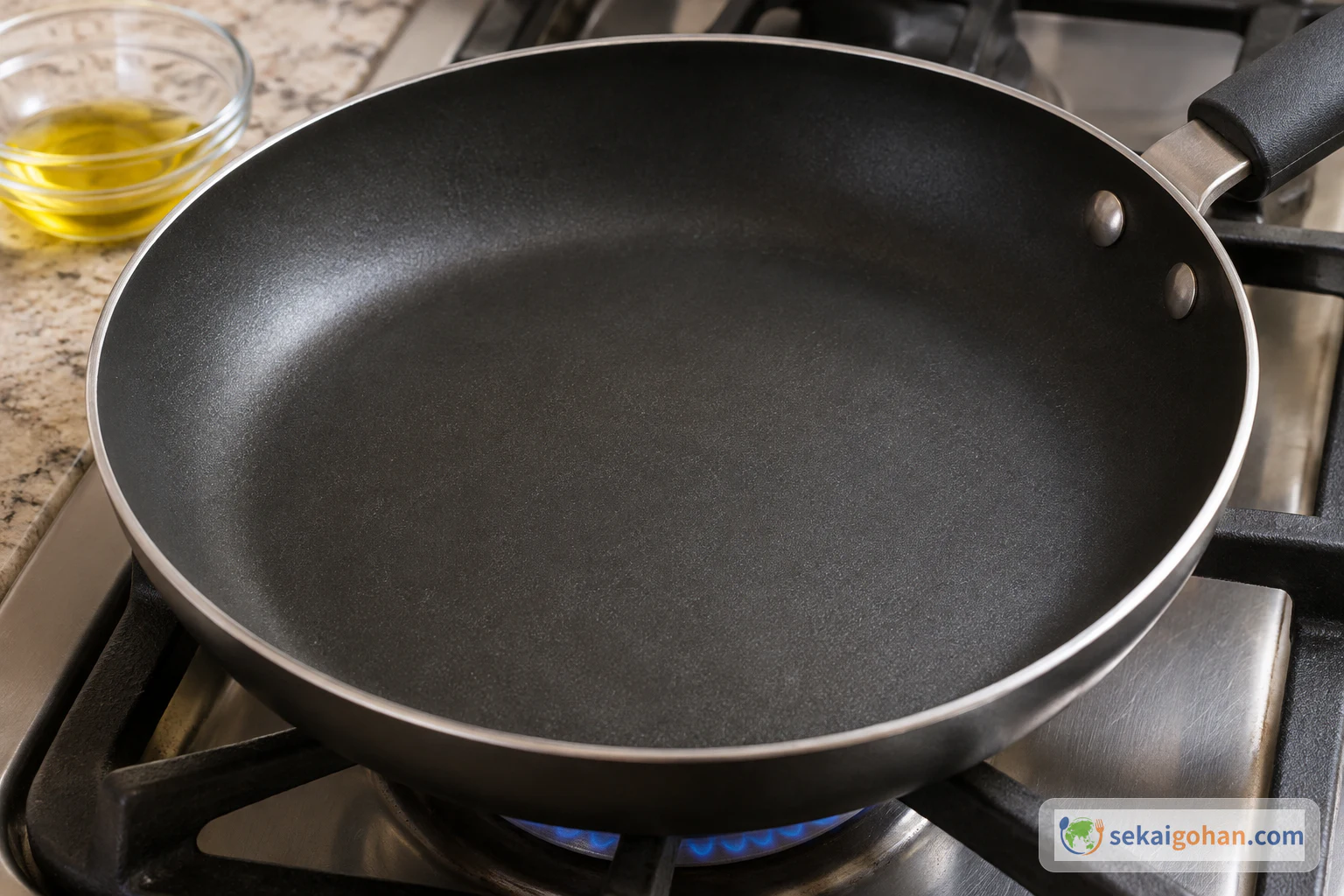
- Two frying pans, one for the filling and one for the egg nets
- Spatula
- Food thermometer with a thin tip
- Fine, clean needle
- Separate cutting boards and knives for raw pork or shrimp and for the garnishes
- Clean mixing bowl and small bowls
- Clean shallow bowl for the filling
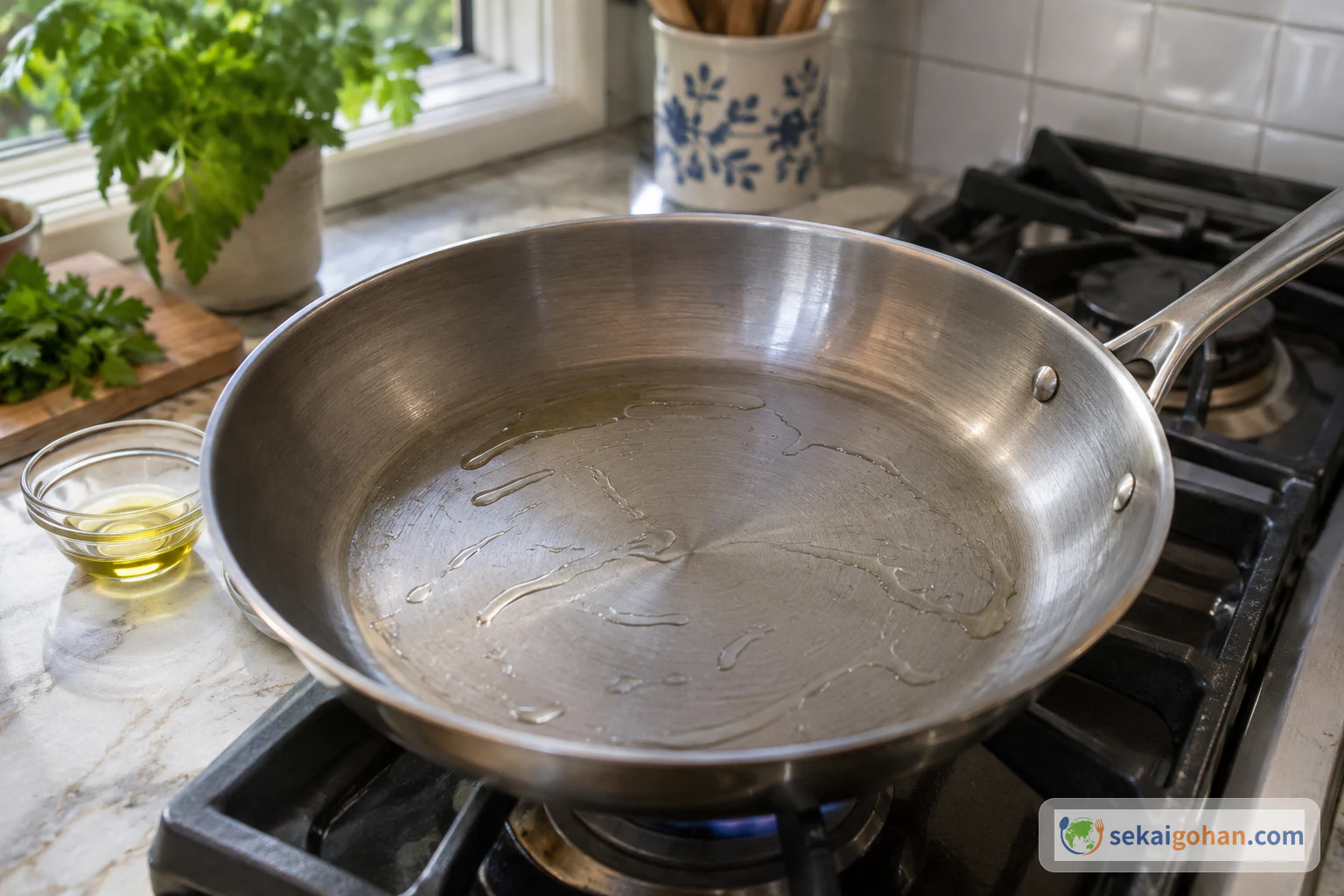
- Pastry brush or similar, for spreading oil thinly
- Spoon
- Clean towel
- Clean plates
Method: Filling First, Then Nets, Then Folding
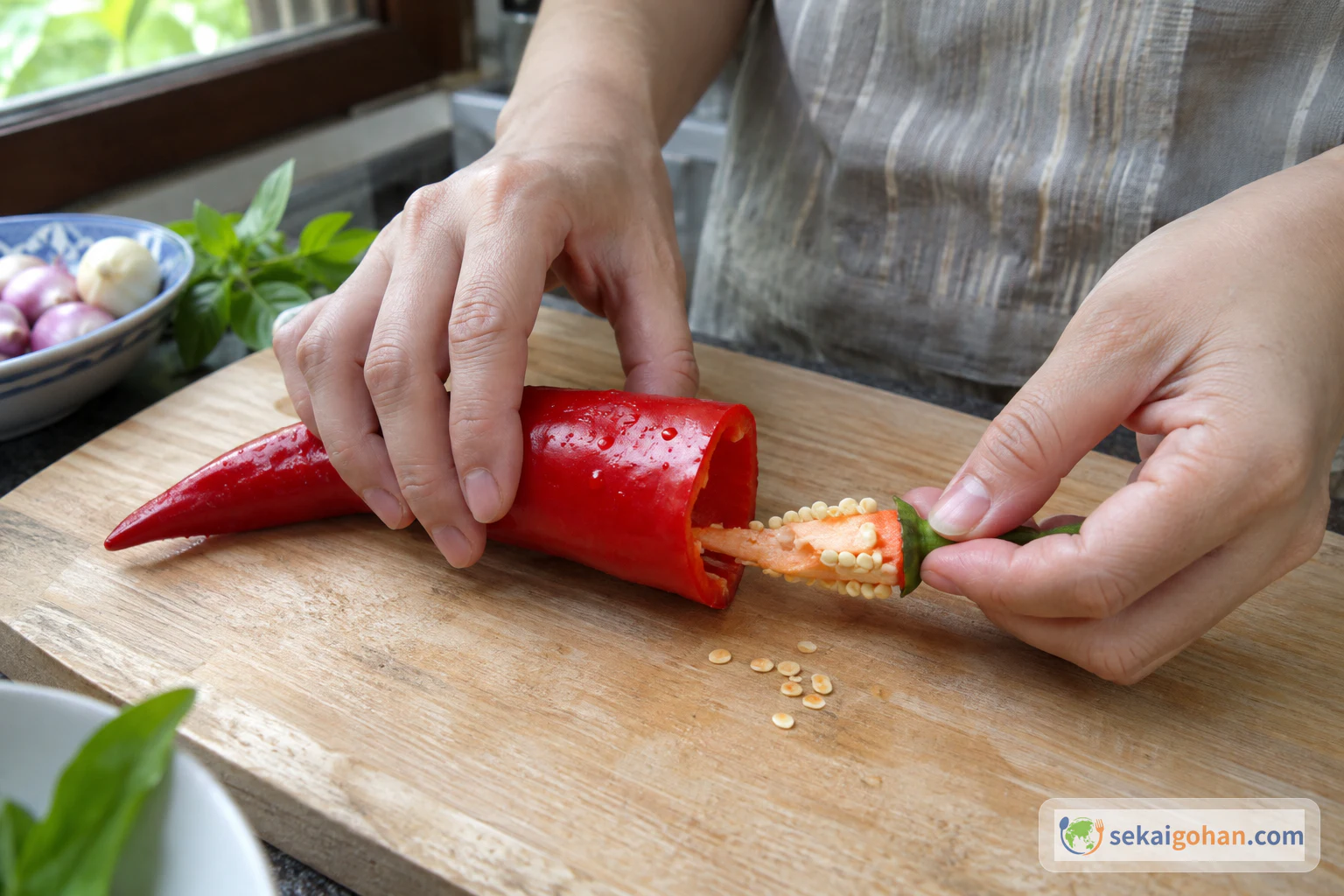
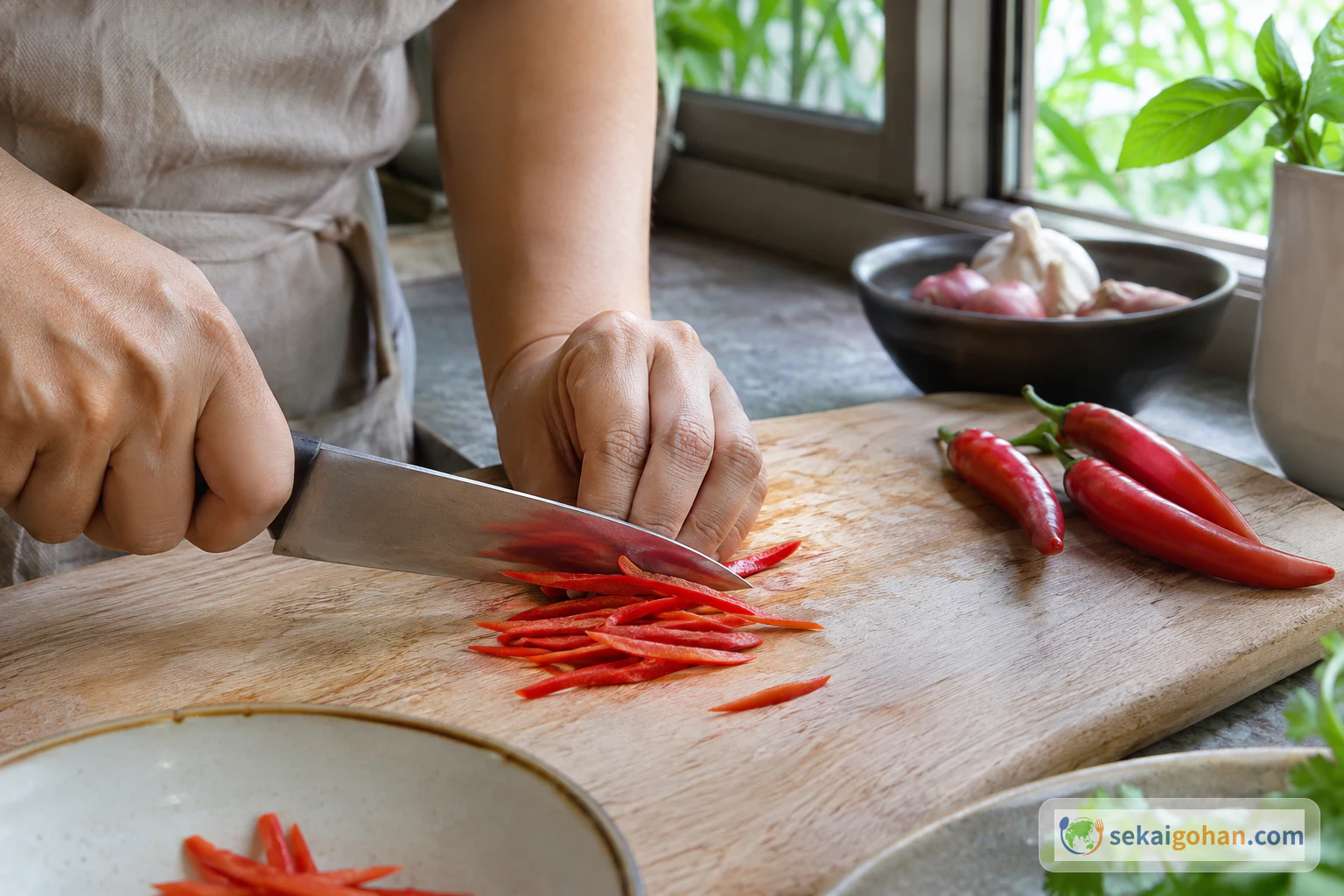
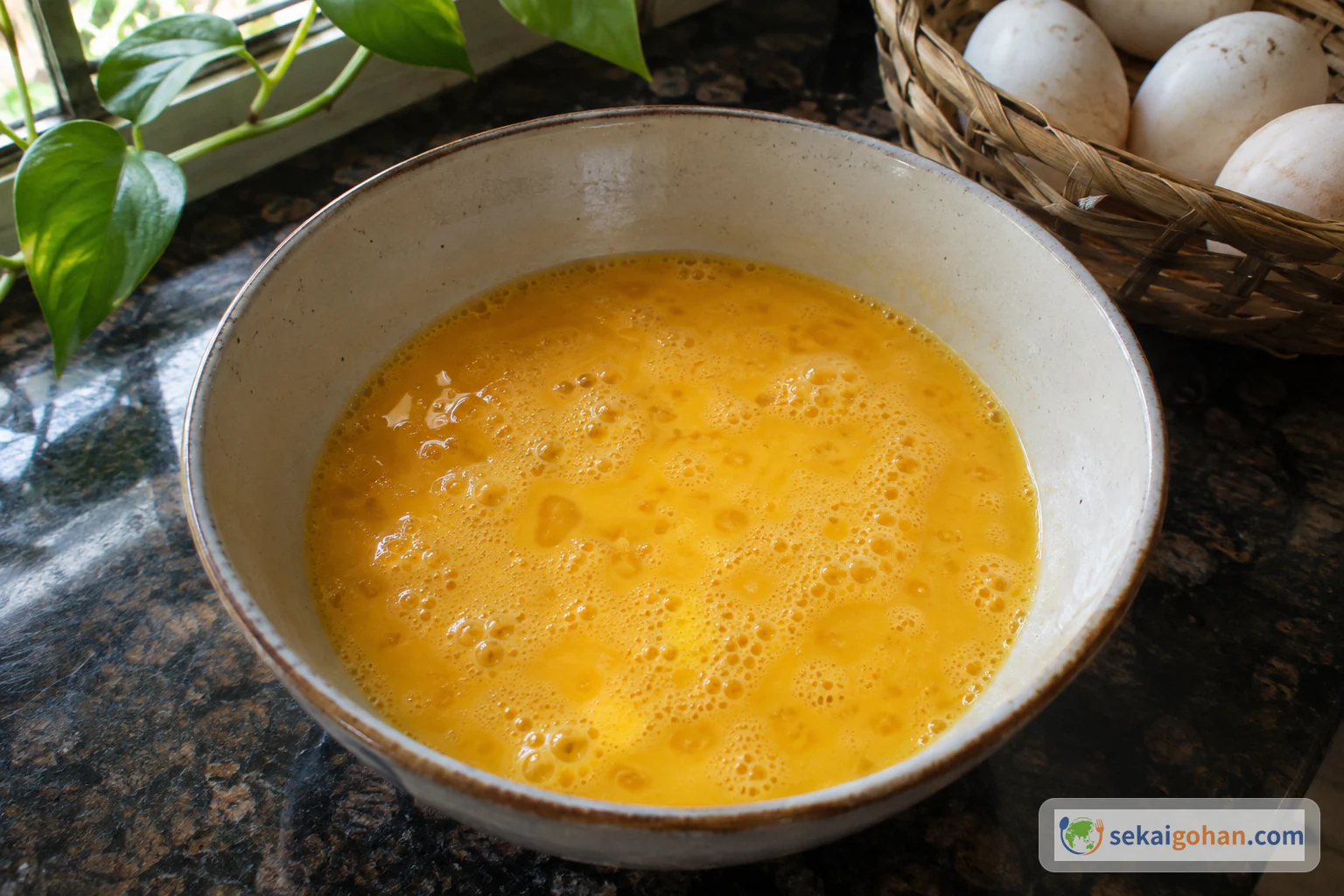
Infants, older people and people with weakened immune systems are more likely to become seriously ill from foodborne infection. The checks below help you follow public cooking advice, but they do not guarantee safety. The images illustrate each action and do not show that a temperature or doneness has been reached.
When Things Go Off Track
| What you see | What to do |
|---|---|
| The egg forms a solid sheet | Let it fall in thinner streams and leave more open space between strands on the next net |
| Liquid egg seeps out at the needle check | Keep cooking over low heat and check again |
| Part of the net looks soft or runny | Keep cooking until white and yolk are both firm. Do not keep any part soft on purpose |
| The filling center does not stay at 75°C for 1 minute | Keep cooking, gather it into a mound and measure again |
| The oil is running low | Spread it more thinly, and do not go over 1 tbsp in total. Next time, hold back more for the egg pan at the start |
| Filling or garnish shows through the gaps | This is part of the dish. The parcel does not need an airtight seal |
| The parcel looks like an open basket | Fold the edges inward so the flaps lie flat across the filling instead of standing upright |
What Can Change and What Stays
Most of the flexibility is in how you prepare and handle the ingredients, not in what goes into the dish.
| Element | Your options | Keep fixed |
|---|---|---|
| Aromatic paste | Store-bought or homemade | 1 tbsp in total |
| Peanuts | Ready-roasted | 1/4 cup, coarsely crushed |
| Oil | Divide it between the pans as needed | 1 tbsp in total |
| Beaten egg | One bowl or several small bowls | 7 duck eggs, with nothing added |
| Garnish | Arrange the chili and leaf as you like | Washed under running water and used raw |
Culture and History: A Name With an Unsettled Story
La tiang is often discussed alongside หรุ่ม (rum), a dish with a similar-looking name. This article does not treat the two as the same. In a signed article for A Cuisine, published on Cheewajit, Sitthichok Sricho compares several cookbooks and expert accounts and says the line between them is hard to draw firmly. The older recipes in the article also differ from one another in filling and shape, and the author does not declare any one of them the true version.
Both names appear in a poem by King Rama II. That tells us the names were recorded in the poem. It does not prove where the dish began, show that it arose at court, or explain the origin of a modern recipe such as Nickktwf's. Here, "la tiang" means the specific form in the Wongnai post: pork and chopped shrimp filling wrapped in a net of duck egg.
Frequently Asked Questions
Can I use chicken eggs?
This article stays with the seven duck eggs in Nickktwf's post and has not tested a chicken-egg version. Its cooking endpoint is also based on duck-egg advice from the Food Safety Authority of Ireland.
What are the proportions in the paste?
The post lists 1 tbsp of a combined coriander root, garlic and pepper paste, also called สามเกลอ, and treats it as already prepared. It gives no ratio, so none is invented here. Store-bought paste is fine, and homemade paste should also total 1 tbsp.
How much is a cup in metric?
The post does not say what size of cup it uses. The amounts stay in its own units, because any gram or milliliter figure would be a guess.
Will this really make 30 pieces?
The post shows 30 pieces, but that yield has not been measured here. It also does not say how many nets to make or how much egg goes into each one, so your count may differ.
Why not check the egg net with a thermometer?
Thermometers need a certain insertion depth. ThermoWorks says its Thermapen needs at least 1/8 inch (about 3 mm), and Clemson University's extension service says thermocouple types need at least 1/4 inch. We judged that a thin strand of egg net could not provide that depth, though strand thickness has not been measured. This is an editorial judgment, because no public guidance specific to thin egg nets was found.
The endpoint used instead is firmness: both white and yolk set, as the Food Safety Authority of Ireland advises for duck eggs. The FDA and CDC say the same for eggs in general. This article does not claim that the net reaches 75°C for 1 minute, or the 71°C (160°F) that the CDC gives restaurants and retailers for egg dishes.
Does a firm net mean it is safe?
No guarantee can be made. The FDA also says color and texture are not reliable indicators of safety and that a food thermometer is the reliable method. The needle check is an editorial addition, not public guidance. The Irish advice is also not a Japanese standard, and we did not find a Japanese public source giving an endpoint for duck eggs.
That advice also says dishes containing duck eggs should be heated until piping hot throughout. In this method, the net and filling are each cooked first and the assembled parcel is not reheated. The Food Safety Authority of Ireland notes that older people, infants and people with weakened immune systems are more likely to become seriously ill, so take that into account when deciding who to serve.
Why are the chili and coriander left raw?
Nickktwf's recipe uses them that way, and this article does not quietly turn it into a cooked version. Wash both well under running water before use, following FDA advice on fresh produce, and keep them away from raw pork, shrimp and raw egg.
Can I make la tiang ahead?
No storage period is set here, and the dish is intended for serving the same day. Do not leave parcels at room temperature for long, and refrigerate any you will not eat right away within 2 hours of cooking.
Sources
- Nickktwf, "สูตร ล่าเตียง พร้อมวิธีทำโดย Nickktwf," Wongnai community. Ingredients, amounts, instructions, the 4–5 inch egg net, and the listed yield and times. https://www.wongnai.com/recipes/ugc/d7c12452d279411baa373862f6f1a740
- Sitthichok Sricho, "หรุ่ม ล่าเตียง อลหม่านอาหารไทย," A Cuisine / Amarin, on Cheewajit. Differences among older recipes, the unsettled line between rum and la tiang, and the limits of the Rama II poem as evidence. https://cheewajit.com/healthy-food/diy-tips/161420.html
- Ministry of Health, Labour and Welfare (Japan), "家庭でできる食中毒予防の6つのポイント." The home-cooking guide of 75°C at the center for 1 minute or more, handwashing, tool hygiene, washing vegetables, and not leaving cooked food at room temperature for long. https://www.mhlw.go.jp/stf/seisakunitsuite/bunya/kenkou_iryou/shokuhin/syokuchu/01_00006.html
- U.S. Food and Drug Administration, "Safe Food Handling." Rinsing produce under running water, cooking eggs until yolk and white are firm, the limits of color and texture as indicators, separate cutting boards, and refrigerating within 2 hours. http://www.fda.gov/food/buy-store-serve-safe-food/safe-food-handling
- U.S. Food and Drug Administration, "What You Need to Know About Egg Safety." Cooking eggs until yolk and white are firm. https://www.fda.gov/food/buy-store-serve-safe-food/what-you-need-know-about-egg-safety
- U.S. Centers for Disease Control and Prevention (archived), "Salmonella Braenderup outbreak (2018): Advice to consumers and retailers." Cooking eggs until yolk and white are firm, and the 71°C (160°F) figure for egg dishes in restaurants and retail. https://archive.cdc.gov/www_cdc_gov/salmonella/braenderup-04-18/advice.html
- Food Safety Authority of Ireland, "Advice on duck eggs." Cooking duck eggs until white and yolk are solid, heating dishes containing them until piping hot, handling and hygiene, not tasting raw mixtures, and groups at higher risk. https://www.fsai.ie/Consumer-Advice/Food-Safety-and-Hygiene/Advice-on-duck-eggs
- Food Safety Authority of Ireland, "FSAI reminds consumers on cooking duck eggs before eating," 2024. Eating duck eggs only when white and yolk are solid, and washing hands, utensils and surfaces after handling them raw. https://www.fsai.ie/news-and-alerts/latest-news/fsai-reminds-consumers-on-cooking-duck-eggs-before
- ThermoWorks, "Getting an Accurate Reading." The minimum insertion depth of about 1/8 inch for the company's Thermapen. https://blog.thermoworks.com/getting-an-accurate-reading/
- Clemson University Cooperative Extension, Home & Garden Information Center, "Food Thermometers: A Key to Food Safety." Insertion depths of at least 1/4 inch for thermocouple types and at least 1/2 inch for digital instant-read types. https://hgic.clemson.edu/factsheet/food-thermometers-a-key-to-food-safety/