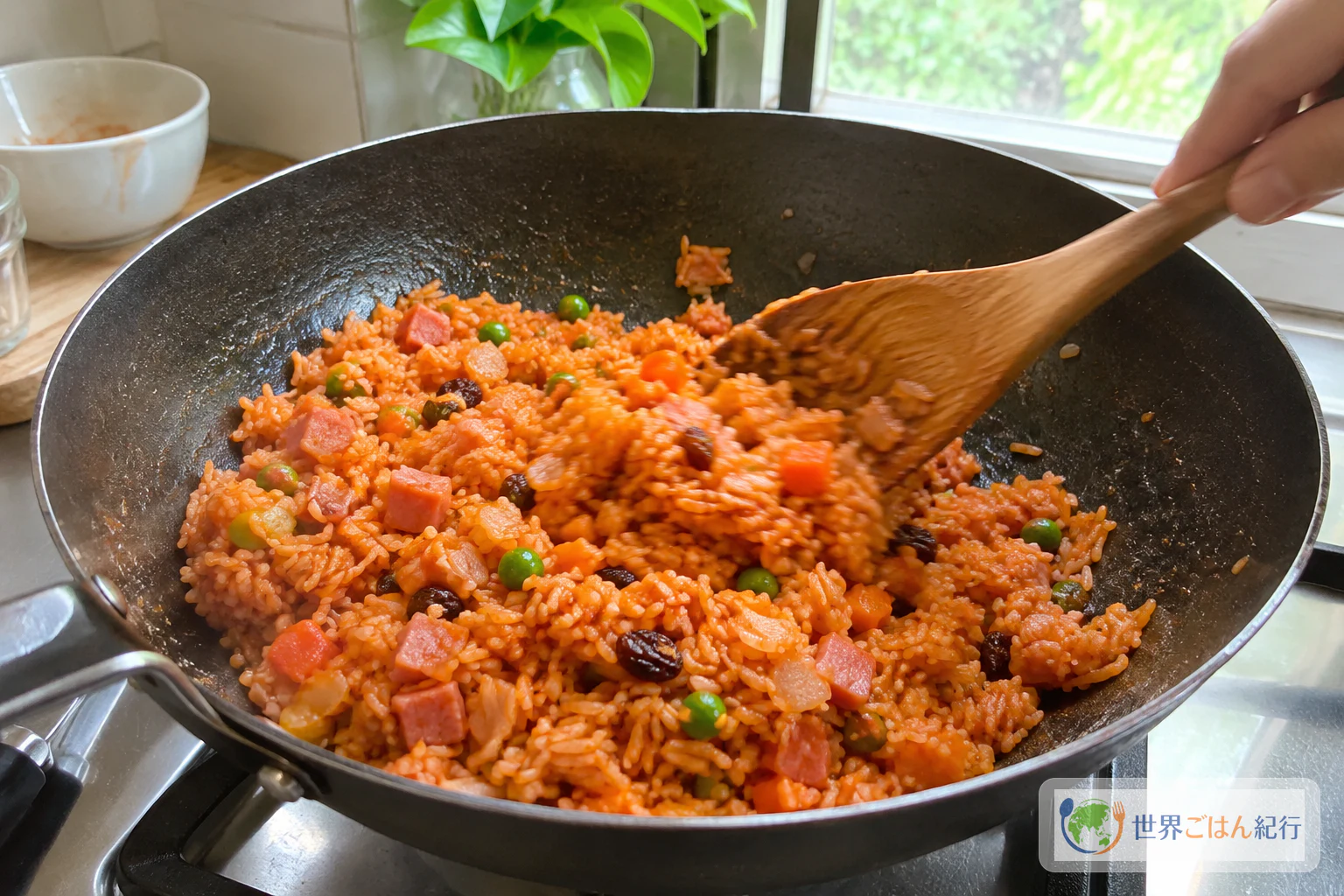
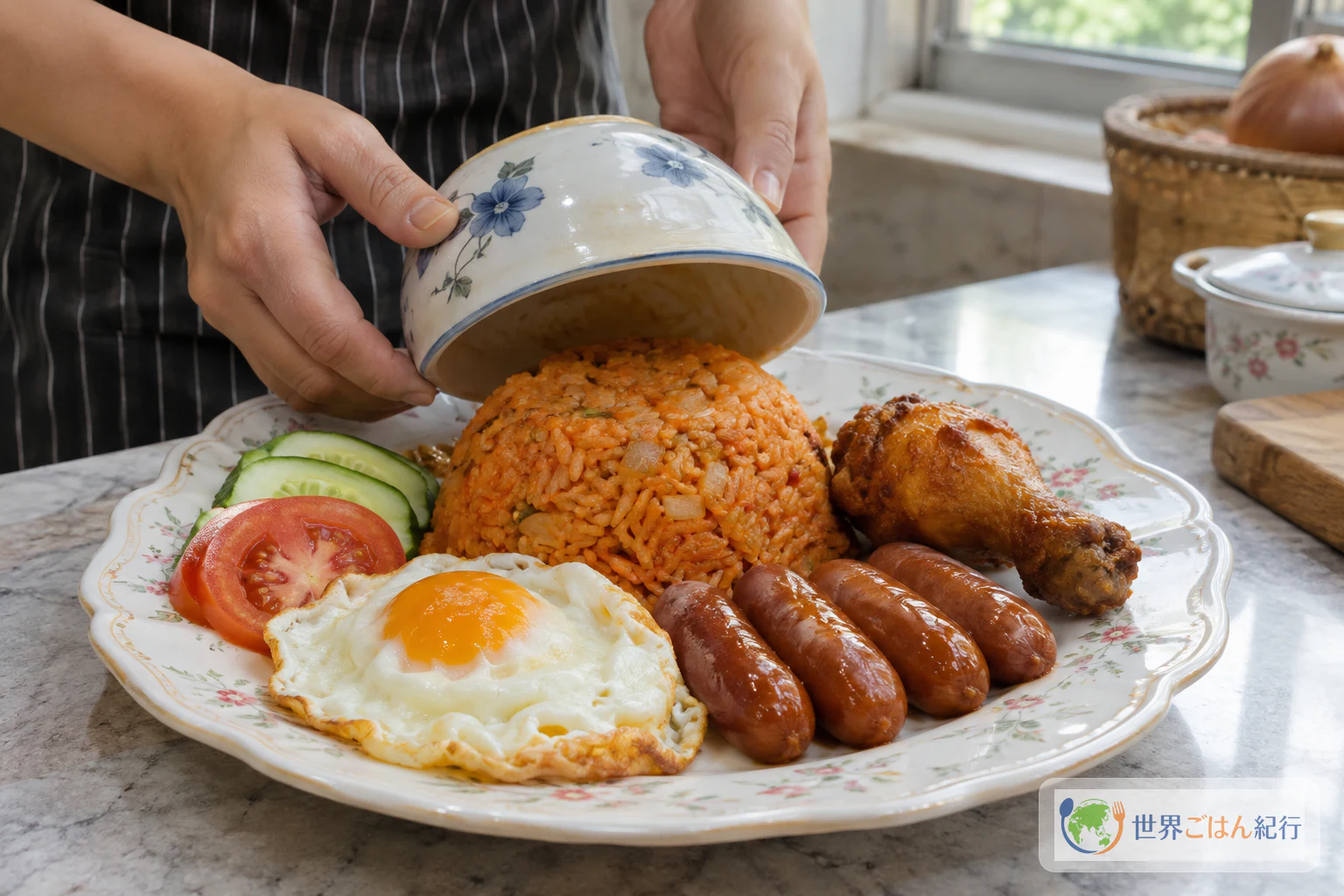
Khao Phat Amerikan: Orange-Red Rice and Three Fried Sides
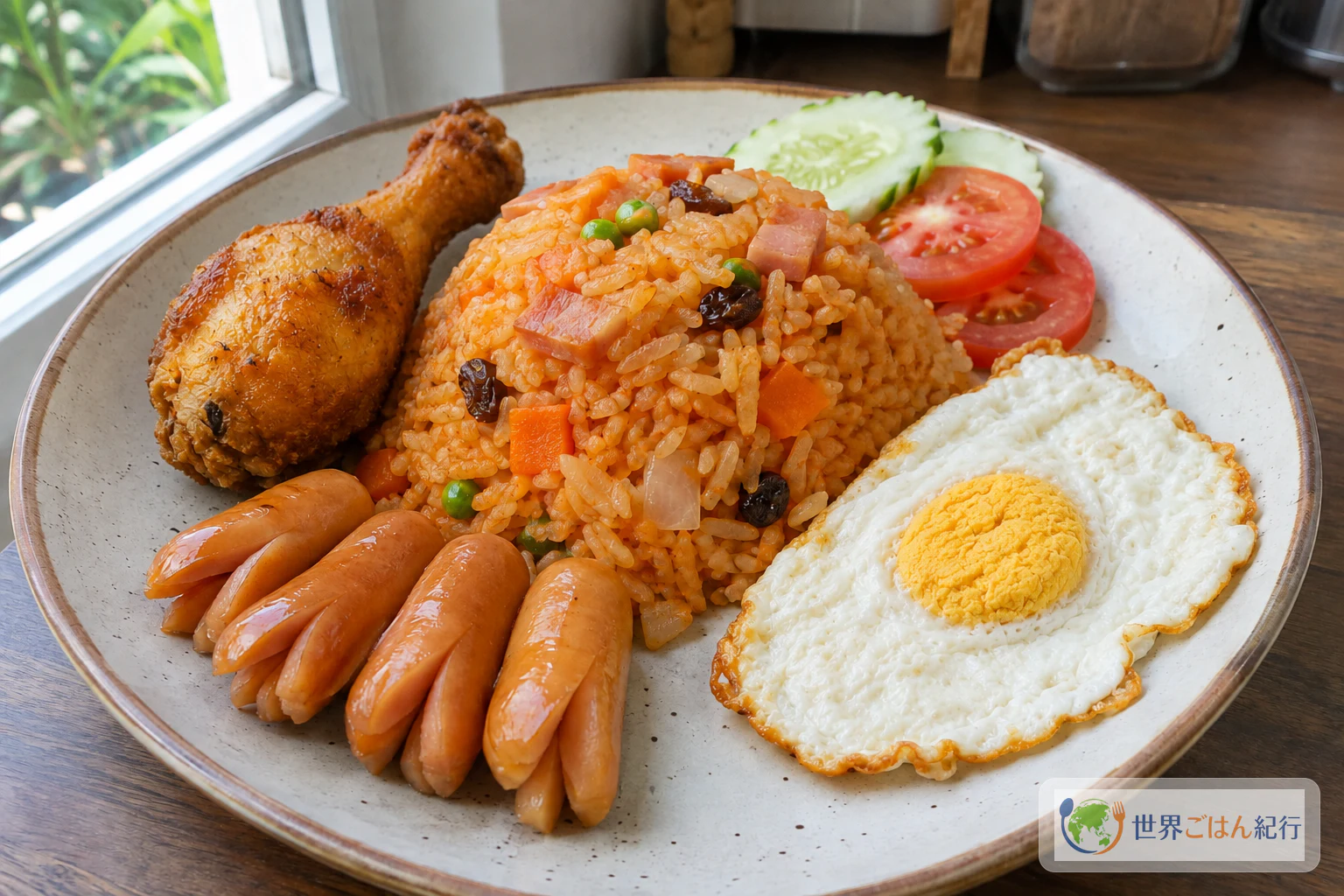
Ketchup-red fried rice studded with ham, raisins and peas, with a fully cooked fried egg, sausages and a fried chicken drumstick set beside it. Each side is cooked on its own, and the rice comes last.
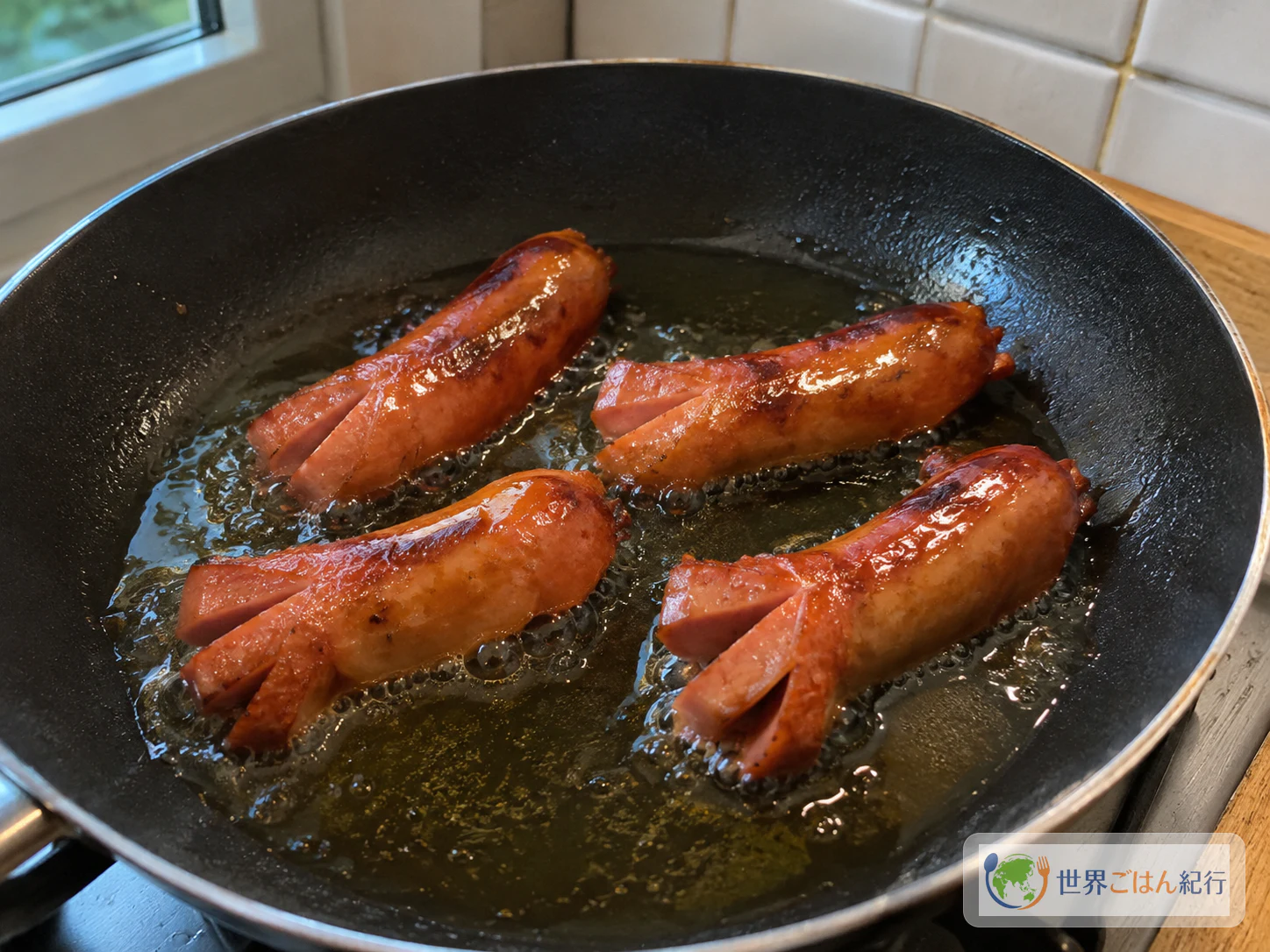
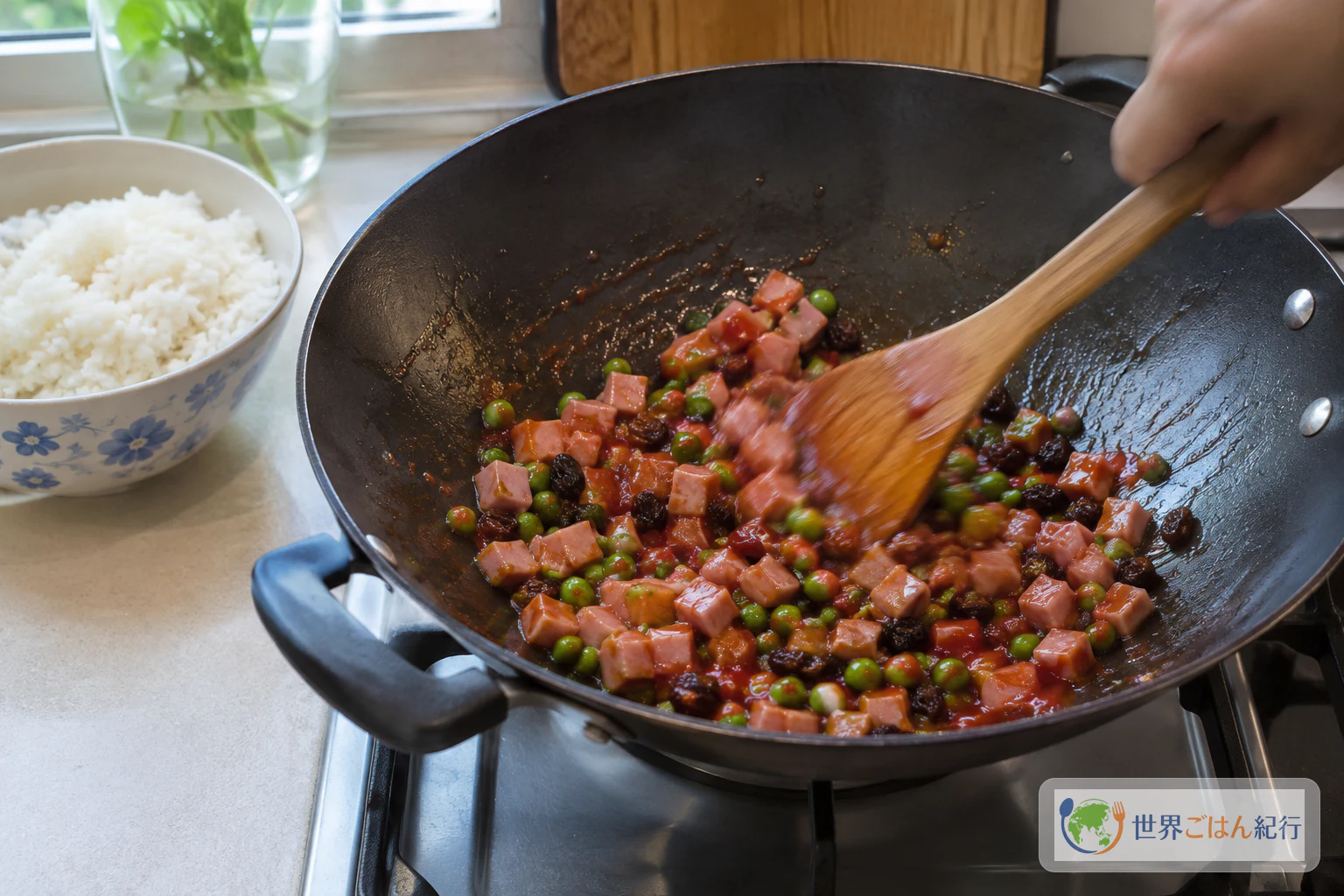
The rice on this plate is orange-red from ketchup, flecked with diced ham, green peas and raisins. Next to it sit a fried egg, sausages with slits cut at both ends, and a piece of fried chicken. This is khao phat amerikan (ข้าวผัดอเมริกัน), literally "American fried rice": a Thai dish, despite the name.
The "American" refers to the way the plate is put together. Ketchup rice is paired with sides that were seen in Thailand as American-style, much like a breakfast plate of eggs and sausages. It is not a standard dish in the United States. In Bangkok you can find it with roasted chicken instead of fried, and recipes vary in the egg, the meats and whether raisins go in. This article follows one household version closely, from the chilled rice to the molded mound on the plate. For more dishes from the same country, see Thailand.
About This Recipe: One Household's Formula
The recipe here comes from issue 41 of Saranrom, a journal published by Thailand's Ministry of Foreign Affairs. It is the personal household recipe of the article's named author, พิษณุ โสภณ. It is not a ministry food standard or an official formula for the dish. Sekai Gohan has not kitchen-tested this recipe.
A few things are worth knowing before you cook:
- No serving count is given. The recipe does not state how many people it feeds or how much it makes. The amounts below are arranged on a single plate as a presentation choice, not as a stated yield.
- The rice is given as "1 ถ้วย". The recipe does not define the vessel or its volume, so it is kept as written rather than converted to US cups, Japanese cups or grams.
- The chicken has two options. The recipe offers either one drumstick or four lower-wing pieces (drumettes). This article uses one drumstick only and does not mix the two.
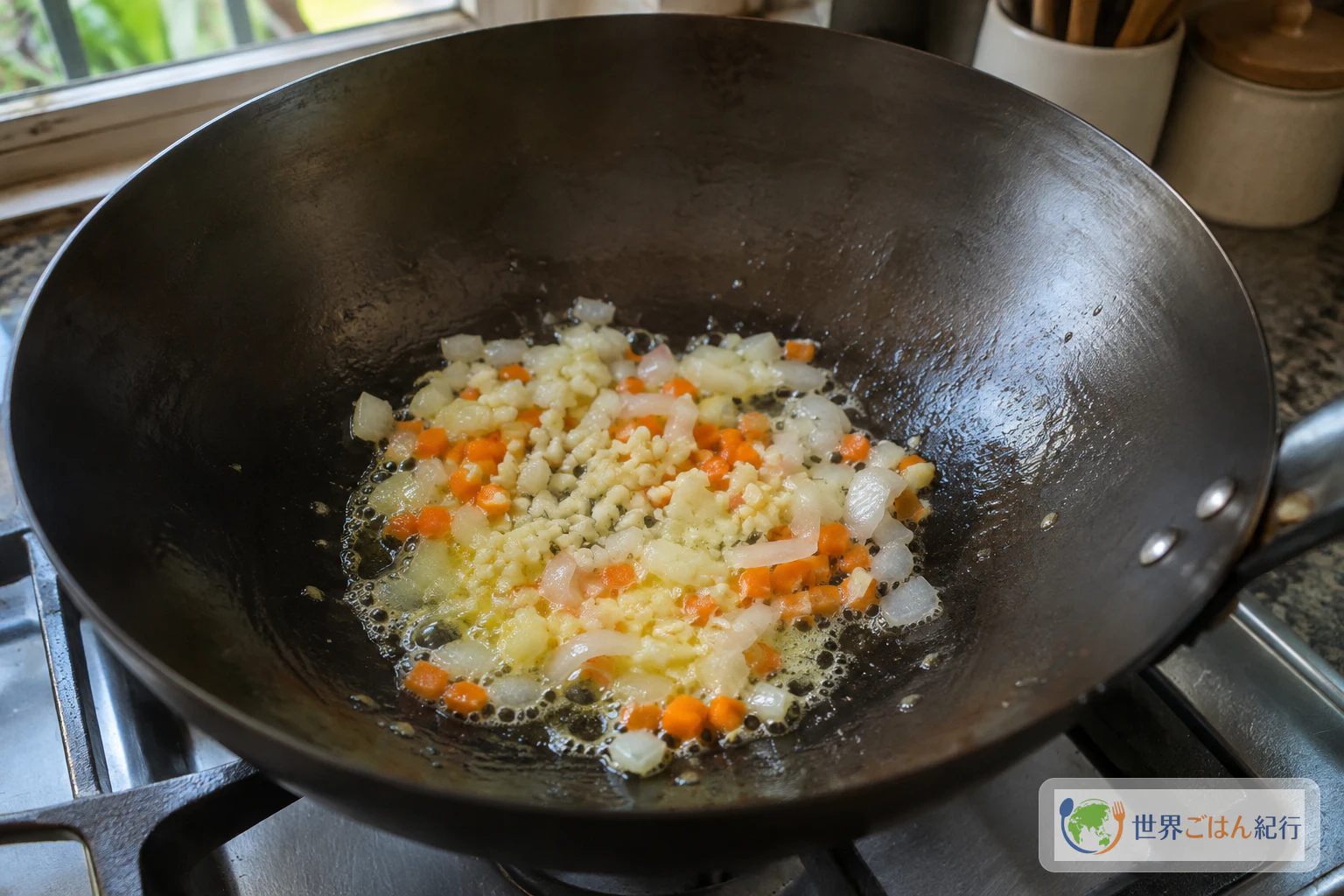
- Carrot has no stated step. The recipe lists 1 tablespoon of diced carrot but does not say when it goes in. Here it is cooked with the onion, without adding any extra cooking time.
- Salt and pepper are totals. The recipe lists 1/2 teaspoon salt and 1/2 teaspoon pepper. Here all the salt goes into the chicken marinade once. The pepper is divided between the marinade and the final seasoning of the rice. No exact split is given, and neither total is used twice.
- Some details are not given. The recipe gives no amounts for butter or oil, no frying time and no coating for the chicken. None is added here.
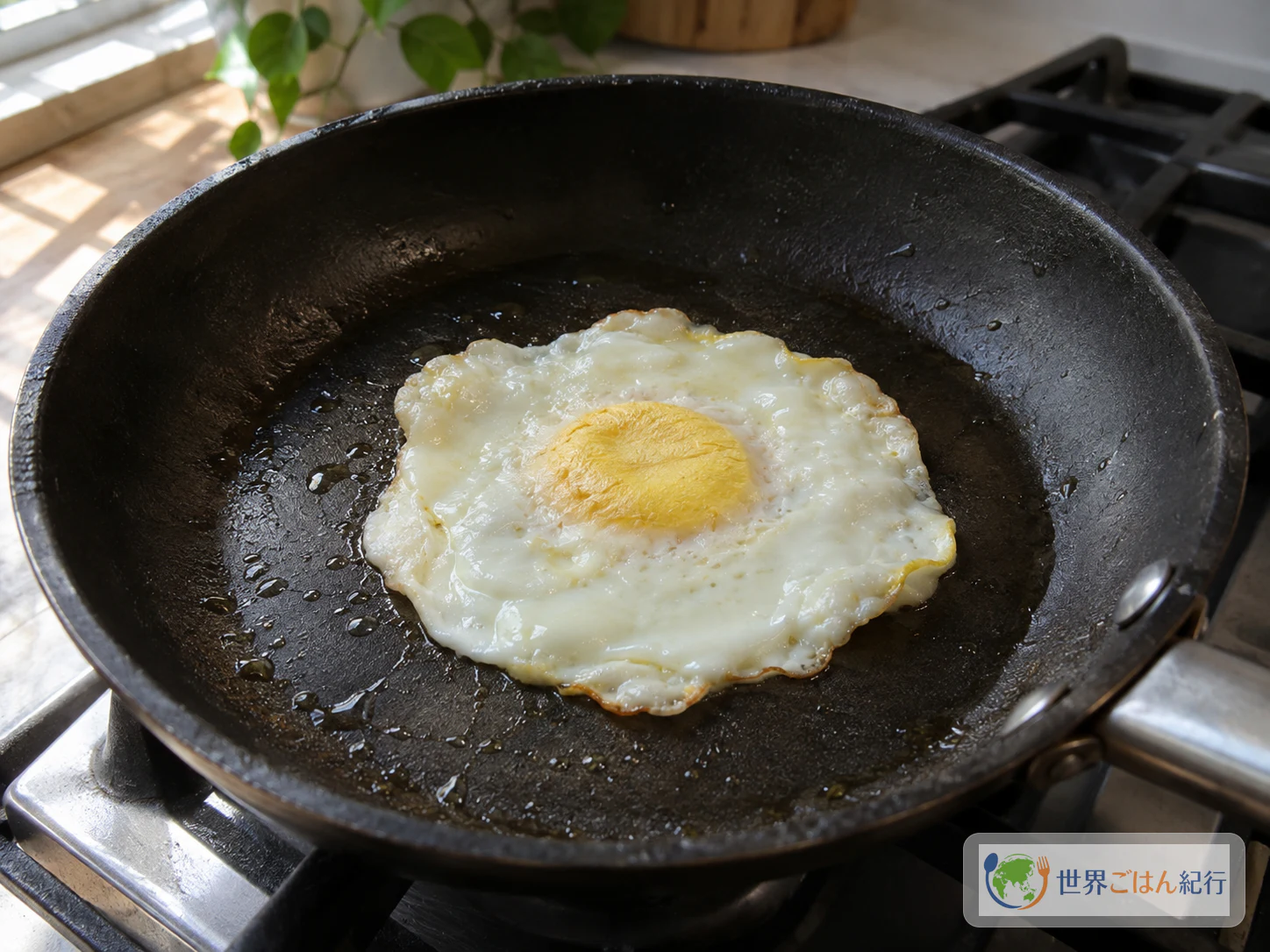
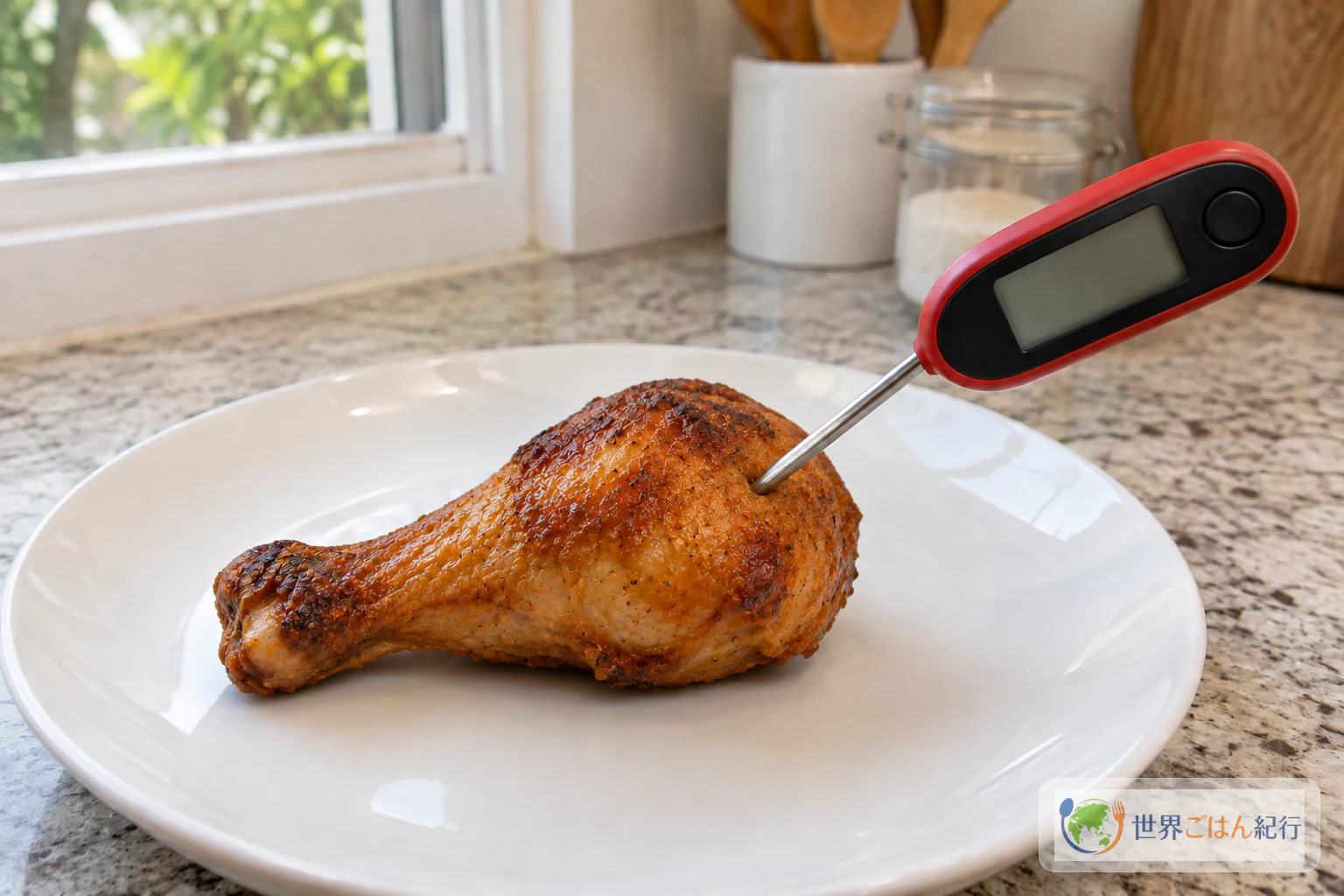
For safety, the recipe's instruction to fry the chicken "until cooked" is paired with FoodSafety.gov's guidance: all poultry should reach 165°F (74°C), measured with a food thermometer. The egg is cooked until both the white and the yolk are firm, also following FoodSafety.gov.
Ingredients: Ketchup Rice and Its Fried Sides
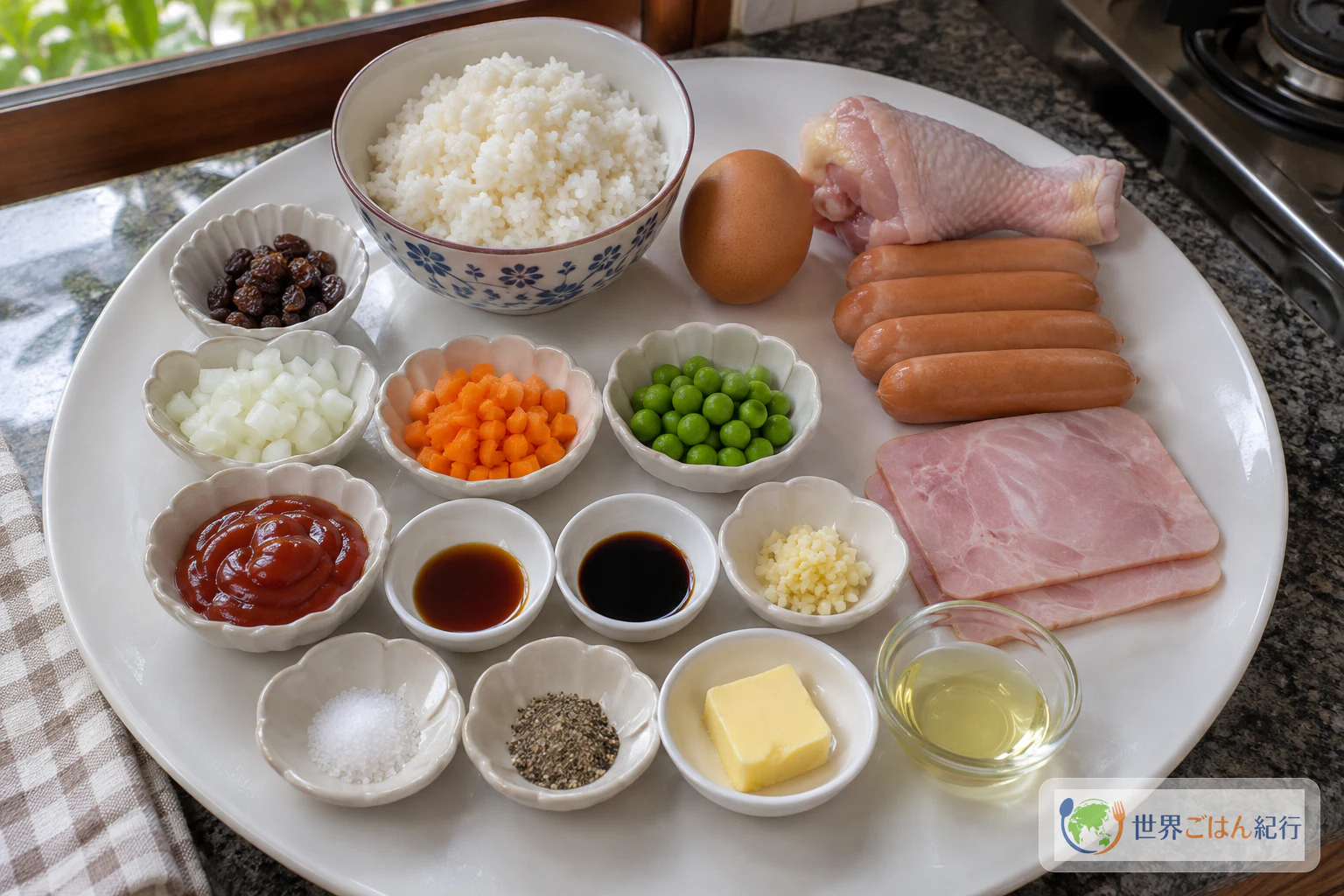
Equipment
- A skillet for the egg, sausages and chicken
- A second clean pan or wok for the fried rice
- A food thermometer (instant-read)
- A covered container for marinating the chicken
- A separate cutting board, knife and utensils for raw chicken
- Clean plates for the cooked sides
- A small bowl for molding the rice
- A rice paddle or spatula
Choosing and Substituting Ingredients
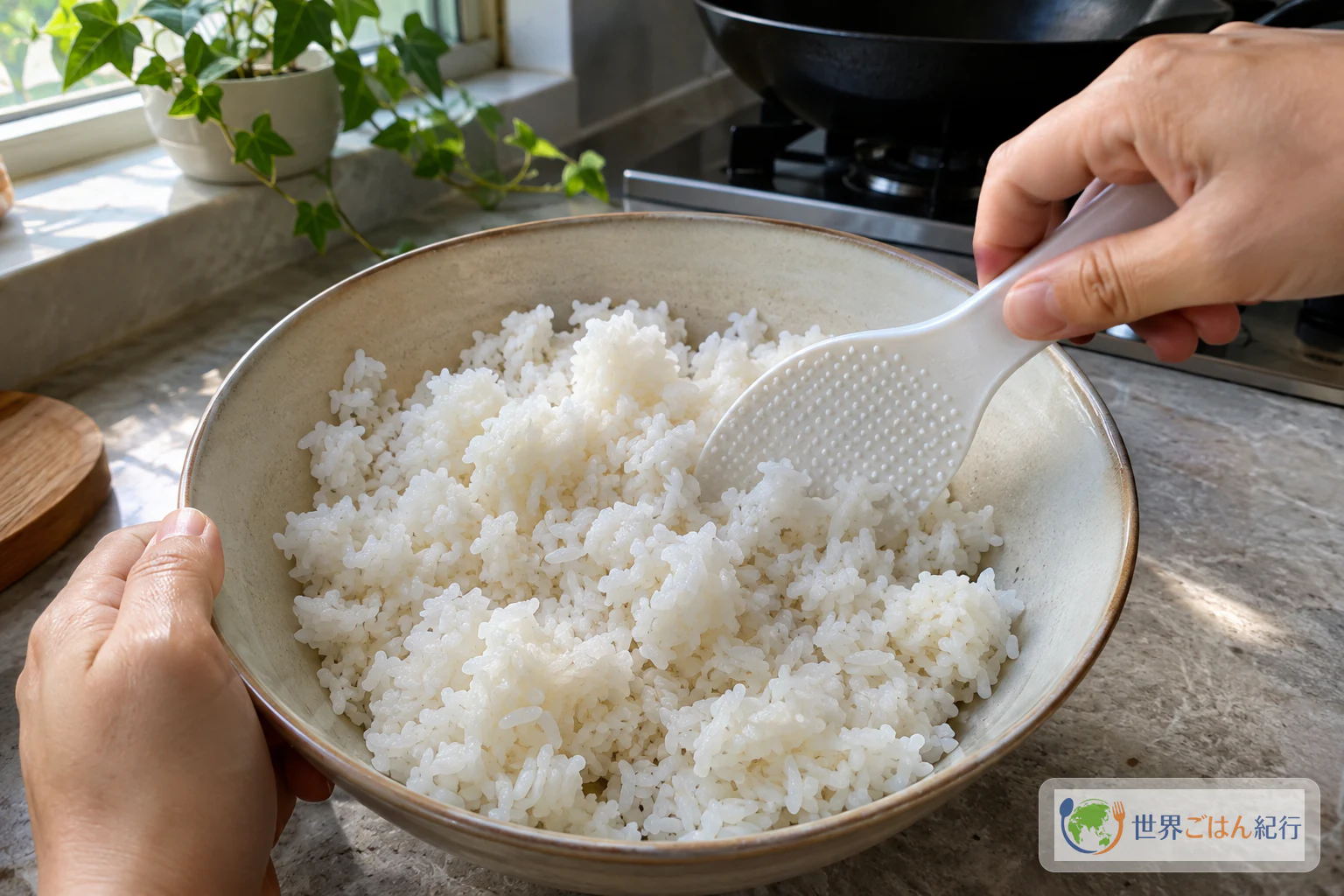
Rice. Use rice that is already cooked and has been chilled, which makes the grains easier to separate. Do not make this with raw rice. Keep cooked rice in the refrigerator rather than leaving it out at room temperature for a long time.
Two soy sauces. Use light soy sauce in the chicken marinade and soy sauce in the rice, as two separate items. Keep them separate if you can. If you replace both with one bottle you already own, the flavor will shift, so treat it as your own adjustment. Japanese usukuchi and koikuchi shoyu are not direct one-to-one matches for these two labels.
Ketchup. Ketchup is the main seasoning of the rice, so use one you like the taste of.
Butter. Unsalted butter is used for the aromatics. With all the salt already in the chicken, salted butter would make the rice saltier.
This dish usually contains egg, soy (soy sauces) and milk (butter). Depending on the product, soy sauce, ham and sausages may also contain wheat or other allergens, so check the labels of what you buy. Keep raw chicken, and anything it has touched, away from cooked food and foods that won't be cooked further.
Method
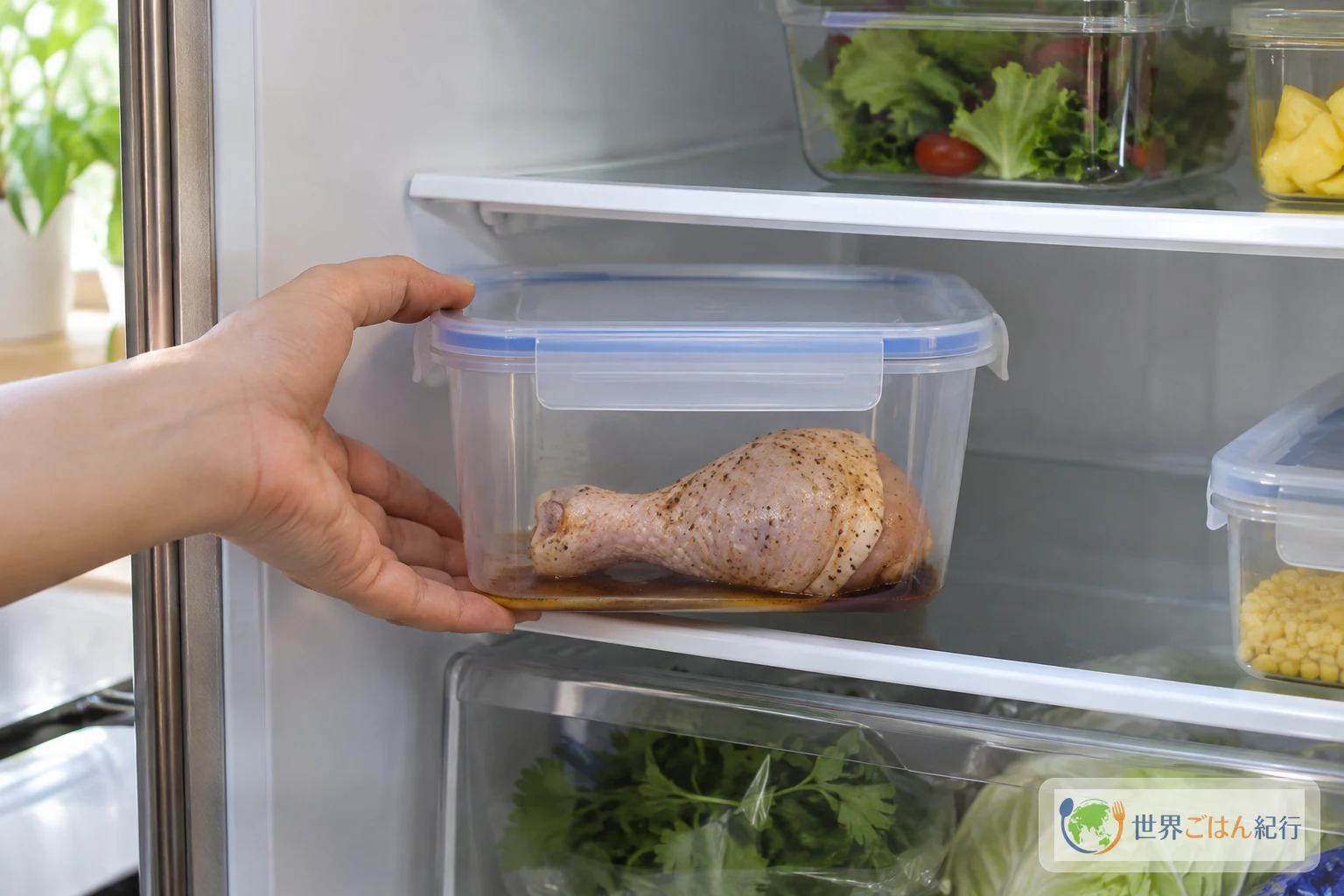
Marinate the chicken first. Then cook the three sides one at a time in this order: egg, sausages, chicken. Fry the rice last in a separate clean pan, then mold it and plate everything together.
Troubleshooting
| Problem | Likely cause | What to do |
|---|---|---|
| The rice clumps in the pan | It wasn't chilled, or the clumps weren't broken up first | Next time, chill the cooked rice and loosen it before frying. For now, press the clumps apart with the spatula as you stir |
| The rice is patchy white and orange | Not stirred long enough after the rice went in | Keep folding until every grain is evenly coated |
| The chicken reads below 165°F (74°C) | Not fried long enough; the center is thick | Return it to the oil, keep frying, and check again on a clean plate. Fry it as long as it needs rather than by a fixed time |
| The egg yolk is still soft | Taken off the heat too soon | Leave it over low heat until the yolk is firm as well as the white |
| The rice tastes salty | Soy sauces, ham and sausages all add salt | Don't add extra salt to the rice. Next time, check how salty your ham and sausages are |
Variations You Will Meet
The plate changes from cook to cook. A Bangkok restaurant described by writer and photographer Austin Bush serves ketchup rice with raisins, a fried egg and roasted chicken. A recipe page from Thai Nippon Foods uses scrambled egg and ready-made fried chicken, and makes the raisins optional. Another English-language recipe on ThaiFoodCookbook.net uses a similar set of cooked rice, onion, tomato sauce, raisins, sausage, egg and butter, cooking the egg and sausage before the rice.
The household recipe followed here also gives four lower-wing pieces (drumettes) as an alternative to the drumstick. If you are curious how other fried rice styles differ, compare it with Chinese home-style fried rice. For another Thai plate built around chicken and rice, see khao man gai.
Where the Name Came From: Two Stories, No Settled Answer
How khao phat amerikan began is not settled. A page from Thailand's Science and Technology Knowledge Centre presents two hypotheses side by side. In one, a cook from Isan made the dish for American troops, a story usually placed in the Vietnam War era. In the other, Sureepan Maneewat of the Ratchathani restaurant created it from breakfast ingredients after a flight was canceled. Versions of this account place it at an airport restaurant at Don Mueang.
The Saranrom article also mentions more than one origin story, and its author notes that there is no clear historical proof for any of them. Either way, the "American" in the name points to the eggs, sausages and fried chicken that frame the rice. It does not mean the dish came from the United States.
Frequently Asked Questions
Is khao phat amerikan an American dish?
No. It is a Thai dish. The Saranrom article and the Science and Technology Knowledge Centre both describe it as Thai. The name refers to the American-style sides served with the ketchup rice.
Did it start at an airport restaurant?
That is one of the stories, but it is not proven. The other credits a cook serving American troops. Neither has been established with primary historical evidence, and the Saranrom author says there is no clear proof.
Are the raisins essential?
The household recipe used here includes 1 tablespoon. Some restaurants and recipes include them and others make them optional, so leaving them out gives a different but still recognizable plate.
How many minutes should I fry the chicken?
The recipe gives no frying time, only medium heat until cooked. Instead of a fixed time, move the drumstick to a clean plate after frying and check that the thickest part reaches 165°F (74°C) with a food thermometer, following FoodSafety.gov's guidance for poultry.
What are the two soy sauces?
The recipe lists light soy sauce (ซีอิ๊วขาว) for the chicken and soy sauce (ซอสถั่วเหลือง) for the rice as separate items, 1 teaspoon each. This article keeps the two labels as given and does not match them to particular Japanese or other soy sauces.
How many people does this serve?
The recipe does not say. Here the listed amounts are arranged on one plate. That is a presentation choice, not a stated yield.
Japan's health ministry gives a different chicken temperature. Which should I use?
Japan's Ministry of Health, Labour and Welfare gives its own guidance: heat the center to at least 75°C for at least 1 minute. That is a separate standard. This recipe uses FoodSafety.gov's 165°F (74°C) check, and the two shouldn't be mixed into one rule. The ministry also advises keeping raw meat separate from other food and utensils, which applies here too.
Sources
- พิษณุ โสภณ, "ข้าวผัดอเมริกัน — อาหารสานสัมพันธ์ไทย-อเมริกา," Saranrom journal, issue 41, Ministry of Foreign Affairs of Thailand. The author's personal household recipe and the source of the ingredient amounts and cooking order used here; also notes the multiple origin stories and the lack of clear historical proof. https://image.mfa.go.th/mfa/0/mkKfL2iULZ/e-book/saranrom/41publication.pdf
- Science and Technology Knowledge Centre, Office of the Permanent Secretary, Ministry of Higher Education, Science, Research and Innovation (Thailand), "รู้หรือไม่ ข้าวผัดอเมริกันไม่ใช่ของคนอเมริกัน." The two competing origin hypotheses. https://www.stkc.go.th/node/4612
- Austin Bush, "Khao phat Amerikan." A Bangkok restaurant serving ketchup rice with raisins, fried egg and roasted chicken. https://www.austinbushphotography.com/blog/blog/khao-phat-amerikan.html
- Thai Nippon Foods Co., Ltd., "Thai Food Khao Pad American." A contemporary Thai recipe page with ketchup rice, optional raisins, sausage, egg and fried chicken; used for comparison only. https://thainipponfoods.com/en/menu-recipes/thai-food-khao-pad-american/
- ThaiFoodCookbook.net, "American fried rice thai recipes." Another recipe with a similar set of components, cooking the egg and sausage before the rice; used for comparison only. https://www.thaifoodcookbook.net/thaifoodrecipes_english/thaifoodalacarte/thaifood_americanfriedrice.html
- FoodSafety.gov, "Safe Minimum Internal Temperatures." All poultry, including legs and wings, to 165°F (74°C) measured with a food thermometer; eggs cooked until both yolk and white are firm. https://www.foodsafety.gov/food-safety-charts/safe-minimum-internal-temperatures
- Ministry of Health, Labour and Welfare, Japan, "カンピロバクター食中毒予防について(Q&A)." A separate guideline of at least 75°C at the center for at least 1 minute, and keeping raw meat apart from other food and utensils; cited for comparison only. https://www.mhlw.go.jp/stf/seisakunitsuite/bunya/kenkou_iryou/shokuhin/syuchu/campylobacterqa.html