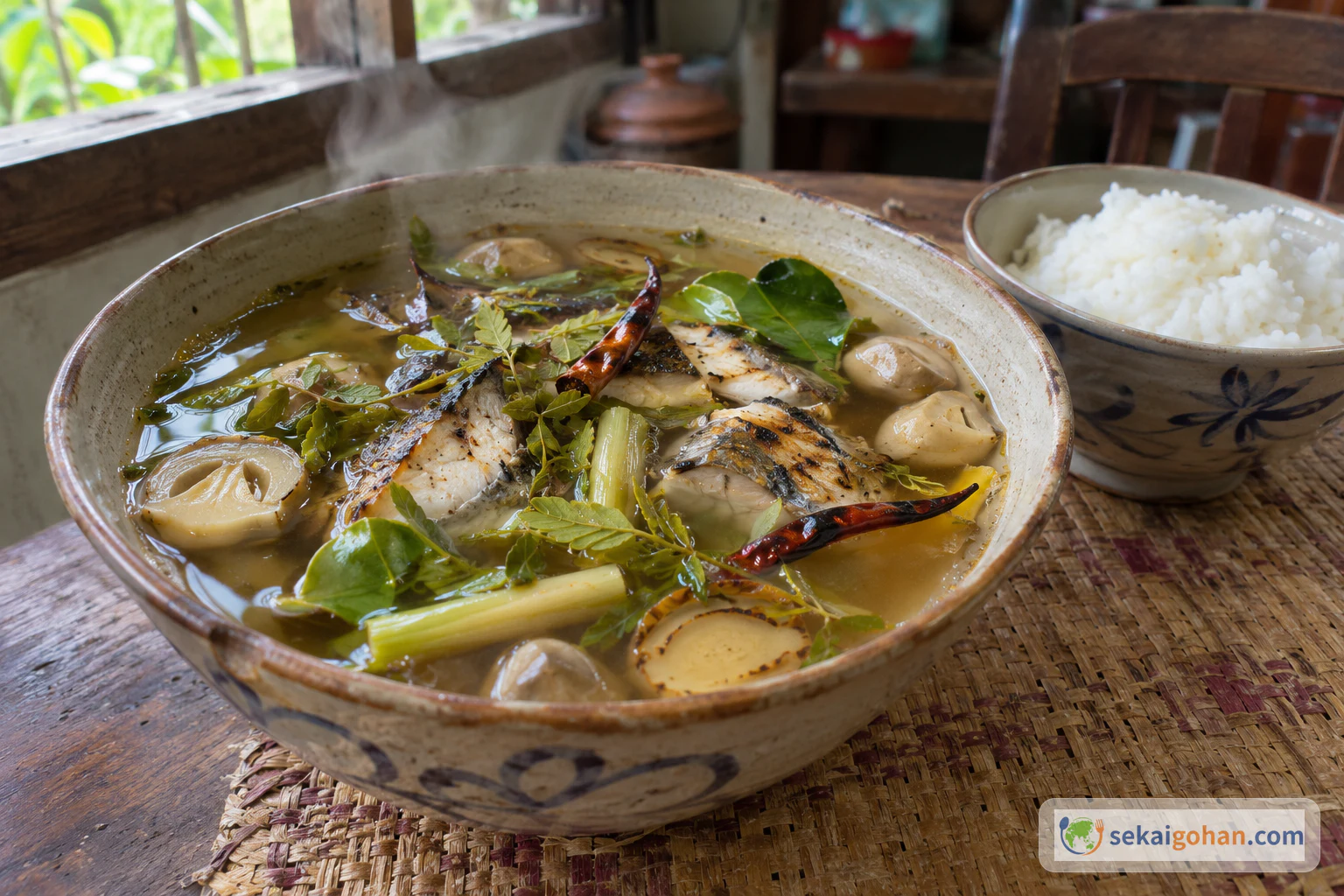
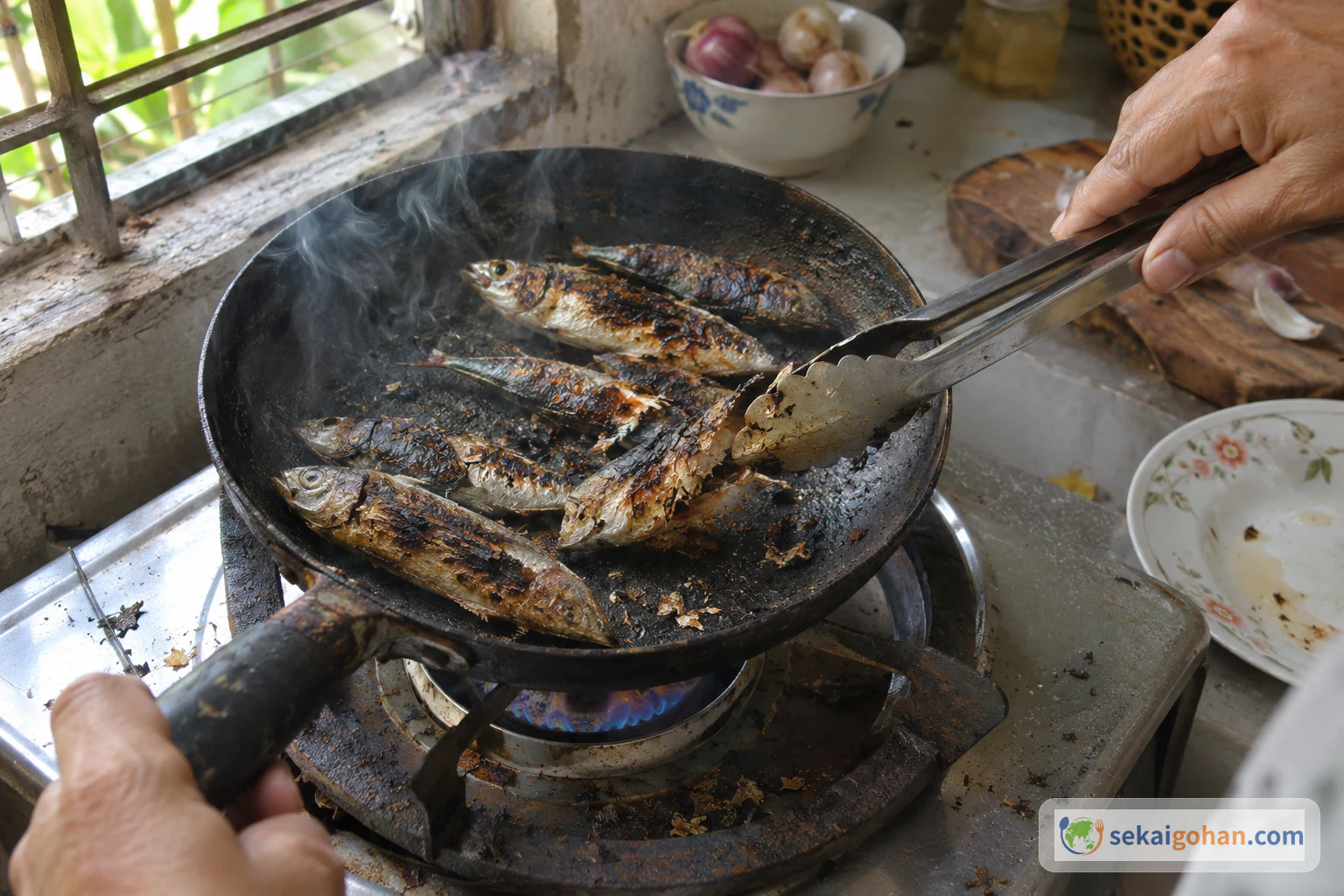
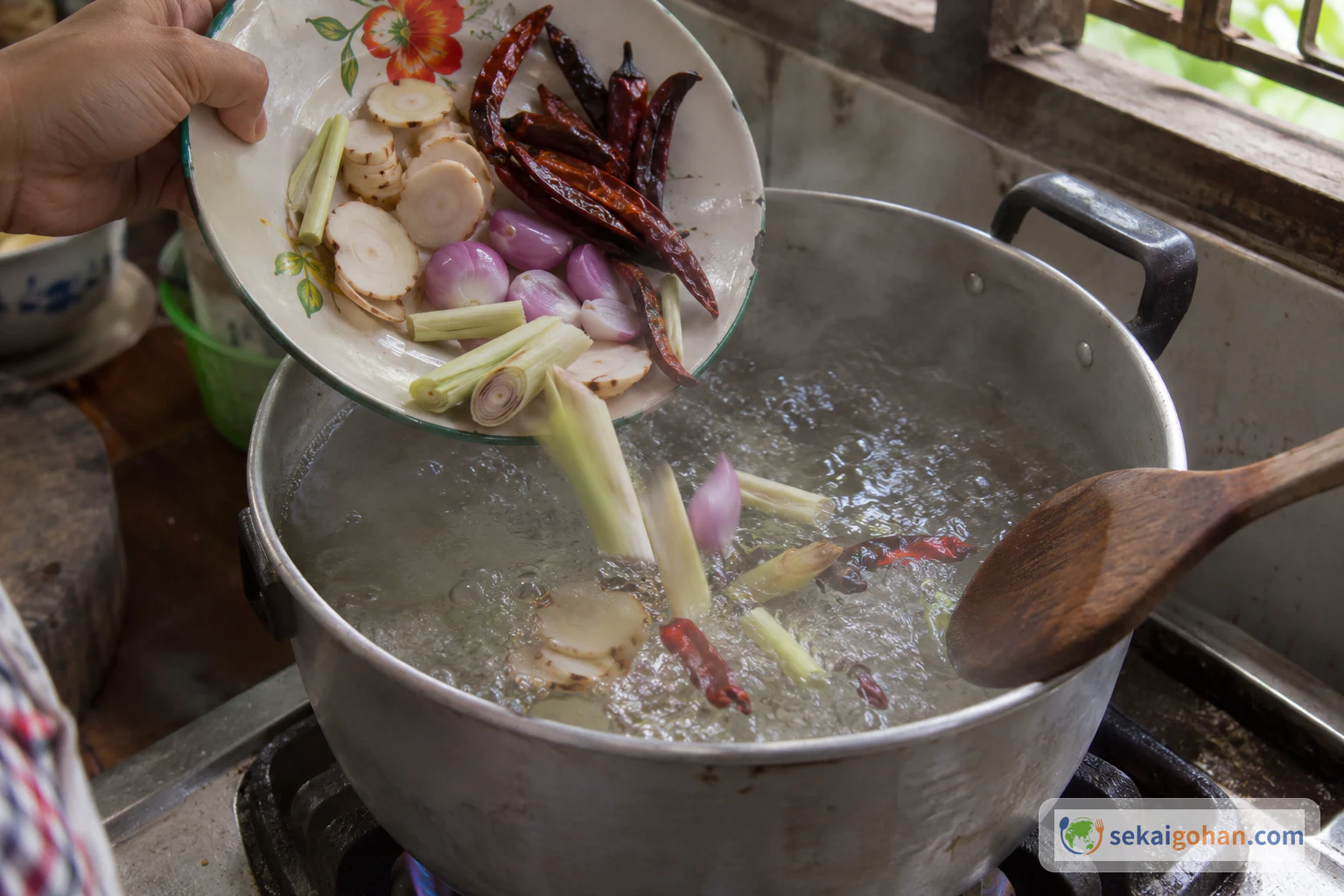
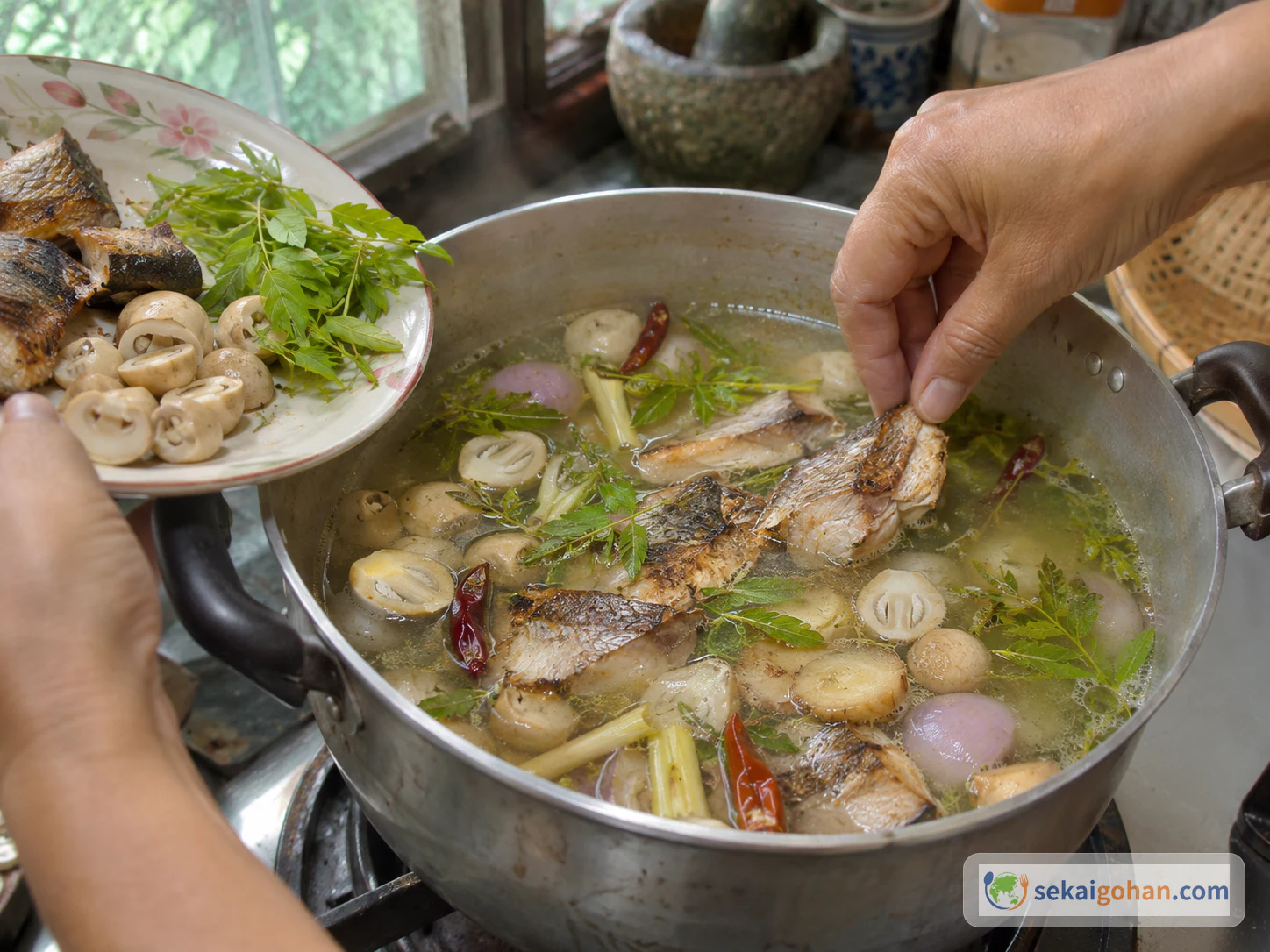
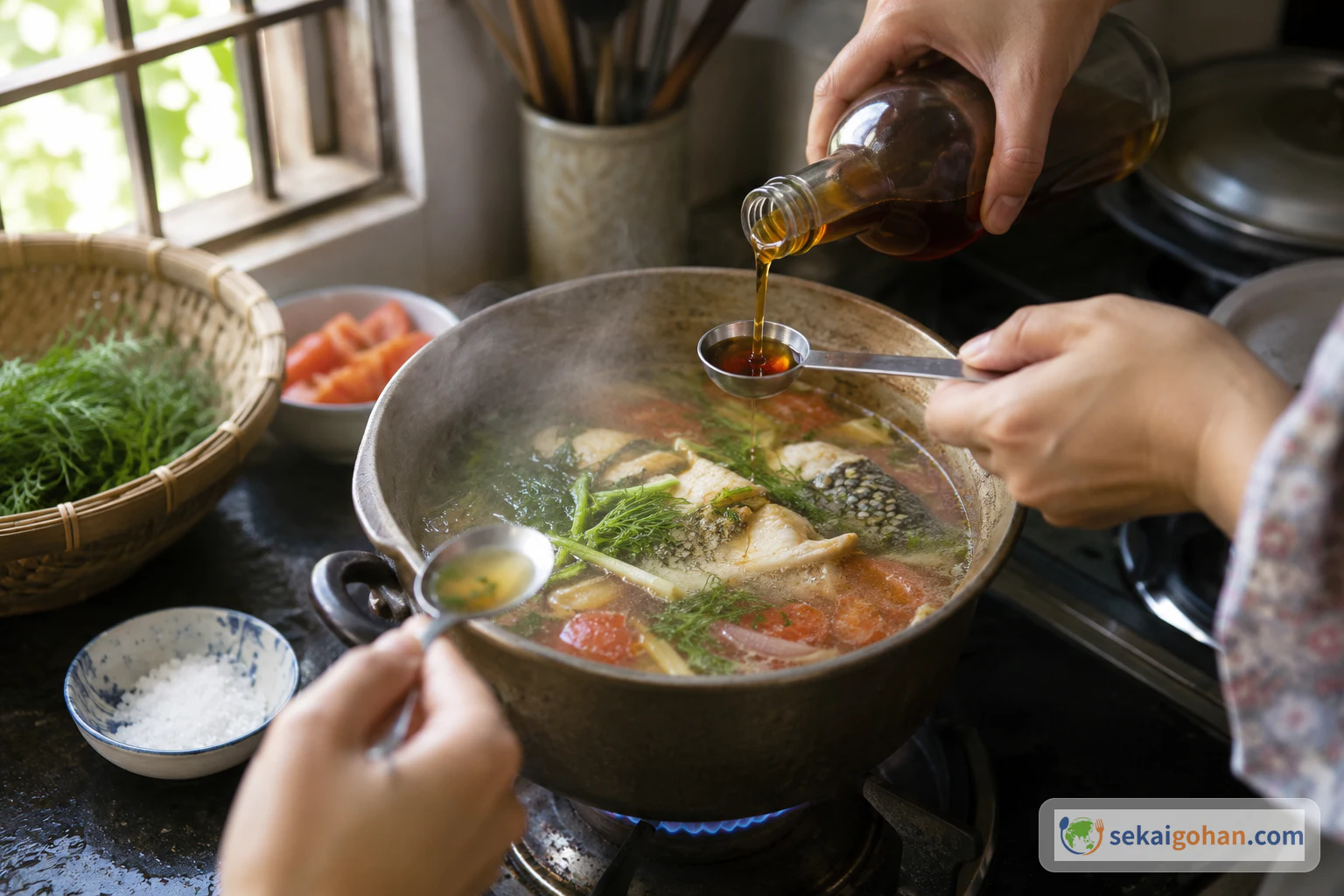
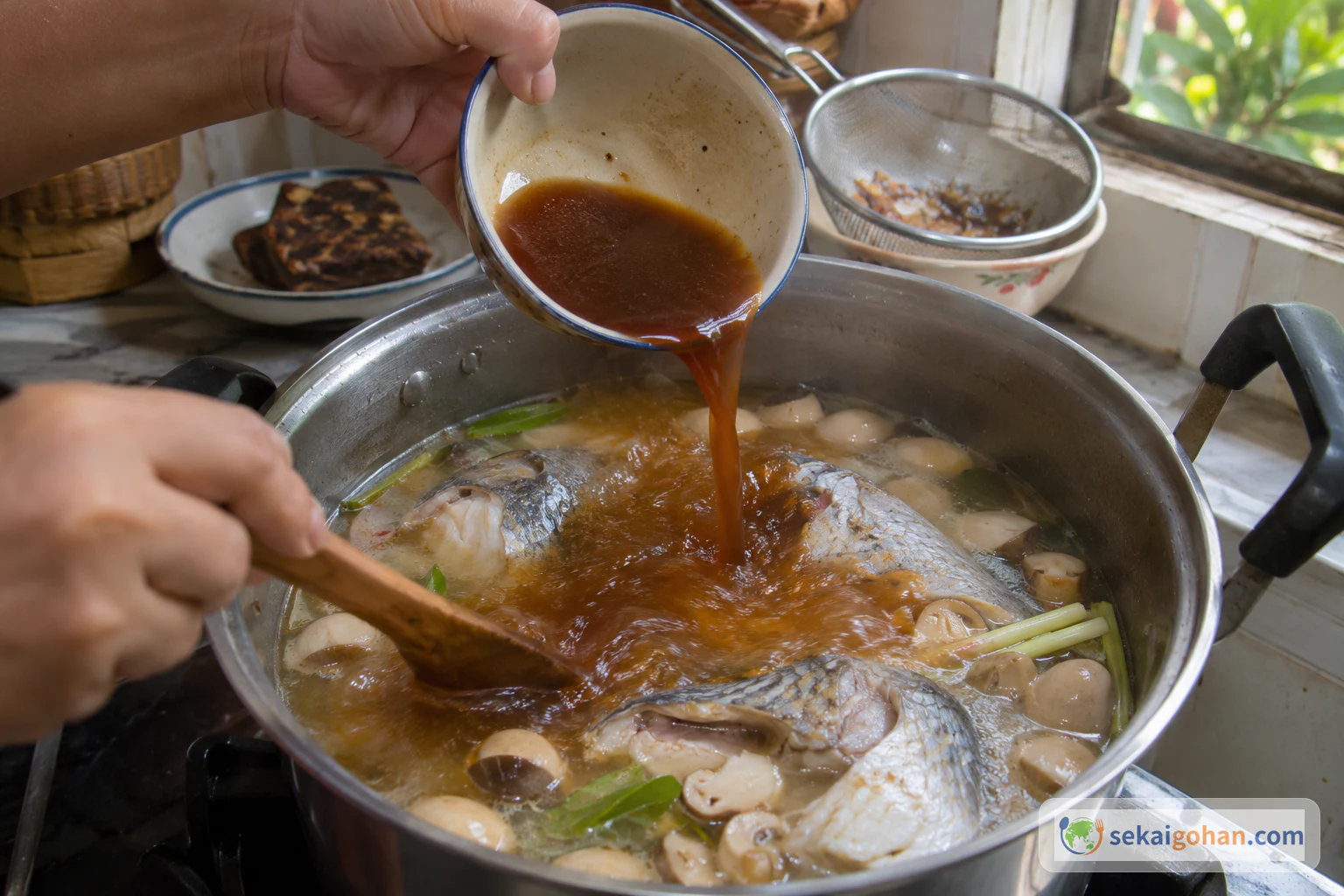
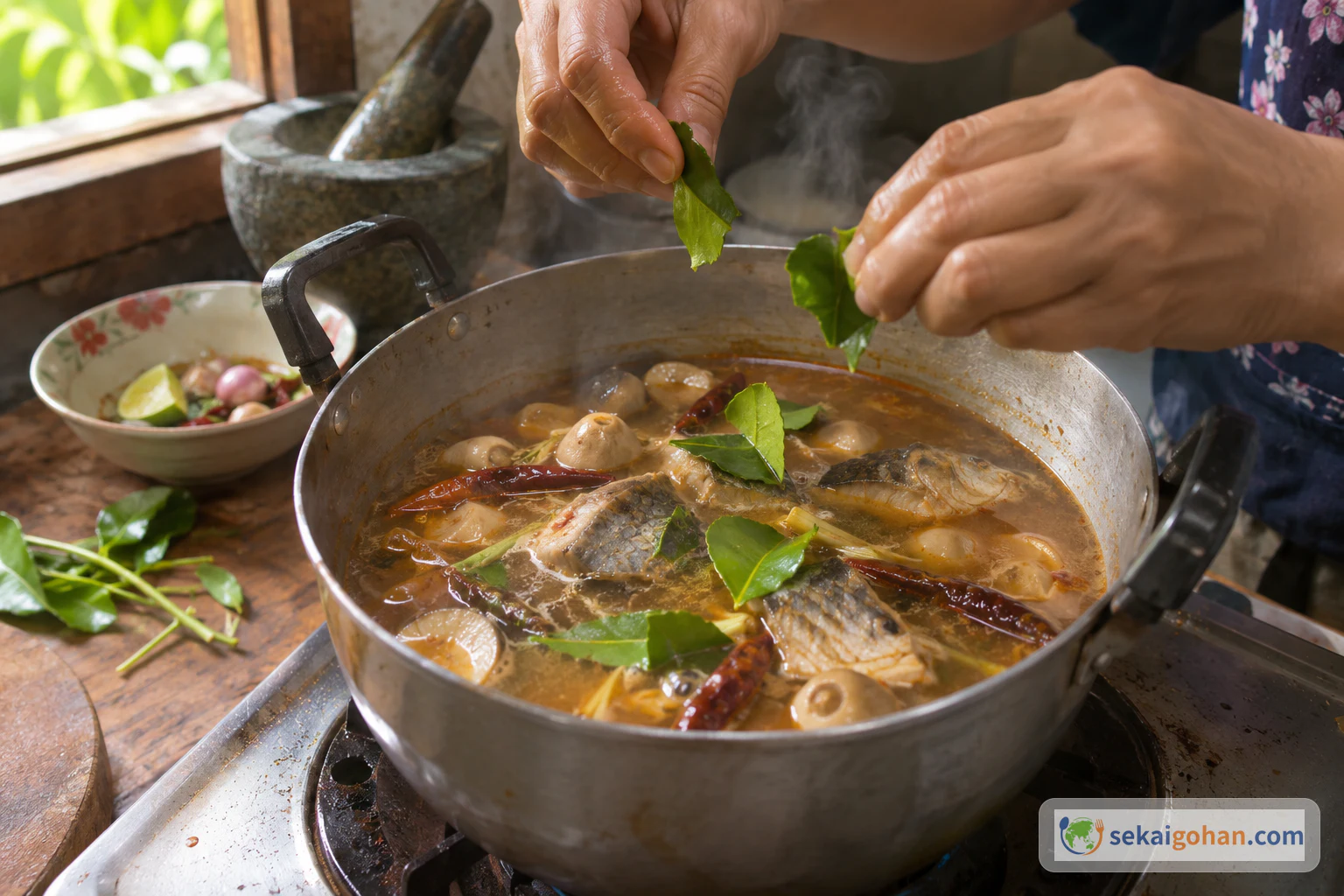
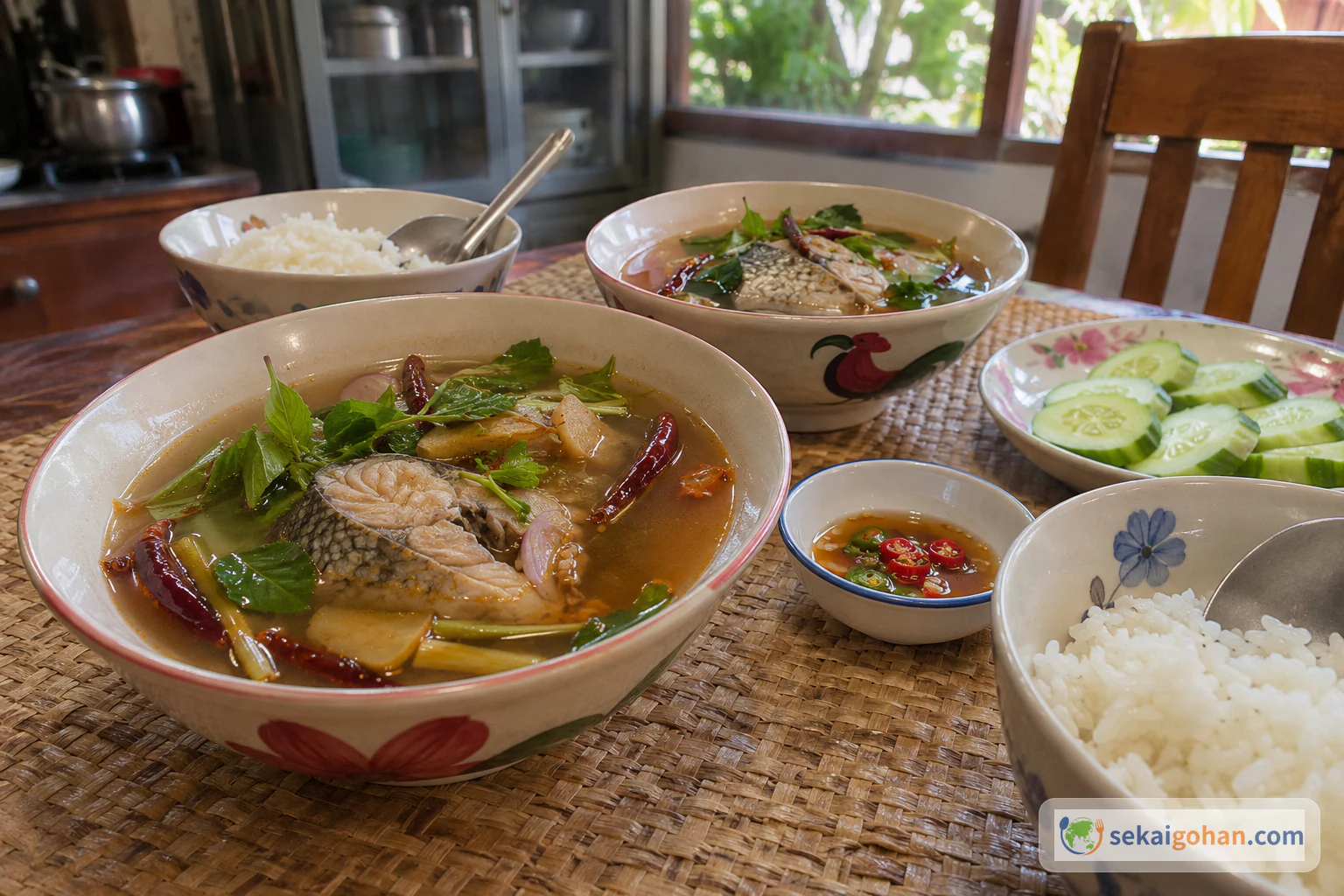
The fish goes into the dry pan already grilled, its skin blistered and dark, and it soon smells of smoke and toasted skin. Next to the stove a few dried chilies have just come out of their own short turn in a hot pan, darker now and sharp enough to make you cough. This is the start of tom khlong (ต้มโคล้ง), a Thai fish soup made with grilled fish, tamarind for sourness and roasted dried chilies for heat, with galangal, lemongrass, shallots and kaffir lime leaves steeping in the broth. It tastes salty and sour first and smoky underneath, with a light sweetness from the fish and shallots. It comes to the table steaming, next to warm rice.
Grilled Fish, Tamarind and a Dry Pantry
Tom (ต้ม) means to boil, and tom khlong sits in the same family of Thai soups as tom yum and tom kha. What sets it apart is the sourness. In the traditional version tamarind, not lime, gives the sour taste, and the flavour leans hard toward salty and sour. Tom yum balances all five tastes more evenly. The herbs and chilies here are dried or roasted, the fish is grilled before it meets the pot, and the broth carries a smoky depth that the brighter lime soups do not have.
| Soup | Where the sourness comes from | What defines it |
|---|---|---|
| Tom khlong | Tamarind water, young tamarind leaves | Grilled fish, roasted dried chilies, salty-sour flavour |
| Tom yum | Lime | All five tastes in balance |
| Tom kha | Not what defines it | Coconut milk and galangal |
| Gaeng som | Not the point of the comparison | A curry paste with turmeric, so it counts as a gaeng, not a tom |
Fish from the larder, herbs from the garden
The usual explanation for the dish is Thailand's preserved fish: salted fish, dried fish, pla ra and grilled fish kept for later. Grilled fish ended up in a pot of water, dried chilies went in with it, and a soup took shape. Everything else it needs is either a dry-store staple (crisp dried fish, tamarind paste, dried chilies, shallots) or grows by the back door (galangal, lemongrass, kaffir lime, bird's eye chilies). That made it an easier soup for an everyday kitchen than tom yum.
In Phitsanulok province it is listed as one of the local recommended dishes. There the cook often uses sea bass (pla kaphong), salted fish (pla khem) or tilapia (pla nil). One way to serve it is to make the broth on its own, grill or fry the fish separately, put the fish in the bowl and ladle the hot soup over it. In the traditional version tamarind paste gives the sourness and salt gives the saltiness. Many cooks today use lime and fish sauce instead. The dish is cooked all over Thailand, and where it began is not settled. Some people call it a northeastern dish, but that link could not be confirmed.
Households also disagree about the sweetness. One explanation says it came from shallots wrapped in banana leaf and roasted before they went into the pot. The other says the fish and shallots supplied all of it, and palm sugar or white sugar were never added. Both versions are still told. Even with the same name, one bowl can be salty from salted fish and another soft and smoky from fresh fish grilled at home, and the sour edge depends on whether it came from young tamarind leaves or paste.
A name nobody has pinned down
Nobody knows for sure where the word khlong comes from. It is often linked to an older dish name, phlong (โพล้ง), and some count tom khlong and tom phlong as the same soup. Tom khlong appears in the record Pratithinbat lae Chotmaihet of Rattanakosin Era 108, which works out to 1889 by our own arithmetic, since the text gives no Gregorian year. Tom phlong kung (with prawns) appears in Tamra Kap Khao of Rattanakosin Era 109. Tom phlong pla salit (with gourami) appears in Mae Khrua Hua Pa. Those old texts are the closest thing to a family tree the soup has.
In Thai it is ต้มโคล้ง. In English you will see tom khlong, tom klong and tom kloang, and tom khlong pla when fish is named. Another name for it is tom hok ue (ต้มโฮกอือ). Searching under several spellings turns up a lot more home cooking. For the wider Thai table, see Thai cooking.
Ingredients (serves 4)
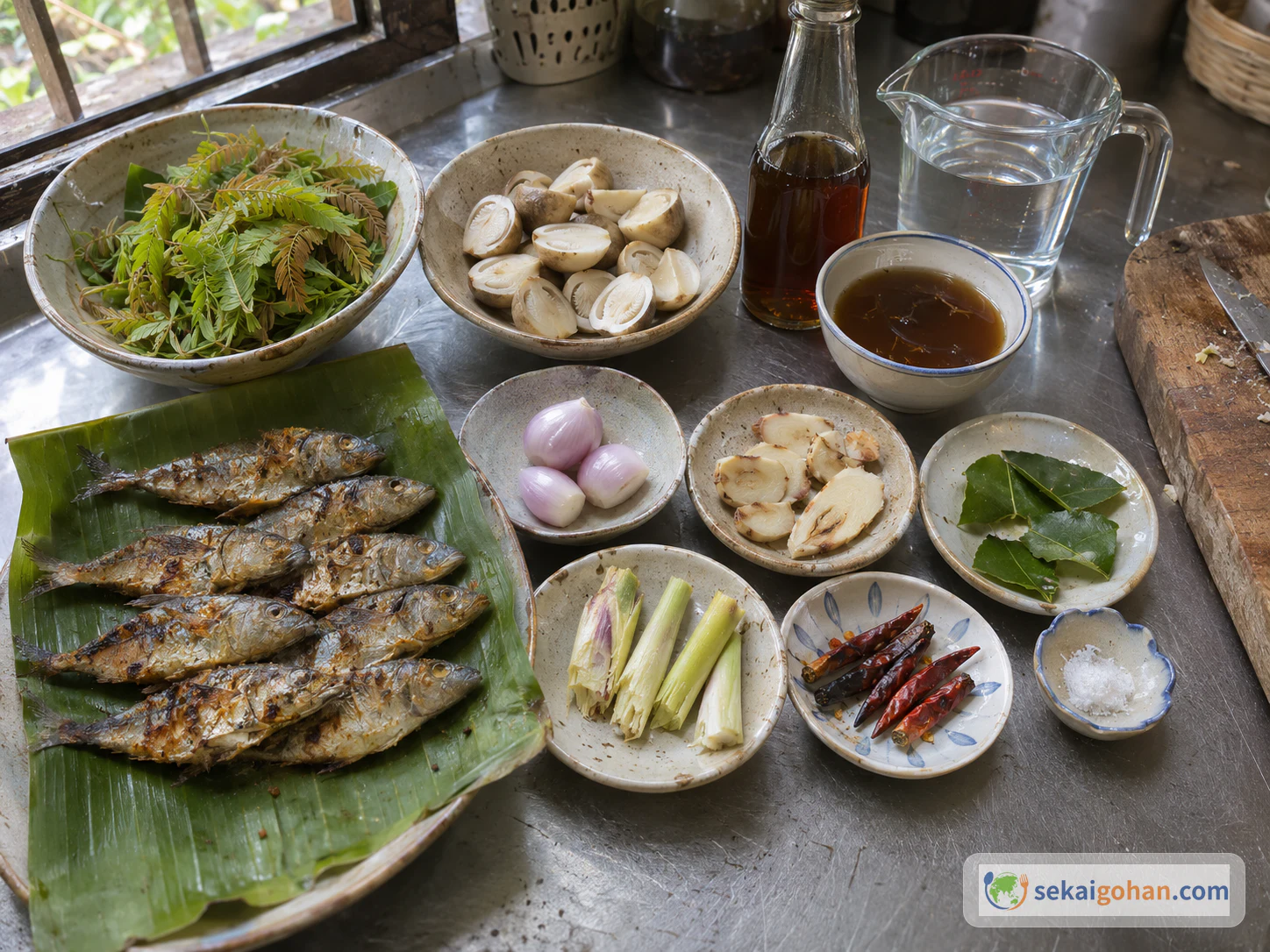
Tamarind blocks and concentrates differ a lot in strength. Dissolve a block in hot water and push it through a strainer, or thin a concentrate with a little water. Add it to the pot a little at a time. The soup can always take more sourness later, but you can't take it back out.
Tom khlong contains fish and fish sauce, mushrooms, and kaffir lime leaves, which are a citrus. The ingredient list has no dairy, egg, wheat or peanut.
Equipment
- A saucepan of about 2 quarts (2 L), big enough for 5 cups of water and eight fish
- A fish grill or a frying pan with a wide base for re-toasting the fish
- A small dry pan for toasting the chilies
- Measuring cups and spoons
- A wooden spatula that won't break up the fish
- Kitchen scissors for cutting the grilled fish and snipping out small bones
- A kettle of hot water for topping up the broth
Choosing and Substituting
The fish. Use eight small fish, grilled. Horse mackerel, salt-grilled, gives off fat and makes a richer broth. Sardines, also eight, work the same way. Sea bass fillets, roughly 14 oz (400 g) as a rough guide for the eight fish, taste mild and clean, close to the soft freshwater fish used in Thailand, and have fewer bones. If you use salted fish, it brings a lot of salt, so cut back on the fish sauce.
Tamarind paste comes as a block or a concentrate from Asian grocers and online. It is the tart cooking paste, sold apart from the sweet tamarind candy. It carries the whole sour side of the dish, so keep the tamarind and keep the chilies toasted. Change either one and you are making a different soup.
| What to look for | Supermarket or freezer swap | What changes |
|---|---|---|
| Galangal | Frozen galangal; ginger at a pinch | Ginger is hotter and has none of galangal's sweet, piney scent |
| Lemongrass | Frozen or dried lemongrass | Dried is weaker; simmer it longer to draw it out |
| Kaffir lime leaves | Frozen leaves; a little lime zest if you have none | Zest turns bitter easily |
| Dried bird's eye chilies | Other small dried red chilies, adjusted by count | The heat hits more directly |
| Straw mushrooms | Shimeji, maitake or canned straw mushrooms | The aroma shifts; leave the can liquid out |
| Shallots | Small red onions | Sweeter, with a lighter aroma |
| Young tamarind leaves | Leave them out and use tamarind water for the sourness | The green note goes and the sourness gets rounder |
| Fish sauce | Any fish sauce | Brands differ in saltiness, so taste as you add it |
Method: Salt First, Then Sour
Allow twenty minutes for prep and twenty at the stove. Do the knife work and chili toasting first, then re-toast the fish, because once the water boils, things move quickly. The fish goes in, the seasoning follows as soon as the fish starts to soften, and the lime leaves come last. Taste at every stage, and keep the kettle hot to top up the broth if it cooks down.
When It Goes Wrong
| What you see | Why | What to do |
|---|---|---|
| Sour but thin and flat | The tamarind went in before the salt was set | Add fish sauce first, taste, then adjust the sourness. Keep to the salt-then-sour order |
| A fishy smell lingers | The fish wasn't re-toasted enough, or the herbs were cut back | Never skip re-toasting, and keep the full amount of galangal and kaffir lime leaves |
| The fish has melted away | It was cooked too long or stirred | Stop when the fish starts to flake, and shake the pan rather than stirring |
| The aroma is muddy | The lime leaves boiled too long | Add them last and turn off the heat once their scent rises |
| Too hot | Too many chilies for your taste | Use fewer chilies next time, but still toast the ones you use |
| Too salty | The fish sauce is a salty brand | Thin with hot water, and use less fish sauce next time, relying on the toasted fish for depth |
| Tamarind too strong | The paste is concentrated | Dissolve and strain the paste first, then add it in small amounts |
Serving, Variations and Storage
At the table
Tom khlong is served hot, with warm rice, and it works as the centre of a meal. Each person spoons broth over their rice and picks out pieces of fish. The broth is the point, so serve it in deep bowls with plenty in each. For a different presentation, grill or fry the fish separately, set it in the bowls and pour the boiling broth over it at the table.
Variations
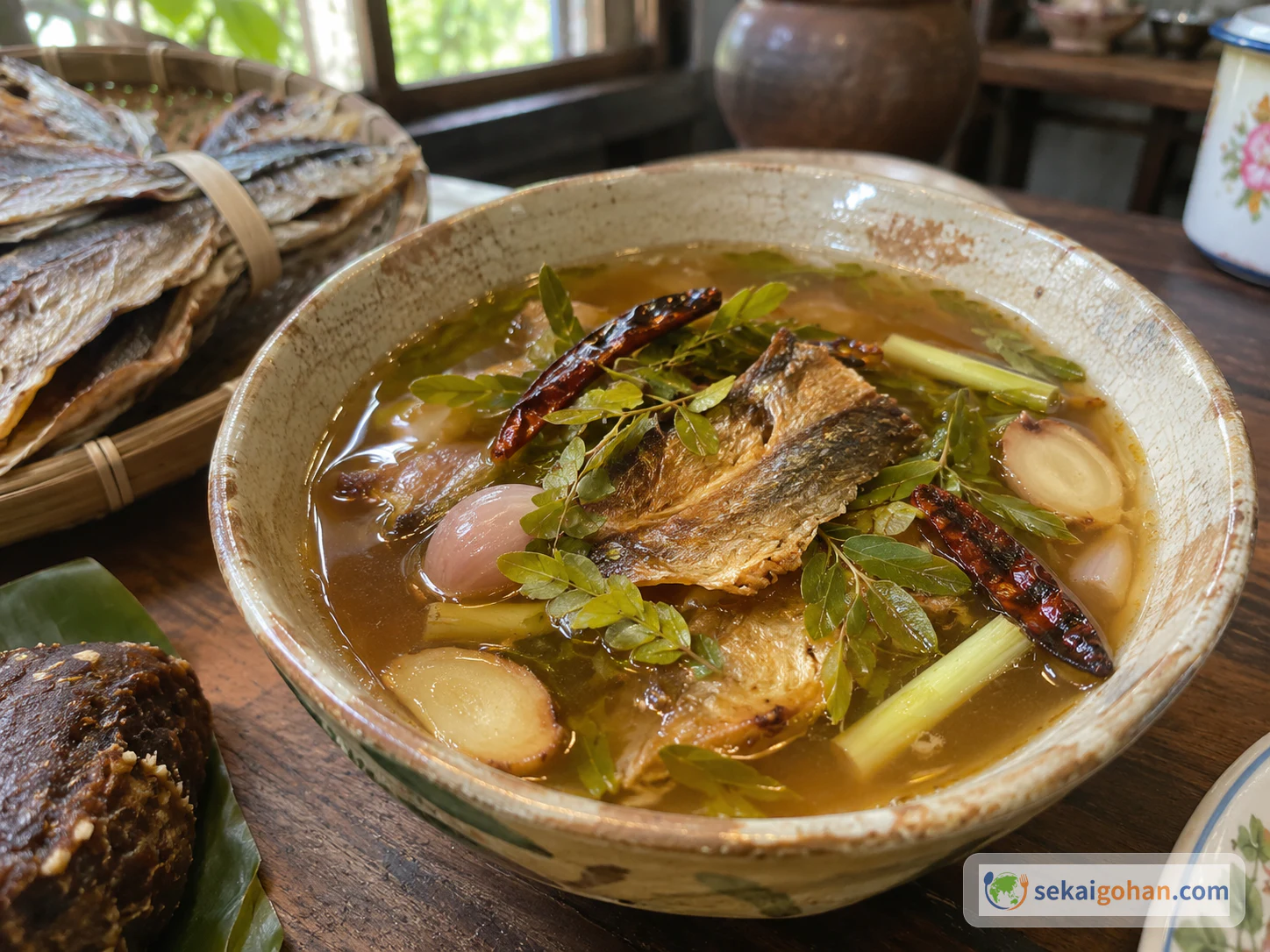
With dried fish. This version stands on its own with its own amounts, for 2 to 3 people. Wash about 10½ oz (300 g) of dried fish, grill it until fragrant and cut it small. Simmer it in 3 cups of water with 5 to 6 shallots, 1 cup of young tamarind flowers or leaves and 5 chilies. Season with 1 tbsp salt or 2 to 3 tbsp fish sauce, and add lemon juice to taste. It comes out saltier and more concentrated, with a sharper sour edge from the lemon.
With salted fish. Salted fish sets the salt level by itself, so cut back the fish sauce and salt. Add water to adjust as you taste.
Finished with lime. For the modern style, squeeze in lime after the heat is off and season with fish sauce. The sourness becomes sharp and bright instead of round.
Milder. Use fewer chilies than 5 for children or older eaters, and toast them just as carefully so the smoky edge stays.
Storing leftovers
Let leftover soup cool, then refrigerate it in a clean, covered container. Before eating, reheat it until it is hot all the way through to the centre. Warm one portion at a time in a small pan over gentle heat, because the fish breaks up easily.
Frequently asked questions
Can I make tom khlong without tamarind?
Tamarind is the main sour flavour, and nothing else gives quite the same round sourness. Lime with fish sauce makes the modern version, which is a brighter, sharper soup. If tamarind leaves are missing but you have paste, you can still make the dish.
Can I start with fresh fish instead of fish that is already grilled?
Yes. In Thailand smoked or grilled fish is the most common choice, but fresh fish works too. Grill it until the skin is browned and fragrant, then follow the method from step 2 so the smoky flavour still goes into the broth.
How do I make it less salty?
Use less fish sauce and let the toasted, grilled fish carry the depth instead. Taste after step 5 and thin with hot water if needed. If you use salted fish, cut the fish sauce from the start.
Is anything in it raw or home-fermented?
No. The fish is grilled, re-toasted and then simmered until the flesh is white and opaque right through. Fish sauce is a fermented seasoning, but you buy it ready-made, and nothing in the recipe is fermented at home.