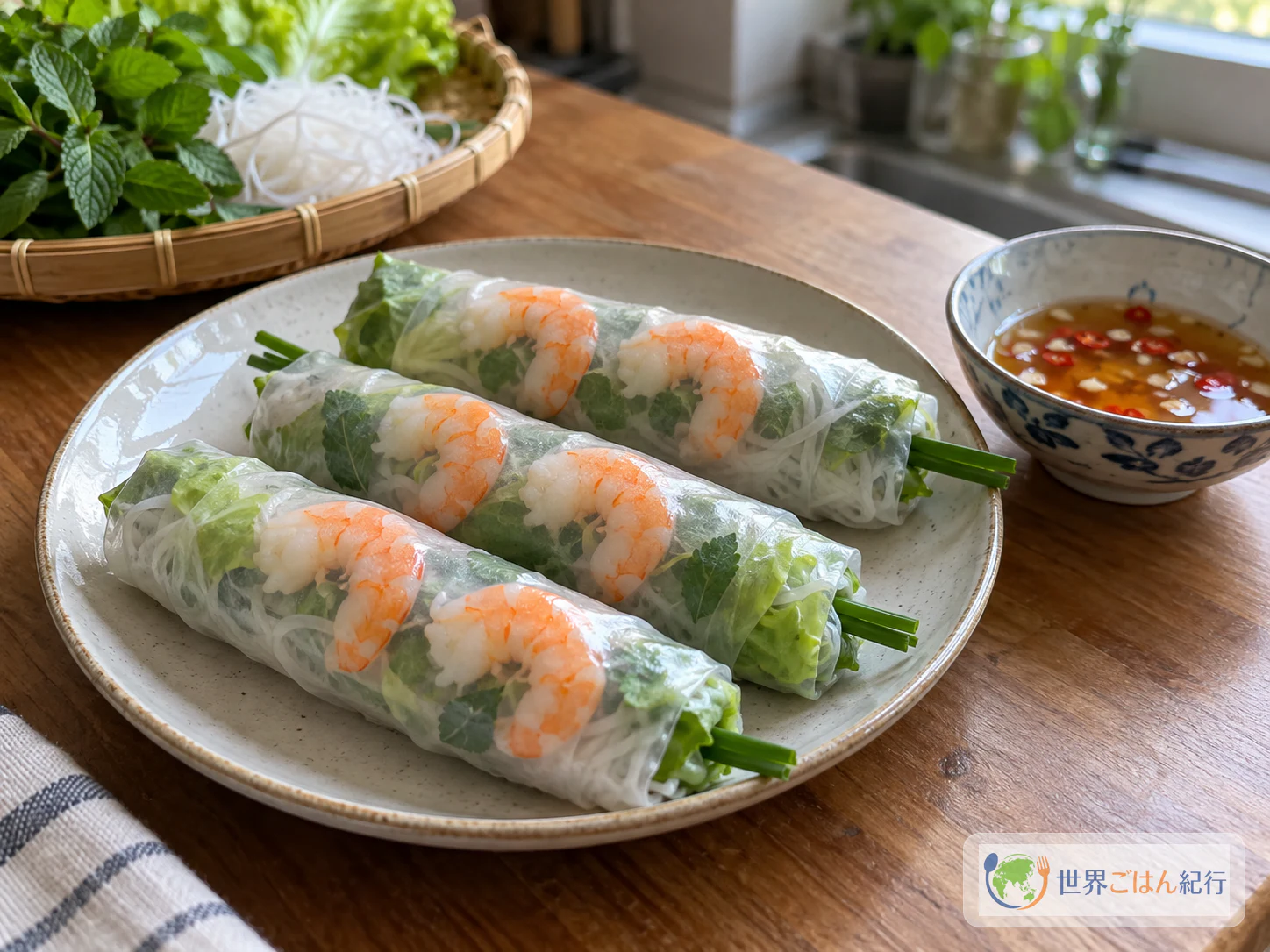
Gỏi Cuốn: Colors Showing Through a Translucent Wrapper
The pork, shrimp and noodles go in cooked and cooled, with washed, dried raw lettuce and herbs; the wrapper is wet only briefly, and the rolls are made just before eating. Keep the filling modest so one turn of rice paper closes around it.
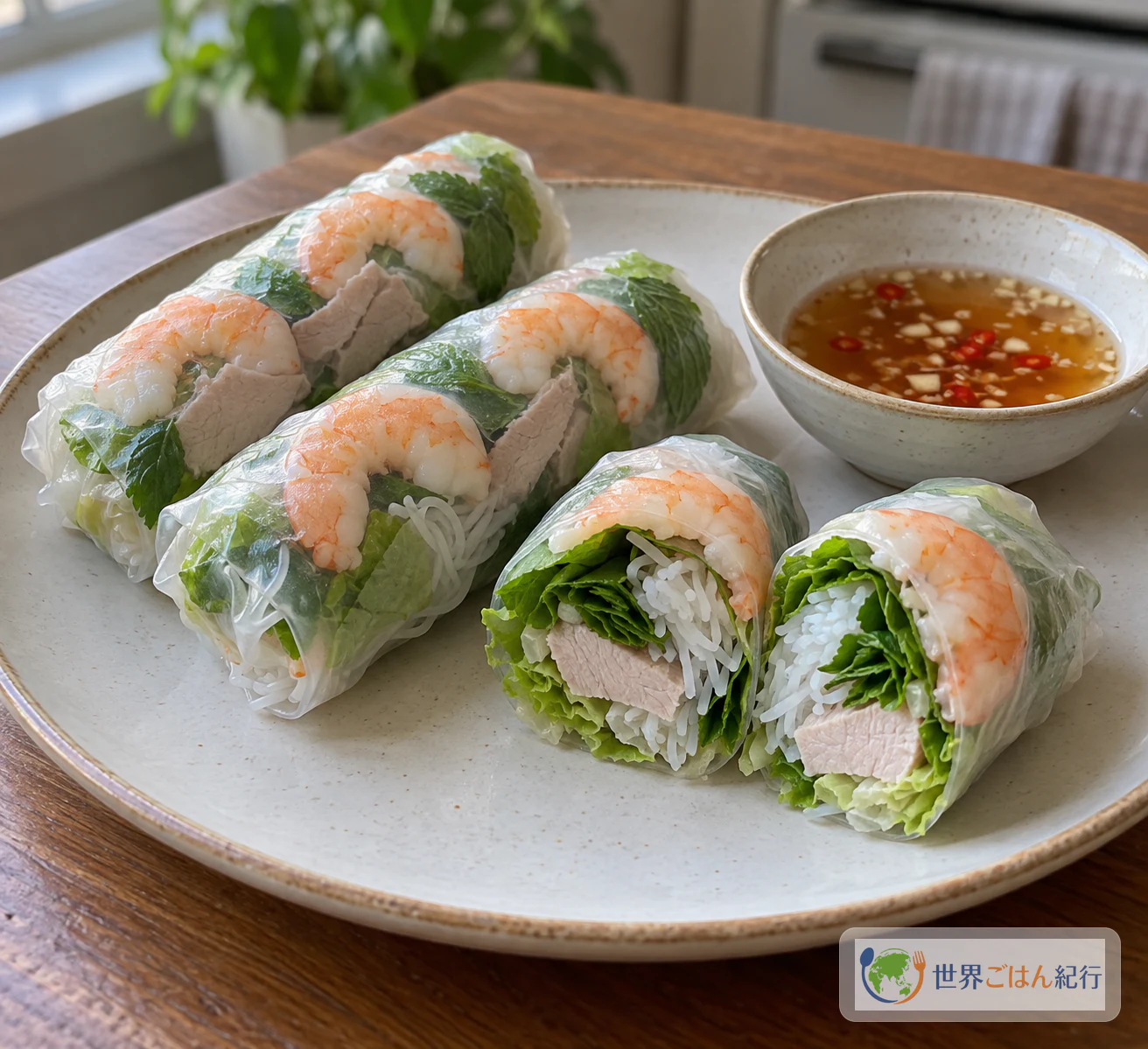
Through a thin, nearly clear sheet of rice paper you can see the pink of halved shrimp, the green of lettuce and herbs, and the white of fine rice noodles. Dip a roll into a sweet, sour and salty fish-sauce sauce, and the soft wrapper, springy noodles, mild shrimp and pork, and cool herbs all arrive in one bite. Vietnam's national tourism authority introduces gỏi cuốn through the childhood memory of someone from Ho Chi Minh City, who ate these rolls as an after-school snack.
Gỏi cuốn is a rolled dish known in southern Vietnam: moistened rice paper (bánh tráng) wrapped around rice vermicelli (bún), cooked shrimp, cooked pork, and leafy greens and herbs, then eaten as is, without frying. That makes it a different dish from chả giò, the Vietnamese spring roll that is wrapped and then fried.
This recipe is built for a home kitchen: 12 rolls, enough for 4 people as a light dish, based on a published recipe by Luke Nguyen and scaled from its original 18 rolls. Rather than following the clock, you will judge each wrapper by how it looks and feels, so the steps describe what to watch for at the moment of rolling. It is not presented as the one true version of the dish; households and shops vary the fillings and especially the dipping sauce.
Ingredients for 12 Rolls (4 Light Servings)
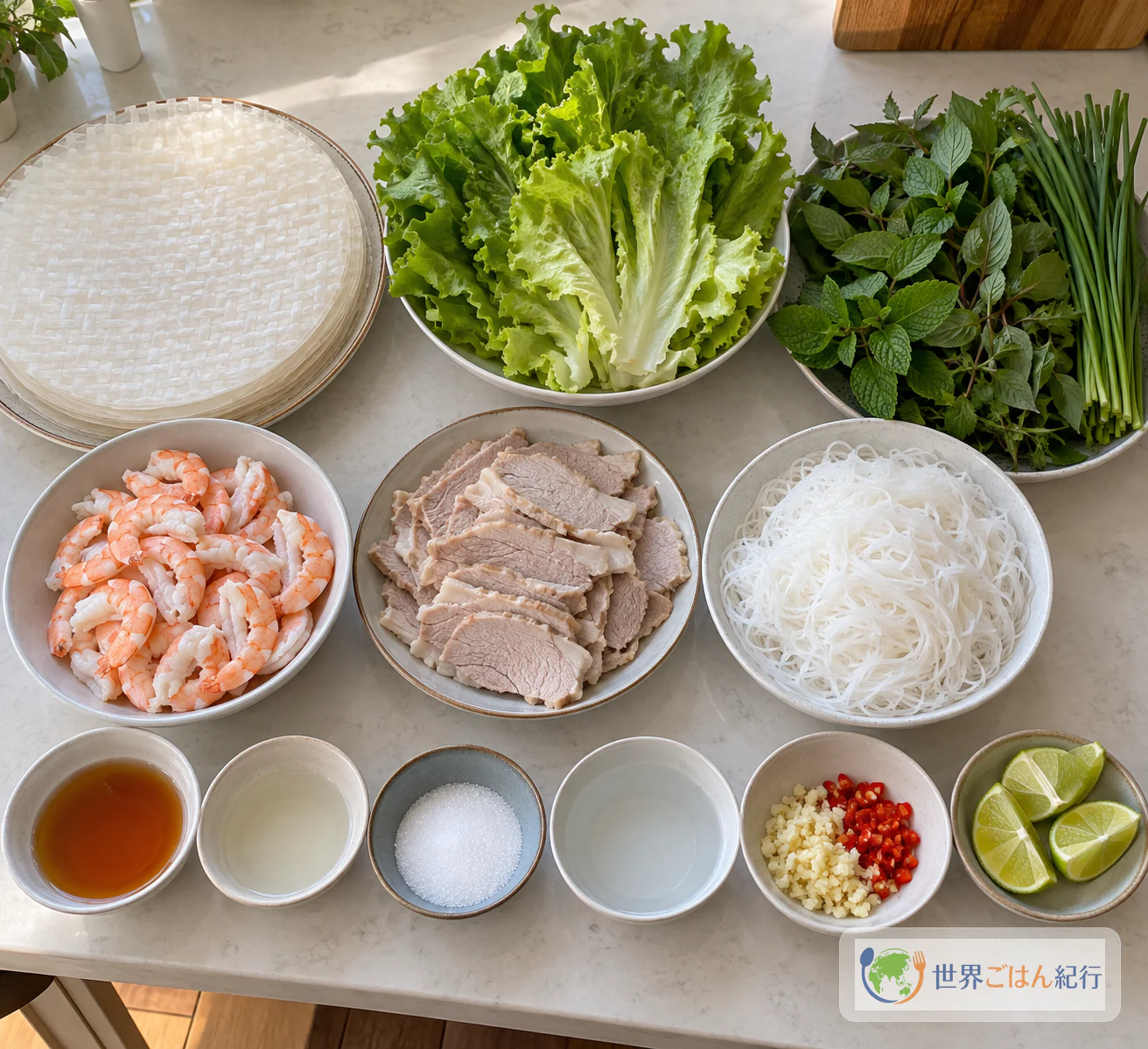
Rolling shrimp, pork, noodles and herbs together gives each its job: the noodles and wrapper are soft, the shrimp and pork add gentle savoriness and some bite, and the herbs bring a cool, fresh aroma. The amounts below are two-thirds of a batch that makes 18 rolls for 6 people. The pork in particular looks small, but it is spread thinly and evenly across 12 rolls as a light snack.
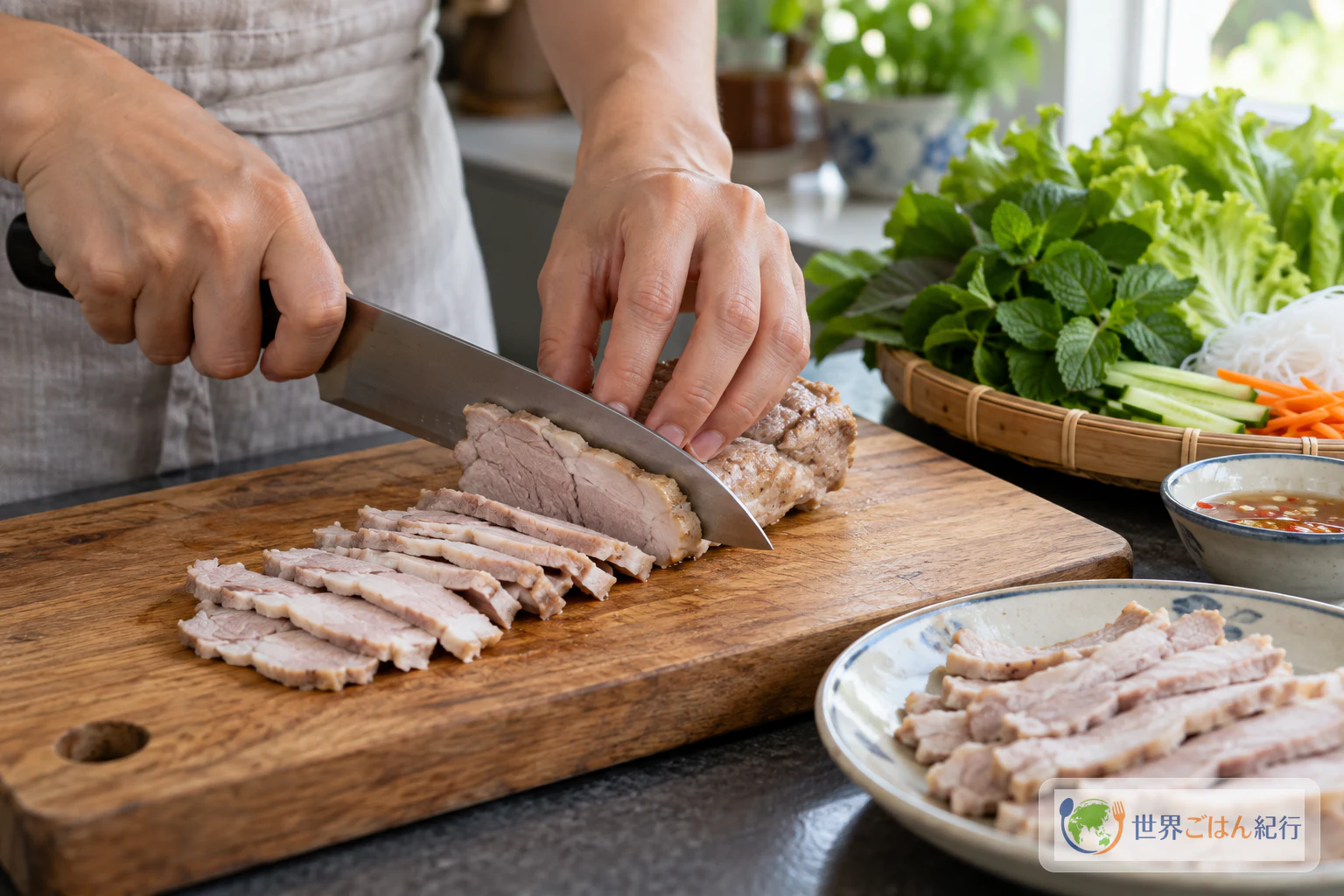
If you buy pork as a raw piece, it will shrink as it cooks; a raw piece of roughly 100–150g is a practical size to buy, and you then use about 76g of the cooked, sliced meat across the 12 rolls.
This recipe contains shrimp (a crustacean) and fish sauce (fish). If you serve a peanut-based sauce, it also contains peanuts. Check the labels on rice paper and rice noodles for their ingredients. The pork and shrimp are always cooked before rolling; never roll raw meat or raw shrimp.
Equipment
- A large flat plate or shallow tray, for wetting one wrapper at a time
- A clean flat plate or cutting board for rolling
- Separate cutting boards and knives for raw pork and shrimp, and for washed vegetables and cooked fillings
- A small food thermometer, for checking the pork
- A pot for cooking the pork and shrimp, and a small saucepan for the dip
- A fine colander for draining the noodles
Choosing and Substituting: Wrapper, Noodles and Herbs
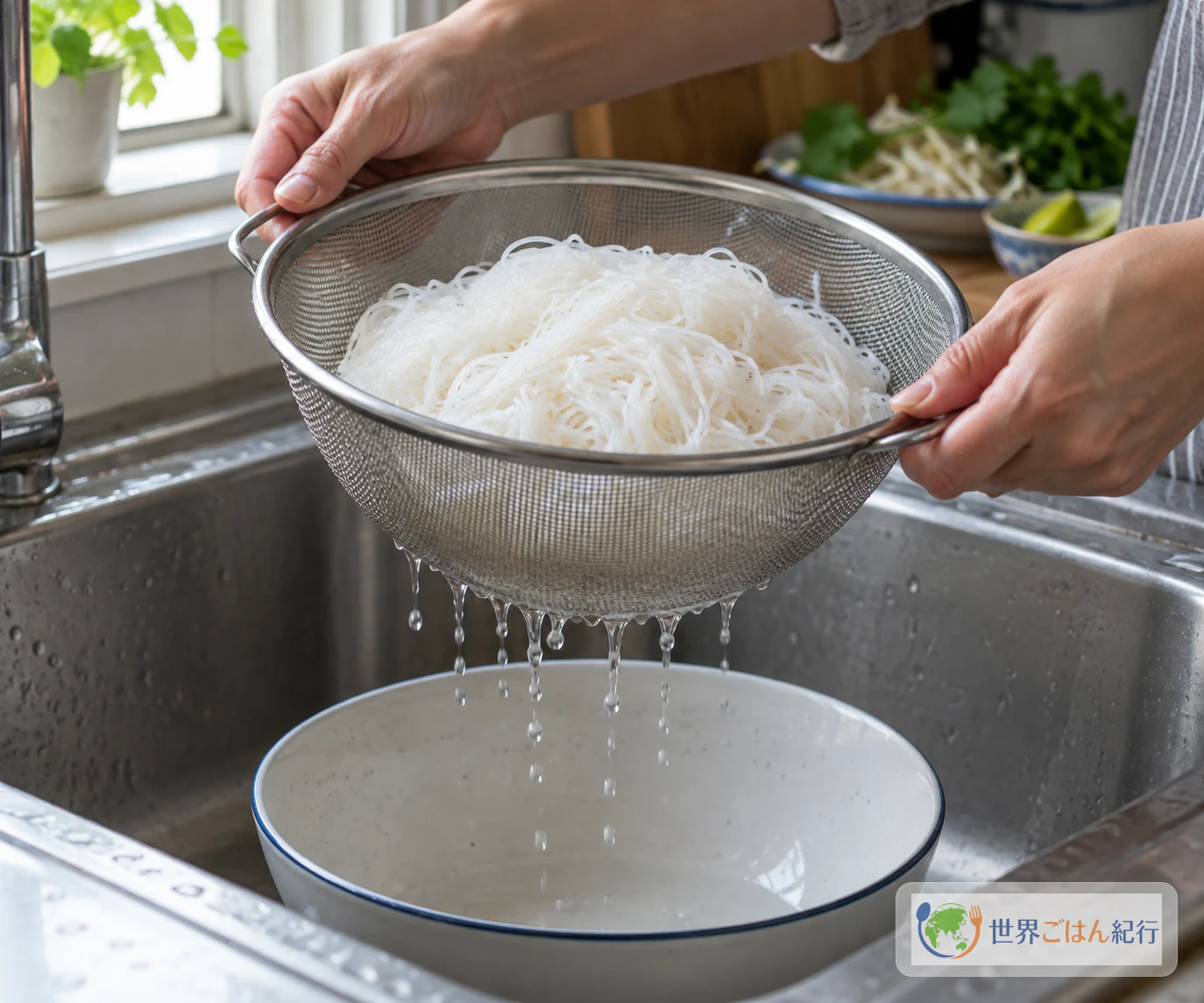
The two specialty items to look for are round rice paper and thin rice noodles. Check the diameter and the ingredient list on the package (rice, tapioca and so on). Follow the package directions for the noodles; thick rice noodles are harder to roll and change the texture.
Herbs. Use mint and perilla. In Vietnamese, rau thơm is the general word for fresh herbs, not another name for perilla or cilantro. If you cannot find perilla, Japanese shiso is a home substitute, but its aroma is stronger and different. Cilantro is a separate option that takes the rolls in another direction. You can use any one of these or mix them, but none is an exact match; if you can find perilla or other Vietnamese herbs, use those first. Leaving all herbs out still gives you a roll, but the cool, fresh layer becomes much weaker.
Garlic chives. Scallions can stand in, but their aroma is milder.
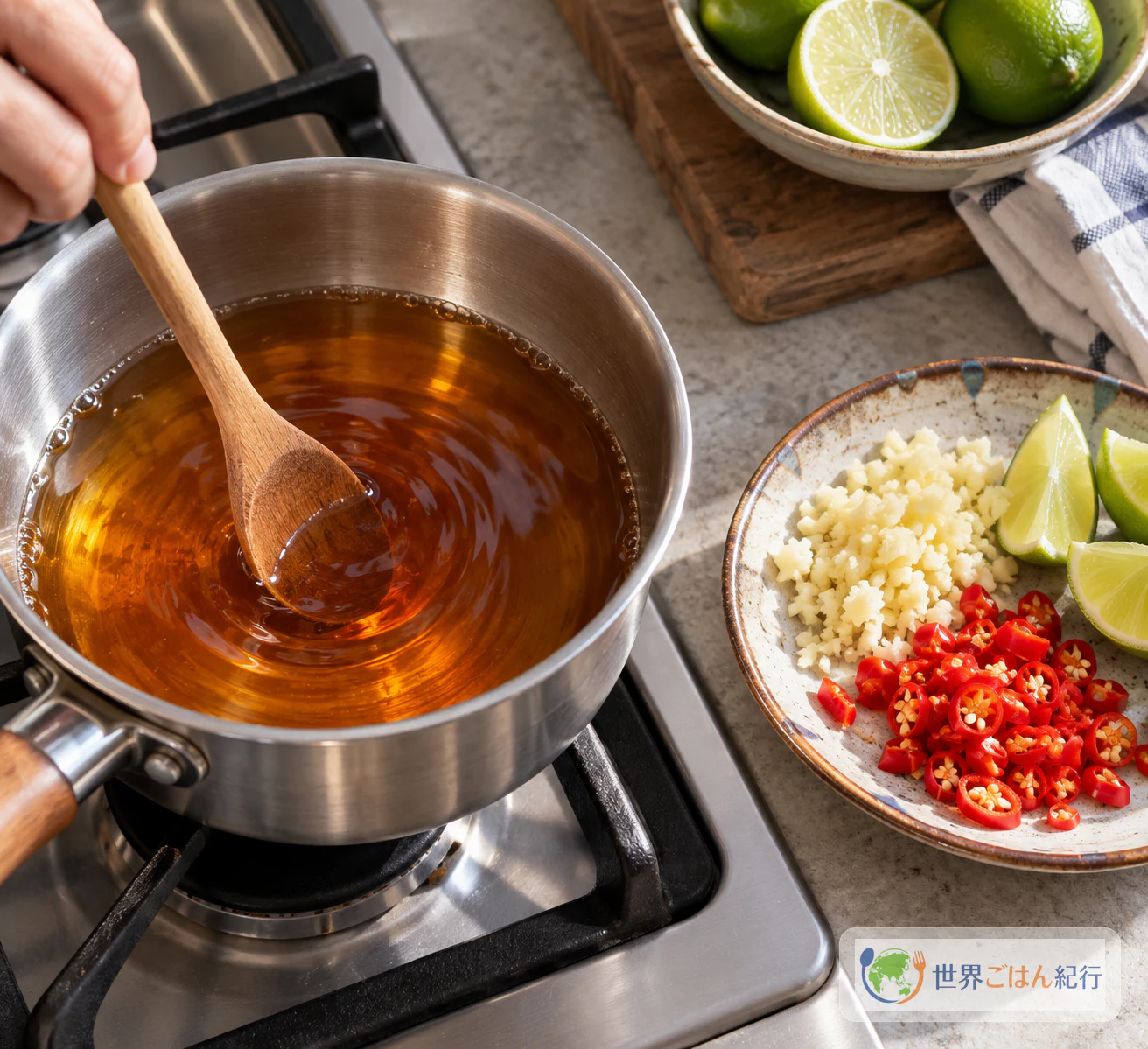
Fish sauce. It is the core of this dip, giving salt and savoriness. A soy-and-citrus sauce can be used by people who avoid fish, but it lacks the fermented depth of fish sauce and is a different sauce, not a substitute version of this one. Fish sauce brands differ in saltiness, so taste as you go.
Method: Cook, Cool, Then Roll
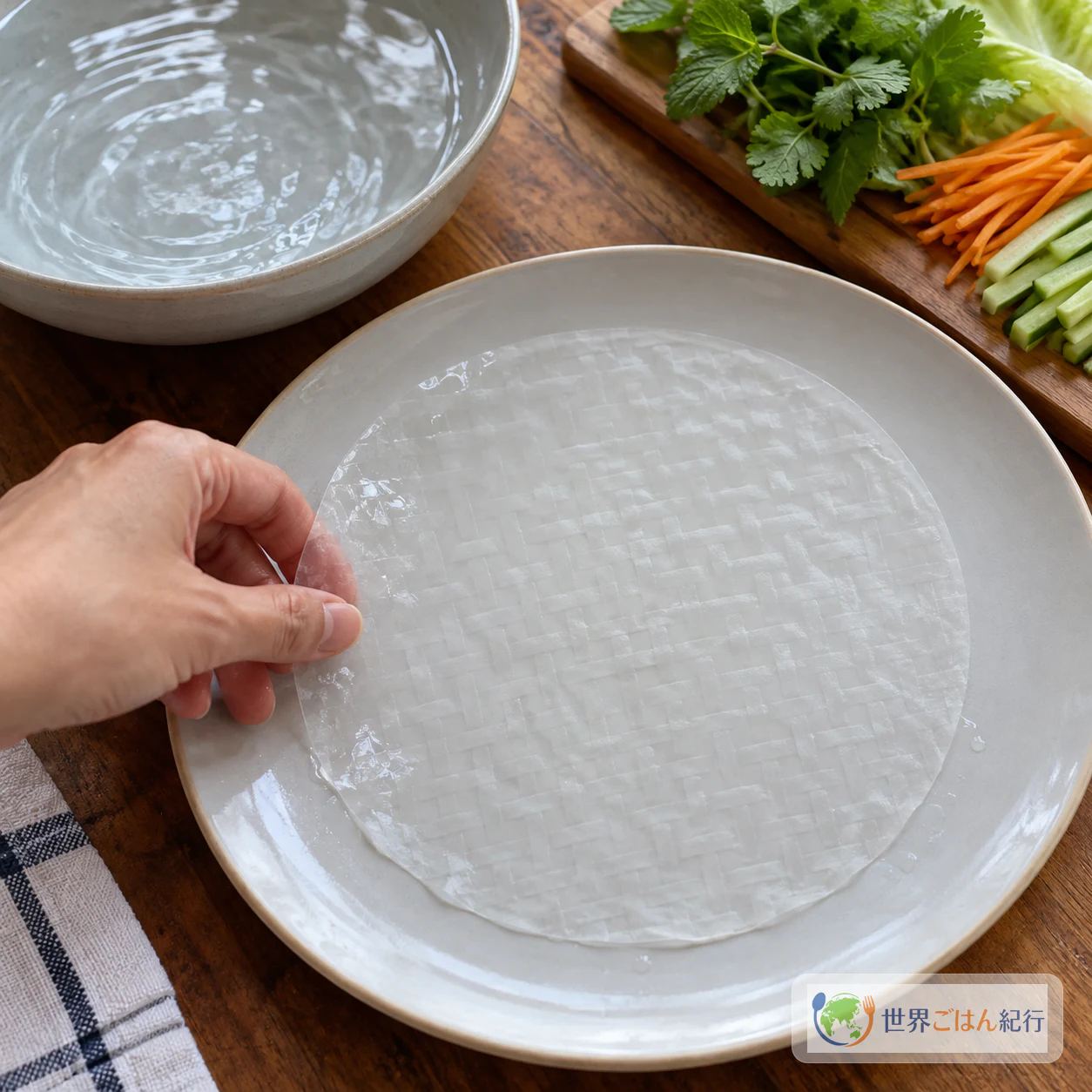
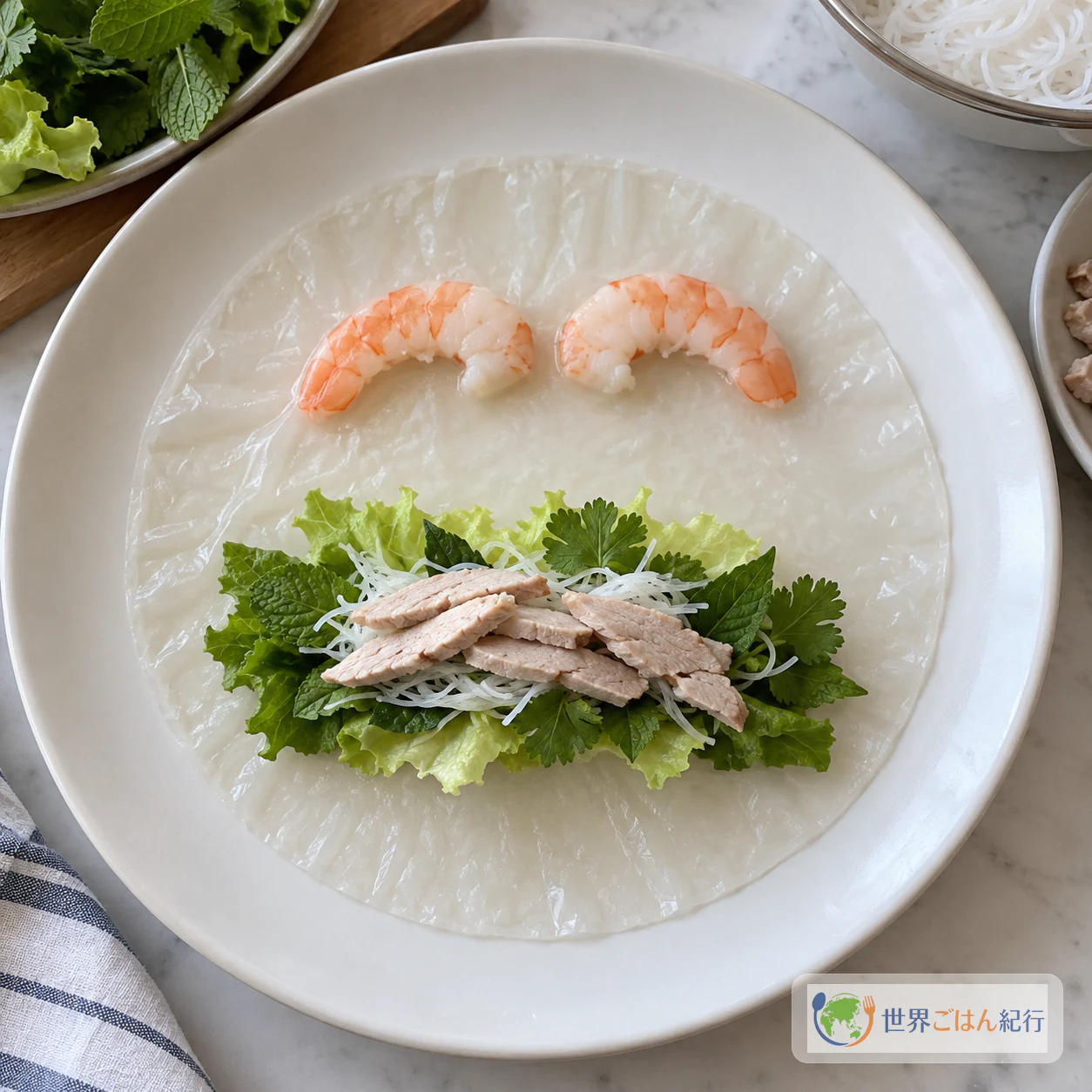
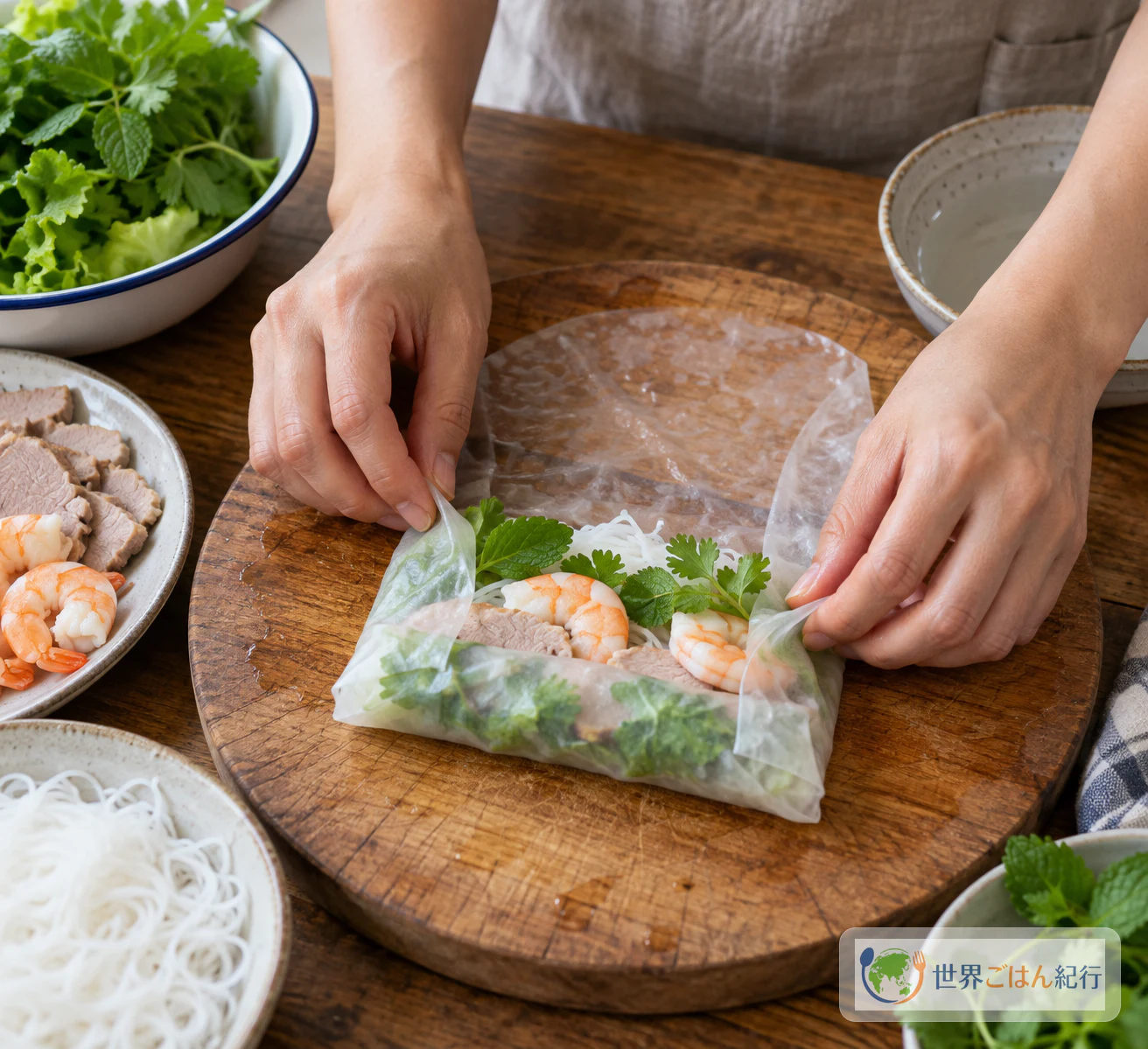
Cook and cool the pork, shrimp and noodles, and wash and dry the lettuce and herbs first; then make the dip, and only then start wetting wrappers. Rolling goes smoothly when everything is within reach.
Torn, Sticky, Unrolling: Fixing Common Problems
| What happens | Likely cause | What to do |
|---|---|---|
| The wrapper tears | Too much filling, wrapper soaked too long, or rolled while still dry | Reduce the filling, wet the wrapper only briefly per the package, and wait for it to soften on the surface |
| The wrapper sticks | Surface too wet, or finished rolls touching each other | Roll on a clean plate or board, keep rolls apart, and don't leave wrappers sitting in the water |
| The roll comes undone | Too much filling, sides not folded, not rolled all the way | Keep the filling in a short band, fold the sides in before covering, and rest the roll seam-side down |
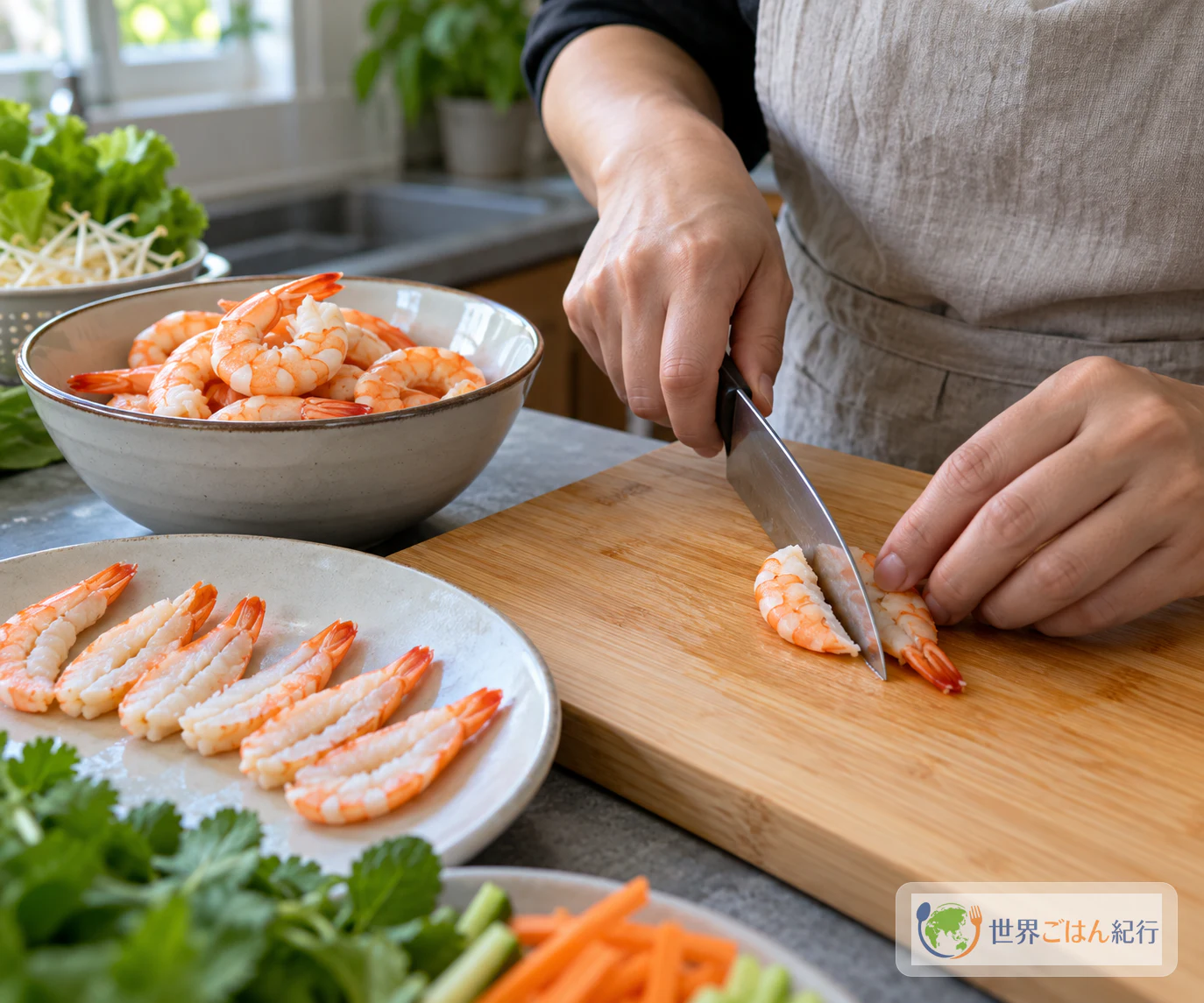
| The shrimp don't show from outside | Shrimp placed too far in, or shifted sideways | Line the shrimp halves up near the far edge and keep them in place as you roll |
| The flavor is flat | Noodles or vegetables still wet, or the dip is too weak | Drain the noodles and dry the greens well. Fish sauces differ in saltiness, so adjust the dip a little at a time |
| The wrapper turns hard | Rolls left standing for a long time, or dried out in the refrigerator | Roll just before eating. Don't leave perishable fillings at room temperature to keep them soft |
Variations
- Without cilantro. Build the herbs around mint and shiso or perilla. The rolls stay refreshing, though shiso's aroma comes forward and it does not fully replace Vietnamese herbs.
- Pork belly instead of pork neck. Pork belly also appears in descriptions of the Ho Chi Minh City version, and its fat makes the rolls richer. It is a different cut from the pork neck in the original recipe.
- Shrimp-forward rolls. Use less pork to let the shrimp stand out. The savoriness and how filling the rolls feel will change, so this is a variation rather than the original.
- More vegetables. If you add other vegetables, pat them dry and reduce the rest of the filling so the wrapper doesn't tear.
- A dip without fish sauce. A soy-and-citrus dip lacks the fermented seafood depth of fish sauce and is a different sauce. For peanut allergies, avoid peanut sauce.
Southern Vietnam's Rolled Snack and Its Sauces
GoVietnam's guide to Ho Chi Minh City food classifies this dish as gỏi cuốn tôm thịt, a southern and Ho Chi Minh City roll of bánh tráng, bún, boiled shrimp, thinly sliced boiled pork, and greens and herbs, eaten freshly rolled. Vietnam's tourism authority describes a similar combination of lettuce and herbs, rice noodles, steamed pork and shrimp, and its after-school snack story is one scene from one city, not a picture of every household.
The sauce is where the rolls change the most. Vietnam's tourism authority notes that a rich, fermented dipping sauce shapes how the rolls taste, and the Ho Chi Minh City guide names a peanut-based sauce (tương đậu phộng) and mắm nêm as pairings. This recipe uses the lighter fish-sauce dip from Luke Nguyen's recipe as its base, but none of these is the single correct sauce. Stories about where gỏi cuốn began also circulate, but without solid records behind them, so they are left out here.
If you like the pairing of rice noodles, pork and herbs, bún thịt nướng puts them in a bowl instead of a wrapper. For another southern dish eaten by wrapping it in greens and herbs, try bánh xèo, the crisp rice-flour crêpe.
Frequently Asked Questions
What is the difference between gỏi cuốn and chả giò?
Gỏi cuốn wraps cooked fillings and herbs in moistened rice paper and is eaten without frying. Chả giò wraps its filling and is then fried, so it is a different dish.
How many seconds should I soak the rice paper?
Follow the package directions first. The original recipe gives no number of seconds; wet the wrapper briefly and let it finish softening on the plate until it folds easily without sticking to your fingers.
Why does the wrapper tear when I roll it?
Check how long it was soaked, how much filling you used, and how wide the filling is compared with the wrapper. Less filling, a shorter dip in water and a gentle hand while rolling all help.
Can I make them ahead?
They are best rolled right before eating, because the wrappers firm up and stick as they stand. Don't leave the cooked pork, shrimp or other perishable fillings at room temperature, and refrigerate leftovers promptly. There is no set number of days these rolls can be kept.
Can I make them without cilantro?
Yes. Mint and shiso or perilla work well, though the aroma will differ from rolls made with Vietnamese herbs.
Which sauce should I serve?
The base here is the fish-sauce dip from Luke Nguyen's recipe. Descriptions of the southern version also mention peanut-based sauce and mắm nêm, so the choice of sauce is part of what varies from table to table.
Sources
- Food Network, recipe courtesy of Luke Nguyen, "Soft Rice Paper Rolls with Prawns and Pork: Goi Cuon." The original recipe for 6 servings (18 rolls) with rice paper, cooked small shrimp, pork neck, rice vermicelli, lettuce, herbs and garlic chives; the assembly order and rolling method; and the fish-sauce dip. https://www.foodnetwork.com/recipes/soft-rice-paper-rolls-with-prawns-and-pork-goi-cuon-recipe-2009913
- Viet Nam National Authority of Tourism (Vietnam Tourism), "Eating like a local in Ho Chi Minh City." Gỏi cuốn as a childhood after-school snack in Ho Chi Minh City, its typical fillings, and the role of a rich fermented dipping sauce. https://vietnam.travel/things-to-do/eating-local-hcmc
- GoVietnam Editorial, "Gỏi cuốn tôm thịt Thành phố Hồ Chí Minh." The dish as a southern and Ho Chi Minh City roll, its components, peanut-based sauce and mắm nêm as dips, and serving freshly rolled. https://govietnam.travel/food/goi-nom-2/goi-cuon-tom-thit/
- FoodSafety.gov / U.S. Department of Health and Human Services, "Cook to a Safe Minimum Internal Temperature." Cooking shrimp until the flesh is pearly or white and opaque, and using a food thermometer. https://www.foodsafety.gov/food-safety-charts/safe-minimum-internal-temperatures
- USDA Food Safety and Inspection Service, "Leftovers and Food Safety." Not leaving perishable food at room temperature for more than 2 hours (1 hour above 32°C), and refrigerating cooked food promptly. https://www.fsis.usda.gov/food-safety/safe-food-handling-and-preparation/food-safety-basics/leftovers-and-food-safety
- Ministry of Health, Labour and Welfare (Japan), "Six Points for Preventing Food Poisoning at Home." Cooking until the center reaches 75°C for at least 1 minute, keeping tools separate, and cooling in shallow containers. https://www.mhlw.go.jp/stf/seisakunitsuite/bunya/kenkou_iryou/shokuhin/syokuchu/01_00006.html