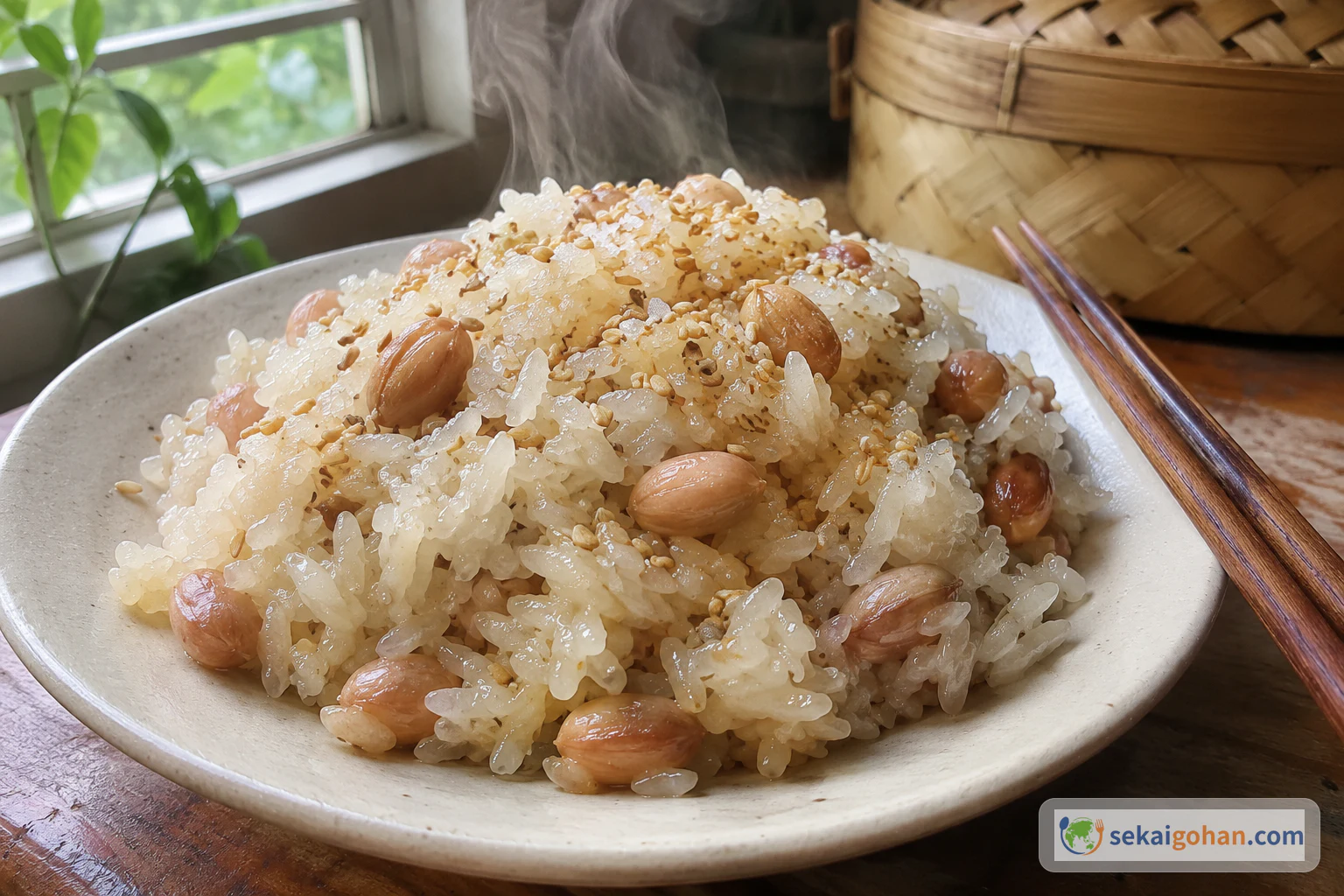
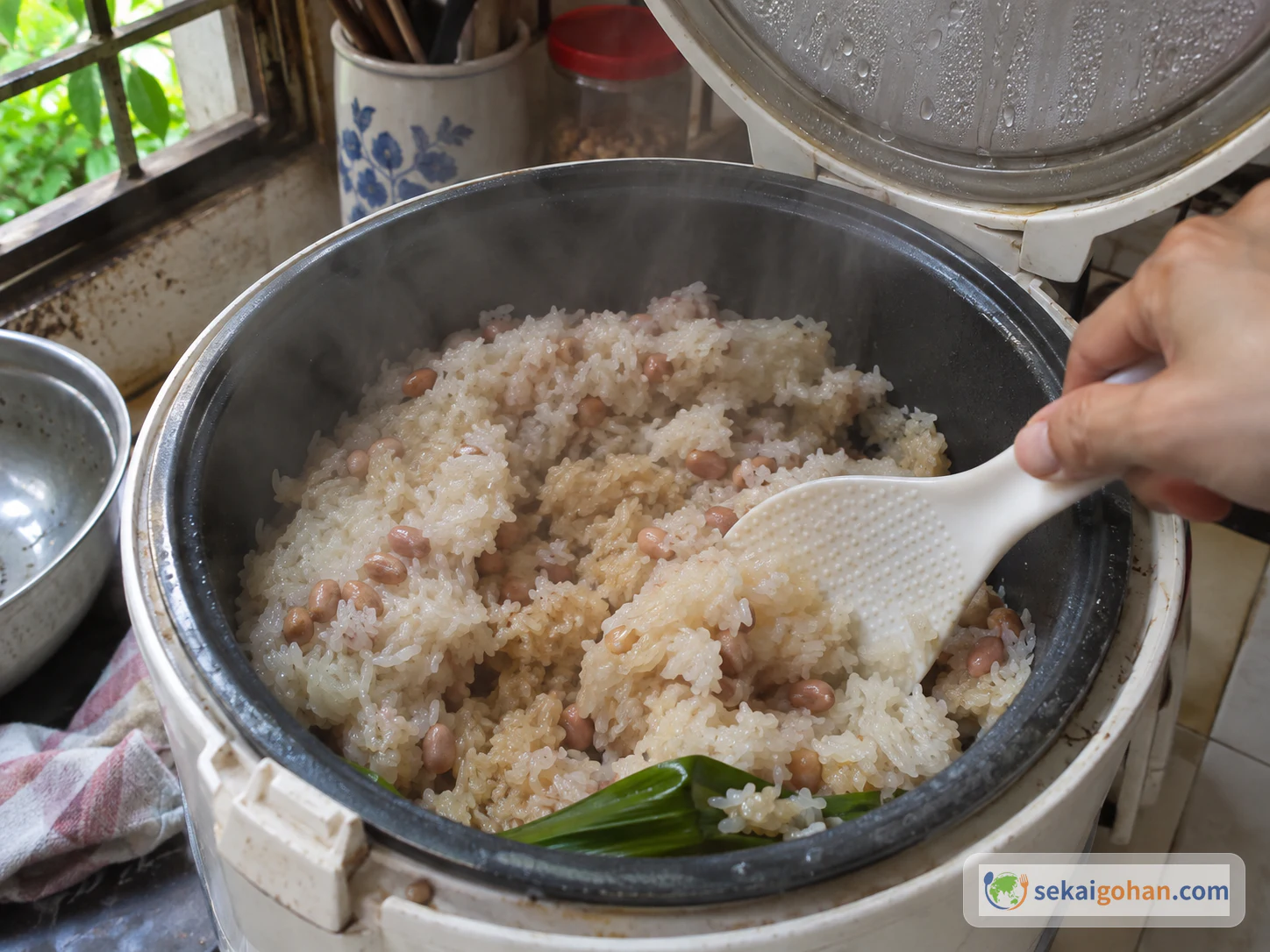
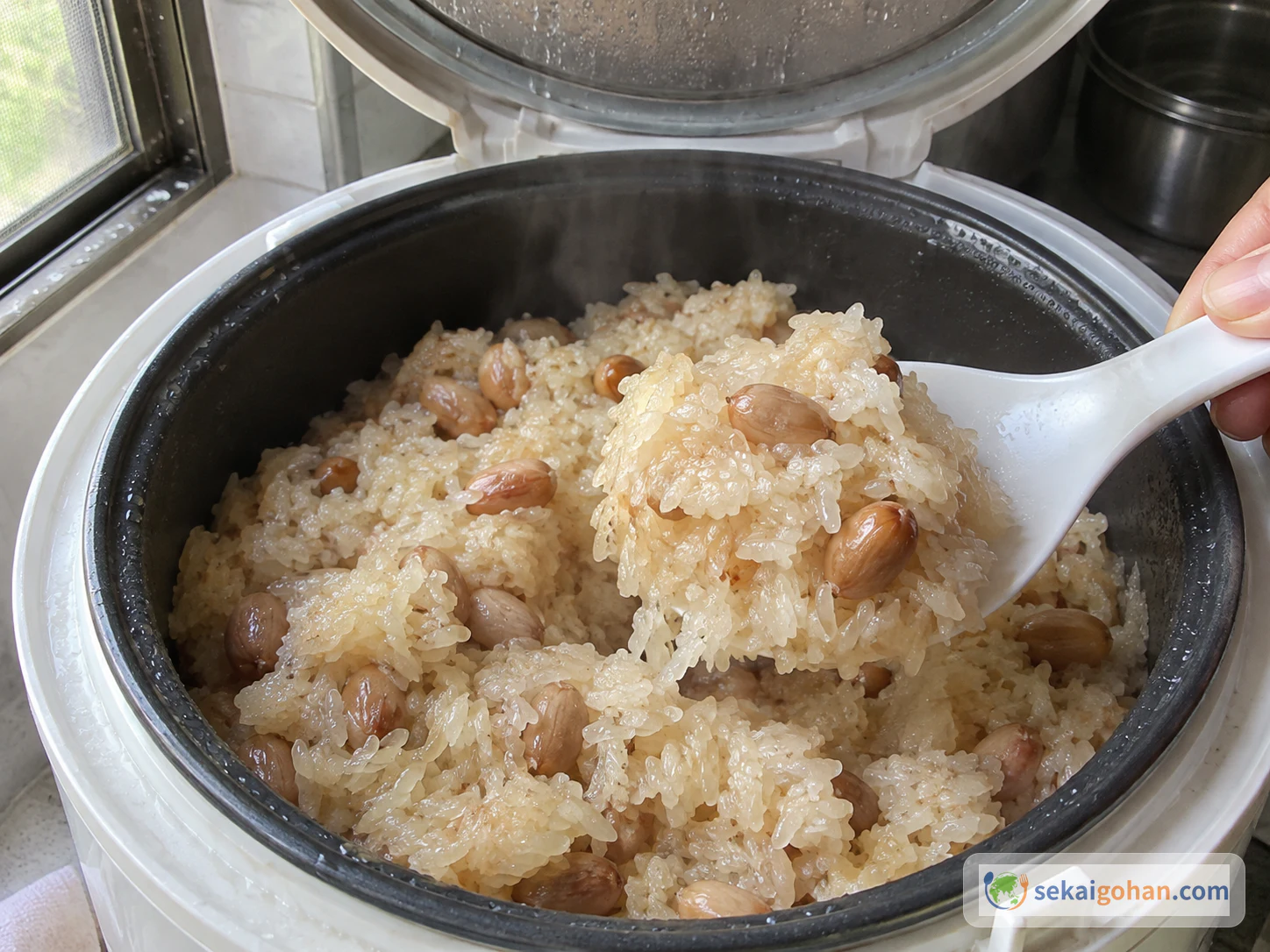
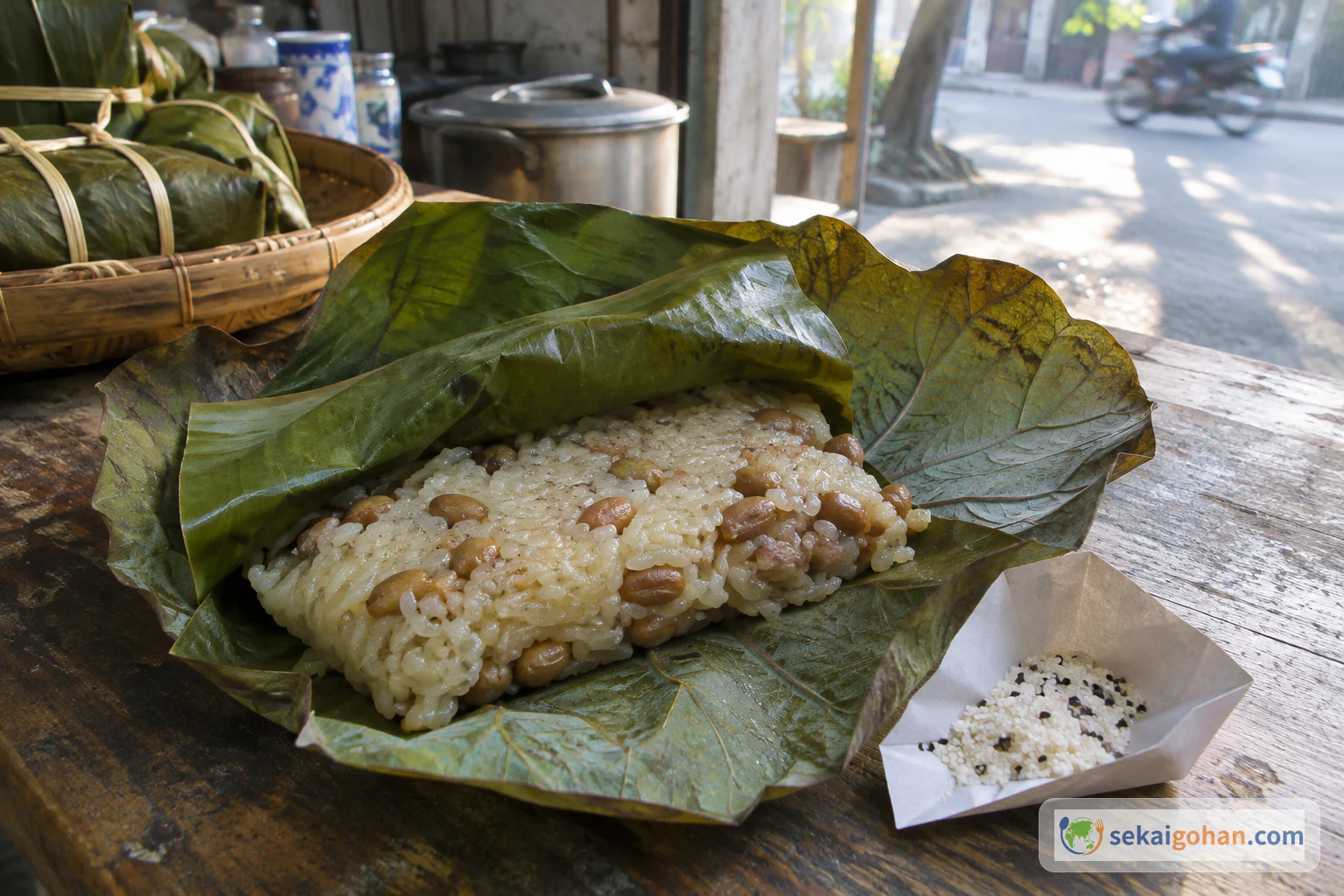
On a Hanoi street corner in the early morning, a vendor scoops sticky rice studded with peanuts onto a lotus leaf, folds it shut and hands over a warm parcel that smells of rice and nuts. By nine the pot is often empty. This is xôi đậu phộng, called xôi lạc in the north: glutinous rice cooked with boiled peanuts, a little salt and a spoonful of chicken fat. The grains are chewy and glossy, the peanuts soft and creamy inside, and a pinch of sesame salt on top turns the whole plate savory and nutty. At home it comes out of an ordinary rice cooker, run twice.
Hanoi's Breakfast Sticky Rice, Under Two Names
Xôi is the Vietnamese word for a whole family of sticky rice dishes. There is xôi xéo with mung beans, xôi gấc tinted red with gấc fruit, xôi ngô with corn, xôi đậu đen with black beans, and many more. Among them, the peanut version is the most common on Hanoi's breakfast streets. Its name follows the peanut itself: northerners call the nut lạc, so the dish is xôi lạc; in the south the nut is đậu phộng or đậu phụng, so the same rice becomes xôi đậu phộng.
Xôi is the breakfast sold most in Hanoi, and the street-corner vendors sell through their pots between about six and nine in the morning. Xôi lạc comes with lạc vừng, a crushed peanut and sesame salt, or ruốc, fine pork floss, sprinkled on top. In 2013 a portion cost between 5,000 and 10,000 dong. Hanoians judge a good xôi lạc by two things: peanuts even in size with not one moldy kernel, and rice that is chewy and smells of itself. Wrapped in a lotus leaf, the rice stays warm and keeps its fragrance on the ride to work.
Breakfast is only one of its jobs. Xôi is cooked for celebrations as readily as for an ordinary morning, and what goes on top ranges from pork floss to braised pork belly, pâté, sausage and, now and then, a scoop of ice cream. Glutinous rice is one of Vietnam's major crops, and the same grain goes into bánh chưng, the leaf-wrapped cake of the New Year, and cơm lam, sticky rice cooked inside bamboo. You can wander further through Vietnamese dishes from there.
The north tends to eat xôi lạc salty, with savory pork alongside. In the south, some cooks swap the water for coconut milk and add sugar, and the same dish turns sweet and rich. Neither side holds to one rule, and the share of peanuts swings widely from cook to cook; some steamed versions use equal weights of rice and peanuts. The recipe below keeps the rice in the lead, with the peanuts scattered through it.
Xôi is filling, yet people in Hanoi also say it can feel nóng ruột, a warm feeling in the stomach.
Ingredients (serves 4 to 5)
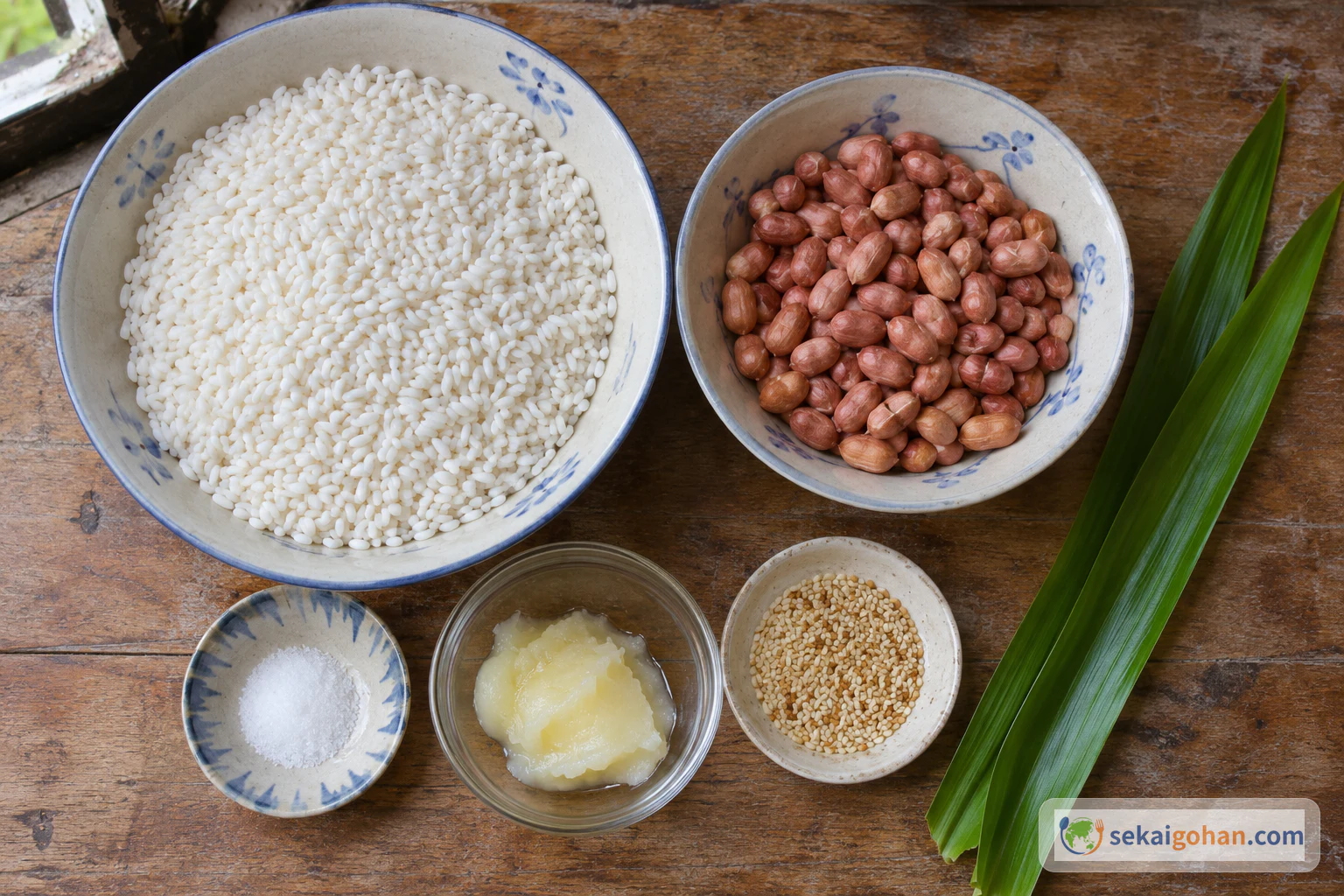
Peanuts are a major allergen and the center of this dish; leaving them out leaves no xôi lạc. The pork roll, sausage or pork floss served on the side can carry other allergens, so read their labels.
Equipment
- Rice cooker with a cook setting and an automatic keep-warm setting
- Large bowl for soaking the rice
- Small saucepan for boiling the peanuts
- Colander or sieve
- Wide mixing bowl and spatula
- Rice paddle
- Aluminum foil, if you have no pandan leaves
Choosing the Rice, Peanuts and Fat
Raw peanuts are the one thing you cannot swap. Look for shelled raw peanuts, often sold as peanuts for boiling. Roasted or salted peanuts break apart during the pre-boil, bring their own salt, and give a texture closer to a snack than to soft, tender nuts. Glutinous rice, also sold as sweet rice or sticky rice, is just as fixed. Thai and Japanese glutinous rice both work, with small differences in chew from variety to variety. Old rice and broken grains are the ones that keep a hard core after cooking.
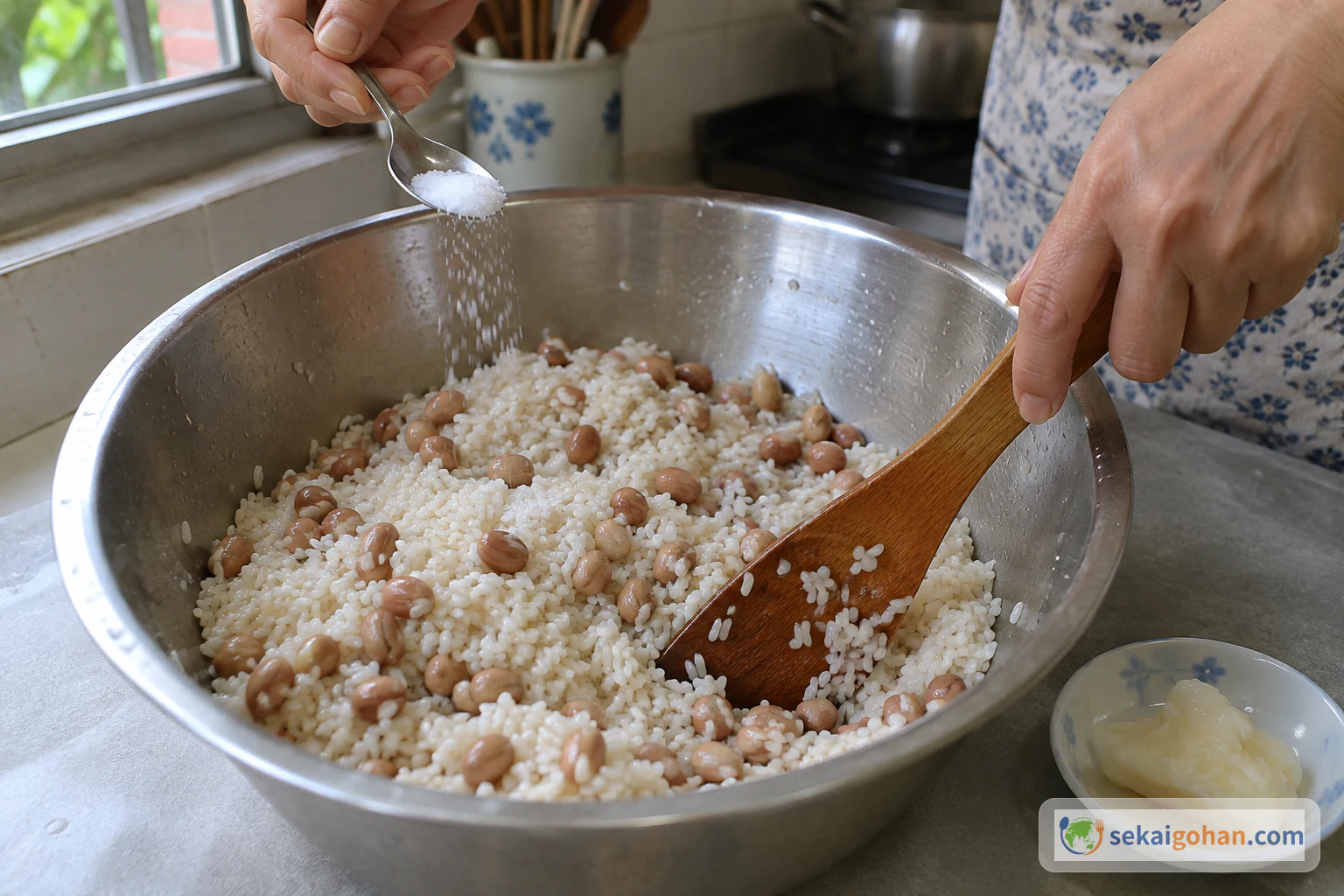
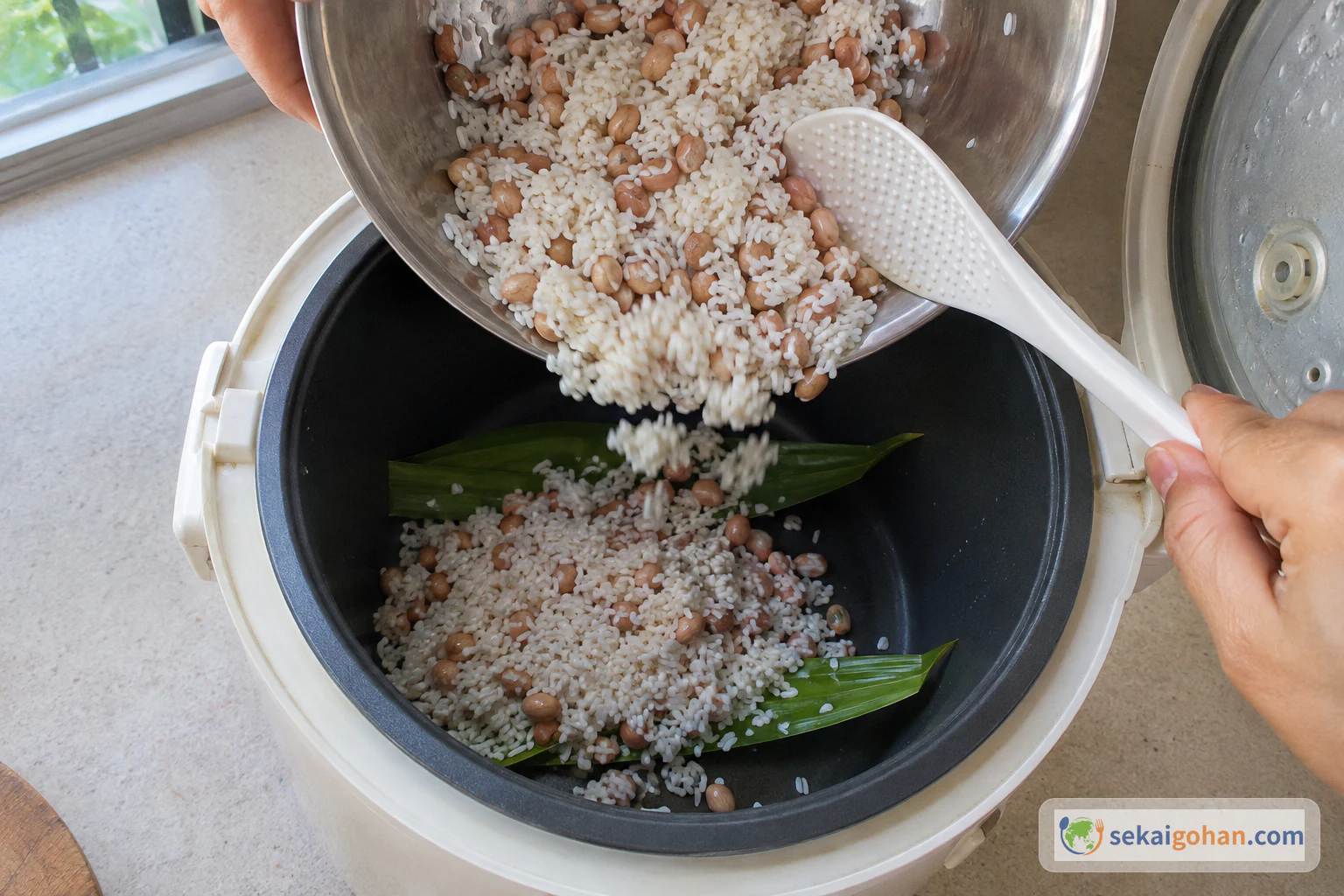
Chicken fat gives the rice a deeper, savory roundness. To render your own, warm chicken skin slowly over low heat and spoon off the clear fat. Rice bran oil or a neutral vegetable oil works well and tastes lighter. Skip sesame oil in the pot; its aroma pushes in front of the rice and peanuts. Pandan leaves are sold frozen at Thai and Southeast Asian grocers. Without them, a sheet of aluminum foil protects the bottom of the pot, but the rice loses its sweet, grassy perfume. The dish still works, only plainer.
Mold on peanuts can produce aflatoxins, which form most readily in hot, humid conditions. They damage genetic material and can cause cancer, so keep exposure as low as possible. Throw out any kernel that is discolored, shriveled or smells musty. Store raw peanuts dry, cool and clean, and buy only what you will use soon.
Method: Soak, Boil, Then Two Rounds in the Rice Cooker
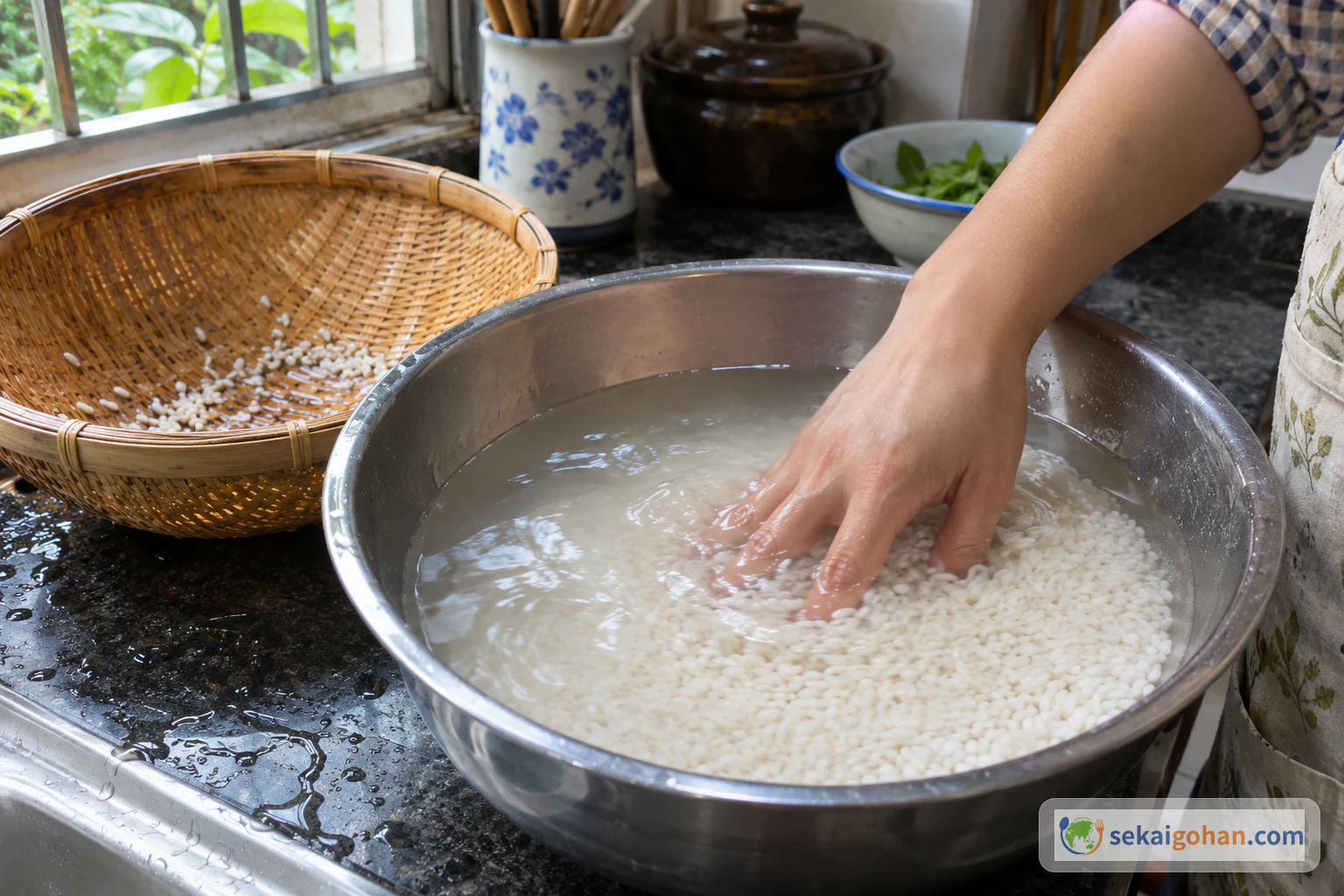
Start the rice soaking first, then boil the peanuts while it sits; both are ready at about the same time. After that the rice cooker does most of the work, with one stop between the two cycles to turn the rice. The final rest on keep-warm is what softens the last of the grain.
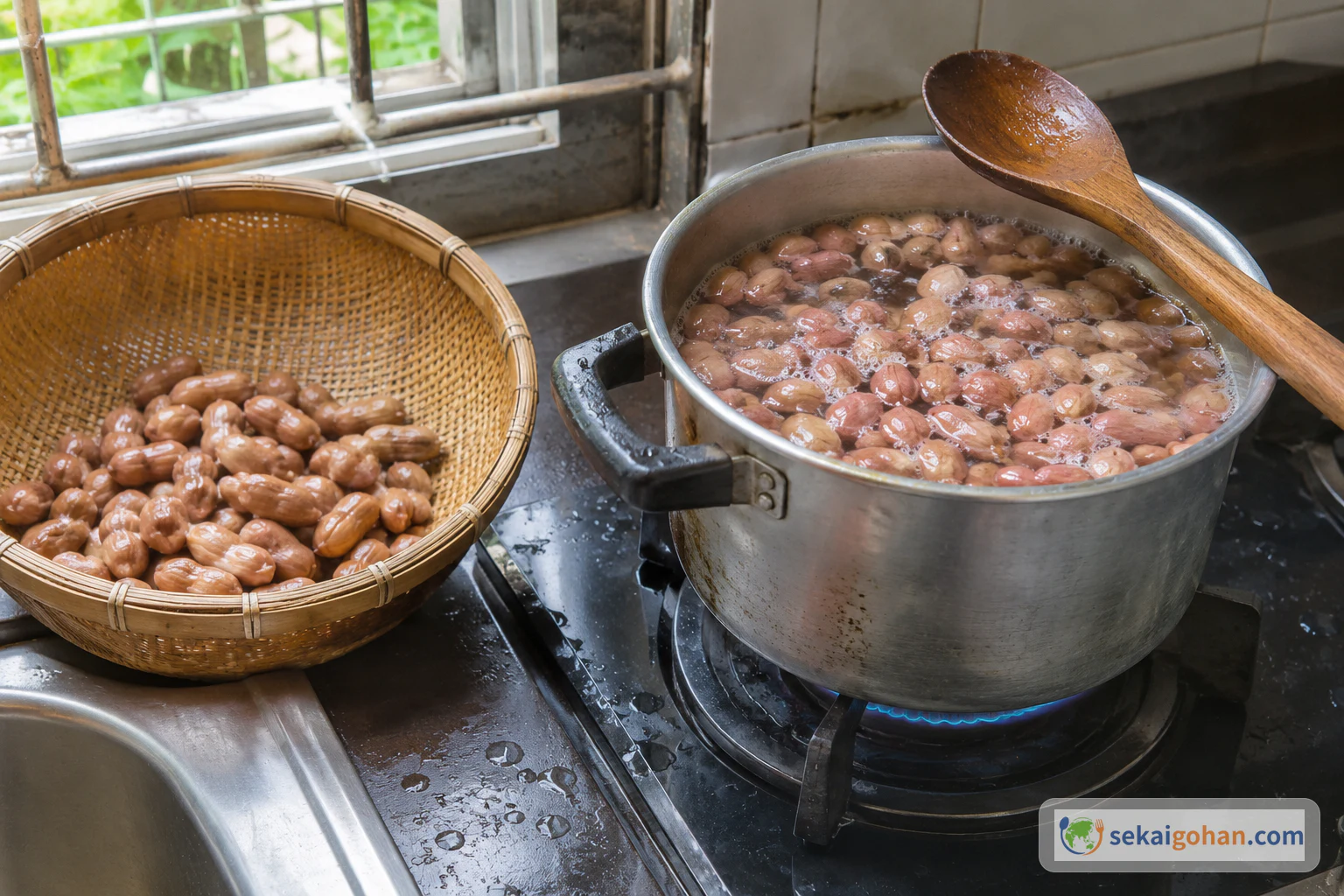
Peanuts that go into the rice cooker raw come out hard, however long the rice cooks. Boil them until a peanut bitten in half is soft right to the center before they meet the rice.
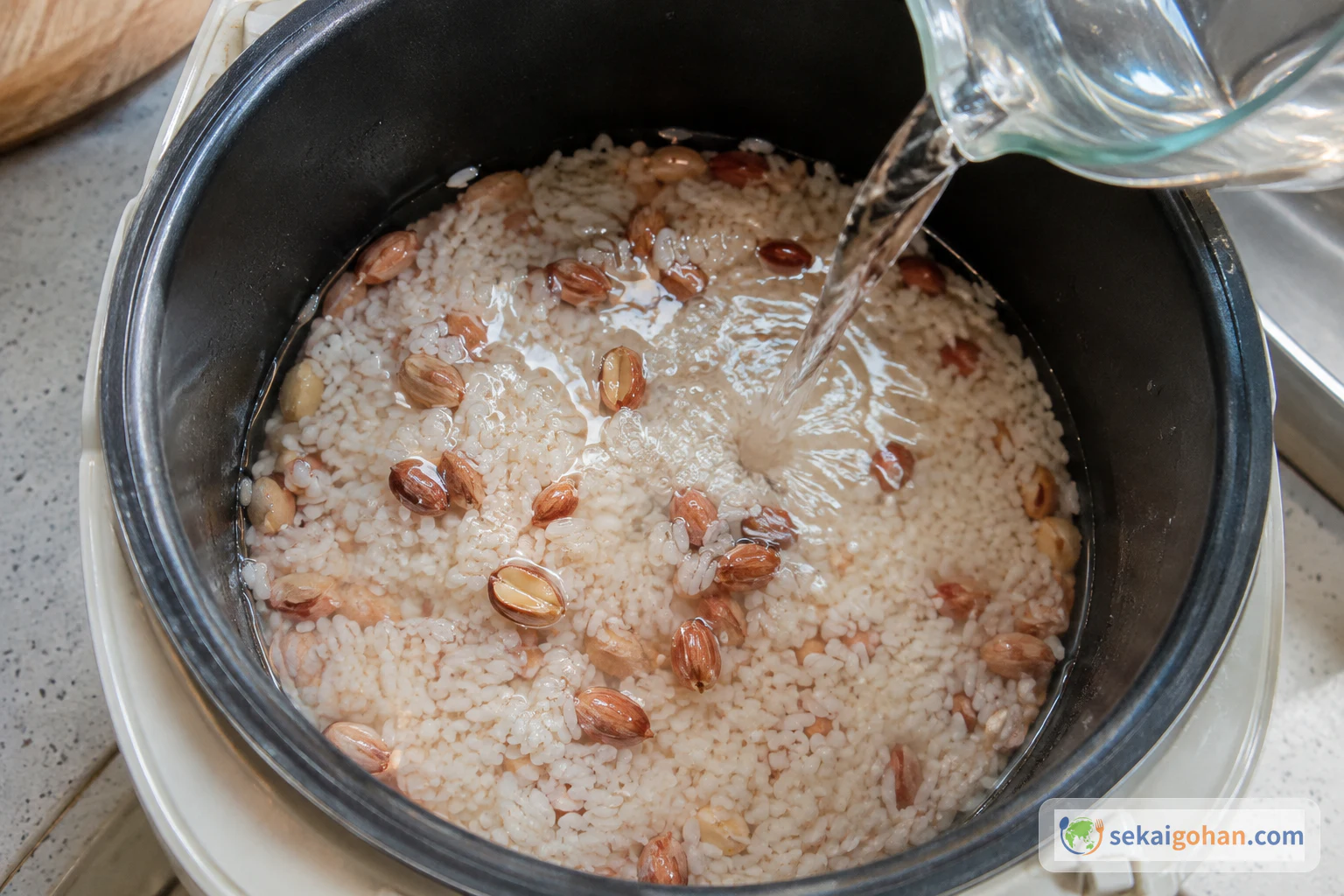
Too much water at step 5 gives soft, wet rice at the bottom of the pot. When in doubt, keep the water at the surface of the rice and no higher.
When It Goes Wrong
| What you see | Why | What to do |
|---|---|---|
| Peanuts still hard in the finished rice | They were boiled too briefly, or not at all | Next time, boil until the center is soft before mixing; soaking them overnight first shortens the boil |
| Wet, soggy rice at the bottom | Too much water, or steam dripping back from the lid | Fill only to the surface of the rice, and keep the lid open only briefly when you turn the rice |
| Broken, mushy grains | The rice was scrubbed hard when washing, or soaked far too long | Wash with loose fingers; keep the soak to about an hour unless the grain is still hard |
| Rice stuck and scorched on the bottom | No liner in the pot | Line the base with pandan leaves or aluminum foil |
| Hard cores in the grain after the rest | The rice was not soaked long enough, or your cooker runs a shorter cycle | Next time soak until a grain crushes easily between two fingers; cooking times differ from one cooker to the next, so judge by the rice |
| Some grains soft, others firm | The rice was not turned after the first cycle | Turn from the bottom every time between cycles |
Serving, Variations and Leftovers
At the table
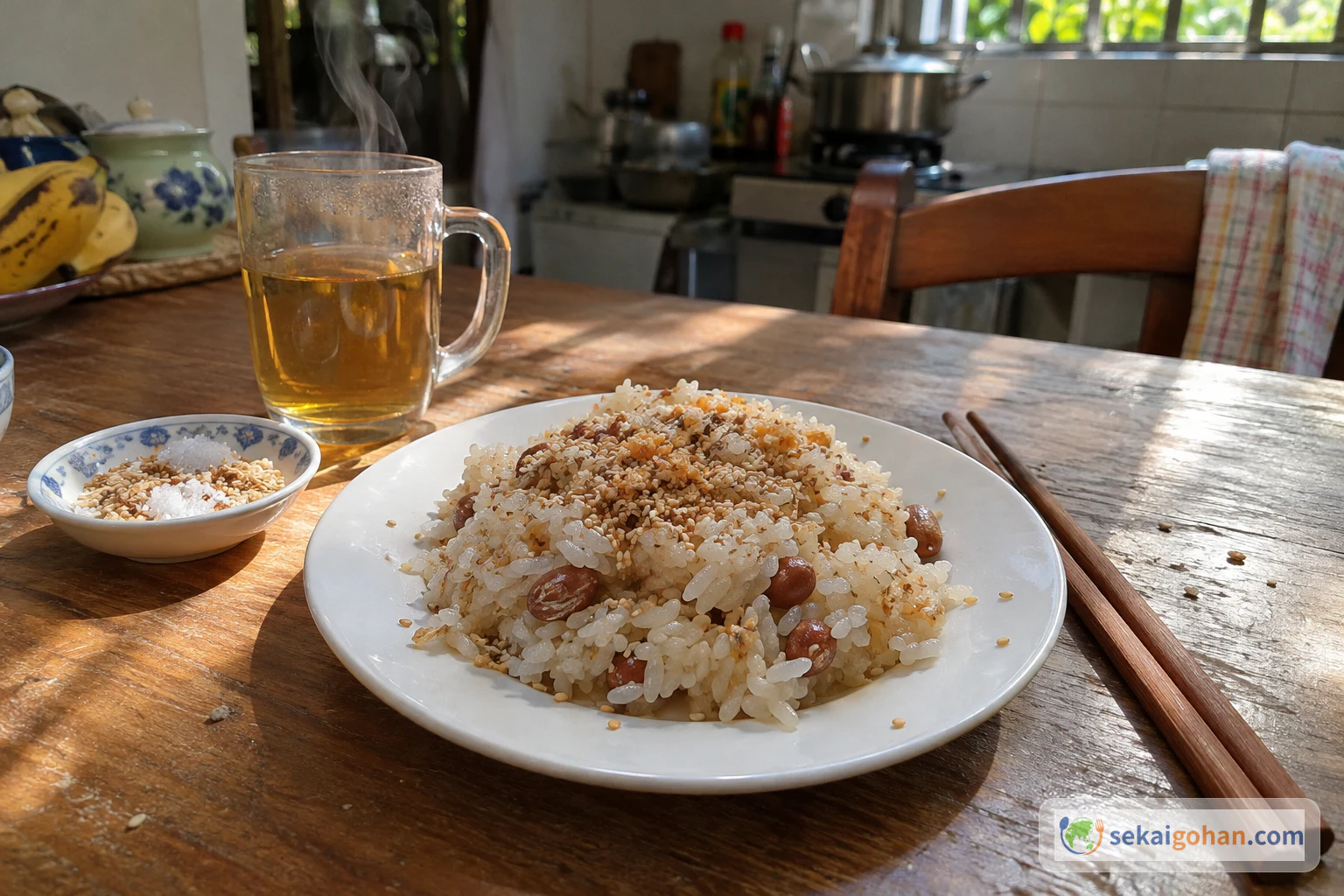
Xôi lạc is a breakfast plate, eaten with chopsticks and a cup of hot tea. Sesame salt is the classic finish: mix toasted white sesame with salt to taste. In Vietnam, savory sides go on top or alongside, most often chả lụa, the smooth pork roll, chả mỡ, its fattier cousin, or ruốc, pork floss. Each adds salt and fat that the plain rice soaks up.
Variations
- Sweet southern style: replace the water with coconut milk and add a little sugar. The rice turns sweet, creamy and richer, closer to a dessert than a breakfast plate.
- Steamer version with coconut: a separate recipe with equal weights of glutinous rice and peanuts, 1 lb 2 oz (500 g) each, plus 7 oz (200 g) grated coconut, five pandan leaves, and salt and sugar. Soak the rice for 4 to 6 hours. Soak the peanuts in salted water for 15 minutes, then boil them for 15 minutes. Mix rice and peanuts, pile them in the steamer around a hole poked in the center, and steam for 15 minutes. Stir and steam for 15 minutes more, then drizzle over 3½ to 4 tbsp (50–60 ml) coconut milk and 2 oz (60 g) sugar a little at a time and steam for a final 5 minutes. Peanuts dominate every bite and the coconut makes it sweet.
Leftovers
Do not leave the rice sitting on keep-warm or at room temperature for long. Cool leftovers, then refrigerate promptly in a covered container. Reheat the next day in the microwave or in the rice cooker until hot and steaming all the way through; sprinkle a little water over grains that have firmed up in the fridge.
Frequently asked questions
Can I use regular long-grain or jasmine rice?
No. The chew and stickiness come from glutinous rice, and regular rice gives a dry, separate pilaf with peanuts. Look for bags labeled glutinous, sweet or sticky rice.
Can peanut butter or chopped nuts stand in for whole peanuts?
They change both flavor and texture too much to give xôi lạc. Peanut butter melts into the rice and turns it pasty, and chopped nuts lose the soft, whole bite that sets this dish apart. Whole raw peanuts, boiled first, are the only way to get there.
Is xôi đậu phộng gluten-free?
The rice and peanuts contain no gluten; glutinous rice is named for its stickiness, not for gluten. The fat, sesame and salt add none either. Check the labels of pork rolls, sausages and pork floss if you serve them alongside.