
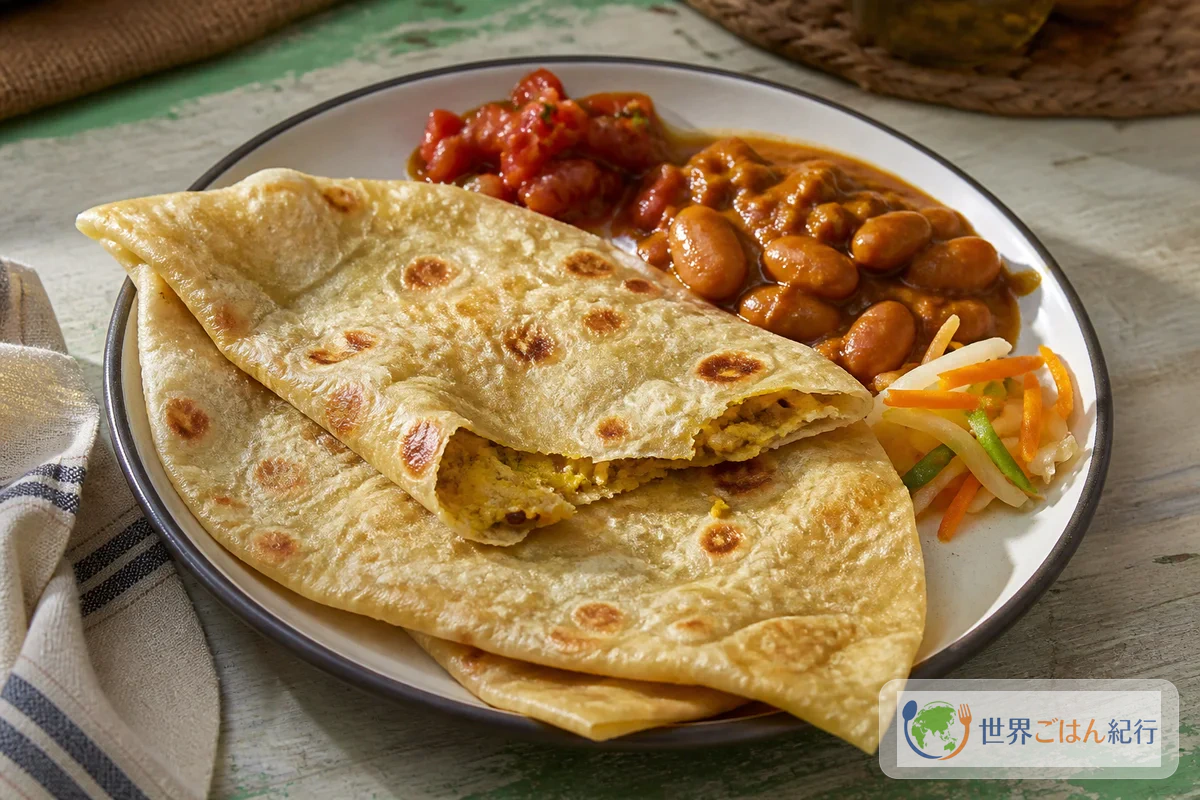
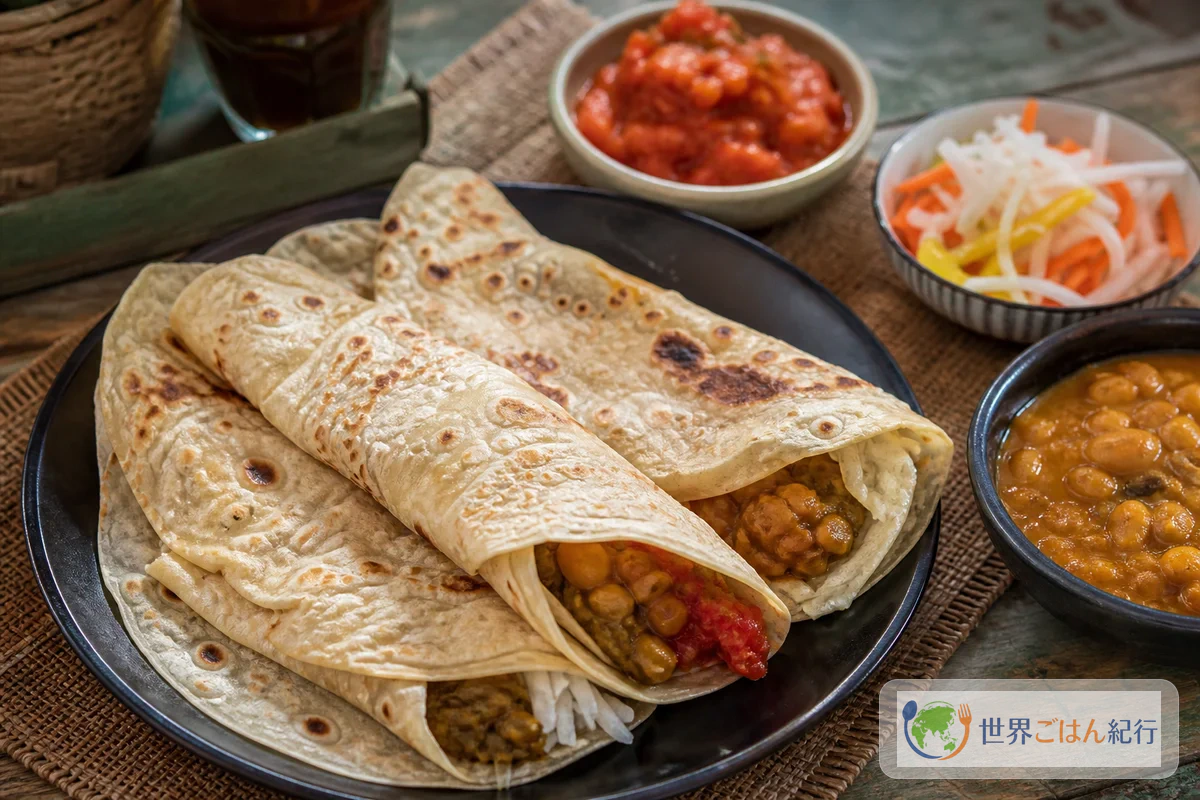
A pair of thin Mauritian flatbreads, rich with cumin
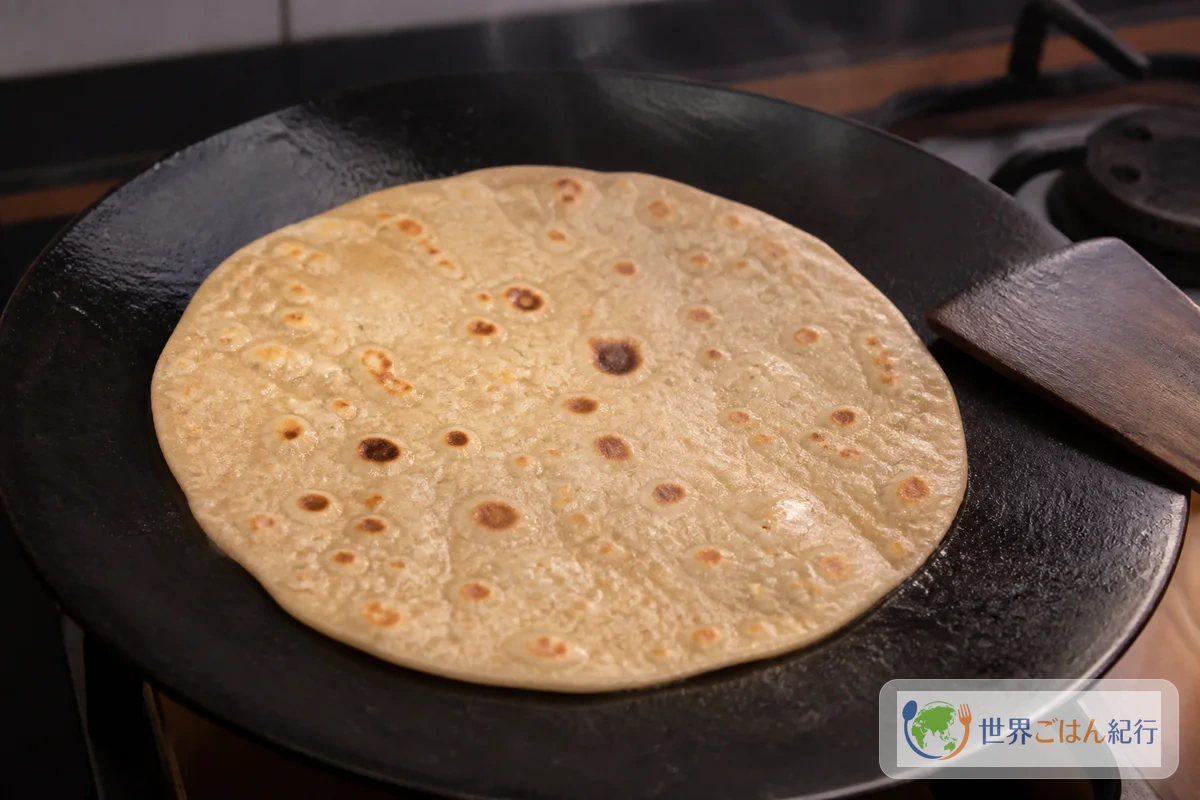
Set the dough on a hot tawa and small bubbles rise on the surface, the yellow of the split peas faintly showing through. When brown spots appear on the flipped side, stack two fresh ones and scoop up tangy tomato rougaille or a thick butter bean curry. Dholl puri (Dholl puri / Dhal puri) is a representative Mauritian street food in which split peas are wrapped in wheat dough and cooked thin.
Unlike the fried Indian dal puri, the star isn't the toasty aroma of oil but the crumbly texture of dry split peas and the fragrance of cumin. Rather than eating a single piece as bread, stacking two to wrap curry and pickles is closer to the way it is enjoyed locally.
A bean-filled roti raised at island street stalls
Mauritius government tourism material also introduces dholl puri as a dish loved on an island where food cultures meet. After the abolition of slavery, the number of indentured laborers from India grew in the 19th century, and a table of beans, vegetables, dal and pickles became part of island cooking. Rather than treating the dish as an "import" of one country, it is closer to reality to see it as Indian home cooking that grew into a street dish within island life, also shaped by African, European and Chinese influences.
Behind it lies the history of Aapravasi Ghat, through which more than 460,000 indentured laborers, mostly from India, passed between 1834 and 1920. UNESCO describes this facility, built in 1849, as the place where people from India, East Africa, Madagascar, China and Southeast Asia entered the island. Dholl puri is not just a recipe but a dish in which the use of beans and flour carried by people on the move became everyday at the island's table.
Local introductions and travel writing describe it as a light meal cooked at stalls from early morning and eaten in places such as Quatre Bornes, Rose Hill, Vacoas and Port Louis. The thickness of the dough, how much the beans are left in grains, the heat of the rougaille and the achar served alongside differ from stall to stall, so there is no need to treat any one formula as absolute at home. However, two things greatly affect flavor and texture: turning the beans into a dry powder rather than a paste, and cooking it thin and eating it in pairs.
The overlap in name and beans with Indian fried dal puri (in Japanese) and Guyanese split pea fritters pholourie (in Japanese) comes from immigrant food cultures changing form in different places. When making dholl puri, don't make it thick like fried bread. Treat it as a roti cooked on a tawa, matching the thinness of the dough to the juiciness of the accompaniments.
Ingredients (makes 8 pieces, serves 4)
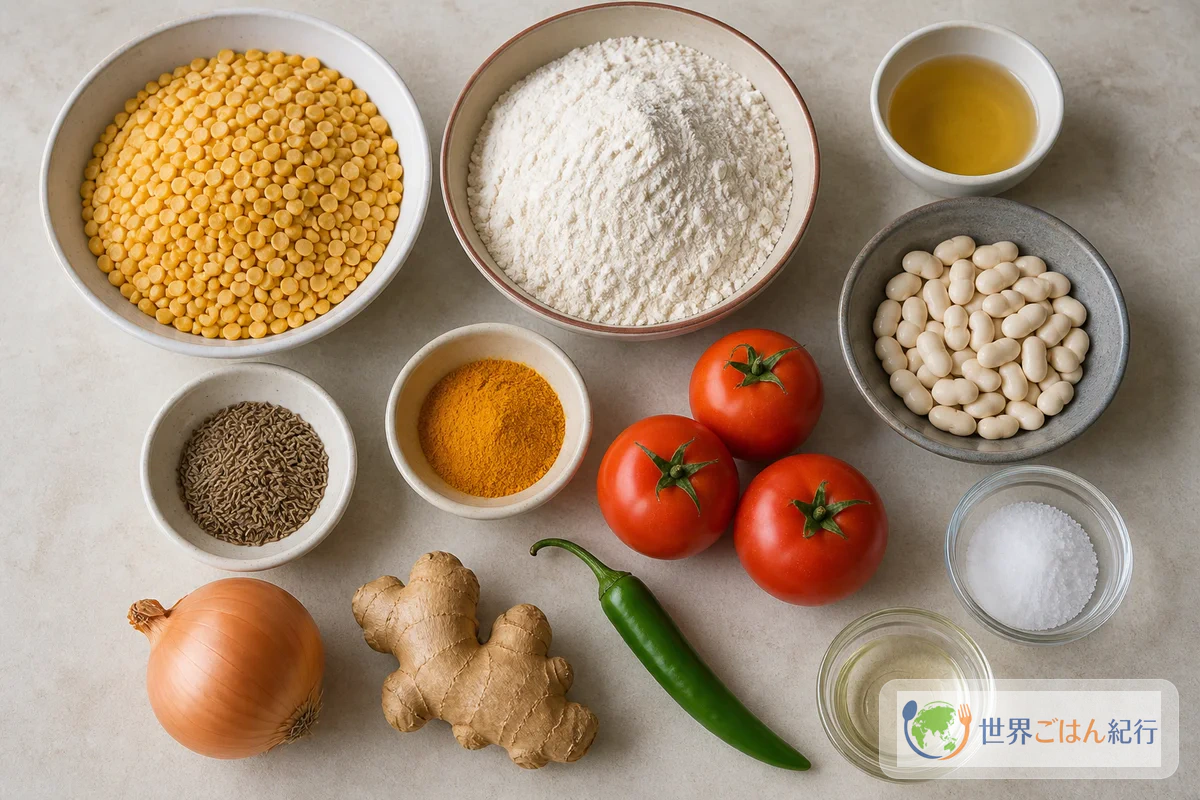
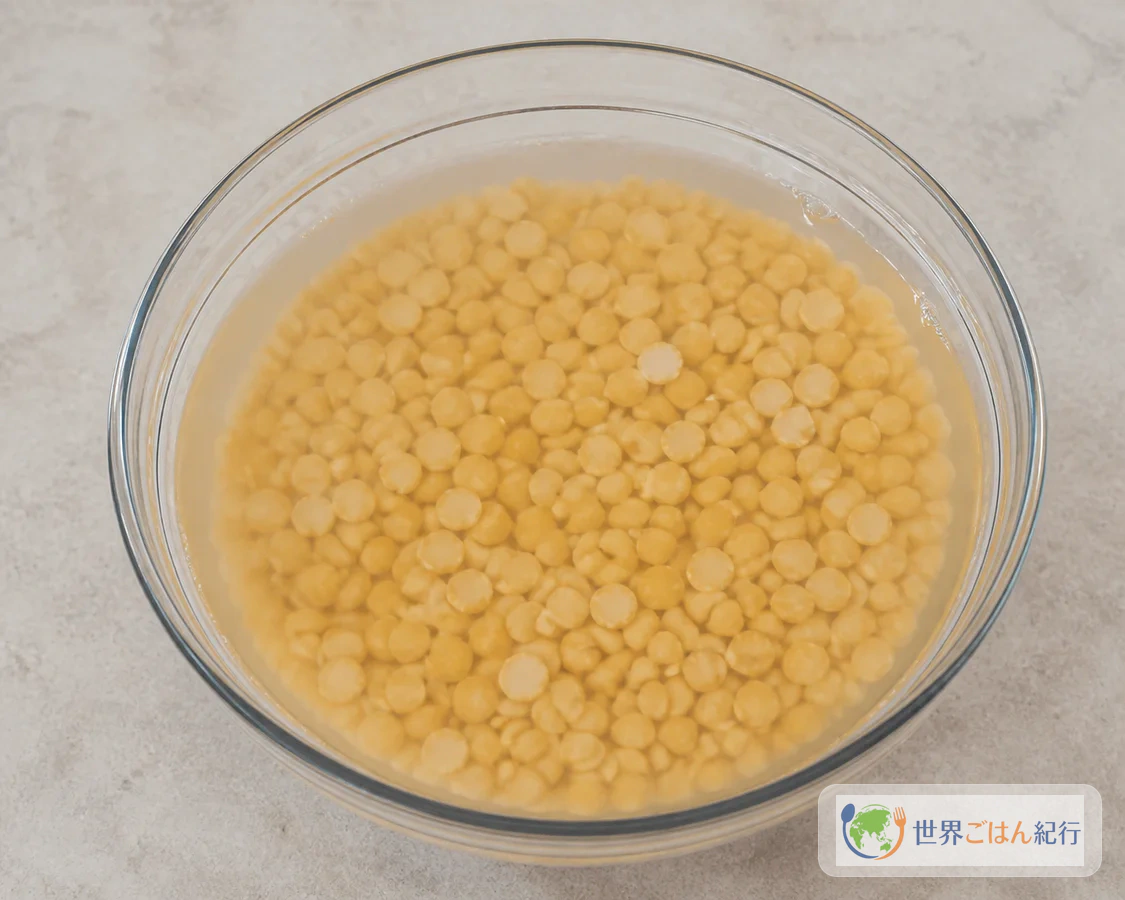
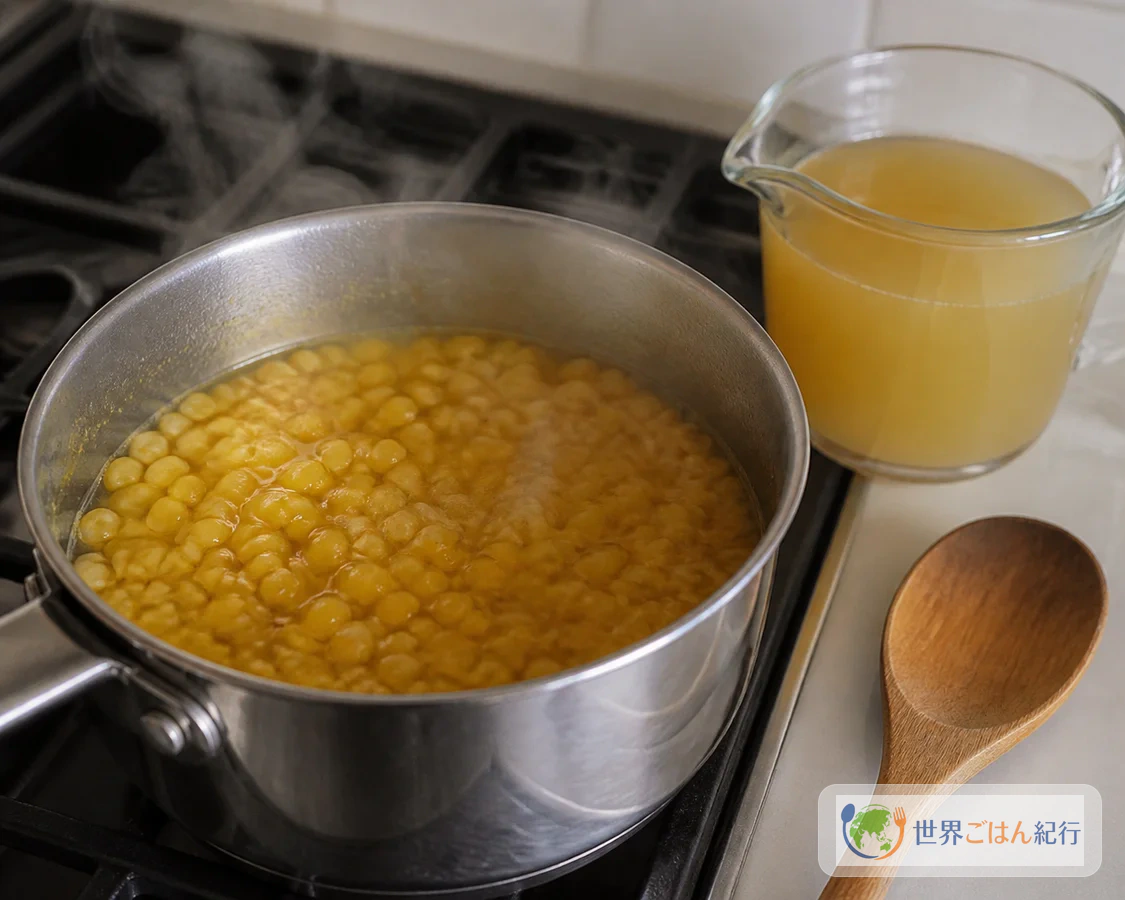
The quantity makes eight thin flatbreads 20 to 22 cm across, about two per person. The dholl gram used in local recipes is found elsewhere as yellow split peas or chana dal. Even with the same package label, cooking time varies with how the beans are split and their size, so go by the state "splits when pressed with a finger but doesn't fall apart in the liquid" rather than by time.
You will use a pot for cooking the beans, a skillet for drying them, a flat tawa or heavy skillet and a rolling pin. You can make it without a tawa, but a flat surface of about 26 cm that lets you cook a rolled round without moving it makes it easier to heat evenly to the edges.
This recipe contains wheat and legumes. If you serve achar or store-bought curry, check separately for labeling of dairy, mustard, seafood, peanuts and so on. Replacing the wheat flour with rice flour changes the dough's ability to be wrapped and rolled thin, so it can't be treated as a gluten-free alternative recipe.
Where to find things
Fresh tomatoes and onions are fine from everyday shopping. What's worth looking for is whole cumin seed, which supports the bean aroma; turmeric, which evens out color with only a little; and a flat tawa, which makes it easy to lay out the dough when cooking many pieces.
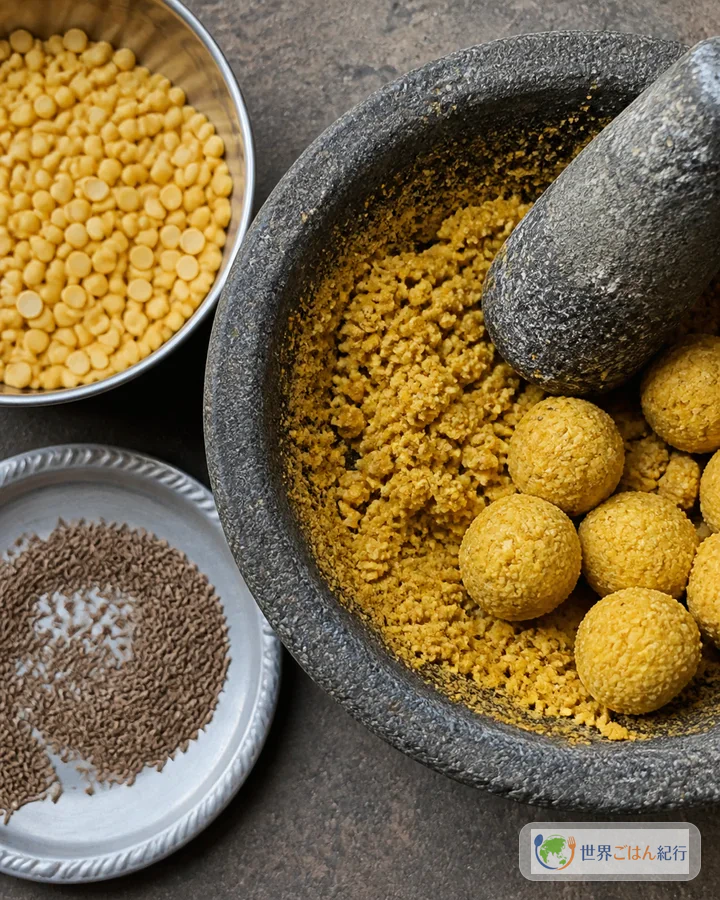
Cumin seed leaves a core of aroma when mixed into the toasted beans. Look for jars labeled whole cumin seed, without salt or other spices mixed in. If you only have ground cumin, you can still make it; choose whole seed when you have other dishes that will use up the jar.
Turmeric is only 1/2 tsp, but it matches the yellow of the filled beans with the earthy aroma of the curry. Check that the label shows turmeric alone; it makes sense to buy if you'll use it in curries and bean stews too.
A tawa is not a necessity. A heavy skillet can cook one piece at a time, so if you make this only once a year you can do without it. If you often cook roti or chapati, or want a wide flat surface to flip dough on, check that it is cast iron, suits your home heat source, and note the diameter and whether it has a handle.
Instructions
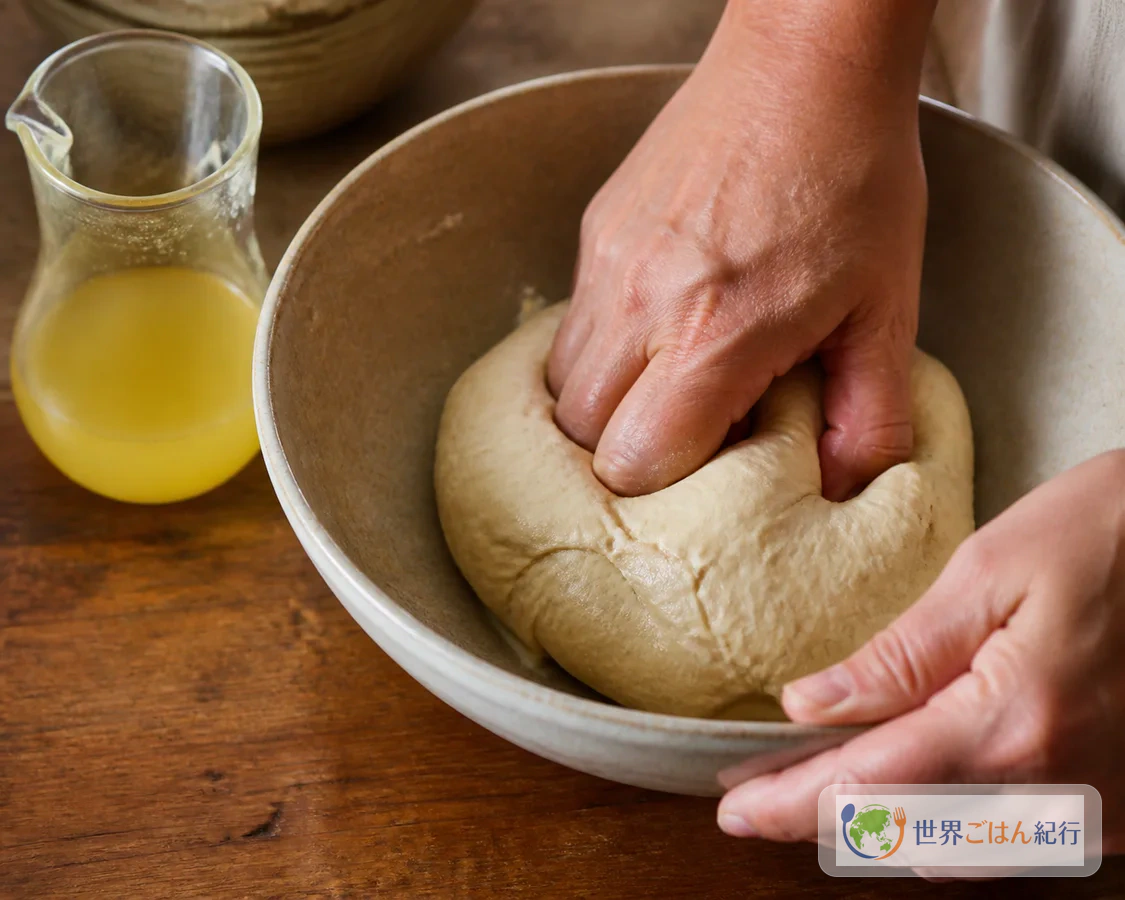
While the beans cook, cut the accompaniments, and while the beans cool, knead the dough. In this order it is easier to avoid the mistake of tearing the dough by putting warm filling into it.
Making rougaille and butter bean curry
Eaten alone, dholl puri puts the aroma of beans and wheat forward. Add the acidity of rougaille and the juiciness of butter bean curry and the table is set for the flatbread. If you make both at once, cut the onions and tomatoes while the beans cook.
Rougaille
Roughly chop 2 tomatoes, 1/2 onion, 1 clove garlic, 10 g ginger and 1 green chili. Put 2 tsp oil in a skillet and cook the onion, garlic and ginger over medium heat for 3 minutes. Add the tomatoes and a little salt and simmer over medium-low heat for 6 to 8 minutes. Stop when the tomato corners remain and juice comes out when pressed with a spoon, and the acidity layers over the bean filling. You can add chili later, so it's fine to start with half.
Butter bean curry (cari gros pois style)
Cook 1/2 onion in 2 tsp oil for 4 minutes, then add a little garlic, a pinch of turmeric and 1 tomato. Add 200 g drained butter beans and 150 ml water and simmer over low heat for 8 to 10 minutes. Mash just two or three beans with a wooden spoon and, when the liquid has thickened, adjust with salt. Don't make the curry a thin soup; bring it to a thickness that doesn't run out when you fold the dholl puri.
At Mauritian tables, pickled vegetables, coriander and chili sauce may also be served. Even a small spoonful of whatever achar you have puts crisp acidity against the sweetness of beans and wheat.
Substituting while protecting the dryness of the beans
When you can't find the local ingredient names, there's no need to push toward a different dish while keeping only the dish name. If you know the order of what makes dholl puri what it is, you can read the effect of substitutions.
| Ingredient or tool in question | Closer to local | Easier to get | What changes |
|---|---|---|---|
| Beans | Dholl gram, yellow split peas | Chana dal | Chana dal grains are slightly larger and need a little longer to cook |
| Alternative beans | Yellow split peas | Skinless moong dal | Moong dal gets soft, so leave less cooking liquid |
| Dough | Refined wheat flour | All-purpose flour, all-purpose plus whole wheat | The more whole wheat, the more toasty but the more prone to cracks |
| Cooking surface | Iron tawa | Heavy skillet | Heat retention differs. Lower the heat with a thin pan |
| Acidity | Local achar | Cucumber or carrot pickles | The spice aroma changes, but the palate-cleansing role remains |
If using chana dal, mash one at 15 minutes into cooking. If a core remains, extend by 2 to 3 minutes at a time, then spread the softened beans on a plate and cool fully. Red lentils break down quickly and hold moisture before grinding into powder, so they are not suited to a first attempt.
With a dough of only whole wheat, the thin rolled edges crack easily. If you want to keep the wheat aroma, limit whole wheat to 60 g and make the rest all-purpose; that works better with the task of wrapping beans.
Fixing things when they go wrong
The beans turned into a paste
They were overcooked or mashed before draining. If there's a lot of moisture, put them in a dry skillet over medium-low heat and dry them for 3 to 5 minutes, spreading with a wooden spoon. Move to a plate, cool completely and wait until a squeezed handful keeps its shape. If it still doesn't hold together, don't force it to be wrapped; use it as a bean side dish added to the rougaille, and prepare a small new batch of beans for the dough so the failure doesn't spread.
The dough tears while rolling
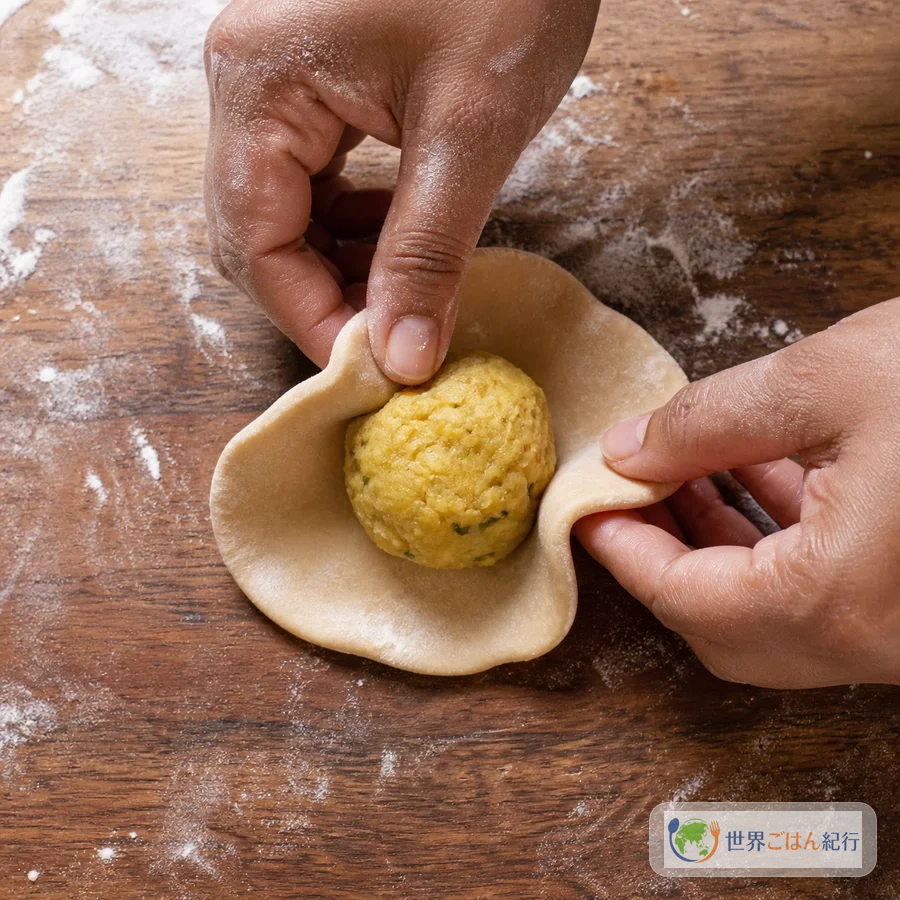
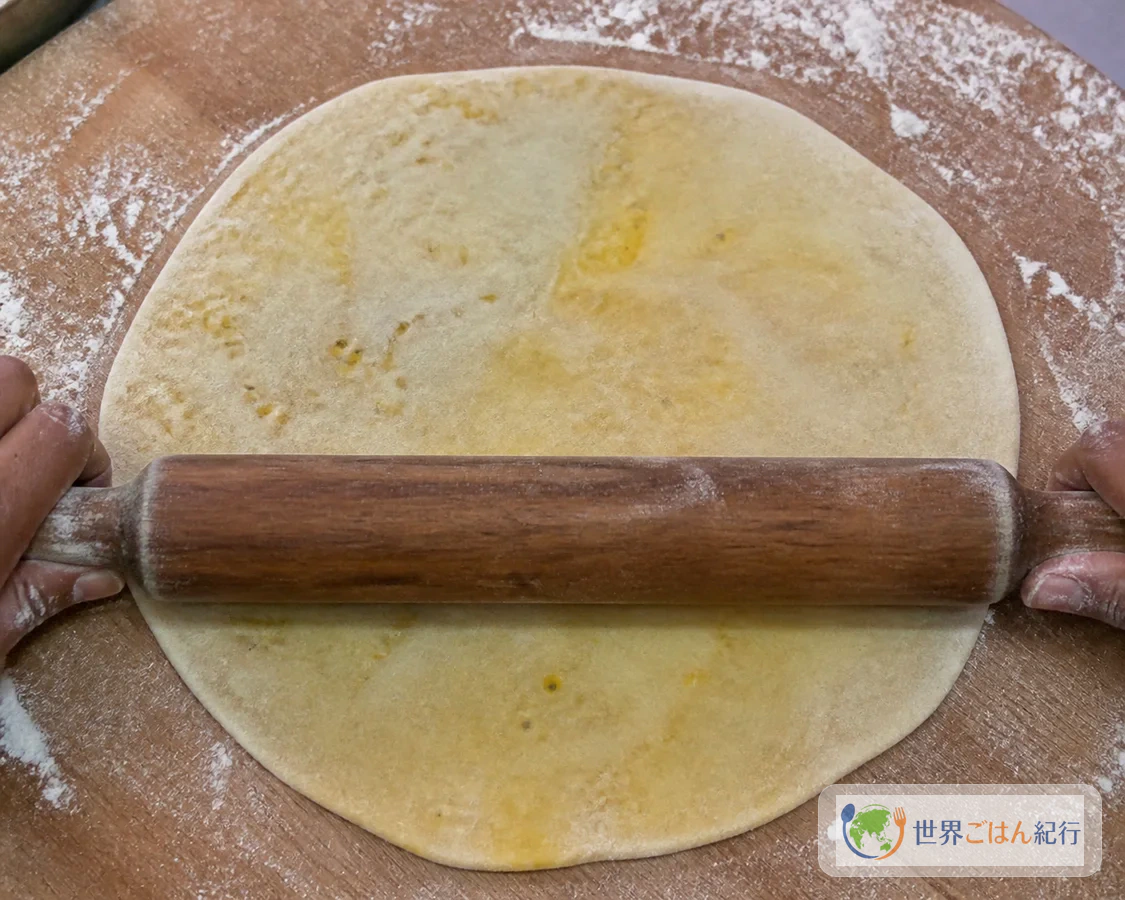
The filling is too big, the seam too thick or the dough dry. Cover the surface with a damp cloth and rest 10 minutes, then spread the circle first with your palm without pressing hard with the rolling pin. Pinch a torn hole closed and stop at about 18 cm. If you force it to 22 cm, beans come out, and scorched grains stick to the tawa.
No browning and the dough is stiff
The tawa wasn't preheated enough or there is too much dusting flour. Do the water-drop test before cooking the first one, and brush off excess flour. If spots don't appear by 90 seconds a side, raise the heat a little, but don't leave it until the surface dries. Wrapping each cooked piece in a cloth right away brings back suppleness through the steam.
Burnt on the surface but cold inside
The heat is too high. Lower to medium-low, shorten the time per side and flip after bubbles appear on the surface. Because the filling is already cooked, it is easier to adjust if you treat browning the dough and carrying heat to the center as separate things.
Storage and nutrition guide
It's a dish to eat freshly cooked, but wrap leftovers one by one in plastic wrap after cooling and keep them for about 2 days in the refrigerator. To eat, warm each side in a dry skillet for 30 to 45 seconds, and if stiff, use a spray bottle just once. To freeze, cool fully, bag them separately and plan to use within 1 month. If left a long time after thawing, the dough cracks easily from the beans' moisture, so it is easier to handle by placing it still frozen in a skillet over low heat.
Nutrition (estimate per person for 2 dholl puri, not including accompaniments)
| Nutrient | Guide |
|---|---|
| Calories | 500 kcal |
| Protein | 19 g |
| Fat | 12 g |
| Carbohydrates | 84 g |
| Fiber | 10 g |
| Sodium | 620 mg |
The values vary with the beans, the oil actually absorbed and the curry or achar you serve. With beans and wheat as the main ingredients, two pieces is closer to a staple than a light snack.
FAQ
Q1. Are yellow split peas and chana dal the same?
They are not the same bean. The dholl gram in local recipes, the yellow split peas sold in Japan and the chana dal at Indian grocers differ in grain size and aroma. At first, use whichever is easier to get and stop cooking when it splits when pressed but isn't holding too much water. Giving priority to whether you can make a dry filling, rather than an exact match of the dish's name and the bean, makes adjusting easier.
Q2. Can I make it without a tawa?
You can make it in a heavy skillet. If the bottom is thin, don't preheat too long and cook one piece at a time over medium-low heat. Don't move the dough after setting it down; flip it by looking at the bubbles and brown spots. Only people who cook roti often need to consider a dedicated tawa.
Q3. How many pieces do you stack to eat?
We planned on two per person. Serving a single piece with a side is also a way to eat it, but stacking two to wrap bean curry and rougaille gives a good balance of cooked wheat, beans and acidity. For a small appetite, one piece plus a side works.
Q4. Is it still local-tasting without chili?
It's fine. Heat can be added later through the rougaille or achar, so it is easier to adjust the whole if you leave out the green chili and keep cumin and turmeric in the bean filling. Even when adding heat, don't put much in the beans from the start; serve a sauce at the table.
Q5. How much can I make the day before?
You can do the steps through cooking the beans and grinding them to powder, or prepare the rougaille and butter bean curry, the day before. Cool the filling, seal it and refrigerate. Do the wrapping in dough on the day you cook, and if using cold filling, bring it back to room temperature for about 10 minutes. Storing wrapped dough for a long time moves moisture across and makes it tear easily before rolling.
Related dishes
- Indian fried dal puri (in Japanese): compare it with the small puri that puffs up in oil, also filled with beans.
- Dal tadka (in Japanese): shows the difference between a dish where beans are cooked down and the step of drying the beans for dholl puri.
- Guyanese pholourie (in Japanese): another Indian-diaspora dish with beans and spices, with a different texture to enjoy.
Sources
- Explore Mauritius | Government of Mauritius (accessed and checked 21 August 2026)
- Aapravasi Ghat: How a UNESCO World Heritage site keeps the memory of indentured labour alive | UNESCO (accessed and checked 21 August 2026)
- Aapravasi Ghat | UNESCO World Heritage Centre (accessed and checked 21 August 2026)
- Dholl Puris Recipe | Les Moulins de la Concorde (accessed and checked 21 August 2026)
- The Story of Dholl Puri in Mauritius | restaurants.mu (accessed and checked 21 August 2026)
- Mauritian Dholl (Dhal) Puri | Mauritius Life (accessed and checked 21 August 2026)
- Mauritius street food guide | Mauritius Life (accessed and checked 21 August 2026)
- Mauritius: dholl puri savoury pancakes | The Guardian (accessed and checked 21 August 2026)
- Mauritian Dholl Puri Recipe | Cook's Hideout (accessed and checked 21 August 2026)



