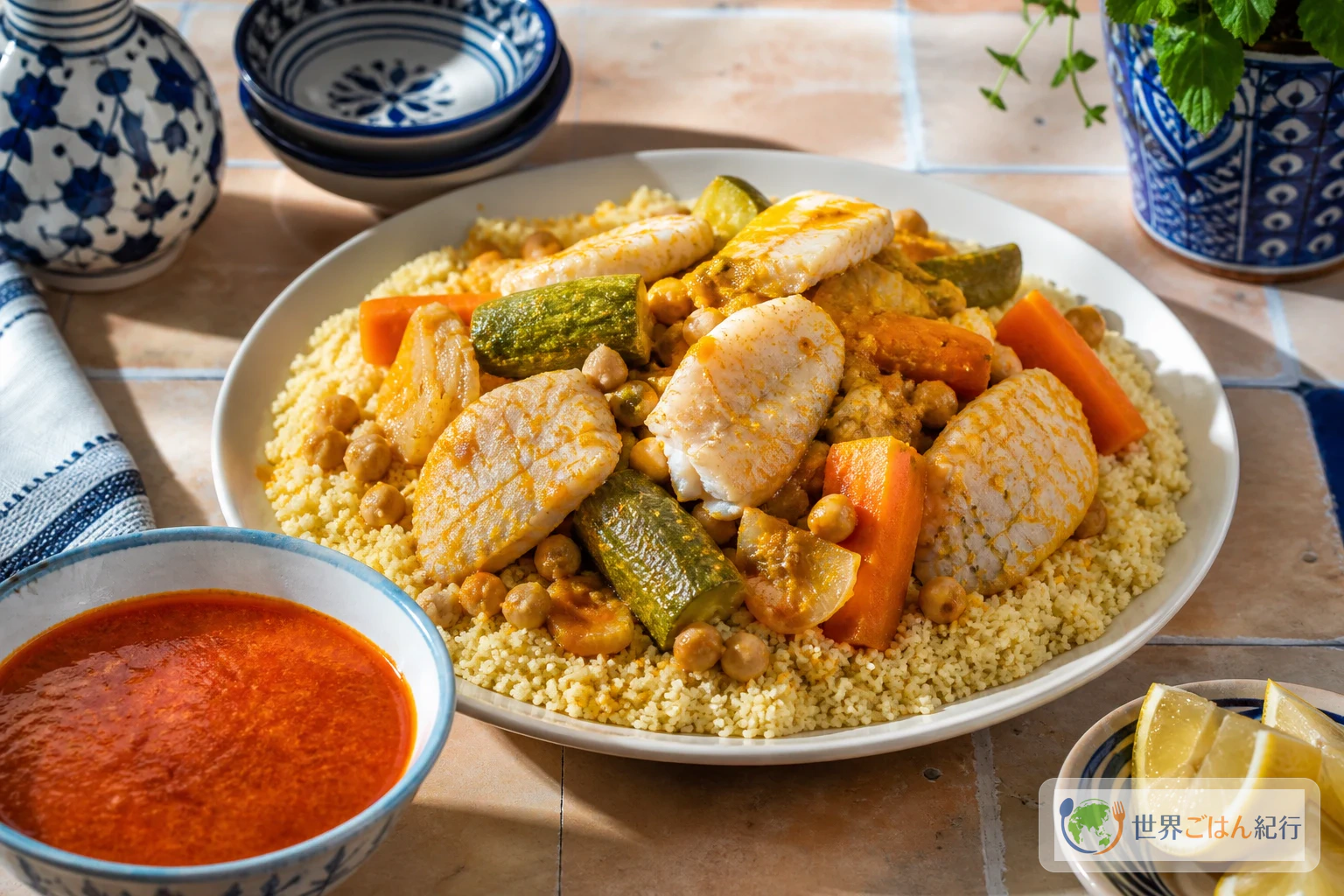
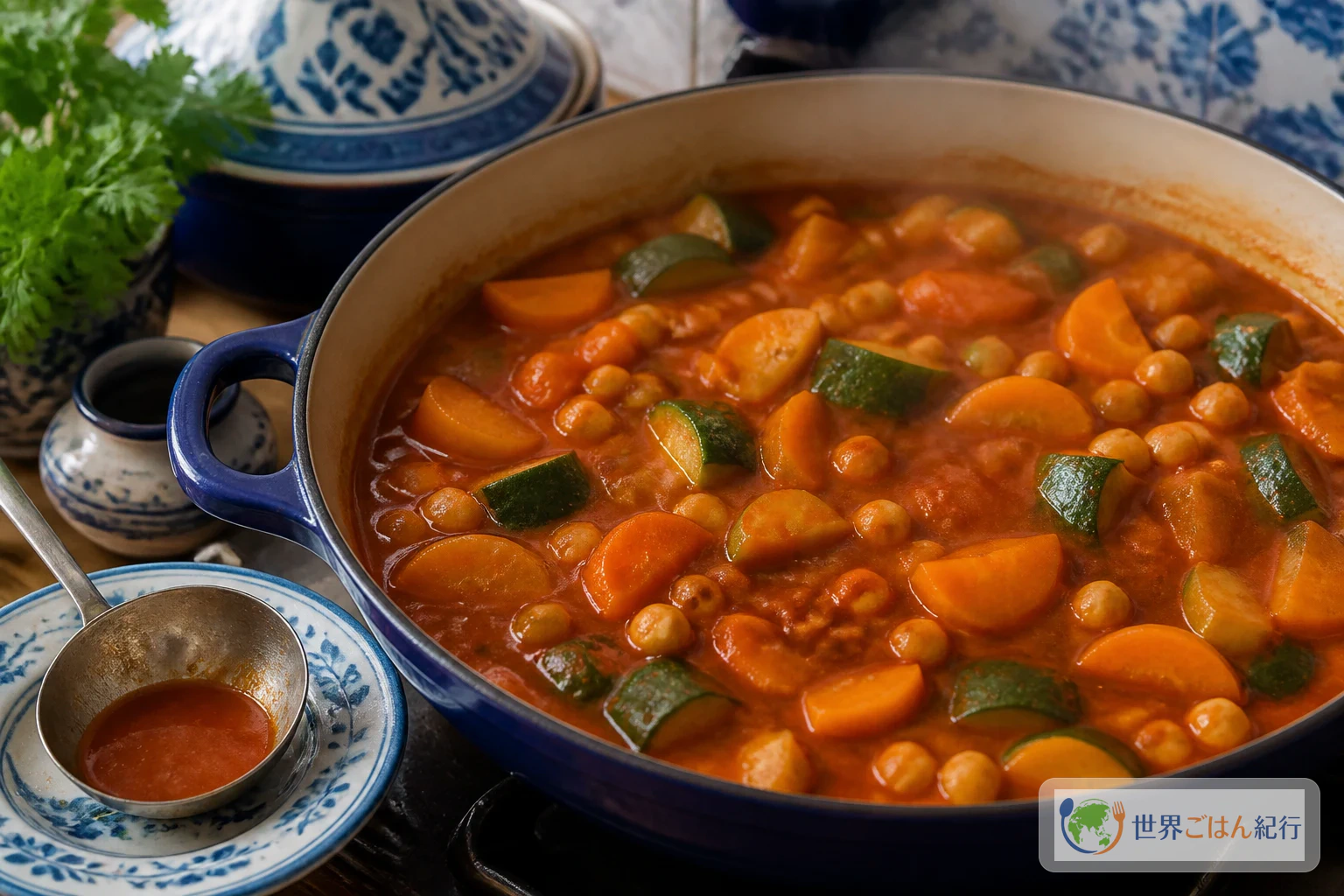
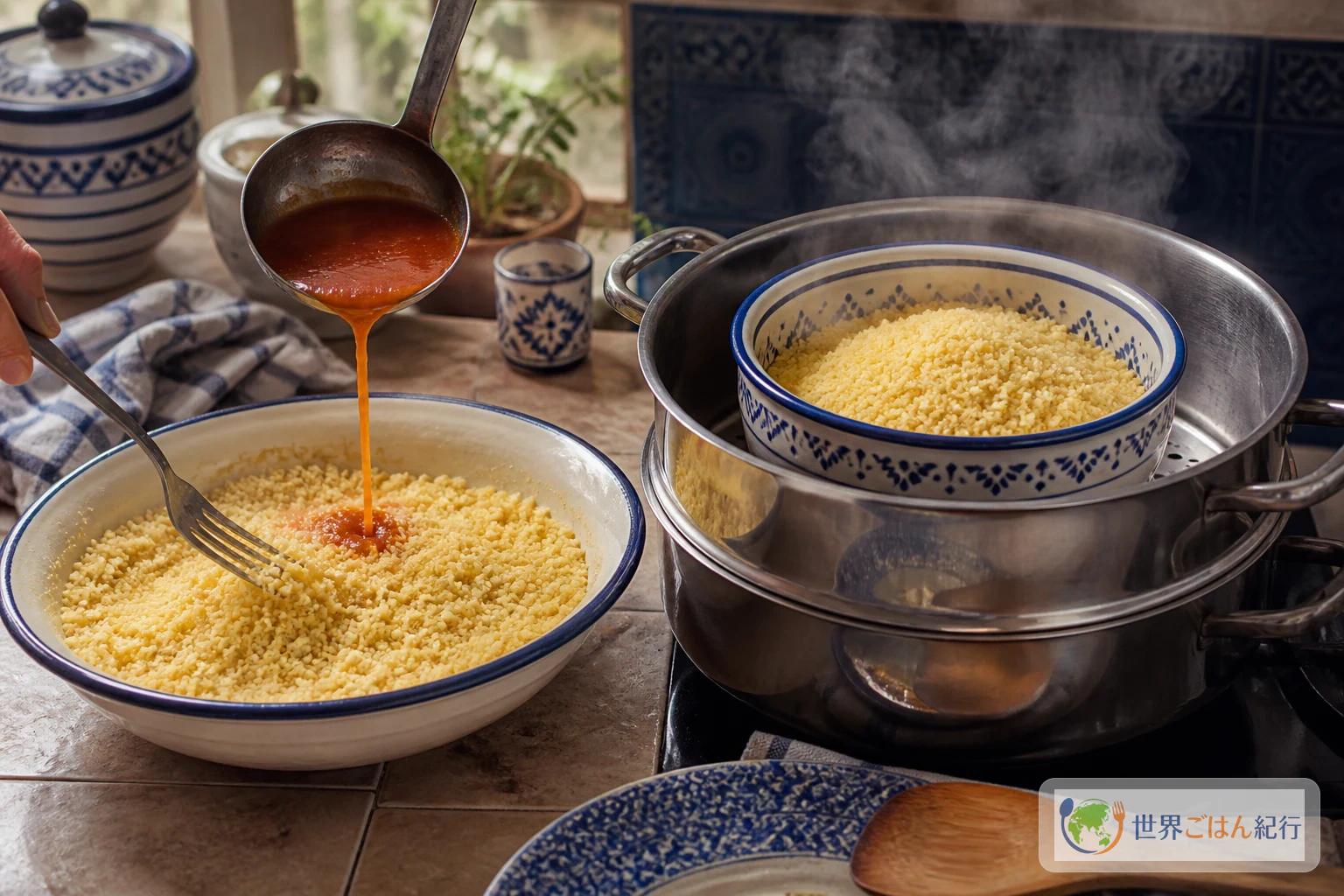
Lift the lid and red tomato steam and the smell of fish rise from the pot. The broth isn't a thin soup; it has the savoriness of onion and chickpeas and is thick enough to leave a faint track from a spoon. In a separate bowl the couscous grains are loosened, softly colored only where the broth has been poured.
Fish couscous (couscous au poisson) is a Tunisian dish in which fish and vegetables are brought together in a broth of harissa and spices and served with couscous that has been steamed or rehydrated in hot liquid. Couscous made with fish is eaten along the coast, and a tourist guide to Bizerte in the north also introduces a couscous made with grouper. It isn't the same dish as Morocco's couscous with meat and vegetables, and the interest of making it at home lies in keeping the fish from falling apart and moving the heat and tang of the red broth into the grains.
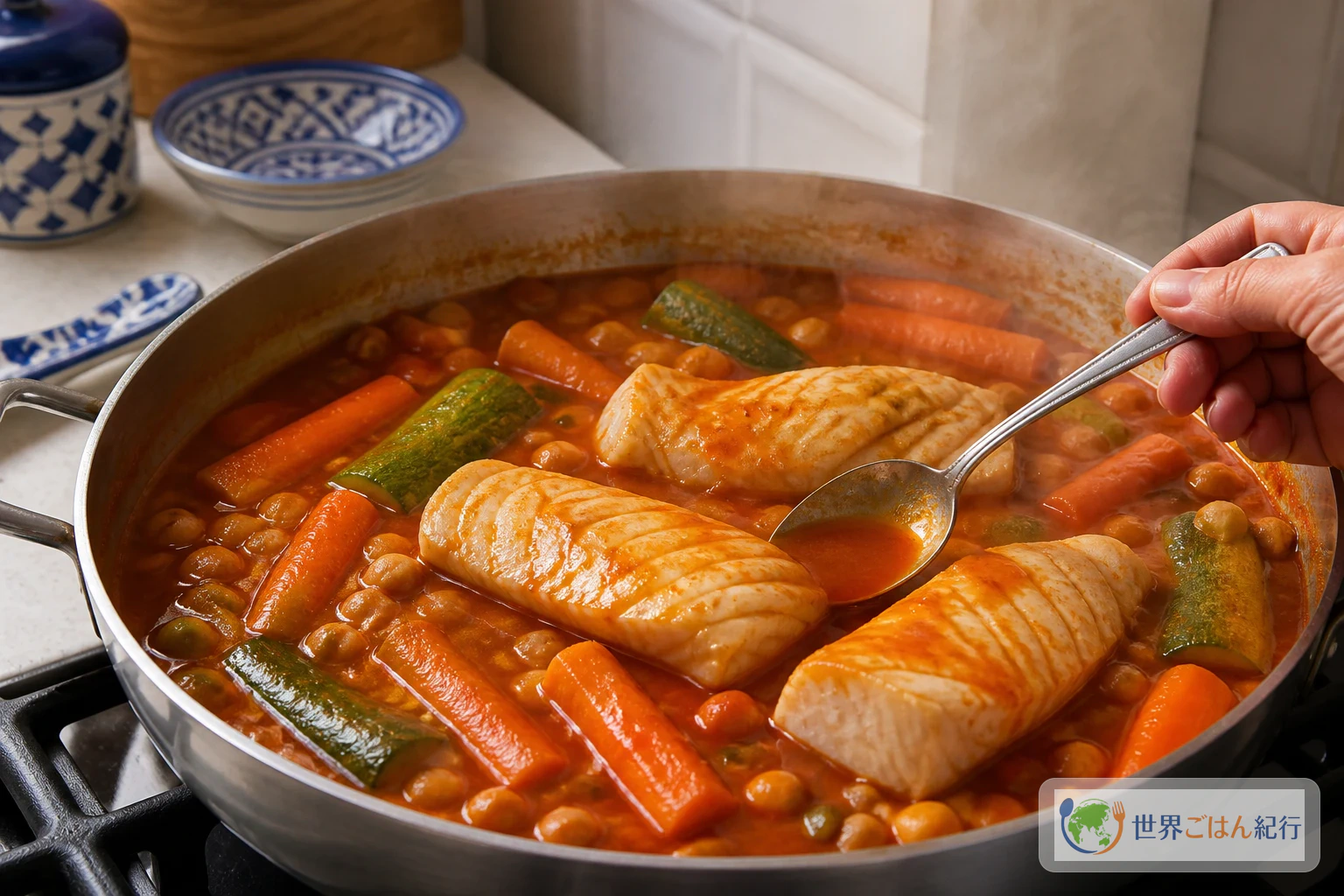
Don't simmer the fish from the start; make the broth from vegetables and bring the fish back at the end. That decides the flavor and texture of this plate. Cod gives a mild fish sweetness and sea bream keeps the aroma of the sea, and harissa and caraway make the same red sauce take different outlines.
This serves 4. Keep the grains separate and finish the broth so a spoon can scoop it. The main method uses the easy approach with store-bought couscous that is rehydrated in hot liquid, and also gives the more local approach for products labeled for steaming. How long the fish cooks depends on the thickness of the fillets, so stop by looking at the color of the center and how the flesh flakes.
Method: prepare the broth, the grains and the fish separately
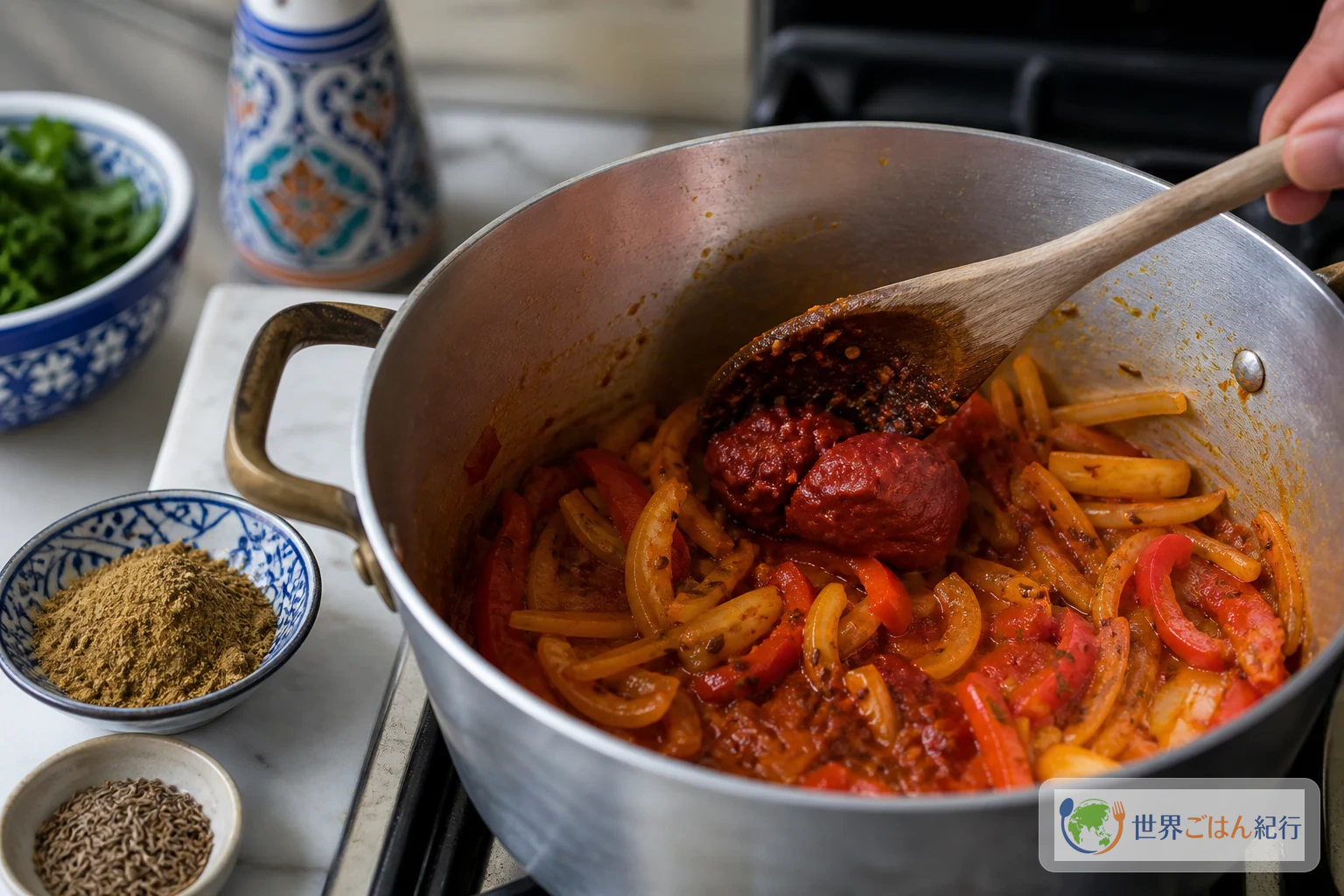
The red Tunisian broth isn't made from chili heat alone. Soften the onion slowly in oil, open up the aroma of cumin and caraway, bring out the sweetness of the tomato paste, and only then add liquid. Moving the fish around in this pot for long clouds the broth and breaks the skin and flesh into small pieces. Keep to the order of adding the fish once the vegetables are cooked, and the broth is rich and the fish is easy to plate.
Harissa varies by product in heat, saltiness, and its blend of garlic and coriander. For a first batch, cap it at 20 g to set the heat of the pot, and choose one that you can add more of at the table, which lets a family split their preferences. If you'll use a chili condiment only once, you can make this with red paprika and a little chili powder, but the aroma and saltiness peculiar to harissa will be something else. Check the size of the tube or jar and its ingredient list.
If you don't buy harissa, add a little chili powder to 2 g red paprika powder and make up the salt as you taste. The heat comes closer, but the roundness of fermented chili paste doesn't come back. If you want the fish to be the star, choose a mild product; if you'll also use it for bread or bean dishes, choose one with more spices in its ingredients, which makes it less likely to be left over.
Ingredients: serves 4 and substitutions
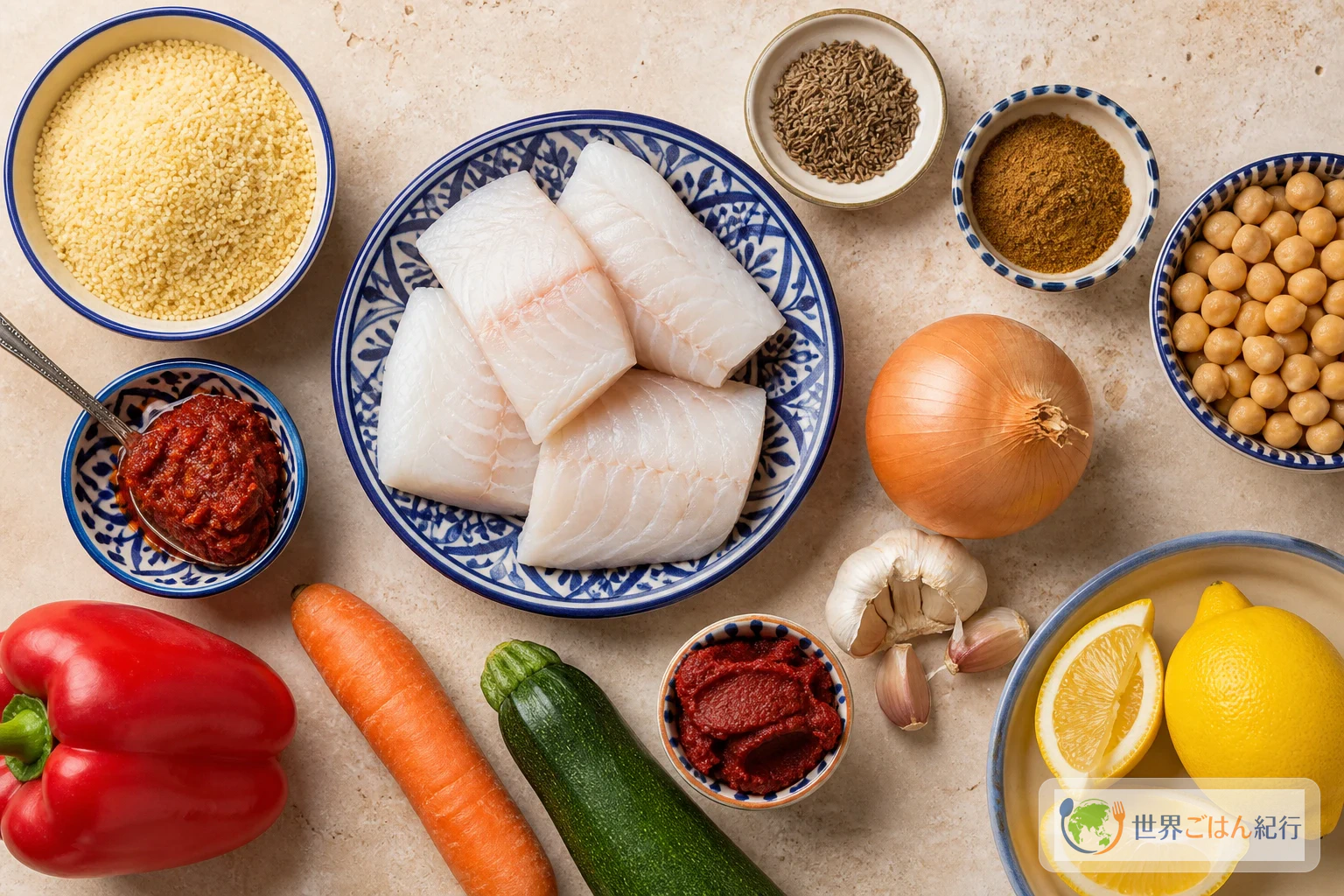
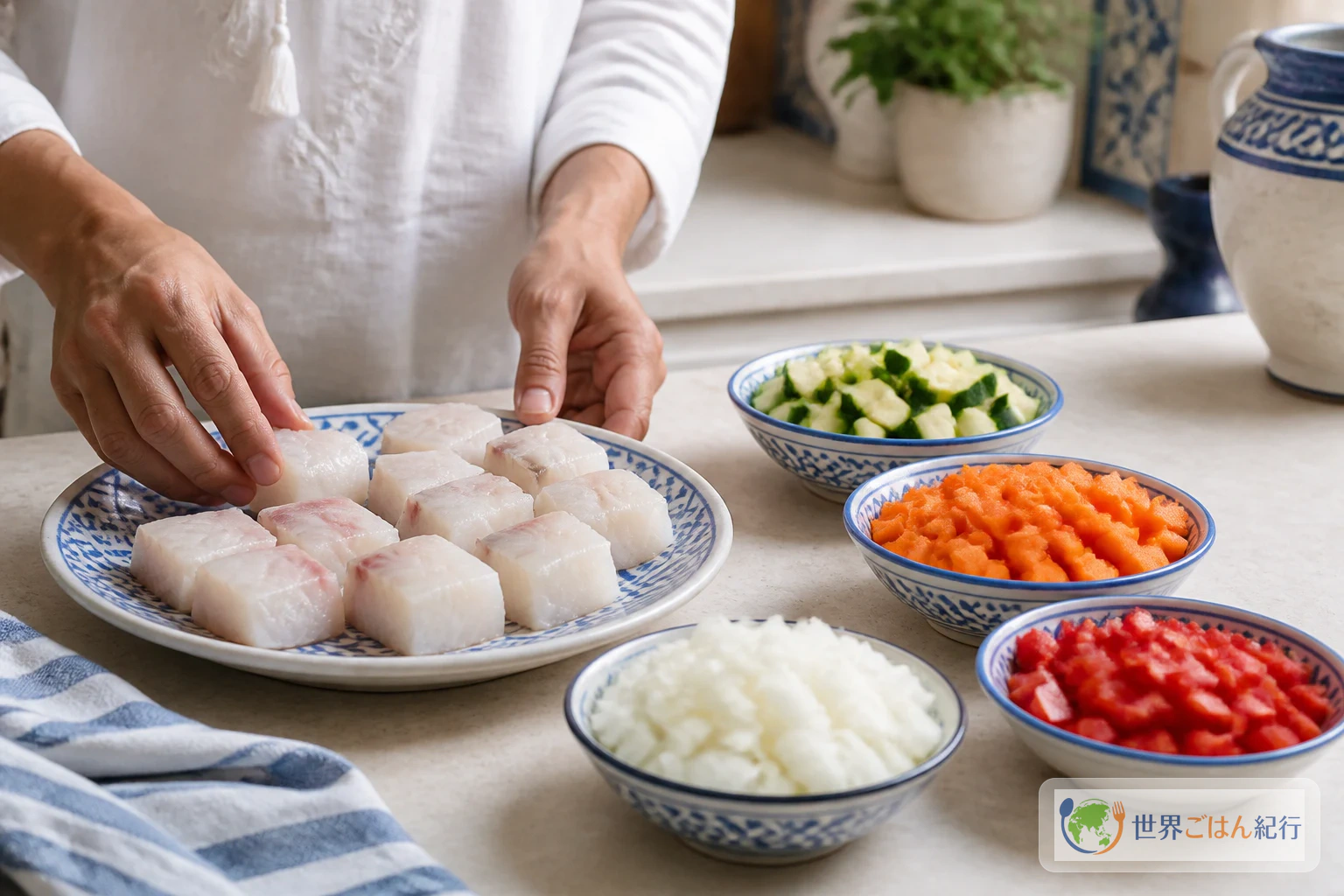
Using one kind of fish, 500 g, makes it easier to match how it cooks. For cod, fillets with skin and bones removed are easy to handle, and for sea bream, large skin-on fillets are less likely to fall apart. Spanish mackerel, which is fatty, has a stronger aroma, so start with 15 g harissa.
Harissa varies by product in heat, saltiness, and its blend of garlic and coriander. For a first batch, cap it at 20 g to set the heat of the pot, and choose one that you can add more of at the table, which lets a family split their preferences. If you'll use a chili condiment only once, you can make this with red paprika and a little chili powder, but the aroma and saltiness peculiar to harissa will be something else. Check the size of the tube or jar and its ingredient list.
If you don't buy harissa, add a little chili powder to 2 g red paprika powder and make up the salt as you taste. The heat comes closer, but the roundness of fermented chili paste doesn't come back. If you want the fish to be the star, choose a mild product; if you'll also use it for bread or bean dishes, choose one with more spices in its ingredients, which makes it less likely to be left over.
Couscous is a food made by shaping durum wheat semolina into grains. Replacing it with rice or rolled barley makes it a different dish, so if you want to reproduce the grain feel of fish couscous, first get a bag of dry couscous. Fine-grained products absorb broth quickly, and medium-grained ones hold their shape more easily when combined with the toppings, so for a first batch medium grain, or one labeled regular grain on the bag, is easier to handle.
Caraway looks like cumin but its aroma is cooler, with a faint hint of citrus. You can make the broth with cumin alone, but you lose the aroma that makes fish fat seem lighter. If you plan to use it in bread, sausages or cabbage dishes outside Tunisian cooking, it is worth buying as seeds. If you're trying it just this once, it's fine to leave out the caraway, increase the cumin to 2.5 g and add a little lemon zest. Make sure it's seeds rather than powder, and check the quantity.
A steamer suits people who want to keep the grains out of the water and let them take up the broth in stages. If you already rehydrate in a deep pot and a heatproof bowl, or are making it just once, there's no need to buy more. If you will steam couscous, steamed buns and vegetables many times, check the diameter that fits your pot and the height of the lid, and choose a dedicated steamer. Check whether it is a 28 cm size, whether it's stainless steel, and what the set of steaming tray and pot contains.
Regional differences in Tunisia and the coastal table
Couscous isn't a dish of Tunisia alone. In 2020 UNESCO inscribed the knowledge and practices of growing semolina, grinding it, rolling it into grains, steaming it, and handing down the tools and ways of eating, as an intangible cultural heritage shared by Algeria, Mauritania, Morocco and Tunisia. What is served with it changes with place, season and occasion, so it is closer to reality to see it as a dish where the grains are prepared by steam and the broth and toppings are divided among the family, rather than fixing it to "couscous is only with these toppings."
Fish appears because fish is easy to get in Mediterranean towns. The Tunisian National Tourist Office's guide to Bizerte in the north introduces a couscous made with grouper alongside seafood dishes, and explains that in coastal towns couscous is made with fish rather than meat. There is no need to keep hunting for grouper in other countries; choose a firm white fish and adjust the cooking time and aroma by the kind of fish, and the idea of the coastal dish moves into your kitchen.
Looking at Tunisian examples compiled in an academic paper, fish species are tied to season and place. The table below is not one nationwide recipe but a guide for reading how dish names and ingredients combine.
| Example of place or season | Recorded couscous | Judgment for recreating it |
|---|---|---|
| Summer seafood dish | Kosksi Saifi Bel Manneni made with grouper | Cut sea bream, sea bass or cod larger and pair with zucchini |
| Spring seafood dish | Kosksi Rebiî Bel Bouri made with gray mullet | Use it if you can get fresh mullet. If the smell bothers you, switch to sea bream |
| Winter seafood dish | Kosksi Chetoui Bel Morjen made with red sea bream | Use sea bream with turnips and carrots to bring out the sweetness of root vegetables |
| Sfax and the Kerkennah Islands | Kosksi Bel Karnit made with octopus | Add pre-boiled octopus at the end. Don't simmer raw octopus briefly |
| The Monastir coast | Kosksi Bechcherkaou made with small fish | A dish for when you can handle small fish whole. At home, fillets are safer and easier to check for doneness |
That fish species and accompanying vegetables move with place and season is this dish's regional difference. Beyond whether fish is used, even the size of the grains, the heat of the broth, whether root vegetables go in first, and whether coastal fish goes on last, change with what the household has and the day it is eaten.
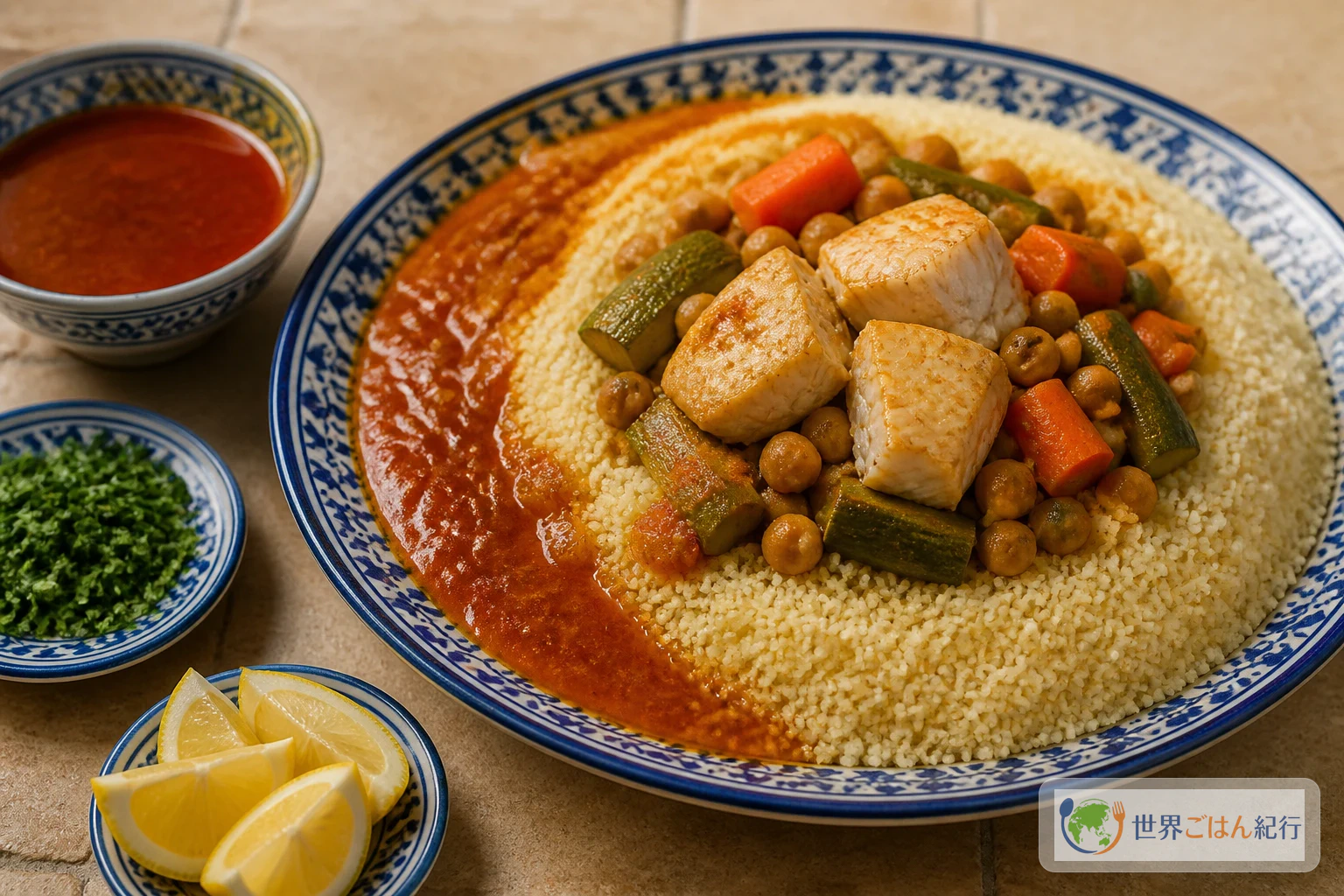
The day of the week for eating couscous also isn't the same everywhere. The research materials note regions where Friday is the norm and regions where it is made on market day, and also describe roles as a dish for receiving guests, a family lunch, and a dish shared with neighbors. Mounding the grains on a large platter, putting the toppings on top and serving the broth alongside lets each person decide the amount of broth. Not mixing the fish into the grains from the start is not only for appearances, but also makes it easier to pick out bones and flaked flesh.
Harissa is also not simply a hot sauce. UNESCO's record explains that knowledge of drying chilies, removing the stems and seeds, washing and crushing them, seasoning them with salt, garlic and coriander and preserving them has been handed down within home preparation and community gatherings. Even a small amount in the pot brings in chili heat, garlic and the aroma of spices at the same time, so the impression changes if you only add the same amount of chili powder.
Choosing fish, heat and grains when recreating it
Choose fish by thickness and freshness, not "expensive fish"
If you look for the local fish names as they are, the dish drifts away just from gathering ingredients. For a first batch, the easiest to use are fish that take up the aroma of the broth and whose fillets are easy to keep an even thickness.
| Fish | Taste and handling | Adjustment in the steps |
|---|---|---|
| Cod | Mild taste, so the harissa and lemon are easy to recognize | Don't boil the broth hard; check 4 cm pieces at 6–8 minutes |
| Sea bream | Firm flesh; with the skin on it holds its shape | Place skin side down and check the thick part first |
| Spanish mackerel | Fatty, with the fish aroma coming forward | Start with less harissa and add lemon at the end |
| Gray mullet | You can try the spring regional variation, but the aroma changes with freshness | If there is any off smell, don't use it; choose pre-trimmed fillets |
Don't choose fish at the fish counter that smell sour, ammoniated or strongly fishy. Check frozen products for torn bags and heavy frost, and thaw slowly in the refrigerator. Lemon and harissa are not seasonings that bring spoiled fish back to an edible state.
Decide the amounts of harissa and cumin after tasting the product
15–20 g of harissa moves heat into the broth for 4 servings without easily hiding the taste of the fish. With a hot product, start at 10 g and reduce the salt in the broth. With a mild product, use 20 g and add more at the table. Taste a little on a small plate before it goes in the pot, and if a product's saltiness is stronger than its heat, first reduce the amount rather than increasing the liquid and tomato paste.
Warm the caraway seeds in the oil for about 30 seconds and the aroma comes out. Even using the same amount of cumin powder, the earthy aroma becomes the main thing and the cool quality that carries through to the fish is weak. If you don't have caraway, increasing the cumin by 0.5 g and adding a little lemon zest is the substitute that keeps the outline of the flavor easiest at home.
Steam the couscous or rehydrate it
Dry couscous comes as a rehydrating kind that has been steamed and dried beforehand, and a kind finished by exposing it to steam. If you decide the amount of liquid without reading the package, the grains stay hard or absorb all the broth and turn heavy. If you're trying it once in a home kitchen, pouring in hot broth and resting 5 minutes is the method that lets you see the state in a short time. If you have a steamer, check whether the grain type is suited to it before choosing the double steaming method.
Switching to rice makes a staple that catches the red fish broth, but it doesn't give the texture of grains loosened with your fingertips or the aroma of steam. If making it with rice, think of it as a separate dish of tomato-stewed seafood served beside rice, and don't force the name and texture to be the same; it will feel more satisfying.
Six variations: adjusting to the season and the people eating
Fish couscous becomes a different plate not only by changing the fish but by adjusting the seasonal vegetables and the thickness of the broth together.
- Summer sea bream and zucchini: Change the white fish to 500 g sea bream and increase the zucchini to 200 g. Cooking the fish skin side down keeps the flesh from splitting even in the red broth, and the lemon's acidity feels lighter.
- Winter root vegetable couscous: Replace the zucchini with 150 g turnip and 100 g leek, and simmer 10 minutes with the carrot. The root vegetables absorb broth, so add 50 ml water and check the thickness before the fish goes in.
- A seafood plate with shrimp added: Reduce the white fish to 400 g and add 120 g shrimp, shelled and deveined. Add the shrimp with the last 3–4 minutes of the fish simmer and take them out when the flesh turns white and firm. Don't serve to anyone with a crustacean allergy.
- Sfax-style octopus: Cut 250 g of pre-boiled octopus into bite-size pieces and warm it in the last 3 minutes of the broth. Long cooking tends to toughen it, so don't simmer raw octopus for the same time as the fish. Don't mix it into the couscous; set it on top as a topping.
- The sweet-tart touch of raisins: Add 30 g raisins at the same time as the chickpeas. They give the fish broth a sweet aftertaste, but they aren't an ingredient in every coastal fish couscous. Use less harissa and notice the difference in flavor.
- Chickpea and pumpkin, without fish: Leave out the 500 g fish, increase the chickpeas to 240 g and the pumpkin to 250 g, and simmer in vegetable stock. Serve it not as fish couscous but as a bean and vegetable couscous using the same grains and red broth. Pumpkin breaks down easily, so add it for the last 8 minutes after the broth is made.
Where to go back when it goes wrong
If you're at a stage where you can take the fish out, move the fish to the plate and fix only the broth. If you keep stirring broken-down fish in the pot, the toppings and broth both get heavy without your knowing the cause.
| Condition | Likely cause | How to fix it |
|---|---|---|
| The broth is bitter | The spices or tomato paste scorched | Move it to another pot leaving no black bits, and add 50 ml boiling water and 1 tsp tomato paste. If the bitterness is strong, start over |
| The broth is watery | The vegetables released water, or too much stock was added | Before the fish goes in, reduce for 5–8 minutes over medium-low heat. If the fish is in, take the fish out first and then reduce |
| The center of the couscous is hard | Large grains, too little broth, or not enough resting | Add hot broth 1 tbsp at a time, cover and rest 2 minutes. Press a grain to check the center |
| The couscous is sticky | Too much liquid, over-stirring, or pouring all the broth at once | Spread it on a shallow plate and let the steam out. Don't pour on more broth; serve it separately from the toppings |
| The fish broke apart | Boiled too hard, or turned many times | Set the broken flesh gently on top of the couscous. Next time use lower heat and spoon the broth over to cook it |
| Too salty | The saltiness of harissa and fish stock stacked up | Add a little unsalted broth and increase the chickpeas and vegetables. Lemon alone doesn't remove the saltiness |
| Strong fishy smell | Poor freshness, water from thawing, or insufficient prep | If it smells sour or like ammonia, don't taste it and throw it away. Don't mask it with seasoning |
Avoid mixing couscous into a thin broth and reducing it together. Even if the grains absorb the liquid, the flavor of tomato and fish doesn't concentrate; only the surface gets heavy. Decide the thickness in the broth in the pot, and adjust how much you pour onto the grains at the table.
Storage and serving
Because it contains fish, don't let the finished dish cool for long in the pot. Divide the couscous, broth and fish, ideally into separate shallow containers, and refrigerate once the steam has gone. Keep seafood refrigerated from purchase to cooking, and it is safest to use raw fish within 2 days. Even after cooking, it varies with your refrigerator's cooling and the kind of fish, so finish fish-containing toppings mainly on the same day to the next. Public storage charts also give a guide of 3–4 days at 4°C or below for soups and stews, but for keeping aroma and texture it is better to eat sooner.
Don't eat food left at room temperature for 2 hours or more, left in summer heat for 1 hour or more, or that has a sour smell, foam or sliminess. Reheat the fish thoroughly to the center, and for the couscous, sprinkle 1–2 tsp water, cover, and restore the dryness in a steamer or microwave. If freezing, divide the fish and broth by serving, wrap the couscous separately, and use it soon. If the grains become too soft after thawing, don't add more broth; serve a little of the warmed fish sauce at a time.
This dish is easier to handle if you don't finish it on individual plates but set the toppings on a mound of grains on a large platter and leave the broth in small bowls. Putting lemon, chopped parsley and harissa for adding heat on the side lets people who want the fish mild and people who want to soak in plenty of red sauce enjoy the same pot. With Tunisia's brik as a starter, and lablabi (in Japanese) as a small bean dish, the toastiness of the fried pastry and the softness of the chickpeas don't overlap with the grains of the fish couscous. Tasting it against Moroccan couscous, you can see how even among North African grain dishes the construction built around a fish broth differs.
Couscous uses wheat-derived semolina, so don't serve it to anyone with a wheat allergy or avoiding gluten. Fish, shrimp, octopus and chickpeas also call for care. The ingredients and production lines of harissa differ by product, so check the label, and wash cutting boards, knives and bowls that touched raw fish with detergent and running water before using them for other foods.
Nutrition information
The figures below are an estimate for 4 servings using 500 g white fish, 240 g couscous, 120 g chickpeas, 45 ml olive oil, vegetables and harissa. They vary with the kind of fish, the saltiness of harissa and fish stock, and differences between couscous products, so they won't match the nutrition label of a product you buy.
| Per serving (approx.) | Amount |
|---|---|
| Energy | About 540 kcal |
| Protein | About 30 g |
| Fat | About 18 g |
| Carbohydrate | About 63 g |
| Dietary fiber | About 8 g |
| Salt equivalent | About 2.8 g |
Frequently asked questions
Can I make it without a couscoussier?
Yes. For couscous meant to be rehydrated, covering for 5 minutes after pouring in 270 ml of broth is the approach that's easy at home. Stacking a colander over a pot in place of a steamer lets the grains fall through the mesh and concentrates lid condensation on them, so don't use it with a product not labeled for steaming. If you already have a heatproof bowl and a lid, you can try it once without buying a dedicated tool.
Can I substitute rice or pasta for couscous?
Rice can be a staple that catches the red fish broth, but it won't have the fine grains and the loosened texture of couscous. Breaking thin pasta into short pieces doesn't give even grain size and changes the rehydration time. For a first try, use couscous, and next try serving the broth over a staple you have as a separate dish; that makes the differences easier to judge.
What do I do if the harissa is too hot?
Move a little of the broth into a separate small pot and dilute it by adding unsalted water or fish stock and tomato paste a little at a time. Dividing the amount of hot sauce you pour over the couscous keeps more of the fish's flavor than adding sugar to the whole pot to hide the heat. Next time, before switching products, start with 10 g harissa and add more at the end.
Can cumin replace the caraway seeds?
It can, but the aroma changes. The cool aroma of caraway is gone and the warm aroma of cumin becomes the center. Increasing the cumin to 2.5 g and adding a little lemon zest makes it easier to keep a lightness that suits the fish. If you buy caraway, decide by whether you plan to use the seeds in bread or cabbage dishes too.
Can I make it with frozen white fish?
Yes. Thaw it in the refrigerator, wipe off the water that comes out thoroughly, then cut. Putting fish into the pot with the surface still frozen drops the broth temperature, releases water from the fish and thins the flavor. Don't choose fish with torn bags, heavy frost, or that looks to have been thawed and refrozen repeatedly.
How do I cook shrimp or octopus in place of fish?
Add shrimp for the last 3–4 minutes of the fish simmer and pre-boiled octopus for the last 3 minutes. Both tend to toughen if simmered long, so don't give them the same 6–10 minutes as fish. If using shell-on shrimp, tell the people eating how to handle the shells and veins, and check for crustacean allergy.
Sources
- Knowledge, know-how and practices pertaining to the production and consumption of couscous (UNESCO). Checked its inscription as shared heritage, the knowledge of making and steaming the grains, and differences in accompaniments by region, season and circumstance. Accessed and checked 28 August 2026 (JST).
- Harissa, knowledge, skills and culinary and social practices (UNESCO). Checked the ingredients of harissa, the knowledge of drying and crushing chilies to preserve them, and its place in home and community food culture. Accessed and checked 28 August 2026 (JST).
- Dougga Tunisia - Visit Dougga Tunisia and Bizerte (Discover Tunisia). Checked seafood dishes in Bizerte, grouper couscous, and couscous made with fish in coastal towns. Accessed and checked 28 August 2026 (JST).
- Archaeology of Couscous between Kitchen and Cinema: A Selective Inventory of Scientific Research on Couscous and Its Culinary Practices (CINEJ Cinema Journal). Checked Tunisian couscous by fish species, season and region, its role at family and guest tables, and regional differences in the day of the week. Accessed and checked 28 August 2026 (JST).
- Couscous tunisien au poisson (RICARDO). Checked a cooking example combining white fish, tomato paste, harissa, chickpeas and couscous and the flow of searing the fish first and combining it with couscous at the end, and reworked the amounts and steps for home cooks in Japan. Accessed and checked 28 August 2026 (JST).
- Selecting and Serving Fresh and Frozen Seafood Safely (FDA). Checked how to judge smell and condition when buying seafood, refrigeration and thawing, the 145°F (about 63°C) center temperature, and the guide that fish flesh turns opaque and separates with a fork. Accessed and checked 28 August 2026 (JST).
- Cold Food Storage Chart (FoodSafety.gov). Checked storing food at 4°C or below, the refrigerated storage guide for soups and stews, and the approach to storage periods for seafood and leftovers. Accessed and checked 28 August 2026 (JST).