
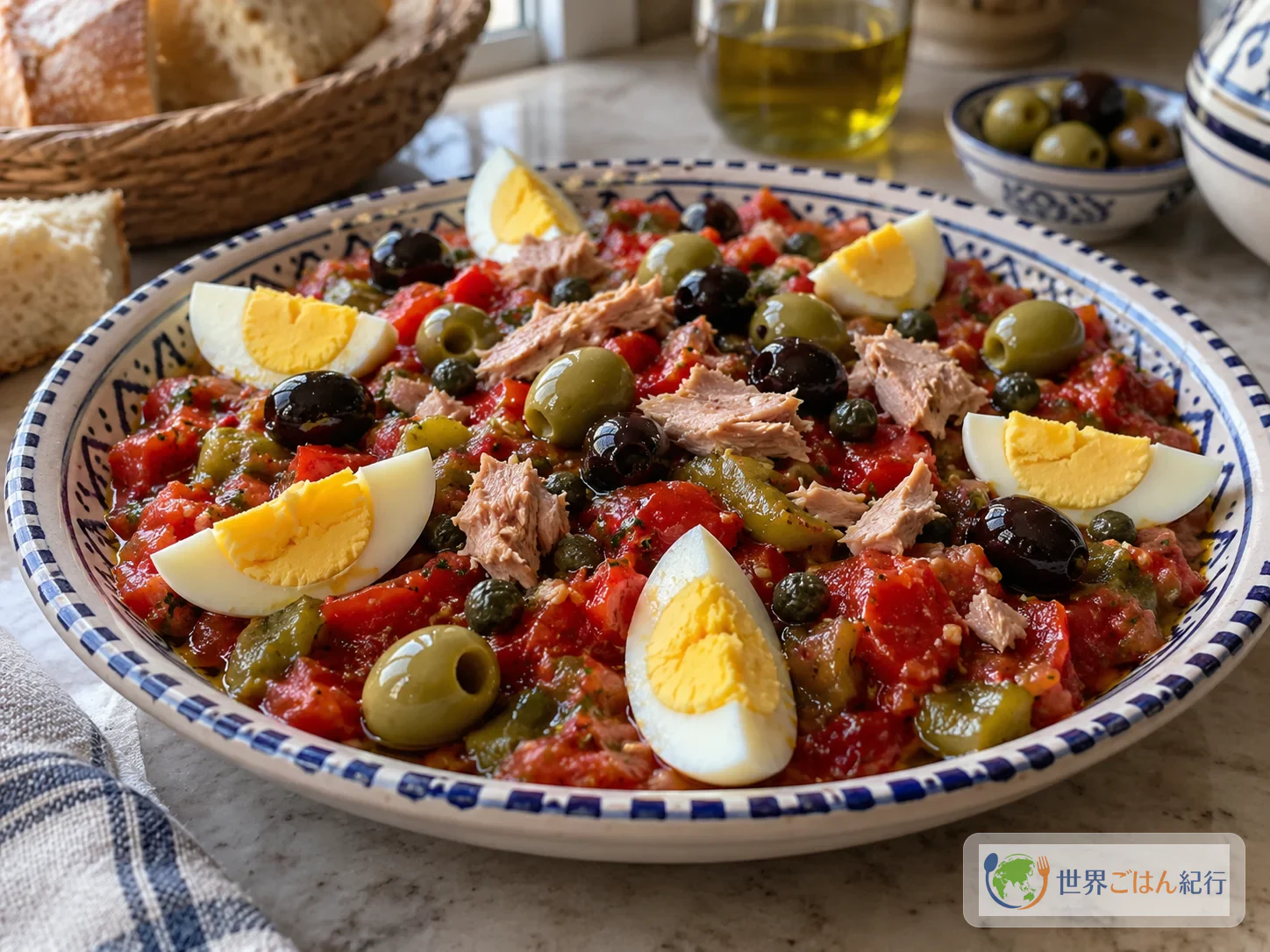
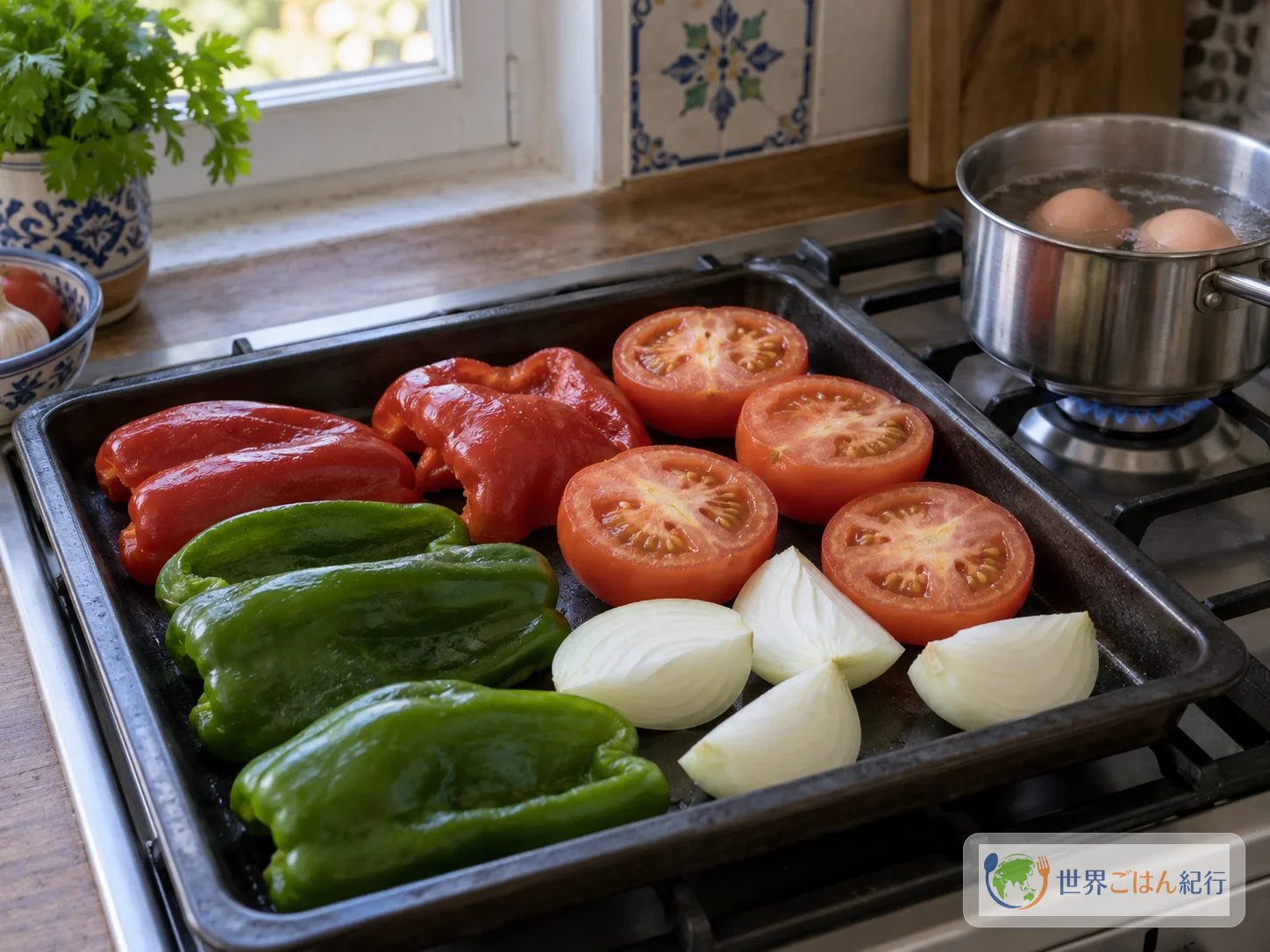
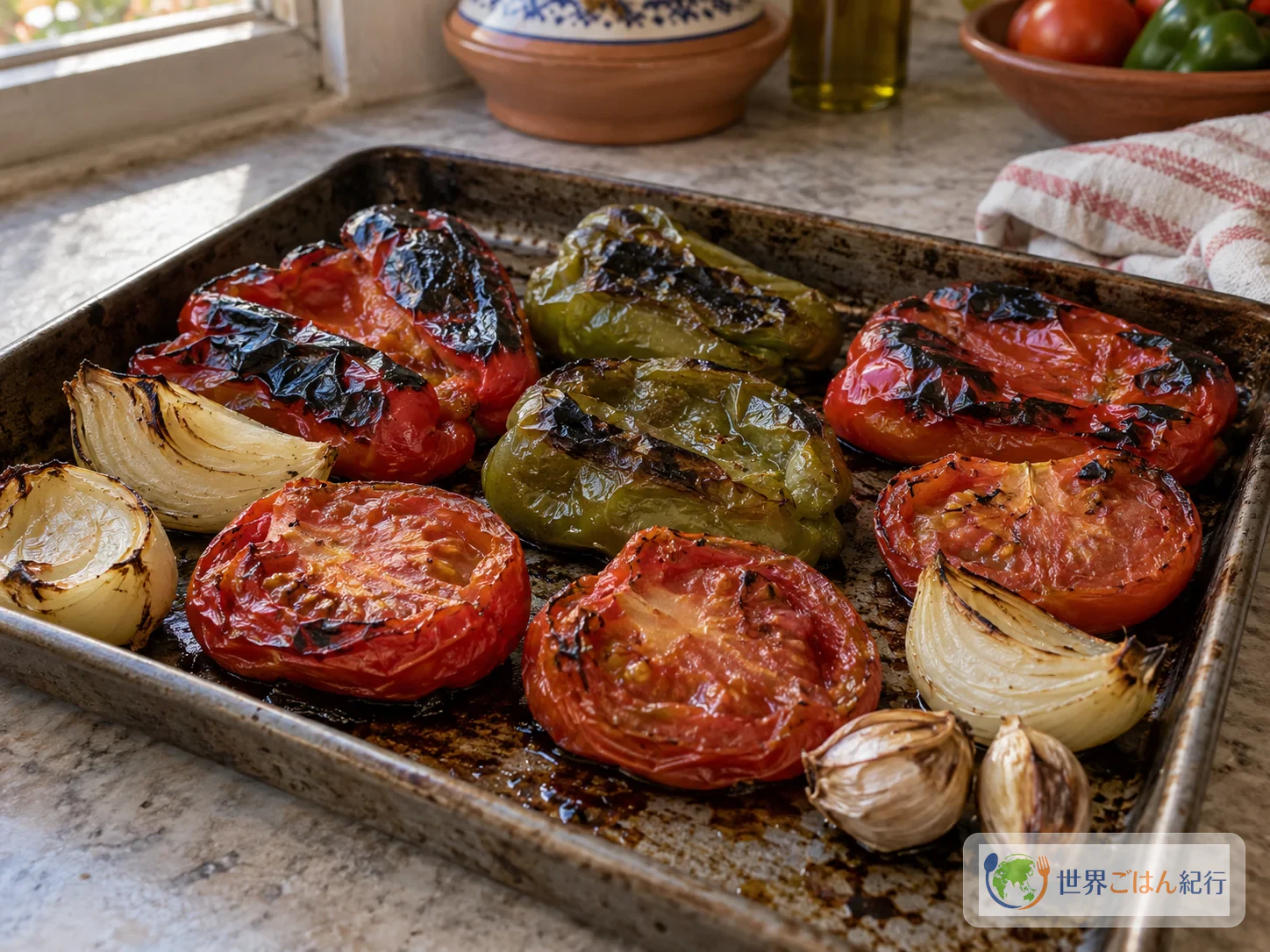
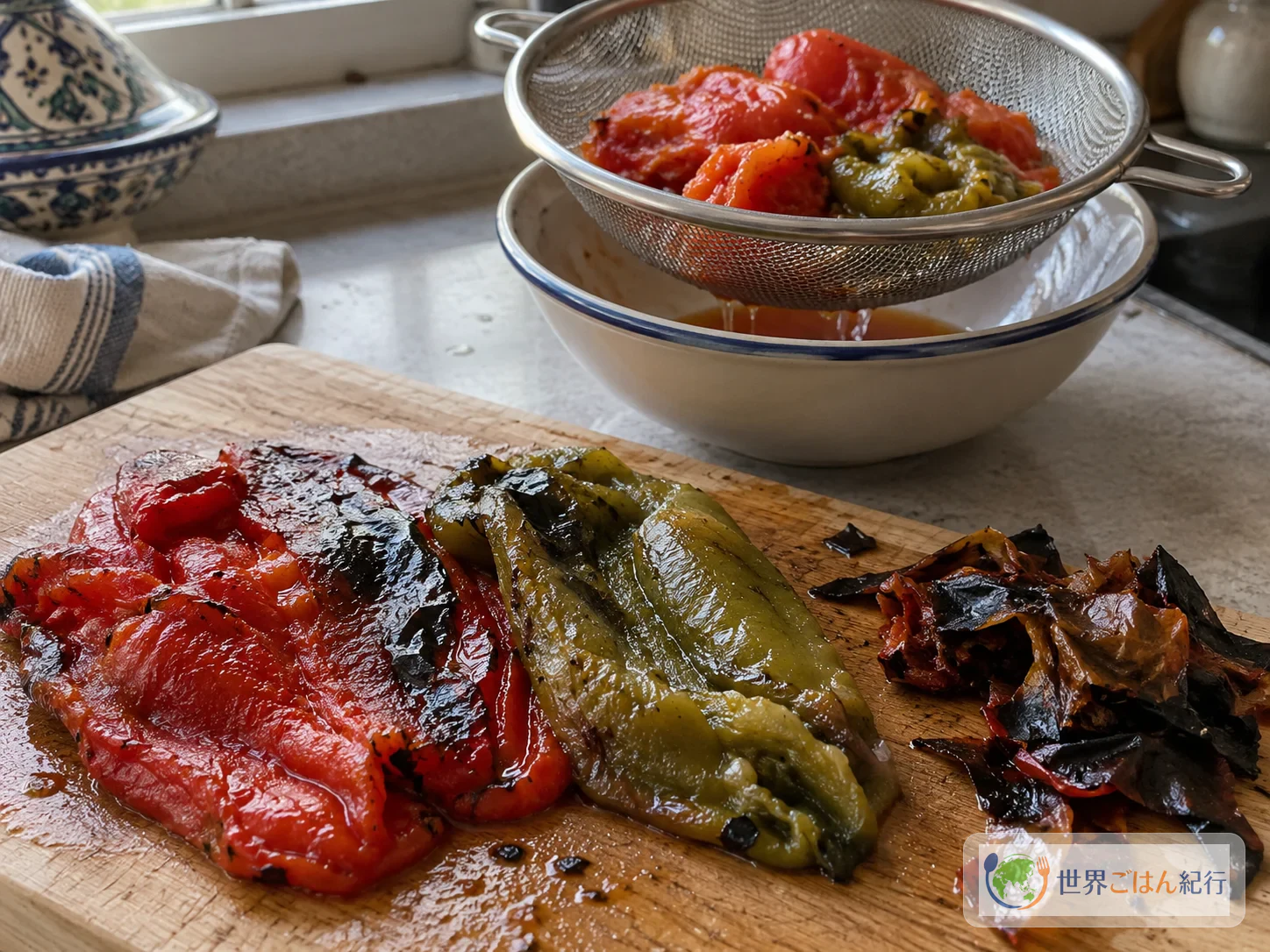
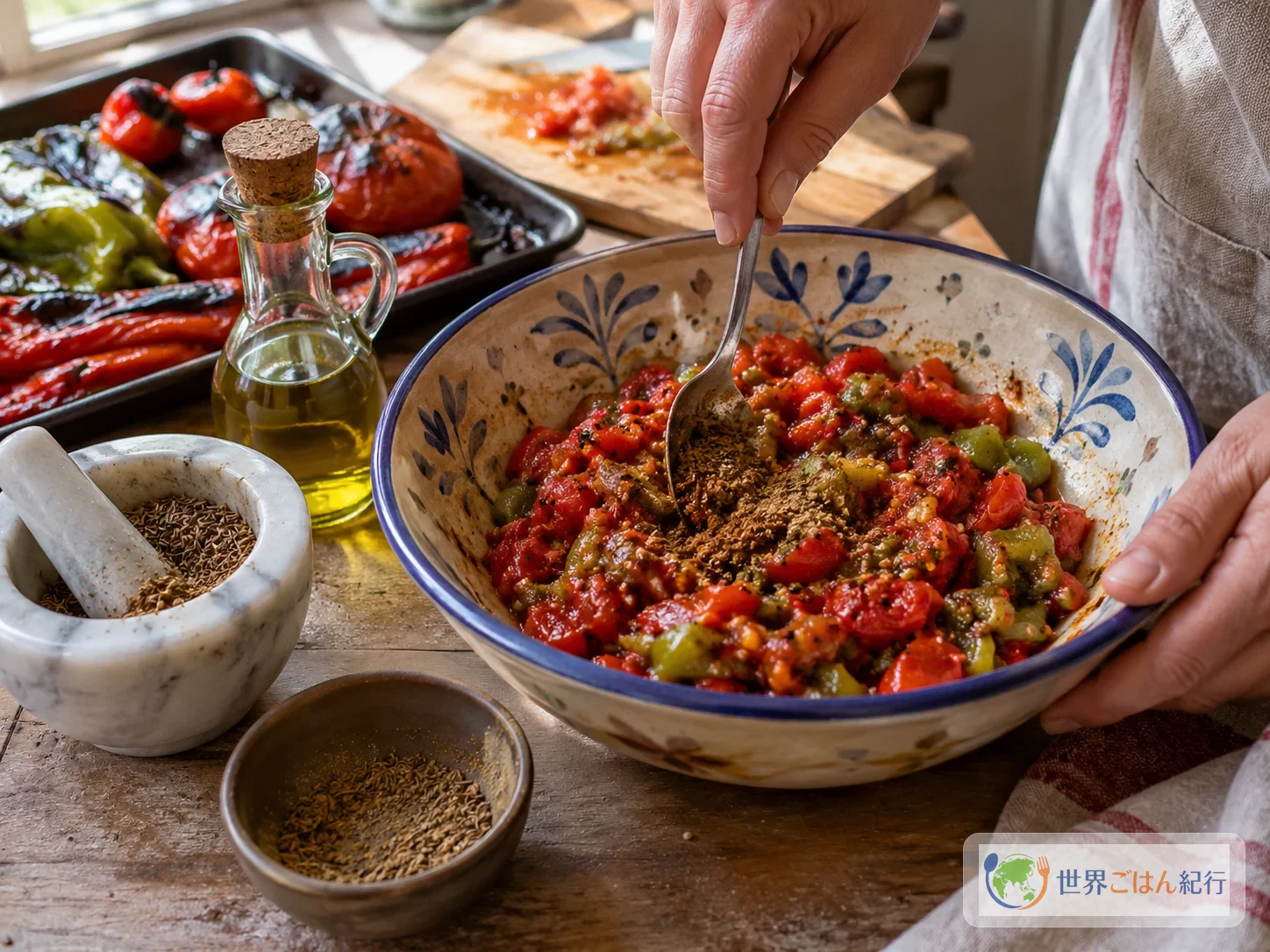
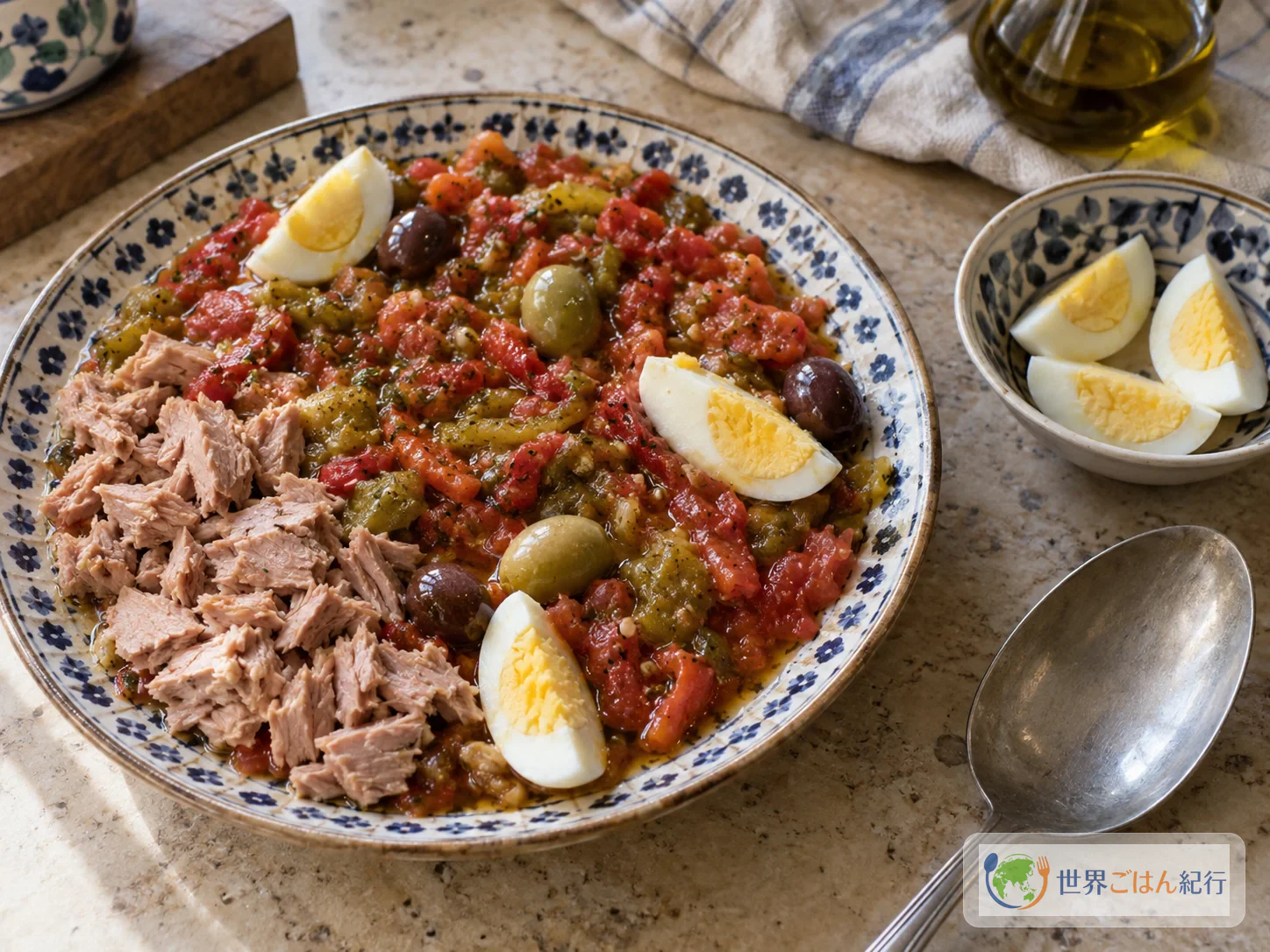
In a Tunisian home kitchen, the black skins of peppers roasted over an open flame or in the oven slip off easily, the soft flesh is chopped with a knife, and eggs and tuna are set alongside. Slata mechouia (salade méchouia) is a salad you roast first and chop afterward. The vegetables are roasted and then made into a cold dish.
You roast the vegetables for a toasty flavor, remove the blackened skins, and use only the flesh inside. It is not a dish in which you mix in plenty of the char. Peppers and tomatoes are easy to find in Japan too, and the places people trip are moisture and the handling of the spices. Peel and drain, and crush the caraway finely: those are the keys to reproducing it at home. For 4 servings, plan on 25 minutes of prep, 35 minutes of heat, and about 60 minutes in all. Oven preheating and chilling time are separate, and the eggs can be boiled while the vegetables roast.
Tunisian salad: cooked first, then brought to the table
Méchouia means "grilled," and its starting point differs from the plate of raw vegetables you picture when you hear the word salad. The French spelling salade méchouia and Slata mechouia both mean the same dish. As the roasting step kept in the name says, you roast the vegetables, peel them, chop them and dress them with oil, in that order. In the kitchen, the procedure is nothing like a salad of diced raw tomato and cucumber.
Tuna and egg join this vegetable-centered dish. There are versions that add tuna, hard-boiled egg, black or green olives and capers, but it isn't fixed that you use all of them every time. Spread the chopped vegetables on a plate and put the toppings on, and each bite can vary the ratio of vegetables to extras. When serving on a big platter, use clean serving tongs or a spoon to portion it. Bread goes alongside. The WPSU recipe has instructions to serve flatbread, and in Japan serving thin slices of baguette is recommended (editorial suggestion).
There isn't one fixed way to roast this dish. Local Tunisian recipes include roasting over charcoal, over a stove flame, and in the oven. Whatever the tool, the roasted vegetables are peeled and used. The World Kitchen material from WPSU in the US also introduces a method of roasting in the oven or on an outdoor grill and chopping with a knife or food processor. It can be made in an oven, so it can be said to be a dish shared in a form that can be reproduced in home kitchens overseas. We do not discuss here the year of its origin or which people created it.
Local recipes describe both crushing in a mortar called a mehrass and chopping with manual or electric tools. You don't need to buy special equipment; you can make it by chopping finely with a knife. The mouthfeel changes depending on whether you crush it smooth or leave grains, but it can't be said that there is only one authentic texture.
Heat of the chili and quantity of tomato vary from house to house
Looking at local records, there are versions that choose sweet peppers and versions that choose hot chilies. Binetna's cooking record mentions meski (the less hot type) and ba9louti (the hot type). That doesn't mean these are the same varieties as Japanese green peppers. The vegetables need not be made hot, either; if you mainly use sweet Japanese bell peppers and add heat separately, everyone sharing the same plate can adjust to their own taste. It can be made with sweet vegetables.
The share of tomato also varies by household. Local records have versions with 10 peppers to 2 tomatoes, 4 to 3, and 4 to 5. Vegetable sizes also differ, so don't treat the ratio of counts as the one correct answer. Comparing the proportions, versions with more peppers make the taste of the flesh come forward more easily, while more tomato adds moisture and acidity (the editors' reading). We could not confirm a fixed ratio by city or by north and south; it seems best to take it as a difference between households and cooks. The home proportion used here is 600 g of peppers to 300 g of tomatoes. Japanese bell peppers are large, so don't match the local counts directly.
Differences in spices are also part of the range within the same dish. Carvi is caraway and coriandre is coriander, and they are separate spices. Don't confuse them with cumin either. Caraway and cumin are different things; among the spices used are the local version with caraway and coriander and the WPSU version with coriander and paprika. The aim isn't to increase spices. In this proportion, lightly crush the caraway seeds and use it with ground coriander at 1/2 tsp each. If you overdo them, adding more roasted vegetables to dilute is easier for restoring the balance than adding oil (editorial suggestion).
Ingredients (serves 4)
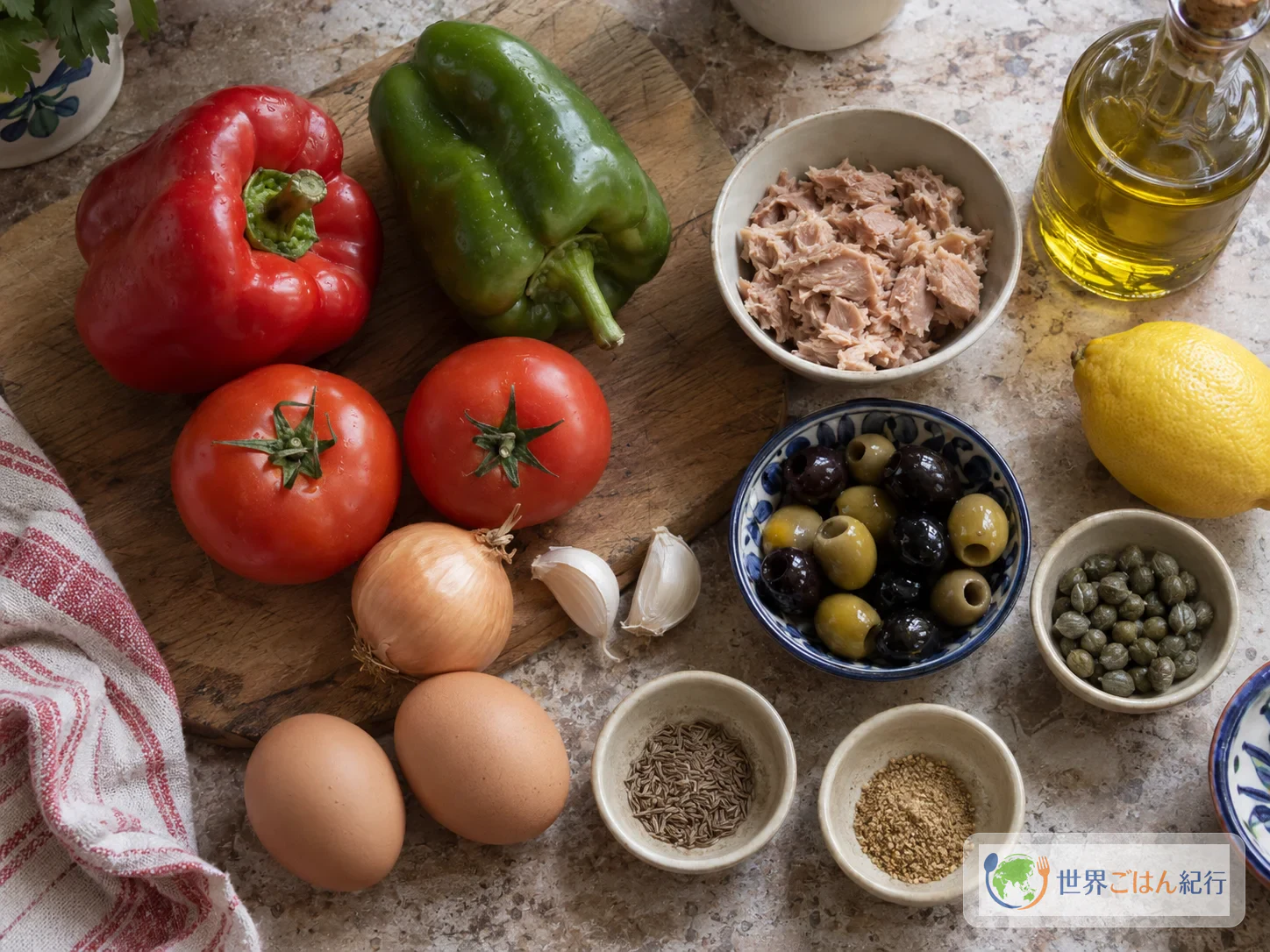
This proportion is adjusted for a home kitchen. The base is 600 g in total of red and green bell peppers, about 1–2 of each, and when you mix in small green peppers, match the total weight. Tomatoes are about 2 medium for 300 g, and onion is 1/2–1 small for 100 g. Bell pepper sizes in stores vary quite a lot, so match the vegetables by weight. The 4 servings is an amount for an appetizer or side dish, and the quantity of bread to serve with it as a staple is listed separately in the table. Bread is not included in the nutrition calculation.
Look for caraway seeds under their general name and measure after crushing the seeds. If you put in a lot of whole seeds, the aroma becomes uneven bite by bite, so make them fine and mix them through. Ground coriander is the powder from ground seeds, not fresh cilantro. Distinguishing the ground seed from the fresh leaf matters; replacing it with the fresh leaf in the same amount doesn't give the same flavor. You can make it without caraway, but that aroma is lost. Making the coriander 1 tsp total is a home-kitchen substitution and won't taste the same.
Thick-fleshed peppers keep plenty of flesh even after peeling. Small green peppers can dry out down to their thin flesh if roasted too long, so check their state early. Red and green are not a required combination. Made with only red, the sweetness and color change, and mixing in green adds the flavor of green vegetables (the editors' reproduction suggestion).
Method
Preheat the oven to 220°C (430°F) and plan on 25–35 minutes of roasting. That doesn't include preheating and chilling time. Cooking varies with the appliance and the size of the vegetables, so don't take them out by the clock alone; look at the skin and flesh more than at the roasting time. An overhead grill chars faster, and if you leave it for the same time as an ordinary oven you will burn it. Use it as the appliance's instructions say. If you roast over charcoal, don't carry over the oven's roasting time as is.
Drain before adding oil, and you don't end up pouring away oil and liquid together later. If liquid builds up before you dress it, drain it again in the sieve for 2–3 minutes. After dressing, remove a little of the excess liquid with a spoon. In either case, don't squeeze the flesh in your fist.
If there are many bits of black skin, remove them before dressing. Cut away thinly any parts of the flesh that were roasted until burnt. We don't recommend trying to char vegetables that were underdone over high heat after chopping them. Think of the stage of roasting them soft and the stage of chopping and dressing them as separate.
Be careful not to burn yourself on the baking sheet, the vegetable juices or the steam when you open the bowl. Use oven mitts and tongs, and wait until the vegetables are cool enough to touch. Wash your hands, tools and counter that touched raw egg. Cook eggs until both white and yolk are set. Keep the clean tools you cut vegetables with separate from those that touched raw egg.
With bread, a plate of vegetables becomes a meal
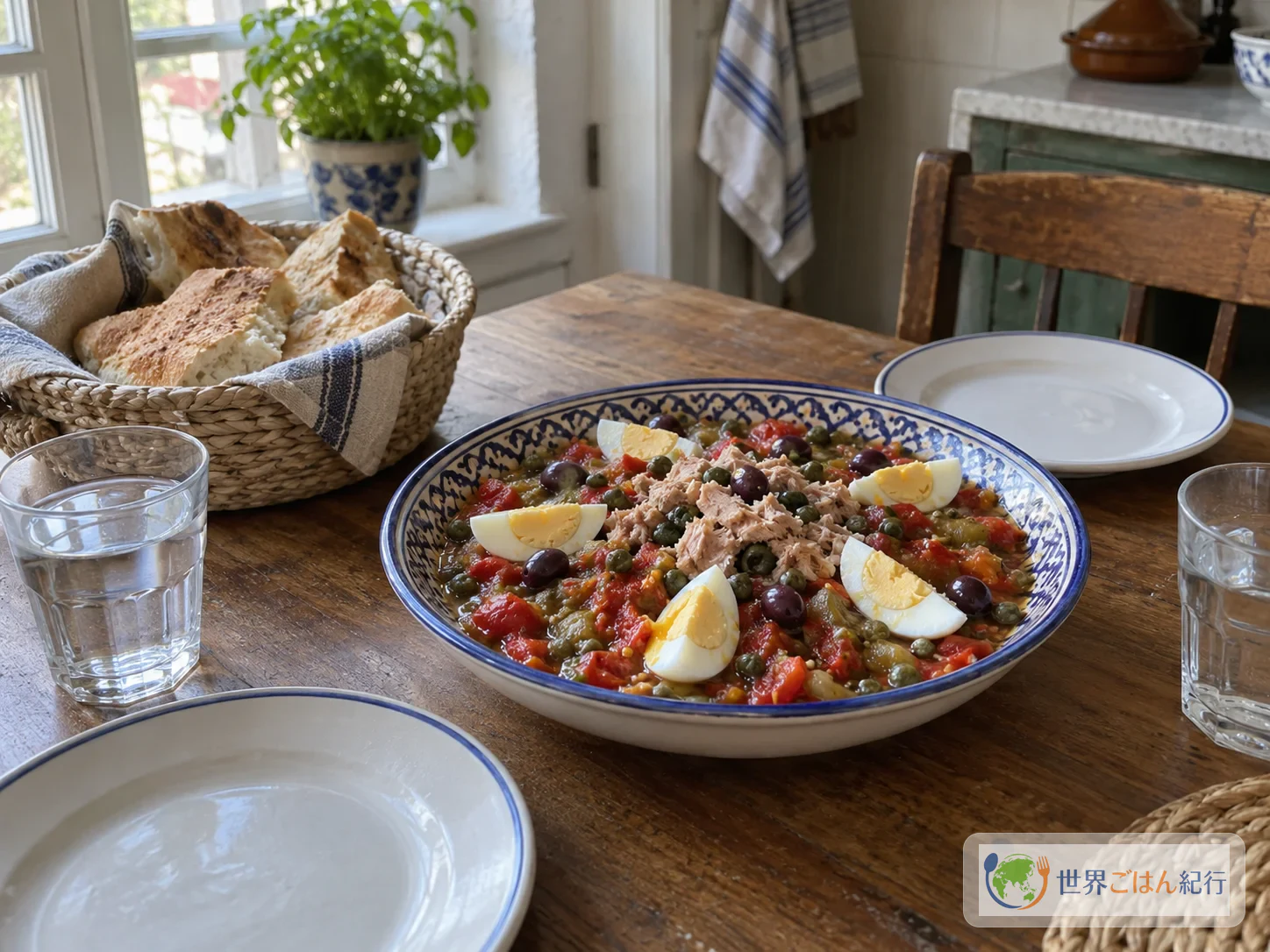
Dab the chopped soft vegetables and oil onto bread and eat them with small amounts of egg, tuna and olives. Eating by scooping the vegetables with bread turns a big platter into a meal. Adding the bread right before eating keeps it from going soggy with moisture. In Japan, warming the bread slightly or thinly slicing it is recommended. We are not presenting a particular local ritual or a fixed time of day for eating it.
As an appetizer or side dish, serving it with grilled fish or meat is one suggestion for the table. Paired with brik (in Japanese), the fried pastry with tuna and egg, you can reduce the tuna and egg on the salad side and adjust the overlap. The toppings can be served separately, so change how you serve them to suit the dish you pair them with. Moroccan taktouka (in Japanese), which uses similar vegetables, is a dish in which roasted peppers and tomatoes are simmered. Its steps differ from mechouia, where you roast, chop and dress, so making them side by side next could be fun.
Five ways to change the flavor
| Change | Adjustment for 4 servings | Difference in taste and how to eat |
|---|---|---|
| Less heat | Don't add hot chilies; make it with the sweet bell peppers of the base proportions | Centers on the taste of the roasted vegetables |
| Vegetables only | Omit the 140 g tuna and 2 eggs | Suits an appetizer or side. Nutrition differs from the base recipe |
| Made with red bell peppers | Make all 600 g of bell peppers red | A home variation in which color and sweetness change |
| More tomato | Add 100 g tomato and reduce the peppers by 100 g | More acidity and moisture, so extend the draining |
| On bread | Slice 200 g bread thin and put the topping and salad on right before eating | Easy to pick up. Don't leave it on for long |
The five ideas in the table are adjustments for home kitchens, not traditional recipes handed down in a particular city or household. When you want heat, prepare chopped fresh chili on a separate dish and mix a little into your own plate at a time. Try a small amount before adding it to everything. Chilies differ in heat by variety, so it can't be said that a fixed amount gives the same heat.
Making ahead, and how to fix a failure
Cover the finished salad in a clean shallow container and refrigerate it at 4°C (40°F) or below. Put it in the refrigerator within 2 hours of cooking, or within 1 hour where the temperature is above about 32°C (90°F). Quick refrigeration at 4°C or below is the premise of making ahead. The general guide FoodSafety.gov gives for salads containing eggs and tuna is 3–4 days refrigerated. At home, though, the conditions of cooking and serving aren't constant, so here we limit the suggestion to finishing it by the next day. That is not a guarantee that the next day is always safe. Adding the tuna and egg only in the amount you'll eat, right before eating, makes the vegetable portion easier to handle. Don't mix leftovers that sat out on the table for a long time with freshly chilled portions.
Don't eat anything for which the refrigeration conditions weren't met. Do not judge safety by tasting or smelling alone. Adding lemon or oil doesn't make improperly left-out food safe again. This salad contains egg and fish, and the bread contains wheat. Check the ingredient labels on processed items such as canned tuna, olives and capers too. People with relevant allergies should leave out those ingredients and also watch for contact via tools and portioning.
| Problem | Likely cause | How to recover |
|---|---|---|
| Liquid pools on the plate | Mixed in too much tomato juice or baking sheet juice | Return it to the sieve before dressing. After dressing, remove the excess liquid with a spoon |
| Bitter | Too much black skin or burnt garlic | Remove before dressing. Once mixed in it can't be removed, so dilute it with more roasted vegetables |
| Salty | Added up the saltiness of the tuna, olives and capers | Add undressed roasted vegetables. Don't try to dilute with oil alone |
| No grains, watery | Ran the blender continuously | It won't return to grains. Add separately chopped roasted pepper |
| The vegetables are hard | Underheated for the size or the oven | Return to the oven before chopping and add 5 minutes at a time |
Salad combined with egg and tuna is not suited to freezing. If making ahead is the purpose, finishing it according to the amount you'll eat is easier to handle than freezing a large amount of the finished dish. Add the egg and tuna right before eating. There are examples in local cooking records of freezing the vegetables alone, but after thawing they can release liquid and change in texture. We cannot give a guaranteed guide for freezing time or quality.
FAQ
Can I make it without caraway?
Yes. There is a substitute that makes the ground coriander 1 tsp in total, but it can't reproduce the aroma of caraway. Think of the substitute for the aroma as different. We do not replace it with fresh cilantro or cumin as if they were the same thing.
Can I make it without the oven?
Locally there are methods of roasting over charcoal or over a stove flame. If you use a Japanese fish grill, check in the manual whether vegetables, baking sheets and aluminum foil can be used, and the distance from the heat. You can't carry over the guide of 25–35 minutes at 220°C in an oven as is. You can also cook it gently in an ordinary frying pan, but the toasty aroma of roasted skin changes.
Can I mix in raw tomato?
Mixing in raw tomato makes both the texture and the moisture something else, and changes it from the basic "roast and peel" salad. Use cooked tomatoes, drain them and then dress.
Is it a spicy dish?
The base proportions use no hot chilies. Locally there are versions with sweet peppers and versions with hot ones. Let only those who want heat add it on their own plates.
How far can I prepare the day before?
You can prepare up to the stage of roasting, peeling and draining the vegetables. Put them in a clean shallow container and quickly refrigerate at 4°C (40°F) or below. Chopping and dressing the next day, then adding the tuna and egg right before eating, is the recommended approach. The day before, prepare only up to the vegetables, and do not leave anything at room temperature overnight.
Do I need a mortar or food processor?
You can chop to 3–5 mm (1/8–1/4 in) with a knife, so no special appliance is needed. Caraway seeds can be crushed in a small mortar or with a bag and rolling pin. When you use an electric appliance, check the state every few seconds. Run it until the grains are gone and it becomes a different dish.
Nutrition guide
One serving is a quarter of the base proportions, about 270 kcal, 12 g protein, 20 g fat, 17 g carbohydrate and 4.5 g fiber. This is an estimate from the main ingredients, not including bread but including tuna, egg and olives. The calculation assumed 300 g each of red and green bell pepper, 27 g oil, 100 g of edible egg, 140 g of oil-packed white tuna and 50 g of green olives. Green bell pepper is approximated with the value for green pepper, and the trace spices and capers are not included. This is an estimate without bread, derived from ingredient weights and values in the food composition database, not measured values. Because raw vegetable values are used, components lost in peeling and draining are not reflected. The numbers also vary with whether the tuna is oil- or water-packed, how much liquid you drain, and the saltiness of processed items. Do not link these numbers to medical effects or health advantages.
Increase the amount of oil and fat and calories rise; omit the egg and tuna and the protein changes too. A dish changed to the quantities in the variations table can't be treated as having the same numbers as the base recipe. If you want to reduce salt, taste a bite that includes the tuna, olives and capers before adding the rest of the salt. Checking the saltiness of the toppings is the clue for adjusting the salt. People undergoing treatment who have dietary restrictions should put the instructions of their doctor or registered dietitian first.
Sources
- Cuisine Tunisienne — Salade Mechouia — Name, vegetables, peeling, toppings. Accessed and checked: 8 October 2026 (JST)
- Binetna/Ines Jenfaoui — La fameuse salade mechouia — Sweet and hot peppers, cooking tools, use of caraway. Accessed and checked: 8 October 2026 (JST)
- WPSU — World Kitchen: Tunisian Recipes (Recipe II) — Roasting temperature and doneness, how to chop, eating with bread. Accessed and checked: 8 October 2026 (JST)
- Tunisie Numérique — Recette : La salade méchouia — The 220°C roasting version, onion, composition of spices. Accessed and checked: 8 October 2026 (JST)
- FoodSafety.gov — Salmonella and Eggs — Cooking eggs, cleaning tools, time to refrigeration. Accessed and checked: 8 October 2026 (JST)
- FoodSafety.gov — Cold Food Storage Chart — Refrigeration at 4°C or below, storage guide for egg and tuna salads. Accessed and checked: 8 October 2026 (JST)
- Ministry of Education, Culture, Sports, Science and Technology (Japan), Food Composition Database — red bell pepper, green pepper, tomato. Used for the nutrition estimate of main ingredients. Accessed and checked: 8 October 2026 (JST)
- Ministry of Education, Culture, Sports, Science and Technology (Japan), Food Composition Database — onion, garlic, olive oil. Used for the nutrition estimate of main ingredients. Accessed and checked: 8 October 2026 (JST)
- Ministry of Education, Culture, Sports, Science and Technology (Japan), Food Composition Database — oil-packed tuna, boiled egg, green olives. Used for the nutrition estimate of main ingredients. Accessed and checked: 8 October 2026 (JST)
- Ministry of Education, Culture, Sports, Science and Technology (Japan), Food Composition Database — lemon juice. Used for the nutrition estimate of main ingredients. Accessed and checked: 8 October 2026 (JST)



