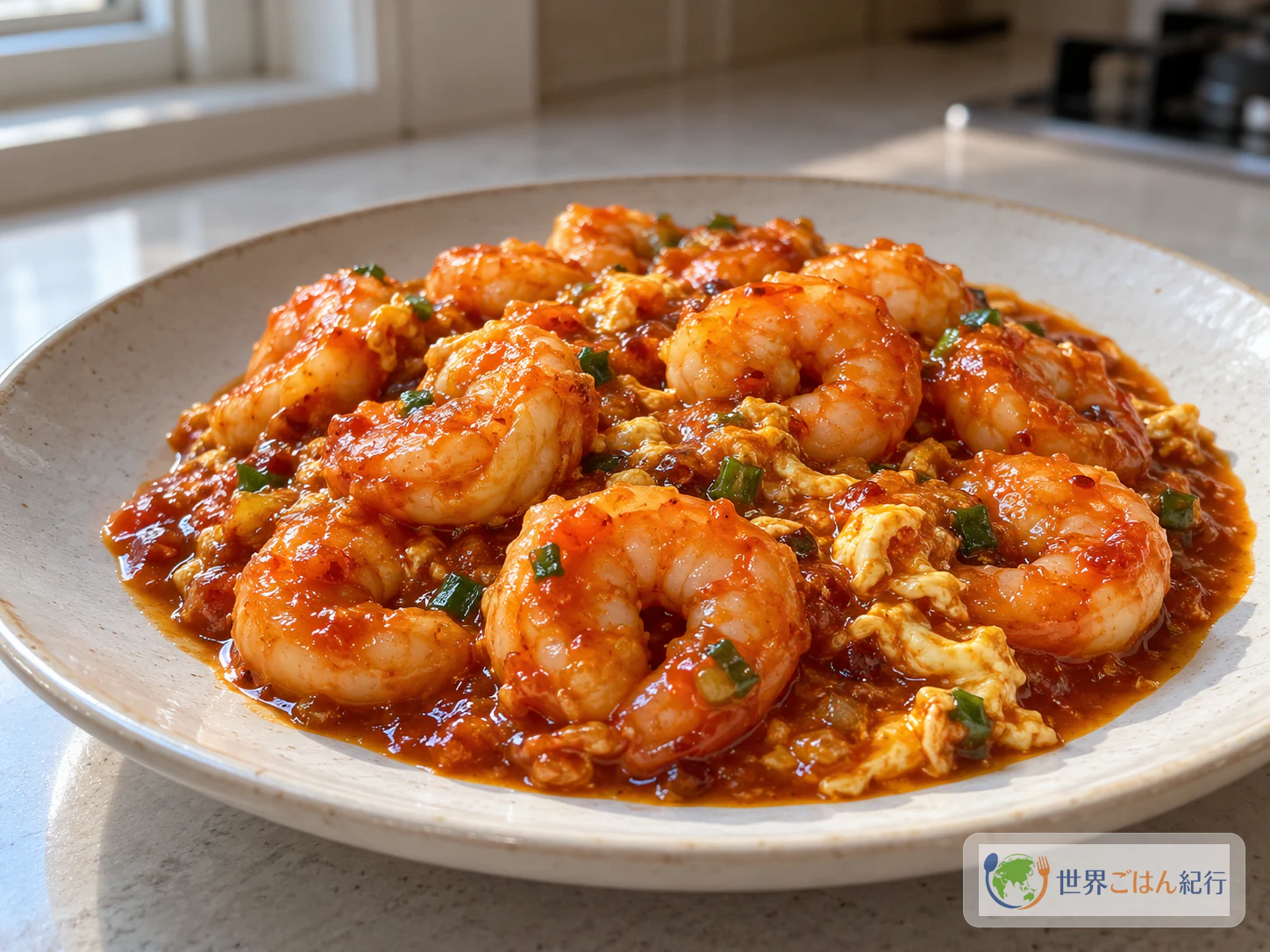
Chili Shrimp: Shrimp That Leave the Pan Early and Finish in a Red Sauce
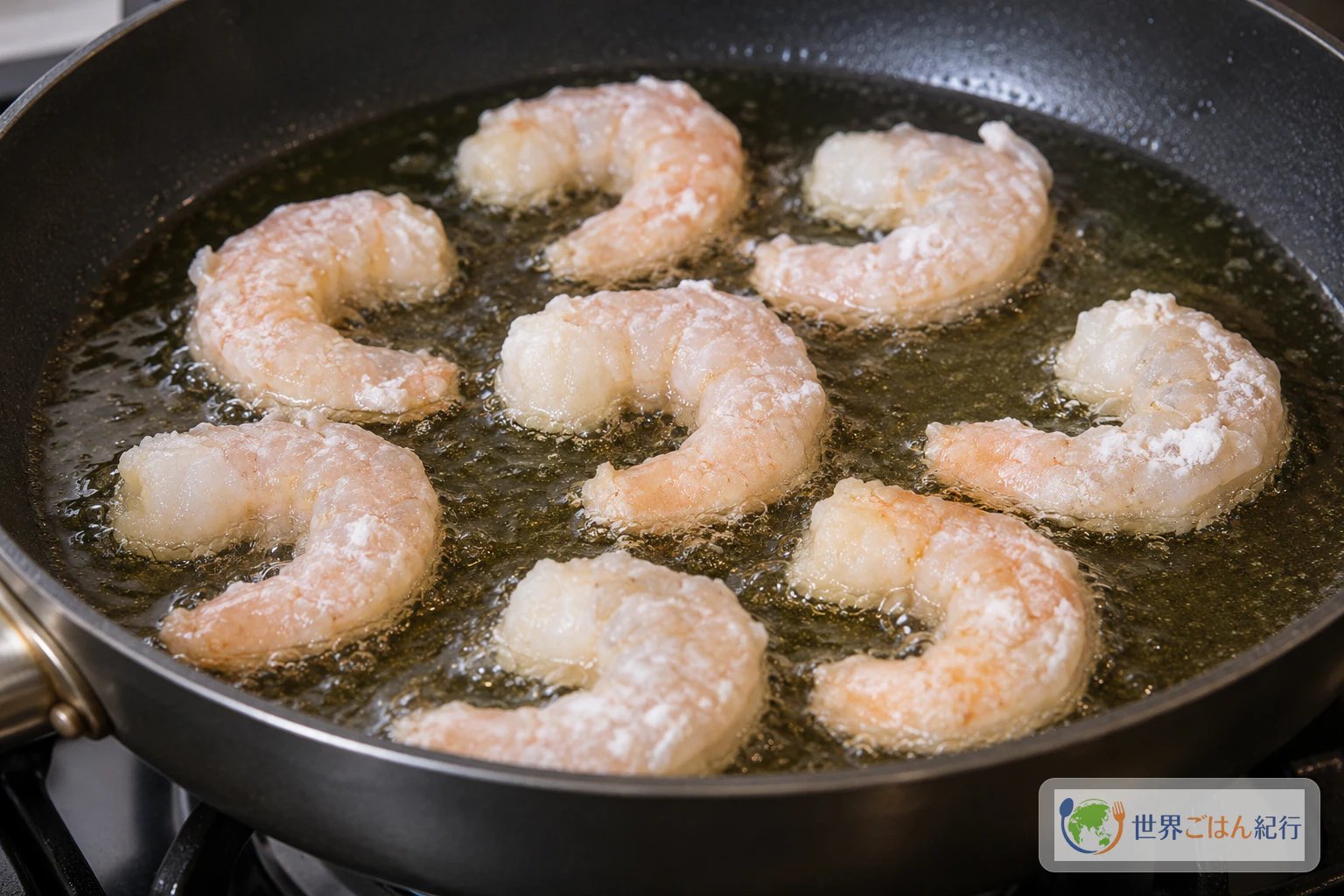
The shrimp cook in two stages. First they go partway in shallow oil. Then they finish cooking through in the sauce. Keep the doubanjiang from burning, and keep the egg white for the coating separate from the beaten egg used at the end.
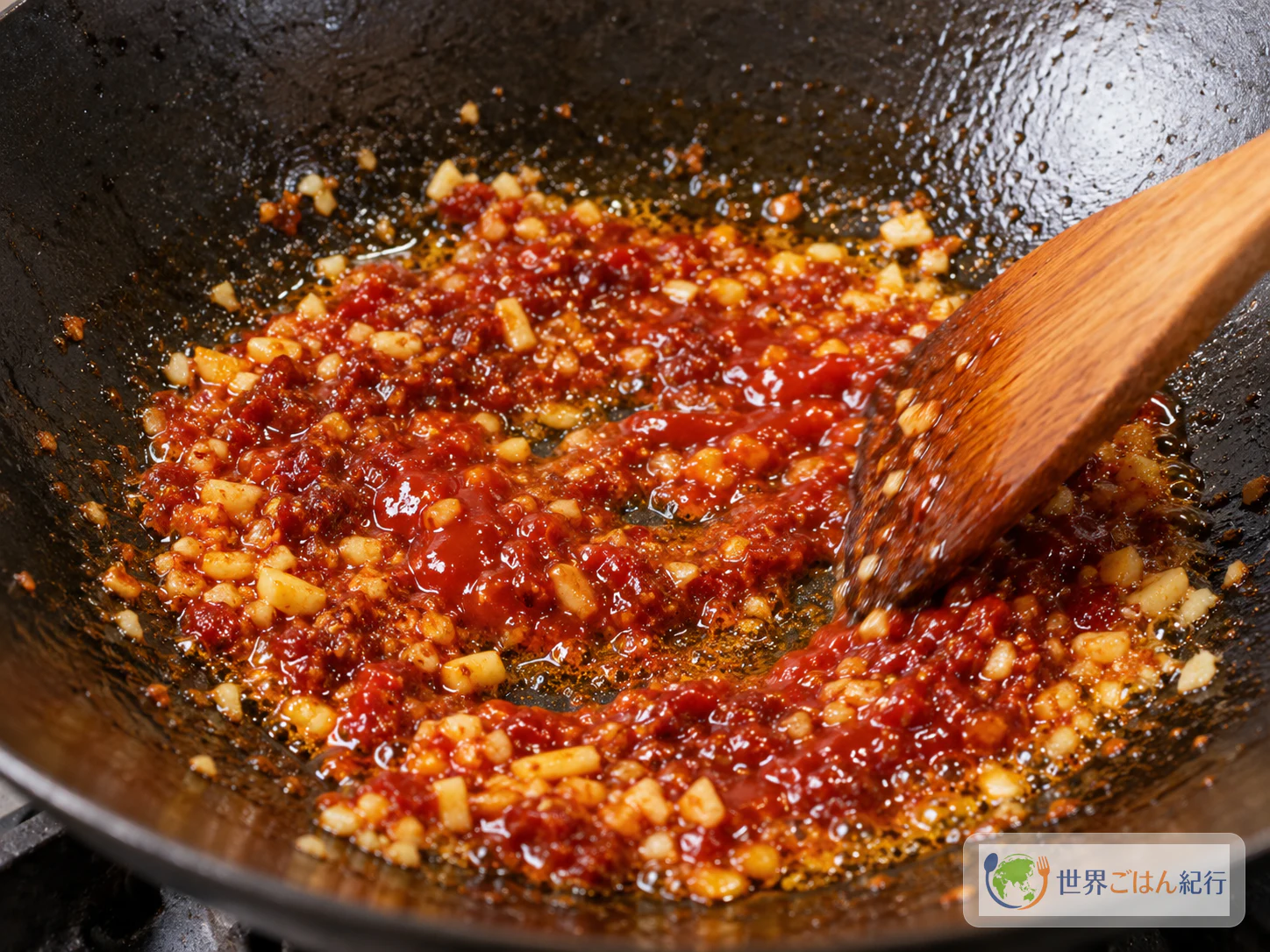
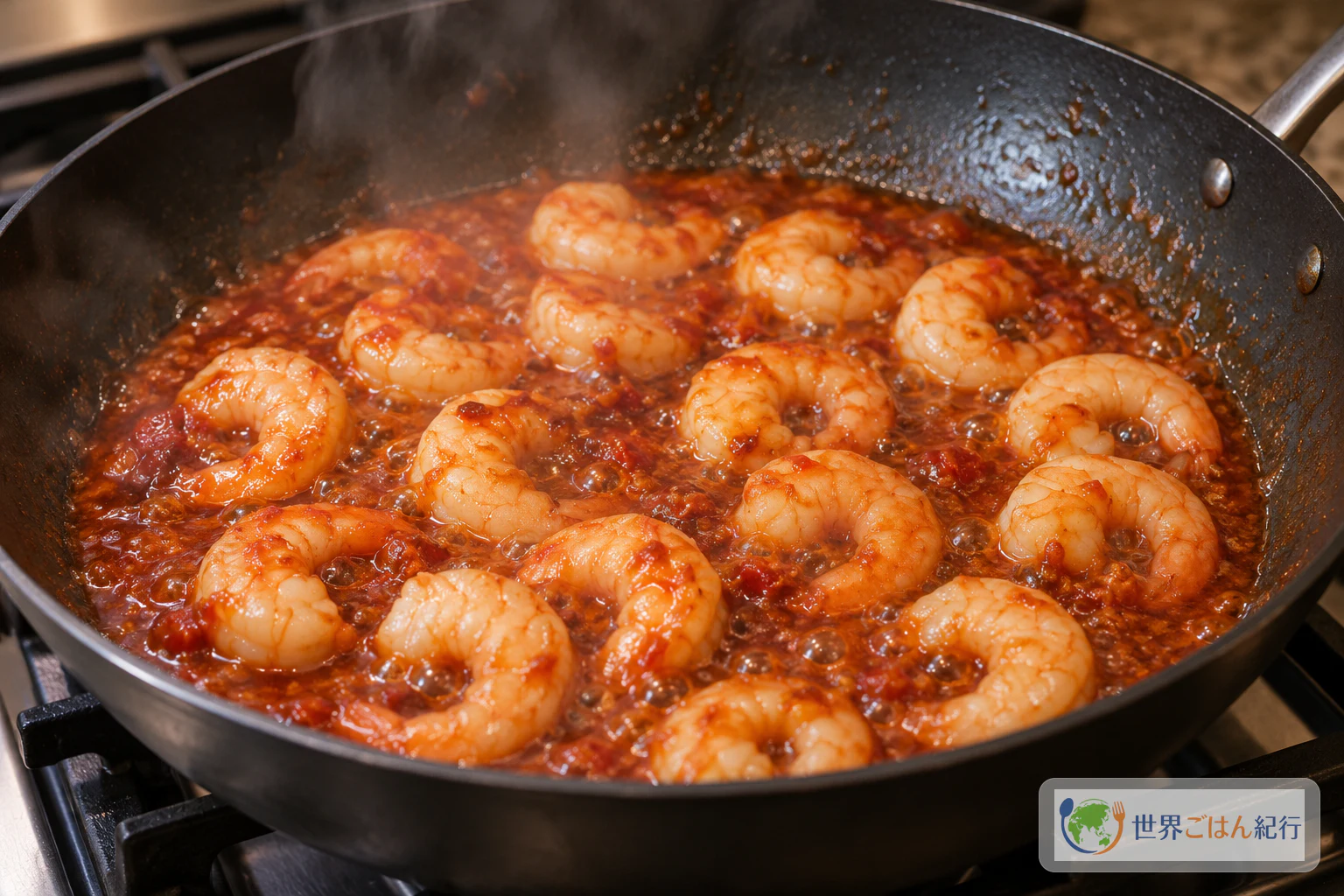
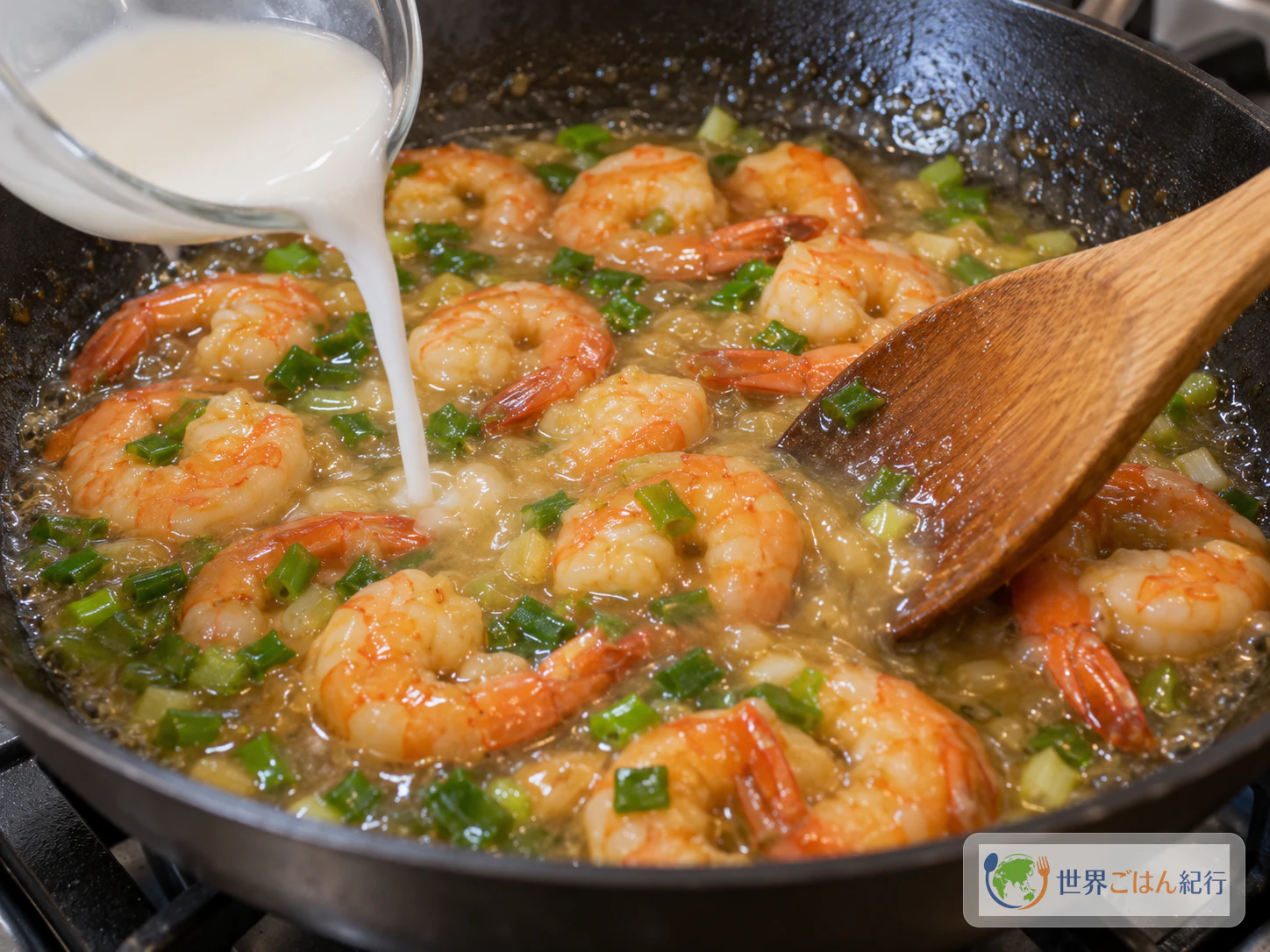
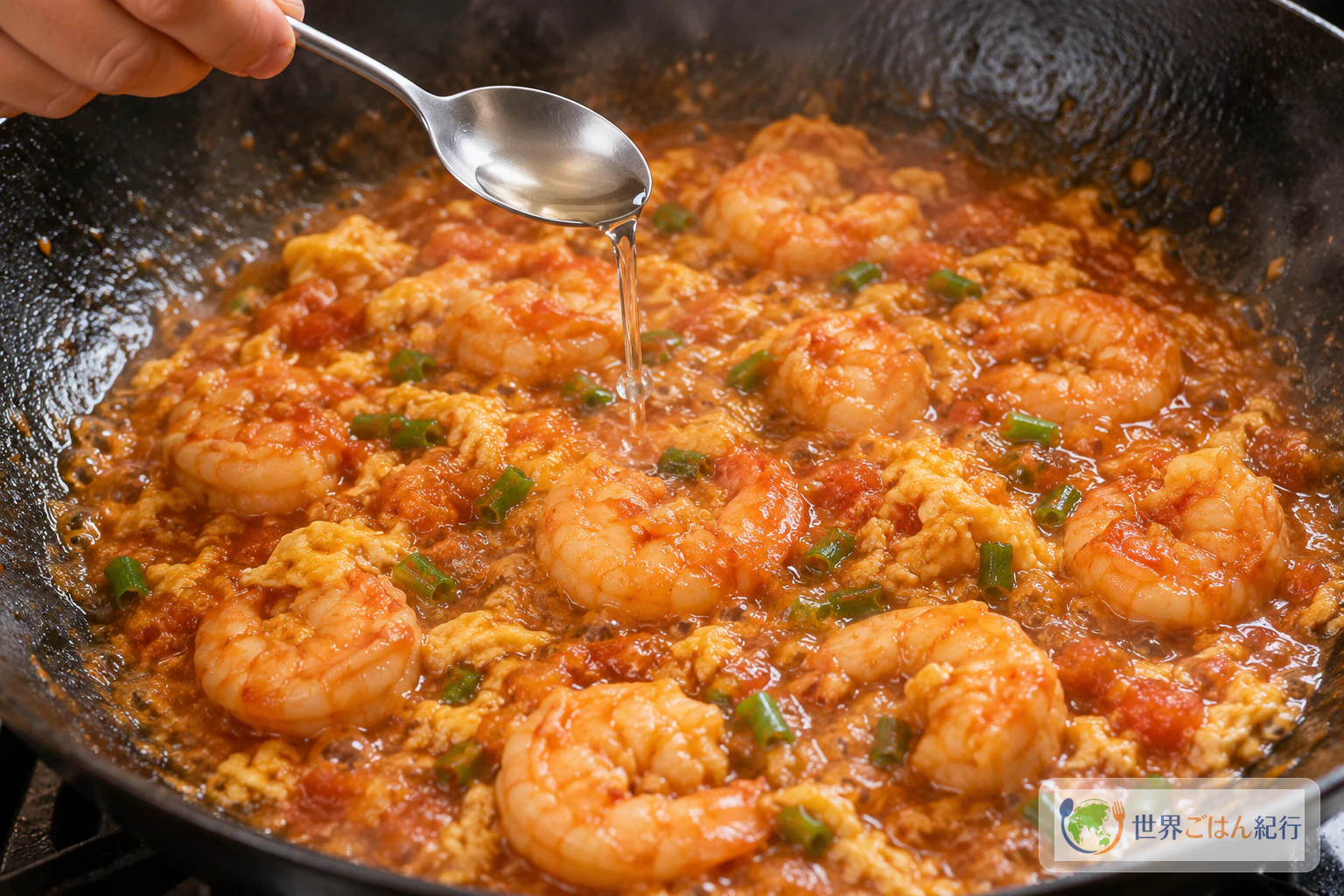
Garlic, ginger and doubanjiang go into the pan off the heat, then warm slowly over a low flame until fragrant. Ketchup, cooking sake and chicken stock turn the pan into a red simmering sauce. The shrimp, already coated and part-cooked, go back in. Green onion and a potato-starch slurry thicken it. A little beaten egg and a little vinegar finish the dish.
In Japan this dish is widely known as "ebi chili" (エビチリ), or "shrimp in chili sauce." This article follows one home recipe for it: Kikkoman Home Cooking's "えびのチリソース(乾焼蝦仁)," credited to Tsutomu Yamashita, written for 4 servings with a listed cooking time of 25 minutes. The recipe does not split that time into preparation and cooking. The amounts here follow that one recipe, including some that may look unusual, such as a full 5 tbsp of potato starch for the coating.
Sekai Gohan files this dish with our China recipes. That placement is a catalog shelf, not a claim about where the dish began.
This recipe has not been kitchen-tested by Sekai Gohan. The amounts and order follow the published recipe, and the safety guidance comes from public food-safety agencies.
Ebi Chili, 乾焼蝦仁 and 乾焼蝦鬆: Names That Overlap
The same everyday name covers more than one dish. Kikkoman titles its recipe "えびのチリソース" and adds the Chinese characters 乾焼蝦仁. The Tsuji Culinary Institute group's Chinese-cooking column describes the dish known in Japan as ebi chili, but calls its own version 乾焼蝦鬆 and explains that it was arranged to suit Japanese tastes. The characters look alike, but the recipes behind them are different, so neither name should be read as a one-to-one translation of "ebi chili."
In the same column, Akira Yokota, a professor of Chinese cooking at the school, describes the dish as Sichuan cooking as made in Shanghai rather than "pure" Sichuan cooking. He also notes that in Sichuan it is made, though not seen as often as in Japan, and that cooks there may use doubanjiang or paojiao (泡辣椒), a fermented chili. This is a cook's teaching column, not a history study. It shows how wide the range of form and flavor can be under one name. It does not prove that any single version is the original.
The sources used here do not establish a country, a year or a person of origin for chili shrimp. The official history of the Shisen Hanten restaurant group records that Chen Kenmin, who was born and raised in Sichuan, came to Japan in 1952, opened the first Shisen Hanten in Tamuracho, Tokyo, in autumn 1958, and spread Sichuan cooking around Japan. His successor, Chen Kenichi, carried it further through television, including NHK's Kyō no Ryōri. That history does not mention chili shrimp, so it says nothing about who created this dish or when.
Ingredients (Serves 4)
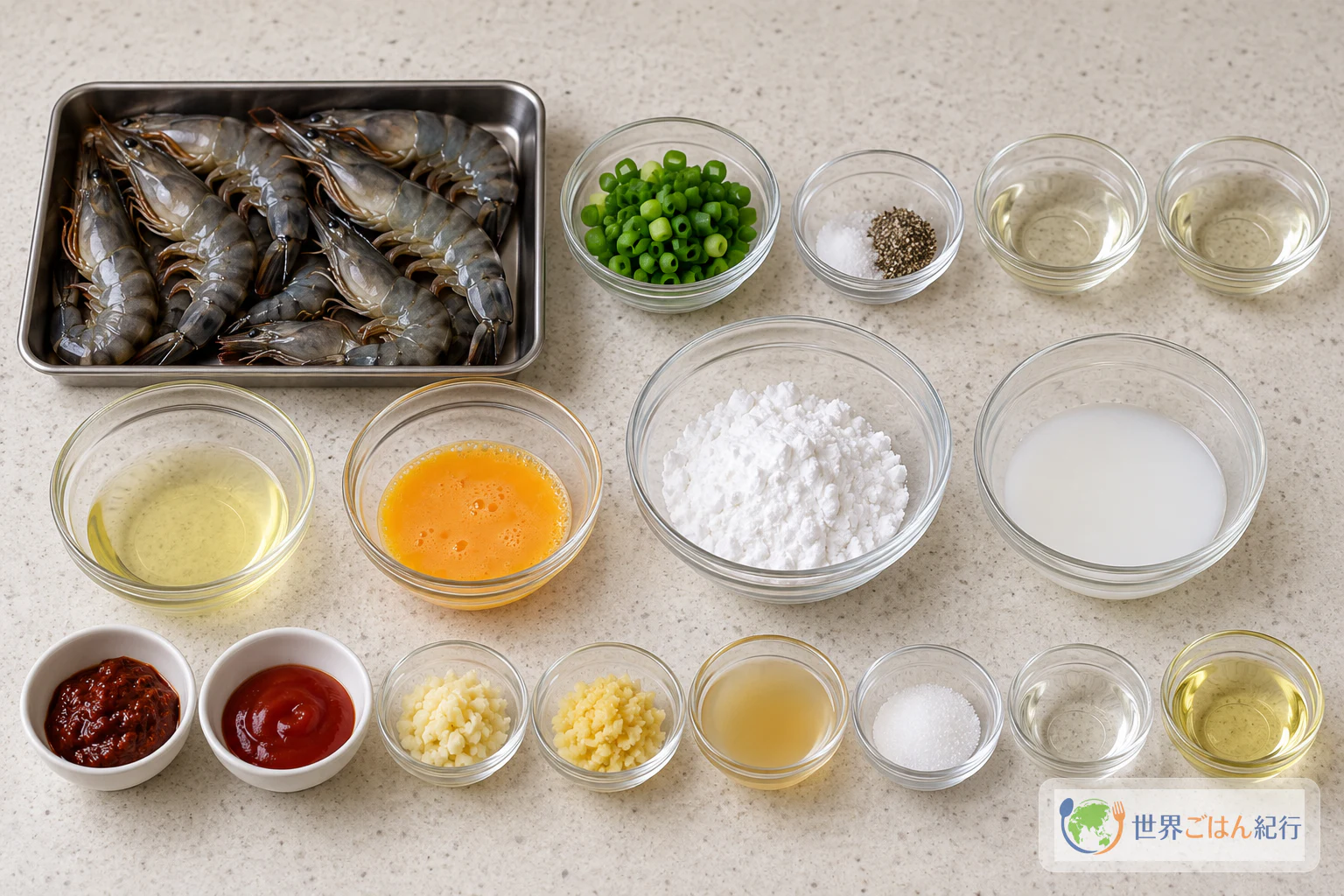
Cooking sake appears twice: 1 tbsp goes on the shrimp in group A, and another 1 tbsp goes into the sauce in group C. Measure them separately. The same goes for the egg. The white of 1 egg coats the raw shrimp, while half a beaten whole egg goes into the finished sauce. Set out the B and C groups in their own small bowls before you start cooking.
Equipment
- Frying pan
- Mixing bowl for seasoning and coating the shrimp
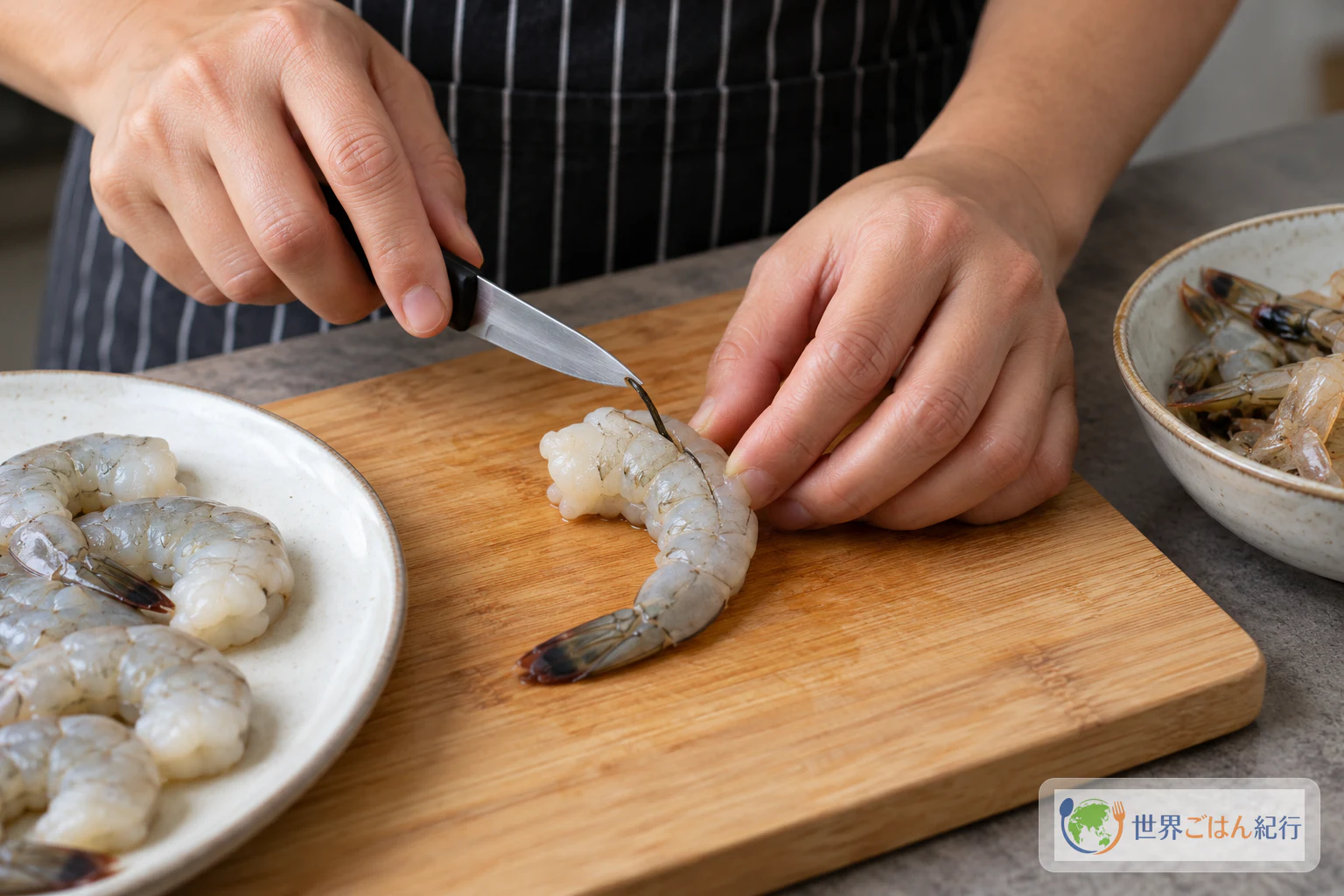
- Small knife for deveining
- Cutting board and utensils used only for the raw shrimp
- Plate or tray for draining the part-cooked shrimp
- Spatula
- Small bowls for the B and C groups, the slurry and the beaten egg
Choosing and Handling: Keep the Sauce as Written, Keep Raw Shrimp Apart
The sauce stays as listed. Doubanjiang, tomato ketchup, chicken stock, cooking sake and potato starch are all part of its balance, so don't swap them or add other chili sauces or oils.
The shrimp are weighed with their shells on. The 160g is a shell-on weight, so don't treat it as a weight of peeled shrimp.
For raw seafood:
- Refrigerate or freeze seafood as soon as you get it home.
- Store it so its drips don't fall onto other foods.
- Rinse fish under running water before cooking.
- Don't reuse chopsticks or utensils that touched raw seafood for other foods.
Also:
- Keep juices from raw meat and seafood away from foods eaten raw and from cooked food.
- Wash the knife and board used for seafood, then pour boiling water over them.
- Cook foods that are meant to be cooked thoroughly.
In this dish, that means three things. Keep the board, knife and bowl used for raw shrimp away from the green onion and finished food. Wash your hands after handling raw shrimp. Finish the shrimp in the sauce until they are fully cooked.
This dish contains shrimp and egg. Doubanjiang, ketchup, chicken stock and potato starch are processed products, so check their labels for allergens such as wheat. The first shallow-oil cook only takes the shrimp partway; they are not ready to eat at that point. Cooked shrimp have flesh that is firm, pearly and opaque. Use that as the sign that they are done once they have finished in the sauce. The beaten egg should also cook in the hot sauce rather than stay raw.
Method: Part-Cook the Shrimp, Build the Sauce, Return the Shrimp
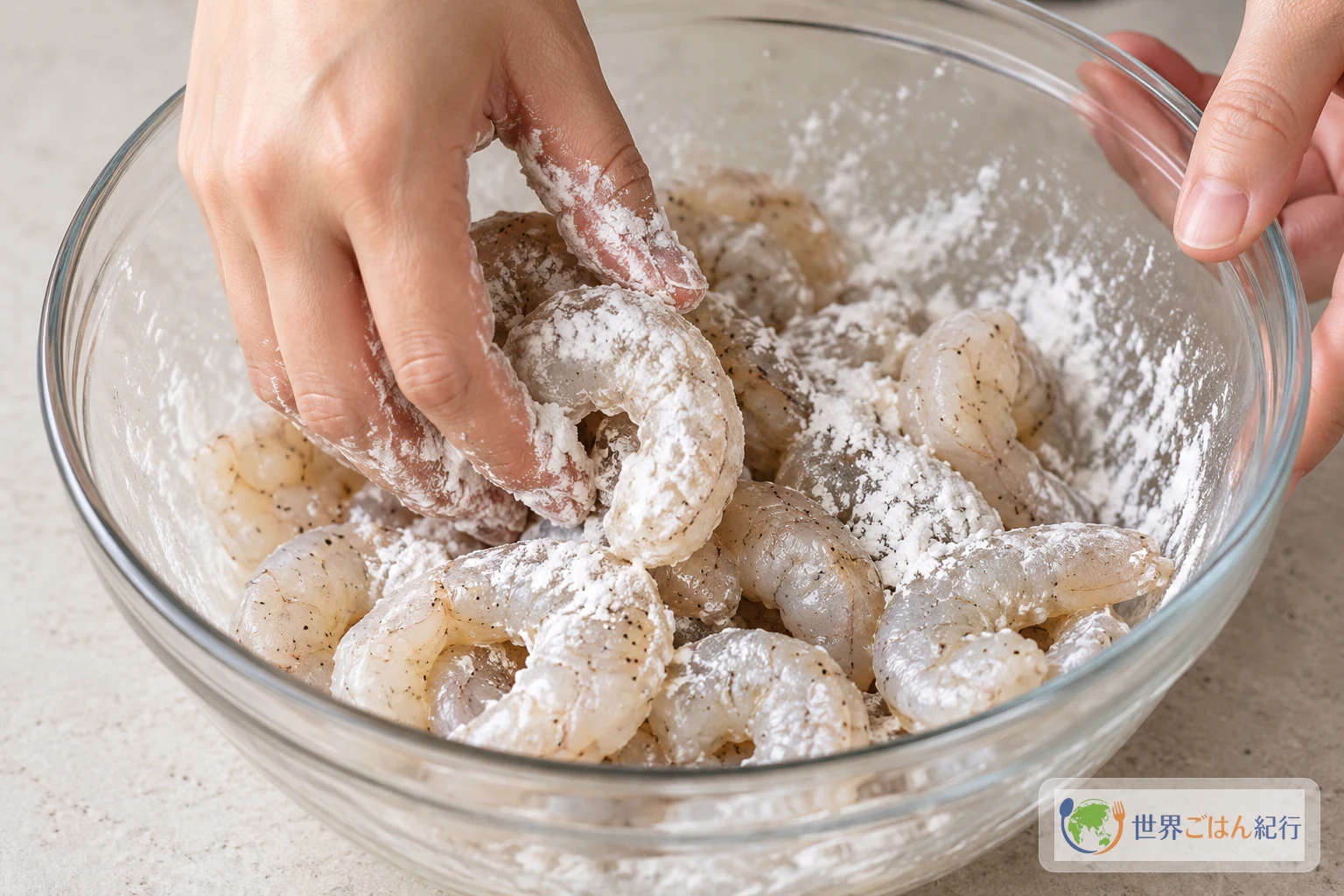
Season and coat the shrimp, then cook them partway in shallow oil and lift them out. In the same pan, warm the aromatics, add the sauce, and return the shrimp to finish cooking. Thicken the sauce, then add the egg and the vinegar.
When Something Looks Wrong in the Pan
| What you see | Likely reason | What to do |
|---|---|---|
| The doubanjiang darkens fast or smells scorched | The pan was too hot when the aromatics went in | Next time, take the pan fully off the heat before adding group B, then stir over low heat only |
| The shrimp still look glassy or translucent in the center | They have only had the first, partial cook | Keep cooking them in the sauce until the flesh is firm, pearly and opaque |
| The beaten egg looks runny and raw | It went in at the very end and has not set yet | Keep stirring it through the hot sauce until it cooks |
| The coating slides off or looks thin | The shrimp were still wet before seasoning | Pat the shrimp dry after rinsing, then season, add the egg white, and fold in the starch |
| The whole egg went into the coating | The egg white and the finishing egg were mixed up | Set the white of 1 egg and half a beaten egg in separate, labeled bowls before starting |
How Other Versions Differ
The Kikkoman recipe is one home version among several. Comparing it with others shows which choices define it. Leave the amounts below in their own recipes rather than mixing them into this one.
| Version | How it is built |
|---|---|
| Kikkoman (this article) | Shell-on black tiger shrimp, seasoned and coated in egg white and potato starch, part-cooked in shallow oil, then finished in a doubanjiang, ketchup and chicken stock sauce with green onion, slurry, beaten egg and vinegar |
| S&B Foods "えびチリ" | Also 4 servings and 25 minutes. Uses peeled shrimp, sears them until they change color, then cooks aromatics and green onion, a sauce with bottled chili sauce, doubanjiang, ketchup and stock, and finishes with slurry |
| Tsuji Culinary Institute group (乾焼蝦鬆) | Presented as a version arranged for Japanese tastes. The same column notes that Sichuan cooks may use doubanjiang or fermented paojiao chili |
What sets the Kikkoman version apart is the two-stage cooking of coated shrimp and its egg-and-vinegar finish. The other versions differ in shrimp form, sauce base and finishing.
Frequently Asked Questions
Is chili shrimp a Chinese dish or a Japanese one?
The sources used here do not settle that. The dish is widely known in Japan as ebi chili. The Tsuji column describes its own version as arranged for Japanese tastes and links the style to Sichuan cooking as made in Shanghai. No source here names a single country, year or creator, so this article doesn't either.
How much water goes into the potato starch slurry?
The Kikkoman recipe lists only "3 tbsp of potato starch slurry" and gives no water ratio. This article keeps that measure as written and does not add one.
Can I use peeled shrimp, or water instead of chicken stock?
The recipe offers no substitutions. It weighs the shrimp shell-on (160g) and uses chicken stock (150ml) in the sauce. Other recipes that use peeled shrimp are separate recipes with their own balance, so their amounts aren't carried over here.
Are the shrimp done after the shallow-oil step?
No. That first cook takes them only to about 80 percent. They finish cooking in the sauce, and are ready when the flesh is firm, pearly and opaque, which is the visual guide the U.S. Food and Drug Administration gives for cooked shrimp.
How long do leftovers keep?
None of the sources used here give a storage period for the finished dish, so this article doesn't give one. For the raw shrimp, MAFF advises refrigerating or freezing seafood as soon as you get it home and keeping its drips away from other foods.
Sources
- Kikkoman Corporation, Home Cooking, "えびのチリソース(乾焼蝦仁)のレシピ・つくり方" (recipe by Tsutomu Yamashita). Main source for the recipe: 4 servings, listed cooking time of 25 minutes, all ingredients and amounts, and the order of the steps. https://www.kikkoman.co.jp/homecook/search/recipe/00002469/
- Tsuji Culinary Institute group, "エビのチリソース煮込み" (Akira Yokota, professor of Chinese cooking). Used for the name ebi chili in Japan, the separate 乾焼蝦鬆 version arranged for Japanese tastes, the description of the dish as Shanghai-style Sichuan cooking, and regional use of doubanjiang and paojiao. https://www.tsuji.ac.jp/oishii/recipe/navi?CID=TJONCS0001&RECIPE_CD=c03004
- S&B Foods, "えびチリ." A separate 4-serving recipe used only for comparison; none of its amounts or steps are mixed into this recipe. https://www.sbfoods.co.jp/recipe/detail/00909.html
- Shisen Hanten, "ヒストリー HISTORY." The restaurant group's official history of Chen Kenmin's arrival in Japan in 1952, the founding of Shisen Hanten in 1958, and the spread of Sichuan cooking in Japan. It does not mention chili shrimp. https://www.sisen.jp/history/
- U.S. Food and Drug Administration, "Selecting and Serving Fresh and Frozen Seafood Safely." Used for the visual sign that cooked shrimp are firm, pearly and opaque, and for general seafood handling. https://www.fda.gov/food/buy-store-serve-safe-food/selecting-and-serving-fresh-and-frozen-seafood-safely
- Ministry of Agriculture, Forestry and Fisheries of Japan, "知っておきたい食中毒予防の基本." Used for rinsing fish before cooking, keeping utensils for raw seafood separate, refrigerating or freezing seafood on getting it home, and keeping drips off other foods. https://www.maff.go.jp/j/pr/aff/2506/spe1_01.html
- Ministry of Health, Labour and Welfare of Japan, "家庭での食中毒予防." Used for keeping raw seafood juices away from ready-to-eat and cooked foods, washing and scalding knives and boards used for seafood, and cooking food thoroughly. https://www.mhlw.go.jp/stf/seisakunitsuite/bunya/kenkou_iryou/shokuhin/syokuchu/01_00008.html