Agedashi Tofu: A Thin Fried Coating Meeting Hot Dashi
A thin, light coating of potato starch on the outside, soft tofu on the inside, and a hot, clear dashi sauce with fresh garnishes. Fry the tofu right before serving and pour the sauce while it is hot.
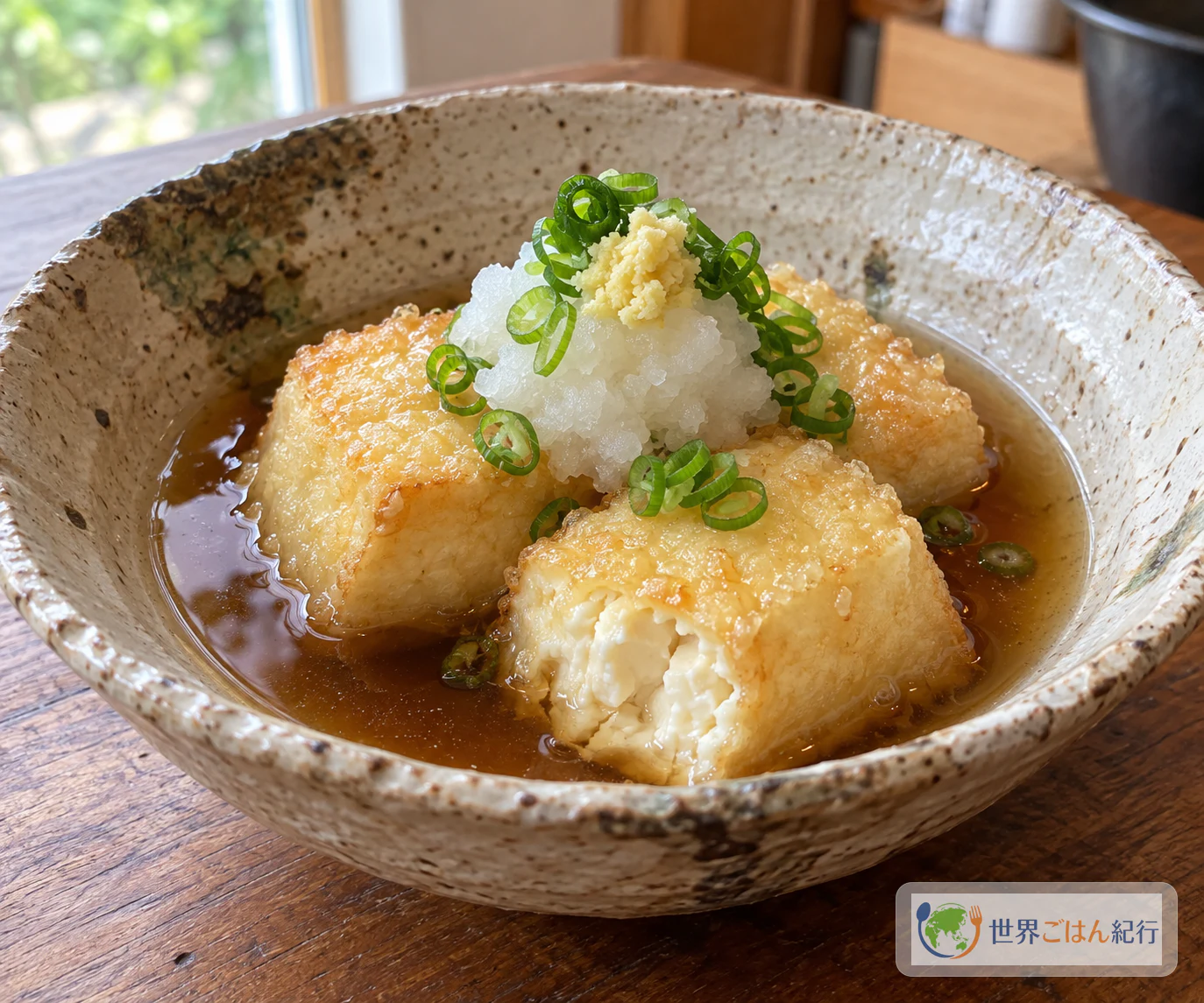
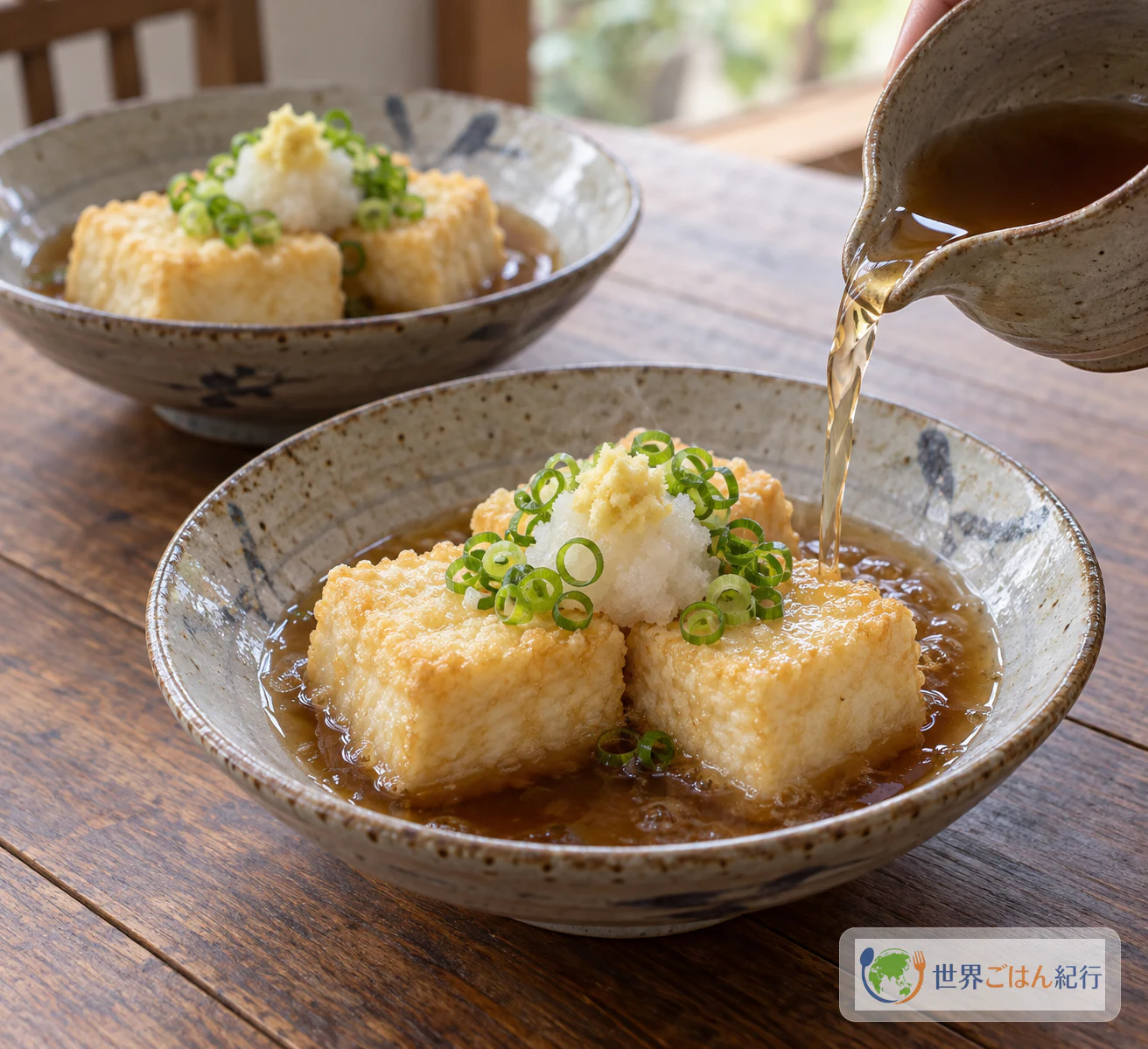
Freshly fried pieces of tofu go into a small, steaming bowl, and the hot dashi sauce poured around them begins to soak into the edges of the pale-golden coating. The surface that was crisp a moment ago starts to soften where it touches the sauce, while the tofu underneath stays tender. Grated daikon, a little grated ginger and sliced scallion sit on top. That meeting of a delicate fried coating, warm savory sauce and fresh aromatics is the heart of agedashi tofu.
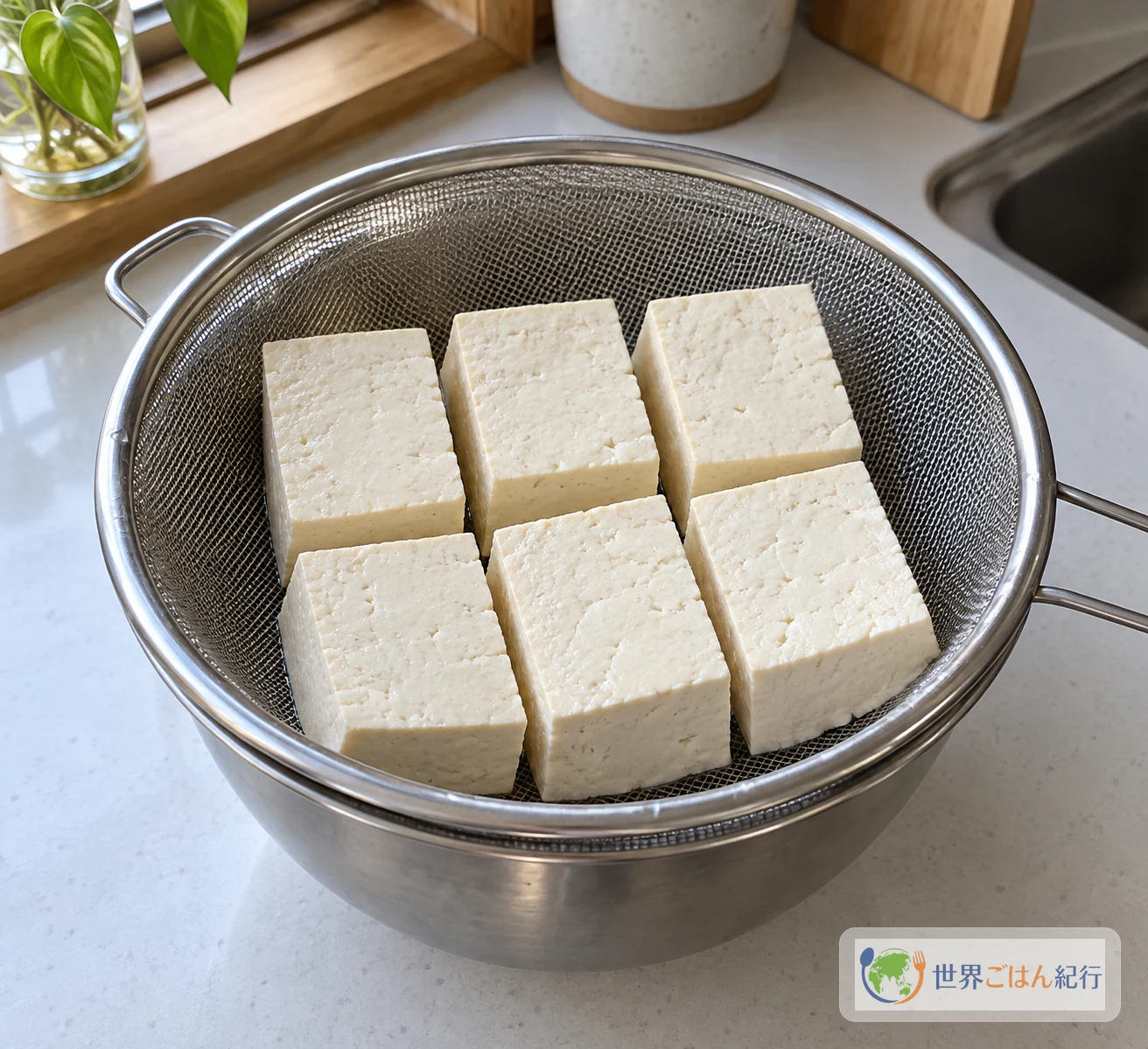
This recipe follows a two-person home recipe from Ajinomoto Park without changing its amounts: one 300g block of momen (firm) tofu cut into six pieces, a simple sauce of water, soy sauce, mirin and granulated dashi, and three classic garnishes. Each person gets three pieces. For more of the country's cooking, you can browse dishes from Japan.
In Japanese it is written 揚げ出し豆腐, 揚げだし豆腐 or 揚出し豆腐, read agedashi dōfu. In English it usually appears as "agedashi tofu."
What Agedashi Tofu Is: Not Atsuage, Not Aburaage
Agedashi tofu is tofu given a thin coating, usually potato starch, then fried and served in a warm dashi-based sauce. That coating and sauce are what set it apart from other fried tofu foods in Japan. Atsuage is tofu fried without any coating, and aburaage is another, separate fried tofu product; neither is the same thing as agedashi tofu, even though all three start from tofu and hot oil.
Potato starch is the common coating, but versions dusted with wheat flour also exist. Home cooks and restaurants vary in the type of tofu they use, how thick the coating is, how strong the sauce is, and which garnishes go on top. Today it appears both as a home side dish and as a dish to go with drinks.
Tofu Culture and What Is Not Known About the Name
Tofu has long been an important plant-based ingredient in shōjin ryōri, the vegetarian cooking associated with Buddhist temples, according to an overview by the Japan Tofu Association. That is background about tofu itself, though. The sources used here do not establish that agedashi tofu specifically came from temple cooking.
The origin of the word "agedashi," the place or shop where the dish began, and when it took its present form are all uncertain. Age is generally explained as referring to frying, but the meaning of dashi in the name has not been settled. An English-language guide mentions that the 1782 book Tofu Hyakuchin (One Hundred Tofu Dishes) records fried tofu, but a fried tofu entry in that book should not be read as proof of the modern dish with its starch coating and dashi sauce. What can be said with confidence is how the dish is made and eaten now.
Ingredients: Serves 2, Six Pieces of Momen Tofu
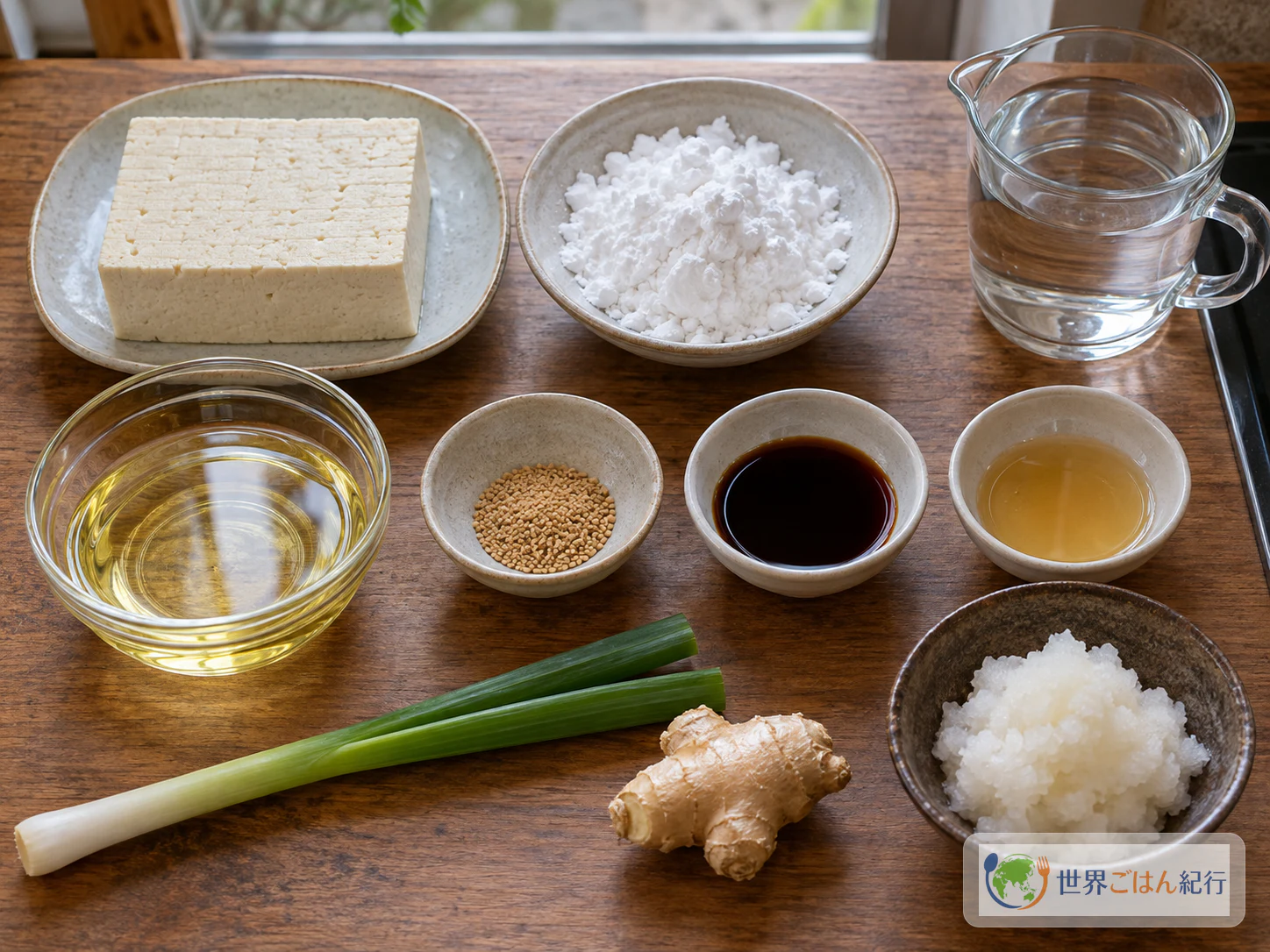
These are the source recipe's amounts for two servings. The potato starch and frying oil are given only as "as needed," so no weights are listed for them.
Choosing and Substituting Ingredients
Momen tofu is the version used here because it keeps its shape. Silken tofu (kinugoshi) is also common for agedashi tofu and gives a smoother inside, but it is softer and breaks more easily, so it is treated below as a separate variation rather than a straight swap.
Potato starch is not the same thing as cornstarch. Look for katakuriko or a bag labeled potato starch. A wheat-flour coating is a known alternative, but it changes the color and texture of the coating, so it is also treated as a variation.
The daikon weight is for grated daikon, not 50g of raw daikon before grating. The main recipe does not squeeze the water out of it.
The granulated dashi is a specific product. Hondashi's ingredients include lactose, bonito powder and bonito extract, and its listed allergen is milk. If you buy a different granulated dashi, check that product's own ingredient and allergen labeling.
This dish contains soy (tofu and soy sauce). Regular soy sauce usually contains wheat, so check the label of the bottle you use. The specified granulated dashi lists milk as an allergen on the manufacturer's product page. Separately from legally labeled allergens, it contains fish ingredients derived from bonito, so the standard recipe is not vegetarian and is not suitable for people avoiding fish. Always check the labels of the actual products you buy.
Equipment
- Small saucepan for the sauce
- Strainer or colander set over a bowl
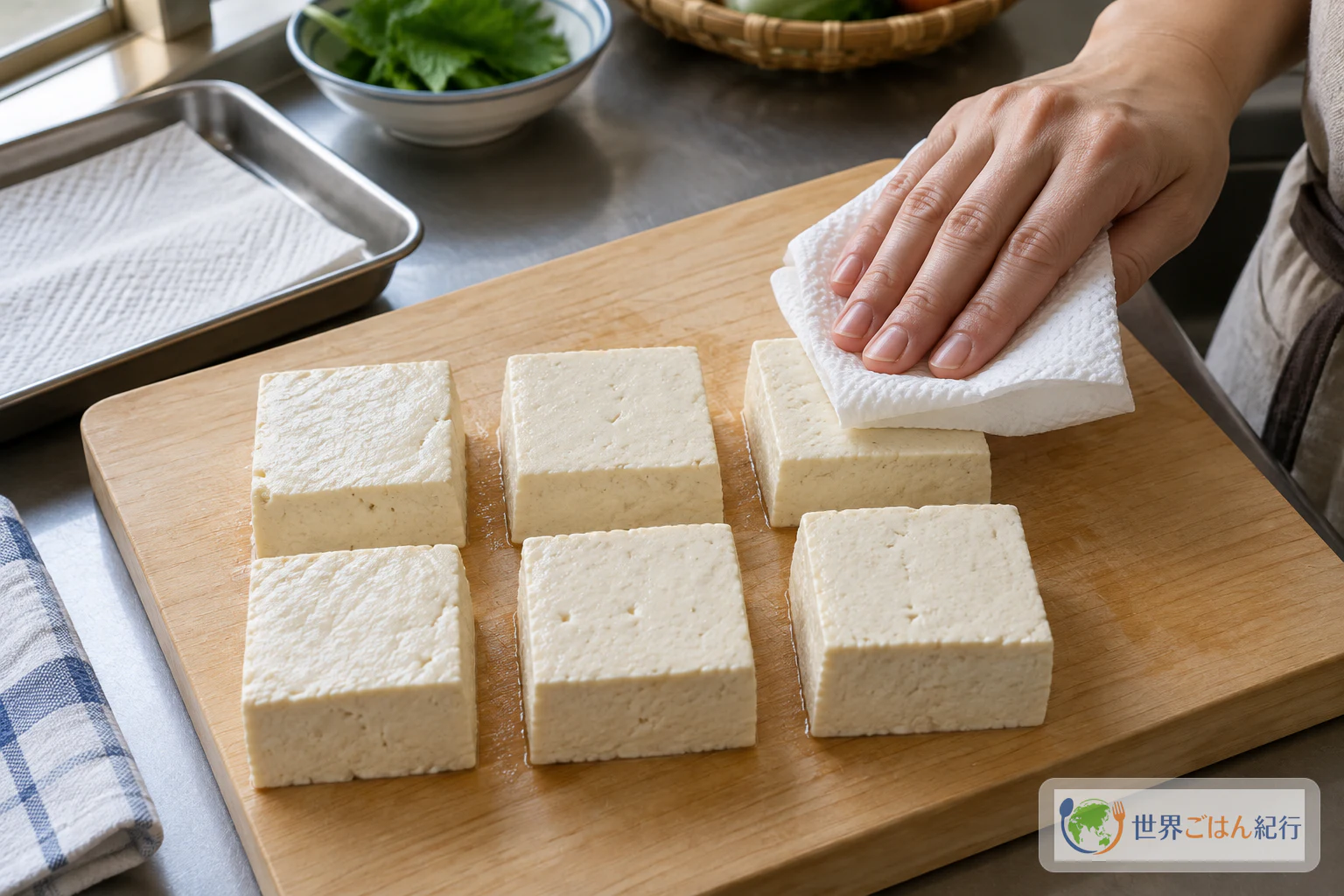
- Clean kitchen paper
- Shallow tray or plate for the potato starch
- Deep pot suitable for deep-frying
- Kitchen thermometer (helpful for holding 175°C; not essential to buy)
- Slotted spoon
- Wire rack set over a tray
- 2 small serving bowls
Method: Make the Sauce First, Then Serve the Tofu Straight From the Oil
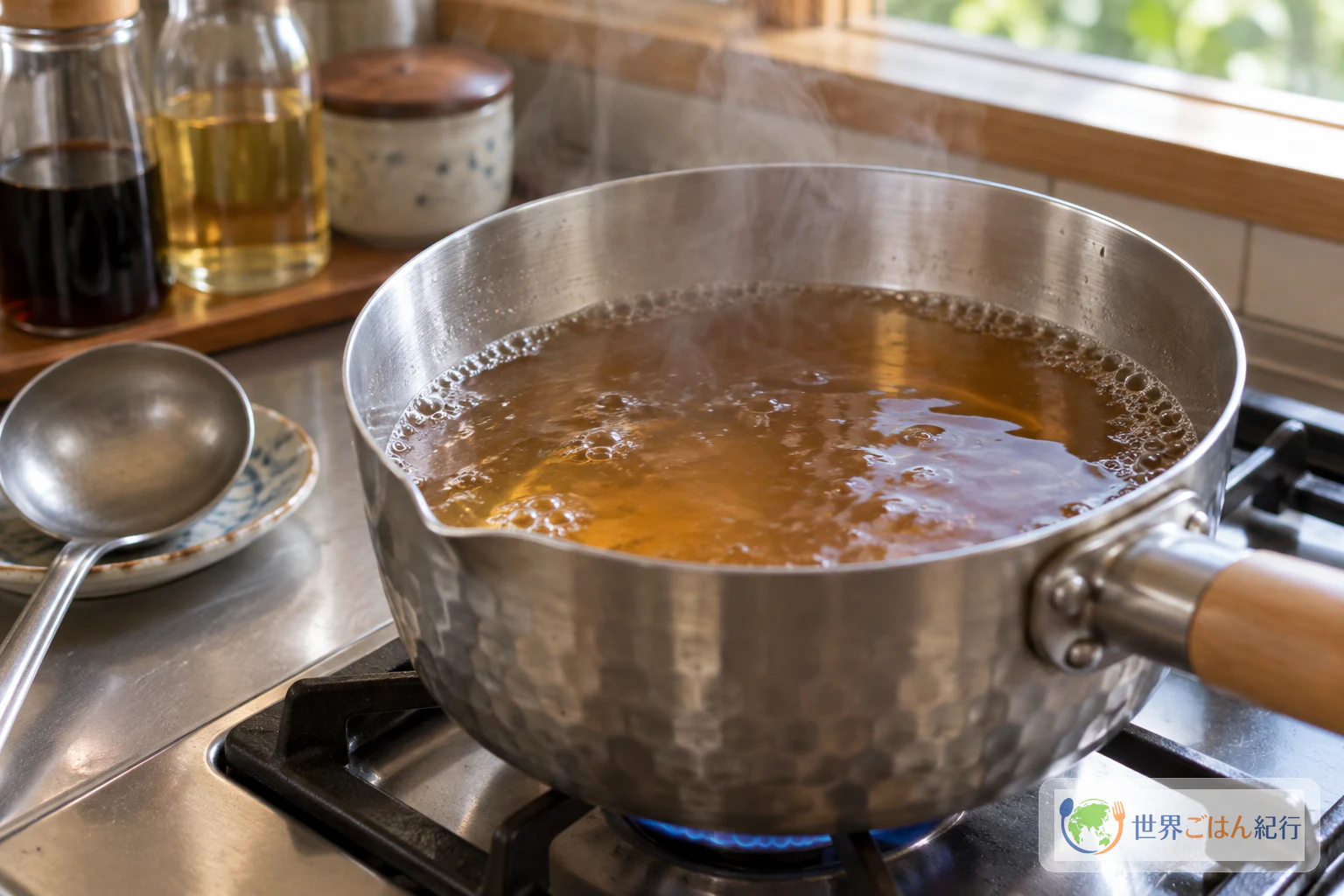
The source recipe brings the sauce to a boil after the tofu is fried. Here the sauce and garnishes are prepared first so the tofu can go into the bowls the moment it comes out of the oil. This is an editorial change to the order, not to the ingredients or amounts.
Troubleshooting: Peeling Coatings, Spatter and Broken Tofu
| Problem | Likely cause | What to do |
|---|---|---|
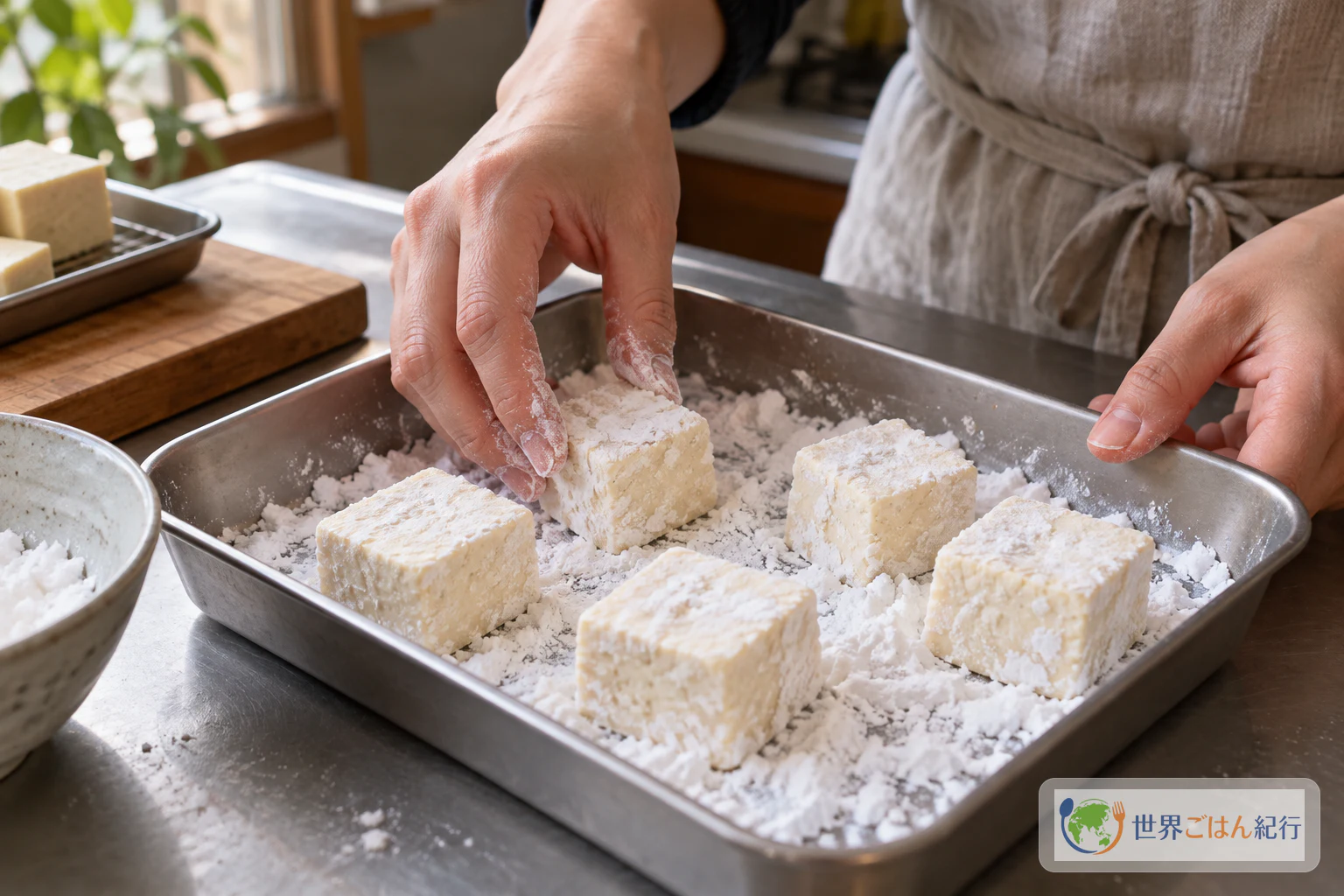
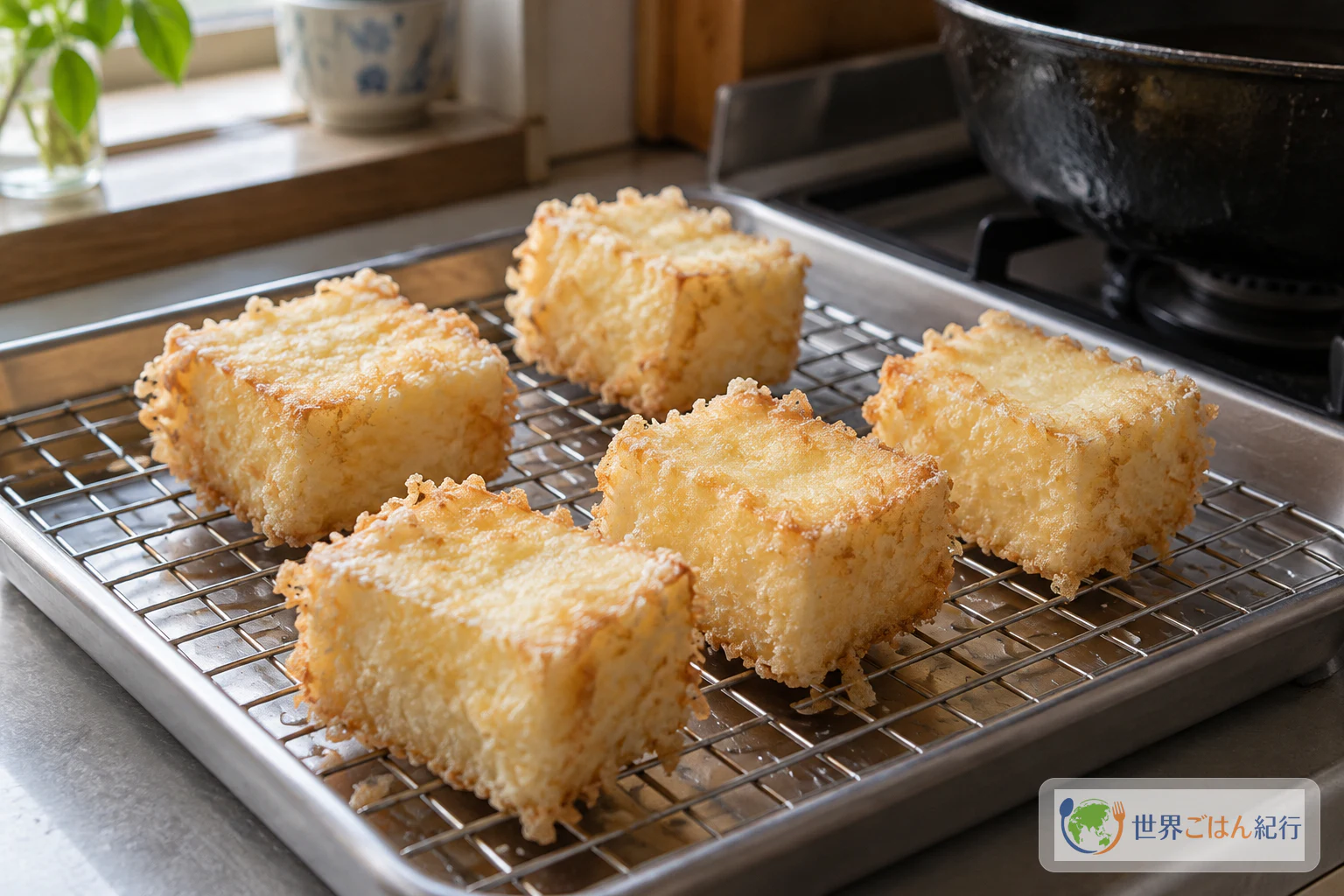
| The coating peels off or the oil spatters | The surface was still wet, or the starch went on too thick or too early | Pat every side dry after draining, coat just before frying, and shake off excess starch |
| Tofu breaks while coating or frying | Very soft tofu, or rough handling | Use momen tofu for this recipe and lower pieces into the oil gently with a slotted spoon |
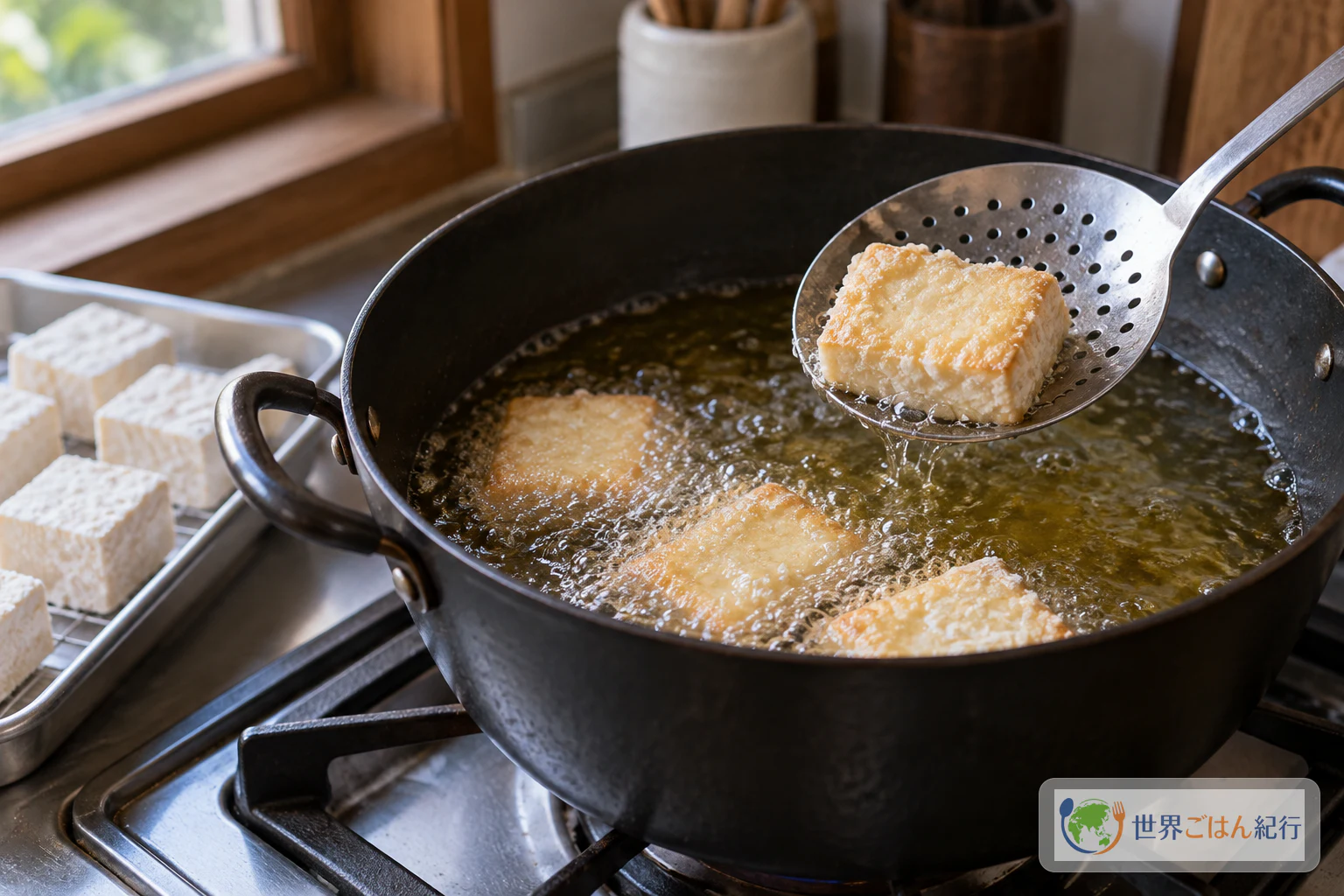
| Pieces haven't floated or colored after 1–2 minutes | The oil may not be at 175°C | Check the temperature with a thermometer and fry fewer pieces at a time |
| The sauce turned thick or cloudy | Leftover starch was added to the sauce | Keep the starch tray and the sauce separate |
| The sauce is lukewarm in the bowl | It cooled while the tofu was frying | Bring it back to a simmer just before pouring |
| The bowl tastes watery | Liquid from the grated daikon | Optionally drain the grated daikon lightly, as some other recipes suggest; the main recipe does not require it |
Variations: Kept Separate From the Main Recipe
These come from other published recipes or are open ideas. They change the result, so treat each as its own dish rather than mixing them into the amounts above.
- Silken tofu: Smoother inside, but harder to handle. It needs gentler draining with less pressure than momen tofu.
- Wheat-flour coating: Asahi Kasei's version coats the tofu in wheat flour and fries it at 170°C. The color and texture of the coating differ from a potato-starch coating.
- Mentsuyu sauce: Kikkoman's version cuts one block of momen tofu into 4 pieces for two people, makes the sauce from 50ml of 4x-concentrated mentsuyu with 150ml water, and fries at 170°C until lightly colored.
- Fried okra: Kikkoman's version also deep-fries okra to serve alongside. Treat it as an add-on arrangement, not part of the standard recipe.
- Plant-based dashi: Switching the bonito-based granules for kombu or shiitake dashi is an untested, separate idea; the sauce will taste different, and it is not an equivalent substitute for the standard recipe.
Frequently Asked Questions
Can I use silken tofu?
Yes, silken tofu is common for agedashi tofu and gives a smoother inside. It is softer and more fragile, though, so drain it more gently and handle it carefully. This recipe uses momen tofu because it holds its shape.
What if I don't have potato starch?
Cornstarch is not the same ingredient, so this recipe doesn't treat it as a drop-in replacement. A wheat-flour coating is an established alternative, as in Asahi Kasei's version, but expect a different color and texture.
Can I make the dashi plant-based?
The specified granulated dashi contains bonito, so the standard recipe isn't vegetarian. A kombu or shiitake dashi is possible as a separate, untested variation; the flavor of the sauce will change. Check the ingredients of any dashi product you buy.
How far ahead can I prepare?
The sauce and garnishes can be prepared first, as in step 1; keep the sauce hot until serving. Coat the tofu only just before frying, and serve it as soon as it comes out of the oil.
What about leftovers?
Agedashi tofu is best eaten freshly made. If you do keep some, follow general household food-safety guidance: divide it into small, shallow portions, cool it quickly, refrigerate it, and reheat it to 75°C or above as a guide. No storage period has been established for this dish, and the texture of the coating after storing is not guaranteed.
Does the mirin's alcohol cook off?
The sauce is brought only briefly to a boil, so it is not guaranteed that the alcohol is completely gone.
Sources
- Ajinomoto Park (Ajinomoto Co., Inc.), "カリっと、ふわふわ揚げ出し豆腐" (Crispy, fluffy agedashi tofu). The main recipe: the two-serving ingredients and amounts, cutting the tofu into 6 pieces, draining for about 5 minutes, coating with potato starch, frying at 175°C for 1–2 minutes until floating and lightly colored, and serving with hot sauce, scallion, ginger and grated daikon. https://park.ajinomoto.co.jp/recipe/card/706092/
- Ajinomoto Co., Inc., "ほんだし® 商品情報" (Hondashi product information). The product's ingredients, including lactose, bonito powder and bonito extract, and milk as its listed allergen. https://www.ajinomoto.co.jp/products/detail/?ProductName=hondashi
- Kikkoman Home Cooking, "揚げだし豆腐 人気の定番を簡単めんつゆで" (Agedashi tofu with mentsuyu). A comparison recipe: cutting into 4 pieces, a mentsuyu-and-water sauce, frying at 170°C, and fried okra. https://www.kikkoman.co.jp/homecook/search/recipe/00002244/
- Asahi Kasei Home Products Recipe Library, "基本の和食!揚げ出し豆腐" (Basic Japanese agedashi tofu). A comparison recipe with a wheat-flour coating fried at 170°C, the advice to prepare garnishes and dashi before frying, and lightly draining grated daikon. https://ahp-recipe.jp/sheet.php?recipe=1638
- Food in Japan, "Agedashi Tofu: Recipe, Sauce and Tofu Guide." General description of the dish, potato-starch and wheat-flour coatings, the uncertain origin of the name, and the caution about reading the 1782 Tofu Hyakuchin as evidence for the modern dish. https://www.foodinjapan.org/japan/agedashi-tofu/
- Japan Tofu Association, "豆腐の歴史" (History of tofu). Background on tofu as an important plant-based ingredient in shōjin ryōri; not evidence for the origin of agedashi tofu itself. https://tofu-as.com/tofu/history/
- Ministry of Health, Labour and Welfare (Japan), "家庭での食中毒予防" (Preventing food poisoning at home). General guidance on dividing leftovers into shallow portions, cooling them quickly, and reheating to 75°C or above. https://www.mhlw.go.jp/stf/seisakunitsuite/bunya/kenkou_iryou/shokuhin/syokuchu/01_00008.html