Chanpurū: Browned Tofu Goes Out of the Pan, Then Comes Back
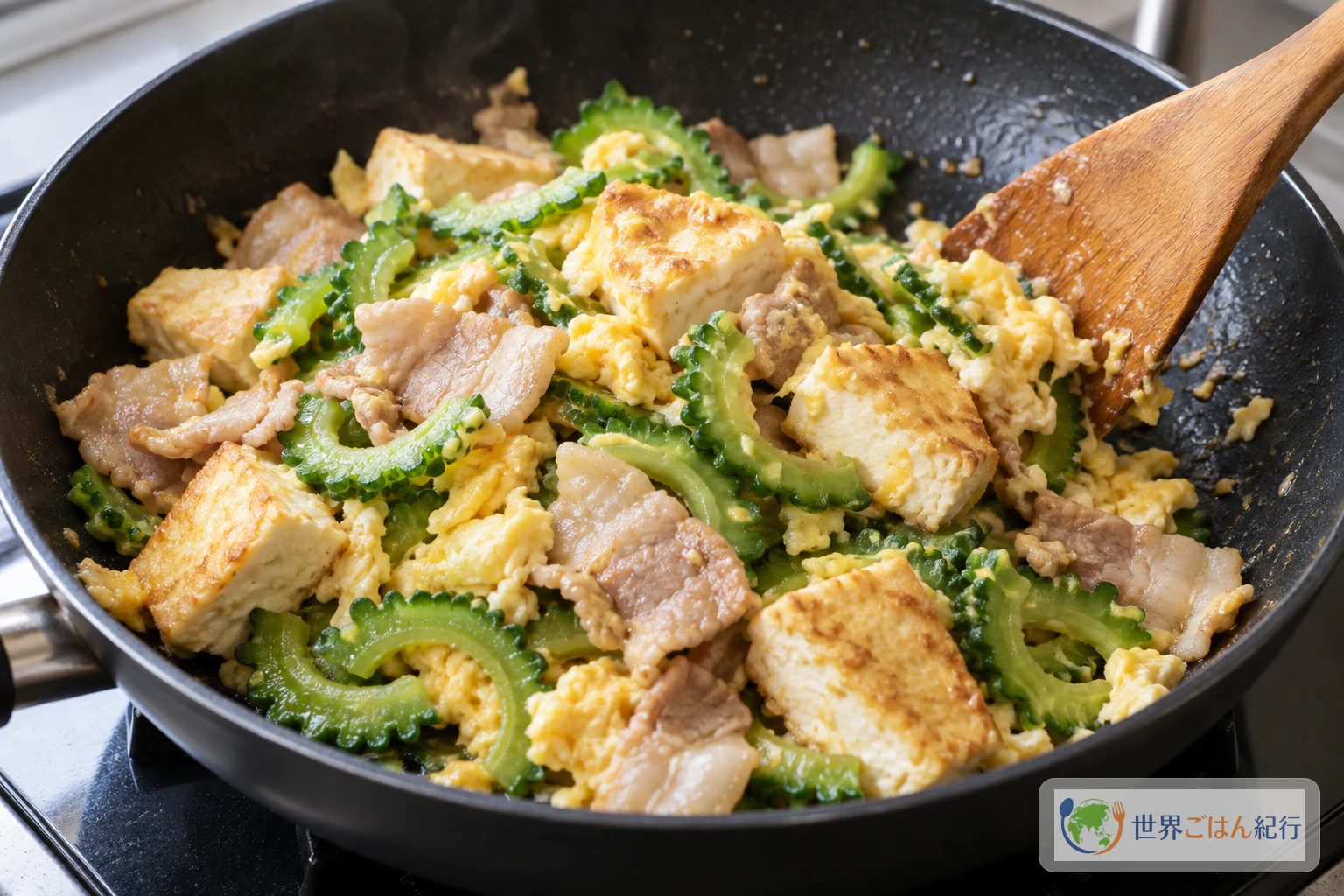
Brown the tofu first and set it aside. Then cook the bitter melon briefly in the same pan, coat it with egg, and return the simmered pork and the tofu at the very end.
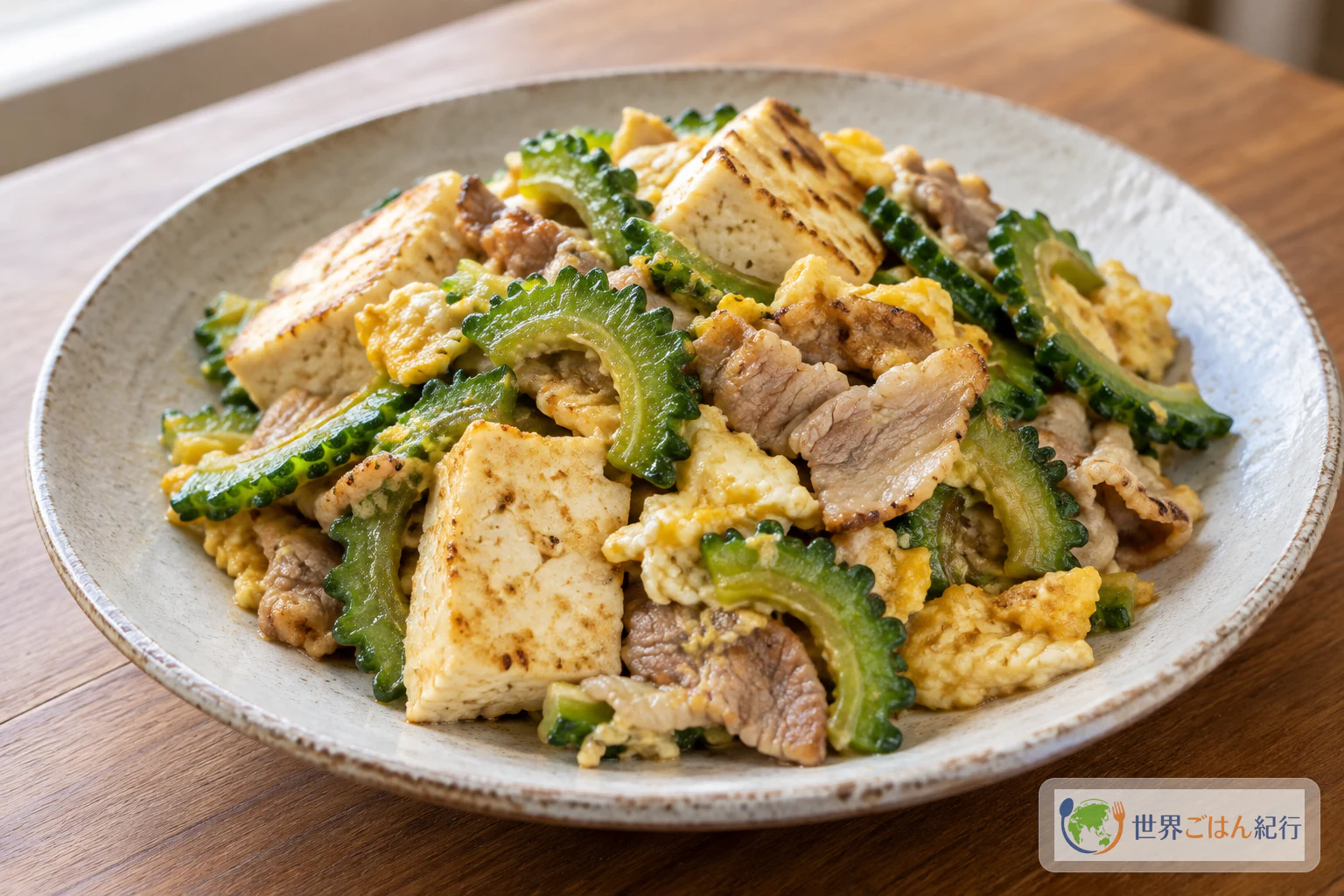
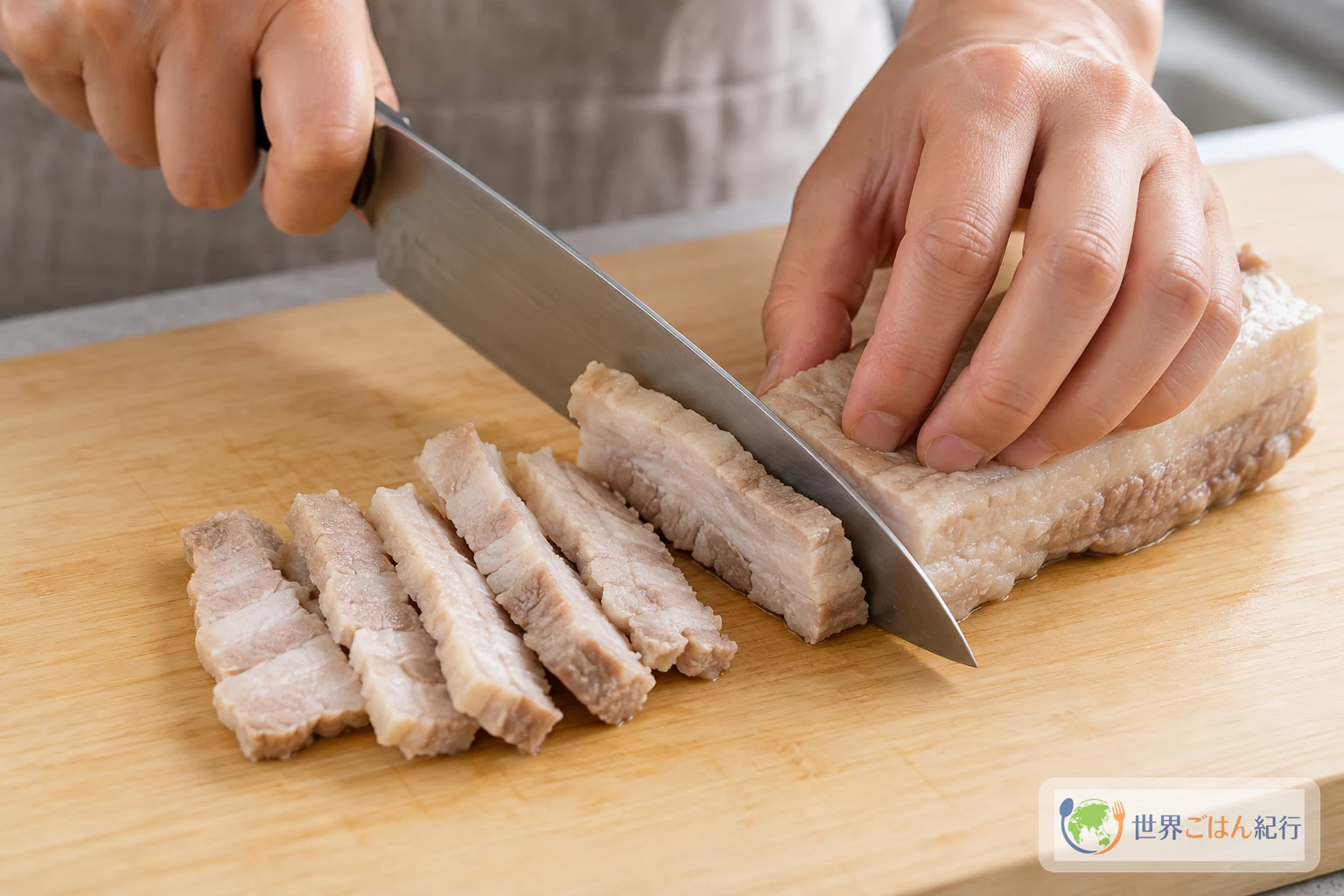
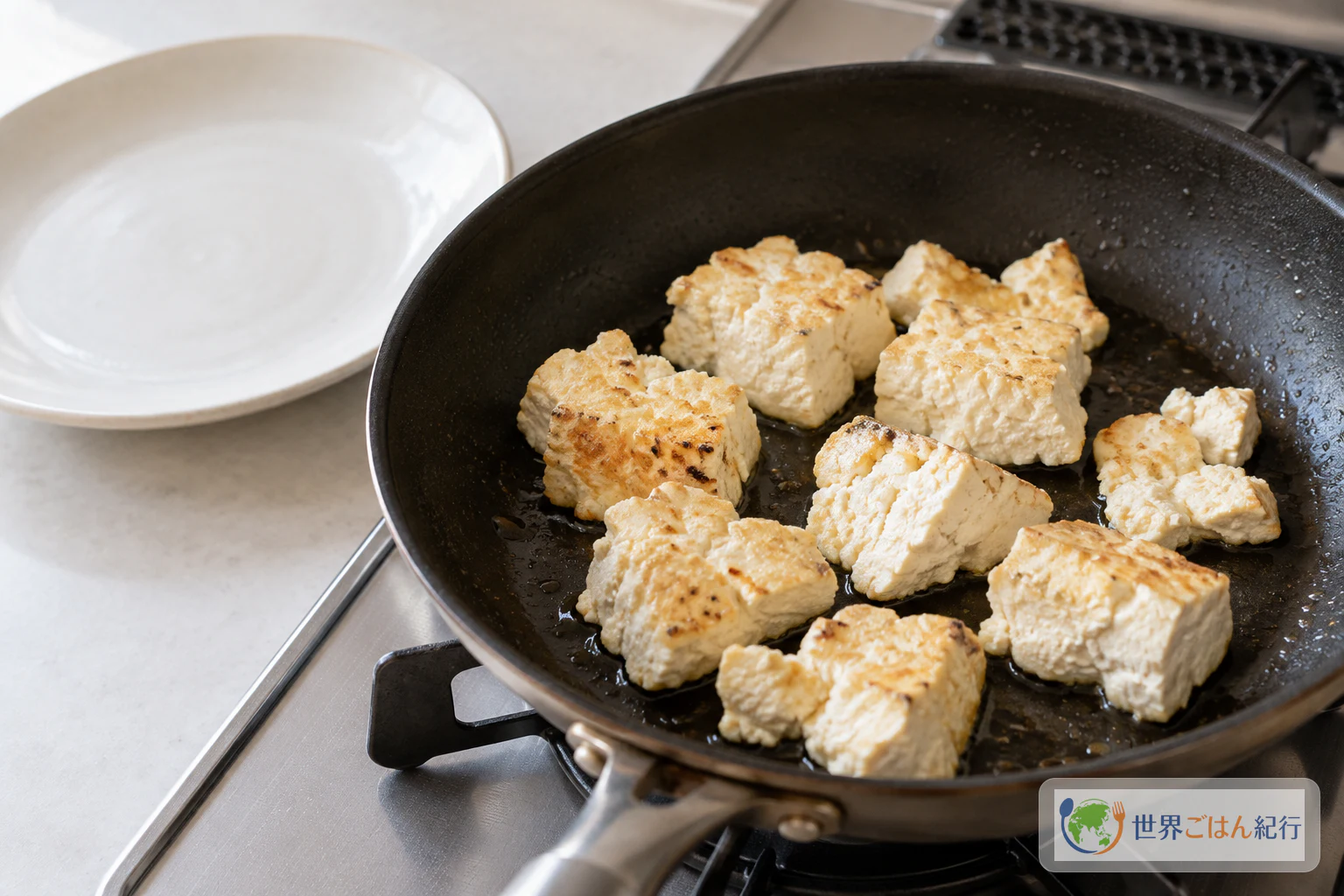
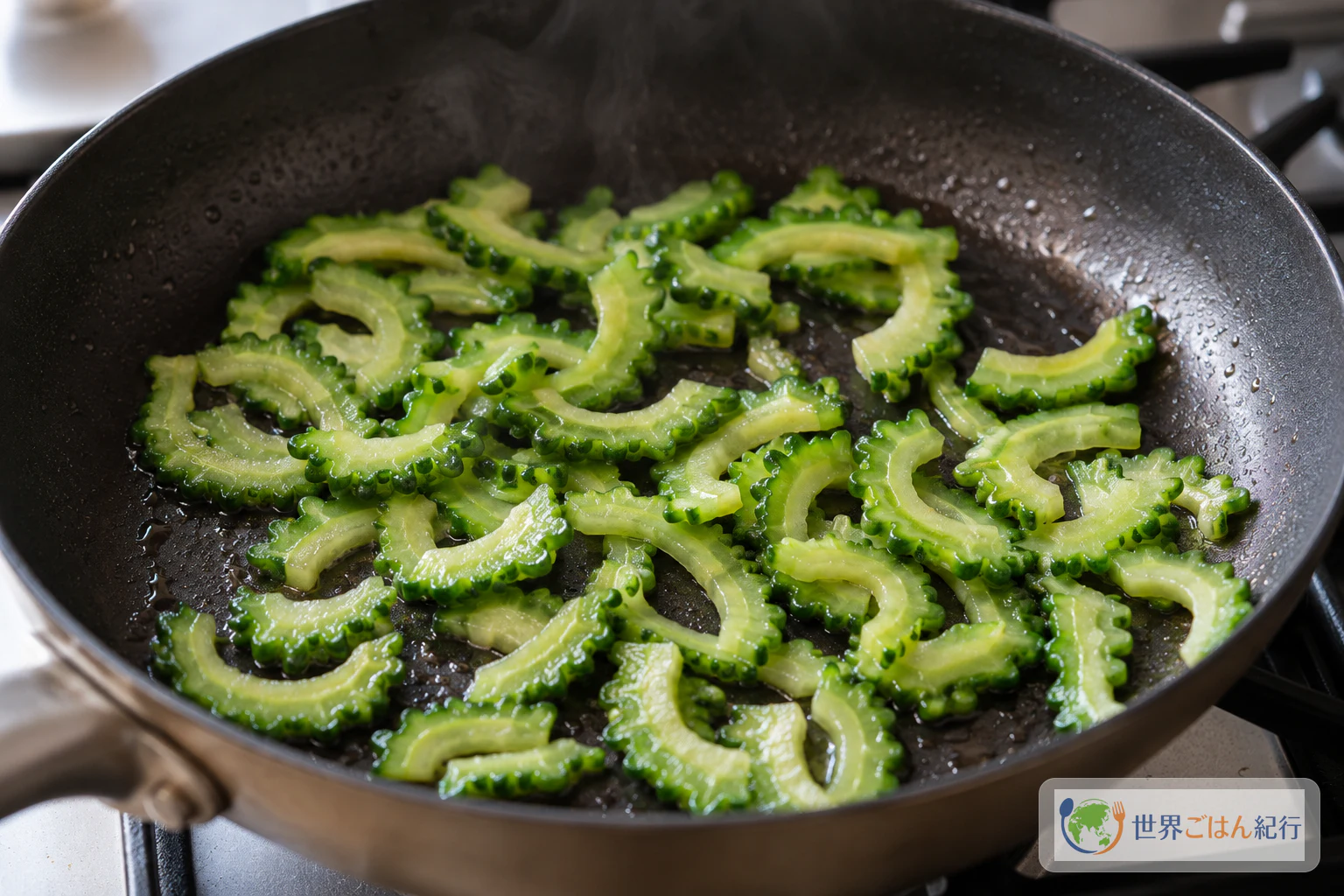
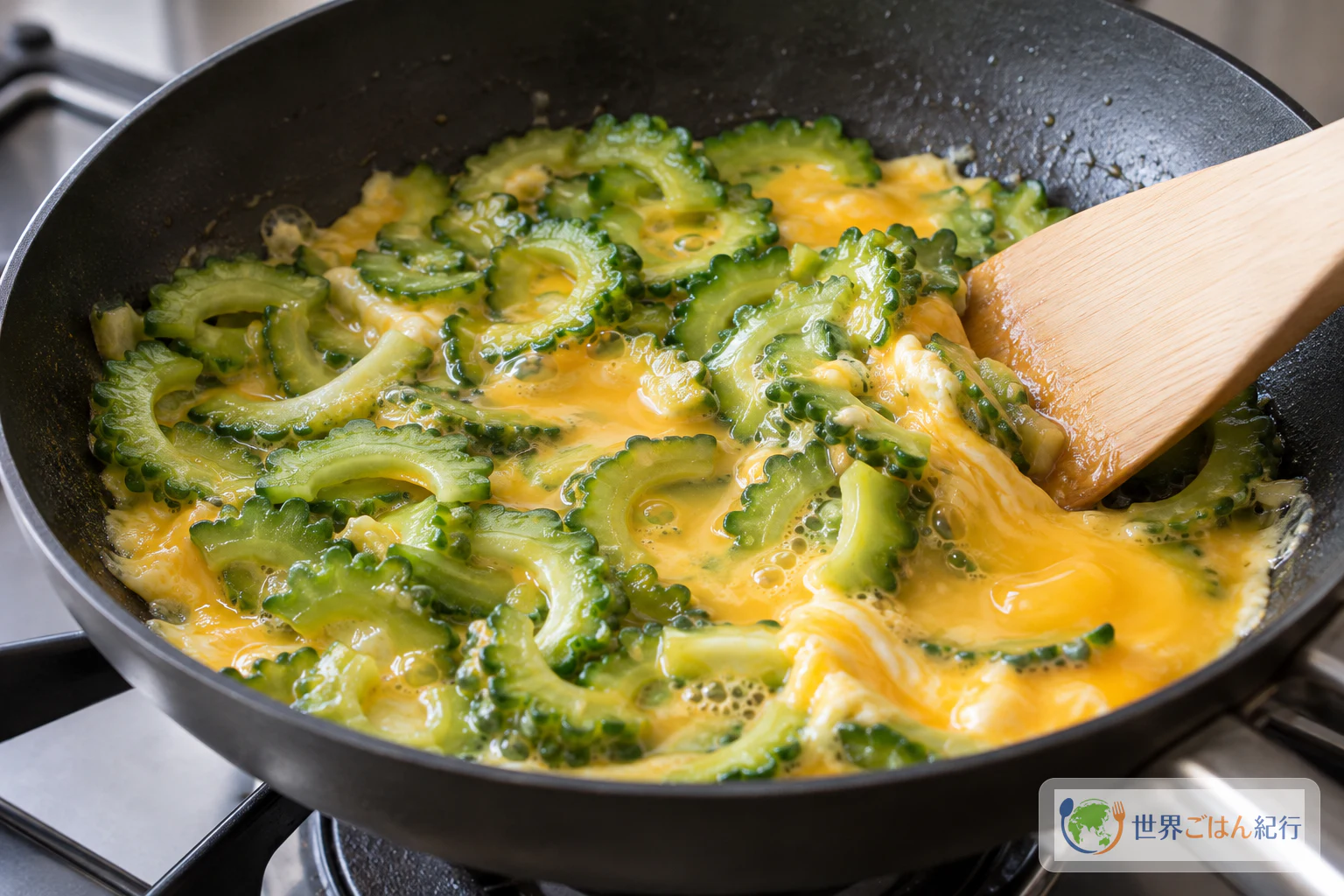
Near the end of this recipe, the frying pan holds thin green half-moons of goya (bitter melon) just coated in beaten egg. Large, hand-torn pieces of tofu, browned a few minutes earlier and waiting on a plate, go back in, along with strips of pork belly that were simmered in a separate pot before the pan was ever heated. Everything is folded together, and the dish is done.
That order of browning, setting aside and returning is the backbone of the goya champuru recipe published by Japan's Ministry of Agriculture, Forestry and Fisheries (MAFF) in its regional-food collection, with the recipe provided by Ryukyu cuisine researcher Junko Ashitomi (安次富順子). This article follows that recipe for 4 servings, as written in its ingredient list and numbered method.
What Chanpurū Is: A Family of Stir-Fries, Not One Fixed Recipe
The MAFF page describes chanpurū (チャンプルー) as a stir-fry of browned island tofu and seasonal vegetables, and presents goya champuru (ゴーヤーチャンプルー) as a representative example. In other words, "chanpurū" names a broader family of dishes; it does not refer to a single ingredient list. Goya champuru is one branch of that family, and it is the branch this recipe reproduces.
Other branches use different vegetables, meats and seasonings. An Okinawan food-information site presents chanpurū as a home dish in which tofu plays the lead and seasonal vegetables are stir-fried quickly, and another Okinawan recipe site publishes a tofu chanpurū with cabbage, onion, carrot, bean sprouts, "pork", soy sauce and powdered dashi, and no egg at all. Those are separate recipes with their own amounts and order. Nothing from them is mixed into the recipe below.
Ingredients for 4 Servings (MAFF Goya Champuru, Momen Tofu Version)
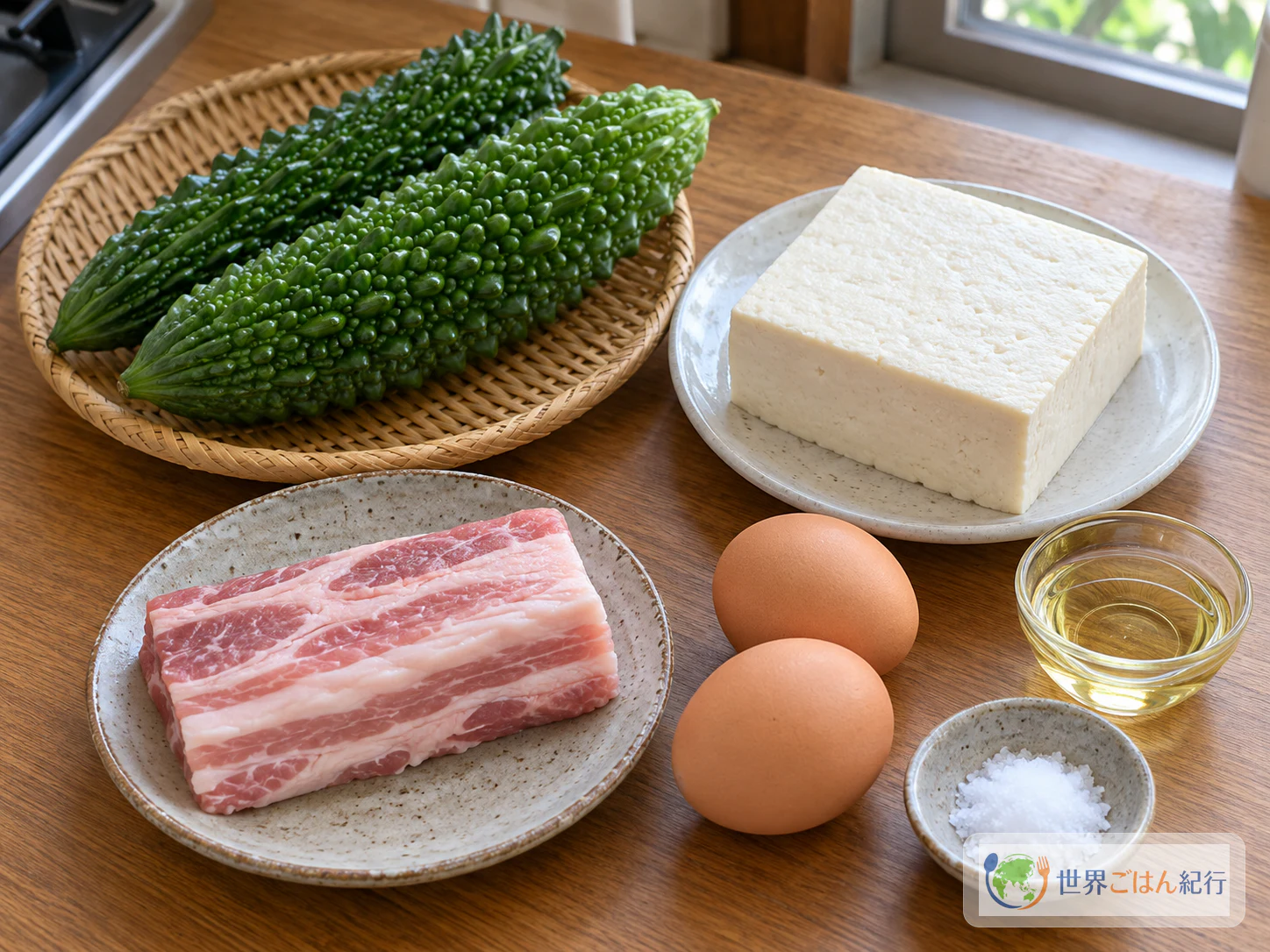
The source lists either Okinawa tofu or momen tofu. This article uses momen tofu throughout, so the steps and photos follow one consistent method. There is no soy sauce, luncheon meat, onion, cabbage, dashi or garnish in this version.
The amounts, heat levels and times below are those given in the MAFF recipe. Sekai Gohan has not kitchen-tested this version. Salt is given only as "as needed" in the source, so it is left that way here.
This recipe contains soy (tofu) and egg, and it contains pork. If you choose a variation that uses canned pork or soy sauce, check that product's label separately.
Equipment
- Frying pan
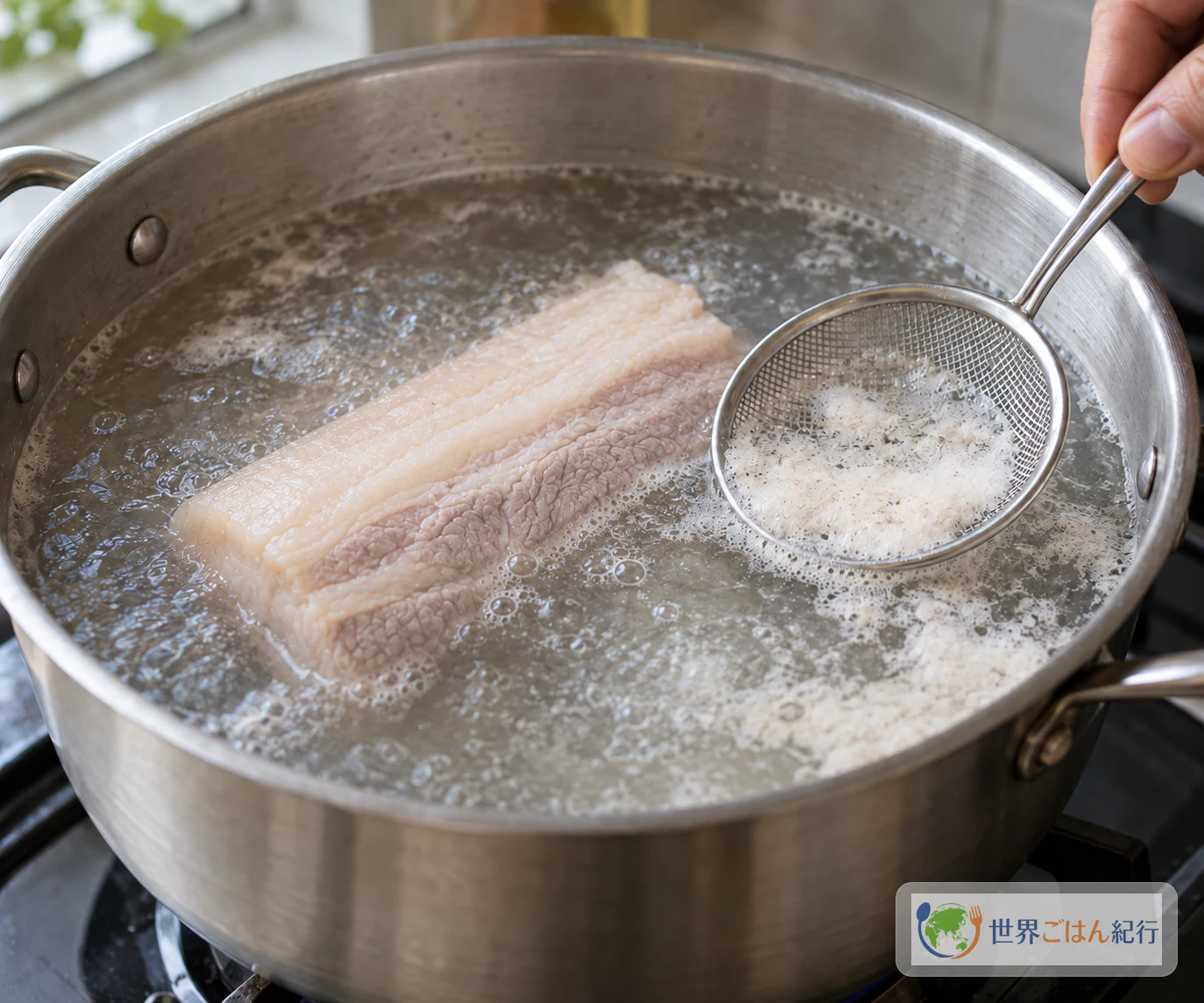
- Pot for simmering the pork
- Kitchen paper (paper towels)
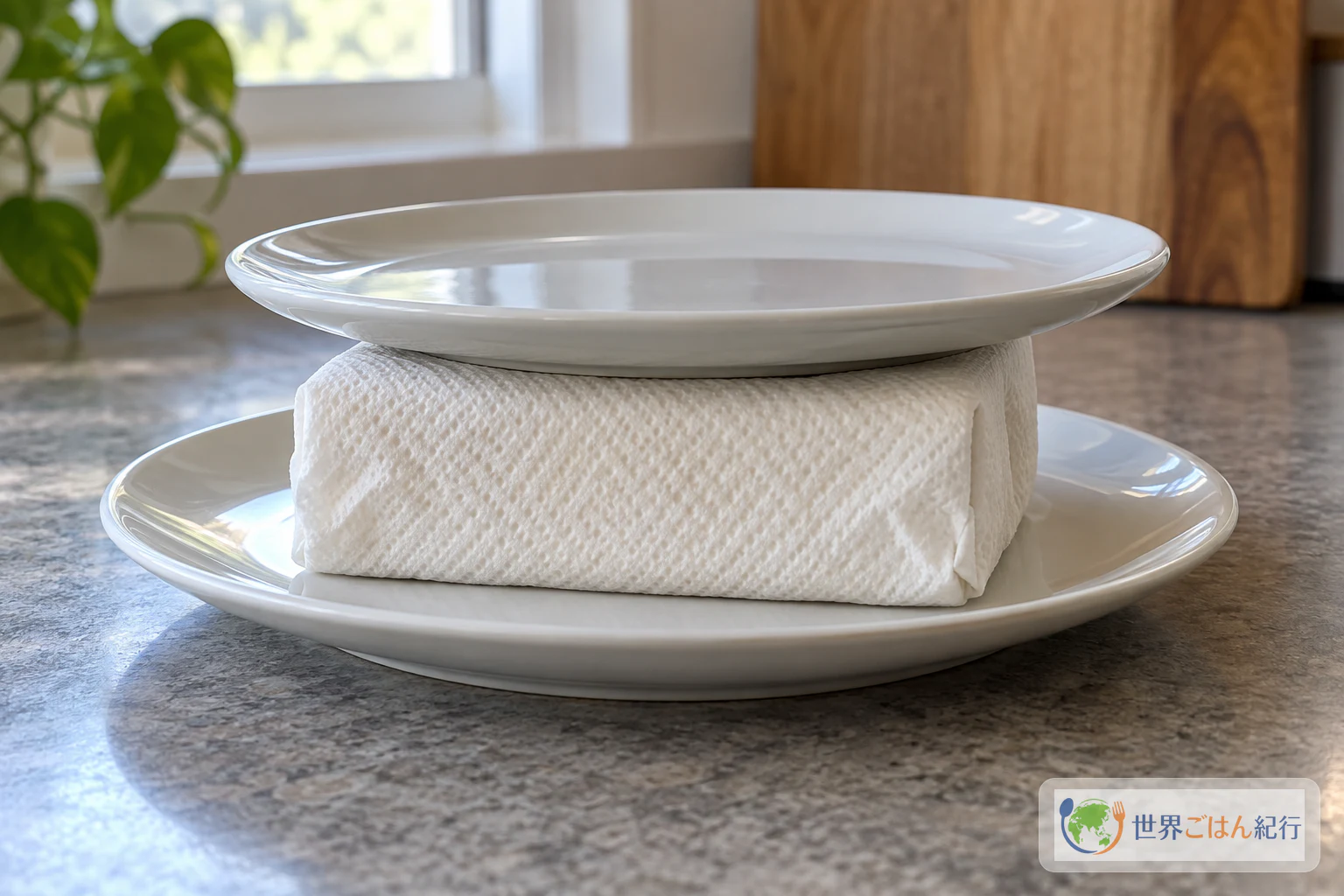
- A small, clean plate to use as a weight for the tofu
- A plate for holding the browned tofu
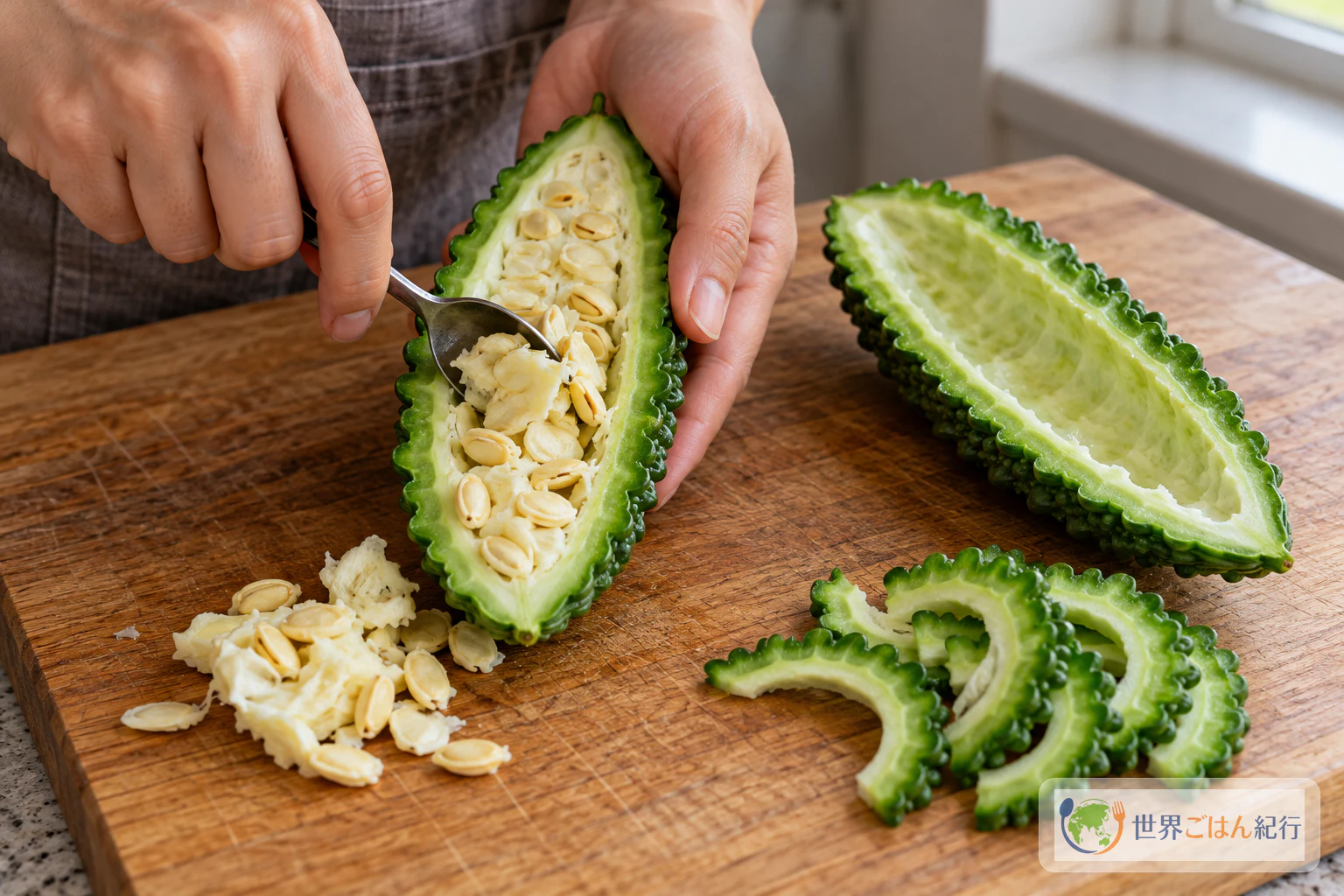
- Knife, cutting board and a spoon for scraping out the goya seeds
- Food thermometer (optional, for checking the pork's center temperature)
Choosing and Swapping: What This Version Fixes and What It Leaves Out
Tofu. The source allows Okinawa tofu (island tofu) or momen tofu. Only the momen path comes with the paper-and-weight draining step of about 10 minutes, and that is the path used here. Island tofu is a different product, and this article does not claim that its moisture or texture is the same as momen.
Pork. The source lists pork belly (三枚肉) or a pork belly block, 100g either way. It does not offer thinly sliced pork as a substitute.
Canned pork. The MAFF page's general description notes that some households use canned pork, such as Spam, instead of pork belly. It gives no amount, no timing and no salt adjustment for that swap, so it is not part of this recipe. Another Okinawan goya champuru recipe that does use luncheon meat has entirely different amounts; its numbers are not converted into this one.
Soy sauce. The MAFF page's descriptive text mentions adding soy sauce around the edge of the pan to finish, but the ingredient list and numbered method include no soy sauce and give no amount. This recipe follows the ingredient list and numbered method, so it uses no soy sauce.
Goya. No substitute for goya is given in the source.
Method: Three Separate Preparations, Then One Pan
Prepare the goya, the tofu and the pork separately before the frying pan goes on the heat. Wash anything that has touched raw pork, including hands, knife, cutting board and tongs, before it touches the goya or any cooked ingredient, and keep raw meat juices away from other foods.
Troubleshooting: Watery Tofu, Scorched Goya, Firm Egg
| Problem | What to check | What to do within this recipe |
|---|---|---|
| The tofu releases water in the pan | Whether the momen tofu was wrapped and weighted | Give it the full paper-and-weight drain of about 10 minutes before tearing it |
| The tofu breaks up or does not brown | Piece size and how often it is moved | Tear it into large pieces, brown it in 1 tbsp of oil over medium heat, and take it out before cooking the goya. Do not stir it in from start to finish |
| The goya scorches | Heat level | Keep the heat at low to medium for about 1 minute, as the source specifies |
| The egg overcooks | How long the egg cooks alone | Pour it straight over the goya to coat it, then return the pork and tofu without delay, following the source's order |
| You are unsure about the pork | Thickness, pot, water | Do not rely on 20–30 minutes alone. Check that the center reaches 75°C for at least 1 minute with a thermometer, and do not reuse raw-meat utensils on cooked food |
| It tastes too bitter | Goya preparation | The MAFF page's descriptive text mentions lightly salting the goya and giving it a gentle squeeze to tame bitterness, but gives no amount or time. That is a household option outside this recipe's measured method |
Storage and Reheating
The MAFF recipe gives no storage guidance. Follow the home food-safety advice of Japan's Ministry of Health, Labour and Welfare. Do not leave the cooked dish at room temperature for a long time. Handle leftovers with clean utensils, divide them into shallow containers so they cool quickly, and refrigerate them (the ministry gives 10°C or below as the guide for a refrigerator). When reheating leftovers, heat them thoroughly, using 75°C or above as the guide. No number of days for storage or method for freezing is given in these sources.
Chanpurū in Okinawa: Homes, Restaurants and a Year-Round Vegetable
According to the MAFF page, goya champuru has been passed down throughout Okinawa Prefecture and is eaten both at home and in restaurants in the prefecture. The same page describes goya as a summer vegetable, but notes that improved varieties now make it available all year, so the dish is made beyond the summer months as well.
Looking across the family, the differences are concrete. The MAFF recipe uses pork belly and egg; another Okinawan goya champuru uses luncheon meat; and a tofu chanpurū from an Okinawan recipe site leaves out egg and adds several vegetables, soy sauce and powdered dashi. What these share is tofu browned and set aside, then returned to the pan. The origin of the word "chanpurū" is not established in these sources, so this article does not offer one. For more dishes from the same country, see Japan.
Branches of the family and where this recipe sits
| Version | Main ingredients | Relation to this recipe |
|---|---|---|
| MAFF goya champuru (this recipe) | Goya, momen or Okinawa tofu, pork belly, egg, oil, salt | Followed as written, with momen tofu |
| Household swap noted on the MAFF page | Canned pork such as Spam in place of pork belly | No amount given; not part of this recipe |
| Goya champuru from an Okinawan food-information site | Goya, luncheon meat, tofu, egg, salt, oil, in different amounts | A separate recipe; its amounts are not used here |
| Tofu chanpurū from an Okinawan recipe site | Island tofu, cabbage, onion, carrot, bean sprouts, "pork", soy sauce, powdered dashi; no egg | A different branch of the family |
Frequently Asked Questions
Does every chanpurū contain goya?
No. The MAFF page describes chanpurū as a stir-fry of browned island tofu and seasonal vegetables, with goya champuru as one representative example. This article reproduces that goya branch.
Can I make it without island tofu?
Yes. This recipe uses momen tofu from the start, 300g, wrapped in paper and weighted for about 10 minutes. The source lists Okinawa tofu as the other option.
Can I use Spam?
The MAFF page mentions canned pork such as Spam as something some households use, but the recipe itself calls for 100g of pork belly or pork belly block. No conversion amount or salt adjustment for canned pork is given.
Is it the same dish without egg?
This recipe uses 2 eggs. The egg-free tofu chanpurū published elsewhere is a separate recipe with its own ingredients and order, not an adjustment of this one.
Do I need soy sauce?
Not in this version. The MAFF page's descriptive text mentions soy sauce, but its ingredient list and numbered method do not include it and give no amount, so this recipe leaves it out.
Is 20 minutes of simmering enough for the pork?
The 20–30 minutes is the source's guide for simmering until tender. For safety, go by the ministry's benchmark of 75°C at the center for at least 1 minute, checked at the thickest part, rather than by the clock alone.
Sources
- Ministry of Agriculture, Forestry and Fisheries (Japan), "ゴーヤーチャンプルー 沖縄県 (Goya Champuru, Okinawa Prefecture)," Uchi no Kyōdo Ryōri; recipe by Ryukyu cuisine researcher Junko Ashitomi. Chanpurū as a stir-fry of browned island tofu and seasonal vegetables, goya champuru as its representative example, its use in homes and restaurants across Okinawa, the 4-serving ingredient list and numbered method, the canned-pork household variation, and the soy sauce mentioned only in the descriptive text. https://www.maff.go.jp/j/keikaku/syokubunka/k_ryouri/search_menu/menu/47_11_okinawa.html
- Kuwachii Okinawa (Okinawa food-information site), "ゴーヤーチャンプルー (Goya Champuru)," citing Okinawa Prefecture's Okinawa 100 no Kenkō Ryōri. A separate goya champuru recipe using luncheon meat, and chanpurū described as a tofu-led home dish of quickly stir-fried seasonal vegetables. https://kuwachii-okinawa.com/recipe/2927/
- Ajimaa Okinawan Recipes, "豆腐チャンプルー (Tofu Chanpurū)." A separate tofu chanpurū with vegetables, "pork", soy sauce and powdered dashi, and no egg. https://recipe.ajima.jp/recipe/?rid=22
- Ministry of Health, Labour and Welfare (Japan), "お肉はよく焼いて食べよう (Cook Meat Thoroughly)." Not eating pork raw or undercooked, and 75°C at the center for at least 1 minute as the general heating benchmark. https://www.mhlw.go.jp/stf/seisakunitsuite/bunya/0000049964.html
- Ministry of Health, Labour and Welfare (Japan), "家庭での食中毒予防 (Preventing Food Poisoning at Home)." Keeping raw meat juices away from other foods, refrigerators at 10°C or below, not leaving cooked food at room temperature, cooling leftovers in shallow containers, and reheating to 75°C or above. https://www.mhlw.go.jp/stf/seisakunitsuite/bunya/kenkou_iryou/shokuhin/syokuchu/01_00008.html