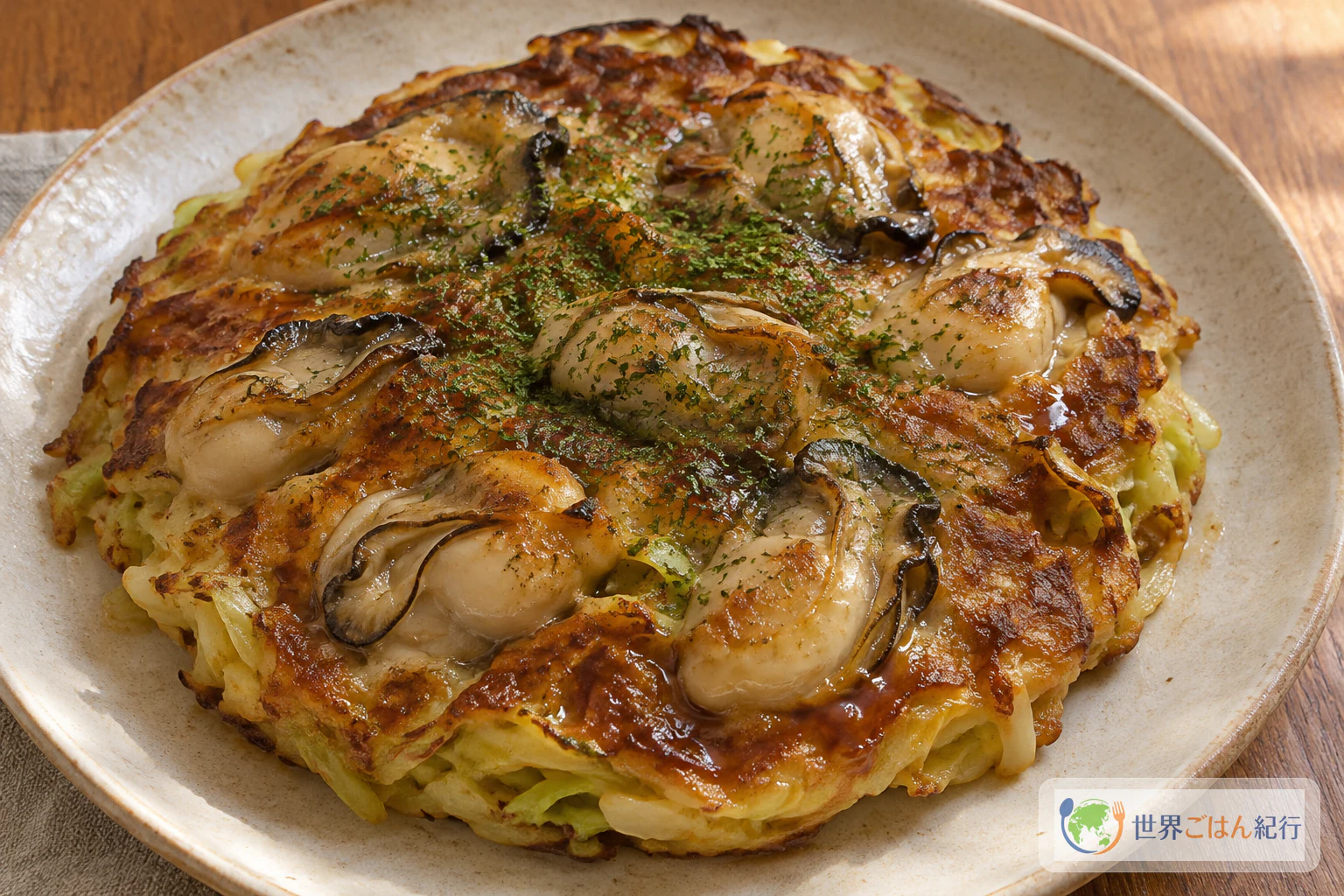
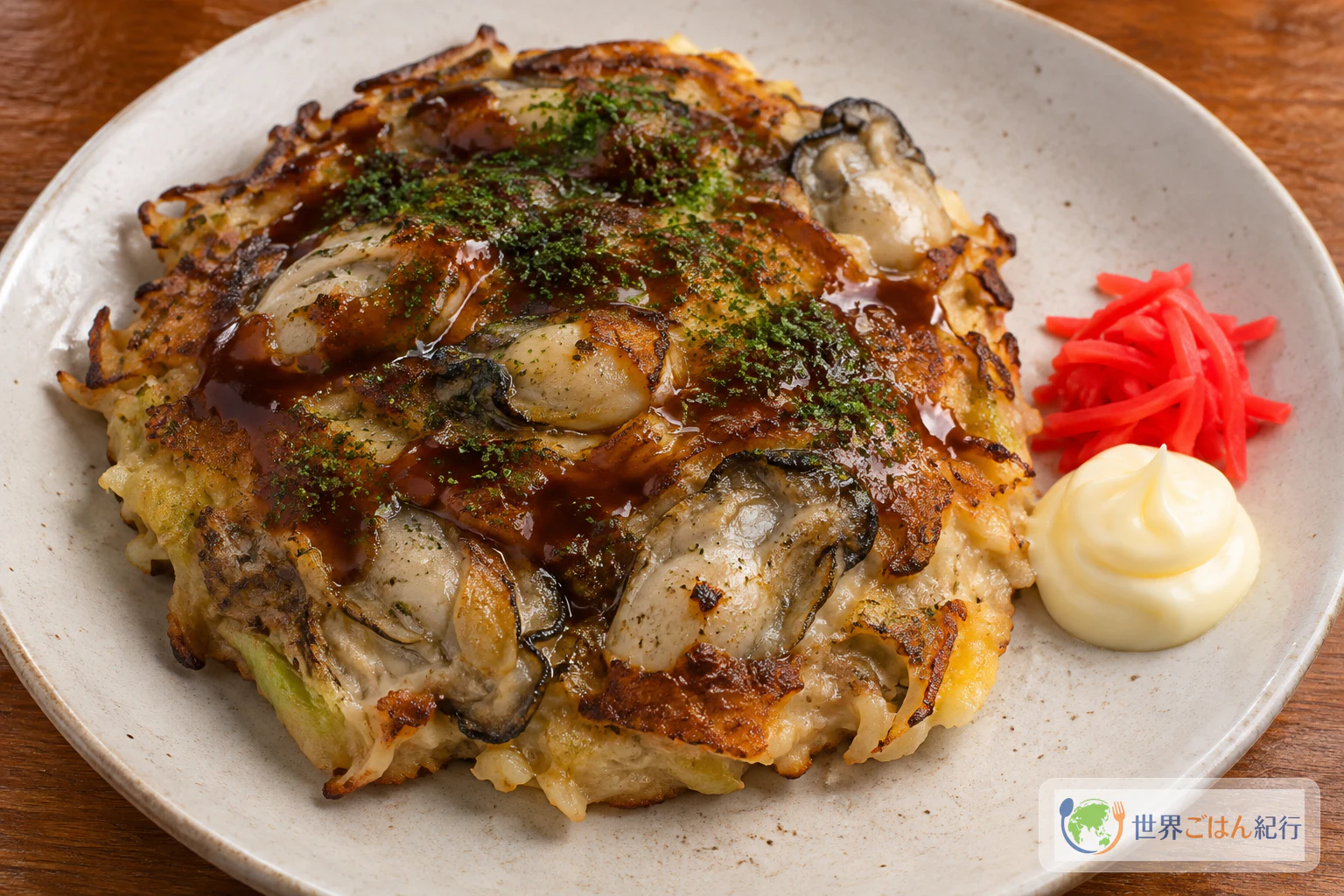
Kakioko: Oysters and Cabbage on a Hot Griddle in Hinase
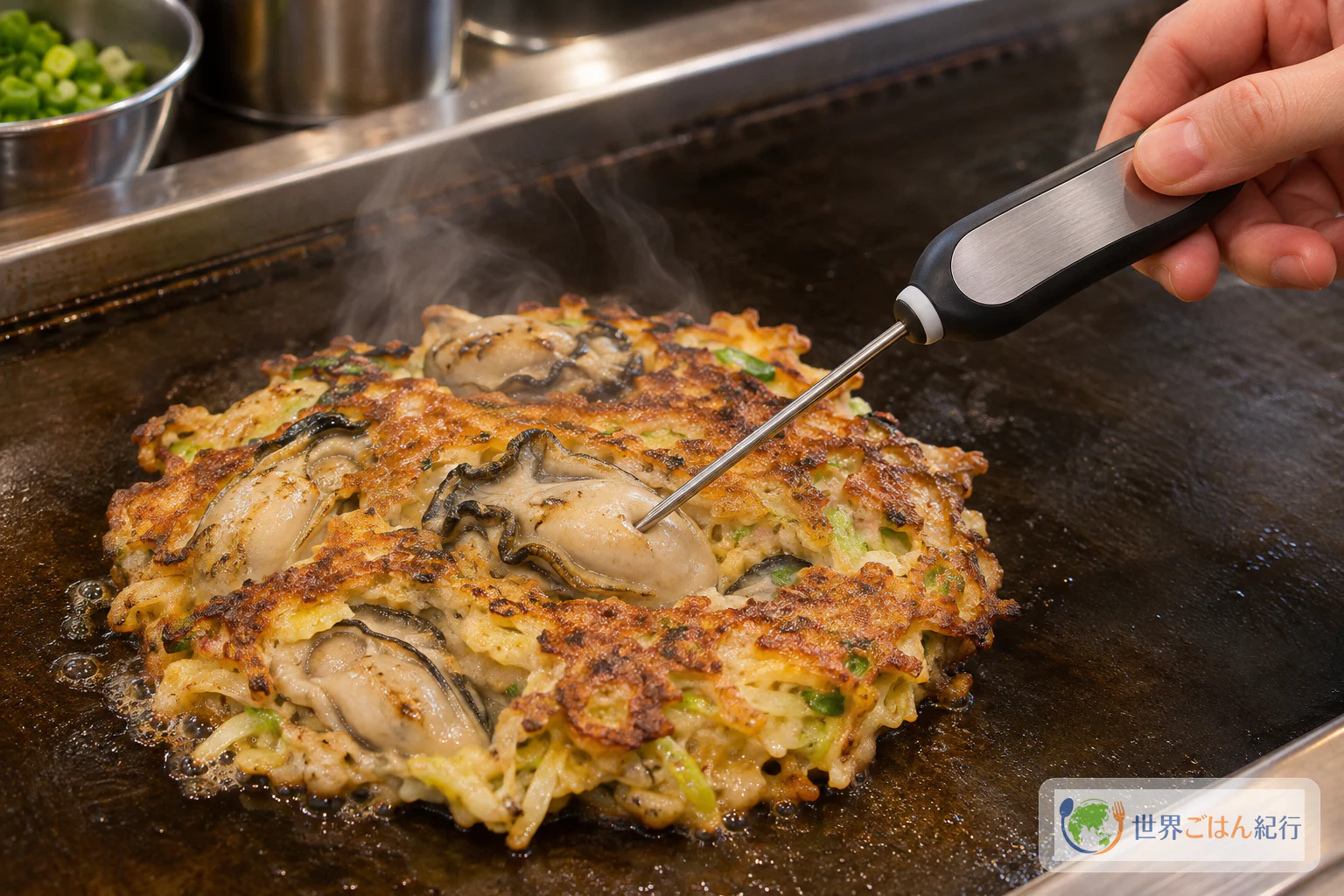
Keep the oysters as the star and the cabbage as a separate filling between layers of batter. Judge doneness by the temperature at the center of the thickest oyster, not by the color of the crust.
At Okonomiyaki Hori in Hinase, a loose batter with shredded cabbage mixed through it goes onto a hot griddle. Tenkasu and katsuobushi round out the flavor, oysters go on top, and the whole thing steam-cooks slowly before being finished with sauce. That is how Okayama's tourism site describes this shop's method in its feature on the dish. The owner, Ritsuko Hori, describes the method as sitting between Kansai-style mixed okonomiyaki and Hiroshima-style layered okonomiyaki.
Kakioko is the oyster okonomiyaki of Hinase, a town in Bizen City, Okayama Prefecture. It belongs to one place and is a local specialty rather than a general name for any savory pancake with oysters in it. You can find more dishes from the same country on our Japan page.
Which Recipe This Is, and What We Chose
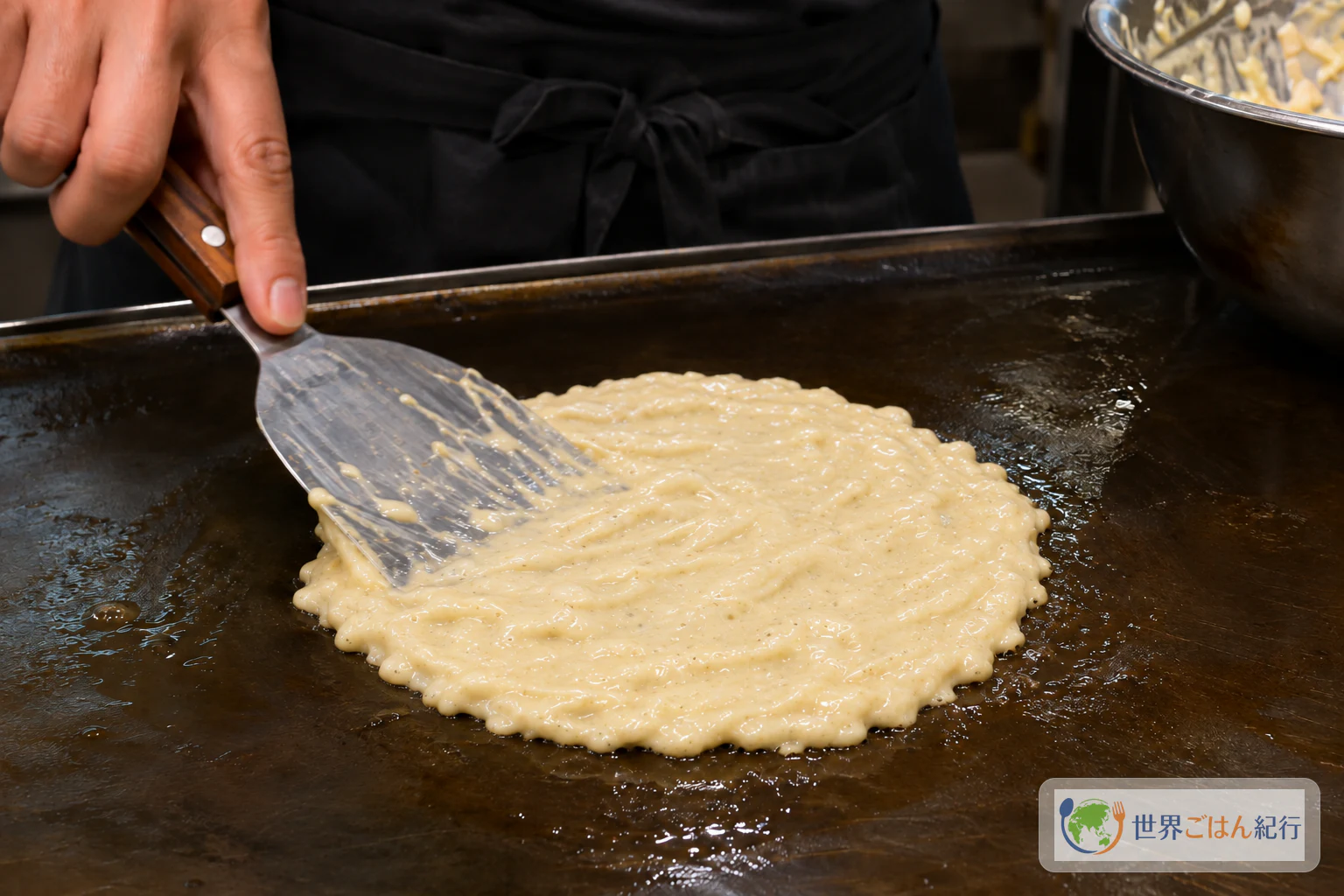
The recipe below is the two-serving home recipe published on the site of Hinase Kaki (日生牡蠣), an oyster producer in Hinase. Its method has three stages: spread batter in an oiled frying pan or on a griddle, add the filling and pour on more batter, then cook both sides until well browned. It also says that the oysters are for cooking and must be cooked through to the center.
This is one home version. It is not a unified official Hinase recipe, the method of every shop, or the definitive form of the dish. The producer's site does not name a recipe author, and it does not present the recipe as one issued by the local kakioko association. Sekai Gohan has not kitchen-tested this recipe.
The producer's recipe leaves some operations open, so we made these editorial choices:
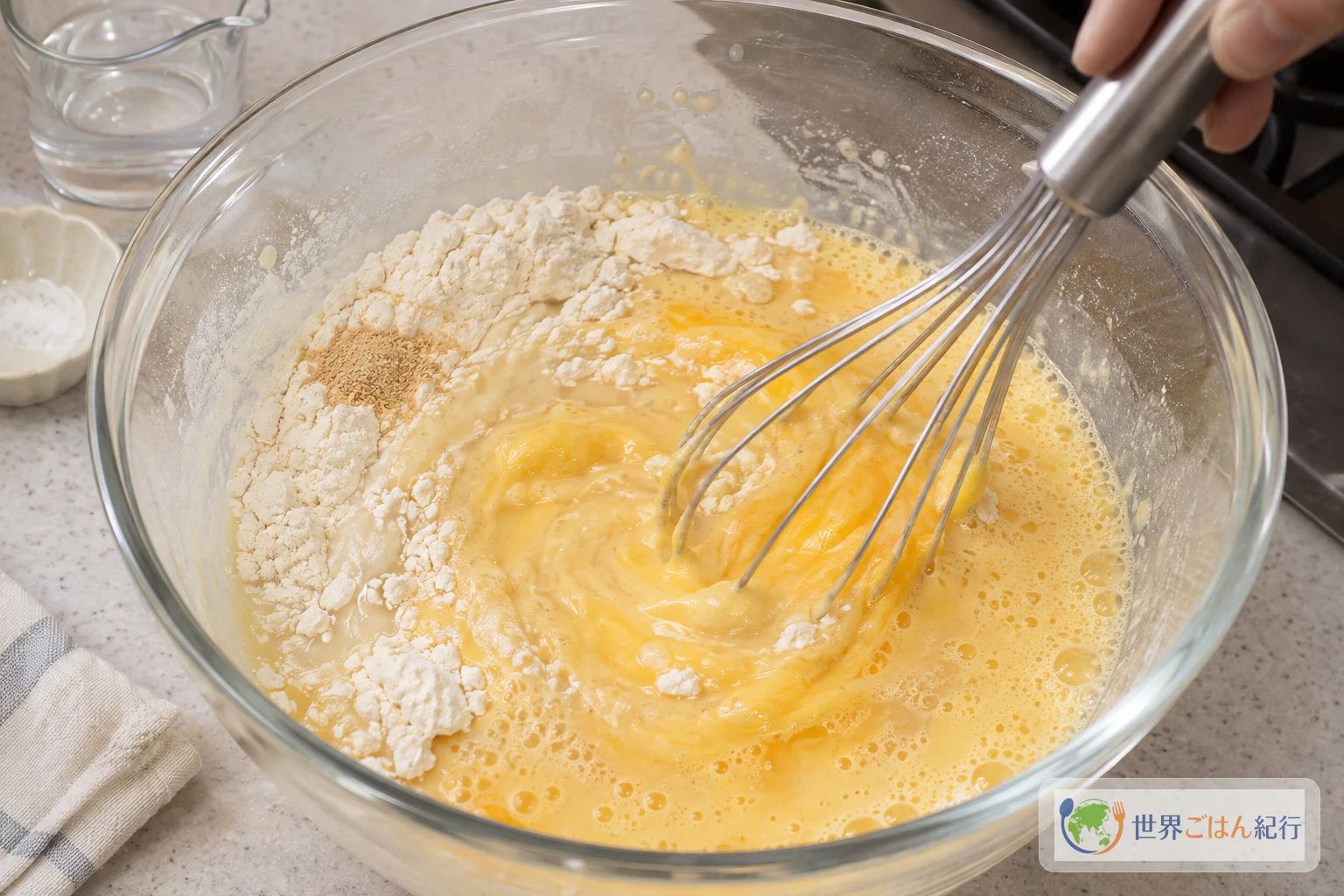
- Eggs: The eggs are listed with the batter ingredients, but mixing them in is not spelled out. We mix the whole eggs with the other batter ingredients.
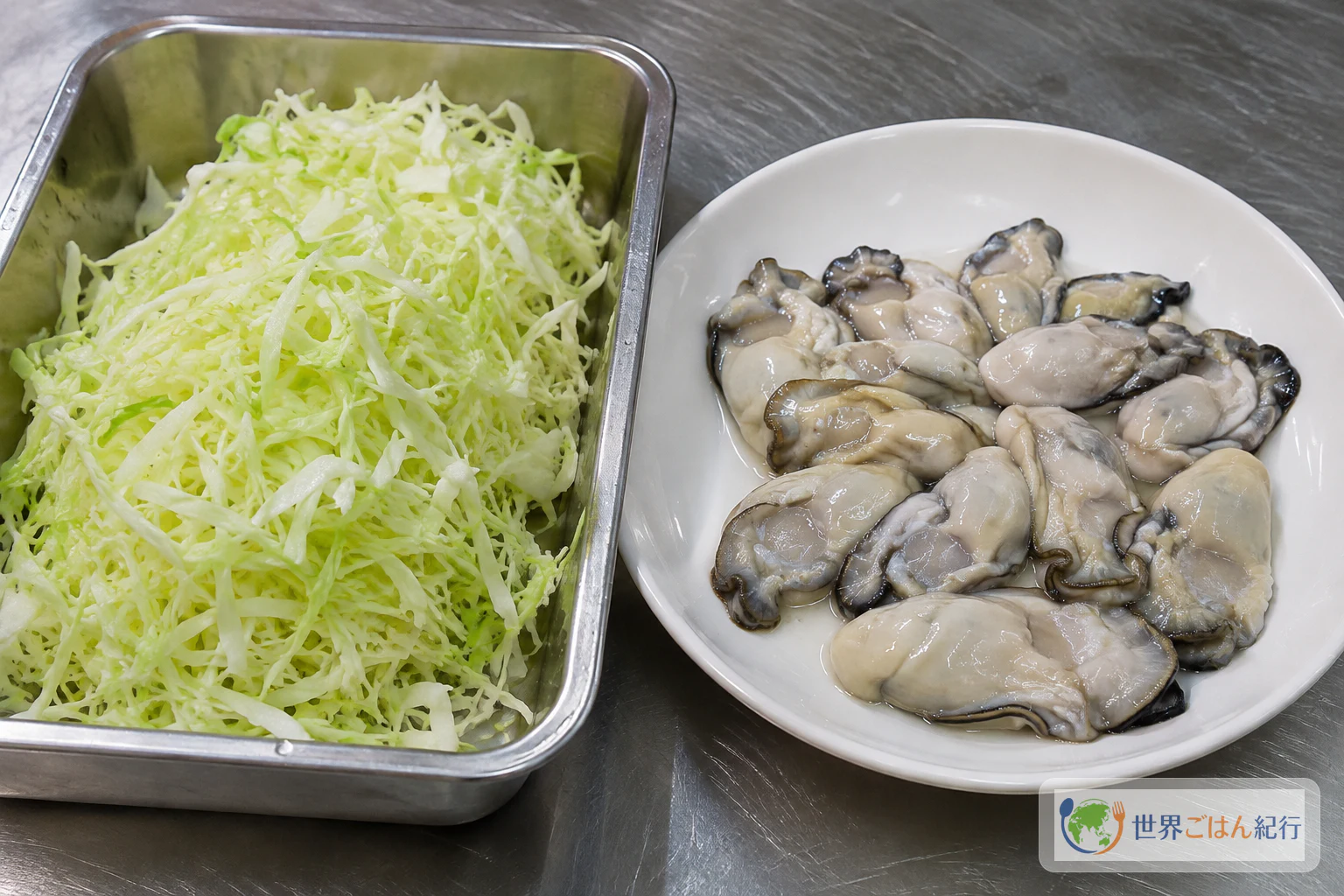
- Cabbage: The cabbage is listed as a filling, so we lay it on the batter instead of mixing it in. This differs from the Okonomiyaki Hori method above, and we have not blended the two.
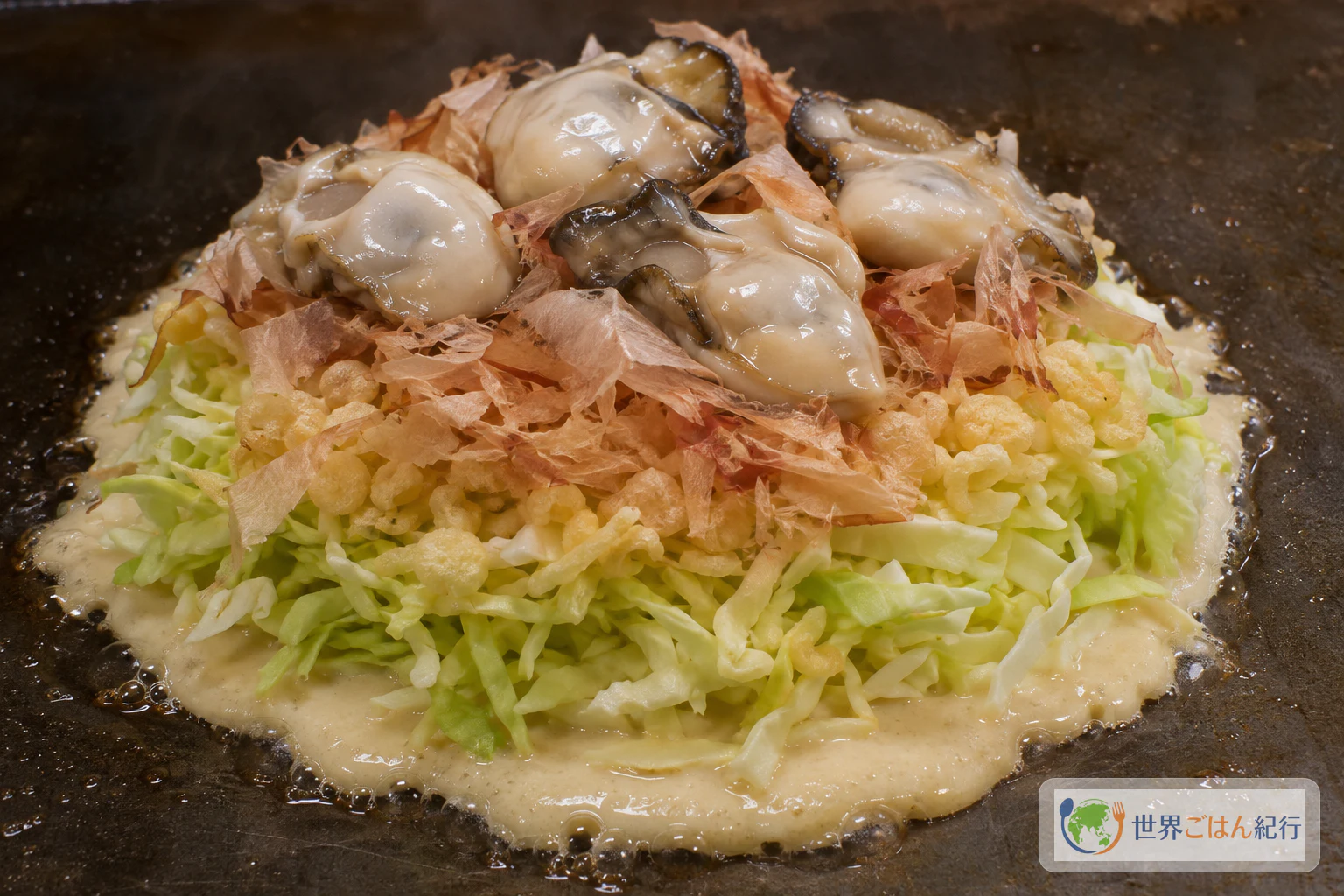
- Filling order: No order is given. We use cabbage, tenkasu, katsuobushi, then oysters.
- Hygiene steps: Rinsing the oysters and the hand and utensil washing are home-kitchen hygiene steps we added. The rinsing method is not the producer's.
- Temperature check: The thermometer step comes from Japanese government food-safety advice, not from the producer's recipe.
The producer's recipe does not give a cooking time, pan size, batter thickness, how to divide the batter, a cabbage weight, an oyster count, or a number of pancakes. We have left these open instead of inventing them.
Ingredients for 2 Servings
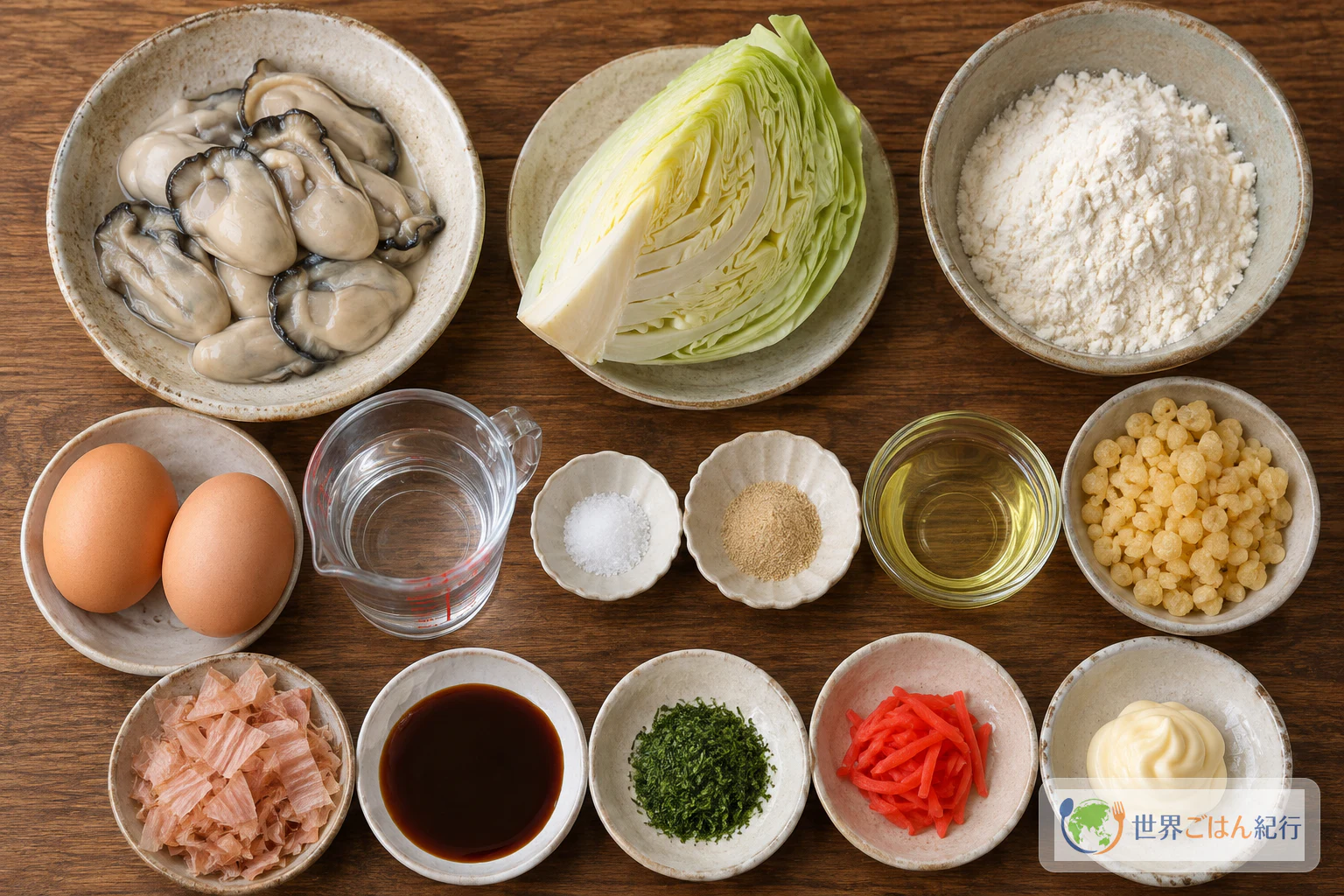
Choosing the Oysters and Toppings
- Oysters: Buy oysters labeled for cooking and keep them refrigerated until you are ready to prepare them. A raw-eating label or a fresh appearance does not replace thorough heating.
- Cabbage: A quarter head varies with the size of the cabbage.
- Toppings: Choose the ones you like. You do not need all of them, and the list is not exhaustive.
- Allergens: This dish contains oysters, egg, wheat and fish. Check the labels on the tenkasu, dashi, sauce and mayonnaise as well.
Equipment
- Frying pan or griddle
- Broad spatula or turner
- Food thermometer
- Mixing bowl and whisk
- Knife and cutting board
- Strainer for draining the oysters
- Separate plates for raw oysters and for the finished pancake
Method: Batter, Filling, More Batter, Both Sides
There is no fixed cooking time here because the heat of your pan and the thickness of your oysters decide how long it takes. Have the thermometer ready before you start cooking.
Heating the Oysters Through: What Counts as Done
Japan's Ministry of Health, Labour and Welfare advises that foods such as bivalves that may be contaminated with norovirus should ideally be heated so that the center reaches 85–90°C for 90 seconds or longer. A brown crust, the pan temperature, a recipe's cooking time or a raw-eating label cannot stand in for this.
The producer's phrase about browning both sides is a cooking guide, not a safety check. This article's text and images cannot guarantee that your oysters have been heated adequately, including the image of the thermometer. Measuring the thickest oyster is the check to use, because the time needed changes with your heat and the thickness of the oysters.
The ministry's Q&A also addresses cross-contamination. Use dedicated tools, such as a cutting board and knife, for bivalves, or wash and disinfect tools after each use. It notes that disinfecting utensils with hot water is effective at 85°C or above for 1 minute or longer. Alongside that advice, we suggest rinsing raw vegetables well under running water. Wash your hands, tools and plates after they touch raw oysters and before they touch cooked food or toppings.
Troubleshooting
| Problem | What to do |
|---|---|
| The crust is brown, but the oyster center is below 85°C | Keep cooking and measure again. Color does not settle the question |
| The oysters vary in size | Measure the thickest one |
| You have no thermometer | Get one before making this recipe if you can. We cannot offer a time that replaces the temperature check |
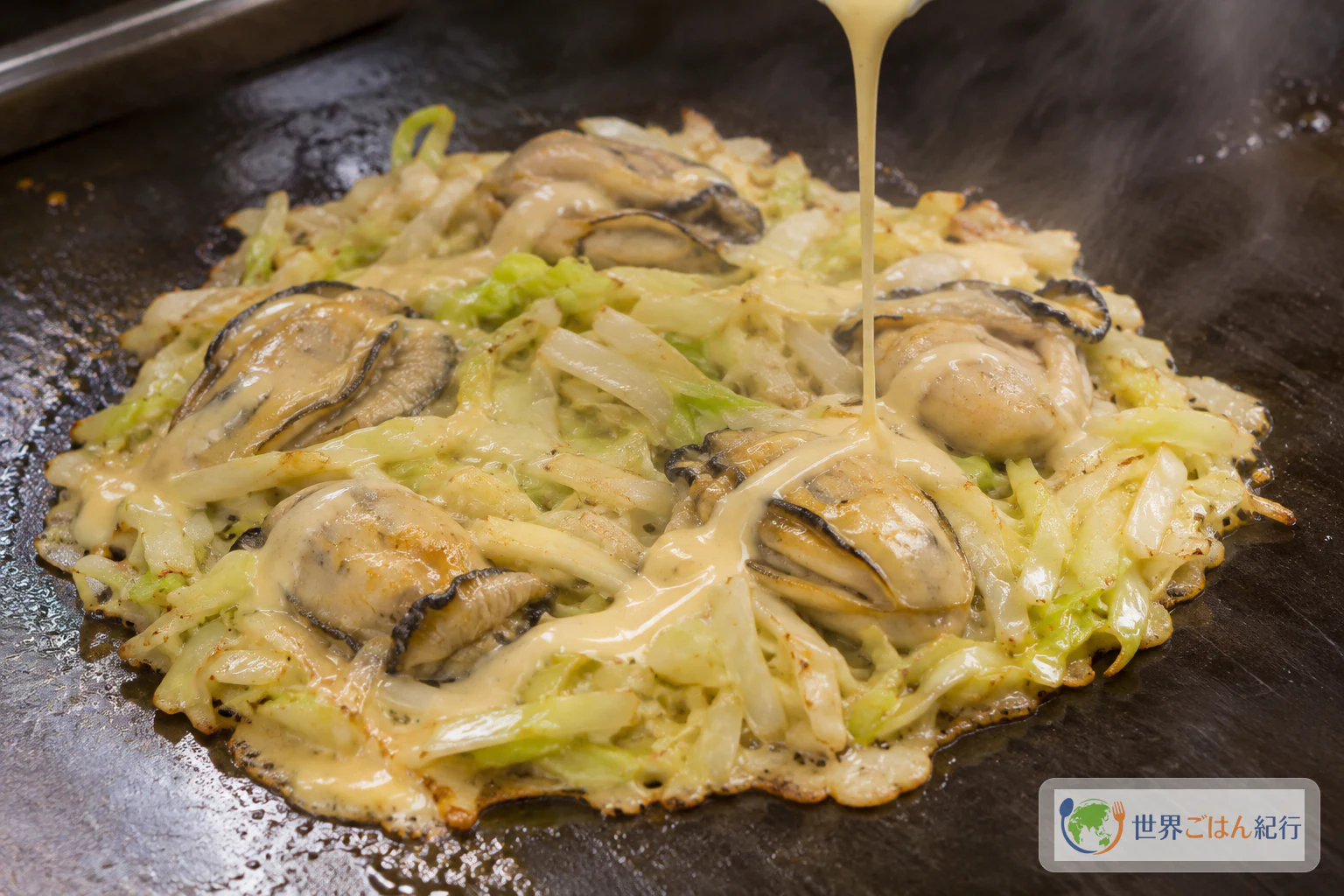
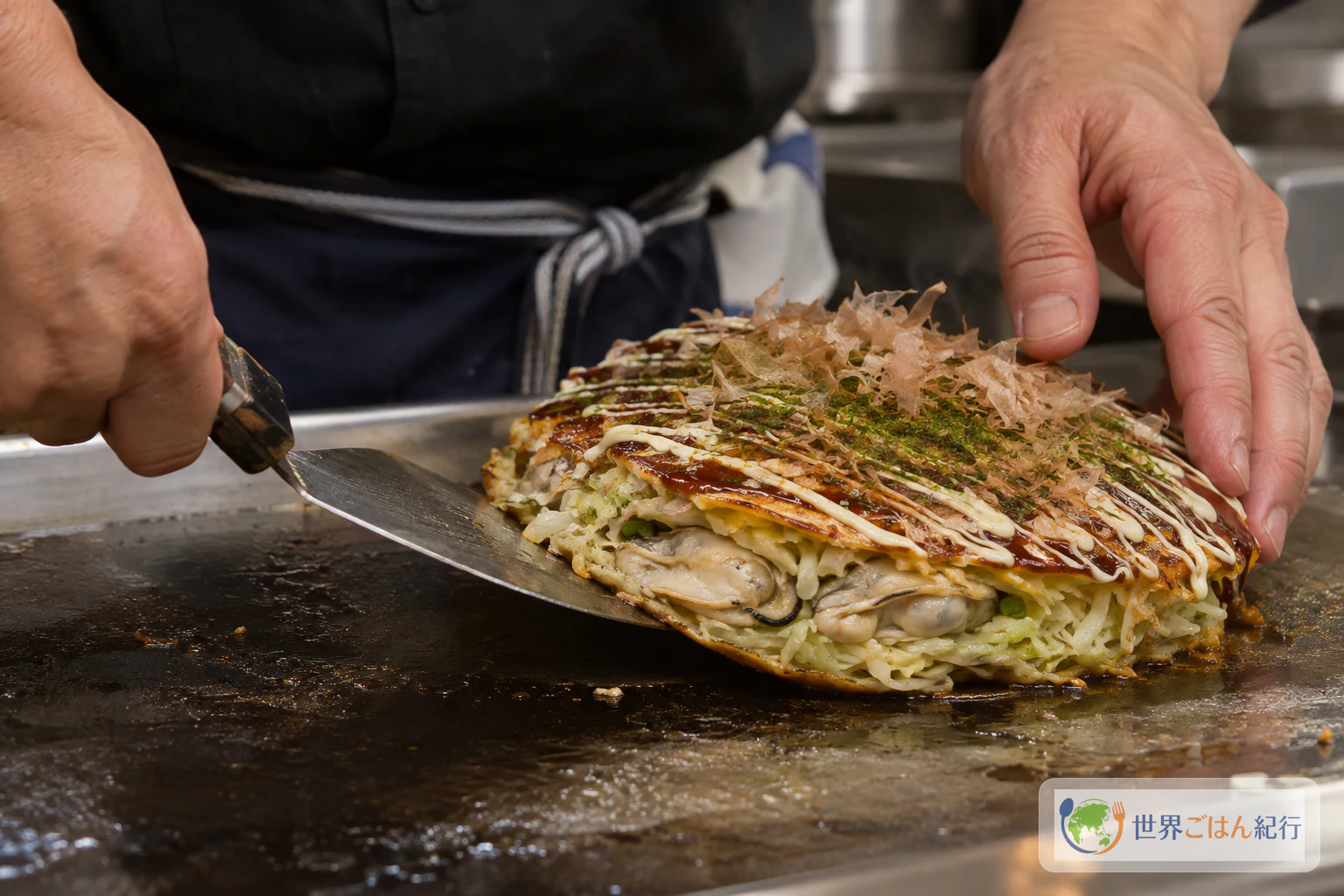
| The filling looks loose before turning | Pour a little more of the remaining batter over the gaps, then turn with a broad spatula |
| The oysters are dripping when you lay them on | Drain them again and remove the excess water |
| A plate or spatula touched raw oysters and you need it for the finished pancake | Wash it first, or use a clean one |
Variations That Keep the Dish Intact
| What changes | Options | What stays the same |
|---|---|---|
| Cooking surface | Frying pan or griddle | Check the center of the thickest oyster |
| Toppings | Sauce, aonori, beni shoga, mayonnaise or similar, in any combination | The pancake underneath is unchanged, and toppings do nothing for safety |
| Cabbage placement | Mixing it into the batter is a different approach, like the shop method described at the top of this article | The same oyster heating advice applies. This recipe's steps and amounts were not written for that method, so treat it as a separate dish |
Hinase, Oysters and a Griddle Tradition
Japan's Agency for Cultural Affairs includes Hinase kakioko in its 100-Year Food database, which records Hinase as the main area where the dish has been handed down. By tradition, it is said to date from around the Showa 40s, the decade beginning in 1965. Treat that as an inherited account rather than a precise founding date.
The database names Hinase's local oysters, shredded cabbage and sauce made in Okayama as features of the dish. It describes a loose batter topped with a generous heap of cabbage and oysters and cooked on a griddle, and it lists Hinase's griddle spatula, the kote or teko, as a tool. It also mentions a local group, the Hinase Kakioko Machizukuri no Kai (日生カキオコまちづくりの会), in connection with preserving and passing on the dish.
Okayama's tourism feature presents freshly landed Hinase oysters as the star of the dish and also mentions a sauce made specially for Hinase kakioko. That sauce is part of the local story, but it is not required for this home recipe, which simply offers okonomiyaki sauce as an optional topping.
Frequently Asked Questions
Is this the official Hinase kakioko recipe?
No. It is a home recipe from one Hinase oyster producer's site, with the editorial choices listed near the top of this article. Hinase shops can have their own methods, as the Okonomiyaki Hori example shows.
Why isn't the cabbage mixed into the batter?
The producer's recipe lists cabbage as a filling and describes adding the filling after the batter is spread, so we lay it on separately. Okonomiyaki Hori mixes shredded cabbage into its batter, but that is the shop's own method. Neither is presented here as the standard for all of Hinase.
How long should I cook it?
The producer's recipe gives no time, and we have not added one. Cook both sides until browned, then use a thermometer to apply the ministry's advice of 85–90°C at the center for 90 seconds or longer.
Can I use oysters labeled for raw eating?
The producer's recipe specifies oysters for cooking. If yours are labeled for raw eating, the label does not change the heating advice, so cook them to the same center temperature and time.
Does 2 servings mean two pancakes?
The producer's recipe does not say. It gives amounts for two servings without stating a number of pancakes, a pan size or how to divide the batter.
Do I need all the toppings?
No. Sauce, aonori, beni shoga and mayonnaise are options listed by the producer's recipe, with no required amounts.
Sources
- Hinase Kaki (日生牡蠣, oyster producer site), "Kakioko" home recipe. Used for the two-serving ingredients and amounts, the three-stage method, optional toppings, and the instruction to use oysters for cooking and cook them through to the center. https://hinase-kaki.com/2026/10/01/kakioko/
- Okayama Kanko Web (Okayama Prefecture Tourism Federation), "日生で水揚げされる新鮮カキが主役の名物お好み焼き『日生カキオコ』." Used for regional background, the origin period as told, the Okonomiyaki Hori method and its owner's description, and the specially made sauce. https://www.okayama-kanko.jp/feature/made_in_okayama/26
- Agency for Cultural Affairs, Japan, "100-Year Food Database: Hinase Kakioko" (PDF). Used for the traditional origin period and area, characteristic ingredients, the griddle spatula, and the local preservation group. https://www.bunka.go.jp/seisaku/shokubunka/foodculture/assets/pdf/hyakunenfood/jirei/pdf_1249.pdf
- Ministry of Health, Labour and Welfare, Japan, "Norovirus Q&A" (Q15 and Q17). Used for the heating advice for bivalves at risk of norovirus, and for preventing cross-contamination through dedicated tools or washing and disinfecting after each use. https://www.mhlw.go.jp/stf/seisakunitsuite/bunya/kenkou_iryou/shokuhin/syokuchu/kanren/yobou/040204-1.html