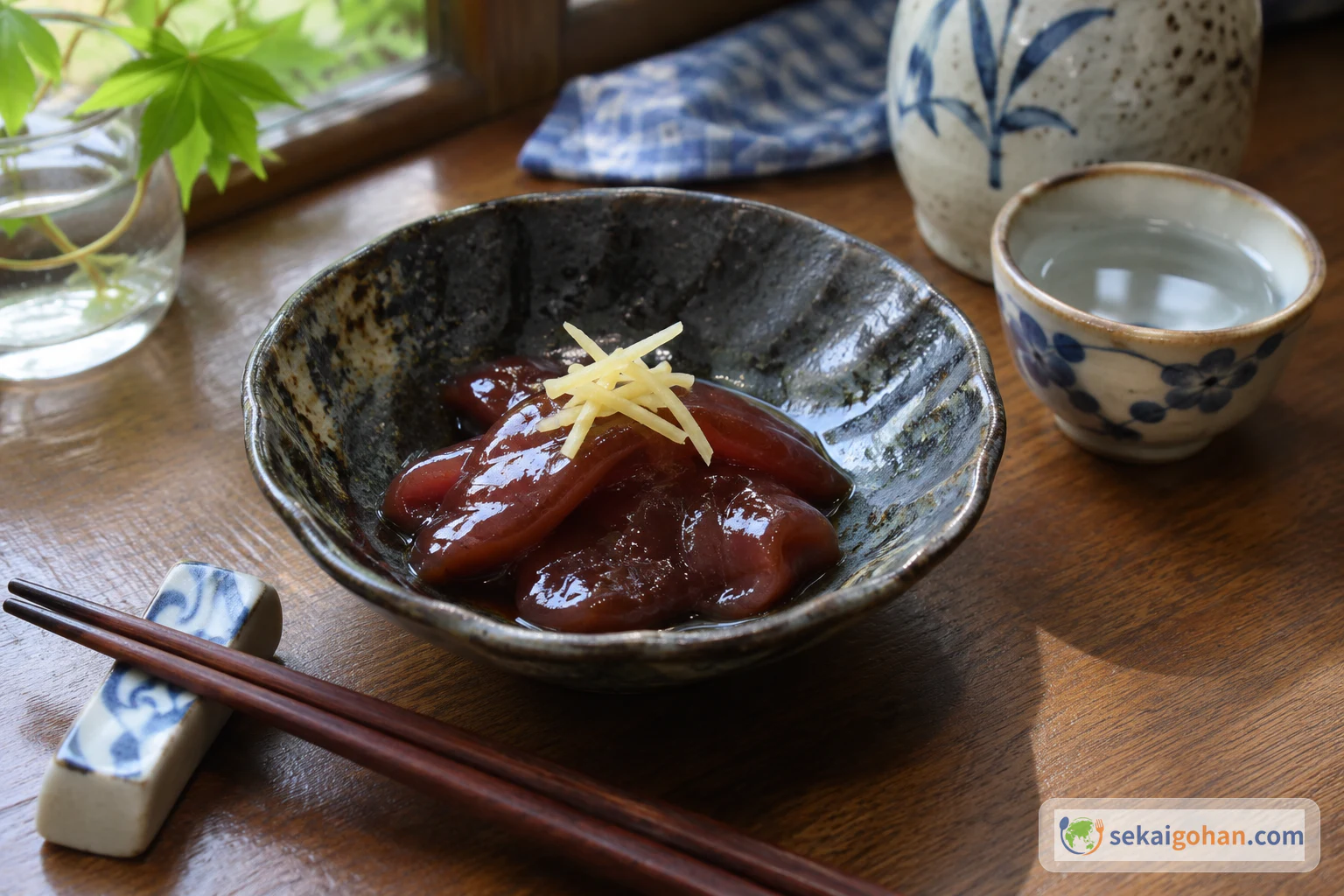
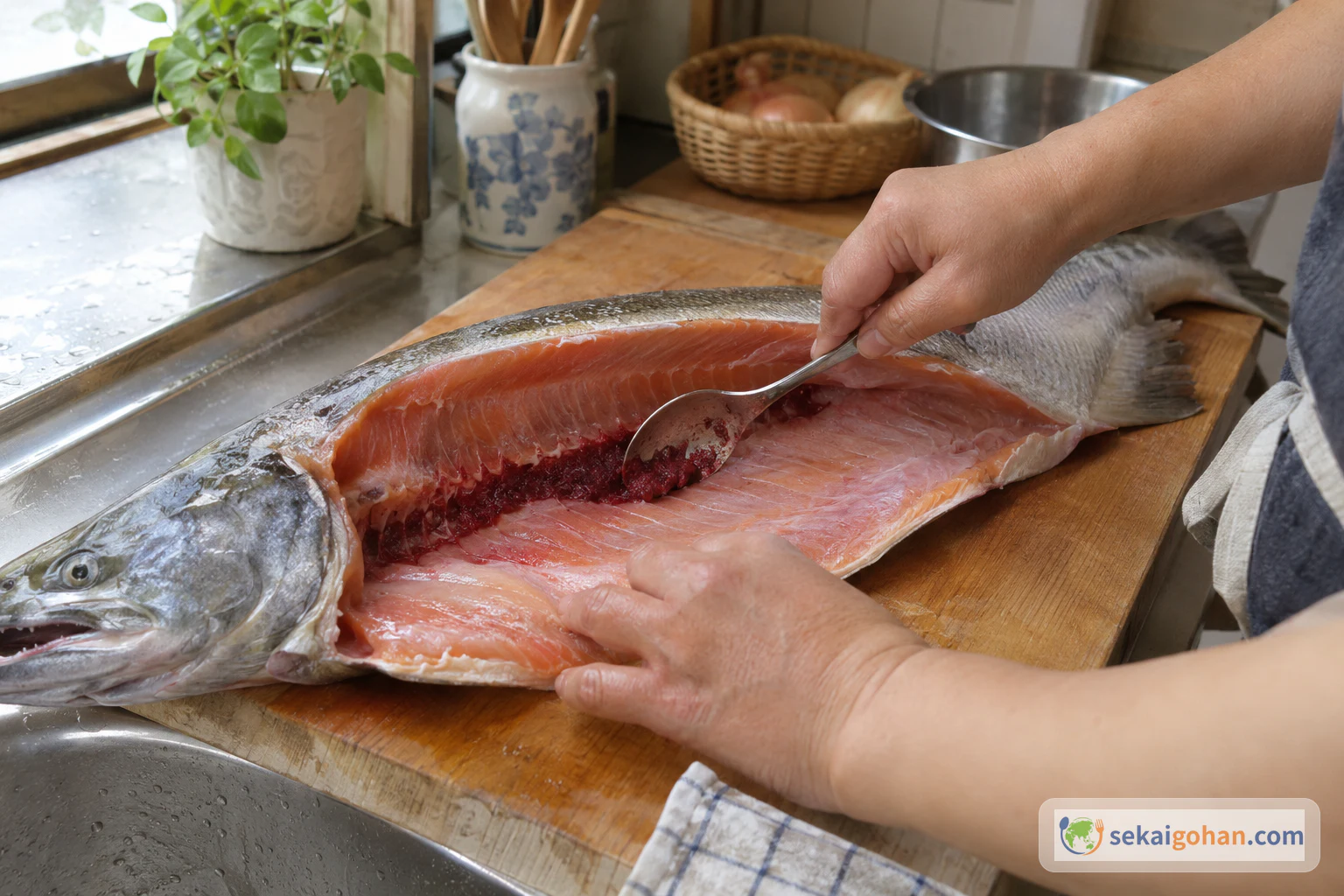
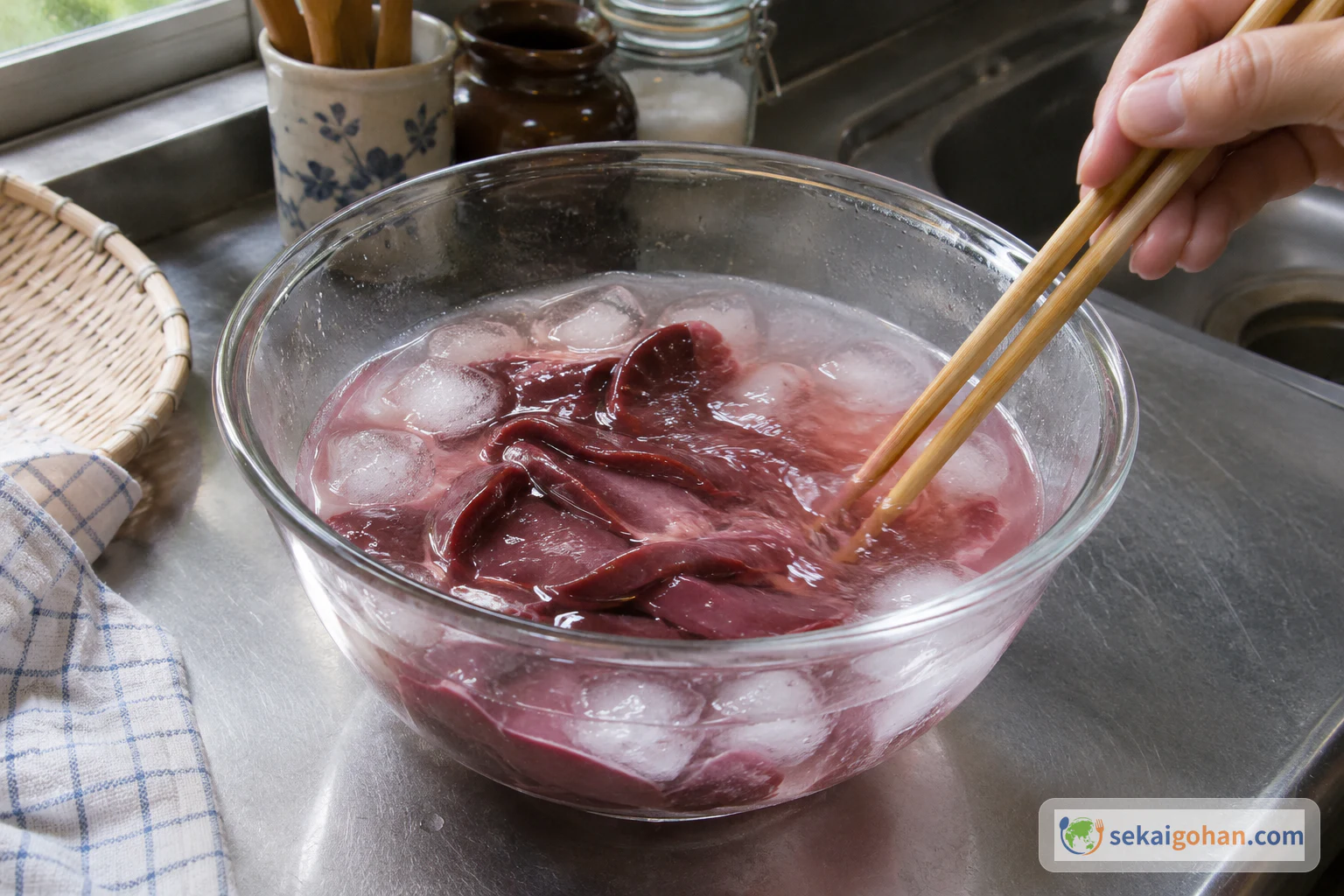
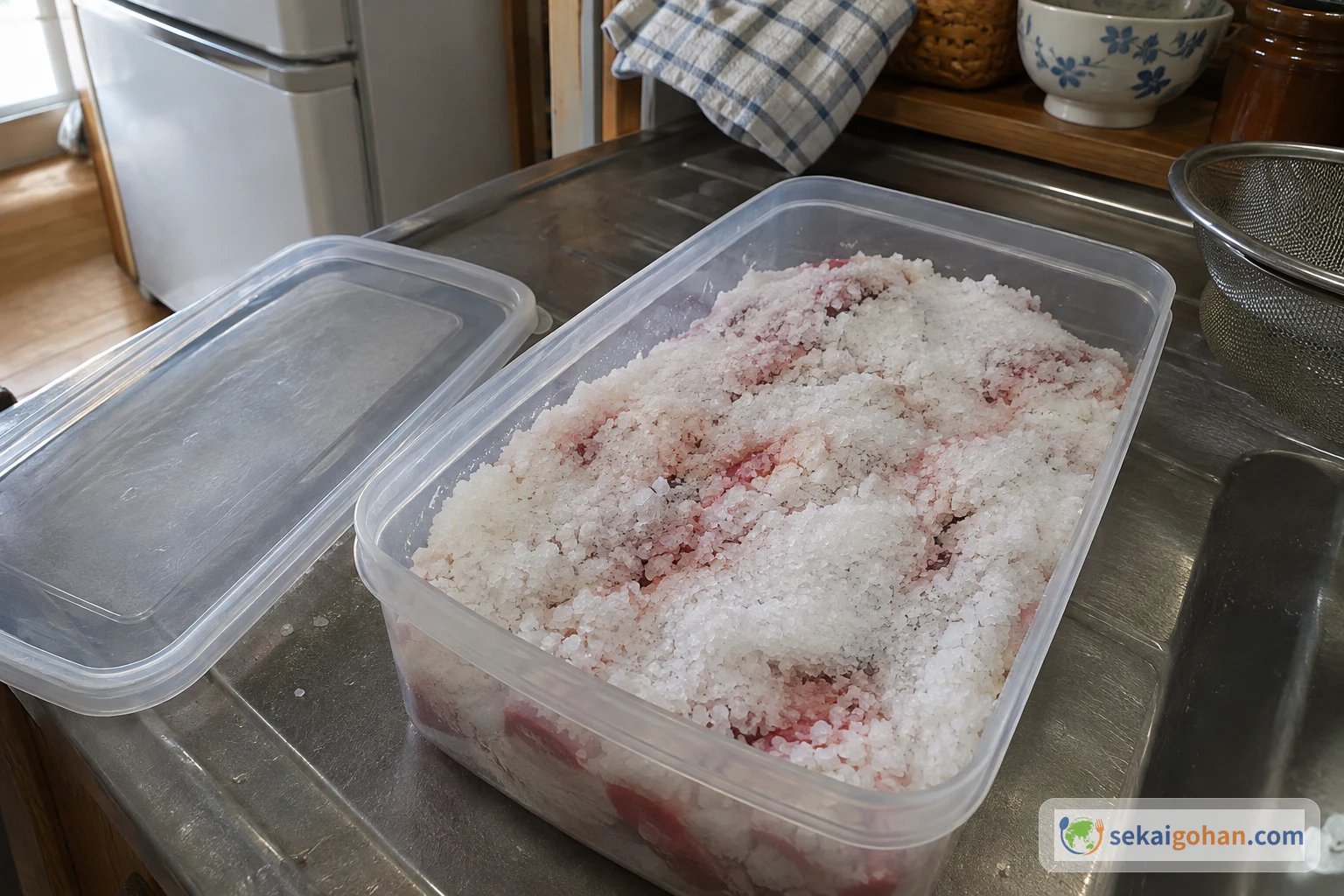
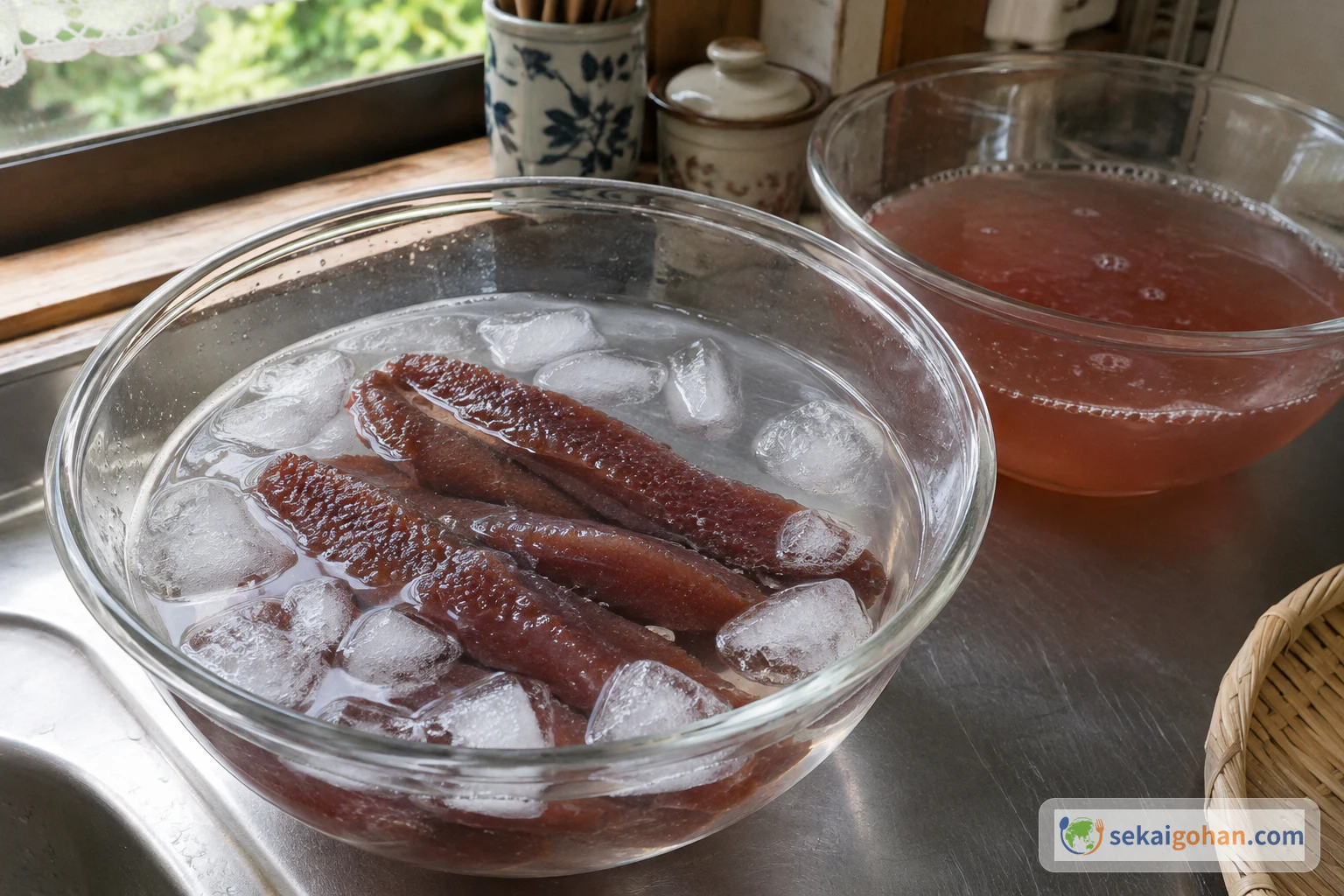
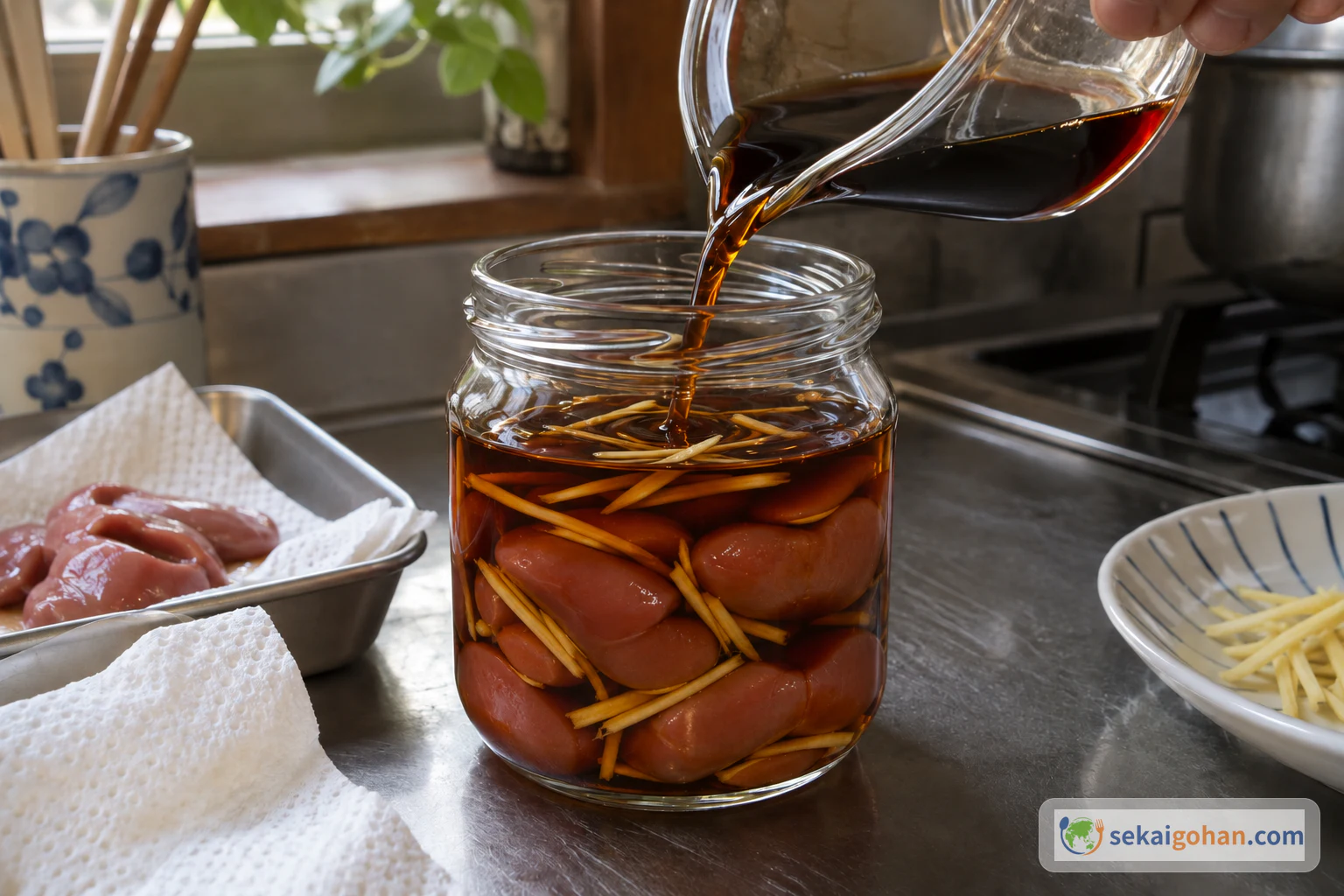
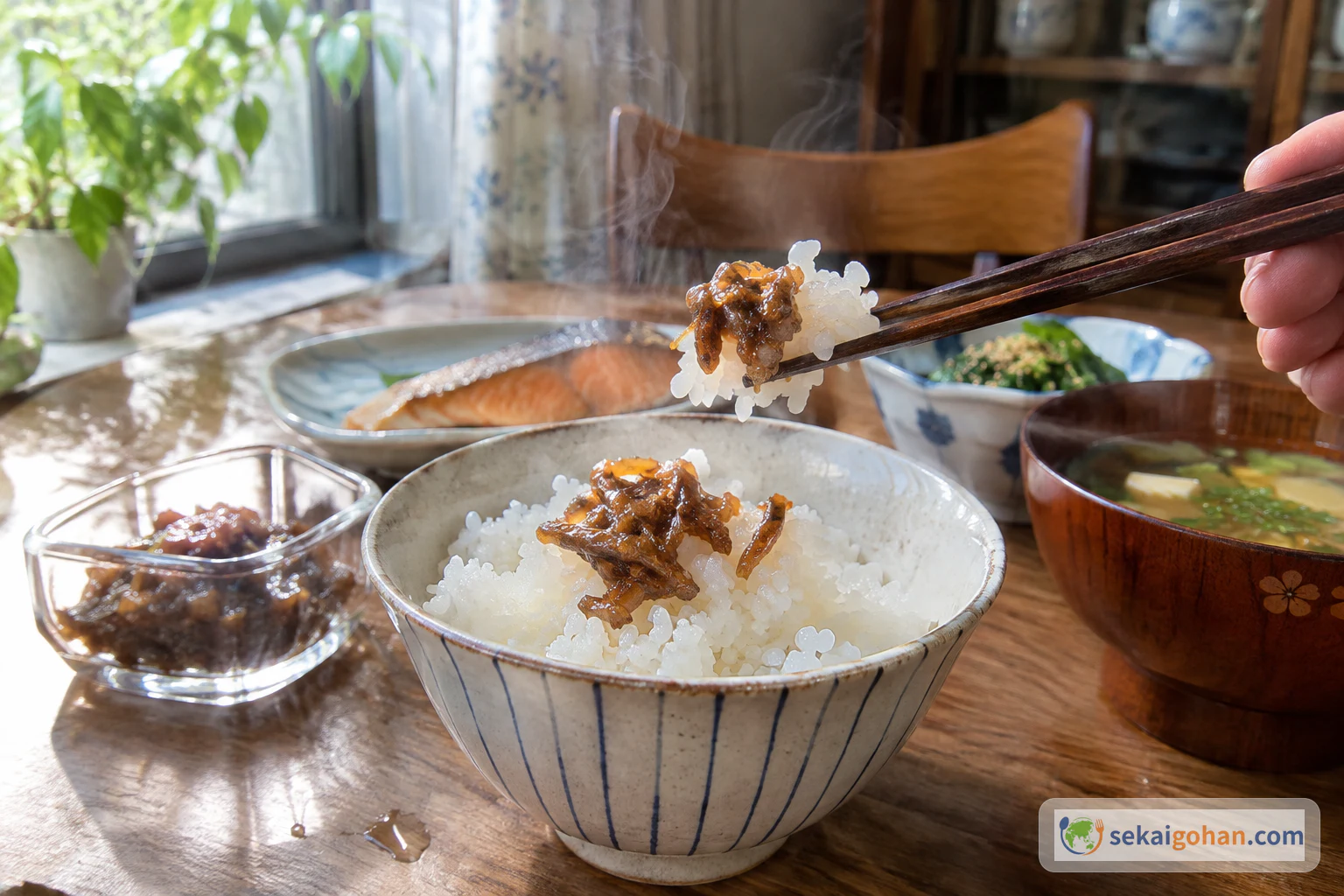
Open a whole salmon, lift out the guts, and you find a long dark-red line pressed against the inside of the backbone. Run a spoon along it and it comes away soft and deep red. That strip is the kidney, and in Hokkaido it becomes mefun: salted until it firms, rinsed in ice water, then steeped for a few days in soy sauce with shredded ginger. Each fish gives you only this one thin strip, so it arrives at the table in a small dish, a few glossy pieces at a time.
To eat it, you chop it finely with the tips of your chopsticks and put a little on hot rice, or eat it with a cup of sake or shochu. The flavour is salty and dark, with the ginger cutting through the richness of the blood. A few grains of rice per bite are enough to carry it.
A strip from the backbone of an autumn salmon
Mefun is a shiokara made from salmon kidney. It has the same salt-cured idea as the better-known squid shiokara, but it starts from a part of the salmon that is easy to overlook. The kidney has its own names in Japanese. It is called sewata (背腸, "back gut") because it runs along the spine, and chiwata (血腸, "blood gut") because it is full of blood. It is also called minawata. In the rest of Japan, mefun is known as a specialty of Hokkaido, where autumn salmon come into the rivers and fishing towns pack the cured kidney into jars.
Where the name comes from is not settled. It is often said to come from an Ainu word, mefunu or mefun, for kidney, but Japanese dictionaries say the origin is unclear and only that it may be Ainu. The kidney of a male chum salmon is the prize, taken from along the central bone of the fish.
Mefun is sometimes written 女奮 in kanji.
Two kinds of mefun: the long cure and the quick soy steep
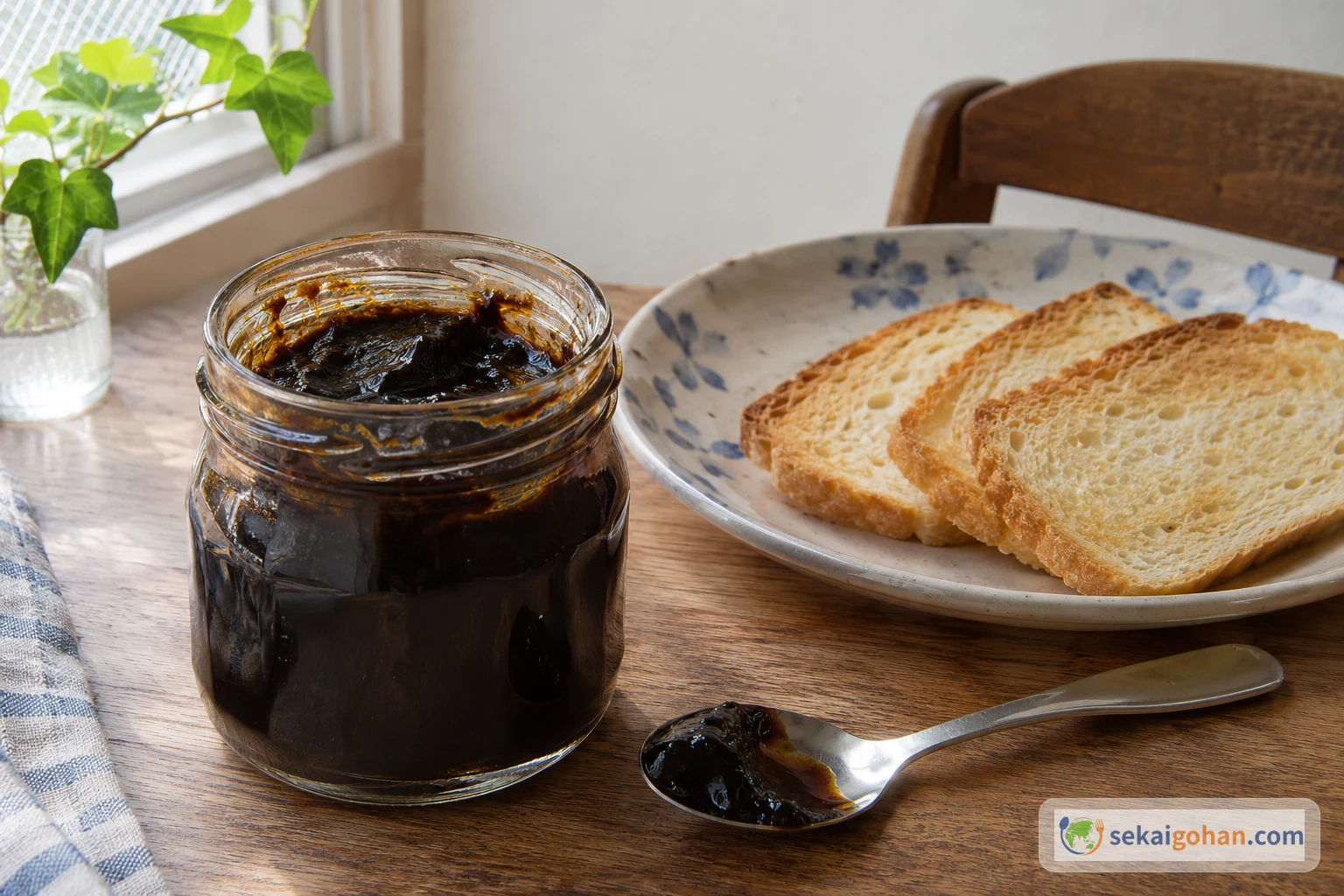
The mefun sold in jars comes from a slow process. Producers wash the kidneys and salt them heavily, at 30 to 35 percent salt, for a day. Then they wash them again, salt them to about 12 percent, air-dry them, pack them into containers to mature, and use sake for flavour. The cured kidney is ready at around six months. In the jar it keeps maturing, and after about a year it turns thick and slightly syrupy. A spoonful of that very dark, almost black paste is a different thing from the homemade kind.
The mefun that home cooks and Hokkaido anglers make is quick. They salt the kidney overnight, take the salt out with ice water, and steep it in ginger soy for two or three days. This is the version to make at home. The six-month cure needs producers' salt levels and their control over air-drying, so if you want that thick, aged flavour, buy a jar. You can read about other regional dishes on our Japan page.
Ingredients
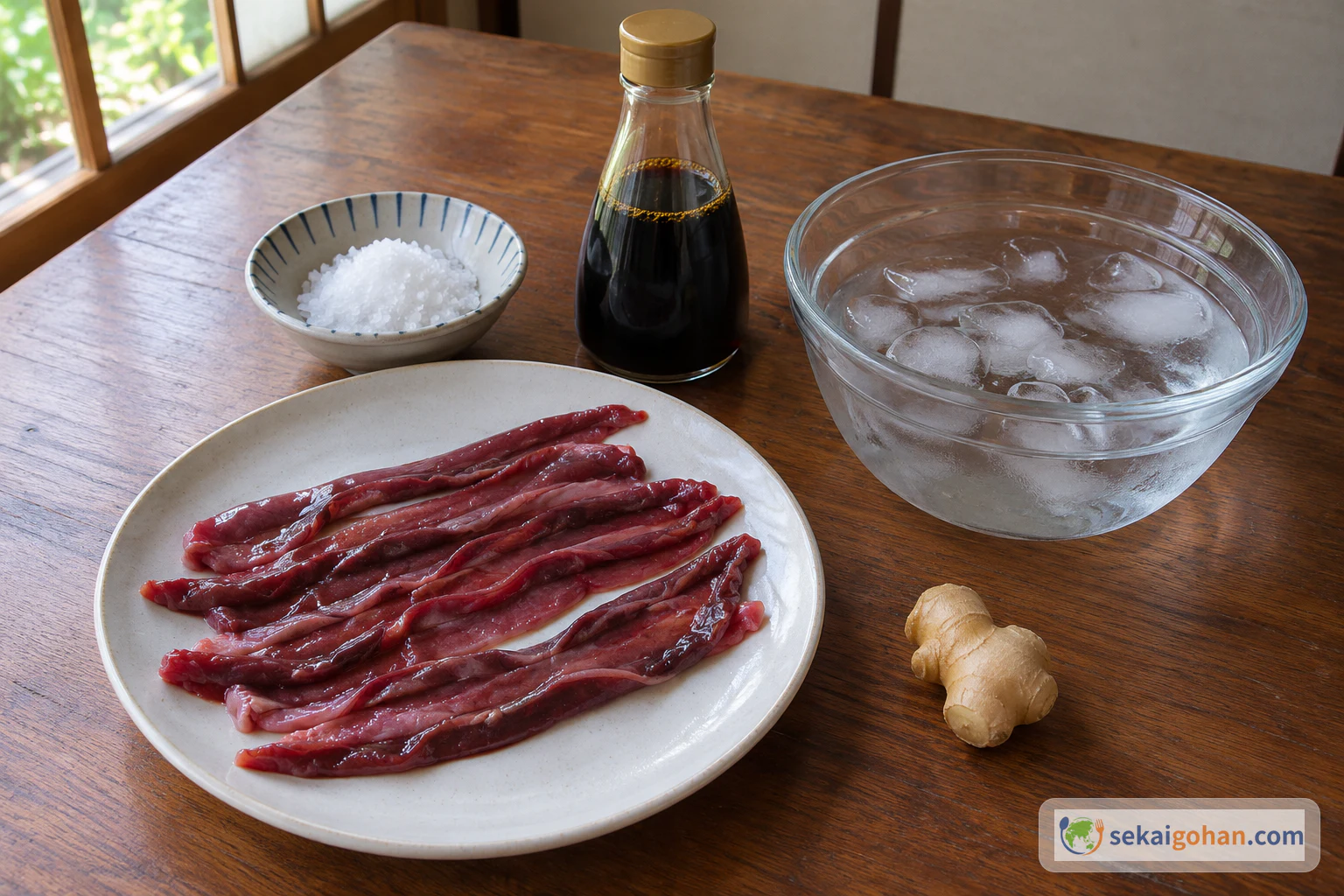
Everything is measured against the fish. One salmon gives one kidney strip, and the ginger and soy scale with however many strips you have.
This dish contains salmon. Soy sauce contains soy and usually wheat. If you dilute it with mentsuyu, check that label too.
Equipment
- Cutting board and a knife or metal spoon for scraping out the kidney
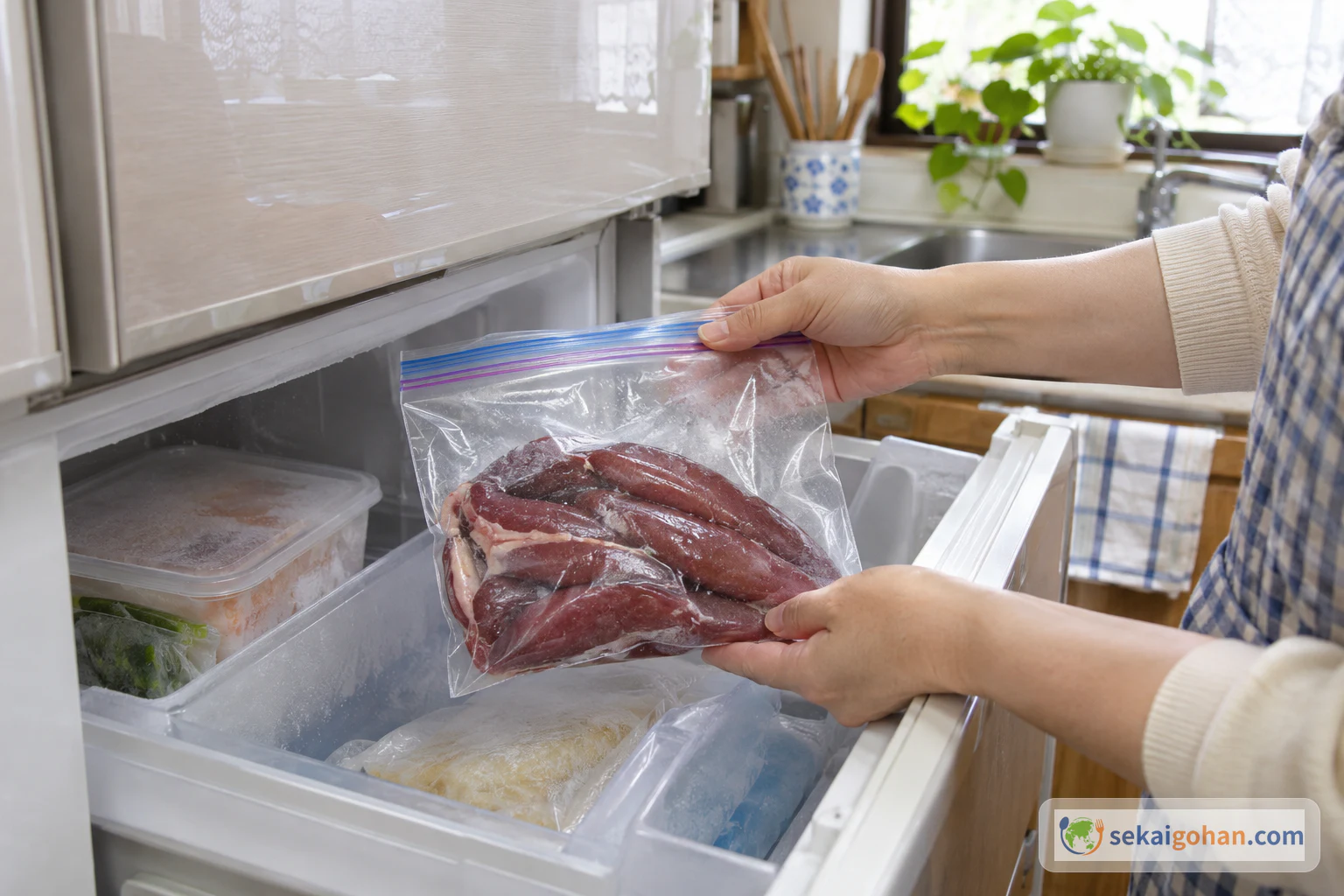
- Flat zip-top freezer bag
- A freezer that holds -4°F (-20°C) or colder
- Glass or stainless bowls for ice water
- Lidded food container for salting
- Small clean glass jar or lidded storage container for the soy
- Paper towels
- Chopsticks
Buying the fish, or buying a jar
You cannot make mefun from fillets or salted salmon. You need a fresh whole salmon with its guts still in, so look for autumn salmon at a fishmonger, a Japanese grocer, or a seafood shop selling whole fish. Ask for fish sold for eating raw, or buy from a fishmonger you trust, and keep it cold on the way home. Chum salmon is the fish to look for. Masu works the same way.
If you can't get a whole fish, a jar of mefun is the easy way in. Japanese grocers and online shops sell it as a Hokkaido specialty. The aged kind is darker and thicker than homemade, and a little goes a long way.
The salt and soy can change a little. Any coarse salt works. If your soy sauce is very strong, dilute it with mentsuyu, which makes the steep milder and slightly sweet. What must stay is the order: freeze first, salt hard, rinse, then steep in ginger soy. That order is what separates mefun from salmon that has just been soaked in soy.
Method
Most of the time here is spent waiting. You freeze for a day, salt overnight, soak in rounds of ice water for a few hours, then steep for two or three days in the refrigerator. Clear space for a bowl and a jar before you start, and keep the kidney cold the whole way through.
When it goes wrong
| What you see | Why | What to do |
|---|---|---|
| A bloody smell in the jar | The kidney was cut before steeping | Keep strips whole until serving, and chop only what you eat |
| The salt slides when you turn the box over | Too little salt or too little time | Press more salt over the top and leave it in the refrigerator until it holds, up to a full day |
| Too salty after steeping | The ice-water soaks were short | Next time, soak longer in each round of ice water |
| The soy tastes harsh | The soy sauce is very strong | Dilute it with mentsuyu for a rounder steep |
| A sour or off smell, mould, or an unexpected colour | Something has spoiled | Throw the batch away and start again with clean containers |
Serving and variations
At the table
Mefun is food for drinking and food for rice. It goes in a small dish beside sake or shochu, a few chopped pieces at a time, or on a bowl of hot white rice. It also works as a rice-ball filling and a salty accent in dressed dishes (aemono). It is also used in a pasta sauce. Jarred aged mefun can be served in small amounts on thin melba toast with a glass of Western spirits.
Variations
- Sake and chili steep. Another Hokkaido version soaks the kidney in salted ice water, salts it heavily for half a day, then desalts it for about an hour in sake and water mixed 1:1. The steep is soy, sake, julienned ginger and dried red chili (takanotsume), for 2 to 3 days. The sake softens the salt, and the chili leaves a slow heat at the end. Freeze the kidney first, as in step 2, whichever steep you use.
- Mentsuyu steep. Diluting the soy with mentsuyu gives a gentler, slightly sweet mefun.
- Rice balls. Chopped mefun goes in the centre of an onigiri. The rice absorbs the soy around it.
Storage
Keep homemade mefun covered in the refrigerator, always under its soy, and finish it within one week. For jarred mefun, follow the label. Some are stored frozen, and others are kept refrigerated for a stated period, such as 30 days.
Frequently asked questions
Can I make mefun from salmon fillets or salted salmon?
No. Mefun comes from the kidney along the backbone of a fresh whole salmon with its guts still in, so fillets and salted salmon are not the way to make it. Buy a whole fish, or a jar of mefun.
Which salmon gives the best mefun?
Chum salmon is the classic fish, and the kidney of a male chum salmon is the most prized. Masu works too. Freshness matters most, so gut the fish the day you buy it.
Can I leave homemade mefun to age into the thick jarred kind?
No. Finish homemade mefun within a week. The thick, dark kind comes from producers who salt to set levels, air-dry the kidney and mature it for months, and for that flavour you buy a jar.