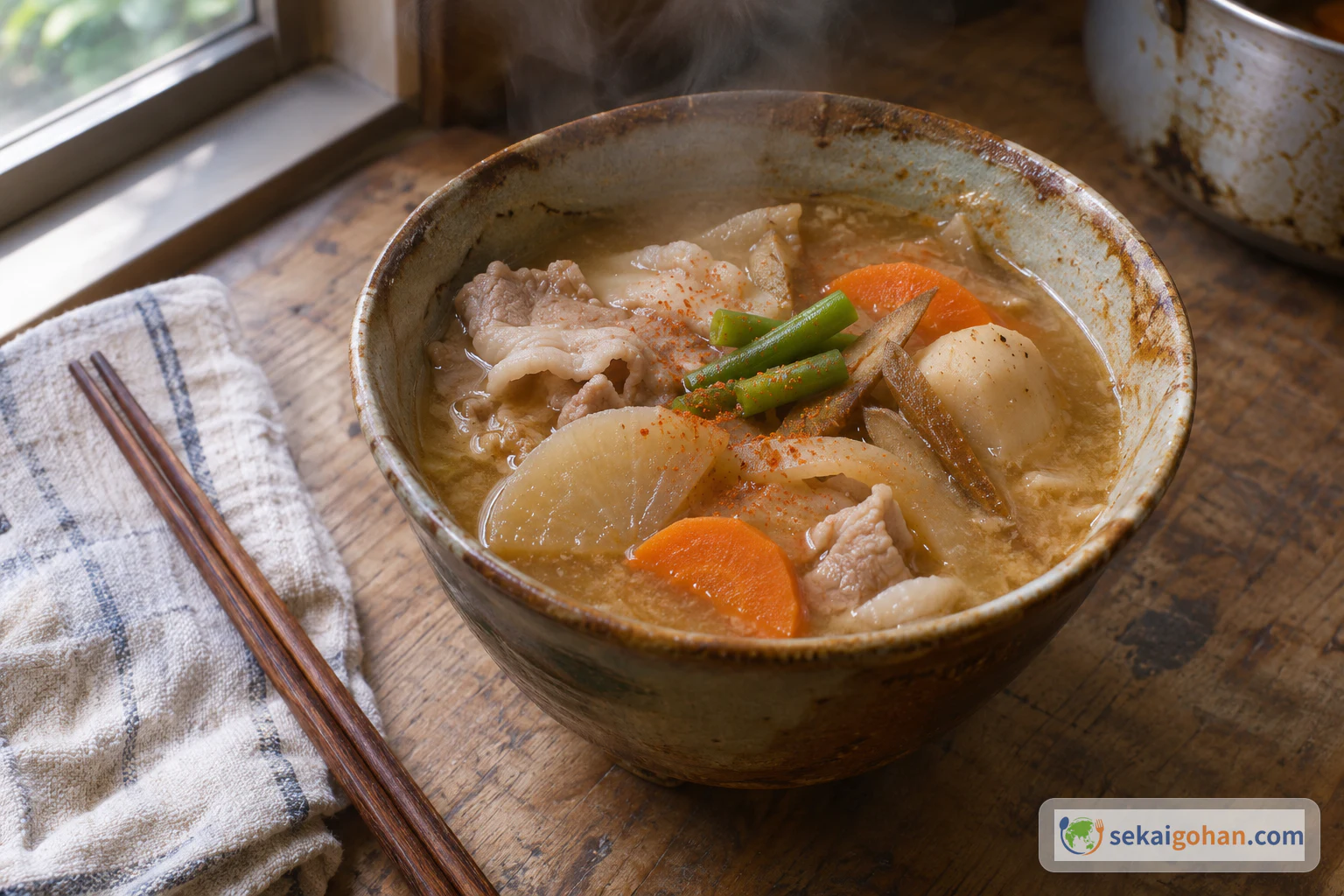
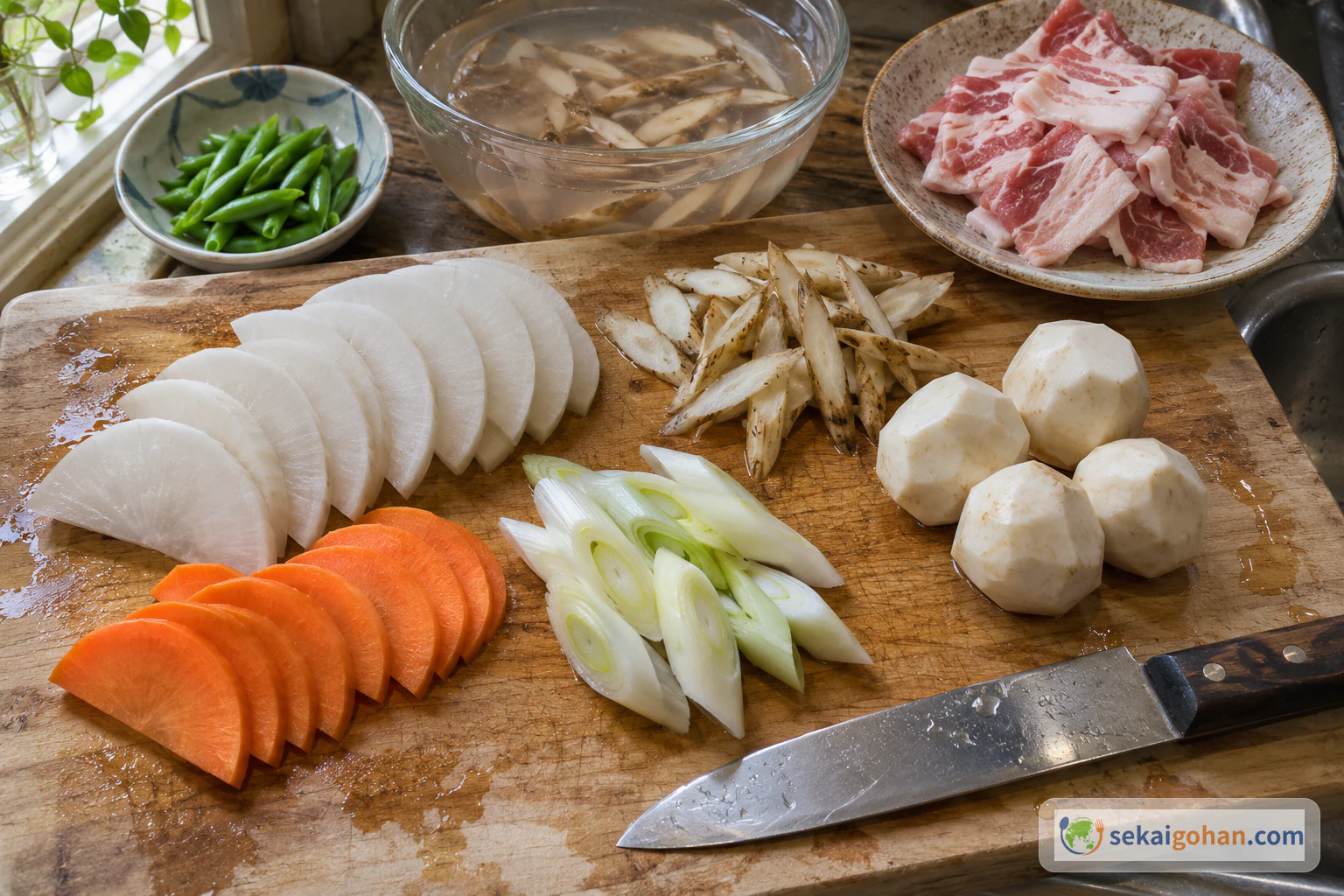
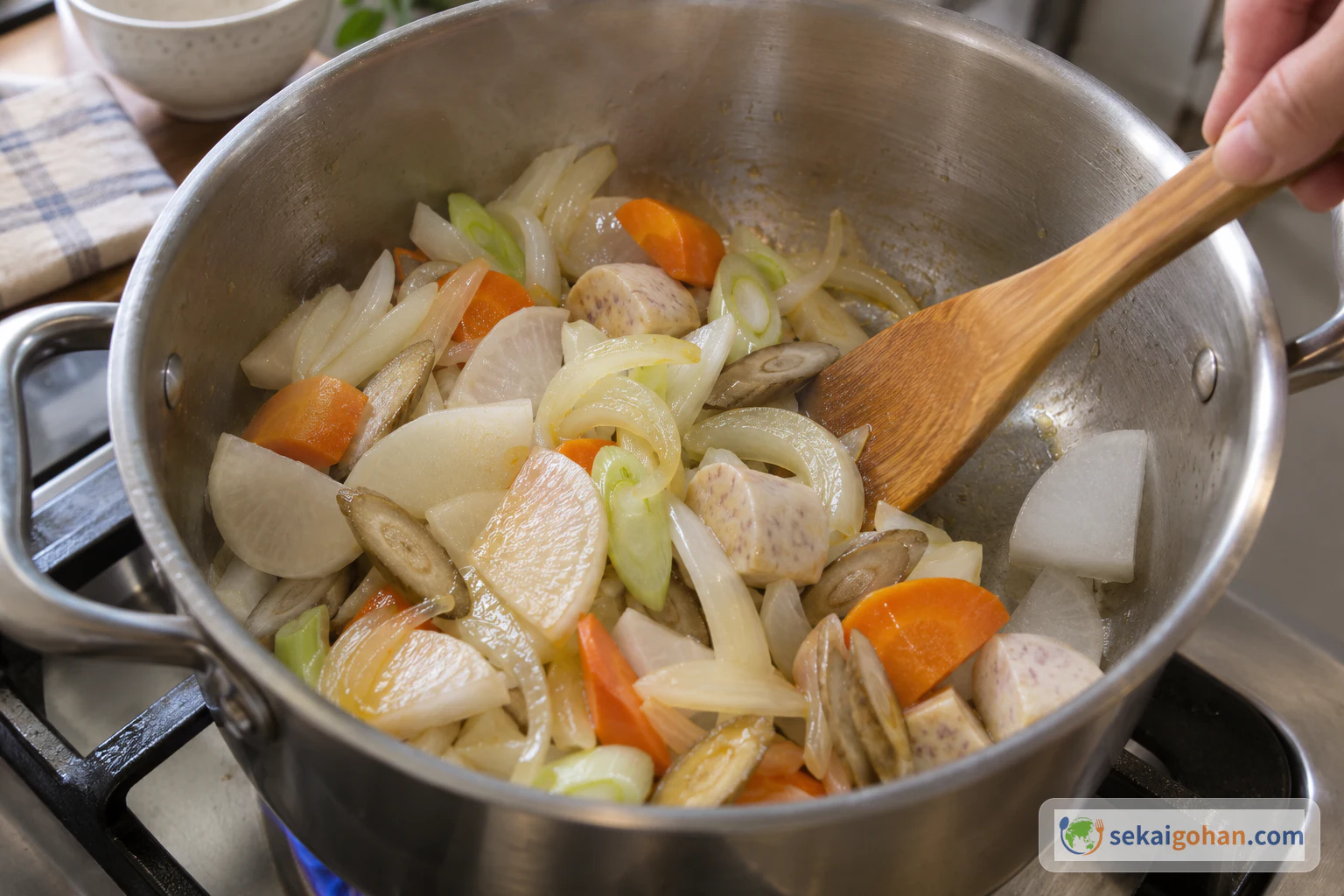
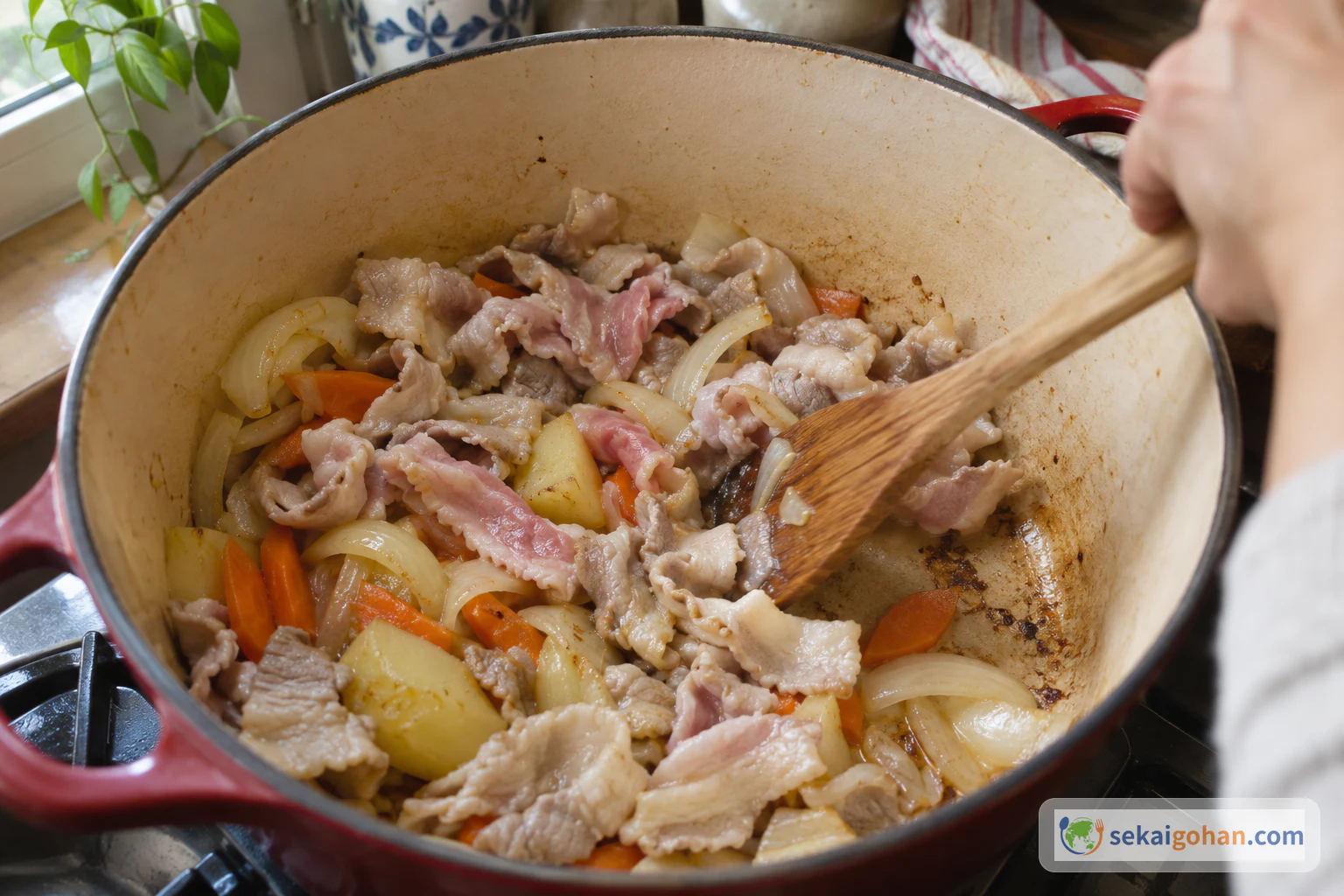
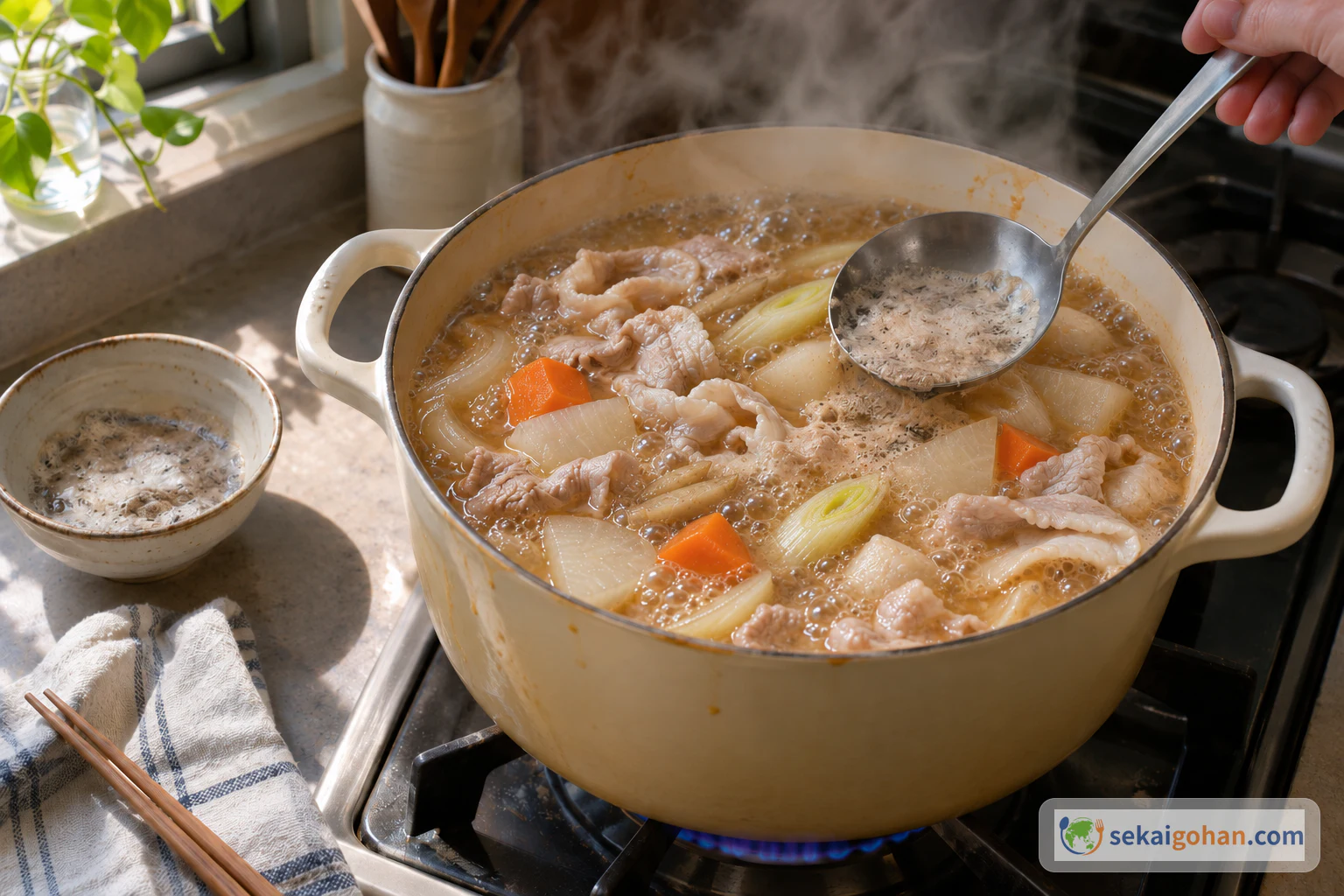
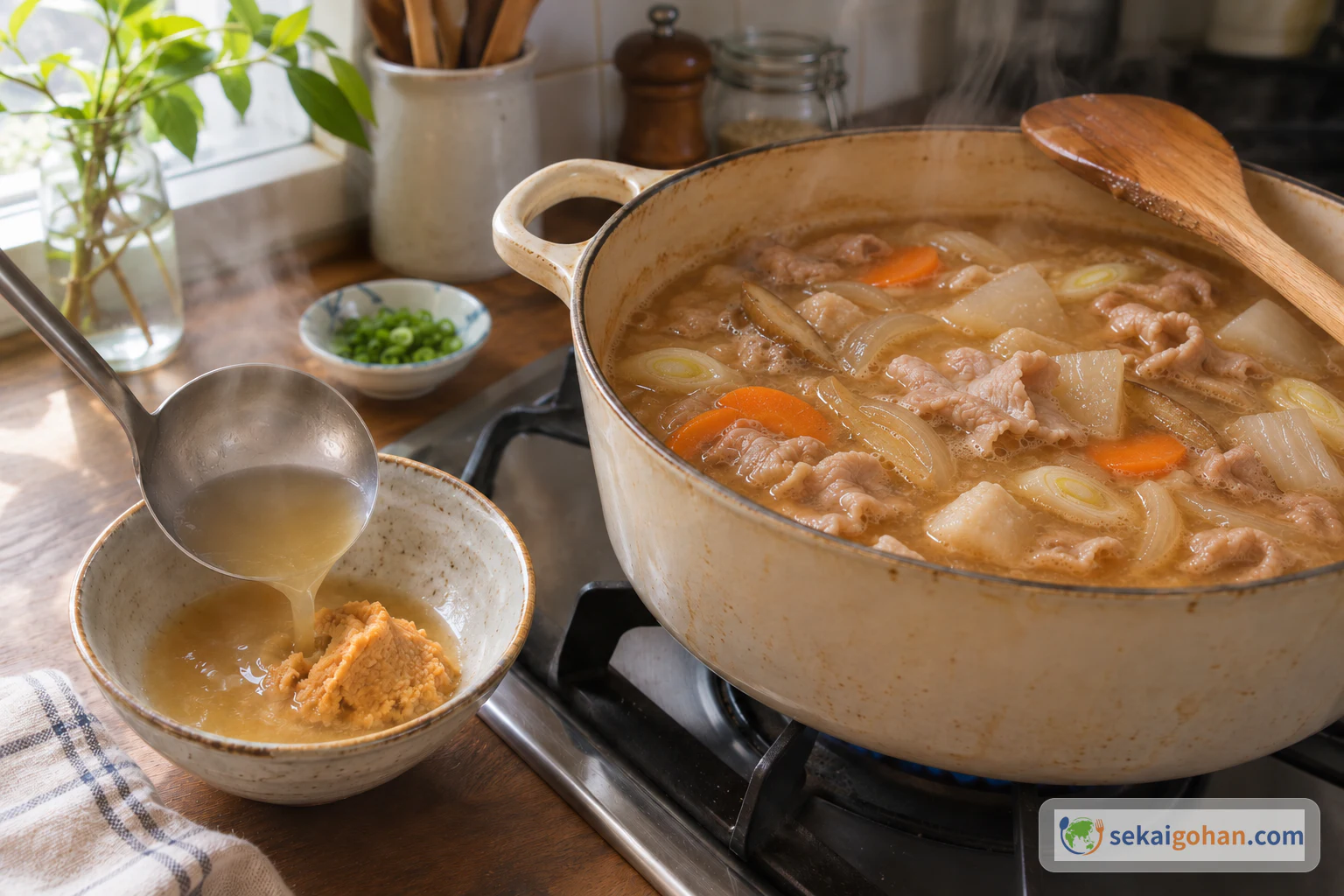
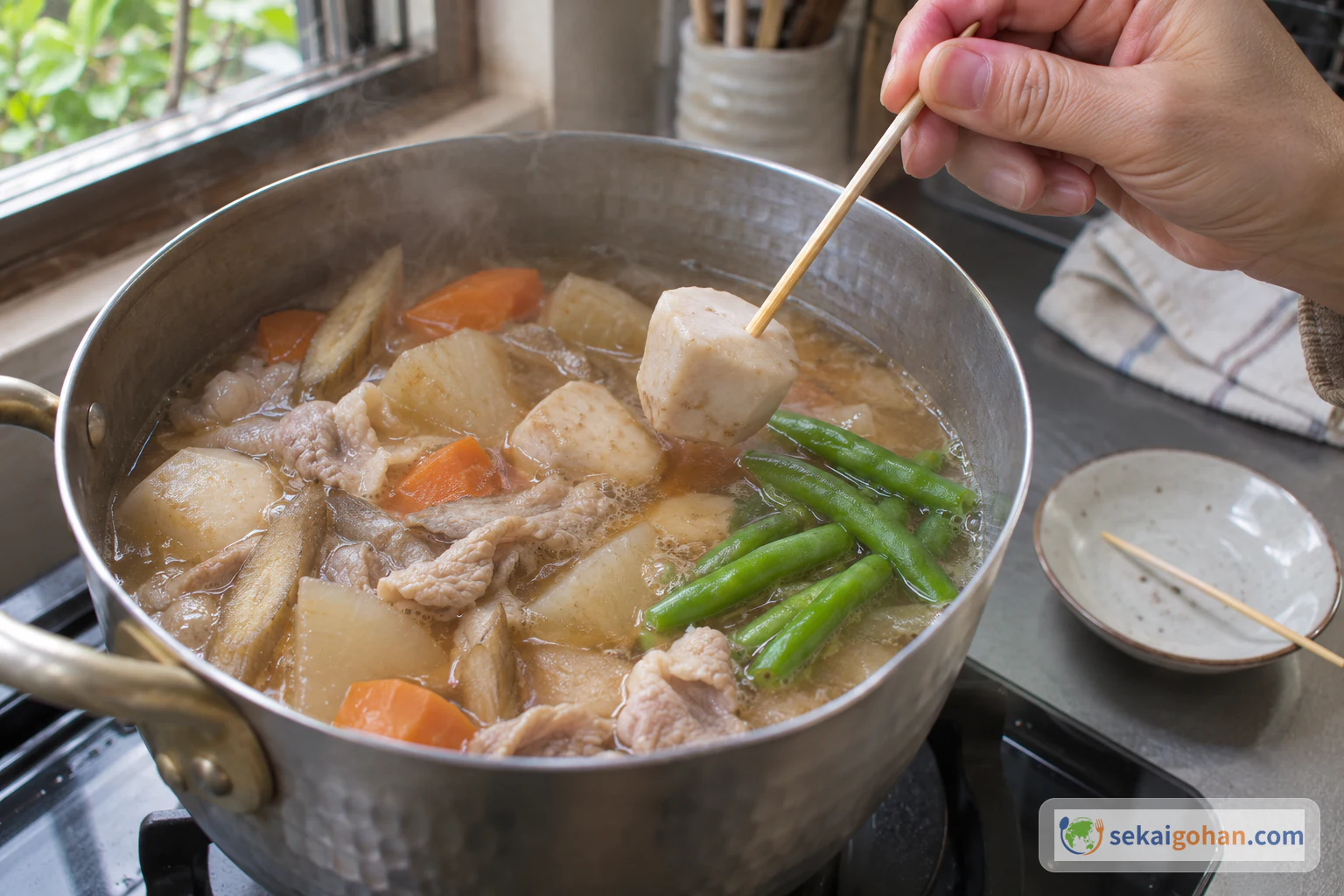
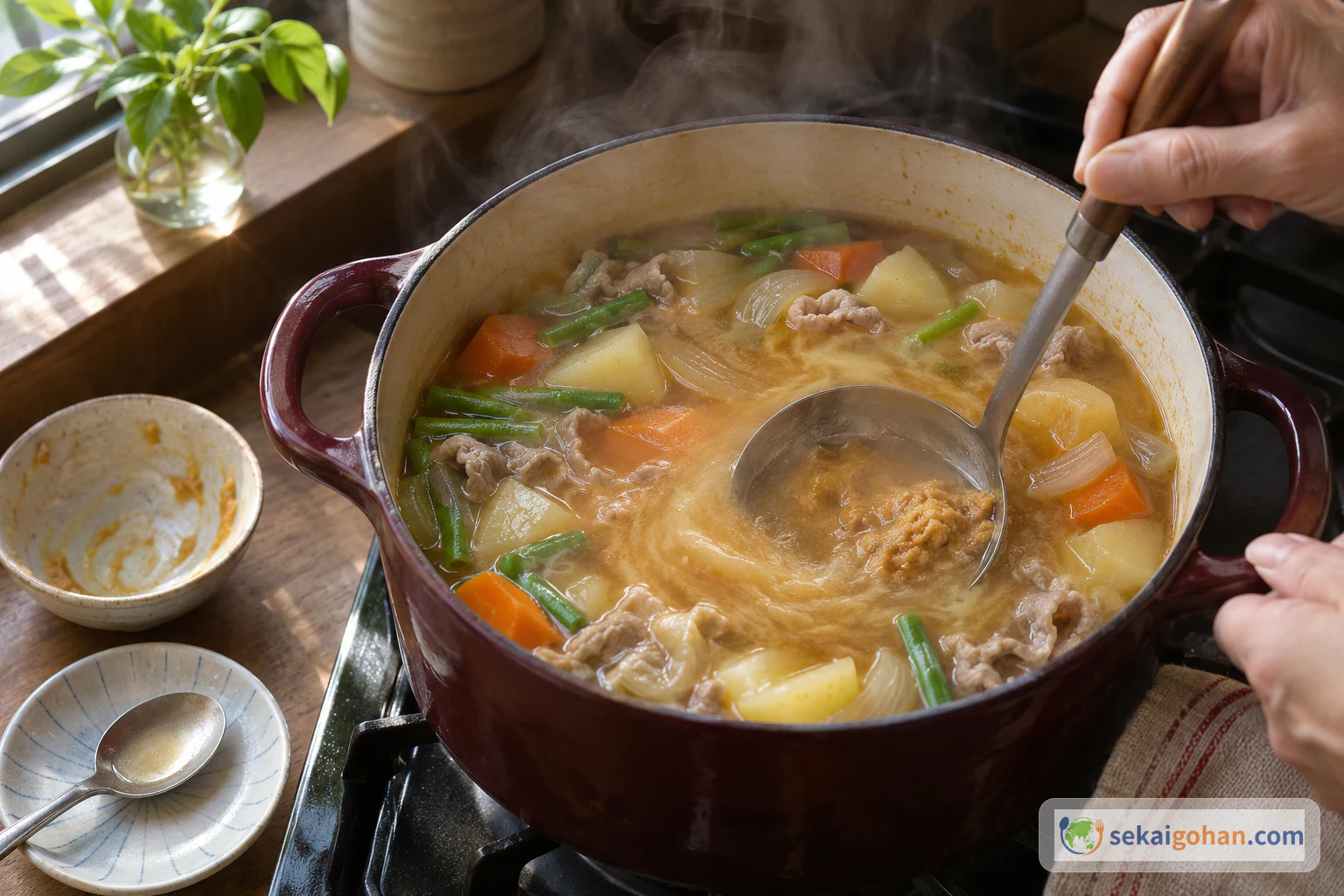
The vegetables hit a thin film of oil and hiss. Daikon, carrot, burdock, onion, taro and leek all go into the pot at once, and within a minute the onion edges turn glassy and the kitchen smells of earth and oil. Then the pork belly goes on top, the water goes in, and the miso goes in twice: once to soak into the vegetables and once at the end to bring back its aroma. Tonjiru is Japan's pork and root vegetable miso soup. It is cloudy, sweet from the pork fat and the roots, and so full of vegetables that it eats more like a stew with broth than a soup. It shows up on winter tables across the country, often in a pot big enough to last until the next day.
A Pot of Pork, Roots and Miso, Cooked Differently in Every Region
What sets tonjiru apart from everyday miso soup is the way the miso goes in. Ordinary miso soup gets its miso at the very end and is never allowed to boil afterward. Tonjiru breaks that rule on purpose. Half the miso goes in early and simmers with the vegetables, so the daikon and taro take on its flavor all the way through. The rest goes in at the end for fragrance. Add the sheer amount of vegetables and the fat from the pork belly, and the soup becomes a dish in its own right. It is eaten all year, but people make it most in winter to warm up. It goes into school lunches, and at local events it is cooked in huge batches and handed out.
The characters 豚汁 mean "pork soup" and are read two ways: tonjiru and butajiru. Both are in use. Kagoshima, in the far south of Kyushu, lists its local version under both readings.
Kagoshima: pork country and sweet barley miso
Kagoshima raises more pigs than any other prefecture in Japan, and its black pork, Kagoshima kurobuta, is a famous brand. Through the Edo period, Buddhist teaching made eating meat taboo in most of Japan, yet in the Satsuma domain, today's Kagoshima, people regularly ate pork, wild boar and deer. Satsuma held the Ryukyu Kingdom under its control and took up the pork eating already common there. On the Amami Islands a native breed called shima-buta was raised. Tradition credits Shimazu Iehisa with bringing black pigs from Ryukyu, and in the Meiji era they were crossed with English Berkshires.
Kagoshima also makes a lot of barley miso, which uses plenty of koji, is lower in salt and noticeably sweet. The local tonjiru reflects all of this. The broth is made by soaking small dried sardines (iriko) in water, then boiling them briefly. Konnyaku and thick fried tofu (atsuage) go in with the roots, the barley miso goes in only once at the end, and each bowl is topped with chopped scallion and ginger. It is a separate, complete version of the dish rather than a variation on the national one.
Ishikawa's mettajiru and the imoni of the northeast
In Ishikawa on the Sea of Japan coast, the hearty pork soup called mettajiru sets itself apart with sweet potato where other tonjiru uses potato. The name is traced to yatara mettara, roughly "any old how", for the way the pot is loaded or the vegetables chopped. One story says farmers started making it to use up big harvests. A character makes and eats mettajiru in Kabi (Mold), a Meiji-era novel by Tokuda Shūsei. The sweet potato is a certified Kaga vegetable from Kanazawa, a crop that came from Satsuma as seed tubers and growing methods at the end of the Genroku era.
Go north to Tohoku and the same kind of pot gets a different name. In Yamagata, imoni is a riverside autumn ritual. The story usually told puts its start in the mid-1600s, when boatmen at the end of the Mogami River route, near Nagasaki in Nakayama town, cooked local taro with the dried cod they carried while they waited for their cargo to be collected. Beef came in around the start of the Shōwa era. Inland Yamagata imoni is now taro, beef and soy sauce. Shonai, on the coast, uses pork and miso with atsuage, konnyaku and leek, which puts it very close to tonjiru. Mogami adds wild greens and mushrooms. Okitama uses firm tofu with a little miso as a hidden seasoning. Imoni parties sit alongside New Year and year-end parties on the calendar, and every mid-September a festival cooks imoni in a pot 6.5 meters (about 21 feet) across.
In Sendai, autumn means "imoni (tonjiru)" by the river. People build hearths from stones, light wood or charcoal, and cook local taro, seasonal vegetables and pork with Sendai miso. Convenience stores sell firewood for it during the season. Sendai cooks use long leek, not onion. Some people there draw the line between tonjiru and imoni at the potato, with regular potato for tonjiru and taro for imoni, but inland Yamagata imoni is beef and soy sauce, so the potato alone does not settle it. The same pot can be tonjiru in one town and imoni in the next, and both names are correct where they are used. More of the country's cooking is gathered on our Japan page.
Where tonjiru came from
Nobody agrees on where tonjiru began. One theory says someone added meat to kenchin-jiru, a vegetable soup. Another points to botan nabe, the wild boar hot pot, which in the Tamba region of Hyogo, where it has been made for generations, is usually seasoned with miso. Others credit the old Imperial Japanese Navy, which supposedly used miso in place of curry powder, or the frontier soldier-farmers of Hokkaido (tondenhei), whose soup became "ton-jiru". Another says it split off from satsuma-jiru as the pork version of that soup. Kagoshima is commonly said to have eaten it since the Edo period.
Meat eating never fully stopped during the taboo years. Game was eaten as kusuri-gui, "medicine eating", to nurse the sick and build strength. From the 18th century, Edo had shops called momonji-ya that sold boar and deer, mostly cooked in miso. Miso softens the gamy smell of meat, adds savoriness and warms the body, which is probably why it became the standard seasoning for game. Today the dish has a new life outside the home. A tonjiru specialist opened in Otemachi, Tokyo, in autumn 2019 and grew to five shops across Tokyo, Yokohama and Osaka, often with lines out the door. In 2021 a highball bar in Honmachi, Osaka, turned its lunch service into a tonjiru shop, and a tonjiru set-meal restaurant opened in Kagurazaka, Tokyo.
Ingredients (serves 6 to 8)
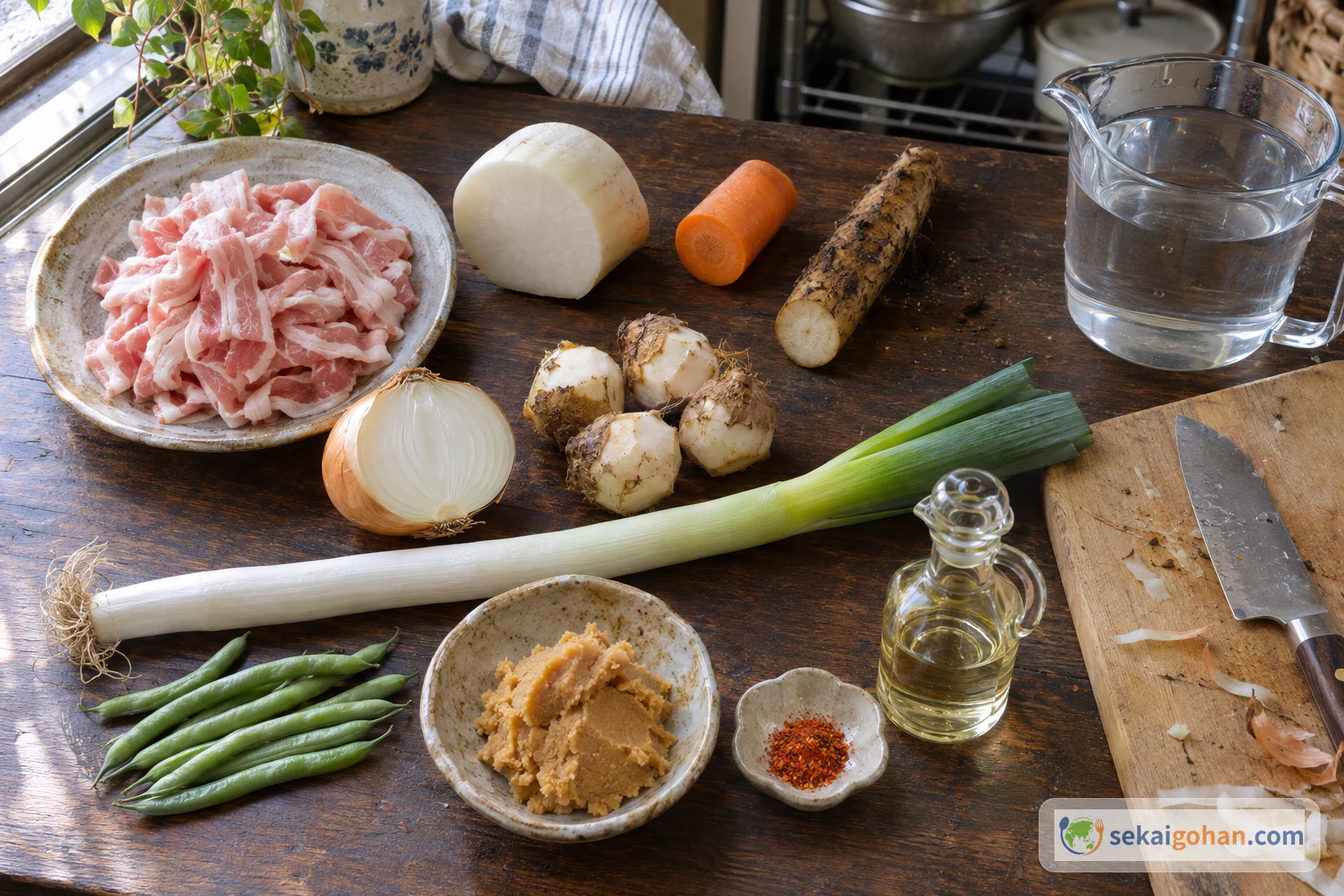
This is a big pot, and it is meant to be. To make less, halve every ingredient by the same amount. Halving everything, miso included, keeps the balance: 2 cups (500 ml) of water and 2½–3 tbsp of miso go with a half batch.
Miso is made from soybeans, and some miso also contains wheat, so read the ingredient label. The soup contains pork. Sesame oil, if you use it, contains sesame.
Equipment
- Heavy pot of about 4.25 quarts (4 L)
- Wooden spatula
- Ladle
- Bamboo skewer
- Measuring spoons
- Knife and cutting board
- Bowl of water for the burdock
- Small dish for the green beans
Choosing and Substituting
Fatty pork is the backbone. Pork belly gives the most flavor and fat. If you use pork offcuts (komagire), pick pieces with some fat on them. Lean pork thigh works too, but the soup turns lighter, so stir-fry in sesame oil to bring back some richness. Sesame oil also gives a stronger, nuttier finish with any cut. Salad oil lets the vegetables taste more like themselves.
Miso decides the final taste more than anything else, and salt levels vary a lot between brands. That is why the amount is a range. A rice or blended miso is the standard choice. Barley miso makes the soup sweeter and less salty and moves it toward the Kagoshima style. Red miso is saltier and deeper. White miso is sweet and pale. When you switch types, adjust the amount by tasting.
For the vegetables, taro can be replaced with sweet potato, Chinese yam (nagaimo) or potato. Potato holds its shape and tastes lighter. Chinese yam is lighter in texture and less slippery. Sweet potato brings strong sweetness and puts you close to Ishikawa's mettajiru, so cut it large. Pre-washed taro saves you peeling slippery tubers. Leaving out the onion makes the soup less sweet, and more leek makes it more aromatic, which is the Sendai way. Green beans are there for color and crunch. Skip them and the pot looks browner, but the flavor stays the same. Plain water is enough for the broth because the pork and vegetables make their own stock. If you use dashi, make it lighter than you would for ordinary soup.
Method
The knife work comes first, and once it is done the cooking moves in one direction. Cut everything before you turn on the stove, keeping the green beans aside. The pot then goes from a quick stir-fry to a boil to a long, quiet simmer. That simmer, after the first miso, is your hands-off stretch.
Cook pork until it is done all the way to the center. The guideline is 145.4°F (63°C) at the center for at least 30 minutes, or 167°F (75°C) for at least 1 minute. At home, cook at a higher temperature than that whenever you can. The minutes in the steps measure cooking time, not the temperature inside the meat, so check that every strip has lost its pink before you serve. Raw or undercooked pork carries hepatitis E virus, Salmonella and Campylobacter, however fresh it is. Since June 12, 2015, Japan's Food Sanitation Act has banned selling or serving pork meat or offal to be eaten raw. Keep raw pork away from other food, and wash your hands, knife and board after touching it.
When It Goes Wrong
| What you see | Why | What to do |
|---|---|---|
| Too salty | The miso is a salty brand, or all 6 tbsp went in | Thin with hot water or dashi, a little at a time. Next time stop at 5 tbsp and taste |
| Flat, thin taste | The stir-fry was too short or the broth too weak | Add a little sesame oil for aroma, or simmer in a few dried sardines (niboshi). Add more miso only as a last resort |
| Pork stuck to the pot | The pork hit the bare pot, or the heat was too high | Take the pot off the heat and scrape the pork free. Next time put the vegetables in first |
| Taro breaking up, broth murky | Pieces cut too small, or the pot boiled hard | Keep the heat low. Treat what has broken up as body for the broth and stop stirring |
| Burdock turned dark | It sat in the air too long after cutting | Put each piece into water as soon as it is cut |
| Miso aroma gone | The pot boiled after the second miso | Turn off the heat and stir in a little more miso |
| Brown, dull green beans | They cooked too long | Add them only after the taro test and give them 2–3 minutes |
Serving, Variations and Leftovers
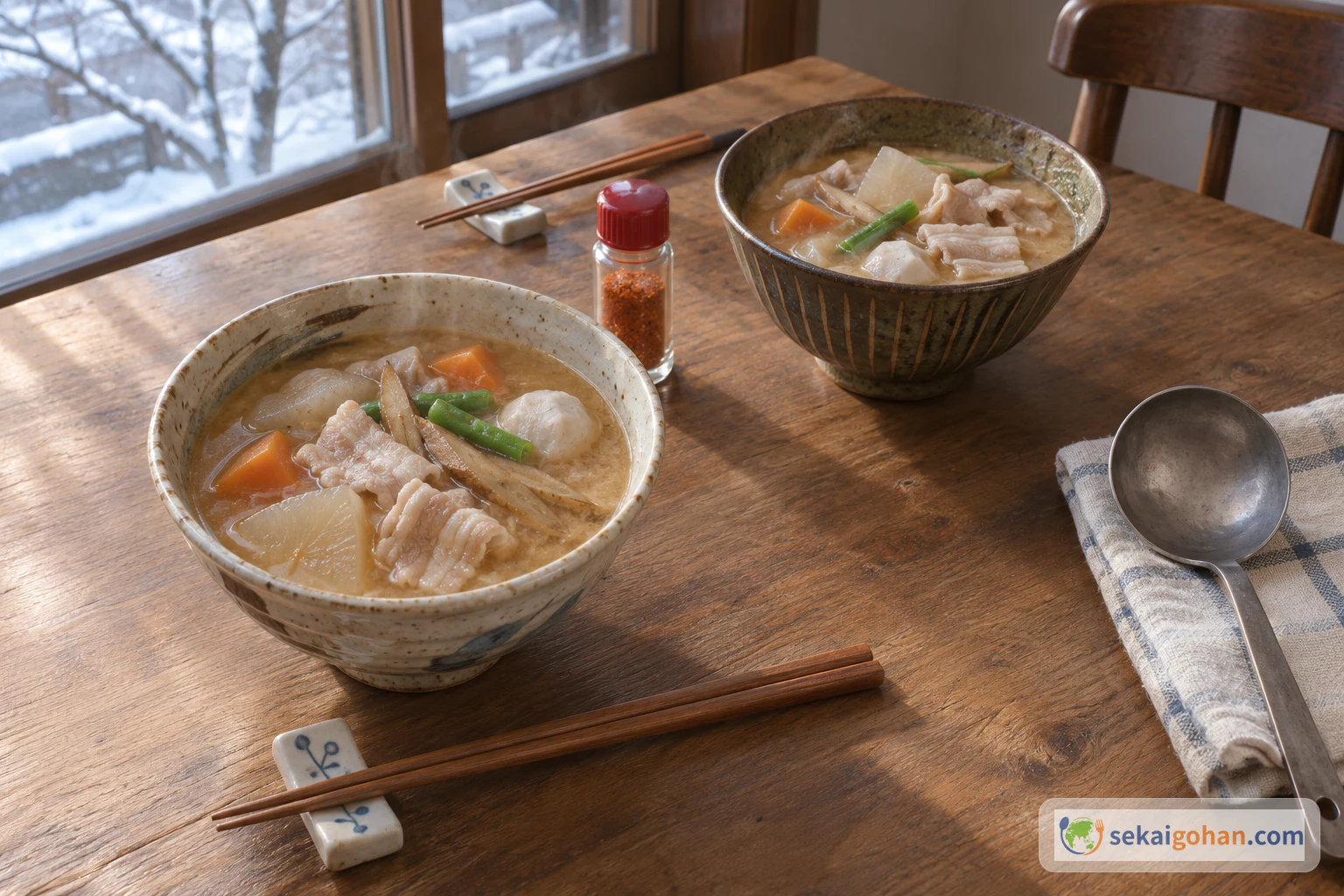
Tonjiru goes to the table in bowls you can hold in your hand, with the chili set out for each person to add. With a pot this full, the soup is one of the main dishes, and in winter it is the dish that warms everyone up. Pork brings vitamin B1 and the roots bring fiber.
Variations
- Dried sardines in the water. Add 3–4 niboshi with the water. You get more savory flavor without making a separate stock, and the soup tastes full even with miso at the low end of the range.
- Milk or soy milk. Stir a little in, a little at a time, and cut back on the miso. The soup turns mellow and slightly Western in feel. Add it gradually and taste as you go.
- Curry powder. Stirred in, it turns the pot into a curry soup with the same pork and roots.
- A little ketchup. Its glutamate adds savoriness, so you can use less miso and still get a rich soup, which helps if you are cutting back on salt.
Leftovers
Cool the soup, move it to a clean covered container and refrigerate it. The next day, put only what you will eat in a pot and warm it over medium-low until it is just about to boil. Reheating dulls the miso aroma, so stir in a little extra miso after warming and taste.
Frequently asked questions
Can I make it without stir-frying first?
Yes. Some cooks start everything in cold water: pork, vegetables and konnyaku go into the pot together, the foam is skimmed once it boils, and the miso goes in once the vegetables are nearly tender. Cooks are divided on which way is better. Stir-frying first gives a deeper, oilier flavor, and starting in water gives a cleaner, lighter broth.
How is tonjiru different from kenchin-jiru?
Kenchin-jiru is a separate vegetable soup. One theory on the origin of tonjiru is that someone added meat to kenchin-jiru, which is why the two get compared so often. In tonjiru, pork and its fat are the center of the flavor, with root vegetables cooked in miso around them.
What else can I put in?
Lotus root, mushrooms, steamed soybeans and clams all go well with it. Konnyaku is a common addition. Cut it into thin strips, rub it with salt, blanch it, and add it to the pot with the root vegetables.
Why does my pot need to be heavy?
The vegetables and pork are stir-fried in very little oil before any water goes in, and a thin pot gets hot spots that scorch the onion and glue the pork down. A heavy pot spreads the heat, so the stir-fry stays a gentle coating rather than browning.