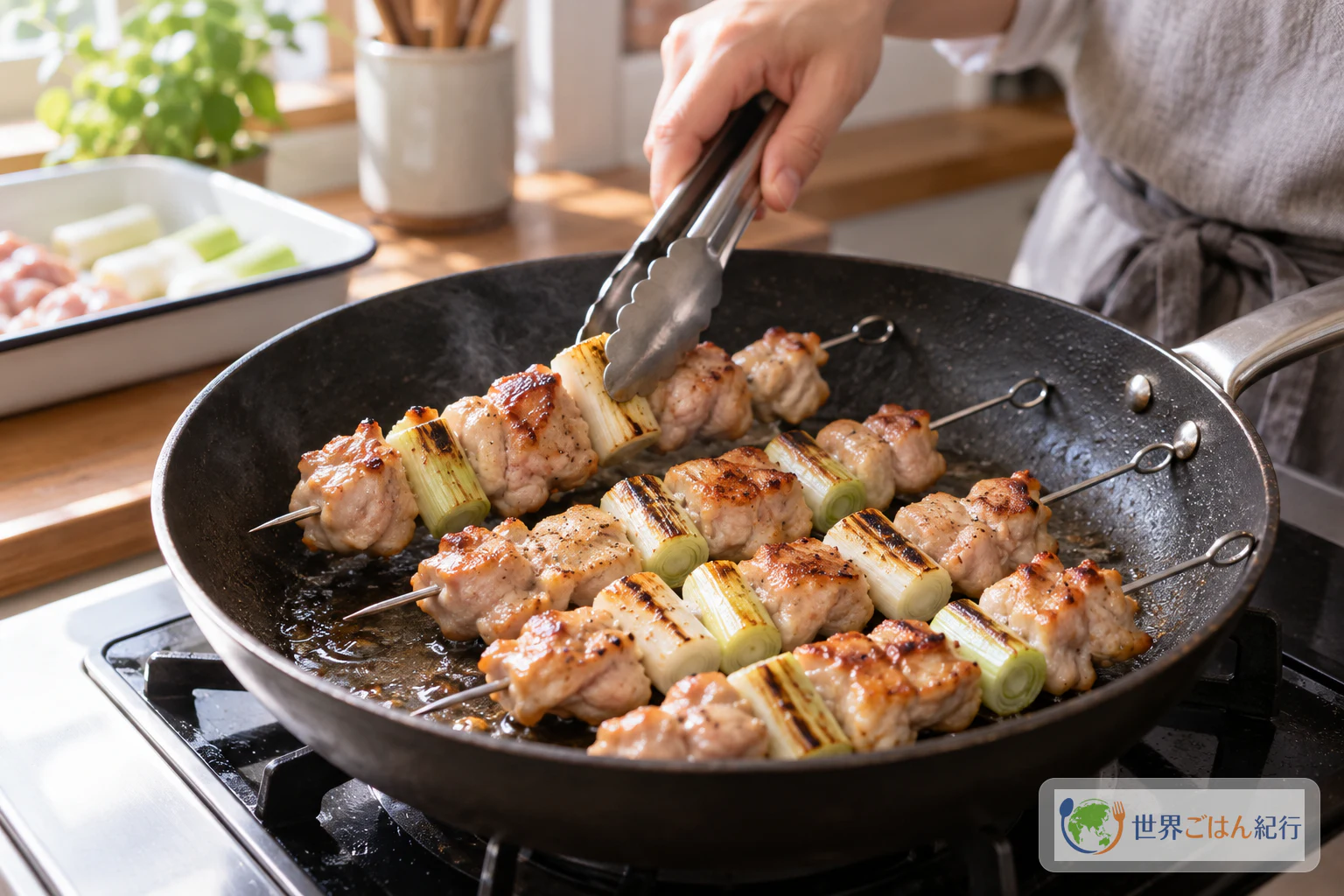
Negima: Browned Chicken, Sweet Long Onion and a Glossy Tare
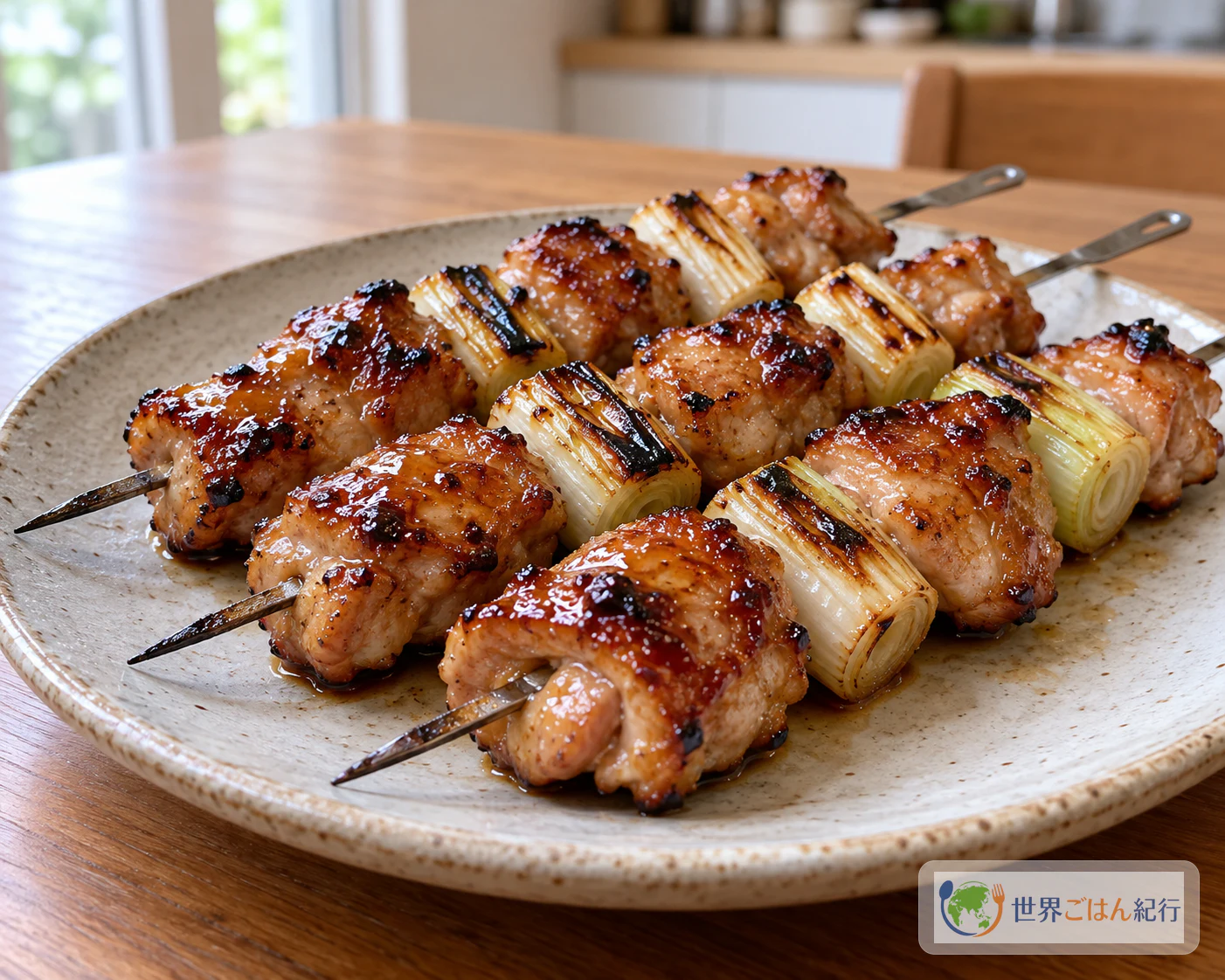
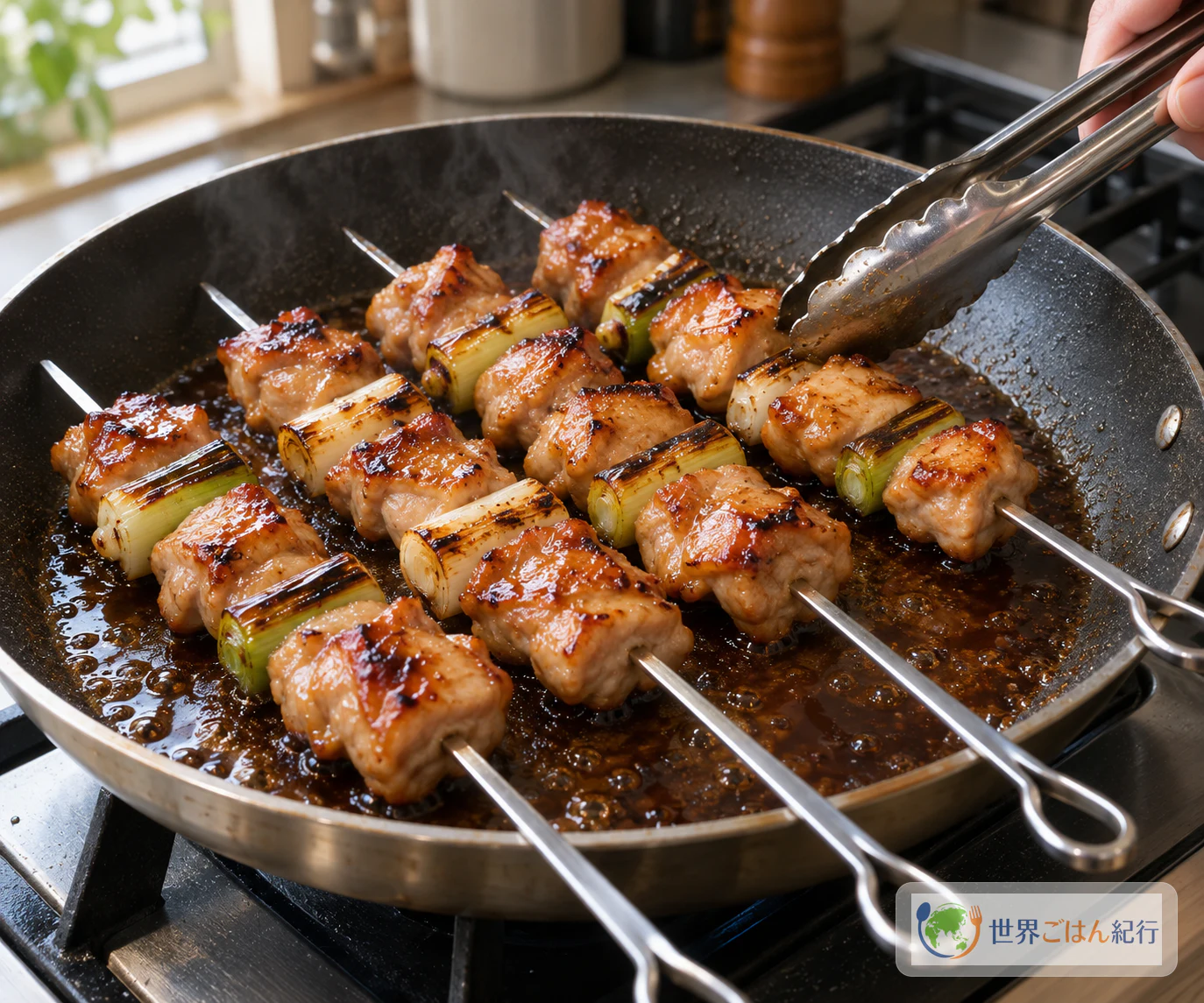
Browned chicken thigh, long onion that turns sweet in the heat, and a soy sauce and sugar tare that pulls them together. Cook the chicken through first; the tare goes on last.
The MICHELIN Guide's feature on yakitori describes the smell of grilling drifting out of shops marked by red lanterns, and food that you can eat straight off the skewer without chopsticks. It is one of Japan's most casual pleasures.
This recipe brings that dish into a home kitchen in its simplest form: negima, chicken thigh and Japanese long onion threaded alternately on skewers. It does not try to imitate a charcoal grill. A frying pan cannot give you charcoal aroma, so the focus here is on two things a home cook can control well: cooking the chicken through with a lid, then finishing with a tare that turns glossy over low heat.
Yakitori, Negima and a Name That Means Something Else in Muroran
Yakitori is grilled chicken on skewers, and negima is the version that alternates chicken with Japanese long onion (negi). Kikkoman's recipe, which this article follows, presents yakitori as chicken skewers and pairs thigh meat with long onion.
Where does the "ma" in negima come from? The MICHELIN Guide introduces one explanation: in the Edo period, skewers of long onion and tuna (maguro) were grilled, and the "ma" of maguro stayed in the name after chicken took tuna's place. Treat this as an explanation the guide presents, not a settled etymology.
The word yakitori also changes meaning by region. According to Hokkaido's official tourism site, in Muroran "yakitori" means skewers of pork shoulder and onion, served with mustard, and the site links the dish to the food culture of the steel-making city in the 1930s. It is a separate regional dish, so its pork and onion are not mixed into this chicken recipe.
Ingredients: Serves 2, Exactly as in the Source Recipe
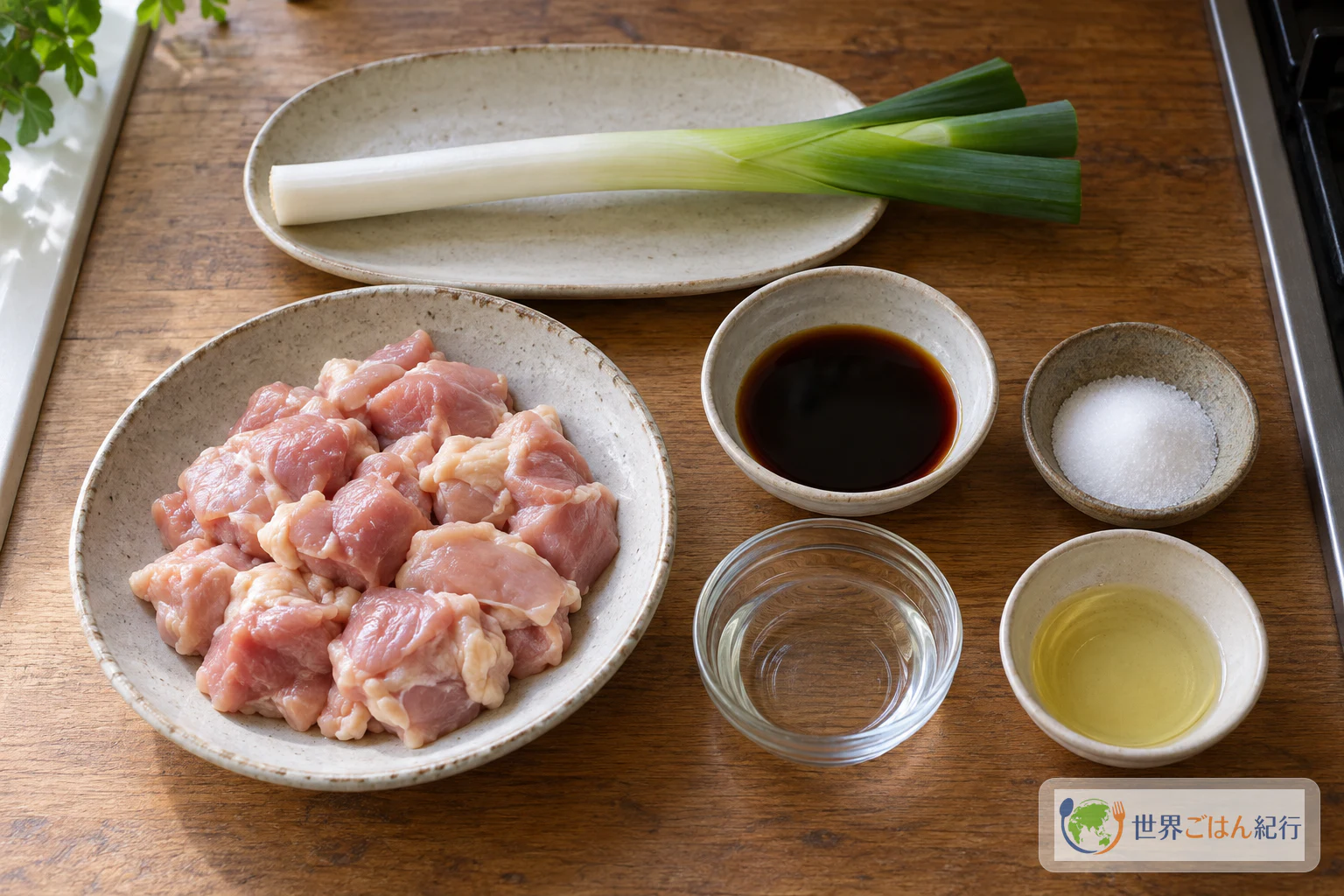
These are the full amounts from Kikkoman's recipe for 2 servings. The source does not give a number of skewers or the size of the chicken pieces, so neither is stated here.
Kikkoman's measurement guide gives 1 Tbsp (US) as about 15 mL (14.7 mL) and 1 tsp as about 5 mL (4.9 mL), so a standard 15 mL tablespoon works. The sugar is measured by volume; no gram conversion is given.
Soy sauce commonly contains soy and wheat. Check the label of the product you use for allergens; they vary by product.
Equipment
- Metal skewers (the source recipe uses metal skewers), short enough that the frying pan lid closes over them
- Small saucepan for the tare
- Frying pan with a lid
- Tongs
- Clean food thermometer
- A cutting board and plate kept only for raw chicken
Choosing and Swapping: What Changes the Dish
- Chicken: Use boneless thigh so it threads easily; the source does not say whether to keep the skin on. There is no basis in this recipe for switching to breast, and the fat and texture would change, so breast is not offered as a substitute here.
- Long onion: If you use another thick green onion in place of Japanese negi, its thickness, aroma and how it browns will change. No particular variety can be called equivalent.
- Oil: The source allows any oil you like. A strongly flavored oil will change the aroma of the chicken and tare.
- Soy sauce: The source specifies Kikkoman soy sauce. Use a standard soy sauce rather than switching to a different style.
- Nothing extra: No salt, sake, mirin or garnish goes in. All six ingredients are used, and no extra tare is made beyond the amounts in the table.
Method: Cook Through First, Glaze Last
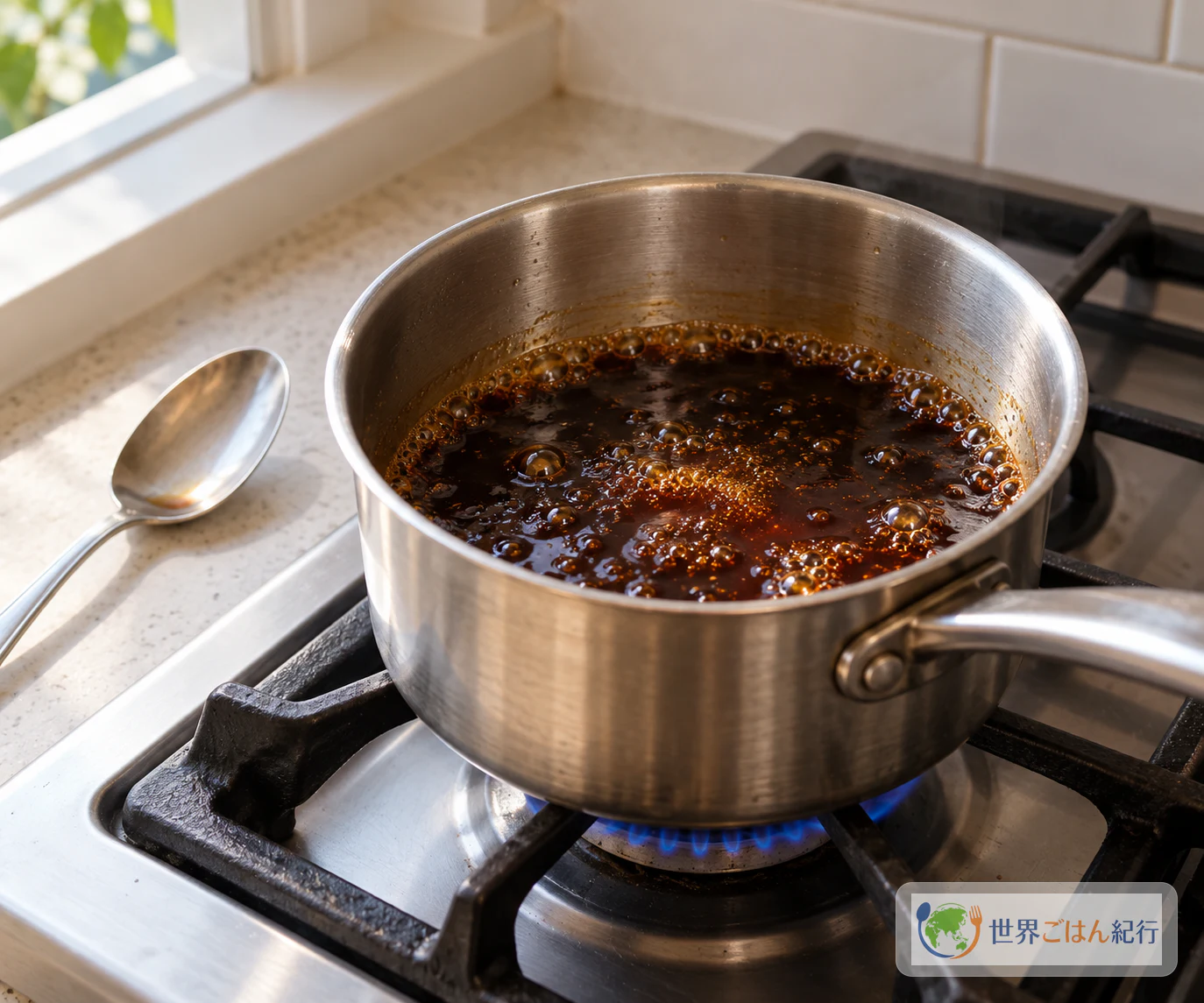
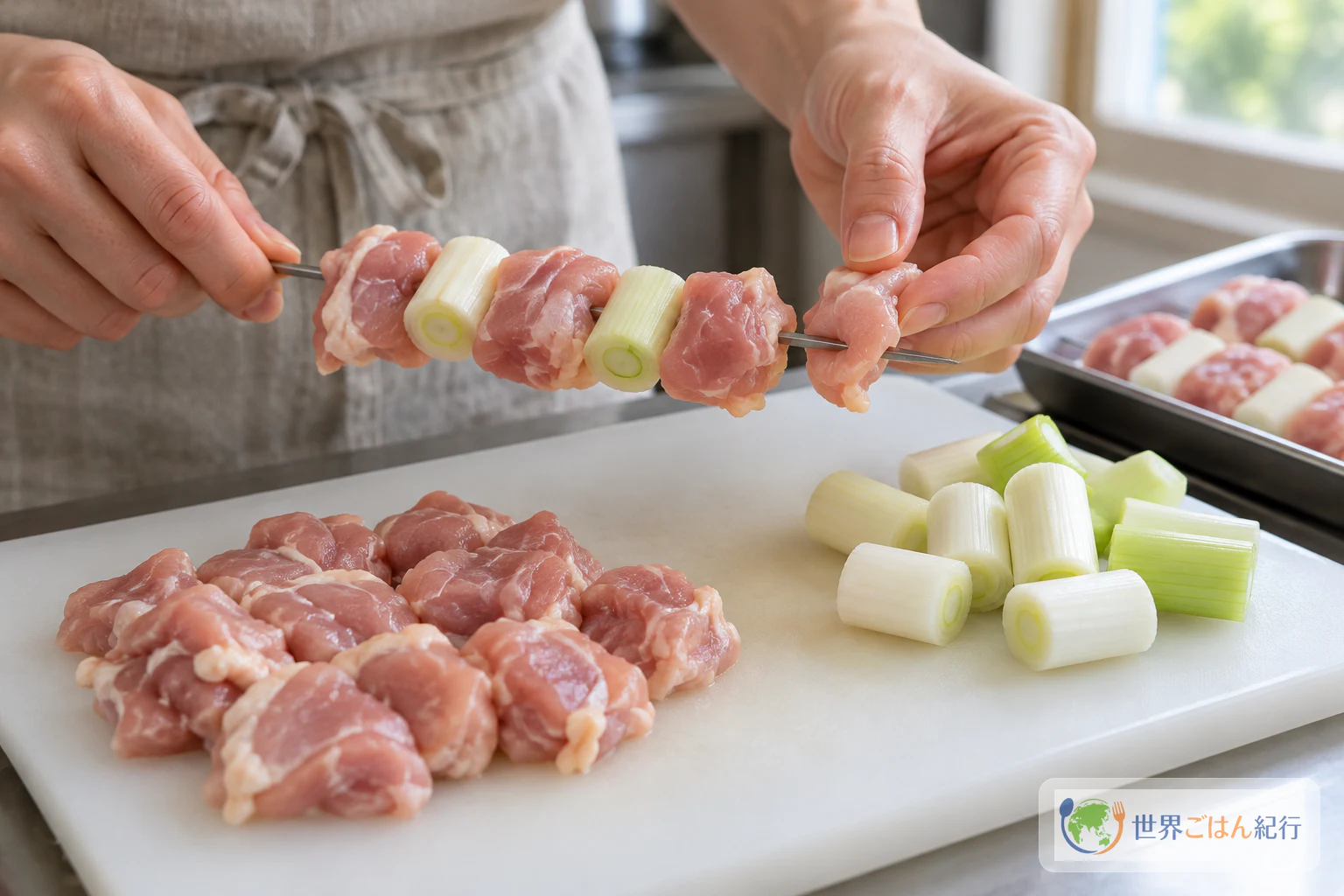
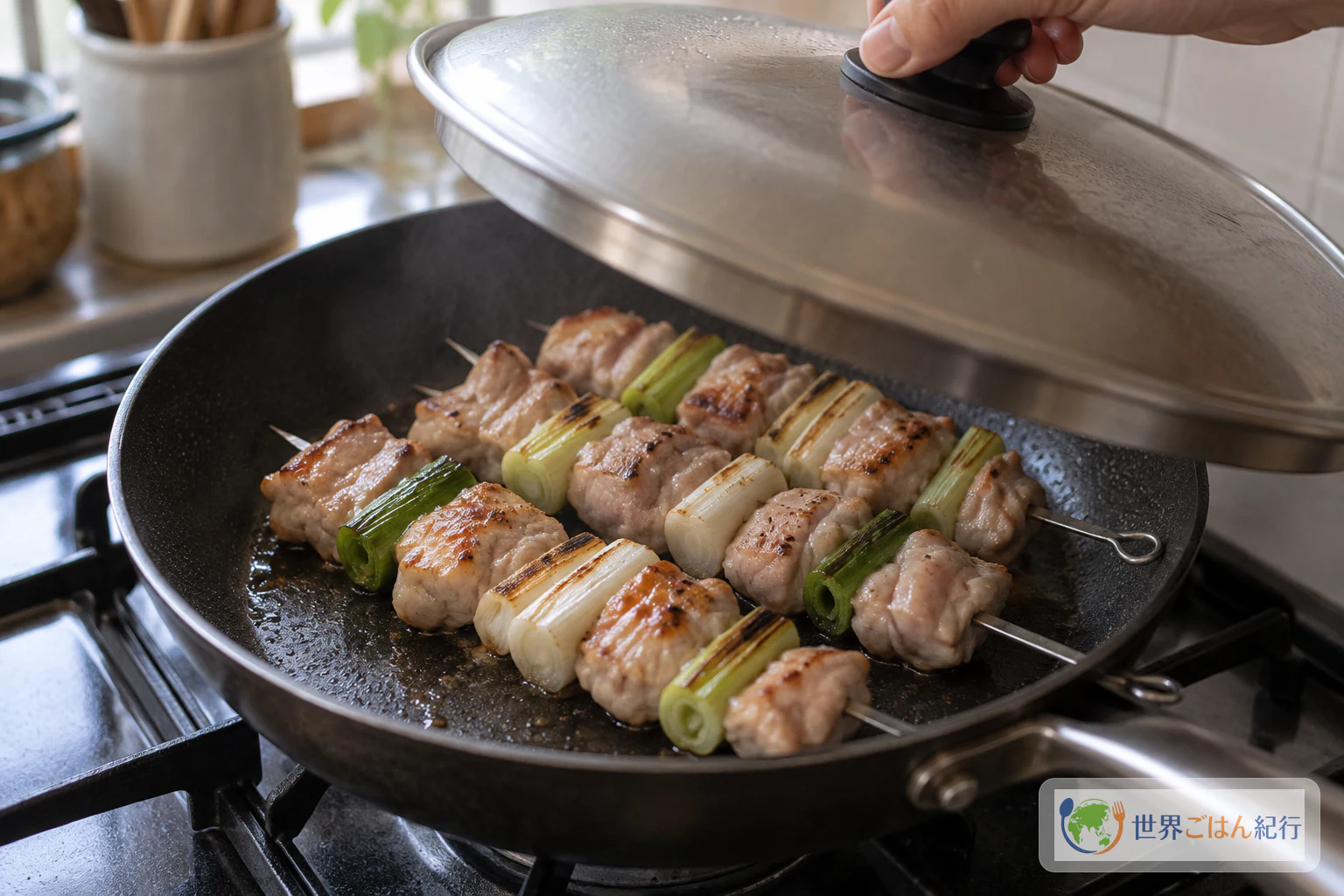
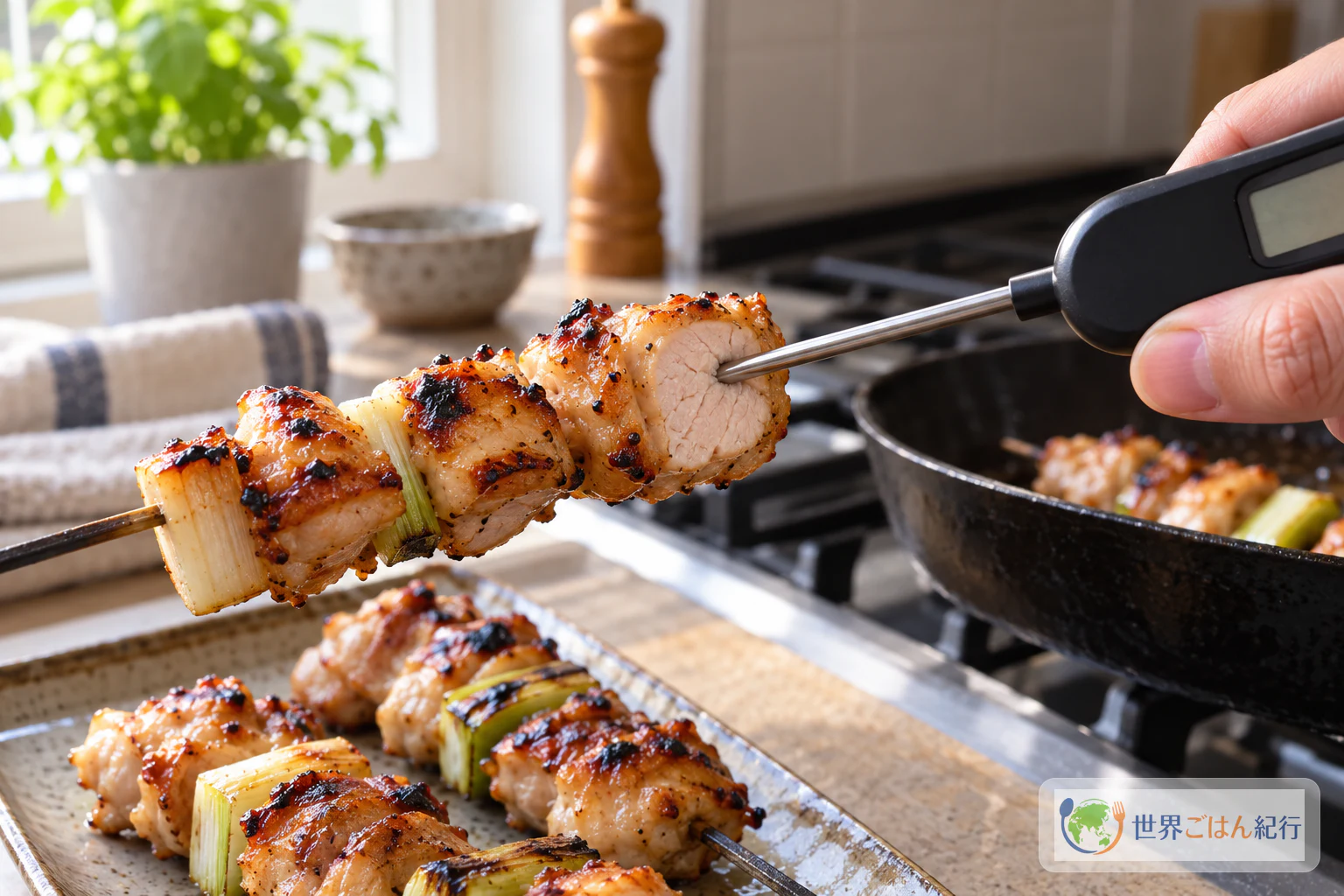
Make the tare, cook the skewers through with the lid, confirm the chicken's center with a thermometer, and only then add the tare.
Uneven, Burnt, Pale: Fixing Common Problems
| Problem | Likely cause | What to do |
|---|---|---|
| Some pieces are cooked, others not | Chicken pieces cut to different sizes | Keep cooking and check the thickest piece with the thermometer. Next time, cut the pieces to a similar size |
| The center hasn't reached 75°C for 1 minute after the listed times | Thick pieces or a gentle stove | Keep cooking over low heat, turning, and check again. Don't move on to the tare yet |
| The tare burned | Tare added too early or heat too high | Add the tare only after the chicken is cooked, and keep the heat low while glazing |
| The outside is well browned | Browning doesn't show the center's temperature | Still check the center with the thermometer |
| The tare is runny and doesn't cling | Too short a glaze | Keep turning over low heat until glossy |
Tare goes on at the end, never on raw chicken, because the sugar in it browns and burns quickly while the chicken still needs time to cook. Separating the two stages lets you cook the chicken fully first and then spend only a short time on the glaze.
Leftovers
The source recipe gives no storage conditions, so no storage period is given here, and making this ahead is not recommended. Following the Ministry of Health, Labour and Welfare's guidance for home kitchens, don't leave food at room temperature for long before or after cooking. Divide any leftovers into clean, shallow containers, cool them quickly and refrigerate. When reheating, heat until the center reaches 75°C or higher. Leftover tare is not guaranteed to keep.
Variations Worth Trying
- Salt instead of tare: Salt-seasoned yakitori is a separate recipe, and the source used here gives no amounts for it, so no measurements are offered.
- Chicken-only skewers: Leave out the long onion to compare the texture with negima. This is an adaptation of the same recipe, not a separate source recipe. Check the center temperature as in step 4.
- Thicker or thinner long onion: The thickness changes how it browns and how long the skewers need. Judge by the chicken's center temperature, not the listed minutes.
- More or fewer glazing turns: More turns build gloss, but watch closely for burning.
- Muroran yakitori: Pork shoulder and onion with mustard belongs to a different recipe, with its own steps and seasoning.
From Street Stalls to Red Lanterns: Yakitori's Place at the Table
A frying pan can't give you a charcoal aroma. This recipe aims for browned chicken, sweet long onion and a glossy tare, not a copy of a specialist grill.
According to the MICHELIN Guide, yakitori stalls appeared in the mid-Meiji period (the 1880s–90s), grilling scraps and offal from restaurants on skewers, and the dish became widely popular in the 1960s as broiler chickens spread. This is the guide's account rather than a single agreed origin for all of Japan.
The same feature explains why skewers suit the dish so well: they make the food easy to eat by hand, and easy to brush with tare as it grills.
At specialist shops, the experience goes well beyond thigh and long onion. Japan's Ministry of Agriculture, Forestry and Fisheries introduces yakitori restaurants where diners enjoy the different flavors of each part of the chicken, and shops that grill over binchotan charcoal. This recipe sticks to chicken thigh only; for a home cook it is the easiest place to start. You can find more dishes from Japan on Sekai Gohan.
Frequently Asked Questions
Tare or salt?
This recipe is the tare version from Kikkoman. The same source gives no amounts for a salt version, so none are given here.
Can I use wooden skewers?
The source recipe recommends metal skewers. How to prepare wooden skewers is not covered by the sources for this recipe, so it isn't answered here.
How long does it take?
Kikkoman lists 20 minutes for the recipe, with 3 minutes covered and 3 minutes uncovered in the pan. These are the source's figures, not a guarantee for your stove. Decide when the chicken is done by checking that the center reaches 75°C or higher for at least 1 minute.
Is Muroran yakitori made with chicken?
No. According to Hokkaido's official tourism site, Muroran yakitori is made with pork shoulder and onion and served with mustard.
Should I rinse the chicken first?
No. Japan's Ministry of Agriculture, Forestry and Fisheries advises against washing raw chicken. Wash your hands and tools after handling it instead, and keep it away from other foods.
Sources
- Kikkoman Corporation, "Yakitori (Grilled Chicken Skewers) - with Japanese Long Onion." Description of yakitori and negima; ingredients and amounts for 2 servings; the frying-pan method and tare; metal skewers; cutting the long onion about 3 cm (Cooking Basics on the same page); the listed cooking time of 20 minutes. https://www.kikkoman.com/en/cookbook/recipe/00001871.html
- Kikkoman Corporation, "Weights & Measurements." 1 Tbsp (US) about 15 mL (14.7 mL) and 1 tsp about 5 mL (4.9 mL). https://www.kikkoman.com/en/cookbook/weight.html
- MICHELIN Guide, "Yakitori." The history of yakitori stalls, why skewers make the food easy to eat and brush with tare, and the explanation offered for the name negima. https://guide.michelin.com/jp/en/article/features/yakitori_en-2
- HOKKAIDO LOVE! (Hokkaido Official Tourism Site), "Muroran yakitori." Muroran yakitori as a regional dish of pork shoulder and onion served with mustard, and its connection to the steel city's food culture in the 1930s. https://www.visit-hokkaido.jp/en/spot/detail_12815.html
- Ministry of Agriculture, Forestry and Fisheries (Japan), "鶏料理を楽しむために~カンピロバクターによる食中毒にご注意を!!~" (Enjoying chicken dishes safely: beware of Campylobacter food poisoning). Heating chicken to 75°C or higher at the center for at least 1 minute, cooking until the center turns white, not washing raw chicken, and preventing cross-contamination. https://www.maff.go.jp/j/fs/campylobacter.html
- Ministry of Agriculture, Forestry and Fisheries (Japan), "Washoku: The Spirit of Japanese Cuisine." Yakitori restaurants that serve different parts of the chicken, and shops that use binchotan charcoal. https://www.maff.go.jp/j/shokusan/gaisyoku/pamphlet/pdf/washoku_english.pdf
- Ministry of Health, Labour and Welfare (Japan), "家庭での食中毒予防" (Preventing food poisoning at home). Heating to 75°C at the center for at least 1 minute, preventing cross-contamination, not leaving food at room temperature for long, cooling leftovers quickly in shallow portions, and reheating to 75°C or higher. https://www.mhlw.go.jp/stf/seisakunitsuite/bunya/kenkou_iryou/shokuhin/syokuchu/01_00008.html