Galbi: Thin Ribs, a Row of Bones, and a Glaze That Browns Fast
Ribs cut thin across the bone, a soy marinade sweetened with pear, and a quick, hot sear that browns the glaze without burning it. Everything else in this recipe is there to protect those three things.
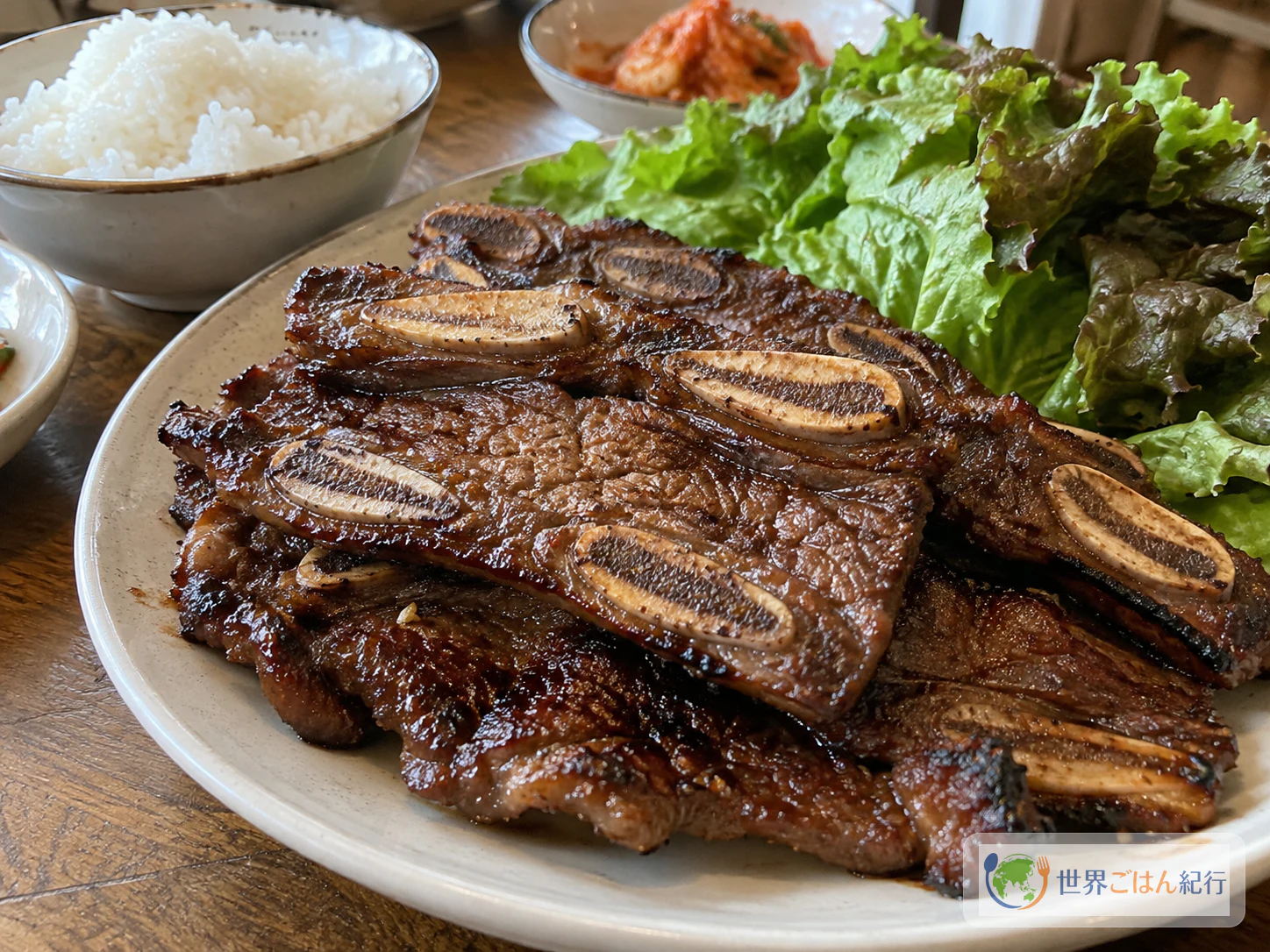
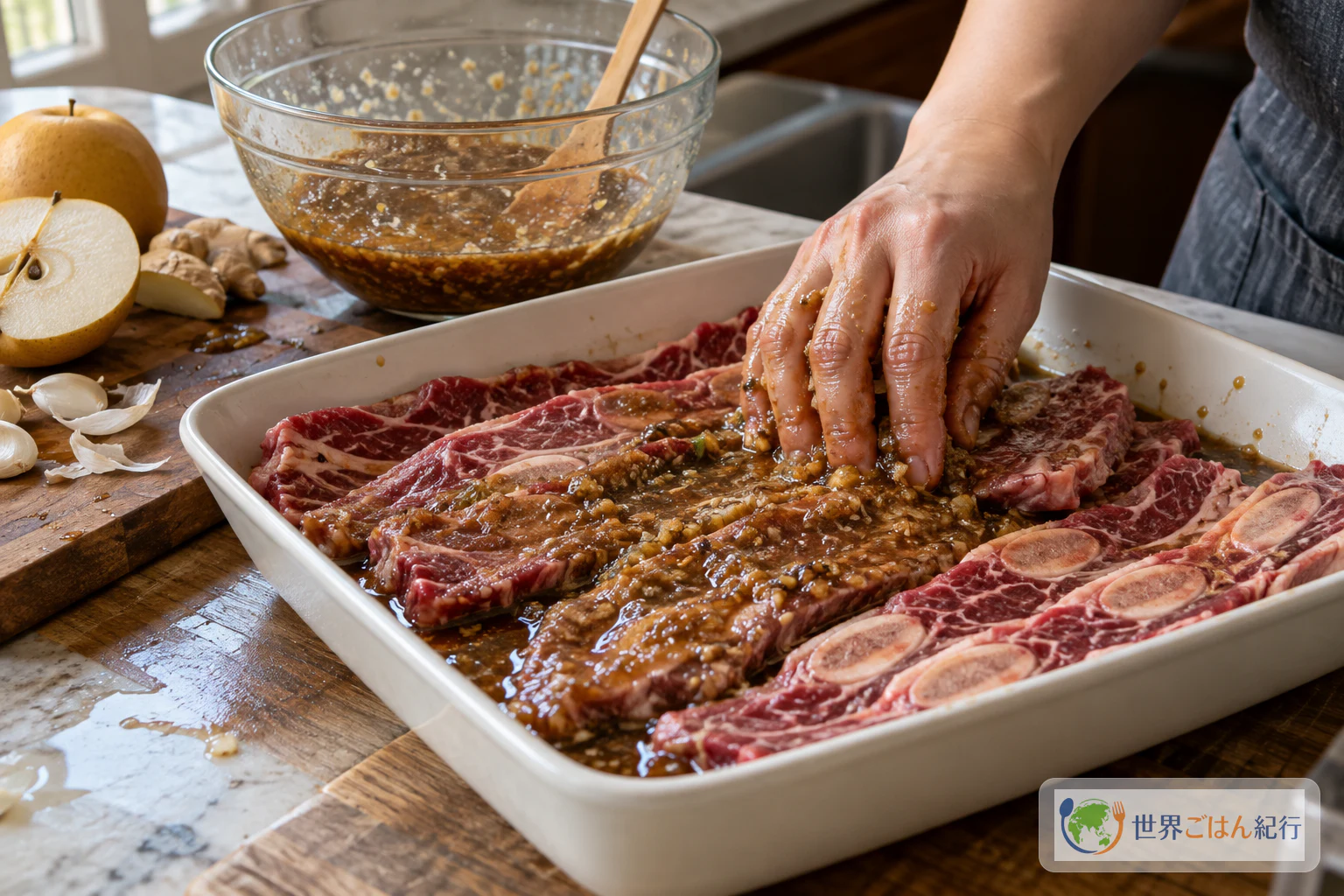
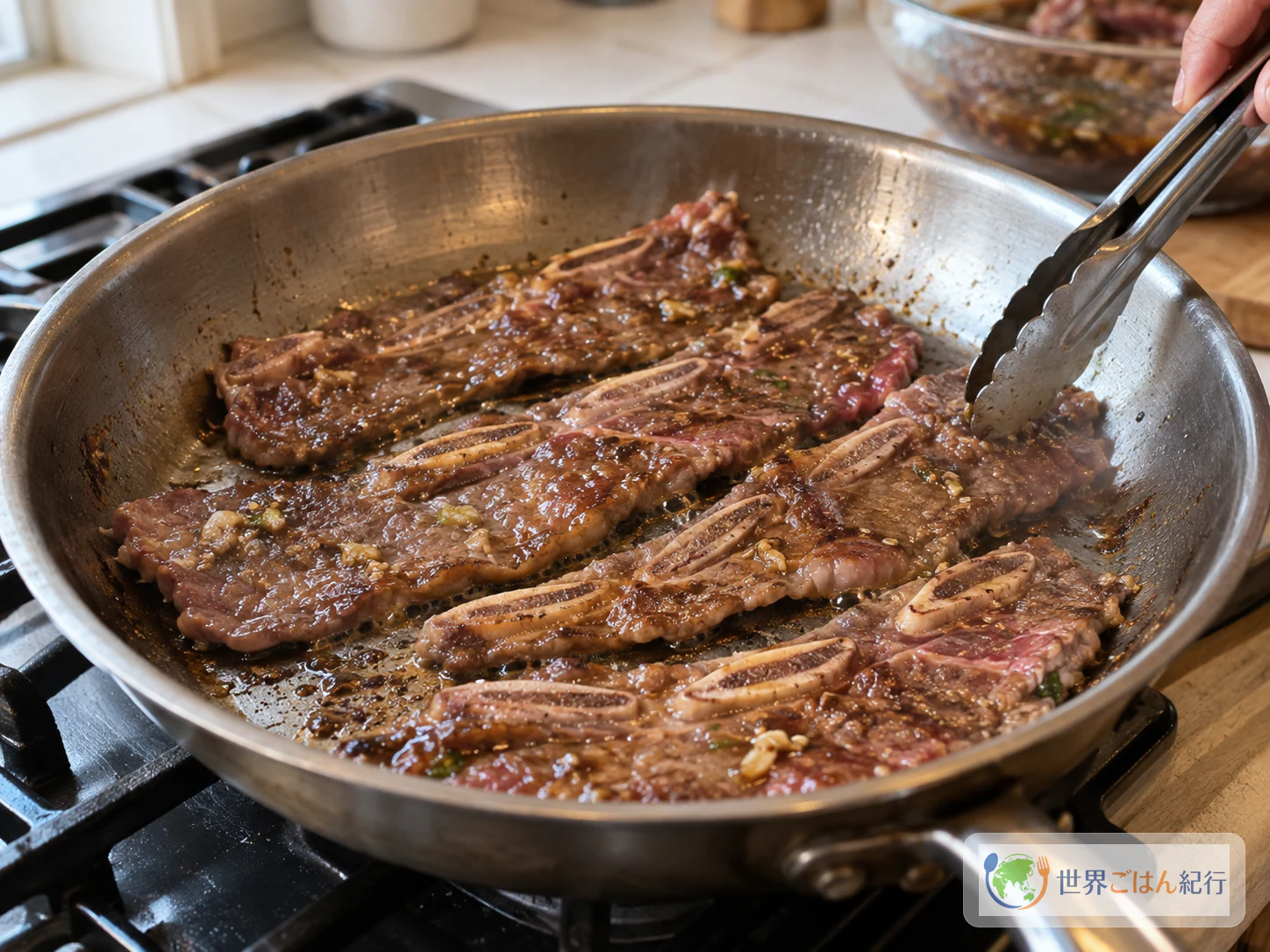
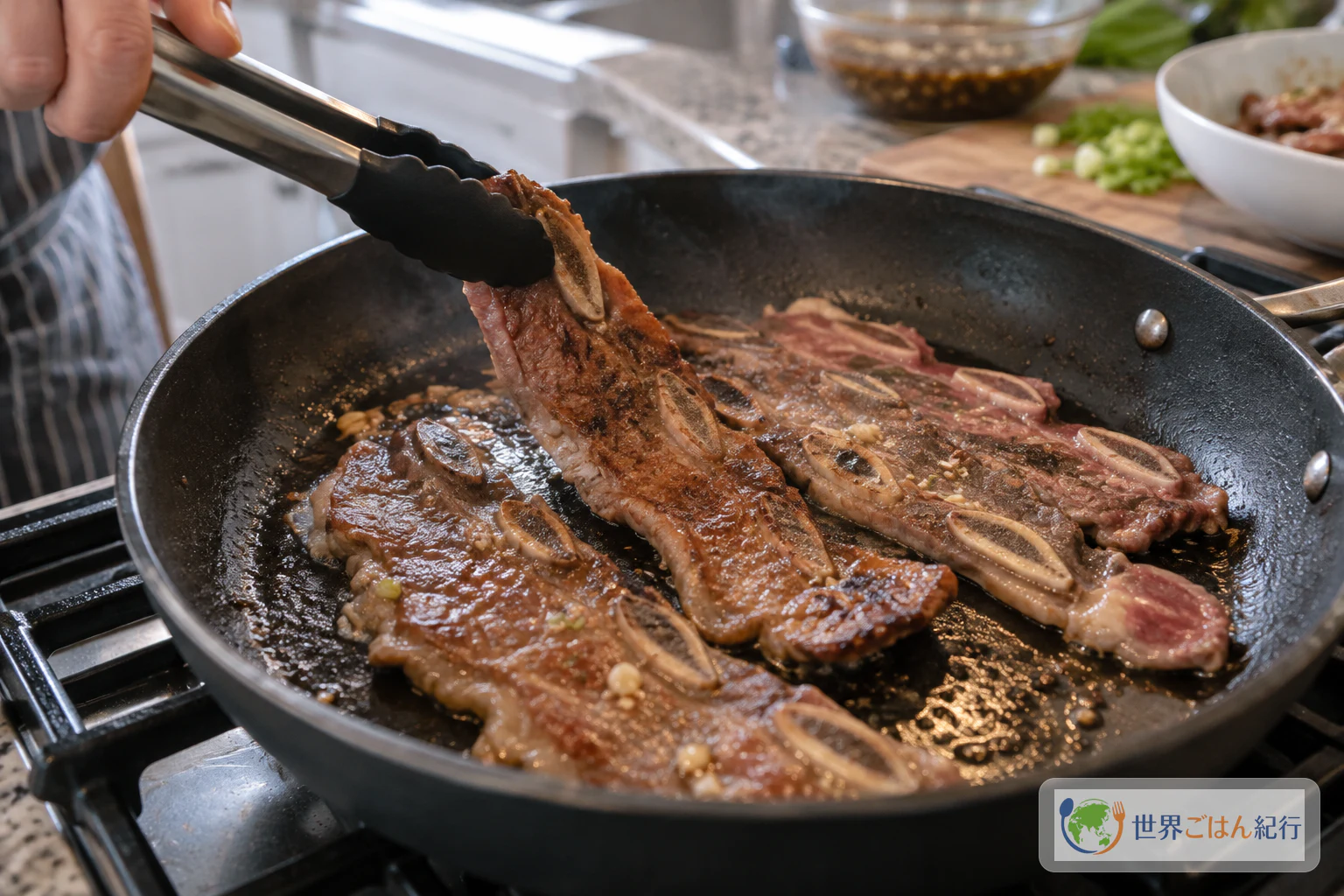
Lay a strip of LA galbi in a hot pan and you can see what makes it different: along one edge sits a neat row of small, oval bone cross-sections, and around them the meat is thin enough that the sweet-salty marinade starts to darken within moments. This is galbi (갈비) cut the "LA" way, also called flanken cut. Korea's official tourism organization, VISITKOREA, describes it as beef short ribs sliced thin across the bone, rinsed of bone fragments, soaked overnight in a fruit-sweetened soy marinade and then grilled.
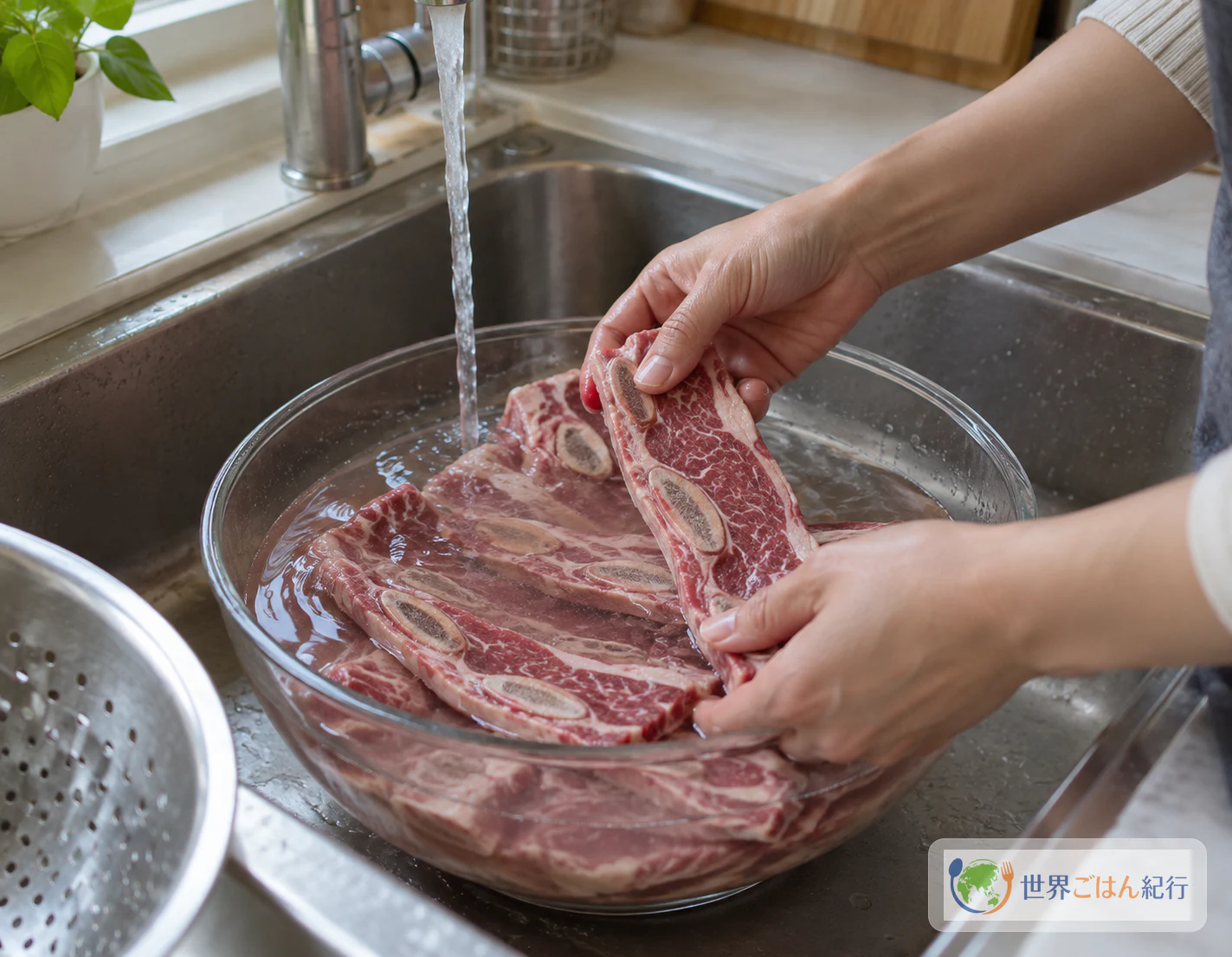
That thinness is what makes the cut easy to handle at home, and it is also where the tricky parts sit. Sawing across the bone can leave gritty fragments on the cut faces. The sugar in the marinade browns quickly and can tip into burning. And the meat sold as "kalbi" in many shops is not always this shape. Before getting to amounts, it helps to know that one word, galbi, covers more than one cut.
Korean Galbi and LA Galbi: What's the Difference?
Galbi refers to the ribs, and grilled galbi is galbi-gui (갈비구이). Korean Bapsang, a Korean home-cooking resource, explains that galbi is the word for ribs and that the grilled dish is called galbi-gui. That separates it from galbi-jjim (갈비찜), which VISITKOREA describes as bone-in beef or pork ribs braised in a soy-based sauce. Galbi-jjim is a braise with its own ingredients and method; this article is about grilling, and the two are not mixed here. Nor is this dak-galbi, the spicy chicken stir-fry whose name sounds similar (see dakgalbi).
Grilled galbi itself comes in more than one cut. Korean Bapsang describes a traditional style that starts from thicker English-cut short ribs, with the meat opened out along the bone. LA galbi is the other approach: the ribs are sliced thin across the bones, so each piece carries several bone cross-sections in a row. This recipe uses the LA cut.
Where the "LA" comes from is not settled. VISITKOREA presents the theory that the style began among Koreans living in Los Angeles as the leading one, while also noting that several theories exist. It is best read as a likely story rather than a confirmed origin.
Where Japanese Yakiniku "Kalbi" Meets Korean Galbi
The word "kalbi" is also familiar from yakiniku restaurants in Japan, but the meat served under that name there is not necessarily the same thin, bone-in LA cut or the same marinade. The two overlap without being identical.
On the history of yakiniku, a 2015 interview with the honorary chairman of Japan's national yakiniku association, published by the Agriculture & Livestock Industries Corporation (ALIC), describes today's yakiniku restaurants as taking shape shortly after the Second World War, and yakiniku as a food culture that carries Korean-derived elements while developing in its own way in Japan. The same interview presents dipping grilled meat into a sauce as the Japanese style. This is the view of someone from the industry, not a final verdict from food historians.
This recipe cooks Korean-style LA galbi, adapted for an ordinary home kitchen and frying pan. For another Korean marinated beef dish with a different cut and cooking method, see bulgogi.
Ingredients: One Recipe, Kept Whole
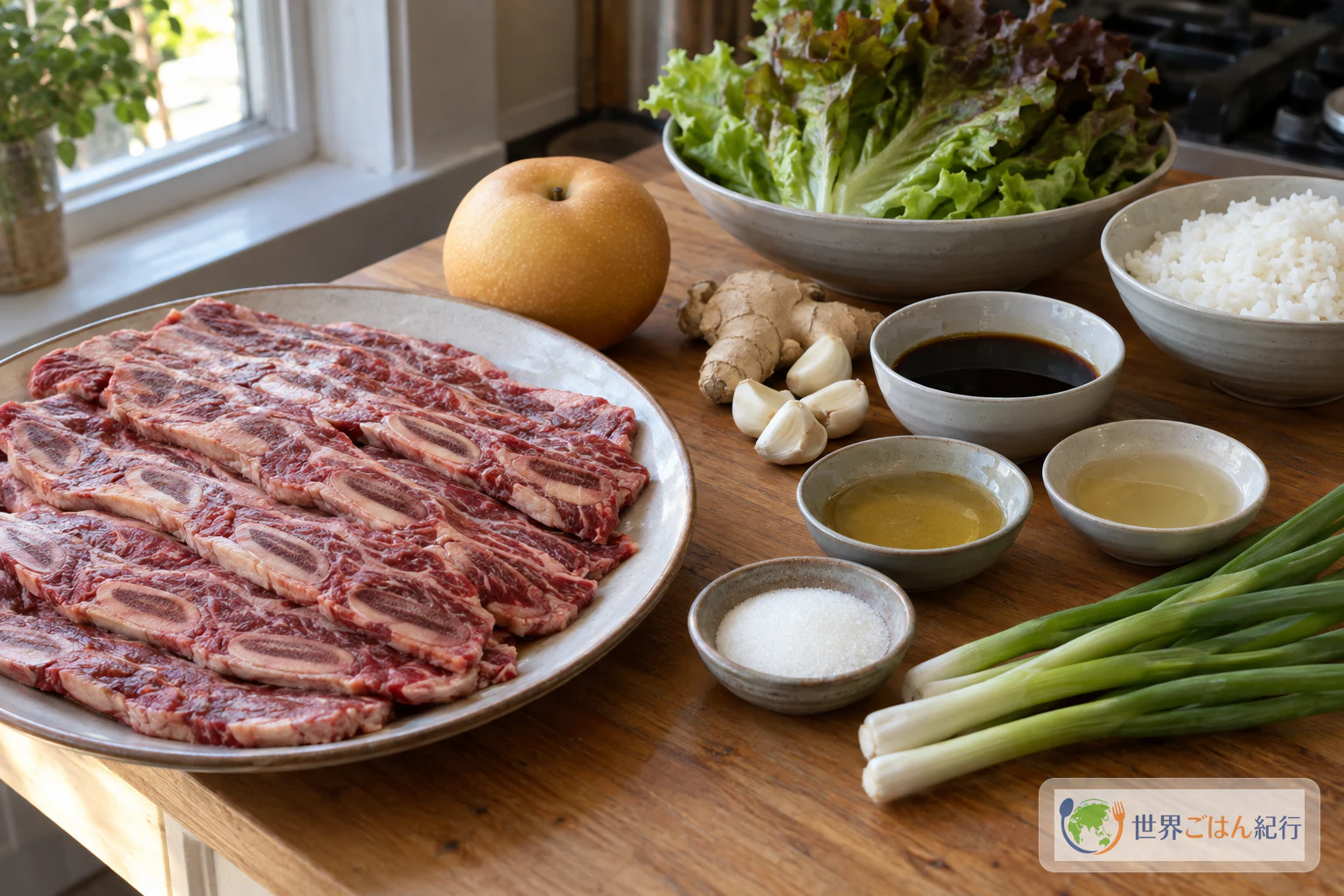
These are Korean BBQ short ribs (yangnyeom galbi) for 4 servings. How far 1 lb of bone-in ribs goes at your table depends on how much rice, lettuce and how many side dishes you serve alongside.
Choosing and Substituting: Cut, Pear and Seasonings
The cut matters most. Ask a butcher or a Korean grocery for LA galbi or flanken-cut bone-in short ribs. Boneless "kalbi" or boneless short rib can be used, but treat the result as a different, simplified dish: the texture and look change, and the cooking times in this recipe do not carry over.
Pear. The recipe calls for Asian (Korean) pear. If you can't find one, a grated Japanese nashi pear such as Kosui or Hosui is a practical stand-in, but sweetness and juiciness vary by variety and it will not taste identical. Korean Bapsang gives apple as a substitute for Korean pear; the pear aroma shifts toward apple. The same resource notes that kiwi and pineapple have a strong tenderizing effect and should only be used in small amounts, so they are not suggested here as substitutes for a long 12–24 hour marinade.
Onion. Some galbi marinades include onion; VISITKOREA's description, for example, uses pear and onion. The Food Network recipe used here has no onion. If you want to try an onion-based version, treat it as a separate recipe rather than adding onion to this one.
Mirin and sake. Keep both: mirin brings sweetness, sake brings liquid and aroma, and dropping one changes both flavor and consistency. If you use Japanese mirin, taste rather than cutting the sugar on your own. Japanese drinking sake works, though the flavor may not match exactly. Some cooking sake contains added salt, so check the label and keep in mind that the soy sauce already brings salt. Do not assume the alcohol in the sake and mirin is completely cooked off.
Soy sauce. Regular dark (koikuchi-style) soy sauce is a reasonable baseline; other types change the color and saltiness.
Oil. A neutral vegetable or grapeseed oil works. Swapping in strongly flavored sesame oil changes the dish, so avoid doing it across the board.
Soy sauce contains soy. Store-bought dipping sauces and ssamjang served at the table may contain soy, sesame, wheat and other allergens, so check their labels. Soy sauce and cooking sake also vary by product. For anyone allergic to pear or apple, switching to another fruit does not solve the problem; don't push a different fruit as a fix.
Equipment
- Food processor (optional; a grater and knife also work)
- Bowl for rinsing the ribs
- Paper towels
- Clean lidded container for marinating
- Colander or strainer for draining
- Frying pan
- Tongs for raw meat, kept separate from utensils for cooked meat
- Separate plates for raw and cooked meat
Method: Rinse, Marinate Overnight, Sear Hot
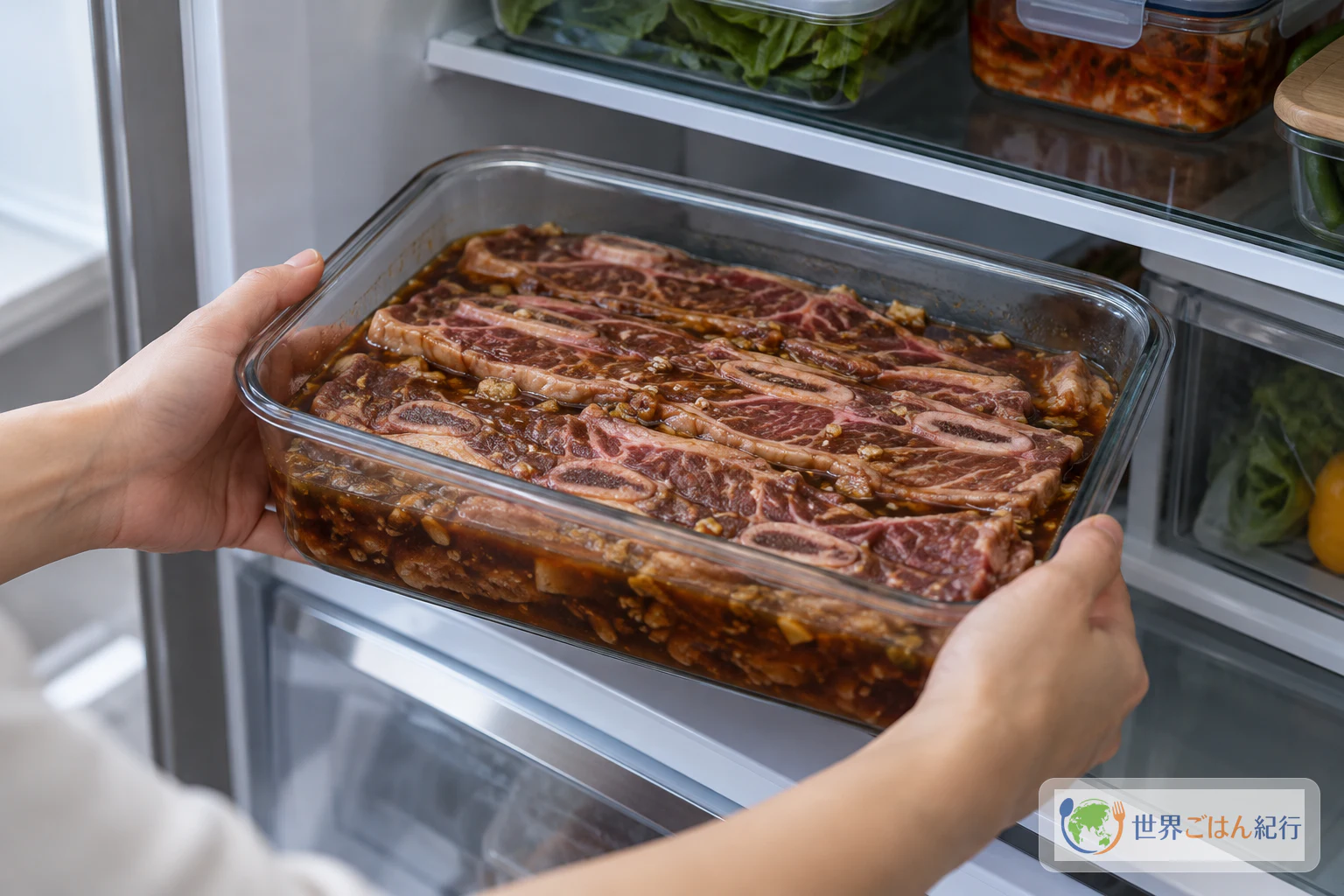
Rinse and marinate the ribs the day before; the meat needs 12–24 hours in the refrigerator. Searing takes only minutes per batch, so have the scallions, lettuce, rice and serving plates ready before the meat goes in the pan.
The times below are guides only. Thickness, heat and your pan all change how fast the meat cooks, so cook until it is done through to the center, including the parts near the bone.
Common Problems and How to Fix Them
| Problem | Main cause | What to do |
|---|---|---|
| Gritty bits of bone | Fragments left from cutting across the bone | Rinse the cut faces around each bone carefully before marinating, without spraying water around the kitchen |
| The glaze burns | Sugar in the marinade, too much marinade left on the meat, a crowded pan | Drain the meat well, cook in a single layer, lower the heat if needed, and wipe burnt marinade out of the pan between batches |
| The meat is tough | A cut too thick for a quick sear, or a strong tenderizing fruit used for a long marinade | Choose bone-in ribs cut thin enough for this method; thick pieces fall outside these short cooking times. Don't use kiwi or pineapple in large amounts or for long marinades |
| Too salty or too sweet | Mixing in amounts from other recipes, product differences in soy sauce or cooking sake | Keep to this recipe's ratios, check the salt in your cooking sake, and adjust at the table with lettuce, rice or a separate sauce rather than reworking the marinade |
Variations
- Japanese pear instead of Asian pear: Easier to find. Juice and sweetness differ by variety, so the result is close but not identical.
- Apple instead of pear: A substitute Korean Bapsang gives for Korean pear. The fruit aroma moves away from pear.
- Frying pan: The method in the source recipe, and the easiest to manage with home equipment.
- Grill: The source recipe also notes grilling. Preheat the grate thoroughly and oil it. Over a grill it is easy to watch for burning, but the same rule holds: cook through to the center.
- Thicker English-cut ribs, opened out: A different galbi style. Don't reuse this LA-cut recipe's times or marinade amounts for it as they are.
At the Table: Lettuce Wraps, Rice, and Separate Sauces
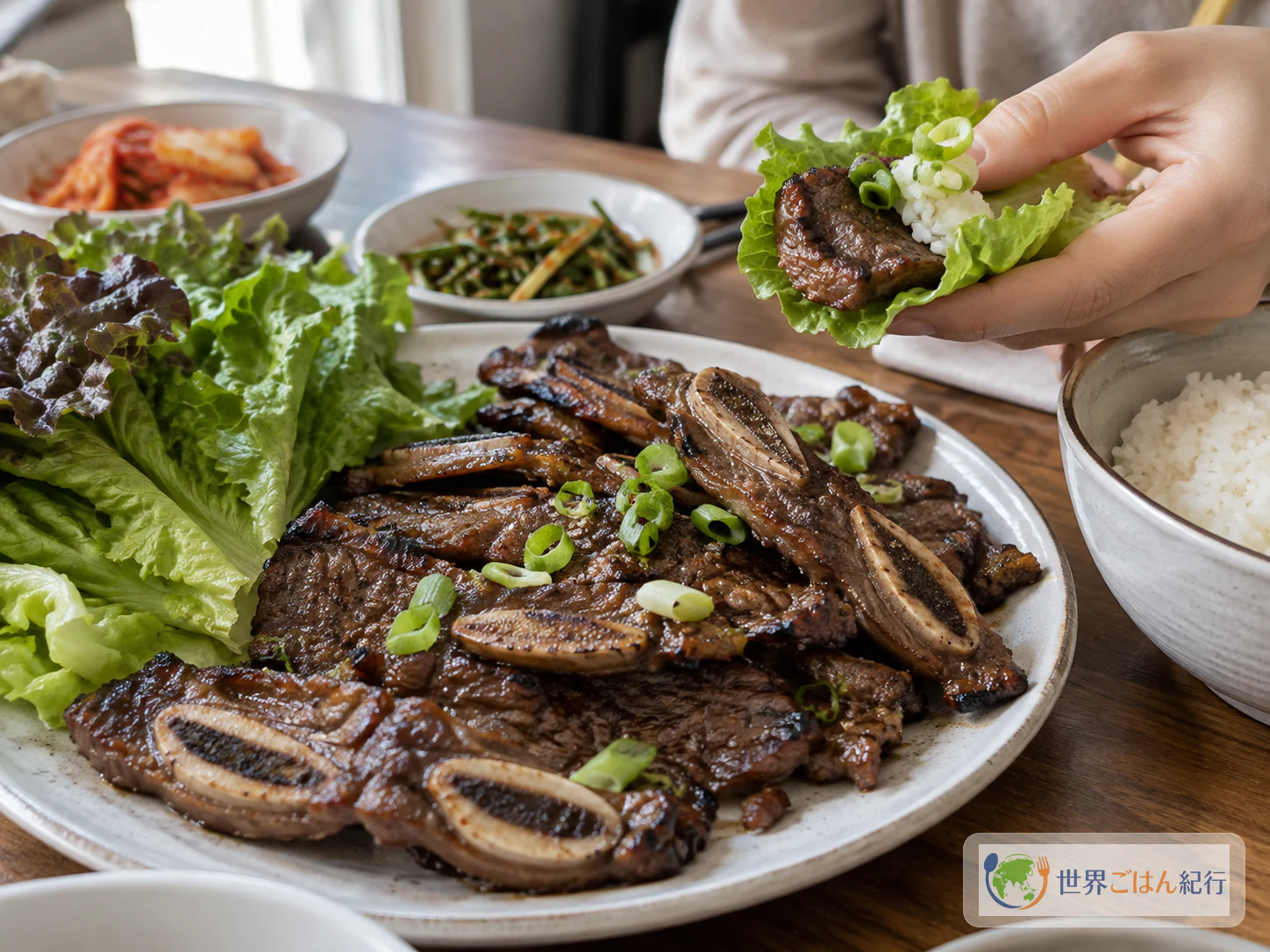
VISITKOREA gives Chuseok and Seollal as examples of holidays when LA galbi is eaten. That is an example, not a rule that every household follows or that it is always eaten on those days. The source recipe serves galbi in lettuce wraps or with white rice, and Korean Bapsang describes wrapping the meat in lettuce with ssamjang. If you add ssamjang, check its label for allergens.
A Japanese-style table might instead put the galbi next to white rice with a dipping sauce on the side, close to the yakiniku habit of dipping grilled meat described in the ALIC interview. Neither arrangement is the one "correct" way; choose the one that suits your table. For a side dish, japchae is another Korean dish that fits alongside.
Storage and Kitchen Hygiene
Marinate only in the refrigerator, in a clean lidded container on a lower shelf, and don't leave raw meat out at room temperature for long. Keep separate utensils for raw meat and wash them every time they've been used; Japan's Ministry of Health, Labour and Welfare gives this guidance for restaurant kitchens, and it is a useful reference at home too.
Cook beef through to the center, and use separate chopsticks or tongs for raw and cooked meat, as Japan's Ministry of Agriculture, Forestry and Fisheries advises. Eat cooked galbi soon after cooking and don't leave it sitting at room temperature. This article doesn't give a specific number of days for keeping leftovers; follow official home food-storage guidance where you live.
Frequently Asked Questions
Can I make it without Korean pear?
Yes. A Japanese nashi pear is the closest stand-in, and apple is the next option, a substitute given by Korean Bapsang. Either works, but the aroma and sweetness won't be exactly the same as with Korean pear.
Can I use boneless kalbi instead?
You can make something tasty, but it is a different, simplified dish. The texture and look differ from bone-in LA galbi, and the cooking time changes too, so don't rely on this recipe's times. Cook until done through to the center.
Are LA galbi and "kalbi" the same thing?
Not always. LA galbi is sliced thin across the bone so that each piece shows several bone cross-sections. Other galbi uses thicker ribs with the meat opened out along the bone, and the "kalbi" at Japanese yakiniku restaurants may be a different cut again.
How is this different from Korean galbi-jjim?
Galbi-jjim is bone-in beef or pork ribs braised in a soy-based sauce. This recipe is galbi-gui, grilled ribs, and the two are different dishes with different methods.
Sources
- Korea Tourism Organization (VISITKOREA), "LAカルビ(LA갈비)" (LA Galbi). Describes LA galbi as a type of grilled beef rib, cut thin across the bone; rinsing off bone fragments; an overnight marinade of pear, onion, soy sauce, sugar, garlic and cooking wine before grilling; eating it on Chuseok and Seollal as examples; and the theory that the name began among Koreans in Los Angeles, presented as the leading one among several. https://japanese.visitkorea.or.kr/svc/contents/contentsView.do?vcontsId=181684
- Korean Bapsang, "Galbi (Korean BBQ Short Ribs)." Explains galbi as ribs and galbi-gui as the grilled dish; the traditional opened English-cut style versus the LA flanken cut; apple as a substitute for Korean pear and the strong tenderizing effect of kiwi and pineapple; and wrapping in lettuce with ssamjang. https://www.koreanbapsang.com/galbikalbi-korean-bbq-short-ribs/
- Food Network / Hooni Kim, "Korean BBQ Short Ribs (Yangnyeom Galbi)." The recipe used here: amounts for the short ribs, pear, ginger, garlic, sugar, mirin, soy sauce, sake and oil; refrigerating 12–24 hours; pan-searing over medium-high heat about 2 minutes on the first side and 1–2 minutes on the second; serving with lettuce or white rice. https://www.foodnetwork.com/fnk/recipes/korean-bbq-short-ribs-yangnyeom-galbi-7151579
- Agriculture & Livestock Industries Corporation (ALIC), "美味しく、楽しい焼肉料理で豊かな食生活をお客様に~焼肉は日本で育った食文化~" (interview with the honorary chairman of Japan's national yakiniku association). The interviewee's view that today's yakiniku restaurants took shape shortly after the war and developed independently in Japan with Korean-derived elements, and the Japanese style of dipping grilled meat in sauce. https://www.alic.go.jp/koho/mng01_000072.html
- Korea Tourism Organization (VISITKOREA), "Galbi jjim Recipe: Korean Food." Galbi-jjim as bone-in beef or pork ribs braised in a soy-based sauce, distinct from grilled galbi. https://english1.visitkorea.or.kr/enu/FOD/FO_EN_EC_Recipes.jsp?cid=1928286
- Ministry of Agriculture, Forestry and Fisheries of Japan, "安全に食事を楽しむ!肉、魚、野菜の調理法" (Safe cooking for meat, fish and vegetables). Cooking beef through to the center and using separate chopsticks or tongs for raw and cooked meat. https://www.maff.go.jp/j/pr/aff/2506/spe1_02.html
- Ministry of Health, Labour and Welfare of Japan, "飲食店HACCP手引書 改訂第3版 交差汚染・二次汚染の防止" (HACCP guide for restaurants: preventing cross-contamination). Storing raw meat in lidded containers on a lower refrigerator shelf, and keeping raw-meat utensils separate and washing them each time; a restaurant guide used here as a reference for home hygiene. https://www.mhlw.go.jp/content/11130500/001198229.pdf