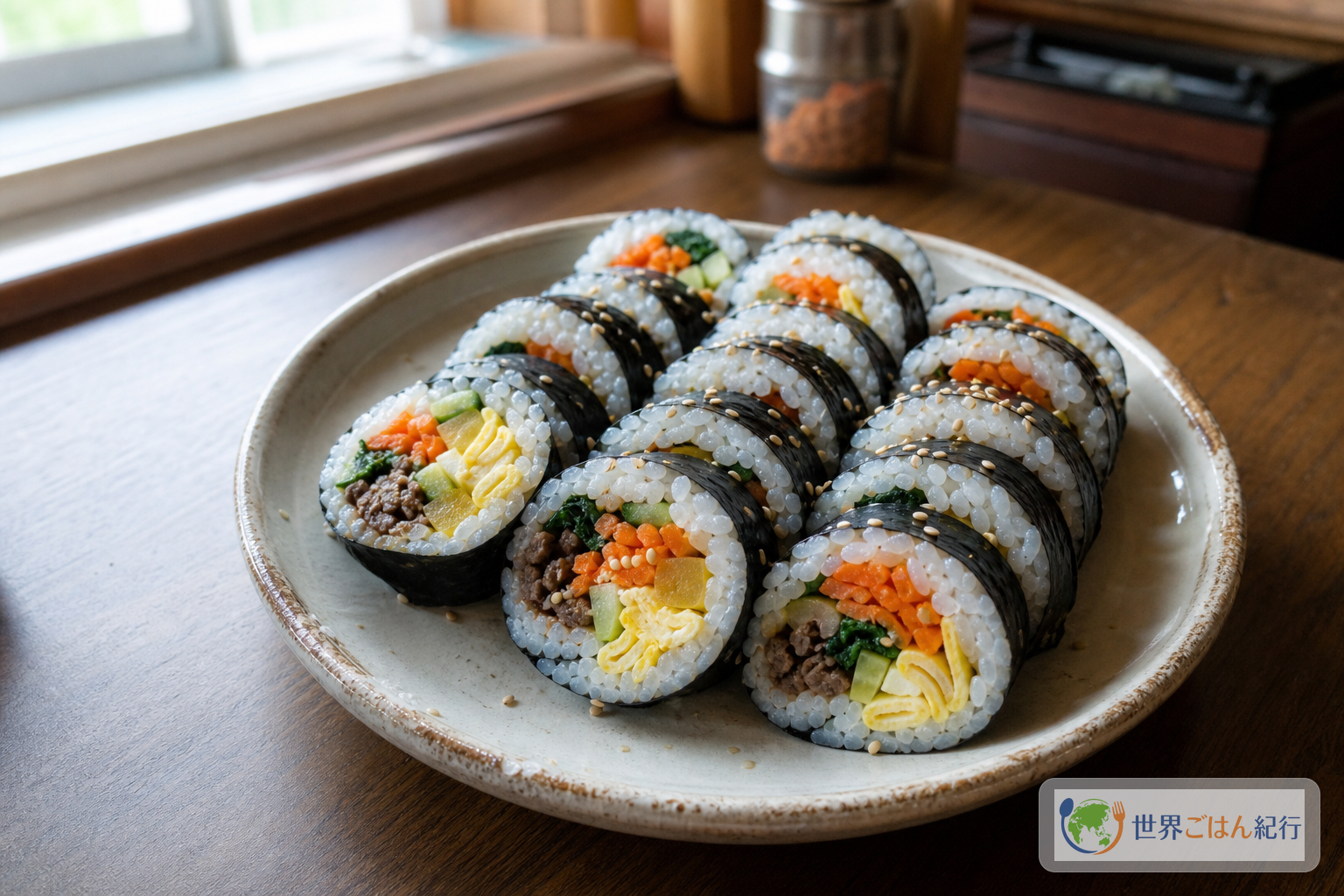




Sesame oil scent moves into the seaweed in the kitchen
In an evening kitchen, drop sesame oil onto freshly cooked rice and the aroma rises in a completely different direction from sushi rice. It is not the sharp smell of vinegar; it is a round aroma that receives toasted seaweed, stir-fried carrot, egg and the sweet saltiness of pickled radish. Even before it is rolled, gimbap already feels like a lunch box.
Gimbap (김밥, also written kimbap) is the Korean seaweed roll, from 김 (gim, seaweed) and 밥 (bap, rice). In Korea it is loved as a food for picnics, school trips, light lunches and potlucks, and the fillings change often from home to home and shop to shop. It looks close to Japanese maki sushi, but the big difference is that the rice is not seasoned with vinegar; it is dressed with sesame oil and salt.
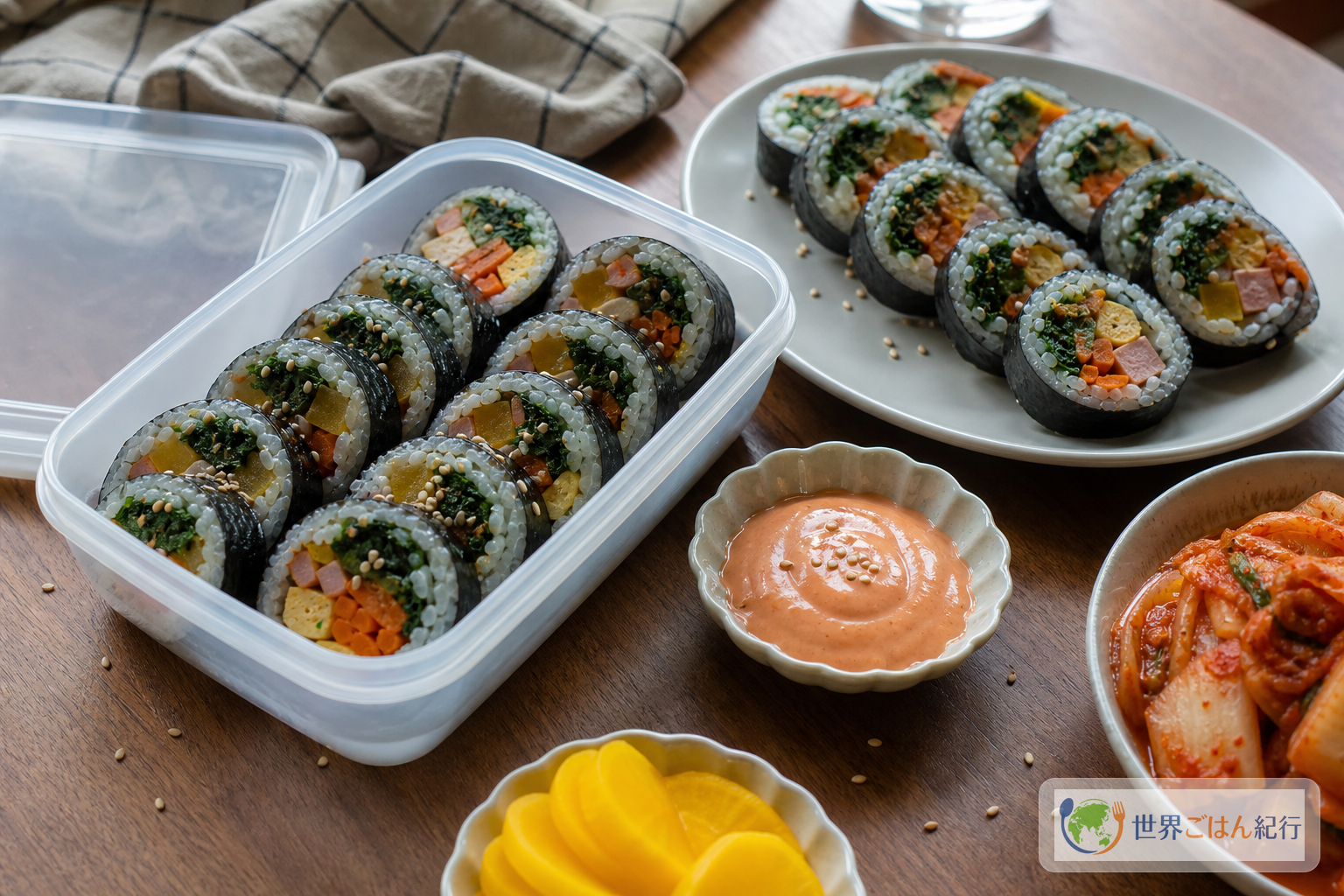
What is hard to get right is not gathering special seasonings but not leaving too much water in the fillings. Spinach that is squeezed too lightly wets the rice, carrots that are under-cooked stay hard, and pickled radish cut too thick splits at the end of the roll. Fix those, and you get quite close without a trip to a Korean grocery.
This article uses a home version of beef, egg, carrot, spinach, pickled radish and cucumber as its base. If you have danmuji (단무지, Korean yellow pickled radish), use it; if not, adjust ordinary pickled daikon for moisture and saltiness. For a day when you want plenty of meat, link it with bulgogi; to add more Korean rice dishes, bibimbap; to add a large-plate side dish, japchae, and the table comes together more easily.
In Korean it is written 김밥; in English, Gimbap or Kimbap. This article uses "gimbap" throughout. Rather than packing in as many fillings as a Korean specialty shop, it favors a thickness that is easy to roll in a home kitchen.
From the history of seaweed and rice to the school-trip lunch
Describing gimbap only as "Korean-style seaweed roll" loses a little of the dish's outline. The Korean 김밥 combines 김 (gim, seaweed) and 밥 (bap, rice). When modern gimbap was born as a single dish has not been settled. Some say it was influenced by Japanese maki sushi; others see the long-standing Korean custom of wrapping rice and side dishes in seaweed or leaves as having turned into the modern roll. The food-culture article in the Korean cultural magazine Koreana also calls the origin uncertain and presents records from several periods.
Seaweed itself was on Korean tables long before modern gimbap. A 15th-century geography text records seaweed as a product of Gyeongsang and Jeolla provinces. The 1849 Dongguk Sesigi (Record of Seasonal Customs) features gim-ssam and bok-ssam, rice and side dishes wrapped in seaweed or leaves. This is not a record that can be said to be the same form as gimbap today, but it shows that a foundation for eating seaweed and rice together existed before the cylindrical gimbap.
The seasoning changed too. A 1958 newspaper recipe presented by Koreana features "chobap," rice seasoned with vinegar, sugar and salt, spread on seaweed. In later recipes the vinegar dropped out, and a form spread in which the rice is seasoned with sesame oil and salt, and sometimes only sesame salt. So even though gimbap looks like maki sushi, the center of the bite is different. It does not bind the fillings with sourness; it layers the toastiness of seaweed, the round aroma of sesame oil and the light saltiness of egg and vegetables in one bite.
On when the modern cylindrical gimbap became widespread, the Korea Tourism Organization's food introduction says the 1960s to 1970s, explaining that it became the standard lunch for spring and autumn school trips. On the morning of the trip, a family cuts the fillings into long strips and nibbles the ends cut off at the finish of the roll. This memory, as the Tourism Organization tells it, conveys that gimbap was less a dish for special feasts than a lunch made by someone who knows the family's tastes. That there is no single right combination of fillings follows from the same.
Looking at regions shows more of gimbap's character as "one portable meal." In Tongyeong, South Gyeongsang Province, chungmu gimbap (충무김밥), named after the old place name Chungmu, is well known. It is described as having originated as a lunch for fishermen eating on boats: small, lightly seasoned seaweed rolls served with radish kimchi and seasoned squid on the side. Because nothing is packed inside the rice and seaweed, the cross-section and the way of eating differ from ordinary gimbap.
It is also interesting that the star filling changes by shop and region. A type with plenty of carrot is introduced for Jeonju, a type with thick egg for Gyeongju, a type with spicy squid for Busan, and a type with whole Pacific saury for Jeju. For a first batch, you do not need to reproduce every regional filling. Keep three things—don't turn the rice into vinegared rice, cut the fillings thin and even, and drain the water—and it stands up as a home version.
In other words, the axis of flavor to protect in your own kitchen is not "gathering every Korean filling." Cook the rice slightly firm, coat it lightly with sesame oil and salt, and cook each filling separately and let it cool. If you have no danmuji, ordinary pickled daikon is fine. But if you add vinegar and turn it into sushi rice, you move away from the aroma of gimbap. Whether to buy large Korean seaweed sheets or sesame oil is enough to decide next time by how close you want to bring this axis.
| Point of comparison | Gimbap | Maki sushi |
|---|---|---|
| Rice | Seasoned with sesame oil and salt | Sushi rice with vinegar, sugar and salt |
| Fillings | Mainly cooked meat, egg, vegetables and pickled radish | Raw fish, egg, cucumber, dried gourd strips and so on |
| When it is eaten | Lunch boxes, school trips, snacks, potlucks | Meals, celebrations, sushi restaurants, family events |
| Aroma | Sesame oil, seaweed, vegetables | Vinegared rice, seaweed, seafood |
| Where it tends to go wrong | Seaweed tears from moisture, loose roll | Temperature of the sushi rice, handling of seafood |
Gimbap gives great freedom in fillings. Maangchi's classic method uses carrot, egg, danmuji, spinach and beef, and Korean Bapsang also explains the idea of cooking the rice slightly firm and drying the fillings before rolling. This article translates that idea into ingredients that are easy to gather at an ordinary supermarket.
In Korean shops you also see variations beyond the basic form, such as chamchi gimbap (참치김밥) with tuna, cheese gimbap (치즈김밥) with cheese and maeun gimbap (매운김밥) with spicy fillings. Regional differences also show in whether the fillings are rolled in or served on the side, as with the chungmu gimbap mentioned in the background above. For a first batch at home, learning the roles of danmuji, egg, greens, carrot and meat is less likely to fail than adding more fillings.
To bring gimbap closer as a rice dish, it holds together better without vinegar. When you want sourness, serve kimchi, pickled radish or a light vinegared side at the table. Turning the rice itself into sushi rice weakens the aroma of Korean seaweed and sesame oil.
Ingredients: gimbap with ordinary supermarket ingredients

This makes 4 thick rolls, serving 4 as a lunch box, or about 6 if cut and arranged at a Korean meal. Use rice cooked slightly firm. Mixing freshly cooked rice takes on aroma easily, but putting it on seaweed while still steaming tears the sheet, so season the rice last, after the fillings are ready.
This recipe may use ingredients containing egg, beef, soy, wheat and sesame. If you use soy sauce, gochujang, pickled radish or ham, some products contain wheat, soy, fish extract or coloring. If you have a food allergy, check the ingredient labels.
If you can't get danmuji, you can make it with ordinary pickled daikon. If it is very sweet, rinse it in water for 10 seconds, pat it dry and cut into 8 mm square sticks. Sticks keep the center from shifting when rolled better than stacked thin slices.
Shopping: Korean ingredients worth seeking out

Eggs, carrots, spinach, cucumber and beef are fine from a nearby grocery. What is worth adding are strongly aromatic Korean sesame oil, large seaweed sheets, and gochujang for changing the flavor at the table. Danmuji brings you closer, but rather than hunting for it on a first try, adjusting ordinary pickled daikon for thickness and moisture is less likely to fail.
| What to buy | Priority | Reason |
|---|---|---|
| Korean sesame oil | High | Supports the aroma of the rice, fillings and finish |
| Large Korean seaweed or toasted nori sheets | High | Small seasoned packs can't be rolled |
| Gochujang | Medium | Not needed for basic gimbap, but it can go into variation sauces and a Korean menu |
| Bamboo rolling mat | Medium | Plastic wrap works too, but a mat makes an even shape easier |
| Danmuji | Medium | Worth a look if there is a Korean grocery nearby |
Sesame oil sets the aroma of the rice
The rice in gimbap puts the aroma of sesame oil up front. The condition for buying it is that you will use it not only for gimbap but also for spinach namul and bulgogi, and finish it before the aroma fades after opening. If you are rolling 4 rolls only once, toasted sesame oil you already have is enough, so skip buying a large set.
Choose large seaweed sheets first
Large seaweed sheets directly determine whether you can roll. Small seasoned snack packs are handy to put on the table, but they crack from oil and salt and are hard to handle on a rolling mat. For gimbap, choose large sheets.
If your household uses seaweed for rice balls and regular meals, a bulk pack is a candidate, but for just 4 rolls skip it. Check the number of sheets, the number of individual packs and whether it is seasoned, and if large toasted nori you already have rolls well, no extra purchase is needed.
Don't roll in the heat; add it at the table
Gochujang is not a seasoning that goes inside basic gimbap. The condition for buying is that someone will add heat at the table, and that you can use it next day for tteokbokki or kimchi jjigae. Check the capacity and ingredients on the label. If you don't cook spicy dishes, or are rolling only for children, the dish stands without the sauce too.
Instructions: spread thin and don't roll too hard
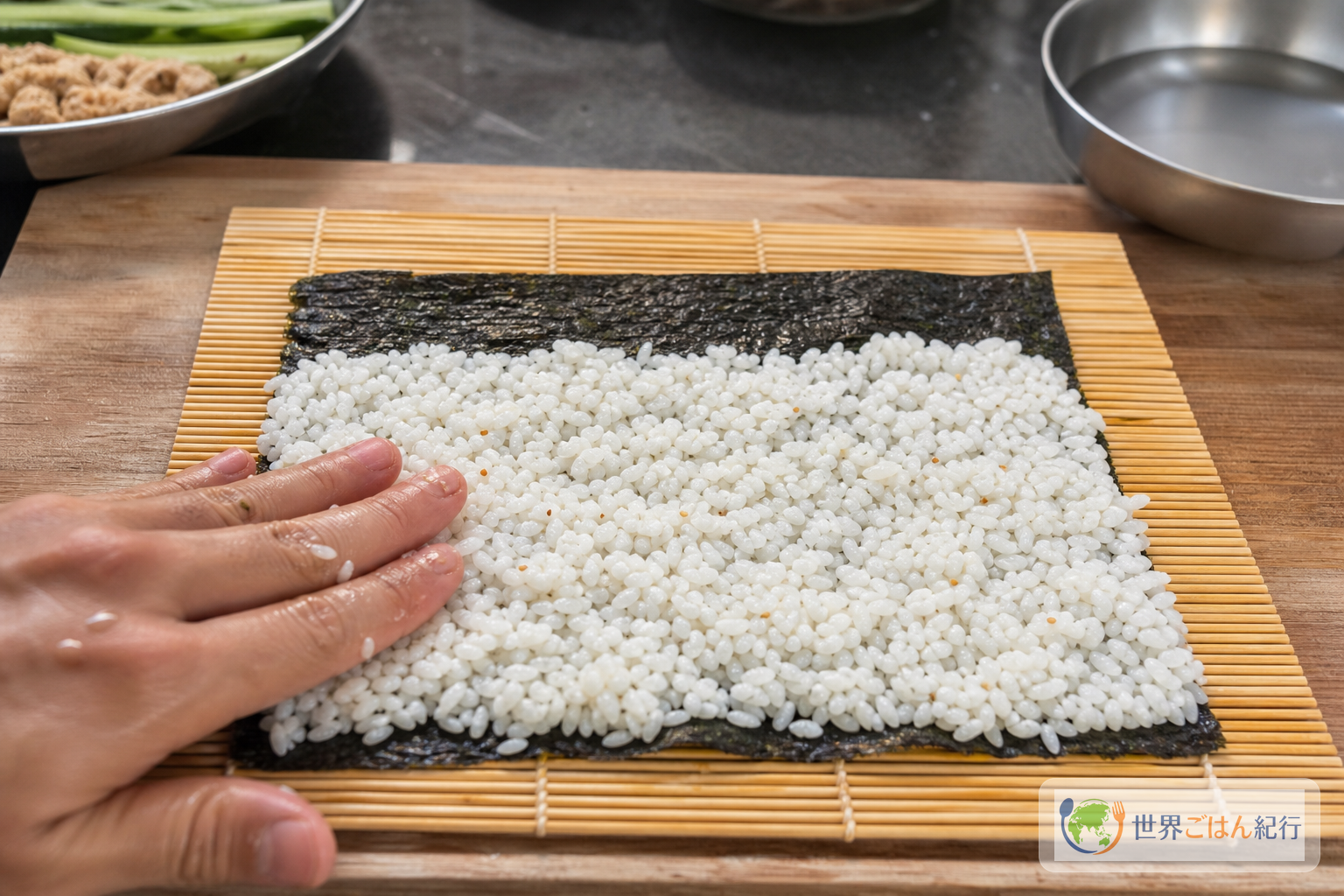
Gimbap is a "rolling" dish, but whether it succeeds is decided before rolling. Thin rice, thin fillings, little water, and heat cooled off. When those four line up, the shape holds without crushing it by force.
Gimbap suits lunch boxes, but because it uses egg, meat and greens, it is not something to leave long at room temperature. Eat it soon after making; if you pack it for a lunch box, cook the fillings thoroughly and cool them well before packing. Japan's Ministry of Agriculture, Forestry and Fisheries (MAFF) also advises draining water, cooling food before packing it into a lunch box and using ice packs for long carrying. See also MAFF's food-poisoning prevention for lunch boxes (in Japanese).
What goes wrong: fixing tearing, loosening and wateriness
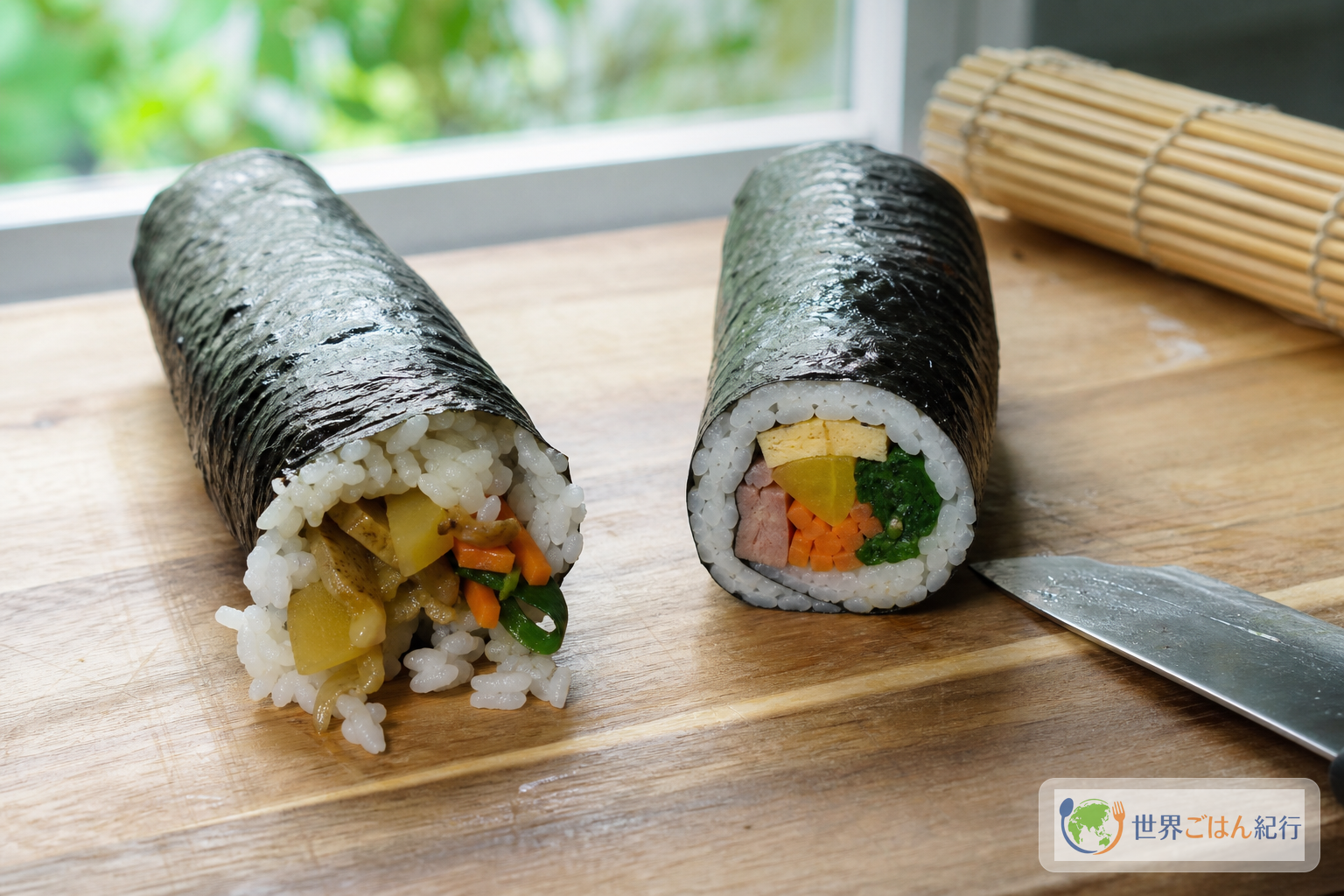
When the seaweed tears, the heat of the rice and the water in the fillings are the likely causes. Don't put rice on while steaming; cool it to a little hotter than body temperature. Squeeze the spinach with both hands, and for cucumber only when it is very watery, coat with 1/4 tsp salt, leave 5 minutes and wipe with paper. Drain the liquid from the pickled radish too and wipe the surface before using.
When the roll is loose, you have put the fillings too far into the center. Put them slightly nearer than center, where they can be enclosed at the first turn of the roll. Closing the fillings in with the first turn gives a cleaner cross-section than pressing hard on the mat many times. After rolling, resting it seam-side down for 3 minutes lets the seaweed absorb a little moisture from the rice and settle.
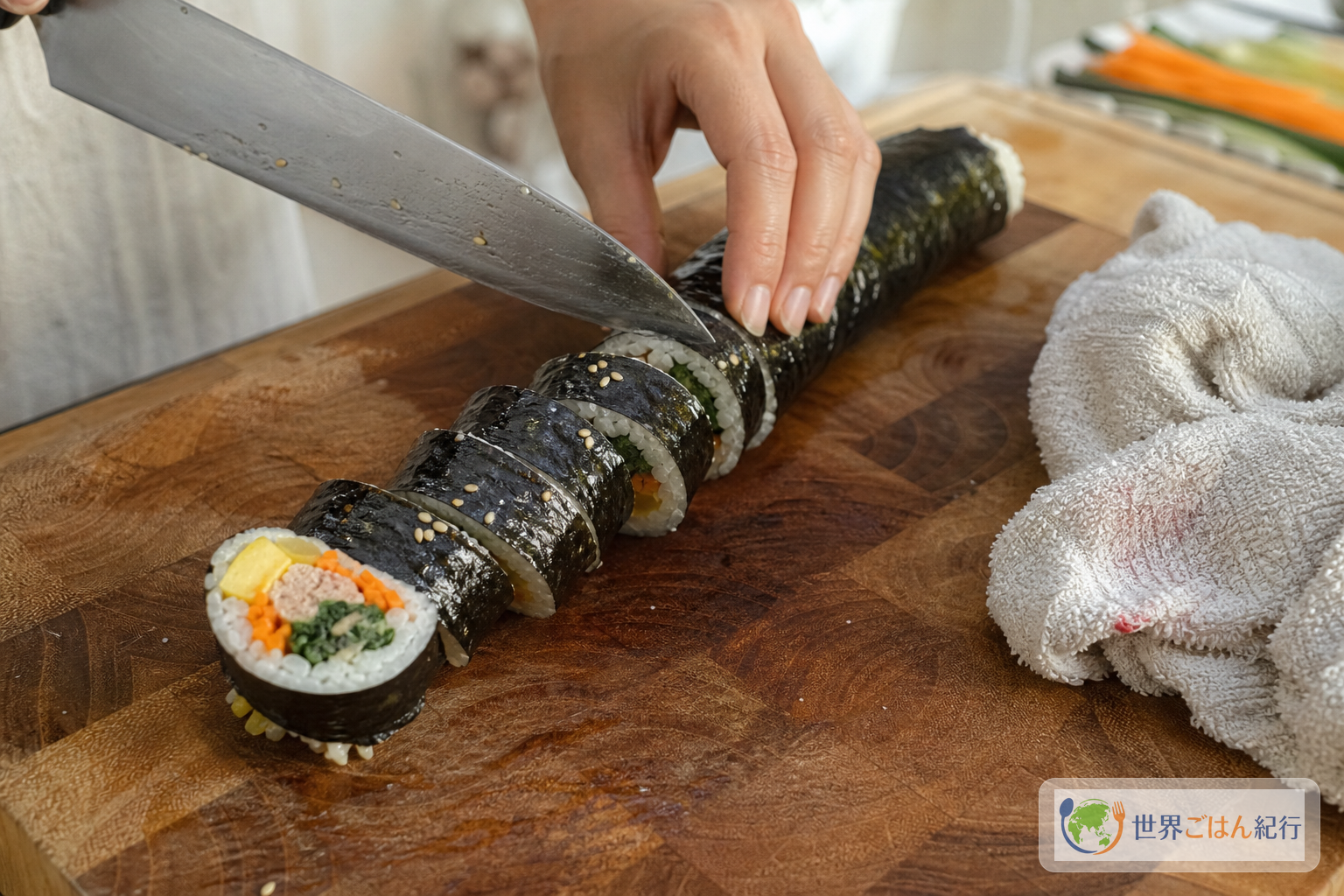
If it falls apart when cut, rice is stuck to the blade. Wipe it after each slice with a damp cloth or brush a thin film of sesame oil on it. Pressing straight down makes the fillings escape, so move the blade back and forth in long strokes as if slicing sashimi. About 2 cm wide is easy to handle, and slices cut too thin tip over under the weight of the fillings.
If the flavor is blurry, before adding more salt to the rice, look at the saltiness of each filling. Gimbap is not mixed as you eat, so the spinach, carrot, meat and rice each need a light flavor of their own. If only the meat is strong and the rice is plain, the taste varies bite to bite.
If you have leftover fillings, it is better not to force a thicker roll. When one roll exceeds 4 cm in diameter, a home knife has trouble cutting it. Move leftover fillings into the next day's bibimbap, or put them as a mild side dish next to doenjang jjigae.
How to eat it and keep it: lunch boxes, picnics, reviving the next day

Gimbap tastes best when the freshly made seaweed is slightly firm and the rice is still fluffy. Served at the table, aim to eat within 20 minutes of cutting. For a lunch box, cook the meat and egg all the way through, cool the fillings before rolling, and arrange the cut gimbap without packing it tight so the cross-sections aren't crushed.
To refrigerate, put cut gimbap in a shallow container and cover it so it doesn't dry out. The guide is from the day to the next day. In the refrigerator the rice hardens and the seaweed softens. To revive it deliciously, beat 1 egg, coat the cut faces lightly, and cook in a skillet with 1 tsp oil over medium-low heat for 2 minutes, then turn and cook 1 minute. Stop when the egg is set and the surface is lightly warmed.
Reviving it in the microwave alone tends to dampen the seaweed. If you must, arrange on a heatproof plate, loosely cover with plastic wrap and heat at 600 W for only 20 to 30 seconds. Aim just to take the chill off the rice rather than make it hot. Overheating releases water from the pickled radish and cucumber and collapses the cross-section.
For a menu, red dishes go well with mild gimbap. Serve tteokbokki in small bowls for a street-stall feel, or kimchi jjigae for a satisfying lunch. On days when you want less heat, finish with japchae and a soup such as seaweed soup.
Frequently asked questions
Can I make it with Japanese toasted nori instead of Korean seaweed?
Yes. If you use Japanese toasted nori, don't brush sesame oil on it before rolling; adjust the aroma on the rice side. Small seasoned Korean seaweed snack packs are thin and crack easily, so they suit serving at the table more than rolling in.
What can I substitute when I don't have danmuji?
Ordinary pickled daikon (takuan) can stand in. If it is very sweet, dip it in water for about 10 seconds, pat the surface dry and cut into 8 mm squares. Pickled red shiba-zuke and quick cucumber pickles are very watery and change the color and taste of the cross-section, so takuan is easier on a first try.
Can I make it without beef?
Yes. Ham, fish sausage, tuna crumble or thick fried tofu can substitute. If you use tuna, drain the oil well, and stir-fry it with 1 tsp soy sauce, 1/2 tsp sugar and 1/2 tsp sesame oil to drive off water. Cut the fried tofu into 1 cm square sticks and cook over medium heat 2 minutes on each side before using.
Can I prepare the fillings the day before?
Yes. Make the spinach, carrot, beef and egg the day before and refrigerate in separate containers. Seasoning the rice and rolling suit the day itself. Rolling the day before dampens the seaweed and hardens the rice, so for a lunch box too, rolling in the morning looks better.
What if I don't have a rolling mat?
Plastic wrap and a clean cloth can stand in. Lay down a double layer of plastic wrap, put the seaweed on it and roll. Plastic wrap alone tends to concentrate force at one point, so after rolling, wrap the whole in the cloth and lightly even out the thickness of the cylinder. If you will make it often, a mat is steadier.
Is there a way to make it not spicy for children?
Basic gimbap is not spicy. Don't roll the gochujang sauce in; serve it at the table for adults only. For children, use a little less salt in the rice and rely on the saltiness of the pickled radish. If they dislike cucumber, increase the egg and carrot slightly.
Sources
For the history and local tables, I mainly checked Korean public tourism information and a cultural magazine. Koreana covers old records of seaweed, modern seasoning, Tongyeong's chungmu gimbap and regional differences in fillings. The Korea Tourism Organization presents its establishment as a school-trip lunch in the 1960s and 1970s, and serving gimbap with soup or tteokbokki. Quantities and home steps were checked against the classic recipes of Korean Bapsang and Maangchi and adjusted for easy-to-find ingredients. Lunch-box storage follows the guidance of Japan's Ministry of Agriculture, Forestry and Fisheries.
- Koreana: Gimbap, Comfort Food in a Roll
- Korea.net: The Evolution of Korea's Rolled Rice Dish
- Korea Tourism Organization: Korean Food Story, Hansik
- Korea Tourism Organization: Do You Know Gimbap?
- Korean Bapsang: Kimbap Recipe
- Maangchi: Classic gimbap recipe
- Ministry of Agriculture, Forestry and Fisheries of Japan: Preventing food poisoning when making lunch boxes (in Japanese)