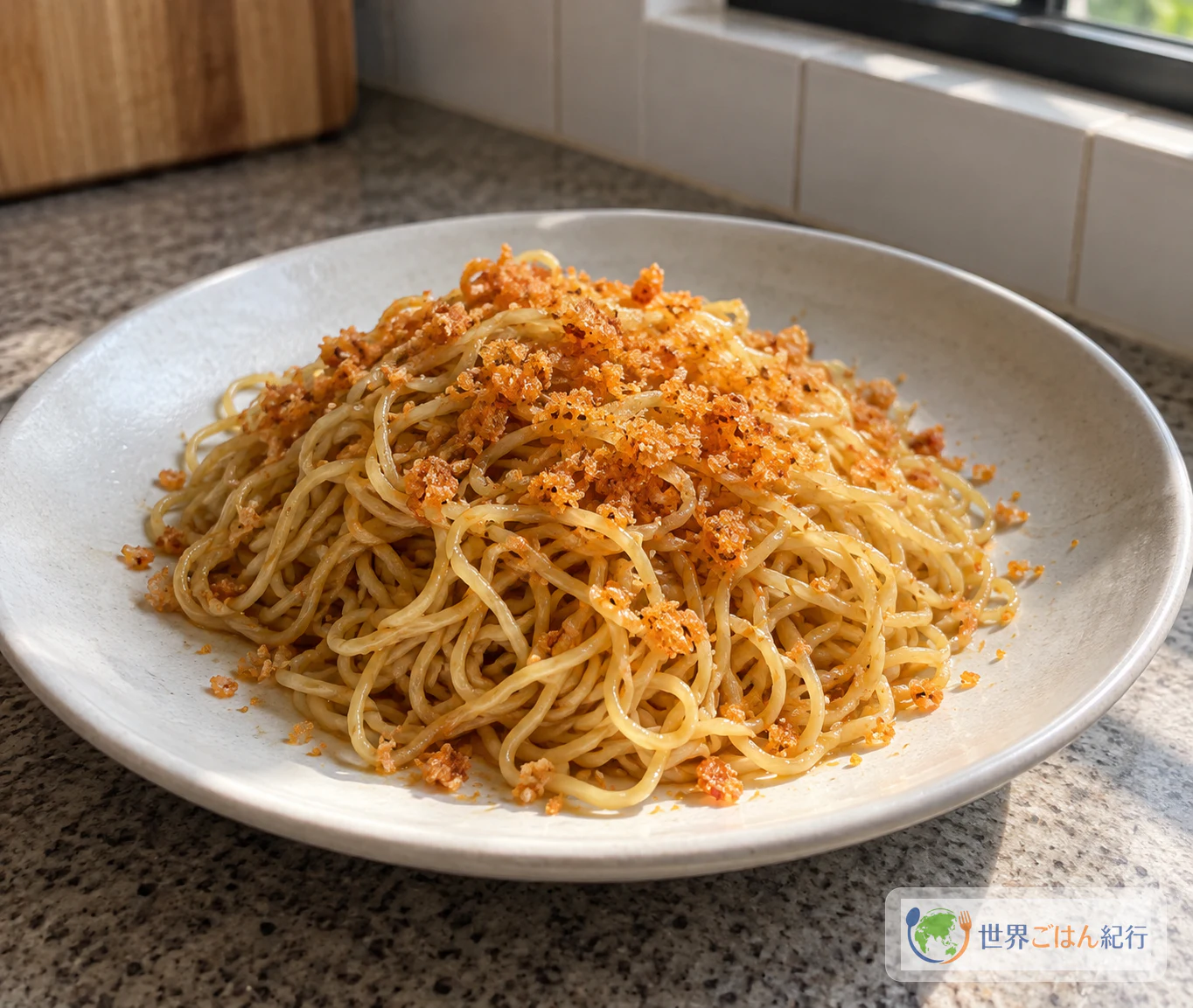
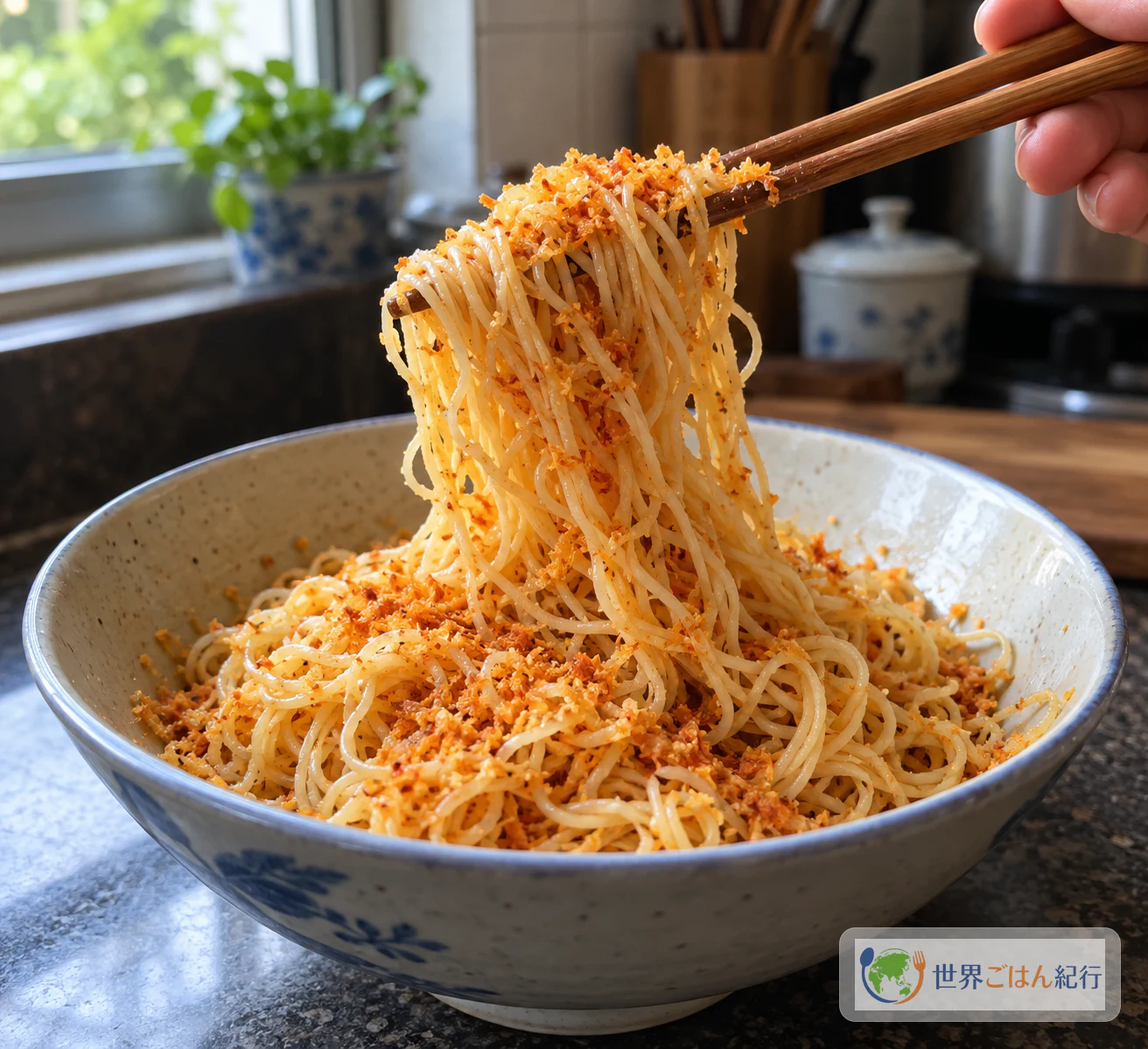
Shrimp Roe Noodles: Tiny Toasted Roe Against Springy Noodles
Fine, dry-toasted shrimp roe; thin noodles cooked only until the strands separate; and just enough fat and light soy sauce to coat them. Nothing else goes on the plate.
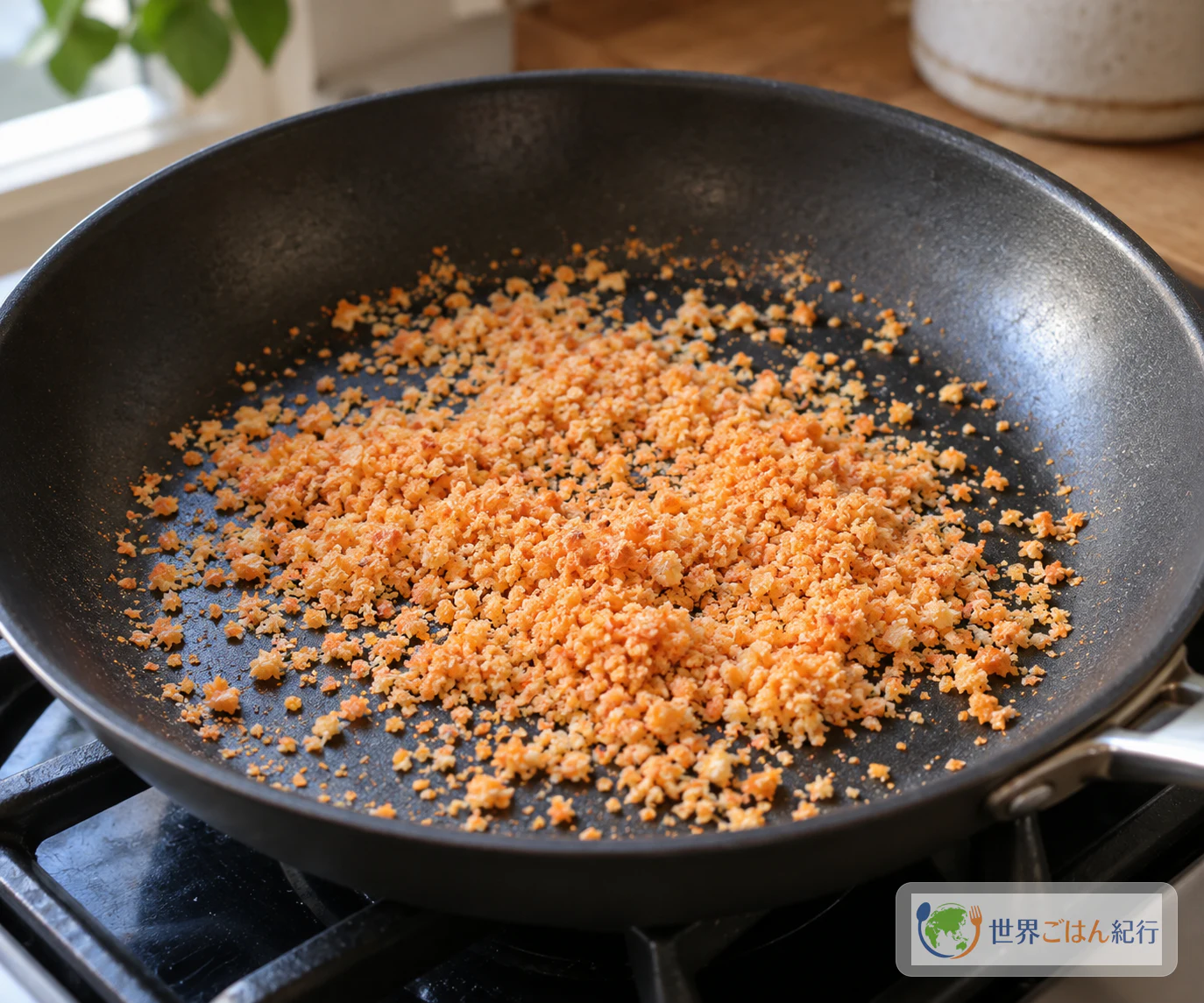
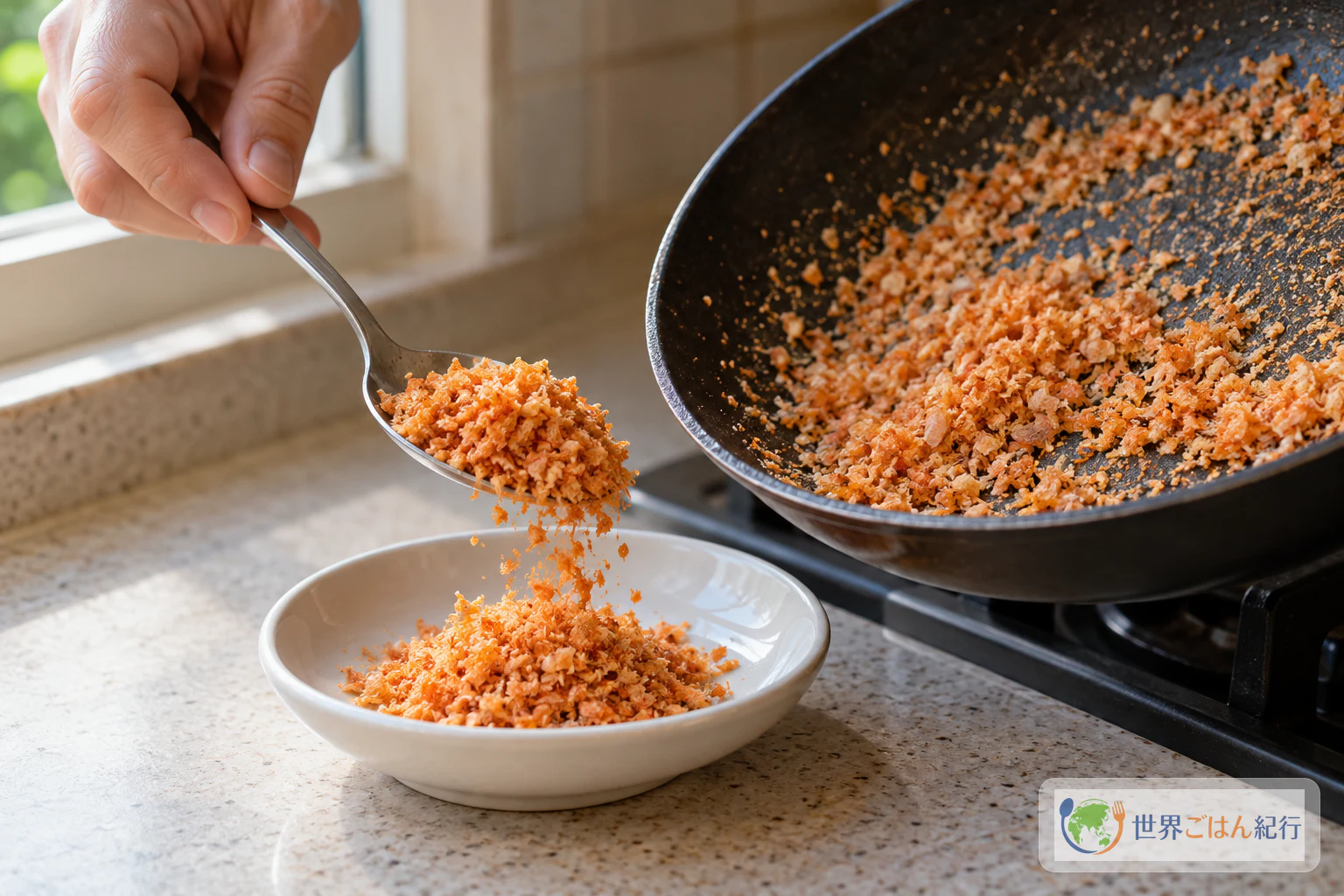
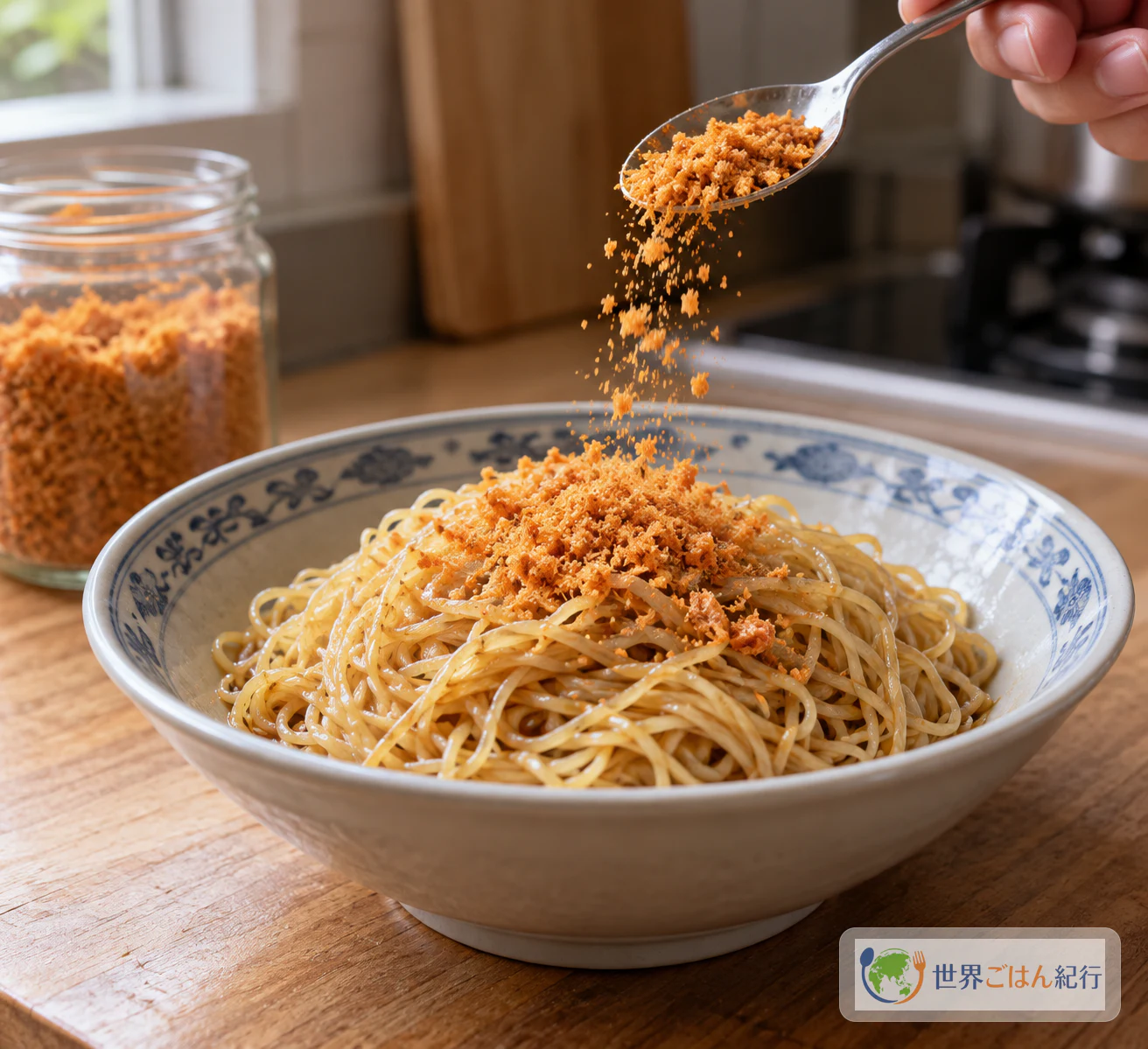
A dry pan, medium heat, and three-quarters of a tablespoon of reddish-orange powder. In the home recipe followed here, the shrimp roe is toasted on its own, with no oil and no water, until its aroma rises. The recipe's author, Wiffy of the food blog NoobCook, writes that dry-toasting the powder this way draws out its aroma and umami. The roe is then set aside while a single bundle of thin wonton noodles cooks, and it only meets the noodles at the very end.
The Macao Government Tourism Office (MGTO) lists dried shrimp roe noodles among Macao's local foods. Its short description pairs tiny shrimp roe, strong in salty sea flavor, with springy egg noodles. That page does not give a measured recipe, so the amounts and steps in this article come from one specific source: Wiffy's one-serving recipe, which the author titles Hong Kong Shrimp Roe Noodles. Wiffy writes that the dish originated in Macau and is also found in Hong Kong. That is the author's own account, not an independent history, and this recipe is presented as a Hong Kong home version, not as the single authentic Macao method.
This recipe has not been kitchen-tested by Sekai Gohan. The amounts and cues below follow the published home recipe; where it gives no number, this article does not supply one.
The dish appears as 蝦子撈麵, 蝦子麵 and 蝦籽麵. In English, look for "shrimp roe noodles" or "dried shrimp roe noodles", and for the topping itself, "dried shrimp roe powder".
Ingredients (Serves 1)
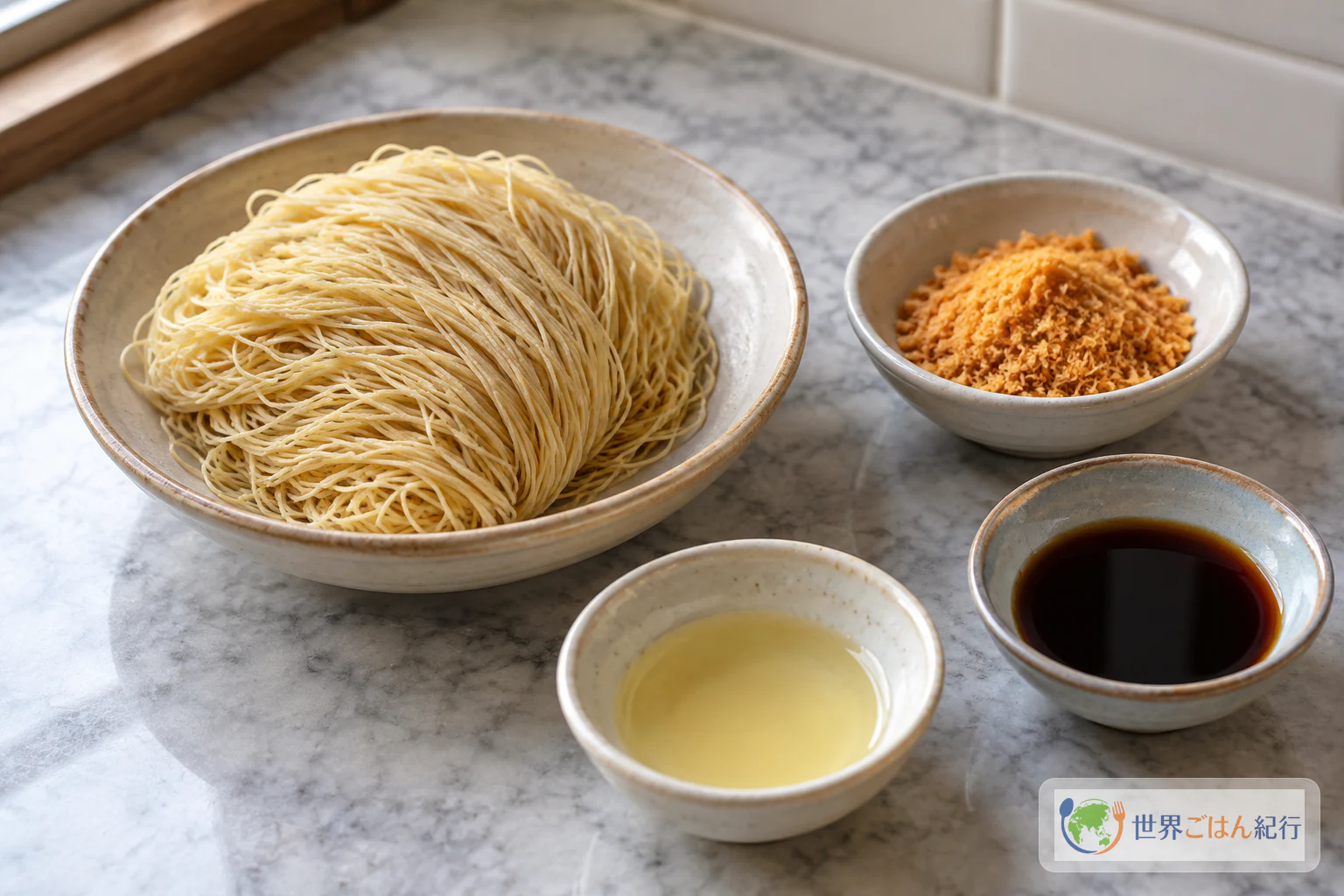
Equipment
- Dry skillet or frying pan
- Small saucer
- Pot for cooking the noodles
- Colander
- Serving plate
Choosing the Roe, Noodles and Fat
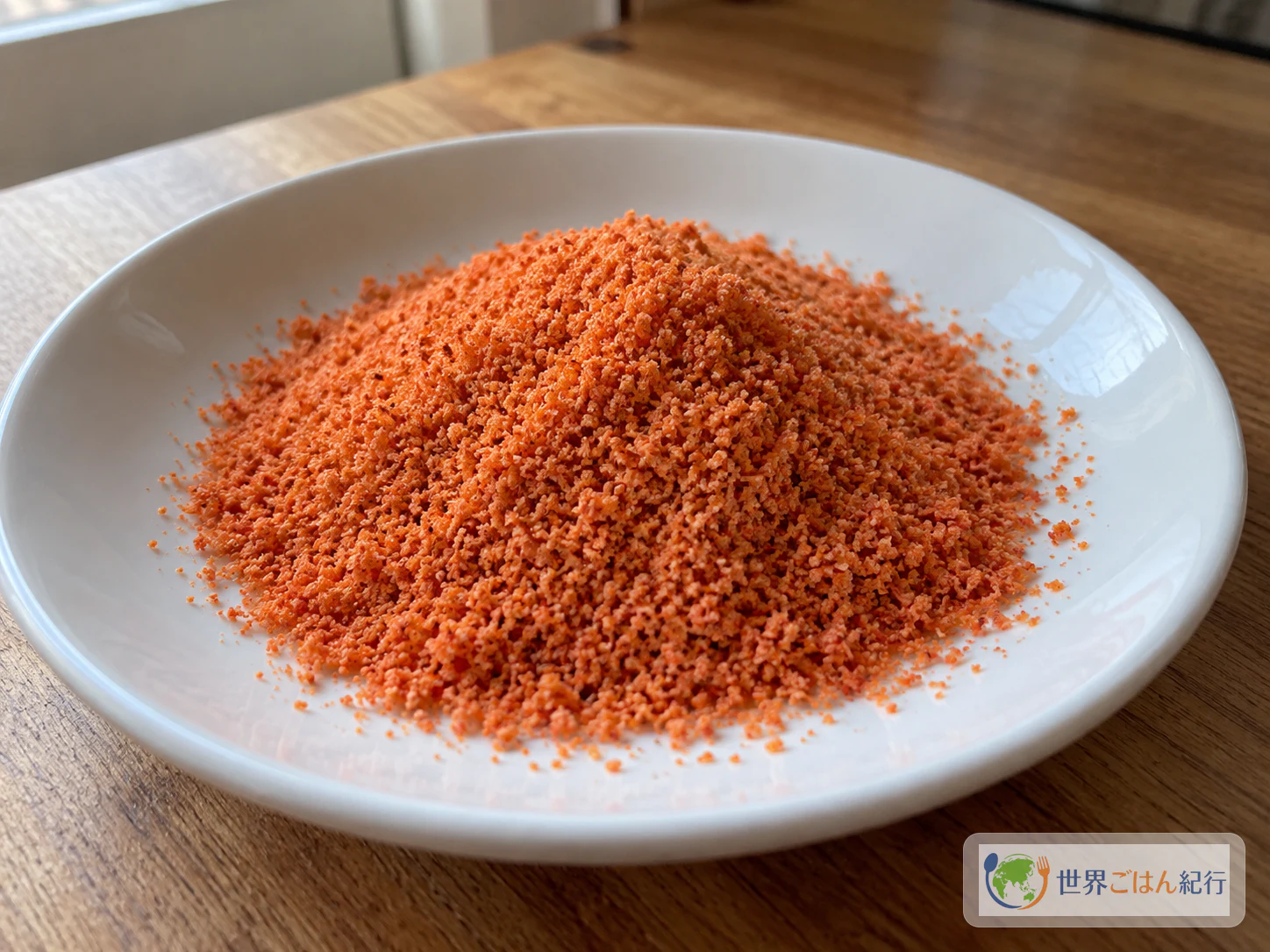
Shrimp roe powder is not dried shrimp. What you want is the roe: very small, reddish-orange granules that are almost a powder. Packages of dried shrimp meat, fish roe or tobiko are different ingredients, and none of them is a substitute. Also watch for packaged noodles that already have shrimp roe worked into the strands. Macao makers sell such noodles as a product of their own (see the variations below), but in this recipe the roe is a separate topping on plain noodles.
Thin wonton noodles. Use thin wonton noodles. One bundle of about 50 grams makes one serving. Do not substitute another noodle.
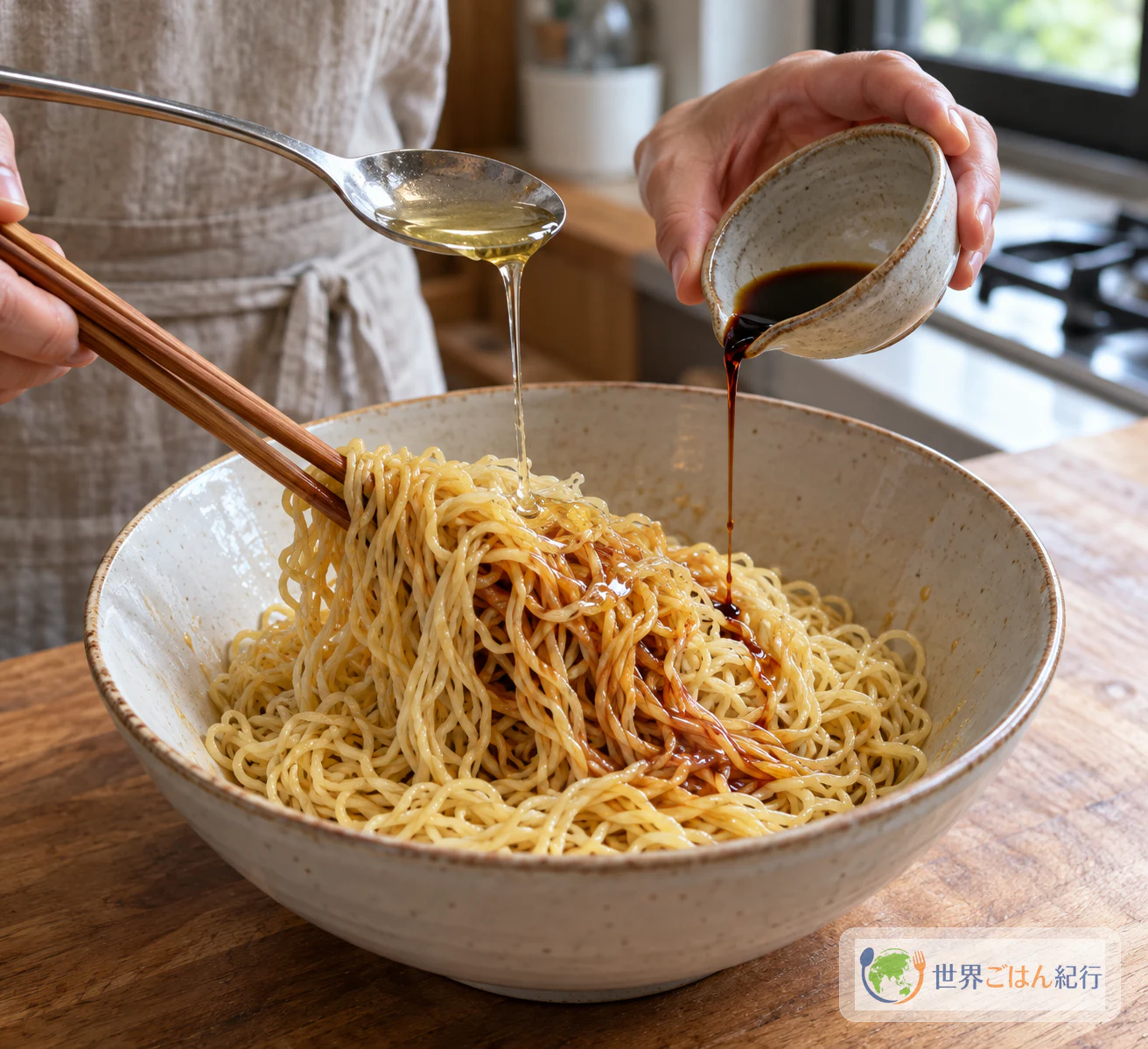
Lard oil or shallot oil, not both. The steps below use lard oil. Shallot oil can be used instead, at the same 1 tbsp. If you choose shallot oil, use it in place of the lard oil. Do not add both.
Light soy sauce. Use light soy sauce. Don't assume Japanese usukuchi soy sauce is the same thing, and don't use dark soy sauce in its place. Adjust to taste.
Where to look. Search for "dried shrimp roe powder" and "thin wonton noodles", and check the package to confirm it says shrimp roe, not dried shrimp meat or noodles with roe already worked in.
Shrimp roe comes from shrimp. If you have a shrimp allergy, do not make this dish. Noodle brands and ingredients vary, so read the labels on the noodles, the roe powder, the soy sauce and the lard oil for wheat, egg, soy and any cross-contact warnings. For packaged foods sold in Japan, the Consumer Affairs Agency publishes information on food-allergy labeling.
Method: Toast the Roe First, Meet the Noodles Last
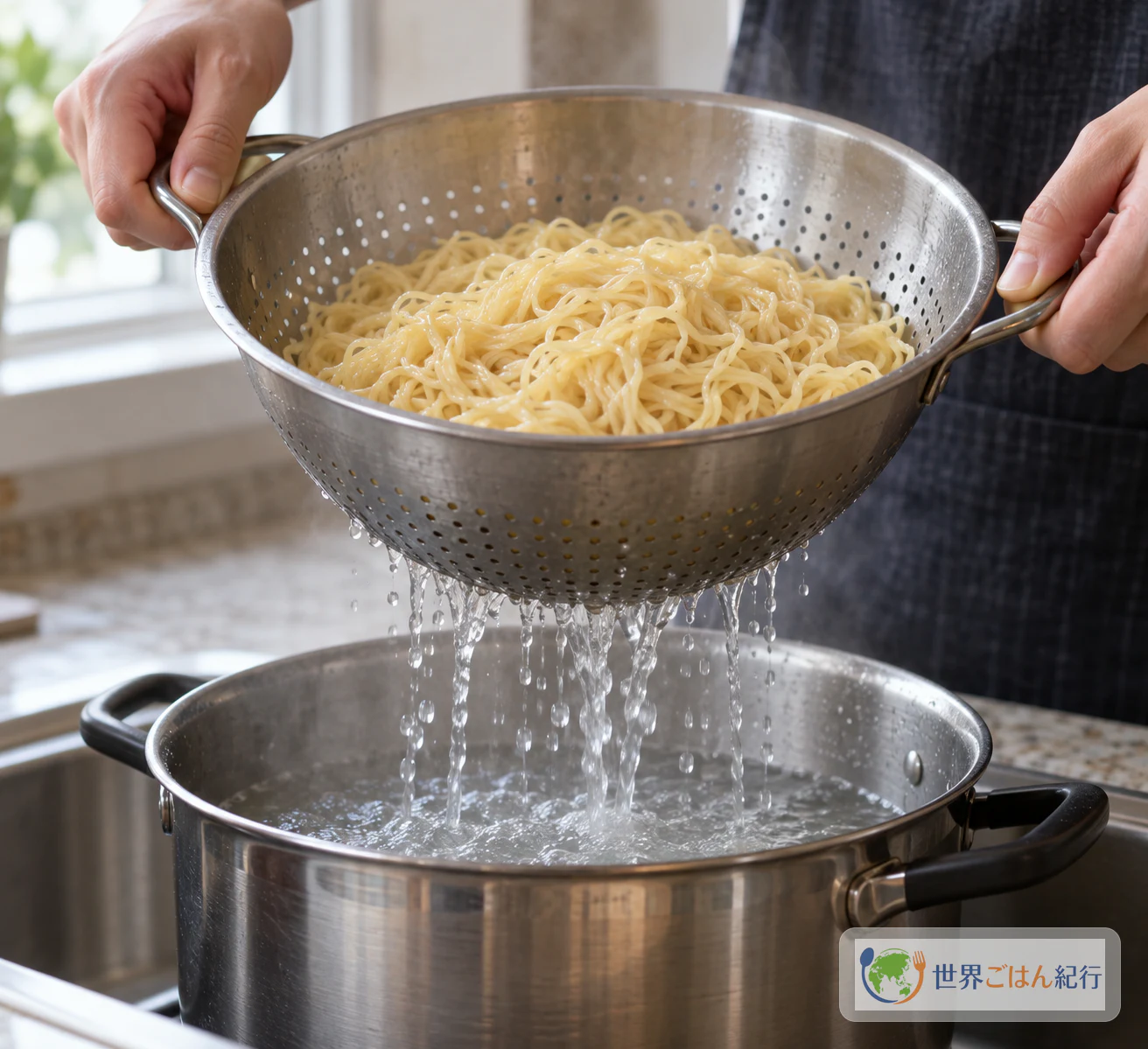
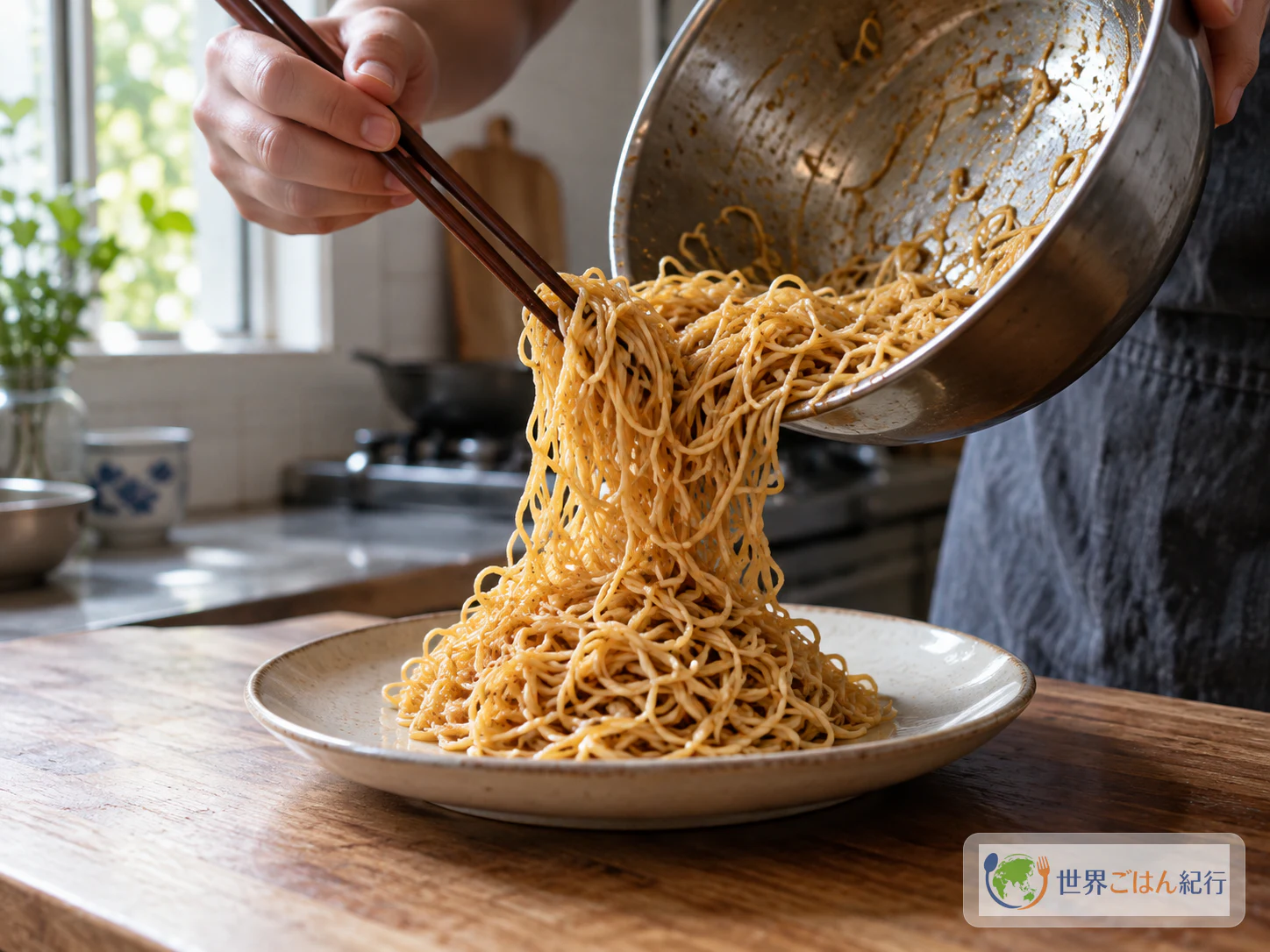
The roe is toasted and set aside before the noodles go anywhere near the pot. Judge each stage by what you see and smell: aroma for the roe, separated strands for the noodles.
Tips for Getting It Right
| What to watch | The cue to follow | What to avoid |
|---|---|---|
| Toasting the roe | Medium heat, dry pan, stop when fragrant, about 1 minute or less | Adding oil or water to the pan; leaving it on past the point of aroma |
| Keeping the roe separate | Move it to a saucer before the noodles start | Dropping raw roe powder into the noodle water |
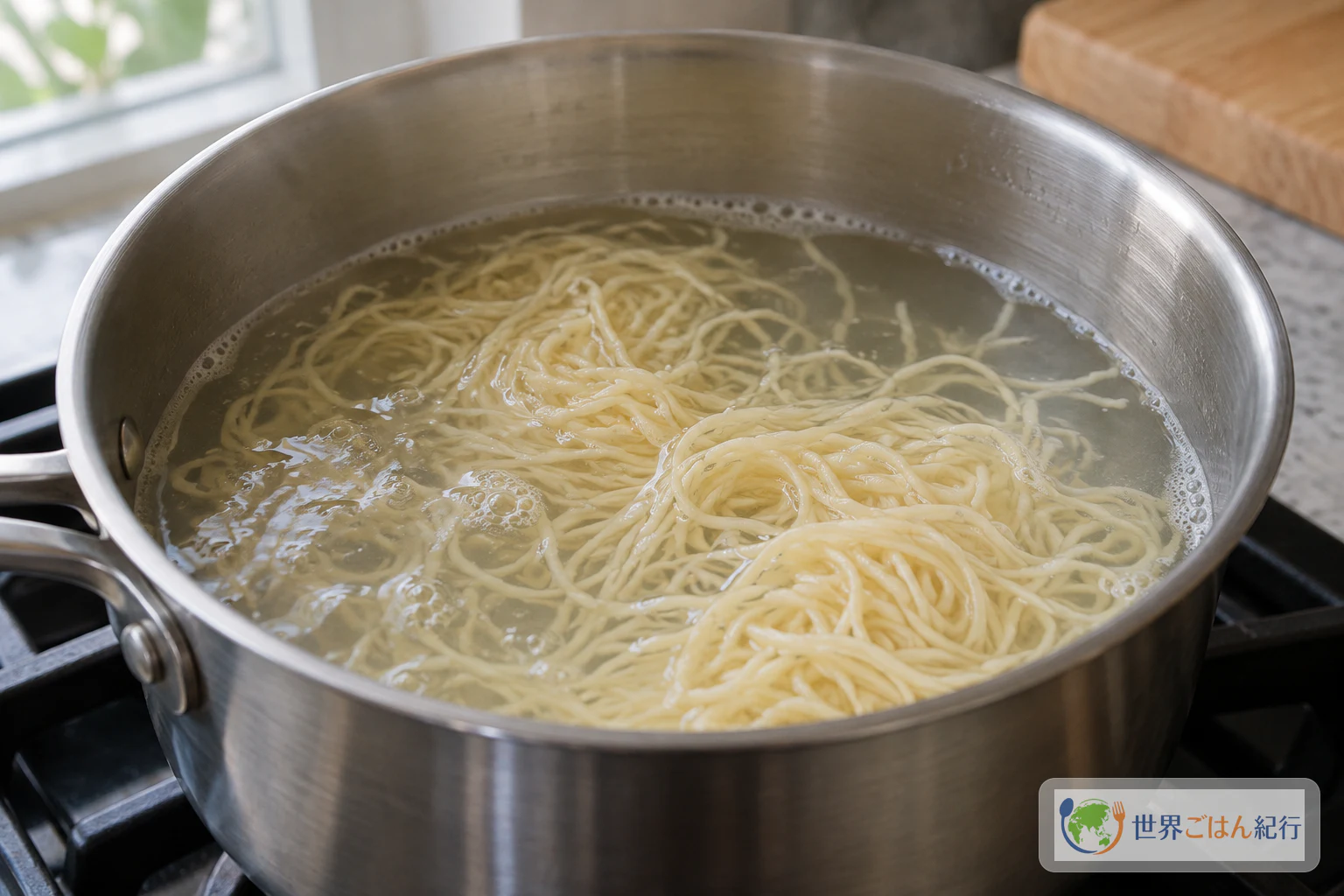
| Cooking the noodles | Stop when the strands separate | Borrowing cooking times from other recipes or noodle packages |
| Seasoning | 1 tbsp fat and 1/2 tsp light soy sauce, then taste | Using lard oil and shallot oil together |
| Finishing | Sprinkle, serve right away, toss before eating | Letting the plate sit before it is eaten |
The recipe gives no color target or thermometer reading for the roe, so aroma is the signal. It also gives no water amount, starting water temperature or minute count for the noodles. Because thin wonton noodles vary, the only guide is the one you can see: the bundle loosening into separate strands.
Versions You May Come Across
The name "shrimp roe noodles" covers more than one preparation. These are the forms described in the references used for this article. They explain why this recipe names the version it follows; none of them should be mixed into the steps above.
- Shallot oil instead of lard oil. Wiffy's recipe allows shallot oil at the same 1 tbsp in place of the lard oil.
- A two-serving recipe without toasting. Ellen L. of The Hong Kong Cookery gives a separate recipe for two that tosses egg noodles with lard and soy sauce and sprinkles the dried roe on at plating, without a dry-toasting stage. Ellen L. also writes that lard is the traditional oil in their recipe. Its quantities and salted cooking water belong to that recipe only.
- Different noodle timings. Ellen L.'s recipe distinguishes cooking times for dried and fresh Cantonese-style egg noodles. Those times are for that recipe's noodles and are not transferred to the thin wonton noodles here.
- Roe worked into the noodles. A profile on Macao Ideas, a platform of the Macao Trade and Investment Promotion Institute (IPIM), quotes the second-generation owner of Cheong Kei Noodle Factory as saying their shrimp-roe noodles absorb fresh shrimp roe and fish broth into the noodles themselves. The product listing names shrimp, flour, eggs, pepper and baking powder among its main ingredients and suggests serving the dried noodles in their cooking water with salt to taste. That is a different purchase and a different method.
- Restaurant bowls and roe-coated bundles. MGTO's Flavours of Macao brochure describes one restaurant style with bamboo-pole hand-kneaded egg noodles, freshly roasted shrimp roe and a dried-flounder broth. It also profiles Pastelaria Han Van's packaged noodle bundles, each given a thick layer of roe. A Macao Ideas listing describes that product as served with a rich soup base. Neither the broth nor the coated bundle is part of this recipe.
Noodle Craft in Macao, and Where This Home Version Fits
MGTO presents dried shrimp roe noodles as one of Macao's local foods, describing tiny roe with a strong sea-salty flavor that suits springy egg noodles. The agency's wording is a short tourism description rather than a recipe, and it does not claim that there is a single way the dish is made.
The other Macao sources show several forms side by side. The Flavours of Macao brochure describes one restaurant's bowl: egg noodles kneaded by hand with a bamboo pole, topped with freshly roasted roe and served in dried-flounder broth. In a different account, the owner of Cheong Kei, a noodle factory founded in 1995 that supplies Macao restaurants and residents, describes roe and fish broth being absorbed into the noodles during making, so the soup base needs no extra seasoning. One is a restaurant presentation, the other a maker's description of their own product. Neither is presented here as the standard for all of Macao.
A government business profile from Macao's Economic and Technological Development Bureau (DSEDT) traces the history of one noodle shop, Wong Chi Kei. According to the profile, the founder learned bamboo-pressed noodle making in Guangzhou in the 1940s, opened a noodle shop in Dongguan in 1946, and moved the business to Macao in November 1959, where it became known for slender noodles and shrimp-roe soup. The profile lists noodles mixed with shrimp roe among its recommendations. These dates belong to that one business; they are not the origin date of shrimp roe noodles.
In 2025, Macao's Cultural Affairs Bureau announced new additions to its intangible cultural heritage list, including bamboo-pressed noodle-making technique (竹昇面制作技艺). The recognized item is the noodle-making craft, not the shrimp roe noodle dish, and the listing does not mean every shrimp roe noodle is made with bamboo-pressed noodles.
Against that background, the recipe in this article is smaller and simpler: separately bought roe powder and thin wonton noodles, brought together at the end. Wiffy writes that the noodles can be eaten on their own or alongside a simple vegetable side or wonton soup served separately; those accompaniments are not part of the plate. It is one Hong Kong home version, not evidence of how a Macao restaurant makes the dish.
Frequently Asked Questions
Is shrimp roe the same as dried shrimp?
No. The ingredient is the roe, sold as tiny granules or powder. Dried shrimp meat is a different product and is not used in this recipe.
Can I use fish roe or tobiko instead?
None of the references supports that substitution, and it is not part of this version. Fish roe and tobiko are different ingredients from dried shrimp roe.
Can I use noodles that already contain shrimp roe?
Those are a separate product. Macao makers describe noodles with roe and broth worked into the strands, or bundles coated in roe and served with soup, and they come with their own serving suggestions. This recipe is written for plain thin wonton noodles with roe powder added on top.
How many minutes do the noodles cook?
Wiffy's recipe gives no minute count; it says to cook them until the strands separate. Other recipes and products give their own times for different noodles (Ellen L.'s recipe for Cantonese-style egg noodles, and Han Van's packaged bundle), but those are not carried over here. Wiffy's recipe card lists 5 minutes of preparation and 5 minutes of cooking, and the blog files the post under 15-minute recipes; no total time is given, and this article does not calculate one.
What if I have a shrimp allergy, or need to avoid wheat or egg?
Do not make this dish if you have a shrimp allergy. The recipe does not specify the noodles' ingredients or a brand, so check the actual package labels and manufacturer warnings for every ingredient you buy.
Can I make it ahead or store leftovers?
The recipe says to serve immediately and gives no storage or reheating guidance, so none is offered here. For the dried roe itself, Ellen L. advises keeping it away from humidity, without giving a storage period.
Sources
- Macao Government Tourism Office (MGTO), "Local Food." Lists dried shrimp roe noodles among Macao local foods and gives a short description of tiny, sea-salty roe and springy egg noodles; no measured recipe. https://www.macaotourism.gov.mo/en/dining/taste-of-macao/local-food
- Macao Government Tourism Office (MGTO), Flavours of Macao (brochure, PDF). Describes one restaurant style with bamboo-pole hand-kneaded egg noodles, freshly roasted roe and dried-flounder broth, and profiles Pastelaria Han Van's roe-coated noodle bundles. https://content.macaotourism.gov.mo/uploads/mgto_brouchures/4b668be7d97d5f6fa92e6c55a7d9cab950d8d9f4.pdf
- wiffy, "Hong Kong Shrimp Roe Noodles," NoobCook, 2015-01-19. The author's introduction: Hong Kong labeling, the author's statement on the dish's Macau origin, preference for thin wonton noodles, tossing the roe through before eating, and optional separate accompaniments. https://noobcook.com/shrimp-roe-noodles/
- wiffy, "Shrimp Roe Noodles Recipe," NoobCook. The one-serving recipe card used for the ingredients and steps in this article, including the shallot-oil alternative and the card's prep and cook times. https://noobcook.com/shrimp-roe-noodles/2/
- Ellen L., "Chinese Shrimp Roe Noodles 蝦籽麵," The Hong Kong Cookery, 2014-04-08. A separate two-serving recipe used only for comparison, with the author's description of dried roe, noodle timings, humidity note and note on lard. https://www.thehongkongcookery.com/2014/04/chinese-shrimp-roe-noodles.html
- Macao Ideas, IPIM, "Cheong Kei – Crafting Unique Noodles and Flavour for Over 20 Years," 2021-07-16. Profile of Cheong Kei Noodle Factory, with the owner's description of roe and fish broth absorbed into the noodles. https://macaoideas.ipim.gov.mo/en/dynamic/view/75
- Macao Ideas, IPIM, "Cheong Kei Shrimp Roe Noodles." Product listing with main ingredients and the maker's serving suggestion. https://macaoideas.ipim.gov.mo/en/product/874
- Macao Ideas, IPIM, "Supreme Double Shrimp Roe Noodles (3 servings)," Pastelaria Han Van Loi. Product listing describing roe-coated noodle bundles served with soup, with the product's own cooking instructions. https://macaoideas.ipim.gov.mo/en/product/2247
- Macao Economic and Technological Development Bureau (DSEDT), "Distinctive Shops - Wong Chi Kei." Business history of one noodle shop and its menu, not the dish's origin. https://www.dsedt.gov.mo/lcp/en_US/store_detail.jsp?id=3
- Cultural Affairs Bureau of the Macao SAR Government, "《非物质文化遗产名录》新增12个项目," 2025-10-13. Announcement listing bamboo-pressed noodle-making technique as intangible cultural heritage. https://www.icm.gov.mo/gb/news/detail/23983
- Consumer Affairs Agency, Government of Japan, "食物アレルギー表示に関する情報." General information on food-allergy labeling for packaged foods in Japan. https://www.caa.go.jp/policies/policy/food_labeling/food_sanitation/allergy/index.html