Agujjim: Firm Monkfish and Crisp Sprouts Under a Glossy Red Sauce
Thick pieces of monkfish that hold together, soybean sprouts that still snap, and a red sauce thickened just enough to cling to both. Everything in the method protects those three things.
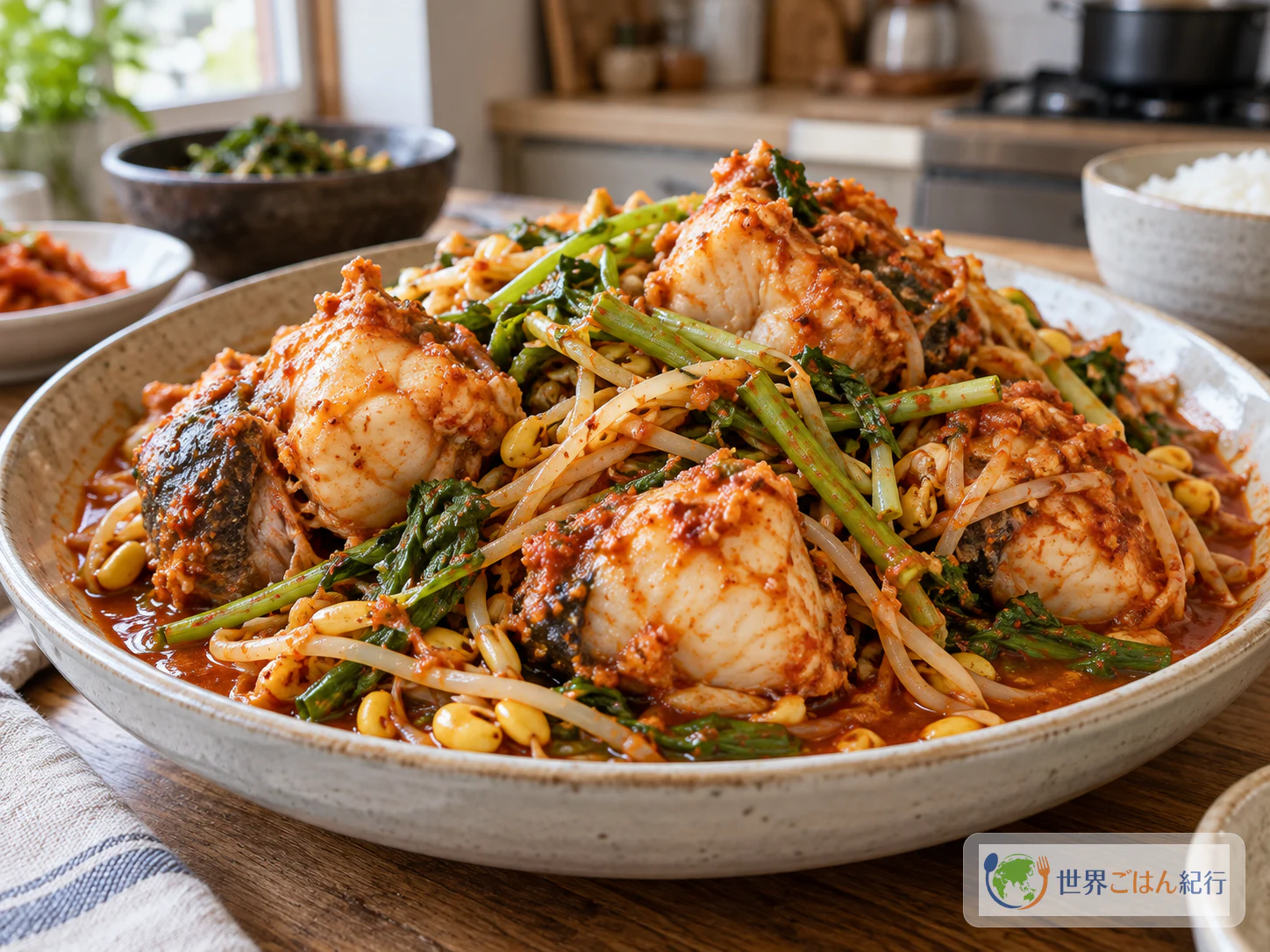
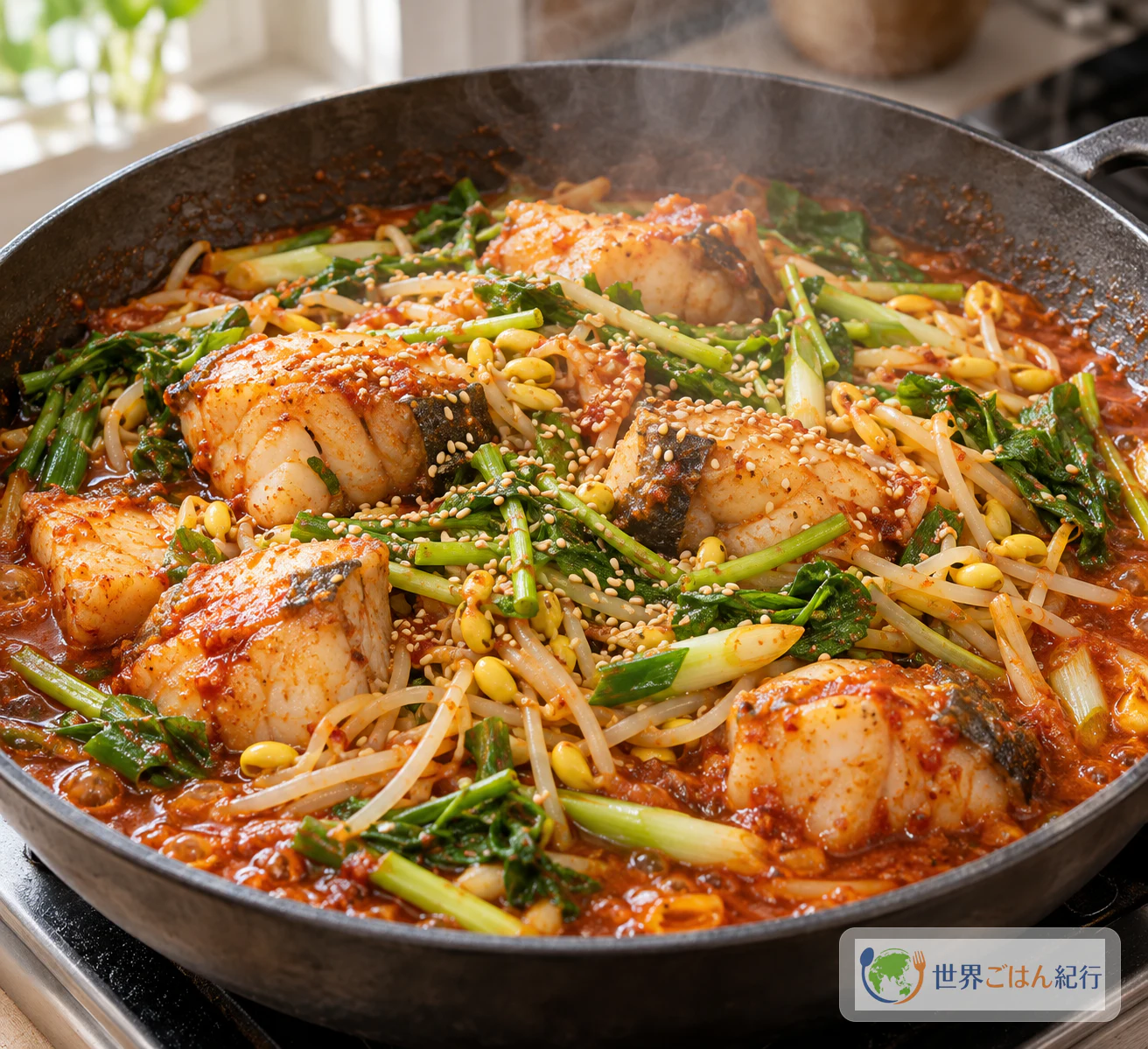
A glossy red sauce coats chunks of monkfish and a tangle of thick soybean sprouts, with green flecks of minari and scallion running through it. The fish is chewy and dense, the sprouts are crisp, and the sauce carries chili, garlic and a little sesame. Agujjim is a Korean dish of monkfish braised in a spicy seasoning with soybean sprouts, and it is eaten with rice.
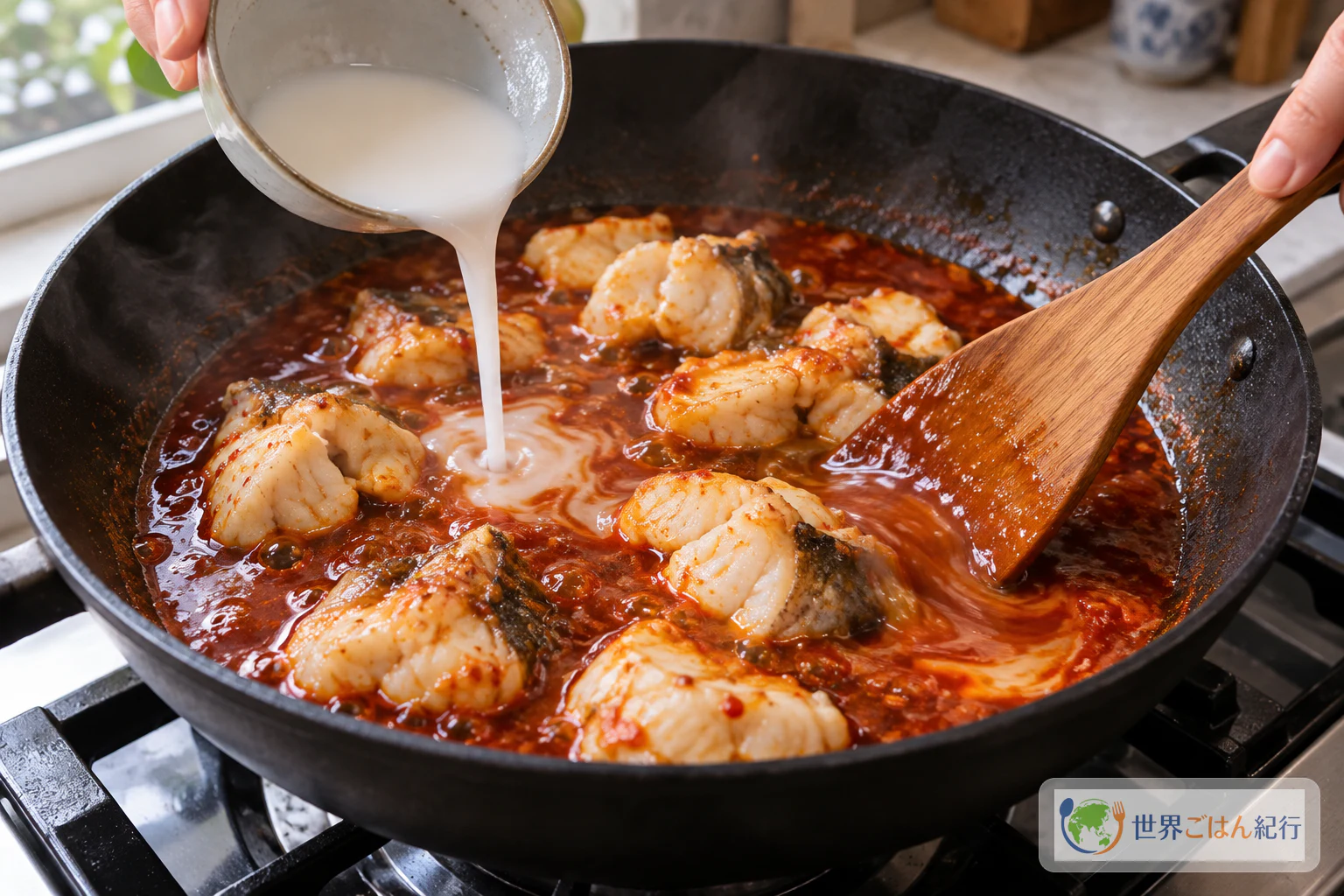
In a home kitchen, two things decide whether it works: how thick you cut the fish, and how little you cook the sprouts. This recipe follows one four-serving home-cook version from Korean Bapsang. The fish gets a short covered braise, the sauce goes in, a starch slurry gives the sauce body, and the sprouts and greens are folded in only at the very end. Below you will find the ingredients, the seven steps, how to choose substitutes, and how to fix the most common problems. For another Korean dish with a chili-based seasoning, see dakgalbi.
The dish is written 아귀찜 (agwijjim) and also 아구찜 (agujjim). VISITKOREA lists both forms. Korea.net explains that in South Gyeongsang Province people say agujjim, dropping the "i" sound of agwijjim. Both refer to the same dish. English recipes usually call it "spicy braised monkfish."
Where Agujjim Comes From: Masan, Odong-dong and a Dish That Traveled
Agujjim is closely associated with Masan, in South Gyeongsang Province. Korea.net's food-tourism feature on the province presents it as a regional specialty and describes a cluster of agujjim restaurants in Masan's Odong-dong neighborhood. The same feature retells a local story about fishermen and a Masan restaurant. It is worth enjoying as a story that people tell, not as a documented origin.
How the dish began is genuinely debated. A 2019 study in the Journal of the Korean Society of Food Culture links its appearance to Masan in the 1960s and notes that accounts of its birth differ, according to the paper's abstract. The abstract also describes agujjim restaurants spreading to Seoul in the 1970s, dedicated restaurant streets forming in the 1990s, and "Masan agujjim" becoming a local brand recognized well beyond the region. Taken together, this is the picture of a regional dish that became a national one, without one settled origin story.
The regional ingredient pattern described by Korea.net includes bean sprouts, minari, mideodeok (미더덕, a kind of sea squirt), chili, doenjang, scallion and garlic. VISITKOREA describes the dish as monkfish with water parsley, bean sprouts, red pepper powder and garlic, and points to the chewy fish and spicy vegetables as its defining textures. Korean Bapsang mentions crunchy sprouts, rice on the side, and mideodeok and minari as common elements. The home version here keeps the monkfish, sprouts and minari at the center and leaves out mideodeok, which is hard to find outside Korea.
Ingredients (Serves 4)
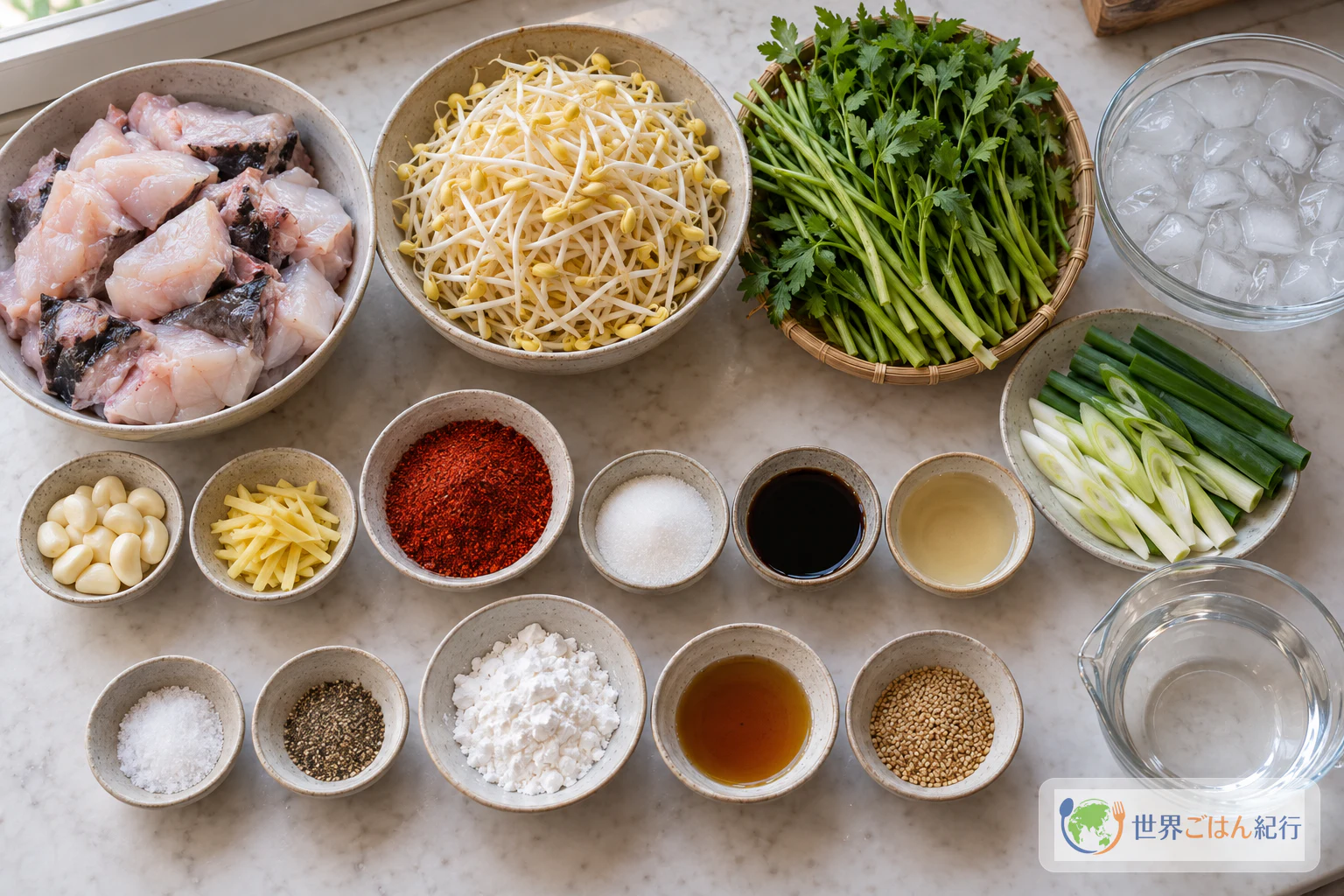
These amounts follow the four-serving recipe from Korean Bapsang, in its original pounds, ounces, cups and spoon measures. This base version uses Korean cooking rice wine, minari and potato starch. It leaves out the source's optional shrimp and clams. Four separate portions of water are used at different points in the recipe. Measure each one separately for its stated step; do not interchange the amounts.
For metric cooks, the source amounts come to roughly 680 g of monkfish, 227 g of soybean sprouts and 57 g of minari. The fish pieces are about 5 cm thick and the minari lengths about 7.5–10 cm. For the liquids, this article uses an editorial measuring convention of 240 ml per cup, 15 ml per tablespoon and 5 ml per teaspoon: 1/2 cup is 120 ml and 2 tbsp is 30 ml. The source does not specify these capacities. The original recipe is written in pounds, ounces, cups and spoons. Spoon measures of dry ingredients are kept as volumes and not converted to weight.
Equipment
- Deep, heavy skillet with a lid
- Small pot with a lid, for the sprouts
- Colander
- Mixing bowl for seasoning the fish
- Small bowl for the sauce
- Small bowl for the starch slurry
- Bowl of ice water
- Paper towels
- Cooking thermometer, for checking the thickest piece of fish
Choosing and Substituting: Monkfish, Gochugaru, Sprouts and Greens
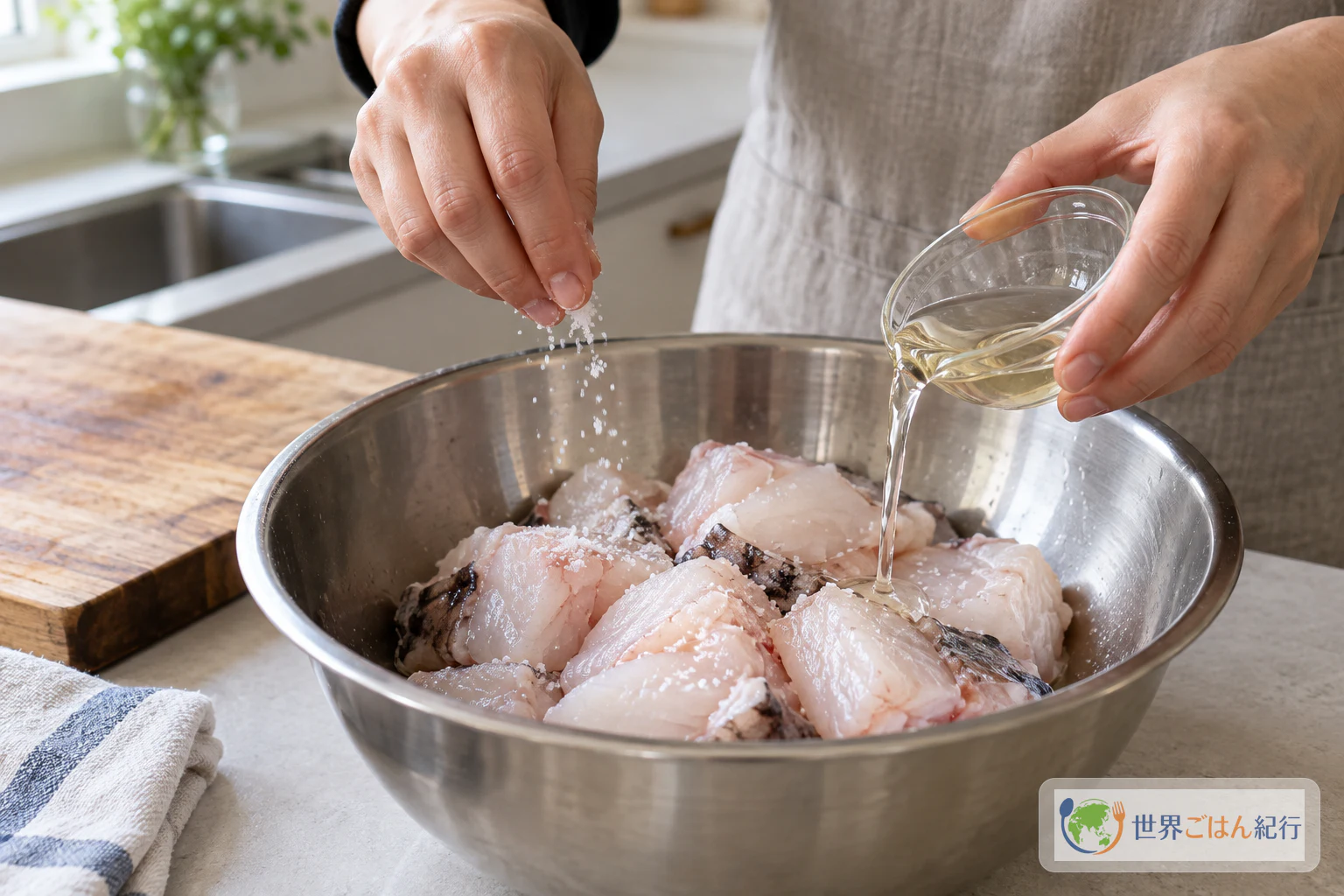
Monkfish. Korean Bapsang notes that the dish can be made with bone-in, skin-on monkfish or with fillets. If a whole fish feels unwieldy, ask a fishmonger or look in the frozen fish section for cut pieces. Thaw frozen monkfish in the refrigerator overnight. If you are cooking it right away, you can instead thaw it in a sealed bag submerged in cold water. Pat it dry before seasoning. Swapping in another white fish changes both the flavor and the texture, so treat that as a different dish rather than agujjim.
Cooking wine. The source calls for cooking rice wine (mirim/mirin) or dry white wine. Japanese hon-mirin is sweeter, so it will not give the same taste. If you want to stay close to the original, use Korean cooking rice wine or a dry white wine.
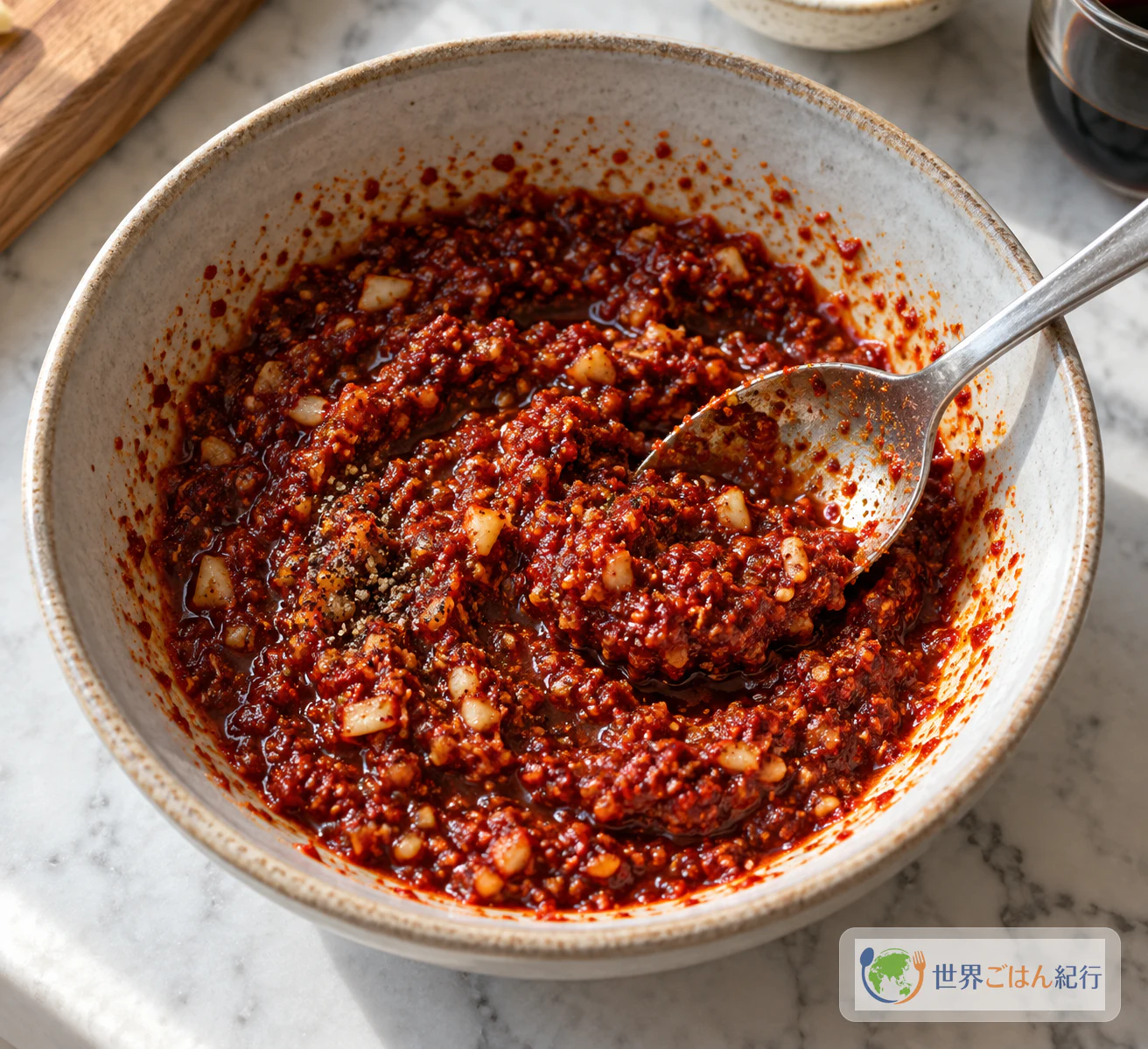
Gochugaru. Korean chili flakes give the sauce its red color and much of its aroma. Japanese ichimi or ordinary chili powder differs in grind and aroma, so neither is a one-for-one swap for the same amount. When shopping, search for "Korean chili flakes" or "gochugaru."
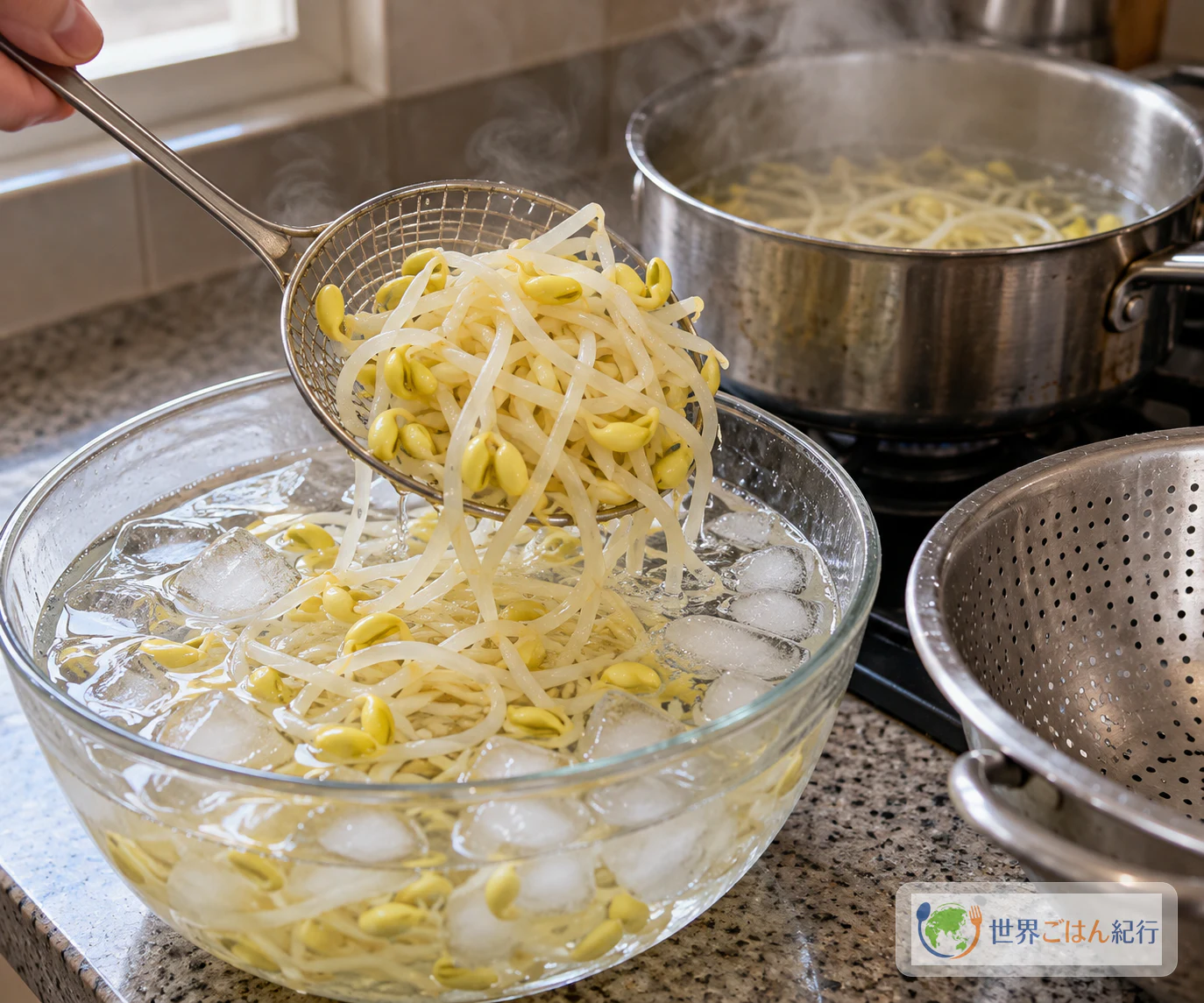
Soybean sprouts. Use thick soybean sprouts, not mung bean sprouts. Soybean sprouts have a beany aroma and a thicker, firmer crunch, and that crunch is half the point of the dish.
Minari. Minari is a waterside green in the parsley family. The source names watercress as an alternative, but watercress has a different aroma. Japanese seri points in a similar direction, but it is not the same either. Choose one green before you start and stay with it. Don't switch greens, or starches, partway through cooking.
Starch. The source allows corn starch or potato starch. This version uses potato starch, which in Japan is sold as katakuriko.
This dish contains fish (monkfish), soy (soybean sprouts and soy sauce) and sesame (sesame oil and seeds). Many soy sauces also contain wheat, so check the label. If you add the optional shrimp or clams, the dish also contains shellfish. Check the labels on all seasonings and processed products.
Method: Short Braise for the Fish, Last-Minute Sprouts
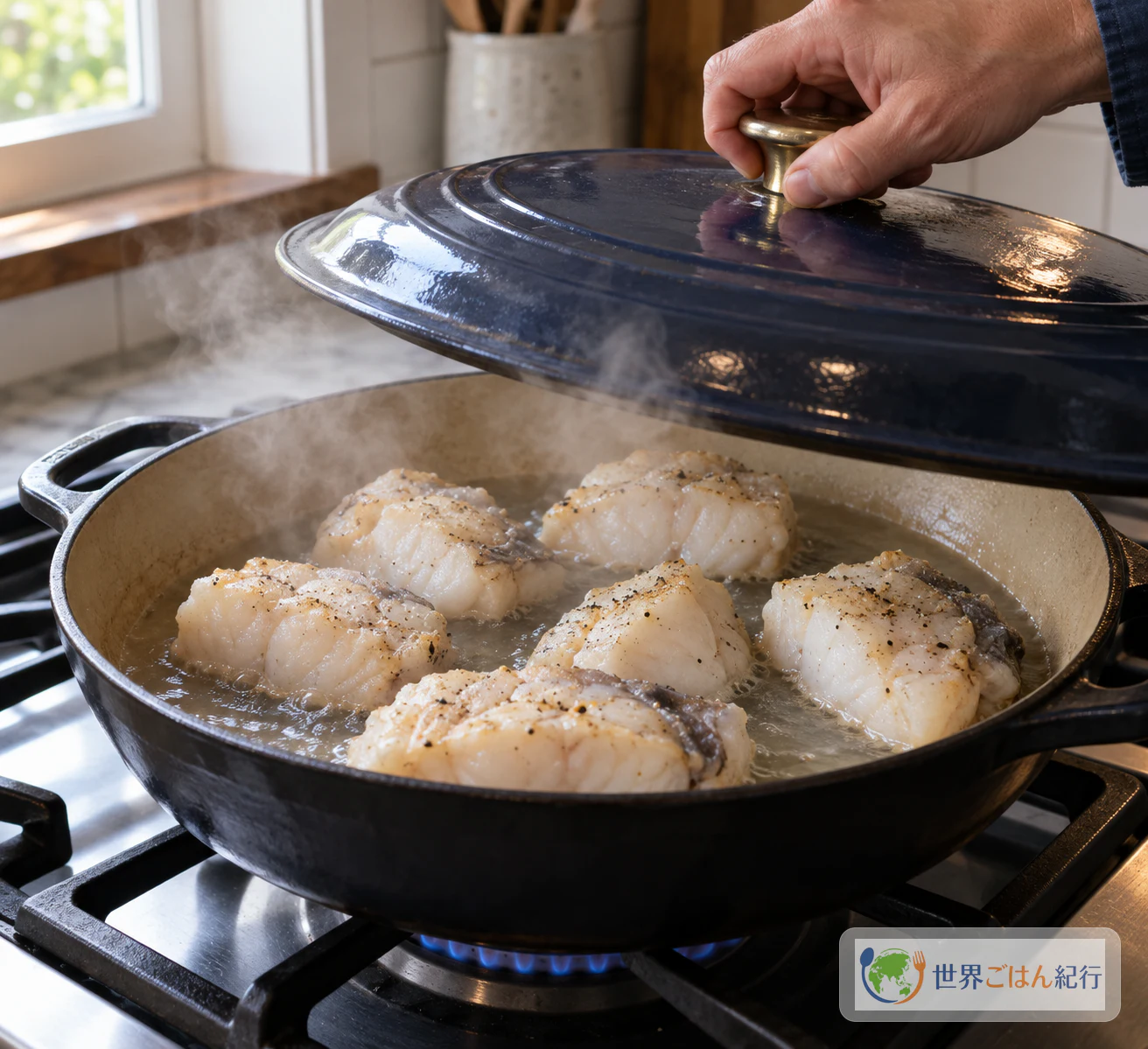
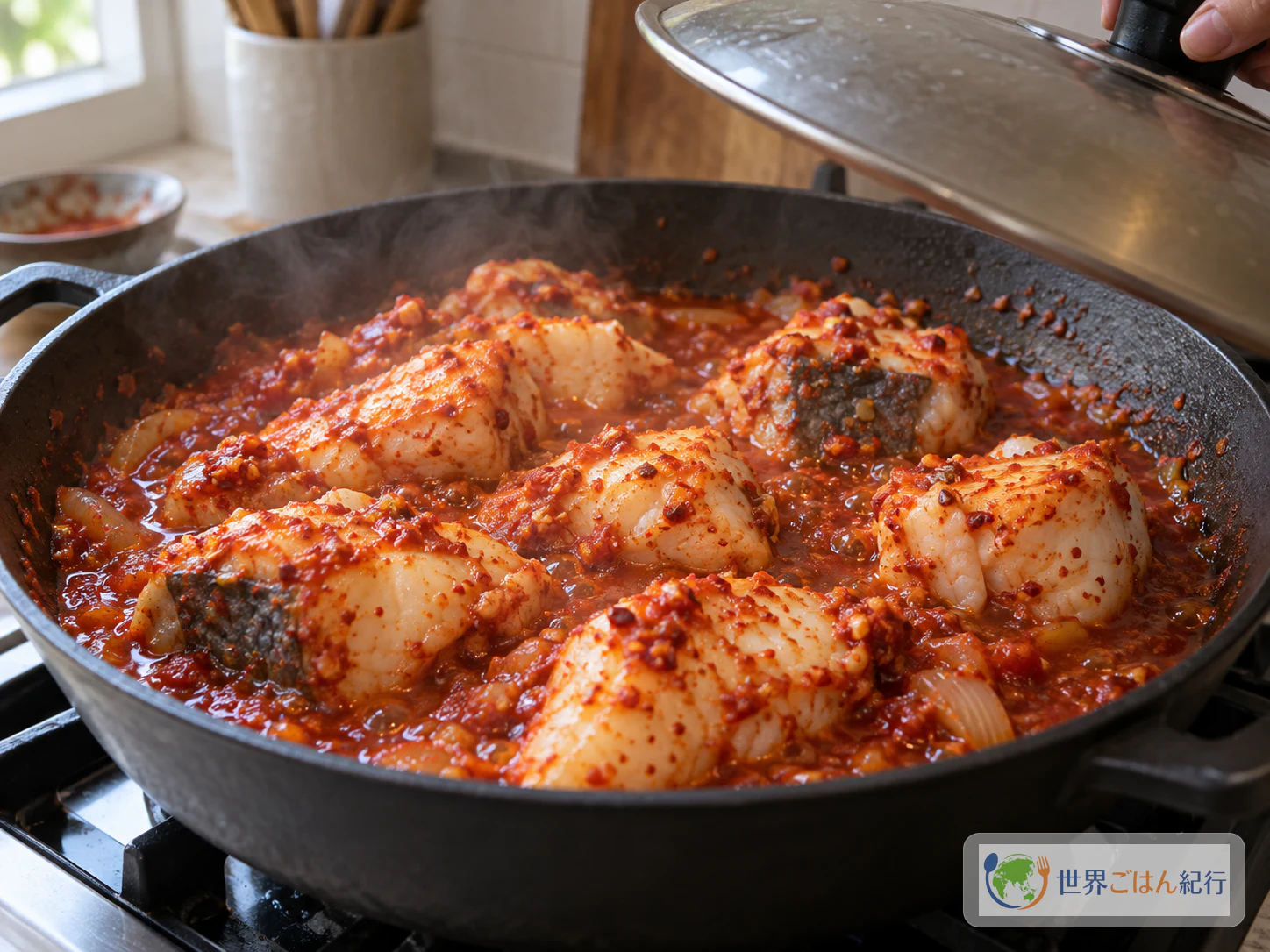
The fish braise takes only a few minutes, so get the sauce, chilled sprouts, cut greens and starch slurry ready before the fish goes into the pan. The minute counts below come from the source recipe. They are guides, not guarantees: thicker pieces of fish take longer.
The source's minute counts (3–4 minutes, then 2–3 more) are cooking guides. They are not a promise that every piece reaches a safe temperature. The U.S. FDA's general guidance is that most seafood should be cooked to 145°F (about 63°C), until the flesh is opaque and separates easily. This is a general seafood guideline, not a monkfish-specific figure. Check the center of the thickest piece rather than relying on looks or time alone. Keep raw fish refrigerated until you cook it.
Serving: A Shared Platter With Rice
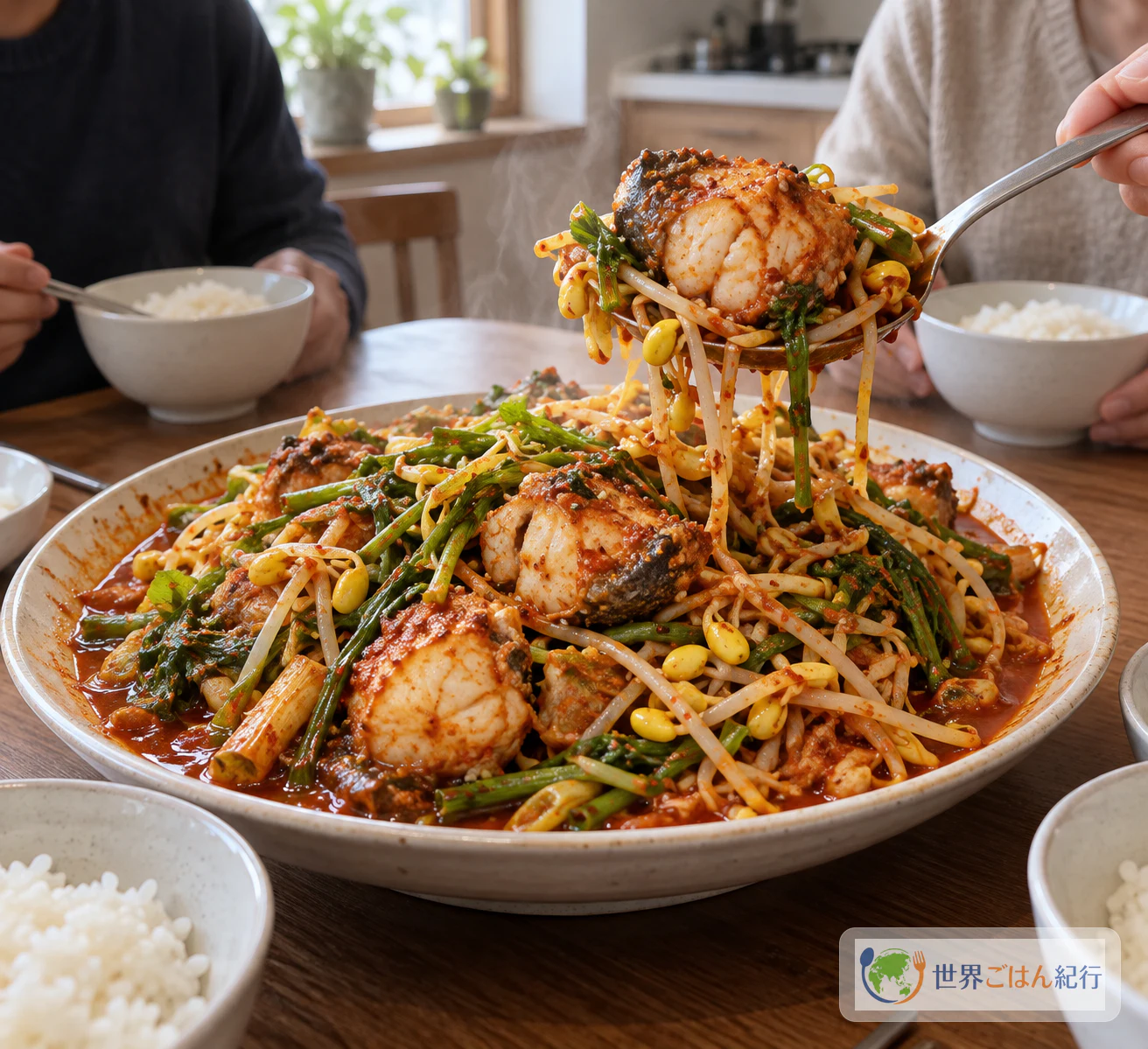
Agujjim is eaten with rice, which softens the heat and catches the sauce. Korean Bapsang notes that in restaurants the dish often comes as a large portion shared at the table. At home, a single platter with individual bowls of rice works the same way. Serve a piece of fish with a tangle of sprouts each time, so every bite has the dense fish and the crunch together.
Agujjim is best eaten freshly made. If there are leftovers, don't leave them out at room temperature. Refrigerate them promptly and reheat them thoroughly before eating. Expect the sprouts to lose some of their crunch.
Fixing Problems: Soft Sprouts, Broken Fish, Thin Sauce
| Problem | Likely cause | What to do |
|---|---|---|
| The sprouts are limp | Cooked too long, not chilled, or added too early | Boil them for only 2 minutes, chill them in ice water right away and add them in the final step. Don't braise them with the fish |
| The fish falls apart | Uneven pieces, turned too often, or stirred hard after the vegetables went in | Cut even, thick pieces. Turn them only once during the first braise. Fold the vegetables in with large strokes instead of stirring from the bottom |
| The thickest piece isn't done | Pieces thicker than the recipe assumes | Before adding the vegetables, cover and keep cooking until the center reaches 145°F (about 63°C) |
| The sauce is watery | Slurry poured in without stirring, or the starch settled in the bowl | Re-stir the slurry, stir it into the pan and give it time to thicken. Stay within the 1 tbsp starch and 2 tbsp water; don't add extra starch by guesswork |
| The sauce is too thick | Liquid reduced more than expected | Loosen it with a little of the pan's cooking liquid at a time. This is a home adjustment, not part of the source recipe |
| Too spicy | Gochugaru level | Reducing the gochugaru also weakens the red color and aroma. Serve it with plenty of rice and mild side dishes. No reduced amount has been worked out for this recipe |
Variations Worth Knowing
With mideodeok, closer to Masan. Regional versions often include mideodeok, a sea squirt that adds its own texture and a taste of the sea. If you can find it, it moves the dish toward the regional style. No quantity is given here, since the source recipe doesn't use it.
Minari or watercress. Minari gives the dish its intended green aroma. Watercress, the source's alternative, makes a perfectly good agujjim with a different, more peppery note. Japanese seri is a separate editorial substitution idea, close in direction but not identical.
Bone-in or fillet. Bone-in, skin-on monkfish is how the dish is often made. Fillets are easier to eat. The source accepts both, so choose based on what you can buy and how you like to eat.
Optional shrimp or clams. The source lists 6 large shell-on shrimp as optional and mentions small clams as an alternative, without a quantity for the clams. Neither is part of the base recipe above. If you add shrimp, cook them until opaque and firm. If you add clams, follow the cooking directions on the product and discard any that don't open. An open shell on its own does not guarantee the clam is safe.
Heat level. Gochugaru carries both heat and color, so cutting it back gives a paler, milder sauce. Adjust gradually to suit your table, and lean on rice to balance the spice.
Frequently Asked Questions
Can I make agujjim with a fish other than monkfish?
You can braise another firm white fish the same way, but the result changes. Monkfish's chewy, dense flesh is the heart of agujjim, and the dish is named after the fish. Look for monkfish first, and treat other fish as your own variation.
What if I can't find minari?
The source recipe allows watercress, with a different aroma. Japanese seri is another option. Whichever you choose, add it at the end so it stays fresh and green.
Can I use mung bean sprouts instead of soybean sprouts?
They will cook, but you lose the thick crunch and beany aroma of soybean sprouts, which is a big part of the dish. Look for soybean sprouts at an Asian grocery if your supermarket doesn't carry them.
Why do the sprouts go into ice water?
Chilling them right after the 2-minute boil and draining them stops the cooking. Folding them in only at the end then keeps them crisp. That is the reason this recipe cooks them separately.
How should I thaw frozen monkfish?
Thaw it in the refrigerator overnight. If you plan to cook it right away, you can thaw it in a sealed bag submerged in cold water. Pat it dry before seasoning.
Why are there two Korean spellings?
아귀찜 (agwijjim) and 아구찜 (agujjim) are the same dish. VISITKOREA lists both forms, and Korea.net explains that in South Gyeongsang Province the name is pronounced agujjim, without the "i." The two forms reflect a difference in spelling and pronunciation, not a mistake.
Sources
- Korean Bapsang, "Agujjim (Spicy Braised Monkfish)." Source of the four-serving recipe: ingredient amounts, cooking sequence and minute guides; the Korean names agu/agwi for monkfish; watercress as an alternative to minari and corn or potato starch for the slurry; restaurant portions often being shared; and crunchy sprouts, rice, mideodeok and minari as common elements. An English-language home-cook version, not a standard for every Masan restaurant or household. https://www.koreanbapsang.com/agujjim-spicy-braised-monkfish-with/
- Korea Tourism Organization (VISITKOREA), "Spicy Braised Monkfish (아귀찜(아구찜) / Agwijjim (Agujjim))." The spellings 아귀찜 and 아구찜, and the dish's makeup of monkfish, water parsley, bean sprouts, red pepper powder and garlic, with chewy fish and spicy vegetables. https://english.visitkorea.or.kr/svc/contents/contentsView.do?vcontsId=178730
- Korea.net / Ministry of Culture, Sports and Tourism, Republic of Korea, "Food Tourism 8: South Gyeongsang Province." The dish's association with South Gyeongsang and Masan, the restaurant cluster in Odong-dong, the local agujjim pronunciation, the regional ingredient pattern, and the local origin story, presented here as a story rather than proof. https://www.korea.net/NewsFocus/FoodTravel/view?articleId=119380
- Kyou-Jin Lee, "Appearance and Diffusion of Aguijjim (아귀찜)," Journal of the Korean Society of Food Culture, 2019. Cited only for points stated in its abstract: the dish's association with 1960s Masan, differing accounts of its birth, the spread to Seoul in the 1970s, restaurant streets in the 1990s, and Masan agujjim as a nationally recognized local brand. https://www.jfc.or.kr/journal/article.php?Array=&code=66138
- U.S. Food and Drug Administration, "Selecting and Serving Fresh and Frozen Seafood Safely." General guidance on thawing seafood in the refrigerator or in a sealed bag under cold water, cooking most seafood to 145°F (about 63°C), fish flesh turning opaque and separating easily, and discarding shellfish that do not open. It does not give a monkfish-specific braising time. https://www.fda.gov/food/buy-store-serve-safe-food/selecting-and-serving-fresh-and-frozen-seafood-safely