Georgia

Shkmeruli: Georgian Chicken in Garlic Milk Sauce

Shkmeruli is a Georgian dish from the Racha region: seared chicken simmered briefly in a garlicky milk sauce. This recipe uses boneless thighs and covers milk vs. sour cream, keeping the garlic from burning, a safe internal temperature, storage, skillet swaps and how to fix a split sauce.

This recipe was translated from the Japanese original by the Sekai Gohan editorial team. Read the original (Japanese)

  • Prep20 min
  • Cook35 min
  • Total55 min
  • Serves4 servings
  • LevelEasy

Georgian shkmeruli finished in a black skillet: seared chicken simmered in a white sauce of milk and garlic

Garlic steam that carries the kitchen to a Tbilisi canteen

Nights when you sear chicken thighs for dinner are usually safe nights. Salt and pepper and they're good; a splash of soy sauce and they go with rice. But pour milk into the pan after searing that same chicken, toss in a big handful of crushed garlic, and the air in the kitchen changes at once. The sweet steam of garlic settles over the butter and chicken fat, and the white sauce starts to bubble. That sound alone is enough to make you reach for bread to tear.

Shkmeruli (შქმერული) is a chicken dish said to come from the village of Shkmeri in Racha, a mountainous region in northwestern Georgia. The basic idea is seared chicken simmered briefly in a garlicky sauce of milk or sour cream. In Japan it became a hit through a fast-food chain's limited-time menu, which made it seem like a creamy stew, but at heart it is a dish that brings together the toasty flavor of seared chicken and garlic milk in the same pan.
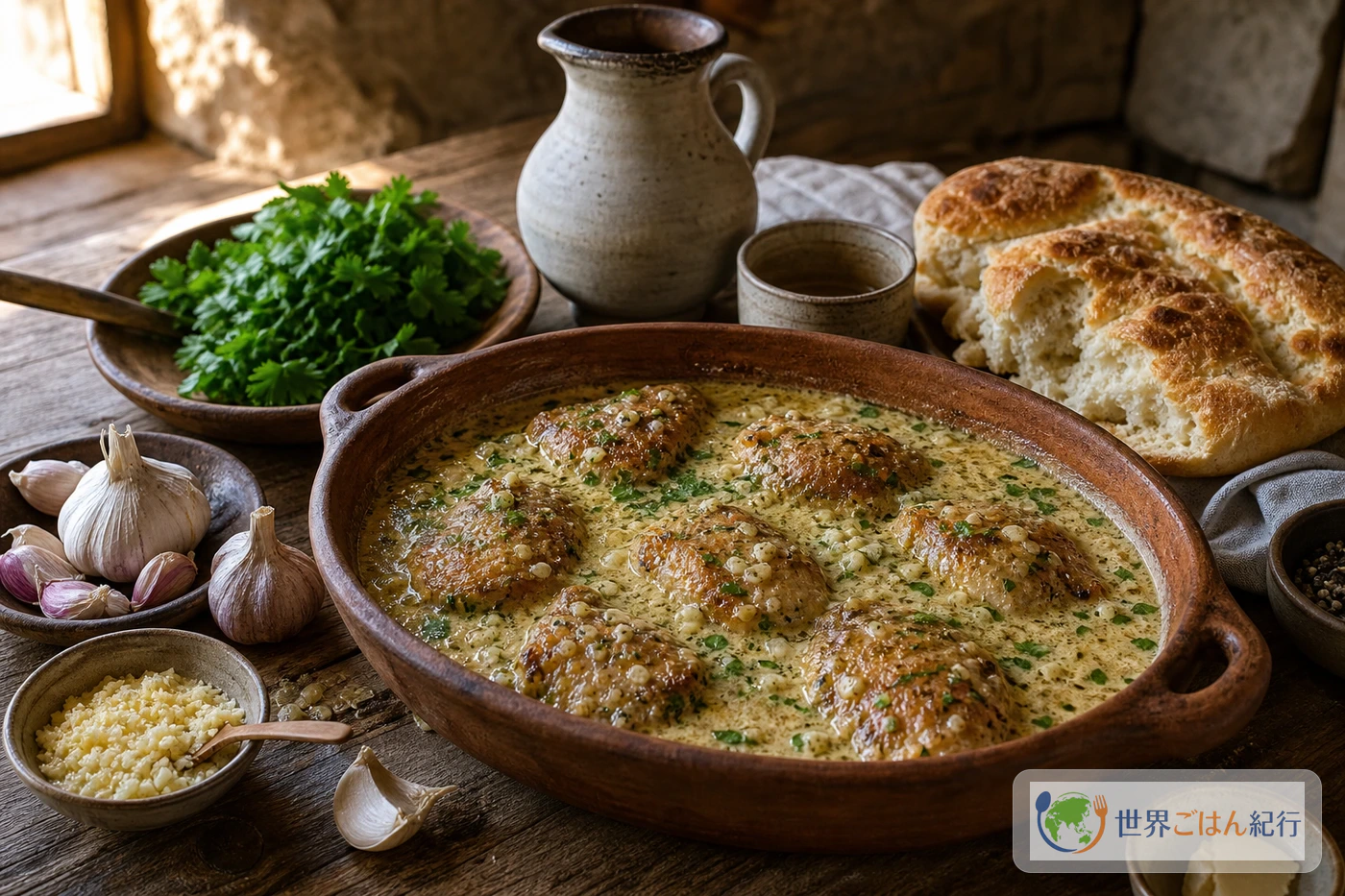
A pot of shkmeruli and bread on a wooden table evoking a Racha kitchen
The white sauce looks like the star, but searing the chicken well first is what gives the dish its flavor

In a home kitchen, the hard part isn't the ingredients but the heat. Burn the garlic and it turns bitter; boil the milk hard and it splits; rush the chicken and the center stays underdone. Instead of a whole butterflied bird, this recipe uses easy-to-find boneless chicken thighs in a skillet or frying pan, aiming for garlic that never scorches, a sauce that resists splitting, and chicken cooked all the way through.

Among Georgian dishes, it helps to learn it alongside the cheese bread khachapuri (in Japanese), the soup dumplings khinkali (in Japanese) and the walnut-sauced satsivi (in Japanese); together they show how a Georgian table is put together. On days when you want garlic flavor in more everyday cooking, Svan salt (in Japanese) is a good match too.

About the name

In Georgian it is written შქმერული, and in English you will see both shkmeruli and chkmeruli. This article uses shkmeruli, the spelling that's easiest to search for.


The story of shkmeruli: white garlic chicken from a Racha village

Georgian food is known for walnuts, herbs, cheese and wine. Shkmeruli stands out for how few ingredients it needs: chicken, garlic, milk and salt. Some local recipes use sour cream thinned with a little water instead. Rather than piling on spices, the core of the dish is letting the garlic perfume the fat left from searing the chicken and wrapping it all in dairy.

Georgia Travel and Advantour both explain that the name comes from the village of Shkmeri in Racha. Georgia Travel describes it as crisply seared chicken combined with milk and garlic, and notes a regional variation in parts of Racha where it is finished with just water and garlic, no milk at all. So rather than a single fixed cream dish, it is closer to a home-style dish with a clear core: it comes from Racha, the chicken is seared, the sauce is garlic, and it is served in a hot pan.

In the Georgian Recipes version, a young chicken is butterflied and fried, the garlic is warmed in the frying fat, milk or sour cream is added, and everything is moved to a traditional clay dish called a ketsi for a short final heating. In other words, picking up the flavor left in the pan where the chicken was seared matters more than making the sauce in a separate pot.

What to keep in this version

Cheesy versions are fun, but make it once without cheese first. The essence of shkmeruli is chicken fat from searing, garlic, dairy and bread. Cheese makes it more approachable but blurs the rustic outline of this Racha dish.


Ingredients (serves 4)
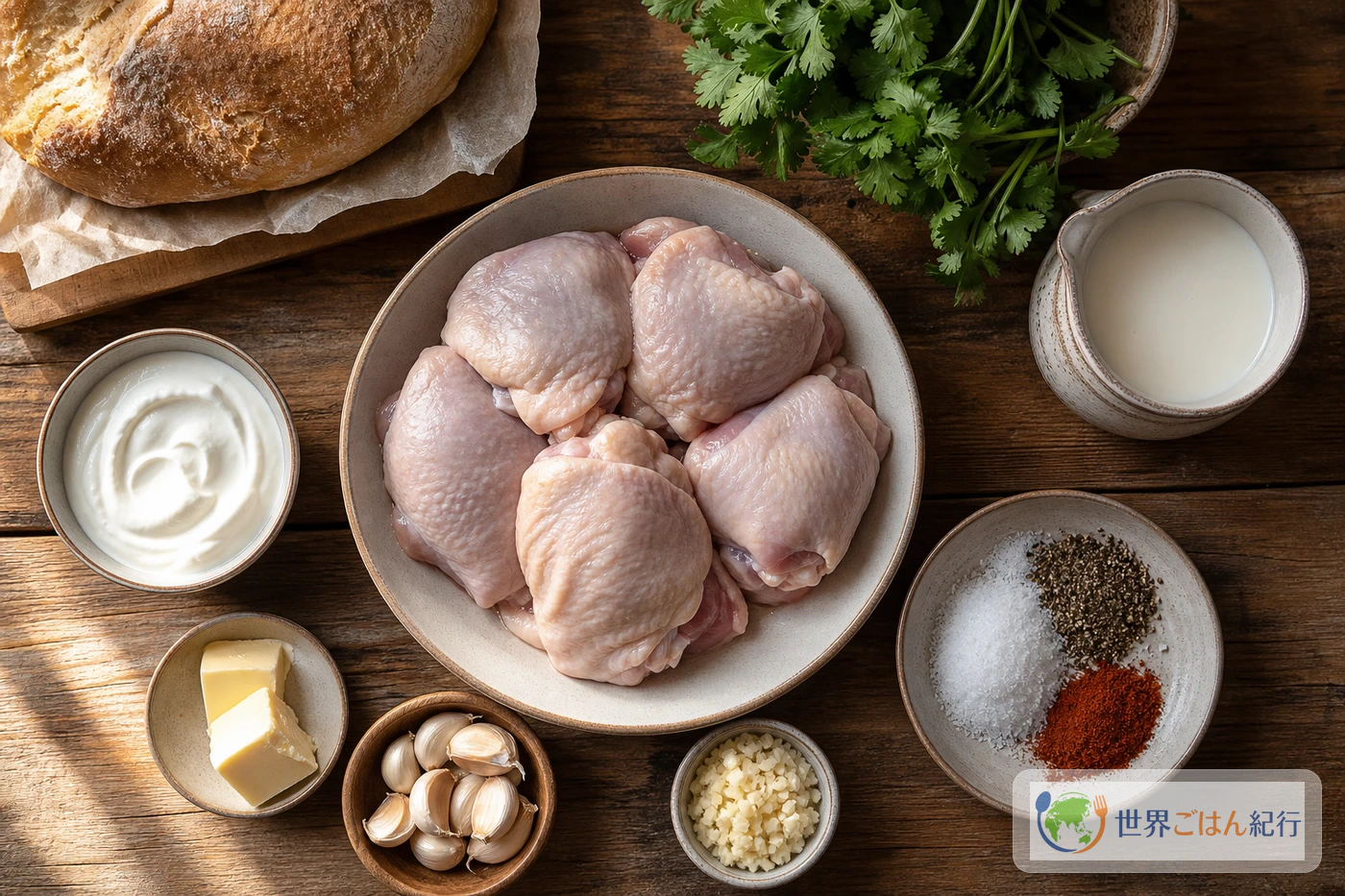
Ingredients for shkmeruli: chicken thighs, garlic, milk, sour cream, butter and herbs on a wooden board
There aren't many ingredients. Fresh garlic rather than jarred paste gives the white sauce a sweet aroma

In Georgia a young chicken is sometimes butterflied whole and seared, but at home bone-in thighs or large boneless thighs work fine. Bone-in pieces add flavor but are a little harder to cook through evenly, so boneless thighs are the better choice the first time.

Chicken and seasoning

Ingredient Amount Substitutes & notes
Chicken thighs 900 g 1.1 kg if bone-in. Skin-on recommended (about 2 lb)
Salt 1 1/2 tsp For the chicken. Season the sauce separately
Black pepper 1/2 tsp Coarsely ground
Paprika 1/2 tsp For color. Can be left out
Cake flour 1 tbsp For browning the skin and lightly thickening the sauce. All-purpose flour works
Butter 20 g About 1 1/2 tbsp. If salted, go easy on the salt in the sauce
Rice bran oil or vegetable oil 1 tbsp Olive oil also works

Garlic milk sauce

Ingredient Amount Substitutes & notes
Garlic 8 cloves (about 50 g) 6 cloves for a milder sauce, 10 for a Georgian-canteen level of garlic
Milk 250 ml About 1 cup. Whole milk; low-fat milk splits more easily
Sour cream 60 g Or 60 ml heavy cream. Milk alone gives a slightly lighter sauce
Water 80 ml Loosens the pan juices from searing
Salt 1/3 tsp Taste and adjust at the end
Coarsely ground black pepper 1/4 tsp For finishing
Cilantro or flat-leaf parsley 10 g A little green onion if you don't like cilantro

To serve

Ingredient Amount Substitutes & notes
Baguette or country loaf 1/2 loaf For scooping up the sauce, like Georgian shoti bread
Cucumber 1 Slice 5 mm thick as a palate refresher
Tomatoes 2 Cut into wedges
Lemon 1/2 Squeeze a little over when the dairy feels heavy
Allergies and food safety

This dish contains chicken, dairy and wheat. Cook the chicken to an internal temperature of 74°C (165°F). Browning alone is not a safety check, so measuring the thickest part with a thermometer saves trouble.

Equipment for this dish

Shkmeruli is easier with a heavy pan. A thin frying pan works, but when the heat hits it hard the milk can boil up suddenly and split. A cast-iron skillet is ideal. If you have an instant-read thermometer, use it in the steps; for the sour cream or heavy cream, choose whatever you can get locally from the ingredient table.


Method: build the browning first, then bring it back to the white sauce

The key to shkmeruli is not simmering in white sauce from the start. Sear the chicken skin well and pass the fat left in the pan on to the garlic and milk. Dairy splits easily if boiled hard, so once the sauce goes in, keep the heat low.
  1. Prep the chicken

    12 min

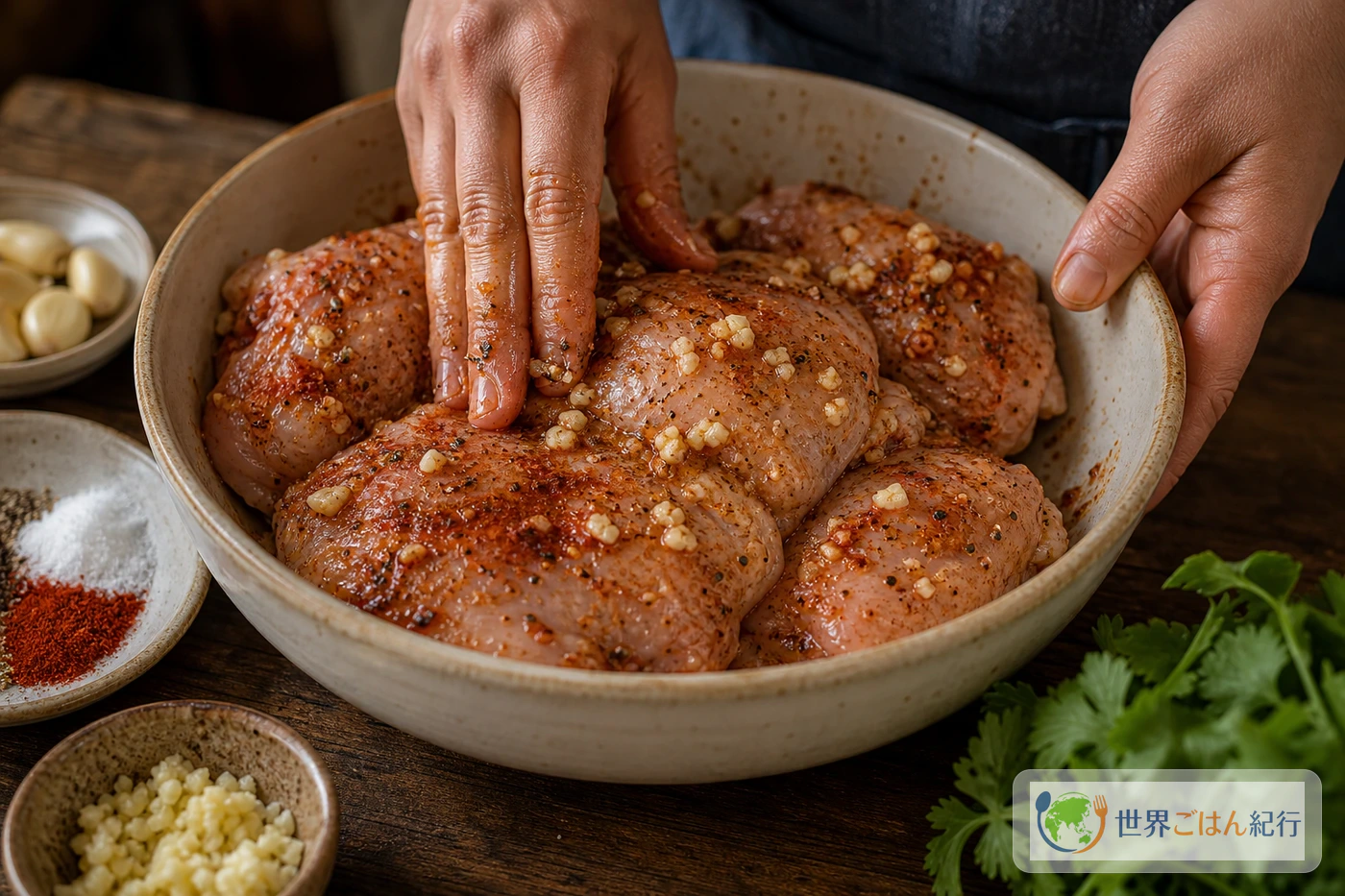
    Cut each piece of the 900 g chicken thighs into 2 or 3 pieces and open up the thick parts so everything is about 2.5 cm (1 inch) thick. Season with 1 1/2 tsp salt, the black pepper and the paprika, then dust the skin side lightly with 1 tbsp flour. Leave at room temperature for 10 minutes, until the surface has lost a bit of its chill and the flour looks damp and absorbed, then move on.

    Seasoning chicken thighs with salt, pepper and paprika
    Even out the thickness and dust the skin lightly with flour for steady browning
  2. Sear skin side first

    14 min

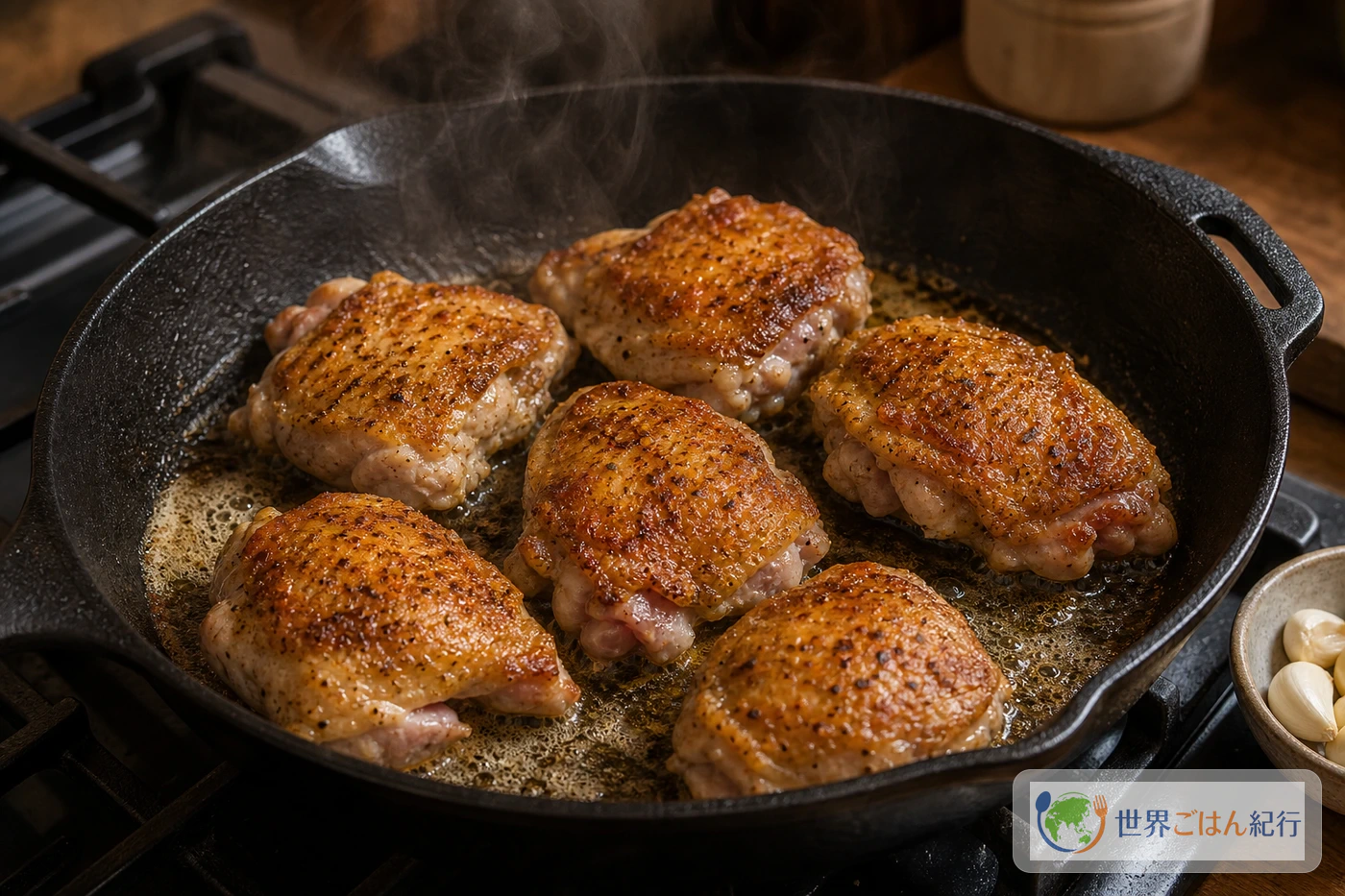
    Add 1 tbsp oil to the skillet and heat over medium for 1 minute. Lay the chicken in skin side down and sear without moving it for 7 minutes. When the skin is deep golden and clear fat is running from the edges, turn the pieces and cook the other side for 5 minutes. The center doesn't need to be fully cooked yet. Transfer to a plate, and if any browned bits in the pan have turned black, wipe them out lightly with a paper towel.

    Browning the chicken skin in a skillet
    Sear the skin over medium heat without moving it, leaving flavorful fat in the pan
  3. Warm the garlic without burning it

    3 min

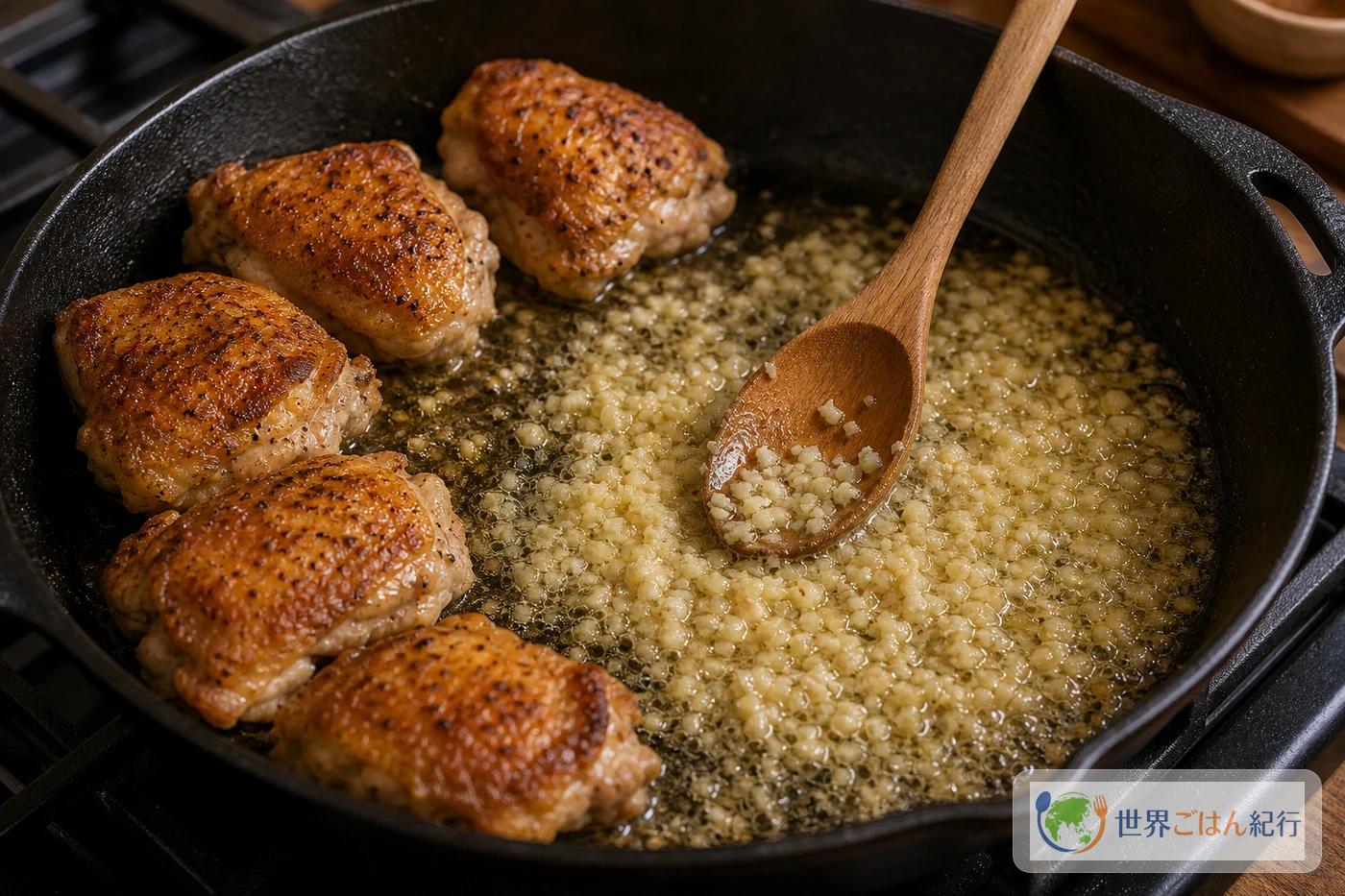
    Lower the same pan to low heat and add 20 g butter and the 8 cloves of finely crushed garlic. Stir for about 2 minutes and stop when the garlic is pale and foaming and smells sweet. The important thing is to turn the heat down before it starts to brown. Burnt garlic makes the whole sauce bitter, so if the pan looks dry, add 1 tbsp water.

    Warming garlic over low heat in the chicken fat and butter
    Don't fry the garlic; keep it pale and let its aroma move into the fat
  4. Add the milk and sour cream

    5 min

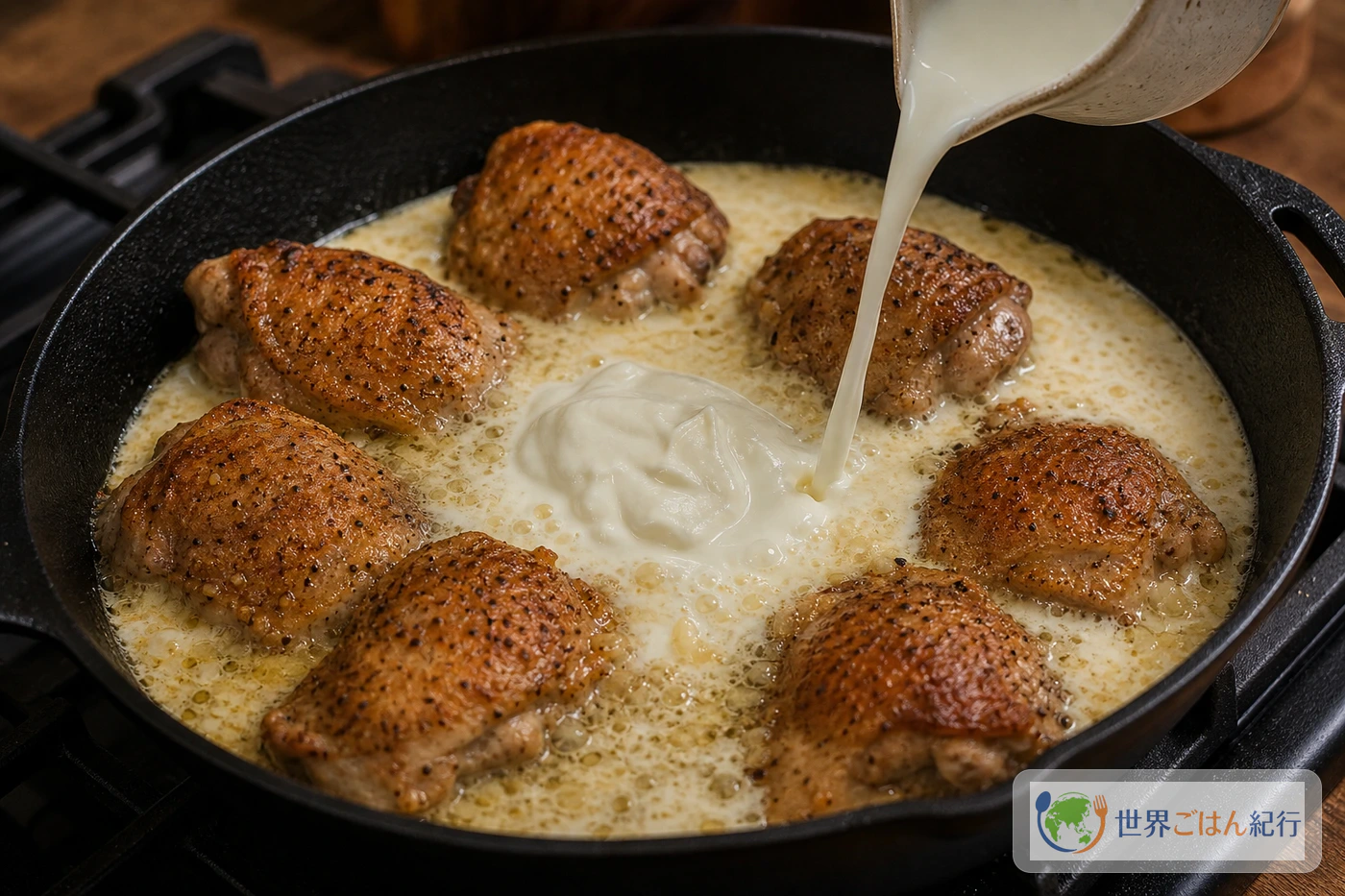
    Pour in 80 ml water and scrape up the browned bits from the bottom with a wooden spatula. Add 250 ml milk and warm over medium-low for 2 minutes. When small bubbles appear around the edge of the pan, stir in 60 g sour cream until dissolved. Don't let it boil hard; aim for an evenly white sauce with the garlic spread throughout. Add 1/3 tsp salt, and add more at the end if it tastes flat.

    Pouring milk and sour cream into the skillet to make the garlic sauce
    Once the dairy is in, keep it at medium-low. Stop at small bubbles, never a rolling boil
  5. Return the chicken and finish

    10 min

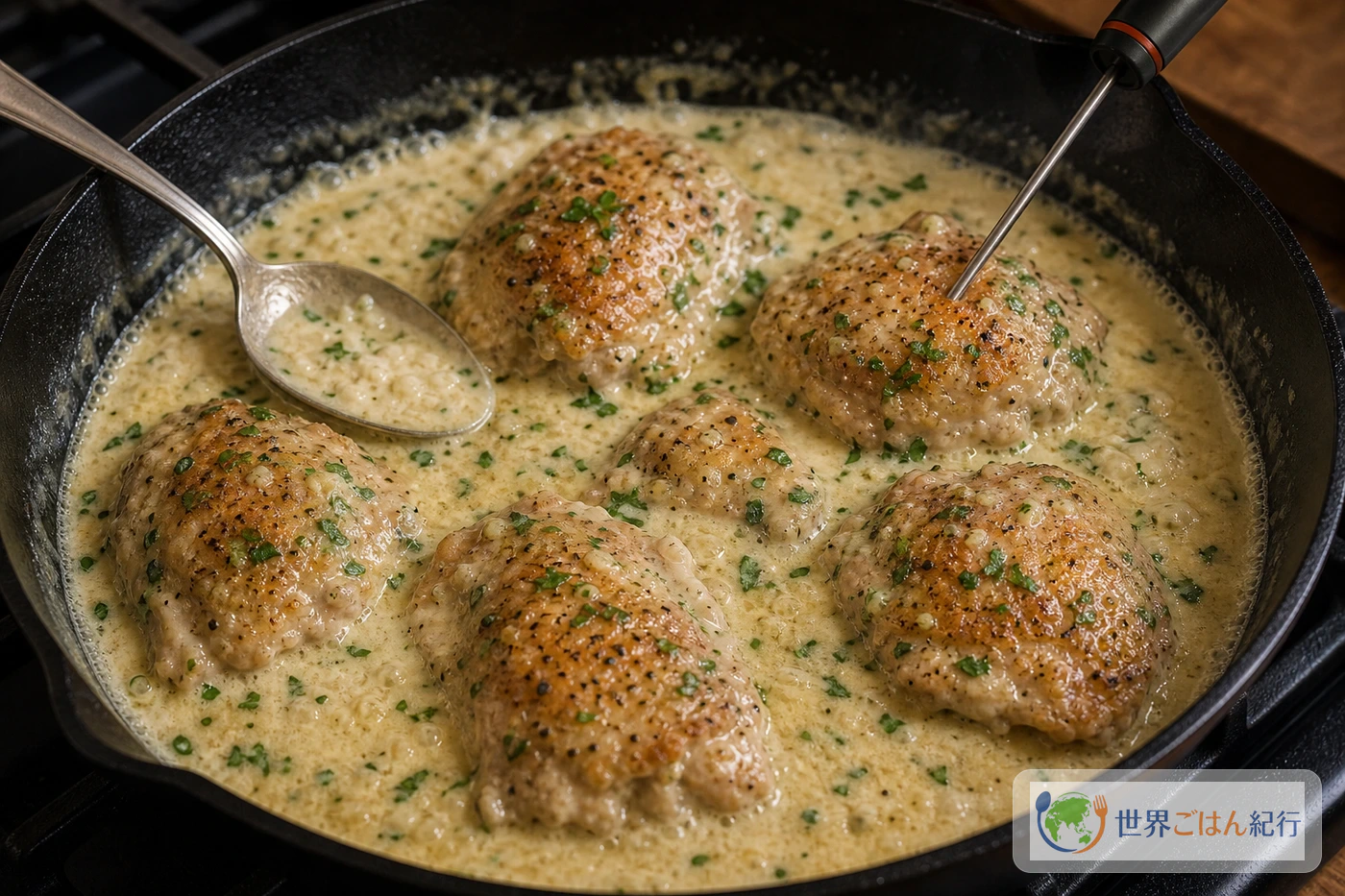
    Return the chicken to the pan skin side up and simmer over low heat for 8 minutes. The sauce should come about halfway up the chicken, with small bubbles steadily rising at the edge of the pan. Spoon sauce over the skin just once along the way. It's done when the center reaches 74°C (165°F), the sauce lightly coats a spoon, and the raw garlic smell is gone. Turn off the heat and sprinkle with black pepper and the chopped herbs.

    Finishing shkmeruli over low heat and checking the internal temperature
    Finish briefly over low heat, and stop once the internal temperature and the sauce's body are right
If the sauce splits

If the milk breaks into curds, turn off the heat, add 2 tbsp cold milk and stir while swirling the pan. Even if it doesn't come fully back together, it's still fine to eat. Next time, avoid low-fat milk and don't let the sauce boil.


How to eat it: scoop the white sauce with bread

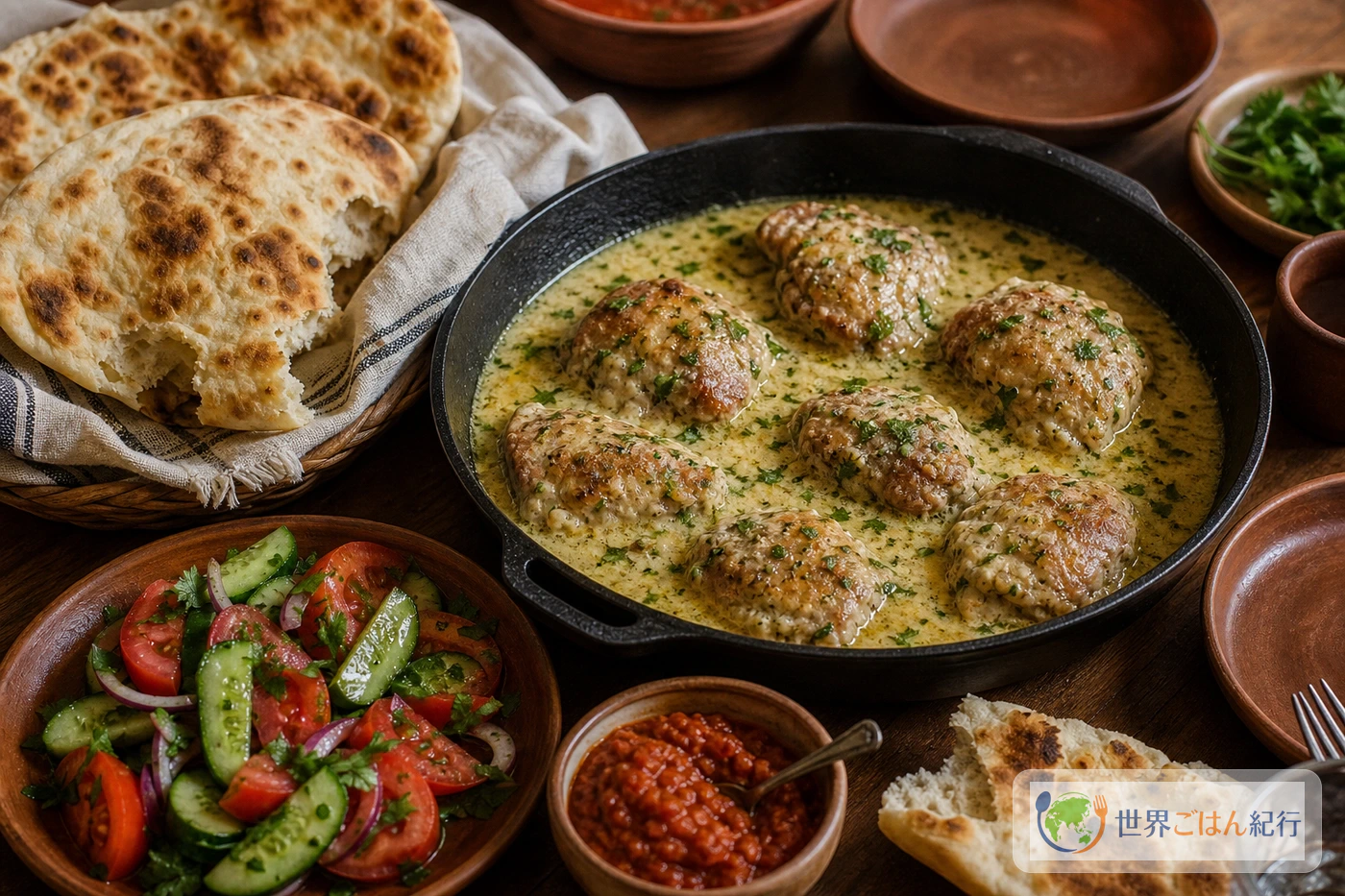
Shkmeruli with bread and small plates of cucumber and tomato on a Georgian-style table
Don't leave the sauce on the plate; scooping it up with bread is what makes it shkmeruli

Shkmeruli is delicious spooned over rice. But to enjoy it as a Georgian dish, put bread beside it first. Wipe up the white sauce with bread and eat it together with the toasty chicken skin and sweet garlic, and the point of the dish becomes clear.

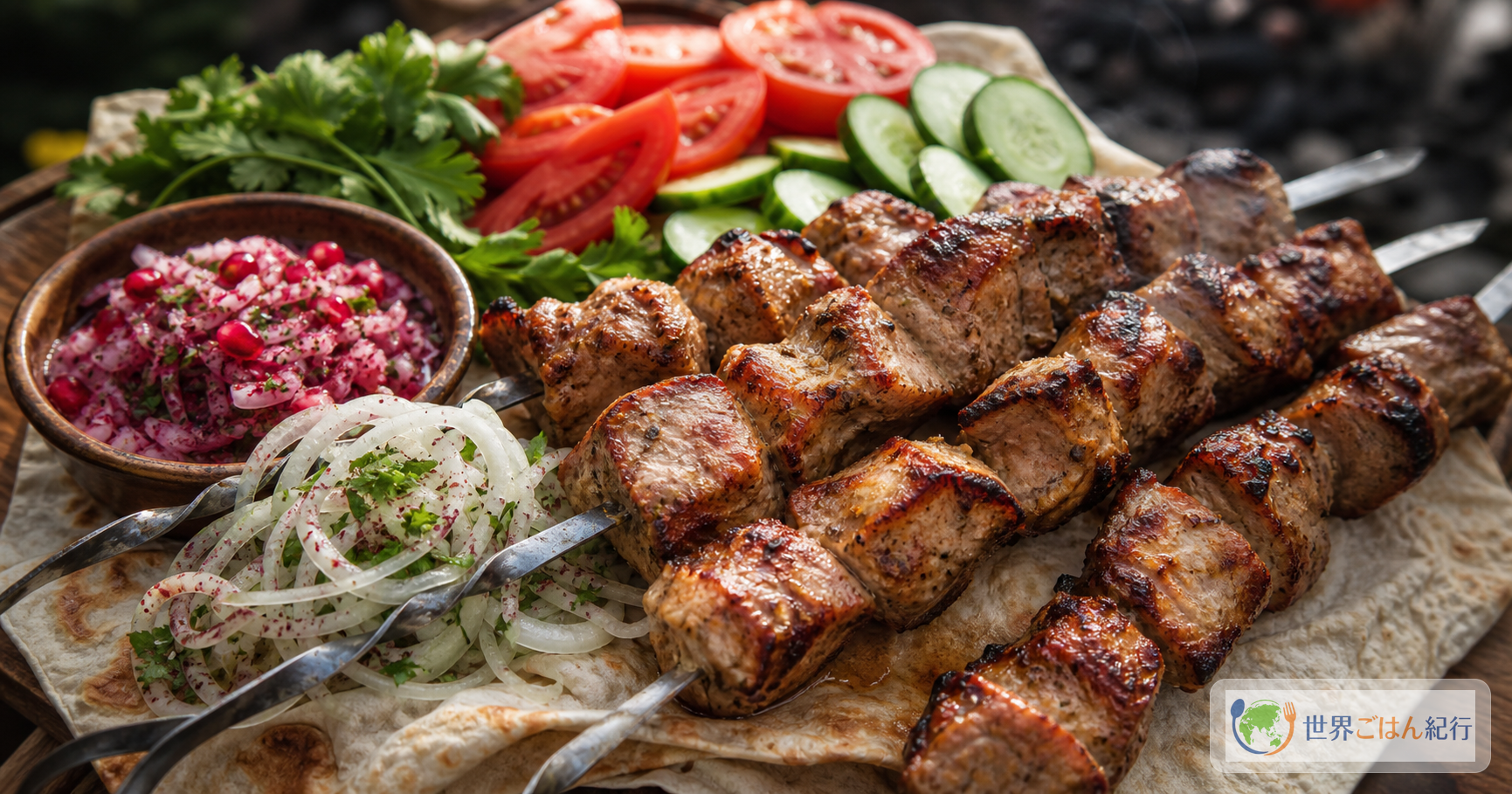
For an everyday table, baguette, country bread or thick toast are easiest. On rice nights, plain white rice keeps it from getting too heavy, more so than buttered rice. Something cool on the side, such as tomatoes, cucumber, lemon and chopped herbs, lifts the weight of the garlic and dairy.

For a Georgian dinner, start with an herb salad, bake khachapuri (in Japanese) as the bread, and make shkmeruli the main course. If there is already plenty of meat on the table, serve only a little of the walnut-sauced satsivi (in Japanese) and save khinkali (in Japanese) for another day so it doesn't get tiring. When you'd rather have chicken lightly stewed with tomatoes and herbs than a white garlic sauce, chakhokhbili (in Japanese) makes a good contrast. Planning with the Georgian food overview (in Japanese) open makes it easier to balance cheese, herbs, walnuts and garlic.

To get closer to the traditional pan

A traditional ketsi is a shallow unglazed clay dish. A skillet or heatproof ceramic dish is a perfectly good substitute. What matters is serving it in a hot vessel so the sauce doesn't cool down before you finish eating.


Troubleshooting: garlic, milk and heat

With so few ingredients, the reasons shkmeruli goes wrong are easy to pin down. Bland, bitter, split sauce, tough chicken. Fix these four and the home version becomes very reliable.

Problem Cause Fix
Bitter Garlic was fried over medium heat or higher until it colored Next time, 2 minutes over low heat. If it burned, start the garlic over
The sauce splits Low-fat milk, high heat, long cooking Use whole milk and stop at small bubbles
Bland Chicken under-seasoned; browned bits not picked up from the pan Salt the chicken first and scrape the pan with the water
Tough chicken Breast meat only, overcooking, not resting Use skin-on thighs and stop at 74°C (165°F)
Garlic too harsh Raw garlic flavor remained Simmer the sauce 2–3 more minutes over low heat to round it out
It turns into cream stew Too much milk and cream Use less sauce and brown the chicken more deeply
Lots of garlic, but never burnt

The character of shkmeruli lies in the amount of garlic. But garlic scorched over high heat is a different thing entirely. Draw out its aroma over low heat while it stays pale, then mellow it a little in the milk, and even a large amount won't taste harsh.

Don't overdo the sour cream

More sour cream makes it richer, but also tangier and heavier. 60 g is plenty to start. If you want to get closer to Georgian recipes, try making a milk-only version and a sour-cream-only version side by side to taste the difference.


Storage and make-ahead: keep the sauce separate for easier leftovers

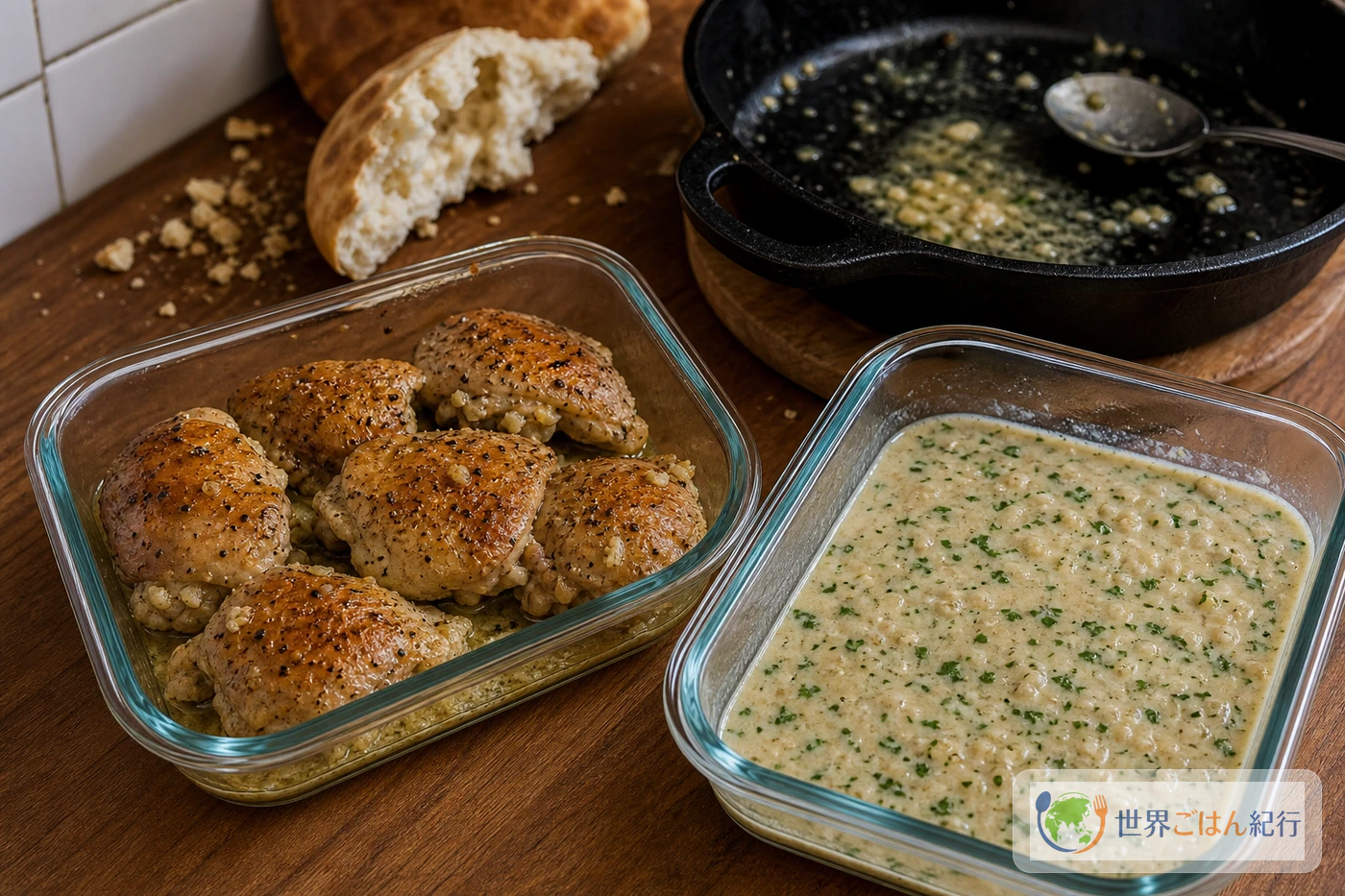
Shkmeruli chicken and garlic milk sauce divided into storage containers
Cool leftover shkmeruli in shallow containers, with the chicken and sauce separated for easier reheating

Shkmeruli is best freshly made. Still, with garlic sauce left over, you'll want to save some for the next day. To store it, divide the chicken and sauce into shallow containers and refrigerate once they've cooled down a bit. Eat within 2 days.

Reheat over low heat. Put the sauce in a pan, add 2 tbsp milk and warm over low heat for 2 minutes. Return the chicken, cover and heat for 3–4 minutes. Turn off the heat once it's hot all the way through. Reheating only in the microwave softens the skin and makes the sauce more likely to split, so finishing in a pan gives a better result.

Freezing is less recommended. Dairy sauces tend to split when thawed, and the garlic aroma goes flat. If you must freeze, freeze only the chicken, use it within 1 month, and make the sauce fresh. Leftover sauce is easy to turn into lunch the next day by tossing a little with boiled potatoes, short pasta or toast.


Frequently asked questions

Can I make it with milk only?

Yes. Georgian Recipes gives both a milk version and a sour cream version. Milk alone is lighter; adding a little sour cream or heavy cream makes the sauce less likely to split on a home stove. For a first try, the in-between version of 250 ml milk with 60 g sour cream is a good choice.

Can I add cheese?

It's tasty, but it moves toward a different dish. Many of the versions that became popular in Japan include cheese, while the basic Racha form centers on chicken, garlic, and milk or sour cream. If you add cheese, keep it to 40 g of shredded pizza cheese at the end, and make it without cheese at least once first.

Can I use chicken breast?

You can, but it toughens easily. If you do, open 700 g chicken breast to 2 cm thick, salt it and let it sit for 10 minutes. Sear for 4 minutes per side, cut the simmering time in the sauce to about 5 minutes, and turn off the heat as soon as the center reaches 74°C (165°F). Soaking it long in a dairy sauce tightens the fibers.

Does it still work with less garlic?

It does. If 8 cloves feels too strong, use 6. But cutting down to 2 or 3 cloves blurs the outline of shkmeruli. If you use less, add a little more black pepper and chopped herbs at the end to make up for the missing aroma.

Do I need white wine or spices?

No. Some modern recipes add a little white wine, but leaving it out makes the basic version easier to understand. Black pepper is plenty for spice. If you use Svan salt, it's quite salty, so cut the salt for seasoning the chicken to 1 tsp.

What can I do with leftover sauce?

It goes well with boiled potatoes, short pasta and sautéed mushrooms. Put the sauce back in a pan, add 2 tbsp milk, warm it over low heat and toss in the potatoes or pasta. If it tastes too salty, loosen it with a little unsalted butter or milk.


Sources