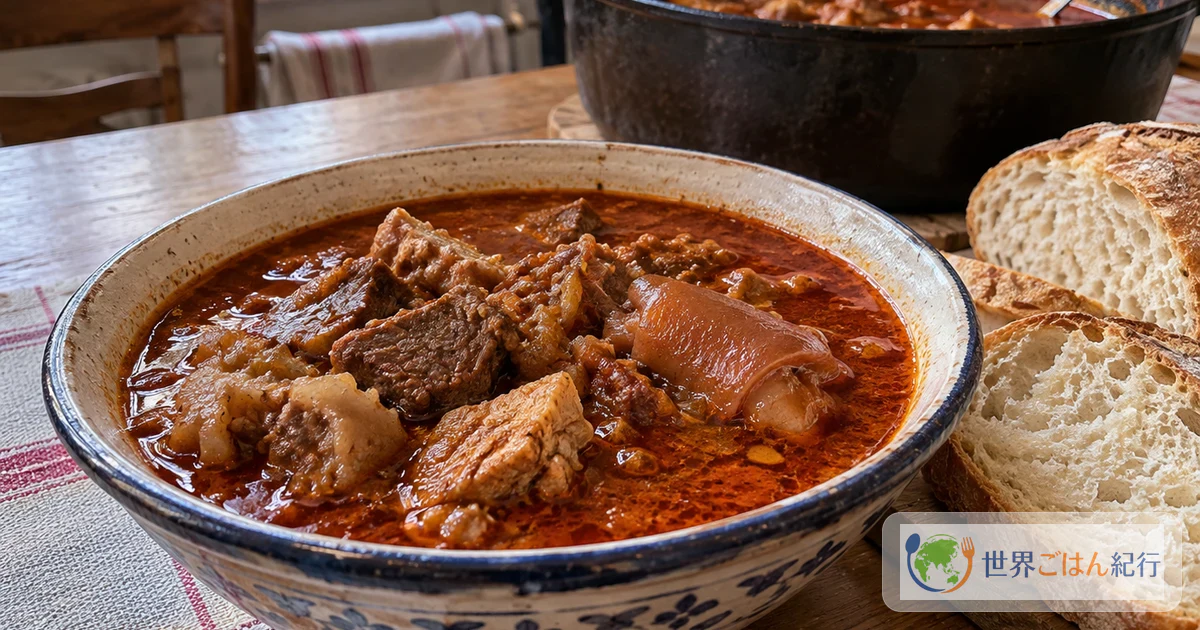
A harbor-town soup, with saffron and fish rising from the pot
The day you find fish frames at the fish counter, the options for the menu widen a little. You could braise them with vegetables, but with the heads and bones of white fish, there is another path: simmer them with onion, tomato, garlic, fennel, and saffron into a golden soup. Orange peel and fish scent fill the kitchen, and when you spread garlicky rouille on toasted baguette, the air shifts in a different direction from your usual seafood pot.

Bouillabaisse is the fish soup that represents Marseille, and it is not a dish of simply simmering fish. The Marseille tourist office presents bouillabaisse as an emblematic dish of the city and explains the way it is eaten, combining the fish, the broth, rouille or aioli, and croutons rubbed with garlic. Authentic restaurants on location are particular about the species of fish, but gathering the same fish in a home kitchen elsewhere is not realistic.
This article separates what to keep from what to change. What to keep: making the broth from fish frames, using saffron and fennel, not boiling the fillets hard, and serving rouille and bread. What to change: the fish. Even without scorpionfish or gurnard, white-fish frames, cod, sea bream, sea bass, shrimp, and mussels or clams can bring it into a home pot.
Even among French braises, it goes in a different direction from pot-au-feu (in Japanese), enjoyed for the clear savor of meat and vegetables, or from garbure, which builds thickness with beans and meat. In bouillabaisse, the gelatin of the fish, olive oil, tomato, herbs, and saffron layer together, and in the end the bread receives the soup. If you bought saffron for Spain's fideuà or paella valenciana (in Japanese), this is one of the dishes where that little jar can be used most satisfyingly.
Bouillabaisse is not a dish that gets better the longer you cook the fish. Make the broth from fish frames in about 35 minutes, cook the potatoes in the strained broth, and add the fillets and shellfish for only the last 8 to 10 minutes. Keep the heat not high but so that the surface just trembles.
Ingredients (serves 4)

This is the quantity for a heavy pot 22 to 24 cm in diameter. White fish suit the frames. It can be made with the frames of oily fish, but the aroma comes through strongly, so avoiding them the first time makes failure less likely. Mussels suit the mood, but if they are hard to find, clams with the sand purged are fine.
Allergies and safety
This contains fish, shrimp, shellfish, egg, and wheat. It can also be made with white fish alone, leaving out the shrimp and shellfish, but if you use shellfish, always check the sand purge and cracked shells. FoodSafety.gov gives a safe internal temperature for fish of 145°F, about 63°C. On days when the fillets are thick, turn off the heat when the flesh is white and opaque and the center has reached 63°C.
Ingredients and tools that make a difference

The fish and potatoes can be bought nearby. What is worth looking for elsewhere is saffron, which decides the aroma even in small amounts, a heavy pot that steadies the heat, and a thermometer that lets you check the center temperature of the fish. Rather than buying fresh items to fill out the list, focus on the tools that reduce failure and the core of the aroma.
Saffron makes not only the color but the dry, floral aroma characteristic of bouillabaisse. You can turn it yellow with turmeric, but the aroma is something else.
A heavy pot is best for bouillabaisse. If it keeps boiling, the fish breaks apart and the broth clouds. A thick-walled pot is less prone to sudden swings in heat and easier to hold at a gentle low simmer.
White fish is a food where doneness is hard to judge by eye. On days you use thick fillets, or serve children or elderly family members, a thermometer lets you turn off the heat with confidence.
Method: do not simmer the fish, let it swim at the end
Separate the pot for making the broth from the time you add the fish you will eat. If you put the fillets in from the start, by the time you eat they have broken up and lost their savor. Think of the frames as the stock, and the fillets and shellfish as the filling, and the flow becomes clear.
A table of options for getting close to the original at home
If you think "I can't make bouillabaisse because I don't have the authentic fish," you stall. What matters more than getting the species names perfect is separating the part that makes the stock, the part you eat, and the part that makes the aroma.
| Where you hesitate | Closer to the original | Realistic choice | What to keep when substituting |
|---|---|---|---|
| Fish | Several kinds such as scorpionfish, gurnard, conger-type fish, and monkfish | 500 g white-fish frames, cod, sea bream, sea bass | Do not use only oily fish. Separate the frames and fillets |
| Shellfish | Mussels | Clams, hard-shell clams | Purge the sand and discard any that do not open |
| Aroma | Fresh fennel, saffron, orange peel | Fennel seed, saffron, citrus peel | Do not use only one of saffron and fennel |
| Rouille | Egg yolk, oil, garlic, saffron, chile | Mayonnaise, potato, garlic, saffron water | Do not overdo the garlic, and keep it at a thickness that dissolves into the broth |
| How to eat | Broth, fish, bread, and rouille separately | Fine to put it all in a deep bowl | Leaving out the bread and rouille makes it drift toward just a fish soup |
On days you cannot find frames at the fish counter, rather than forcing yourself to make it with expensive fillets alone, asking the fishmonger "Do you have white-fish frames?" is the shortcut. If there are no frames, set aside 100 g of fillet for the broth and add the rest as the filling at the end. On days the stock is weak, bringing out the fennel and saffron properly keeps more of the bouillabaisse character than reducing the tomato a little.
Where it is easy to go wrong

| State | Cause | Fix |
|---|---|---|
| Fish breaks up | Fillets went in early, or the boil was strong | Fillets only for the last 8–10 minutes. Shake the pot over low heat |
| Cloudy broth | The frames were boiled hard, or pressed too hard in the sieve | Drop to small bubbles at 80–90°C, and press lightly when straining |
| Fishy | The blood line remained, or too much oily fish | Wash and pat dry the frames. Use mostly white fish at first |
| Flat flavor | One of the saffron, fennel, or orange is weak | Add saffron water at the end, and crush a little fennel seed to add |
| Rouille is harsh | Too much garlic or too strong a chile | Add a little potato and mayonnaise and adjust with lemon juice |
| Shellfish do not open | They were weak to begin with, or undercooked | Cook 1 more minute, and discard any that still do not open |
Reducing a thin broth for a long time can make only the salt stand out. On a day the frames were too few, the right answer is to use more frames next time. If you fix it on the spot, do not suddenly add salt; trying a little saffron water, then 1 tsp olive oil, then a few drops of lemon juice, in that order, brings back the outline.
How to eat it and storage

To lean toward the Marseille style, first enjoy the broth with bread and rouille, and then eat the fish and potatoes. At home you may serve it in one bowl, but adding bread and rouille partway changes the aroma and weight within the same broth. If you pair it with white wine, a dry one with acidity suits it. For a non-alcoholic drink, sparkling water with squeezed lemon or cold iced tea also cuts the weight of the oil.
When storing, keep the broth and fish apart. The guide is 1 day in the refrigerator, and for the broth alone, 2 weeks in the freezer. Fish turns dry when frozen, so finishing it the next day suits it better. To reheat, warm the broth first over low heat, without boiling, to around 80°C, and then return the fish for only 2 to 3 minutes. Heating all at once in a microwave tends to toughen the fish, so reviving it in a pot is more stable.
Leftover broth can become a rice porridge the next day with a little rice. However, avoid reheating again and again with the shellfish and shrimp still in it. Warming the broth with the ingredients taken out, adding cooked rice and simmering for 5 minutes, and returning the remaining fish at the end keeps the flesh from breaking down too much.
Learning how it is eaten on location
In a recipe from the Provence-Alpes-Côte d'Azur tourism board, Marseille bouillabaisse uses several Mediterranean fish, olive oil, garlic, onion, fennel, parsley, and saffron, and is served with rouille and garlic croutons. Even if the species of fish are replaced at home, you want to keep the framework of aromatic vegetables, fennel, saffron, rouille, and bread.
The Marseille tourist office introduces an explanation that the name bouillabaisse comes from the movement of cooking, bringing it to a boil and then lowering the heat. That sense is useful when cooking at home too. Raise the temperature once to bring out the aroma, and lower the heat when the fish goes in. It looks like a bold harbor-town dish, but in the end it is quite delicate.
If you make it with the fish you can get, you will do better not to try to make everything "the same as the original." What to keep is the freshness of the seafood, the heat, the combination of aromas, and the pleasure of combining bread and rouille at the table. Even without scorpionfish, the moment saffron's color spreads in the pot and toasted bread soaks up the broth, you are very close to bouillabaisse.
FAQ
Can I make it without saffron?
You can, but the aroma characteristic of bouillabaisse is weaker. If it is only color, a small amount of turmeric can make it yellow, but saffron layers more naturally with fennel, tomato, and the fish aroma. For the first time, I recommend using even just 0.2 g.
Is one kind of fish all right?
One kind of fillet to eat is fine. However, frames for the broth should be prepared separately for more flavor. If you make it with fillets only, do not simmer the whole quantity; put in just 100 g first for the broth and cook the rest at the end.
I cannot get mussels.
Clams or hard-shell clams can substitute. For either, purge the sand, and do not use any with cracked shells or that do not open when cooked. If you leave out the shellfish, adding 100 g more frames makes up for the depth of the broth.
Is rouille essential?
Not essential, but it greatly changes how it is eaten. Where fish soup alone feels light, the bread spread with rouille takes it up. If you dislike garlic, you can reduce the amount to 1/4 clove.
Can I prepare it the day before?
You can go as far as making and straining the broth from the frames the day before. Refrigerate it, and the next day add the potatoes, fillets, and shellfish to finish. Leaving the finished dish with the fillets in it overnight makes the fish tend to toughen.
How do I make it not spicy for children?
Leave out the cayenne pepper in the rouille and replace it with a little paprika. The soup itself is not spicy, so splitting the rouille into an adult one and a child one makes it easy to adjust at the table.
Sources and references
- Marseille Tourism, "Bouillabaisse, the traditional fish soup"
- Provence-Alpes-Côte d'Azur Tourism, "Bouillabaisse de Marseille recipe"
- FoodSafety.gov, "Cook to a Safe Minimum Internal Temperature"
- Wikipedia, "Bouillabaisse"