Small Squares That Become a Mountain Table
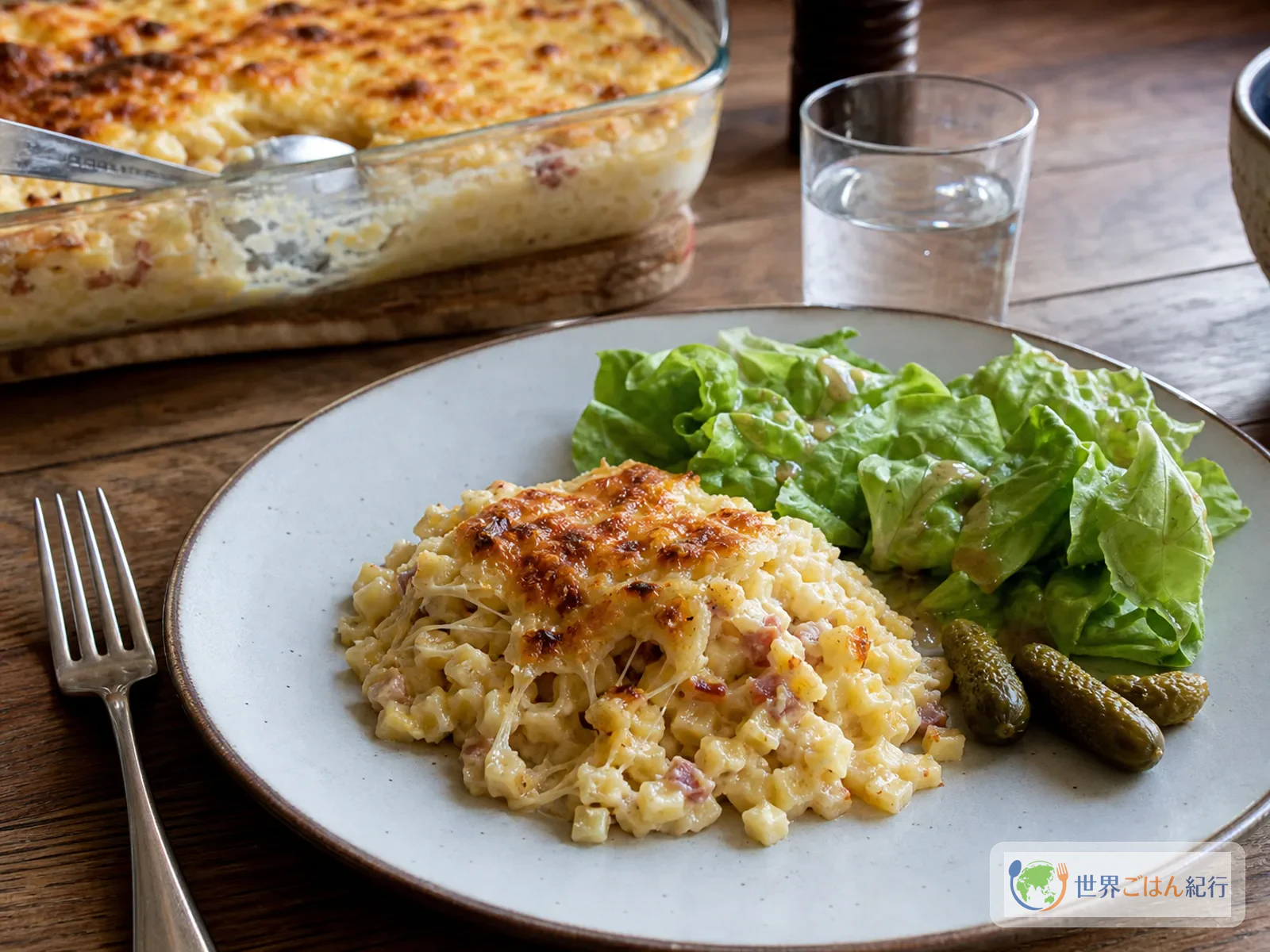
Kneading flour on a cold day slows the time in the kitchen a little. Crack eggs into the pale gray of buckwheat flour and press with your palm, and a plain dough comes together, not as taut as soba, not as cheerful as pasta. Roll it thin and cut it into 1 cm squares. Each piece is modest, but boiled and baked with cream and cheese, it becomes a plate that could come out of a mountain chalet in Savoie.
Crozets de Savoie are small square pasta from the Savoie region of eastern France. There are versions with buckwheat and ones with wheat only, and locally they are boiled as a side dish or baked croziflette-style with onion, lardons, cream and Reblochon cheese. If tartiflette is made with potatoes, think of croziflette as a mountain gratin made with crozets, and the direction of the flavor is easy to grasp.
What is troublesome elsewhere is that crozets themselves are almost never in an ordinary supermarket. They can sometimes be found at import food shops, but they are not a pantry staple. So this article makes hand-cut crozets from buckwheat flour and bread flour, and bakes them croziflette-style in a home oven. If you can't get Reblochon, combine raclette, a washed-rind cheese and a lightly aged semi-hard cheese to move toward the aroma of a mountain cheese.
For a quiet stew from the same France, pot-au-feu (in Japanese), and for a table of melted cheese, Swiss raclette (in Japanese), are close relatives. Crozets sit between them. There is the handwork of kneading flour and the pleasure of baking cheese. For the little hesitation you feel at the shop, the table when it is done is quite powerful.
Crozets de Savoie is written crozets de Savoie in French. Crozets are the small square pasta, and croziflette is used as the name of the dish in which those crozets are baked with cheese, cream and bacon. In this article, hand-cut crozets are finished croziflette-style.
Ingredients: Gather the Aroma of Buckwheat and a Mountain Cheese

This amount serves 4. Served as a main dish it feeds 4; as a side to a meat dish it can be shared by 6. If you can get store-bought crozets, replace the dough ingredients with 320g of crozets and adjust only the boiling time to the package.
This recipe contains wheat, buckwheat, egg, milk and pork. If you have a buckwheat allergy, don't use the buckwheat flour; make it with 260g bread flour. The flavor leans toward wheat, but it still works as a croziflette-style bake.
Ingredients you can substitute, and ones that are hard to replace
| Role | Ingredient to keep | Possible substitute | What changes with the substitute |
|---|---|---|---|
| Buckwheat aroma | 120g buckwheat flour | All bread flour | The plain Savoyard aroma weakens |
| Stretch of the dough | 140g bread flour | 140g all-purpose flour | Slightly more prone to tearing, but manageable at home |
| Saltiness of the meat | Thick-cut bacon | Pancetta, salt pork | Pancetta is very salty, so cut a little of the salt in the dough and boiling water |
| Mountain cheese | Reblochon type | Raclette, taleggio, tomme, washed-rind types | Aroma, melting and saltiness change |
| Baking dish | A heatproof dish about 20 cm | Cast-iron skillet | The bottom of a skillet browns easily, so allow 2 minutes less baking |
What takes the most shopping in many places is the cheese, the buckwheat flour and the tools. Buckwheat flour can be found at baking-supply shops and the dried-goods aisle, but the closer to freshly milled, the more aroma it gives. The ideal cheese is Reblochon, but it may be unavailable depending on imports. In that case, combine small amounts of a good-melting raclette type, an aromatic washed-rind type and a mild semi-hard type, and make up the missing saltiness with the bacon.
Cream, milk and ordinary natural cheeses, though, are ingredients easy to buy nearby. Raclette cheese is also less likely to fail if you buy it from a specialist or import shop where you can see the amount. What is worth tracking down is a rolling pin to roll hand-cut crozets evenly, a heatproof dish of about 20 cm that is not too deep, and a cast-iron skillet when you want strong browning. It is the same with dishes that handle thin dough like achma (in Japanese): when the size of the tool fits, the work itself suddenly settles.
Tools worth deciding on when you shop
| Priority | What to prepare | What to look at | Substitute |
|---|---|---|---|
| High | A rolling pin of about 30 cm | A length that makes it easy to roll the dough out to 20 cm wide | A clean wine bottle. But it is heavy and the thickness tends to vary |
| High | A heatproof dish of about 20 cm | Height of about 4 cm. If too shallow the sauce spills, and if too deep the browning is slow | An 18 cm round dish. Allow 3 to 5 minutes more baking |
| Medium | A cast-iron skillet | One that gives strong browning on the bottom and rim | Keep the heatproof dish and add 2 minutes on the upper rack |
Raclette cheese is not Reblochon itself, but its stretch and aroma when heated are close, so it is easy to use as a first substitute. The rolling pin is for evening the dough to 2 mm, and the heatproof dish is for keeping the sauce and cheese at the right thickness. A skillet is not essential, but suits when you want a toasty chalet-style edge. Like chipa guasu (in Japanese), where a corn dough is baked in a heatproof dish, the depth of the dish governs the moisture of the finished result.
Method: Cut the Dough, Bake It to Browning
Crozets are small, so if you hurry the process they stick to the work surface. Allow time to rest the dough, and after cutting, loosen them lightly with dusting flour before boiling. Once you move to baking, think of it as heating through to the center first and coloring the surface last, rather than browning it all at once on the upper rack.
Where It Goes Wrong, and How to Fix It
If you think "they are small pasta, so it's easy," crozets fail unexpectedly. The problem is not the shape but the moisture, the thickness and the baking. Hand-cut crozets in particular take up more water than dried pasta, so leave room for them to absorb the sauce after boiling.
| Problem | Cause | Fix |
|---|---|---|
| The dough cracks | Too little water, or not rested enough | Add 5ml water, bring it together, and rest 20 minutes |
| The dough is sticky | Too much water, or too little dusting flour | Add flour 2 tsp at a time, and dust the surface lightly too |
| They clump when boiled | They were stacked after cutting, or the water was too weak | Spread the 1 cm squares out and scatter them into boiling water |
| The center is floury | Too thick, or too little boiling time | Roll to 2 mm and taste one to check the center |
| The bake is watery | Too much cooking water, or the sauce is thin | Start with 40ml of cooking water and add 1 minute over low heat to thicken |
| The cheese separates | It was baked suddenly under strong top heat | Warm it first on the middle rack at 200°C, and color it on the upper rack only at the end |
| The taste is heavy | No sour accompaniment | Put 2 tsp white wine vinegar in the salad and serve cornichons |
With buckwheat flour in the dough, you are tempted to aim for the thinness of Japanese soba. But if crozets are too thin they tear when boiled and dissolve into the sauce when baked. Leaving a thickness of around 2 mm, with a small springiness when bitten, is easiest to handle at home.
How It Is Eaten Locally, and a Menu to Build Around It
Savoyard cooking has many strong dishes suited to the Alpine climate. Cheese, potatoes, bacon, flour foods. Crozets too are not a light starter but are positioned close to a main dish for a cold day. In local recipes, store-bought crozets are often used, and for a weeknight dinner the flow is to boil dried crozets and bake them all at once with sautéed ingredients and cheese.
If you serve it at home, the menu looks cleaner if you don't add too much. Since the star is cream and cheese, sour leafy greens, a soup low in salt, a dry white wine or warm tea are enough alongside. If you add a meat dish, keep it small, and serve a small clear soup like leftover broth from pot-au-feu (in Japanese), so the table doesn't get heavy.
If you can get Reblochon, leaving a thin layer of the rind gives aroma. If someone in the family isn't used to strongly scented cheese, combining 150g raclette with 70g of a natural cheese (not pizza cheese) is milder. Using only pizza shreds melts easily, but the earthy aroma of a mountain cheese dish weakens.
Viewed as a European flour dish, crozets are a little like Finland's Karelian pasties (in Japanese). Neither relies on showy spices; they build satisfaction from the grain, dairy and browning of a cold land. To keep the Savoyard character, protecting the aroma of the buckwheat and the browning at the rim of the dish is more effective than adding more cheese.
Branching points toward the authentic, in a home kitchen
Hand-cut crozets do not fully replace dried Savoyard crozets. The commercial ones locally are more uniform and keep their shape when boiled, while ones made at home tend to bring out the aroma of buckwheat. Changing how you organize the work depending on which you prioritize reduces failures.
| Point of hesitation | If you prioritize the authentic | If you prioritize stability at home |
|---|---|---|
| Crozets | Use 320g store-bought crozets and boil 1 minute less than the package says | Hand-cut with 120g buckwheat and 140g bread flour, and keep to 2 mm thickness |
| Cheese | Lay Reblochon thin, rind and all | Combine 150g raclette with 70g of a mild natural cheese |
| Bacon | Make the saltiness stronger with lardons or pancetta | Get aroma from thick-cut bacon, and fix the boiling water salt at 1% |
| White wine | Move toward a dry white of Savoie | Cut only the heaviness with 40ml water and 1 tsp white wine vinegar |
| Baking dish | A shallow ceramic dish to bake a wide surface | A 20 cm square dish, within 3 cm thickness, moving from the middle rack at 200°C to the upper rack |
For the first time, what to keep is not putting in too much buckwheat flour, not making the crozets thick, and not scorching the cheese suddenly. If you don't miss these three, even without Reblochon it stands up well enough as a mountain gratin to eat on a cold day.
Storage and Make-Ahead

Baked crozets keep for 2 days refrigerated after cooling about 20 minutes and moving to a shallow container. If you refrigerate it in the large heatproof dish, the center is slow to cool and reheating the next day is uneven. Dividing it into portions is safer and more stable in taste.
To reheat, in the oven, 10 to 12 minutes at 180°C (350°F). If the surface is dry, drizzle 1 tbsp milk around the edge, cover with aluminum foil for 8 minutes, and remove it for the last 2 minutes. To warm in a small pot, add 2 tbsp milk and stir over low heat for 4 to 5 minutes. The microwave is quick, but the oil of the cheese tends to separate, so heat at 600W for 1 minute 30 seconds, rest 30 seconds, then another 30 seconds, in that increment.
Freezing is possible, but the texture of hand-cut crozets drops a little. If freezing, don't do it before baking; wrap the baked dish in single portions and finish it within 2 weeks. Thaw in the refrigerator for half a day. Putting it straight into a hot oven burns only the surface while the center stays cold.
Frequently Asked Questions
Q1. Can I substitute store-bought macaroni?
You can, but the impression of the dish changes a great deal. Macaroni has a hole and holds too much cream, so you don't get crozets' characteristic feeling of "biting a small plank." If you substitute, use 300g of a small short pasta and boil 1 minute less than the label. If you put priority on crozets' character, cutting by hand into 1 cm squares gets closer.
Q2. Can I make it without buckwheat flour?
Yes. Make the dough the same way with 260g bread flour, 2 eggs, 40ml water and 1/2 tsp salt. With wheat only, the aroma is mild and the taste leans toward the sauce. If you want to bring back a little Savoyard plainness, mix in just 40g whole wheat flour and use 220g bread flour.
Q3. What is the most realistic substitute if I can't find Reblochon?
Raclette cheese is easy to handle. It melts well, and its aroma moves toward a mountain cheese. Taleggio and washed-rind cheeses have strong aromas and are a matter of taste for families. If you make it with ordinary pizza cheese alone, add a little more black pepper at the end and use thick-cut bacon to make up the aroma.
Q4. Can I make the dough the day before?
Yes. Shape the dough into a flat disc, wrap it in plastic and refrigerate overnight. The next day, take it out to room temperature for 20 minutes before rolling. Rolled cold, the edges tend to crack and chip when cut into 1 cm squares. Cut crozets dry out easily, so do the cutting on the day.
Q5. What do I do if I don't use white wine?
Use 40ml water combined with 1 tsp white wine vinegar. Too much vinegar puts an edge on the cream, so stop at 1 tsp. The aroma of alcohol is gone, but the sourness that cuts the heaviness of the cheese and bacon remains.
Q6. How deep a baking dish suits this?
A square dish of about 20 cm and about 4 cm tall is easy to handle. A shallow dish tends to spill when the sauce bubbles, and a deep dish tends to brown only the cheese on top while the center stays lukewarm. If you only have a deep dish, spread the crozets no thicker than 3 cm, bake at 200°C for 15 minutes, and color for just 2 minutes on the upper rack.
Q7. What if I don't have a rolling pin?
A clean wine bottle or a round water bottle can roll it. But the edges tend to stay thick, so divide the dough into halves and roll from the center outward. Parts thicker than 3 mm stay floury in the center even after boiling, so press lightly by hand to even out the thickness before cutting.
Sources
- Alpina Savoie, "La Croziflette", accessed 2026-05-21, https://www.alpina-savoie.com/nos-recettes/fiche-produit/la-croziflette
- Syndicat Interprofessionnel du Reblochon, "Crozotto au Reblochon", accessed 2026-05-21, https://www.reblochon.fr/nos-recettes/crozotto-au-reblochon/
- Wikipedia contributors, "Crozets de Savoie", accessed 2026-05-21, https://en.wikipedia.org/wiki/Crozets_de_Savoie