

Soupe à l'oignon: A Cheese Crust, Soft Bread and the Sweetness of Onions
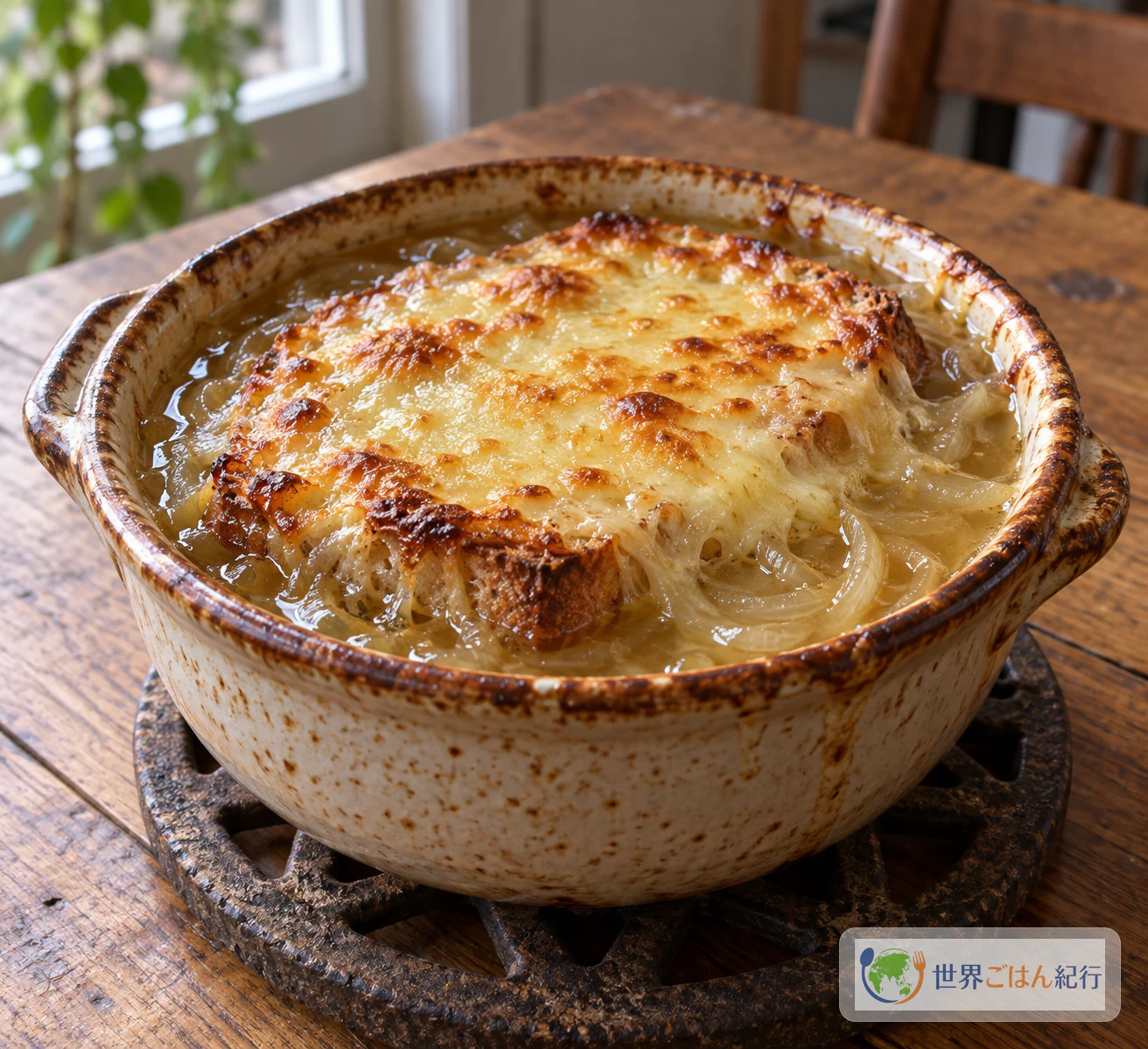
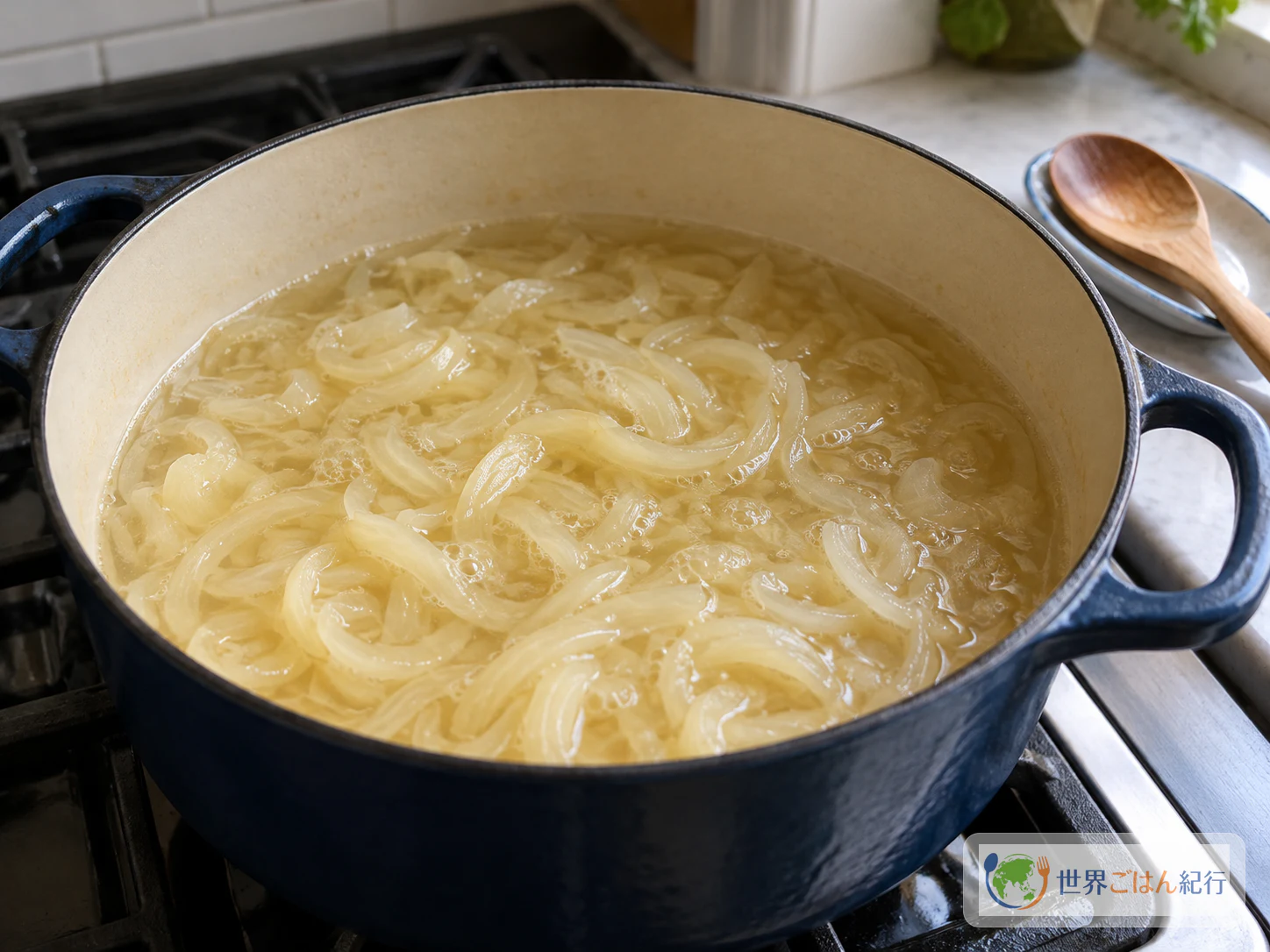
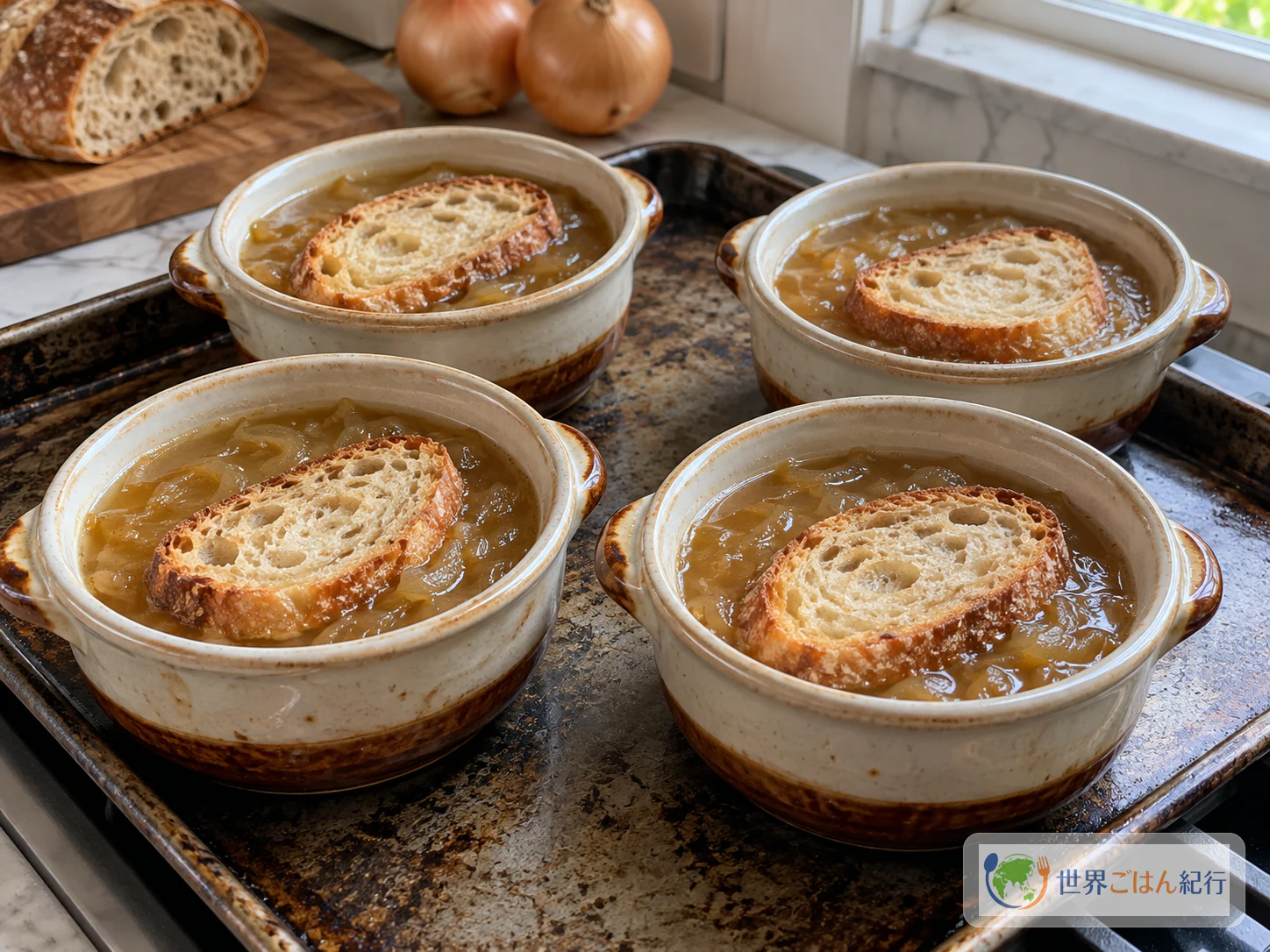
Onions stewed slowly until soft and sweet, not pushed to dark brown. A light broth that lets them lead. One slice of bread and a cap of cheese that go under the heat before the bread has time to sink.
The spoon meets resistance first: a crust of cheese, blistered gold in places, stretched over the rim of a small bowl. Push through and the bread underneath gives way, soaked and soft, and steam rises from the onion broth below. Every spoonful brings up a little of each layer together.
Soupe à l'oignon simply means "onion soup" in French, and onion soups come in many forms. This article is about one in particular: the gratinée, the version finished with bread and cheese and browned under heat, and specifically the Gratinée des Halles, the soup tied to the old central food market of Paris. An educational dossier from the Centre des monuments nationaux / Conciergerie describes it as a dish once sold by street vendors to warm the merchants and shoppers of the Halles, which by the mid-19th century had made its way onto the menus of the eating houses around the market and become a symbol of the city's night life.
The recipe here follows the four-serving Gratinée des Halles from that dossier, with a few clearly marked editorial choices. It uses ingredients you can find in an ordinary supermarket: yellow onions, butter, water, country bread and Comté.
Soupe à l'oignon is onion soup in general. Soupe à l'oignon gratinée is the version topped with bread and cheese and browned. The dossier calls the market version gratinée des Halles.
A Soup for the Market at Night
The Halles were the great food market at the heart of Paris. According to the Conciergerie dossier, onion soup was first something street sellers offered to the people working and buying there, a hot bowl for cold hours. By the middle of the 19th century it had moved onto the menus of the restaurants and bars around the market and had become bound up with the city's nocturnal culture.
The same dossier quotes Gérard de Nerval's La Bohème galante (1852), in which he mentions people at the Halles grating Parmesan over their onion soup. That detail is worth holding next to the recipe below, which uses Emmental or Comté: cheese choices around this soup have never been fixed to a single kind.
There is also a much-repeated story that Louis XV improvised the soup in a hunting lodge from onions, butter and Champagne. SIAL Paris tells it as a widely shared tale while noting that historians doubt its accuracy. It is best treated as a legend, not as the origin of the dish.
Ingredients: 4 Servings, Following the Halles Recipe
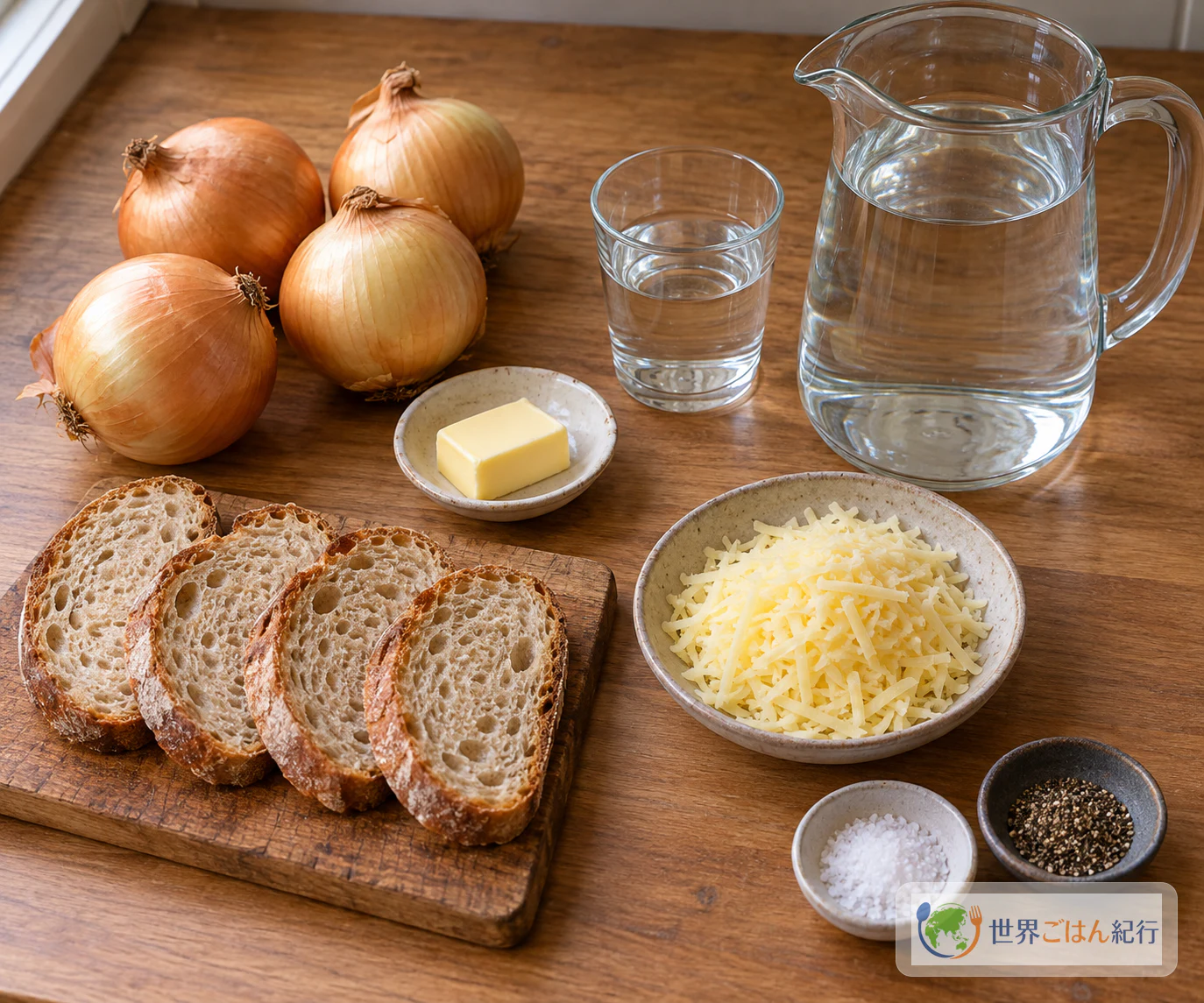
These amounts serve four. Boiling water or chicken or beef stock can be used for the soup liquid, and Emmental or Comté for the topping. This version chooses water and Comté.
The 100ml and 1.5L of water are the amounts you pour in, not the volume of finished soup; how much remains after cooking will vary.
This version uses no flour, so expect a thinner, clearer soup.
This soup contains milk (butter, cheese) and wheat (bread). If you use a commercial stock instead of water, check its ingredient label for allergens and salt.
Equipment
- Chef's knife and cutting board
- Heavy-bottomed pot with a lid
- Wooden spoon or spatula
- Kettle for the boiling water
- Ladle
- 4 individual bowls that the manufacturer explicitly states are safe under an oven grill (broiler)
- Sturdy baking tray to carry the bowls
- Oven with a grill or top-heat setting
- Oven gloves and a dry heatproof mat or trivet for each bowl
Use only bowls the maker clearly labels as suitable for oven-grill or broiler use. Do not assume that a bowl marked only "oven-safe" can also go under a grill. Never use bowls without a heat-resistance rating.
Choosing the Liquid, Bread and Cheese
Liquid. Choose one of three: boiling water, chicken stock or beef stock. Water keeps the onions at the front and makes the salt easy to judge. Chicken stock adds savoriness; beef stock brings a stronger meaty flavor. If you use stock cubes or granules, follow the package directions and taste before salting, since salt varies by product.
Butter. If you only have salted butter, it works, but hold back on the salt you add at the end.
Bread. Use slices of pain de campagne that are pas trop épaisses, "not too thick." A baguette can stand in, but the shape and how the bread drinks up the broth will change the texture. The bread is not toasted first.
Cheese. Emmental can replace the Comté in the same 120g; the aroma and saltiness will shift. A melting Gruyère is also possible. Mozzarella and similar cheeses move the dish's flavor away from this soup, so they are not recommended as the main substitute.
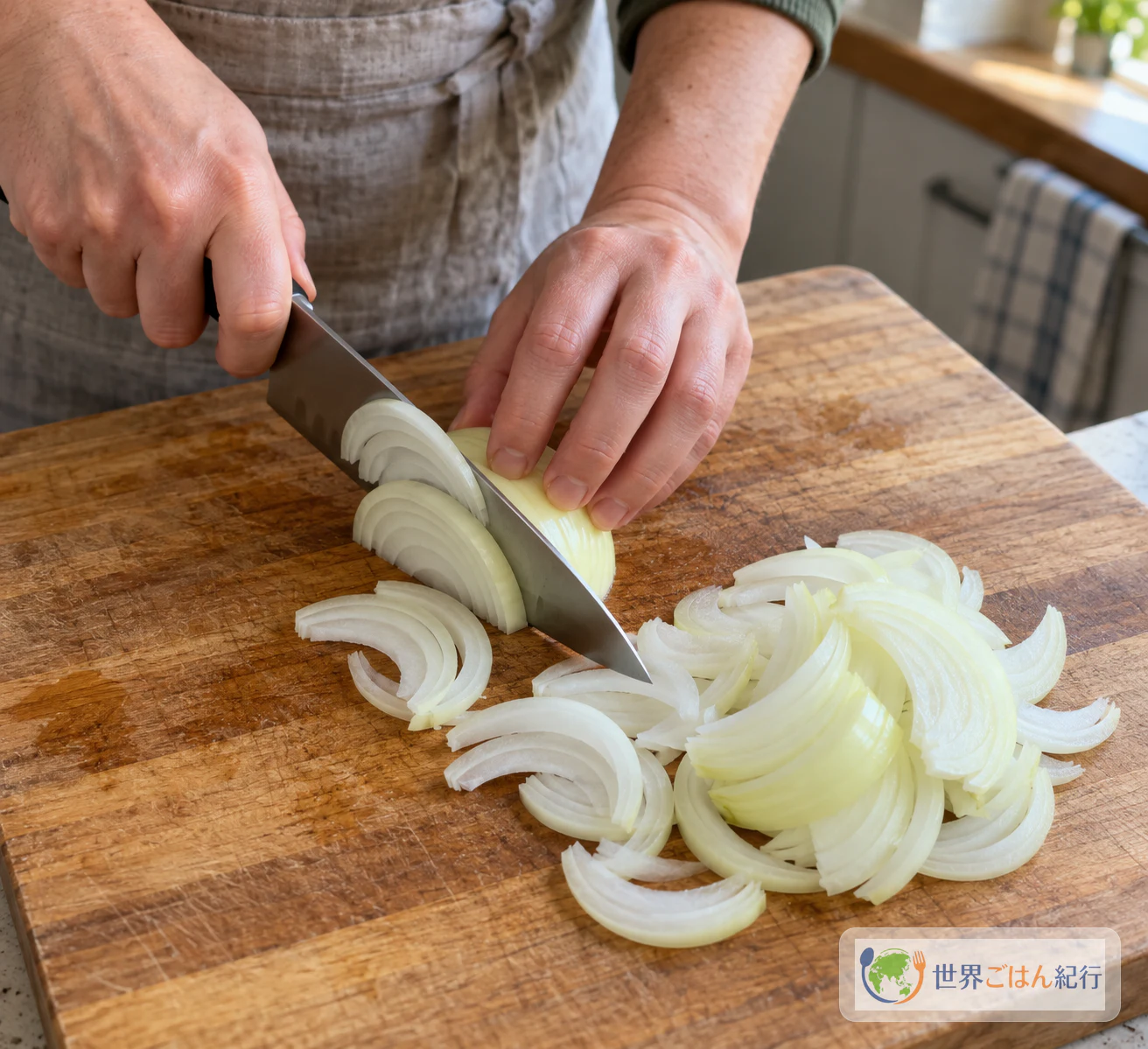
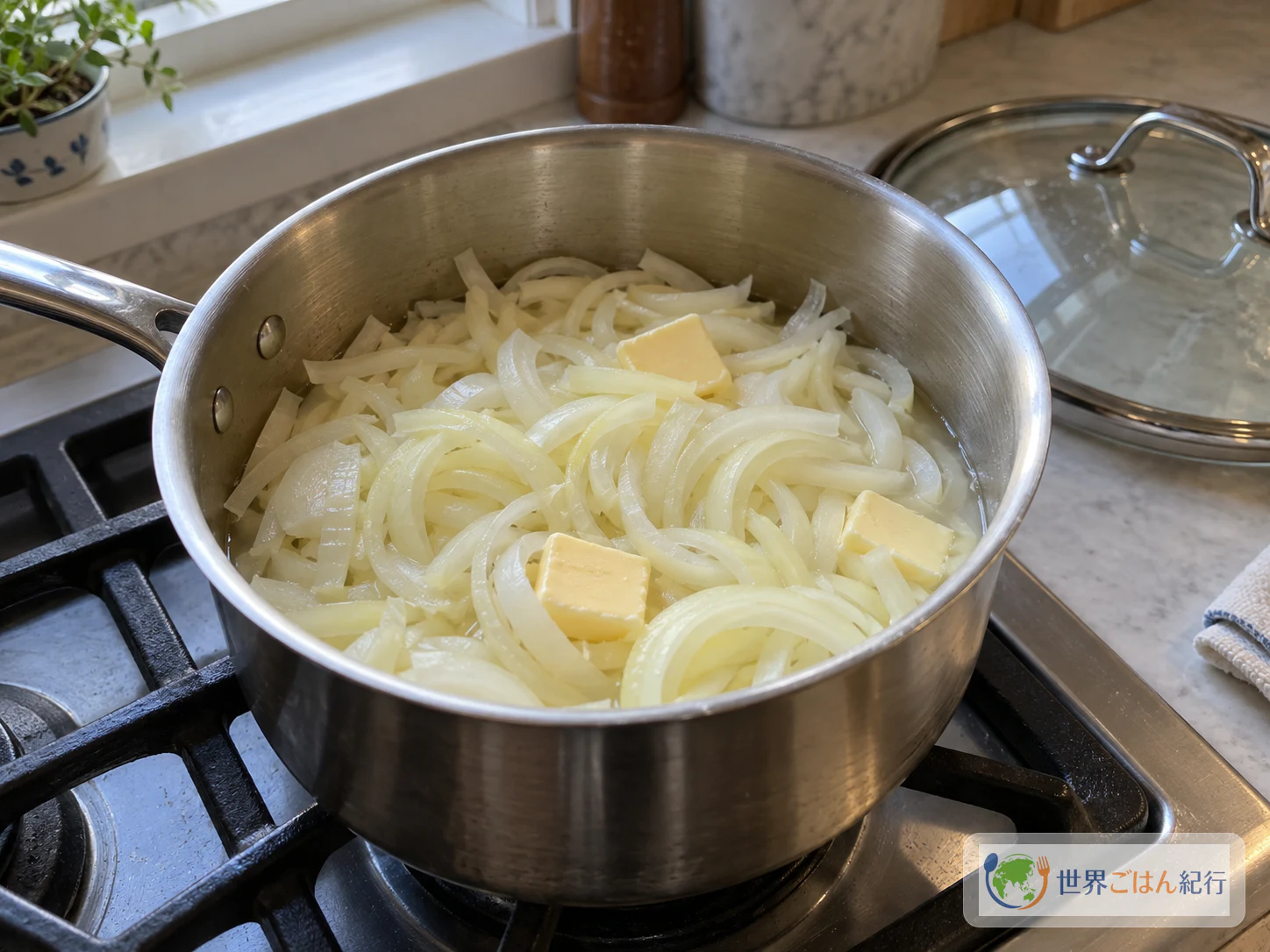
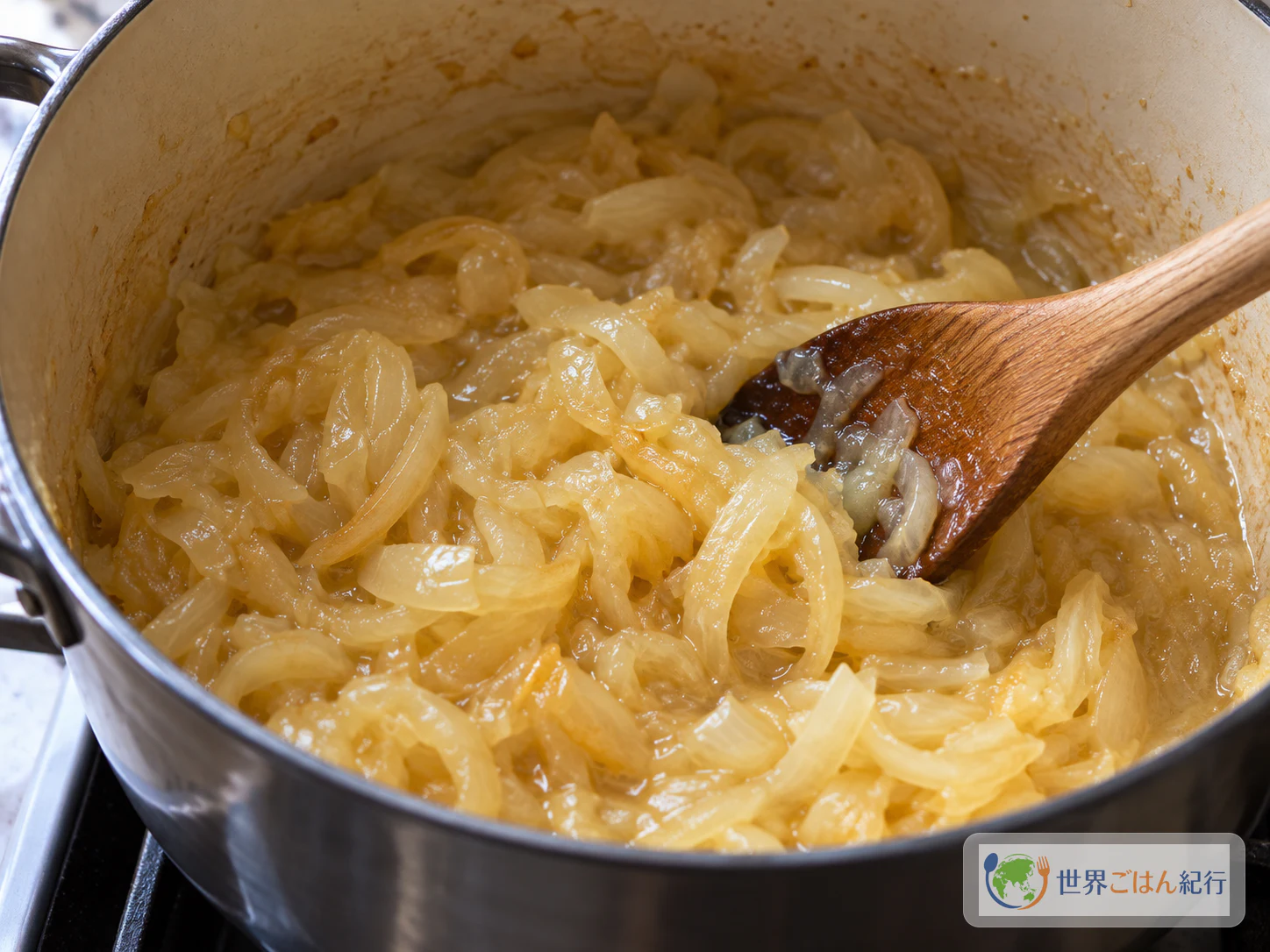
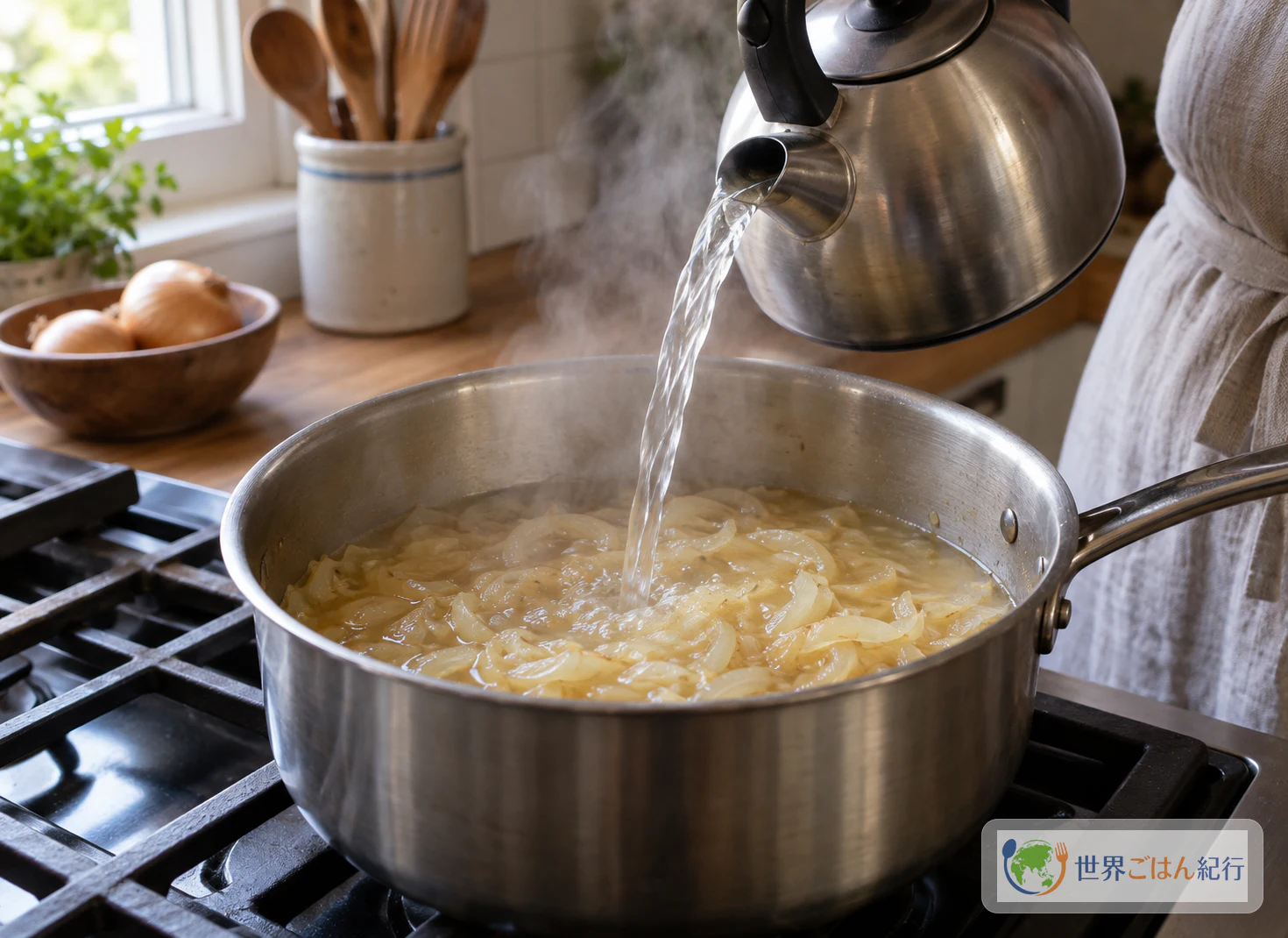
Method: Slow Onions, a Gentle Simmer, Then Straight Under the Grill
Watch the onions for softness and the cheese for color, and stop by eye.
Eating It: Breaking Through the Layers
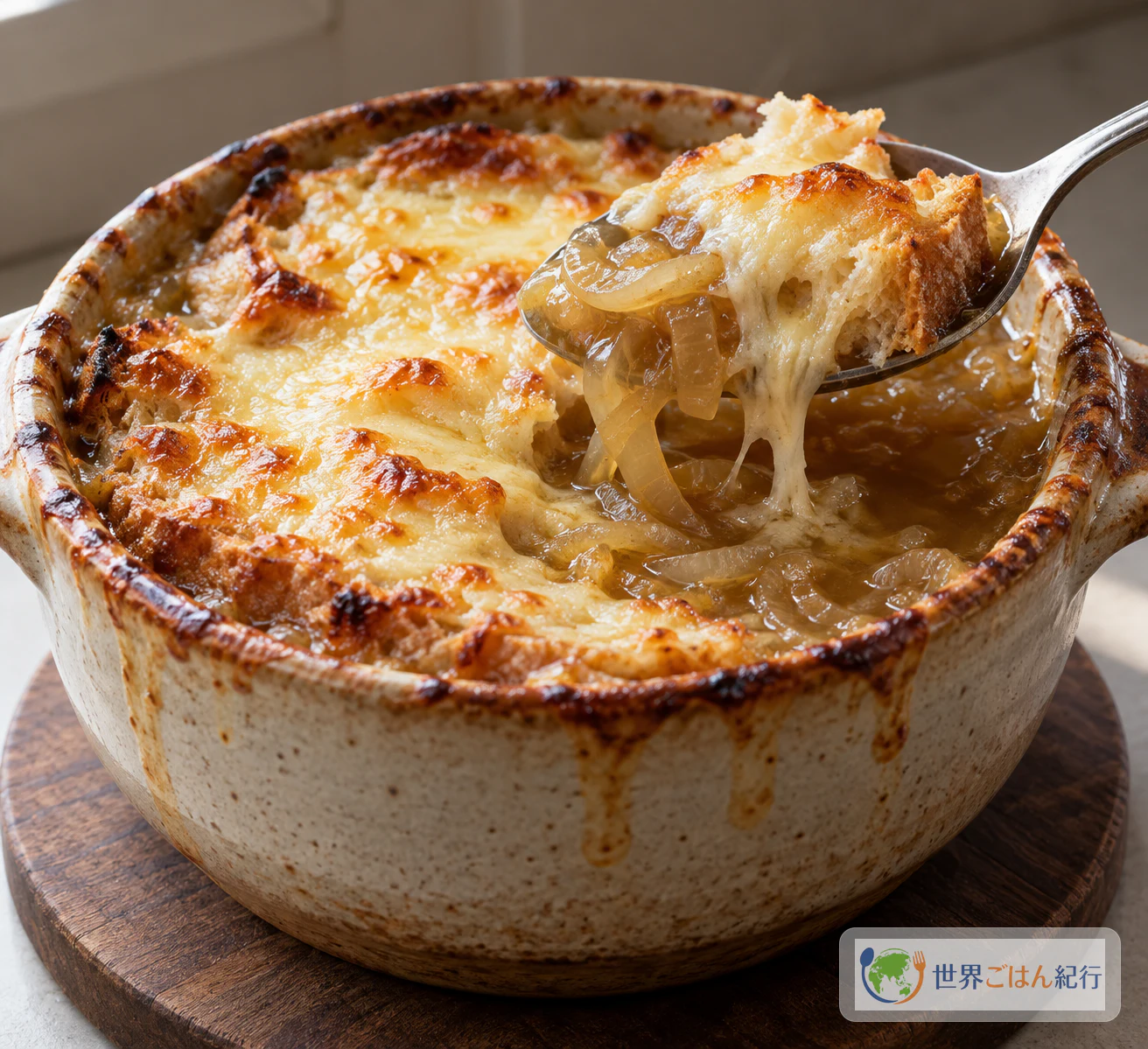
The pleasure of a gratinée is in the layers. Break the cheese with the edge of the spoon, push down through the softened bread and lift out broth and onion together. The sweetness of the onions, the roundness of the butter, the light broth, the bread that has drunk it in, and the salty, toasted cheese all arrive in one spoonful.
Pale, Scorching, Sinking: Fixing Problems
| Problem | Likely cause | What to do |
|---|---|---|
| Onions still white and watery | Not yet cooked long enough | After 35 minutes, check that they are translucent and soft, with a little moisture left in the pot. You do not need a browned color; this recipe does not ask for one |
| Bottom of the pot about to scorch | Heat too high | Lower the heat. The 100ml of water all goes in at the start, so don't add that 100ml again. If the pot is close to boiling dry, adding a little water is an adjustment outside the source; add only as much as needed |
| Bread sinks into the soup | Too long between filling the bowls and baking | Top each bowl with bread and cheese right after filling, and move straight to the oven |
| Bowls get very hot before the cheese browns | Distance from the grill | Watch the color constantly and adjust how close the tray sits to the heat |
| Soup tastes thin | Water chosen as the liquid, or under-seasoning | Adjust salt and pepper at the end. Next time, try chicken or beef stock, the source's other options |
| Soup seems lighter-bodied than expected | Flour omitted | This is expected in this edited version |
A note on color: in a separate side-by-side test, Serious Eats found that pushing onions toward a very dark brown can bring bitterness, and that cooking time varies with the pot, the heat and the quantity. That is a different recipe with different timings, but it supports staying with the gentle, uncolored approach here.
Variations: How the Bowl Changes
Each of these is a departure from the base recipe above.
- Water (the base here). The onions lead and the salt is easy to control.
- Chicken stock. The source's own alternative. More savoriness; check the salt in the product.
- Beef stock. Also allowed by the source. A stronger meaty flavor.
- Cheese. Start from the same 120g. Emmental (in the source) or Gruyère (a change from the source) shift the aroma and saltiness.
- Bread. Baguette or other bread instead of country bread changes how much broth it absorbs, how the top browns and how chewy it is.
According to SIAL Paris, water or stock, the handling of the bread and the amount of cheese vary from kitchen to kitchen and region to region. Nerval's Parmesan is another reminder that there is more than one way to finish the bowl. You can find more French dishes, from slow-cooked stews to mountain cheese cooking, on the France page.
Leftovers and Reheating
No storage period has been verified for this recipe, so none is given here. If you want to keep some soup, set it aside before adding the bread and cheese, which also helps the topping stay at its best when you make the gratinée later.
Following Japan's Ministry of Health, Labour and Welfare guidance on preventing food poisoning at home: divide leftovers into clean, shallow containers, cool them quickly and refrigerate. Don't leave the soup standing at room temperature for long. When reheating, heat it thoroughly, to at least 75°C, until it comes to a boil, before adding fresh bread and cheese and browning.
Frequently Asked Questions
Do the onions need to be caramelized to a deep brown?
Not in this recipe. The Halles version stews the onions under a lid over low heat for 35–40 minutes and tells you not to let them brown. Other recipes take the onions much darker; Serious Eats notes that going too dark can turn them bitter. There is no single correct color, but this soup aims for soft and sweet.
Is beef stock essential?
No. The source allows boiling water, chicken stock or beef stock. Water keeps the focus on the onions; stock adds savory depth.
Which cheese should I use?
The source gives Emmental or Comté. This recipe uses Comté, with the same 120g of Emmental as the main alternative. Choose whichever you can find.
Should I toast the bread first?
The source does not. The bread goes onto the soup untoasted and the bowls go under the heat immediately, before it sinks. Some other recipes do toast the bread first; that is a different method.
Can I make it ahead?
No storage time has been tested for this recipe. If you make the soup ahead, keep it separate from the bread and cheese, cool and refrigerate it in shallow containers as described above, and reheat it thoroughly before assembling and browning.
Why is there no flour?
The original method mentions adding flour, but the ingredient list gives no amount. Instead of guessing or borrowing from another recipe, this version leaves it out and is honest that the result is an edited, thinner soup rather than an exact reproduction.
Sources
- Centre des monuments nationaux / Conciergerie, "Paris, capitale de la gastronomie" (educational dossier, section "La Gratinée des Halles," printed p. 9). The four-serving recipe and method used here; the soup's association with the Halles market, its place on mid-19th-century menus around the market and in the city's night life; Gérard de Nerval's 1852 mention of Parmesan on Halles onion soup. https://www.paris-conciergerie.fr/enseignants/ressources-pedagogiques/documents/dossier-pedagogique-paris-capitale-de-la-gastronomie2
- SIAL Paris, "Soupe à l'oignon gratinée : un classique façonné par le temps." The Louis XV hunting-lodge story as a legend whose accuracy historians doubt; the soup's 19th-century link to the Halles; variation in liquid, bread and cheese between kitchens and regions. https://www.sialparis.com/fr-FR/tendances/actualites/french-onion-soup
- Serious Eats / Daniel Gritzer, "French Onion Soup (Soupe à l'Oignon Gratinée)." A separate recipe and comparison: bitterness from very dark onions, color timing that varies with pot, heat and quantity, and good chicken stock as a usable option. Not used for this recipe's amounts or times. https://www.seriouseats.com/french-onion-soup-recipe
- Académie du Goût, "Soupe à l'oignon gratinée." Another French recipe with a different formula, consulted only for comparison and not merged into this recipe. https://www.academiedugout.fr/recettes/soupe-a-loignon-gratinee_9737_4
- Ministry of Health, Labour and Welfare (Japan), "家庭での食中毒予防" (Preventing food poisoning at home). Dividing leftovers into shallow containers, cooling quickly, avoiding long periods at room temperature, and reheating to 75°C or above. https://www.mhlw.go.jp/stf/seisakunitsuite/bunya/kenkou_iryou/shokuhin/syokuchu/01_00008.html