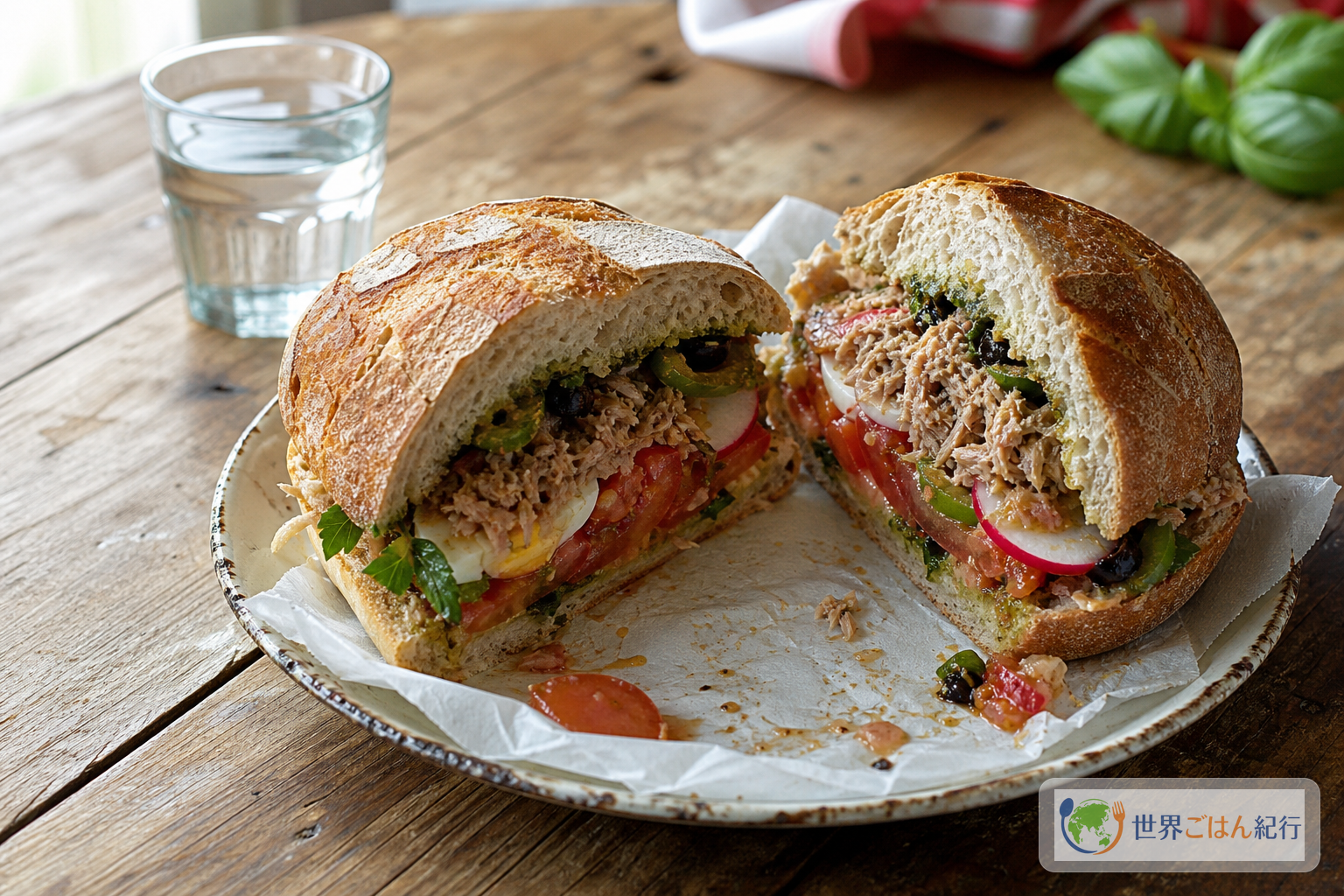
Tomato juice soaked into bread: a lunch from Nice
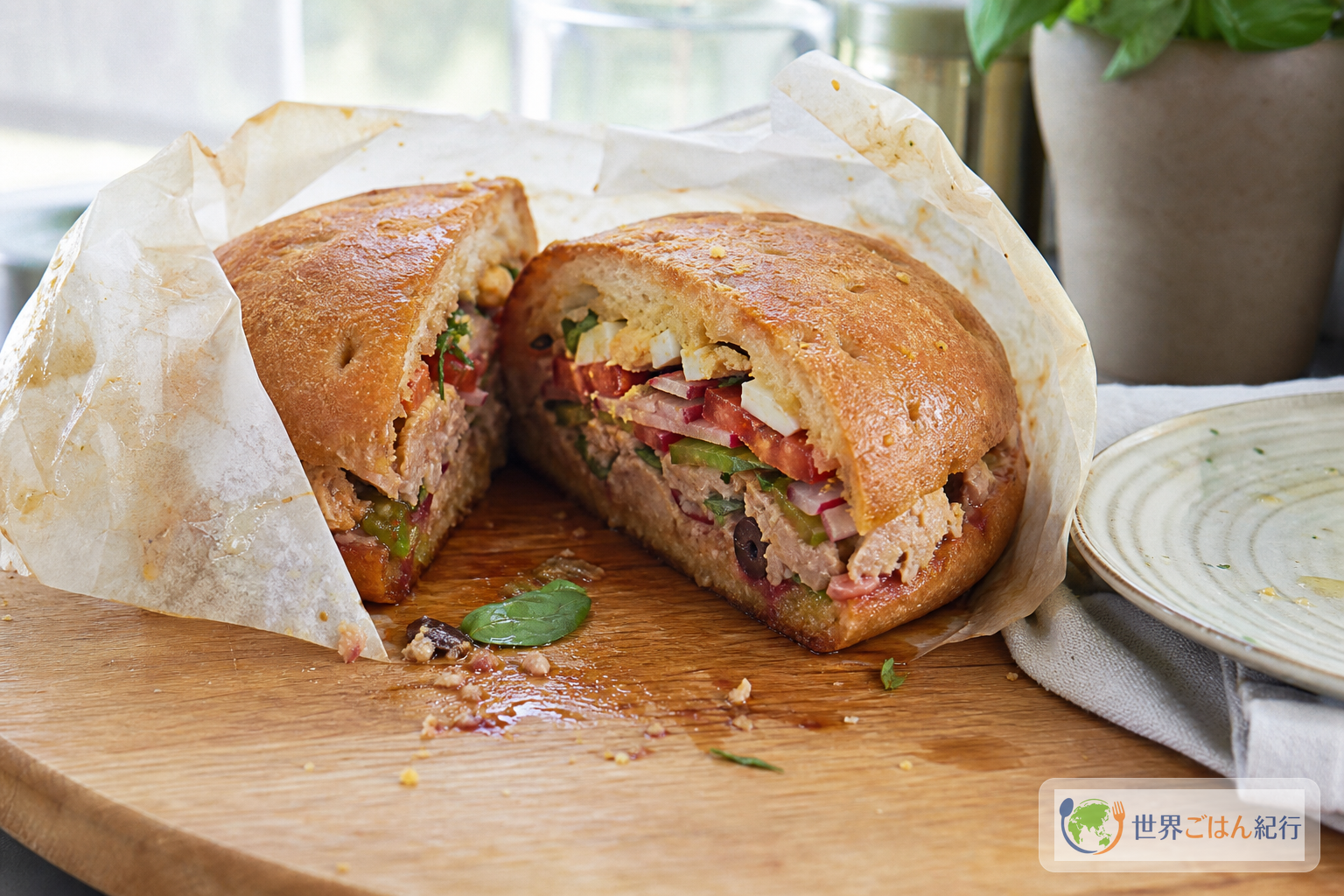
Open a round roll and press a ripe tomato against it, and red juice seeps into the white crumb. Then layer on olive oil, tuna, egg, black olives and basil. Even before it is cut, the cutting board in your kitchen moves a little closer to a seaside market.
Pan bagnat is written Pan bagnat in French and also Pan banhat in the Niçois form; it is the sandwich of Nice. A near-literal sense is "bathed bread." But it is not a dish aiming for a damp, weak bread like a convenience-store sandwich. It is a dish that has a firm round roll receive tomato juice, a little vinegar and olive oil.
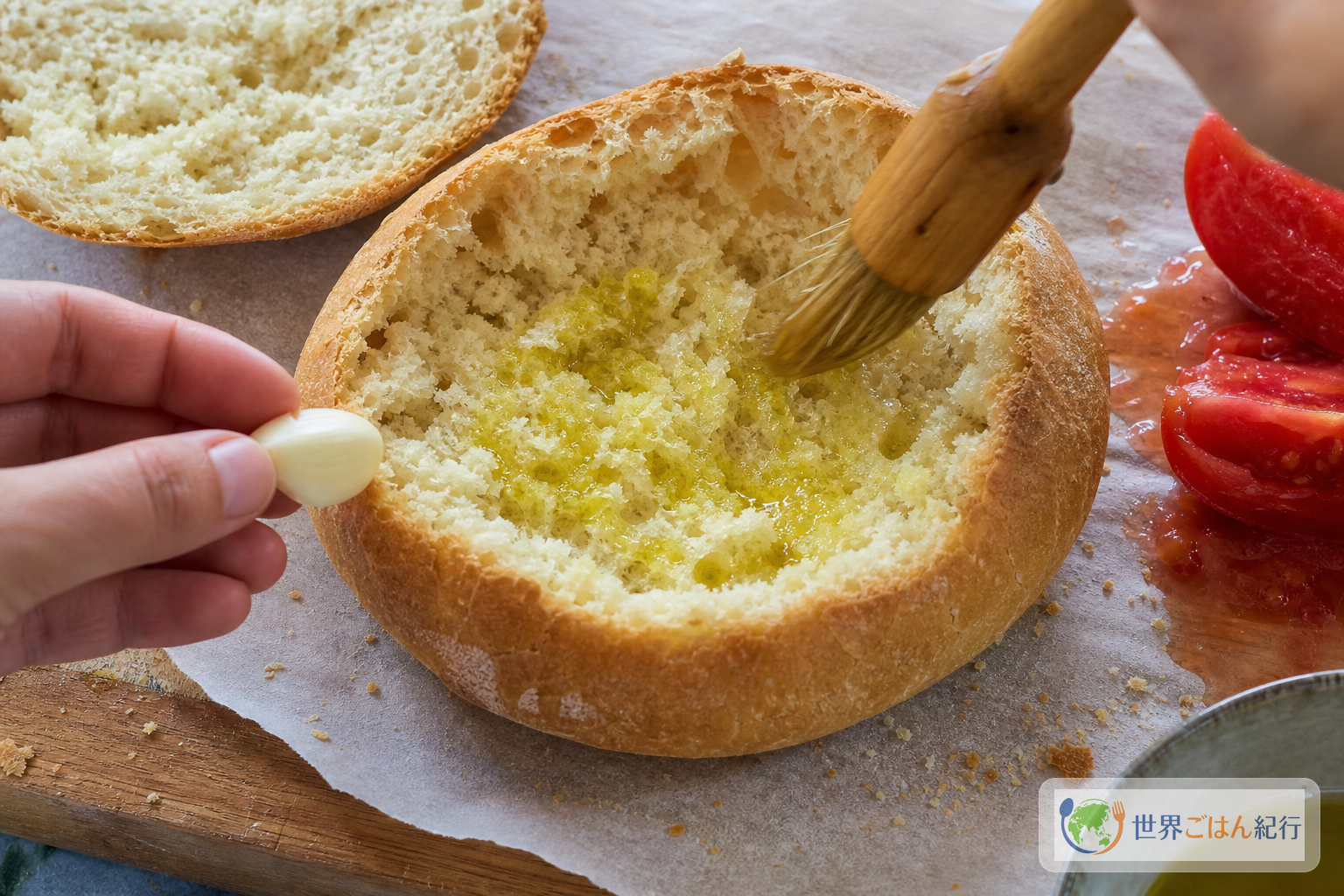
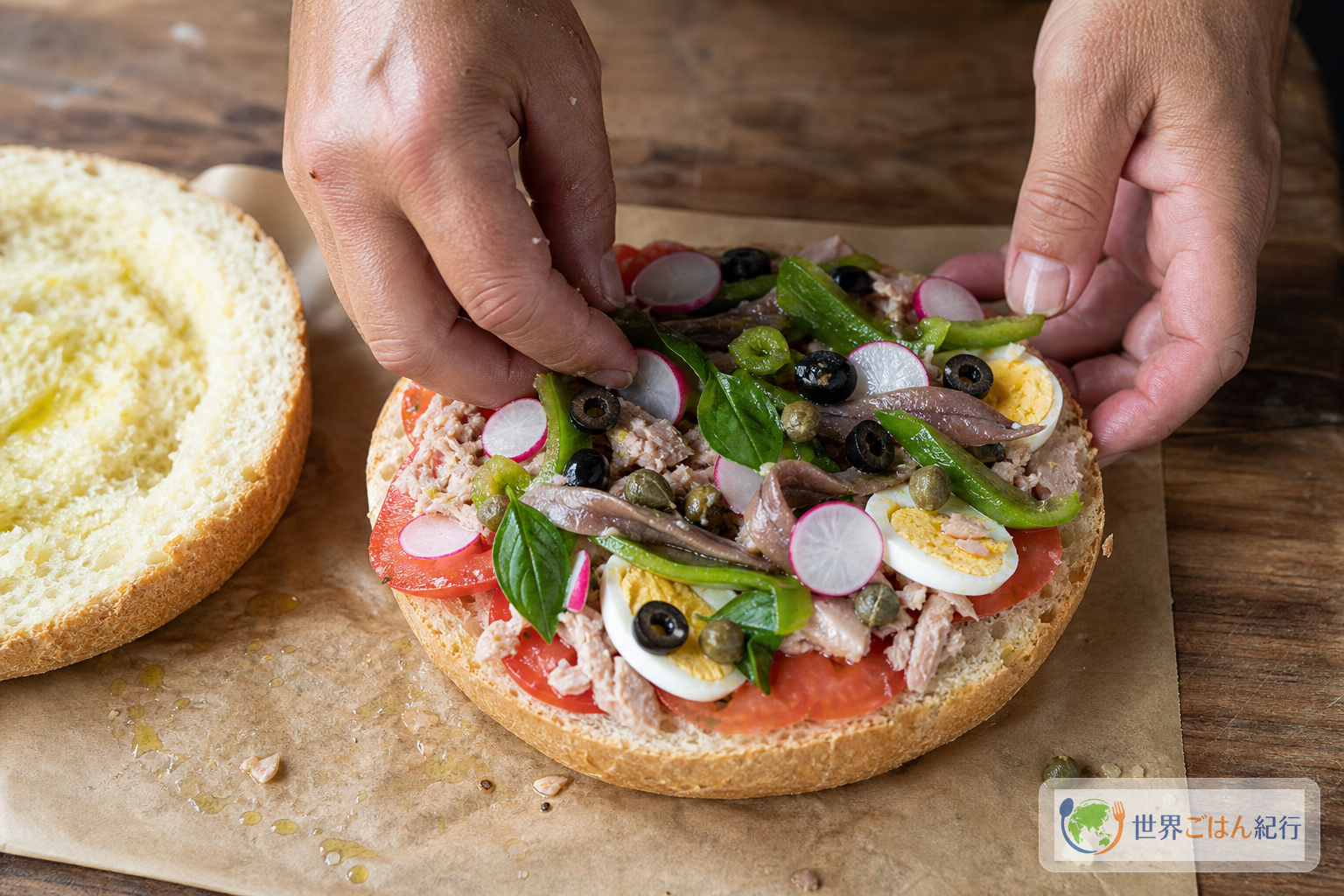
In this article, with the Niçois backbone of round roll, tomato, boiled egg, tuna or anchovy, black olives, basil and olive oil, the amounts are set to be easy to make at home. The point is not to pile on luxurious fillings, but not to push watery vegetables in as they are, to hollow the bread a little to leave room for oil and juice, and to wrap it and let it rest.
Pan bagnat is not a tuna sandwich bound with mayonnaise. What wets the bread is tomato juice, olive oil and a little wine vinegar. Rather than adding lettuce, ham or cheese, seasoning the tomato's moisture with salt and wrapping and pressing the bread comes closer to the Niçois feel.
Background: from a poor cook's use of bread to a market portable lunch
The name pan bagnat keeps the kitchen sense of not wasting hardened bread. Old bread softened with water or tomato juice and eaten with the vegetables and salted fish of a Niçoise salad. From there the bread itself became the vessel, and it turned into a sandwich you could carry. Today it is known as a snack you can buy at bakeries and markets around Nice, but its starting point was less a showy specialty than a lunch that someone working from morning could eat with one hand.
Niçois cooking is not made only of fish from the sea. Tomatoes, peppers, young onions, radishes, basil, olives, eggs, salted fish. Ingredients from the hills and the sea mix, and the shadow of neighboring Liguria and Provence enters too. Another bread dish of Nice is pissaladière (in Japanese), with its cooked onions. Pan bagnat does not sweeten with fire; it is a dish that moves the juice and oil of raw vegetables into the bread.
There are regional differences too. Older explanations say that tuna and anchovy are not put in together, because anchovy was the everyday salt and tuna the filling for a somewhat richer day. In modern markets and English-language recipes it is also common to layer both in small amounts. In this article, so the flavor holds together in a home kitchen, tuna is the star and anchovy is used in a small amount as a thin line of saltiness. For a table with someone who dislikes the smell of fish, there is also a branch that leaves out the anchovy and makes up the salt with black olives and capers.
The hard part of making it elsewhere is the bread. The round roll for a local pan bagnat is firm outside and built to soak up juice inside. Soft dinner rolls or brioche crush when pressed, the sweet bread unable to support the moisture of the filling. Within what is easy to buy, hard round rolls, a small campagne, ciabatta, or a thick baguette suit it. What matters is to take out a little of the crumb to make space to receive the tomato juice and oil.
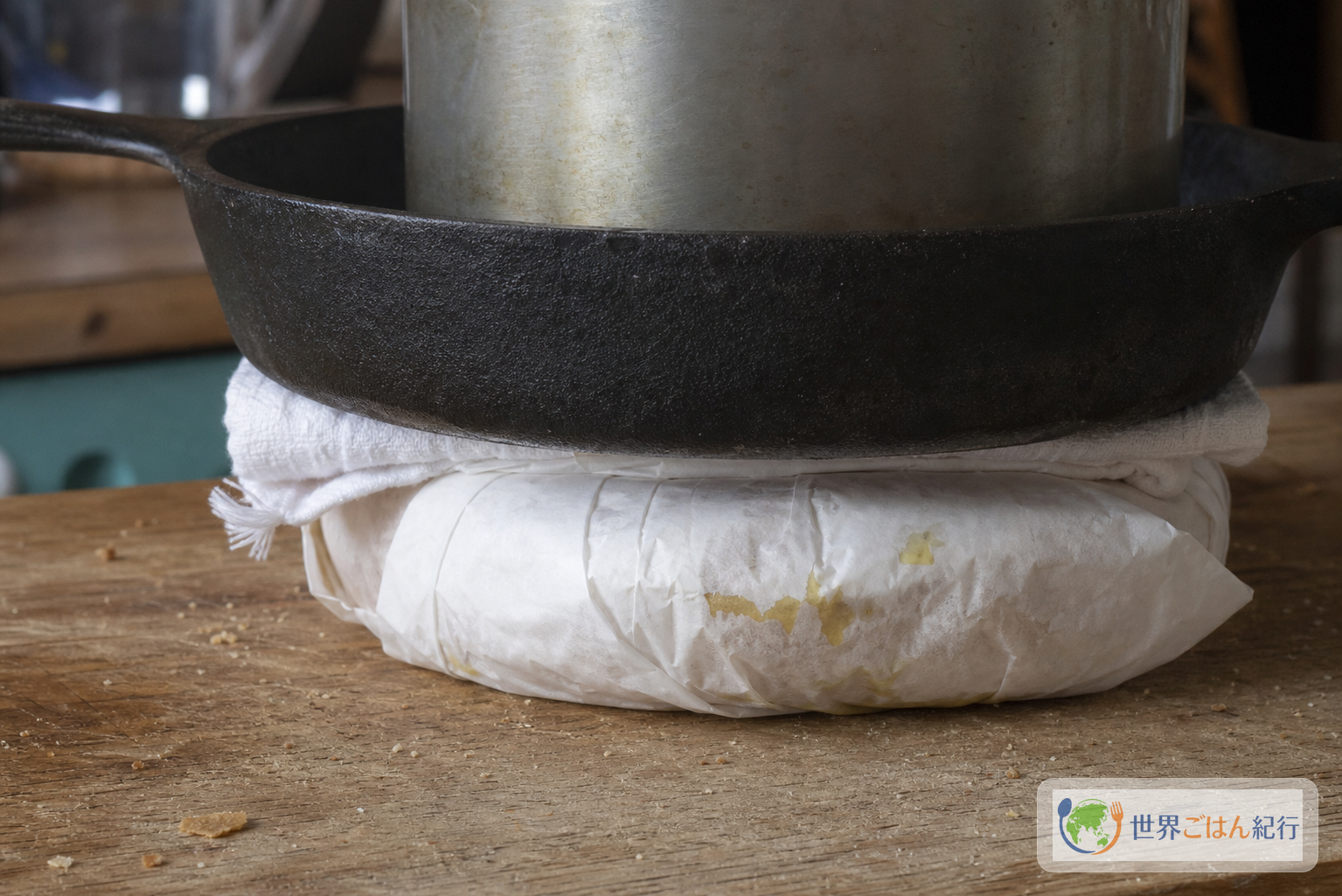
Seen in local life, pan bagnat is not a dish stacked neatly on a plate. It is pressed a little in its wrapping, juice seeps when cut, and filling spills a little when held in the hand. That clumsiness is part of its ease of eating. In a home kitchen, rather than trying to look tidy and cutting at once, it works better to wrap it and leave it for 30 minutes. When the moisture of the filling settles and the outline of oil enters the bottom of the bread, it is no longer just a tuna sandwich but a dish of "bathed bread."
Ingredients (serves 4)
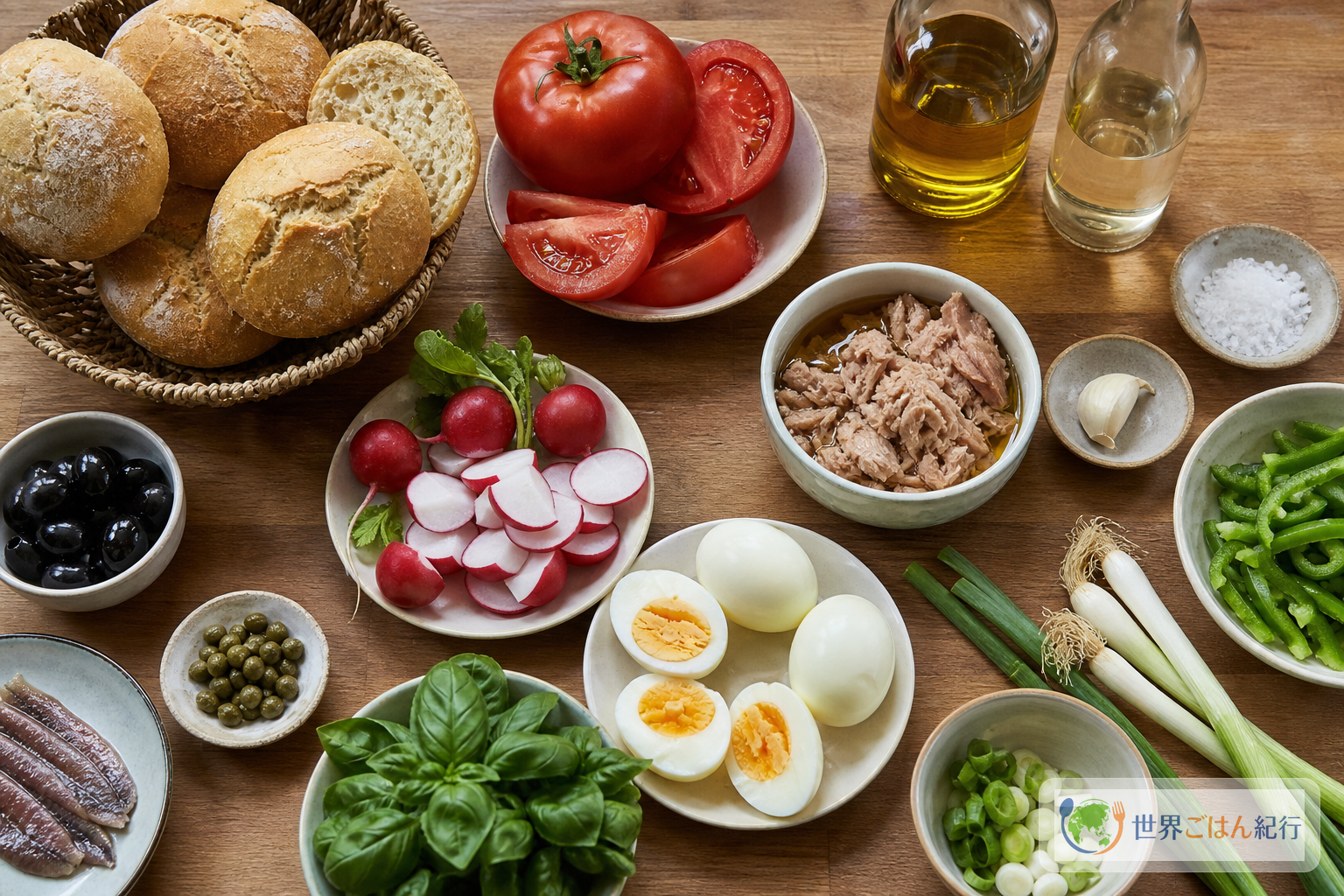
Makes 4 servings with 4 round rolls. You can also make one large campagne and slice it, but for the first time wrapping one portion at a time makes it easier to control the moisture.
This recipe uses wheat, egg and fish. Anchovy, tuna, olives and capers are high in salt, so if you are on a low-salt diet follow the instructions of your doctor or dietitian. If making it for children, halving the anchovy and leaving out the capers makes it easier to eat.
Shopping: bread and vegetables locally, choose only the oil and the salty accents
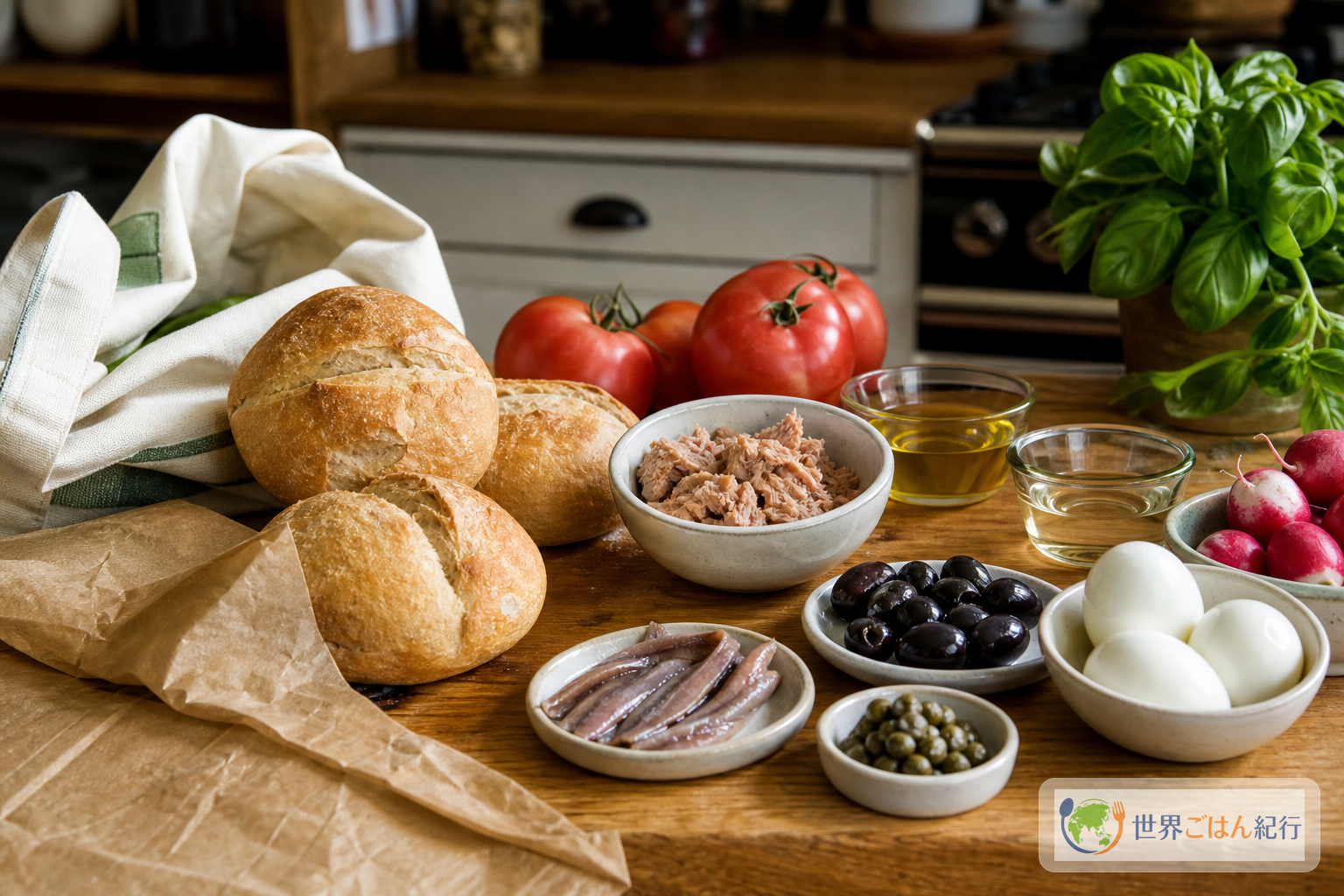
The bread, tomatoes, eggs, tuna, radishes and peppers are fresher bought from a nearby supermarket. The things worth looking for are the olive oil that goes straight into the bread, the white wine vinegar that sets the acidity in a small amount, and the capers that make points of saltiness. Anchovies and black olives can also be bought at import food shops, but small cans or jars are enough for the first time. If you buy a large amount of a brand that is too salty, the taste turns heavy before you use it up.
Choose a bread that springs back a little when pressed by hand. A fluffy round roll looks easy to eat, but when wrapped and pressed it cannot hold the moisture and the bottom becomes like a sweet dumpling. If using campagne, cut it into single portions and then take out a little of the crumb. For baguette choose a thick one, and with thin ones do not overfill.
Choose tomatoes with aroma. More than sweetness, what matters is that juice comes out when you cut them. On days when you have only hard tomatoes, cut them, salt them and leave 10 minutes, and use the juice that comes out for the bread. Oil-packed tuna suits it, but if you use water-packed, flake it and mix in 10 ml olive oil and black pepper before layering.
The olive oil goes straight into the bread, so rather than one with only strong bitterness, one with greenness and roundness is easier to use. The amount looks large, but divided among 4 rolls it is 15 ml per person.
White wine vinegar is only 10 ml, but its job is to cut the oiliness of the bread a little. Use too much and it becomes not a Niçoise salad but a sour tuna sandwich, so start modestly.
Capers are not the star. On days when the saltiness of the black olives and anchovy is weak, adding just a few keeps the taste from blurring. What is left over can go to fish dishes, potato salad and creamed chicken.
Method: wet it, layer it, press it and rest it
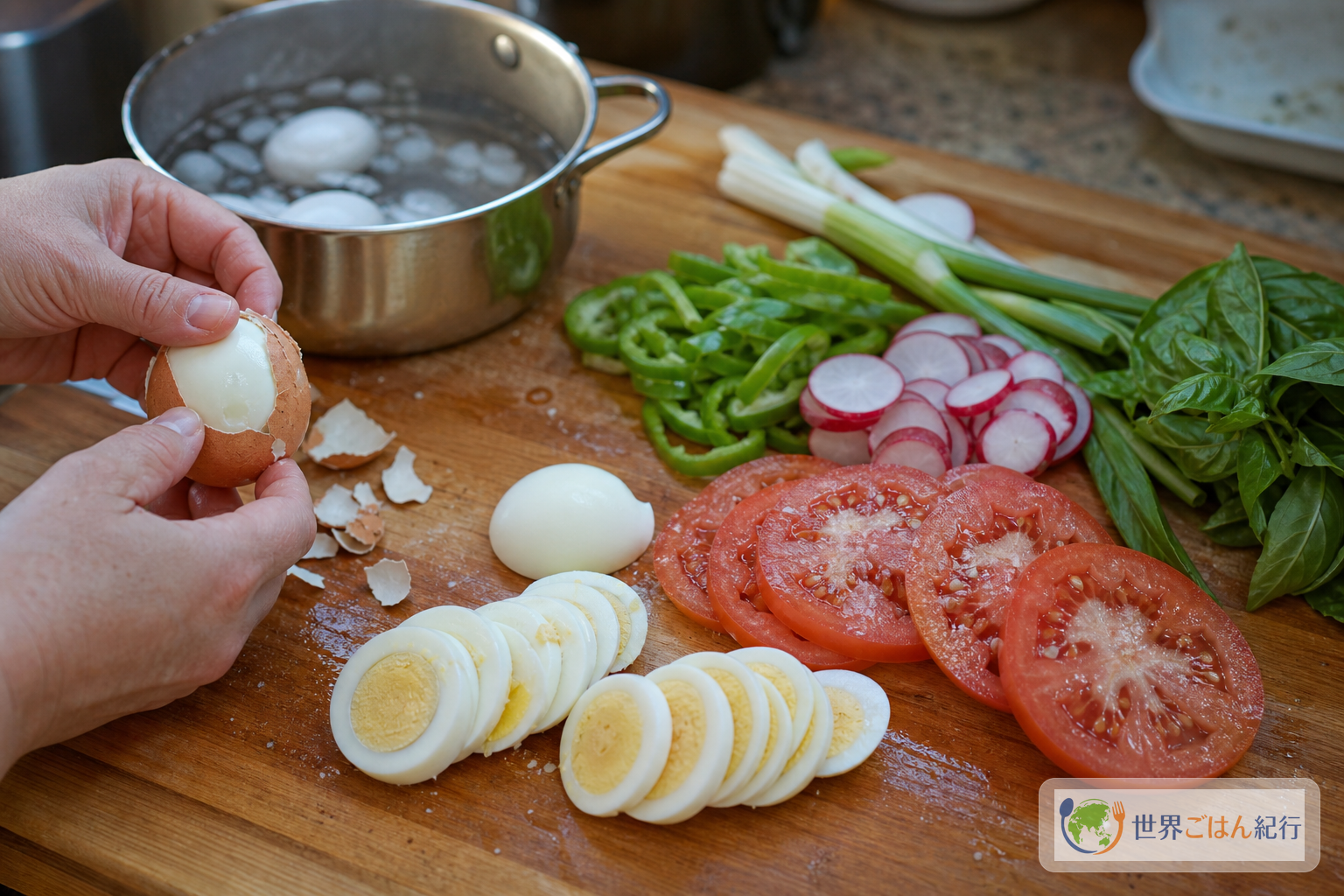
Pan bagnat uses almost no heat. For that reason it is more stable if you do not leave vague the time to boil the eggs, the width of the vegetable cuts, the moisture put in the bread, and the time to wrap and press.
A decision table for getting close to the original in a home kitchen
Pan bagnat can be made without gathering every local ingredient. But there are things you can change and things that bring it closer to something else if you do. What to protect first is the mechanism for wetting the bread, the tomato juice, the oil, and the saltiness of fish or olives.
| Where you hesitate | Local-leaning | Realistic elsewhere | What to protect |
|---|---|---|---|
| Bread | A round hard roll for pan bagnat | Small campagne, ciabatta, thick baguette | Avoid sweet bread, sandwich bread, thin rolls |
| Fish | Anchovy, or tuna | Oil-packed tuna as the star, with a little anchovy | Do not bind with mayonnaise |
| Vegetables | Tomato, young onion, pepper, radish, seasonal beans or artichoke | Tomato, spring onion, green pepper, radish are enough | Do not put in watery vegetables too thick |
| Olives | Small black olives from Nice | Pitted black olives, a little Kalamata | Wipe off the liquid and keep the saltiness |
| Acidity | A little wine vinegar | White wine vinegar, a little rice vinegar | Do not make vinegar the star |
| Resting | Flavor goes in as you carry it wrapped | Weight it and rest for 30 minutes | Do not cut right after making it |
On days you leave out the anchovy, finely chopping black olives and capers and scattering them as points tightens the taste better than increasing the tuna. Too much tuna strengthens the impression of an ordinary tuna sandwich. Conversely, made with anchovy alone, the saltiness is quite grown-up. For the first time the middle, 160 g tuna and 8 anchovy fillets, is easiest to eat.
Adding lettuce makes it look more like a sandwich, but in pan bagnat the moisture and texture tend to go off. If you must, use just one small leaf with the thick rib removed and the water wiped off well. Putting tomato and oil into the bread comes closer to the core of this dish than bulking it up with volume.
Causes of failure: fix moisture, salt and bread separately
| State | Main cause | Fix |
|---|---|---|
| Soggy bottom | All the tomato moisture went in, the bread is soft | Next time take out some tomato seeds and use only half the water released by salting |
| Filling spills | Vegetables thick, bread not hollowed | Slice radish 2 mm, pepper 3 mm, egg 5 mm as a guide |
| Too salty | Anchovy, olives and capers stacked up | Leave out the capers and reduce anchovy to 1 fillet per roll |
| Taste is blurred | Used water-packed tuna as is, too little oil | Mix 10 ml olive oil and black pepper into the tuna before layering |
| Bread tastes sweet | Used brioche-type or dinner-roll bread | Switch to hard round rolls, ciabatta or campagne |
| Egg crumbles | Boiled too short, not cooled before cutting | Boil 9 minutes over medium heat and cool 5 minutes in ice water before cutting |
If it feels watery when finished, it is not a dish to reheat in a toaster. Pan bagnat is a cold sandwich, so fix it by adjusting the moisture next time. This time, the realistic move is to open the wrapping and wipe off the excess juice lightly before eating. Conversely, if the bread is dry, dripping about 1 tsp olive oil on the cut face brings it back.
Eating, storage and linking to the next dish
Pan bagnat suits being held in the hand in its paper more than being put on a plate and eaten with knife and fork. For lunch, cold water, a light soup and fruit are enough. If cutting small as a starter, linking to Nice's pissaladière (in Japanese), the Mediterranean bread dish panzanella, and dakos, which handles tomato and oil in a similar way, shows the differences among dishes that have bread soak up juice.
For storage, the day it is made is the basic rule. If refrigerating it wrapped, eat within 8 hours. Left until the next day the bread becomes even more moist, but because it uses egg and fish, it is safer not to stretch it long at home. When carrying it, wrap one at a time and keep it with an ice pack. Storing after cutting dries the cut face, so cut just before eating.
Leftover ingredients can go to the next dish. Leftover tomato and bread can be panzanella, leftover black olives and capers Catalonia's esqueixada (in Japanese), and leftover olive oil and white wine vinegar Brazil's vinagrete. Rather than buying a large jar just for pan bagnat, it is easier to use up if you go on cooking dishes where bread soaks up juice.
FAQ
Can I put in both tuna and anchovy?
Older local explanations hold that tuna and anchovy are not put in together. In a home version, making tuna the star and using a little anchovy makes the flavor come together easily. On days you want to lean strongly toward the local style, narrow it to one or the other.
Can I put in mayonnaise?
Leaving it out makes it more like pan bagnat. The fat comes in as olive oil, and the acidity comes from vinegar and tomato juice. Adding mayonnaise makes it easier to eat, but closer to an ordinary tuna sandwich.
Can I make it with a baguette?
Yes. Cut a thick baguette into 4, open it horizontally and take out a little of the crumb. A thin baguette holds little filling and tends to crack when pressed, so reduce the filling by about 20%.
Can I make it the day before?
There is a way of leaving it overnight in the refrigerator, but because a home version uses egg and fish, the same day is the basic rule. If you must prepare the day before, go only as far as cutting the vegetables, and do the assembly and pressing on the morning of the day you eat.
Are capers essential?
They are not. If the saltiness of the black olives and anchovy is sufficient, you can leave them out. Only on days when the black olives you can buy are weak in flavor, scattering 12 g over the whole tightens the taste.
Sources
I consulted the following to check the name of pan bagnat, the local view of its ingredients, the custom of pressing and resting it, and the adjustment of amounts for home cooking. In the text, amounts and steps are adjusted so they are easy to reproduce in a home kitchen.