Sauerkraut: Cabbage That Slowly Gathers Its Sourness
There are only two ingredients, so the work goes into measuring accurately, keeping the cabbage under its brine and watching the temperature. Seasoning matters less than doing those three things the same way every time.
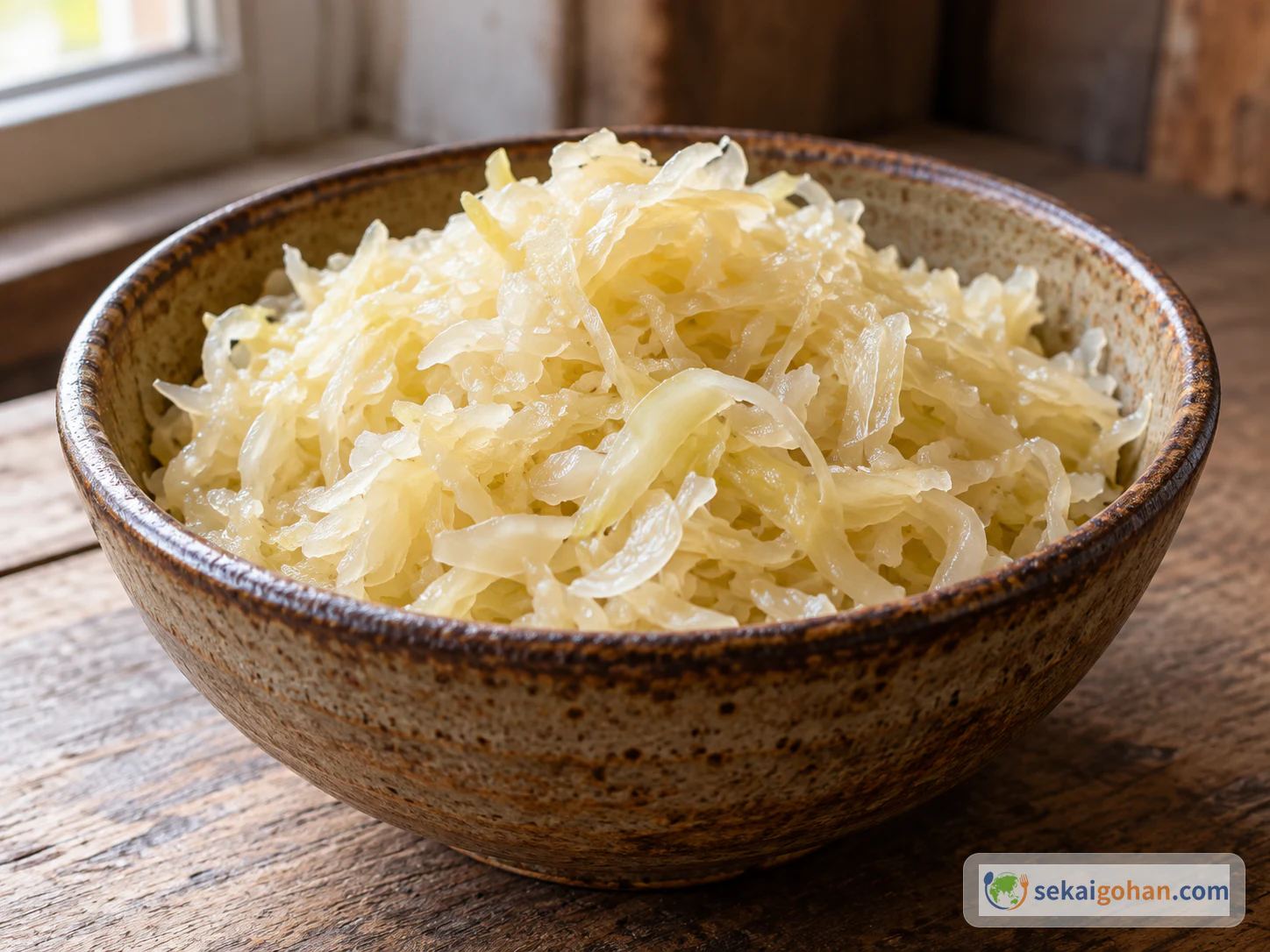
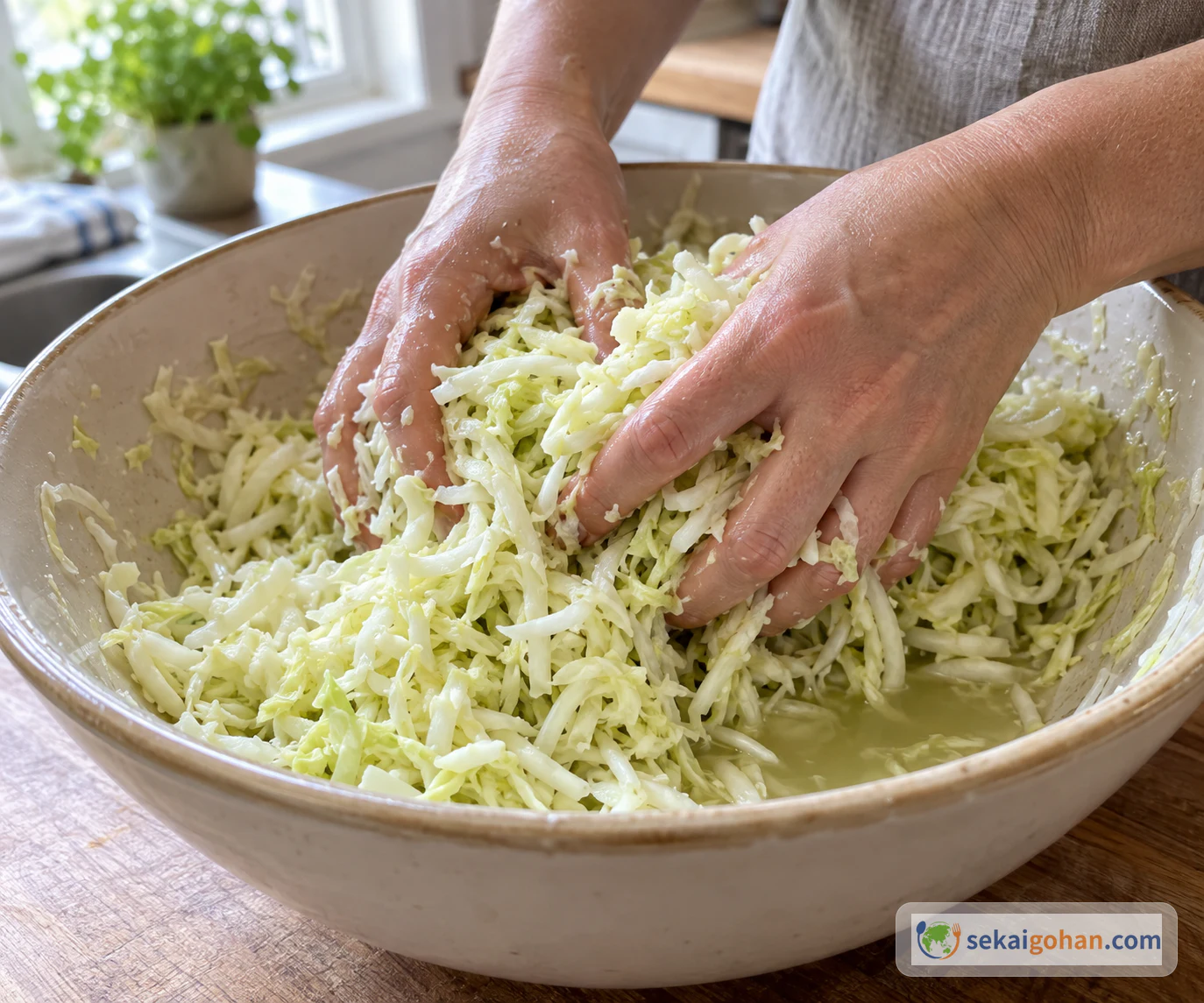
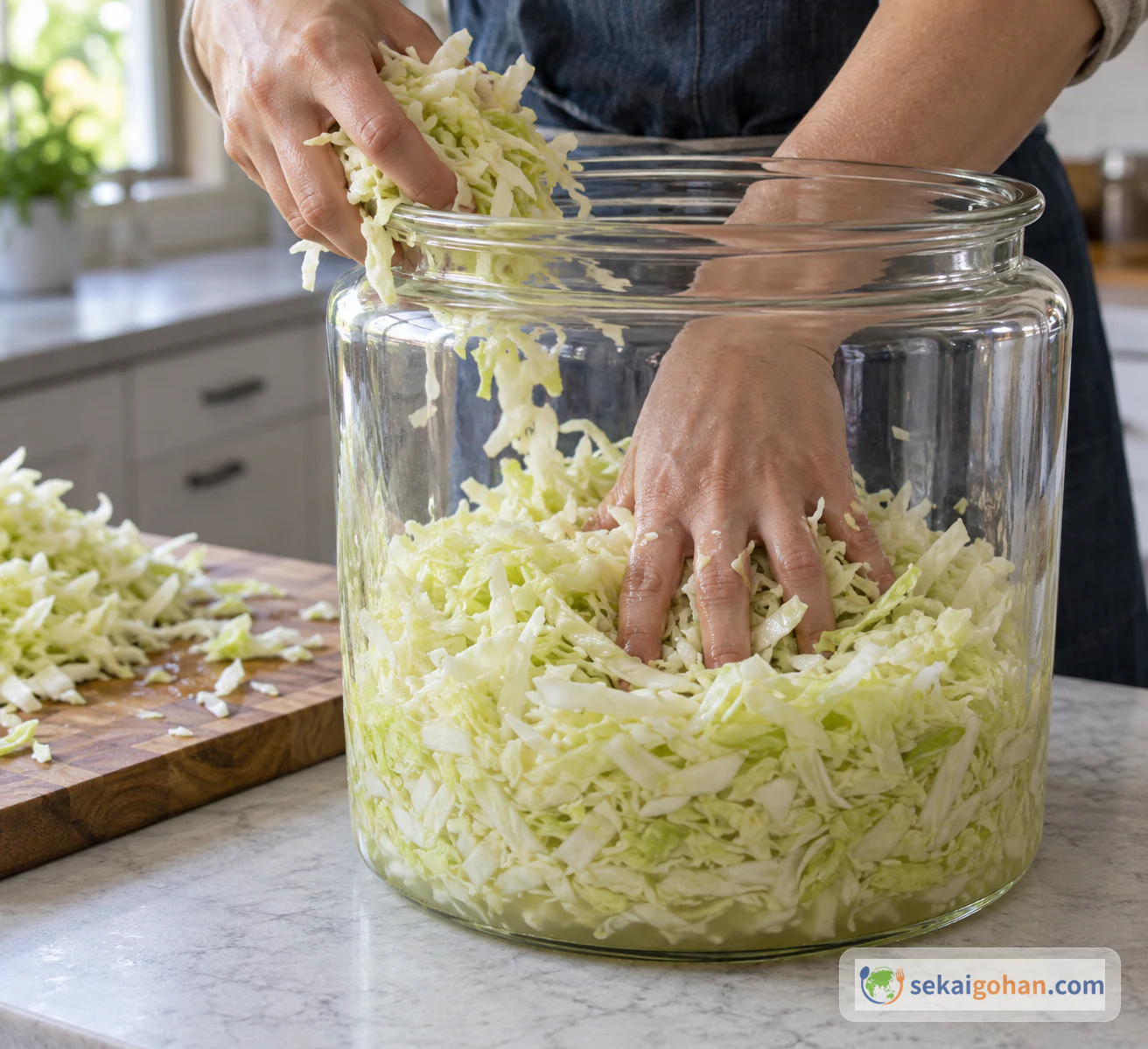
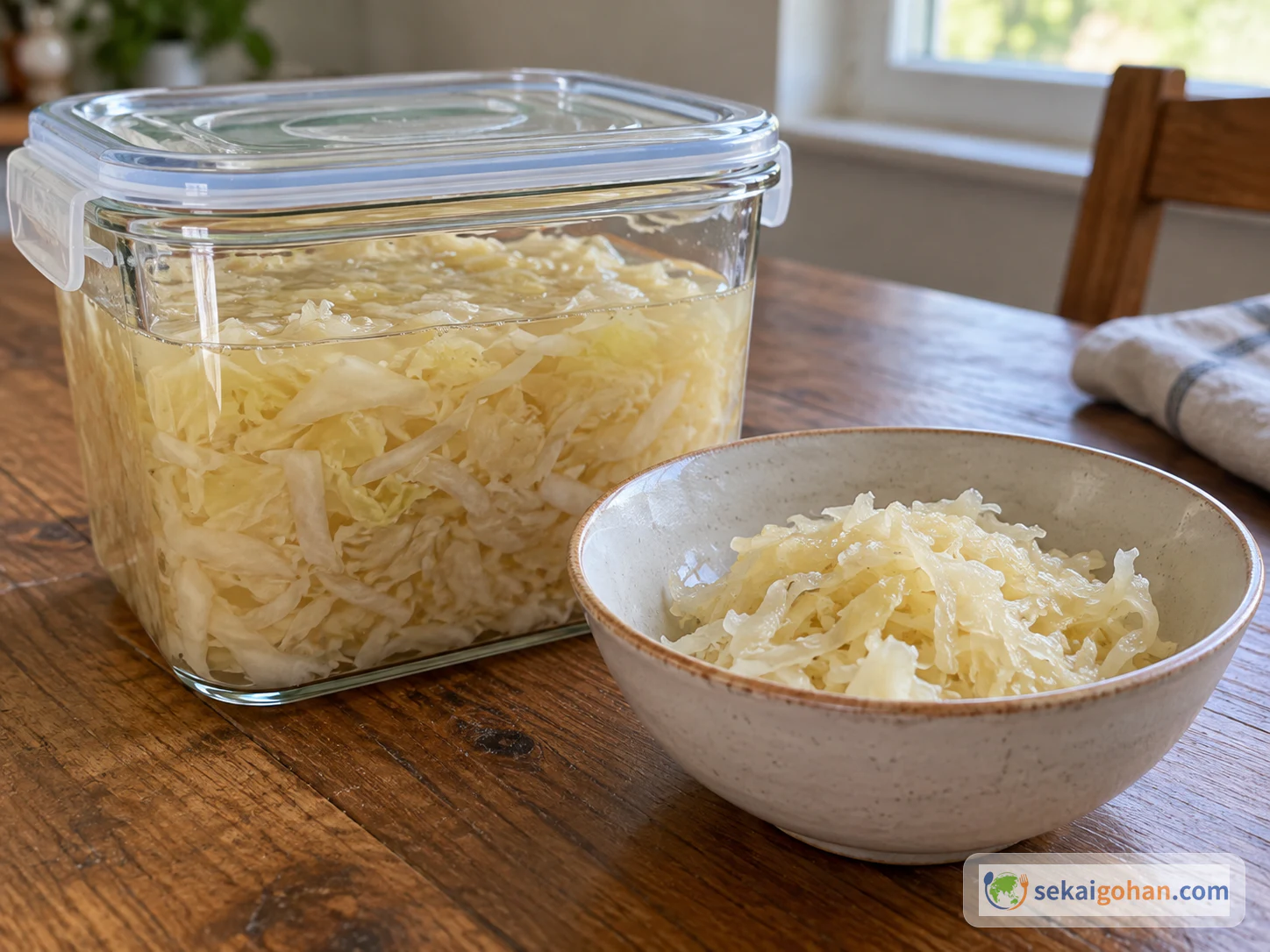
Shredded white cabbage goes into a wide crock with salt and nothing else. It is pressed down under a plate and a weight, covered with a cloth and left to sit. Over the following weeks the cabbage sours in its own brine, and what comes out is a preserved food with a sharp, clean acidity. Sauerkraut is that slow handoff from the day you pack the crock to the day it reaches the table.
The sourness does not come from vinegar. It comes from lactic fermentation of the cabbage in salt. That is why this recipe has so few ingredients and still asks for care. The salt has to be measured against the shredded cabbage, the cabbage has to stay below the liquid, and the crock has to sit at a suitable temperature. How long fermentation takes depends on temperature, so a number of days on its own can't tell you when the batch is ready.
Sauerkraut is also easy to confuse with Bayrisch Kraut, the Bavarian-style warm cabbage dish. Bayrisch Kraut is fresh cabbage cooked and eaten the same day. Sauerkraut is shredded cabbage fermented with salt. They differ in method, in how they keep and in flavor, so one doesn't replace the other.
Ingredients: Shredded Cabbage and Salt, in 5 lb Units
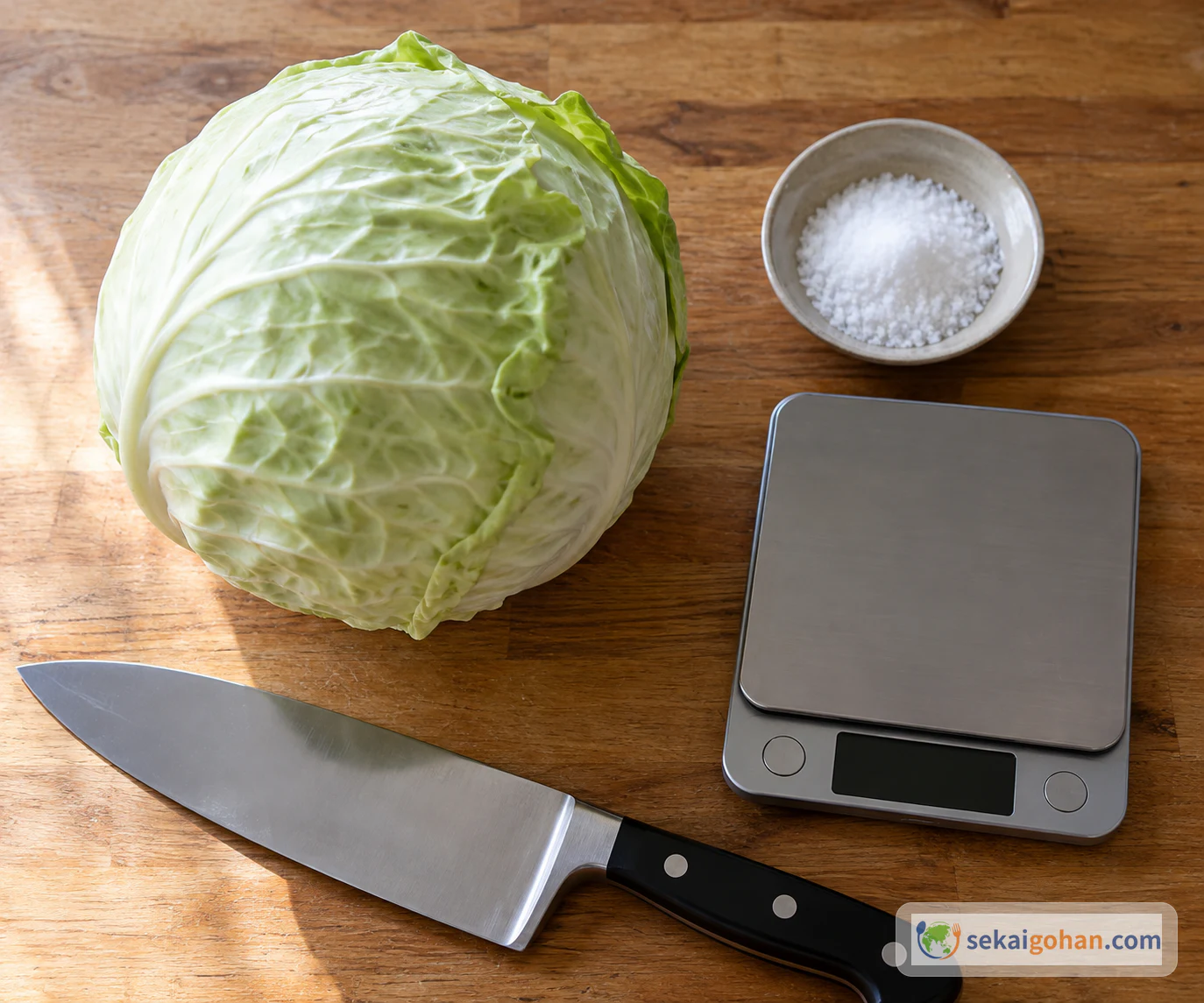
This recipe follows the National Center for Home Food Preservation (NCHFP) sauerkraut method. One batch is the working unit given in its steps: 5 lb of shredded cabbage to 3 US tablespoons of salt. Penn State Extension's standard crock method gives the same 5 lb of shredded cabbage to 3 tbsp of canning or pickling salt and states that the cabbage is weighed after shredding.
This recipe uses a working unit of 5 lb cabbage and 3 tbsp salt. Don't scale down from the larger batch of 25 lb of cabbage and 3/4 cup of salt, which doesn't match it arithmetically.
Choosing Cabbage and Salt
The salt is measured by volume, so don't convert it to grams. The tablespoons are US tablespoons. One US tablespoon is about 14.8 mL, a little less than a 15 mL tablespoon, and the metric figures above are volume conversions only. How much a spoonful of salt weighs depends on the type of salt and its grain size. Don't reduce the salt or adjust it by taste.
Use canning or pickling salt. Don't assume table salt, coarse salt or reduced-sodium salt will behave the same way. Choose canning or pickling salt and check its labeling; this recipe does not establish that another type of salt is an equivalent substitute.
White cabbage is the only vegetable this recipe covers. Ordinary supermarket white cabbage works. Weigh it after trimming and shredding, as described above.
Keep other recipes separate. A German home recipe from the broadcaster NDR uses 1 kg of white cabbage with 20 g of salt, a 2% ratio by weight, and suggests optional spices. That is a different recipe. Don't combine its ratio with the tablespoon measure used here.
Equipment
- Kitchen scale, for weighing the shredded cabbage
- Chef's knife and cutting board (a cabbage slicer or traditional Krauthobel is optional)
- Large non-reactive bowl for salting
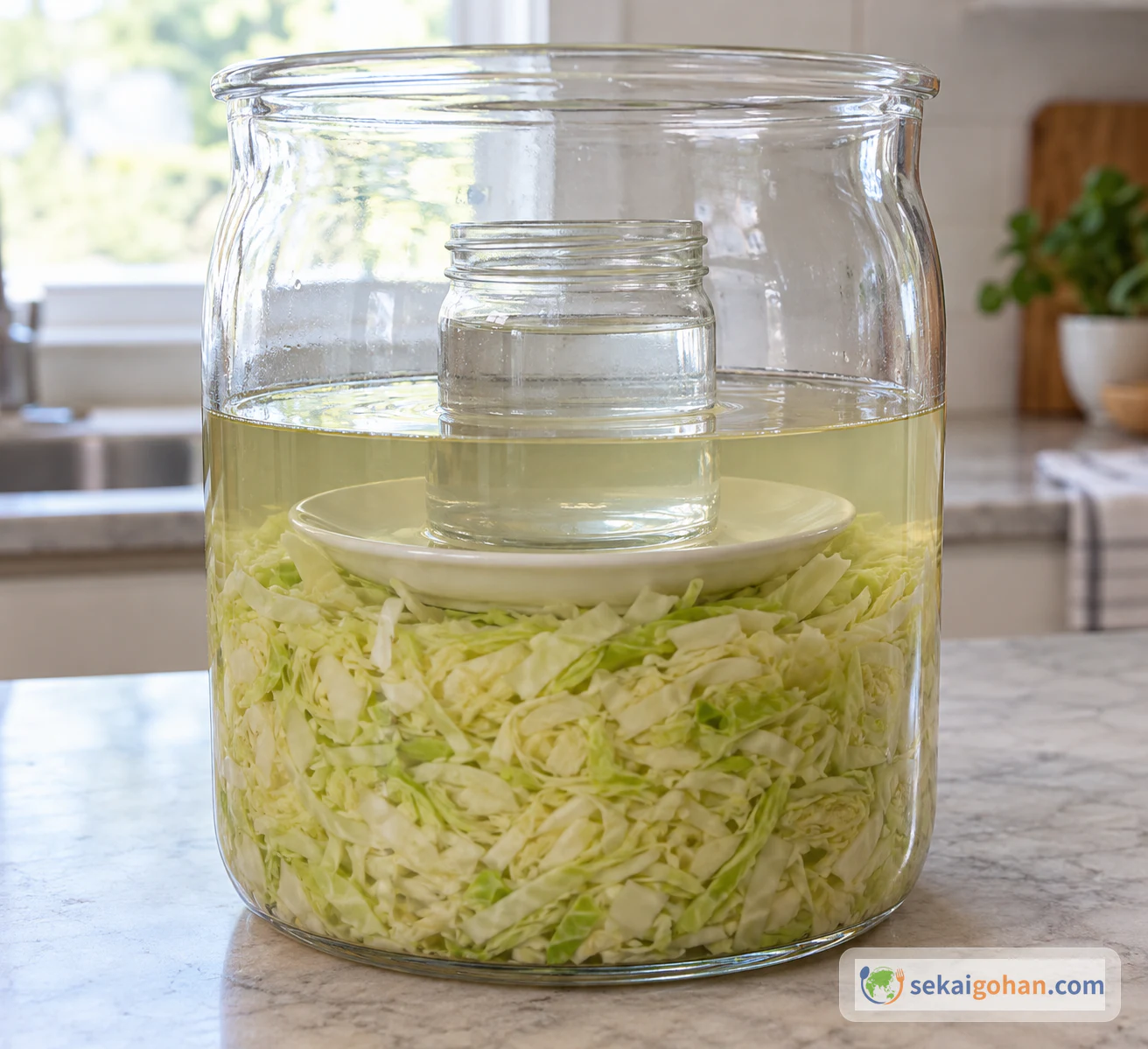
- Food-grade fermentation crock or container in glass, ceramic or food-grade plastic, with a capacity of at least 1 US gallon (about 3.8 L) per 5 lb of vegetables. The capacity is not meant to be filled to the brim. Choose a shape that leaves 4–5 inches (about 10–13 cm) between the top of the cabbage and the rim, lets the brine stand 1–2 inches (about 2.5–5 cm) above the cabbage and holds the plate and weight. Don't use metal that reacts with acid, or a chipped or cracked container.
- A clean plate that fits inside the container and rests on the cabbage
- A weight, such as a clean, sealed glass jar filled with water
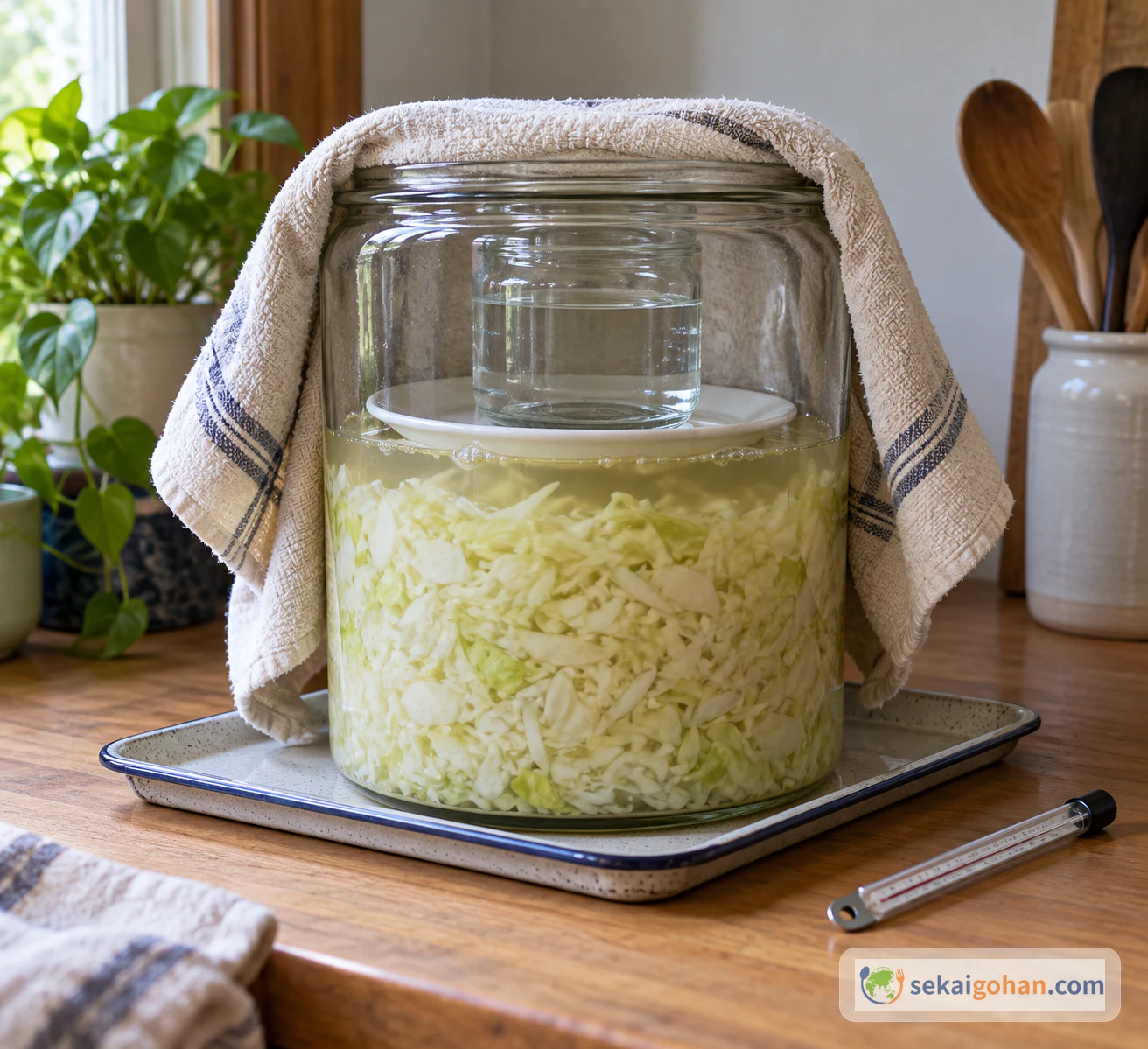
- A clean, heavy towel to cover the container
- A tray to set the container on
- Thermometer
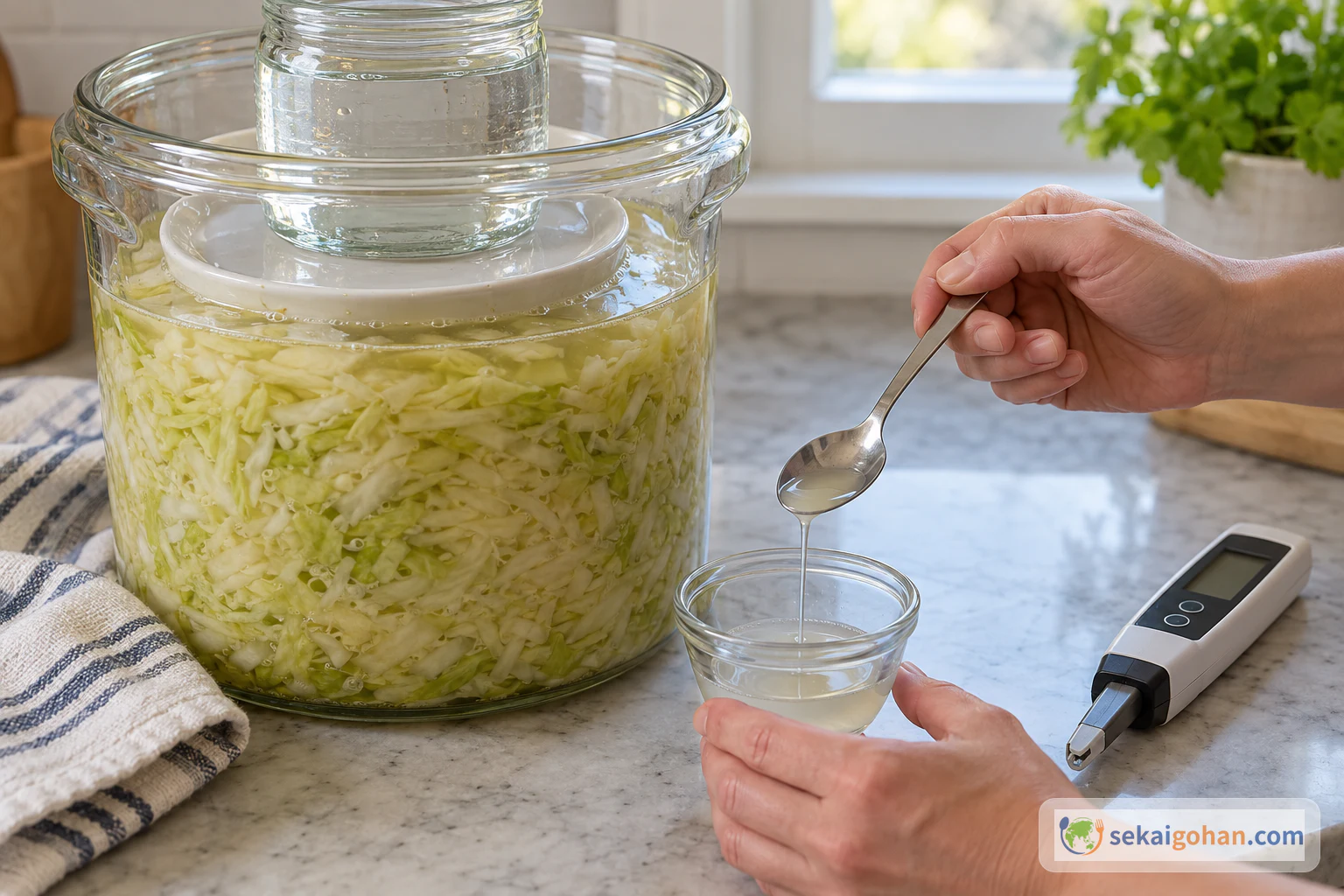
- A pH meter or other pH testing tool suitable for fermented foods, used according to the manufacturer's instructions for calibration, sampling and temperature
- A clean spoon and a separate small cup for taking pH samples
Wash the container, plate and weight in hot soapy water and rinse them well in very hot water. Check that glass items can take the heat and follow the manufacturer's cleaning instructions.
Method: From Shredding to the Refrigerator
Fermentation time depends on temperature. Measure the temperature where the crock actually sits, and judge completion by the pH and bubbling indicators below. Don't go by the number of days or by tasting.
When Things Go Off Course: Brine, Temperature and Warning Signs
You can't reliably tell safe from unsafe surface growth at home by color or appearance. Following this recipe, a good pH reading and no visible problems are still not a guarantee of safety. If anything looks or smells wrong, discard the batch without tasting it.
| Situation | What to do |
|---|---|
| The juice doesn't cover the cabbage | Press the cabbage down firmly again first. If it is still not covered, add only as much boiled and cooled top-up brine (1½ US tbsp salt to 1 US quart water) as needed. Don't add loose salt by guesswork |
| The weight has tipped or cabbage is poking above the brine | Reset the plate and weight so all the cabbage is 1–2 inches below the brine |
| The room is cooler than planned | The NCHFP notes fermentation may not happen below 60°F, and the times it gives depend on temperature. Don't assume the 3–4 week guideline applies |
| The room is warmer than planned | Above 75°F the NCHFP says sauerkraut may soften. Above 78°F the University of Minnesota Extension notes a risk of over-fermentation and spoilage. Move the crock somewhere cooler and out of direct sun |
| The bubbles have stopped but the pH is above 4.60 | Measure again every 1–2 days, taking each sample into a separate cup |
| You have no way to measure pH | Don't use days or taste instead of a pH reading to declare the batch complete |
| Mold, sliminess or a foul smell | Discard without tasting. Don't remove only the surface and eat the rest |
Bubbles and a sour smell alone don't show that the batch is finished or safe. Clean hands, a clean spoon and clean containers at every check help keep the batch in good order.
Ways to Eat It and Variations
Make every change after fermentation and outside the crock. Don't add vinegar, sugar, onion or spices to the fermenting cabbage. Vinegar and sugar turn it into a different kind of pickle.
Finished sauerkraut has two broad uses. You can serve it raw for its acidity and crunch, or add it to cooked dishes. Neither one is the single way it is eaten everywhere.
- Raw on the side. Serve a small portion straight from the refrigerator as a sharp, crisp accompaniment.
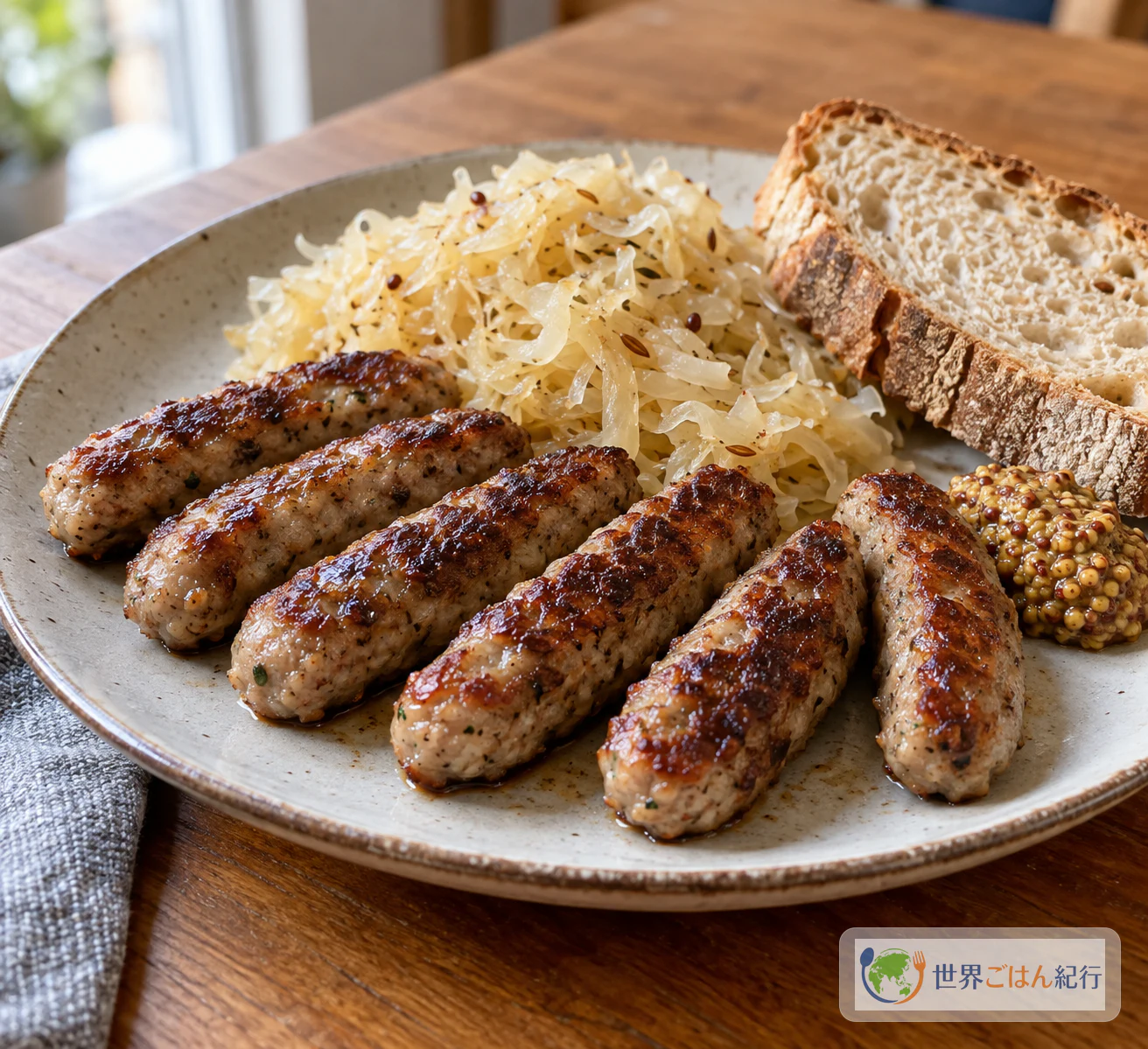
- Warmed alongside meat or sausages. Warm a portion in a separate pan and serve it next to a meat dish. This changes how you eat the sauerkraut, not the fermentation.
- Cooked with onion. Cook onion in a separate pan and add sauerkraut. Don't put onion in the fermenting crock.
- In a sandwich. Drain a little sauerkraut and use it as a sour layer.
- Caraway, juniper or bay as a separate serving variation. NDR's home recipe names caraway (Kümmel), juniper berries (Wacholderbeeren) and bay leaves (Lorbeer) as optional spices but gives no amounts. They aren't part of this recipe, and there's no sourced quantity to suggest.
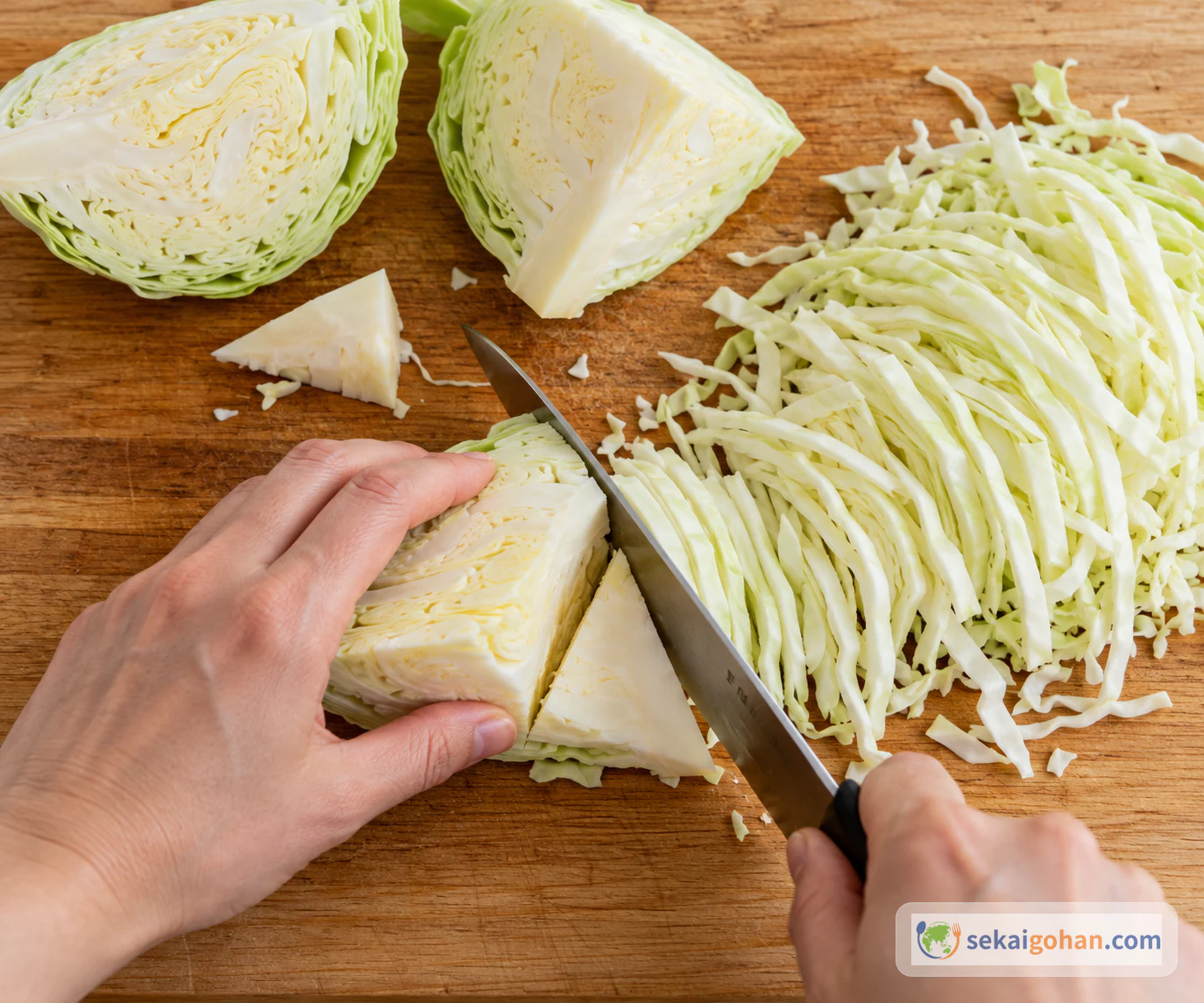
Changing the shred width from about 1/16 inch (about 1.5 mm) changes how the cabbage takes the salt and how it feels to eat. The same timing doesn't follow. Other vegetables, including red cabbage and vegetable mixes, are not covered here. Don't apply this ratio to them.
The Krauthobel and the Uncertain History of Sauerkraut
Sauerkraut is strongly tied to German food and the German language, but it is best understood as a preserving method shared across German-speaking and neighboring regions. It is not a single national recipe. You can read more about the wider table on our Germany country page.
The tools tell part of the story. The LVR open-air museum in Lindlar holds a wooden Krauthobel, a cabbage plane made between 1930 and 1959 and used to shred white cabbage. The museum's description outlines the traditional process. The shredded cabbage was layered with salt, pressed or tamped down, and covered with cloth and a weight. After lactic fermentation it was kept under its brine. Those steps line up with this recipe: shred, salt, press, cover and keep it submerged. A knife and a bowl do the same job for a home-sized batch.
Where sauerkraut began is uncertain. Austria's Federal Ministry of Agriculture states that its exact origin is unknown. It presents the idea that fermented cabbage was first made in China as a possibility, not as established fact. The same ministry notes a reference to sauerkraut in the Austrian poem Meier Helmbrecht from around 1270. It also describes how sauerkraut served as a food that kept and traveled well, useful for feeding large groups and armies. That is the context here: inexpensive cabbage turned into a food that could last.
Frequently Asked Questions
How many grams is 3 tablespoons of salt?
This recipe doesn't give a gram weight. The source measures the salt by volume, 3 US tbsp (about 44.4 mL). The weight of a spoonful changes with the type and grain size of the salt. Use canning or pickling salt and measure it with a spoon.
Do I weigh the cabbage before or after trimming?
After. Remove the outer leaves and core, shred the cabbage, then weigh out 5 lb (about 2.27 kg). The NCHFP's working unit and Penn State Extension's standard method both use shredded cabbage at this weight.
The juice doesn't cover the cabbage. What should I do?
Press the cabbage down firmly first. If it is still not covered, boil and cool brine made from 1½ US tbsp of salt per 1 US quart of water, and add only as much as you need. Then reset the plate and weight so the cabbage sits 1–2 inches below the surface.
How many days until it is ready?
It depends on temperature. The NCHFP gives about 3–4 weeks at 70–75°F and 5–6 weeks at 60–65°F. The University of Minnesota Extension treats fermentation as complete when the pH is 4.60 or below and bubbling has stopped. Use those indicators together, and don't decide by the number of days alone.
Why not close the crock with a tight lid?
This method uses a plate and a weight to keep the cabbage under the brine, with a clean, heavy towel on top instead of an airtight lid. Gas forms during fermentation and needs a way out.
Can I use Bayrisch Kraut instead?
Bayrisch Kraut can fill a similar place on the plate, but it is fresh cabbage cooked and eaten the same day. It isn't fermented and doesn't keep the way sauerkraut does.
Sources
- National Center for Home Food Preservation, University of Georgia, "Sauerkraut." The 5 lb working unit with 3 tbsp of canning or pickling salt, the shred thickness, the salting and packing steps, the top-up brine ratio, temperature and time guidelines, and refrigeration after fermentation. https://nchfp.uga.edu/how/ferment/recipes/sauerkraut/
- National Center for Home Food Preservation, University of Georgia, "Suitable Containers, Covers, and Weights for Fermenting Food." Container capacity per 5 lb of vegetables, keeping vegetables 1–2 inches under the brine with a plate, weight and heavy towel, and cleaning containers. https://nchfp.uga.edu/how/ferment/general-information-on-fermenting/suitable-containers-covers-and-weights-for-fermenting-food
- Penn State Extension, "Fermentation—Sauerkraut and Pickles," in Preserving Fall & Winter Vegetables (PDF distributed by UC ANR). The standard crock method with 5 lb of shredded cabbage and 3 tbsp of canning or pickling salt, the coin thickness of 1/16 inch (1.5 mm), and not tasting batches that show mold, sliminess or a bad odor. https://ucanr.edu/sites/default/files/2023-09/388163.pdf
- University of Minnesota Extension, "Preserving food at home: Fermentation." Keeping vegetables under the brine, food-grade glass, ceramic and plastic containers, the ideal temperature of 68–72°F (20–22°C), the risk above 78°F, pH 4.60 or below with bubbling stopped as completion indicators, and refrigeration stopping fermentation. https://extension.umn.edu/es/node/172346
- Norddeutscher Rundfunk (NDR), recipe by Tarik Rose, "Selbst gemachtes Sauerkraut." A German home recipe for comparison: 1 kg white cabbage with 20 g salt, and caraway, juniper and bay as optional spices without amounts. https://www.ndr.de/ratgeber/kochen/rezepte/Selbst-gemachtes-Sauerkraut,sauerkraut164.html
- LVR-Freilichtmuseum Lindlar / Portal Alltagskulturen, "Objekt Krauthobel." A cabbage plane made 1930–1959 for shredding white cabbage, and the traditional process of layering with salt, tamping, covering with cloth and a weight, and keeping the cabbage under brine. https://alltagskulturen.lvr.de/de/objekte/Krauthobel/DE-MUS-377513/lido/dc00005509
- Austrian Federal Ministry of Agriculture, Forestry, Climate and Environmental Protection, Regions and Water Management (BMLUK), "Sauerkraut." The unknown origin, the possibility of early production in China, the reference in Meier Helmbrecht around 1270, and sauerkraut's use as a preserved food for large groups and armies. https://www.bmluk.gv.at/themen/lebensmittel/trad-lebensmittel/speisen/sauerkraut.html