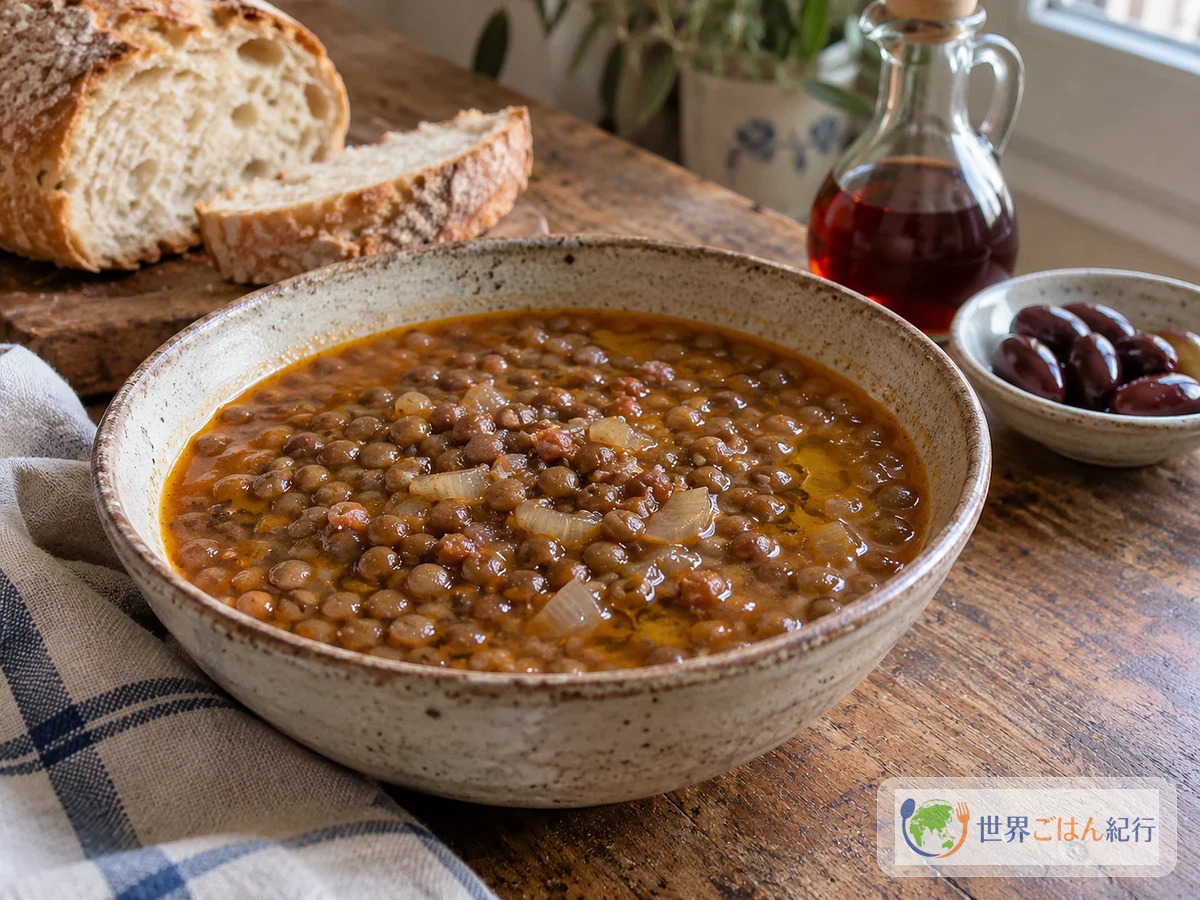
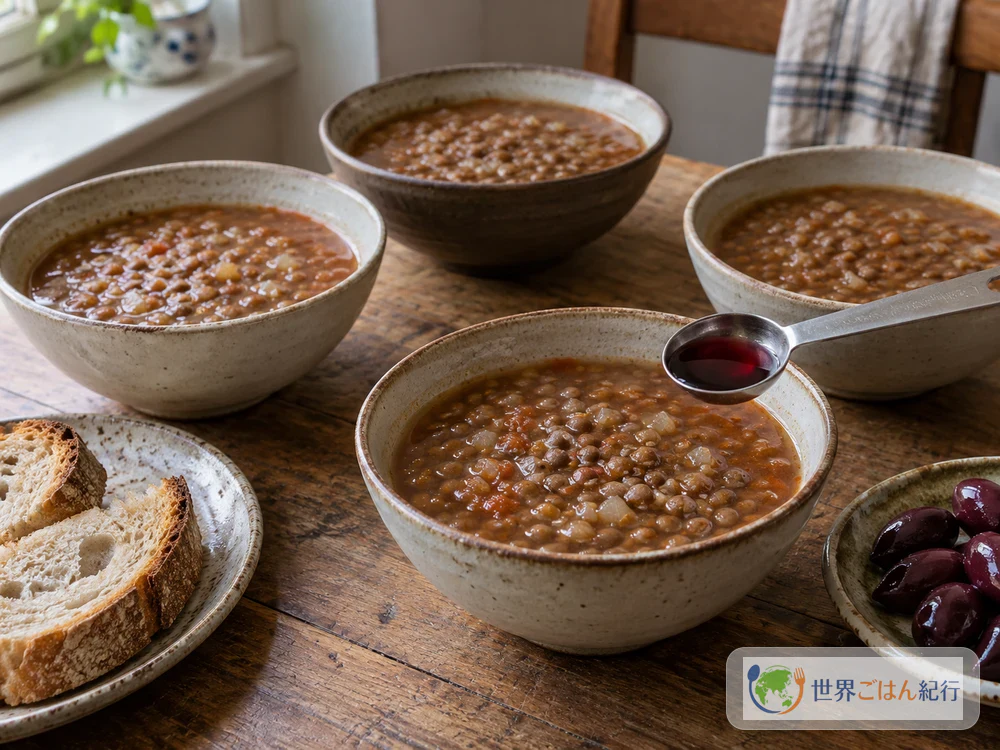
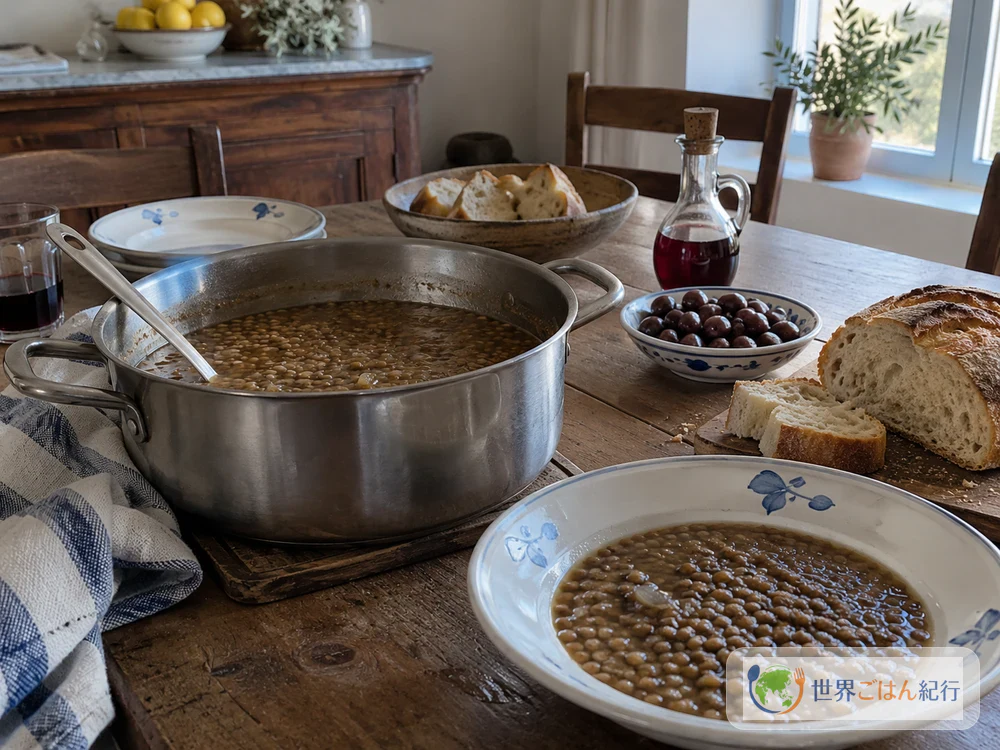
Picture a Greek family table: a steaming bowl of small brown lentils, sliced bread, olives, and a little bottle of vinegar. Fakes is a Greek home-style soup of lentils simmered with onion, garlic, bay leaf, and olive oil, and many cooks add a small splash of red wine vinegar just before eating. The flavor is not fully set in the pot. The vinegar added at the table is the finishing touch.
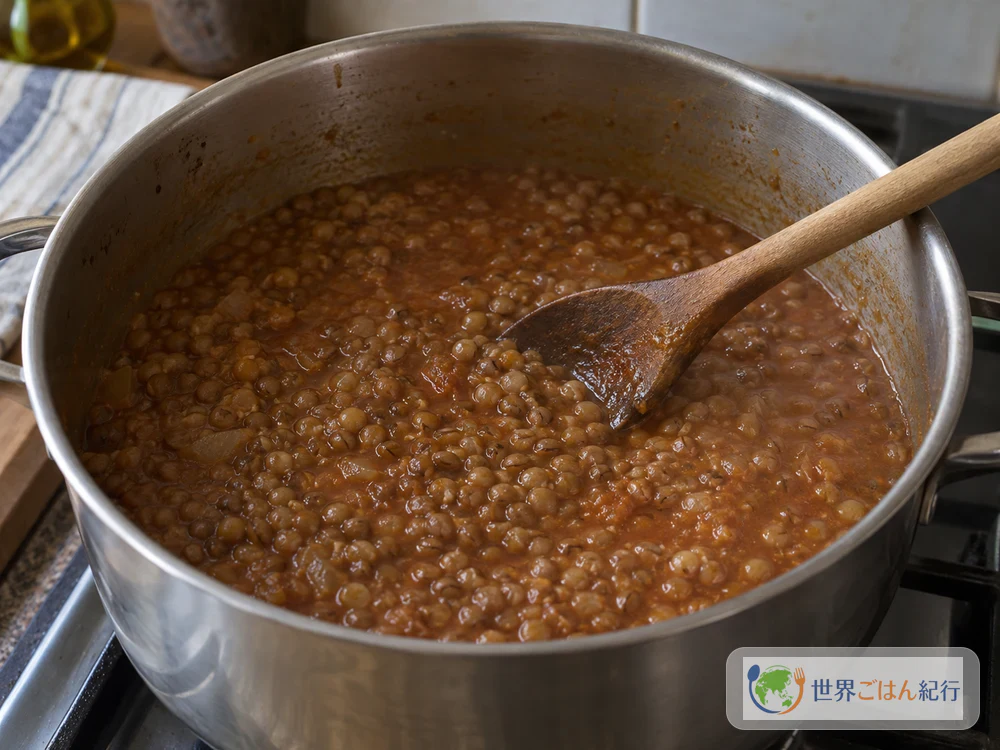
It looks plain, but when the spoon goes in, the lentils keep their shape, they are tender when you bite into them, and the broth has a light body. This version uses no meat and no stock cube; it is simmered in water, the way many home cooks do it. That is why keeping the lentils whole and the round mouthfeel the olive oil carries are the whole point. About an hour is the usual cooking time, but it can stretch depending on the type and age of the lentils, so check whether the firm core has disappeared rather than watching the clock.
A Home Kitchen's Flavor in One Bowl of Lentils
In Greek it is written Φακές, and in English Fakes Soupa. Φακές (fakes) is also the Greek word for lentils. Made with brown or green lentils, it is a humble one-pot family dish, quite unlike the elaborate oven dishes served for feasts. It is often presented as a warming winter dish, but it is not only a winter food.
Billie Bitzas of Mia Kouppa, a site about Greek cooking, writes that her family ate fakes almost every Friday when she was growing up. That is one family's memory, not a habit of every Greek household. The same site presents the meatless version as a soup suited to Lent. Religious dietary rules vary by day and by practice, though, so it cannot be said that oil is always permitted. For serving, bread, olives, and feta cheese are common companions. If you avoid dairy, simply leave the feta out.
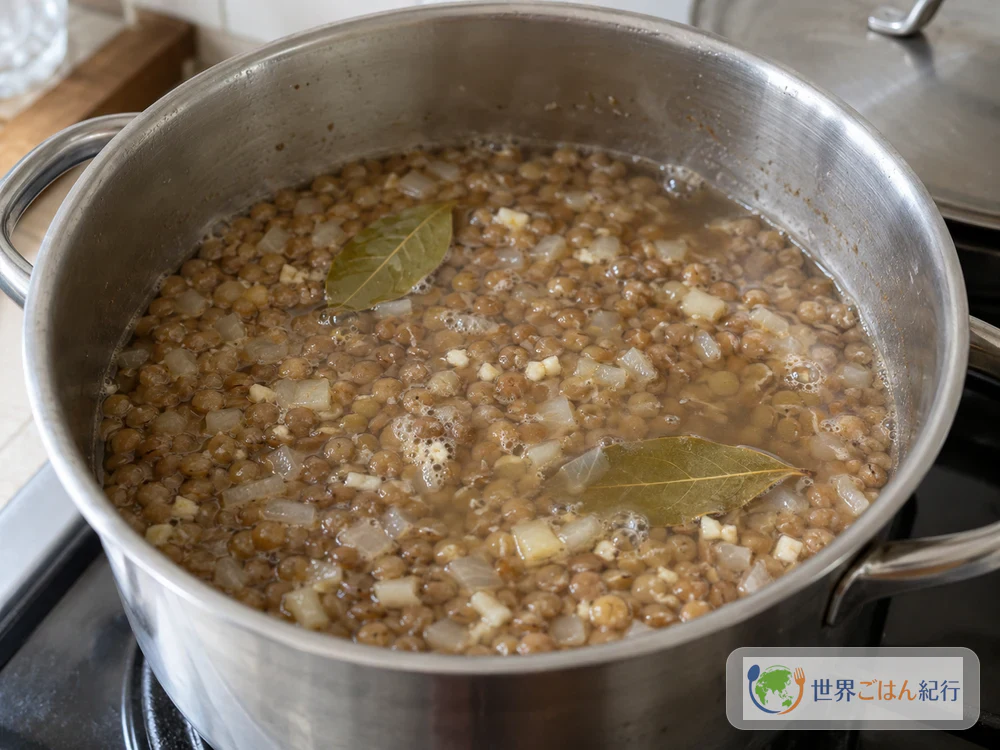
What goes in the pot differs from home to home. Some keep it spare, simmering only onion and garlic in water; others sauté carrot and celery in oil and add tomato sauce for a red soup. Some recipes leave the tomato paste optional, and no one treats a version without tomato as incomplete. The amount of tomato is up to the household. This recipe simmers the onion and garlic without sautéing and adds a little tomato paste once the lentils are tender, a home-cook-friendly balance.
The cook Fotini, from the island of Lefkada, describes a tradition of pairing the lentils grown in the village of Eglouvi on the island with a rose vinegar made locally. That is a story about one place's lentils, not a claim that vinegar means rose vinegar everywhere in Greece. At home, ordinary brown lentils and red wine vinegar make a perfectly good soup. There is no need to hunt for an island brand.
Ingredients (serves 4)
This is a balance adjusted for home cooking, built around 300 g brown lentils, 1,200 ml water, and 60 ml olive oil. Add water as the soup cooks down. Your first choice should be whole brown lentils with their skins on. Green lentils work too, but they may take longer to cook.
Soup
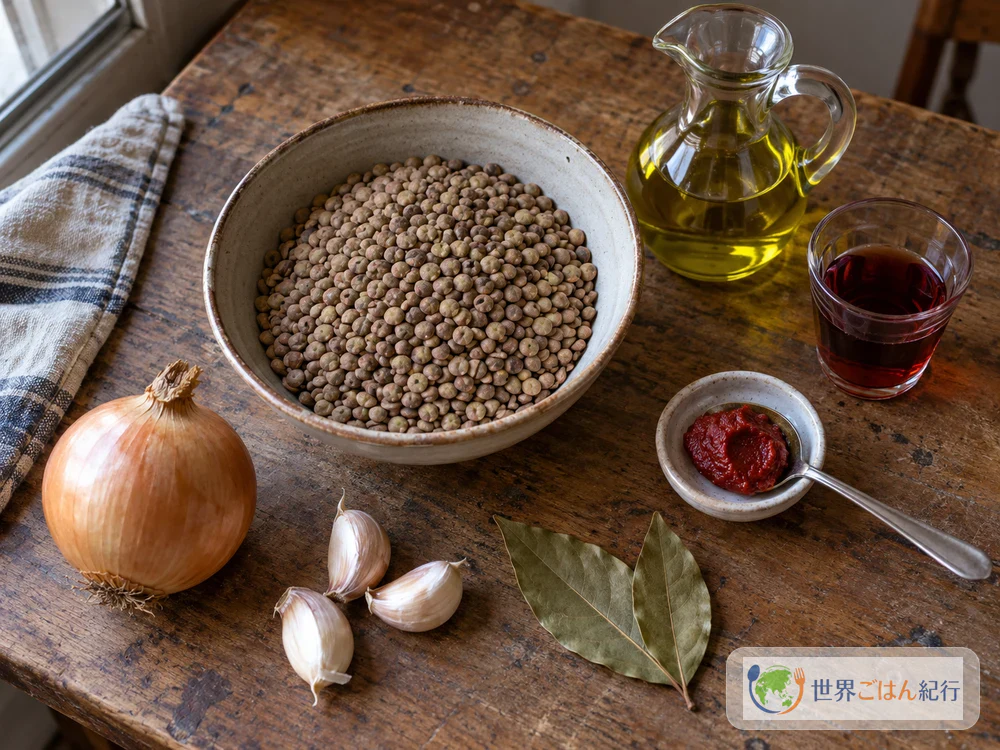
When shopping at an import grocer or online, look for labels such as "brown lentils." Do not put the red wine vinegar in the broth from the start; add it bowl by bowl. Lemon juice in its place brings a citrus aroma to the sourness, which is the difference. And the 60 ml of olive oil is not oil for frying the onion; it is an ingredient that builds the flavor and mouthfeel of the broth. The oil is part of the soup, so leaving it all out changes the result.
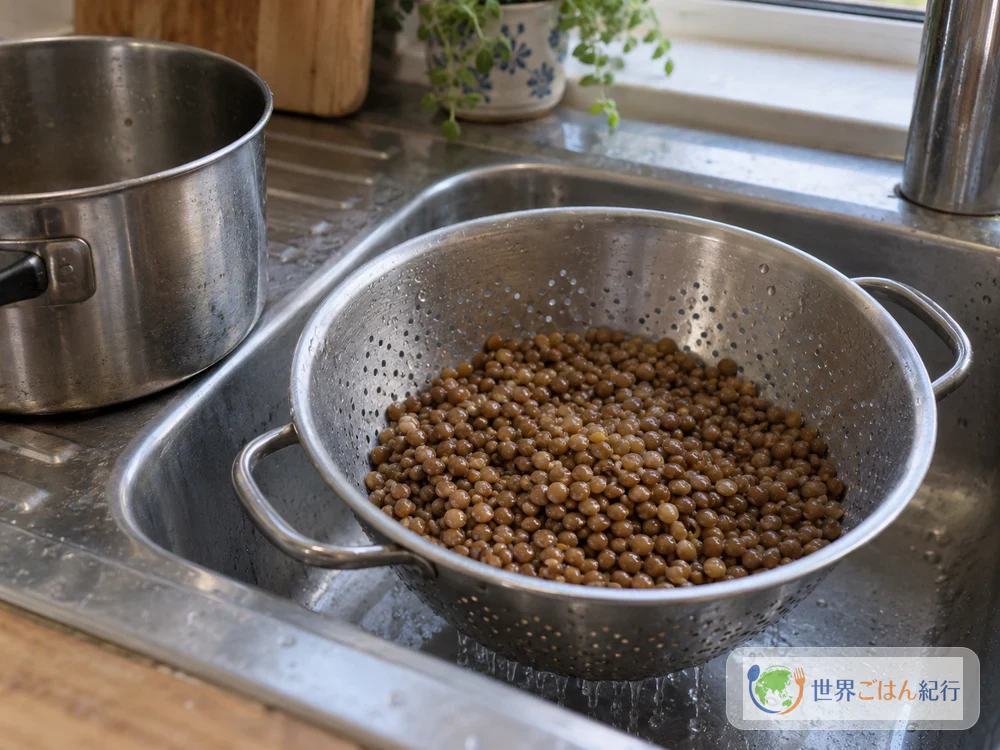
Lentils can generally be cooked without soaking. Some households parboil them or soak them for a few hours, but it cannot be said that this makes them easier to digest. Here there is no soaking: rinse the lentils and parboil them for just 2 minutes. If the package gives cooking directions, check those as well. Adjust the simmering time to the condition of the lentils.
Instructions
You need a pot of 3 L or larger, a colander, and a wooden spoon. Prep takes 10 minutes and cooking about 50, roughly an hour in all. The age and size of brown lentils change the cooking time, so go by how tender the lentils are rather than the clock.
If you add acidic ingredients such as tomato or vinegar while the lentils are still hard, they can take longer to soften. Wait for tomato until Step 3 and vinegar until Step 4. Some households add carrot and celery, but that is a different recipe. Do not mix it into this plain version.
After adding the oil, stir gently from the bottom of the pot. Do not crush all the lentils into a smooth puree. If the bottom starts to catch, lower the heat and add 50–100 ml hot water to bring back the consistency. Keeping the liquid level up before it starts to scorch matters more than stirring constantly.
Hard Lentils, Too-Thick Soup: What You Can Fix in the Pot
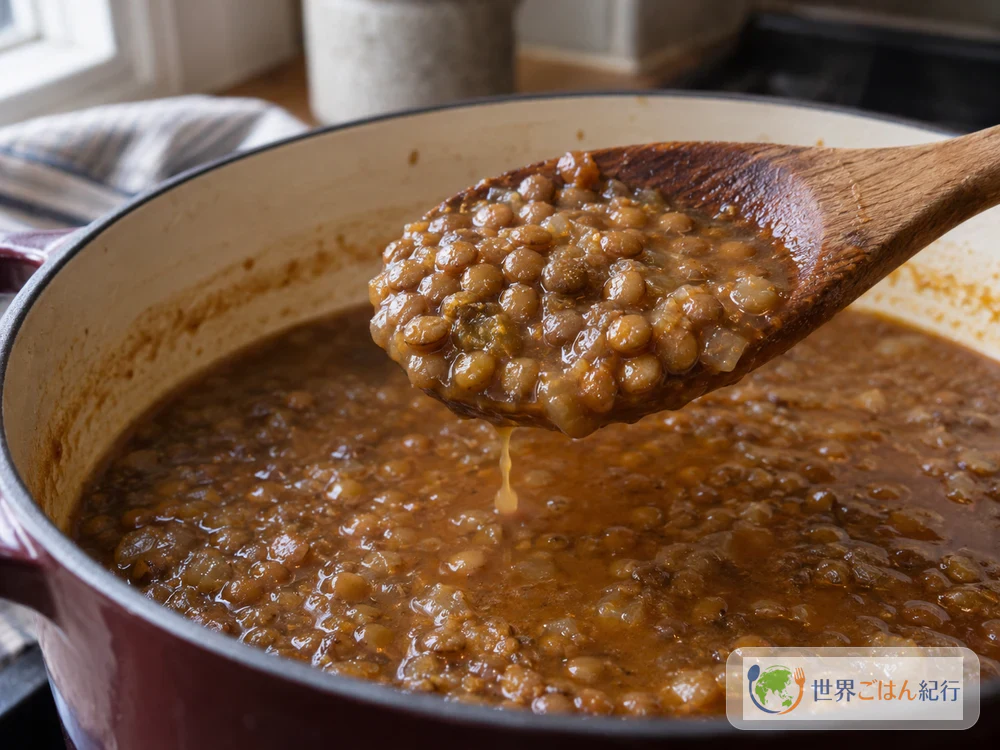
Even when you cook for the stated time, lentils can still be hard. Older dried lentils sometimes take longer to soften, and green lentils do not always finish in the same time as brown. In that case, leave out the vinegar, add hot water to cover the lentils, put the lid on, and cook over low heat in 10-minute rounds. If they are hard, add hot water and extend the time, tasting repeatedly until the core is gone.
| Problem | How to tell | Fix |
|---|---|---|
| Lentils still hard | The center is firm when you bite | Hold off on vinegar, add hot water, and cook over low heat in 10-minute rounds |
| Too thick | The lentils pile up when pushed with a spoon | Add 50–100 ml hot water at a time and stir gently |
| Watery | Lentils and clear liquid are separate | Check that the lentils are tender, then simmer uncovered over medium-low heat for 3–5 minutes at a time |
| Too sour | The sourness comes before the lentil flavor | Use less vinegar in the next bowl. If you have unseasoned soup left, mix it in to dilute |
| Scorched bottom | A burnt smell | Move only the unscorched top portion to another pot. Do not scrape the burnt bottom |
If you turn off the heat and let it sit for 15–20 minutes, the soup thickens more than right after cooking. It gets thicker as it cools, so when making ahead or reheating, add hot water to bring it back to the amount of liquid you like. Adjust the salt in small amounts after adding water. Adding salt to a soup that has cooked down tends to make it too salty.
With Bread and Olives, It Is Lunch
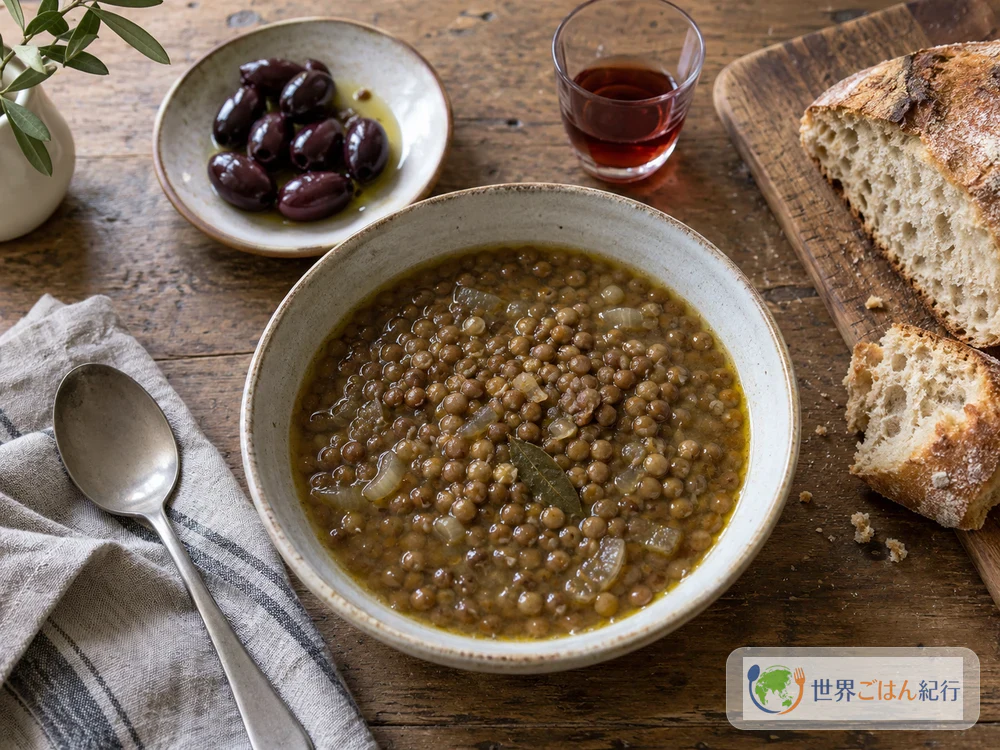
Tear the bread, dip it in the broth, and use the bread to eat up the broth too. Put the olives on a separate plate. The vinegar is on the side not to make the whole pot sour but so that each person can finish the soup to their own taste. Feta can go on a separate plate if you like, or be left out if you avoid dairy. The amounts in the ingredient list cover only the bread and olives; the feta is outside the recipe amounts.
For four people, the idea is that bread as the staple makes a full meal. You can also divide it into smaller bowls as a side dish, with no need to change the pot's balance. If you want a different bean stew, the white-bean fasolada is a good next dish. If you want raw vegetables alongside, try it with Greek salad (in Japanese). And adjusting the acidity of each bowl yourself as you eat is the pleasure of this table.
The nutrition information is a rough per-serving estimate for the soup only, excluding bread, olives, and any extra feta. Based on a reference balance of 300 g brown lentils, 120 g onion, 3–4 garlic cloves, and 60 ml oil divided among 4 bowls, rounded for this home-style recipe with a little tomato paste, the reference values are 420 kcal, 20 g protein, 16 g fat, and 50 g carbohydrate. They vary with the products used for the lentils and oil and with how it is portioned, and are not measured values.
Storage and Common Questions
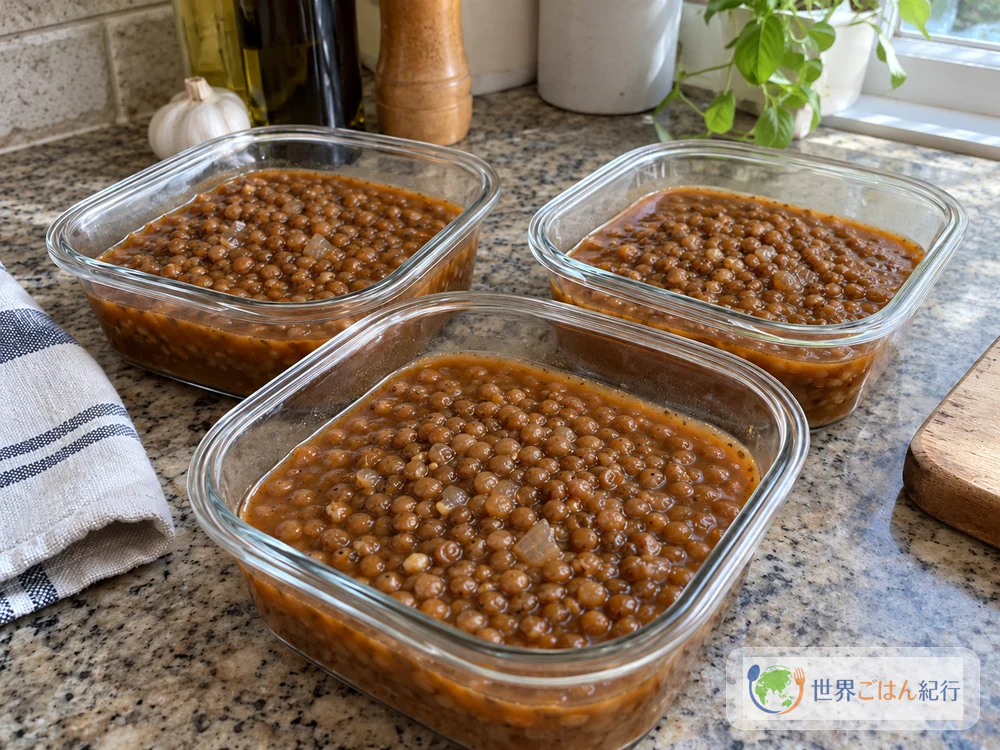
Can I eat it the next day?
Do not leave it in the pot. Divide it into small containers and cool it quickly. Cooling quickly in small portions is the key, and it should go into the refrigerator within 1–2 hours of cooking. Keep the refrigerator at 0–5°C and finish the soup within 48 hours. If you do not think you can finish it, freeze it early. Soup left out overnight at room temperature should not be treated as stored food.
Having no meat in it does not mean it can sit at room temperature. Before refrigerating, avoid cooling a full pot slowly for a long time. When freezing, seal the soup, label it with the date, and thaw it in the refrigerator. Use it up within 24 hours after it has fully thawed.
Can I make it with red lentils or canned lentils?
Red lentils are not recommended if you are aiming for the same grain texture as skin-on brown or green lentils. You get a broken-down soup that is still edible, but the finished dish is something else. Canned lentils are already cooked, so they cannot be swapped by weight for 300 g of dried ones, and the parboil and 30–40 minute simmer here do not carry over. Cooked lentils need a recipe written for them. Think of dried lentils and cooked lentils as different ingredients.
Can I eat it if I don't like vinegar?
The vinegar is served on the side, so you can make a bowl without it. The 10 ml red wine vinegar is a starting point for four bowls, not an amount to put in the pot. Lemon juice can replace it, starting from the same amount, but the aroma changes. The only heat is 0.2 g black pepper, and no chili is used. If you leave out the pepper, the steps are the same.
What should I watch for with food allergies?
Check the packaging labels and each person's allergens. The bread served alongside contains wheat, and added feta contains milk. A lentil soup cannot be called safe for everyone. Processed items such as tomato paste and vinegar should also have their ingredients checked. We cannot give individual advice on whether someone with an allergy may eat it.
Sources
- Eli K. Giannopoulos — Greek Lentil Soup recipe (Fakes Soupa) — Brown lentils, the version with tomato paste, vinegar and sides. Accessed and checked 8 October 2026.
- Billie Bitzas — Fakes (Greek Lentil soup), Mia Kouppa — A family Friday dish, the version with vegetables, the role of soaking, and why lentils stay hard. Accessed and checked 8 October 2026.
- Fotini — Greek Lentil Soup Recipe, Real Greek Recipes — A plain lentil soup, the order in which to add the oil, and the local story of Lefkada lentils and vinegar. Accessed and checked 8 October 2026.
- Food Standards Agency — How to chill, freeze and defrost food safely — Cooling in small portions, refrigerator temperature, keeping within 48 hours, and thawing in the refrigerator. Accessed and checked 8 October 2026.