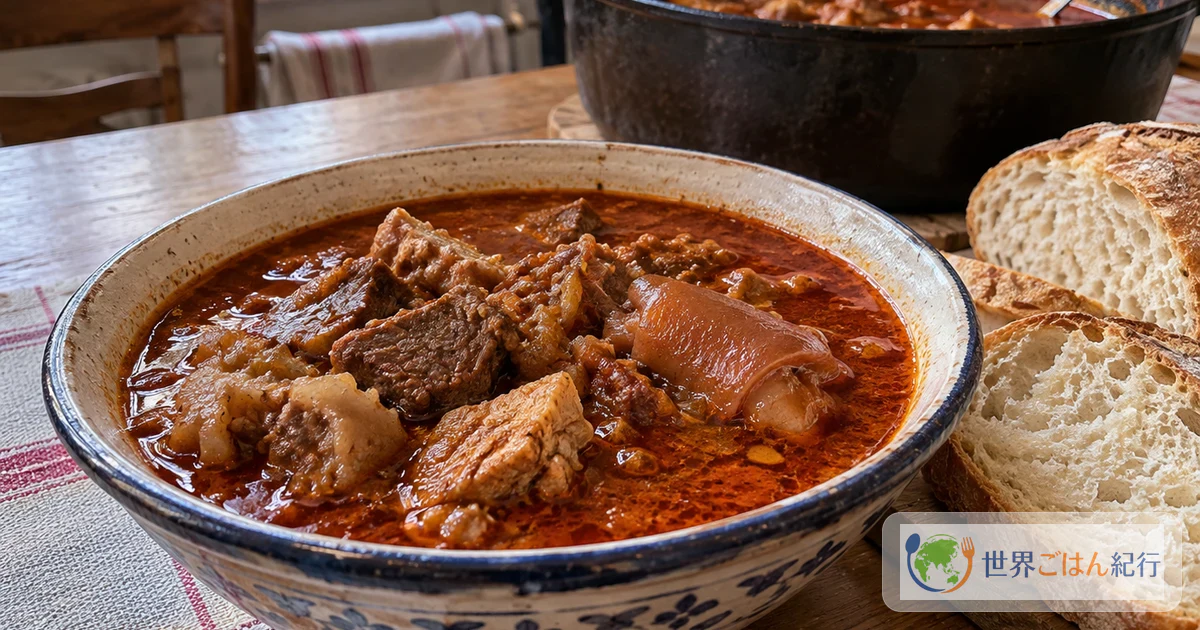
"Grandmother's bean soup" from the Aegean kitchen
Ask someone raised in a Greek home "what is the taste of your mother's cooking?" and a surprising number name fasolada. It isn't on the menus of fancy restaurants. It isn't showy to look at. But the smell of olive oil and beans simmering from the kitchen on a winter Sunday, and a table set with feta, bread and a bowl of soup: that is the original landscape of Greek food memory.
Fasolada is Greece's national dish: dried white beans braised slowly in olive oil with tomato, carrot, celery and onion. Greece has several dishes called "to ethniko fagito" (the national food), but none is loved by the whole country, made in every region and stamped on every generation's memory like fasolada.
The name Fasolada (Φασολάδα) derives from the Greek "fasolia" (white beans). Ancient Greece also had bean dishes, and a bean stew is said to have been served at Pyanopsia, a festival of Apollo. The present form (with tomato) was established after the 16th century, when tomatoes and white beans arrived from the New World. During the fasting periods (nistia) of the Greek Orthodox Church, it is an essential main source of protein for believers who give up animal foods. It belongs to the group of olive-oil braises called "ladera."
In Japanese, searching for "fasolada" yields little more than a few lines of notes attached to Greek travelogues. In English, Greek food bloggers publish detailed methods and cultural background as "grandmother's recipes," but there are almost no systematic introductions in Japanese. This article faithfully reproduces the way fasolada is actually made in Greek homes, and explains its ancient history and the Orthodox fasting culture based on English-language primary sources. Read it together with Greek moussaka (in Japanese) and you can see the whole picture of the Greek table.
Ingredients (serves 4)
In Greece the large white beans "gigantes" from Kastoria and Florina are considered the best quality, but ordinary large white beans from a regular grocery make a perfectly good fasolada. Canned cannellini beans are available at import shops and many supermarkets. If you use canned beans you can skip the soaking and pre-boiling and shorten the cooking time a great deal. Dried beans have the better flavor, but either way the essence of fasolada is not lost.
Cooking tips
The taste of fasolada depends heavily on the olive oil. Extra virgin olive oil from the Kalamata region or Crete in Greece is best. The balance of pungency and bitterness suits the tomato and beans of fasolada best. Italian or Spanish oil also makes a good one, but try Greek if you can. Using the same oil for cooking and for finishing is the Greek way.
The enemy of bean dishes is salt too early. Add salt in the last 15–20 minutes of the simmer so the beans soften all the way through. The same principle applies to the lentils in Lebanese mujaddara (in Japanese).
In Greece it is said that "fasolada is for the next day." Left overnight in the refrigerator, the beans absorb the soup, the savor of the vegetables spreads through everything, and the flavor deepens a great deal. Making extra to secure the next day's portion is the Greek way. Drizzling extra olive oil on when reheating restores a flavor no less than freshly made.
Greece also has a "lemon fasolada" without tomato. Instead of canned tomatoes, add 3 tbsp lemon juice at the end of the simmer and scatter dill over to finish. The soup is a yellowish white, with a lighter flavor. In summer it also suits eating chilled.

Variations
Spicy version
During the simmer add 1 dried chili (seeds removed) and sprinkle Aleppo pepper (a coarsely ground Middle Eastern chili) over at the end. It adds a zing like Tunisian chakchouka (in Japanese) and is especially warming on a cold winter day.
Gigantes plaki style
Use large gigantes beans (large white beans can substitute), use less liquid, and bake in a 180°C oven for 1 hour. The tomato sauce reduces richly and the beans take on a browned surface. A classic Greek meze (appetizer), it is a separate dish from fasolada but with the same root. It is superb with wine.
Chickpea version (revithia)
Use 300 g dried chickpeas in place of white beans. In Greece it is a different soup called "revithia soupa," but the method is almost the same. Chickpeas have a nutty flavor and pair especially well with lemon. As with Indian khichdi (in Japanese), the wisdom of combining beans and grains to get complete protein exists across Eurasia.
Pressure-cooker version
Put the soaked beans in a pressure cooker with all the ingredients and cook at high pressure for 25 minutes. After natural release, open the lid and finish with salt and olive oil. It shortens the simmering time greatly.

Background of the dish
Ancient Greek beans and offerings to the gods
The prototype of fasolada goes back to ancient Athens in the 5th century BC. The food of that time differed from modern fasolada: it was a porridge-like dish called "pyanos," made by stewing chickpeas or lentils with grain.
It is said that in ancient Athens there was a custom of offering a bean stew to Apollo at the autumn festival Pyanopsia. The habit of stewing and eating beans itself can be said to have continued from antiquity to the present.
However, the white beans (Phaseolus vulgaris) and tomatoes used in today's fasolada both originate in the New World and reached Europe in the 15th–16th centuries. So ancient pyanos and modern fasolada share the spirit of "cooking beans," but the ingredients have been entirely replaced.
Ladera: the philosophy of olive-oil braising
Fasolada belongs to a group of Greek dishes called "ladera (λαδερά)." Ladera literally means "oily dishes," a general term for the method of braising vegetables (or beans) with olive oil in plenty of water. All ladera dishes are plant-based, and correspond to "nistisimo (fasting food)," which may be eaten during the Greek Orthodox fasting periods (said to total around 180 days a year).
In the Greek Orthodox fasting calendar there are many days through the year when animal foods are given up, such as the 40 days of Lent before Easter, the 15 days before the Dormition of the Virgin and the 40 days before Christmas. The most efficient way to take protein through these long fasting periods is bean dishes, and the religious cycle of eating is deeply tied to how fasolada rose to be a "national dish."
From the table of the poor to national pride
In the first half of the 20th century in Greece, fasolada was regarded as "food of the poor." During the occupation in the Second World War there was a severe famine, and there were times when food itself was hard to get. After the war, there was also a tendency among a middle class that could now eat meat and fish to avoid fasolada as "food of the past."
But from the 1990s, as the health effects of the Mediterranean diet drew worldwide attention, fasolada was reappraised as "a food heritage Greece should be proud to show the world." In 2010 the Mediterranean diet was inscribed on UNESCO's Intangible Cultural Heritage list (Greece was one of the nominating countries), and attention has turned again to home cooking centered on beans and olive oil.
Dried white beans contain about 22 g protein and about 20 g fiber per 100 g (according to the Standard Tables of Food Composition in Japan). In a large study of Greek adults (Trichopoulou et al., 2003), people whose diets were closer to the traditional Mediterranean pattern, rich in legumes, vegetables and olive oil, tended to have lower mortality.

Also worth reading
Fasolada is a doorway into Greek cooking. Please try other traditional dishes around the Mediterranean too.
- Moussaka (Greece) (in Japanese): Baked eggplant and ground meat
- Mujaddara (Lebanon) (in Japanese): A Mediterranean dish of lentils and bulgur
- Chakchouka (Tunisia) (in Japanese): A North African dish of tomato and egg
- Koshari (Egypt) (in Japanese): Egypt's national dish of beans, rice and pasta
Try humble European home cooking too.
- Goulash (Hungary): The classic paprika stew
- Caldo verde (Portugal) (in Japanese): Kale and potato soup
- Svíčková (Czechia) (in Japanese): Beef in cream sauce
Dishes to make alongside
- How to make moussaka (in Japanese) - Continue with the table of the same country.
- How to make carbonnade - Reuse ingredients and aromas from the same region.
- How to make waterzooi (in Japanese) - Reuse ingredients and aromas from the same region.
FAQ
What beans can I use in place of white beans?
Large white beans give the closest texture. Other white beans also make a good one. Using chickpeas makes the different Greek dish "revithia," which is also superb. Lentils cook too quickly to give fasolada its slow-simmered character, so we don't recommend them.
Isn't 100 ml of olive oil too much?
In traditional Greek fasolada, some homes use even more olive oil. Extra virgin olive oil is rich in omega-9 fatty acid (oleic acid) and polyphenols and is a core ingredient of the Mediterranean diet's health effects. You can reduce it, but below 70 ml the creaminess and flavor of the soup are greatly reduced.
Can I make it in a pressure cooker or electric pressure cooker?
Yes. Put in the soaked beans, vegetables, canned tomatoes, 1 L water and 50 ml olive oil, cook at high pressure for 25 minutes and release naturally. After opening the lid, finish with salt and the remaining olive oil. For an electric pressure cooker, the "beans" mode at about 50 minutes is a guide.
Is it good when I'm not fasting?
Of course. Fasolada developed as a fasting food, but it is satisfying as an ordinary meal. If it feels light, eat it together with Greek moussaka (in Japanese) or grilled fish for a more substantial meal. At Greek tavernas, the most common lunch is a set of fasolada, feta, horta (boiled greens) and bread.
Nutrition (per serving, 4 servings)
Fasolada is especially rich in plant protein and fiber. As with Nepali dal bhat, combining beans and grain (bread) covers the essential amino acids.
| Nutrient | Amount |
|---|---|
| Energy | about 500 kcal |
| Protein | about 19 g |
| Fat | about 23 g |
| Carbohydrate | about 55 g |
| Fiber | about 18 g |
| Sodium | about 1,200 mg |
Sources
- Kremezi, A. (2000). The Foods of the Greek Islands: Cooking and Culture at the Crossroads of the Mediterranean. Boston: Houghton Mifflin.
- Trichopoulou, A. et al. (2003). "Adherence to a Mediterranean diet and survival in a Greek population." New England Journal of Medicine, 348(26), 2599-2608.
- Ministry of Education, Culture, Sports, Science and Technology (Japan), "Standard Tables of Food Composition in Japan, 2020 (Eighth Revised Edition), Supplement 2023" (in Japanese)
The following are recipe sources by Greek food bloggers.
- My Greek Dish. "Traditional Greek bean soup recipe (Fasolada)." My Greek Dish.
- Dimitras Dishes (2024). "Fasolada in 30 minutes." Dimitras Dishes.